Obelisks of Villa Torlonia
In short. The Obelisks of Villa Torlonia are two twin monoliths of pink Baveno granite, a little over 10 meters tall and weighing more than 22 tons each, raised in 1842 inside the park at Via Nomentana 70 in Rome at the wish of Prince Alessandro…
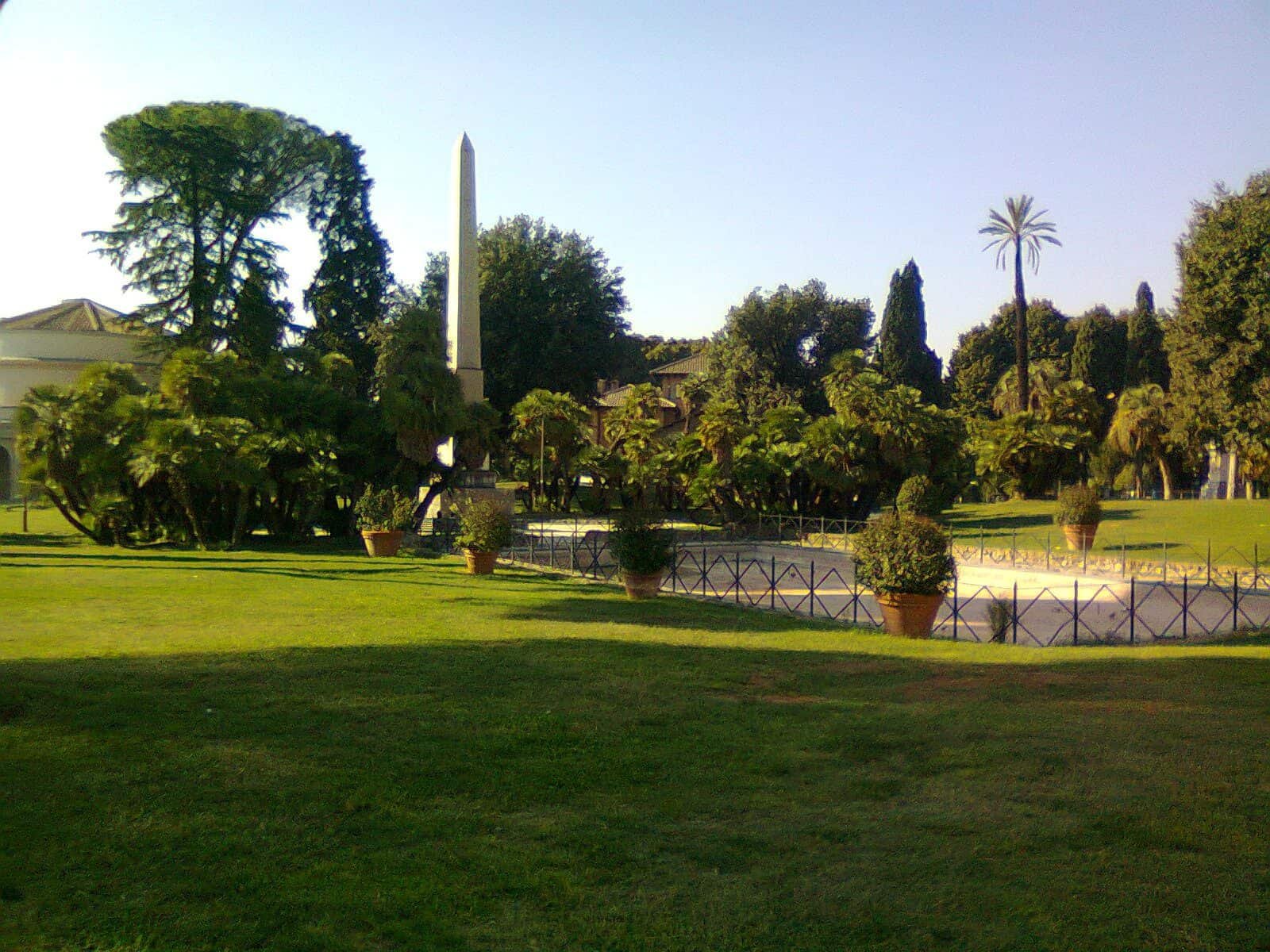
The Obelisks of Villa Torlonia are two twin monoliths of pink Baveno granite, a little over 10 meters tall and weighing more than 22 tons each, raised in 1842 inside the park at Via Nomentana 70 in Rome at the wish of Prince Alessandro Torlonia, who dedicated them to the memory of his parents Giovanni and Anna Maria. They aren't Egyptian antiquities brought to Rome by the Caesars. They are two 19th-century obelisks, cut in a quarry on Lake Maggiore, carved with hieroglyphs composed by an Italian Egyptologist who was a contemporary of Champollion and translated into Latin on the travertine bases so that anyone could read them. The park that hosts them, now city-owned, measures about 132,000 square meters and is open every day with free admission: you can see the obelisks without a ticket, just by walking.
This page tells the story of the two obelisks in full: where the stone comes from, why Alessandro Torlonia wrote to the viceroy of Egypt and what happened when he got no answer, how a hieroglyph was carved in 1842, who translated the texts, what happened on the afternoon of June 4, 1842 in front of 7,000 people and a pope, where exactly the two monoliths stand relative to the Casino Nobile and how to fit them into a wider visit. For the monumental complex as a whole, the reference page remains that of Villa Torlonia. For the individual museum buildings there are the pages of the Casino Nobile, the Casina delle Civette and the Casino dei Principi. Here the subject is the two obelisks, and only them.

What the Obelisks of Villa Torlonia really are
Rome is the city of obelisks. It has more of them than any other city in the world, counting the Egyptian ones transported in imperial times and the Roman ones made in imitation. Most of them stand in public squares, under a cross, set upright again between the 16th and 19th centuries by the popes. The two at Villa Torlonia belong to a different and much rarer category: they are private obelisks, commissioned by a banker, produced by Italian craftsmen at a precise moment in European history, and conceived from the start as a commemorative funerary monument inside a family garden.
The difference is substantial. An Egyptian obelisk that arrived in Rome in the first century is loot: it has a history in Egypt and a second life in Rome, and the two don't communicate. A 19th-century obelisk built at Baveno for a Roman prince is instead a fully coherent object, thought out in one go. The client decides the measurements, the material, the text, the placement, the date of the raising and even the audience that will attend. The Obelisks of Villa Torlonia are a project, not a find.
Two monoliths, not Egyptian antiquities
It must be said without ambiguity, because the misunderstanding is frequent among visitors: neither stone has ever seen the Nile. Alessandro Torlonia would have wanted authentic Egyptian obelisks and asked for them through diplomatic channels, but didn't get them. What you see in the park today is the result of a fallback that became an undertaking: two new monoliths, quarried, shaped, polished and carved between 1839 and 1842 in Italy.
That doesn't make them less interesting, quite the opposite. An Egyptian obelisk tells us about pharaonic Egypt and the Rome of the Caesars. The Obelisks of Villa Torlonia tell about the Italy of 1842: the Egyptomania unleashed by the deciphering of hieroglyphs, the new industrial capacity of the Piedmontese quarries, the network of river and sea transport linking Lake Maggiore to the Tiber, the cultured vanity of a family recently arrived at the top of Roman society and the wish to tie it forever to a visible sign.
The numbers of the two obelisks
Each of the two monoliths is a little over 10 meters tall in the shaft and weighs more than 22 tons. These are figures to be read through the eyes of someone who had to move them without combustion engines: 22 tons of granite is a load that in 1842 is moved only with winches, rollers, hemp ropes, inclined planes and many hands. The fact that there are two, and not one, doubles every problem: two quarries, two cuts, two transports, two raisings, two travertine bases, two distinct iconographic programs.
The shaft has a square section tapering upward, with the terminal pyramidion, according to the Egyptian canon. The four faces of each obelisk are entirely covered with vertical columns of hieroglyphs. The travertine bases, besides supporting the monolith, bear carved Latin translations of the hieroglyphic texts: a didactic choice that has few parallels among Roman obelisks.
Where exactly in the park
The two obelisks are placed at equal distance from the Casino Nobile, on axis with the building's two main fronts. The obelisk dedicated to Giovanni Raimondo Torlonia, the father, stands in front of the main facade, toward the north, so on the side of the monumental entrance on Via Nomentana. The obelisk dedicated to Anna Maria Torlonia, the mother, is on the opposite side of the casino, in front of the rear facade, in the area behind the palace.
The symmetry is not a decorative detail: it's the key to reading the whole program. The two parents look at their son from the two ends of the same axis, and the Casino Nobile, the family's residence, occupies the geometric and symbolic center. Whoever enters from Via Nomentana meets the father first, crosses the house and finds the mother on the other side. It's a dynastic stage set built with an architect's precision, and that's why the obelisks should be looked at walking in a straight line, not at random.
Alessandro Torlonia, the man who wanted the Obelisks of Villa Torlonia
To understand the two monoliths you have to understand who ordered them. The Torlonia family is not a medieval baronial house: it's a story of very fast rise. Encyclopedic sources trace the founder back to Benedetto Tourlonias, from the Puy-de-Dôme, in Auvergne, at the end of the 1600s. The Torlonia settled in Rome in 1750 with Marino, who died in 1785, and the real founder of the fortune is his son Giovanni, born in 1755 and died in 1829.
Giovanni Torlonia built the estate as a business agent, contractor and banker. He founded the Torlonia Bank in 1814 and acquired titles and fiefs: the principality of Civitella Cesi, recognized by Pius VII, and the duchy of Poli and Guadagnolo. In 1797 he was made marquis, and in the same year he bought on the Nomentana the villa that had belonged to the Colonna and before that to the Pamphilj: the agricultural property that would become Villa Torlonia. The money was there. Prestige was missing, and prestige in Rome is bought with architecture.
Who Alessandro Torlonia was
Alessandro, born in 1800 and died in 1886, is the son who brings the operation to completion. At his father's death in 1829 he inherits the estate and the means to transform it. He is the client who in 1832 called in Giovan Battista Caretti, who then turned to Quintiliano Raimondi for the Theater and the Limonaia and to Giuseppe Jappelli for the southern part of the park. And he is the man who in 1875 would be created Prince of Fucino for having drained the lake of the same name, one of the most imposing hydraulic works of 19th-century Italy, which gave back to agriculture about 16,000 hectares in Abruzzo.
This is the profile to keep in mind in front of the obelisks: not an amateur in love with Egypt, but an entrepreneur used to running huge construction sites, complicated transports and large crews. Draining the Fucino and raising two 22-ton monoliths belong to the same mentality: a logistical problem is solved with organization, capital and stubbornness.
The letter to the viceroy of Egypt
The starting point of the whole affair is a request that went unanswered. Alessandro Torlonia wrote to the viceroy of Egypt asking for two authentic obelisks. Throughout 1838 the answer didn't arrive. At that point the Roman prince made the decision that changes the history of his garden: if Egypt wasn't giving him any, he'd have them made.
It's worth measuring the audacity of the choice. Making two obelisks in the 19th century meant taking on by oneself all the difficulties that in antiquity had been faced by a State: finding a sound bank of rock long enough to yield a 10-meter monolith without fractures, cutting it, shaping it, transporting it for hundreds of kilometers, carving it with a writing that nobody in Europe could read until a few years earlier and finally standing it up. None of the four steps was a given.
Why two and not just one
The answer is in the commemorative program. A single obelisk would have celebrated one person only. Two obelisks made it possible to honor father and mother together, Giovanni and Anna Maria, giving each an identical monument in form and size but different in text, orientation and date of raising. The pair also serves the architecture: only with two monoliths could that symmetrical axis crossing the Casino Nobile from north to south be built.
There's also a less noble reason, and a very 19th-century one: doubling is ostentation. Anyone in Rome could show an ancient obelisk in a papal square. No private person could show two, new, in his own garden, with his own name carved in hieroglyphs. The message still arrives today, intact, to those who walk in the park.
Pink Baveno granite, the stone of the Obelisks of Villa Torlonia
The choice of material is the first technical act of the project, and it's a conscious and in a sense philological choice. Classical Egyptian obelisks are in red Aswan granite, the stone of the first cataract of the Nile. Unable to have Aswan, Torlonia looked for the most similar available granite: that of the Baveno quarries, on Lake Maggiore, at the time in the Kingdom of Sardinia and today in the province of Verbano-Cusio-Ossola.
Baveno granite is a medium-grained pink granite, with warm-colored feldspar, gray quartz and dark mica. Polished, it gives a uniform, bright pink that at a distance really blends with the red of Aswan. It's not a stopgap substitute: it's a historically important stone for Italian monumental building, and its 19th-century fortune owes not a little to spectacular commissions exactly like this one.
Why Baveno and not another quarry
There were three conditions to satisfy together, and very few quarrying basins satisfied them all. First, the color: it had to be pink, otherwise the Egyptian illusion would collapse at first glance. Second, compactness: a 10-meter monolith can only be obtained from a quarry face free of through fractures, because a single transverse crack ruins months of work. Third, and perhaps decisive, the position: Baveno is on the shore of Lake Maggiore, and a 22-ton block in the 19th century travels comfortably only on water.
This last point deserves attention, because it explains the geography of the undertaking better than any aesthetic consideration. From the quarry to the lakeshore the route is short. From the lake you enter the river system and from there you reach the sea. A quarry just as beautiful but located in the mountains, far from a navigable waterway, would have made the project simply impossible with the means of the time.
The journey from Lake Maggiore to Rome
The route of the two obelisks is one of the most fascinating chapters in the history of 19th-century transport in Italy, and it's worth following step by step. The monoliths left Lake Maggiore and went down the river to the mouths of the Po. There they were loaded for sea navigation on the vessel called Fortunato, which took them by sea to the coast of Lazio and then up the course of the Aniene.
The landing took place at Ponte Nomentano, the ancient bridge over the Aniene from which Via Nomentana takes its name. From there to the villa a few kilometers remained as the crow flies, but they were the slowest of the whole journey: the overland transport from the landing to the park took eight days. Eight days to cover a distance that a bus covers today in a quarter of an hour. It's the exact measure of what moving 22 tons on the road without engines meant.
The vessel Fortunato, a floating construction site
The Fortunato, a trabaccolo whose sides had been dismantled to take the cargo, was not only a means of transport. It was also the workshop in which the hieroglyphs were carved. The solution is ingenious and comes from a practical constraint: once the monolith is laid out on a ship, turning it to work the other faces is simpler than on land, because the hull works as a cradle and the weight is spread over the structure.
The stonecutters worked one face at a time, then. When the carving of one side was done, the obelisk was rotated outward to expose a new face. With the last rotation the monoliths found themselves literally outside the ship: the system of successive rotations had gradually moved them beyond the edge. The account, handed down in the literature on the undertaking, gives the image of a floating construction site in which the ship itself was part of the equipment.
The hieroglyphs of the Obelisks of Villa Torlonia
Here lies the most surprising aspect of the two monoliths, the one that makes them a document of cultural history and not just garden furniture. In 1842 hieroglyphs had been readable for very few years. Jean-François Champollion had announced the decipherment in 1822 with the famous letter to Monsieur Dacier, and had died in 1832. Having new hieroglyphic texts carved, composed on purpose, meant testing very young European Egyptology on a public and permanent monument.
It wasn't a matter of copying signs at random for show, as happened in 1,000 objects of 19th-century Egyptomania. The texts of the Torlonia obelisks were composed as real texts, with a precise content, proper names, titles, dates and auspicious formulas, and were then translated into Latin on the bases so the cultured public could verify them. It's a translation operation in two directions: from Italian to hieroglyph and from hieroglyph to Latin.
Luigi Maria Ungarelli, the Barnabite Egyptologist
The author of the texts was the Bolognese Barnabite father Luigi Ungarelli, who lived from 1779 to 1845, an Egyptologist expert in hieroglyphs and collaborator of Jean-François Champollion. He is a figure who deserves more fame than he has: a religious and a scholar, he was one of the few in Italy able to work on Egyptian texts in the decade immediately following the decipherment.
Entrusting the drafting of the inscriptions to Ungarelli was a choice of quality, not of convenience. The prince could have settled for decorative signs, and nobody in Rome would have noticed. He wanted instead an authentic content, written by someone who had worked with the decipherer. The result is that the Obelisks of Villa Torlonia are, in their own way, a scientific publication 10 meters tall.
The casts of San Giovanni and Piazza del Popolo
Composing the text wasn't enough: it also had to be carved in the right style. The stonecutters had no tradition to lean on, because nobody in Europe had been carving hieroglyphs for millennia. The solution was elegant and typically Roman: they used casts taken from the hieroglyphs of two authentic Egyptian obelisks in the city, the one at the Lateran, in front of the Basilica of St. John Lateran, and the one in Piazza del Popolo.
The choice of the two models is not random. The Lateran obelisk is the tallest in Rome and comes from Karnak. The one in Piazza del Popolo, the Flaminio, was the first obelisk brought to Rome by Augustus. They are two absolute reference monuments for anyone who wanted to study how a hieroglyph sign is actually carved in granite: depth of the groove, rendering of curves, spacing between columns, proportion of the signs. Copying those casts meant learning the trade from the ancient masters, without intermediaries.
The Latin translations by Gabriele Laureani
To allow the texts to be understood, Alessandro Torlonia had the Latin translation carved on the travertine bases of the obelisks. The translation was done by Monsignor Gabriele Laureani, who lived from 1788 to 1850, general custodian of the Accademia dell'Arcadia and first custodian of the Vatican Library. Here too the choice of person is significant: the most distinguished Latinist of papal Rome, put at the service of a text composed in a language dead for 15 centuries and deciphered 20 years before.
The practical effect, for the visitor, is remarkable. In front of almost all the obelisks in the world you look at an incomprehensible surface. In front of these two you can lower your gaze from the hieroglyph to the travertine and read what it says. It's an experience that has very few equivalents in the Roman monumental landscape, and it escapes most of those who cross the park absent-mindedly.
The inscriptions of the Obelisks of Villa Torlonia
The texts deserve to be quoted, because they're the direct voice of the client. They're worded according to the pattern of Egyptian monumental inscriptions, with the name of the dedicator, that of the dedicatee, the reason for the dedication, the material, the place and the date expressed in the Egyptian calendar. The result is a fascinating hybrid: 19th-century content, pharaonic form.
The obelisk dedicated to the father, Giovanni Raimondo
The text carved in hieroglyphs on the obelisk dedicated to the father, translated into Italian, reads:
ALESSANDRO TORLONIA, DUKE OF CERI, HAD TWO NOBLE OBELISKS CUT FROM THE BAVENO QUARRY IN THE SEMPIONE. / THIS OBELISK IS DEDICATED BY ALESSANDRO, PRINCE OF CIVITELLA CESI, TO HIS FATHER GIOVANNI, FORMERLY DUKE OF BRACCIANO, IN ORDER TO ETERNALIZE HIS NAME IN THE HOMELAND. / THE YEAR 1842, THE MONTH OF MESORI THE DAY 28 ON WHICH THE OBELISK WORKED IN PINK GRANITE WAS RAISED FACING THE DOOR THAT LOOKS NORTH.
Three things should be noted. The first is that the text openly declares the origin of the stone: the Baveno quarry is named in the hieroglyph, with no attempt to pass the monolith off as Egyptian. The second is the title of Duke of Ceri next to that of Prince of Civitella Cesi, which captures the accumulation of fiefs and dignities of the family. The third is the final formula, that door facing north: the inscription records the orientation of the monument, exactly as Egyptian texts did.
The obelisk dedicated to the mother, Anna Maria
The text carved in hieroglyphs on the obelisk dedicated to the mother, translated into Italian, reads:
THE SON OF THE DUKE OF BRACCIANO HAS EMBELLISHED THE BUILDING OF HIS FATHER (THE VILLA) HAS BUILT SUMPTUOUS HOUSES, BRILLIANT AS THE SUN, FOR THE PERPETUITY OF DAYS. / WITH SINGULAR MUNIFICENCE DUKE ALESSANDRO TORLONIA HAS HAD TWO OBELISKS SAILED FROM THE TICINO TO ROME. / MAY THIS MONOLITH BE CALLED THE OBELISK OF THE LATE DUCHESS ANNA MARIA TORLONIA, WHICH HER SON HAS HAD CARVED IN TOKEN OF RESPECT. / THE YEAR 1842 MONTH THÒOT DAY 23 , THE OBELISK WAS RAISED FACING THE DOOR THAT LOOKS SOUTH: MAY THIS LAST FOR INNUMERABLE DAYS.
This second text is richer and more revealing than the first. It doesn't just dedicate the monument: it tells the whole undertaking of the villa, declaring that the son embellished his father's building and built sumptuous houses, brilliant as the sun. It's an explicit self-celebration, worded in the language of Egyptian royal stelae, where pharaohs listed their buildings with exactly the same rhetoric. And it cites the Ticino as a waterway, because the Ticino is the outflow of Lake Maggiore.
The Egyptian dates, Mesori and Thòot
The two inscriptions date the raisings according to the Egyptian calendar: month of Mesori day 28 for the first, month of Thòot day 23 for the second. Mesori is the last month of the Egyptian year, Thòot the first: the two obelisks, in the chronological fiction of the inscription, close one year and open another. The effect may be intended or the mechanical result of converting the real dates of 1842. Either way it remains one of the hidden refinements of the monument, and it appears on no sign in the park.
The use of the Egyptian calendar completes the disguise. A 19th-century reader able to follow the text found himself in front of a document formally Egyptian in every part, from the writing to the dating, and substantially Roman in every content. It's exactly the game that cultured Egyptomania loved most.
The raising of June 4, 1842
The first obelisk to be stood up was the one dedicated to Giovanni Raimondo, on the afternoon of June 4, 1842. It was a public event organized like a show, and the account that remains is one of the liveliest documents of the Rome of Gregory XVI.
190 men and eight winches
The obelisk was raised by 190 men, among them 16 artillerymen operating eight winches, to the roll of drums. The presence of the artillerymen isn't folklore: in the 19th century the corps that had the technical competence to maneuver large masses with winches, tackles and ropes was the artillery, used to moving very heavy pieces over difficult terrain. The drum roll wasn't musical accompaniment, it was the metronome that synchronized the effort: 190 men pulling together must pull in time, otherwise the load swings.
In about half an hour the obelisk was brought over the vertical of the pedestal, to be pivoted on it. Half an hour to lift 22 tons from horizontal to vertical, with human strength alone multiplied by the winches, is a remarkable technical result, and says a lot about the preparation of the site: the trials, the ropes, the counterweights and the attachment points had been studied down to the smallest details.
7,000 spectators, a pope and a king
In front of the monument there were 7,000 spectators. The Strada Pia, today Via XX Settembre, and Via Nomentana were, for the occasion, clogged with pedestrians and carriages. Among these was that of Pope Gregory XVI, who hadn't wanted to miss the event, together with the King of Bavaria Ludwig I and three cardinals, among them the powerful Secretary of State Luigi Lambruschini.
It's worth dwelling on this list. A reigning pope, a foreign sovereign fond of art and antiquities, the Secretary of State and 7,000 Romans summoned to a banker's private garden. No ceremony could certify better the arrival of the Torlonia at the top of Roman society. The obelisk, before being a funerary monument, was a perfectly successful social act.
The downpour and the resumption by torchlight
Then the unexpected happened. A violent downpour forced the workers to interrupt the operation and look for shelter. The pope too had to take shelter in the Casino Nobile, and the prince was glad to have him visit it: a setback instantly turned into a society occasion, with the pontiff personally escorted through the rooms of the residence just renovated by Caretti.
The raising resumed after sunset, by torchlight, and only after replacing the ropes, which were soaked with water. The detail is technical and important: wet hemp stretches, loses breaking load and becomes treacherous, and no serious master builder would have risked 22 tons on waterlogged ropes. Replacing the ropes in the middle of the night, with the site already loaded, is the moment when the undertaking truly was at risk.
The final celebration
The work was completed amid fireworks, firing of firecrackers, launching of aerostatic balloons and music from several bands. The repertoire is the canonical one of the great Roman festivals of the time, with the significant addition of the aerostatic balloons, which in 1842 were still a modern marvel and appeared only in the most expensive celebrations.
Anyone who imagines the park of Villa Torlonia as a quiet place would do well to mentally reconstruct that night: torches, drums, bands, firecrackers, an obelisk rising in the dark and 7,000 people watching. It's probably the most crowded day this garden has ever known.
The second obelisk, July 26, 1842
The obelisk dedicated to Anna Maria Torlonia was raised on its pedestal about a month and a half later, on July 26, 1842, on the occasion of the feast of Saint Anne: the choice of the date is evidently symbolic, because it ties the dedication to the mother to the feast day of the saint of the same name. The monolith was placed in the area behind the palace, in front of the southern facade.
Much less memory remains of this second ceremony, and it's understandable: the theatrical stroke had already been delivered in June, the pope did not repeat, and the raising of the second obelisk was above all the technical completion of a program already announced. For those visiting the park, though, the second monolith is often the more interesting one to observe, because it stands in a less beaten part of the garden and you almost always look at it alone.

The park that hosts the Obelisks of Villa Torlonia
The two obelisks can't be understood outside their container. The park of Villa Torlonia is in Municipio II of Rome and has a total area of about 132,000 square meters, with a layered history both from the point of view of its historical-social function and for the evolution of its landscape character. The main entrances are at Via Nomentana 70, Via Siracusa and Via Lazzaro Spallanzani.
In the 1700s it was an agricultural property of the Pamphilj, passed then to the Colonna and finally, at the end of the century, to the banker Giovanni Torlonia. The transformation into a representative residence begins with Giuseppe Valadier between 1802 and 1806, continues with Giovan Battista Caretti from 1832 and goes on with Quintiliano Raimondi and Giuseppe Jappelli. In 1925 the villa was granted as a residence to Benito Mussolini, who stayed there until 1943. In 1977 it was purchased by the Municipality of Rome and since 1978 it has been open to the public as a park.
The axis of the Casino Nobile
The Casino Nobile is the pivot of everything. Valadier created it between 1802 and 1806 by incorporating the old structure of Vigna Colonna and adding projecting wings, porticoes and airy terraces. Caretti, from 1832, gave it its current look with a majestic pronaos with a monumental loggia on the main facade, replacing the original arcaded wings with Doric columns on the sides of the building.
That pronaos is the reason the northern obelisk works so well. A neoclassical temple with columns and pediment, seen from afar along the avenue, requires a vertical counterpoint that declares its solemnity. The obelisk does exactly this: it cuts the sky in front of the pediment and turns a facade into a stage set. Anyone who wants to understand the project should line up on the axis and look at the two elements together, not separately.
The other buildings of the park
Around the obelisks the park preserves a repertoire of buildings with no equal in Rome: the Casino Nobile, the Casino dei Principi, the Casina delle Civette, the Temple of Saturn, the Chapel of Sant'Alessandro, the Amphitheater, the Tower, the Serra Moresca and the Moorish Grotto, the Capanna Svizzera. To these are added the neoclassical fake ruins and the tournament field, as well as the Villa Medievale that today hosts Technotown and the Limonaia used as a refreshment point.
This variety is the fruit of a precise idea of the 19th-century garden, in which the path had to reserve surprises of a different style at every bend: a classical little temple, a Moorish grotto, an Alpine hut, an amphitheater. The obelisks, in this repertoire, represent the Egyptian component, indispensable in any cultured garden of the time. The difference is that here the Egyptian component was taken terribly seriously.
The Serra Moresca and the Tower
The Serra Moresca complex was designed by Giuseppe Jappelli around 1839, in the same years in which work on the obelisks was going on, and is openly inspired by the Alhambra in Granada, with use of peperino, iron and cast iron. It includes the greenhouse proper, with a fountain and exotic plants, an artificial grotto with small cascades and ponds, and the tower characterized by large windows with cast-iron frames and colored glass.
The complex went through a long season of decay and was restored in two phases, the first between 2007 and 2013, the second concluded more recently under the direction of the Capitoline Superintendency, with a museum display. Today it is open to the public, but with its own calendar, different from that of the villa's other museums, and it stays closed in the months of July and August.
The Casina delle Civette
The Casina delle Civette was born in 1840 as the Capanna Svizzera, designed by Jappelli on commission from Alessandro Torlonia himself, with an exterior of tuff bosses and interiors painted in tempera to imitate rocks. It then underwent successive transformations until it became the home of Prince Giovanni Torlonia junior, who occupied it until his death, in 1938.
Today it hosts the museum of artistic stained glass windows, famous for its collection of Liberty-style stained glass made by workshops such as Picchiarini's, and for its interior decorations in wrought iron, boiseries, stuccoes and majolica. Whoever visits the obelisks does well to schedule this one too, because it's the most complete testimony of what it meant, for the Torlonia, to build a garden as a collection of different worlds.
The bunker of Villa Torlonia, the other face of the park
A few dozen meters from the obelisks a completely different chapter of history opens, and it's worth knowing because almost nobody connects the two. Under the park there are three air-raid shelters, built at successive moments during the years of Mussolini's residence, and they can be accessed only with a guided visit.
The first shelter was made from the cellar under the small lake called Fucino, 60 meters long and five wide, which at the end of 1940 was equipped with anti-gas doors and an air filtering and regeneration system. In 1941 a second semi-basement shelter was built under the Ballroom of the Casino Nobile. In December 1942 construction began on the bunker proper, dug about 6.50 meters deep, protected by four meters of reinforced concrete, cylindrical in shape with a cross-shaped layout. On July 25, 1943 Mussolini was removed from power and the bunker was not yet completed.
How to visit the bunker
Access is only by guided visit on reservation, with a dedicated calendar and different arrangements for individuals and groups. The current display combines the historical elements with an immersive component that includes sound simulations and ground vibrations, produced by 10 transducers placed under the floor.
From the basement of the Casino Nobile you reach the second shelter Mussolini had fitted out and the bunker built afterward, and an underground tunnel connected the basement to the Casino dei Principi. The park that on the surface shows two 19th-century obelisks dedicated to a mother and a father hides, a few meters below, the fear of 1943: it's a contrast that no other Roman garden offers with the same sharpness.
The obelisks of Rome and the place of the two Torlonia ones
To place the two monoliths correctly you need an overview of the city. Rome keeps authentic Egyptian obelisks, brought in imperial times, and obelisks of ancient Roman manufacture, made in imitation. To these are added the modern monoliths. Most are concentrated in the squares of the center: the Flaminio in Piazza del Popolo, the Lateran one in front of St. John Lateran, the one in Piazza Navona on the Fountain of the Four Rivers, the small elephant of Santa Maria sopra Minerva, the one in front of Trinità dei Monti above the staircase of Piazza di Spagna, the one on the Quirinale between the Dioscuri.
In that list the two obelisks of Villa Torlonia hold a unique position: they are the only ones conceived, cut, carved and raised entirely in the 19th century for a private client, inside a private property, and with a hieroglyphic text composed on purpose. They are not a reuse, not a trophy, not a restoration. They are a creation.
Roman Egyptomania, before and after
The Roman passion for Egypt has a very long history. It began with Augustus, continued with the Isiac sanctuaries of imperial times and with Roman imitations, flared up again in the Renaissance and the Baroque with the obelisks set upright again by the popes and with the inventions of Athanasius Kircher and Bernini. The decipherment of hieroglyphs in 1822 gave it a new and different kind of push: from then on Egypt was no longer just an imaginary, but a text that could be read.
The Obelisks of Villa Torlonia are born exactly on that threshold. They are children of decorative Egyptomania in form and placement, but children of the new scientific Egyptology in content. They would have been impossible 20 years earlier, because nobody would have known how to write the text, and probably different 20 years later, because the discipline would already have taken more academic and less spectacular paths.
Other Roman places of Egypt
Anyone who gets passionate about this vein can build a city itinerary joining monuments very far from each other. The Pyramid of Cestius is the oldest and most striking Egyptianizing monument in the city, tomb of a Roman magistrate built in about 10 years at the end of the first century BC. The Capitoline Museums hold Egyptian and Egyptianizing materials, and so does the complex of Hadrian's Villa at Tivoli, where Hadrian had the Canopus built in memory of a sanctuary in the Nile delta.
Adding Villa Torlonia to this itinerary changes the perspective, because it introduces the only 19th-century chapter of the series. You go from the Rome that plunders Egypt to the Rome that imitates it, and finally to the Rome that studies and rewrites it. Three different attitudes toward the same civilization, all visible within a radius of a few kilometers.
How to get to the Obelisks of Villa Torlonia
The reference address is Via Nomentana 70, in the Nomentano neighborhood, just past Porta Pia as seen from the historic center. The other two entrances are on Via Siracusa and Via Lazzaro Spallanzani. The park is public and access is free: to see the two obelisks you need no ticket, and you don't even need to book.
By public transport
Via Nomentana is served by surface lines that run along all of it starting from the Porta Pia area, and the simplest way to arrive is to get off at the stop nearest to the monumental entrance. Lines and frequencies change over time and should be checked on the official channels of Rome's public transport before leaving home, especially on holidays.
The practical advice is another one: if you come from the center, it's better to get off earlier and walk the last stretch along the Nomentana. You cross one of the most beautiful urban stretches of Umbertine Rome, with the villini and the early-20th-century buildings, and you arrive at the entrance with your eye already prepared for the scale of the park.
By car and by bike
Arriving by car is possible, but parking in the area is complicated during office hours and on weekends. Whoever has a choice should do without the car. A precise restriction communicated by the museums should also be kept in mind: bicycles are not allowed inside Villa Torlonia, so anyone arriving by pedaling must leave the bike outside the gates.
The detail surprises many, because in other Roman parks the bicycle is tolerated or even encouraged. Here the reason is the fragility of the paths and the density of historic buildings along the lanes. It's worth knowing beforehand, to avoid having to go back to the entrance.
What's around
The park sits in a part of the city rich in opportunities. A little farther north is Villa Ada, the large estate that belonged to the Savoy. Toward the Trieste neighborhood is the Coppedè district, one of the most photographed and most bizarre places in the capital. Whoever wants a day dedicated to the great historic Roman parks can continue with Villa Borghese and the Pincio, or move to the opposite bank toward Villa Doria Pamphilj, the largest in Rome, and Villa Celimontana.
The combination that works best in half a day is Villa Torlonia in the morning and Coppedè right after: two examples of architectural fantasy 80 years apart, a few minutes' walk from each other, that light each other up.
Frequently asked questions about the Obelisks of Villa Torlonia
Where are the Obelisks of Villa Torlonia?
The two Obelisks of Villa Torlonia are inside the park of Villa Torlonia, in Rome, with the main entrance at Via Nomentana 70 and secondary entrances on Via Siracusa and Via Lazzaro Spallanzani. The two monoliths are at equal distance from the Casino Nobile, on axis with its two main fronts.
How much does it cost to see the Obelisks of Villa Torlonia?
The Obelisks of Villa Torlonia cost nothing, because they're in the public park and are accessible during the garden's hours, without a ticket and without a reservation. The museum buildings inside the park, instead, are paid, with their own ticket office and closing days.
Are the Obelisks of Villa Torlonia Egyptian?
No, the Obelisks of Villa Torlonia are not Egyptian: they are two 19th-century monoliths, commissioned by Alessandro Torlonia in 1842 in pink Baveno granite, with hieroglyphs composed on purpose a few years after Champollion's decipherment. The form, the material and the patina often lead visitors to believe them ancient, but the date is carved in the inscriptions themselves.
How do you get to the Obelisks of Villa Torlonia by public transport?
You reach the Obelisks of Villa Torlonia by public transport by getting off on Via Nomentana, served by surface lines that run along it between Porta Pia and the Nomentano neighborhood. The reference address is Via Nomentana 70, the main entrance of the park.
Is the park of Villa Torlonia wheelchair accessible?
Yes, the park of Villa Torlonia can be traveled by wheelchair along the main paths, which however have a gravel surface: it's possible but tiring, and with a manual wheelchair a companion is advisable. The accessible restrooms are inside the museums, not along the park's avenues.
Are the Obelisks of Villa Torlonia suitable for kids?
Yes, the Obelisks of Villa Torlonia lend themselves to a story that immediately captures kids: two enormous stones, a prince who writes to a faraway king and gets no answer, 190 men who pull them up with ropes. It's a story with a beginning, an obstacle and an ending, that can be told in a few minutes in front of the monument.
When to go see the Obelisks of Villa Torlonia?
The park of Villa Torlonia is beautiful all year, but in spring the garden is at peak bloom with clear morning light, while in autumn the color of the foliage changes the backdrop of the two obelisks and makes them more photogenic. The Roman summer at midday flattens everything and makes the visit tiring.
Who had the Obelisks of Villa Torlonia built?
The Obelisks of Villa Torlonia were commissioned by Alessandro Torlonia, Prince of Civitella Cesi, in memory of his parents: the first, dedicated to his father Giovanni Raimondo, was raised on June 4, 1842, the second, dedicated to his mother Anna Maria, on July 26 of the same year. It's the only Roman case in which a 19th-century private citizen signed himself in hieroglyphs.
For those who prefer to have the park told by a professional, the network of licensed tour leaders working in Rome and Lazio comes under TourLeaderPro, which organizes made-to-measure routes also for corporate groups and themed visits off the usual circuits.

Hours, tickets and visits at Villa Torlonia
The park and the museums have different rules, and confusing them is the first mistake of anyone organizing the day. The obelisks are in the park, so free and accessible during the garden's hours. The museum buildings have a ticket office, closing days and rates.
Park hours
The park follows seasonal hours: from October to March it opens at 07:00 and closes at 19:30. From April to September it opens at 07:00 and closes at 20:30. Closing therefore follows the light, and this has a notable practical consequence for anyone who wants to photograph the obelisks: in winter the golden hour falls comfortably within opening hours, in summer closing arrives before the sun is really low.
Museum hours
The three main museums, Casina delle Civette, Casino Nobile and Casino dei Principi, open Tuesday to Sunday from 09:00 to 19:00, with last entry at 18:00. They are closed on Monday, May 1 and December 25. On December 24 and 31 the hours are reduced, from 09:00 to 14:00 with last entry at 13:00. The Serra Moresca and the Torre Moresca have their own calendar: from April 1 to September 30 they open from 10:00 to 19:00, with total closure in July and August, while from October 1 to March 31 the hours are from 10:00 to 16:00. The closures on Monday, May 1 and December 25 apply to the Serra too.
Tickets
There is a single ticket office and it's located at the Casino Nobile. The current rates are €13.50 full price and €9.00 reduced for the Casino Nobile together with the Casino dei Principi with exhibition, €10.50 full and €7.00 reduced for the Casina delle Civette with exhibition, €8.00 full and €5.00 reduced for the Serra Moresca with the Torre Moresca, €12.00 full and €6.00 reduced, reserved for ages 6 to 18, for the Bunker and the air-raid shelters. The audio guides, available in Italian, English and French, cost €4.00 and are handed out sealed with disposable earbuds. Online purchase carries a presale fee of €1.00.
Two pieces of information change the picture for many visitors. The first: from February 2026 museum admission is free for residents of Rome and the Metropolitan City, upon presenting a valid document. The second: the MIC Card, the card of the Rome civic museum system, gives the right to free admission. Groups of 5 to 25 people must make a reservation, free of charge, by calling 060608, with advance purchase of at least five tickets. School groups enter free by presenting the required documentation.
Contacts and checks
The civic museums' call center answers at 060608 every day from 09:00 to 19:00. Before leaving, in particular for the Serra Moresca and the bunker, it's best to consult the notices section on the official site, because temporary closures and out-of-service systems are communicated there and can change the day's plan.
When to go see the Obelisks of Villa Torlonia
The park is beautiful all year, but not all seasons pay off equally for those who come mainly for the two monoliths. In spring the garden is at peak bloom and the morning light is clear. In autumn the color of the foliage changes the backdrop of the two obelisks and makes them much more photogenic. The Roman summer, at midday, flattens everything and makes even walking tiring, not to mention that the Serra Moresca stays closed in July and August.
On the day of the week the criterion is simple: on Monday the museums are closed, so it's the worst day for anyone who wants to combine obelisks and interiors, but it's also the quietest for anyone who wants only the park. On weekends the garden is intensely lived in by the neighborhood, with families, runners and kids: it's a nice way to see it alive, but not the best for a clean photograph.
The time of day
For the northern obelisk, the one dedicated to the father, the best light is that of late afternoon, when the raking sun enhances the pink of the granite and detaches the shaft against the pronaos of the Casino Nobile. For the southern one, dedicated to the mother, early morning works better. The difference depends on the orientation of the two fronts: one faces north, the other south, and it's written in the inscriptions themselves.
The Obelisks of Villa Torlonia with kids
The park works very well with the little ones, and the two obelisks lend themselves to a story that captures them right away: two enormous stones, a prince who writes to a faraway king and gets no answer, a ship that carries the stones along the rivers, 190 men who pull them up with ropes and a storm that sends everyone hiding. It's a story with a beginning, an obstacle and an ending, and it can be told in five minutes in front of the monument.
The second hook is the hieroglyphs. Getting kids to look for the signs repeated on the four faces, the birds, the circles, the hands, and then showing them that on the travertine base it's written what they mean, almost always produces an effect of wonder. It's the chance to explain that a writing can be forgotten and then found again.
Inside the park there are play areas, wide lawns, the Casina delle Civette with its windows full of animals and the Villa Medievale that hosts Technotown, the center dedicated to scientific and technological creativity. A full morning is easy to build, alternating half an hour of monument and half an hour of running on the lawn.
Accessibility
The park can be traveled by wheelchair along the main paths, which however have a gravel surface: it's possible but tiring, and with a manual wheelchair it's best to plan for a companion. The accessible restrooms are inside the museums, not along the park's avenues.
The two obelisks, being in open and flat spaces near the Casino Nobile, are among the most easily reachable elements of the entire complex. The museums also offer dedicated services and tactile and sensory routes for visitors with disabilities, with a calendar of activities published on the official channels. For specific needs, a call ahead to 060608 remains the quickest way to get reliable answers.
What to look at up close on the Obelisks of Villa Torlonia
Many visitors stop 10 meters away, take a vertical photo and move on. It's a shame, because these two monuments reveal themselves only up close. Here's what to look for.
The quality of the carving
Look at the depth of the grooves and the sharpness of the outlines. Granite is one of the hardest stones to work, and every hieroglyphic sign requires patient work with chisel and abrasive. The stonecutters of 1842 had in front of them casts of ancient obelisks and had to reproduce their style without any prior practice: comparing the rendering of identical signs on different faces sometimes lets you tell different hands at work.
The travertine bases
They are the most neglected part and the most telling. There you read the Latin text, and there you measure the client's didactic intent. Travertine, the Roman material par excellence, holds up the granite from the north disguised as Egyptian granite: the stratigraphy of the materials tells the whole cultural operation on its own.
The pyramidion
The pyramidal tip that closes the shaft is the element that more than any other declares fidelity to the Egyptian model. Look at it against the light and judge its proportions relative to the overall height: the taper of the shaft and the angle of the pyramidion are the two parameters that distinguish a successful obelisk from a simple pointed pillar.
The color, when wet
One last photographer's tip: pink Baveno granite changes completely with rain. Wet, the pink saturates and the quartz starts to sparkle, while dry and in full light it tends to a washed-out gray. Going to the park right after a downpour, with the sun coming back, is the best way to understand why Alessandro Torlonia chose exactly this stone.
A curiosity about the Obelisks of Villa Torlonia
The best curiosity concerns the hieroglyphic text of the obelisk dedicated to the mother. It doesn't speak only of Anna Maria Torlonia: it declares that the son embellished his father's building and built sumptuous houses, brilliant as the sun, for the perpetuity of days. It's exactly the formula with which pharaohs celebrated their building works on royal stelae. Alessandro Torlonia, a 19th-century Roman banker, had the résumé of an Egyptian king written about himself, in the language of an Egyptian king, and planted it in his own garden.
The second little twist is even more fun. The same inscription cites the Ticino as the waterway traveled by the two obelisks. The Ticino is the outflow of Lake Maggiore, so the fact is correct, but the rhetorical effect is irresistible: in the fiction of the text the Lombard river takes the place of the Nile, and the monoliths' navigation toward Rome retraces point by point the journey of the ancient obelisks from Aswan toward the Mediterranean. The disguise is complete, and nobody declares it: you have to read it.
Finally there's a third curiosity, purely chronological. The two inscriptions date the raisings to the month of Mesori and the month of Thòot, which in the Egyptian calendar are respectively the last and the first month of the year. The two obelisks, in their official dating, close one cycle and open another.
Something nobody tells you about the Obelisks of Villa Torlonia
Nobody will tell you that these two obelisks aren't ancient. The form, the material, the hieroglyphs and the patina lead almost all visitors to take them for Egyptian, and the park does nothing to correct the impression. Yet their birth date is written in the inscriptions themselves: 1842. Knowing they're 19th-century takes nothing away, if anything it adds: it means that someone, barely 20 years after the decipherment of hieroglyphs, had the nerve to write a new text in a dead language and carve it on 22 tons of granite.
The second thing they don't tell you is that the translations can be read. On the travertine bases are the Latin texts, and it's one of the very few occasions in the world when you can go from hieroglyph to meaning without intermediaries and without panels. Most people walk around the monument without ever lowering their gaze to the base, which is precisely the point where the monument speaks.
The third concerns the position. The two obelisks are not placed at random in the greenery: they are at equal distance from the Casino Nobile, on axis with the two main fronts. Visiting the park aimlessly, as almost everyone does, means missing the project completely. Anyone who wants to see it must stand on the north axis and walk in a straight line to the south axis, crossing the building with the eye. It's a route of a few minutes and it radically changes the understanding of the place.
My advice for visiting the Obelisks of Villa Torlonia
The advice is to visit them as a sequence, not as two separate objects. Enter from the monumental entrance at Via Nomentana 70, follow the main avenue and stop in front of the obelisk dedicated to Giovanni Raimondo with the pronaos of the Casino Nobile in the background. Stay there a few minutes, read the travertine base, then walk around the monolith and look at the four faces, because the text continues on all of them.
From there continue toward the Casino Nobile, go around it or through it if you have the ticket, and come out on the opposite side. The second obelisk, Anna Maria's, appears on axis in front of the southern facade. Having done this, you've understood the project: the house between the two parents, the son at the center, the single axis that holds them together. It's a 20-minute walk and it's worth more than any guide.
The practical things that make the difference. Go early, because the park opens at 07:00 and the first hour is by far the most beautiful. Bring a bottle of water, because the avenues in summer are long and not very shaded in the central stretches. Leave the bike outside, because it's not allowed inside. And if you want the museums too, check Monday on the calendar, because they're closed. A clear opinion: anyone who arrives at Villa Torlonia for the museums and glances at the obelisks in passing leaves without having seen the most original thing in the park.
Anyone who prefers to rely on a professional to build the whole Roman day around this visit will find the reference at TourLeaderPro Rome, which works with groups and companies in the capital's territory.
Another well-known fact, yet rarely cited
Everybody knows Mussolini lived at Villa Torlonia. Few connect that fact to the obelisks, yet the connection is physical and worth spelling out: for 18 years, from 1925 to 1943, the head of the Italian government looked out every day on a funerary monument dedicated by a 19th-century banker to his own parents, written in hieroglyphs and translated into Latin. The park we cross today with a stroller was a guarded private residence, and those two monoliths were part of the daily panorama of power.
The second rarely cited fact concerns the depth of the subsoil. Under the lawn where people photograph the obelisks run three air-raid shelters. The Fucino cellar, 60 meters long and five wide, equipped at the end of 1940 with anti-gas doors and an air filtering system. The semi-basement shelter of 1941 under the Ballroom. And the bunker proper, begun in December 1942, dug 6.50 meters deep and protected by four meters of reinforced concrete, never completed because on July 25, 1943 Mussolini was removed from power. The garden has two levels and two eras, and the distance between them is a few meters.
The third concerns ownership. The villa was purchased by the Municipality of Rome in 1977 and opened to the public in 1978. Before then, for almost two centuries, anyone who wanted to see these obelisks had to be invited. The fact that today you walk in for free from 07:00 in the morning is a recent achievement, and it's worth remembering while walking the avenues.
The right photo to take at the Obelisks of Villa Torlonia
The photograph you'll take home isn't the frontal one of the isolated monolith, which flattens everything and tells nothing. It's the one on axis: obelisk in the foreground slightly off-center and the pronaos of the Casino Nobile in the background, with the columns rising behind the granite shaft. You need a lens that is not too wide-angle, because a wide angle distorts the vertical and makes the obelisk fall backward, and you need raking late-afternoon light on the north side.
The second shot to plan is the detail of the hieroglyphs at close range, with side light creating shadow inside the grooves. In full midday sun the carving disappears, because there's no shadow to reveal it. In raking light every sign becomes legible. It's the same reason archaeologists photograph inscriptions at dawn or sunset.
The third is the least obvious and the most beautiful: the travertine base with the Latin text in the foreground and the shaft vanishing vertically out of focus. It's the image that explains the monument, because it shows the mysterious writing and its translation together. If I had to choose just one to tell about the Obelisks of Villa Torlonia to someone who's never been, I'd choose this one.
One technical tip, finally. Wet pink granite saturates and shines, dry in full light it tends to gray. If you can choose the day, go right after the rain. If you can't, avoid the central hours and look for a slightly overcast sky, which is the best condition for photographing stone.
Some important events that happened here in history
The first event is the purchase. In 1797 Giovanni Torlonia, made marquis the same year, bought on the Nomentana the villa that had belonged to the Colonna and before that to the Pamphilj. It's the act that turns an agricultural property into a project of representation, and without it none of the later events would have happened.
The second is the construction site of Giuseppe Valadier, between 1802 and 1806. The architect turns the existing casino into an elegant palace, incorporating the old structure and adding projecting wings, porticoes and terraces. He converts the small Casino Abbati into what will become the Casino dei Principi, designs the Scuderie and builds a majestic entrance, later demolished.
The third is 1829, the year of Giovanni Torlonia's death and of Alessandro's entry onto the stage, who in 1832 called in Giovan Battista Caretti and opened the park's most creative season, with works that would go on for about a decade and involve also Quintiliano Raimondi, author of the Theater and the Limonaia, and Giuseppe Jappelli, who from around 1839 redesigned the southern part with the Serra Moresca and, in 1840, the Capanna Svizzera.
The fourth is June 4, 1842, the afternoon of the raising of the first obelisk in front of 7,000 people, Pope Gregory XVI, the King of Bavaria Ludwig I and three cardinals, with 190 men at the winches, the downpour that interrupts the operation and the nighttime resumption by torchlight. The fifth is July 26 of the same year, the feast of Saint Anne, when the second obelisk, dedicated to the mother, is raised.
The sixth event is 1925, when the villa was granted as a residence to Mussolini, who stayed until 1943. With him came the three air-raid shelters and the unfinished bunker. The seventh is the Anglo-American occupation after the war, between 1944 and 1947, which left the complex in difficult condition. The eighth and last is the municipal purchase of 1977 and the opening to the public from 1978, followed by the long season of restorations begun in the 1990s and continued, for the Serra Moresca, between 2007 and 2013 and then until recent years.
Who has passed by the Obelisks of Villa Torlonia
The first name is that of the client, Alessandro Torlonia, born in 1800 and died in 1886, Prince of Civitella Cesi and Duke of Ceri, who in 1875 would be made Prince of Fucino for draining the lake of the same name. The two obelisks bear his name carved in hieroglyphs, and it's the only Roman case in which a 19th-century private citizen signed himself this way.
The second is Pope Gregory XVI, who on June 4, 1842 wanted to attend the raising in person and who, surprised by the downpour, took shelter in the Casino Nobile, being accompanied by the prince on a tour of the rooms. With him were the King of Bavaria Ludwig I, a sovereign fond of art and classical antiquities, and three cardinals, among them the Secretary of State Luigi Lambruschini.
The third is the Barnabite father Luigi Ungarelli, who lived from 1779 to 1845, from Bologna, Egyptologist and collaborator of Jean-François Champollion, author of the hieroglyphic texts. Beside him should be remembered Monsignor Gabriele Laureani, who lived from 1788 to 1850, general custodian of the Accademia dell'Arcadia and first custodian of the Vatican Library, author of the Latin translations carved on the travertine bases.
The fourth group is that of the architects who built the context: Giuseppe Valadier, Giovan Battista Caretti, Quintiliano Raimondi and Giuseppe Jappelli. The fifth is Prince Giovanni Torlonia junior, who lived in the Casina delle Civette until his death in 1938 and who owes his fame among Romans to that residence.
The sixth, inevitably, is Benito Mussolini, resident in the villa from 1925 to 1943, client of the air-raid shelters and the unfinished bunker. The seventh, less illustrious and greater in number, are the 190 men of the June 4 raising, among them the 16 artillerymen at the eight winches, and the 7,000 spectators who that afternoon blocked the Strada Pia and Via Nomentana with pedestrians and carriages. They are, at bottom, the real protagonists of the day.
Quick questions about the Obelisks of Villa Torlonia
Where are the Obelisks of Villa Torlonia?
Inside the park of Villa Torlonia, in Rome, with the main entrance at Via Nomentana 70 and secondary entrances at Via Siracusa and Via Lazzaro Spallanzani. The two monoliths are at equal distance from the Casino Nobile, on axis with the building's two main fronts.
Are the Obelisks of Villa Torlonia Egyptian?
No. They are two 19th-century obelisks, commissioned by Alessandro Torlonia and raised in 1842, in pink granite from the Baveno quarries on Lake Maggiore, with hieroglyphs composed on purpose by an Egyptologist of the time.
How tall are the Obelisks of Villa Torlonia?
A little over 10 meters each, with a weight of more than 22 tons per monolith.
What stone are they made of?
Pink granite from the Baveno quarries, on Lake Maggiore, at the time in the Kingdom of Sardinia and today in the province of Verbano-Cusio-Ossola. It was chosen because it was, among the available granites, the most similar to the Aswan one used for the Egyptian obelisks.
Why didn't Alessandro Torlonia buy real Egyptian obelisks?
He tried. He wrote to the viceroy of Egypt asking for two authentic ones, but throughout 1838 he got no answer. At that point he decided to have them made in Italy.
Who are the two obelisks dedicated to?
To the client's parents: the northern one to his father Giovanni Raimondo Torlonia, the southern one to his mother Anna Maria Torlonia.
When were they raised?
The first on the afternoon of June 4, 1842, the second on July 26 of the same year, on the day of the feast of Saint Anne.
Who wrote the hieroglyphic texts?
The Bolognese Barnabite father Luigi Ungarelli, who lived from 1779 to 1845, an Egyptologist expert in hieroglyphs who had collaborated with Jean-François Champollion.
Can the inscriptions be read?
Yes. On the travertine bases of both obelisks is carved the Latin translation of the hieroglyphic texts, done by Monsignor Gabriele Laureani, general custodian of the Accademia dell'Arcadia and first custodian of the Vatican Library.
How were the obelisks transported to Rome?
From Lake Maggiore by river to the mouths of the Po, then by sea on the vessel Fortunato, then going up the course of the Aniene to the landing at Ponte Nomentano. The last overland stretch, from the landing to the villa, took eight days.
Where were the hieroglyphs carved?
On board the vessel Fortunato, whose sides had been dismantled. After the carving of each side the monolith was rotated outward to expose a new face, until at the last rotation the two obelisks found themselves outside the ship.
Who attended the raising of the first obelisk?
7,000 spectators, Pope Gregory XVI, the King of Bavaria Ludwig I and three cardinals, among them the Secretary of State Luigi Lambruschini. The operation was carried out by 190 men, of whom 16 artillerymen assigned to eight winches.
What happened during the ceremony of June 4, 1842?
After about half an hour the obelisk was already on the vertical of the pedestal, but a violent downpour interrupted the operation. The pope took shelter in the Casino Nobile, accompanied on a tour by the prince. The work resumed after sunset by torchlight, with the ropes replaced because they were soaked with water.
Do you pay to see the Obelisks of Villa Torlonia?
No. The two obelisks are in the public park, admission is open and free during the garden's opening hours. The ticket is needed only for the museum buildings.
What are the park hours of Villa Torlonia?
October to March from 07:00 to 19:30. April to September from 07:00 to 20:30.
What are the museum hours of Villa Torlonia?
Casina delle Civette, Casino Nobile and Casino dei Principi open Tuesday to Sunday from 09:00 to 19:00, with last entry at 18:00, and are closed on Monday, May 1 and December 25. The Serra Moresca has its own calendar and stays closed in July and August.
How much is the museum ticket?
Casino Nobile together with Casino dei Principi with exhibition €13.50 full and €9.00 reduced. Casina delle Civette with exhibition €10.50 and €7.00. Serra Moresca with Torre Moresca €8.00 and €5.00. Bunker and air-raid shelters €12.00 and €6.00 for ages 6 to 18. From February 2026 museum admission is free for residents of Rome and the Metropolitan City.
Can you visit the bunker of Villa Torlonia?
Yes, but only by guided visit on reservation. The bunker was begun in December 1942, dug about 6.50 meters deep and protected by four meters of reinforced concrete, and was never completed.
How big is the park of Villa Torlonia?
The total area given by the museums is about 132,000 square meters.
Can you enter Villa Torlonia by bike?
No. Bicycles are not allowed inside Villa Torlonia and must be left outside the gates.
Is Villa Torlonia wheelchair accessible?
The main paths can be traveled, but the surface is gravel and requires care, better with a companion. The accessible restrooms are in the museums.
How much time do you need to see the Obelisks of Villa Torlonia?
20 minutes are enough for the complete sequence, from the northern obelisk to the southern one passing around the Casino Nobile. For the whole park with at least one museum you need half a day.
What is the best time for the visit?
Spring and autumn, with the first hour of the morning or late afternoon. In summer the park closes at 20:30 but the central hours are tiring, and the Serra Moresca stays closed in July and August.
Who designed the buildings of Villa Torlonia?
Giuseppe Valadier between 1802 and 1806, Giovan Battista Caretti from 1832, then Quintiliano Raimondi for the Theater and the Limonaia and Giuseppe Jappelli for the southern part, including the Serra Moresca of around 1839 and the Capanna Svizzera of 1840, later become the Casina delle Civette.
Since when is Villa Torlonia a public park?
The villa was purchased by the Municipality of Rome in 1977 and opened to the public from 1978.
Can you take photos of the obelisks?
In the park yes, no problem. For professional photo shoots and for the museum interiors the conditions set by the operator apply, which must be requested in advance.
Are the Obelisks of Villa Torlonia suitable for a visit with kids?
Yes. The story of the commission, of the river journey and of the raising interrupted by the storm works very well with the little ones, and the park offers lawns, play areas and the Casina delle Civette a few steps away.
How do you get to Villa Torlonia from central Rome?
By taking Via Nomentana starting from the Porta Pia area, with the surface lines that serve it. Lines and hours should be checked on the official public transport channels before leaving.
Which Roman obelisks inspired the stonecutters?
Those of the Lateran, in front of San Giovanni, and of Piazza del Popolo, both Egyptian originals, whose hieroglyph casts were used to imitate their style.
What do the inscriptions of the obelisks say?
They declare that Alessandro Torlonia had two noble obelisks cut from the Baveno quarry, dedicate them to his father Giovanni and his mother Anna Maria, list the works carried out in the villa and record the date and orientation of the raising according to the Egyptian calendar.
For those preparing a visit to Rome in English, the city's practical guides and suggestions on what to see are on ItalyPlanner, while the section dedicated to art and history collects the museum and monument routes of the country.
In one sentence: the Obelisks of Villa Torlonia are the most underrated monument in Rome relative to the amount of history they contain. Two new stones disguised as ancient ones, a writing just resurrected and used to say 19th-century things, a banker who makes himself king of Egypt for an afternoon in front of a pope soaked by the rain. It's worth walking through the gate on Via Nomentana, lining up on the axis and looking at them the way they should be looked at.
Article written by the editorial team of TourLeaderPro, contact them for Private/Corporate/V.I.P. Tours and Experiences.
Planning a trip to Rome? The English-language guides to visit the city are on ItalyPlanner.com.