Casino Nobile – Villa Torlonia Museums
In short. The Casino Nobile is the main building of Villa Torlonia, at Via Nomentana 70, 00161 Rome.
The Casino Nobile is the main building of Villa Torlonia, at Via Nomentana 70, 00161 Rome. You enter through the monumental gate on the Nomentana, take the central avenue, and after 200 meters of gentle uphill the palace appears at the end of the perspective, with its pronaos of Ionic columns and its terracotta pediment. The museum is open Tuesday through Sunday, from 09:00 to 19:00, with last entry one hour before closing. It's closed on Mondays, May 1 and December 25, while on December 24 and 31 the hours are reduced to 09:00 to 14:00 and on January 1 opening is pushed to 11:00 to 20:00. The ticket for the Casino Nobile, which now also includes the Casino dei Principi with the current exhibition, costs €13.50 full price and €9.00 reduced. The combined ticket for the Villa Torlonia Museums, which includes the Casino Nobile, the Casino dei Principi, the Casina delle Civette and the Serra Moresca, costs €17.00 full price and €13.00 reduced. In July and August, when the Serra Moresca complex is closed to the public, the combined ticket includes the three remaining museums and drops to €14.00 full price and €11.00 reduced. Combined tickets are sold only at the ticket office, which is single and is located at the Casino Nobile. The audio guide costs €4.00 and is available in Italian, English and French.
Reservations aren't required for a self-guided visit: you arrive, buy the ticket and go up. Buying online in advance is possible and carries a €1.00 presale fee. Groups of between five and 25 people, instead, must book, free of charge, with the call center of the civic museums, which answers at 060608 every day from 09:00 to 19:00. Residents of Rome and the Metropolitan City get into the civic museums free by showing an ID, and the same goes for holders of the MIC card. Prices for temporary exhibitions may vary from this price list, so it's worth checking the updated price on the Villa Torlonia Museums website before you go. The bunker and the air-raid shelters under the Casino Nobile have a separate ticket, €12.00 full price and €6.00 reduced, and can be visited only on a guided tour with mandatory booking: whoever imagines finding them included in the museum ticket is disappointed at the ticket desk.
You get there by subway line B, getting off at Bologna or Policlinico and walking about 10 minutes, by tram 3 and tram 19, Viale Regina Margherita/Nomentana stop, by the buses that run along Via Nomentana, that is lines 60, 62, 66, 82 and 90, or by those of Via Bari, that is 61, 490, 495 and 649. The park is open every day from 07:00 to 19:30 between October 1 and March 31 and from 07:00 to 20:30 between April 1 and September 30, closed on January 1 and December 25. Bicycles are not allowed inside the villa, and this is a detail that surprises many Romans who are convinced otherwise.
The palace is part of the museum system of Villa Torlonia, together with the Casina delle Civette and the Casino dei Principi. To get oriented in the wider landscape of the city's civic and state collections, you can start from the page dedicated to the museums of Rome.

What you visit at the Casino Nobile of Villa Torlonia
Three different things live inside a single building, and it's worth knowing that before going in, because the ticket is just one and the time you need changes a lot depending on how much each one interests you. On the ground floor and the piano nobile is the Villa Museum: the Torlonia family's reception rooms, with restored 19th-century decorations and a selection of sculptures from the family collections. On the second floor is the Scuola Romana Museum, which has nothing to do with the 19th century: paintings, sculptures, drawings and prints by Roman artists between the two world wars. In the basement, closed to self-guided visits, are the air-raid shelter and the bunker built by Mussolini, which can be visited only with a guide and a separate ticket.
The result is a hybrid museum, and that's its strength. You go in to see a princely residence and come out having crossed 150 years of Italian history, from the papal financial bourgeoisie buying a noble title to the painters who painted Rome while the city was filling up with rubble. I don't know many Roman museums that make the same journey in an hour and a half of visiting.
In our judgment the Casino Nobile is the least loved of the Villa Torlonia Museums and the most underrated. The Casina delle Civette draws the attention because it's photogenic and strange. Here you need the patience to read a decoration, which is a less immediate exercise. Whoever has that patience finds a building that tells much more.
The history of the Casino Nobile of Villa Torlonia
1797: Giovanni Raimondo Torlonia buys the Vigna Colonna
In 1797 Giovanni Raimondo Torlonia bought the agricultural estate known as Vigna Colonna, along Via Nomentana, and commissioned the architect Giuseppe Valadier to restore the buildings included in the property. The estate had belonged to the Pamphilj as an agricultural holding and in the 18th century had passed to Cardinal Girolamo Colonna, who had done some work there without changing its vocation: vine rows, farmhouses, a manor building, a small casino called Abbati. Nothing that resembled a villa for show.
It's worth pausing for a moment on who the buyer was, because everything you see afterward depends on him. The Torlonia came from the Auvergne, were originally called Tourlonias and were cloth merchants who moved to Rome in the 18th century. Giovanni Raimondo turned trade into banking and banking into credit to the Papal State in the hardest years, those of the Napoleonic requisitions and war indemnities. Lending money to a pope in difficulty was risky and profitable: the Torlonia came out of it with fiefs, titles and a fortune that had no equal in Rome in the 19th century. The villa on the Nomentana was born as a public declaration of that jump in class.
1802-1806: Giuseppe Valadier and the first Casino Nobile
The first restoration and enlargement work on the Casino Nobile lasted from 1802 to 1806. Valadier converted the existing manor building into an elegant palace and turned the small Abbati casino into a more graceful little building, the one now called the Casino dei Principi. He built the stables, a monumental entrance and rearranged the park, creating symmetrical, perpendicular avenues, with the palace placed at the center of the layout. Inside, stuccoes and rearrangements were redone, and some of the paintings made then were later moved to the room called the Berceau.
Valadier was the most sought-after architect in the Rome of those years, the man of Piazza del Popolo and the Pincio, and his imprint on the Casino Nobile is recognizable in one precise thing: measure. The original facade has a pronaos formed by a portico on the ground floor and a loggia on the first floor, with columns with Ionic capitals holding up a triangular pediment. The lower part of the facade was built as a rusticated base, with parts imitating travertine, and allowed carriages to pull up and unload guests under cover. It's a building designed for arrival, not for surprise.
1829-1842: Alessandro Torlonia and Giovan Battista Caretti
On Giovanni's death, in 1829, his son Alessandro inherited the most significant properties and continued the work, entrusting it to other artists. In 1832 he called Giovan Battista Caretti, architect and painter, who worked for about a decade and changed the character of the villa. In the park Caretti built the Temple of Saturn, the Fake Ruins, the Tribune with Fountain, the Amphitheater, the Caffe-house. Inside the Casino Nobile he signed the decorative apparatus of the main rooms. Alessandro wanted to make the entrance monumental by adding a vestibule on the facade, and on the pediment a terracotta high relief depicting the Triumph of Bacchus, the work of Rinaldo Rinaldi, was placed.
Then Alessandro turned to two other architects: Quintiliano Raimondi for the Theater and the Orangery, today the Limonaia, and Giuseppe Jappelli for the layout of the whole southern part of the villa, the one with the serpentine paths, the little lakes and the exotic plants, where the Swiss Hut, the Greenhouse, the Tower and the Moorish Grotto rose. In 1842 the campaign of works culminated with the erection of the two pink granite obelisks dedicated to the memory of his parents, Giovanni and Anna Maria Torlonia. Whoever wants to read the full story of those two monoliths will find it on the page about the obelisks of Villa Torlonia.
An observation in front of the pediment: the Torlonia villa is a catalog. Doric temple, fake ruins, Moorish greenhouse, alpine hut, Egyptian obelisks, Italian-style theater. It isn't confusion, it's a showing off of repertoire: a family that could afford every style bought them all. The Casino Nobile is the only building in the park that stays faithful to a single grammar, the Neoclassical one, and for that reason it works as a fixed point amid the rest.
Late 19th and early 20th century: Giovanni Torlonia junior
The next heir, Giovanni Torlonia junior, redrew the perimeter of the property once again: he had the Villino Medievale built, a new boundary wall, the Villino Rosso, the guardhouse villino at the entrance on Via Spallanzani, and radically transformed Jappelli's Swiss Hut until it became the Casina delle Civette, the villino where he chose to live. It's a detail that explains a lot: the prince left the palace for show and withdrew into a small, eccentric and private building. The Casino Nobile remained the family's public face, and at a certain point that face was left without tenants.
1925-1943: the Casino Nobile as Mussolini's residence
On July 22, 1925 Benito Mussolini moved into the Casino Nobile with his family. Giovanni Torlonia junior rented him the property for the symbolic sum of one lira a year, and on the prince's death, in 1938, his brother Carlo confirmed the agreement. The Mussolini family settled into the rooms of the palace, keeping a large part of the original furnishings: he occupied the bedroom on the piano nobile, with the study next to the bedroom, his wife Rachele Guidi the opposite room, and the children and the service staff the top floor.
Architectural changes were few and targeted: two private bathrooms and, with the war, the underground shelters. In the ballroom, receptions and private film screenings were held, and in the park a tennis court and a riding track were made for the children. During the war years, on Rachele's initiative, part of the garden was converted to a vegetable garden with potatoes, lettuce, vines and corn, while near the Old Stables a henhouse, a pigsty and a rabbit hutch appeared. The villa of the pope's bankers had become a war farm.
On July 25, 1943 the family left the villa and did not return. In June 1944 the whole complex was occupied by the troops of the Anglo-American command, which stayed until 1947. Those three years of military use, added to the following decades of abandonment, are the reason many statues in the museum are headless or mutilated: it wasn't time that reduced them like this, it was people.
1977-2006: public purchase and restoration
In 1977 the City of Rome bought the villa, which has been open to the public as a park since 1978. The building stock was in terrible condition and the recovery proceeded in successive work sites, starting in 1991. The Casina delle Civette reopened in 1997, the Casino dei Principi and the Casino Nobile in 2006, the Theater on December 7, 2013, the Serra Moresca in 2021, the bunker and the air-raid shelters in April 2024. The Scuola Romana Museum was established in 2006 in the restored rooms of the second floor and completely reorganized in 2025.
Between October 2025 and early 2026 the palace was the object of a maintenance work site carried out by Zètema Progetto Cultura on behalf of the Sovrintendenza Capitolina: the exterior facades and all the projecting architectural decorations were treated, the terracotta high relief of the main tympanum was fully restored, and the wooden window and door frames were overhauled with partial replacement of shutters and main doors. Whoever has in mind the gray, washed-out Casino Nobile of a few years ago now finds it with clean whites and the Triumph of Bacchus readable from the avenue. It's worth looking at it from a distance before going in.
The architecture and facades of the Casino Nobile
The main facade, the one you see arriving from the avenue, is the Valadier piece corrected by Caretti. The ground-floor portico holds up the first-floor loggia. The columns have Ionic capitals and support the triangular pediment occupied by the high relief. The rusticated base, worked to imitate travertine, gives the building the visual support that a body this wide needs and let carriages pull up under the portico. On the opposite front and on the sides the decoration becomes drier: the windows are framed with restraint, the pediments alternate, and the overall feeling is of a public building lent to a private use.
The detail I always point out is the relationship between the giant order and human scale. The columns of the pronaos span two floors and give the palace the tone of a temple. Then you go in and the first room is elliptical, low and enveloping. The jump is deliberate: outside the family speaks to the city, inside it speaks to its guests. Also look at the color of the pediment's terracotta against the white of the stuccoes, now that the restoration has cleaned it: it's a chord with few comparisons in 19th-century Rome.
The atrium of the Casino Nobile and the two ancient bases
In the atrium are kept two sculptures that visitors almost always walk past without seeing, and which are instead an excellent exercise in reading. The first is a modern base built around a fragment of an ancient sarcophagus from the second half of the 3rd century AD, in Carrara marble and Greek island marble, with a lion biting a boar. The chiaroscuro effects of the relief allow it to be placed in the years between 270 and 280. The second is a modern base composed from an ancient altar of the late Flavian age, end of the 1st or beginning of the 2nd century AD, in Carrara and Luni marble, decorated with squared pilasters with eagle-shaped capitals, an acanthus frieze and plant scrolls.
They are composite objects: an ancient piece and a 19th-century support built on purpose to display it. In the 18th and 19th centuries this was the normal way of treating the ancient, and the Torlonia collection is full of it. Whoever expects pure archaeological finds is thrown off. Whoever understands that the museum also tells the collector's taste starts to enjoy it.
The Casino Nobile visitor route: the ground floor
The ground floor and the piano nobile both had a function of representation, with decorations on a theme that varies from room to room. The basement and the second floor were instead meant for the servants' quarters, and the basement was also reached through an underground gallery that still exists. The museum route follows the original sequence of the rooms, and that's its greatest merit: you walk in the order in which a guest of the Torlonia walked.
The entrance room of the Casino Nobile
The first room is elliptical, with 12 white marble columns. The vault is divided into compartments by stucco work and in each compartment appear the Torlonia coats of arms and allegories of Fame. The walls are treated in fake peach-blossom marble. The floor, in Carrara marble and bardiglio, repeats exactly the design of the ceiling, so that whoever enters finds himself inside a figure that repeats above and below him.
It's a threshold room built with a precise idea: announcing the family. The coats of arms repeated 12 times and the Fame flying over the guest's head aren't neutral decoration, they're a message. A banker who bought a title in 1800 needed to say who he was before even offering a drink.
The first vestibule
The walls of the first vestibule imitate breccia corallina marble, the ceiling is coffered with gilded parts, putti, rosettes and scrolls. The room is inspired by Renaissance stufe, that is those heated, richly decorated rooms that in 16th-century residences served for rest and private conversation. Pietro Paoletti painted there in oil on the wall a series of mythological scenes: Leda with the swan, Diana and Callisto, Pan and Syrinx, the Birth of Venus, the Rape of Europa. The Galatea is done partly in fresco.
Here are displayed three works from the Torlonia collection. An Amazon by Bartolomeo Cavaceppi in Carrara marble, a copy of the Mattei Amazon kept at the Capitoline Museums. A Faun by the same Cavaceppi, also derived from a Greek original. And an aedicula pediment with the symbols of Fortuna, of the Trajanic age, end of the 1st or beginning of the 2nd century AD.
The name of Cavaceppi comes back in this museum more than any other and is worth explaining right away. Bartolomeo Cavaceppi was the greatest restorer of antiquities in 18th-century Rome: in his workshop on Via del Babuino mutilated ancient sculptures were completed, recomposed, sometimes reinvented to satisfy the market of European collectors. Many of the marbles you see here passed through those hands, and what today we would call a historical fake was then normal and appreciated practice.
The library of the Casino Nobile
The library keeps the barrel vault decoration, with a central painting by Pietro Paoletti showing Dante and Virgil meeting the ancient poets. The subject is the fourth canto of the Inferno, Limbo, where the great poets of antiquity welcome Dante among them: a choice that in a private library works as a statement of program.
In the room is a copy of the Dancer with Finger to Chin, also known as the Manzoni Dancer, commissioned in 1811 from Antonio Canova for the sum of 4,400 scudi, in Carrara marble. The piece on display lacks head, hands and feet, with the surface altered by weather damage. It's not an ancient mutilation: it's the result of the decades in which this sculpture was left exposed to the elements while the villa was falling to pieces. In front of this torso it's worth stopping longer than seems necessary. Canova's Dancer is one of the most elegant inventions of European Neoclassicism, and seeing it reduced like this says more about 20th-century Rome than many books.
The Berceau Room
The name of the room comes from the decoration of the vault, which simulates a pergola: berceau, in French, is precisely the arbor of greenery that covers a garden path. At the center was placed a panel by Domenico del Frate with putti arranged around a Torlonia coat of arms, now lost. On the walls were painted panoramas by Giovan Battista Caretti.
The plant fiction inside the house is a recurring theme in Roman residences since the 16th century, and the Torlonia took it up with the Neoclassical update. Note that this room and the Psyche Room face each other: painted pergola on one side, love myth on the other. The sequence of the rooms isn't random, it has a thematic progression that hurried visitors miss completely.
Antonio Canova's bas-reliefs at the Casino Nobile
This is the most novelistic story of the museum. In the dining room of the Casino Nobile were originally placed 10 high reliefs by Antonio Canova. They were dispersed in 1832, during the improvements wanted by Alessandro Torlonia, and for a century and a half all trace of them was lost. In 1997 three of them were found in the basements of the Theater of Villa Torlonia. They are plaster copies of examples kept in the Museo Correr in Venice and in the Gallerie d'Italia, and today they are on public display.
The Dance of the Phaeacians comes from the Odyssey: Halius and Laodamas dance before Ulysses, and the rhythm of the movement is amplified by the circularity of the drape that wraps them. The ball suspended in the air, in the Homeric account, alludes to the perfection of the universe. The Death of Priam comes from the Aeneid: Pyrrhus grabs the old king by the hair in the act of striking him, and the construction of the scene has been compared by critics both to 15th-century sculpture and to Greek ceramics. Socrates drinking the hemlock comes from Plato's Phaedo: the philosopher is surrounded by followers in grief, in a style that recalls Giotto and Masaccio. The figures are modeled with progressively lower relief the farther you get from the center, and that gradation measures the drop in dramatic tension. Behind Socrates you see a bench with a tunic and a chain, symbol of the imprisonment just left.
Stop at these three plaster pieces. Canova thought in reliefs the way a director thinks in shots, and here you can see the process in its pure state: the depth isn't perspectival, it's emotional. They are the most valuable object in the entire Casino Nobile, and almost nobody looks at them because they are plaster and plaster doesn't impress.

The portico of the Casino Nobile
The portico connects the two wings of the palace and is marked by Tuscan columns in travertine. Two statues restored by Cavaceppi toward the end of the 18th century are displayed there.
The first is an Athena Parthénos of the late Trajanic age, between the beginning of the 2nd and the 3rd century AD, a Roman copy of Phidias's chryselephantine original, in Pentelic marble with additions in Luni marble. It was bought by Giovanni Torlonia in 1800 and placed at the entrance propylaea of the villa. It had the head, the left hand with the spear and the left foot. The head was removed in 1983. On the chest and shoulders you can still recognize the shields with the gorgoneion and the eight coiled snake tails.
The second is a Large Herculaneum Woman, also identified as Ceres, in island marble with additions in Carrara marble, headless. The identification as Ceres is due to the poppy bulbs that the figure holds. The statuary type of the Large Herculaneum Woman is one of the most successful of ancient art, replicated for centuries as a model of female dignity.
The portico is also the place where you best understand how the house worked: a covered passage between the two wings, with light coming in from the side and statues arranged like waymarkers. In summer you can breathe here, and it's a good place to gather your thoughts halfway through the visit.
The Psyche Room
The Psyche Room faces the Berceau Room and is decorated on the vault with frescoes by Pietro Paoletti in a Raphaelesque layout, telling the fable of Cupid and Psyche: Cupid crowning Psyche, Psyche and Jupiter, Psyche before Venus, Psyche and the sleeping Cupid, Mercury presenting Psyche to Jupiter. The reference is declared: the Loggia of Psyche at the Farnesina, painted by Raphael and his workshop, was the obligatory model for anyone tackling this subject in Rome. Whoever wants to see the original can go to the Villa Farnesina, in Trastevere.
Three sculptures are displayed in the room. A Diana the Huntress from the school of Bertel Thorvaldsen, mid-19th century, in Carrara marble, now headless though in the archive photographs the head is still there. The dress uncovers the legs in the classical formula of the running goddess. A Satyr by Cavaceppi in plaster, headless, missing the left forearm and calf, with the right leg resting on a decorated trunk and the right hand holding the thyrsus. A Head of a Woman from the Cavaceppi workshop in Carrara marble, larger than life, found in the basements of the theater, with the nose and neck damaged.
Comparing the archive photographs with what remains is the real subject of this room. A museum can display the damage or hide it: here the damage is displayed, and that's fine.
The Room of the Italian Poets and Artists
The room owes its name to the 32 portraits painted by Pietro Paoletti inside a fake Neo-Gothic architecture. Among the figures you can recognize Dante, Petrarch, Leonardo da Vinci, Michelangelo Buonarroti and, in a position that says it all, Carlo Torlonia, inserted in place of Giorgio Vasari.
That substitution is the most interesting thing in the room and deserves to be told properly. A gallery of illustrious men was a codified genre: the greats of the past were painted to associate oneself with their authority. Replacing Vasari, that is the first historian of Italian art, with a living member of the commissioning family means moving the family into the canon. It is shameless and it is effective, and nobody tells visitors about it.
The room also holds a Diana of Gabii in cast iron, an anonymous 19th-century work, a copy of the Greek original attributed to Praxiteles and dated to 345-346 BC, intended for the temple of Artemis Brauronia and now in the Louvre. The goddess is shown in the act of putting on her dress. Several copies of it were made in the 19th century. This one keeps traces of gilding, which suggests an original blond finish, and comes from near the Villino Medievale.
The second vestibule
The second vestibule is symmetrical to the first with respect to the entrance room: walls in fake giallo antico marble, a coffered ceiling with rosettes and acanthus leaves. It houses five works from the Cavaceppi workshop, and is in fact a small anthology of 18th-century restoration.
The Modesty by Bartolomeo Cavaceppi, in Carrara marble, derives from the 2nd-century AD original known as the Capitoline Pudicitia. It was placed in an aedicula of the Palazzo Torlonia and then on the entrance wall of the villa. The Pandora, again by Cavaceppi in Carrara marble, copies a Roman statue perhaps depicting a priest, bought in 1753 by Pope Benedict XIV for the Capitoline collection. In the restoration Cavaceppi replaced its head. The Hadrian from the Cavaceppi workshop, in Carrara marble, replicates a Roman original but with the head turned differently and the paludamentum treated with a Baroque taste. The Caracalla from the workshop, in plaster, copies the original in the Capitoline Museums, the one with the oblique gaze that critics have always admired. The Antisthenes, finally, is part of a herm of the philosopher, with the face typical of his iconography, derived from an original by Phyromacos of the second half of the 2nd century BC.
If I had to point to one room where you learn something precise about Roman collecting, I'd point to this one. Five pieces, five different degrees of distance from the ancient: from discreet completion to plaster copy. It's a lesson in method disguised as an antechamber.
The piano nobile of the Casino Nobile of Villa Torlonia
The ballroom of the Casino Nobile
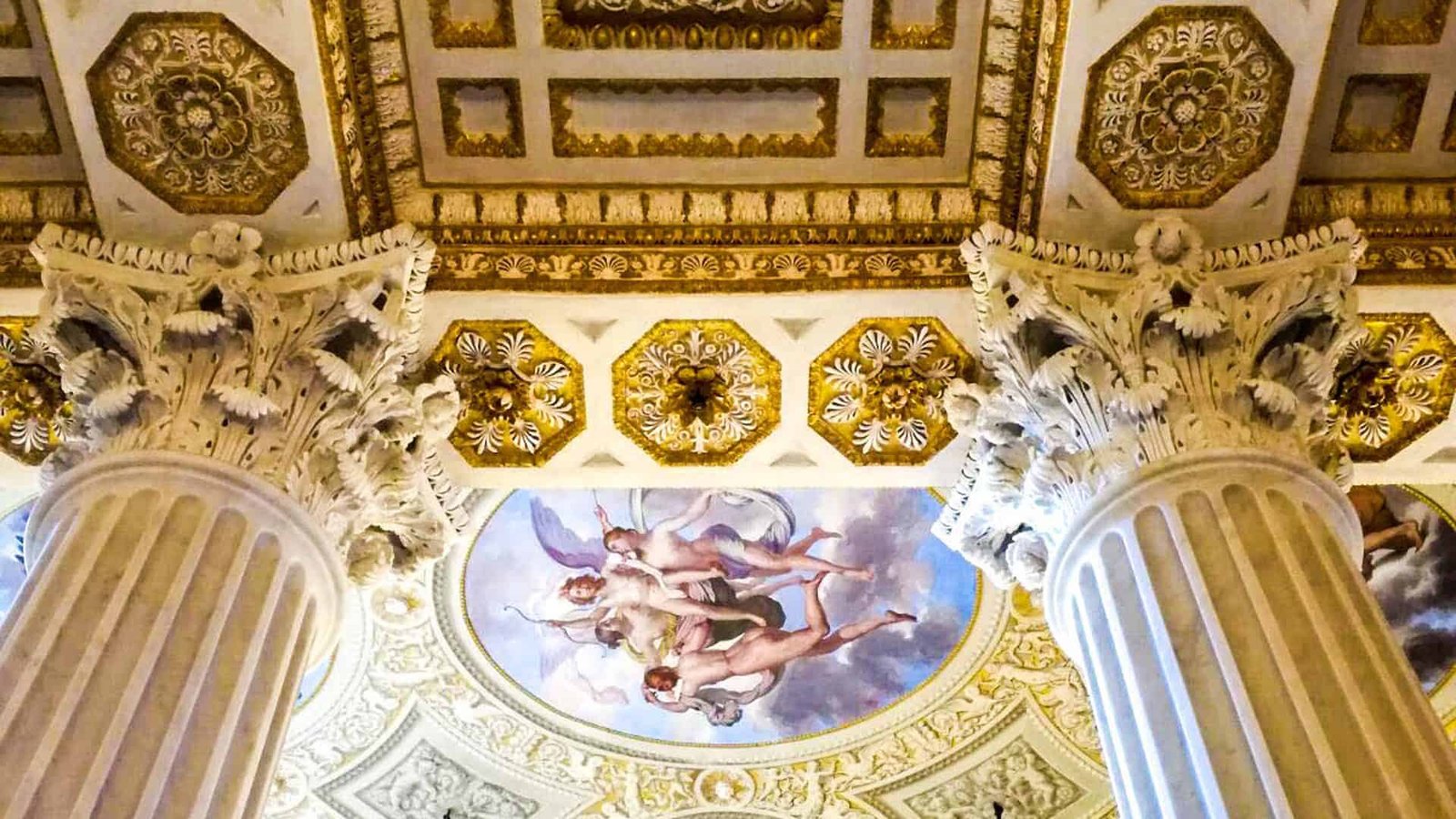
The ballroom is the central space of the palace and occupies two floors in height. Caretti kept Valadier's original structure and added two side balconies, paintings, stuccoes, gilding and marbles. The columns with composite capitals, the frieze of cupids and the gilded coffers are the work of Pietro Galli.
The vault tells stories of Cupid, painted by Domenico Toietti and Leonardo Massabò. In the lunettes you see the flight of the 12 hours and the flight of the three Graces, by Massabò, and the Parnassus by Francesco Coghetti. The walls are treated in fake giallo antico marble. The original floor was a polychrome mosaic identical to the one in Palestrina, which in 1888 was dismantled and moved to the Palazzo Torlonia in Piazza Scossacavalli.
Two sculptures complete the furnishings. An Aphrodite of the Flavian or Hadrianic age, restored by Cavaceppi, in Thasos marble with additions in Luni marble: in the restoration she was turned into a nymph, and originally occupied the aedicula of the central niche of the fake ruins in the park. A Togatus of the Augustan age or early Tiberian age, also restored by Cavaceppi, in Luni marble, placed in 1802 in the Palazzo Torlonia and then subjected to further interventions.
This room is where the villa stops being a house and becomes a theater. Raise your eyes to the balconies and try to imagine the use: musicians above, guests below, and the family showing itself from on high. Then remember that in the 1930s films were screened here, with the projector on under Coghetti's Parnassus. Few Roman rooms have changed function with this ease.
The staircase
The staircase that joins the ground floor to the piano nobile takes up a surprisingly small space for a palace of this size. The steps are marble, the railing is a balustrade in chiseled bronze by Filippo Ghirlanda.
On the staircase is placed a torso of Heracles in Luni marble of the Hadrianic age, mounted on a modern herm. Cavaceppi, to adapt it to the taste of the time, sawed off the legs of the statue and mounted it precisely on the herm. The hero is shown in maturity, with beard and curls, the twisted taenia in his hair, a muscular chest, the leonté on the left shoulder and the club in the left hand. The statuary type can be traced to the Heracles bibax or dexioumenos of the second half of the 4th century BC. It comes from the Palazzo Torlonia in Piazza Venezia and was later placed in an outside niche of the villa's theater.
The gesture of sawing the legs off an ancient marble to make a bust seems to us today a barbarity, and then it was a furnishing adjustment. Look at the point of the cut: it's the signature of a whole era.
The antechamber
From the staircase you enter the antechamber, made out of the loggia of the pronaos. The ceilings were decorated by Decio Trabalza with Dawn, Day and Night, the canonical cycle of the hours.
Three male busts are displayed there. One cuirassed, attributed to the Cavaceppi workshop, end of the 18th century, in Carrara marble, with scale armor, a paludamentum fastened by a circular bulla and a tunic underneath. A second from the Cavaceppi workshop, also end of the 18th century and also in Carrara marble, again cuirassed, with the pteryges coming down from the sleeves: today it lacks a head, but in the archive photographs the head was there and resembled a Trajan. A third cuirassed bust with Gorgon, of the early Antonine age, mid-2nd century AD, in Asia Minor marble, with a paludamentum and a shoulder piece decorated with ivy.
From the antechamber the loggia overlooks the avenue: it's the room the Mussolinis crossed every day to leave the house, and it's also the point where the 19th-century villa and the 20th century touch without telling each other.

The Bacchus Room
The Bacchus Room is frescoed with the Stories of the Myth of Bacchus by Francesco Podesti, who also painted the Four Seasons and the Three Continents there. The ceiling fresco, Bacchus meeting Ariadne, is partly lost because of a collapse, while the wall paintings are intact. Podesti's frescoes are enclosed in a grotesque structure designed by Caretti. The mosaic floor depicts the infant Hercules strangling the serpents.
Francesco Podesti, from Ancona in the Marche, is today a name for specialists and in the 19th century was one of the most celebrated painters in Italy: his is the decoration of the Sala dell'Immacolata in the Vatican. Seeing him here, in a private room, lets you measure what official Italian painting was before naturalism changed the rules.
The detail I recommend looking for is the collapse. The gap in the ceiling has not been filled back in as fake antique: you see the void. It's a modern and honest restoration choice, and in a house that was born as a catalog of fictions it has an almost moving effect.
The Gothic Room
The Gothic Room is almost entirely frescoed and covered in mosaic by Caretti in the Gothic style. The windows are painted in trompe-l'oeil, the floor is a mosaic with Gothic motifs. In the ceiling two roundels tell episodes from the Gerusalemme liberata: Erminia among the shepherds and Armida carrying off the sleeping Rinaldo.
The Torlonia Gothic has nothing medieval about it, it's a literary Gothic: it comes from chivalric poems and the historical novel, that is from the European fashion that in the same years produced the English and German neo-Gothic castles. Tasso, here, works the way Walter Scott worked elsewhere. In a Roman villa where three rooms away there is Cleopatra and five away there is Alexander the Great, the Gothic Room completes the map of the world that the patron wanted to own.
The Venus Cabinet
The Venus Cabinet is a small room with a coffered ceiling, at the center of which is a panel attributed to Luigi Coghetti with the Toilet of Venus. It's a space of passage and intimacy, of the kind that in 19th-century residences served as a dressing room or a small study. Those in a hurry don't even notice it, and yet its reduced scale is precisely its interest: after the ballroom, this room measures how little space was enough for the real life of the owners.
The bedroom
At the two ends of the piano nobile the bedrooms were placed, with drapery, curtains and canopy beds, decorated with the panels of the Toilet of Venus and of Psyche carried by the Winds by Pietro Paoletti.
The room as it is set up today is in early 20th-century neo-Baroque style: it belonged to Giovanni Torlonia junior and then to Benito Mussolini, who slept there from 1925 to 1943. The original furnishings were found in 1997 in a ministry storeroom and put back: wardrobe, chest of drawers, console, two nightstands, sideboard, small armchair, chair and bed. The wardrobe has an elm wood frame with walnut veneer. The bed rests on an elm wood base with walnut veneer and has twisted side columns and scrolls, headboards with scrolls, carved feet and small twisted columns on the front posts. The blankets are in tones of brass yellow and cardinal red. The nightstands and the chest of drawers are in 17th-century Ligurian style, with anthropomorphic handles. The sideboard has pilasters and a stepped base. The console has three drawers on a base of scrolls and putti, with wooden columns shaped like candelabra.
This is the room where groups go quiet. Not for the furniture, which is well made and nothing more, but because the bed is that one: you look at a domestic object and think of who slept on it for 18 years while signing the racial laws. The museum doesn't underline it with any scenographic apparatus, and it's right. The history stands on its own.
The passage room
The passage room was used by Mussolini as a boudoir and was covered with wallpaper. The restoration removed the paper and brought to light a frieze and a fresco consistent with the style of the Bacchus Room. It's the clearest document of how the family behaved inside the Torlonia house: not demolish, cover. Under the wallpaper of the 1920s the 19th century was intact, and it came back out 70 years later.
Alexander's Chapel
Between 1833 and 1840 a chapel wanted by Alessandro Torlonia was inserted into the Casino Nobile. By 1905 it had already disappeared. In 1997, in the basements of the theater, furnishings and fragments that belonged to it were found. The sculptures and paintings seem attributable to Carlo Aureli.
Today on display are a panel with an angel in plaster, attributed to Aureli and dated around 1840, with the winged angel in profile, the head turned to the left and the hands holding a tiara among the drapery. A multi-lobed panel with little putti in plaster, with traces of gilding, by the same author and from the same years. Some fragments of Cosmatesque flooring by an unknown author, early 19th century, with semicircles, stars and geometric motifs. A lunette with Madonna and saints in plaster with traces of gilding, also attributed to Aureli around 1840, with the Madonna enthroned among the saints. And an altar frontal in Carrara marble with two angels holding a drape with the inscription AVE MARIA.
The fate of this chapel says how little sentimental the Torlonia's relationship with their own memory was: built, decorated, dismantled and forgotten in 70 years. The 1997 discovery in the basements of the theater, together with Canova's reliefs and other sculptures, was one of those moments when a restoration site gives back more than it was looking for.
The Egyptian Room
The walls of the Egyptian Room are frescoed by Luigi Fioroni with stories of Cleopatra and Mark Antony, inspired by the Egyptian repertoire. The frescoes are surrounded by a frame with hieroglyphs, fake columns and fake basalt architecture, designed by Caretti. The scenes are the Meeting of Antony and Cleopatra, the Coronation of Antony and Cleopatra and Cleopatra kneeling before Antony. The floor is in marble and bardiglio, with two mosaics again dedicated to Antony and Cleopatra.
The Roman Egyptomania of the 19th century deserves a note. After the Napoleonic campaign in Egypt and the publication of the Description de l'Égypte, the pharaonic repertoire entered the furnishings of half of Europe. In Rome it found fertile ground because the city possessed real obelisks and a tradition of ancient Egyptian-style taste that went back to the emperors. The hieroglyphs you see here are decorative, not readable: nobody expected them to be.
The Alexander Room
The Alexander Room was the dining room of the palace and is completely frescoed with scenes recalling Alexander the Macedonian, with a not even very veiled praising allusion to the patron Alessandro Torlonia. The bas-relief frieze depicts the Triumph of Alexander in Babylon and is the work of Bertel Thorvaldsen. The walls carry allegories by Francesco Coghetti. In the aediculae are placed statues of Apollo and of the muses of Alexander the Great, referred to the school of Thorvaldsen and to Pietro Tenerani. The floor is a commesso with zodiac scenes executed in the Etruscan manner by Carlo Seni.
Thorvaldsen's frieze has a story of its own: the original version, modeled in a few months in 1812 for the Quirinale in view of a visit by Napoleon that never took place, made the Danish sculptor famous throughout Europe, and the Torlonia wanted a version of it for their dining room. Dining under the triumph of a conqueror who carries your name, in a house bought with money lent to the pope, is the perfect summary of this family. If I had to choose a single room to show someone who wants to understand 19th-century Rome, I'd choose this one.
The Scuola Romana Museum on the second floor of the Casino Nobile
On the second floor of the Casino Nobile, in the rooms that in the 19th century housed the servants' quarters and in the 1930s Mussolini's children, there is a museum that has no thematic relationship with the villa and that by itself justifies the ticket. The Scuola Romana Museum was established in 2006 and in 2025 was completely reorganized according to updated museum criteria, with new acquisitions. It displays more than 150 works among paintings, sculptures, drawings and prints.
The collection was born from the collaboration between the Capitoline institutions and the Archivio della Scuola Romana Association, founded in 1983 by the gallery owner Netta Vespignani, who was the first to work systematically on promoting the Roman artists between the two wars. The Archive is based in the Casino dei Principi, the building not far away inside the same park, which also hosts the temporary exhibitions of the Villa Torlonia Museums.
How the Scuola Romana Museum is arranged
The route is organized by thematic cores rather than in strict chronological order: Roman landscapes, construction sites, the city without myth, Via Cavour School, Villa Strohl Fern, the representation of faces and bodies, the artistic languages between the two wars. It's an approach that helps the non-specialist visitor, because it lines up works that speak of the same Rome from different points of view.
Via Cavour School takes its name from the studio in which, at the end of the 1920s, Mario Mafai, Antonietta Raphaël and Scipione worked: a tiny group that set against the rhetoric of the Novecento italiano a painting of matter, of dirty color and of the periphery. Villa Strohl Fern, instead, was the private park next to Villa Borghese where the Alsatian patron Alfred Strohl Fern rented studios to artists: a good part of the avant-garde Rome of the early 20th century passed through there.
The artists and the works of the collection
Among the names represented are Antonio Donghi, Francesco Trombadori, Riccardo Francalancia, Ferruccio Ferrazzi, Mario Mafai, Antonietta Raphaël, Corrado Cagli, Giuseppe Capogrossi, Alberto Ziveri, Fausto Pirandello, Renato Guttuso, Renzo Vespignani, Pericle Fazzini, Mirko Basaldella, Leoncillo Leonardi, Luigi Bartolini, Guglielmo Janni, Emanuele Cavalli and Roberto Melli.
Among the works you meet are the self-portraits of Ferrazzi, Ziveri and Mafai, the Boy Killing the Serpent by Mirko Basaldella, the Flight from Sodom by Antonietta Raphaël, the still lifes of Francalancia and Trombadori, and a series of views of Rome that are worth looking at in sequence.
On those views the judgment is clear-cut: they're the most precious thing on the second floor. They are the Rome of the new neighborhoods, of the demolitions, of the peeling walls and of the peripheries that grew while the regime built the showpiece city. Whoever visits Rome looking only at Baroque facades has no idea of this city. Whoever goes up to the second floor of the Casino Nobile sees it painted by those who lived in it.
I add a note on Antonietta Raphaël: born in Kaunas, in Lithuania, the daughter of a rabbi, arrived in Rome by way of London and Paris, a sculptor and painter in an environment that gave women very little. Her presence in this house, which was Mussolini's residence until 1943, is one of those coincidences that history produces and that nobody plans. It's worth the time you give her.

The basement, the shelters and the bunker under the Casino Nobile
Under the palace there is a world that the ordinary ticket does not include and that can be visited only with a guide, by reservation. It's worth telling about anyway, because it explains the 20th-century part of the building better than any panel.
The first shelter was made at the end of 1940 in an 18th-century cellar located under the so-called Fucino lake, in the park. The ancient structure was fitted with gas-tight doors, air filtration and regeneration systems, electric lighting and services. In 1941 the problem was noticed: that shelter was far from the Casino Nobile, about 150 meters, and to reach it you had to cross the garden in the open. A room on the basement floor, exactly under the ballroom, was then reinforced with reinforced concrete about 120 centimeters thick.
In December 1942 construction began on a real air-raid bunker, under the direction of the fire department. It was dug at a depth of about 6.50 meters next to the Casino Nobile, with a cylindrical structure, reinforced concrete masonry about four meters thick, rooms arranged in a cross and two emergency exits. It was never completed: Mussolini fell in July 1943 before the works were finished. During the German occupation of Rome the shelter was used all the same by the population of the area.
From the basement you also enter an underground room discovered during the renovation work, decorated and furnished by Giovan Battista Caretti in a style that imitates an Etruscan tomb, with painted bands and zoomorphic and phytomorphic figures. A fake Etruscan tomb a few meters from an air-raid bunker: the stratigraphy of this house needs no comment.
The bunker and the shelters were reopened to the public in April 2024 with an exhibition route that documents the life of the Mussolini family in the villa and the Allied bombings of Rome. Three multimedia rooms with synchronized projections and sound design reconstruct an air raid, with sirens, the noise of airplanes, detonations and floor vibrations produced by 10 transducers. The visit is guided and booking is mandatory. The ticket costs €12.00 full price and €6.00 reduced, free for children up to five years old. Openings change from season to season: the dates for the summer period are on the page about the visits to the Villa Torlonia bunker.
The multimedia reconstruction works with young people and with those who have no memory of the war, and it's understandable that it's needed. With elderly people, those who really lived through the bombings, I'd use it with caution. It's not a flaw of the museum, it's a useful precaution.
How to get to the Casino Nobile of Villa Torlonia
The address is Via Nomentana 70, in the Nomentano district, and the other entrances to the park are on Via Siracusa and on Via Lazzaro Spallanzani. From the main gate the Casino Nobile is 200 meters along the central avenue, with the single ticket office at the Casino Nobile.
By subway you take line B and get off at Bologna or at Policlinico and walk about 10 minutes. From Policlinico the route along Viale Regina Margherita is more direct. By tram you arrive with the 3 and with the 19, Viale Regina Margherita/Nomentana stop, which drops you a few hundred meters from the gate. By bus, lines 60, 62, 66, 82 and 90 serve Via Nomentana, or 61, 490, 495 and 649 serve Via Bari.
By car it's a different matter. Via Nomentana has prohibitions almost everywhere, the blue-line parking of the Nomentano neighborhood rarely frees up and at peak hours the traffic on the artery is heavy. The most concrete advice I can give you is to leave the car at home and take tram 3, which on the same ride also takes you to Villa Borghese if you want to extend the day. Remember that bicycles are not allowed inside Villa Torlonia: those who arrive pedaling have to leave them outside.

Tickets, MIC card and combined tickets for the Villa Torlonia Museums
The ticket for the Casino Nobile, which now also includes the Casino dei Principi with the current exhibition, costs €13.50 full price and €9.00 reduced. Anyone planning to see more than one building should consider the combined ticket: €17.00 full price and €13.00 reduced for the Casino Nobile, Casino dei Principi, Casina delle Civette and Serra Moresca, and €14.00 full price and €11.00 reduced in July and August, when the Serra Moresca is closed and the combined ticket includes the three remaining museums. Combined tickets are bought only at the park's ticket office, not online.
Buying a single ticket online in advance carries a €1.00 presale fee, and tickets bought online or through the call center are neither refundable nor changeable: it's a constraint worth keeping in mind if the weather is uncertain and you're thinking of combining the visit with a walk in the park.
On the MIC card the story is simple and worth repeating because many people don't know it: it costs €5, lasts 12 months, gives free access to the Rome Capital Museum System and is reserved for those who have a temporary domicile or study at a university in Rome and the Metropolitan City. For residents of Rome and the Metropolitan City, entry to the civic museums is free by showing an ID. Some temporary exhibitions, however, provide for a very reduced ticket of €2.00 even for the categories that would be entitled to free entry, so the updated price list on the Villa Torlonia Museums website should be checked before getting in line. Anyone looking for an overall picture of the free opportunities in the city can start from the page on free museums in Rome.
The reductions apply to the categories provided by the current fare schedule. Elementary and middle school pupils accompanied by teachers get in free upon presentation of the name list, and the same free entry applies to people with disabilities and their companion. Groups of between five and 25 people and school groups must book free of charge at 060608.
A professional observation: if you're in Rome for a few days and have to choose a single ticket of the four, take the Casino Nobile. It has the most content, has two museums in one and holds up to a long visit even in bad weather. The Casina delle Civette is more beautiful, but it's done in 40 minutes.
How to really visit the Casino Nobile of Villa Torlonia
For the Villa Museum, that is the ground floor and the piano nobile, allow 40 minutes if you walk briskly and a good hour if you read the captions. For the Scuola Romana Museum allow another 40. With the audio guide, which costs €4.00 and is available in Italian, English and French, you easily reach an hour and a half. Those who want to add the Casina delle Civette and the Casino dei Principi must count on a whole morning, and that's what I recommend: the park is big and walking inside it is part of the experience.
On the order of the visit there's a piece of advice that goes against the current. Almost everyone does the ground floor, goes up to the piano nobile and then, tired, skips the second floor or crosses it in 10 minutes. Do the opposite: as soon as you're in, go straight up to the Scuola Romana Museum, with fresh eyes and the room empty, and come down afterward. The 19th-century rooms hold up very well even to a visit made at the end of the round, the 20th-century paintings don't.
On the time of day: early morning on a weekday, right after the 09:00 opening. In the early afternoon the school groups arrive, and in rooms of these dimensions 20 kids change the acoustics of the whole floor. On the other hand, if you go on a rainy day, the Casino Nobile is one of the few Roman museums where bad weather takes nothing away: the natural light comes in low and the decorations read even better.
The Casino Nobile of Villa Torlonia with children
The museum works with children more than the name would suggest, as long as you give them something to look for. The floor mosaics are an excellent game: the infant Hercules strangling the serpents in the Bacchus Room, the zodiac in the Alexander Room, Cleopatra and Antony in the Egyptian Room. The headless statues make an impression and need to be explained, not hidden. The Gothic Room, with the fake painted windows, usually wins them over.
What really interests them, though, is that Mussolini lived in this house and that there's a bunker under the floor. With kids from the third year of middle school up, the bunker visit, booked separately, is a history lesson that no book replicates. With the smallest, under eight, it's better to avoid it: the air-raid simulation, with sirens and vibrations, is designed to scare and it works.
After the museum there's the park, which is the real trump card of the day: 14 hectares with lawns, avenues and extravagant buildings, and children can run. Many families make the opposite mistake, that is the park first and the museum after, and arrive at the rooms with already tired kids.
Accessibility of the Casino Nobile
The Casino Nobile is a historic building on several levels and access for people with mobility difficulties needs to be organized beforehand. People with disabilities and their companion get in free. Before the visit it's worth contacting the call center at 060608, active every day from 09:00 to 19:00, to have confirmed which floors are reachable on the day you go and which services are active: the notices section of the Villa Torlonia Museums website reports any temporary closures of rooms or equipment.
On the bunker the matter is different and has to be said clearly: you go down underground by stairs, into narrow spaces, with a guided route at a fixed time. Those with difficulty walking or who suffer from claustrophobia should think carefully before booking.
What to see around the Casino Nobile
Inside the park, within a five-minute walk, are the Casina delle Civette with its museum of artistic stained glass, the Casino dei Principi with the Archivio della Scuola Romana and the temporary exhibitions, Caretti's Temple of Saturn with its four Doric granite columns, the Fake Ruins, the Theater reopened in 2013, the Serra Moresca with the Tower, the Limonaia with a bar and restaurant and the two pink Baveno granite obelisks of Villa Torlonia. The Villino Medievale houses Technotown, the City's technology and science play center. Under the park there are Jewish catacombs of the Roman age, discovered in 1919, which cannot be visited.
Outside the gate, within 10 minutes of walking, you reach the Coppedè neighborhood, the most photographed architectural caprice in northern Rome, and the Luigi Pirandello house museum on Via Antonio Bosio. A little farther on, on Via Nizza, is the MACRO, Rome's contemporary art museum. Going up the Nomentana you enter Villa Ada, and from there, on the Salaria, you reach the Catacombs of Priscilla. Going down toward Termini instead, a quarter of an hour by bus, is Palazzo Massimo alle Terme, where ancient sculptures are seen without the 18th-century additions: the comparison with the marbles restored by Cavaceppi here at the Casino Nobile is instructive and I recommend it to anyone with half a day to spare.
A curiosity about the Casino Nobile - Villa Torlonia Museums
The floor of the ballroom, the one on which the Torlonia had half of papal Rome dance, was a polychrome mosaic identical to the mosaic of Palestrina. Not just any mosaic: the Nile mosaic of Palestrina is the largest and most famous Hellenistic mosaic to have come down to us, a view of the Nile in flood over six meters long, with hippopotamuses, crocodiles, huts, soldiers and temples, which since the 17th century has been the pride of the sanctuary of Fortuna Primigenia. Making a replica of it for the floor, in the most important room of one's own villa, was a gesture of enormous cultural ambition: it meant declaring that one's house could compete with an ancient sanctuary.
That floor is no longer there. In 1888 it was dismantled and moved to the Palazzo Torlonia in Piazza Scossacavalli, in the Borgo, and the ballroom was left without its showpiece. Whoever enters today looks up, toward Coghetti's Parnassus and the flights of the Hours, and has no reason to look down. And yet for 50 years the masterpiece of this room was under the feet of the guests.
The curiosity inside the curiosity is that the Torlonia's gesture was not isolated. In the same villa, a few tens of meters away, there are a fake Doric temple, Roman ruins built on purpose, a Moorish greenhouse, a Swiss hut and two real pink granite obelisks just over 10 meters tall and weighing more than 22 tons each. The replica of the Palestrina mosaic belonged to the same project: to own by copy everything that could not be owned by purchase. In the ballroom the first thing to do is look at the floor and imagine the Nile. It helps to understand what this house was.
One thing nobody tells you about the Casino Nobile - Villa Torlonia Museums
Almost all the ancient sculptures you see in this museum are not, strictly speaking, ancient sculptures. They are works that passed through the workshop of Bartolomeo Cavaceppi in the second half of the 18th century, that is completed, recomposed, finished with new parts and in several cases copied from scratch. An Amazon that derives from the Mattei Amazon of the Capitoline Museums, a Pandora whose head was replaced in the restoration, a Hadrian with the head turned differently from the original, a Caracalla in plaster, a Heracles whose legs were sawed off to mount him on a herm because that was the fashion. The museum states this in the captions, precisely, and almost nobody reads them.
Knowing this changes the visit completely. What you have in front of you is not an archaeological collection: it's the taste of an 18th- and 19th-century collector, staged with the materials of antiquity. Cavaceppi worked for the European market of antiquities, that of the English nobles on the Grand Tour and the sovereigns of the North, and his trade consisted in giving fragments a pleasing and salable form. The modern concept of conservative restoration, which forbids adding what isn't there, would arrive more than a century later.
There is then a second thing that nobody says, and it's a practical one: the Casino Nobile ticket does not include the bunker. They are two separate entrances, with two separate prices and two separate procedures, and the bunker is seen only with a guided tour and mandatory booking on days and times that change from season to season. Every year I meet visitors who arrive convinced of the opposite, buy the museum ticket, go up, come down and ask where the entrance to the underground is. The answer is that it has to be booked beforehand, often days in advance.
A third little-known piece of information, useful to those who live in the city: since February 2026 residents of Rome and the Metropolitan City get into the civic museums free by showing an ID. Many Romans keep paying for the ticket because nobody tells them at the ticket desk unless they ask.
The advice I give you for visiting the Casino Nobile - Villa Torlonia Museums
The main advice concerns order and time, as already anticipated: go on a weekday at 09:00, right when it opens, and go straight up to the second floor. The Scuola Romana Museum asks for attention and rested eyes. The 19th-century rooms, with their dense decoration, hold up very well even to a reading done at the end of the visit. Doing the opposite, as almost everyone does, you reach the 20th-century paintings with heavy legs and cross them in 10 minutes.
The second piece of advice is to take the audio guide, which here is really useful. It costs €4.00 and is available in Italian, English and French. It's not a tourist accessory: in this museum the difference between a well-painted room and a well-painted room that you understand lies entirely in knowing who painted what and why. Without support, the Room of the Italian Poets remains a wall of unknown faces and the replacement of Vasari with Carlo Torlonia goes unnoticed.
Third: separate the bunker from the museum. Book the guided visit to the underground on another day, or take it as the closing moment of a morning that's already long, but don't think of squeezing everything into two hours. The bunker has a strong emotional design and, right after the Alexander Room, it stuns.
Fourth, and perhaps the most useful: if you have time for only one museum in the park, choose the Casino Nobile. If you have time for two, add the Casina delle Civette and buy the combined ticket at the ticket office. If you have time for a whole morning, do the four sites counterclockwise starting from the Casino Nobile, so you finish at the Limonaia with something to drink. And avoid the car: Via Nomentana has prohibitions almost everywhere and the blue-line parking of the Nomentano rarely frees up. Tram 3 remains the best solution.
Last recommendation: leave at least a quarter of an hour for the park before going in. Looking at the facade from the avenue, with the freshly restored terracotta Triumph of Bacchus on the pediment, prepares the eye for everything you'll see inside. Whoever goes in at a run loses half the sense of the building.
Another well-known fact, yet rarely cited
That this house was Mussolini's residence everyone knows. What is rarely cited is the contract: Prince Giovanni Torlonia junior rented it to him for the symbolic sum of one lira a year, from July 22, 1925, and on the prince's death, in 1938, his brother Carlo confirmed the agreement. One lira a year for a villa of 14 hectares with a Neoclassical palace in it, a theater, a Moorish greenhouse and two obelisks.
It's worth dwelling on what that rent means. It wasn't a generous gift, it was a political investment: a financial aristocracy securing a privileged relationship with the new power by making its own house available. It's the same mechanism that a century earlier had brought the Torlonia from the cloth trade to princely rank, lending money to the Papal State at the moment of need. The family changed creditor, not method.
The second element rarely cited is what happened inside the rooms. The Mussolini family settled in keeping a large part of the original Torlonia furnishings: he in the bedroom of the piano nobile, with the study next to it, Rachele Guidi in the opposite room, the children and the servants on the upper floor. The interventions were minimal, two private bathrooms and the war shelters. The passage room was covered with wallpaper, and under that paper the restoration found the 19th-century frieze intact. In the park, in the war years and on Rachele's initiative, potatoes, lettuce, vines and corn were grown, and near the Old Stables a henhouse, a pigsty and a rabbit hutch appeared.
The third element, the least known of all, concerns what came after. On July 25, 1943 the family left the villa. In June 1944 the complex was occupied by the troops of the Anglo-American command, which stayed until 1947. Three years of barracks inside a historic villa, followed by 30 years of abandonment, explain the headless statues, the corroded surfaces, the collapsed ceilings. The City of Rome bought the property in 1977 and opened it as a public park from 1978. The Casino Nobile reopened restored only in 2006. Between the departure of the Mussolinis and the reopening of the museum, 63 years passed.
The right photo to take at the Casino Nobile - Villa Torlonia Museums
The best photograph is the one almost nobody takes, and it's shot from outside. Stand on the central avenue, about 40 meters from the facade, and frame the pronaos with the pediment head-on: the Ionic columns of the giant order, the rusticated base imitating travertine and, above, the terracotta high relief with the Triumph of Bacchus by Rinaldo Rinaldi, which the facade restoration has brought back to a readable color. It's the photograph that explains the building in a single frame: a private palace built with the grammar of a temple.
The time matters. The main front gets the best light in the late afternoon, when the low sun sets the relief of the tympanum apart from the background and the white of the stuccoes warms up. At noon the same facade looks flat and the terracotta loses its warm tone. In winter the morning also works, with the sun low.
If you're looking for a less predictable image, move to the side and photograph the palace in three-quarter view including a piece of lawn and the holm oaks of the park: the villa regains its nature as a residence amid greenery, which is lost entirely when seen head-on. Another good framing is from below, at the level of the rusticated base, with the columns rising out of frame: it conveys the intended disproportion between giant order and human step.
Inside, before raising your phone, ask at the ticket office what is allowed in the rooms and in any temporary exhibitions, because the rules can vary from one installation to another. The spaces that repay the most are the ballroom seen from below, with the two balconies and the vault by Toietti and Massabò closing the frame, and the floors: the zodiac of the Alexander Room and the infant Hercules of the Bacchus Room photographed from above, vertically, give geometric images that almost no visitor takes home. A blunt piece of advice: a single well-made photograph of the facade is worth 20 blurry shots of the rooms.
Some important events that happened here in history
The first event is the purchase of 1797, when Giovanni Raimondo Torlonia bought the Vigna Colonna and called Giuseppe Valadier. An agricultural estate of the Pamphilj, passed in the 18th century to Cardinal Girolamo Colonna, became in nine years, between 1802 and 1806, a stately residence with a palace, a minor casino, stables and symmetrical avenues. It's the moment when a family of bankers enters the Roman noble landscape through the front door.
The second is Alessandro Torlonia's campaign, opened in 1832 with the arrival of Giovan Battista Caretti and closed in 1842. In that decade the Temple of Saturn, the Fake Ruins, the Tribune with Fountain, the Amphitheater and the Caffe-house were born, and inside the Casino Nobile the Bacchus Room, the Gothic Room, the Egyptian Room and the Alexander Room. On June 4, 1842 the first of the two pink Baveno granite obelisks was erected, dedicated to Giovanni Raimondo Torlonia, in the presence of Pope Gregory XVI. The second, dedicated to Anna Maria Torlonia, was raised on July 26 of the same year. A pope who attends the erection of a private obelisk says how much that family counted.
The third event is from 1919, when in the basements of the villa an underground Jewish cemetery of the Roman age was identified, today known as the Jewish catacombs of Villa Torlonia. They can't be visited, but their existence places this piece of the Nomentana inside the history of the oldest Jewish community in Europe.
The fourth is July 22, 1925, with Mussolini's arrival, and the fifth is December 1942, when the fire department began digging the cylindrical bunker at a depth of 6.50 meters next to the Casino Nobile, with four meters of reinforced concrete and two emergency exits. It wasn't finished: on July 25, 1943 the head of government fell and the family left the villa. The shelter was used all the same by the population during the German occupation of Rome.
The sixth event is June 1944, with the occupation of the complex by the Anglo-American command, which stayed until 1947, and the seventh is 1977, when the City of Rome bought the villa, leaving it in conditions that imposed a very long recovery. From 1978 the park is public.
The eighth is 1997, one of those years that in the history of a museum count for 10: in the basements of the Theater of Villa Torlonia three of the 10 high reliefs by Antonio Canova dispersed in 1832 were found, together with fragments of the vanished Alexander's Chapel, while in a ministry storeroom the original furnishings of the bedroom reappeared. The ninth is 2004, with the discovery of the underground room decorated by Caretti in imitation of an Etruscan tomb. The 10th is 2006, with the reopening of the restored Casino Nobile and the establishment of the Scuola Romana Museum on the second floor.
The last two are recent: April 2024, with the reopening to the public of the bunker and the air-raid shelters and the new multimedia route, and 2025, with the complete reorganization of the Scuola Romana Museum and the work site on the facades of the palace, run by Zètema Progetto Cultura for the Sovrintendenza Capitolina, which fully restored the terracotta high relief of the tympanum and overhauled window frames, shutters and main doors.
Who has passed through the Casino Nobile - Villa Torlonia Museums
The first name is that of Giuseppe Valadier, the architect who between 1802 and 1806 transformed an agricultural manor building into the palace we see. Valadier is the man who redesigned Piazza del Popolo and the climb to the Pincio, and his presence here, at the start of his mature career, explains the sobriety of the layout. After him, from 1832, came Giovan Battista Caretti for a decade, architect and painter, who filled the villa with buildings and the palace with decorations. With him worked Quintiliano Raimondi, author of the Theater and the Orangery, and Giuseppe Jappelli, the man from Padua who redesigned the whole southern part of the park with little lakes, serpentine paths and the Swiss Hut later turned into the Casina delle Civette.
Then there are the artists. Pietro Paoletti painted the first vestibule, the vault of the library, the Psyche Room and the 32 portraits of the Room of the Poets. Domenico del Frate worked on the Berceau Room. Francesco Podesti frescoed the Bacchus Room with the Four Seasons and the Three Continents. Luigi Fioroni painted the Egyptian Room. Francesco Coghetti the Parnassus of the ballroom and the allegories of the Alexander Room. Domenico Toietti and Leonardo Massabò the stories of Cupid and the flights of the Hours and the Graces. Decio Trabalza the Dawn, Day and Night of the antechamber. Luigi Coghetti the Toilet of Venus of the Venus Cabinet. Pietro Galli the capitals and the frieze of cupids of the ballroom. Filippo Ghirlanda the chiseled bronze railing of the staircase. Carlo Seni the zodiac floor executed in the Etruscan manner.
Among the sculptors the museum holds works by Antonio Canova, Bertel Thorvaldsen, Pietro Tenerani, Rinaldo Rinaldi, author of the high relief of the pediment, Carlo Aureli, who worked on Alexander's Chapel, and of course Bartolomeo Cavaceppi, the 18th-century restorer whose hand is recognizable in half the museum.
In the park, on June 4, 1842, Pope Gregory XVI passed through, present at the erection of the first obelisk. The Torlonia lived there: Giovanni Raimondo, the founder of the fortune. Alessandro, the son who made the villa a catalog of styles. Giovanni junior, the last prince, who left the palace to go live in the Casina delle Civette and who in 1925 rented everything to Mussolini for one lira a year. And Carlo, the brother, who in 1938 confirmed the agreement.
From July 22, 1925 to July 25, 1943 Benito Mussolini lived there with Rachele Guidi and the children. In the ballroom receptions and film screenings were held. In the park a tennis court and a riding track were made. From June 1944 to 1947 the palace housed the Anglo-American command, with officers and soldiers quartered in the Torlonia rooms.
And then, in a certain sense, the painters of the Scuola Romana passed through, arriving on the second floor many decades after their death: Mario Mafai and Antonietta Raphaël, Antonio Donghi, Fausto Pirandello, Renato Guttuso, Corrado Cagli, Giuseppe Capogrossi, Alberto Ziveri, Renzo Vespignani, Mirko Basaldella, Pericle Fazzini, Leoncillo Leonardi. The collection exists also thanks to Netta Vespignani, the gallery owner who in 1983 founded the Archivio della Scuola Romana Association. That Raphaël's paintings, she a Lithuanian Jew, are today displayed on the floor above the bedroom of the man who signed the racial laws is the most just thing that has happened in this house.
Quick questions about the Casino Nobile - Villa Torlonia Museums
How much is the ticket for the Casino Nobile of Villa Torlonia?
€13.50 full price and €9.00 reduced for the Casino Nobile together with the Casino dei Principi with the current exhibition, according to the official website. Buying online in advance adds a €1.00 presale fee. Temporary exhibitions can have different rates.
What are the opening hours of the Casino Nobile?
Tuesday through Sunday, from 09:00 to 19:00, with last entry one hour before closing. Closed on Mondays, May 1 and December 25. On December 24 and 31 the hours are 09:00 to 14:00, on January 1 11:00 to 20:00.
Is the combined ticket for the Villa Torlonia Museums worth it?
It's worth it if you see at least three buildings. It costs €17.00 full price and €13.00 reduced for the Casino Nobile, Casino dei Principi, Casina delle Civette and Serra Moresca. In July and August, without the Serra Moresca, it costs €14.00 full price and €11.00 reduced. It's bought only at the park's ticket office.
How long does the visit to the Casino Nobile of Villa Torlonia take?
About 40 minutes for the Villa Museum, another 40 for the Scuola Romana Museum on the second floor. With the audio guide you reach an hour and a half. For the four museums of the park you need a morning.
Do you need to book to visit the Casino Nobile?
No, for a self-guided visit you buy the ticket at the ticket office and go in. Free booking at 060608 is instead mandatory for groups of five to 25 people and for school groups.
Does the museum ticket include the Villa Torlonia bunker?
No. The bunker and the air-raid shelters have a separate ticket, €12.00 full price and €6.00 reduced, and can be visited only on a guided tour with mandatory booking.
Is entry to the Casino Nobile free if you live in Rome?
Yes. Residents of Rome and the Metropolitan City get into the civic museums free by showing an ID. Some temporary exhibitions still provide for a very reduced ticket of €2.00.
What is the MIC card and is it valid for the Casino Nobile?
It's the card of the Rome Capital Museum System: it costs €5, lasts 12 months, gives free entry and is reserved for those who have a temporary domicile or study at a university in Rome and the Metropolitan City. It's also valid for the Casino Nobile.
Is there an audio guide at the Casino Nobile?
Yes, it costs €4.00 and is available in Italian, English and French. In this museum I recommend it: without support many decorations remain unreadable.
Can you take photographs inside the Casino Nobile?
The conditions can vary from one installation to another and during temporary exhibitions: ask at the ticket office before going in. Outside, the facade can be photographed freely, and late afternoon is the best moment.
Is the Casino Nobile accessible to people with disabilities?
The building is historic and spreads over several levels. Entry is free for people with disabilities and for the companion. It's worth phoning 060608 beforehand to have confirmed which floors and which services are available on the day of the visit. The bunker route, which is reached by stairs in narrow spaces, isn't suitable for those with difficulty walking.
Is the Casino Nobile of Villa Torlonia suitable for children?
Yes, if you give them something to look for: the floor mosaics, the fake windows of the Gothic Room, the mutilated statues to be explained. The bunker, with the sound simulation of the air raid, I recommend from age 12 up.
Where do you buy the ticket and where is the ticket office?
At the Casino Nobile, where the single ticket office of the Villa Torlonia Museums is located, entering through the gate at Via Nomentana 70. Combined tickets are sold only there. The 060608 call center answers every day from 09:00 to 19:00.
How do you get to the Casino Nobile by public transit?
Subway line B, Bologna or Policlinico stops, then 10 minutes on foot. Trams 3 and 19, Viale Regina Margherita/Nomentana stop. Buses 60, 62, 66, 82 and 90 on Via Nomentana, or 61, 490, 495 and 649 on Via Bari.
Can you enter Villa Torlonia by bicycle?
No, bicycles are not allowed inside the park. Those who arrive pedaling have to leave them outside the gates.
What is the difference between the Casino Nobile and the Casina delle Civette?
The Casino Nobile was the official, ceremonial residence of the Torlonia and today houses the Villa Museum and the Scuola Romana Museum. The Casina delle Civette was the private home of Giovanni Torlonia junior and is today the museum of artistic stained glass. Two functions, two eras, two kinds of beauty.
What is the Scuola Romana Museum?
It's the collection on the second floor of the Casino Nobile dedicated to Roman artists between the two world wars: more than 150 works among paintings, sculptures, drawings and prints, established in 2006 and completely reorganized in 2025.
Did Mussolini really live in the Casino Nobile?
Yes, from July 22, 1925 to July 25, 1943, with his wife Rachele Guidi and the children. Prince Giovanni Torlonia junior rented him the villa for a symbolic lira a year.
Can you visit the Jewish catacombs of Villa Torlonia?
No, they cannot be visited. They were identified in 1919 in the subsoil of the villa and remain closed to the public.
What is the best time to visit the Casino Nobile?
The morning of a weekday, right after the 09:00 opening. In the early afternoon the school groups arrive. A rainy day takes nothing away from the visit, in fact it's the right occasion.
What is there to see nearby?
Inside the park the Casina delle Civette, the Casino dei Principi, the Theater, the Temple of Saturn, the Fake Ruins, the Serra Moresca, the Limonaia and the two obelisks. Outside, within 10 minutes on foot, the Coppedè neighborhood, the Pirandello house museum and the MACRO on Via Nizza, and going up the Nomentana Villa Ada.
Is the Casino Nobile closed for works?
Between October 2025 and early 2026 the facades and the terracotta high relief of the pediment were restored. Before leaving it's still worth glancing at the notices section of the Villa Torlonia Museums website, where temporary closures of individual rooms are reported.
Is the Casino Nobile worth visiting if you have little time in Rome?
If it's your first visit to the city and you have two days, no: the ancient center comes first. If you're returning to Rome for the third or fourth time and want to understand the city's 19th and 20th centuries, the Casino Nobile is one of the best choices you can make.

The Casino Nobile, in short, should be visited by addition: first the bankers' house, then the dictator's house, then the painters' museum. They're three buildings inside one, and none of the three can be understood without the other two. It's worth going back in winter, when the park is empty and the palace is seen at the end of the avenue with nobody in front of it, and stopping longer in front of Canova's three plaster pieces, which remain the most beautiful object of this house and the least looked at. If you have an hour and a half and the desire to reflect on how a city becomes what it is, this is the right address on the Nomentana.
Article written by the editorial team of TourLeaderPro, contact them for Private/Corporate/V.I.P. Tours and Experiences.
Planning a trip to Rome? The English guides to visiting the city are on ItalyPlanner.com.