Villa Torlonia Bunker Tours: Summer Openings July and August 2026
In short. The summer visits to the Bunker and air-raid shelters of Villa Torlonia are over.
The summer visits to the Bunker and air-raid shelters of Villa Torlonia are over. The cycle for individual visitors ran from July 4 to August 30, 2026, Saturdays and Sundays, and on August 30 it closed its doors as planned. Today is September 12, 2026, so anyone looking for those dates won't find them anymore. The good news, and I'll say it right away because it's the only thing that really matters to anyone who arrives here intending to go down under the Casino Nobile, is that the underground spaces haven't closed at all: the calendar of the Villa Torlonia Museums has simply turned the page and from September 5, 2026 the autumn cycle has started, running until December 27. The visits remain guided, remain by reservation, remain concentrated on the weekend. The hours change, and they also change over the course of the autumn, which is why further on I explain where to look instead of trusting a date copied from somewhere.
A methodological premise, because this place needs one. The Bunker of Villa Torlonia is not an attraction you add to the tour of the park when you have time left over. It's a closed route, with an entrance and an exit that don't coincide, with a maximum of 20 people per slot, with a fixed duration of 50 minutes and with the explicit ban on turning back along the way. You enter from the Casino Nobile and re-emerge in the garden, on the opposite side. Anyone who shows up without a ticket on Sunday afternoon hoping to slip into the group almost always finds the slot sold out, and not out of spite from the ticket office: 20 spots go fast, especially when there's only one slot in the day, as happened on Saturdays in July and August.
Below I tell what the summer of 2026 was like in the underground spaces, what you really see going down the stairs, what the three overlapping levels making up the complex are, how old the story beneath the feet of those walking in the park is, and how to organize now, with September past, to book without queuing twice. The least known piece of Villa Torlonia's history, the one underground, is also the one that strikes first-time visitors most.
What the summer openings of July and August 2026 were
The summer cycle for the individual public began on Saturday, July 4, 2026 and closed on Sunday, August 30. Exactly two months, with a grid of slots designed for the hot season, when Rome empties of Romans and fills with visitors looking for something to do in the hours when the sun beats down too hard to be outdoors. The visits in Italian were on Saturday at 17:00 and on Sunday at 10:00 and 17:00. In English, on Saturday at 11:00. On August 15, which fell on a Saturday and was a holiday, the program was reinforced with two slots in Italian at 10:00 and 17:00, while the English visit at 11:00 that day was skipped precisely because the Saturday was a holiday.
Anyone with minimal familiarity with how Rome's civic museums work recognizes the logic of that grid right away. The 17:00 on Saturday and Sunday is not a random time: it's the hour when, in July and August, the park starts to become livable and people leave home. The 10:00 on Sunday catches those who want to get it done before lunch. And the English slot on Saturday morning is the share reserved for foreign visitors, who in Rome in summer are the absolute majority of the museum public. No visits from Monday to Friday: the site is closed five days out of seven, and this holds now too.
The cost, in summer as in autumn, has stayed that of the guided visit ticket: €12 full price, €6 reduced. The reduced price is valid for those aged 6 to under 18, for those holding a valid MIC card, for those with a valid RomaPass, for people with disabilities and for one companion of theirs. Children from zero to five years old enter free, and don't even take one of the 20 spots, because they're considered additional to the booked group: their ticket is collected directly at the start of the visit. On online purchase you pay a presale fee of €1, with a maximum of five tickets per transaction.
What surprised more than one summer visitor is that the MIC card, which opens almost everything in Rome's civic museums, doesn't zero the price here: it gives the reduced rate. The Bunker is considered a guided visit to all effects, not a museum admission, and guided visits have a separate rate because they require a dedicated educational operator for each slot. The same goes for the RomaPass. It's a distinction that annoys, in the moment, those who were convinced they'd get in free, but it has its logic: what you pay for is not the door, it's the person who accompanies and tells.
Why the summer dates counted more than they seemed
Every year, when the Bunker's summer calendar comes out, there's a small race that Romans know and occasional visitors don't. In July and August the slots are reduced compared with autumn and spring, because staff go on vacation and the civic museums lighten the program. Fewer slots means fewer total spots, and since the cap per slot stays fixed at 20 people, the math is ruthless: on August weekends it happened that everything was sold out days ahead. Whoever organized on Wednesday for Sunday made the right choice. Whoever turned up on Saturday morning at the Casino Nobile ticket office hoping for an afternoon spot was often left stranded.
There's also a seasonal element that explains why in summer those visits had a particular value. Underground the temperature is stable and clearly lower than on the surface. On a Roman August day, with the park at five in the afternoon still an oven, going down six meters below ground level is an immediate physical relief. The flip side is humidity: the walls sweat, the floor in some points is shiny, and in fact the rules recommend comfortable, waterproof shoes. It's not a ritual formula. Whoever goes down in flip-flops finds out after three steps.
What you see going down under the Casino Nobile
The current route is the one inaugurated on April 5, 2024, when the air-raid Shelter and the Bunker were reopened to the public after long restoration and refitting work, with a brand-new multimedia display. Before that date the underground spaces had already been visitable in different forms, but the setup you find today is the 2024 one, and it's a declaredly immersive setup: the historical information is there and it's serious, but the bet of the display is to make you feel what it meant to be underground while bombs fell above.
You start by going down the stairs that lead from the rooms of the Casino Nobile to the semi-basement floor. The official description speaks of a break that is not only architectural, and the formula is precise: above there are air, light and the beauty of a neoclassical palace full of stuccoes and reception rooms, below there are darkness, humidity and a physical sense of constriction. The passage lasts a few seconds and is the first thing the display makes you understand without a word.
The first part of the route tells the life of Mussolini and his family at Villa Torlonia through a video built with historical photographs. You see parties, official ceremonies, tennis matches on the court made in the old Campo dei Tornei, riding exercises. It's a sequence that serves to fix a simple concept: for 18 years this villa was a private home, with children, pianos, guests and daily habits, and the underground spaces were born exactly from the moment when that normality stopped being guaranteed.
In the following rooms the story shifts to the bombings of Rome, reconstructed through the newsreels of the time, with particular attention to those on the San Lorenzo district. Alongside the projections of historical documents, the exhibition constantly uses photographic collages that seem printed directly on the walls: they're not hung panels, they're images that adhere to the masonry and give the impression of walking inside the photographs instead of in front of them.
The second part is the one that strikes the public most. Three rooms connected by a series of synchronized projections reconstruct episodes of life inside an air-raid shelter during a bombing. There's no linear narrative with a beginning and an end: there are fragments, voices, gestures, waiting. It's the right choice, because life in the shelters was made of exactly this, of long hours broken by sudden noises.
The third part is titled The Bombed City and plays on a double point of view. On the floor flow images of Rome seen from planes in flight during an attack, while on the walls the city reduced to rubble is projected. Whoever is above doesn't perceive the effects of what he does, whoever is below suffers the consequences: the editing puts the two perspectives in the same environment and lets them look at each other. It's a display that doesn't preach and for that very reason works.
The last stop is the bunker proper, reached by a steep staircase. Here the display deliberately steps back: the large cylindrical structure was left purposely free of objects and projections, to enhance its structural quality. In that bare space an air raid is simulated with the reproduction of sounds, the sirens, planes approaching, detonations, and with ground vibrations. The tactile part is entrusted to 10 transducers installed under the floorboards, which transmit to the legs what the ears hear. The exit from the bunker leads straight back into the villa's gardens, through a long corridor.
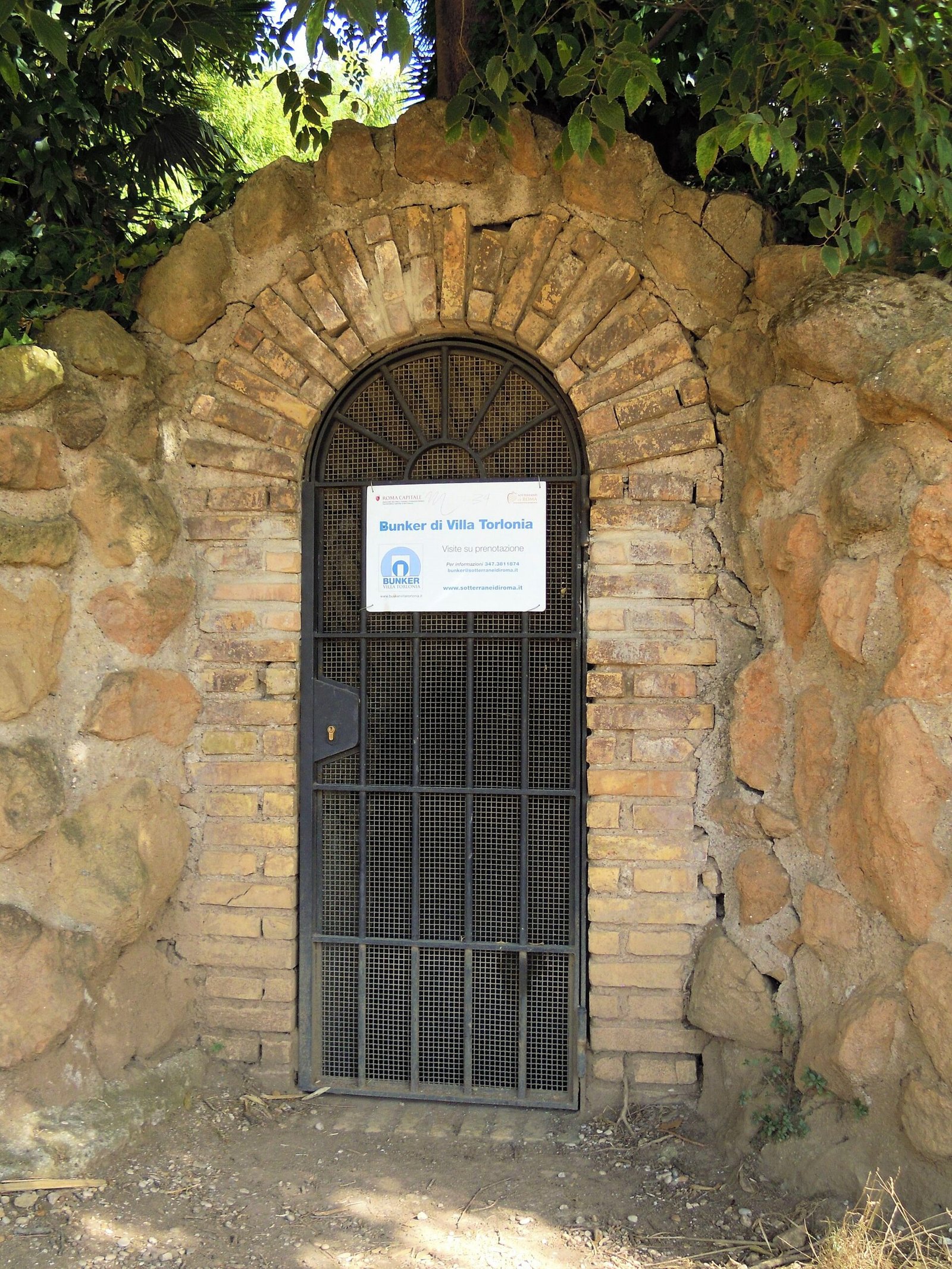
The final passage from darkness to the light of the park is the most successful thing of the whole route, and it isn't even designed: it's a consequence of topography. You exit through a door into the greenery, with pines overhead and kids running, after 50 minutes spent hearing sirens. No explanatory panel says what those three seconds say.
The three overlapping levels: cellar, anti-gas shelter, bunker
The thing that most often escapes, even those who have just finished the visit, is that under Villa Torlonia there isn't one shelter: there are three, built at different times and by different criteria, and each is born because the previous one had proved insufficient. The sequence is a small story of growing fear, and it's very well documented.
The first space identified as a shelter was an underground cellar that was under the small lake called Fucino, built by the Torlonia in the 19th century, most probably making use of an ancient pre-existing cemetery area. It was accessed through a door in front of the east entrance of the Theater. It was 60 meters long and five wide: a tunnel, in essence. At the end of 1940 it was equipped with anti-gas doors, with an air filtering and regeneration system, with electric light and with other fittings meant to make the place livable during prolonged stays.
The flaw of that solution emerged early and had nothing to do with the cellar itself. It had to do with distance. Between the Casino Nobile and the shelter there were about 150 meters to cover in the open, and 150 meters outdoors during an air-raid alarm is a very long time. On top of that the small lake beneath which it lay was perfectly visible from above, and a target recognizable from the air is exactly what you don't want over your head when you're hiding.
In 1941 they therefore moved to the second solution: using a room on the semi-basement floor of the Casino Nobile, originally used as a kitchen, located right under the ballroom. That room was reinforced with a layer of reinforced concrete about 120 centimeters thick, fitted with armored anti-gas doors and an air purification and exchange system. The advantage was evident: you went down from inside the house, without sticking your nose outside. The disadvantage, equally evident, is that 120 centimeters of concrete over your head protect from splinters and partial collapses, not from a bomb that arrives straight on.
Hence the third and last solution, the most ambitious. Mussolini entrusted the National Firefighters Corps with the construction of a real air-raid bunker under the square beside the Casino Nobile, with more advanced materials and techniques. The work began in December 1942 for an expected amount of 240,000 lire, a figure that ended up doubling: it became necessary to deepen the excavation for the foundations and to dismantle a pre-existing underground corridor connecting the Tribuna con Fontana to a secret room wanted by Alessandro Torlonia in the 19th century.
The bunker was dug about six and a half meters deep, outside the foundations of the Casino Nobile, but with direct access from the building's semi-basement floor through a long staircase. Cylindrical shape, to better distribute the stresses of an explosion, and masonry of four meters of reinforced concrete. Inside, several rooms laid out in a cross, with two emergency exits: one onto the square beside the Casino, the other inside the Tribuna con Fontana, reachable along an underground corridor.
That bunker was never finished. On July 25, 1943 Mussolini was removed from power and work was still in progress. The client never used it, not even once. It was used instead by the inhabitants of the villa and the surrounding neighborhood during the German occupation, exactly the people it hadn't been designed for. It's one of the sharpest reversals I know in the building history of Rome, and the visit tells it without laying it on thick.
A curiosity about Villa Torlonia Bunker Tours: Summer Openings July and August 2026
The best curiosity concerns the cost of the works. The bunker was supposed to cost 240,000 lire and ended up costing double. Not because of corruption, not because of waste: because of geology and archaeology. When the firefighters began to dig, in December 1942, they realized the foundations required going deeper than planned, and that in the subsoil of the square ran a 19th-century corridor connecting the Tribuna con Fontana to a secret room wanted by Alessandro Torlonia. That corridor had to be dismantled, because it got in the way of the layout of the new excavation.
Let's stop on this detail for a moment, because it's delightful. In 1942, in the middle of the war, with the bombings at the door, the construction of Italy's most modern shelter was slowed by the existence of a secret passage built 80 years earlier by a Roman prince who loved oddities. Alessandro Torlonia is the same man who had built in the park a Temple of Saturn, some Fake Ruins and a Tribuna con Fontana, all designed by Giovan Battista Caretti starting in 1832. He had a taste for staging and, apparently, for hidden connections too. His scenographic imagination ended up costing the bunker's budget 120,000 lire.
There's more, and it concerns the cellar that became the first shelter. The official description says the Torlonia built it in the 19th century most probably making use of an ancient pre-existing cemetery area. It means that the first place chosen to protect the head of government from the bombs had been carved inside a space already dug centuries earlier to bury the dead. Anyone who knows Rome's subsoil isn't surprised: down here every new hole intercepts an old one. But the overlap, in this specific case, has a symbolic density that no multimedia display could improve.
And finally the curiosity of curiosities, the one almost nobody connects: the same villa, in the northwestern area, hides an underground Jewish cemetery, discovered in 1919 and studied by the archaeologists Roberto Paribeni and Italo Gismondi, who published a first plan of it. In the 1970s a second campaign of studies, led by Father Umberto Fasola, identified a second catacomb connected to the first: the older one is frescoed, the second has an apsed area. The Jewish catacombs of Villa Torlonia can't be visited with the Bunker visits and in general aren't open to the public, but they exist, they're there, and they lie under the same lawn.
Holding the two things together helps understand what this park really is. Above, a 19th-century garden with obelisks and fake ruins. Below, in different places, a Jewish cemetery of the imperial age and a dictator's air-raid shelter. Putting the two presences in the same sentence gives chills.
Something nobody tells you about Villa Torlonia Bunker Tours: Summer Openings July and August 2026
What nobody tells you is that Mussolini never used that bunker. Not once. Not one alarm, not one night, nothing. Work began in December 1942 and on July 25, 1943, when he was removed by the Grand Council and arrested, the site was still open. The cylindrical structure you visit today, four meters of reinforced concrete, six and a half meters below the level of the square, two emergency exits, cross-shaped rooms, is an unfinished work built for a person who didn't make it down there in time.
The sequel to this story is even less told. After July 25, 1943 the Mussolini family left the villa, and during the German occupation of Rome the bunker was opened and used by the inhabitants of the villa and the neighboring district. In those months the shelter of the head of fascism served as refuge for doorkeepers, gardeners, Nomentano families who heard the sirens and went down where they could go down. The bunker worked, just once and for ordinary people, and it worked when its client was already elsewhere.
In 1944 the villa was occupied by the Anglo-American Allied command, which stayed until 1947. Three years of troops inside a 19th-century park left heavy damage to the buildings and the garden, and it's one of the reasons the complex reached the 1970s in disastrous condition. Villa Torlonia became a public park only in 1978, after the acquisition by the Municipality, and the restorations of the individual buildings came piecemeal in the following decades. The Bunker, in this sense, is the latest arrival: the reopening with the current display is April 5, 2024.
A second rarely cited element concerns the relationship between the three levels. In the common imagination a dictator's bunker is a single armored block. Here instead you can see very well the defensive stratification: a cellar adapted in a hurry at the end of 1940, an armored service room in 1941, a deep excavation begun in 1942. Every step corresponds to a worsening of Italy's military situation, and it's readable in the masonry: 120 centimeters of concrete in the shelter inside the house, 400 centimeters in the external bunker. Fear is measured in thickness.
Third thing rarely said: that famous shelter in the former cellar was designed for prolonged stays, with an air filtering and regeneration system and electric light. It wasn't a hole where you waited 20 minutes. A length of 60 meters by a width of five is the plan of a space designed to host many people for many hours. Whoever designs a place like this doesn't imagine a raid: imagines a long war. And indeed Rome was hit by 51 air bombings between July 1943 and May 1944.
Fourth and last: access to the air-raid shelter through which you reach the exit is by steep stairs, exactly like the entrance to the bunker. The site isn't accessible to people with motor disabilities, and the official site states this clearly. A descriptive video is in preparation, which will be visible at the ticket office and on the website, to allow at least a mediated experience for those who can't go down. Put bluntly: if you have problems with knees, hips or balance, this isn't the right visit, and better to know before having paid.
My advice for visiting Villa Torlonia Bunker Tours: Summer Openings July and August 2026
Advice number one is trivial and I repeat it because it's the one that saves the day: book online, ahead. The cap is 20 participants per slot and the weekend slots are few. The ticket is bought from the Civic Museums portal, in the dedicated box, with a €1 presale fee and a maximum of five tickets per transaction. Whoever has the MIC card can buy from the MIC card site and from the app. Whoever prefers the counter can prepurchase at the Villa Torlonia ticket offices, again with €1 presale and, this is the detail that catches many, paying by credit card only.
The villa's ticket offices are three and not everyone knows: the one at the Casino Nobile, with entrance from Via Nomentana 70, the one at the Serra Moresca, with entrance from Via Siracusa, and the one at Technotown, with entrance from Via Lazzaro Spallanzani 1. If you arrive from Via Siracusa or from Spallanzani you don't need to cross the whole park to buy the ticket: you can do it at the entrance you come in by. Purchases remain possible until spots run out, so online booking remains the safest route.
Advice number two: arrive early, but not too early. A quarter of an hour before is the right measure. The meeting point is at the Casino Nobile and the group leaves on time, because the sequence of slots in the underground spaces is timed to the minute: if the 16:00 group comes out late, the 17:00 one slips. Whoever arrives breathless at the last second risks finding the group already gone down, and there's no way to catch up along the route, since the path is one-way and you can't turn back.
Advice number three, shoes. The rules recommend comfortable and waterproof footwear and are right. Below there's real humidity, not figurative, and the steps in some points are smooth. I'll add something the rules don't say: bring something to put over your shoulders even in high summer. The temperature swing between the square and the bottom of the bunker, in August, is notable, and 50 minutes underground in a T-shirt wet with sweat aren't pleasant.
Advice number five, the one almost nobody follows: don't put the Bunker at the end of a full day. Many squeeze it in after three museums and a walk, and arrive already tired in a tight, dark and loud environment. The result is that the raid simulation, which should impress, becomes annoying. Better to make it the first appointment of the afternoon and then go back up, calmly, toward the Casina delle Civette or toward the Casino Nobile, which have a completely different rhythm and serve as decompression.
Advice number six: bathroom first. Inside the route there are no restrooms, and 50 minutes with no chance to leave before the end are 50 real minutes. With small children this is the only real logistical worry of the day.
Advice number seven: leave the big backpack at home. The rules forbid bringing in bulky objects, from luggage to strollers to musical instruments, and also forbid food and drinks, animals of any kind including those in carriers, and of course smoking. Whoever arrives in Rome with a rolling suitcase and thinks of slipping into the visit before going to the station finds the door closed, and has lost the ticket, because tickets sold are non-refundable.
How to visit the underground spaces today, after the summer cycle closed
Let's move to the practical part, the one that serves whoever reads now. The summer 2026 dates are used up, the last was Sunday, August 30. From September 5, 2026, though, the cycle for individual visitors that the Villa Torlonia Museums have scheduled until December 27, 2026 has begun. The mechanism is identical to the summer: guided visits by reservation, weekends only, maximum 20 participants per slot, entry from the Casino Nobile and exit in the park, duration 50 minutes.
The difference is that the autumn calendar is denser than the summer one, because staff return and the civic museums go back to full operation. In the first part, the September one, the slots in Italian are distributed between Saturday afternoon and Sunday, with the English visit confirmed on Saturday morning. From the start of October on the grid widens quite a lot, with more slots on both Saturday and Sunday, and with some extraordinary openings on the holidays in December. I'm not giving you the complete hour-by-hour list here now, and I'll tell you right away why.
The reason is simple: the hours of the Bunker visits change from cycle to cycle and, within the same cycle, change between one period and another. They already changed between July and September, and they'll change again between September and October. Any list of hours written here risks becoming false within a few weeks, and a wrong time is worse than no time, because it produces wasted trips. The official event page on the Villa Torlonia Museums site carries the updated grid, period by period, and it's the only place worth looking before booking.
I'll add a recommendation that holds for all Rome's civic museums and for this one in particular: always check the notices page too before planning the visit. The notices are the channel through which the Capitoline Superintendency communicates unexpected closures, system breakdowns, hour changes for ceremonies or maintenance. A multimedia system with synchronized projections, sound spatialization and transducers under the floor is by definition a system that stops every now and then, and when it stops the slot is skipped.
On booking, the fixed point is one: it's mandatory. It isn't a prudential recommendation, it's written in the official event information. Even those who show up at the ticket office aren't buying free admission, they're buying a spot in a specific slot, until sold out. If you're one of those people who hate fixing hours in advance, with the Bunker you have to make an exception.
Last practical element, valid all year: the site is closed Monday to Friday. Visits for individuals exist only on Saturday and Sunday, plus any holiday days included in the calendar. During the week the underground spaces host visits for groups and schools, which follow a different booking channel and don't mix with the individual public. Anyone who is in Rome only on weekdays, in short, will have to give up or organize with a group.
How much it costs and what the ticket includes
The guided-visit ticket for individuals costs €12 full price and €6 reduced. The reduced price is for young people aged 6 to under 18, for holders of a valid MIC card, for holders of a valid RomaPass, for people with disabilities and for one companion. Children from zero to five years old enter free and don't use up spots in the quota.
The ticket includes the complete guided visit, that is the historical rooms of the route, the immersive rooms, the section dedicated to the bombed city and the final bunker with the simulation. It doesn't include admission to the Casino Nobile museum, which is a separate ticket, nor the exhibitions running in the villa's other buildings. This is a recurring source of misunderstanding: you enter through the Casino Nobile, but you enter to go down, not to visit the rooms on the piano nobile.
Related advice: if you plan both the Bunker and the museum, do the museum first and then the Bunker, not the other way around. Coming out of the bunker you find yourself in the park, far from the Casino Nobile entrance, and going back to visit the rooms is a pointless detour. Also, seeing the ballroom first and then the armored room exactly beneath that same ballroom produces an immediate understanding that is lost in the reverse order.
Another well-known fact, yet rarely cited
The well-known fact is that Mussolini lived at Villa Torlonia. Everyone knows it, it's the first thing said about the villa, it's written in every guide to Rome. What almost nobody cites is the rent: one lira a year. Prince Giovanni Torlonia junior, last heir of the branch descending from Alessandro, granted him the residence on July 22, 1925 at that symbolic figure, and the agreement was then confirmed by his brother Carlo after Giovanni's death in 1938.
One lira a year isn't a rent, it's a tribute. And understanding why one of Italy's richest families made such a tribute to the head of government explains a lot about the relationship between the Roman aristocracy and the regime in the 1920s. The Torlonia were bankers who had bought the title and the villa within two generations: Giovanni Raimondo Torlonia purchased the property from the Colonna in 1797 and in 1806 commissioned Giuseppe Valadier to transform it into a princely residence. A century and a half later, the descendant of the man who had bought respectability was offering it for use to the one who handed respectability out.
Second rarely cited detail: Mussolini didn't move in right away. The grant is from July 1925, but in the first years he used the villa only for a few official meetings. The real move, with his wife Rachele and the children, took place in 1929. That's a four-year difference that changes the sense of the chronology: the villa becomes a family home when the regime is already consolidated, not when it's still being built.
Third detail: Prince Giovanni junior didn't leave. He ceded the Casino Nobile and moved to the Casina delle Civette, the fairy-tale building full of Liberty stained glass in the eastern part of the park, where he lived until his death in 1938. For 13 years, then, the head of fascism and an eccentric prince obsessed with owls lived in the same garden, a few hundred meters from each other. The strangest coexistence of 20th-century Rome went almost unnoticed.
Fourth: the only building works Mussolini wanted in the palace were two bathrooms, one for himself and one for his wife, and the air-raid shelters. The bathrooms were made in a masonry structure on the veranda that connected the two bedrooms, also wanted by him. That masonry and the two bathrooms were demolished in the 1990s restorations, to recover the original southern facade and give light back to the ballroom, which Valadier's arched window illuminated and which the addition had completely darkened. Of everything the tenant added to the palace, in short, only what lies underground remains.
Fifth, and perhaps the most forgotten: in 1942 Rachele Mussolini had war gardens made at Villa Torlonia, following the national campaign for food self-sufficiency. In the Torlonia's 19th-century park potatoes, lettuce, vines and corn were planted, and near the Scuderie Vecchie a henhouse, a pigsty and a rabbit hutch were installed. The romantic garden with its fake ruins and obelisks, in the same period when the bunker was being dug, was partly a vegetable plot with farmyard animals.
The right photo to take at Villa Torlonia Bunker Tours: Summer Openings July and August 2026
Let's start from an honest premise: inside the route photography is hard and, in some passages, makes little sense. The immersive rooms live on synchronized moving projections, and a projection photographed with a phone becomes a blurry blotch with sky-high digital noise. The light is very low, exposure times lengthen, and the result is usually an image that recalls nothing of what you saw. I'll add that the group is 20 people in narrow spaces and that stopping to frame creates a plug.
The right photo, then, is just one and it's not a photo of projections: it's the cylinder. The final chamber of the bunker proper was deliberately left free of objects and images, precisely to let the structure be read. Four meters of reinforced concrete all around, cylindrical development, raw surface. Frame the curve of the wall keeping a vertical element in the foreground, someone's shoulder or the jamb of a passage, and rest the phone against the wall to stabilize it instead of holding it freehand. With a solid support, even in low light, the wall comes out incised and the texture of the pour can be read.
The second shot I recommend is the steep staircase leading to the last level. Seen from below, with the steps rising and getting lost in the dark, it tells the depth better than any caption. Here too, fixed support and no flash: flash flattens everything and returns a gray rectangle without depth, besides bothering whoever is next to you in an environment where eyes have adapted to the dark.
The third photo, the one that really counts and that almost nobody takes, is outside. You exit the bunker directly into the villa's gardens, through a long corridor, and the point where the door opens onto the green is the image that sums up the whole visit: a low threshold in the middle of the lawn, pines above, full light after 50 minutes of darkness. Take it turning back, with the exit low in the frame and the park taking the upper two thirds. That's the photograph that, looked at again months later, gives you back the right feeling.
If instead you're interested in the classic postcard of Villa Torlonia, the best shots are on the surface and have nothing to do with the war: the facade of the Casino Nobile with the pronaos, the Casina delle Civette with the stained glass backlit in late afternoon, the Serra Moresca after restoration, and of course the obelisks, which are one of the most photogenic and least known details of the park. Within 200 meters you have the neoclassical, the Liberty, 19th-century orientalism and an air-raid shelter: few gardens in Europe offer a similar sequence.
The park above the bunker: what to see before and after
Villa Torlonia has been a public park since 1978 and has a characteristic that distinguishes it from Villa Ada and Rome's other historic villas: the density of buildings. In a little over 13 hectares there are the Casino Nobile, the Casino dei Principi, the Casina delle Civette, the Villino Medievale, the Villino Rosso, the Serra Moresca with the Tower, the Scuderie, the Limonaia, the Temple of Saturn, the Tribuna con Fontana, the Fake Ruins, the Amphitheater and two obelisks. It's a catalog of collector's architecture, and the credit, if you can put it that way, goes to the Torlonia's theatrical taste.
The park's story begins much earlier. From the 1600s to the mid-1700s the property belonged to the Pamphilj, who used it as an agricultural estate, like many others in the same area outside the gates. It then passed by inheritance to Cardinal Girolamo Colonna, who kept the agricultural use and started the construction of the first core of the villa. In 1797 the Colonna family ceded it to the banker Giovanni Raimondo Torlonia, who in 1806 commissioned Giuseppe Valadier to build the villa proper.
Valadier transformed two pre-existing buildings, the main building and the Casino Abbati, into the palace and the current Casino dei Principi, built the Scuderie and a monumental entrance later demolished when Via Nomentana was widened, and rearranged the park with symmetrical, perpendicular avenues that cross in front of the palace. In 1832 Alessandro Torlonia entrusted Giovan Battista Caretti with the continuation of the work, and from there came the Temple of Saturn, the Fake Ruins, the Tribuna con Fontana, the Coffee house, the Chapel of Sant'Alessandro and the Amphitheater.
At the start of the 20th century Giovanni Torlonia junior had built the Villino Medievale, the Villino Rosso, a new boundary wall, a new entrance on Via Nomentana and the doorkeeper's villino on Via Spallanzani, and transformed the old Capanna Svizzera into the Casina delle Civette. In that phase the facade on Via Nomentana was set back by 20 meters, and the setback caused the destruction of Caretti's Coffee house and Amphitheater. Rome was growing, the street was widening, and a piece of 19th-century park ended up under the asphalt.
Today the park has three entrances, on Via Nomentana, on Via Lazzaro Spallanzani and on Via Siracusa, and is open every day from dawn to dusk. The walk I recommend to anyone with a couple of hours after the visit to the underground spaces is this: you exit the bunker into the garden, go back up toward the Tribuna con Fontana to see from outside the point where one of the shelter's two emergency exits is, continue toward the Serra Moresca, cross the central avenue to the Casina delle Civette and finish at the small lake. In between, if you have time, the Casino dei Principi, which often hosts temporary exhibitions.
Anyone who wants to go beyond the boundary wall has two directions. To the west, a few minutes' walk, is the Coppedè district, the cluster of fantastic architecture around Piazza Mincio that is perhaps the only thing in Rome as out of scale with good taste as the Casina delle Civette. To the south, beyond the railway, is San Lorenzo, the district that on July 19, 1943 paid the highest price of the bombing of Rome, and that from the Bunker is reached in a few minutes by bus. Doing the two things on the same day, the underground spaces and then the stricken district, gives the visit a completely different weight.
Some important events that happened here in history
On July 22, 1925 Prince Giovanni Torlonia junior grants Benito Mussolini the residence in the villa at the symbolic figure of one lira a year. It's the date that changes the nature of the place: from private residence of a family of bankers to living quarters and semi-official seat of the head of government. In the first years the villa is used mostly for meetings. From 1929 it becomes the Mussolini family home, which occupies the Casino Nobile on all floors, keeping much of the original furnishings.
In 1930 the ballroom of the Casino Nobile hosts a reception attended by Gandhi, passing through Rome. The same room, in the following years, is used for private film screenings. Under that room, 10 years later, the room that will become the second air-raid shelter is armored, with 120 centimeters of reinforced concrete.
In 1919 an underground Jewish cemetery had been discovered in the northwestern area of the villa, later studied by Roberto Paribeni and Italo Gismondi, who published a first plan. In the 1970s Father Umberto Fasola identified a second catacomb connected to the first. The discovery places Villa Torlonia within the geography of ancient Jewish Rome, a layer of history that has nothing to do with the Torlonia and that precedes everything else by almost two millennia.
At the end of 1940 the 19th-century cellar under the small lake of the Fucino is equipped as a shelter, with anti-gas doors, filters, an air regeneration system and electric light. In 1941 the semi-basement room of the Casino Nobile is armored. In December 1942 the firefighters begin the digging of the bunker under the side square. Three stages in two years: it's the calendar of the fear of a man who saw the air war approaching his own home.
On July 19, 1943 Rome is bombed for the first time, and the San Lorenzo district is the hardest hit. Between July 1943 and May 1944 the city suffers 51 air bombings. It's the real context that the route's display reconstructs in the rooms dedicated to the bombed city, with the newsreels of the time and the projections on the floor and walls.
On July 25, 1943 Mussolini is removed from power and arrested. The family leaves Villa Torlonia. The bunker, whose work isn't yet finished, will never be used by its client. During the German occupation it serves instead as shelter for the inhabitants of the villa and the surrounding district.
In 1944 the Anglo-American Allied command occupies the villa and stays until 1947. The buildings and the garden come out of that period in terrible condition, and the decay continues for decades. In 1978 the property becomes a public park of Roma Capitale, and the long season of restorations begins, building by building, which has given back the Casina delle Civette, the Casino Nobile, the Casino dei Principi and, more recently, the Serra Moresca complex.
On April 5, 2024 the air-raid Shelter and the Bunker reopen to the public with the new multimedia display, after major restoration and refitting work. From that moment the guided visit to the underground spaces enters the calendar of the Villa Torlonia Museums on a stable basis, with cycles scheduled for the individual public and separate channels for groups and schools. The summer 2026 cycle, from July 4 to August 30, is one of these, and the autumn one, which started on September 5, 2026, is its direct continuation.
Who has passed by Villa Torlonia Bunker Tours: Summer Openings July and August 2026
The first name is that of the client, Benito Mussolini, who was the conceiver and the never-user of these underground spaces. He lived in the villa from 1925 to 1943, slept in the prince's room on the first floor, had his study adjoining the bedroom, and from the small sitting rooms of the ground floor received the few guests he admitted to the house, because, as his son Romano later told, he valued privacy within the domestic walls.
Then there's the family. Rachele Guidi, the wife, who had the bedroom opposite her husband's, who modernized the kitchens in the semi-basement and who in 1942 filled the park with war gardens, a henhouse and a pigsty. The children, who with the staff lived on the third floor. Romano Mussolini, who played the grand piano of the Sala di Bacco, so much that that room was called the music room. Vittorio, who obtained the use of the Villino Medievale. And Bruno's widow, Bruno having died in an air accident in 1941, who went to live in the Casino dei Principi.
There's the master of the house, Prince Giovanni Torlonia junior, who offered the villa and withdrew to the Casina delle Civette, where he lived with the servants surrounded by stained glass and owl-themed furnishings, an obsession so evident as to fuel rumors of his alleged madness. He died in 1938 and his brother Carlo confirmed the symbolic rent.
There's Gandhi, who in 1930 took part in a reception in the ballroom of the Casino Nobile, the room exactly above what would become the second air-raid shelter. There's, before everyone, the team of architects: Giuseppe Valadier, who designed the villa starting in 1806, and Giovan Battista Caretti, who from 1832 transformed it into a park of stage sets.
There are the men of the National Firefighters Corps, who dug the bunker starting in December 1942 and who found themselves demolishing Alessandro Torlonia's secret corridor to make room for the foundations. Their names aren't in the guides, but the reinforced concrete cylinder you visit today is their work.
There are the inhabitants of the villa and of the Nomentano district, who between September 1943 and June 1944 went down there when the sirens sounded. They're the only ones to have used that shelter for the purpose it was built for, and they're also the ones we know almost nothing about.
There are the soldiers of the Anglo-American Allied command, who occupied the villa from 1944 to 1947. There are the archaeologists Roberto Paribeni and Italo Gismondi, who studied the Jewish catacomb discovered in 1919, and Father Umberto Fasola, who in the 1970s identified a second one connected to the first.
And finally there are the restorers, the designers of the multimedia display and the educational operators who now accompany the groups. They are, in practice, the people who know these spaces best: they do two, three, five slots a day on weekends, know by heart where visitors get scared, where they slow down, where they ask questions. If you have the chance, at the end of the route, stop two minutes to ask: the best things about this place are told by them.
Who I recommend this visit to and who not
I recommend it to anyone with even a cursory interest in 20th-century Rome, and I recommend it especially to those who think they know Villa Torlonia because they walk the dog there on Sunday. Seeing what lies under that lawn changes the way you cross it. I also recommend it to kids from age 12 up: the immersive display communicates directly, without requiring you to read a panel, and the simulation part leaves a mark no textbook page leaves.
I don't recommend it to those who suffer from claustrophobia, photophobia or phonophobia, and on this the rules are explicit. The spaces are closed and narrow, the route is one-way and there's no turning back, the sounds are loud and sudden, the lights change abruptly. Anyone with one of these problems shouldn't test themselves here: it's not a game and it's a group of 20 people that has to move forward together.
It's unfortunately not practicable for people with motor disabilities: both the entrance to the bunker and the access to the air-raid shelter from which the exit is reached are by steep stairs. The Superintendency has announced a descriptive video that will be viewable at the ticket office and on the website, designed precisely to give the route back to those who can't take it on physically.
On very small children I'm open but cautious. From zero to five years old they enter free and don't take spots, so formally they can be there. In practice, 50 minutes in the dark with sirens and floor vibrations is a lot for a three-year-old, and strollers can't be brought in because they fall among the forbidden bulky objects. With a small child, better to postpone the visit by a few years and meanwhile enjoy the park, which for little ones is one of the best in Rome.
How to fit the underground spaces into a Roman day
The day that works best is the one that holds together surface and subsoil in the same quadrant of the city. You start mid-morning from the Coppedè district, a 10-minute walk from Via Nomentana entrance, because with raking light the facades are at their best. You enter the villa around noon, visit the Casina delle Civette unhurriedly, have lunch at one of the Nomentano places or buy groceries and sit on a park bench. Early afternoon the Casino Nobile, then the booked slot at the Bunker.
The reason I put the Bunker at the end of the museum part, but not at the end of the day, is practical: you come out in the park, and if you still have light you can close with a walk among the Temple of Saturn, the Fake Ruins, the Serra Moresca and the small lake. Coming out of the dark and finding the sunset among the pines is the right ending.
The more demanding variant, the one I recommend to those who come to Rome to understand and not to tick off a list, adds San Lorenzo. You go down from the Nomentano toward the basilica of San Lorenzo fuori le mura, which was hit in the bombing of July 19, 1943 and still bears the marks of that day in its rebuilt facade. Seeing the villa's underground spaces in the morning and the basilica in the afternoon, with half an hour's walk in between, is the most effective way I know to understand what the list of 51 bombings really means.
Anyone who wants to insist on the theme of memory has two other places in the city that complete the picture: the Historical Museum of the Liberation on Via Tasso and the Fosse Ardeatine Mausoleum. Neither is a light outing, and they shouldn't all go in the same afternoon. But an itinerary on Rome in the Second World War that starts from a dictator's bunker and arrives at Via Tasso is a route that holds up, and that no tourist guide proposes as a block.
Practical summary
What: guided visit to the air-raid Shelter and the Bunker under the Casino Nobile, Villa Torlonia Museums, Via Nomentana 70. The summer cycle for individual visitors ran from July 4 to August 30, 2026 and has ended. From September 5 to December 27, 2026 the next cycle is under way, again for the individual public, again on weekends.
How it works: reservation mandatory, maximum 20 participants per slot, duration 50 minutes, entry from the Casino Nobile and exit in the park, one-way route with no possibility of turning back. Visits always led by the in-house educational operators, available in Italian, English, French, Spanish and German. Closed Monday to Friday for the individual public.
Cost: €12 full price, €6 reduced for young people aged 6 to under 18, holders of valid MIC card and RomaPass, people with disabilities and companion. Free for children from zero to five years old, who don't take spots in the quota. €1 presale fee, online and at the ticket office, with a maximum of five tickets per online transaction. At the villa's ticket offices, that is Casino Nobile, Serra Moresca and Technotown, prepurchase is paid by credit card only.
What to bring and what to leave: comfortable and waterproof shoes, a light sweatshirt even in summer, the bathroom done beforehand because inside there are no restrooms. Bulky objects, strollers, animals even in carriers, food, drinks and smoking are forbidden. Tickets are non-refundable and the receipt must be kept for the whole duration of the visit.
Where to check the hours: the event page on the Villa Torlonia Museums site, which publishes the grid by period, and the notices page, which reports closures and changes. The hours already changed between the summer and autumn cycles and also change within the same cycle, so the check has to be made every time.
Frequently asked questions about Villa Torlonia Bunker Tours, summer openings July and August 2026
Can you still visit the underground spaces of the Villa Torlonia Bunker after summer 2026?
Yes: the summer cycle for individual visitors of the Villa Torlonia Bunker ran from July 4 to August 30, 2026 and has ended, but from September 5, 2026 a new cycle for the individual public has begun, scheduled until December 27, 2026, with the same mechanism of guided visits by reservation on weekends.
How much does the ticket cost?
The guided-visit ticket for individual visitors costs €12 full price and €6 reduced. The reduced price is for young people aged 6 to under 18, for those with a valid MIC card or RomaPass, for people with disabilities and for one companion. Children from zero to five years old enter free and don't use up spots in the quota.
Do you need to book?
Yes, reservation is mandatory: the advice is to book online ahead, because the cap is 20 participants per slot and the weekend slots are few. The ticket is bought from the Civic Museums portal, with a €1 presale fee and a maximum of five tickets per transaction.
Where is the Villa Torlonia Bunker?
The Bunker is under the Casino Nobile, inside the Villa Torlonia Museums, at Via Nomentana 70 in Rome. The current route, inaugurated on April 5, 2024 after long restoration work, is an immersive multimedia display, different from the one visitable in simpler forms in previous years.
How many people enter per slot?
Each visit slot at the Villa Torlonia Bunker welcomes a maximum of 20 participants. With reduced slots in July and August, when staff go on vacation and the civic museums lighten the program, the total number of spots available on weekends is reduced further.
Did Mussolini ever use the bunker during an alarm?
No, never: work on the bunker under Villa Torlonia began in December 1942 and on July 25, 1943, when Mussolini was removed by the Grand Council and arrested, the site was still open. The structure, four meters of reinforced concrete at six and a half meters deep, was never used during a real alarm.
Is the visit suitable for kids?
It's recommended above all for kids from age 12 up: the immersive display communicates directly, through projections and reconstructions, without requiring the reading of panels. For younger children the experience in the dark with complex historical content may be less suitable.
Before you go
If you're building a Roman day around this visit, or if you have to fit it into a longer trip in Italy, there are two useful tools. For those who work in the sector, that is tour leaders, licensed guides and group organizers who have to make capped slots, mandatory reservations and hours that change every two months add up, the reference is TourLeaderPro, which networks professionals and knows the real timing with which reservations work in Rome's civic museums. For those instead putting together an Italian itinerary from scratch, with days, transfers and priorities to decide, ItalyPlanner is the right place to understand how much time Rome really takes and what is best left out.
Last recommendation, the same I'd give a friend. Don't treat the Bunker as a macabre curiosity to tick off. It's the place where an entire city, for 11 months, learned to live with the noise of planes, and it's also the involuntary monument to the fear of a man who had decided that city's fate. Go down calmly, listen to what the operators tell, and when you come back up into the park stop for 30 seconds before walking again. The difference between the dark below and the pines above is all the story you need.