Ardeatine Caves Mausoleum
In short. Via Ardeatina 174, 00179 Rome: the Ardeatine Caves Mausoleum can be visited every day and admission is free, with no ticket and no reservation for individual visitors.

Via Ardeatina 174, 00179 Rome: the Ardeatine Caves Mausoleum can be visited every day and admission is free, with no ticket and no reservation for individual visitors. From Monday to Friday the mausoleum opens at 8:15 and closes at 15:30, while the museum inside closes a quarter of an hour earlier, at 15:15. On Saturday and Sunday the mausoleum keeps 8:15-16:30 and the museum 8:15-16:15. Closing days are January 1, Easter Sunday, May 1, August 15, and December 25 and 26. Guided visits are booked with ANFIM, the National Association of the Families of Italian Martyrs, at least one week in advance and with a minimum of five participants: telephone 06 6795629, email info@anfim.org. The complex is served by ATAC lines 118 and 218: from Termini take Metro A to San Giovanni and then the 218, or Metro B to Circo Massimo and then the 118. Visitors arriving by car find parking at the entrance, on Via Ardeatina. Bicycles, motorcycles and kick scooters are not allowed in. The visit route is accessible to people with mobility disabilities. The hours given are those published by the Mausoleum's official site: in the weeks of the commemorations they may change, and a phone call before leaving saves a wasted trip.
The Mausoleum stands in a stretch of the city that belongs entirely to the chapter of underground and funerary Rome: a few hundred meters away are the Catacombs of San Callisto, a little farther the Catacombs of San Sebastiano, and all around spreads the Appian Way Park. Anyone planning a day in this quadrant can start from the index of Rome's tourist attractions and build a route.
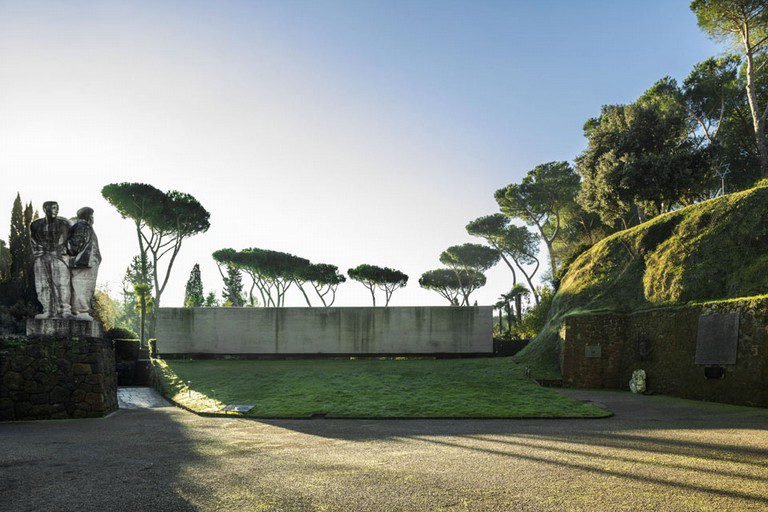
What the Ardeatine Caves Mausoleum Is
The Ardeatine Caves Mausoleum is the collective tomb of the 335 people whom the German occupation troops shot on March 24, 1944 inside some abandoned pozzolana quarries along Via Ardeatina, in reprisal for the attack carried out by the GAP partisans on Via Rasella on the afternoon of the day before. It is not a museum, even though it contains a museum. It is not a cemetery, even though there are 336 sarcophagi. It is a national monument built on the exact spot where the event happened, and this coincidence between the place of the crime and the place of memory is the reason the visit carries a different weight from any other Roman visit.
The distinction matters because it shapes how you behave at the entrance. In a museum you go in to look at objects. Here you go into a war cemetery that is also a work of art of twentieth-century Italy, and the two things have to be held together without the second making you forget the first. The complex is entrusted to the Ministry of Defense, which looks after it through the General Commissariat for Honoring the Fallen, the body in Italy responsible for military memorials. Reception, guided visits and outreach activity are in large part the work of ANFIM, the association of the victims' relatives, born precisely from those families and still today a living guardian of the place.
In our judgment the Mausoleum is the most successful monument of republican Rome and the least visited by Romans themselves. None of the great public works built in the city after the war stands comparison for coherence between form and content. And yet most people arrive knowing the number, 335, and nothing else. The number alone teaches nothing.
The Event That Explains the Ardeatine Caves Mausoleum: Via Rasella, March 23, 1944
To understand why the Ardeatine Caves Mausoleum exists you have to start from a street 200 meters long that climbs toward the Quirinal, right in the center, a quarter of an hour on foot from Piazza Barberini. Rome had been under German occupation since September 11, 1943. The Allies had been stuck at Anzio for two months, hunger in the city was real, roundups were daily, and the Roman Resistance operated with the formations of the Gruppi di Azione Patriottica, the GAP, who acted in small clandestine cells inside the urban fabric.
The Bozen Column
Every afternoon the 11th company of the third battalion of the Polizeiregiment Bozen, a unit of the Ordnungspolizei made up largely of South Tyrolean conscripts, went up Via Rasella in column to return to the Viminale barracks after training. There were about 150 men, they marched singing, and they always passed at the same time. The regularity of that transit is the reason the GAP chose that spot: a military habit repeated every day at the same time and along the same route is, in war, a mistake.
The action took place at around 15:50 on March 23, 1944, the 26th anniversary of the founding of the Fasci di Combattimento. A device of about 12 kilos of TNT had been placed inside a street-cleaning cart. The one who lit the fuse was Rosario Bentivegna, disguised as a street sweeper, who then walked away after Carla Capponi handed him the overcoat to cover his uniform. The group included, among others, Carlo Salinari, who coordinated the action, Franco Calamandrei, Mario Fiorentino, Pasquale Balsamo, Marisa Musu, Lucia Ottobrini, Raoul Falcioni, Silvio Serra, Giulio Cortini, Laura Garroni, Francesco Curreli, Duilio Grigioni, Fernando Vitagliano, Guglielmo Blasi. The explosion was followed by the throwing of some hand grenades from the upper part of the street.
The German dead were 32, on the spot or in the hours immediately after. A 33rd, Vinzenz Haller, died the next day, and this late death had a terrible weight on the count of the reprisal, as we will see.
The Civilians Hit on Via Rasella
Six Italian civilians also died in the explosion and the shooting that followed. Two were killed by the blast: Antonio Chiaretti, 48, a Bandiera Rossa partisan who happened to be passing, and Piero Zuccheretti, a boy of 12. Four others fell under German fire in the frantic minutes that followed: Annetta Baglioni, 66, Pasquale Di Marco, 34, Erminio Rossetto, 20, and the partisan Enrico Pascucci. The 11 confirmed civilian wounded include Orfeo Ciambella, Efrem Giulianetti and Giorgina Stafford. These are names that are rarely cited and that nonetheless belong entirely to this story.
In the minutes after, the Germans rounded up the houses of Via Rasella and dragged out dozens of people, lining them up in front of Palazzo Barberini. Of those men, 10 ended up on the reprisal list and were shot the next day at the Ardeatine Caves, having had nothing to do with the attack.
The Notice That Never Existed
A legend hard to kill has circulated about Via Rasella for 80 years: that the German commands had published a notice inviting the attackers to turn themselves in to avoid the reprisal, and that the partisans evaded it, letting others die in their place. No historical document, no judicial act, no German or Italian archive paper has ever attested the existence of that notice. The reprisal was decided and carried out within 24 hours, in secret, and the Roman population learned of it only on March 25, when the Stefani agency issued a communiqué that spoke of the order already carried out. The communiqué was, in fact, the first and only public information: there was no warning, there was no ultimatum, there was no possibility of exchange.
It is worth adding the legal fact, because that too is the object of recurring manipulation. The British and Italian military courts that tried the German officers classified the attack as an unlawful act in light of the Fourth Hague Convention of 1907, on the premise that the GAP fighters did not meet the formal requirements of a regular combatant. Italian justice, in civil and criminal venues, has instead always recognized Via Rasella action as a legitimate act of war attributable to the Italian State, and the Court of Cassation confirmed it in 1957 in the civil judgment brought by the families of the civilian victims. These are two distinct planes and they have to be kept distinct: whoever mixes them usually does so on purpose.
The Reprisal Order and the Night of March 23 to 24
The Chain of Command
Hitler was informed in the early afternoon of March 23 and reacted by demanding an immediate reprisal that, according to testimony gathered after the war, was supposed to make the world tremble: there was talk of killing 30 to 50 Italians for every German soldier dead. Applied to the letter, that proportion would have meant between 1,000 and 1,500 dead. Field Marshal Albert Kesselring, commander of the Italian front, after consulting the supreme command judged that measure impracticable and set the ratio at 10 to 1, taking up a proposal of General Eberhard von Mackensen, commander of the Fourteenth Army. Mackensen also set the selection criterion: the so-called Todeskandidaten were to be used, those condemned to death and men already liable to capital punishment.
General Kurt Mälzer, city commander of Rome, had rushed to Via Rasella right after the blast and had gone into a rage in front of witnesses. It was Mälzer who tasked SS Lieutenant Colonel Herbert Kappler, head of the security police in Rome, with compiling the list of names. The physical execution was first offered to Major Dobbrick, commander of the battalion hit, who refused. It then fell to Kappler's men.
How the List Was Compiled
The most chilling point of the whole affair is the bookkeeping. Kappler began working on the list on the night of March 23 to 24, and he faced an arithmetic problem: 330 men to shoot, and in the prisons of Via Tasso and Regina Coeli about 290 prisoners at his disposal, of whom only three already sentenced to death and 16 accused of crimes that carried the death penalty. The criterion set by Mackensen, that is shooting the condemned, was materially impossible to apply. Kappler then abandoned it and filled the list with whoever he had.
Ending up on it were 75 Jews who were in prison awaiting deportation, included with the consent of General Wilhelm Harster, and other antifascists of the Jewish religion. Ending up on it were 10 men taken from the Viminale barracks because they were considered known communists. Ending up on it were the 10 civilians rounded up on Via Rasella. Ending up on it was Colonel Giuseppe Cordero Lanza di Montezemolo, head of the Clandestine Military Front, one of the most tortured men of Via Tasso. Ending up on it was Don Pietro Pappagallo, an Apulian priest accused of communist activities. Ending up on it was Aldo Finzi, a Jew, a deputy, formerly undersecretary of the Interior under Mussolini in the early years of fascism and then removed because of the racial laws. Ending up on it were 37 Italian soldiers, among them three generals and three Carabinieri officers.
At 03:00 in the morning on March 24 Kappler believed he had reached 320. Rome's police chief Pietro Caruso, after consulting minister Buffarini Guidi, supplied 50 names taken from the detainees held by the Italian police. Pietro Koch, who led the fascist gang operating out of the Pensione Jaccarino, guaranteed his share by 14:00. Italian collaboration in compiling the list is not a marginal detail: it is documented, it was decisive, and Caruso's trial in September 1944 ended in a death sentence carried out at Forte Bravetta.
Around 13:00 on March 24 came the news of the death of the 33rd Bozen soldier. Kappler, on his own initiative, added 10 names: 10 Jews arrested in the preceding hours. 10 lives added to a list because one man had died in a hospital. This is the mechanism, and there is no way to tell it less coldly than that.
March 24, 1944 in the Quarries of Via Ardeatina
Why the Pozzolana Quarries
The choice of the place was technical, and the coldness of the criterion says a lot. They needed an isolated spot, outside the built-up area, not visible from the road, able to hold 330 bodies and sealable with mines. The pozzolana quarries along Via Ardeatina met all the requirements. They were tunnels dug in the volcanic bed to extract pozzolana, the material that in Rome has always been used to make mortar, and that here had been quarried until the 1930s leaving long corridors between 30 and 90 meters, about four meters high and three wide. They were abandoned. They were right up against the catacomb zone, in a stretch of countryside where in 1944 almost nobody lived.
The geological makeup of the quadrant, moreover, explains the whole story of the area: it is the same soft tuff that made it possible to dig the catacombs of Rome along the southern consular roads. The rock that had allowed third-century Christians to dig kilometers of tunnels allowed the Germans, 1,600 years later, to find in half an hour an execution chamber ready to use and sealable.
How the Execution Unfolded
The transfer of the prisoners began in the early afternoon, with trucks shuttling from Via Tasso and from Regina Coeli. None of the condemned knew where he was being taken. The men had their hands tied behind their backs. Kappler used 74 men from his command, 13 officers including himself, 60 non-commissioned officers and one private, and set a procedure whose stated aim was to spread responsibility: every officer had to fire, so that no one could later claim to be a stranger to it.
The prisoners were brought in in groups of five, led to the end of the tunnel lit by electric flashlights, made to kneel on the bodies already fallen and killed with a shot to the back of the neck, the Genickschuss. Captain Carl Schütz directed the shifts. Erich Priebke, Kappler's aide, checked the list and ticked off the names as the groups entered. Kappler had calculated one minute per man. The start, around 15:30, proceeded with what the trial records called precision and discipline. Then the scene degraded. Some prisoners resisted, some shooters drank, many shots missed the target and repeated shots were needed, many bodies were left devastated. Lieutenant Wetjen refused to fire and Kappler persuaded him by standing next to him and firing with him. Only one officer, Second Lieutenant Günther Amonn, did not manage to go through with it. There were 67 shifts. The last 25 men were killed around 20:00, when it was already dark outside.
The Five Extra Men
When the execution was over Priebke redid the count and noticed that there were 335 bodies in the tunnel instead of 330. Five men had been brought there by mistake, taken from a wrong list or added in the confusion of the transports. They were alive, they had seen everything, and the ordered number had already been reached. Kappler ordered them killed. The reason, reported by SS Major Karl Hass in his postwar depositions, was that they had seen.
Those five men are the reason the total is 335 and not 330, and they are also the charge that held up in court after the war. The courts' reasoning was as follows: reprisal at the ratio of 10 to 1 could be discussed within the categories of the laws of war of the time, but the killing of five people in excess of the order received was plain murder, with no cover from any superior order. The bookkeeping that had built the massacre became, five men at a time, the instrument that condemned its authors.
The Blasting of the Tunnels
When the execution was finished, the German engineers mined the entrances and set off the charges to seal the quarries and erase every trace. The explosions were heard by the Salesian religious who had a house nearby, who in the following nights went down into the tunnels: they found corpses piled in heaps more than a meter and a half high. It was they, together with some local residents, who spread the news of what had really happened, while the official communiqué spoke generically of an order carried out.
From that moment and for the following 14 months the quarries remained a semi-clandestine place of pilgrimage. The women looking for a missing husband or son went up along the Ardeatina and left flowers in front of the blocked entrances. The memory of the place is born there, before any monument and before any architecture competition: it is born from those who did not yet know whether under that earth there was their own name.

The 335 Victims of the Ardeatine Caves Mausoleum
The number has become a fixed expression, and like all fixed expressions it has ended up covering what it names. 335 men, no women. The youngest was 15, the oldest 74. Among them were generals and tailors, lawyers and bakers, university professors and boys working as errand boys. The list was compiled in one night by an officer who needed to fill a numerical box: that is why the human sample that results strikingly resembles a cross-section of the Rome of 1944.
The Makeup of the Group
The historical reconstruction of the administrative categories under which the prisoners were registered gives this picture: 154 were at the disposal of the Aussenkommando, 23 awaiting trial, 16 already sentenced, 75 held as Jews, 40 detained for political reasons, 10 detained for public security reasons, 10 arrested on Via Rasella after the attack, and one had even been acquitted by a German tribunal and had not yet left prison.
If instead you look at political and military affiliations, based on the identified remains, the picture is that of a very plural Roman Resistance: about 50 men of Bandiera Rossa, the communist movement not aligned with the PCI that in Rome had an enormous weight and a much smaller memory, about 50 from the Partito d'Azione and Giustizia e Libertà, about 40 soldiers of the Clandestine Military Front and the Badoglian formations, 19 Freemasons, socialists, communists, monarchists, Catholics, anarchists. There are also common prisoners, men who were inside for crimes with no relation to the war and who ended up on the list because numbers were needed.
At least nine victims were foreign: Giorgio Leone Blumstein and Salomone Drucker, born in Lviv. Sandor Kereszti, from Budapest. Boris Landesman, from Odessa. Marian Reicher and Schachne Wald, Poles. Eric Heinz Tuchman, from Magdeburg. Paul Peisach Wald, from Berlin. Bernard Soike. They were Jews who had fled eastern and central Europe and had believed they would find refuge in Rome. The city gave them back to German fire.
The 75 Roman Jews
The Ardeatine Caves massacre is the largest massacre of Jews carried out on Italian soil. At least 75 of the victims were held for racial reasons, and most of them came from the roundup of the Jewish quarter or from the arrests carried out in the months after October 16, 1943. Some Roman families lost several men in the same night, fathers and sons together, and the surnames Di Consiglio and Di Veroli recur several times on the tombs. The link with the history of the Ghetto is direct and material, and anyone who wants to follow it all the way should devote another half day to the Jewish Museum of Rome and the Synagogue of Rome, where the room devoted to the Roman Shoah tells the story of October 16 and its consequences.
A detail little known in Rome: among the 75 are men arrested in the street in the last 48 hours, that is, added to the list when the count had to be closed. The total randomness of the criterion, in those hours, struck first the most exposed and most easily findable community. It was not a case of ideological selection. It was a choice of administrative convenience, which, if possible, makes it worse.
The Youngest and the Oldest
The youngest of those shot was Michele Di Veroli, born in Rome on February 3, 1929: he was 15 years and one month old. With him, of the same age, Duilio Cibei, born on January 8 of the same year. The oldest was Mosè Di Consiglio, born in Rome on January 25, 1870: 74 years old. Between the oldest and the youngest run 59 years, two whole generations, and this fact alone dismantles any attempt to narrate the Ardeatine Caves as a military event between combatants.
In front of the tombs it is worth looking for the birth dates instead of the names. It is a brutal but effective exercise: you go from a list to a set of biographies in less than a minute. The plaques carry name, surname, date of birth, profession, and the profession is the part that strikes the most: bricklayer, typographer, lieutenant colonel, student, shopkeeper, coachman, engineer.
The Names Everyone Knows
Some of those shot have a name that has entered Roman street names. Colonel Giuseppe Cordero Lanza di Montezemolo led the Clandestine Military Front, that is the network of officers of the Royal Army who stayed in Rome after September 8. He was arrested in January, tortured for two months in Via Tasso and did not talk. Don Pietro Pappagallo, a priest from Terlizzi, had hidden Jews and draft evaders and supplied them with false documents. General Sabato Martelli Castaldi, General Simone Simoni, Colonel Giovanni Frignani, who had played a part in Mussolini's arrest in July 1943, Carabinieri Major Ugo De Carolis. Aldo Finzi, who had been a deputy and undersecretary in Mussolini's first government and who ended up shot as a Jew by the regime he had helped bring to power: his story is perhaps the most dizzying of the whole list.
Anyone who wants to follow the thread of the military in the Roman Resistance will find material at the Infantry Historical Museum and the Carabinieri Historical Museum, where the story of the Clandestine Military Front and that of the carabinieri deported or shot are documented with papers and relics.
The Recovery of the Bodies at the Ardeatine Caves and the Work of Attilio Ascarelli
Rome was liberated on June 4, 1944. On June 10 the Ardeatine Quarries Commission was established, chaired by the American colonel Charles Poletti, Allied governor of the city. On July 26 the exhumation and identification operations began, which would last until November. That is four months of work that make up the most forgotten and most decisive page of the whole affair: without that work the Ardeatine Caves Mausoleum would today be an anonymous ossuary, and the Italian memory of the massacre would have remained a number without faces.
Who Attilio Ascarelli Was
Attilio Ascarelli was a Roman forensic doctor of a Jewish family, a university professor, removed from teaching by the racial laws of 1938 and forced into hiding during the occupation. At the liberation he was entrusted with the scientific coordination of the recovery. He was 63. He worked for months in conditions that no manual contemplates, and produced a technical report that has remained the reference document on what happened inside the quarries.
The fact that the man charged with giving the victims their names back was a Roman Jew expelled from the university by the same regime that had handed those victims to the Germans is not a colorful detail. It is the reason why, on the visit route, a stop of its own is devoted to him, on a par with the monument and the tombs.
The Identification Method
The operations were carried out jointly by the Commission, Ascarelli's medical team, the fire brigade unit detached to the Verano, and the cemetery staff. The first phase was clearing: the explosions had collapsed the vaults of the tunnels, and to reach the bodies about 2,000 cubic meters of material had to be removed. Only afterward did the actual extraction begin.
Each body extracted was numbered and taken to the forensic unit, where it was put back in order and received a religious service officiated by a priest and a rabbi together, over every body, because at the time of discovery it was not possible to know which of the two communities it belonged to. Given the advanced decomposition after four months, recognition relied on physical and anatomical features, on dentistry, on clothing and personal objects found on the body: a ring, a letter, a pair of glasses, a uniform button, a tram ticket. Relatives were then called to recognize the effects laid out on tables.
The result is surprising for the time and for the conditions: Ascarelli's team gave a name to more than 320 of the 335 victims. Very few remains stayed without identity and they rest in the tombs with only the indication of unknown. Anyone who visits today and stops in front of those few mute plaques understands, better than with any caption, what it means to erase a person.
What the Autopsies Said
The autopsies overturned the version that circulated in the city. There was no mass shooting in a volley: the examinations showed that each victim had been killed individually, with one shot from a handgun to the back of the neck fired at very close range. The cases in which multiple shots had been needed were documented, as were the injuries indicating bodies fallen on top of other bodies. This technical evidence became the backbone of the prosecution in the later trials, because it turned a collective reprisal into a series of 335 individual executions, each with an identifiable perpetrator.
From the Site of the Massacre to the Monument: The Competition
The Italian government took on the commitment, right after the liberation, to erect on the site a monument to the perpetual memory of the martyrs. The city announced the competition in September 1944. The council resolution approving it is dated January 15, 1945, with a deadline of April 10 of the same year. It was the first architecture competition of liberated Italy, and this gives the measure of how much the event weighed on public conscience: before houses, before schools, before bridges, a tomb was put out to competition.
The Judging Commission and the First Round
The commission was chaired by the mayor of Rome Filippo Andrea VI Doria Pamphilj and included Luigi Piccinato, Enrico Tedeschi, Enrico Calandra, Aldo Della Rocca, and at a later point De Angelis d'Ossat representing the families. In the first round, projects presented under mottos, as was customary, were examined: Apoteosi by Vittorio Alegiani and Mario Cavalleri, Giovine Italia by Giovanni Jacobucci, Per aspera ad astra by Franco Minissi, T.F.B. by Luigi Mainardi and Antonio Morroni, Le palme by Ildebrando Savelli and Francesco Pennisi, Pax by the Baccin brothers, A tre by Beniamino Barletti, Cesare Ligini and Roberto Nicolini, Non dolet by Nicola Cantore, Nello Ena, Costantino Forleo and Gaetano Minnucci, U.G.A. by Giuseppe Perugini and Uga de Plaisant, Passi sunt by Giorgio Scazzocchio, Risorgere by Nello Aprile, Cino Calcaprina, Aldo Cardelli and Mario Fiorentino with the sculptor Francesco Coccia.
The commission advanced four projects to the second round: Risorgere, U.G.A., Non dolet and Passi sunt. The stated criterion was the ability to renounce monumental rhetoric. In 1945, in Italy, a war memorial still meant columns, eagles, lictor's fasces readapted as best they could: the request to reject that vocabulary was, in itself, a political stance.
The Second Round and the Two Winning Groups
On September 2, 1946 the commission declared the projects Risorgere and U.G.A. joint winners. The sculptor Mirko Basaldella had meanwhile joined Perugini's group, proposing an abstract work on the theme of the angel. A tie, in an architecture competition, is usually the mask of an embarrassment. Here instead it produced the best possible result: the two groups were invited to work together, and the monument you visit today is the collective work of five architects, Nello Aprile, Cino Calcaprina, Aldo Cardelli, Mario Fiorentino and Giuseppe Perugini, and two sculptors, Mirko Basaldella and Francesco Coccia.
Mario Fiorentino would later become one of the major names of postwar Roman architecture, the man behind Corviale. Giuseppe Perugini is the one of the experimental house in Fregene. At the Ardeatine Caves they were all young or very young, out of the war for only a few months, and they designed their most mature work at the start of their careers. It is a rare circumstance in the history of architecture, and worth keeping in mind while you walk under the slab.
The Families' Opposition and the Compromise
The winning design called for a raised slab on the esplanade, at the spot where there were previously four water tanks. The victims' families, gathered in associations and backed by the ANPI, objected: they wanted their dead to stay inside the tunnels, at the exact spot where they had been killed, and not in a new construction built alongside. On February 2, 1947 they presented an alternative design for burial in the quarries, which the Ministry of Public Works accepted with an allocation of 70 million lire.
It was a real controversy, a bitter one, and its resolution is the key to reading the whole monument. After the third anniversary of the massacre a compromise was reached that Minister Umberto Tupini supported: above-ground burial, in sarcophagi gathered under a single covered space, external to the tunnels but physically connected to the site of the massacre. Put differently: you visit the quarry where they were killed and then pass, without leaving the enclosure, into the chamber where they are buried. The route and its sequence are the result of a negotiation between architects and widows, and this is the reason why it works.
The Construction Site and the Inauguration
The construction site opened on November 22, 1947 and lasted two years. For the construction an additional 130 million lire was allocated. The inauguration took place on March 24, 1949, the fifth anniversary of the massacre, in the presence of authorities, partisan and deportee associations, students and a crowd of ordinary citizens.
The works were not finished, however. The gate by Mirko Basaldella was completed in 1951, after a heated debate, because part of public opinion and of the families themselves judged that violent abstraction ill suited to a tomb. Final approval came in March 1950. The sculptural group by Francesco Coccia and the museum, designed by Perugini, completed the complex in the following years. The Mausoleo delle Fosse Ardeatine, in short, was not born all in one day: it settled over a decade of public discussion, which makes it also a document on how republican Italy learned to speak of its dead.
The Architecture of the Mausoleo delle Fosse Ardeatine
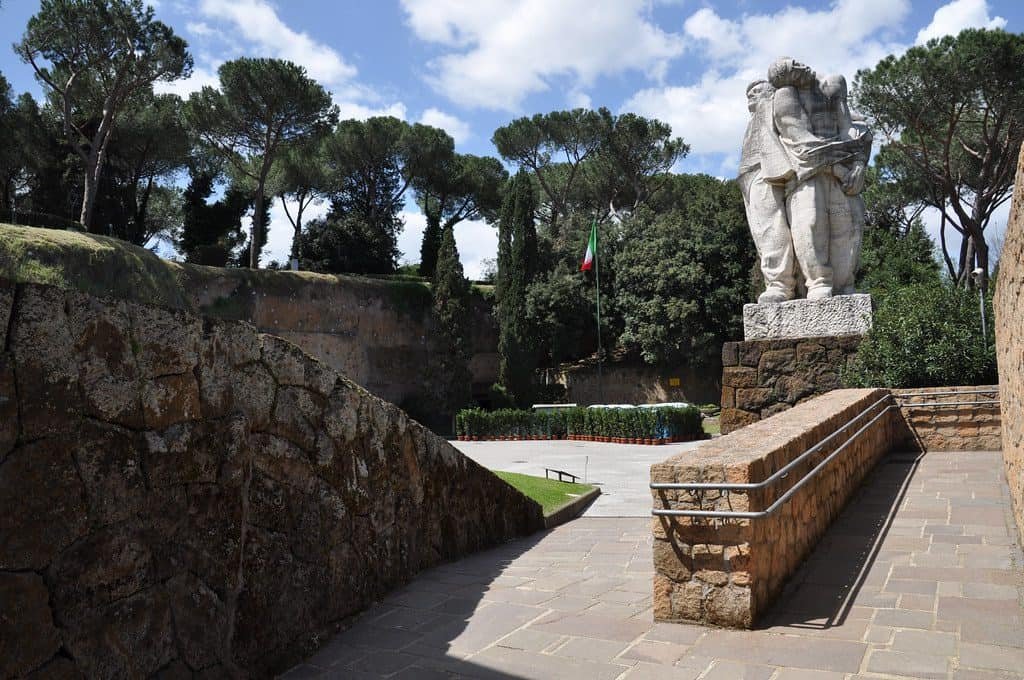
The complex is considered by many historians the first modern Italian monument, and the definition holds. There is not a single element of the traditional commemorative language: no column, no equestrian statue, no Latin inscription, no architectural order. There is a rustic wall of sperone stone that encloses the area and separates it from Via Ardeatina, an esplanade, the mouths of the quarries, and a slab.
The Suspended Slab of the Mausoleo delle Fosse Ardeatine and the Reason for That Solution
The shrine is a hollow reinforced-concrete monolith with a rectangular plan, 25 meters by 50 and 3.55 meters high, sunk two meters into the ground. It does not rest on the ground along the perimeter: between the base and the roof runs a thin continuous slit of light. From the outside the result is that the roof seems to float, resting on nothing, like a tombstone of oversized dimensions laid above the ground.
The solution answers a precise problem, and the answer is the reason this architecture is studied in schools. The designers had to build a collective tomb without falling into the rhetoric of the monument and without building a church, since among the buried there were Catholics, Jews, atheists and men of every political conviction. They chose the most elementary funerary object that exists, the gravestone, and enlarged it until it became a building. Under the tombstone are the dead. Nothing else is needed, and any symbolic addition would have weakened the idea.
There is a second effect, which you only grasp on entering. The crack of light along the whole perimeter brings inside a low, raking blade of light at the height of the sarcophagi, while the volume overhead stays dark and looming. You walk in a half-light pressed down from above, with the light arriving from below and from the sides. The ceiling is slightly curved to soften the compression, that is, to keep the space from becoming unbearable. Even so, anyone who enters instinctively lowers their voice in the first three meters. It is not a theatrical effect, it is a well-made calculation of proportions.
The Esplanade, the Wall and the Sequence of the Visit
The layout of the complex imposes a route and leaves no choices. You enter by the gate on Via Ardeatina, cross an esplanade, meet the sculptural group, descend into the quarry tunnels, climb back up and enter under the slab. The sequence is narrative: first the context, then the place of the crime, finally the burial. Anyone who walks it in reverse, and it happens to those who arrive in a rush, loses half the meaning.
In the forecourt a space is dedicated to the Marzabotto massacre, and the Christian cross and the Star of David appear together there, the two signs that reflect the religious makeup of the people buried. It is a very carefully weighed choice of balance for the Italy of 1949, when the idea of giving the two symbols equal visual dignity in a public space was by no means a given.
Mirko Basaldella's Gate at the Fosse Ardeatine Mausoleum
The entrance gate is the work of Mirko Basaldella, from Friuli, brother of the painter Afro and the sculptor Dino, and on its own it would be reason enough to come all the way out here. It is made of bronze, about six meters long, and it represents nothing recognizable: it is a tangle of thorny, thread-like, twisted forms that alludes at once to barbed wire, tortured bodies and burned vegetation. The language is expressionist and informal in origin, years ahead of the Italian artistic debate.
In 1950 that abstraction set off a public controversy that is striking to reconstruct today: people debated if a non-figurative work was respectful of the dead, if the families had a right of veto, if modern art could enter a national shrine. Approval came in March of that year and the work was completed in 1951. Two other examples, smaller in size, were placed inside the complex.
Mirko's gate is the artistically highest thing in the whole monument, and the most misunderstood. Anyone who arrives expecting a wrought-iron gate with the dates stamped on it is left disoriented, and is right to be. That tangle is the only element of the complex that tries to represent the violence instead of commemorating its victims, and it is there precisely to keep the visit from becoming consoling. Look at it against the light from the inside, when you leave: it reads much better than from the outside.
The Three Ages of Francesco Coccia
The sculptural group that presides over the forecourt is by Francesco Coccia, the sculptor of the group Risorgere. It is carved in travertine and rests on a base of tuffaceous stone from Monte Compatri. It depicts three naked men, pressed against one another and bound, of three different ages: a young man, an adult, an old man. The work is known as The Three Ages, and it alludes to the moment when the prisoners were led toward the quarries.
The choice of three ages is not a generic allegorical device: it matches the real fact that inside those tunnels a boy of 15 and a man of 74 were killed together. The sculpture is figurative, much easier to read than Mirko's gate, and the presence of the two languages in the same enclosure is one of the reasons the complex interests art historians so much: they are two opposite ways of answering the same question, and they coexist without canceling each other.
If I had to name the best spot to look at it from, I would say three-quarter view, with the slab of the shrine in the background. In that frame you understand the relationship of scale the designers built: the human figure stays small, the stone lid dominates everything, and the message is that individuals were swallowed up by something enormously bigger.
The Shrine and the Sarcophagi of the Fosse Ardeatine Mausoleum
Under the slab there are 336 granite tombs, arranged in seven double rows. 335 belong to the victims of the massacre. The 336th is empty and is dedicated to the martyrs of Italy, that is, to all those who fell in the Nazi-Fascist massacres and have no tomb. That empty sarcophagus is, for those who know how to read it, the most demanding element of the monument: it declares that this is not only the tomb of 335 Romans, but the place where the country decided to lay symbolically all its dead without a grave.
The Order of the Tombs at the Fosse Ardeatine Mausoleum
The sarcophagi are not ordered alphabetically, or by age, or by political or religious affiliation. They follow the order of exhumation, that is, the order in which the bodies were pulled out of the tunnels in the summer and autumn of 1944. It seems like a technical detail and is in fact a precise moral decision: whoever enters finds no hierarchy, no general in front and stable boy at the back, no Jews separated from Catholics. They find the random order in which the earth gave them back.
Each slab carries name, surname, date of birth and profession, and many have a photograph. The few that have no name bear only the word unknown. Fresh flowers are a constant presence: the families keep bringing them, and 80 years after the massacre the loving upkeep of this place is still in the hands of the victims' descendants, not the State.
What It Feels Like to Walk In
A direct answer, because it is the most frequent question before going in. The space is low, dark and 50 meters long, and it produces a physical sense of oppression that no photograph conveys. Many visitors walk down the central corridor without stopping, to get out sooner. It is an understandable mistake but it is a mistake: the visit only makes sense if you stop in front of at least about 10 tombs and read the details in full. 335 gravestones read in bulk stay a number. 10 gravestones read one by one become 10 people.
The Quarry Tunnels and the Underground Route
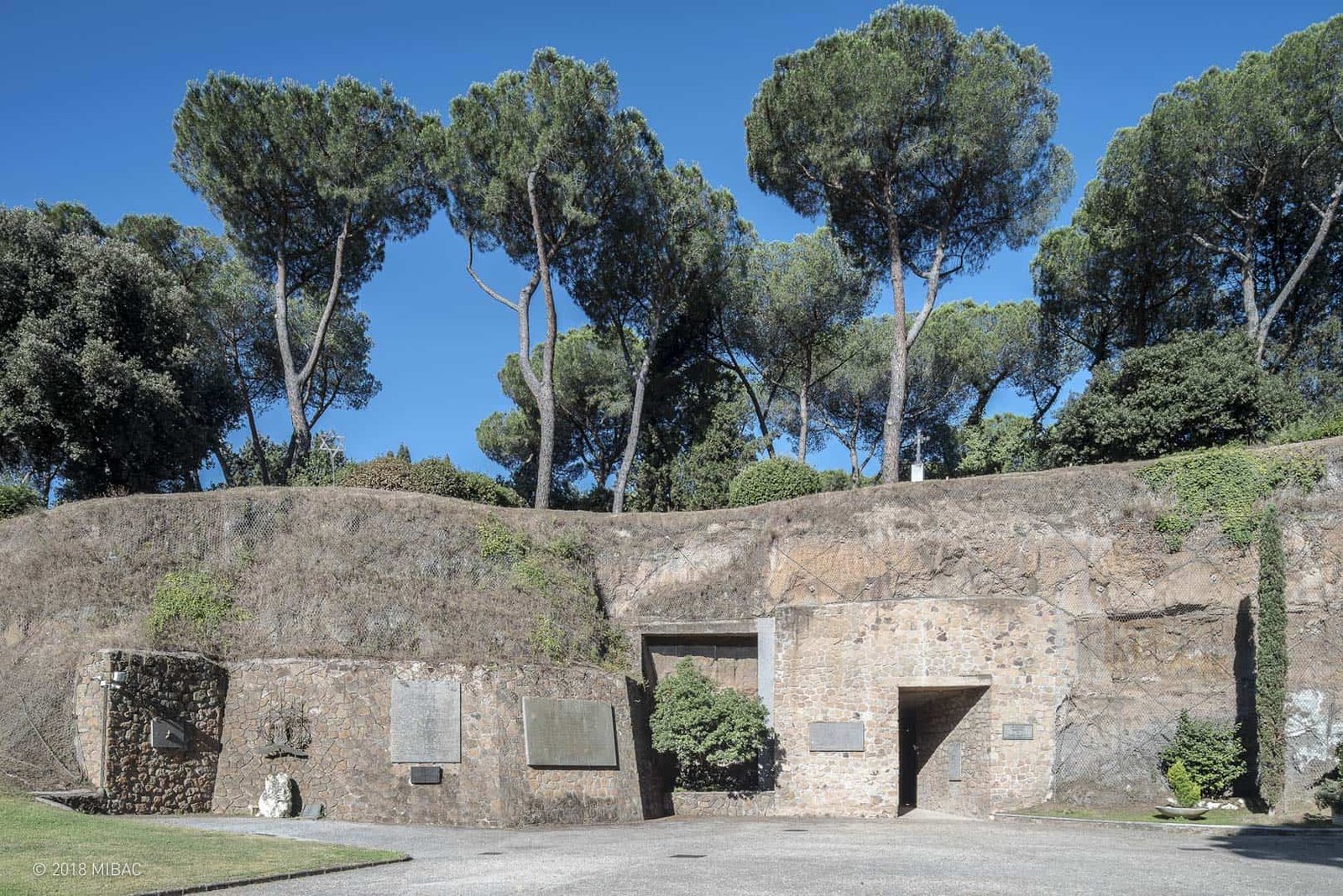
Before the shrine you enter the quarries. The tunnels have been reinforced and made walkable, and the route leads to the point where the execution took place. The floor is still the original one, the rock is the same, the height is the original: you walk inside a space dug to extract building material and used for 24 hours as an execution chamber.
There are dim lamps and a few plaques. At the spot of the shooting a gravestone marks the event, without emphasis. The temperature is the constant one of the Roman tuff subsoil, around 15 degrees even in August: if you visit in summer, bring something to put on, as you would for the catacombs.
The connection with the nearby quarries is direct: we are in the middle of the system of tunnels that also produced the Catacombs of San Callisto, a few hundred meters away, and the catacombs of Domitilla. Anyone who visits the two underground sites on the same day takes home a comparison worth a history course: the same tunnels, the same rock, 1,600 years apart, and two opposite ways of treating the dead.
The Relics Museum of the Fosse Ardeatine Mausoleum
Behind the slab of the shrine is the museum, designed by Giuseppe Perugini and dedicated to the historical reconstruction of the massacre and of the context in which it came about. It displays documents, photographs, relics, personal objects that belonged to the victims, materials on the occupation of Rome between September 1943 and June 1944. This is where you understand the papers: the orders, the telegrams, the lists, the minutes of the identifications.
The museum has slightly shorter hours than the mausoleum, 15 minutes less at closing, and anyone who arrives close to closing risks finding it already shut while the shrine is still open. That is the practical reason I advise never showing up in the last hour: you lose exactly the part that gives meaning to the rest.
On the educational value, one precise opinion. The photographs of the recovery of the bodies, displayed together with Ascarelli's documents, are harsh and need preparation if you are with a school group. They are not gratuitous: without those images nobody would understand what it means to give a name back to a body after four months under a landslide. But they must be introduced beforehand, not found by chance around the corner.
How to Visit the Fosse Ardeatine Mausoleum Today
Hours, Entrance and Booking
Admission is free and there is no need to book for an individual visit. The mausoleum opens at 8:15 every day. It closes at 15:30 Monday through Friday and at 16:30 on Saturday and Sunday. The museum inside closes 15 minutes earlier in both cases, so at 15:15 on weekdays and 16:15 on weekends. Annual closures fall on January 1, Easter, May 1, August 15, December 25 and 26. The early morning opening hours and the early-afternoon closing on weekdays are the first cause of wasted trips: anyone who plans the visit after lunch on a working day almost always arrives late.
Guided Tours of the Fosse Ardeatine Mausoleum and the First Sunday of the Month
Guided tours are organized by the ANFIM and must be booked at least one week in advance, by writing to info@anfim.org or calling 06 6795629. There is also a WhatsApp contact at 392 4484043. They are open to schools of every level, organized groups and small groups of five or more participants.
Then there is an initiative that I consider the most precious thing in the whole place and that almost no one knows about: on the first Sunday of every month the guiding is entrusted to the victims' relatives, free of charge, as part of the program dedicated to the city's remembrance. Hearing the story of your own grandfather's tomb from someone who carries that surname is an experience with no equivalent in any Roman museum. If you can choose the date of your visit, choose that one.
The Audio Guide and the Six-Stop Route
The complex has an audio guide that accompanies the visitor along a route divided into six stops: the entrance, the mausoleum, the historical event, the figure of Attilio Ascarelli, the tombs, the relics museum. The structure of the route is well designed, because it puts the reconstruction of the event before the burial and gives a separate stop to the work of identification, which elsewhere would have been dismissed in three lines.
How Long the Visit Takes
One hour is the minimum to avoid rushing. An hour and a half is the right length for anyone who wants to read the gravestones and stop at the museum. With a school group and a guide it takes a full two hours, questions included, which in this place always come and are almost always good. It is not a visit that pairs well with something else in the same hour: it is better to put an outdoor walk before or after, on the Appian Way or at Caffarella, to get some air.
How to Get to the Fosse Ardeatine Mausoleum
To the Fosse Ardeatine Mausoleum by Public Transport
The complex is served by ATAC lines 118 and 218. From Termini the two most convenient combinations are Metro A to San Giovanni and then the 218, which goes up Via Ardeatina and stops in front of the entrance, or Metro B to Circo Massimo and then the 118, which runs past the Baths of Caracalla, Porta San Sebastiano and the Appian Way. The 118 is the choice I recommend to first-time visitors: you cross half of ancient Rome before arriving, and the passage from city to countryside helps you understand why in 1944 that stretch of Via Ardeatina was considered out of the way.
If you arrive from Ostiense or EUR, you can also count on the lines serving the inner stretch of Via Ardeatina, with a stop at Navigatori, from which however a stretch on foot remains. Bus frequency in this quadrant thins out a lot on weekends and in the middle of the day: check the departures before setting out, especially for the return, because waiting half an hour in front of the gate after this visit is heavier than usual.
By Car and by Bicycle
The entrance on Via Ardeatina has parking, and it is one of the few Roman places of memory where arriving by car is not a problem. Bicycles, motorcycles and scooters cannot enter the complex: you leave them outside. Anyone arriving by pedaling along the Appian Way, which many do on Sundays when the stretch is closed to traffic, has to factor in this step.
On Foot from the Appian Way
From Via Appia Antica, at the height of the Catacombs of San Sebastiano, you reach Via Ardeatina by crossing the countryside on a walk of about 20 minutes. It is the best way to arrive, because you walk the same landscape the German trucks crossed on March 24, 1944, and because it lets you tie together in a single day the Christian burial ground, the burial ground of the Resistance and the farming landscape of the Appian Way Park. Closed shoes, though: in winter the ground is muddy.
How to Behave Inside the Fosse Ardeatine Mausoleum
This is the part no tourist page writes, and it is the only truly indispensable thing. In here there are 335 tombs and the relatives of those buried here still come, every week. It is not a metaphor and not a figure of speech: it is likely that while you are visiting there will be a family in quiet reflection in front of a tomb.
Low voice, always. Phones on silent, and calls made outside the enclosure. No food and no drinks inside. Head coverings off under the shrine, whether a hat or a hood, with the exception of the kippah. Nobody sits on the sarcophagi and nobody leans backpacks or bags on them. With a class, the rule that works is to say all this before going in through the gate, not after: inside you don't lecture, you keep quiet.
On clothing there is no written code, and there is no need to dress in black. What is needed instead is to avoid showing up in beachwear, which happens in summer and looks very out of place. The criterion is simple: here you behave as in a cemetery, because this is a cemetery.
March 24: The Commemoration at the Fosse Ardeatine Mausoleum
Every year, on March 24, the Mausoleum hosts the official commemoration of the massacre. It is the ceremony attended by the highest offices of the State, the ANFIM, the Resistance associations, the City of Rome, representatives of the Jewish Community and the schools. On major anniversaries the attendance of the President of the Republic is established custom.
The ritual includes the laying of wreaths, the reading of the victims' names and silence. The reading of the names, one by one, takes a very long time, and it is the part that strikes anyone attending for the first time: 335 names spoken aloud take a length of time nobody imagines before hearing it.
A practical warning: on March 24 and the days immediately around it, access may be limited or regulated for security reasons, and the ordinary hours go out the window. Anyone who wants to take part must ask the ANFIM in advance. Anyone who simply wants to visit the complex would do better to choose another day, because that is the day of the families and the institutions.
The Trials: Kappler, Priebke, Hass
The 1948 Trial of Herbert Kappler
Herbert Kappler commanded the Sicherheitsdienst, the Sicherheitspolizei and the Gestapo in Rome, and through them he also effectively controlled the Fascist police apparatus. He was tried by an Italian military court in 1948, together with some of his subordinates, for the Fosse Ardeatine massacre and for the gold extortion imposed on the Roman Jewish community in September 1943.
The sentence follows the logic described above: he was given a life sentence for the victims killed in excess of the order received, that is, for the five extra men, and for the manner of the execution. A further penalty of 15 years concerned the extortion of the 50 kilograms of gold. It is an outcome that, 80 years later, still keeps legal historians arguing, because in effect the reprisal itself was not considered a crime while the accounting discrepancy was. Debatable as it may be, that reasoning was nevertheless the only one that allowed a full conviction in 1948.
Gaeta, the Celio and the 1977 Escape
Kappler served his sentence in the military prison at Gaeta, in the Angevin fortress, where he married in 1972. In 1976, ill with cancer, he was transferred by decision of Defense Minister Arnaldo Forlani to the Celio military hospital, into a room on the third floor guarded by the Carabinieri. In the early hours of August 15, 1977, he escaped with his wife's help and took refuge in Germany. On the manner of it, conflicting versions circulate, including those given at different times by his relatives, and none has ever been established definitively. He died in Germany in February 1978, at the age of 70.
The escape had heavy political consequences and was felt as an affront by the victims' families. It has to be said in full: the man who had compiled the list died free, in his own bed, 34 years after the massacre.
Priebke and Hass in the 1990s
Erich Priebke, an SS captain and Kappler's aide, had checked the list at the Ardeatine and had personally fired. He lived for decades in Bariloche, Argentina, where he was identified by a U.S. television crew. On November 2, 1995, the Argentine Supreme Court granted the Italian extradition request, and on November 21 Priebke arrived in Italy.
The first trial opened before the Military Tribunal of Rome on May 8, 1996, and closed on August 1 with a declaration that proceedings should not continue because the statute of limitations had expired, and with an order for his release. The public reaction was immediate: the crowd surrounded the courthouse and for hours prevented the defendant from leaving. On October 15, 1996, the Court of Cassation annulled that ruling.
The new trial opened on April 14, 1997, in the bunker courtroom at Rebibbia, with SS Major Karl Hass also on trial, who at the Ardeatine had escorted the victims and had given the decisive testimony on the five extra men. On July 22, 1997, the sentence was 15 years, 10 of them covered by amnesty. On March 7, 1998, the Military Court of Appeal reformed the ruling and sentenced both to life, and on November 16, 1998, the Court of Cassation made it final. A few months later Priebke obtained house arrest in Rome for reasons of age and health, and stayed there until his death on October 11, 2013, at the age of 100. His funeral was a public affair and no municipality wanted his burial.
The fact that the last trial for the Fosse Ardeatine took place more than 50 years after the events, and that it took a television crew to reopen it, is a part of Italian history that this place tells in spite of itself.
The Historical Museum of the Liberation, the Complementary Site
The Fosse Ardeatine Mausoleum cannot be fully understood without Via Tasso. At 145 Via Tasso, a couple of steps from San Giovanni, stood the prison of the German security police: the cells where Montezemolo, Don Pappagallo and dozens of other men were locked up and interrogated, men who on March 24, 1944, were loaded onto the trucks and taken to the Ardeatina. Today that building is the Historical Museum of the Liberation, and it preserves the cells intact, with the prisoners' graffiti on the walls.
The museum is open every day from 9:00 to 19:00, Sundays and holidays included, with closures on Christmas, New Year's Day, Easter and Ferragosto. Admission is free, with a voluntary donation. Booking is required only for groups of more than six people, 15 days in advance, while guided tours for schools and organized groups require 20 days and a maximum of 25 participants. Guides are suspended in July and August. There are free audio guides in Italian, English, Spanish and German. Phone 06 7003866.
The order I recommend is Via Tasso in the morning and the Ardeatine the next day, not the same day. Doing the two things within a few hours is technically possible and psychologically wrong: the cell room is one of the hardest experiences in the city, and arriving at the Mausoleum right after means walking through it without seeing it. A third piece, for those who want to complete the picture, is the Casa della Memoria e della Storia in Trastevere, home to the institutes and associations that hold the archives of the Roman Resistance.
What Is Around the Fosse Ardeatine Mausoleum
The complex sits in a quadrant worth a whole day. Within a kilometer are the Catacombs of San Callisto, the largest of Rome's underground Christian cemeteries, with the crypt of the third-century popes. A little further on are the Catacombs of San Sebastiano and the Basilica of San Sebastiano fuori le mura. On the Appian Way, at the start of the ancient stretch, stands the little church of Domine Quo Vadis, and toward the city the monumental gate of the Aurelian Walls, Porta San Sebastiano, with the Museum of the Walls.
Anyone continuing south along the Appian Way reaches the Villa of the Quintilii, the largest suburban villa in the Roman suburbs. To the west, on the other side of Via Ardeatina, opens the Caffarella valley, which is the best way to walk back toward San Giovanni, crossing real countryside inside the Grande Raccordo.
On the urban side, the natural completion of the visit is the places of memory in the center: Via Tasso, the Ghetto, the Jewish Museum of Rome. Anyone interested instead in military history and monumental burials can plan on the Verano Cemetery, where worked the staff who collaborated in the recovery of the bodies in 1944, and the Pyramid of Cestius with the nearby Non-Catholic Cemetery.
A logistical tip: around here there are no corner cafes. The stretch of Via Ardeatina in front of the Mausoleum has no services, and anyone arriving with a class or a group of elderly people must plan for water and a stop before or after, toward San Sebastiano or toward Caffarella. The complex has restrooms, but no refreshment point.
The Fosse Ardeatine Mausoleum with Schools and Young People
It is one of the places most visited by Roman schools, and rightly so. But it is also one of the easiest to get wrong. It happens that classes arrive without knowing what Via Rasella was, cross the shrine in seven minutes and leave commenting on the architecture. The problem is not the kids: it is the preparation.
What works, from direct experience, is arriving having already worked in class on three things: the chronology of the nine months of occupation of Rome, from September 8, 1943, to June 4, 1944. The mechanics of the reprisal, that is, the 10-to-one ratio and the compiling of the list. And at least five individual biographies, chosen among the victims, to assign to small groups. With this baggage, the visit lasts twice as long and produces real questions.
On age: under 11 or 12 the relics museum is heavy, and the photographs of the recovery of the bodies may be too much. The shrine and the tunnels, on the other hand, are bearable at any age as long as there is an adult who explains beforehand and does not leave the group to itself inside. For middle school and high school it is, without hesitation, the most effective contemporary history visit Rome offers.
The tours led by the victims' relatives, on the first Sunday of the month, are an opportunity worth chasing even outside the school calendar. A kid who hears an elderly gentleman say his father's name in front of a tomb learns something no lesson conveys.
Accessibility at the Fosse Ardeatine Mausoleum
The visiting route of the Mausoleum is accessible to people with motor disabilities. The forecourt is flat, the shrine is at ground level and the corridors between the tombs are wide. The underground stretch of the quarries, by the nature of the place, has a more uneven floor and slopes: anyone with particular needs should call beforehand, because the staff knows the route and can point out the best alternative.
The lighting inside the shrine is deliberately low, and anyone with vision problems struggles to read the gravestones: a small flashlight, used discreetly and without pointing it at other visitors, solves it. The parking at the entrance reduces to a minimum the stretch to be covered for anyone arriving by car with a person who has difficulty walking.
When to Go to the Fosse Ardeatine Mausoleum and When to Avoid It
The best time is early morning, just after the 8:15 opening, on a weekday. The complex is almost empty, the raking light comes in through the perimeter slot at the right angle, and you can read at your leisure. The second choice is Sunday morning, which has the advantage of the longer hours and, on the first one of the month, of exceptional guides.
To avoid: weekday early afternoons, because you arrive close to closing. The days around March 24, if you are not coming for the commemoration. And days of pouring rain, because the route includes outdoor stretches and the floor of the quarries becomes slippery. August works better than you would think, except for the day of Ferragosto when the complex stays closed: the underground temperature is constant and the city is empty.
One last thought on the calendar: on April 25 and June 2 the place has above-average attendance, with wreath-layings and institutional presences. It is not a problem, but anyone looking for silence should choose another day.
A Curiosity About the Fosse Ardeatine Mausoleum
The curiosity that almost no one knows concerns the sarcophagi and their order. Anyone entering under the slab expects alphabetical order: it is the criterion of all the military shrines in the world, from the Verano Ossuary to the Allied war cemeteries. Here instead the 335 tombs follow the order of exhumation, that is, the sequence in which the bodies were extracted from the tunnels between July and November 1944 and numbered by the forensic unit.
It means that the first tomb of the first row corresponds to the first body pulled out of the landslide, and the last to the last. There is no relation with the alphabet, with military rank, with age, with religion or with party. A division general can find himself next to a baker, a Jew next to a Catholic priest, a man of Bandiera Rossa next to a monarchist officer. It was a conscious choice, discussed and wanted: the only order allowed had to be the one in which the earth had given them back, because any other criterion would have reintroduced a hierarchy where the Germans had made none.
There is a second layer to this curiosity. The exhumation numbering is not as random as it seems: it depends on the position of the bodies in the tunnels, and the position of the bodies depends on the order in which the groups of five were made to enter on March 24. In approximate terms and with all due caution, the order of the tombs preserves a reversed trace of the sequence of the execution. Walking along the rows you walk, without knowing it, through the accounting of that afternoon.
I'll add the detail that strikes the most: over every body extracted, even before its identity was known, Catholic and Jewish funeral rites were performed together, by a priest and a rabbi. Nobody knew whom that body belonged to, and so each was given both blessings. In four months of work, that gesture was repeated 335 times.
Something Nobody Tells You About the Fosse Ardeatine Mausoleum
That the monument, as you see it, is the result of a fight. A hard, public fight, lasting almost two years, between the architects who won the competition and the victims' families, and without that fight there would be something completely different today.
The design awarded in 1946 called for the raised slab over the forecourt, on the spot where there used to be four water tanks. The relatives said no. They wanted their dead to stay inside the tunnels, exactly where they had been killed, and they considered the transfer to a new structure a second removal. On February 2, 1947, together with the ANPI, they submitted an alternative plan for burial inside the quarries, and the Ministry of Public Works accepted it by allocating 70 million lire. For a few months the award-winning monument was, in effect, canceled.
The compromise came after the third anniversary of the massacre and was backed by Minister Umberto Tupini: above-ground entombment in sarcophagi gathered under a single roof, but in a space physically connected to the site of the massacre, inside the same enclosure and at the end of the same route. The visitor crosses first the quarry and then the burial chamber, and the two things remain one thing. It is exactly what the families were asking for, obtained with the means of modern architecture instead of underground burial.
The thing nobody tells, then, is that the architectural masterpiece was not born from the inspiration of a solitary designer, but from a negotiation in which the other party was widows, mothers and orphans with a very precise idea of what they wanted. I'll add that Mirko Basaldella's gate too went through a public controversy over the legitimacy of abstract art in a shrine, and was approved only in March 1950. This place is a negotiated monument, and that is the reason for its strength: every one of its choices had to justify itself in front of someone who had lost a son.
My Advice for Visiting the Fosse Ardeatine Mausoleum
The main piece of advice is one, and it is worth more than all the others put together: don't come here first. Come after having seen Via Tasso, or at least after having read the chronology of the nine months of occupation. Anyone who arrives at the Ardeatine without knowing what Via Tasso prison was, who the GAP were and what happened on Via Rasella, walks through a fine monument and goes home with a number. The place does not explain itself, and has the dignity of not trying.
Second piece of advice, on timing. Show up at 8:15, at opening, on a weekday. You will be almost alone, and the light coming in through the perimeter slit of the shrine, at first hour, is raking and very low: it lights the sarcophagi and leaves the ceiling in the dark, which is precisely the effect the monument was designed for. At midday that effect is lost. Anyone with no alternative to the weekend should choose the first Sunday of the month, for the guiding by the relatives.
Third piece of advice, on the internal sequence. Respect the route: gate, forecourt, sculpture, tunnels, shrine, museum. Many visitors go straight under the slab, because it is the thing you can see, and then come back. That way you reach the sarcophagi without having seen the quarry, and the burial chamber becomes an architectural fact instead of the consequence of what has just been shown.
Fourth, on reading. Don't try to read all the gravestones: you can't, and you numb yourselves halfway through the first row. Pick 10 at random and read them in full, name, date of birth and profession. It is the only way I know to walk out of there with people in your head instead of a figure.
Fifth, on pairing the day. Don't squeeze this visit between two appointments. Afterward, you need an outdoor walk: the Appian Way or Caffarella are a quarter of an hour away and serve exactly this purpose. If you have a group, build it into the program: people leave the shrine in silence and need 20 minutes of open sky before talking again.
Another Well-Known Fact, Yet Rarely Cited
That the soldiers killed on Via Rasella were not Germans in the sense in which the word is usually used. The 11th Company of the Third Battalion of the Polizeiregiment Bozen was largely made up of South Tyroleans, men born and raised in an Italian province, many of them German-speaking and enlisted in the Ordnungspolizei after South Tyrol passed under the direct administration of the Reich in the autumn of 1943. They were not young conscripts picked among the best: it was a second-line unit, with a high average age, used for public order duties in the capital.
The fact has been public for decades and appears in all serious reconstructions, yet it remains at the margins of the current narrative, which prefers the simpler image of a column of SS. The reason it deserves to be remembered is not consoling and does not soften anything: the Ardeatine massacre remains a reprisal ordered by the German command and carried out by Kappler's men. It does serve, though, to understand how deeply the European civil war ran through Italy itself, and how little national categories explain 1944.
A second fact goes with it, equally well known to historians and equally little cited: the list of the condemned was also compiled with names supplied by Italian authorities. The police chief of Rome, Pietro Caruso, handed over 50, after consulting with the Interior Minister of the Social Republic, and Pietro Koch's gang guaranteed its quota by early afternoon on March 24. Without that contribution Kappler would not have reached the number. Caruso was tried in Rome in September 1944 and shot at Forte Bravetta: it was the first major trial of liberated Italy, and it took place in such a climate of tension that on the opening day the crowd lynched the director of the Regina Coeli prison.
A third element of the same family: the final count was not 330 men but 335, and the difference comes not from an order but from an administrative error and from the decision to eliminate the witnesses. Five men died because someone had miscounted. It is on this arithmetic, and not on the reprisal as such, that the convictions of the Italian trials rested.
The Right Photo to Take at the Fosse Ardeatine Mausoleum
You start from what you don't photograph, because here it comes first. You don't photograph the tombs with the names and photographs of the victims, and in particular you don't photograph a single tomb as if it were a subject. They are the graves of people whose children and grandchildren are alive and come to this place: those gravestones do not belong to the visitor. You don't photograph people in quiet reflection, ever, not even from behind and not even from afar. You don't photograph the laying of flowers. And of course you don't take smiling portraits, you don't take selfies inside the shrine and you don't use flash, which besides being intrusive destroys exactly the quality of light for which this space exists.
What you do photograph, with respect and without hurry, is the architecture. The right photograph of this place is only one: the slab of the shrine shot from the outside, from a low height, almost crouching, with the lens at the height of the slot of light running along the whole perimeter. From that point of view the reinforced-concrete roof seems detached from the ground and suspended, and it is the reason the monument is in architecture textbooks. You need a day of raking sun, so first thing in the morning or the last hour before closing, and you need nobody in the frame.
The second photograph that is truly worth it is Mirko Basaldella's gate, shot against the light from the inside as you leave. The bronze tangle becomes a silhouette and reads much better than from the outside, where flat light flattens it. Third, if you really want a figurative one: Coccia's group of The Three Ages in three-quarter view, with the slab of the shrine in the background, for the relationship of scale between the human figures and the roof.
Inside the shrine the rule is simple: at most one overall photograph, taken from the entrance, with no people in the frame and without lingering. If even a single family is visiting, you put the camera away and that's it. It is not a matter of regulation, it is a matter of measure: in a cemetery you don't photograph other people's graves, and this is a cemetery with 335 graves.
For organized groups and for anyone working with professional equipment, tripods included, the rule is to ask the staff first. The practical rule that applies to everyone: take at most three photographs in the whole visit, and choose them beforehand. The time saved is spent reading the gravestones.
Some Important Events That Happened Here in History
The first event is the fact itself. On March 24, 1944, between 15:30 and about 20:00, 335 men were killed in these tunnels with a shot to the back of the head, in groups of five, in 67 rounds. Then the German army engineers mined the entrances and blew up the vaults to seal the place.
The second event happened a few hours later, during the night, and nobody had planned it. The Salesian religious who lived nearby heard the explosions, came closer, entered the quarries and found the bodies piled in heaps more than a meter and a half high. It was their testimony, together with that of some local residents, that got the truth moving around the city about what the official communique of March 25 had described as an order carried out. For the following months the women looking for their missing men went up Via Ardeatina to leave flowers in front of the blocked entrances: the memory of this place begins there, in clandestinity, four years before the monument.
The third event is the summer of 1944. On June 10, six days after the liberation of Rome, the Commission for the Ardeatine Caves was established, chaired by the U.S. colonel Charles Poletti. On July 26 the exhumation operations began, coordinated by the forensic physician Attilio Ascarelli with the firefighters and the Verano staff. About 2,000 cubic meters of collapsed material had to be removed before reaching the bodies. The work went on until November and gave a name back to more than 320 of the 335 victims.
The fourth event is March 24, 1949: the inauguration of the Mausoleum, on the fifth anniversary, in the presence of the authorities, the partisan and deportee associations, students and a crowd of citizens. The construction site had been open since November 22, 1947. In March 1950 Mirko Basaldella's gate was approved, after a public controversy over abstract art in shrines, and it was completed the following year.
The fifth event is the sequence of the annual commemorations of March 24, which from the postwar period to today have made this forecourt one of the two or three places where the Republic celebrates itself. The full reading of the 335 names, one by one, is the part of the ritual nobody forgets.
The sixth, and for me the most significant of recent decades, is May 3, 2017: the President of the Italian Republic Sergio Mattarella and the German Federal President Frank-Walter Steinmeier came together to the Fosse Ardeatine, laid a laurel wreath in front of the gravestone of the 335 fallen and entered the Mausoleum together. Present, among others, were the chief rabbi of Rome Riccardo Di Segni and the president of the ANFIM Rosina Stame. The German head of state entering the tomb of the victims of a German reprisal, accompanied by the Italian head of state, is an event worth as much as a treaty.
Who Has Passed Through the Fosse Ardeatine Mausoleum
The first name to mention is not that of an illustrious guest, it is that of the person who worked here: Attilio Ascarelli. The Roman forensic physician, a Jew, expelled from the university by the racial laws of 1938, spent four months of the summer and autumn of 1944 here directing the recovery and identification of the bodies. Nobody has frequented this place as he did, and no later visitor has seen what he saw.
The architects who built it passed through here, who at the time were young veterans: Nello Aprile, Cino Calcaprina, Aldo Cardelli, Mario Fiorentino and Giuseppe Perugini, with the sculptors Mirko Basaldella and Francesco Coccia. Fiorentino would become one of the protagonists of Roman architecture in the second half of the twentieth century, the author of Corviale. Perugini would sign the experimental house in Fregene. The most mature monument of their careers they designed at the start, with the war just over.
In the immediate postwar period Colonel Charles Poletti passed through, the Allied governor of Rome, who chaired the Commission for the Ardeatine Caves established on June 10, 1944. The reconstruction ministers passed through, and in particular Umberto Tupini, Minister of Public Works, who backed the design compromise with the families.
Then there are the heads of state. The March 24 commemoration has seen the participation over the years of the highest authorities of the Republic, and on major anniversaries the presence of the President of the Republic is established custom. The most significant episode remains that of May 3, 2017, when Sergio Mattarella and the German Federal President Frank-Walter Steinmeier laid a laurel wreath together and paid homage to the victims inside the Mausoleum, accompanied among others by the chief rabbi Riccardo Di Segni and by the president of the ANFIM Rosina Stame.
But the visitors who truly count, in this place, are others and have no name that ends up in the papers: they are the victims' relatives, who from 1949 to today come, bring flowers, keep the association open and on the first Sunday of every month guide visitors along the route free of charge. They are by now children and grandchildren, in many cases great-grandchildren. If you happen to be there on one of those Sundays, the person guiding you in front of a tomb might carry the surname carved above. There is no other visit like it in Rome.
Quick Questions About the Fosse Ardeatine Mausoleum
How Much Is a Ticket for the Fosse Ardeatine Mausoleum
Nothing: admission is free for everyone, regardless of age or residence, and the museum inside is free too. There is no ticket office and no reduced rate, because there is no full price. The complex is a national shrine entrusted to the Ministry of Defense, not a paid museum.
What Are the Hours of the Fosse Ardeatine Mausoleum
Opening at 8:15 every day. The mausoleum closes at 15:30 Monday through Friday and at 16:30 on Saturday and Sunday. The museum inside closes 15 minutes earlier, so at 15:15 on weekdays and 16:15 on weekends. In the weeks of the commemorations the hours may vary: a phone call before setting out avoids surprises.
When Is the Fosse Ardeatine Mausoleum Closed
January 1, Easter Sunday, May 1, August 15, December 25 and 26. On other days, weekdays and holidays, the complex is open.
Do I Need to Book to Visit the Fosse Ardeatine Mausoleum
For an individual visit, no: you show up at the entrance on Via Ardeatina during opening hours. Booking is required for guided tours and for groups, must be made with the ANFIM at least one week in advance and requires a minimum of five participants.
How Long Does the Visit to the Fosse Ardeatine Mausoleum Take
One hour is the minimum to avoid rushing, an hour and a half the right length including the museum, a full two hours with a guide and a school group.
Can You Take Photographs Inside the Fosse Ardeatine Mausoleum
Outside and of the architecture, yes, discreetly and without flash. Of the tombs with the names and photographs of the victims, and of people in quiet reflection, the answer is no: they are the graves of families who still frequent the place. For professional equipment and tripods it is best to ask the staff.
Is the Fosse Ardeatine Mausoleum Wheelchair Accessible
The visiting route of the Mausoleum is accessible to people with motor disabilities, and the parking at the entrance reduces the stretch to be covered. The underground stretch of the quarries has a more uneven floor: for particular needs it is best to call beforehand.
How to Get to the Fosse Ardeatine Mausoleum by Public Transport
ATAC lines 118 and 218. From Termini: Metro A to San Giovanni and then the 218, or Metro B to Circo Massimo and then the 118. The address is Via Ardeatina 174.
Is There Parking at the Fosse Ardeatine Mausoleum
Yes, the entrance on Via Ardeatina has parking. Bicycles, motorcycles and scooters, however, cannot enter the complex.
What Is the Difference Between the Fosse Ardeatine and the Catacombs Next Door
Both are tunnels dug in the same volcanic rock, but 1,600 years apart and for opposite reasons. The catacombs of San Callisto and San Sebastiano are Christian cemeteries of the second and third centuries, dug to bury. The quarries of Via Ardeatina were extraction operations to obtain pozzolana, and were used for a single day as a place of execution and concealment.
Why the Victims Are 335 and Not 330
The ratio set by the German command was 10 Italians for every soldier killed on Via Rasella. 33 soldiers died, so the number ordered was 330. When the execution was over, there turned out to be five extra men, brought there by mistake: they were killed too because they had witnessed it.
How Many Victims Were Identified
The team directed by Attilio Ascarelli, between July and November 1944, gave a name back to more than 320 of the 335 victims. The few bodies left without an identity rest in tombs bearing only the word unknown.
How Many Jews Were Killed at the Fosse Ardeatine
At least 75 of the victims were detained for racial reasons. It is the largest massacre of Jews carried out on Italian territory.
Who Was the Youngest of the Victims
Michele Di Veroli, born in Rome on February 3, 1929: he was 15. Duilio Cibei, his contemporary, was born on January 8 of the same year. The oldest was Mosè Di Consiglio, born in 1870, who was 74.
Is the Ardeatine Caves Mausoleum suitable for children
The shrine and the tunnels are bearable at any age, as long as an adult explains beforehand what they are going to see. The memorabilia museum, with the photographs of the recovery of the remains, is heavy for children under 11 or 12. For middle and high school students it is the most effective contemporary history visit Rome offers.
Are there guided tours of the Ardeatine Caves Mausoleum
Yes, organized by ANFIM on reservation, at least a week in advance and for five participants or more. On the first Sunday of every month the free guidance is entrusted to the victims' relatives: it is absolutely the best option.
Is there a bar or a refreshment point at the Ardeatine Caves Mausoleum
No. The complex has restrooms but no refreshment point, and the stretch of Via Ardeatina in front of the entrance has no businesses. It's best to bring water and plan a stop before or after, toward San Sebastiano or the Caffarella.
How long is the wait in line at the Ardeatine Caves Mausoleum
As a rule there is no wait at all: entrance is free and attendance is low, except on commemoration days and during the spring school visits, which are concentrated in late morning.
What exactly do you see during the visit
The square with the sculptural group The Three Ages by Francesco Coccia, the bronze gate by Mirko Basaldella, the tunnels of the pozzolana quarries up to the point of the execution, the shrine under the concrete slab with the 336 tombs, and the memorabilia museum with documents, photographs and personal objects.
What is tomb number 336
It is an empty sarcophagus, dedicated to the martyrs of Italy, that is, to all the victims of the Nazi-Fascist massacres who have no burial place. In the square of the complex, a space is dedicated to the Marzabotto massacre.
What to see near the Ardeatine Caves Mausoleum
The Catacombs of San Callisto and San Sebastiano, the Basilica of San Sebastiano fuori le mura, Domine Quo Vadis, the Appian Way Park with the Villa of the Quintilii, the Caffarella valley and, toward the city, Porta San Sebastiano with the Museum of the Walls.
What is the best time to visit the Ardeatine Caves Mausoleum
First thing on a weekday morning, right after the 8:15 opening: very few people and the low light coming in through the perimeter slit of the shrine. Alternatively, the first Sunday of the month for the guidance by the relatives.
Can the Ardeatine Caves Mausoleum and the Historical Museum of the Liberation be visited together
They complement each other but it's better not to do them on the same day. Via Tasso 145 preserves the cells of the German police prison from which many of the victims left on March 24, 1944. It is open every day from 9:00 to 19:00 with free entrance. Two separate days, in this order, work much better than a single one.
Who runs the Ardeatine Caves Mausoleum
The complex is entrusted to the Ministry of Defense, through the General Commissariat for Honors to the Fallen. The welcome, the guided tours and the outreach activity are largely handled by ANFIM, the association of the victims' relatives.
What stays with you, in the end, is not the architecture, which is extraordinary all the same, but the row of birth dates on the tombs: 1929, 1870, 1912, 1926. If you have only one hour to spend in this city to understand what the Italian twentieth century was, spend it here, early in the morning, walking slowly and reading 10 plaques in full. Leave through Mirko's gate with something you won't forget, and it is not a tourist souvenir.
Article written by the editorial team of TourLeaderPro, contact them for Private/Corporate/V.I.P. Tours and Experiences.
Planning a trip to Rome? The English guides to visiting the city are on ItalyPlanner.com.