Casa della Memoria e della Storia
In short. The Casa della Memoria e della Storia is at Via di San Francesco di Sales 5, in the Trastevere district, in that strip of Rome between the Tiber and the climb up the Janiculum that Romans still call, out of habit, the Lungara.

The Casa della Memoria e della Storia is at Via di San Francesco di Sales 5, in the Trastevere district, in that strip of Rome between the Tiber and the climb up the Janiculum that Romans still call, out of habit, the Lungara. It's an address almost nobody knows by heart, and that already says a lot. It isn't a monument, it isn't a stop on a list, it isn't a place you run into by chance while strolling. You get there because you decided to go. That is exactly its nature, not a flaw.
First of all, I want to clear up a misunderstanding that I see repeated every time the name shows up on a list of things to do in Rome. The Casa della Memoria e della Storia is not a museum. It has no visitor route, no display cases with relics laid out in chronological order, no ticket, no audio guide, no bookshop at the exit. It's a center for study and meetings, open to the public and free to enter, where a number of associations and institutes dealing with anti-fascism, the Resistance, deportation and twentieth-century history have their offices, their archives and their programs of activities. If you show up expecting a museum, you'll be thrown off. If you show up knowing what you're looking for, you'll find a great deal.
What the Casa della Memoria e della Storia really is
The institution belongs to the City of Rome, today Roma Capitale, and it was inaugurated on March 24, 2006. The date is no accident and I'll come back to it later, because it's the key to understanding everything else. The idea behind it is simple and in some ways ambitious: to put under one roof the associations that keep the direct memory of anti-fascism and the war of Liberation, together with the cultural institutes that do research on that memory, and to give them a shared space where they can work, keep documents, organize meetings and receive the public.
Put like that, it may sound like a bureaucratic solution, a streamlining of offices. In reality the reasoning was subtler. The associations of partisans, deportees, internees and political persecutees had all been born in the same months, between 1944 and 1946, and for 60 years each had worked on its own, in apartments scattered around the city, with archives kept in metal cabinets and witnesses growing old. Bringing them together in a single public place meant two things: protecting those materials from the very real risk of being scattered, and turning the memory of veterans into a heritage that belongs to everyone, open to anyone, students included.
A place of work, not a showcase
When you enter the Casa della Memoria e della Storia, the first thing to know is that you are entering a place where someone is working. That's not a polite formula. In one room someone is cataloging photographs, in another someone is preparing a presentation for the evening, in the conference room there may be a seminar under way, in the library a student is writing a thesis. It's the atmosphere of a research institute, not of a museum, and it should be respected as such.
This difference has a practical consequence that is worth making clear right away. The program is everything. Without a meeting, a presentation, a temporary exhibition or an appointment in the library, the visit risks shrinking to a look at an atrium and a staircase. With an appointment or an event on the calendar, instead, it becomes one of the densest experiences Rome offers to anyone interested in the twentieth century. The program is published by the institution and by the associations based there, and it's always worth checking before you set out, because hours and openings change with the seasons and with the activities under way.
How to get to the Casa della Memoria e della Storia
Via di San Francesco di Sales is a short, sloping street that climbs from Via della Lungara toward the slopes of the Janiculum. If you come on foot from Piazza Trilussa and Ponte Sisto, you take Via di Santa Dorotea, pass under Porta Settimiana and continue along the Lungara. It's seven or eight minutes of walking, no more. On the right you pass the Villa Farnesina and then Palazzo Corsini. On the left, after a few dozen meters, the very long wall of the Regina Coeli prison begins. Via di San Francesco di Sales opens right there, just before or just after it, depending on which way you're walking.
By bus, the most convenient option is the lines that run along the Lungotevere della Farnesina and the Lungoteveri of Trastevere. The 23 and the 280 leave you a few minutes' walk away. If you come by tram, take the 8 and get off at the first stops on Viale Trastevere, then walk about 10 minutes north through the old heart of the district. From Termini station it's best to combine metro and bus, or to take one of the buses that go down toward Largo di Torre Argentina and continue on foot beyond Ponte Sisto. By car, quite simply, you don't go there. The Lungara is narrow, parking doesn't exist and the limited traffic zone of Trastevere does the rest.
The last stretch on foot
The last stretch is the part I like best. Via della Lungara is one of the streets in Rome most loaded with history and at the same time one of those least visited by tourists. It was opened by Pope Julius II at the beginning of the 1500s as a straight axis meant to connect the Vatican to Trastevere, and it still keeps that straight, stately course, with Renaissance palaces on one side and, on the other, the prison architecture of the 1800s. Walking from Porta Settimiana toward Via di San Francesco di Sales means crossing four centuries in five minutes.
If you have trouble walking, keep the slope in mind. The street climbs, the cobblestones are the classic ones and in some places the sidewalk is reduced to a minimum. It isn't a prohibitive route, but it isn't a stroll on the flat either. For up-to-date information on the accessibility of the interior spaces it's best to contact the venue directly before going, because it's a historic building that has been adapted and the situation has to be checked case by case.
The building that houses the Casa della Memoria e della Storia
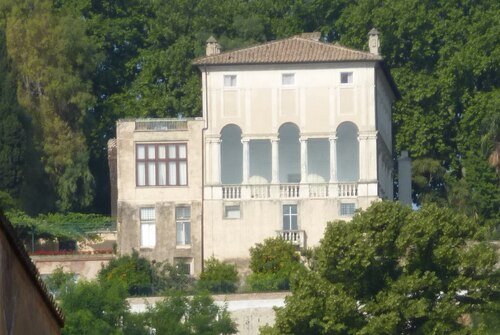
The complex on Via di San Francesco di Sales is a former convent settlement, one of the many that dotted this part of the city when the Lungara was an area of vegetable gardens, monasteries and suburban villas. Its building history is the typical Roman one: built for a religious community, taken over by the State after the unification of Italy, adapted several times to public functions, restored in recent times to house something none of its builders could have imagined. Behind it, on the hill, stands Villa Lante al Gianicolo, the sixteenth-century villa built for Baldassarre Turini, which today houses the Finnish Institute.
The conversion into the seat of the Casa della Memoria e della Storia left the original structure readable: the long corridors, the aligned rooms, the courtyard, the sense of recollection that monastic buildings keep even when their use changes. Anyone with an eye for architecture will notice that no effort was made to turn the spaces into a spectacle. There are no stage sets, no immersive installations, no dramatic lighting. It's a choice, and it's the right choice for a place that deals with these subjects.
Why right here
The location has a logic that goes beyond the availability of municipal space. A few dozen meters away, on Via della Lungara, is the Regina Coeli prison, which during the nine months of the German occupation of Rome was one of the two major places of detention for Roman anti-fascists, together with the SS prison on Via Tasso. Many of the men killed at the Fosse Ardeatine on March 24, 1944 were taken from there. Opening a center dedicated to the memory of the Roman Resistance a stone's throw from that wall is not a topographical detail. It's a statement.
There is also a quieter reason, which concerns the character of the neighborhood. Trastevere is the Rome of the historic working-class districts inside the walls, a popular neighborhood until the 1970s and then gradually transformed by tourism and nightlife. The Roman Resistance had one of its social roots here, together with San Lorenzo, Quadraro, Centocelle, Testaccio, Quarticciolo and Tiburtino. Rooting memory in a neighborhood and not in a palace of the monumental center is a way of saying where that history came from.
The Lungara and Regina Coeli around the Casa della Memoria e della Storia
The wall you walk along as you arrive at the Casa della Memoria e della Storia is that of the Regina Coeli prison, at Via della Lungara 29. It started out as a convent in the 1600s, wanted by two Colonna sisters and financed by Pope Urban VIII and then by Innocent X, and the Carmelite nuns had to leave it for good in 1873, after yet another law of suppression. It has been a prison since 1881. The name comes from the church dedicated to Maria Regina Coeli that stood there.
Walking along the wall, you notice the famous bocche di lupo, the screens that close off the cell windows and let you see only a piece of sky. They are what strikes you most, and they are also the thing not to photograph. Behind those openings are people who are held there today, not ghosts of history. Discretion in front of a working prison is not a formality.
The Mantellate: how things really stand
On the opposite side of the complex runs Via delle Mantellate, and here you have to be precise, because it's the point on which the most confusion circulates. Le Mantellate was the name Romans used for the women's section of Regina Coeli, from the name of the nuns who served there. Ending up in the Mantellate, in twentieth-century Roman speech, meant ending up in prison as a woman, and it's an expression that entered song and the city's way of talking.
That women's section no longer exists. The women prisoners of Rome were transferred, during the 1970s, to the Rebibbia penitentiary complex, which is on the other side of the city, in the Tiburtina area, about 10 kilometers from here. The Rebibbia women's prison is today the largest women's penal institution in Italy. Regina Coeli, therefore, is today a men's prison, and Via delle Mantellate keeps only the name. I say this because you sometimes hear it told, even by well-informed people, that the women's prison would still be there behind the wall. It isn't, and the correction matters: in the memory of a place, closing dates weigh as much as opening ones.
One episode has to be remembered in this block. On the night between January 24 and 25, 1944, Sandro Pertini and Giuseppe Saragat, sentenced to death and to long imprisonment, were broken out of the third wing of Regina Coeli, which was under German control. The operation was organized by the Roman Resistance with false papers and very steady nerves. The jurist Giuliano Vassalli, then a young lawyer and Socialist leader, played a decisive role in it, and he would later become Minister of Justice and president of the Constitutional Court. Two future presidents of the Republic walked out of that door with a forged release order. It happened 200 meters from the place we're talking about.
Why the Casa della Memoria e della Storia was inaugurated on March 24
The Casa della Memoria e della Storia opened on March 24, 2006. Anyone in Rome who deals with these events knows what that day means. On March 24, 1944, in the pozzolana quarries along Via Ardeatina, the SS killed 335 men. It's the massacre of the Fosse Ardeatine, the worst massacre carried out by the Germans in an Italian city during the occupation, and the deepest wound in Rome's civic memory.
Choosing that date to inaugurate a study center meant placing the institution inside a precise lineage. Not an administrative founding anniversary, not a generic institutional occasion, but the day of the city's mourning. It's the way the City said, without any need for speeches, which history this house answers to.
What happened on March 23 and 24, 1944
The facts have to be told exactly, because a quantity of legends has settled on them that still circulate today. On the afternoon of March 23, 1944, on Via Rasella, a narrow street that climbs from the Traforo toward the Quirinal, a group of GAP partisans of the central GAP set off a charge as a column of the Bozen battalion passed, a German police unit incorporated into the occupation forces. In the attack and the exchange of fire that followed, 33 soldiers of that unit died.
The reprisal was decided in the hours immediately after, on the criterion of 10 Italians killed for every German who died. The lists were compiled by drawing on the prisoners of Via Tasso and Regina Coeli, on people already sentenced to death, on people awaiting trial, on people arrested for trivial reasons, and on Roman Jews already in prison simply for being Jews. The final count was 335 killed, five more than the number planned: a clerical error that nobody bothered to correct except by killing those men too. The bodies were sealed in the quarries with explosive charges.
Among the 335 were army officers like Colonel Giuseppe Cordero Lanza di Montezemolo, priests like Don Pietro Pappagallo, professors like Pilo Albertelli, lawyers, workers, shopkeepers, students, militants of every political formation of the National Liberation Committee, 75 Roman Jews, and men who had done absolutely nothing except be on the wrong list on the wrong day. The youngest was 15. This is the fact to keep in mind when people talk about the Roman Resistance as an abstract matter.
The Mausoleum and its relationship with the Casa della Memoria e della Storia
On the site of the massacre today stands the Ardeatine Caves Mausoleum, one of the most successful monuments of postwar Italian architecture: a great concrete slab suspended over the 335 tombs, letting a blade of light filter in along its perimeter. The design came from a group of architects, Nello Aprile, Cino Calcaprina, Aldo Cardelli, Mario Fiorentino and Giuseppe Perugini, with the bronze gate by Mirko Basaldella and the sculptural group by Francesco Coccia. It was completed in 1949.
The Casa della Memoria e della Storia does not duplicate that place and does not claim to replace it. It does something else: it keeps and makes available the documents, the testimonies, the studies that let you understand how things got there. The mausoleum is the place for reflection. This is the place where you study. Anyone who has time for both should visit them on the same trip, but not on the same afternoon, and in this order: first the documents, then the tombs.
The associations based at the Casa della Memoria e della Storia
What distinguishes this place is that it isn't run by a single body. Associations take part in its activity that represent the direct memory of anti-fascism, the Resistance and the war of Liberation, together with cultural institutes that do research and teaching on that memory. Some of these associations have donated or deposited their archives here, which makes the Casa della Memoria e della Storia, from the documentary point of view, much more than a sum of offices.
The acronyms you meet there are ANED, the Associazione nazionale ex deportati politici nei campi nazisti. ANEI, the Associazione nazionale ex internati. ANPI, the Associazione nazionale partigiani d'Italia. ANPPIA, the Associazione nazionale perseguitati politici italiani antifascisti. FIAP, the Federazione italiana associazioni partigiane. The Associazione partigiani cristiani, which is part of FIVL, the Federazione italiana volontari della libertà. IRSIFAR, the Istituto romano per la storia d'Italia dal fascismo alla Resistenza. The educational section and some sound and audiovisual archives of the Associazione culturale Circolo Gianni Bosio. And the coordination of Italian oral history.
That list is worth reading slowly, because it's a photograph of a society. There is no single memory of the Resistance. There are the fighting partisans, the political deportees in the concentration camps, the soldiers interned in Germany after September 8, the people persecuted by the regime in the 1920s and 1930s, the Catholic volunteers, the professional historians, the collectors of songs and voices. Keeping them together under one roof is harder than it seems and more useful than people think.
What is not here, and why it's good to know
Since approximate lists circulate online, I'll add a clarification that helps anyone planning a study visit. Not all the foundations and institutes in Rome that deal with contemporary history are based here. Many have their own independent offices elsewhere in the city and have relations of collaboration with the Casa della Memoria e della Storia, not of residence. Before showing up at Via di San Francesco di Sales to consult the archive of a specific body, check directly with that body where its papers are physically kept. It's a banal piece of advice that saves wasted afternoons.
The ANPI and the Casa della Memoria e della Storia
The Associazione nazionale partigiani d'Italia was born in Rome in 1944, when the north of the country was still occupied and the war of Liberation was under way. It was recognized as a moral body as early as 1945. It's the best-known of the associations present, and it's also the one that has gone through the deepest transformation. Born as an organization of fighters, over the decades and with the gradual disappearance of the generation that had fought, it opened membership to those who had not been partisans, becoming an association for passing on memory more than one of veterans.
In the rooms of the Casa della Memoria e della Storia this transition is visible to the naked eye. At public occasions you still see, ever rarer, men and women who lived those years as adults. Next to them are researchers in their forties and high school students. It happens that at one meeting a direct testimony and an academic paper follow each other in the same afternoon, with all the tension that this brings: personal memory and historical reconstruction don't always say the same thing, and the way they are set against each other is precisely the work done here.
The Roman Resistance in figures and names
The Resistance in Rome lasted a little under nine months, from September 8, 1943 to June 4, 1944, and took place inside an occupied city, with no mountains to climb into and no possibility of forming large armed bands. It was therefore an urban and clandestine resistance, made up of patriotic action groups, a clandestine press, networks helping Allied prisoners escaped from the camps, hiding places for Jews and for draft evaders, strikes, railway sabotage, military intelligence.
Rome was awarded the gold medal for military valor for the war of Liberation. Behind that medal lie the defense of Porta San Paolo on September 10, 1943, the only episode in which regular units and Roman civilians fought together against the Germans at the gates of the city. The shootings at Forte Bravetta. The massacre of the Fosse Ardeatine. The roundup of Quadraro in April 1944, when about 700 men were captured and sent to forced labor in Germany. The roundup of the Ghetto on October 16, 1943. These are the episodes that form the documentary core around which this institution works.
The ANED, deportation and the Casa della Memoria e della Storia
The Associazione nazionale ex deportati politici nei campi nazisti brings together the survivors of political deportation and their families. It's a reality that the Italian public tends to confuse with others, and the confusion has to be untangled with care because it concerns the lives of different people. Political deportation struck opponents, strikers, captured partisans, draft evaders, people arrested in roundups. They were sent to Mauthausen, Dachau, Buchenwald, Ravensbrück, Flossenbürg and the other camps of the German concentration system, with a legal condition and a fate different from those of racial deportation.
The work of the ANED was for decades a registry job: establishing who had left, from where, on which convoy, who had come back and who had not. It seems like dry bookkeeping and is instead the most important operation, because the deportation machine worked precisely by erasing names. Giving back a name, an arrest date, a registration number and a place of death to a person who had been reduced to a figure is the act at the origin of all the historiography on the subject.
Why the distinction between deportations matters
In the Casa della Memoria e della Storia, associations representing different experiences live side by side, and this coexistence is precious for teaching. In the same day you can attend the testimony of a relative of a political deportee and the presentation of a study on the deportation of Roman Jews, and understand that these are two stories that intertwine but don't coincide. The reasons for arrest were different, the destinations were different, the survival rates were different, and in racial deportation they were dramatically lower.
Confusing the two is not a venial sin. It means losing sight of the specificity of the extermination and, at the same time, the specificity of political repression. One of the reasons I recommend this place to teachers is precisely the chance to let people feel this distinction firsthand, through documents and not through definitions learned by heart.
The ANEI and the military internees at the Casa della Memoria e della Storia
The Associazione nazionale ex internati represents a story that for 40 years stayed at the margins of the Italian public narrative, and that only in recent decades has found the space it deserves. After the armistice of September 8, 1943, the Italian soldiers captured by the Germans in Italy, in the Balkans, in Greece, on the Aegean islands, were disarmed and sent to the camps of the Reich. They did not receive the status of prisoners of war. They were classified as Italian military internees, a category invented on purpose to strip them of the protections of the Geneva Convention and assign them to forced labor.
There were hundreds of thousands of them. Each was offered, more than once, the chance to join the Italian Social Republic and go home in uniform. The great majority refused and stayed in the camps until the end of the war, in conditions of hunger and exploitation that were extremely harsh. That refusal, repeated individually by isolated men, without organization and without weapons, has been called a resistance without arms, and it has its full place in the history of the Liberation.
The return and the silence
The bitterest chapter of this story is the homecoming. Those who came back in 1945 found a country that had neither the tools nor the desire to listen to them. They were not partisans, they were not decorated fighters, they had been soldiers of a defeated army and passive prisoners in the eyes of those who didn't know. Many never spoke of it again. The testimonies collected starting in the 1980s and 1990s, and the prison diaries that came out of drawers after their authors' deaths, have reopened that chapter. Materials of this kind, collected by the associations, are among those that make the Casa della Memoria e della Storia interesting for anyone doing research.
On this subject, one of the most striking documents of that experience is a notebook of recipes. Men who were dying of hunger spent their evenings writing down, on makeshift paper, the dishes of their homes. It's a form of mental resistance that no political definition can contain, and you understand it only by seeing the handwriting.
The ANPPIA and the political persecutees at the Casa della Memoria e della Storia
The Associazione nazionale perseguitati politici italiani antifascisti brings together those who were hit by the regime's repression before the war, and their descendants. It's the acronym that pushes the chronological horizon of this place backward. It doesn't begin in 1943, it begins in 1922, and in some cases even earlier.
The tools of Fascist repression were police confinement, admonition, formal warning, special surveillance, dismissal from work, forced exile, and above all the Special Tribunal for the Defense of the State, established in 1926 after the attempt on Mussolini's life in Bologna and together with the so-called leggi fascistissime. That tribunal, made up of officers of the Militia and presided over by military men, judged thousands of anti-fascists until the fall of the regime, handing down tens of thousands of years of prison in total and several death sentences.
The confino, an Italian institution
The confino deserves an explanation, because to foreign visitors it is incomprehensible and to Italians it often looks like a mild punishment. It consisted of deporting a person, without a trial and by administrative order, to an island or a remote village in the South, for a period that could reach five years and that was regularly renewed. Ventotene, Ponza, the Tremiti Islands, Lipari, Ustica and dozens of small municipalities of the southern Apennines were places of confino.
It wasn't a holiday. It meant losing your job, your home, your ties, the ability to support your family, and being watched day and night. But those islands also became involuntary political schools, where men of different formations argued for years. The best-known document to come out of the confino is the Ventotene Manifesto, written in 1941 by Altiero Spinelli and Ernesto Rossi with Eugenio Colorni: a text on European federal unity born in a place of punishment. This too is history that is studied here.
The IRSIFAR and historical research at the Casa della Memoria e della Storia
The Istituto romano per la storia d'Italia dal fascismo alla Resistenza is the properly scientific component of this whole. It belongs to the national network of historical institutes of the Resistance and the contemporary age, a network born right after the war to gather the papers of the civil war before they were lost, and which over time became one of the soundest research infrastructures in the country, with a national institute in Milan and dozens of provincial and regional institutes.
What does an institute like that actually do. It preserves and inventories archival collections. It publishes research. It organizes seminars and conferences. It trains teachers, which is a function recognized by law and much less known than it should be. It supervises degree theses. It answers questions from relatives looking for news of a family member who was arrested or deported. That last one is a daily, quiet activity that no cultural budget records and that for the families involved is worth more than any conference.
The value of a local archive
The history of the Roman Resistance is not written with the great national archives alone. It is written with the minutes of the section meetings, with the papers of the commissions for recognizing partisan status, with letters, with group photographs, with a hospital's registers, with the list of the tenants of a building. These are scattered materials, produced by minor bodies, and for that very reason fragile: a house move and a flooded cellar are enough to make them disappear.
The work of collecting and cataloging done here serves exactly this purpose. And it's the reason why the Casa della Memoria e della Storia, which to a distracted visitor may look like a container of conference rooms, is in fact a repository of materials that in many cases exist in a single copy in the world.
The Circolo Gianni Bosio and the voices of the Casa della Memoria e della Storia
Among the presences in this house, that of the Circolo Gianni Bosio is the most unusual and the most interesting. The circle takes its name from Gianni Bosio, a scholar and cultural organizer who in the 1950s and 1960s was among the founders of research on popular cultures and social song in Italy. In Rome the circle has worked for decades on the city as sung and spoken: field recordings, interviews, work songs, tavern songs, voices of the borgate, and then the voices of the migrants who since the 1990s have changed the sound of the city.
At the Casa della Memoria e della Storia are the educational section of the circle and sound and audiovisual archives that are a rare heritage. Rare not because they contain sensational revelations, but because they keep what normally isn't kept: the way ordinary people told their own lives when someone took the trouble to switch on a recorder.
What oral history is
Oral history is not a collection of anecdotes. It's a discipline with a method, which deals with what written sources don't record: the perception of events, how they are reworked, the way a community builds its own account. An oral historian knows that memory gets things wrong and treats the error as data, not as a defect. If 100 people remember a fact in a way that the documents contradict, that way of remembering says something important about the community that remembers it.
Rome has a strong tradition in this field, and the best-known book to come out of that tradition is devoted precisely to the Fosse Ardeatine: a study built on hundreds of interviews with relatives, survivors and witnesses, which reconstructs not only the massacre but the very long tail of stories, blame assigned, silences and controversies that followed it for half a century. Anyone who frequents the Casa della Memoria e della Storia should know that line of work. It explains why in this city certain arguments are still so heated.
The library of the Casa della Memoria e della Storia
Inside the Casa della Memoria e della Storia there is a library, and it's the simplest way in for anyone who wants to understand the place without waiting for an evening event. It's a specialized library: Italian twentieth-century history, fascism and anti-fascism, the Resistance, the war of Liberation, deportation and internment, the history of contemporary Rome, oral history. It isn't a neighborhood library where you go to borrow the latest novel, even though it is part of the city's circuit of public libraries.
The collection was built up by accumulation: purchases, donations from scholars, personal libraries of militants and historians that arrived here when the owner died, publications of the associations, magazines and periodicals from the field, gray literature that you can't find in bookshops. That is the reason it's worth coming even if you have access to larger university libraries. Here you find pamphlets, proceedings of local conferences, out-of-print editions and association bulletins that elsewhere haven't been cataloged.
How to behave in a specialized library
If you aren't used to this kind of institution, here are a few rules of common sense. You phone or write beforehand, explaining what you're looking for. You ask if the material is on open shelves or has to be requested. You bring an ID. You put away pens and use a pencil if you're consulting archive materials. You agree in advance on what you can photograph. These are basic courtesies, but they make the difference between a productive afternoon and a closed door.
I'll add a piece of advice that holds for all libraries of this kind: arrive with a precise question. Someone who shows up saying they're studying the Resistance will inevitably get a vague answer. Someone who shows up saying they're looking for material on clandestine activity in a specific neighborhood, over a defined span of months, puts the librarian in a position to be truly useful. And the librarian, in places like this, is the best source there is.
The archives of the Casa della Memoria e della Storia
The least visible and most precious part of this institution is the archives. Some of the associations based here have donated or deposited their collections here, that is, the papers produced in the course of their activity from the postwar period to today, along with older documentation gathered by members. Alongside these are the sound and audiovisual archives, which follow different preservation rules and pose specific technical problems, first among them the obsolescence of the media.
An association collection, for someone not familiar with archival material, contains far more than its name would suggest: correspondence, assembly minutes, membership lists, recognition files, photographs of demonstrations, posters, newspaper clippings, preparatory materials for publications, personal papers that arrived from private bequests. It's a mine for anyone studying the history of memory, that is, the way the recollection of an event is built, celebrated, contested and rewritten in the decades after the event itself.
The memory of memory
This is an important point. The papers kept here don't document only 1943 and 1944. They document 1955, 1968, 1985, 2005, that is, the forms the recollection of those years took in the life of the Republic. The controversies over monuments, the disputes over recognitions, the debates over school textbooks, the controversies over the trials of German war criminals held 50 years late: all of this leaves a trace in the papers of an association.
For a contemporary historian this is first-rate material, because it allows you to study not the event but its long shadow. And for a curious visitor it's the discovery that public memory is not a natural fact. It's a building site, with contracts, quarrels and rework, exactly like a building.
The Casa della Memoria e della Storia and the libraries of Rome
The Casa della Memoria e della Storia is part of the system of public libraries of Roma Capitale, which means two concrete things. The first is that anyone who holds the card of the city's library circuit already has a door open. The second is that the catalog of this library can be searched together with that of the other locations in the network, and so a search done from home can tell you in advance if the volume you need is here or elsewhere.
The Roman library system is one of the least celebrated and most effective cultural infrastructures of the city: dozens of locations spread through the neighborhoods, many with thematic specializations, and a program of events that in certain seasons is denser than that of far more prestigious institutions. The Casa della Memoria e della Storia is, within this network, the node devoted to contemporary history and the memory of the twentieth century.
A practical detail that saves time
Check the calendar before you come. The opening hours of a facility like this vary with the time of year, with staff availability and with the events under way. In the weeks around January 27 and April 25 activity picks up and some spaces may be taken up by initiatives. I don't give hours and contact details here precisely because that would be the quickest way to give wrong information. The source to consult is the website of the institution and that of the municipal library system.
The Giorno della Memoria at the Casa della Memoria e della Storia
In Italy, January 27 is the Giorno della Memoria, established by law 211 of July 20, 2000, in remembrance of the extermination of the Jews and of deportation. The date corresponds to the day on which, in 1945, Soviet troops entered the camp of Auschwitz. Around that date the Casa della Memoria e della Storia concentrates a considerable part of its annual program, with meetings, book presentations, screenings, testimonies and initiatives for schools.
What I recommend to anyone in Rome in those days is to choose the less crowded and more specific events, the ones in which a historian presents research on a circumscribed subject. The official celebrations have their function, but it's in the small rooms that you learn something. And whoever has made it all the way here on a January evening has usually come to learn something.
October 16, 1943, the Roman date
Alongside January 27, which is a European date, Rome has a specific date of its own, and anyone who frequents the Casa della Memoria e della Storia knows it. At dawn on October 16, 1943, a Saturday, German units surrounded the area of the Ghetto and other districts of the city and arrested more than 1,200 people, going house to house with lists already prepared. Those detained were gathered at the Collegio Militare on Via della Lungara, a very short distance from here, and held for two days.
On October 18 a little over 1,000 of them were loaded onto a train at Tiburtina station and deported to Auschwitz, where they arrived after five days of travel. The great majority were killed on arrival. 16 came back, 15 men and a single woman, Settimia Spizzichino. None of the children deported that day returned.
The detail that chills, and that has to be said because it concerns this very street, is the place of assembly. The Collegio Militare on Via della Lungara is on the same street you walk to get to the Casa della Memoria e della Storia. Anyone walking along the Lungara passes the doorway from which, on October 18, 1943, those people came out to climb onto the trucks. There is nothing to photograph, nothing to visit. There is only knowing it.
Via Tasso and the Casa della Memoria e della Storia
Anyone who wants to understand the Roman Resistance has to connect three addresses: Via di San Francesco di Sales 5, Via Tasso 145 and Via Ardeatina. The second is the Museo storico della Liberazione, in the Esquilino, and it occupies the premises that during the occupation were the headquarters of the German security police command and its prison. More than 2,000 anti-fascists were locked up and interrogated there between September 1943 and June 1944. Many ended up shot at Forte Bravetta or killed at the Fosse Ardeatine.
The building had been put up at the end of the 1930s and rented to the German embassy, which was based in the nearby Villa Wolkonsky. When the occupation began, the windows of the rooms turned into cells were walled up and the spaces divided. The cells have been preserved as the Germans left them when they withdrew, with the graffiti traced by the prisoners still on the walls: names, dates, tallies of days, prayers, messages to relatives.
Two places, two different functions
The difference between the two addresses is sharp and worth keeping in mind to organize an itinerary well. Via Tasso is the physical place of the repression. You enter the cells, you read the walls, you come out different from how you went in. It's a museum, it has a route, it has a collection of documents, posters, relics. The Casa della Memoria e della Storia has none of this, and doesn't need it. It's the place where that history is studied, discussed and passed on, not the place where it happened.
When there's time, a sequence in three stops spread over two days is best: Via Tasso to understand what the repression was, the Mausoleo delle Fosse Ardeatine for its outcome, the Casa della Memoria e della Storia for the tools with which to read the whole. In this order, the route makes sense. In the reverse order, it works as preparatory reading. Done all in one afternoon, it doesn't work at all.
The stumbling stones and the Casa della Memoria e della Storia
Walking around Rome you increasingly find, set into the paving in front of a doorway, small blocks of polished brass engraved with a name, a date of birth, the date and place of arrest, the destination, the date of death. These are the stumbling stones (pietre d'inciampo), a project by the German artist Gunter Demnig begun in Germany in the 1990s and then spread across Europe. Today it is considered the largest decentralized work of art on the continent, with tens of thousands of stones laid.
In Rome the first stones were laid in 2010, and since then laying them has become an annual event, generally between the end of January and the first days of February. The city now counts hundreds of them. Each stone sits in front of the last home freely chosen by the person remembered, and this is the rule that gives the project its strength: not a monument in a square, but a name in front of a door, in the middle of the daily life of those who pass by every morning.
Why the project concerns this place too
Preparing a laying requires research work that can't be improvised. You have to establish with certainty the name, the address, the arrest date, the route of the deportation and the final fate, and you have to trace the relatives, whose consent the project asks for. It's exactly the kind of documentary work that the associations and institutes at the Casa della Memoria e della Storia have been doing for decades, and it's the reason why meetings and presentations devoted to the stumbling stones find a natural home here.
The name of the project contains a point worth explaining, because in Italian it gets misunderstood. You don't trip physically. The stones are flush with the paving. You trip with your gaze and with your memory. Demnig's formula is that you bend down to read, and by bending down you bow to the person remembered. It's a design detail, and it explains why the stone is never laid vertically.
Rome from September 1943 to June 1944: the timeline you need
To find your bearings in what you hear at the Casa della Memoria e della Storia, it helps to have an essential chronology of the nine months of the occupation in your head. Here it is in brief, with the dates that really count.
1943
On July 19, 1943 the San Lorenzo district and the surrounding areas were hit by the first Allied bombing of Rome, with thousands of dead. It was the blow that broke the idea, cultivated until then, that the city would be spared. On July 25 the Grand Council of Fascism voted no confidence in Mussolini, who was arrested. The regime fell after 20 years. On August 14 Rome was declared an open city, a declaration that spared it neither later bombings nor occupation.
On September 8 the armistice was announced. The king and the government left the capital. The army was left without orders. Between September 9 and 10, Italian units and Roman civilians fought the German forces at the gates of the city, with the hardest fighting at the Magliana, at Porta San Paolo and along Via Ostiense. On September 10 Rome was occupied. On October 16 came the roundup of the Ghetto. In the following months the National Liberation Committees, the clandestine press and the patriotic action groups were organized.
1944
On January 22, 1944 the Allies landed at Anzio. Liberation seemed a matter of days and turned out to be a matter of months, because the front stalled on the Gustav Line and in the beachhead. Rome lived through a winter of hunger, curfews and raids. On January 24 came the escape of Pertini and Saragat from Regina Coeli. On March 23 the action on Via Rasella, and on March 24 the massacre of the Fosse Ardeatine. Between April 15 and 17 the roundup of Quadraro, with about 700 men captured and deported to forced labor in Germany.
On June 4, 1944 Allied troops entered the city and Rome was liberated, the first capital of Western Europe to be. Two days later, on June 6, the Allies landed in Normandy, and the liberation of Rome vanished from the front pages of the world within 48 hours. This is one of the elements that explain a certain asymmetry in the international memory of the Roman story.
The series and meetings at the Casa della Memoria e della Storia
The program is the beating heart of the place. Over the course of a year the Casa della Memoria e della Storia hosts book presentations, seminars, lecture series, screenings, temporary documentary exhibitions, meetings with witnesses, and study days organized by the resident associations or by outside parties who ask to use the spaces. It's almost always free activity open to everyone, and that free access is not a detail. It means that anyone, with no financial filter, can walk into a room where contemporary history is being discussed at a serious level.
The regular audience is an interesting mix. There are the elderly militants of the associations, there are researchers, students, teachers, and neighborhood residents who drop by because they saw the flyer. It's an audience that asks questions, which often makes the final debate more instructive than the main talk. Anyone visiting from outside who has a free evening in Rome would do well to consider this option instead of yet another tour of the alleys.
The documentary exhibitions
The temporary exhibitions you see here are almost always exhibitions of documents and photographs, not objects: panels, reproductions, explanatory displays, sometimes listening stations. They are sober installations of modest cost, which live on the quality of the material and the care of the texts. Anyone expecting stage sets will be disappointed. Anyone who knows how to read a photograph and a caption will find plenty to chew on.
When there's a photography exhibition on the Rome of the 1940s, I recommend taking a moment for a simple exercise: look in the images for the places you know. Recognizing a street you walked the day before, in a photograph taken under the occupation, is the most direct way to understand that this history happened exactly here and not in some abstract elsewhere.
Schools and the Casa della Memoria e della Storia
A significant part of the activity is aimed at students. The associations and institutes based here have worked for years with Roman schools on programs that range from the classroom lecture to the archive workshop, from preparing the memory trips to the concentration camps to research on a local source. There are different formats depending on age and available time, and they are agreed with the teachers.
The archive workshop is the format I defend most firmly. It consists of putting a few real documents, or faithful reproductions, in front of a class and having them read: a form requesting recognition of partisan status, a letter from confino, a card from the political records file, a service order, a list of deportees. Kids who yawn at the textbook go quiet in front of handwriting. The difference between reading that the racial laws existed and reading the form in which a family declared its own race is all there.
The problem of the generation without witnesses
There is an issue that is being discussed openly in Rome these years, and anyone who frequents the Casa della Memoria e della Storia should know it. The direct witnesses of those years are disappearing. Anyone who was 20 in 1944 would be over 100 today. Very soon, the transmission of memory will no longer be able to count on meeting someone who was there, which for 60 years has been the main tool of teaching on these subjects.
The answer, across Europe, lies in the move from testimony to document: from the survivor's voice to the archive, the source, the historical method. It's a delicate step, because a document doesn't move you the way a person speaking does, and it is also a gain, because a document can be verified, put in context, discussed. Institutions like this one exist precisely to manage that step, and this is the soundest reason to consider them an investment and not an expense.
Doing research at the Casa della Memoria e della Storia
If you are a university student, a doctoral candidate, a journalist, an independent researcher or simply someone looking for news of a relative, here is how to proceed. First of all, identify the right body. The associations present are different and each has its own expertise and collections. Anyone looking for a political deportee goes to the ANED, anyone looking for a military internee goes to the ANEI, anyone looking for someone sentenced by the Special Tribunal goes to the ANPPIA, anyone seeking recognition of partisan status goes to the ANPI, and anyone seeking historical framing and bibliography goes to the research institute.
Then write. A well-made email contains the full name of the person sought, the date and place of birth, the last known address, the presumed date of arrest and any family document you already have, even a photograph with a dedication on the back. The more details you provide, the better the chance the search succeeds, because the collections are ordered by criteria that rarely match what you are looking for.
The other sources to cross-check
Research on a single person is never exhausted in one archive. You have to cross-check the municipal archive and the civil registry records, the State archives, the papers of the central political records file for those the regime put on file, the deportation lists, the Railways archives for the convoys, the military archives for soldiers, the archives of religious communities and parishes, and for Roman stories the historical archive of the Jewish community.
The strength of the Casa della Memoria e della Storia in this work is not the amount of paper it keeps, but the fact that it brings together in the same building people who know where to look. An afternoon spent talking with those who work here is worth, for getting your bearings, months of groping around online.
What to see around the Casa della Memoria e della Storia
The area is one that amply repays a walk. Less than five minutes on foot, on Via della Lungara, are the Villa Farnesina, with the frescoes of Raphael and his workshop, and across from it Palazzo Corsini with the Galleria Nazionale d'Arte Antica. Behind Palazzo Corsini opens the Botanical Garden, one of the most restful spots in the city and the best way to unwind after a morning of heavy subjects.
Climbing the Janiculum you reach the panoramic promenade, the busts of the Garibaldians and the Museo della Repubblica Romana e della memoria garibaldina, which tells the story of 1849, the other moment when this hill was a battlefield. The link with the Casa della Memoria e della Storia is not forced. The two episodes, 1849 and 1943, are the two poles around which the Roman idea of civic resistance was built, and the places are less than a kilometer apart.
Heading down toward the district
Toward the heart of Trastevere you come to Santa Maria in Trastevere with its mosaics, the Museo di Roma in Trastevere at San Egidio, devoted to Roman popular life, and farther on Santa Cecilia. Crossing the Tiber you reach in a few minutes the Portico d'Ottavia, the Museo Ebraico and the Synagogue, that is, the place of October 16, 1943.
If I had to build a whole day around this theme, I'd design it like this: morning at the Casa della Memoria e della Storia with an appointment made, a light lunch in the area, afternoon in the Ghetto with a slow stop along the Portico d'Ottavia and in the side streets looking for the stumbling stones, and the end of the day at the Museo Ebraico. A day like that is more tiring than you'd imagine, and for that reason I advise against adding anything else to it.
Practical information on the Casa della Memoria e della Storia
Admission is free. There is no ticket office, and no reservation is required for ordinary events, except when the organizer asks for it because of capacity. Since it isn't a museum, there is no visiting hour in the usual sense of the term. There are the opening hours of the offices and the library, and there is the calendar of public events, which are concentrated in the late afternoon and evening.
I don't give hours, phone numbers and email addresses here, and I say so explicitly because it's a choice and not an oversight. These are data that change, and a wrong detail published on a page that stays online for years does more harm than missing information. The right thing to do is to consult the official website of the institution and the portal of the library system of Roma Capitale, which publish the updated calendar.
How much time you need
It depends entirely on why you come. To attend a presentation, an hour and a half. For a documentary exhibition, 40 minutes. For a study session in the library, half a day. For serious archive research, several visits. Anyone who stops by just to see what the place is like, with no appointment and no event, will stay 10 minutes and leave thinking there was nothing to see. And in a way they'll be right, because what there is to see here is the people at work and the documents they bring out, not the walls.
Services and behavior
The spaces are those of a public institute: conference rooms, meeting rooms, library, association offices, exhibition areas of modest size. There's no café, no restaurant, no shop. For a coffee you head down toward Trastevere. The rules of behavior are those of a library: silence in the study rooms, phones on silent, no photographs without asking. And, however superfluous it may sound, skip the selfies. It's not that kind of place.
Memory and history: why the Casa della Memoria e della Storia is called that
The name contains two words that in everyday language are used as synonyms and that in the vocabulary of historians mean different things. Memory is the lived and transmitted recollection. It belongs to those who were there and to those who inherited the account, it is selective, emotional, oriented to the present, and has every right to be so. History is the critical reconstruction of facts through sources. It is verifiable, debatable, correctable, and by its nature it must be able to contradict memory when the documents require it.
Putting the two words on the same sign is a demanding choice, because the relationship between memory and history is conflictual by nature. An association of veterans keeps a memory. A research institute makes history. Making them live under the same roof means accepting that now and then there will be arguments, and that the argument will happen in public. That is exactly what happens in the rooms of this house, and it is its most interesting quality.
A concrete example of that conflict
The best-known case, in Rome, concerns Via Rasella. For decades the belief circulated in the city that the Germans had posted notices inviting the attackers to turn themselves in to avoid the reprisal, and that the GAP partisans had not done so. Historical research has established that those notices never existed and that the reprisal was decided and carried out before anyone could have turned themselves in. The court rulings confirmed the legitimacy of the partisan action. Despite that, the popular belief survives.
That gap between what the documents show and what part of the city continues to believe is, for a historian, a subject of study in its own right. It isn't resolved by raising your voice. It's tackled by showing the papers, explaining how a fact is established, admitting that collective memory has a life of its own. If you want to understand why an institution like this one is needed, this is the best reason.
The Casa della Memoria e della Storia in the Rome of today
There are at least three ways of looking at a place like this. Some consider it a relic, an annex of twentieth-century associations destined to run out along with their members. Some consider it an outpost, a piece of civic infrastructure to be defended. And some consider it simply a specialized library with an excellent calendar of meetings. The three readings don't exclude one another, and in our judgment the third is the best way to get people who start from the first to discover the second.
Rome is a city that digests everything, including its own recent history. Within a square kilometer, here, you find a working prison, a Renaissance villa with frescoes by Raphael, a botanical garden, a foreign academy, the military college from which the deportees of October 16 departed and a center for the study of the Resistance. There's no plan behind this combination. There's stratification, which is the way Rome treats time. It's up to the person walking to put it in order.
The neighborhood and its residents
Trastevere has changed a lot. The working-class district described by postwar literature and cinema has given way to a neighborhood of bars, short-term rentals, foreign students and night tourism. The historic families moved out to the outskirts decades ago. In this context, the upper part of the Lungara remains one of the few areas that keep a different rhythm, partly because there's nothing to drink or buy along that wall.
It's also the reason I recommend the walk on a winter evening, when the district is still quiet. You climb from Ponte Sisto, pass under Porta Settimiana, follow the wall, and arrive at the turn onto Via di San Francesco di Sales with the lit windows of the conference room. It isn't a spectacular itinerary. It's one of those that stay with you.
A curiosity about the Casa della Memoria e della Storia
The best-known curiosity concerns the birth date. Cultural institutions, as a rule, open when they are ready: when the works are finished, when the inspection is passed, when the councilor has a free calendar. The Casa della Memoria e della Storia did the opposite. It chose the date first and then got there. March 24, 2006, the 62nd anniversary of the Fosse Ardeatine, is not just any day in the Roman civic calendar, and it is the only day of the year on which the whole city, however it thinks, stops on the same thing.
There is a practical consequence of that choice that almost nobody notices: it means that every anniversary of the institution coincides with a commemoration of mourning. No cake, no toast, no self-congratulatory celebration. The birthday of this house is the day people go to the Fosse Ardeatine. I find it one of the most elegant decisions taken by a Roman municipal administration in cultural matters, and I find it elegant precisely because nobody ever advertised it.
The second curiosity is geographical, and those with a sense of direction discover it on their own. From Via di San Francesco di Sales, the wall of the Regina Coeli prison and the doorway of the Collegio Militare on Via della Lungara are respectively a few meters and a few minutes' walk away. That is: the center that studies deportation and the Roman Resistance is within sight both of the prison from which many of the victims of the Ardeatine were taken, and of the building where the Roman Jews arrested on October 16, 1943 were gathered. There is no sign that this weighed on the choice of location, which depended on the availability of the property. Chance, sometimes, has a precision that planning does not reach.
One thing nobody tells you about the Casa della Memoria e della Storia
What nobody tells you is that here, on certain evenings, people argue. Not in the vulgar sense of the word. They debate, even bitterly, in front of an audience that listens. It happens when new research challenges an established element of the story, when a relative in the room corrects the historian who is speaking, when two associations with different political histories judge the same episode differently. In a traditional museum this never happens, because the museum displays a version already decided. Here the version is still being put together.
The second thing nobody tells you is that the place, materially, is not spectacular. Anyone who arrives with the idea of a great memory center finds a sober building, ex-convent corridors, rooms of normal size, functional furnishings, no stage sets. Some people are disappointed after 10 minutes. The value is not in the container and is entirely in the people, the documents and the calendar. If you don't know that in advance, the encounter fails. This information also serves to avoid that disappointment.
The third is the most useful in practice. Not all the Roman bodies dealing with this history are based here, and the lists circulating online are often out of date. Some institutes cited as resident have their own independent offices in other parts of the city and only collaborate with this house. If you are organizing an archive consultation, check with the specific body where its papers are physically kept before making an appointment. It's the most valuable operational advice I can give you about this address.
The advice I give you for visiting the Casa della Memoria e della Storia
There is only one piece of advice and it is worth more than all the others put together: don't come for nothing. Look at the calendar before you set out and choose a date when something is happening. A presentation, a seminar, a screening, a documentary exhibition, the opening of a series. If instead you are interested in the library, write or call beforehand and arrange access, explaining what you are looking for. An hour of preparation turns this visit from a disappointment into a discovery, and I know of no other place in Rome where that ratio is so lopsided.
The second piece of advice concerns the order of things. If you also plan to see Via Tasso and the Fosse Ardeatine, spread them over two days and not one. These are places that demand emotional energy, and cramming them together produces the opposite of the desired effect: a saturation after which nothing registers anymore. One place a day, with time to walk and to be silent between one and the next, is the formula that works.
How to prepare before you come
Arrive with a few notions already in your head. You don't need academic preparation. It's enough to know what happened between September 8, 1943 and June 4, 1944, what Via Tasso and the Fosse Ardeatine were, what happened on October 16, 1943. With those four reference points in mind, an evening meeting here becomes understandable and gripping. Without them, you listen to names and acronyms that attach to nothing.
If you travel with teenagers, prepare them a bit more and choose the event with care. A methodological seminar will lose them in the first five minutes, while a talk on research into an individual story will keep them awake. And if you travel with small children, simply postpone. It isn't a matter of bans, it's that the place isn't designed for them, and there's nothing wrong with admitting it.
The right way to be here
One last piece of advice, concerning conduct. This is not a place of solemn commemoration, and you don't need to tiptoe in as if into a shrine. It's a place of work, where people debate, take notes, ask questions, and have a coffee at the café downstairs afterward. Respect here is not a stiff silence, it's attention. Taking seriously what is said, checking, asking when you don't understand. That is how a place like this wants to be treated.
Another well-known fact that is rarely cited
The well-known fact is that Rome was the first capital of Western Europe to be liberated, on June 4, 1944. You read it in every textbook. What is cited far less is the chronological tail: two days later, on June 6, the Normandy landings began, and the news of the liberation of Rome vanished from the front pages of the whole world within 48 hours. The correspondents who had followed the Italian campaign were transferred, the newsreels changed front, international attention moved and never came back.
The consequence is still visible today and measurable in the perception of foreign audiences. Millions of people know what Normandy was. Very few, outside Italy, know what the nine months of the occupation of Rome were, or the roundup of the Ghetto, or the Fosse Ardeatine. This is the biggest and most constant gap in visitors' knowledge: highly educated people, informed about everything, who are completely unaware that this city was occupied for nine months.
The second well-known and rarely cited fact concerns the number of victims of the Fosse Ardeatine. That there were 335, everyone knows. That the planned count called for 330, that is 10 for each of the 33 German soldiers killed, and that the five extra were the result of a clerical error in compiling the lists, far fewer know. Those five men were killed because nobody, that afternoon, wanted to take responsibility for sending them back to their cells. It is the detail that says more than any other about the bureaucratic nature of that massacre, and it should be told without adding a single word of comment.
Third rarely cited fact: justice. The trials of the Germans responsible for the massacre ended in final convictions only in the 1990s and 2000s, more than half a century later, and were made possible also by the discovery, in 1994, of an archive of files on war crimes that had stayed closed for decades in a storeroom in Rome. That documentary story changed Italian judicial history over the last 30 years, and it is one of the reasons why, in this city, archives are not a subject for specialists.
The right photo to take at the Casa della Memoria e della Storia
First the photographs not to take, because here they matter more than the others. Don't photograph the bocche di lupo of the Regina Coeli prison. Behind those windows are people held there today, and it's also a matter of rules, not just decency. Don't photograph the people working in the rooms without asking. Don't photograph archive documents without authorization, because they are subject to rules of protection and confidentiality that apply even when they concern events from 80 years ago.
The right photograph, instead, is the one nobody takes: the sign and the doorway on Via di San Francesco di Sales, shot from the bottom of the street so as to keep in the frame the slope of the road and, in the background, the green of the Janiculum falling away behind the roof. It's an ordinary image of an ordinary building, and that is exactly the point. It serves to remind you that a city's civic memory doesn't live in a monument but at an address, like an office, like a school, like a home. In the light of late afternoon the climb takes on a long shadow that gives depth to the shot.
The other two framings worth the effort
The second is on Via della Lungara, at the mouth of Via di San Francesco di Sales: you focus on the street sign and leave the long wall of the prison blurred in the background. It's a photograph that requires care not to frame security posts, and for that very reason it should be taken with restraint and without lingering too long. It tells, in a single image, the relationship between this institution and what lies next to it.
The third is the best for those with patience: a full conference room during a meeting, shot from the back, with the heads of the audience in silhouette and the speaker at the far end. You have to ask permission, and it has to be done without flash and without noise. It's a banal photograph in any other context, and here it means something precise: that 80 years later, on a November evening, 50 people sat down in a room to hear the story of what happened in their city. If I had to choose a single image to explain this place, I'd choose that one.
Some important events that took place here in history
You have to honestly distinguish two things: the events that happened inside this building and those that happened within a radius of a few hundred meters. The building, as a convent complex first and as a public seat later, was not the stage for famous episodes. Its story is the one common to half of Rome, a religious property passed to the State after the unification of Italy and adapted several times. The event that concerns it directly is the inauguration of March 24, 2006, which made it the first Roman municipal institution conceived as the common house of the associations of anti-fascist memory.
Within a radius of 200 meters
Here the list gets dense. The Regina Coeli prison, opened in 1881 in the former Carmelite convent on Via della Lungara, was the main place of political detention of occupied Rome. In the third wing, under German control, hundreds of anti-fascists passed through, and from there many of the men killed at the Fosse Ardeatine on March 24, 1944 were taken. On the night between January 24 and 25, 1944, Sandro Pertini and Giuseppe Saragat, future presidents of the Republic, were broken out of that prison, in an operation organized by the Roman Resistance with false papers.
A little farther along the same street, the Collegio Militare was the place where the more than 1,000 people arrested in the roundup of October 16, 1943 were gathered. From there, two days later, the trucks left for Tiburtina station and then the train to Auschwitz. It is the gravest event to have taken place on this street and it has no plaque proportionate to its gravity, which is itself a fact in the history of memory.
Further back in time
Via della Lungara was opened at the beginning of the 1500s by Pope Julius II as a straight axis between the Vatican and Trastevere, and soon the Villa Farnesina faced onto it, built for the Sienese banker Agostino Chigi and frescoed by Raphael, Baldassarre Peruzzi and Sebastiano del Piombo, and later the palace that the Corsini would turn into their Roman residence, where in the 1600s lived Christina of Sweden, the queen who had abdicated and moved to Rome.
On the hill behind, Villa Lante al Gianicolo was built in the early 1500s for Baldassarre Turini, datary of Pope Leo X, on a design attributed to Giulio Romano. Today it houses the Finnish Institute. And in 1849, during the Roman Republic, the whole ridge of the Janiculum was the front line against the French troops. The villas on the hill were destroyed by artillery and rebuilt afterward. This street, put another way, saw two sieges and an occupation within a century.
Who has passed through the Casa della Memoria e della Storia
Those who have passed through here, first of all, are the last witnesses. In the first years of activity, after 2006, it was still possible to hear in these rooms men and women who had fought in the Roman Resistance, who had been deported, who had been interned in Germany after September 8, who had lived through October 16 hidden in an attic. Many of them came here dozens of times, in front of school classes, with the infinite patience of someone who repeats the same story for the 100th time because they know that for the listener it is the first.
Professional historians have passed through and still do: university lecturers, researchers, archivists, doctoral students, authors of studies presented here before academic venues. It's one of the characteristics of the place. Many studies on the Rome of the twentieth century had their first public discussion in these rooms, in front of a mixed audience in which academics sat together with people directly involved in the events described. A severe test for an author.
The other presences
Relatives have passed through. It's the quietest and most frequent category of visitor: children, grandchildren and by now great-grandchildren of people arrested, deported, killed, who arrive with a photograph, a letter, a postcard from the camp, sometimes only a surname and a suspicion. They ask for help understanding what happened to their relative. It's the least visible work done here and, for the families involved, the most important.
Thousands of students from Roman schools have passed through, on school trips or in workshops, and their teachers, who in many cases have used this place as a base for preparing the memory trips to the camps. Administrators and institutional representatives have passed through on the dates of the civic calendar, with the customary ceremonies. And above all the neighborhood residents and ordinary Romans have passed through, those who walk in because they read a flyer and stay to listen.
The latter are the reason this place makes sense. Official celebrations are organized everywhere and pass. Direct testimonies, unfortunately, are running out. The archives will remain regardless. What is not guaranteed is that there will still be someone willing to walk in, sit down and listen on a November evening. As long as that room fills up, the Casa della Memoria e della Storia works exactly as it was meant to.
Quick questions about the Casa della Memoria e della Storia
Where is the Casa della Memoria e della Storia
The Casa della Memoria e della Storia is at Via di San Francesco di Sales 5, in the Trastevere district, between the Tiber and the climb up the Janiculum. The street is short and sloping and climbs from Via della Lungara, next to the long wall of the Regina Coeli prison. It occupies a former convent complex. It's not a place you run into by chance while strolling. You get there because you decided to go.
How to get to the Casa della Memoria e della Storia
On foot from Piazza Trilussa and Ponte Sisto, take Via di Santa Dorotea, pass under Porta Settimiana and continue along the Lungara. It's seven or eight minutes. By bus, lines 23 and 280 leave you a few minutes' walk away. With tram 8 you get off at the first stops on Viale Trastevere and walk about 10 minutes north. By car it's not worth it. The Lungara is narrow and parking doesn't exist.
Do you pay to enter the Casa della Memoria e della Storia
No, admission is free. There is no ticket office and for ordinary events you don't need to book, except when the organizer asks for it because of capacity. Presentations, seminars, screenings and documentary exhibitions are also almost always free and open to everyone. Keep in mind that it isn't a museum. It has no visitor route and no display cases. It's a center for study and meetings on the Resistance and the twentieth century.
When is it open and what are the hours
There is no visiting hour as in a museum. There are the opening hours of the offices and the library and the calendar of public events, which are concentrated in the late afternoon and evening. Hours change with the time of year and with the activities under way, so check the official website of the institution and the portal of the library system of Roma Capitale. Around January 27 and April 25 activity picks up.
How much time you need for the visit
It depends on why you go. For a presentation allow an hour and a half, for a documentary exhibition 40 minutes, for a study session in the library half a day. If you stop by without an event and without an appointment you stay 10 minutes and see little, because what counts here is the people at work and the documents. Look at the calendar and choose a date when something is happening, or write beforehand to arrange access to the library.
What is there to see near the Casa della Memoria
Less than five minutes on foot, on Via della Lungara, you find the Villa Farnesina with the frescoes of Raphael and, across from it, Palazzo Corsini with the Galleria Nazionale d'Arte Antica. Behind Palazzo Corsini is the Orto Botanico. Climbing the Janiculum you reach the panoramic promenade and the Museo della Repubblica Romana e della memoria garibaldina. Heading down toward the district you meet Santa Maria in Trastevere, and across the Tiber the Portico d'Ottavia.
Article written by the editorial team of TourLeaderPro, contact them for Private/Corporate/V.I.P. Tours and Experiences.
Planning a trip to Rome? The English-language guides to visiting the city are on ItalyPlanner.com.
Contact Information
Via San Francesco di Sales, 5
Roma Roma Città, Roma Città