Porta Pia
In short. Porta Pia is the gate of the Aurelian Walls that Pope Pius IV had built between 1561 and 1565 to a design by Michelangelo Buonarroti, and it was the last architectural commission of his life.

Porta Pia is the gate of the Aurelian Walls that Pope Pius IV had built between 1561 and 1565 to a design by Michelangelo Buonarroti, and it was the last architectural commission of his life. The artist was 85 years old when he presented the drawings to the pontiff, and he died in 1564, before the work site was finished. Anyone arriving today in the square of Porta Pia finds two superimposed monuments that tell two different stories, 300 years apart: on one side the 16th-century gate, with its front facing the city and that extravagant, highly tense architectural language that nobody before Michelangelo had dared to put on an urban gate. On the other, the memory of September 20, 1870, when the artillery of the Kingdom of Italy opened a gap in the walls and the bersaglieri entered Rome, ending the temporal power of the popes. The two stories have fused into a single name, to the point that the expression the breach of Porta Pia has entered the Italian language as a synonym for an irreversible historical turning point. And this is exactly where the most widespread misunderstanding about this place arises, the one the lines that follow set out to clear up once and for all: the breach was not opened on the gate, or even next to the gate, but on a stretch of curtain wall about 50 meters away, where today there is no arch, only a rebuilt wall and a plaque.
Where Porta Pia Is and How to Get There
Porta Pia closes the eastern end of Via XX Settembre, at the point where the street opens into the square of the same name, and marks the boundary between the Castro Pretorio district and the 19th-century neighborhoods that open beyond the walls, toward Via Nomentana and the Salario. It's an extremely busy traffic hub: the square is a big ring crossed every day by thousands of vehicles, with the gate in the middle like a travertine island surrounded by lanes. This condition is part of the problem and part of the fascination of the place, because Porta Pia is one of the few Roman monuments that almost nobody looks at by choice: most of the people who pass it do so by car or bus, headed somewhere else.
On Foot from the Center of Rome
The most beautiful walking route starts from the Quirinal Palace and follows Via del Quirinale, then Via XX Settembre, in a straight walk of about 20 minutes that exactly retraces the route Pius IV wanted in the 16th century. It's the right way to get here, because the gate was conceived precisely as the backdrop of that street: walking it you understand in a few steps what an urban axis designed to culminate in a monument means. From Piazza della Repubblica and the Baths of Diocletian the distance drops to just under a quarter of an hour, while from Via Veneto and Porta Pinciana you get there along Corso d'Italia, that is, walking along the line of the walls, in about 20 minutes.
By Public Transport
The metro station closest to Porta Pia is Castro Pretorio, on Line B, from which you walk for about 10 minutes along Viale Castro Pretorio and Viale del Policlinico. Termini station too, served by Lines A and B and by all regional and national trains, is reachable on foot in a little over a quarter of an hour. At street level the square is served by several bus lines that run along Via Nomentana, Corso d'Italia and Via XX Settembre, and the stop bears the name of the square itself: anyone coming from the neighborhoods to the northeast of the city almost certainly passes through here, because Porta Pia remains the natural passage between the Nomentana and the center.
Anyone arriving by car should keep in mind that the square is a big traffic ring with no dedicated parking and that parking on the surrounding streets is paid during daytime hours from Monday to Saturday, with spaces scarce at all peak hours. The most practical solution for those coming from outside Rome is to leave the car in a park-and-ride lot connected to the metro and complete the trip on Line B to Castro Pretorio or Termini: in an area so dense with ministries, embassies and hospitals, looking for a spot at street level is almost always a waste of time.
Landmarks for Getting Your Bearings in the Square
The square is wide and disorienting for first-time visitors, but three reference points are enough to know where you are. The first is the gate itself, recognizable because it's the only isolated building at the center of the road ring. The second is the Bersagliere Monument, the bronze statue of a running bugler that stands on the side away from the city, facing the gate. The third is the stretch of walls that extends southeast toward the Policlinico and the Castra Praetoria: following it with your eyes for about 50 meters you reach the point of the breach, marked by the marble monument with the plaques and by the column topped by the winged Victory. Anyone who keeps these three elements in mind won't get the side wrong and, above all, won't confuse the gate with the breach.
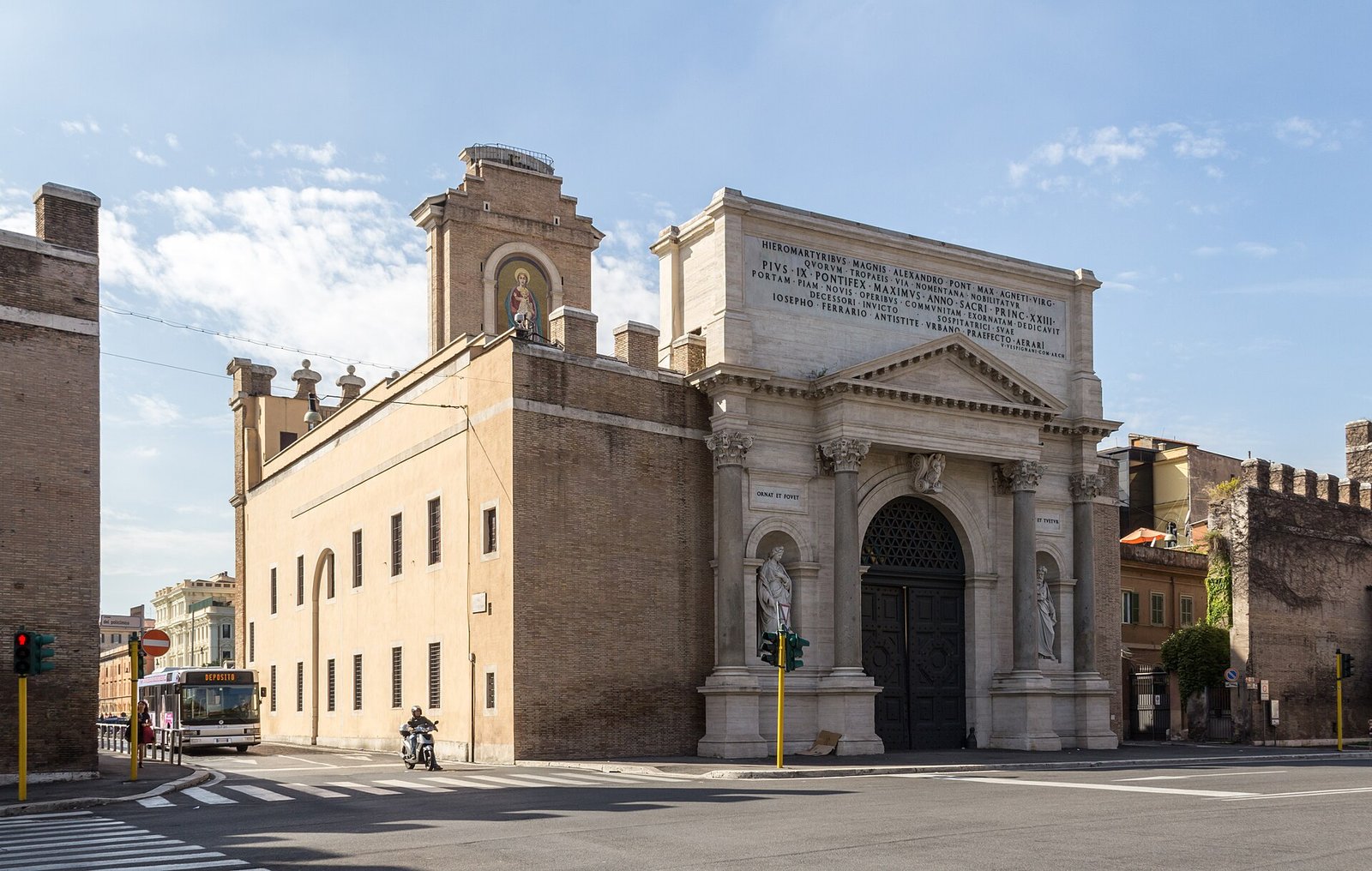
What Porta Pia Is: A New Gate in Place of an Ancient One
Porta Pia was born to replace the nearby Porta Nomentana, walled up in 1564 at the will of Pius IV himself, which stood a little under 100 meters away to the southeast, along the present Viale del Policlinico. It was therefore not the opening of a new gap in a blind stretch of wall, but the relocation of an existing opening to a point judged better suited to the urban design the pope was carrying out. It's a distinction that matters, because it explains the apparently odd position of the gate and the way it connects to the curtain wall.
The Replacement of Porta Nomentana
Very little remains today of the old Porta Nomentana and that little is hard to see: the opening was blocked up and the front incorporated into the boundary wall of what is now the British embassy, with the semicircular tower on the right still recognizable and the one on the left demolished in 1827 to recover an imperial-era tomb that had been incorporated into it during the construction of the walls. Anyone walking along Viale del Policlinico can spot the place by looking carefully at the brick curtain, but without knowing what to look for it's almost impossible to notice. It's one of those corners of Rome where an entire monument hides inside a perimeter wall.
A Gate Set Back from the Walls
Michelangelo's most unusual design choice concerns the placement: Porta Pia is not aligned with the curtain of the walls but set slightly back toward the inside of the city, and it connects to the circuit of walls through two short oblique stretches topped by the same crenellation. The result is that the gate forms a kind of small recessed square, a scenic backdrop conceived for those who look at it arriving from Via Pia, that is, from inside. Michelangelo's interest, as scholars have observed, went far more to the theatrical and pictorial aspect of the gate than to its defensive or customs function: it's an urban gate that thinks like a stage backdrop, not like a work of fortification.
Two Fronts, Two Eras, Two Languages
Anyone visiting Porta Pia must keep in mind that the two sides of the monument are not contemporaries and don't speak the same architectural language. The front facing the city, the one you see arriving from Via XX Settembre, is the 16th-century Michelangelesque front, though reworked in the attic after the 19th-century damage. The front facing outward, the one you see arriving from Via Nomentana, was completed only in 1869 to a design by Virginio Vespignani in a neoclassical language that attempts a dialogue with the 16th century without imitating it. Confusing the two fronts is the most common mistake of those who photograph the gate and then describe it: they are two faces that tell of two centuries very far apart.
Michelangelo's Design: Three Drawings and an Economic Choice
Michelangelo presented Pius IV with three different designs for Porta Pia, and according to Giorgio Vasari's account the pope chose the one of lowest cost. It's one of the most quoted and at the same time most misunderstood pieces of information about the gate: the most beautiful or most ambitious drawing was not chosen, but the one that cost the least. The fact that the work we see is the result of an economic choice, and not an aesthetic one, completely changes the way you look at it.
Three Lost Drawings and a Few Surviving Sketches
The three original drawings have not come down to us. A few Michelangelo sketches relating to specific details of the gate remain, kept among the master's sheets, but none of them corresponds to an overall design and none allows us to reconstruct with certainty what the three alternatives presented to the pope looked like. Scholars agree in holding that what was actually built might not correspond perfectly even to the chosen design, because the work site dragged on for years and saw changes along the way. Anyone who tells in detail what the three drawings were like is going far beyond what the sources allow us to state.
85 Years Old and a Work Site Hard to Follow
When Pius IV gave him the commission, in 1561, Michelangelo was 85 years old. He was at the height of his authority, engaged at the same time on the construction of St. Peter's, but he was no longer in a condition to follow the work site with the meticulousness that had characterized his earlier works. His assistants therefore had a significant role in the concrete definition of the design, and this circumstance explains some inconsistencies and some parts of the decoration left plainly unfinished. Michelangelo died in February 1564, with the work site still open.
Giacomo del Duca and the Completion of the Works
The physical execution of the work was entrusted to Giacomo del Duca, a Sicilian architect and sculptor trained in the Michelangelo circle, who would later also build Porta San Giovanni. He was the one who brought the work site to completion after the master's death. The collaboration between the design of an artist by then elderly and the hand of a much younger executor is probably the origin of that stylistic tension that makes Porta Pia an architectural object hard to classify, suspended between the most cerebral Mannerism and a certain roughness of execution.
The Medal of 1561 and the Engraving of 1568
Two figurative documents give an idea of how the gate was meant to look in the initial intentions. The first is a commemorative medal struck in 1561, at the start of the works, attributed to Gian Federico Bonzagna: it shows a gate different from the one built and in all likelihood reflects the appearance planned at the beginning of the work site. The second is an engraving by Bartolomeo Faleti from 1568, regarded by scholars as the most direct testimony of Michelangelo's design. Both images diverge from the present building, and comparing them with the gate we see today is one of the most instructive exercises you can do on this monument.
The Basin, the Towel and the Medici of Marignano
Among the decorations of the inner facade appear two elements that at first sight seem incomprehensible: a circular basin surrounded by a cloth that recalls a towel. They are not abstract ornaments but a heraldic allusion to the patron's family. Pius IV, born Giovanni Angelo Medici, belonged to the Medici of Marignano, a Milanese family unrelated to the Medici of Florence, and tradition held that the origin of that house was tied to the trade of barber. The basin and the cloth would thus be an ironic, or at least allusive, reference to that origin. It cannot be established if it was Michelangelo's idea or a request from the patron.
The Grinning Mask and the Roughed-Out Block
Under the right window of the inner facade a grinning mask with hooked wings is carved, left plainly unfinished. Roman popular tradition has wanted to see in it the face of Michelangelo himself, but it is precisely a tradition, not a documented fact. Under the other window there is instead a barely roughed-out block, which could be evidence of the haste with which the works were concluded after the artist's death. That unfinished block is perhaps the most Michelangelesque detail of the whole gate, because it recalls that condition of the non finito that accompanies so much of the master's sculpture, even if here the incompleteness is almost certainly involuntary.
The Inscription on the Archway
On the central archway runs the dedicatory inscription: PIVS IIII PONT MAX PORTAM PIAM SVBLATA NOMENTANA EXTRVXIT VIAM PIAM AEQVATA ALTA SEMITA DVXIT. Freely translated: Pius IV, supreme pontiff, built Porta Pia after suppressing the Nomentana, and led Via Pia by leveling the Alta Semita. In two lines of lapidary Latin the whole program of the operation is there: a new gate in place of an old one, and a new street made by flattening the route of an ancient Roman road. The inscription is also proof that gate and street were conceived as a single work, not as two separate interventions.
The Outer Facade and Virginio Vespignani's Work Site
The facade of Porta Pia facing the outside of the city, the one everyone photographs today arriving from Via Nomentana, is not the work of Michelangelo but of the architect Virginio Vespignani and was completed in 1869, just a year before the breach. It's a fact that throws almost all visitors and is worth keeping in mind: the most visible and most photographed front of the Michelangelo gate is a little over 150 years old.
The Lightning Bolt, the Ruined Attic and Two Centuries of Waiting
About 40 years after the end of the 16th-century work site, the attic of the gate suffered serious damage, attributed in all likelihood to a lightning strike. From that moment the crowning remained ruined and essentially abandoned for more than two centuries, until 1853, when it was rebuilt to a design by Vespignani. The monument we now consider a 16th-century masterpiece thus went through a very long period of decay, in which its upper part was reduced to a ruin. Some sources place in 1851 the episode that made the intervention urgent, others insist on the old damage: the sure fact is that the rebuilding of the attic was Vespignani's work and falls in the mid-19th century.
The 19th-Century Work Site and the Role of Pius IX
The works begun in 1853 did not concern only the attic but also the side buildings and the inner courtyard, that is, the whole body of the structure joining the two facades. The patron was Pius IX, the last pope-king, who in this way completed after three centuries a work left hanging. For the outer facade Vespignani drew inspiration from Faleti's engraving of 1568, trying to recover something of the lost Michelangelo design, but he translated that model into a neoclassical language that answers the taste of his own time. The result is a solemn, symmetrical and composed front, exactly the opposite of the Mannerist tension that characterizes the inner front.
Saint Agnes and Saint Alexander in the Niches
Vespignani placed in the niches of the outer facade two statues of martyr saints tied to Via Nomentana: Saint Agnes the virgin and Pope Saint Alexander. The choice was not casual, because both figures have their own place of worship along that route, starting with the complex of Sant'Agnese fuori le mura. The two statues were badly damaged during the shelling of September 20, 1870, that is, very few months after being put in place, and were set back only in 1929 after a restoration. Few Roman works of art have had as unlucky a start: inaugurated in 1869, hit by artillery in 1870, put back in their place 60 years later.
Via XX Settembre, the Pius Axis and the Alta Semita
Via XX Settembre links Via delle Quattro Fontane to the square of Porta Pia and follows the route of the Alta Semita, the ancient Roman road that ran along the whole ridge of the Quirinal Hill. It is therefore not a street invented in the 16th century but a very ancient route that Pius IV had leveled and upgraded, as the inscription on the archway of the gate explicitly declares. Understanding this double layer, Roman and 16th-century, is essential to understanding why Porta Pia stands where it stands.
Strada Pia, an Urban Planning Operation
The pope opened the new artery in continuity with the Quirinal Hill and gave it his own name, Strada Pia, and with it a monumental backdrop: the gate. It was one of the great operations of urban direction in 16th-century Rome, in the same logic that had produced the arrangement of the Capitoline Hill, also by Michelangelo, and that would later find its fulfillment in the straight axes of Sixtus V. Strada Pia was to tie the papal residence of the Quirinal to the eastern edge of the city and at the same time make access to Via Nomentana and the suburban vineyards more convenient.
The Name Change of 1871
The street lost the name Strada Pia with a municipal resolution of November 30, 1871, when it was named XX Settembre in memory of the breach of the previous year. The gesture has a symbolic value that is hard to overstate: the axis a pope wanted in order to link his residence to his own gate took the name of the day on which that power ended, and was renamed only 14 months after the event. The same name was then adopted in hundreds of Italian municipalities, so much so that Via XX Settembre is still today one of the most widespread place names in the country.
A Curiosity About Porta Pia
Porta Pia is the last architectural project of Michelangelo Buonarroti and was commissioned when the artist was 85 years old: he died in February 1564, with the work site still going, and never saw the work finished. The curiosity, however, concerns a lesser-known aspect: the gate we see is not the one he drew, and we know this with certainty.
A Gate Nobody Has Ever Seen as It Was Meant to Be
The two oldest images of the monument, the medal of 1561 and Faleti's engraving of 1568, show a building different from the present one, and they also differ from each other. To the changes made during construction were then added the damage to the attic, the 19th-century rebuilding and the completion of the outer facade. The result is that Porta Pia is at once the last work of Michelangelo and a building in which Michelangelo's hand is filtered through at least three successive layers. Nobody, at any moment in history, has seen the Porta Pia designed by Buonarroti in the form in which he imagined it.
The Paradox of a Monument Famous for Something Else
There is then a second paradox. Porta Pia is probably the most famous gate in Italy, but its fame does not come from the architecture: it comes from a military episode that took place about 50 meters away and that had almost nothing to do with the gate. In Italian collective memory the name Porta Pia means September 20, 1870, not Michelangelo. It is one of the most striking cases in which a historical event has literally covered a masterpiece, to the point that very many people who know the expression the breach of Porta Pia perfectly well have not the faintest idea who designed the gate.
Something Nobody Tells You About Porta Pia
The breach of September 20, 1870 was not opened on Porta Pia: it was opened in a stretch of curtain wall of the Aurelian Walls about 50 meters from the gate, at the level of Villa Bonaparte, and the bersaglieri entered Rome through that gap in the wall, not through Michelangelo's archway. It's the most widespread misunderstanding of recent Roman history, and it must be said clearly because nearly all popular accounts suggest the opposite.
Where the Gap Was Really Opened
The Italian shelling began at 5:10 in the morning on September 20, 1870 and concentrated on the stretch of walls between Porta Salaria and Porta Pia. Shortly after nine a wide breach began to open about 50 meters from the gate, at the villa once belonging to Paolina Bonaparte, today the seat of the French embassy to the Holy See. At 9:35 the artillery commanders concentrated fire on that precise point, and after about 10 minutes of very intense fire the gap reached a width of about 30 meters, enough for the troops to pass. The sources diverge on a secondary detail, that is, if the point should be described as to the right or to the left of the gate, and the reason is simple: it depends on the point of observation, because someone looking from outside and someone looking from inside the walls have right and left reversed.
Why the Misunderstanding Took Hold
The expression the breach of Porta Pia caught on immediately because the gate was the most recognizable topographic reference of that stretch of walls, and nobody could have called the event the breach in the curtain wall between number so-and-so and Villa Bonaparte. The synecdoche was inevitable. The problem is that over time the formula stopped being a geographic approximation and became a description taken literally, to the point that in Risorgimento iconography, in paintings and later in cinema you often see bersaglieri bursting through the arch of the gate. That's not how it went: the gate was barred and defended, and the gap was opened in the wall next to it.
What You See Today at the Point of the Breach
The gap was closed up already in 1871 and a first commemorative plaque was affixed at the same spot. In 1895, for the 25th anniversary, the sculptor Ettore Ferrari oversaw the placement of two further plaques at the sides of the original one and the creation, opposite, of a celebratory column topped by a winged Victory in bronze. In 1920, for the 50th anniversary, the Governorate of Rome entrusted Giovanni Battista Giovenale with an overall monumental rearrangement that incorporated the three plaques in a white marble structure with bronze friezes. Anyone who wants to see the exact point must therefore move away from the gate and walk along the wall until finding that marble complex: it's there, not under the arch, that the Papal State ended.
The Advice I Give You for Visiting Porta Pia
The most useful practical advice for visiting Porta Pia is to get there on foot from Via XX Settembre and not from the square, because only by walking the axis of Pius IV do you grasp the architectural sense of the gate, which was designed as the perspective backdrop of that street and not as an isolated object in the middle of traffic.
The Right Route, in Order
The sequence that works best is this: start from the Quirinal, take Via del Quirinale and then Via XX Settembre, stop at the Quattro Fontane intersection to look at the backdrops, continue to the square keeping the gate in front of you, pass through the archway, come out on the outer side to see Vespignani's facade and the Bersagliere Monument, and only then walk along the walls to the monument of the breach. This way you follow the chronological order of events, from the 16th century to 1870, and each piece arrives at the right moment. In all you need about 40 minutes from the Quirinal, not counting stops.
How Much Time to Give the Visit
The gate itself can be taken in in 20 or 30 minutes, walking around it and comparing the two fronts. Anyone adding the monument of the breach gets to 40 minutes. Anyone who manages to get into the Bersaglieri Historical Museum should allow an hour more. It's a visit that combines well with a morning devoted to Umbertine and Risorgimento Rome, and that is hard to justify as a special trip if you're in Rome for only two or three days: in that case it's better to fit it into a route that also includes the Quirinal, the Baths of Diocletian and the Termini quadrant.
The Best Time of Day
The outer facade, facing northeast, gets the best light in the early hours of the morning. The inner facade, facing the city, is better lit in the afternoon. Anyone who wants to photograph both fronts in decent conditions must therefore choose, or allow for two passes at different times. As for traffic, the square is more livable early on Sunday morning and in the middle weeks of August, while in the weekday rush hours the noise and density of vehicles make it hard even to stop and look.
September 20 of Every Year
Anyone who happens to be in Rome on September 20 finds the place in completely different conditions: the anniversary of the breach is celebrated every year with institutional ceremonies at the monument and the presence of the bersaglieri, and on that occasion the area takes on a character it doesn't have on other days of the year. Arrangements and times change from year to year and are announced by the institutions and the veterans' associations in the preceding days: it's best to check them beforehand, because there is no fixed program.
Another Well-Known Fact, Yet Rarely Mentioned
Inside Porta Pia, in the buildings that join the two facades and that originally housed the customs office, is the Bersaglieri Historical Museum: the gate is not just a monument to look at from outside, but a building inhabited by a state military museum. It's a fact known to insiders and to the Romans of the area, yet almost never mentioned in general guides.
The Courtyard, the Busts and Enrico Toti's Bicycle
In the inner courtyard are a monument dedicated to Enrico Toti and the busts of four illustrious bersaglieri: Alessandro La Marmora, founder of the Corps, Luciano Manara and Goffredo Mameli, both fallen in the defense of the Roman Republic of 1849, and Giacomo Pagliari, who fell right here on September 20, 1870 in the assault on the breach. Inside, the most famous piece in the collections is the bicycle of Enrico Toti, the one-legged cyclist bersagliere who fell in the First World War, one of the best-known relics of Italian military memory. The story of Mameli and Manara links this place directly to that of 1849, told at the Museum of the Roman Republic and Garibaldian Memory on the Janiculum.
The Right Photo to Take at Porta Pia
The right photo to take at Porta Pia is not the frontal portrait of the outer facade, which is the one everybody takes and which, what's more, is not by Michelangelo. It's the shot taken from Via XX Settembre, on the axis of the street, which shows the gate as the perspective backdrop of the 16th-century artery.
The On-Axis Shot from Via XX Settembre
Standing in the middle of the roadway of Via XX Settembre, at the moments when the traffic light stops the traffic, and framing toward the east, you get the image for which the gate was designed: the straight run of the street narrowing toward the end and the mass of the gate closing it off. A slightly telephoto focal length, around 50 or 70 millimeters equivalent, compresses the perspective and makes the effect even stronger, bringing the gate closer and making the street seem shorter. It's the same principle that governs the perspective views of 16th- and 17th-century Rome, and it still works perfectly.
The Detail of the Mask
The second shot not to miss is a detail: the grinning mask with hooked wings under the right window of the inner facade, left unfinished. You need a telephoto lens, because it's high up and can't be reached up close, and raking light is best to bring out the relief. It's a much more interesting image than the classic postcard of the gate, because it tells of the incompleteness of the work site and of that taste for the grotesque that belongs deeply to the late Michelangelo language, the same one found in Michelangelo's Cloister at the Baths of Diocletian.
The Monument of the Breach, Without the Gate
The third shot is the one almost nobody takes: the monument of the breach framed alone, along the curtain of the walls, without Porta Pia in the picture. It's the most honest photograph you can take in this place, because it documents the real point where the events happened and not the monument that inherited the name. If you manage to include in the same frame the ancient brick curtain and the white 20th-century marble of the monument, the image also becomes a small essay on the stratification of memory.
Some Important Events That Happened Here in History
The decisive event that took place in this location is the capture of Rome on September 20, 1870, which ended the temporal power of the popes and led to the annexation of the city to the Kingdom of Italy: the Italian troops numbered about 50,000 men in five divisions, the papal army counted 13,624 soldiers between regulars and volunteers.
The Day of September 20, 1870, Hour by Hour
The bombardment began at five in the morning and the batteries of the 7th Artillery Regiment opened fire at 5:10 on the stretch between Porta Salaria and Porta Pia. Shortly after nine the breach began to open at the level of Villa Bonaparte. At 9:35 the fire was concentrated on that point and around 9:45 the gap was about 30 meters wide. Three attack columns were organized: the first with the 12th Bersaglieri Battalion and a battalion of the 41st Infantry (Modena), moving from Villa Falzacappa. The second with the 34th Bersaglieri Battalion and the battalions of the 19th Infantry (Brescia), from Villa Albani. The third with the 35th Bersaglieri Battalion and the battalions of the 39th and 40th Infantry (Bologna), from Villa Patrizi. Around 10 the white flag was raised from the papal camp.
The Death of Giacomo Pagliari
A few minutes after the white flag was raised, a group of papal defenders who had not been informed of the capitulation opened fire from Villa Bonaparte and killed Major Giacomo Pagliari, commander of the 34th Bersaglieri Battalion. The bersagliere Niccolò Scatoli, gravely wounded, kept sounding the charge. The 12th Battalion then burst into the breach followed by the other units, meeting no further resistance. The overall losses of the day were limited compared to the historical scale of the event: Italian sources report 32 dead and 143 wounded according to the initial figures, while other reconstructions indicate 49 dead and 141 wounded, and on the papal side there were 15 dead and 68 wounded. The capitulation was signed at 17:30 of the same day between General Raffaele Cadorna and General Hermann Kanzler at Villa Albani.
The Plebiscite of October 2, 1870
12 days later, on Sunday, October 2, 1870, the plebiscite on annexation to the Kingdom of Italy was held. In Rome the votes in favor were 40,785 against 46 opposed, and in the annexed territory 133,681 yes against 1,507 no. These are numbers that must be read bearing in mind the context of a vote that was public and not secret by today's standards, but that nonetheless capture an unambiguous result. From that moment began the transformation of Rome into a capital, a process that would radically change the city in the following 30 years and of which Via XX Settembre and its ministries are the most direct testimony.
The Closing of the Breach and the Celebrations
The gap was closed already in 1871 and in the same year the street was renamed. In 1895, for the 25th anniversary, came the two side plaques and the column with the winged Victory. In 1920, for the 50th anniversary, the monumental arrangement by Giovanni Battista Giovenale. In 1932 the Bersagliere Monument and the transfer of the museum. In 60 years the place went from battlefield to lay shrine of the Risorgimento, with a stratification of commemorative monuments that is itself a document on the way united Italy built its own memory. Anyone who wants to follow this thread can continue to the Central Museum of the Risorgimento and the Altar of the Fatherland, as well as the Institute for the History of the Italian Risorgimento.
Who Has Passed Through Porta Pia
Through Porta Pia have passed, in the literal or the design sense, Michelangelo Buonarroti who drew it, Pope Pius IV who commissioned it, Giacomo del Duca who built it, Virginio Vespignani who completed it and the bersaglieri of the 12th and 34th Battalions who on September 20, 1870 entered Rome through the breach opened a few meters away.
Michelangelo, Pius IV and the Papal Court
Michelangelo spent the last 30 years of his life in Rome and Porta Pia closes that season. His patron, Giovanni Angelo Medici, who became pope under the name Pius IV, was the pontiff who reopened and concluded the Council of Trent and who promoted in Rome a policy of public works of which Strada Pia and the gate are the most visible example. The same pontiff commissioned Michelangelo to transform the Baths of Diocletian into the basilica of Santa Maria degli Angeli, a work contemporary with this one and less than a kilometer away: two late Michelangelo work sites that look at each other from a distance along the same sector of the city.
The Protagonists of 1870
In 1870 passing through here were Lieutenant General Raffaele Cadorna, supreme commander of the Italian troops, and on the opposite front General Hermann Kanzler, commander of the papal army, who signed the capitulation at Villa Albani in the afternoon of the same day. Among the fallen the name the place has preserved is that of Major Giacomo Pagliari, whose bust is today in the courtyard of the gate. The other three busts in the courtyard recall figures who had already passed through Rome 20 years earlier: Luciano Manara and Goffredo Mameli, fallen in the defense of the Roman Republic of 1849, and Alessandro La Marmora, founder of the Bersaglieri Corps.
The Bersaglieri, Before and After
The link between the bersaglieri and this place has never been broken from 1870 onward. The Corps museum was moved here in 1932, the Bersagliere Monument was erected in the same year, and every September 20 the veterans' associations return to the monument of the breach. Enrico Toti, the cyclist bersagliere who fell in 1916, is present in the courtyard with a monument and in the rooms with his bicycle: a figure who belongs to a completely different war but who in this place has become part of the same memory.
The Bersaglieri Historical Museum Inside the Gate
The Bersaglieri Historical Museum has been housed inside Porta Pia since September 18, 1932, when it was moved here and reinaugurated: it had been founded and inaugurated a first time on June 18, 1904 in the La Marmora barracks in Trastevere. It's a museum of the Italian Army, not a civic museum, and this institutional difference is reflected directly in the way visits work.
The Collections and the Rooms
The route includes the La Marmora room, with two models of carbines devised by the founder of the Corps, the hall of honor, where the historic proposal for the establishment of the bersaglieri is kept, and a shrine that preserves the sword of Alessandro La Marmora and the medals for valor. The other rooms gather weapons, uniforms, portraits and relics relating to the military campaigns in which the Corps was engaged, from the Risorgimento to the two world wars. The museum also keeps a library and a historical archive, tools meant above all for scholars. The best-known piece remains the bicycle of Enrico Toti.
Hours and Access: What Can't Be Confirmed
On the opening hours of the Bersaglieri Historical Museum it's not possible to provide a reliable and up-to-date figure here. The available sources describe the collections and the history of the institution but do not report a verifiable opening calendar, and the Army's institutional pages could not be consulted at the time of writing. Since it is a military museum housed in a state-owned building, access most likely takes place on limited days and time slots and may require booking, as happens with the other museum hubs of the Army. Anyone who wants to visit must contact the museum or the Italian Army in advance to have days, hours and entry procedures confirmed: any hours found on third-party sites should be considered indicative until confirmed by the institution. We do not report hours or prices because it was not possible to verify them.
The Bersagliere Monument in the Square
The Bersagliere Monument was erected in 1932 by the National Bersaglieri Association at the center of the square of Porta Pia, facing the gate: it is a bronze statue six meters tall, the work of the sculptor Publio Morbiducci, depicting a running bersaglieri bugler, armed with a rifle.
The Statue and the Base
The figure is caught in the act of running while sounding the bugle, with the typical plumed hat, and rests on an imposing travertine base made by the sculptor Italo Mancini. The base is decorated with six bas-reliefs in Trani stone depicting salient episodes in the history of the Corps. The choice of the bugler is not casual: it recalls the wounded bersagliere who on September 20, 1870 kept sounding the charge after the death of Major Pagliari.
The Aurelian Walls Around Porta Pia
The stretch of walls into which Porta Pia is set is part of the Aurelian Walls, the defensive circuit begun in 271 under the emperor Aurelian and completed by 279 under Probus, originally about 19 kilometers long, of which about 12.5 kilometers remain today.
How the Walls Were Built
In their original configuration the walls had a height between six and eight meters, plus about two meters of foundation, and a thickness of about 3.30 meters between facing and walkway. The whole structure was made up of 378 sections of crenellated wall interspersed every 30 meters by 381 towers on a rectangular plan, with 14 main gates. The most important intervention was that of Honorius, between 402 and 403, which almost doubled the height, bringing it to between 10.5 meters and 15 meters, created a double system of superimposed walkways and reinforced towers and gates. It is this late antique configuration, not Aurelian's, that we see today in most of the surviving stretches.
The Castra Praetoria, a Little Farther South
A little south of Porta Pia the circuit of walls incorporates the perimeter of the Castra Praetoria, the camp of the Praetorian Guard built under Tiberius, whose outer wall was raised by about five meters when it was incorporated into the circuit. It is one of the most imposing and best readable stretches of all the Aurelian Walls and lies a few minutes' walk from the square, along Viale Castro Pretorio: anyone visiting Porta Pia would do well to make a detour to it, because it shows very clearly how the walls incorporated preexisting structures instead of going around them.
The Restoration by Pius IV and the Building Popes
The walls were the subject of maintenance and restoration throughout the Middle Ages and the modern age, and among the pontiffs who worked on them was Pius IV himself in the 16th century. The opening of Porta Pia must be read within this frame: not an isolated intervention on an ancient monument, but one piece of a continuing policy of care and adaptation of the circuit of walls to the needs of the modern city. For anyone who wants to look further into the subject of the walls in general and visit a walkable stretch, the reference is the Museum of the Walls at Porta San Sebastiano, where you walk inside the patrol walkway.
What to See in the Surroundings
Going out of Porta Pia toward the outside you take Via Nomentana, which leads in a few minutes to Villa Torlonia and, continuing, to the complex of Sant'Agnese fuori le mura. Toward the inside, in the opposite direction, you quickly reach the Baths of Diocletian and, with a longer walk along Via XX Settembre, the Quirinal. These are destinations that combine well with Porta Pia in a day devoted to this quadrant of the city.
Frequently Asked Questions About Porta Pia
Who Designed Porta Pia?
Porta Pia was designed by Michelangelo Buonarroti on commission from Pope Pius IV and built between 1561 and 1565. It was the artist's last architectural project, and he was 85 years old at the time of the commission and died in February 1564, before the works were finished. The physical execution was entrusted to Giacomo del Duca, while the neoclassical outer facade was completed only in 1869 by Virginio Vespignani.
Where Exactly Was the Breach of Porta Pia Opened?
The breach of September 20, 1870 was not opened on Porta Pia but in a stretch of curtain wall of the Aurelian Walls about 50 meters from the gate, at the level of Villa Bonaparte, today the seat of the French embassy to the Holy See. The gap, about 30 meters wide, was closed up in 1871 and the spot is today marked by a marble monument with three plaques and by a column topped by a winged Victory.
Can You Visit Porta Pia and How Much Does It Cost?
Porta Pia can be viewed freely and at no cost from the outside at any time, because it stands in the middle of a public square and is crossed by traffic. There is no ticket to see the gate. A ticket or an access procedure may instead apply to the Bersaglieri Historical Museum housed inside it, whose visiting conditions must be checked directly with the institution.
What Are the Hours of the Bersaglieri Historical Museum at Porta Pia?
The hours of the Bersaglieri Historical Museum have not been confirmed by verifiable and reliable sources, and for this reason are not given here. It is a museum of the Italian Army, not a civic museum, and access most likely takes place on limited days and time slots, possibly by booking. Anyone who wants to visit must contact the museum or the Italian Army directly before showing up on site.
How Do You Get to Porta Pia by Public Transport?
Porta Pia is reached by Metro Line B, getting off at the Castro Pretorio stop, from which you walk for about 10 minutes, or from Termini on foot in a little over a quarter of an hour. At street level the square is served by several bus lines that run along Via Nomentana, Via XX Settembre and Corso d'Italia. There is no dedicated parking and parking on nearby streets is paid during weekday daytime hours.
Why Is Porta Pia Called That?
Porta Pia takes its name from Pope Pius IV, born Giovanni Angelo Medici, who had it built between 1561 and 1565 to replace the nearby Porta Nomentana, walled up in 1564. The same pontiff gave his name also to the street leading to it, Strada Pia, renamed Via XX Settembre by municipal resolution of November 30, 1871 in memory of the breach.
How Long Does It Take to Visit Porta Pia?
To visit Porta Pia 20 or 30 minutes are enough, the time to walk around the monument and compare Michelangelo's inner facade with Vespignani's 19th-century outer one. Adding the walk along the walls to the monument of the breach brings it to about 40 minutes. Anyone who manages to get into the Bersaglieri Historical Museum should allow at least an hour more.
Is Porta Pia Suitable for Kids and Accessible?
Porta Pia stands at the center of a very busy road ring reachable only by signal-controlled pedestrian crossings, so it requires care with small children and offers no protected pedestrian spaces. The sidewalks and crossings of the square are walkable, but the noise and density of traffic make staying there rather uncomfortable at peak hours: it's better to choose early Sunday morning.
What Is the Difference Between Porta Pia and Porta Nomentana?
Porta Pia and Porta Nomentana are two distinct gates of the Aurelian Walls less than 100 meters apart: the second is the ancient one, walled up in 1564 at the will of Pius IV, now reduced to a boundary wall of the British embassy along Viale del Policlinico, while the first is the 16th-century gate built to replace it and connected to the new Strada Pia wanted by the same pontiff.
One Last Tip for Planning Your Itinerary
Porta Pia works much better as a stop on a route than as a destination in itself. The most sensible way to fit it into a Roman day is to link it to the Quirinal and the Scuderie on one side and to the Baths of Diocletian and the Termini quadrant on the other, with a possible continuation toward Villa Torlonia along the Nomentana. This way the gate becomes the fulcrum of a coherent itinerary on 16th-century Rome and on post-unification Rome, instead of an isolated stop in the middle of traffic. The Scuderie del Quirinale often host major exhibitions and can be the right hook for building the day around a temporary show.
Anyone putting together a wider itinerary in this quadrant of Rome, crossing this stop with the walls, the Risorgimento museums and the destinations along Via Nomentana, can find useful planning tools on Tour Leader Pro, while for a broader picture of transport and destinations in Lazio, Italy Planner is a good resource.