Michelangelo’s Cloister
In short. Michelangelo's Cloister is inside the complex of the Baths of Diocletian, home of the National Roman Museum, at the northeast corner of Piazza della Repubblica in Rome, between Viale Enrico De Nicola, Via Cernaia and Termini station.
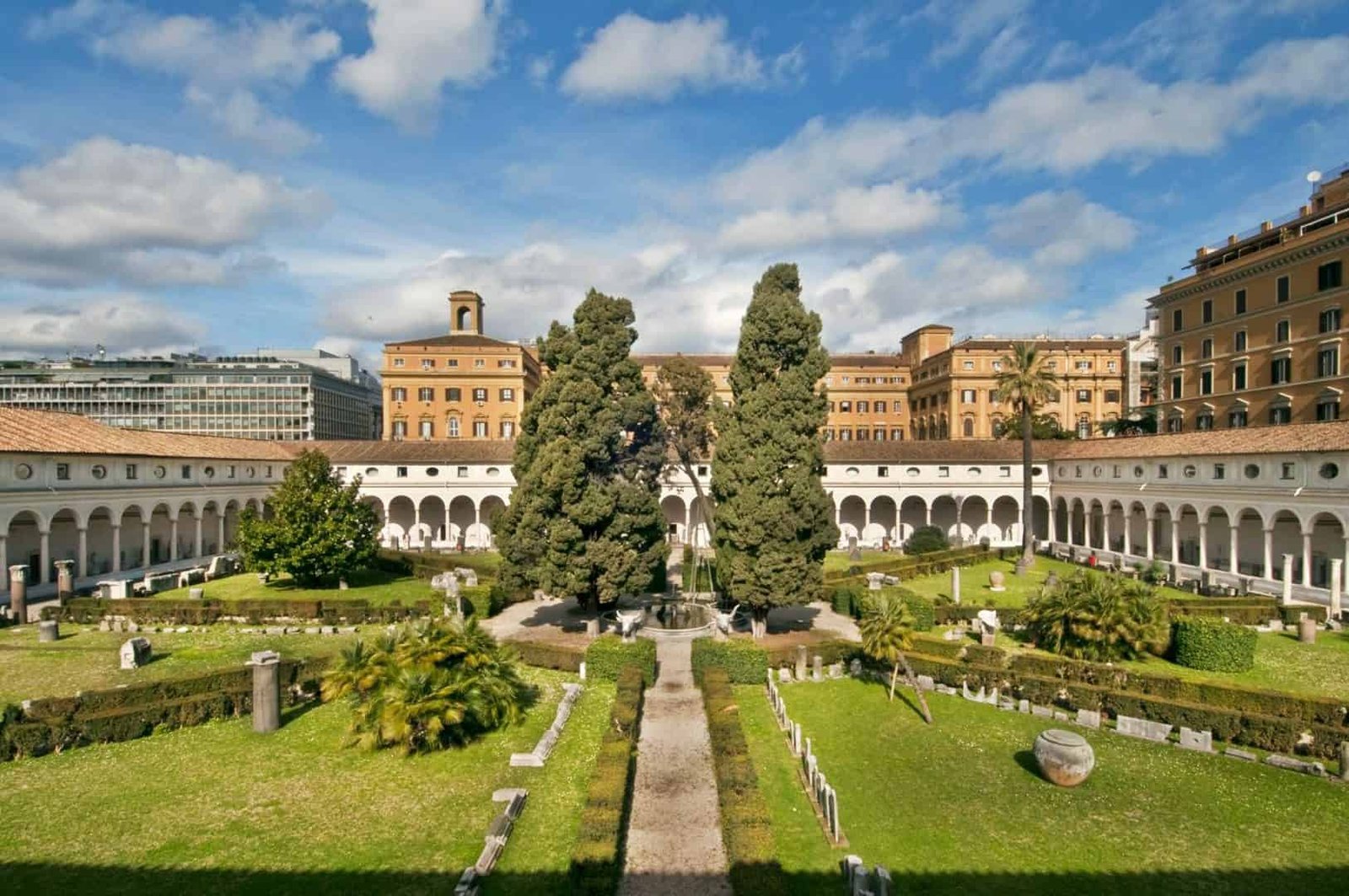
Michelangelo's Cloister is inside the complex of the Baths of Diocletian, home of the National Roman Museum, at the northeast corner of Piazza della Repubblica in Rome, between Viale Enrico De Nicola, Via Cernaia and Termini station. It is the large cloister of the old Charterhouse of Santa Maria degli Angeli, the Carthusian monastery carved in the 1500s inside the ruins of the baths commissioned by Diocletian between 298 and 306 AD. Tradition attributes its design to Michelangelo Buonarroti, and the name of the place comes from that attribution. How much of Michelangelo there really is in those four wings of portico, scholars still debate, and further on we explain why. What is not debated is the scale: four arms about 100 meters long, about a hundred monolithic travertine columns, an area estimated at around 10,000 square meters, an inner garden with a fountain and cypresses, and along the porticoes a forest of sarcophagi, altars, funerary steles and portraits that make the cloister the largest open-air exhibition hall in the city. For those who come in from the Baths of Diocletian it is the surprise that comes after the closed rooms, when the route comes out into the open and the eye, instead of stopping at a wall, runs along 100 meters of columns.
Where Michelangelo's Cloister is and how to get there
The geography of this place matters more than it seems, because Michelangelo's Cloister is in one of the most crossed and least looked-at spots in Rome. Piazza della Repubblica is a knot of traffic and of suitcases dragged toward the station: people pass through with their heads elsewhere. The curved wall of the exedra, the twin porticoes, the Naiads fountain, the façade of ancient brick of the basilica of Santa Maria degli Angeli e dei Martiri form an ensemble that very many people cross without knowing that behind that curtain opens a garden of 10,000 square meters.
By metro and by train: the Repubblica stop and Termini station
The most convenient metro stop is Repubblica, on Line A, which comes out on the square. From the exit to the museum entrance it's a two or three minute walk. The second option is Termini, the interchange between Lines A and B, where the regional trains, the high-speed trains and the connection with Fiumicino airport arrive. From Termini to the entrance of the Baths of Diocletian it's a five or six minute walk. The museum borders the station forecourt, and part of the ancient perimeter wall can be seen from the tracks. Whoever arrives by train has the monument in front of them, and can be inside a building of the 4th century in under 10 minutes of walking.
In the same quadrilateral several sites of the National Roman Museum are concentrated: besides the baths and the cloister there are Palazzo Massimo alle Terme, on Largo di Villa Peretti, and a little farther Palazzo Altemps and Crypta Balbi. The most forgotten presence is the Octagonal Hall of the Baths of Diocletian, on Via Giuseppe Romita, part of the same ancient building block.
By bus and by car
Piazza della Repubblica and Piazza dei Cinquecento are served by dozens of city lines: any bus headed to Termini passes at a useful distance, and Via Nazionale, which starts from the square, is run by the lines that go down toward the historic center.
Arriving by car is the worst choice. The area falls in the most congested band of the center, surface parking spaces are very few and almost always reserved for residents, and the underground parking under Piazza dei Cinquecento has railway-station rates. Whoever comes from outside the city is better off leaving the car at an outlying interchange. The time bands of the limited traffic zone should be checked on the City of Rome website the same day.
On foot, inside a neighborhood that is hard to read
The neighborhood around the cloister is called Castro Pretorio, from the camp of the Praetorian guard that had its barracks here since the age of Tiberius. Walking around the museum's block helps you grasp the scale of the ancient building: the baths covered about 13 hectares, and that perimeter is today drawn by the streets. The wall along Via Cernaia, with its semicircular niches, is ancient. The houses leaning against it are 19th-century. The interlocking of the two layers is the most Roman thing about the neighborhood.
What Michelangelo's Cloister really is: a cloister inside the baths
To understand Michelangelo's Cloister you have to hold together two buildings that belong to different worlds and that physically overlap here. The first is the bath complex commissioned by Diocletian and inaugurated at the beginning of the 4th century, the largest installation of this kind ever built in Rome, sized to hold several thousand people at once. The second is the 16th-century Charterhouse, that is, a monastery of the Carthusian order founded by Saint Bruno of Cologne, an order that lives in an almost hermitic seclusion and that needs a precise architectural structure: a church, a small cloister for communal life, and a large cloister around which the monks' individual cells are arranged, each with its own little garden.
Why an order of hermits builds the largest cloister in the city
This is the point almost everybody gets wrong. A Benedictine or Dominican cloister is a place of common recollection: small, measured on the number of friars who walk around it. The large cloister of a charterhouse works the opposite way: it is a distribution corridor between the cells where the fathers spend almost the whole day in solitude. Each cell has a door onto the portico and a little side window, the turn-hatch, through which the lay brother passed the food without meeting the monk. The more cells are needed, the longer the portico becomes: that's why the Roman one, with four sides of 100 meters, is among the largest in Italy.
Whoever arrives here after seeing the Bramante Cloister immediately perceives the difference in logic: that one is a masterpiece of urban proportion, compact, conceived to be embraced with the eye. This one is a monastic and agricultural enclosure at once, where the central void counts as much as the portico.
The numbers of Michelangelo's Cloister
The data that circulate in guidebooks and museum panels are fairly consistent: four wings of about 100 meters, about a hundred monolithic travertine columns topped by round arches, an area given as around 10,000 square meters between porticoes and garden. The upper floor, added later, is closed and houses museum rooms. The central garden is divided into flower beds by crossing paths, with the fountain in the center and four cypresses at the corners.
An honest word is needed on these figures: 100 meters and 100 columns are round numbers that popular accounts have repeated for a long time and that should be taken as orders of magnitude. The count of the columns changes depending on how the corner piers, which are quadrangular elements, are considered, and the area varies depending on whether or not the covered rooms facing the porticoes are included. A harmless imprecision, but worth knowing before repeating the number to someone else.
What you see today under the porticoes
The cloister is not an empty garden. The four wings work as a gallery of ancient sculpture: along the walls and between the columns are lined up sarcophagi, funerary altars, cippi, steles with portraits of freedmen, architectural fragments, portrait heads and torsos, largely collected in urban excavations between the 19th and early 20th centuries. Seeing them in the open, without display cases, is a different experience from that of a museum room: you understand how they must have looked lined up along the consular roads outside the gates.
In the center of the garden are the seven colossal animal heads, the sculptural group that more than any other imprints itself on the memory of those who visit the cloister. They are large muzzles, carved in marble, which scholarly tradition says were found in 1586 in the area of the Forums, near Trajan's Column and the complex of the Trajan's Markets. We will come back later to the interpretation of these pieces, because it is one of the points where the tourist vulgate and archaeological research do not agree.
Michelangelo's Cloister and the disputed attribution
Precision is needed here, because the name of the monument contains a claim that is not settled. The cloister is called Michelangelo's and guidebooks almost always give it as his work. Art-historical research, instead, uses more cautious formulas, and whoever visits the place has a right to know the state of the debate.
The chronology, which is the first problem
The documentary facts are these. With a bull of July 27, 1561 Pope Pius IV Medici ordered the transformation of the Baths of Diocletian into a church and charterhouse, entrusting the undertaking to the Carthusian order. Michelangelo Buonarroti, who was then 86 years old and busy at the site of St. Peter's Basilica in the Vatican, received the commission for the church, which he carved out of the rooms of the tepidarium and the frigidarium of the baths. Michelangelo died in Rome on February 18, 1564. On the first corner pier of the cloister the date 1565 is incised: the year after his death.
This is enough to exclude that the master directed the work on the cloister. It is not enough to exclude that he left the design, because on 16th-century building sites it was normal for a graphic design to outlive its author and be carried out by others even many years later. The knot is that there is no document directly and incontrovertibly attesting this design, and that the Charterhouse's registers, however reconstructed, do not provide conclusive proof.
What the sources say and what they don't say
On the side favorable to the attribution weighs the continuity of the building site: whoever designed the church was working on the same complex, in the same years, for the same patron, and the current literature states with some regularity that Michelangelo also planned the charterhouse's main cloister. On the opposite side weigh the chronology, the absence of autograph documentation and the architectural language of the portico, more regular and less dramatic than what Michelangelo did elsewhere: whoever knows the Campidoglio or the dome of St. Peter's recognizes in those works a plastic tension that does not appear here.
Hence the hypothesis, which recurs in part of the criticism, that the design was worked out or at any rate substantially reworked by the circle of the master's collaborators, the architects who in the 1560s and 1570s inherited his Roman building sites. On which name to put, though, the literature does not agree, and the writer prefers not to pass off as certain a fact that is not certain. The honest formulation is this: the cloister comes from a project in the Michelangelo orbit, tradition attributes it directly to Buonarroti, its construction begins after the artist's death and the question of authorship remains open. Whoever tells you with confidence that Michelangelo drew those columns with his own hand is giving you as settled something that specialists still discuss.
A very long building site
The construction was not quick. Begun around 1565, it proceeded in fits and starts for lack of funds and dragged on through the whole 1600s: the first floor is recorded as finished only in 1676, 111 years after the date incised on the corner pier. This slowness explains the inconsistencies you notice walking around the portico, where capitals and the proportions of the arches reveal more than one generation of stonecutters.

A curiosity about Michelangelo's Cloister
The curiosity concerns a tree. In the inner garden, at the corners of the central square, four cypresses grow. One of them is held up by a metal structure, because it is very old and can no longer stand on its own. Roman tradition calls it Michelangelo's cypress and holds that it was planted by the artist in person, or in the year of his death, as a sign of the passage from the living man's building site to that of his heirs.
The legend should be treated with the same caution reserved for the attribution of the portico. A common cypress can exceed 400 years, so the thing is not in itself impossible. No public analysis, however, has established a certain dating of the specimen, and the planting by Buonarroti belongs to Roman oral traditions, not to archival documentation. What can be said is that the cypress appears very old, that its silhouette shows up in historic views and photographs, and that the care with which it is kept standing says something about the relationship between Romans and their legends: when a tree becomes a character, you support it with iron rather than lose it.
The gesture does have a precise logic, in any case. The Carthusians planted cypresses in cloisters for symbolic reasons: the cypress is a funerary tree, and in the large cloister of a charterhouse the central garden was also the monks' cemetery, marked by nameless wooden crosses, because the rule prescribed anonymity even after death. Whoever walks on that lawn today walks on a cemetery without gravestones.
The Charterhouse of Santa Maria degli Angeli and its end
The cloister exists because the Charterhouse existed, and the way the Charterhouse ended explains the present look of the complex.
The foundation and the layout
With the bull of July 27, 1561 Pope Pius IV, born Giovanni Angelo Medici, a Milanese, ordered the transformation of the baths into a church and monastery. The operation had a logic that today we would call reuse: the Roman masonry was still standing, the spaces were enormous, the expense of building from scratch would have been unsustainable. The work was entrusted to Michelangelo, then 86, who made the church by exploiting the spaces of the tepidarium and the frigidarium and suggesting, according to tradition, the general layout of the Charterhouse and the design of the large cloister.
The organization followed the Carthusian rule to the letter: a communal zone around the small cloister, with the refectory where the monks ate together only on feast days and the chapter room, and the enclosure zone, with the fathers' cells along the sides of the large cloister and the central part left to green. In the cell, which was a small apartment on two levels with a private garden, the Carthusian prayed, studied, worked and slept. The large cloister was his only street.
The 1600s and 1700s: additions, fountains, decorations
The complex kept growing for two centuries. To 1695 dates the fountain with dolphins in the center of the garden, surrounded by the four cypresses. A local tradition attributes it to Giacomo Della Porta, and on this one must be clear: Della Porta died in 1602 and cannot have built a new fountain in 1695. The most sensible explanation is that the basin or some sculptural elements come from an earlier fountain, perhaps indeed from that circle, reassembled here at the end of the 1600s. Whoever repeats the formula without adding anything passes on a half truth.
In 1700, meanwhile, in the adjacent church the great meridian line wanted by Pope Clement XI for the Jubilee was being made, designed by Francesco Bianchini with Giacomo Filippo Maraldi and Gian Domenico Cassini: a metal line set into the floor, calibrated to mark true noon and to check the date of Easter. Around 1750 Luigi Vanvitelli worked on the interior of the basilica with 18th-century decorations that changed its severity. The cloister stayed on the margins of that season and kept its bareness.
The suppression and the dismantling
In 1884 the Charterhouse was suppressed. Rome had been capital of the Kingdom of Italy for just over a decade, religious orders had been taken over by the State, and the complex was assigned to other uses. Part of the spaces housed the Ospizio Margherita di Savoia for the Blind Poor, while other areas of the baths, the less controlled ones, had long been occupied by workshops, warehouses, depots and taverns: a spontaneous, disordered use that had accompanied the ruins for centuries and that in the 19th century had reached considerable proportions.
In 1889 the State established the National Roman Museum here, which was thus born right inside the suppressed monastery: the institution's historic seat is this one, and the other three city sites were added much later. In 1908 the baths were chosen as the venue of the Grande Mostra Archeologica planned as part of the Universal Exposition for the 50th anniversary of the Unity of Italy, which was then held in 1911. On that occasion the archaeological recovery plan for the Roman structures led to the demolition of most of the Charterhouse's spaces: the monks' cells, the secondary building bodies, the annexes, everything that covered the ancient wall and prevented its being read was torn down.
It is an exemplary episode of the way the Italy of those years treated its recent past: the Roman monument was the value to be saved, the later stratification an encumbrance. Today a similar choice would be unthinkable, and the loss of the 16th-century monastery is considered a serious damage. The large cloister survived because it was too big to demolish and because it was immediately useful as exhibition space: for practical reasons, not out of a judgment of value.

Something nobody tells you about Michelangelo's Cloister
The thing almost nobody says concerns the seven colossal animal heads in the center of the garden, the showpiece of every photograph taken here.
The current version, repeated for decades, says these are heads from the Forum of Trajan, found in 1586 and brought to the cloister at Michelangelo's wish, who supposedly wanted to adorn the garden with those enormous muzzles. Just putting the dates in a row shows it doesn't hold up: Michelangelo died in 1564, the discovery is dated to 1586, 22 years later. Whoever chose to place those sculptures here, it wasn't him. The sentence you read in many guidebooks is chronologically impossible: it is one of those legends that form when the name of a famous artist attracts to itself everything found in the place that bears his name.
The second point concerns provenance. The indication of the area of the Forums, and in particular of the zone of Trajan's Column, is the one scholarly tradition hands down, but it should be taken as tradition. In the 1500s excavations did not produce stratigraphic documentation, and news of discoveries passed through notices, letters and chronicles, with all the inaccuracies that implies.
The third point is of more interest to those who look. These heads are not garden decoration: they are fragments of an apparatus of very large size, and their presence in a forum context most probably points to the decoration of a monumental public building. Today they are arranged like collector's pieces, lined up and close together, and this museum arrangement loses the original sense. When you look at them, try to imagine them not on the ground but up high, on a frieze or a crowning: everything changes, and so does your idea of the scale of imperial architecture. Whoever wants to see how an ancient sculpture display worked inside a modern container can then compare this arrangement with that of the Centrale Montemartini, where statues live alongside diesel engines: two opposite ideas of a museum, both Roman.
The advice I give you for visiting Michelangelo's Cloister
The advice is simple and goes against the way almost everyone visits the place: enter from the Baths of Diocletian, cross the first rooms quickly, get to the cloister and do it first, not last. The reason is that the cloister is the part of the complex that asks for the most time and attention, and it is the one that usually gets dispatched in 10 minutes because the visitor arrives tired, after reading 30 panels of epigraphy and Latium protohistory.
The route that works is this. First the complete circuit of the portico along all four wings, without stopping to read the captions: it serves to grasp the scale and the rhythm, and takes 20 minutes. Then you go back and concentrate on a single category of objects, the sarcophagi or the freedmen's steles or the altars with inscriptions: following just one is far more productive than reading everything a little, and in the end you'll have in your head 20 connected pieces instead of 200 disconnected objects. Finally you go out into the garden and look at the portico from inside, which is the point of view the cloister was built for.
Second piece of advice: time. With the rooms of the baths, the cloister and the epigraphic section you need at least two and a half hours. Whoever has only an hour should do the cloister and nothing else, with no regrets: it is a coherent visit in itself.
Third: the National Roman Museum ticket normally works as a valid ticket for several sites for a certain number of days, but formulas and durations change over time and must be verified on the official website at the time of purchase. The same goes for hours, closing days and any evening openings, which are best not taken as given from third-party sites. The temporary exhibitions in the rooms around the cloister also change frequently.
Fourth, and perhaps the most useful: don't come under the high July sun. The cloister is almost entirely uncovered and the garden offers no continuous shade. The best hours are the first of the morning or the last of the afternoon, in any season.
The sculptures, the steles and the colossal animal heads
It is worth going into detail on what you see, because the cloister is not only an architectural container: it is one of the densest collections of ancient sculpture in the city, and the open-air display makes it legible in a way the rooms do not allow.
The sarcophagi
Along the porticoes are lined up sarcophagi of the imperial age, largely between the 2nd and 3rd centuries AD, with mythological scenes, Dionysian processions, battles, lion hunts, erotes and garlands. The marble chest was expensive, produced in series but customizable: the workshops left the deceased's face roughed out and the portrait was finished at the time of sale. On quite a few examples you can still see barely sketched faces. It's a detail that, once noticed, you never stop looking for.
The steles and altars of the freedmen
The most moving part of the collection is the funerary monuments of the freedmen, the freed slaves: slabs and altars with frontal portraits of couples and families, often clumsy, with names that mix the master's family name and a Greek cognomen, the linguistic signature of an entire biography. Just out of servile condition, they put all the money they had into the tomb along the consular road, public proof of having become somebody. Reading those inscriptions one after another gives back a more realistic Roman society than that of the imperial statues.
The colossal animal heads and the fountain
In the center of the garden are the seven colossal animal heads, the group that gives the cloister its most recognizable image, and next to them the fountain with dolphins of 1695 among the four cypresses: a circular basin, a restrained play of water, no Baroque staging. Whoever comes here after seeing the Trevi Fountain measures in an instant the distance between two ideas of public water, that of the spectacular city and that of the monastery.
Filippo Balbi's painted door
Near the entrance of the cloister there is a door that is not a door. It is a trompe l'oeil painted by Filippo Balbi in 1885, that is, right after the suppression of the Charterhouse, and it represents a half-open opening from which a Carthusian monk seems to look out, surrounded by the objects of the community's daily life: tools, books, utensils, kitchen and work items. Tradition identifies the religious figure depicted with the Carthusian Fercoldo, who is said to have been the father of Pope Clement IV. It is an identification that circulates throughout the local literature and that should be reported as tradition, because it can't be verified on the basis of first-hand documents and belongs to the monastery's internal memory.
Beyond the name, the painting is worth what it is: late 19th-century illusionism executed with great skill and placed at the moment when the community that had inhabited the place for three centuries was being dissolved. This fake door has the tone of a farewell: the monk looks out one last time before the door really closes. Look for it unhurriedly, because it's easy to walk past it without seeing it, which is the effect of every successful trompe l'oeil.
Another well-known fact, yet rarely mentioned
The fact is this: the basilica of Santa Maria degli Angeli e dei Martiri, the church that borders the cloister and is its original reason, has no façade. It has a Roman wall.
Anyone arriving in Piazza della Repubblica sees it and almost nobody notices. The church's front is the curved brick wall of the ancient calidarium, with its rough surface, the niches, the signs of collapses and restorations: no marble, no pediment, no columns, no statues. It is a decision of enormous radicalism for the Rome of the 1500s, the century in which every important church received a showy façade, and the choice to leave the ancient wall in view says more about Michelangelo's relationship with antiquity than many pages of treatise.
The link with the cloister is direct. The same logic of reuse governs the whole complex: the Roman masonry is not hidden but incorporated, the ancient vaults become church vaults, the bath halls become naves, the enclosure of the baths becomes the enclosure of the monastery. This is the reason Michelangelo's Cloister produces in the visitor a sensation hard to define, a kind of double depth: you walk inside a 16th-century portico knowing that the wall that closes it is 12 centuries older.
A second little-mentioned aspect concerns the light. The four wings receive the sun in sequence, and whoever stays long enough sees the portico light up and go dark one side at a time: the sculptures change appearance, and a sarcophagus relief read in raking backlight shows details that vanish completely at noon.
The right photo to take at Michelangelo's Cloister
The photograph everybody takes is the animal heads in the foreground with the portico in the background. It works, and it is also the least interesting, because 5,000 people a year take it in exactly the same way.
The photo really worth taking is another one: stand in a corner of the portico and frame along the side on the diagonal, so that the columns overlap in perspective and the portico closes in a vanishing line that seems never to end. A hundred meters of aligned columns produce, with a slightly telephoto lens, a compression effect that gives back the hardest thing to convey about this place, its length. In the first hour of the morning, with the raking light coming in from under the arches, a regular sequence of luminous trapezoids appears on the floor and gives the image its rhythm.
The second framing worth looking for is from inside the garden toward a corner, with the old cypress held up by the iron structure in the foreground and the portico opening behind it on two sides. It's an image that tells architecture and legend together, and that nobody takes because everyone looks toward the center instead of toward the corners.
Third possibility, for those with patience: the details. A colossal animal muzzle shot from below, filling the frame without context, becomes a powerful, estranging image. The same goes for a sarcophagus hand, for a freedman's face worn by rain, for an inscription with the letters still reddened with minium: the sculptures have been outdoors for more than a century and the surface tells this weather story.
A practical warning: amateur photography without flash and without a tripod is normally allowed in state museums, but tripods, professional equipment and commercial uses require an authorization to be requested at the ticket office.
Some important events that happened here in history
The chronology of the place is long because it holds together two stories, that of the baths and that of the monastery. Here are the passages that matter.
Between 298 and 306 AD the bath complex is built, under the tetrarchy and named for Diocletian: the largest installation of its kind ever built in Rome, sized for thousands of simultaneous users.
In 537, during the Gothic War, the cutting of the aqueducts puts the city's bath installations out of use. The long period of abandonment, spoliation and partial reuse begins, lasting more than a thousand years.
On July 27, 1561 Pope Pius IV issues the bull ordering the transformation of the ruins into a church and charterhouse and entrusts the complex to the Carthusians. The architectural commission goes to Michelangelo Buonarroti.
On February 18, 1564 Michelangelo dies in Rome, at 88, with the building site barely started.
In 1565, as the date incised on the first corner pier recalls, construction of the large cloister begins, presumably on a design from the Michelangelo orbit.
In 1586 scholarly tradition places the discovery of the colossal animal heads in the area of the Imperial Forums, near Trajan's Column.
In 1676 the first floor of the cloister is completed, after over a century of work interrupted and resumed for lack of funds.
In 1695 the fountain with dolphins is placed in the center of the garden, with elements that part of the tradition attributes to Giacomo Della Porta and that, given the chronology, must be reused.
In 1700, for the Jubilee of Clement XI, Francesco Bianchini makes the great meridian line in the adjacent church, one of the most ambitious monumental astronomical instruments of the age.
Around 1750 Luigi Vanvitelli works on the interior of the basilica, redesigning its decorative layout.
In 1884 the Charterhouse is suppressed. Part of the spaces take in the Ospizio Margherita di Savoia for the Blind Poor.
In 1885 Filippo Balbi paints the trompe l'oeil door near the cloister entrance.
In 1889 the National Roman Museum is established here, with this complex as its historic and original seat.
Between 1908 and 1911 the complex is chosen as the venue of the Grande Mostra Archeologica for the 50th anniversary of the Unity of Italy. The recovery plan for the Roman structures entails the demolition of most of the rooms of the 16th-century Charterhouse.
During the 20th century the National Roman Museum spreads over several sites, with Palazzo Massimo alle Terme, Palazzo Altemps and Crypta Balbi, while the Baths of Diocletian remain the seat of the epigraphic and protohistoric collections and the cloister consolidates its function as an open-air gallery.

Who passed through Michelangelo's Cloister
The first name is the one that gives the place its title. Michelangelo Buonarroti came to this building site at the end of a very long life, while he was working on the fabric of St. Peter's, and he agreed to turn an imperial ruin into a church. He had already signed the vault and the Last Judgment of the Sistine Chapel, the Moses of San Pietro in Vincoli and the arrangement of the Capitoline Hill. That one of his last Roman undertakings was the reuse of an ancient building, and not its replacement, deserves attention.
Pope Pius IV, a Milanese and the uncle of Carlo Borromeo, was the patron: the bull of 1561 carries his signature. Pope Clement XI, two centuries later, turned the adjoining church into a paved astronomical observatory, with Francesco Bianchini, Giacomo Filippo Maraldi and Gian Domenico Cassini as the scientific executors. Luigi Vanvitelli passed through around the middle of the 1700s, before the royal palace of Caserta, and left his mark on the church. Filippo Balbi arrived in 1885 and painted the door that doesn't open.
Then there are the monks, who have no names. For three centuries the Carthusian fathers walked along the four sides of this portico in silence, going from the cell to the church and back. Their anonymity is programmatic: the Rule wants the Carthusian to leave no trace, and the burials in the garden carry no inscription. In a place that bears the name of the most famous artist of the Renaissance, the people who actually lived in it are the ones we know nothing about.
In the 1900s the cloister was crossed by generations of archaeologists and epigraphers, because for a century the National Roman Museum was the center of studies on Roman antiquity in Italy. And travelers have come through: whoever gets off at Termini and looks for a quiet place to understand where they have arrived has one of the best silences in the city five minutes away on foot.
When to go to Michelangelo's Cloister and when to avoid it
The cloister is an outdoor space, and that determines everything.
The seasons
The best months are April, May, October and November. In spring the garden is alive and the temperature lets you stand still and look. In autumn the light comes in lower even in mid-afternoon and the portico becomes more dramatic. November, with an overcast sky and wet marble, is an underrated season.
July and August are difficult: midday heat in an open, reflective space is a serious physical test. If you happen to be in Rome in those months, go in at the first opening of the morning. Winter works better than you might think, as long as it isn't pouring: in those months the museum is almost empty.
Times of day and days of the week
The first hour after opening is the best by far, for the light and for the absence of groups. The second good window is the last hour before closing, bearing in mind that the staff gathers visitors early. The weekend is more crowded, but the baths complex almost never has the lines of other Roman museums. The free-admission Sundays promoted by the Ministry of Culture change the picture: check the dates on the official website, because the formula has been modified several times.
With children
The cloister works well with children, better than the closed rooms: wide space, open air, colossal animal heads that make an immediate impression on anyone under 10, sarcophagi with hunting and battle scenes that tell recognizable stories. One suggestion that always works: ask them how many different animals they can recognize among the sculptures and on the reliefs. The game lasts 20 minutes and forces them to really look.
Accessibility
The portico is flat and the paving is regular, so the circuit of the four wings is doable even for those with mobility difficulties or pushing a stroller. The central garden has less compact paths and a few changes in level. The passage between the interior rooms and the cloister involves thresholds and, in some places, steps. Ask the ticket office about the conditions of individual routes, because the layouts change with the temporary exhibitions.
What's around Michelangelo's Cloister
Few places in Rome offer a similar density within a 10-minute walk.
In the same complex are the Baths of Diocletian with the epigraphic and protohistoric sections, and the Octagonal Hall of the Baths of Diocletian, a circular room under a dome, among the most impressive and least visited in the city. The Basilica of Santa Maria degli Angeli e dei Martiri faces onto the same square and can be visited during worship hours: Bianchini's meridian line can be walked along the floor.
Toward Termini is Palazzo Massimo alle Terme, with the frescoes from the Villa of Livia and the mosaics of the imperial age. If I had to point to a single site of the National Roman Museum for someone short on time, that's the one I'd choose. Toward the historic center are Palazzo Altemps, with the ancient sculpture collections of the great Roman families, and Crypta Balbi, the right museum for understanding the passage from the ancient city to the medieval one.
Going down Via Nazionale you reach the Scuderie del Quirinale and, going up, the Quirinal Palace. Continuing toward the Forums you meet Trajan's Markets, home to the Museum of the Imperial Forums, and from there the Colosseum is a few minutes away. On the opposite side, toward the Esquilino, those who love Roman oddities can look for the Alchemical Door of Piazza Vittorio, which is another door that leads nowhere.
For those who want to compare the cloister with other cloisters and other urban silences, the Chiostro del Bramante near Piazza Navona is the obvious point of comparison, and a few steps from there is the Basilica of Santa Maria sopra Minerva, which holds a Christ by Michelangelo and thus completes, with the Moses and the Vatican Pietà, the Roman Michelangelo triangle. For a completely different idea of an archaeological museum, there are the Museum of Civilizations in EUR and the already mentioned Centrale Montemartini in Ostiense.
Quick questions about Michelangelo's Cloister
Where exactly is Michelangelo's Cloister?
Inside the Baths of Diocletian complex, home of the National Roman Museum, at the corner of Piazza della Repubblica, Via Cernaia and Viale Enrico De Nicola, in Rome, a few minutes on foot from Termini station and from the Repubblica stop on Metro Line A.
Is Michelangelo's Cloister really by Michelangelo?
Tradition attributes it to him and the name comes from that tradition. But construction begins in 1565, a year after the artist's death, and there is no direct documentation that definitively proves he authored the design. The correct wording is that it is a project from Michelangelo's circle, with a traditional attribution to Buonarroti that some scholars dispute.
Can you visit it for free?
The cloister is part of the museum route of the Baths of Diocletian and is visited with the museum ticket, except on the free-admission days set periodically by the Ministry of Culture. Check fares, reductions and free admission on the official website of the National Roman Museum.
How much time do you need to visit it?
The cloister alone takes between 40 minutes and an hour to see at a relaxed pace. The whole Baths of Diocletian complex, including the epigraphic and protohistoric sections, takes between 2 and 3 hours.
How big is Michelangelo's Cloister?
Four wings of about 100 meters each, a hundred or so monolithic travertine columns, a total area given as around 10,000 square meters between porticoes and garden. These are round figures, to be taken as orders of magnitude.
Is it the largest cloister in Italy?
It is among the largest, and many sources give it as the largest. The ranking depends on how you measure, that is, whether you consider only the portico or the inner garden as well, and on which complexes are included in the comparison. The prudent wording is that it is one of the largest cloisters in the country.
Why such a big cloister?
Because it is the main cloister of a charterhouse, and in a charterhouse the great portico serves to connect the individual cells of the monks, who live in solitude. The more cells there are, the longer the portico has to be.
What are the animal heads in the middle of the garden?
Seven colossal marble animal heads, which scholarly tradition says were found in 1586 in the area of the Imperial Forums, toward Trajan's Column. They are fragments of a monumental decorative scheme, not objects made as garden furniture.
Is it true that Michelangelo had them placed here?
It isn't possible: Michelangelo died in 1564 and the discovery is dated to 1586. The claim circulates in many guides but is chronologically untenable.
What is Michelangelo's cypress?
One of the four cypresses in the garden, very old and held up by an iron structure, which Roman tradition says was planted by the artist or in the year of his death. No public scientific dating confirms the legend. The tree is in any case very old.
What is the painted door near the entrance?
A trompe l'oeil made by Filippo Balbi in 1885, simulating a half-open door from which a Carthusian monk looks out, surrounded by the objects of monastic life. Tradition identifies the monk as the Carthusian Fercoldo, given as the father of Pope Clement IV. An identification handed down, not documented.
When was the Charterhouse suppressed?
In 1884. Part of the spaces then housed the Margherita di Savoia Hospice for the Poor Blind, and in 1889 the National Roman Museum was established there.
Why is so little of the Charterhouse left?
Because between 1908 and 1911, in view of the Great Archaeological Exhibition for the 50th anniversary of Italian Unity, the plan to recover the Roman structures led to the demolition of most of the monastic rooms. The great cloister was saved by its size and its immediate usefulness as an exhibition space.
Is the cloister covered in case of rain?
The portico is covered on all four sides, the central garden is not. In the rain you walk under the arches, and wet marble makes the reliefs easier to read.
Can you take photographs?
Amateur photography without flash and without a tripod is normally allowed in Italian state museums. For professional equipment, tripods and filming for commercial purposes you need authorization, to be requested from the ticket office.
Is it suitable for children?
Yes, it is one of the most suitable parts of the whole complex: open space, large sculptures, narrative scenes on the sarcophagi.
What are the other sites of the National Roman Museum?
Palazzo Massimo alle Terme, Palazzo Altemps and Crypta Balbi, as well as the Baths of Diocletian with the cloister. The Octagonal Hall is part of the same baths complex.
Is the ticket valid for all the sites?
The museum normally adopts integrated ticket formulas valid across several sites for a limited number of days, but the conditions have changed several times. Check them on the official website at the time of purchase.
What is the difference between the great cloister and the small cloister?
The great cloister, the one called Michelangelo's, served the enclosed area with the monks' cells. The small cloister belonged to the communal area, together with the refectory and the chapter house. Much less of this latter part remains.
Why does the church next door have no facade?
Because the facade is the Roman wall of the calidarium of the baths, left exposed and not covered. It is a design choice tied to the reuse of the ancient building.
What is the relationship between the cloister and Termini station?
The station's name comes precisely from the baths, and the complex borders the railway area. Part of the ancient perimeter wall can be seen from the tracks and from Piazza dei Cinquecento.
Are there temporary exhibitions?
The rooms around the cloister regularly host temporary exhibitions, which change over the course of the year. The updated calendar is on the website of the National Roman Museum.
What is the best time for the light?
The first hour after opening, when the raking sun enters under the arches of one of the sides and draws a regular sequence of bright rectangles on the floor.
Our verdict is that Michelangelo's Cloister is the Roman place that best teaches something hard to explain in words: the city doesn't preserve the past, it lives in it. A fourth-century bath complex became a 16th-century monastery, the monastery became a 19th-century museum, the museum filled the cloister with pieces gathered during the demolitions of the 1900s, and none of the layers has completely erased the one before. If you are looking for a signed masterpiece you will be puzzled, because the signature is uncertain and the portico does nothing to impress you. If you are looking for a place to stand still for half an hour and understand how Rome is made, you will leave with something worth more than a photograph.
Frequently asked questions about Michelangelo's Cloister
Where exactly is Michelangelo's Cloister?
Michelangelo's Cloister is inside the Baths of Diocletian complex, home of the National Roman Museum, at the corner of Piazza della Repubblica, Via Cernaia and Viale Enrico De Nicola in Rome, a few minutes on foot from Termini station and from the Repubblica stop on Metro Line A.
Is Michelangelo's Cloister really the work of Michelangelo?
Tradition and the guidebooks attribute the cloister to Michelangelo, but art-historical research uses more cautious wording on the attribution. The chronology of the documentary facts, starting from the bull of Pope Pius IV of July 27, 1561, in fact opens margins of debate that remain open among scholars.
Are the animal heads in Michelangelo's Cloister really from the Forum of Trajan?
The current version, repeated for decades, says that the seven colossal animal heads in the middle of the garden come from the Forum of Trajan, were found in 1586 and were brought here at Michelangelo's wish. But the dates don't match the artist's life, so this popular attribution should be taken with caution.
What can you see inside Michelangelo's Cloister?
Michelangelo's Cloister holds one of the densest collections of ancient sculpture in Rome, displayed in the open air along the porticoes: sarcophagi of the imperial age, mostly from the second and third centuries AD, together with stelae and the famous colossal animal heads in the middle of the garden.
When is the best time to visit Michelangelo's Cloister?
The best months for Michelangelo's Cloister are April, May, October and November: in spring the garden is alive and the temperature lets you stand still and look, in autumn the light comes in lower even in mid-afternoon, making the portico more evocative. July and August are not recommended.
What is near Michelangelo's Cloister to visit on the same day?
In the same complex as Michelangelo's Cloister are the Baths of Diocletian with the epigraphic and protohistoric sections and the Octagonal Hall, a circular room under a dome, among the most impressive and least visited in the city. The Basilica of Santa Maria degli Angeli e dei Martiri also faces onto the same square.
Is there a particular tree to notice in Michelangelo's Cloister?
Yes, in the inner garden of Michelangelo's Cloister four cypresses grow at the corners of the central square, and one of them is held up by a metal structure because it is very old. Roman tradition calls it Michelangelo's cypress, linking it to the artist's time on this building site.
Article written by the editorial team of TourLeaderPro, contact them for Private/Corporate/V.I.P. Tours and Experiences. For a guided visit to the National Roman Museum and the Baths of Diocletian, with a licensed tour guide, start from the TourLeaderPro contact page. Tour operators building archaeological itineraries in Rome will find the consulting service in the section dedicated to tour operators.
Planning a trip to Rome? The English-language guides for visiting the city are on ItalyPlanner.com, where you will find itineraries designed for those with only a few days who want to understand in what order to put things.