Montecitorio Obelisk
In short. The Montecitorio obelisk is the red granite monolith that rises in the center of the square in front of the Chamber of Deputies, between the Pantheon and Piazza Colonna.
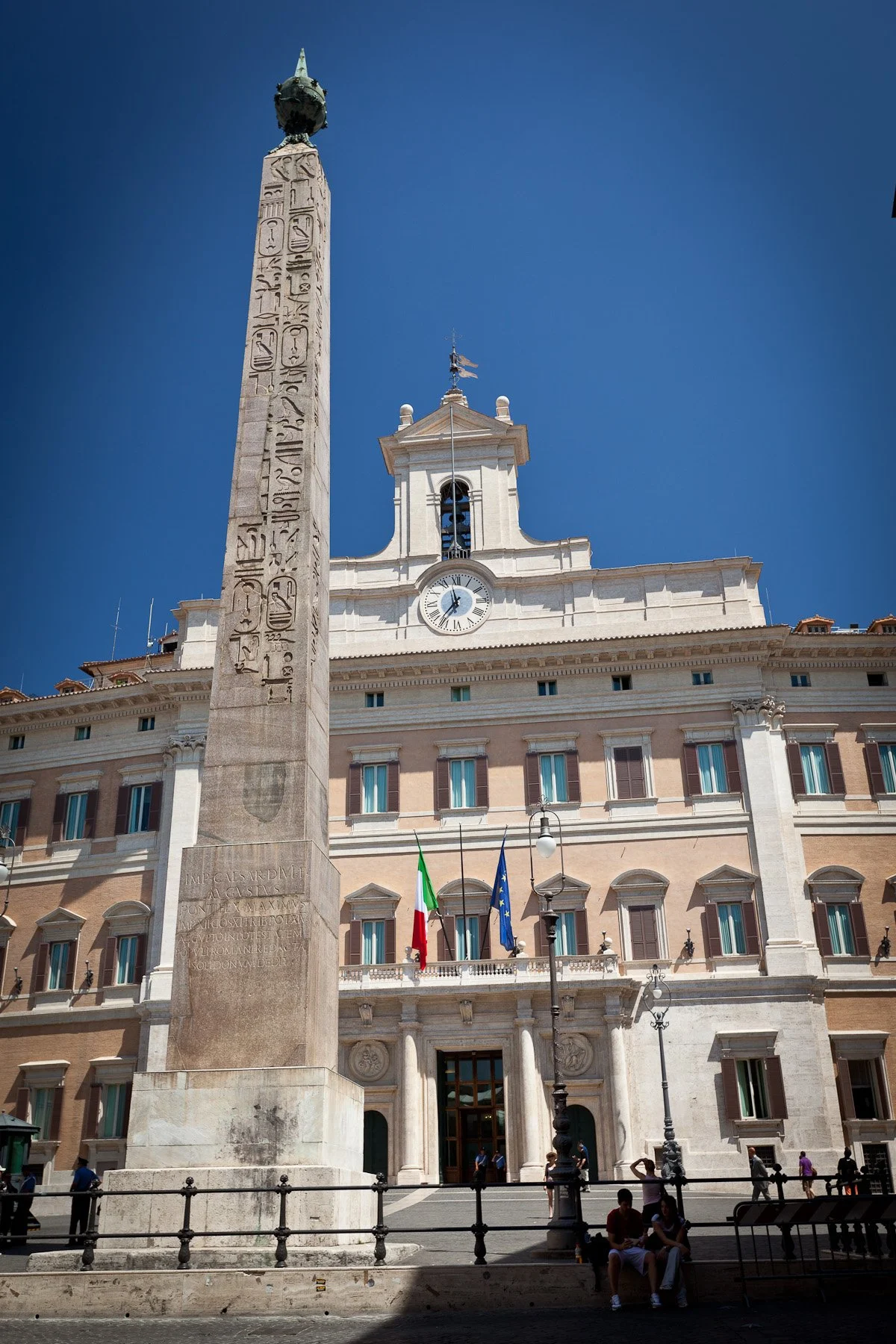
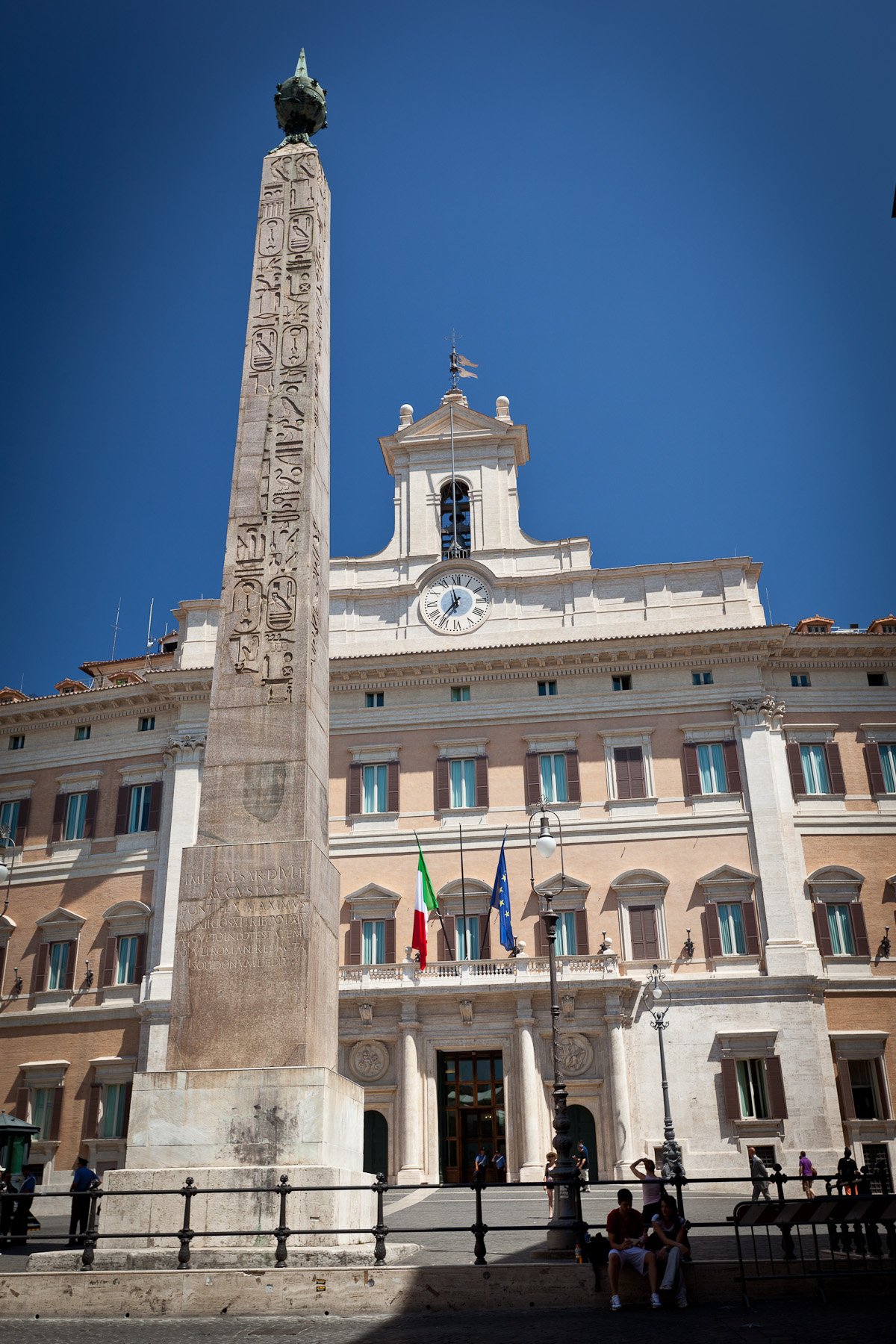
The Montecitorio obelisk is the red granite monolith that rises in the center of the square in front of the Chamber of Deputies, between the Pantheon and Piazza Colonna. It is a genuine Egyptian obelisk, cut in the quarries of Aswan and raised at Heliopolis under the pharaoh Psamtik II between 595 and 589 BC, brought to Rome by Augustus in 10 BC together with the obelisk that today stands in Piazza del Popolo. What makes it different from all the other Roman obelisks is the job it was given: not an ornament and not the marker of a circus, but the needle of a scientific instrument. Augustus planted it in the Campus Martius as the gnomon, that is, the rod that casts the shadow, of an enormous sundial laid out on the ground, the Horologium or Solarium Augusti. A pavement of travertine slabs with lines and letters of gilded bronze, as big as a city block, on which the shadow of the tip wrote its own length every day of the year. Then the obelisk fell, was buried, was found again in pieces, remained for centuries an unkept promise of popes and antiquarians, and only at the end of the eighteenth century stood up again where we see it now. On how that instrument really worked, scholars do not agree at all, and the lines that follow tell this too: the history of the monument, its astronomical function, the debated relationship with the Ara Pacis and the Mausoleum of Augustus, the hieroglyphs carved on it, the medieval fall, the eighteenth-century rediscovery and the meridian line that today runs across the cobblestones of the square.
A useful clarification before we begin: here we talk about the obelisk, not the palace. Anyone looking for the history of the building, the chamber, the Transatlantico and the arrangements for visits to the parliamentary seat will find it in the page dedicated to Montecitorio and the Chamber of Deputies, which covers the palace of Bernini and Carlo Fontana and its institutional use. Here we talk about the Egyptian monolith, about what was around it 2,000 years ago and about what you see today on the paving of the square.
Where the Montecitorio Obelisk Is and How to Get There
The Montecitorio obelisk is in Piazza di Monte Citorio, in the Colonna district, in front of the convex facade of Palazzo Montecitorio, a few dozen meters from Piazza Colonna and Via del Corso. The square is pedestrian, outdoors and freely accessible at any time of day: there is no ticket, no schedule, no door to go through.
On Foot From the Center of Rome
Almost everyone arrives here by chance, walking. From the Trevi Fountain it takes about 10 minutes going down toward Via del Corso and slipping through Via dei Bergamaschi or Via delle Muratte heading west. From the Pantheon the route is even shorter, 5 or 6 minutes passing by Via della Maddalena and Piazza Capranica. From Piazza Navona it is a good quarter of an hour's walk crossing Corso del Rinascimento and the Sant'Eustachio area. From Piazza di Spagna you go down Via dei Condotti to the Corso and then turn left: about 15 minutes without hurrying.
By Public Transport
The metro station closest to the Montecitorio obelisk is Barberini, on line A, from which it is about 10 minutes' walk downhill. Slightly farther, also on line A, are Spagna and Repubblica. There is no metro stop under the square, and you shouldn't expect one: the whole quadrant between the Corso and the Tiber has no stations. For buses the natural reference is the terminus at Piazza San Silvestro, five minutes on foot, and the lines running along Via del Corso and Largo Chigi. Roman line numbers change fairly often because of detours and roadworks, so it's best to check the updated route on the transport company's app on the same day, rather than trusting a list read elsewhere.
What to Expect When You Find the Square
Piazza di Monte Citorio is not a tourist square in the usual sense of the term. It is the open space in front of a parliamentary seat, and you can tell: law enforcement posts, barriers that appear and disappear depending on the work of the chamber, television vans with their antennas raised, journalists waiting for statements on the steps. On days of sensitive sessions the space around the obelisk can be partly closed off: this is not a problem for looking at the monument, which always stays visible, but it is for anyone counting on photographing it with nobody around.
What the Montecitorio Obelisk Is: An Egyptian Monolith With Two Lives
The Montecitorio obelisk is a monolith of red Aswan granite 21.79 meters high, which reaches 33.97 meters counting the modern base and the bronze globe that tops it. It was ordered cut and inscribed by the pharaoh Psamtik II, of the 26th Saite dynasty, who reigned between 595 and 589 BC, and it was raised in the sanctuary of the sun god Ra at Heliopolis, the sacred city northeast of present-day Cairo. It has therefore had two lives separated by almost six centuries: an Egyptian one and a Roman one, and the second gave it a job that the first did not foresee.
The Measurements and Why the Figures Don't Add Up
Anyone comparing several sources finds different numbers, and it is worth explaining why. The measurement of the granite shaft alone, the one that counts from the archaeological point of view, is 21.79 meters. The overall height of the monument as we see it today, including the eighteenth-century pedestal and the bronze sphere, is 33.97 meters. Some popular summaries, including the entry of the free encyclopedia in Italian, give a round figure of 30 meters, which matches neither of the two and looks like a convenient rounding: it's best to be wary of it. On weight, current estimates hover around a good 200 tons, but these are calculations from the volume and density of granite, not a weighing: they should be taken as an order of magnitude.
The Hieroglyphs of Psamtik II
On the four sides of the shaft run columns of hieroglyphs carved for Psamtik II, and there are more on the pyramidion. The texts are royal dedication formulas of the usual type in the Egyptian tradition: the sovereign appears there with his coronation name, Neferibra, and with his birth name, Psamtik, and is called beloved of Ra Harakhti, the sun god in the form of the falcon of the horizon, and of Atum lord of Heliopolis. The pyramidion carries formulas wishing life, health and eternal dominion. These are inscriptions that speak of the sun, and this is anything but a secondary point: when Augustus chose precisely this monolith to make the needle of his solar instrument, he took an object already dedicated to the sun and consecrated it once more to the sun, with a continuity that educated contemporaries were perfectly able to read.
The translations of the hieroglyphs that circulate online are often attempts by enthusiasts and not scholarly editions: the general sense is agreed, the word-for-word rendering is not. For a reliable text you need the specialist epigraphic editions.
The Latin Inscription of Augustus
On the base, on two sides, runs the inscription that Augustus had carved, recorded in the Corpus Inscriptionum Latinarum as CIL VI 702. The Latin text, with the abbreviations resolved, says that the emperor Caesar Augustus, son of the divine Julius, pontifex maximus, acclaimed imperator for the 12th time, consul for the 11th, invested with tribunician power for the 14th, having reduced Egypt to the power of the Roman people, gave this gift to the Sun. They are a few lines, but they say three things at once: that Egypt has been conquered, that the monument is war booty turned into a religious offering, and that the recipient of the offering is the Sun. The same formula appears on the twin in Piazza del Popolo.
The Horologium Augusti: A Sundial as Big as a Neighborhood
The Montecitorio obelisk was raised in the Campus Martius in 10 BC as the gnomon of the Solarium Augusti, also called the Horologium Augusti, a solar instrument laid out on the ground whose dimensions have been estimated, in the most widespread reconstruction, at about 160 by 75 meters. The surface was paved with travertine, and on the slabs ran lines and letters of gilded bronze that marked the days, the months, the seasons and the signs of the zodiac. The idea was simple and monumental at once: the shadow of the obelisk's tip, moving across the pavement, told anyone passing by where in the year the city stood.
How It Worked, in Principle
The principle is that of every gnomon. A vertical rod casts a shadow whose length at noon changes day by day: shortest at the summer solstice, longest at the winter one. If you mark a line on the ground running from south to north and graduate it, the end of the shadow at noon falls each day on a different point, and that point gives the date. It is how a meridian line works, an instrument that the following centuries would use in European cathedrals to fix the date of Easter.
The difference between a meridian line and a complete sundial is substantial. The first measures only one thing, true noon and the seasonal position of the sun. The second requires a grid of hour lines that allows you to read the time even far from noon. The question of which of the two Augustus's monument was is exactly the point on which scholars do not agree, and we will come back to it.
The Golden Sphere on the Tip
Pliny the Elder, in the Naturalis Historia, writes that a gilded sphere was added to the tip of the obelisk so that the shadow would gather on itself instead of fraying confusedly, and adds that the idea supposedly came from observing the shadow produced by a human head. It is a correct technical detail: the sharp tip of an obelisk more than 20 meters high produces a blurred, unreadable shadow on the ground, while a spherical body gives a shadow whose central part stays defined. It is the same reason modern monumental meridians use a gnomonic hole instead of a point. Pliny also attributes the ingenuity of the design to a mathematician called Facundus Novus, in the Latin form, a figure of whom we know practically nothing else: whoever describes him as a court astronomer or as an Alexandrian Greek adds something the ancient text does not say.
What It Was Really For
One of the most concrete explanations of the instrument's function is calendrical. The calendar reform decreed by Julius Caesar in 46 BC had been badly applied by the pontiffs in the following decades, inserting the leap day every three years instead of every four, with a progressive accumulation of error that Augustus corrected around 9 BC by suspending leap years for a few cycles. An instrument able to fix precisely the day of the equinoxes and solstices served to verify publicly that the calendar had come back in phase with the sky. This reading, supported among others by the gnomonics scholar Paolo Albèri Auber in the Rendiconti of the Pontificia Accademia Romana di Archeologia, gives the monument a much less esoteric and much more administrative meaning than the common story suggests: the emperor putting the city's time back in order.
An Instrument That Soon Stopped Working
Pliny again, a few lines later, notes that for about 30 years the observations no longer matched, and proposes several explanations: a change in the course of the sun, a shift of the earth, earthquakes that had bent the gnomon, Tiber floods that had made the ground settle under the weight of the monolith. Considering that Pliny was writing in the 70s of the first century, the instrument would have begun to go off already around the 40s, that is, less than 50 years after the inauguration. It is one of the most valuable pieces of information we have, because it opens the way to all the questions about the later rebuilding of the pavement.
Meridian or Clock? The Debate Scholars Have Not Closed
On the real working of the Horologium Augusti the scientific community has been divided for over 40 years, and anyone who tells the story as if it were settled is simplifying. The reconstruction that made the monument famous, that of the German archaeologist Edmund Buchner published between the 70s and 80s, has been challenged on almost all its main points, but has not been replaced by another reconstruction equally shared. What follows is the picture of the positions, not a conclusion.
Buchner's Excavations and His Reconstruction
Edmund Buchner, director of the German Archaeological Institute in Rome, conducted between 1979 and 1980 an excavation in extremely difficult conditions in the cellars of a building on Via di Campo Marzio, at number 48, descending to a depth of several meters below the present street level. There emerged a stretch of pavement in travertine slabs with an inlaid bronze line and Greek letters in bronze that indicate the names of the zodiac signs, among them Leo and Virgo, and seasonal formulas such as the indication of the beginning of summer. It is the key find: without that fragment of pavement, of the Horologium we would have only Pliny's lines.
On this basis Buchner reconstructed an enormous layout, articulated not only as a meridian line but as a grid of hour lines, and proposed that the instrument was conceived in a figurative relationship with the Altar of Peace and with the dynastic Mausoleum, as part of a single Augustan program for the northern Campus Martius. His most famous, and most contested, thesis concerns the alignment with the Ara Pacis: on September 23, Augustus's birthday, the shadow of the obelisk would have reached into the altar itself, symbolically joining the sun, the princeps and peace.
The Objections: Schütz, Heslin and the Question of Elevation
The first big objection came from physics. In the 1990s Michael Schütz showed with calculations in hand that the shadow of the obelisk, at the latitude of Rome and on that day of the year, would have run out well before reaching the Ara Pacis, and that the alignment described by Buchner could not occur in the form proposed. Schütz also put forward an alternative date of symbolic interest, April 21, the day of the Parilia and the traditional anniversary of the founding of Rome.
The most radical objection is Peter Heslin's, in a 2007 article in the Journal of Roman Studies with an eloquent title: On the So-Called Horologium Augusti. Heslin maintains two theses. The first is that Augustus's monument was not a clock but a simple meridian line: Pliny, he observes, describes an instrument made to follow the path of the sun from solstice to solstice, that is, to measure the length of the days, not to read the hours. The second concerns the elevation. The pavement excavated by Buchner is at a level too high to be the Augustan one, and the ceramic materials found beneath it date it to the Flavian age: it would therefore be a rebuilding by Domitian, consistent with Pliny's report that the original layout had stopped working. If Heslin is right, the pavement that everyone cites as proof of Augustus's clock is almost a century later, and reconstructing the Augustan layout from it is a logical leap.
On this point the Italian encyclopedia entry records that the hypothesis of a horologium able to mark all the hours is no longer supported by anyone, which is perhaps too sharp a formula for a question still open, but gives an idea of how much Buchner's reconstruction has been scaled back.
Frischer's Digital Simulation
The most recent chapter of the story is technological. Bernard Frischer, a virtual archaeologist at Indiana University, rebuilt the Augustan Campus Martius in three dimensions and applied to it the ephemerides of NASA's Jet Propulsion Laboratory Horizons system, which makes it possible to calculate the position of the stars on any date in the past. The result, published in 2017 in Studies in Digital Heritage, confirms that Buchner was wrong on the central point: the shadow did not reach the center of the altar. Frischer, however, does not dismiss the intentionality of the relationship between the two monuments: his simulation identifies, on September 23, the shadow of the sphere falling on the steps of the west front of the Ara Pacis, and the phenomenon repeats for several consecutive days. The same work points out more than 200 solar and shadow alignments never noticed before, spread over much of the year.
October 9 and the Sun on the Tip
Among these alignments there is one that has drawn particular attention: looking at the obelisk from a precise point on Via Flaminia, in line with the Ara Pacis, the disk of the sun came to rest exactly on the apex on October 9, the day of the annual festival of Apollo Palatine. The detail fits well with the dedication carved on the base, which is to the Sun and not to Peace, and with Augustus's personal devotion to Apollo, to whose temple on the Palatine the princeps had annexed his own house and moved the Sibylline Books. It is an evocative reading, and it must be said that it depends entirely on the correctness of the three-dimensional model: changing even slightly the level of the ancient ground or the position of the obelisk, the dates change.
Why the Question Doesn't Close
The crux is that almost all the decisive elements are missing. We do not know with certainty the exact level of the Augustan walking surface, we do not know the precise position of the ancient obelisk except approximately, we have only a fragment of the pavement, and the Ara Pacis is no longer where it stood: it was dismantled and reassembled in 1938 next to the Mausoleum of Augustus, a few hundred meters from the original place and with a different orientation. Every reconstruction of the alignment must therefore mentally put the altar back in its place, and the result depends on how you put it back. The research carried out in the foundations of the Basilica of San Lorenzo in Lucina, where there were hopes of finding other stretches of the pavement, has given no conclusive results. Until more is dug, and under the center of Rome digging means putting whole inhabited blocks in question, the debate remains what it is: open.
A Curiosity About the Montecitorio Obelisk
In 2021, on April 21, the day on which the Birthday of Rome is celebrated, the Carabinieri Command for the Protection of Cultural Heritage announced the recovery of a fragment belonging to the Montecitorio obelisk: a block of pink granite with the cartouche of Psamtik II carved on it, about half a meter high and weighing more than 30 kilograms. The piece was in a private Roman home, kept by the Fallani family, antiquarians who had acquired it at the beginning of the twentieth century, and it was recognized as part of the monolith thanks to the hieroglyphic inscription and the characteristics of the stone. Carlo Maria Fallani decided to donate it spontaneously, and the final destination of the find was entrusted to the evaluations of the Ministry of Culture.
The story says more than it seems about the history of the monument. When the obelisk fell and shattered, the pieces stayed scattered for centuries in the cellars and foundations of the neighborhood. When it was set upright again at the end of the eighteenth century, the gaps were filled with salvaged granite, and nobody bothered to chase down the smaller splinters. Some ended up in the Roman antiques market, which between the nineteenth and early twentieth centuries treated archaeological fragments with a casualness unthinkable today. That a recognizable piece has resurfaced a thousand years after the fall, and more than two centuries after the re-erection, is the proof that the monument we see is a reassembled work, and that not everything that belonged to it has returned to its place.
One Thing Nobody Tells You About the Montecitorio Obelisk
The Montecitorio obelisk is not where it stood in antiquity, and the distance is not negligible: the Horologium Augusti extended across the space behind the present Palazzo Montecitorio, toward Piazza del Parlamento and Via di Campo Marzio, while the monolith today is in front of the palace facade. It is a difference of orientation and position that makes any astronomical reading of the present monument impossible.
The 1998 Line Is a Tribute, Not an Instrument
On the cobblestones of the square runs a straight line pointing toward the main door of the Chamber of Deputies, which very many visitors mistake for Augustus's meridian, surviving or restored. It is not. It is a modern layout, designed in the redevelopment project of the square inaugurated on June 7, 1998, conceived as a memory and a quotation of the ancient. The obelisk's shadow does not follow that line, and the gnomonic function of the monument is definitively lost. Anyone who waits for noon to see the shadow line up on the track will wait in vain.
What Remains of the Original Is Under a Cellar
The authentic stretch of the ancient pavement, with the bronze line and the Greek letters, is below street level on Via di Campo Marzio, in an underground space that is privately owned. It is not a museum site with a ticket office and hours: access is possible only on guided visits organized by speleo-archaeological associations or on days of extraordinary opening, when they are granted. Anyone wanting to see it must find out about the calendars of these initiatives and allow for the fact that the dates are few and the places very few.
The Name of the Hill Is an Unsolved Mystery
Monte Citorio is a small artificial rise, and on the origin of its name the explanations proposed are at least two and none is proven. The first derives it from mons citatorius, the mount of the summons, in reference to the electoral assemblies held in the Campus Martius. The second from mons acceptorius, that is, the mount that receives, because of the dumps and fill material accumulated during the reclamation of the marshy area. It is one of those etymologies on which Roman erudite tradition has built a lot and linguistics has concluded little: whoever tells it as certain, in either direction, goes beyond the evidence.
My Advice for Visiting the Montecitorio Obelisk
The Montecitorio obelisk can be seen in a few minutes, because it is an outdoor monument in a pedestrian square, and for this very reason the advice that matters is not about how to see it but about when to go and what to combine it with. On its own it is a five-minute stop. Included in a route, it is the hinge of one of the densest walks in the center of Rome.
The Right Time and the Days to Avoid
The best light is mid-morning or late afternoon, when the raking sun brings out the hieroglyph carvings on the faces of the shaft: at noon, with the sun high, the granite flattens and the columns of signs become almost invisible. From the practical point of view, the worst moment is that of the parliamentary sessions of greatest political interest, when the square fills with television positions, cables, tents and barriers. There is no calendar you can consult weeks ahead, but a simple indication works: on Sundays and holidays the square is quiet, and in August it is even more so.
Walking Around the Monument, and Looking at the Base
The most concrete advice is to make the complete circuit of the base, which almost nobody does. The four faces are not the same: two carry Augustus's Latin inscription, carved in capital letters of the Augustan age, and the others the eighteenth-century additions recalling the intervention of Pius VI. Recognizing by eye the difference between the two epigraphs, the Roman one and the papal one, is an exercise within anyone's reach and completely changes the way you look at the monument: you stop seeing an obelisk and begin to see the layering of three cultures, Egyptian, Roman and papal, superimposed on the same object.
What to Combine in the Same Walk
The most sensible combination is a short loop that holds together the theme of the Augustan monuments and that of the Roman obelisks. From the obelisk you reach Piazza Colonna in two minutes with the Column of Marcus Aurelius, another vertical monument with a narrative reading. From there you go down toward the Ara Pacis and the Mausoleum of Augustus, that is, the two terms of the relationship discussed on this page, and you finish in Piazza del Popolo in front of the Flaminian twin, the obelisk that arrived in Rome on the same fleet in the same year. It is an itinerary of a couple of hours walking slowly, all flat, all outdoors, which can be done even with the monuments closed. Whoever has less time can limit themselves to the stretch as far as the Pantheon, which is a few minutes' walk away.
Another Well-Known Fact, Yet Rarely Cited
The Montecitorio obelisk was set upright again by Pope Pius VI between 1789 and 1792, and to complete it they used granite taken from the column of Antoninus Pius, an ancient monument dismembered to repair another ancient monument. It is a practice that would be unacceptable today and that then was routine administration: the papal building site considered Egyptian granite a rare and costly raw material, and the Antonine column, by then broken and also buried in the Campus Martius, was the nearest source of compatible material.
The Column of Antoninus Pius and Its Base
Of the column of Antoninus Pius, erected around the middle of the second century, what remains today is the base decorated with reliefs, kept in the Vatican Museums. On one of the sides appears the personification of the Campus Martius, a half-reclining genius holding in his arms precisely an obelisk. That sculpted obelisk is ours: in the Antonine age Augustus's monolith was already so identified with the district that it served as its pictorial emblem. Seeing the relief after the monument is one of those short circuits that layered Rome offers continually.
The Failed Attempts Before Pius VI
The re-erection of 1792 came after almost three centuries of failed attempts. Some pieces of the obelisk had been found as early as 1502 in a cellar in Largo dell'Impresa, the present Piazza del Parlamento. Pope Sixtus V, the pontiff who between 1585 and 1590 set upright again the Vatican, Esquiline, Lateran and Flaminian obelisks with Domenico Fontana's machines, tried to recover this one as well and did not succeed. In 1748, under Benedict XIV, traces of the ancient meridian were found at Piazza del Parlamento 3, where a plaque on the main door recalls the episode by quoting Pliny's description. Only with Pius VI and the architect Giovanni Antinori did the operation succeed.
A Date the Sources Give Differently
On the exact year of the re-erection the sources do not entirely agree. Most indicate 1792 as the conclusion of the works begun in 1789, and it is the most accredited dating. Some popular English-language pages give 1789 as the year of erection, others 1794. The discrepancy probably arises from the difference between the start of the building site, the raising of the monolith to the vertical and the completion of the finishing and the base. Here the span 1789 to 1792 is reported because it is the one on which the soundest sources converge, noting however that the 1794 variant circulates.
The Right Photo to Take at the Montecitorio Obelisk
The right photo at the Montecitorio obelisk is not the frontal one that everybody takes, with the monolith in the center and the palace behind, because it is a flattened image in which the two subjects get in each other's way. The monument works much better when you isolate it against the sky or when you relate it to a single element at a time.
The Low Angle Against the Sky
Getting close to the base and framing upward with a wide-angle lens you get the effect the monument has always sought: the lines of the shaft converge, the pyramidion and the sphere stand out against the open sky, and the square disappears. It is the angle that conveys the real height, which in person is always underestimated. It works best with a uniform cloudy sky or at the blue hour.
The Detail of the Hieroglyphs
The second image to take home is a close-up: a portion of the shaft with the columns of hieroglyphs in raking light. You need a modest telephoto lens or the zoom of a recent phone, and above all the right hour, because with the sun directly overhead the carving vanishes. In partial backlight, with the low sun to the side, the signs stand out in relief and the royal cartouche can be read distinctly. It is the photograph that explains better than any caption that this stone is 2,600 years old and came from Egypt.
Some Important Events That Happened Here in History
The history of the Montecitorio obelisk can be summed up in a handful of dates that mark as many breaks: the dedication of 10 BC, the fall between the 9th and the 11th century, the find of 1502, the rediscovery of the meridian in 1748, the re-erection between 1789 and 1792, Buchner's excavations in 1979 and 1980 and the redevelopment of the square in 1998.
10 BC: The Dedication to the Sun
The year of the consecration is certain and documented by the inscription itself, which indicates Augustus's 14th tribunician power. In the same span of years the northern Campus Martius was filling up with monuments of the princeps: the dynastic Mausoleum was already standing since the 20s BC, the Ara Pacis would be consecrated in 9 BC, and the solar instrument came to complete an urban landscape designed to be read as a unified discourse on power, peace and time. The question still open, as we have seen, is if that discourse was organized in precise geometric alignments or rather in freer symbolic juxtapositions.
Between the 9th and the 11th Century: The Fall
We do not know exactly when the obelisk fell or why. The hypotheses in the field are a fire, an earthquake, and the most cited candidate is the quake that struck Rome in 849, or else the devastation connected with the sack of 1084 by the Norman troops of Robert Guiscard. What is certain is the outcome: the monolith broke into several sections and the ground of the Campus Martius, subject to Tiber floods and the accumulation of debris, progressively buried it. For centuries the neighborhood grew over it, and when it resurfaced it did so inside the cellars of the houses built in the meantime.
1502 and 1748: Two Resurfacings
The first documented resurfacing is from 1502, when some pieces were identified in a cellar in Largo dell'Impresa, today Piazza del Parlamento. It was the moment when the Rome of the popes understood that it had a whole obelisk under its feet, and a very long wait began. The second decisive moment is 1748, when under the pontificate of Benedict XIV stretches of the pavement of the ancient meridian came to light, with a precise correspondence to the description left by Pliny the Elder. The plaque affixed to the main door at Piazza del Parlamento 3 still recalls that find today, and it is worth looking for: it is a short walk from the obelisk's square and almost nobody notices it.
1789 and 1792: Pius VI's Building Site
The re-erection was one of the great urban building sites of late eighteenth-century Rome, in the years immediately before the revolutionary wars that would sweep away the Papal State. Giovanni Antinori, an architect from the Marche who worked for Pius VI also on the obelisks of the Quirinal and Trinità dei Monti, directed the operation: reassembling the sections, filling in the missing parts with granite from the column of Antoninus Pius, building the base, raising it to the vertical. The monument was conceived as a solar instrument in the new arrangement too, with the bronze sphere at the top fitted with a hole, but its position in the square did not allow real astronomical precision.
1979 and 1980: The Excavation in the Cellars
The excavations directed by Edmund Buchner in the cellars of Via di Campo Marzio are the moment when the Horologium stops being a bookish piece of news and becomes again a surface you can touch. Working at that depth, under an inhabited building and in the presence of groundwater, explains why the operation has not been repeated on a large scale. The fragment that emerged, with the bronze line and the Greek letters, remains the central archaeological document of the whole question, and it is also, paradoxically, the piece that fueled all the later challenges, because its elevation and its dating have become the main argument of those who deny the traditional reconstruction.
June 7, 1998: The New Square
The present arrangement of Piazza Montecitorio was inaugurated on June 7, 1998, at the end of a redevelopment project designed by Franco Zagari and carried out at the initiative of the Chamber of Deputies and the Municipality from 1996. The project pedestrianized the space, cleared the square of accessory elements, redid the paving in sampietrini with a polychrome design of semicircular compositions crossed by a straight guide line, replaced the lighting and introduced fixtures in titanium, from the bollards to the chains to the star-shaped studs. The straight line crossing the curved design is the quotation of the Augustan meridian, and the project also recovered the peacock-tail slope dating from Carlo Fontana's layout, with a drop of a few meters from the bottom of the square to the main door of the palace.
Who Has Passed Through the Montecitorio Obelisk
Listing who has passed through the Montecitorio obelisk means lining up 26 centuries of patrons, sovereigns, popes, engravers and scholars, because this monolith has been the object of continuous attention from anyone who counted for something in the city where it stood.
Psamtik II and Augustus
The two patrons are the Saite pharaoh Psamtik II, who reigned a few years but enough to leave monuments throughout Egypt, and Augustus, who carried that monument off. Augustus's gesture was not merely a transport: it was a resemanticization. An Egyptian religious object dedicated to the sun god was rededicated to the Roman Sun and turned into a scientific instrument, with a Latin inscription recalling the conquest of Egypt carved right on the base. It is hard to imagine a clearer declaration of who was in charge now.
Pliny the Elder, Near-Contemporary Witness
The decisive ancient witness is Gaius Plinius Secundus, who in the Naturalis Historia devotes to the monument a passage in Book 36. Pliny writes a few decades after the construction, knows the object in person, and describes its operation, the addition of the gilded sphere, the name of the designer and the fact that the instrument had stopped working properly. Without that passage we would know practically nothing about the Horologium, and the whole modern discussion is at bottom a discussion about how to interpret Pliny's words.
The Popes and the Architects
Sixtus V tried and failed. Benedict XIV brought the meridian back to light. Pius VI brought the enterprise to completion. The architects are just as identifiable: Domenico Fontana, who with his machines had raised the other obelisks of Sixtine Rome, and Giovanni Antinori, who at the late eighteenth-century building site handled a broken and buried monolith. In the eighteenth century the monument was also a subject of erudition: Angelo Maria Bandini devoted a Latin treatise to it in 1750, and Giuseppe Vasi portrayed it in a print of 1738 while it still lay among the rubble.
Engravers, Archaeologists and Contemporary Scholars
Giovanni Battista Piranesi included the Horologium in his plates reconstructing the ancient Campus Martius, with the imaginative freedom that was his own and that has influenced generations of readers. In the twentieth century and in our own the names to remember are those of the scholars who have engaged with the monument: Edmund Buchner with the excavations and the reconstruction, Michael Schütz with the objections of calculation, Peter Heslin with the 2007 revision, Paolo Albèri Auber with the gnomonic studies published by the Pontificia Accademia Romana di Archeologia, Bernard Frischer with the digital simulation. It is a list that tells how an apparently mute monument continues to produce knowledge and disagreement.
The Square Around the Obelisk and What Is Nearby
Piazza di Monte Citorio is closed on the north by the convex facade of Palazzo Montecitorio and opens on the other sides toward a fabric of alleys and small squares that preserve the layout of the modern Campus Martius. Knowing what is around it changes the experience a great deal, because the obelisk is the center of an area in which the ancient emerges intermittently below the level of the eighteenth and nineteenth centuries.
The Palace Behind the Obelisk
The building in front of which the obelisk stands began as a private palace designed by Gian Lorenzo Bernini for the Ludovisi family under Innocent X, with the works interrupted at the death of the pontiff in 1655. Resumed more than 30 years later by Innocent XII with a completely different purpose, that of seat of the papal courts, it was completed by Carlo Fontana, who kept the characteristic curved facade and added the bell gable. The Curia Innocenziana opened in 1696. After the annexation of Rome to the Italian State the building became the seat of the Chamber of Deputies, with the first chamber hall built quickly in the courtyard and inaugurated on November 27, 1871, and was then enlarged at the beginning of the twentieth century with the wing designed by Ernesto Basile, completed in 1918. The detailed history of the building and its rooms is told in the page on Montecitorio and the Chamber of Deputies.
Piazza del Parlamento and Via di Campo Marzio
Leaving the square at the back of the palace you arrive at Piazza del Parlamento, which is the Largo dell'Impresa of the ancient documents, that is, the place where the first pieces of the obelisk were found in 1502, and where in 1748 the meridian resurfaced. From there starts Via di Campo Marzio, under whose cellars the authentic stretch of ancient pavement is preserved. It is a five-minute route that physically crosses the whole history told on this page, with no sign pointing it out: whoever doesn't know walks over it without noticing.
The Destinations Within Short Distance
Within a quarter of an hour's walk you reach the Pantheon, the Trevi Fountain, the Basilica of San Lorenzo in Lucina, the Ara Pacis and the Mausoleum of Augustus. A little farther, toward the southwest, the sacred area of Largo Argentina shows the Republican walking level of the southern Campus Martius, several meters below the present street: it is the most immediate way to understand by eye how much the ground has risen since the obelisk cast its shadow on the travertine. Whoever is specifically interested in obelisks will find interesting also the page on the obelisks of Villa Torlonia, which tell a completely different nineteenth-century chapter of the same Roman passion.
Frequently Asked Questions About the Montecitorio Obelisk
How much does it cost to see the Montecitorio obelisk?
Seeing the Montecitorio obelisk is free, because the monument is in the center of a public, pedestrian, outdoor square, with no fencing, ticket office or access control. There are no paid visits of the monument as such. A cost may exist only for guided tours of the Historic Center organized by private operators, which include it as a stop along with other monuments of the area.
What are the hours of the Montecitorio obelisk?
The Montecitorio obelisk is visible at any hour of the day and night, because Piazza di Monte Citorio is an open urban space and has no opening or closing hours. The only possible limitation concerns barriers and temporary delimitations installed for security reasons, for demonstrations or for television positions on days of intense parliamentary activity, which can narrow the walkable space around the base.
How do you get to the Montecitorio obelisk by public transport?
The Montecitorio obelisk is reached most conveniently on foot from the Barberini metro stop on line A, about 10 minutes away, or from the bus hub at Piazza San Silvestro, five minutes away. There is no metro station in the immediate vicinity of the square. Since the routes of Roman surface lines change often because of roadworks and detours, it's best to check the updated route on the same day.
How long does it take to visit the Montecitorio obelisk?
For the Montecitorio obelisk 10 or 15 minutes are enough: the time to walk around the base, read the inscriptions and look at the hieroglyphs. Included in a wider walk that touches Piazza Colonna, the Pantheon, the Ara Pacis and the Mausoleum of Augustus, it becomes a stop on a route of two or three hours. On its own it does not justify a dedicated trip.
Can you photograph the Montecitorio obelisk?
Yes, photographing the Montecitorio obelisk is permitted without any authorization, since it is an outdoor monument in a public space. It is however advisable to avoid deliberately framing gates, checkpoints and security devices of the parliamentary seat, and keep in mind that the use of drones in the center of Rome and above institutional areas is subject to strict bans and limitations.
Does the Montecitorio obelisk still work as a meridian?
No, the Montecitorio obelisk no longer works as a solar instrument and its gnomonic function is considered definitively lost. The line traced on the cobblestones of the square in 1998 is a commemorative quotation of the Augustan meridian, not a calibrated instrument, and the obelisk's shadow does not follow it. The monolith also is not in the position it had in antiquity, which was behind the present palace.
Is a visit to the Montecitorio obelisk suitable for children and accessible?
The Montecitorio obelisk is suitable for children and accessible to people with mobility difficulties, because it stands in a pedestrian square with no steps to overcome to get close to the monument. The paving, however, is in sampietrini and the square has an uphill slope toward the main door of the palace, two elements that make pushing a stroller or a wheelchair less easy.
Can you visit Augustus's meridian under Via di Campo Marzio?
The preserved stretch of Augustus's meridian is in a private underground space on Via di Campo Marzio and is not a museum site with ordinary opening. Access is only through guided visits organized by specialized associations or on occasions of extraordinary openings granted by the owners, with very limited places. Anyone who wants to see it must follow the calendars of these initiatives and book in advance.
What is the difference between the Montecitorio obelisk and the one in Piazza del Popolo?
The Montecitorio obelisk and the Flaminian one in Piazza del Popolo were brought to Rome from Egypt by Augustus in the same year, 10 BC, but have different origins and destinations: the first is of Psamtik II and was used as the gnomon of the sundial of the Campus Martius, the second is older, dates to the age of Seti I and Ramesses II, and was placed in the Circus Maximus before being moved to Piazza del Popolo by Sixtus V.
One last piece of advice for anyone planning the itinerary: the Montecitorio obelisk gives back much more than it promises if you approach it with a question in mind rather than as a photo to tick off. The right question is how they managed, 2,000 years ago, to measure the time of an entire city with a shadow, and why power needed to do it in public and in stone. With that question in hand, a square you cross absent-mindedly in 30 seconds becomes the best observation point on a Roman idea of order that here is still legible, however debated.
Anyone lining up several stops in the Historic Center, crossing this one with the Augustan monuments of the Campus Martius and with the quadrant between the Corso and the Tiber, may find useful planning tools on Tour Leader Pro, while for a wider picture on transport and on the destinations of Lazio a good resource is Italy Planner.