Column of Marcus Aurelius
In short. The Column of Marcus Aurelius rises in the middle of Piazza Colonna, in the heart of the Campus Martius, and still stands exactly where it was planted at the end of the 2nd century AD: no other cochlid monument in Rome can say as much.
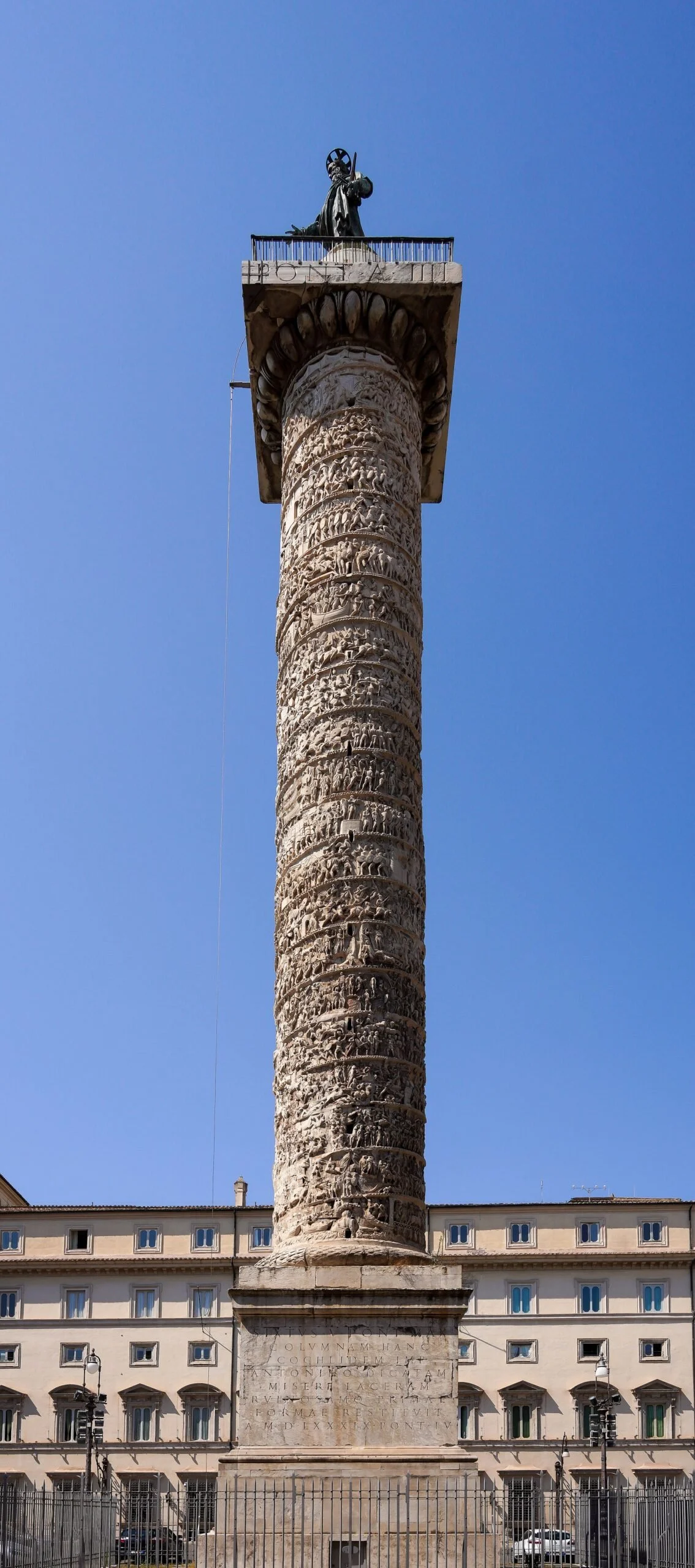
The Column of Marcus Aurelius rises in the middle of Piazza Colonna, in the heart of the Campus Martius, and still stands exactly where it was planted at the end of the 2nd century AD: no other cochlid monument in Rome can say as much. It's a historiated column just under 30 meters tall in the shaft alone, wrapped in a spiral frieze that tells of Marcus Aurelius's campaigns against the Marcomanni, the Quadi and the Sarmatians along the middle course of the Danube, and topped by a bronze statue that isn't the emperor's but Saint Paul's, put up there by Pope Sixtus V in 1589. Around it the city of power has grown: Palazzo Chigi, seat of the Prime Minister's Office, stands in front. A step away opens the square of Montecitorio with the Chamber of Deputies. The foot traffic of via del Corso flows past it all day. The result is that tens of thousands of people walk by it every week without stopping to look at it, mostly convinced it's an urban ornament and not one of the two great narrative monuments of Roman antiquity to survive intact. The lines that follow tell what this column really is, what is carved on its frieze, how it relates to Trajan's Column, from which it derives and from which it departs, what the 16th-century restoration by Domenico Fontana did to it, and how to look at it today with some chance of understanding something.
A useful clarification before starting: on the site the square has a page of its own, dedicated to the urban context, the buildings that surround it and the fountain by Giacomo Della Porta, while these lines concern only the ancient monument placed at its center. For the picture of the square as a whole, everything is on the page dedicated to Piazza Colonna.
Where the Column of Marcus Aurelius is and how to get there
The Column of Marcus Aurelius stands in the middle of Piazza Colonna, in the Colonna district, halfway between the Pantheon and the Trevi Fountain, on the western side of via del Corso. It isn't a monument you visit: it's a monument you arrive in front of, because it occupies the center of a public square open 24 hours a day, with no fence, no ticket office, no opening hours. This makes it one of the few great works of Roman antiquity that anyone can look at at any time, even at three in the morning, without asking anyone's permission.
On foot from the historic center
From the Pantheon it's five or six minutes' walk, taking via del Seminario and then piazza di Montecitorio: it's the most natural route, because it crosses the same sector of the Campus Martius in which the column was erected. From the Trevi Fountain the distance is similar, going down via delle Muratte and coming out onto via del Corso right at the level of the square. From Piazza di Spagna it takes 12 or 15 minutes along via dei Condotti and then the Corso heading south, while from Piazza Venezia and the Capitoline Hill you go up the Corso heading north for a good 10 minutes, passing along the way the bulk of Palazzo Doria Pamphilj.
By public transport
The metro stops nearest to the Column of Marcus Aurelius are Barberini and Spagna, both on Line A, and from both you walk about 10 minutes. There is no metro station facing the square, and for a precise reason: the whole Campus Martius is a dense, stratified archaeological deposit, and digging shallow tunnels in this area has never been practicable. If you're coming from Termini you can take metro A toward Battistini and get off at Barberini or at Spagna, depending on the walk you prefer.
Landmarks so you don't get the wrong square
A very frequent mix-up concerns the name: there is also the Galleria Colonna in Rome, which is something completely different, namely the picture gallery of Palazzo Colonna at Santi Apostoli, which you visit with a paid ticket on set days. If that's what you're looking for, you'll find everything on the page of the Galleria Colonna, which is on the other side of the Corso, toward the Quirinal. The shopping arcade facing Piazza Colonna, once also called Galleria Colonna, is now called Galleria Alberto Sordi: it's the building with the glass roof that opens on the eastern side of the square, and it's an excellent visual landmark to know you've arrived in the right place.
What the Column of Marcus Aurelius is: a cochlid column of the 2nd century
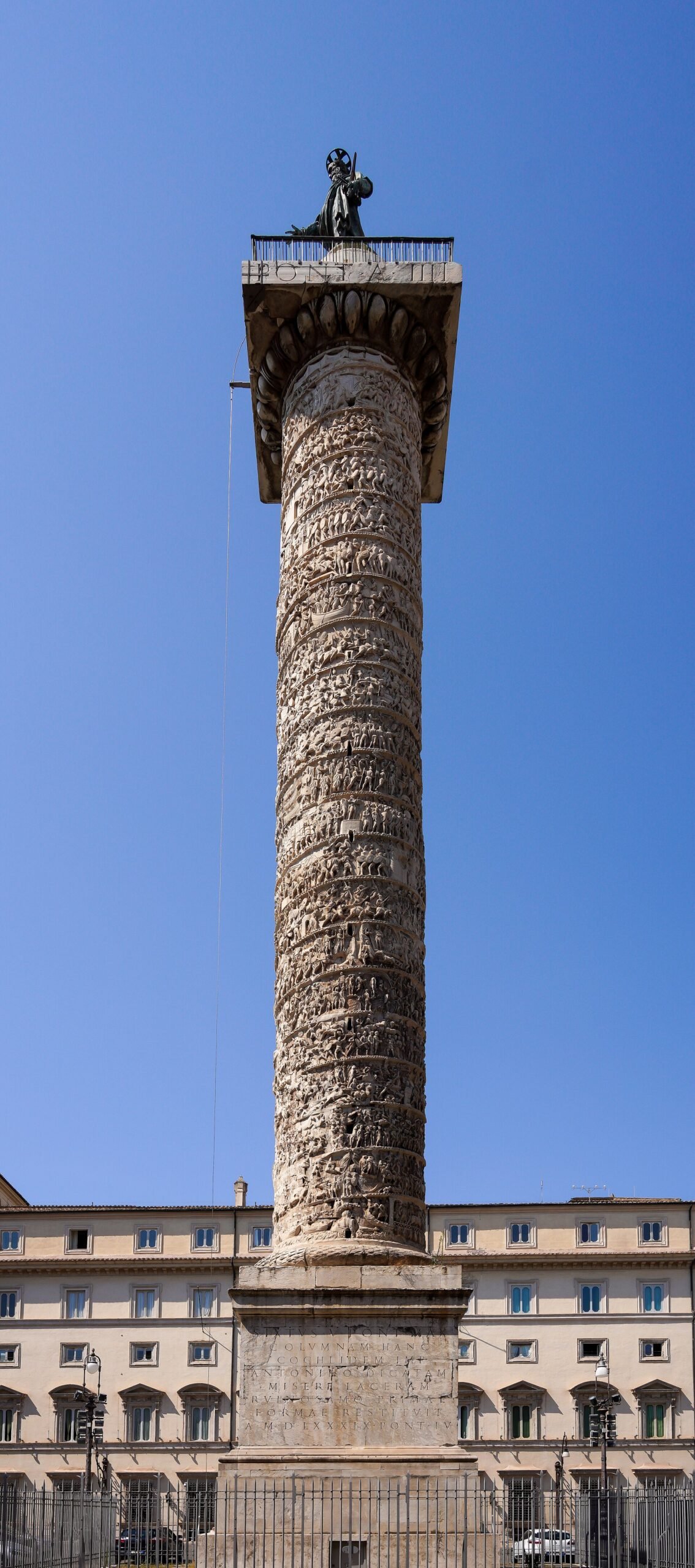
The Column of Marcus Aurelius is a cochlid column, that is, an isolated honorary column, hollow inside, with a spiral staircase running through it and covered on the outside by a sculpted frieze that winds in a spiral from bottom to top. The type is a Roman invention and has had very few examples: Trajan's Column of 113, this one, and then the columns of Theodosius and Arcadius in Constantinople, now lost and known only from Renaissance drawings. Of ancient cochlid columns still standing in the world, two remain, and both are in Rome.
What cochlid means
The word comes from Greek and Latin and refers to the snail: cochlid means spiral, wound like a snail's shell. The term describes two things at once, and this double meaning is the point: it describes the frieze that turns on the outside and the staircase that turns on the inside. In ancient sources the monument appears as columna cochlis, and the same epithet was used for the column of Trajan. It's not a learned detail: the fact that an honorary monument was also a building you could walk through, with a staircase, an entrance and a terrace at the top, is one of the most singular inventions of Roman architecture, and it has no parallel in the Greek world.
The ancient name and the modern names
The official ancient name that the sources give back to us is columna centenaria divorum Marci et Faustinae, that is, centenary column of the divine Marcus and Faustina: centenary because the shaft measures 100 Roman feet, divine because both Marcus Aurelius and his wife Faustina the Younger had been deified after death. In current use the monument is called in three different ways, all legitimate and all in circulation: Column of Marcus Aurelius, Aurelian Column and Antonine Column. This last name, the most ambiguous, derives from the fact that Marcus Aurelius belonged to the Antonine dynasty and became established in the 16th century precisely because of a mistake, the one in the inscription Sixtus V had carved, which will be discussed further on.
The monument's numbers
The shaft of the Column of Marcus Aurelius measures 29.6 meters, equal to 100 Roman feet, and is made of 27 large drums of Luni marble, the white marble of the Luni quarries, the ones that are now called the Carrara quarries. On this figure the sources agree, with a minimal variation between those who count 27 drums and those who count 28, a difference that depends on how the capital block is considered. On the rest of the measurements, instead, the sources diverge, and it's worth explaining why.
How it was built
The marble drums were quarried at Luni, hollowed out inside already at the quarry to lighten them and to prepare the stretch of staircase that each would house, transported by sea to Ostia and then taken up the Tiber to the river port of the Campus Martius. Once on the site they were hoisted and stacked one on top of another with a system of winches and lifting derricks. The frieze, according to the hypothesis most accepted today, was carved largely after assembly, working from top to bottom on scaffolding, exactly as had been done for Trajan's column: it's the only way to get a continuous spiral that crosses the joints between one drum and the next without interruption.
When it was built and by whom
The construction of the Column of Marcus Aurelius began after the emperor's death, which occurred in 180, and ended around 193. The commissioner was his son Commodus, who reigned from 180 to 192, while the completion falls in the years immediately after, when Septimius Severus was settling onto the throne. The monument is therefore posthumous: Marcus Aurelius never saw it and had no say in how he would be told. This is a substantial difference from Trajan's Column, inaugurated in 113 when Trajan was alive and reigning.
The procurator Adrastus and the house next to the column
There is an epigraphic document that concerns not the emperor but the personnel assigned to the monument, and it's one of the most curious testimonies that antiquity has left us on the ordinary management of a public building. These are two inscriptions known to scholars as CIL VI 1585 a and b, relating to a freedman named Adrastus, appointed procurator columnae, that is, procurator of the column, in 193. In the first Adrastus is in charge of the custody of the monument. In the second he asks for and obtains land and materials to build himself a dwelling next to the column itself, presumably because his post required continuous presence.
The frieze: the Germanic and Sarmatian wars wound in a spiral
The frieze of the Column of Marcus Aurelius is about a meter and a half tall, winds around the shaft for 21 turns and counts about 116 scenes: unrolled flat it would exceed 110 meters in length. It tells of the wars the emperor fought along the middle course of the Danube against the Germanic peoples of the Marcomanni and the Quadi and against the Sarmatians, a conflict that took up almost the whole of the last decade of his reign and during which Marcus Aurelius died, in 180, probably at Vindobona or at Sirmium.
Who the Marcomanni, Quadi and Sarmatians were
The Marcomanni and the Quadi were Germanic peoples settled in the area roughly corresponding to Bohemia and Moravia, north of the Danube, that is, just beyond the empire's northern border. The Sarmatians, and in particular the Iazyges, were peoples of Iranian stock settled on the plain between the Danube and the Tisza, famous for their heavy cavalry. Between 166 and 180 these peoples, pushed in turn by movements of peoples farther north, repeatedly broke the Danube frontier and managed to push deep into imperial territory, in at least one case as far as Aquileia, in northeastern Italy.
21 turns, 116 scenes
The narrative unfolds from bottom to top and is read by walking around the monument: anyone who wants to follow it has to go round in circles 21 times with the head rising progressively. The story begins with the army crossing the Danube on a bridge of boats and continues with marches, camp building, sieges, pitched battles, submissions of defeated peoples, speeches of the emperor to the troops. These are the same categories of scene that make up the Trajanic frieze, and this is no accident: the iconographic repertoire is deliberately taken from the model.
Why the chronology is uncertain
The most substantial difference from the Trajanic model, in terms of readability, is that the scenes of the Column of Marcus Aurelius are not arranged in a strict chronological order. On Trajan's frieze the sequence of events can be reconstructed with good approximation by comparing it with literary sources. Here the relationship between image and chronicle is much looser. To complicate matters, for the Marcomannic wars the ancient literary sources are fragmentary: the narrative of Cassius Dio reaches us largely through an epitome, and the Historia Augusta is a late and problematic source. The result is that the frieze, instead of being illustrated by the sources, is often used as a source itself, with all the risks that this entails.
The tone of the story: war without mercy
Anyone who has the Trajanic frieze in mind, with its defeated but dignified barbarians and its hardworking Romans, is struck by the harshness of the Aurelian story. Here appear burned villages, beheaded prisoners, women dragged away by the hair, deportations of entire populations. The depiction of the defeated loses the margin of respect that art historians have always noted in Trajan's column: there is no longer any trace of that suspension of judgment, and violence is shown as a legitimate and necessary exercise of imperial power.
The rain miracle: the most famous scene of the frieze
The most famous scene of the Column of Marcus Aurelius is the one known as the rain miracle, numbered as scene XVI according to the numbering established by Eugen Petersen, and it shows a winged, bearded divinity, with beard and hair streaming down like running water, pouring rain on thirsty Roman soldiers while sweeping away the enemies. It's the most debated episode of the whole monument and one of the most cited of all Roman antiquity: there are dozens of references in sources ranging from the 2nd to the 14th century.
What you see in the scene
The relief shows a Roman army come out of a camp and drawn up in square formation, some oxen of which one is dead, visibly exhausted soldiers, a legionary raising his eyes to the sky in a pose of supplication. Then the rain, which comes down abundantly, dispensed by a winged, bearded figure hovering above. Some soldiers collect the water with their shields and helmets to drink and to water the horses. On the opposite side the enemies are swept away: some lie on the ground together with their horses. The rain, in the logic of the image, is beneficial for some and lethal for others. The next scene shows the surrender of the barbarians.
The lightning scene, a little lower down
A little below, scene XI represents a second prodigy, the one scholars call the lightning miracle: a Roman fortification full of soldiers, against which the enemies have pushed a siege engine, and the lightning that strikes the engine making it collapse on the besiegers. Marcus Aurelius watches the scene motionless, flanked by his bodyguards. The two scenes are close but distinct, and this is an important detail: it means the monument recorded two separate prodigious episodes, not just one.
The ancient versions of the episode
On the origin of the prodigy the ancient sources split along lines that have little to do with meteorology and a lot to do with propaganda. The pagan tradition attributes the event to the intervention of an Egyptian magician named Arnuphis, or to Mercury: it is significant that between December 172 and 173, that is, one or two years after the event, Marcus Aurelius had coins minted showing Mercury inside a little temple, with the legend religio augusti, and that in Rome an aedicula was erected dedicated to Hermes Aerios, a manifestation of Mercury as a god of atmospheric phenomena otherwise unattested.
How modern historiography reads it
The reading prevailing today among scholars holds the two levels together. On the level of facts, it is considered probable that two distinct natural episodes really did occur in a desperate military context: a providential storm during a campaign conducted in conditions of serious water shortage, and a lightning bolt that fell by chance on an enemy siege engine. On the cultural level, it is observed that those two events were reworked and fused in a religious key by competing traditions, each interested in claiming the credit for reasons of legitimation. The dating of the episode remains uncertain: the ancient sources indicate different years between 171 and 174.
A curiosity about the Column of Marcus Aurelius
The curiosity that most strikes those who discover it is this: the Column of Marcus Aurelius is crooked, and it is because of two medieval earthquakes. Looking carefully at the stacking of the drums you notice that some are rotated relative to the others, as if someone had turned a piece of the pile by a few degrees. The explanation accepted by scholars is that the monument underwent a twist following the strong quakes that struck Rome in AD 847 and 849.
The two earthquakes of the 9th century
Those two seismic events left heavy marks all over the city. To the first, the one of 847, is attributed the collapse of a large part of the southern sector of the Flavian amphitheater, the Colosseum, which rested on less stable ground. To the second, the one of 849, is probably attributed the fall of the obelisk that Augustus had brought from Heliopolis for the great sundial of the Campus Martius, the one now called the obelisk of Montecitorio, which was raised again only at the end of the 18th century. The Column of Marcus Aurelius, which stands a few dozen meters from where that obelisk was planted, took the same shock and remained standing, but rotated.
One thing nobody tells you about the Column of Marcus Aurelius
The thing almost nobody says is that the column you see today emerges from a base that isn't the ancient one, and that below the level of the paving there are still several meters of monument that never came back to light. Before the 16th-century restoration about six meters of the structure, including the original entrance to the spiral staircase, were buried beneath the street level that had risen over the centuries. Domenico Fontana dug down to the ground level of his time, but left covered the ancient platform and about three meters of the base.
How much of the monument remains buried
It means that anyone looking at the column sees a building decapitated at the bottom: the raised platform on which it stood is missing, the first courses of the base are missing, the original relationship between the monument and the ancient square is missing. The Column of Marcus Aurelius has never been brought back to Roman level, and it won't be: doing so would mean digging a shaft several meters deep in the middle of one of the most frequented and most heavily guarded squares in Italy, with Palazzo Chigi looking out over the site.
What the original base looked like
The ancient base wasn't smooth: it was decorated with reliefs. Scholars' reconstructions, based on old drawings and descriptions, indicate Victories holding festoons on three sides and a scene of subjugated barbarians on the side facing the via Flaminia. None of these reliefs exists anymore: they were chiseled away at the 1589 building site to make room for the smooth marble facing that you see now. The loss is clear-cut and unrecoverable, and it is one of the reasons why the historical judgment on that restoration remains severe.
The comparison that gives the idea
To get an idea of what was lost it's worth looking at the base of the column of Antoninus Pius, now kept in the Vatican Museums, in Vatican City: it is a marble block with the apotheosis of the emperor and his wife Faustina carried to heaven by a winged genius, and with two scenes of a military parade on the sides. That base belongs to a monument of a few years earlier and gives back to us the quality of the sculpture that also adorned the base of the Aurelian column. Looking at it, and then looking at the smooth 16th-century facing of Piazza Colonna, is an instructive and rather melancholy exercise.
The inner staircase: 203 steps inside the marble
Inside the shaft of the Column of Marcus Aurelius runs a spiral staircase carved into the marble drums, which according to most Italian sources has 203 steps and climbs to a small terrace above the capital. English-language studies more cautiously give a value between 190 and 200 steps: the discrepancy depends on how the connecting steps at the ends are counted, and doesn't change the substance. In both cases it is a narrow, steep climb entirely inside the stone, lit by small slits opened in the thickness of the marble and camouflaged within the sculpted relief. They are visible from the ground too, as thin horizontal slits distributed along the shaft.
Why you can't climb it
The staircase exists, is intact and can be walked, but it isn't open to the public. Access is reserved for the technical staff in charge of checks and maintenance, and there are no guided tours, reservations or special openings that allow visitors to climb: the reasons are safety, conservation and public order, considering that the terrace at the top looks directly onto the seat of the Prime Minister's Office. The same rule in force for Trajan's Column applies. Anyone who finds pages online implying the contrary is looking at wrong information.
The statue of Saint Paul and the restoration by Sixtus V
In 1589 Pope Sixtus V had the Column of Marcus Aurelius restored, entrusting the works to Domenico Fontana, and on that occasion the bronze statue of Saint Paul that is still seen today was placed on the summit, in place of the gilded bronze statue of the emperor that originally stood up there and that had disappeared during the Middle Ages, in all likelihood melted down to recover the metal. It was the second operation of this kind in a few years: in 1587 the same pontiff, with the same architect, had put a bronze Saint Peter on top of Trajan's Column. The two founding apostles of the Church of Rome thus found themselves crowning the two tallest honorary monuments of imperial Rome.
What exactly Domenico Fontana did
Fontana dug around the base until reaching the street level of his time, leaving buried the ancient platform and about three meters of base. He sealed the cracks of the shaft. He made a new entrance to the spiral staircase at ground level, replacing the ancient one, by then buried. He covered the whole structure of the base with new marble, using material taken from the Septizodium, the great Severan nymphaeum on the slopes of the Palatine that Sixtus V himself had demolished and dismantled to get building stone. And finally he had the bronze Saint Paul placed on top, modeled on the example of the Saint Peter placed two years earlier on Trajan's Column.
The tampering: what was lost
The price of that operation was high. The reliefs that decorated the ancient base, the Victories with festoons on the three sides and the subjugated barbarians on the side toward the via Flaminia, were chiseled away to allow the new facing: nothing of them remains, and their reconstruction depends today only on indirect testimony. The legibility of the relationship between the monument and its ancient level was also lost, with the platform definitively covered. And an inscription was added to the monument that gets its dedication wrong, consolidating for centuries a misattribution.
The marble of the Septizodium
The detail of the Septizodium deserves a line of its own, because it shows how late 16th-century Rome worked. The Septizodium was a monumental facade of exedras and columns erected by Septimius Severus in 203 on the southeastern slopes of the Palatine, toward the via Appia: one of the most scenographic buildings of the ancient city, partly surviving until the Renaissance. Sixtus V had it dismantled and its marble was distributed to other papal building sites, including this one. Put another way, the Column of Marcus Aurelius is faced at the base with the remains of another ancient monument demolished for the occasion: an operation of reuse that recalls very closely those of the late antique age, carried out, however, 1,400 years later.
The inscription at the base: a monument dedicated to the wrong emperor
The inscription you read today at the base of the Column of Marcus Aurelius isn't ancient: it's the one Sixtus V had carved in 1589, and it attributes the monument to an emperor different from the one to whom it is dedicated. The Latin text, arranged on eight lines, reads SIXTVS V PONT MAX COLVMNAM HANC COCLIDEM IMP ANTONINO DICATAM MISERE LACERAM RVINOSAMQ PRIMAE FORMAE RESTITVIT A MDLXXXIX PONT IV, and is translated: Sixtus the Fifth, supreme pontiff, restored to its original form this cochlid column dedicated to the emperor Antoninus, miserably torn and ruinous, in the year 1589, the fourth of his pontificate.
The attribution error
The Antoninus of the inscription is Antoninus Pius, predecessor and adoptive father of Marcus Aurelius, who has nothing to do with this monument. The mix-up arises from a real confusion: Antoninus Pius had had an honorary column of his own, erected between 161 and 162 in the same zone of the Campus Martius, a short distance from this one. That column, however, was of red Egyptian granite, about 14.75 meters tall, with no relief on the shaft. In the 16th century its memory had been lost, and the only historiated column visible in that sector of the city was attributed, out of inertia, to the best-known name.
What happened to the real column of Antoninus Pius
The remains of the column of Antoninus Pius resurfaced in 1703, during demolitions in the Montecitorio area, and were dug up in 1705. The shaft turned out to be broken in several places. Several attempts to raise it again failed, a fire damaged its fragments in 1759, and in the end, in 1789, Pius VI decided to use that granite to restore the obelisk of Montecitorio. The sculpted base, on the other hand, has been kept in the Vatican Museums since 1787. The paradox is complete: the column that bears the name of Antoninus is not his, and his real column was dismantled and used as repair material for an obelisk.
The advice I give you for visiting the Column of Marcus Aurelius
The most useful advice concerns the time of day: the Column of Marcus Aurelius should be looked at when the sun lights it from the side, that is, in the early morning or late afternoon, because the relief can only be read when there's shadow inside the grooves. At noon, with the light falling from above, the frieze flattens out and becomes a confused surface. The difference between the two moments is enormous and requires no equipment to appreciate: you just have to choose the time.
Where to look at it from
The second piece of advice concerns distance. The most common mistake is getting too close: from underneath you only see the first coil, foreshortened and distorted by perspective. It's better to move away toward the opposite side of the square, or even better to gain some height. The windows of the Galleria Alberto Sordi, on the eastern side, offer a raised viewpoint accessible without a ticket during the building's opening hours. Some places facing the square have terraces that look at the monument from a better height than the sidewalk.
Binoculars and zoom
The third piece of advice is concrete: a small pair of binoculars, or the telephoto lens of a camera, radically changes the experience. The scenes are at a height between 10 and 40 meters and with the naked eye you only make out the masses. With even a modest magnification you recognize faces, shields, horses, and it becomes possible to look for scene XVI, the rain miracle. Anyone with neither can use the zoom of a phone, which on recent models is enough for the lower band of the frieze.
How much time it takes and how to fit it into an itinerary
A conscious stop in front of the column takes 20 minutes: five for the full circuit of the monument, 10 for looking for the main scenes with the binoculars, five for looking at the square around. Anyone just passing through with only two minutes should spend them at least on walking all the way around, because looking at it from one side only means seeing a quarter of the frieze. The natural itinerary puts it between the Pantheon and the Trevi Fountain, and those who want to really understand it pair it on the same day with Trajan's Column, which can be seen from the balustrades of the Forum of Trajan about 800 meters away, toward the Trajan's Markets.
Another well-known fact, yet rarely cited
The well-known fact is that the Column of Marcus Aurelius is a declared copy of Trajan's Column. What is rarely cited is that precisely in the way the copy fails lies its greatest historical value. The artists who worked on the Aurelian frieze wanted to do as their predecessors had done and didn't manage to, because in the meantime the very way of conceiving the human figure had changed. That failure is the first monumental document of the transformation that leads to late antique art.
What changes in the human figure
On Trajan's Column the figures are built according to the canons of the Hellenistic tradition: natural proportions, believable twists, bodies arranged obliquely in space, proportionate heads. On the Aurelian one the heads become disproportionately large relative to the bodies, the figures are arranged frontally and look toward the viewer, the folds of the drapery are reduced to grooves dug with the drill, the bodies of the defeated writhe in angular rhythms. The naturalistic structure disintegrates and is forced in an expressive direction.
Why this matters
These are exactly the characteristics we will find, taken to their extreme consequences, in the Constantinian reliefs two centuries later and then in Byzantine art: frontality, hierarchy of sizes, renunciation of naturalistic depth. Seeing these traits already emerging in an official monument of the late 2nd century, in the heart of Rome, means understanding that the passage to late antique art was not a sudden decadence caused by invasions, but a long, internal transformation, begun when the empire was still at the height of its power.
Plebeian art and Becatti's explanation
The most influential explanation of this change is the one proposed by Giovanni Becatti and developed by Ranuccio Bianchi Bandinelli with the formula of plebeian art. According to this reading there existed in Rome two parallel languages: an official, classicizing one of Greek derivation, used for public monuments, and a popular one, more direct, less concerned with naturalism, alive in the funerary reliefs of craftsmen and freedmen. From the age of Commodus the second language begins to rise into the first, and the Column of Marcus Aurelius is the place where this can be seen for the first time on a large scale.
The right photo to take of the Column of Marcus Aurelius
The right photo of the Column of Marcus Aurelius isn't the one of the whole monument: it's the close-up detail of a portion of the frieze, taken with a telephoto lens in the raking light of late afternoon. The overall shot, which everyone takes first, gives back a white spire against the sky and communicates nothing of what the monument really is, namely 200 meters of sculpted narrative.
The frieze detail
To get it you need a long focal length and the patience to wait for the light. The lowest coils, between 10 and 15 meters off the ground, are the most accessible to a common telephoto lens and are also the best preserved. Raking light is indispensable: without shadow inside the grooves the relief disappears. In summer the useful window is fairly wide in the late afternoon, in winter it narrows to a few dozen minutes.
Mistakes to avoid
Three recurring mistakes. The first is shooting at noon, with the result of a flat frieze and a blown-out sky. The second is framing from below too close, getting a column that falls backward in an unnatural way: it's better to step back and use a longer focal length. The third is forgetting the fountain by Giacomo Della Porta, which stands a few meters away and offers a foreground of water and marble able to give depth to an otherwise flat frame. Photographing in the square is free, since it is an outdoor public space, but keep in mind that the area is permanently watched because of the presence of institutional offices.
Some important events that happened here in history
The Column of Marcus Aurelius is the only monument in Rome to have remained without interruption in the same spot from the 2nd century AD to today, and for this reason it has gone through the whole history of the city as a fixed spectator: the end of the empire, the Middle Ages, the urban building site of Sixtus V, papal Rome, united Italy, the Republic. What follows is the essential thread.
193: the completion and the appointment of the custodian
The year in which the building site ends is also the one in which Adrastus is appointed procurator of the column. It is 193, one of the most turbulent years in Roman history, the one of the four emperors who succeed one another in a few months until the affirmation of Septimius Severus. The monument dedicated to Marcus Aurelius is handed over to the city just as the Antonine dynasty has died out with the assassination of Commodus.
The 1800s: surveys and engravings
Between the 18th and 19th centuries the column becomes the object of systematic graphic documentation campaigns. Giovanni Battista Piranesi dedicates to it a view of the main elevation spread over six plates. At the end of the 19th century the German archaeologist Eugen Petersen oversees its complete photographic publication and establishes the numbering of the scenes still in use: when scholars speak of scene XVI for the rain miracle, they use Petersen's numbering.
The 1900s and 2000s: the square of power
With the transfer of the capital to Rome and then with the acquisition of Palazzo Chigi by the Italian State in 1916, the square gradually becomes the symbolic center of Italian executive power. Since then the column has served as a permanent backdrop to press conferences, live television broadcasts, sit-ins and demonstrations: it is probably the ancient monument most framed by Italian cameras, and almost always without anyone naming it.
Who has passed by the Column of Marcus Aurelius
By the Column of Marcus Aurelius have passed, in order, the Romans of the 2nd century arriving in the city along the via Flaminia, medieval pilgrims headed to St. Peter's, Renaissance architects with the measuring rod in hand, Grand Tour travelers, and today parliamentary journalists. No other Roman monument has had such a continuous and such a varied public, for the simple reason that no other has stayed so long in the middle of a busy street.
Goethe, July 1787
Among the illustrious visitors the most cited is Johann Wolfgang Goethe, who in the Italian Journey notes on the date of July 24, 1787 having seen the square of the column with Palazzo Chigi lit by the moon and the column standing out in the night sky with its white, dazzling pedestal. Anyone who wants to follow the Roman traces of the German writer will find his Roman residence along the Corso, today a museum, on the page dedicated to the Casa di Goethe, a few minutes' walk from here.
The Romans of today
The last category is the largest and the least aware: the Romans who cross the square every day on their way to work. For most of them the column is a point of orientation and a meeting place, not a monument. Those who work in the parliamentary newsrooms facing the square see it several times a day for years. It is the fate of all the monuments that remain inside the living city instead of ending up in a fenced archaeological area, and it has an obvious advantage: no other ancient relief is so easy to reach.
Column of Marcus Aurelius and Trajan's Column: what really changes
The Column of Marcus Aurelius and Trajan's Column are two distinct monuments, separated by about 800 meters and by almost 80 years, and confusing them is the most common mistake: the first is in Piazza Colonna, the second in the Forum of Trajan, next to the Imperial Forums Museum. Anyone looking for one in the place of the other won't find it.
What they have in common
The similarities are not accidental, because the Aurelian column was conceived as a replica of the Trajanic one: same cochlid layout, shaft of 100 Roman feet, spiral staircase inside lit by slits, continuous spiral frieze dedicated to military campaigns, terrace at the top, bronze statue of the emperor at the summit. Both lost the original statue and both were crowned by Sixtus V with a bronze apostle, by the hand of the same architect: Saint Peter on the Trajanic one in 1587, Saint Paul on the Aurelian one in 1589.
The material differences
The differences begin with the numbers. The Aurelian frieze makes 21 turns against the 23 or 24 of the Trajanic one, and counts about 116 scenes against the more than 150 of the other. The shaft of the Column of Marcus Aurelius is made of a larger number of drums, around 27, and its staircase has a little over 200 steps against the 185 of the Trajanic one. The function of the base also changes: under Trajan's Column was carved the chamber that received the emperor's ashes, while the Aurelian column was never a tomb.
The differences of subject
The Trajanic frieze tells the conquest of Dacia, that is, two campaigns of aggression concluded with the annexation of a new province and with an enormous booty. The Aurelian one tells the Marcomannic wars, that is, a breathless defense of the Danube frontier against peoples who had broken through: no province annexed, no definitive triumph, a war that the emperor did not see end. The difference of subject explains a good part of the difference in tone.
The differences of style
On the formal level the contrast is sharp. On Trajan's Column the relief is low, soft, pictorial, with gradual changes of plane. On that of Marcus Aurelius the relief is high and incised, the drill digs deep creating strong contrasts of light and shadow, the heads are larger relative to the bodies, the figures are arranged frontally instead of foreshortened. Trajan appears in the midst of his soldiers. Marcus Aurelius appears isolated and frontal, flanked by his son-in-law Pompeianus and another officer arranged in three-quarter view like wings, in a composition that underlines his majesty and distance.
The different conception of the human figure
The most important point is precisely this: the very idea of what a human figure is in a public narrative changes. On the Trajanic column the figure is a body in space, built according to naturalistic rules of Greek derivation. On the Aurelian one the figure becomes a sign, sized according to importance and not according to perspective, oriented toward the viewer and not toward the action. That sense of humanity toward the defeated that art historians have always noticed in Trajan's frieze also disappears. It is the road that leads to the reliefs of the Arch of Constantine and then to Byzantine art, and it begins here.
State of conservation: what remains legible
The state of conservation of the Column of Marcus Aurelius is on average good in the structure and problematic in the sculpted surface, as happens to all marbles exposed for 18 centuries in an urban environment. The monument is stable and has no structural problems known to the public, but the legibility of the frieze has decreased over time, above all in the parts most exposed to washout and in the upper coils.
The phenomena of decay
The phenomena documented on outdoor Roman marbles are always the same: formation of black crusts in the areas sheltered from rain, where atmospheric particulate fixes onto calcium sulfate. Erosion and rounding of the profiles in the washed areas. Biological colonization in the damp parts. Surface decohesion that makes the marble friable. To this are added, for a monument made of stacked blocks, the stresses of the ancient metal pins, which as they oxidize increase in volume and can cause microfractures.
What a visitor sees today
In practical terms: from below, with the naked eye and in favorable light, the first five or six coils remain readable in their masses, and with binoculars you recognize figures and details. Higher up the reading becomes difficult because of distance even before decay. The condition of the monument is monitored by the Capitoline Superintendency for Cultural Heritage, which has jurisdiction over it, and over the decades cleaning and maintenance work has followed one another. For up-to-date information on any work in progress or on scaffolding, it's best to check directly with the Superintendency before planning a photographic visit.
Frequently asked questions about the Column of Marcus Aurelius
How much does it cost to see the Column of Marcus Aurelius?
Seeing the Column of Marcus Aurelius is free: the monument stands in the middle of Piazza Colonna, a public square open without fences, without a ticket office and without entrance checks. There is no ticket because there is no closed area to visit. Observation takes place entirely from the outside, from sidewalk level, at any hour of the day and night.
What are the opening hours of the Column of Marcus Aurelius?
The Column of Marcus Aurelius has no opening hours, because it stands in a public square accessible 24 hours a day. The square is lit at night and the monument remains visible after sunset too. The only possible limitation concerns any temporary closures of the square for public order reasons, tied to the presence of the institutional offices facing it.
Can you climb the Column of Marcus Aurelius?
No, you can't climb the Column of Marcus Aurelius. The internal spiral staircase exists, has a little over 200 steps and is intact, but access is reserved for the technical staff in charge of checks: no guided tours, reservations or special openings for the public are planned. The same rule in force for Trajan's Column applies.
How tall is the Column of Marcus Aurelius?
The shaft of the Column of Marcus Aurelius measures 29.6 meters, equal to 100 Roman feet. On the overall height the sources diverge: some studies indicate about 39.7 meters above ground adding the base, other sources speak of about 42 meters and reach almost 50 meters counting the ancient platform now buried and the original statue. The figures measure different things.
How do you get to the Column of Marcus Aurelius by public transport?
You get to the Column of Marcus Aurelius by getting off at the Barberini or Spagna stations of metro Line A and walking about 10 minutes, or with the buses that serve via del Corso and the hub of piazza San Silvestro. There is no metro stop on the square. Routes and surface lines change often: it's best to check them with a navigation app before leaving.
Is the Column of Marcus Aurelius suitable for children?
The Column of Marcus Aurelius works well with children on one condition: that someone tell them what is carved on it. The frieze is a comic strip over 100 meters long with armies, horses, bridges of boats, sieges and a storm sent by a god, and with binoculars the hunt for the scenes becomes a game. Without a story and without magnification it remains a white column.
Can you take photographs of the Column of Marcus Aurelius?
Photographing the Column of Marcus Aurelius is allowed, since it is an outdoor monument in a public space. It's worth remembering that the square hosts institutional offices and is permanently watched: framing the monument poses no problem, while insistent footage of entrances, sit-ins and security personnel can attract attention. For the frieze you need a telephoto lens and raking light.
Is the Column of Marcus Aurelius accessible to people with disabilities?
The Column of Marcus Aurelius is viewed from a flat, paved square, reachable by wheelchair from the sidewalks of via del Corso and the neighboring streets, with no steps to overcome to get a view of the monument. Since there is no internal route to take, the experience presents no barriers: the only real obstacle is the crowding of the area at peak hours.
What's the difference between the Column of Marcus Aurelius and Trajan's Column?
The Column of Marcus Aurelius is in Piazza Colonna and tells the Danube wars against the Marcomanni, Quadi and Sarmatians fought between about 168 and 175. Trajan's Column is in the Forum of Trajan, about 800 meters away, was inaugurated in 113 and tells the conquest of Dacia. The second is the model of the first, but has lower relief, proportionate heads and foreshortened figures, while the Aurelian column has high relief, large heads and frontal figures.
One last note for anyone planning the itinerary
The Column of Marcus Aurelius pays off most as a stop within a route, not as a destination in itself: the sequence that works best puts it between the Pantheon, the Trevi Fountain and San Lorenzo in Lucina, and on the same day has it meet Trajan's Column toward the Imperial Forums. Seeing both of them a few hours apart is the quickest way there is to understand how Rome changed between the 2nd century of Trajan and that of Commodus.
If you're building an itinerary in the historic center and want to cross this stop with the others of the Campus Martius and the Forums, you'll find useful planning tools on Tour Leader Pro, while for a broader picture of transport, getting around and destinations in Lazio, Italy Planner remains a good resource.