Trajan’s Column
In short. Trajan's Column rises almost 40 meters at the northern end of Trajan's Forum, a few steps from Piazza Venezia, wedged between the side of the Trajan's Markets and the twin churches of Santa Maria di Loreto and Santissimo Nome di Maria.
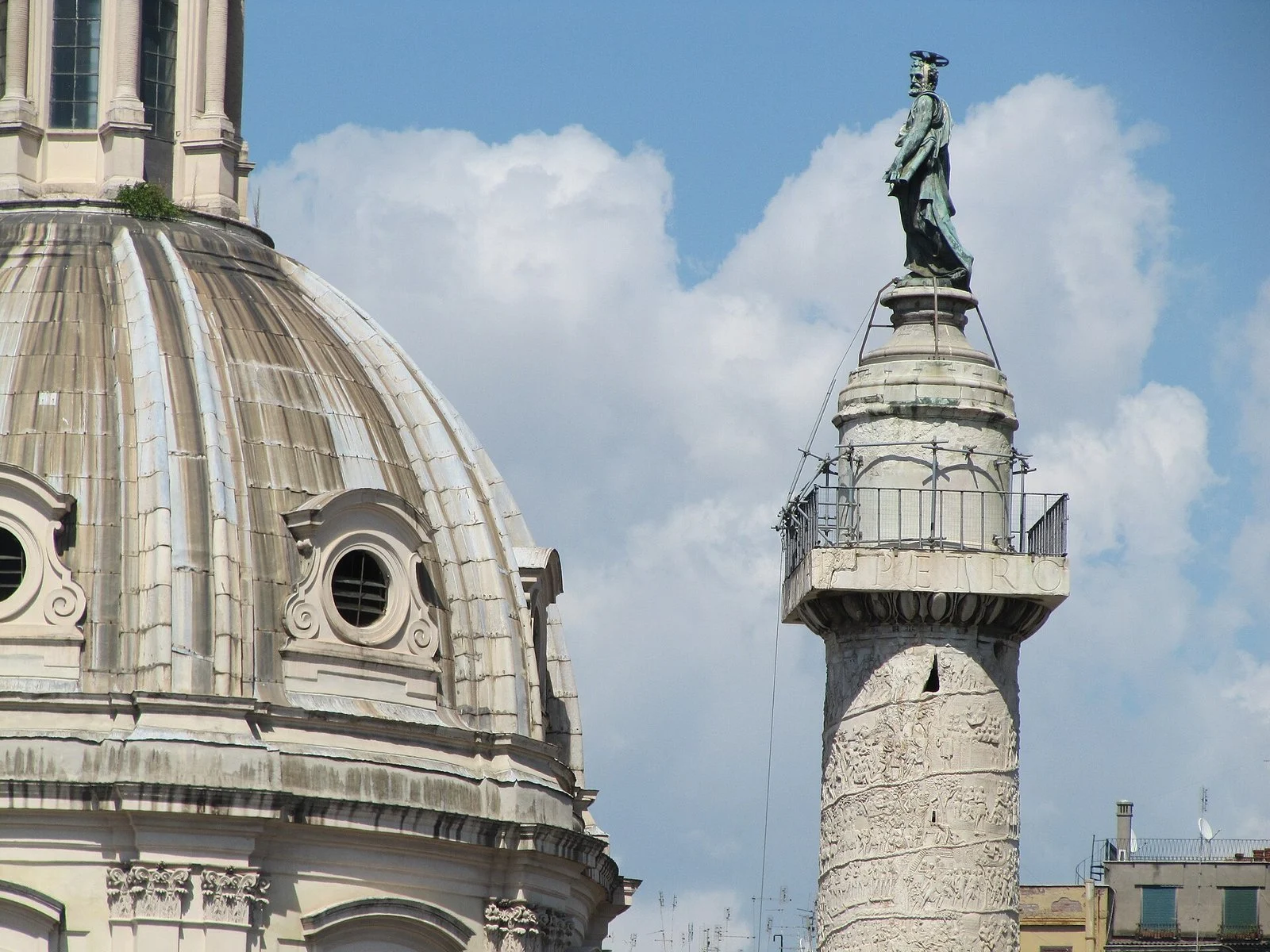
Trajan's Column rises almost 40 meters at the northern end of Trajan's Forum, a few steps from Piazza Venezia, wedged between the side of the Trajan's Markets and the twin churches of Santa Maria di Loreto and Santissimo Nome di Maria. It is the only element of Trajan's Forum to have come down to us practically intact, and it is at the same time the most extraordinary figured document that antiquity has left us about an ancient war: 200 meters of frieze carved in a spiral, wound around the shaft, which tell in images the two campaigns Trajan waged against the Dacians between AD 101 and 106. Nothing comparable exists in the world, either in extent or in detail: no other ancient monument shows us like this, scene after scene, how a Roman army marched, built camps, crossed rivers, besieged fortresses and negotiated with the enemy. The column was inaugurated on May 12, 113 AD, according to the Fasti ostienses, and at the emperor's death its base became the tomb of Trajan himself, in breach of one of the strictest rules of the ancient city. The lines that follow tell how the column is built, what is carved on it, why inside it there is a staircase that almost nobody has climbed, how it is visited today and why it must be kept well distinct from the other great historiated column of Rome, that of Marcus Aurelius in Piazza Colonna.
Where Trajan's Column is and how to get there
Trajan's Column is located in Largo Foro Traiano, in the Monti district, less than 200 meters from Piazza Venezia and right up against Via dei Fori Imperiali: it can be seen from the street, from the top of the balustrade that runs around the archaeological area, with no ticket and no opening hours. This is the first thing to know, because many guides present it as if it were a paid stop inside a museum route, while in reality anyone passing through Piazza Venezia can stop and admire it at no cost, by day as by night.
On foot from the center of Rome
From Piazza Venezia it's just two minutes on foot: you pass along the side of the Vittoriano going up toward Via dei Fori Imperiali and after a few dozen meters the column appears on the left, at the bottom of the depression of the archaeological area, with the bronze statue that crowns it standing out against the sky. From the Pantheon the route takes about 10 minutes via Via del Corso and Piazza Venezia, from the Colosseum about 15 walking along the whole of Via dei Fori Imperiali, from the Capitoline Hill a little over five. It's one of those Roman destinations you don't reach on purpose: you get there because the historic center, from whichever side you cross it, sooner or later leads there.
By public transport
The nearest metro stop to Trajan's Column is Colosseo, on line B, from which you need about 12 minutes on foot going up Via dei Fori Imperiali. Alternatively the Cavour stop, also on line B, leaves you at a similar distance via the Salita dei Monti. Piazza Venezia is one of the best-served surface hubs in the city, crossed by many urban bus lines, and the terminal at Piazza dei Cinquecento at Termini station can be reached in a few minutes with several direct runs. Those arriving by train at Termini can also consider the walk, a little over 20 minutes, that crosses Via Nazionale and goes down toward the Imperial Forums.
Landmarks so you don't go wrong
The surest visual reference is the two domed churches that flank the column on Piazza Venezia side: Santa Maria di Loreto and Santissimo Nome di Maria al Foro Traiano, almost identical at first glance and built nearly two centuries apart. The column stands exactly between them and the front of Trajan's Markets, in a small square sunk about five meters below the modern street level, which corresponds roughly to the ancient walking level. Whoever looks for the monument by looking only toward Via dei Fori Imperiali risks walking past it without seeing it, because the best view comes from leaning over the balustrade of Via Alessandrina or from Via Magnanapoli side.
What Trajan's Column is: a cochlid column, that is, a sculpted spiral
Trajan's Column is a cochlid column, that is, a cylindrical shaft with a spiral staircase running through the inside and a continuous frieze winding in a spiral on the outside. It was the first monument of this type ever made, and all those built afterward, in Rome as in Constantinople, descend from this invention. The term cochlid comes from the Greek kochlias, the spiral shell, and indicates precisely the double helical movement, that of the staircase hollowed out of the marble and that of the carved narrative that turns around it in the opposite direction to the reading.
The measurements: about 30 meters of shaft, 40 with base and statue
The shaft of Trajan's Column measures a little under 30 meters, a figure that sources give as between 29.50 and 29.78 meters depending on the surveys, and that corresponds to 100 Roman feet: for this reason the ancients classed it as a centenary column. Adding the pedestal, the capital and the statue that crowns it, the overall height of the monument reaches about 39.80 meters, a little under 40, that is, the height of a modern 13-story building. The diameter of the shaft is around 3.80 meters at the base and narrows slightly toward the top, following the usual taper of classical architecture.
Luna marble and the stacked drums
The column is built from stacked cylindrical blocks, the drums, made of Luna marble, that is, the white marble quarried in the Apuan Alps and shipped from the port of Luni, in Lunigiana, the same material we commonly call Carrara marble today. On the exact number of drums the sources do not agree: some give 17 monolithic blocks for the shaft alone, others 18, still others count 29 elements including the plinth, base, capital and top blocks. The discrepancy doesn't come from sloppiness but from the fact that different sets are being counted: the shaft proper on one side, the whole monument on the other. Each block of the shaft weighs on the order of 40 tons, and the overall weight of the structure comfortably exceeds 1,000 tons.
A problem of engineering before sculpture
Lifting and placing blocks of 40 tons at a height of 30 meters, aligning them with such precision that the interior staircase carved in each of them came out continuous from one drum to the next, is a technical problem that still impresses today. Each block arrived at the building site already roughed out and already bored through the center, with its own stretch of steps, and had to be rotated at the moment of placing until the last step of one drum matched the first of the next. The design is traditionally attributed to Apollodorus of Damascus, the Syrian architect who built for Trajan the whole forum, the bridge over the Danube and many other works, and who according to tradition was later put to death under Hadrian.
The pedestal and the laurel wreath
The pedestal is a rectangular block decorated on all sides with reliefs of piles of Dacian arms heaped up as trophies: oval shields, helmets, cuirasses, standards, curved swords, all recognizable and all carved with a precision that has made the base a firsthand source for studies of the armament of the Danubian peoples. At the four upper corners of the pedestal are as many eagles holding laurel festoons. Above the pedestal, at the junction with the shaft, runs a carved laurel wreath that marks the point where the spiral of the frieze starts, like a sort of threshold between the official dedication and the narrative.
The interior staircase: 185 steps carved in the marble
Inside Trajan's Column is a spiral staircase of 185 steps, carved directly into the body of the marble drums and lit by a series of slits cut into the thickness of the marble and opening directly onto the outer frieze, which made the climb practicable without torches. It is one of the few parts of the monument that the public does not see and cannot see, because access is reserved for technical staff. The number of steps is one of the few data on which the sources agree compactly, while on the number of the little lighting windows the indications range between about 40 and 43.
A staircase carved out of the mass, not built
The difference from any modern staircase is substantial: here the steps were not set in place or fitted, but obtained by subtraction from the mass of each block before it was hoisted into position. Each drum therefore contains a portion of staircase, and the continuity of the whole depended entirely on the precision of the cut in the quarry and on the correct rotation at the moment of assembly. The Colosseum Archaeological Park has compared the effect to that of an Archimedes' screw, a spiral that climbs inside a solid cylinder, and the comparison conveys well what it meant to conceive a monument of this kind at the beginning of the second century.
The frieze: 200 meters of story wound in a spiral
The frieze of Trajan's Column runs for about 200 meters in length winding around the shaft and tells, in continuous sequence and without separating frames, the two Dacian wars of AD 101 and 102 and of 105 and 106. It is the most extensive figured document that antiquity has left us about a military campaign, and the fact that it has survived almost entirely makes it an irreplaceable source for Roman military archaeology.
How many coils, how many scenes, how many figures
On the exact count of the coils the sources diverge, and the divergence is real, not apparent: some count 23 complete turns, others 24, depending on how the first and last stretches, which are partial, are considered. The number of scenes also changes depending on who divides them: indications are found ranging from about 100 to 155, because the frieze is a continuous narrative and deciding where one episode ends and the next begins is an interpretive choice of the scholar. On the number of figures there is more agreement: around 2,500, with estimates reaching 2,570. The figure of Trajan appears on its own about 60 times, 59 according to the most widespread counts.
The frieze widens as it climbs
One of the most refined devices of the monument concerns the height of the carved band, which is not constant: at the base it measures about 89 centimeters and at the top it reaches about 1.25 meters. The progressive increase serves to compensate for perspective distortion, that is, the apparent shrinking of the figures farther from the observer, and is proof that the sculptors worked thinking of a viewpoint from the ground. In the same direction go the scale of the figures, out of proportion to the landscape, and the deeper relief in the upper coils.
Not a succession of battles
Whoever expects a story of fighting is surprised: scenes of actual battle are a minority. The frieze shows above all the army at work, that is, soldiers felling trees, building roads, raising fortifications, throwing bridges, unloading ships, and shows the emperor sacrificing to the gods, listening to ambassadors, speaking to the soldiers in the scenes of adlocutio. It is a deliberate image: war as an organized, civilizing enterprise, not as a massacre. Ranuccio Bianchi Bandinelli identified behind this narrative coherence the hand of a single designer, whom he called the Master of the Deeds of Trajan, and suggested that he might coincide with Apollodorus of Damascus himself.
The most famous scenes
Among the best-known episodes are the crossing of the Danube on a bridge of boats at the beginning of the first campaign, with the river personification emerging from the waters to watch the soldiers. The great permanent bridge over the Danube designed by Apollodorus, depicted with arches on piers. The siege scenes of the Dacian fortresses. And above all the death of Decebalus, the king of the Dacians, who takes his own life so as not to be taken prisoner while the Roman cavalry reaches him. This last scene is one of the most reproduced in ancient art and has had a very long iconographic fortune, to the point of becoming in the 20th century a reference image for Romanian historiography on the origin of the nation.
A source for military archaeology
The documentary value of the frieze goes beyond art history: from these images we get information on the equipment of the legionary and the auxiliaries, on the shape of the camps, on siege machines, on standards, on river boats, on Dacian dress and arms. Scholars use the frieze with caution, because it is after all a work of propaganda carved in Rome by artists who in all probability had not seen Dacia, but the fact remains that no other ancient source, literary or figured, offers such a quantity of concrete detail. Part of the critics suggest that the sculptors worked from a lost official document, perhaps Trajan's commentaries on the Dacian war, of which only a few words quoted by late sources survive.
A curiosity about Trajan's Column
The inscription on the base of Trajan's Column does not celebrate a military victory: it declares how high the hill was that was removed to build the forum. The text, in capital letters that have become the model par excellence of Western monumental writing, closes with the words ad declarandum quantae altitudinis mons et locus tantis operibus sit egestus, that is, to declare how high the hill was and how much ground was removed for such great works.
The column as a measure of a vanished labor
According to the traditional reading, then, the 100 Roman feet of the shaft correspond to the height of the hilly saddle between the Quirinal and the Capitoline Hill that was leveled to make room for the forum. The column thus becomes a vertical measure of something that no longer exists: a monument raised to make a void visible. It is an idea that has no parallels in antiquity and that has fueled a long debate: some scholars take it literally, others read it as a rhetorical exaggeration, still others see in it an almost sacral meaning, the symbolic replacement of a natural relief with an artifact.
The letters that set the standard
The epigraph is as famous as the frieze, and for reasons that have nothing to do with Dacia: the square capital carved on this base is considered the absolute peak of Roman epigraphy, and from the Renaissance onward it has been copied, measured, traced and studied by calligraphers and typographers of half of Europe. Many modern typefaces derive, directly or distantly, from the study of these letters. Whoever passes in front of the column and stops to look at the base is observing, without knowing it, the ancestor of the shape of the letters they read every day.
Something nobody tells you about Trajan's Column
The frieze of Trajan's Column, in antiquity, was not readable in its entirety from any point: anyone standing in the courtyard at the foot of the monument could follow with the eye only the first coils, and the upper part remained unreadable then exactly as it is today. This is the thing almost no guide says, and it changes the way you look at the monument.
The libraries thesis and its limits
The most widespread explanation is that the frieze was read by leaning out from the terraces or walkways of the two libraries, the Greek and the Latin, which flanked the courtyard where the column stood. The hypothesis is reasonable, because the two buildings were indeed a few meters away and on several levels, and it has become almost a commonplace of popularization. But it has a serious problem: even from the windows of a library you see well only the sector of frieze in front of you, while the story goes around the shaft and to follow it you would have to change buildings every half turn. No reconstruction manages to give back a continuous reading path.
Paul Veyne and the intended poor legibility
The historian Paul Veyne proposed turning the problem upside down: the poor legibility would not be a flaw of the design but the design itself. The monument was not made to inform the passerby about the phases of the Dacian war, but to express imperial majesty through the very idea of an immeasurable and inexhaustible narrative. What matters is not that the frieze be read, but that people know it exists, that it is very long, that it contains everything. Put differently, the column communicates its greatness even before its content, and its illegibility is part of the message.
A space much narrower than it seems
It should be added that the courtyard where the column stood was cramped, wedged between the Basilica Ulpia and the libraries: nothing like the open space you perceive today, when you look at it from the balustrade of Via dei Fori Imperiali across a cleared archaeological area. Whoever entered the ancient courtyard found themselves a few meters from the shaft, forced to tilt the head backward, with the architecture closing off the view on all sides. The current perception of the monument, isolated and visible from afar, is an effect of the 20th-century demolitions and has nothing to do with the ancient experience.
The tomb of Trajan at the base of the column
At the base of Trajan's Column, behind a door cut below the inscription, opens a small chamber in which the ashes of Trajan were placed and, according to the sources, also those of his wife Plotina. The monument is therefore also a tomb, and moreover a tomb placed inside the sacred perimeter of the city, where Roman law forbade burials.
An exceptional exemption from the ban on burial
The ban on burying within the pomerium, the religious boundary of Rome, was one of the oldest and strictest rules of the city: even emperors were cremated and laid to rest outside the walls, as in the case of the Mausoleum of Augustus in the Campus Martius or, later, of Hadrian's mausoleum that became Castel Sant'Angelo. That Trajan's ashes ended up in the heart of his forum was an extraordinary decision, taken by the Senate after the emperor's death, and it signals how exceptional the figure of Trajan was perceived to be already by his contemporaries.
Trajan dead far from Rome
Trajan died in August AD 117 at Selinus in Cilicia, in Asia Minor, while returning from the Parthian campaign. The body was cremated and the ashes were brought back to Rome, where they received the honors of a posthumous triumph and were placed in the chamber at the base of the column. The sources speak of a golden urn. The urn no longer exists and in all likelihood was stolen during the Middle Ages, when the forum was by then in ruins and the area had become a quarry for materials and an inhabited district.
The chamber today
The chamber at the base cannot be visited and cannot be seen from outside except in the form of the walled-up door in the pedestal, recognizable beneath the great inscription on the side facing the Basilica Ulpia. Anyone who wants an idea of how the underground rooms and service structures of the great imperial complexes looked can see, not far away, the archaeological route of the Domus Romane di Palazzo Valentini, which unfolds right under the palace facing the square of the column and which also includes a section devoted to the frieze of Trajan's Column.
The statue at the top: from Trajan to Saint Peter
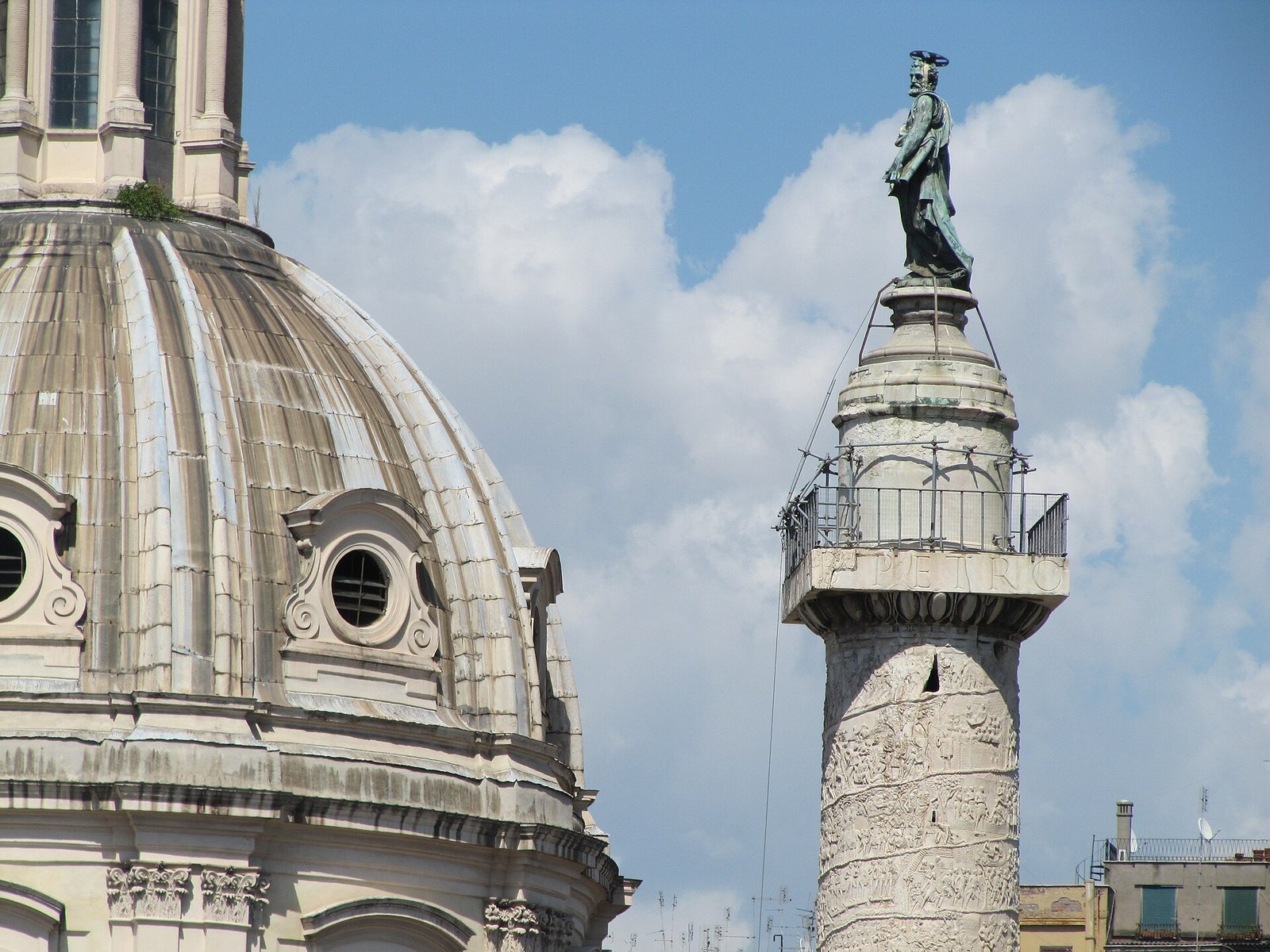
The statue that crowns Trajan's Column today does not depict Trajan but Saint Peter, and it has been up there since 1587, when Pope Sixtus V had a Christian bronze placed in the spot of the imperial statue that disappeared in the Middle Ages. It is a replacement that says a lot about the way Rome has continued to use its ancient monuments instead of merely preserving them.
The original statue and its disappearance
At the top there was originally a bronze statue of Trajan, probably of colossal size, of which nothing remains. We don't know when it vanished: medieval sources no longer mention it and the most accredited hypothesis is that it was removed and melted down at an unspecified moment in the early Middle Ages, when ancient bronze was a precious raw material and abandoned monuments were systematically stripped. For centuries, then, the column remained without a crowning.
Sixtus V and the program of Christianizing monuments
Felice Peretti, Pope Sixtus V between 1585 and 1590, carried out in Rome an urban program as rapid as it was systematic: he opened straight streets, re-erected obelisks, and imposed Christian signs on several ancient monuments. In 1587 he had the bronze statue of Saint Peter placed on Trajan's Column, and two years later, in 1589, he had that of Saint Paul placed on the Column of Marcus Aurelius in Piazza Colonna: the two apostles who founded the Roman Church crowning the two great celebratory monuments of the pagan empire. The operation was directed by the architect Domenico Fontana, the man who also moved the Vatican obelisk for Sixtus V.
Who made the bronze
On the attribution of the Saint Peter the sources do not agree, and the names that recur are those of Tommaso della Porta and Leonardo Sormani for the model, with the casting entrusted to the circle of Bastiano Torrigiani, active in those years on the Sistine bronzes. The date also fluctuates between 1587 and 1588 depending on which moment one considers: the commission, the casting or the final placement. Anyone looking for a single answer will be disappointed: it was a rapid papal work site with several hands involved, documented unevenly.
The advice I give you for visiting Trajan's Column
Trajan's Column is viewed for free from the outside and is not climbed: the most useful advice is therefore to organize your stop around the light and the viewing point, because the difference between a disappointing visit and a memorable one depends almost only on where you stand and at what time. There is no ticket for the column itself, no entrance, no interior route open to the public.
The best viewing point
The place from which the column reads best is not Via dei Fori Imperiali, where you are too far away and see the shaft foreshortened, but the stretch of balustrade on Via Alessandrina, which runs along the side of Trajan's Markets: from there the monument is closer, the pedestal with the inscription is seen head-on and the first coils of the frieze can be made out with the naked eye. If you have binoculars or a telephoto lens, use it from this very point, because it is the only one where the distance lets you isolate the individual figures of the low coils.
The right time
The best light is that of late afternoon in the cold months and of early morning in summer: the raking sun accentuates the volumes of the relief and makes legible a frieze that at noon, with flat light from above, flattens out until it becomes an indistinct texture. In the evening the archaeological area of the Imperial Forums is lit, and the column with the statue of Saint Peter standing out against the darkness is one of the most recognizable images of the center of Rome, even if in those conditions the frieze can't be read at all.
Pair the stop with a visit that explains the context
Since the column alone takes a few minutes, it's worth fitting it into a route that helps you understand where you are: the Museum of the Imperial Forums housed in Trajan's Markets is the natural choice, because it is 50 meters away and because it gives back the scale of the whole Trajanic complex with fragments, casts and reconstructions. As an alternative or in addition, the Domus Romane di Palazzo Valentini offer a multimedia reading that also includes the story of the frieze.
Accessibility and services
Observation from the top of the balustrade is possible also for those who use a wheelchair, because the sidewalks around Largo Foro Traiano are flat and equipped with ramps, while the lowered level of the archaeological area is not accessible and in any case is not open to free circulation. There are no restrooms or ticket office on site: the nearest facilities are in the museums of the area, and it's worth checking their hours and conditions directly with the venues before counting on them.
Another well-known fact, yet rarely cited
The plaster casts of Trajan's Column made between 1861 and 1862 are today a more legible source than the original, because they document the relief before more than a century and a half of further erosion: anyone studying the frieze works on the casts, not on the marble. It is a fact known to specialists and rarely cited in popularization, and it is perhaps the most important thing to know about this monument.
Napoleon III, Pius IX and the Vatican cast-makers
The operation began with a request from Napoleon III, who in 1861 asked Pope Pius IX for permission to take molds from the frieze. The work was carried out by Vatican cast-makers and concluded the following year. From the clay molds two complete series of original casts were made, one destined for France and one that stayed with the pope, the latter made up of 125 pieces. It was the first cast taken from the molds, and this makes it the qualitatively highest testimony.
Where they are today
The papal series, after several moves, entered in 1953 the collections of the Museo della Civiltà Romana at EUR, where it was displayed in a long gallery on four parallel rows: an arrangement that lets you read the scenes horizontally, from left to right, at eye level, that is, exactly as they cannot be read on the original. Other series and other casts, made at different times, are in European museums, from the Victoria and Albert Museum in London to the museum of Saint-Germain-en-Laye in France, and the Romanian collections. The Museo della Civiltà Romana, however, has been closed to the public since 2014 for works, with a reopening announced and postponed several times: anyone wishing to see those casts must check the updated situation before setting out, because at the moment it is not a museum to count on. The EUR museum complex of which it is part is now included in the system of the Museum of Civilizations, which brings together several collections of the district.
Why the casts are worth more than the original, from a documentary point of view
The point is not that the casts are works of art: they are not. The point is that they record a 19th-century state of conservation, that is, one earlier than the most recent deterioration, and that being consultable up close they allow the study of details that on the original, at 30 meters of height and with a corroded surface, are simply lost. Every scientific publication on the frieze, every photographic atlas, every digital reconstruction starts to some extent from that material. It is the rare case in which a copy has taken on a function that the original can no longer perform.
From plaster to digital
In recent years the Colosseum Archaeological Park and the cataloguing institutes have produced systematic photographic campaigns and three-dimensional models of the frieze, with the declared aim of making the narrative accessible scene by scene without climbing the monument. Out of this have come printed photographic atlases and online tools open to consultation, which follow the same logic as the 19th-century casts with different means: bringing the frieze to eye level. The exhibition on the column mounted at the Colosseum between December 2023 and April 2024 brought together exactly these two strands, the European plasters and the digital reproductions, along with a full-scale reconstruction of the capital and the last drums.
The right photo to take at Trajan's Column
The most successful photograph of Trajan's Column is not the frontal one from below, which squashes the shaft and cuts off the statue, but the one taken from the balustrade of Via Alessandrina with the two domed churches in the background: in that framing the monument has a scale of reference and the visual story works.
The framing with the two churches
Standing on the Trajan's Markets side and aiming the lens toward Piazza Venezia, the column stands out between the domes of Santa Maria di Loreto and Santissimo Nome di Maria, which frame it as symmetrical wings. It is the image that recurs in old prints and in 19th-century photographs, and it still works today: it gives depth, shows the real height and tells in a single shot the layering of the square, from the second century to the 1600s.
The detail of the pedestal and the inscription
The second shot not to miss is a close one: the piles of Dacian arms carved on the pedestal and the capital letters of the inscription. They are the only elements of the monument that can be photographed with a normal lens and get a sharp detail, and they are also the most interesting for anyone wanting to show something different from the usual silhouette. The side light at the end of the day, here too, makes the difference.
The frieze with a telephoto lens
With a long focal length, from 200 millimeters up, you isolate the figures of the first coils and get an image that conveys the idea of the continuous narrative. Above the fourth or fifth coil the result drops quickly, both because of distance and because of the erosion of the surface. If you shoot with a smartphone, avoid the digital zoom, which only produces a blurry enlargement, and aim instead for the whole.
Some important events that happened here in history
Trajan's Column was inaugurated on May 12, 113 AD, and since that day it has passed without interruption through 19 centuries of Roman history, always remaining standing, alone among all the buildings of Trajan's Forum. The episodes that follow are the passages that determined its survival and its present appearance.
113: the inauguration
The date is documented by the Fasti ostienses, the official calendar carved at Ostia, and it is one of the few appointments of Roman archaeology that we can place on the exact day. The column was inaugurated when the forum was already in operation: the complex, designed by Apollodorus of Damascus and financed with the booty of Dacia, had been dedicated the year before. Trajan was then about 60 and at the height of his prestige, shortly before leaving for the Parthian campaign from which he would not return.
117: the emperor's ashes in the base
On Trajan's death in Cilicia, the Senate decided that his ashes be placed in the chamber cut into the pedestal: a striking exemption from the ban on burial within the pomerium, which turned a celebratory monument into a mausoleum. The sources report that the ashes of his wife Plotina, who died a few years later, were given the same placement. It was the definitive consecration of the relationship between the emperor and his forum.
The Middle Ages: the column outlives the forum
While the Basilica Ulpia, the libraries and the Temple of the Deified Trajan collapsed or were dismantled to obtain building material, the column remained standing. In the heart of the Middle Ages the area had become an inhabited district, with houses built against the ruins, churches, vegetable gardens and storehouses, and the ground level had risen by meters. A small church, San Nicola de Columna, was built against the column, and the monument came under the control of the abbey that claimed ownership of it. Tradition has it that the Roman Senate had decreed its protection as early as the 12th century, forbidding damage to it. This is a report carried by many popularizing sources and should be taken as historiographic tradition rather than as a document the reader can verify directly.
The legend of Gregory the Great and Trajan's soul
In the Middle Ages the story circulated widely that Pope Gregory the Great, struck by an episode of justice attributed to Trajan, prayed until he obtained the salvation of the pagan emperor's soul. The story, which is popular tradition and not historical fact, had an enormous fortune and reached Dante, who takes it up in the Purgatorio and in the Paradiso. It is also the cultural reason why the monument was never seen as an idol to be torn down: Trajan was, in the medieval Christian imagination, the good emperor par excellence.
The 1930s: the demolitions and Via dell'Impero
Between 1924 and 1932 the demolition of the Alessandrino district and the opening of Via dell'Impero, today Via dei Fori Imperiali, radically changed the context of the column: entire blocks of Renaissance and modern buildings disappeared, the archaeological area was brought to light and the monument found itself isolated at the center of an open space. It was an operation that gave back the visibility of the Forums and at the same time erased centuries of urban layering, and that still divides scholars today.
1984 and 1989: the great restoration
Between the middle and the end of the 1980s the column underwent a full restoration, conducted under the technical direction of Bruno Zanardi, which for decades remained the last systematic intervention on the entire surface. From that work site came the graphic and photographic documentation and the analyses that have been the basis for all later assessments of the state of conservation.
2020: the restoration of the base and the first survey in 30 years
In the summer of 2020, the Colosseum Archaeological Park completed work on the front of the base, with biocide treatments to remove the biological patinas, water cleaning that respects the historic patinas, and consolidation of the parts that had lost cohesion. On the same occasion, using an aerial platform, the first close inspection of the entire shaft since the late 1980s was carried out, with photographic mapping and a three-dimensional reconstruction to compare the current condition with the earlier documentation.
Who passed through Trajan's Column
Some of the names that shaped the European idea of antiquity have passed through Trajan's Column, literally or culturally: from the Renaissance artists who lowered down their drawings of it, to the engravers of the 1700s, to the 20th-century art historians who built entire theories of figurative narrative on this frieze.
Apollodorus of Damascus
The Syrian architect in Trajan's service is the first name tied to the monument. He was responsible for the design of the forum, for the bridge over the Danube shown in the frieze and, according to the most widespread reconstruction, for the very idea of the spiral column. Ancient tradition says he fell out of favor under Hadrian and was put to death after a dispute over the emperor's architectural designs. Scholars treat this story with caution, but it helped fix his image as the great independent architect facing power.
The Renaissance artists
From the 1400s on, the column became an open-air school. Painters and sculptors climbed scaffolding or relied on other people's drawings to study the figures of the frieze, seen as a repertoire of models for the body in motion, for military drapery, for the crowded composition. The column's scenes circulated in sketchbooks and collections of drawings that passed from workshop to workshop, and they influenced the way battle was represented throughout modern European art. Anyone who wants an idea of that taste for antiquity rebuilt in a modern setting can look at the collections of the Capitoline Museums, where the relationship between ancient sculpture and Renaissance display is still readable.
Ranuccio Bianchi Bandinelli and 20th-century historiography
The great Italian archaeologist used Trajan's Column as an exemplary case to distinguish two tendencies in Roman art, the official and the plebeian, and to propose the figure of the Master of Trajan's Deeds. After him the column became the favorite ground for discussing what narrative is in ancient art: how time is told in an image, how the passage from one episode to the next is signaled, how much weight propaganda carries. Paul Veyne, from a different angle, shifted the question from legibility to symbolic function.
Bruno Zanardi and the restorers
The restorer who directed the work site of the 1980s is also the author of the most debated thesis on the monument's decay. According to Zanardi, the main cause of the erosion of the reliefs is not modern air pollution, as is often repeated, but exposure to the humid west wind, a factor already identified in the 1600s by Vincenzo Giustiniani. In support he cites the 1862 casts themselves, which show a state of preservation in many ways similar to the present one, that is, from before the industrial era. The conclusion he draws is about method: preventive, planned conservation is better than costly, cyclical extraordinary restorations.
Trajan's Column and the Column of Marcus Aurelius: two different monuments
Trajan's Column and the column that stands in the middle of Piazza Colonna are two distinct monuments, about 800 meters from each other and separated by almost 80 years. The second is the Column of Marcus Aurelius, also called the Antonine Column, and it is a very common mistake to confuse them. Anyone looking for Trajan's Column in Piazza Colonna won't find it, and vice versa. On this site the piazza has a page of its own, devoted to the urban context of that monument, while these lines are about the column of Trajan's Forum.
What they have in common
The similarities are not accidental. The Column of Marcus Aurelius was built between 180 and 193 AD on the explicit model of Trajan's, with the same spiral design, a shaft that is also 100 Roman feet high, an internal spiral staircase and a continuous spiral frieze celebrating military campaigns. Both lost their original imperial statue, and both were crowned by Sixtus V with a bronze apostle, Saint Peter in 1587 on Trajan's and Saint Paul in 1589 on the Aurelian one, by the hand of Domenico Fontana.
How they differ
The differences, though, are clear. The Column of Marcus Aurelius tells of the wars against the Marcomanni, Quadi and Sarmatians fought along the Danube in the 170s of the second century, not the conquest of Dacia. Its frieze winds in about 21 coils, against the 23 or 24 of Trajan's, with a number of scenes around 116. The shaft is made of a larger number of drums, around 27, and the internal staircase has just over 200 steps. But above all the style changes: the relief is higher and more deeply cut, the heads are larger in proportion to the bodies, the figures look at the viewer frontally, and the narrative is more schematic and less attentive to continuity. It is a more dramatic and more immediate language, which art historians read as one of the first signs of the transformation that will lead to late antique art.
State of preservation: what is really still readable
The state of preservation of the frieze of Trajan's Column gets worse as you go up. The lower coils still keep a sharp relief, while in the upper part erosion has softened the outlines to the point that many figures can only be made out in the casts and in historic photographs. That is the practical reason why the 19th-century documentation remains irreplaceable.
The decay factors
The documented phenomena are those typical of marble exposed in an urban environment: black crusts forming in areas sheltered from rain wash, biological colonization in the damp parts, surface decohesion that makes the marble crumbly, and microfractures. On the main causes the debate remains open, between those who give a decisive weight to 20th-century air pollution and those who, like Bruno Zanardi, hold that the decisive role was played by exposure to humid winds and by natural cycles of alteration, already under way long before industrialization.
Frequently asked questions about Trajan's Column
How much does it cost to visit Trajan's Column?
Trajan's Column can be seen for free from the outside, from the railings around the archaeological area of Trajan's Forum, with no ticket and no reservation. There is no paid entrance for the monument itself. Tickets apply, if anything, to the nearby museums, first of all the Museum of the Imperial Forums in Trajan's Markets, whose prices and hours are best checked directly with the venue before your visit.
Can you climb Trajan's Column?
No, you can't climb Trajan's Column. The internal spiral staircase of 185 steps exists and can be walked, but access is reserved for technical staff and is not offered to the public in any form, not even by reservation or on a guided visit. Some pages online suggest otherwise, but that information is wrong.
How tall is Trajan's Column?
Trajan's Column measures about 39.80 meters in total height, counting base, shaft, capital and statue. The shaft alone reaches just under 30 meters, a figure the sources place between 29.50 and 29.78 meters and which corresponds to 100 Roman feet, the measure by which the ancients classified it as a centenary column.
What does the frieze of Trajan's Column tell?
The frieze of Trajan's Column tells of the two military campaigns Trajan led against the Dacians in the years 101 and 102 and 105 and 106 AD, which led to the conquest of what is now Romania. It runs for about 200 meters, winding in a spiral around the shaft, with about 2,500 figures and a number of scenes that the different readings place between around 100 and 155.
Who is the statue on top of Trajan's Column?
The statue at the top of Trajan's Column depicts Saint Peter and was placed there in 1587 at the wish of Pope Sixtus V, under the direction of Domenico Fontana. It replaced the bronze statue of Trajan that crowned the monument in antiquity and that disappeared, in all likelihood melted down, at an unspecified moment in the Middle Ages.
How do you get to Trajan's Column by public transportation?
You reach Trajan's Column by getting off at the Colosseo metro stop on line B and walking about 12 minutes along Via dei Fori Imperiali, or at the Cavour stop on the same line. Piazza Venezia, a two-minute walk from the monument, is served by many city bus lines coming from Termini and from most of the center.
Is Trajan's Column suitable for children?
Trajan's Column works well as a stop with children precisely because it is short, outdoors and free. The story of the Dacian war carved in a spiral works like an illustrated tale, as long as you explain that the figures can only be made out in the lowest coils. A pair of binoculars makes the stop much more interesting for the little ones.
What is the difference between Trajan's Column and the Column of Marcus Aurelius?
Trajan's Column and the Column of Marcus Aurelius are two different monuments. The first is in Trajan's Forum and tells of the Dacian wars of 101 and 106, the second stands in Piazza Colonna and celebrates Marcus Aurelius's campaigns against the Marcomanni, Quadi and Sarmatians between 180 and 193. Both are spiral columns, but the second has a higher relief and a more schematic style.
Where can you see the scenes of the frieze up close?
The scenes of the frieze of Trajan's Column can be seen up close through the plaster casts taken from the molds in 1862. The most complete series is in the Museum of Roman Civilization in EUR, closed to the public since 2014 and whose reopening has been postponed more than once. Alternatively, there are printed photographic atlases and digital reproductions made by the protection agencies.
One last tip for anyone planning the itinerary
Trajan's Column works best as the first or last piece of a walk along the Forums rather than as a destination on its own. If you have only a few hours in Rome, put it in a route that starts from Piazza Venezia, touches Trajan's Markets, continues along Via dei Fori Imperiali toward the Colosseum and the Palatine, and maybe ends with a detour to the Forum Boarium. It is a monument you understand by looking at what surrounds it, not by isolating it.
Anyone putting together a broader Roman itinerary, combining the stops of the central archaeological area with the rest of the historic center, can find useful planning tools on Tour Leader Pro, while Italy Planner is a good resource for a more general picture of transportation and destinations in Lazio.