Arch of Janus
In short. The Arch of Janus stands in the Foro Boario, the open flat by the Tiber where in antiquity Rome's cattle market stood, a few steps from Santa Maria in Cosmedin and from the square of the Bocca della Verità.
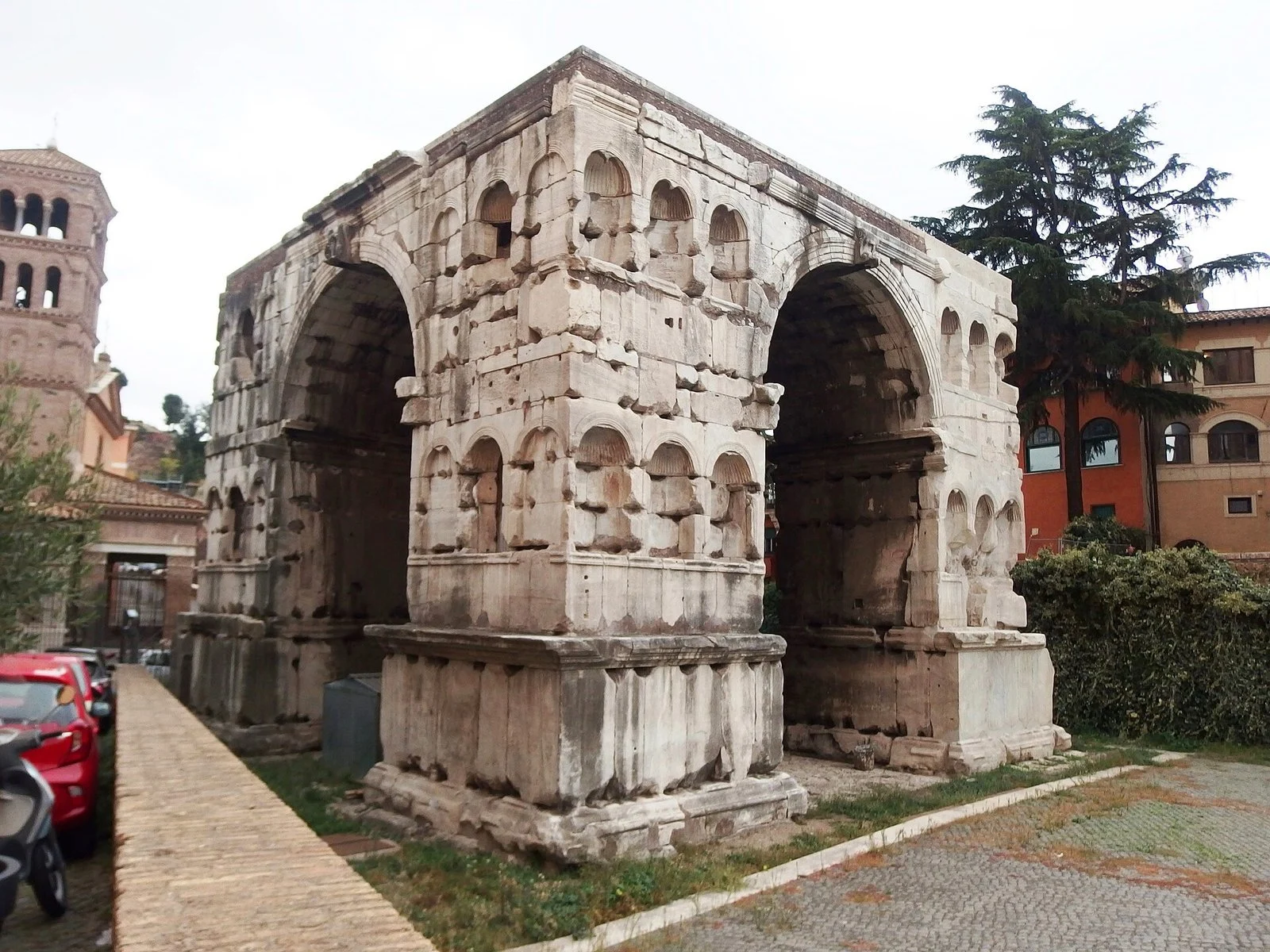
The Arch of Janus stands in the Foro Boario, the open flat by the Tiber where in antiquity Rome's cattle market stood, a few steps from Santa Maria in Cosmedin and from the square of the Mouth of Truth. It is the only quadrifrontal arch, that is, one with four fronts open onto as many streets, to survive from Roman antiquity: a marble mass as tall as a four-story building, planted on a crossing that 2,000 years ago was one of the busiest in the city and that today is a quiet corner, often ignored by those heading straight for the Circus Maximus or the Tiber Island. The name misleads almost everyone: it has nothing to do with the two-faced god of passages and beginnings, except for a similarity of sound that the Romans of the Middle Ages found irresistible. For years the monument was known almost only through a fence, closed after a criminal attack in the 1990s, and only recently has it become fully accessible again thanks to a restoration that also involved the nearby Arch of the Argentarii and the whole corner of the Foro Boario. The lines that follow tell what this monument really is, when it was built, what it was for, how it came down to us passing through a medieval fortress and a 19th-century building site, and how to visit it today.
Where the Arch of Janus is and how to get there
The monument occupies the corner between Via del Velabro and Via San Giovanni Decollato, in the heart of the Foro Boario, the area between the Capitoline, the Aventine and the river that in Roman times hosted the ox market, hence the name (boario comes from bos, ox). It's a small but very dense area of history: around the arch stand the medieval church of San Giorgio in Velabro, the basilica of Santa Maria in Cosmedin with its famous Bocca della Verità, and the two best-preserved Republican temples in Rome, the round one once attributed to Vesta and now referred to Hercules Victor and the rectangular one dedicated to Portunus, protector of the nearby river port.
On foot from central Rome
From the Colosseum you get there in a walk of just under 10 minutes along Via di San Teodoro and Via del Velabro. From the Capitoline, going down from Piazza d'Aracoeli toward Via del Teatro di Marcello, the distance is even shorter. Anyone who visits the Circus Maximus finds the arch a step away, on the opposite side from the main entrance of the racetrack, while anyone arriving from the Tiber and the Tiber Island meets the Foro Boario by crossing Ponte Palatino or following Lungotevere Pierleoni.
By public transit
The most convenient stop is Piazza Bocca della Verità, served by several bus lines connecting the historic center, including those running along Via Petroselli and the Lungotevere. The nearest metro stop is Circo Massimo, on line B, from which you walk about 10 minutes alongside the Valle Murcia. Anyone coming from Termini can therefore take metro B toward Laurentina, get off at Circo Massimo and finish the last stretch on foot, or choose a surface bus that goes down Via dei Cerchi to Piazza Bocca della Verità: both solutions take roughly the same time, and the choice depends only on where you start in the city.
There is no dedicated parking near the arch: the area is largely a restricted traffic zone and street parking, where allowed, is paid during daytime hours from Monday to Saturday. Anyone arriving by car from outside Rome does better to leave the vehicle in one of the park-and-ride lots connected to metro B, for example near the outlying stations of the same line, and complete the trip to the historic center by metro: on weekends, when traffic toward the center concentrates precisely in this band between the Aventine, the Capitoline and the Circus Maximus, it's the quickest solution as well as the cheapest.
Landmarks to avoid getting the intersection wrong
Anyone who doesn't know the area can get their bearings by keeping in mind three landmarks easily visible even from afar: the mass of the basilica of Santa Maria in Cosmedin with its tall Romanesque bell tower, which can be seen from a large part of the Foro Boario, the Capitoline hill behind, recognizable by the profile of the Vittoriano, and the course of the Tiber, which runs a few dozen meters from the arch and separates the rione from the Trastevere district on the opposite bank. The Arch of Janus lies exactly at the center of this triangle of landmarks, on an intersection that today looks out of the way but that in Roman times was one of the most intensely frequented road junctions of the lower city.
What the Arch of Janus really is: a structure, not a triumphal arch
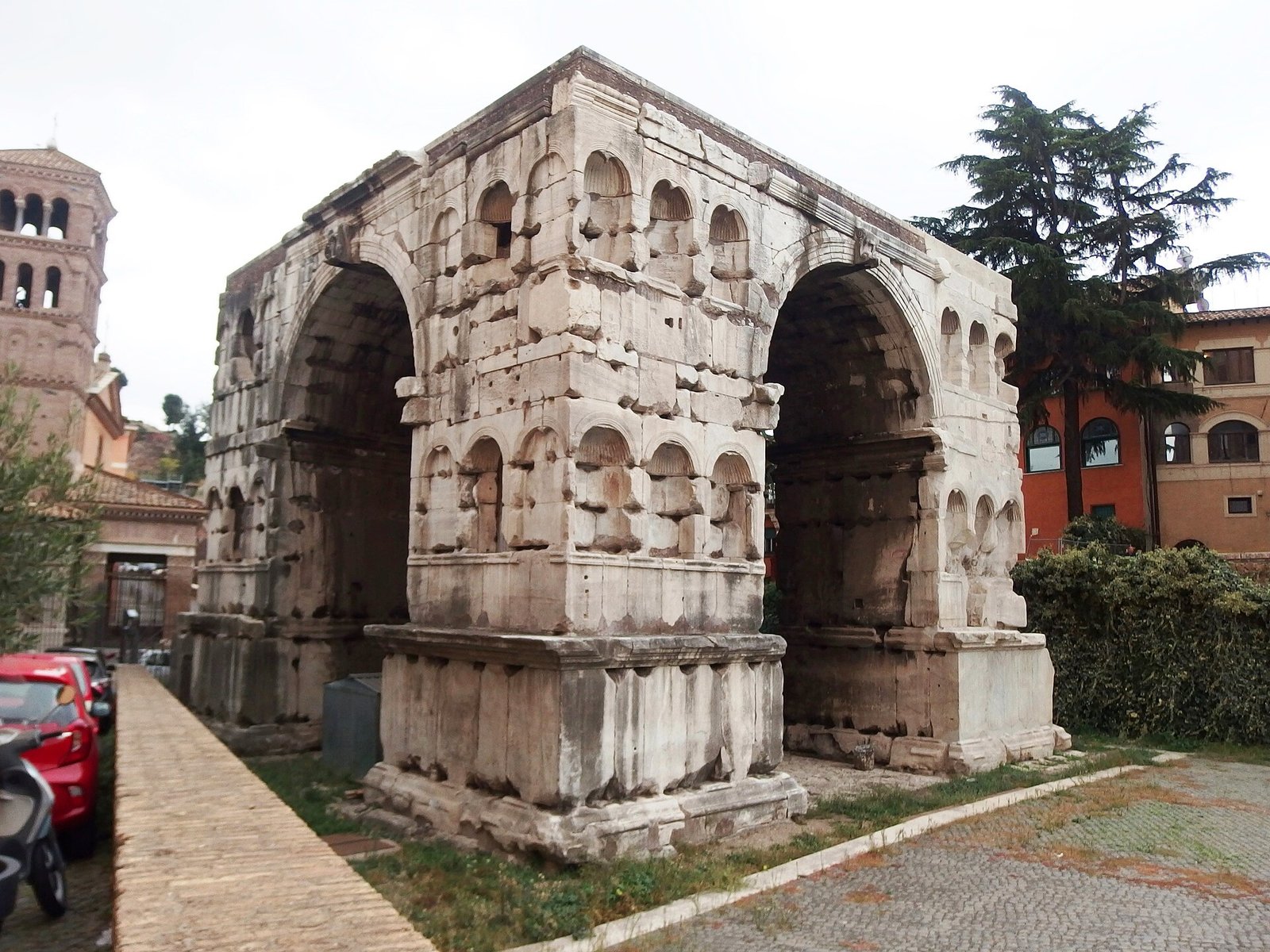
The point to clarify right away is that the Arch of Janus was never a triumphal arch, that is, a monument erected to celebrate the victory of a general or an emperor with a procession passing beneath it. Scholars more correctly define it as a tetrapylon, a structure with a square plan and four large arched openings, one per side, that meet in the center in a cross vault. It is the only monument of this type surviving in Rome in such an intact form, and that's why every guide to the city cites it as a unicum, even though it's a building that for centuries remained on the margins of the main tourist routes.
A structure, not a triumph
The original function, according to the reading most widely shared by archaeologists today, was not celebratory in the strict sense but practical and honorific at the same time: the arch marked a strategic crossroads between the Foro Boario, the Velabrum, the Palatine and the Circus Maximus, and offered shelter from sun and rain to those who worked in the area, in particular the money changers and moneylenders who animated the cattle market. Some scholars have also understood it as an honorary monument dedicated to the Constantinian dynasty, on the basis of the name under which it appears in the ancient sources, Arcus Divi Constantini, which explicitly ties it to the memory of Constantine.
The Foro Boario, it should be remembered, wasn't a marginal area of the ancient city but one of the most important and busiest markets in Rome, comparable in commercial intensity to the nearby Foro Olitorio, devoted instead to the sale of vegetables and legumes. From the archaic age the cattle trade that gave the square its name brought a continuous coming and going of merchants, brokers and moneylenders to this area, the same figures who centuries later would finance, with their own dedications, the nearby Arch of the Argentarii as well. In this context a building like the Arch of Janus, able to offer shade and shelter at a central crossing of the market, had an immediate practical sense that went well beyond the symbolic function alone.
A monument conceived to be passed through from every side
The feature that most distinguishes a tetrapylon from a traditional honorary arch is not just the square plan, but the fact that the building has no main front and secondary one: all four facades are treated with the same decorative care, because the monument was conceived to be seen and passed through indifferently by anyone, from whichever direction they arrived. It's a design choice that reflects well the crossroads function of the area, very different from the logic of true triumphal arches, which always had a privileged axis of march along which the triumphal procession took place.
Materials and construction technique
The load-bearing structure is Roman concrete, the pozzolana-based cementitious material that allowed ancient builders to make imposing vaults, and it is faced with marble slabs largely reused, taken from older monuments by then out of use. It's the same building logic that in the same decades produced the Arch of Constantine near the Colosseum, where reliefs of the Trajanic, Hadrianic and Antonine ages were readapted for a new monument: a way of building typical of late antiquity, when fine marble was scarce and reusing was faster and cheaper than opening new quarries.
The four massive corner piers are the element that bears the whole weight of the central cross vault, the meeting point of the four archways. Each pier measures several meters per side and is conceived to absorb thrusts that discharge in several directions at the same time, a structural problem far more complex than that of an ordinary arch with a single archway, where the thrusts discharge only onto two aligned supports. The late-antique builders solved the problem with a technique already tested for centuries in Roman public building, that of the great cross vaults that supported the imperial baths and the civil basilicas: applied here, on a reduced scale, to a street monument.
Dimensions: a building as tall as an apartment block
The measurements handed down by archaeological studies describe a building with a nearly square plan, with a side of a little over 10 meters and an overall height that, before the loss of the attic, probably exceeded 16 meters: a mass comparable to a four- or five-story apartment building, planted on a road crossing. It's a scale that surprises anyone who, hearing of an arch, expects something more like the contained dimensions of the nearby Arch of the Argentarii, a little over six meters tall: the Arch of Janus instead belongs to an entirely different dimensional register, that of the great imperial honorary monuments.
When the Arch of Janus was built: the fourth-century dating
Scholars place the construction of the arch in the fourth century AD, with several contributions narrowing the range to the first half of the century. On the ancient name there is no doubt: the Regionary Catalogues, the late-antique lists that recorded the buildings of Rome region by region, cite an Arcus Divi Constantini in the area of the Foro Boario, and most scholars identify this arch with the monument now known as the Arch of Janus.
Constantine, his sons or Constantius II: an open problem
On who actually had it erected and in which exact year, the consensus is less clear. A traditional hypothesis links the construction to the visit to Rome of the emperor Constantius II, son of Constantine, in 357 AD, an occasion on which the city paid him solemn honors. A more recent reading, supported by several scholars, proposes instead that the arch had from the beginning an honorary function tied to the memory of Constantine the Great, who died in 337, and that it was commissioned by his sons precisely to celebrate his memory after his death. The two readings are not in open conflict over the decades involved so much as over the figure to whom the tribute was really addressed: here it must be said clearly that the exact date and the specific patron remain debated among specialists, and anyone who proposes a single year, such as 356 or 357, does so by choosing among alternative hypotheses, not by reporting a certain datum carved on an inscription.
Why the dating matters for understanding the arch
Placing the arch in the middle of the fourth century helps explain two things that otherwise clash. The first is the reuse of materials: in an era when Rome was no longer the inexhaustible building site of the golden centuries, readapting ancient marbles was the norm, not the exception, exactly as for the Arch of Constantine. The second is the chronological position of the arch as one of the last great monumental public works carried out in the eastern sector of the Foro Boario before the area, with the fall of the Western Empire, gradually changed function and appearance.
What the Regionary Catalogues say
The Regionary Catalogues, also known as the Curiosum Urbis Romae and the Notitia Urbis Romae, are two administrative lists drawn up between the fourth and fifth centuries that divided Rome into the 14 Augustan regions and recorded, region by region, the main public buildings, from temples to baths to honorary arches. It is a valuable type of source because it is not a literary text subject to rhetorical license, but an administrative document conceived for the practical management of the city, and for exactly this reason historians treat it as a solid reference, even with all the limits of a text handed down through successive copies and not through the original. The citation of an Arcus Divi Constantini in the region where the Foro Boario stood is the main foothold on which the identification with the arch visible today rests, given that no other surviving structure in the same area corresponds as well to the description handed down.
A curiosity about the Arch of Janus
The name everyone uses today, Arch of Janus, is almost certainly a medieval misunderstanding, and it's worth explaining in full because most visitors take the opposite for granted. The Latin term ianus did not indicate only the two-faced god of passages, doors and beginnings: it also indicated, as a common noun, a covered passage, an arched opening that could be walked through. Ancient Rome had several, small tetrapyla scattered through the markets and at crossings, called iani precisely in the technical sense of the term, before anyone thought of a religious dedication.
When in the Middle Ages the memory of the original name, Arcus Divi Constantini, was lost together with the administrative context that had produced it, ordinary people kept calling the structure simply ianus, in the sense of a covered passage, an arch you went under to cross the intersection. Over time, though, that common noun became more and more confused with the proper name of the god Janus, who in the Roman imagination remained associated with passages and doors, and the quadrifrontal form of the monument, with its four facades open onto as many streets, lent itself perfectly to being read as a tribute to the two-faced god who looked ahead and behind at the same time. This is how the name by which the monument is known today was born, through a linguistic misunderstanding more than through the plan of the ancients: the Arch of Janus does not celebrate the god Janus, it celebrates, if anything, the banal and very useful fact of being a covered passage in the middle of a crossroads.
One thing nobody tells you about the Arch of Janus
What you see today, a compact block of gray marble with no upward thrust, is not the arch that the ancient Romans saw completed. The sources and the drawings of the Renaissance and Baroque ages show a monument topped by an attic story, that is, an upper body that rose above the cross vault and that remained visible, though reworked, until the first decades of the 19th century. That attic was demolished in 1830, as part of the work of clearing and restoring the monument carried out in those years, because it was considered a late addition, probably medieval, laid over the Roman structure and not part of the original plan.
An attic lost forever
The result is that the current appearance of the arch, however imposing, is mutilated compared with both the Roman form and the one the monument had gone through the whole Middle Ages and the early modern age. No drawing or survey from the time of the demolition has made it possible to reconstruct with certainty what the original attic looked like: whether crowned with statues, with a continuous frieze or with a simple cornice remains a matter of hypothesis. It is one of the many cases, frequent in 19th-century Rome, in which archaeological restoration, driven by the desire to give monuments an appearance considered more authentic, ended up irreversibly erasing a historical layer that any superintendency today would preserve as a matter of principle.
The empty niches almost nobody notices
There is a second detail that escapes almost everyone even when visiting the arch up close: the facades were conceived to house dozens of semicircular niches with shell-shaped tops, arranged on two superimposed registers along the long sides, conceived to receive statues of divinities. Today the only things still visible, on the keystones of the arches, are four sculpted female figures, conventionally identified with Roma, Minerva and, with a greater margin of uncertainty, Juno and Ceres: the rest of the sculptural apparatus, which according to the ancient sources included a large number of statues, has been lost almost entirely, and several niches turn out never to have had their carving completed, a sign of a late-antique building site that perhaps never reached full completion.
Stopping to look at these empty niches is one of the most useful exercises for understanding how a Roman public monument really worked: it was not just architecture, but a support conceived from the start to receive an entire sculptural apparatus that was meant to speak, with its divine and allegorical figures, to anyone crossing the intersection. Looking today at the emptied niches means looking at a building halved in its original meaning, not only in its physical matter.
A late-antique building site perhaps never finished
The fact that some niches were never completed in their sculptural work is a clue that specialists take seriously: it could mean that the building of the arch, begun with imposing ambitions at a moment of economic straits for the Roman public administration, was never brought to completion according to the original plan. It is not an isolated case in fourth-century Rome, an era in which the resources for great public building had shrunk compared with earlier centuries and in which more than one building site begun with high ambitions stopped before the planned completion.
The advice I give you for visiting the Arch of Janus
The most useful practical advice concerns the schedule. The Arch of Janus is not a monument open every day with continuous hours like the Colosseum or the Forums: after the most recent restoration and enhancement work, carried out also with funds from the national recovery program and aimed at cleaning the marble surfaces, structural consolidation and the arrangement of the surrounding areas together with the nearby Arch of the Argentarii, the area is opened to the public on a limited calendar, typically on weekends and with a single route that includes both arches of the Foro Boario. Before organizing the visit, it's best to check the updated hours on the website of the Capitoline Superintendency or of the Municipality of Rome, because the opening calendar changes with the building sites and the seasons and is the detail most subject to variation of all those reported here.
What to see even if the interior is closed
Even when the inner area of the archaeological route is not accessible, the arch remains perfectly visible and photographable from the outside, because it stands on a public intersection open at all hours. The advice is to build the visit as a single walk that starts from the Mouth of Truth, touches the temples of Hercules Victor and of Portunus, arrives at the Arch of Janus and continues to San Giorgio in Velabro: in under half an hour on foot you cross 2,000 years of Roman history, from the Republican Rome of the temples of the Foro Boario to the late-antique Rome of the arch to the Middle Ages of the church and the fortifications of the Frangipane.
The right time of day
The light of late afternoon, when the low sun lights the marble facades from the side, gives the arch a relief that at noon, with the sun overhead, is almost entirely lost. If the main interest is photographic more than archaeological, late afternoon is the time to prefer, avoiding the central hours when the deep shadow of the archways flattens every detail. The most recent restoration has also enhanced the evening lighting of the area, with a lighting project signed by the director of photography Vittorio Storaro conceived specifically for the two arches of the Foro Boario: anyone who can plan a stop after sunset finds, on the days and at the evening opening hours, an appearance of the monument completely different from the daytime one.
Combining the visit with the rest of the Foro Boario
It's worth remembering that the area around the arch doesn't require an entrance ticket to be admired from the outside: the temples of Hercules Victor and of Portunus can be seen freely from the square, the basilica of Santa Maria in Cosmedin has free admission apart from any voluntary contributions, and the Bocca della Verità itself, under the portico of the basilica, can be visited without a ticket during most of the church's opening hours. This makes the Foro Boario, arch included, one of the areas of Rome with the highest concentration of ancient monuments that can be visited at no cost, a detail not to be taken for granted in a city where many of the main archaeological sites require a ticket.
Another well-known fact, yet rarely cited
A few meters from the Arch of Janus, set against the side of the church of San Giorgio in Velabro, stands a second Roman monument that almost everyone photographs together with the first without knowing that it is a completely different building in date, in function and in patronage: the Arch of the Argentarii.
The Arch of the Argentarii, a century earlier
Erected in 204 AD, and so a good century ahead of the Arch of Janus, the Arch of the Argentarii is not an arch at all in the architectural sense of the term, that is, a structure with a curved archway, but an opening with quadrangular supports covered by a straight architrave. It was erected as a private dedication by the bankers and cattle merchants of the Foro Boario, the argentarii et negotiantes boarii, in honor of the imperial family then reigning: the emperor Septimius Severus, his son Caracalla, Severus's wife Julia Domna and, originally, also the second son Geta and Caracalla's wife, Fulvia Plautilla. The names and images of Geta and Plautilla were later erased from the reliefs, victims of the damnatio memoriae decreed by Caracalla after he had his brother killed and got rid of his sister-in-law.
Why the two monuments get confused
The physical closeness of the two arches, both on the ancient edge of the Foro Boario, leads many visitors to treat them as a single complex, but they are in fact two distinct testimonies of two different moments of Roman history: the Arch of the Argentarii tells of the Severan Rome of the early third century, with its finely carved reliefs of sacrifice scenes, barbarian prisoners and winged Victories, while the Arch of Janus tells of the late-antique and Christian Rome of the fourth century, poorer in resources but still able to erect an imposing monumental mass by recycling older marbles. Seeing them together, in the same glance, is one of the most direct ways to grasp how much the city changed in just a century and a half.
The damnatio memoriae carved in stone
On the Arch of the Argentarii the physical sign of one of the fiercest episodes in Roman dynastic history is still legible today, for anyone who looks carefully at the carved surfaces: the figures of Geta and of Fulvia Plautilla, originally carved beside the other members of the imperial family, were chiseled away after their fall from grace, leaving smooth and anomalous surfaces on the stone in place of faces and bodies. It is a detail the Arch of Janus does not offer, being a monument almost without surviving individual portraits, and one that makes the joint visit to the two arches even more instructive: on one side the damnatio memoriae of the early third century carved into the flesh of the marble, on the other the slower and less intentional despoiling that time and the centuries have inflicted on the lost statues of the late-antique tetrapylon.
The right photo to take at the Arch of Janus
The photo that best conveys the scale of the arch is not the frontal one, taken from the main intersection, but the diagonal one from Via San Giovanni Decollato, which lets you frame two archways at once in a single shot and gives back the depth of the cross vault in the center, the element that more than any other distinguishes a tetrapylon from an ordinary arch with a single archway.
Including the church of San Giorgio in Velabro
A second interesting shot, less obvious, is obtained by stepping back toward Via del Velabro until you frame in sequence the arch, the Arch of the Argentarii and the Romanesque portico of the church of San Giorgio in Velabro: three different eras, from the Roman fourth century to the Christian Middle Ages, lined up in the same frame. It is the image that best tells the stratification typical of this corner of Rome, where no century has entirely erased the previous one.
The detail of the surviving statues
Anyone with a lens able to bring the subject in close finds, in the four female figures carved on the keystones of the arches, a much more intimate photographic subject than the overall shots: they are the only surviving testimonies of the monument's original sculptural apparatus, and it is rare to find them isolated and well lit as happens in the hours when the low sun strikes them from the side. A good detail of one of these figures, with the blurred background of the marble piers, tells the monument better than many panoramic shots.
Some important events that happened here in history
The most recent history of the arch is marked by a tragic episode that has little to do with Roman antiquity and a lot to do with the crime news of the late 20th century. On the night of July 27 to 28, 1993, a car bomb set off as part of the season of Mafia massacre attacks devastated the facade of the very nearby church of San Giorgio in Velabro and damaged the surrounding area, including the monumental complex of the Foro Boario. The damage and the resulting security measures led to the closure of the arch area to the public for a very long period.
28 years of closure and the 2021 reopening
The Arch of Janus remained closed to visits for 28 years, from 1993 until November 2021, when a restoration project supported by the Capitoline Superintendency, the World Monuments Fund and the Fondazione Alda Fendi gave the monument back to the city with a public event and a weekend opening calendar. The reopening was accompanied by a free public art performance, and since then the area has continued to be open on a weekly basis, a fact that many Romans, used for a whole generation to seeing the arch only from behind a fence, welcomed as the end of a long period of neglect for one of the least known monuments of the historic center.
Since then the site has been the object of further enhancement work, including cleaning of the marble surfaces, structural consolidation and redevelopment of the outdoor areas carried out also thanks to funds from the national recovery plan earmarked for the great historic sites of the capital, with the aim of integrating the visit to the arch with that to the nearby Arch of the Argentarii in a single route. The project also included a systematic scientific study of the arch's stone materials, carried out to analyze the provenance of the reused marble blocks and reconstruct more precisely the building phases of the monument, work that could in the future also provide new elements on the still open question of the exact dating and the patron.
A monument forgotten for much of the 20th century
Even before the 1993 attack, the Arch of Janus had lived for much of the 20th century in a condition of relative marginality in the tourist imagination of the city, squeezed by the proximity of more famous monuments such as the Colosseum and the Imperial Forums and rarely included in the standard itineraries of general guidebooks. Several popular publications have described it, not by chance, as a forgotten monument: a definition that captures well the paradox of a building among the most unusual and best preserved in Rome, yet long neglected compared with sites less rare from the typological point of view.
The Middle Ages of the Frangipane
Long before these recent events, the arch had already gone through a radical transformation in the full Middle Ages, when the powerful baronial family of the Frangipane, who controlled a large part of the center of Rome including the ruins of the Palatine and the Colosseum, incorporated it into its own defensive system, walling up the archways and using the structure as the base of a fortified tower. Medieval documentary sources expressly cite a tower tied to this stretch of fortifications already in the course of the 12th century, and the transformations made by the Frangipane remained visible, laid over the Roman structure, for centuries, until the 19th-century interventions removed them together, as already mentioned, with the attic that everyone considered, rightly or wrongly, a medieval addition.
The Frangipane, whose name, according to family tradition, would allude to an ancient gesture of generosity toward the poor of Rome during a famine, were throughout the 12th and 13th centuries one of the most feared baronial houses of the city, able to control entire sectors of the historic center by turning the great ancient monuments, reduced to ruins but still imposing, into as many private fortresses. Besides the Arch of Janus and the Colosseum, the same family controlled for different periods also parts of the Palatine and of the Circus Maximus area, building a defensive system that extended for a long stretch along the southern flank of the ancient center, exploiting the solidity of the Roman masonry as a ready-made base for its own towers.
Why medieval barons chose ancient monuments
The choice to reuse a Roman monument as the base for a fortified tower was neither random nor limited to the Arch of Janus: in the Rome of the central centuries of the Middle Ages, without a strong central power able to impose order, the baronial families competed among themselves for control of the neighborhoods, and the Roman masonry, often more solid and already taller than anything that could be built from scratch quickly, offered an immediate defensive advantage. It is the same fate that befell in those same centuries the Colosseum, also turned into a fortress by the Frangipane, and many other ancient monuments of the city, from the Mausoleum of Augustus to the Theater of Marcellus: medieval Rome, before rediscovering in the Renaissance the artistic and archaeological value of its own ruins, looked at them first of all as building material and as a ready-to-use defensive structure.
Who has passed through the Arch of Janus
Throughout the Middle Ages and the early modern age, anyone crossing the Foro Boario heading toward the river port on the Tiber or toward the Capitoline inevitably passed under one of the four archways of the arch, which long remained one of the obligatory points of passage of the lower city, the one that developed in the bend of the river while the hills gradually went back to vineyard and pasture. The medieval pilgrims heading to Santa Maria in Cosmedin, then the seat of one of the most important deaconries of Byzantine and then medieval Rome, and the merchants who frequented the nearby port of Ripa Grande had in the arch a daily urban landmark, as much as a physical obstacle when the structure was fortified by the Frangipane and its passages were barred.
In Roman times, long before the medieval pilgrims, the money changers and cattle merchants who animated the Foro Boario passed under the arch every day, the same social figures who, at an earlier stage in the history of the square, had financed the building of the Arch of the Argentarii. Reconstructing who actually crossed this intersection means reconstructing the entire economy of a sector of the ancient city devoted to the cattle trade and petty finance, an activity less noble, in the eyes of classical historiography, than the politics of the nearby Roman Forum, but no less central to the daily life of the city.
Travelers, artists and scholars of the modern age
With the Grand Tour, from the 17th century onward, the arch entered steadily into the itineraries of the European artists and travelers who drew and engraved the Roman ruins as an obligatory educational stop: the printed views of the arch, with the attic still standing and often reduced to a crumbling ruin absorbed into later constructions, circulated all over Europe, helping to fix its image before the 19th-century demolition. The scholars who in the 19th century dealt with its restoration and its freeing from the buildings that had absorbed it over the centuries are fully part of the history of modern Roman archaeology, the discipline that in that very century began to distinguish systematically, not always successfully as the story of the lost attic shows, what was Roman and what was a later addition.
The restorers and archaeologists of the 20th century
In the course of the 20th century the arch was the object of further campaigns of study and restoration, in line with the growing attention the Capitoline administration gave to the monuments of the Foro Boario, a sector of the city that in the same decades also saw the excavations and restorations of the temples of Hercules Victor and of Portunus. The archaeologists who have followed one another in the study of the arch have progressively refined the reading of the building phases, distinguishing the reused marble blocks from those worked specifically for the late-antique monument, work made possible by the modern techniques of analysis of stone materials applied also in the most recent restorations.
Today's Romans and the recent rediscovery
For the vast majority of Romans who grew up between the end of the 20th century and the first decades of the 2000s, the Arch of Janus remained for years a monument seen only from outside a fence, closed to the public after the damage suffered in the 1993 attack: an entire generation knew it as a barred ruin, more than as a monument that could be visited. The 2021 reopening, followed by the further enhancement work of the following years, gave the arch back to a public that in large part was passing through it from inside for the first time, after only walking alongside it for decades on the sidewalk of Via del Velabro.
The Foro Boario around the arch: temples, church and Velabrum
The Foro Olitorio and the Theater of Marcellus, a little farther on
Anyone with time to widen the walk beyond the narrow perimeter of the Arch of Janus finds, going up toward the Capitoline along Via del Teatro di Marcello, the Foro Olitorio, the ancient vegetable market alongside the Foro Boario, and the mass of the Theater of Marcellus, the great Roman theater of the Augustan age whose lower arcades closely recall, in building technique, those of monuments contemporary with the period of greatest building splendor in the area. It is a natural extension of the itinerary, because it tells the same urban area at a different moment of its history, the Augustan one, three centuries earlier than the late-antique rebuilding represented by the Arch of Janus.
The comparison between the two historical moments, the Augustan one of the Theater of Marcellus and the Constantinian one of the Arch of Janus, is instructive precisely because it shows two opposite ways of building in Rome: the first with new materials quarried specially, at a moment of nearly unlimited resources for public building, the second drawing on spolia marbles recovered from older buildings, when the resources for great public building were by then much more limited. Walking the two monuments in sequence, within a walk of a few minutes, is equivalent to reading in stone the entire economic arc of ancient Rome.
Understanding the Arch of Janus inevitably means understanding the context in which it stands, because none of these monuments was conceived in isolation from the others. The Foro Boario occupied the flat strip between the Capitoline, the Aventine and the Tiber, in an area that in the archaic age was often flooded by the river and that the Romans gradually reclaimed together with the nearby Velabrum zone, the marshy depression where, according to the legend, the basket with the newborn Romulus and Remus came ashore.
The Republican temples of Hercules Victor and Portunus
A few steps from the arch stand the two best-preserved temples of Republican Rome: the circular one, for a long time mistaken for a temple of Vesta because of its shape, now attributed to Hercules Victor, protector of merchants and of the trade tied to cattle, and the rectangular one on a high podium, dedicated to Portunus, the divinity who protected river ports and in particular the landing that stood precisely on this stretch of the Tiber. Both owe their extraordinary preservation, rare for pagan buildings so ancient, to the fact of having been converted into Christian churches in the course of the Middle Ages, a fate shared by many ancient monuments spared precisely because they were reused.
San Giorgio in Velabro and the Cloaca Maxima
The church of San Giorgio in Velabro, with its Romanesque portico of spolia columns and its medieval bell tower, occupies the opposite side of the intersection from the arch and is tied by a double thread to its recent history, having been the building most hit by the 1993 attack. The church, dedicated to the cult of the relics of Saint George, has its origins in an area already occupied in Roman times by service buildings of the Foro Boario, and like many churches in this area it preserves in its structure columns and reused materials taken from the surrounding ancient buildings, just as the Arch of Janus reused marbles from earlier monuments.
Not far off, toward the Tiber, the outlet of the Cloaca Maxima still opens today, the great sewer collector that according to tradition dates back already to the time of the Etruscan kings and that for centuries discharged the waters of the city center directly into the river, contributing precisely to making this once marshy area of the Velabrum reclaimable and livable. The legend of the finding of Romulus and Remus, laid in a basket that the waters of the flooded Tiber would have left aground precisely in this depression, is inseparably tied to the very name of the Velabrum, which according to a traditional etymology would derive from the Latin term for boat or ferry, vehlum, with which the oldest inhabitants would have crossed the marshy area before the great reclamation works.
The vicus Iugarius and the ancient road network
The Arch of Janus and the Arch of the Argentarii both stand at the point where the ancient vicus Iugarius, one of the streets that linked the Roman Forum to the Foro Boario passing at the foot of the Capitoline, opened onto the cattle market square. Reconstructing the layout of these minor streets, now largely vanished under modern urban planning, helps explain why the area around the arch was such a strategic crossroads: here converged the traffic that came up from the river port of Ripa Grande, the traffic that came down from the Palatine and the Circus Maximus, and the traffic heading toward the political and religious heart of the city, the Roman Forum and the Capitoline.
Why the area was reclaimed so late compared with the rest of the city
An element that explains well the urban history of the Foro Boario and the Velabrum is the fact that this area, because of its particularly low elevation compared with the rest of the city, remained subject to Tiber floods for a long time even after the Roman Forum had already been reclaimed and built up in the archaic age. The archaeological traces of interventions raising the ground level, documented at several points in the area, testify to a gradual reclamation work lasting centuries, which made it possible to build here, in the Republican and then imperial age, a commercial and temple sector among the densest of the ancient city, of which the Arch of Janus represents, chronologically, one of the last great chapters.
Frequently asked questions about the Arch of Janus
What is the Arch of Janus?
The Arch of Janus is a late-antique tetrapylon in the Foro Boario in Rome, that is, a structure with a square plan and four arched openings, one per side, that meet in the center in a vault. It is the only monument of this type to survive in intact form from Roman antiquity.
When was the Arch of Janus built?
The Arch of Janus dates to the fourth century AD. Scholars still debate whether to link it to the visit to Rome of Constantius II in 357 or to a posthumous tribute by Constantine's sons to their father, who died in 337, and there is no inscription that settles the matter definitively.
Why is it called the Arch of Janus if it isn't dedicated to the god Janus?
The name of the Arch of Janus comes from a medieval linguistic misunderstanding: the Latin term ianus also indicated, as a common noun, a covered passage, and this meaning became confused over time with the name of the god Janus, helped by the quadrifrontal form of the monument itself.
Was the Arch of Janus a triumphal arch?
No, the Arch of Janus was not a triumphal arch in the classical sense of the term. Scholars interpret it as a structure both honorary and functional, placed on a strategic crossroads of the Foro Boario and also used as shelter by money changers and cattle merchants.
What did the Frangipane do to the Arch of Janus?
In the full Middle Ages the baronial family of the Frangipane turned the Arch of Janus into the base of a fortified tower, walling up its archways and integrating it into their own defensive system together with other ancient monuments of the center of Rome that they controlled.
Why does the attic of the Arch of Janus no longer exist?
The attic that topped the Arch of Janus was demolished in 1830 during the 19th-century work of restoring and clearing the monument, because it was considered a medieval addition laid over the Roman structure and not part of the original plan.
Can the Arch of Janus be visited today?
The Arch of Janus can be visited, but on a limited calendar after the restoration work carried out on the monument and the surrounding area: it's best to check the updated hours with the Capitoline Superintendency before the visit, because the site stayed closed to the public for 28 years after the 1993 attack and became accessible again only from 2021.
What is the difference between the Arch of Janus and the Arch of the Argentarii?
The Arch of Janus and the Arch of the Argentarii are two distinct monuments a few meters apart in the Foro Boario: the first is a tetrapylon of the fourth century, the second is a quadrangular opening erected in 204 as a private dedication by the bankers of the Foro Boario to the family of Septimius Severus.
What to see near the Arch of Janus?
Around the Arch of Janus are the church of San Giorgio in Velabro, the Arch of the Argentarii, the Republican temples of Hercules Victor and of Portunus, the Mouth of Truth and the basilica of Santa Maria in Cosmedin, all reachable on foot in a few minutes in the same corner of the Foro Boario.
One last piece of advice for anyone planning the itinerary
The Arch of Janus works well as an intermediate stop more than as a destination in itself for a whole morning: anyone coming to Rome for a few days and having to choose among dozens of monuments will do well to include it in a broader route linking the Colosseum or the Palatine to the Circus Maximus and from there to the Foro Boario, rather than dedicating a separate trip to it. It is exactly in this logic of linking nearby stops, often overlooked by those who focus only on the big names, that a monument like this finds its natural place in a well-built Roman itinerary.
Anyone planning a broader itinerary in the center of Rome, crossing this stop with other stops in the historic center and the Tiber area, can find useful planning tools on Tour Leader Pro, while for a broader picture of transport and destinations in Lazio Italy Planner is a good resource.