Casa di Goethe
In short. Casa di Goethe is at Via del Corso 18, a few steps from Piazza del Popolo, in the first stretch of Via del Corso that marks the entrance to the Tridente.
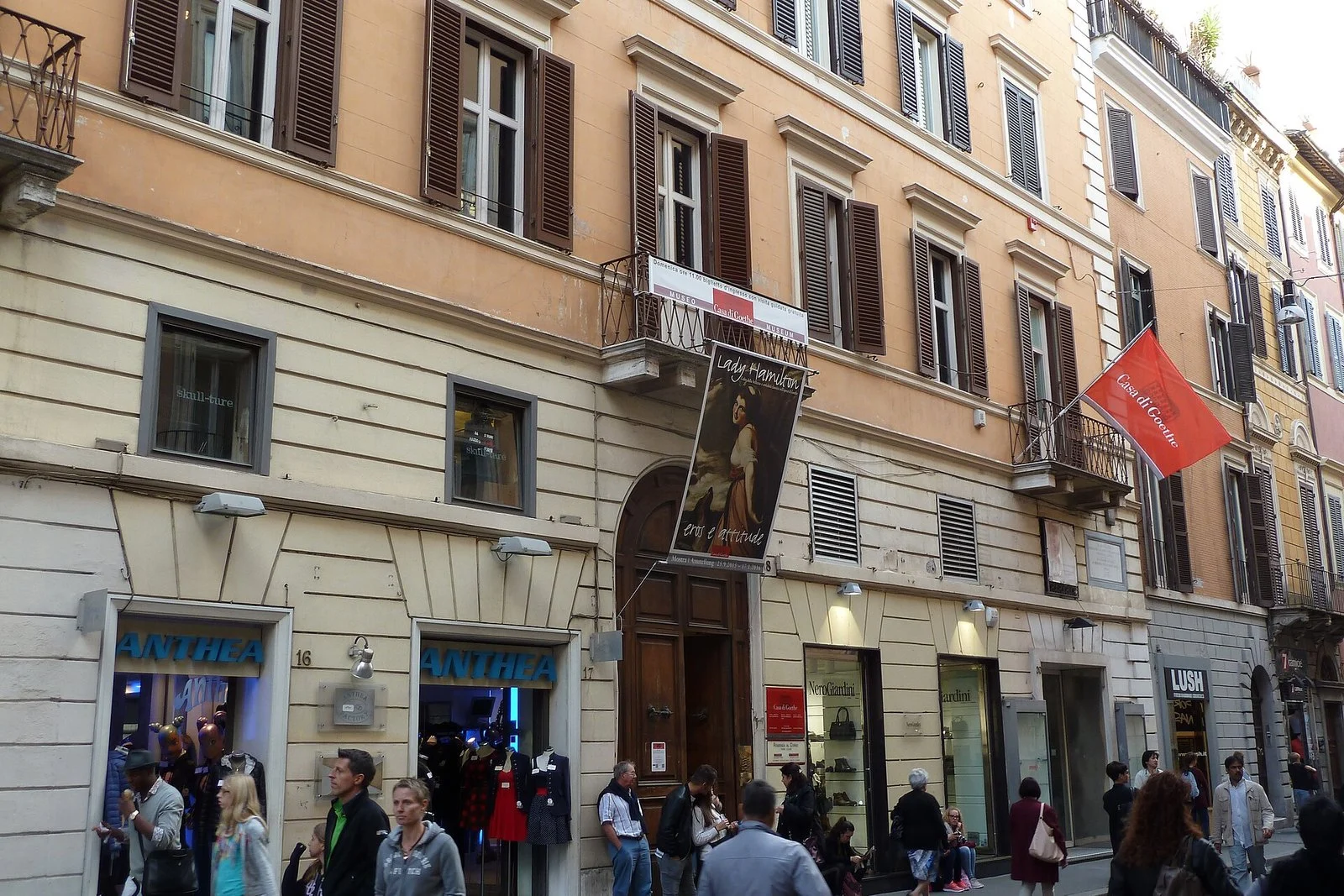
Casa di Goethe is at Via del Corso 18, a few steps from Piazza del Popolo, in the first stretch of Via del Corso that marks the entrance to the Tridente. It is the apartment where Johann Wolfgang Goethe lived between 1786 and 1788 during his journey in Italy, and today it is the only German museum abroad, run by the Association of Independent Cultural Institutes (AsKI). On the first floor of a late sixteenth-century building, among rooms dedicated to the writer's Roman life, original drawings by Tischbein, Hackert and Kniep and a library of 8,500 volumes, it tells one of the densest chapters of the relationship between Germany and Rome. Anyone visiting the Tridente will also find nearby Piazza di Spagna and the Atelier Canova Tadolini, another artist's workshop left intact in the heart of the neighborhood.
Where Casa di Goethe Is and How to Get There
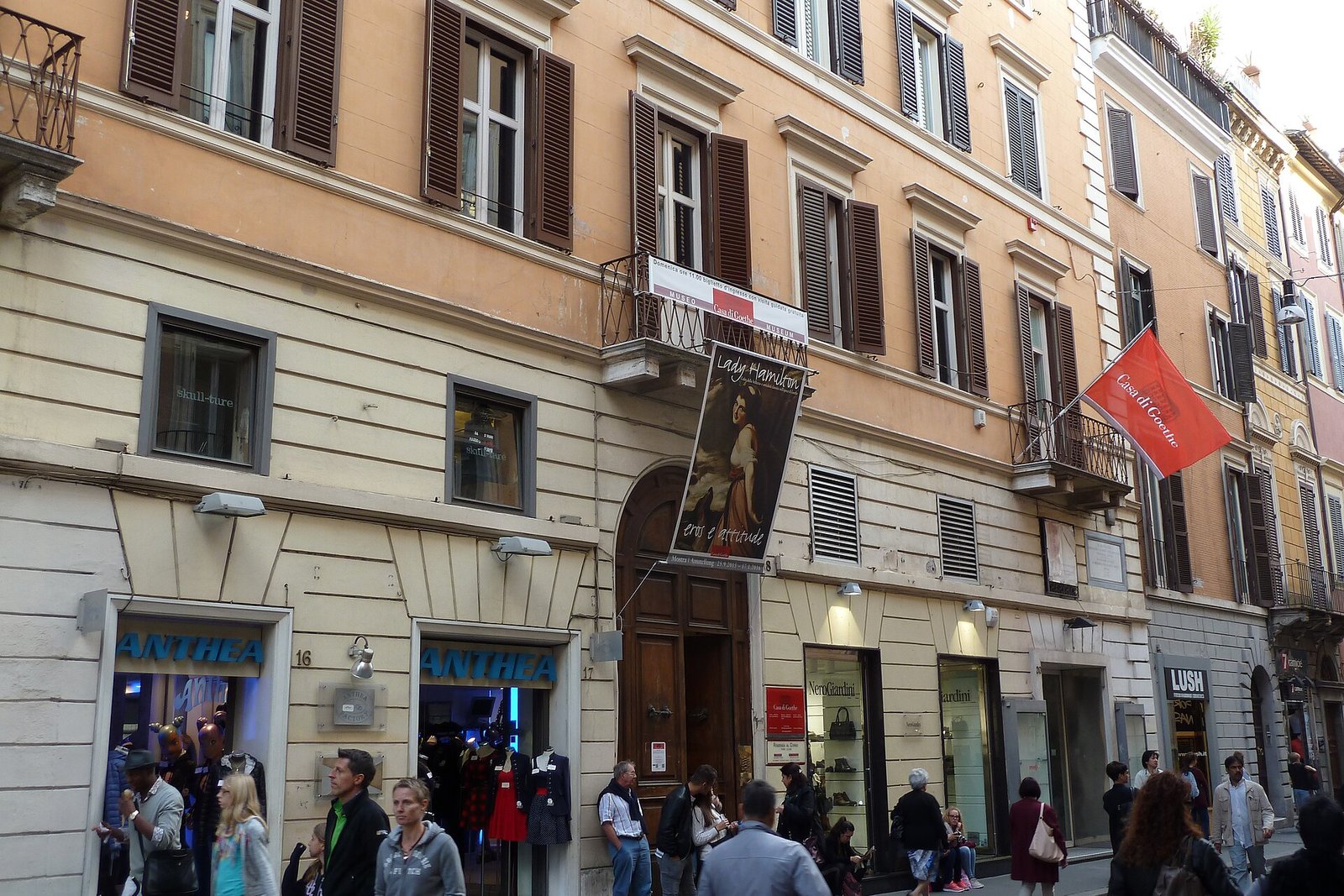
The address is Via del Corso 18, 00186 Rome, in the Campo Marzio district, a handful of meters from the intersection with Piazza del Popolo. It is the most convenient location you can imagine for anyone arriving in Rome without a car: the museum sits in one of the most central points of the Tridente, the triangle of straight streets that opens from Piazza del Popolo toward the heart of the city, formed by Via del Corso, Via del Babuino and Via di Ripetta.
By Metro and on Foot
The closest stop is Flaminio, on metro line A, about 500 meters' walk along Via del Corso or through Piazza del Popolo. From here it is 3 or 4 minutes on foot at an easy pace, crossing one of the most scenic urban spaces in Rome, with the Flaminian obelisk in the center of the square and the twin churches of Santa Maria di Montesanto and Santa Maria dei Miracoli framing the mouth of the three streets. If you are staying in Piazza di Spagna area you can also reach the museum on foot in barely 10 minutes, along Via del Babuino or the Corso itself.
By Bus and Surface Transport
Several ATAC bus lines pass through Piazzale Flaminio and along the first stretch of Via del Corso: it is the most practical solution for anyone coming from parts of Rome not served by the metro. The Historic Center inside the Aurelian Walls, however, is a limited traffic zone during long stretches of the day, so if you travel by car you have to allow for the fact that direct access to the museum is not guaranteed anyway, and it is best to leave the vehicle in one of the paid parking lots outside the ZTL and continue on foot or by public transport.
By Taxi and Private Services
If you arrive from Fiumicino or Ciampino and prefer not to deal with changes of transport with luggage, the taxi is convenient, since from the airports it applies fixed fares to the Historic Center of Rome. The museum, being right in the center, falls within the area covered by these agreed fares. For anyone organizing a private transfer or a small customized tour that includes Casa di Goethe together with other stops in the Tridente, the most convenient solution remains to turn to a specialized operator able to manage times, entrances and transfers between museums on its own.
From Termini and the Other Tourist Areas
From Roma Termini the most direct route is metro line A to Flaminio, or a walk of about 25 minutes that crosses Via del Tritone and the whole length of Via del Corso. From Piazza di Spagna the museum is easily reached on foot, as it is from the Pincio, the panoramic terrace that overlooks Piazza del Popolo from the east: coming down from the terrace you arrive in a few minutes in front of number 18 on Via del Corso.
Piazza del Popolo, the Northern Gate of Rome
To fully appreciate Goethe's choice to settle precisely on Via del Corso, you have to understand the role that Piazza del Popolo played in the Rome of the late eighteenth century. It was not simply a beautiful square among many: it was, in effect, the official entrance to the city for those arriving from the north, along Via Flaminia. Through the ancient Porta del Popolo, which opens on the northern side of the square, pilgrims, diplomats, merchants and, from the eighteenth century on, a growing number of Grand Tour travelers headed for the heart of the city passed for centuries.
The First Look at Rome
Anyone entering Rome through this gate, after weeks of travel across the Alps and the Po plain, suddenly found themselves in front of one of the most scenic urban spaces ever designed: the square opens like a fan into three straight streets, the celebrated tridente formed by Via del Corso in the center, Via del Babuino on the left and Via di Ripetta on the right, with the Flaminian obelisk, brought to Rome from Egypt in the Augustan age, marking the focal point of the composition. For a traveler like Goethe, who arrived after almost two months of travel from Karlsbad, entering the city through this square must have had an enormous symbolic weight: it was, literally, the threshold between the Northern Europe he was leaving behind and the classical world he had come to look for.
Why the Corso Was the Right Street
Among the three streets of the tridente, Via del Corso was historically the most prestigious and the busiest: it followed the route of the ancient Roman Via Lata and already in the eighteenth century housed the residences of the most prominent noble families, besides being the course of the celebrated Barberi horse race held during the Roman carnival, which gave the street its very name. Taking lodging on this street, for a foreign artist or intellectual, meant placing oneself at the exact center of the city's public life, halfway between the Roman aristocratic world and the cosmopolitan community of foreigners that gravitated around Piazza di Spagna and Via del Babuino.
Who Goethe Was and Why He Chose Rome
Johann Wolfgang Goethe, born in Frankfurt in 1749, was already an established writer across Europe when, in the summer of 1786, he decided to leave Germany for Italy. Years earlier he had published the novel that had made him famous, The Sorrows of Young Werther, and he held an important role at the court of Weimar, where he dealt with administration, mines, theater and natural sciences. The Italian journey was not so much a sudden escape as a necessity that Goethe himself called vital: he needed to see with his own eyes the classical world he had read about and studied all his life.
The Secret Departure From Karlsbad
On September 3, 1786, before dawn, Goethe left Karlsbad without telling almost anyone, traveling incognito under a false name to avoid being recognized and delayed along the way. He crossed the Alps, stopped in Verona, Vicenza, Venice and Bologna, and arrived in Rome on October 29, 1786, after almost two months of travel. It was the beginning of an Italian stay that would last, with a long Neapolitan and Sicilian interlude, almost two years, and that Goethe would later tell in his Italian Journey, published only several years after his return home.
The First Roman Stay and the Departure for the South
Arrived in Rome, Goethe settled in the very apartment on Via del Corso, where he found hospitality with the painter Johann Heinrich Wilhelm Tischbein, with whom he had already kept up a correspondence. He stayed in the capital until the first months of 1787, devoting himself to the study of ancient art, to visiting the monuments and to his first attempts at drawing, then left for Naples and Sicily, a trip that kept him away from Rome for about four months.
The Grand Tour and the German Colony of the Tridente
To understand why a German poet ended up living precisely on Via del Corso you have to widen the view to the larger phenomenon of which his journey was a part: the Grand Tour. From the mid-eighteenth century onward, hundreds of artists, writers, architects and simple well-off travelers from Northern Europe crossed the Alps to complete their education in direct contact with ancient and Renaissance Italian art. Rome was the culminating stop of that route, and the Tridente, with its wide, straight streets opening onto Piazza del Popolo, the northern gate of the city for those arriving from the north, became the district of choice for foreigners.
The Role of Winckelmann and the Birth of the Archaeological Fashion
Even before Goethe, another German had already changed forever the way Europe looked at classical art: Johann Joachim Winckelmann, art historian and archaeologist, had lived in Rome from 1755 until his death in 1768, laying the foundations of modern art history with his studies of Greek and Roman sculpture. His theories on the noble simplicity and quiet grandeur of ancient art deeply influenced the following generation of German travelers, Goethe included, who arrived in Rome already shaped by reading Winckelmann's writings and sought in the city's monuments direct confirmation of what he had read.
Via del Babuino, Via Margutta and the Studios of Foreign Artists
Within a radius of a few hundred meters from Via del Corso 18, between the late eighteenth century and throughout the nineteenth, there was a concentration of artists' studios and workshops that is hard to imagine today strolling among the fashion shop windows that now occupy Via del Babuino. Painters, sculptors and engravers from all over Europe rented apartments and studios right in this area, which remained relatively cheap compared with the heart of the ancient city and at the same time very close to the places of study, the foreign academies and the meeting points of the international community. The celebrated Antico Caffè Greco, still open on Via Condotti a few steps from here, was one of these meeting places, frequented by generations of foreign artists, and in the same web of streets you can still find today the Atelier Canova Tadolini, direct evidence of how a nineteenth-century sculpture workshop could remain almost intact to this day.
A Community, Not an Isolated Tourist
The fact that often escapes notice, when speaking of Goethe in Rome, is that his was not at all a solitary stay. He arrived in a city where a dense network of fellow countrymen already existed, painters, sculptors, engravers and simple curious people, with shared habits, regular meeting places and even their own circuit for exchanging information and favors. The apartment on Via del Corso, shared with Tischbein and other painters, was a node of this network, not an exception. Understanding this helps read Casa di Goethe not as the monument to an isolated genius, but as the most tangible testimony of an entire cultural phenomenon, that of the German artistic colony in Rome, which would leave traces well into the twentieth century.
A Curiosity About Casa di Goethe
The curiosity that surprises almost all visitors concerns the name under which Goethe traveled in Italy. To avoid being recognized, slowed down by official invitations and treated as a court official, the poet presented himself for most of the journey as a merchant or a painter named Filippo Miller, or Johann Philipp Möller depending on the sources, and only with his closest friends did he drop the pretense. It is one of the few cases in which one of the most celebrated writers in Europe crossed half a continent incognito, sleeping in village inns and traveling with the barest luggage, just like any ordinary private citizen.
There is also a lesser-known detail about the building itself: the palazzo at Via del Corso 18 was not Goethe's house only for him. In the same building lived, decades later, Paul Heyse, the first German-language writer to receive the Nobel Prize in Literature, in 1910. The Russian writer and philosopher Alexander Herzen also stayed there, at a different moment in his life. A single address, then, has hosted over time three leading figures of European culture, in an interweaving of coincidences that the museum tells only in part.
The Apartment on Via del Corso and Life With Tischbein
Goethe described his own luck in finding lodging with Tischbein in words that today stand out among the museum's materials: it seemed to him a stroke of luck that his painter friend had a fine arrangement, shared with other artists. The apartment on the first floor of Via del Corso 18 in fact housed not only Goethe and Tischbein, but also the painters Johann Georg Schütz and Friedrich Bury, in an atmosphere of German artistic community that was quite common among the foreigners living in Rome in the second half of the eighteenth century.
A Typical Day in Goethe's Rome
The letters and diaries that later fed into the Italian Journey tell of days marked by a precise rhythm: visits to ancient monuments early in the morning, drawing study in the afternoon, evening conversations with other artists and collectors of the German circle in Rome. Goethe visited the Colosseum, the Pantheon, the Forums and the Renaissance villas of the city several times, seeking in the ancient buildings confirmation of theories on architecture and proportions that he had developed reading Vitruvius and Palladio. During this period he also began to practice drawing from life, an activity he considered complementary to writing and not simply a pastime.
The Return to Rome and the Second Stay
After the Neapolitan and Sicilian experience, Goethe returned to Rome in June 1787 and stayed until April 1788, this time in a different apartment, still in the same area of the Tridente. In these final months of the Italian stay he completed the tragedy Iphigenia in Tauris, took up again the unfinished drama Torquato Tasso and worked on passages that would end up in Faust. They were also the months in which he wrote the Roman Elegies, compositions in elegiac couplets inspired by the life and loves lived in the capital, works that he published only years later and with some caution, given the rather explicit themes for the time.
Who Tischbein Really Was, the Landlord
Johann Heinrich Wilhelm Tischbein, born in Haina in 1751 into a family of painters, arrived in Rome a few years before Goethe and had already built a decent reputation there as a portraitist when his writer friend knocked at his door. It was Tischbein who introduced Goethe to the artistic circles of the city, taught him the basics of drawing from life and accompanied him on his first systematic visits to the ancient monuments. The relationship between the two was not free of tension: Tischbein, who hoped to make a large official portrait of the poet to be shown publicly, saw the work in the end stay a long time in his own studio before being sold, and the two did not keep an equally close relationship in the years after the Roman stay. The fact remains that without Tischbein's hospitality the story of Casa di Goethe, simply, would not exist: he was the one who made available the rooms on Via del Corso that are visited today as a museum.
The Diary That Became a Book
The Italian Journey, as we know it today, was not born as a book conceived from the start for publication. During his stay Goethe wrote letters and diary notes that he sent regularly to the friends who had stayed in Weimar, in particular Charlotte von Stein and Duke Carl August. Only many years after returning to Germany, rereading and reworking that material, did Goethe turn it into the narrative form that would be published between 1816 and 1817, with an appendix on the second Roman stay published separately in 1829. The book quickly became a reference point for generations of German travelers headed for Italy, to the point that even today many German-speaking tourists arrive in Rome with, in their suitcase, literally or figuratively, the pages dedicated precisely to Via del Corso and to the places Goethe frequented.
One Thing Nobody Tells You About Casa di Goethe
Almost all descriptions of the museum give 1997 as the year of opening, and that is correct: the Casa di Goethe that you visit today was officially inaugurated on May 30 of that year. What is rarely said is that it was not the first attempt. A first museum dedicated to Goethe in the same building opened as early as 1973, on the second floor of the building, but closed in 1982 for lack of sufficient public funds to keep it going. For almost a decade the apartment where Goethe had lived stayed without a museum to tell its story, until in 1990 AsKI bought the first floor of the building, starting the works that would lead to the definitive reopening seven years later.
A second little-known detail concerns the extent of the spaces: between 2009 and 2012 the museum acquired and opened a second apartment, significantly expanding the surface available for temporary exhibitions and the library. Anyone who visited Casa di Goethe in the 1990s or the early 2000s would therefore find today a museum considerably larger than the one they remember.
The Permanent Collection of Casa di Goethe
The permanent exhibition is titled Goethe in Italy: life, travels, discoveries and occupies a large part of the museum's first apartment. It is not a simple sequence of relics, but a route organized by themes that follows Goethe's many-sided interests during the Roman stay: writing, drawing, the study of light and color, archaeology, classical architecture.
The Drawings of Tischbein, Hackert and Kniep
Among the most important pieces are original drawings by Johann Heinrich Wilhelm Tischbein, the painter who hosted Goethe in 1786, by Jakob Philipp Hackert, a German landscape painter very active in Rome and Naples in those years, and by Christoph Heinrich Kniep, the artist who accompanied Goethe on the journey to Sicily and who supplied him with most of the drawn views that then fed into his travel notes. These drawings convey, better than any description, the gaze with which the German artists of the time observed the ruins, the countryside and the light of Rome.
An entire room of the museum is dedicated to Goethe's studies of light and color, an interest born precisely during his Roman observations and developed in the following years until it became a complete scientific treatise, the Theory of Colors, published in 1810. Another room tells of Goethe's relationship with classical architecture through views and engravings of the city's monuments, while a third gathers the manuscripts and first editions of the literary works composed or taken up again during the Roman stay, among them Iphigenia in Tauris and Torquato Tasso.
The Andy Warhol Portrait and the Contemporary Works
Among the surprises of the route is a portrait of Goethe made by Andy Warhol in 1982, shown in dialogue with the poet's nineteenth-century iconographic tradition, starting from Tischbein's celebrated painting Goethe in the Roman Campagna, the work that more than any other fixed the image of Goethe on his travels, wrapped in a white cloak among the ruins of the Lazio countryside. The museum also gathers works by contemporary artists such as Luigi Ontani and the Spanish sculptor Andreu Alfaro, bearing witness to a dialogue between the figure of Goethe and the most recent art that continues today through the temporary exhibitions.
The Museum's Two Libraries
Casa di Goethe holds two distinct book collections. The first is the historic library of the Deutscher Künstlerverein, the association of German artists in Rome founded in 1848, which reflects the literary tastes of the nineteenth-century German artistic community in the capital. The second is the Goethe library proper, which counts about 8,500 volumes among first editions, illustrated texts, travel accounts and works on the history of ideas and on the cultural relations between Italy and Germany. The two libraries are not normally accessible during the ordinary visit to the museum, but can be consulted on request by scholars and researchers.
The Theory of Colors and the Roman Roots of Goethe's Science
One of the least-known aspects of Goethe's figure is his scientific production, which in Rome found an unexpectedly fertile ground. Observing the light of the Roman countryside, the colors of the sunsets over the Janiculum and the shadows cast by the ancient monuments at different hours of the day, Goethe began to note observations that he considered incompatible with Newton's optical theory, according to which color was a property of white light that could be broken down through the prism. Goethe developed instead an idea of color as a phenomenon that arises from the interaction between light and darkness, an approach closer to subjective perception than to experimental physics. The museum dedicates a room precisely to this line of research, with instruments, drawings and the first formulations of what would become the Theory of Colors, published in 1810: a text that Goethe considered throughout his life more important than his literary production, although the scientific community of the time received it with more skepticism than enthusiasm.
Botany, Geology and the Other Scientific Interests
Alongside the theory of color, the Italian stay also fed Goethe's interest in botany and geology. It was precisely in Italy, observing the variety of Mediterranean plants compared with those known in Germany, that he began to work out the ideas on the metamorphosis of plants that he would publish on his return home, hypothesizing the existence of an original plant form from which all the others would derive by transformation of the organs. The museum route hints at these interests through panels and materials that complete the portrait of an intellectual whose curiosity went far beyond the boundaries of literature alone.
The Temporary Exhibitions at Casa di Goethe
Four rooms of the museum are reserved for temporary exhibitions, which are renewed several times a year and generally address Italian-German themes, the tradition of the journey to Italy from the eighteenth century to today, or the work of individual German artists who had a significant relationship with Rome, such as Max Beckmann and Thomas Mann. The program changes seasonally, so whoever is planning a visit and wants to know which exhibition will be on in the chosen period should check the updated calendar on the museum's official site before leaving.
The temporary exhibitions are often accompanied by lecture series, book presentations and meetings that fall within AsKI's cultural mission: promoting exchange between German and Italian culture through an independent institution, not directly tied to the embassy or the German cultural institute, while keeping relations of collaboration with both.
The Museum Today and Its Cultural Role
Almost 30 years after the reopening of 1997, Casa di Goethe has carved out a role that goes beyond the simple preservation of the memory of a historic stay. The museum works as a true Italian-German cultural center in the heart of Rome, with a busy calendar of lectures, book presentations, chamber concerts and meetings with scholars from both countries. It is not unusual for the rooms to host initiatives aimed at schools too, with educational routes designed to bring Italian and German students closer to the figure of Goethe through practical drawing and writing activities, along the lines of what the poet himself practiced during his Roman stay.
The museum also collaborates with the German Historical Institute in Rome and with the German Academy Villa Massimo, two other German cultural institutions in the capital, in an ecosystem that makes Rome one of the European cities with the highest concentration of institutions dedicated to German culture outside the national borders. This web of relations explains why Casa di Goethe, though a museum of modest size, regularly receives visits from official delegations, researchers and exchange students between the universities of the two countries.
My Advice for Visiting Casa di Goethe
The museum is small compared with the big Roman containers, and for this very reason it should be approached at a different pace. The practical advice is not to treat it as a quick stop between Piazza del Popolo and Piazza di Spagna, but as a stop of its own, to be planned calmly, maybe in the early morning just after opening, when the rooms are quieter and the light coming in from the windows on Via del Corso better conveys the atmosphere of the apartment where Goethe really lived.
Whoever already knows part of the Italian Journey gets the most out of the visit, because many panels and many works speak directly to passages of the book. Even without having read it, though, the route is built to remain understandable and engaging, thanks to explanatory panels in Italian, German and English. I recommend setting aside at least an hour, an hour and a half if a temporary exhibition is also open in the four dedicated rooms during the period of your visit. Another practical piece of advice concerns the season: in the summer months Via del Corso and Piazza del Popolo remain among the most crowded areas of the center of Rome for much of the day, while the museum, being a compact indoor space, offers a pleasant refuge from the heat and the crowd precisely in the middle hours, between 12:00 and 16:00, when the streets of the Tridente are at their peak tourist density. Anyone organizing a more structured stay in the capital, perhaps with a licensed tour guide for a group or for a private tour dedicated to the Grand Tour and to the Rome of foreign artists, will find a reference point in the editorial team of TourLeaderPro, which builds tailor-made itineraries also for companies and small groups.
Combining the Visit With the Rest of the Tridente
Casa di Goethe lends itself well to being included in a broader itinerary dedicated to the Tridente and to the Rome of the Grand Tour: Piazza del Popolo a short walk away, Via del Babuino with its art galleries, Piazza di Spagna with the Trinità dei Monti staircase, and the Atelier Canova Tadolini, the old sculpture studio on Via del Babuino where Antonio Canova worked and which today can be visited as a museum and cafe. A walking itinerary touching these four points takes half a day at an easy pace, without rushing, and is probably the most coherent way to understand why so many foreign artists and writers chose precisely this corner of Rome as the base for their Italian stays. Whoever has more time available can continue the day going down toward the Pantheon or up toward Villa Borghese, whose gardens can be reached in a few minutes from the Pincio terrace, thus closing a route that joins the literary memory of the Tridente with the great green backdrop that dominates the Historic Center from the north.
Hours, Tickets and Practical Information
Casa di Goethe is open Tuesday to Sunday, from 10:00 to 18:00, with last entry at 17:30. The museum is closed on Monday, like most small and medium-sized Roman museum institutions. The full-price ticket costs €6, the reduced one €5, while a family card at €17 is available for family units, admission is free for children under 10. Guided visits by reservation are also available, at an indicative cost of €40 generally calculated for the whole group and not per person, a formula that is especially convenient for those visiting in company or organizing a small educational outing with the school or the company. Prices and conditions may change over time, on the occasion of temporary exhibitions with a combined ticket or special initiatives, so it is always best to check the updated amount on the museum's official site before the visit.
Accessibility and Services
Since it is a historic apartment on the first floor of a late sixteenth-century building, accessibility for people with mobility difficulties should be checked directly with the museum before the visit, because the internal layout of the spaces inevitably reflects the original structure of the building. The museum has a bookshop with publications dedicated to Goethe and to the Italian-German relationship, useful for those who want to go deeper after the visit.
How to Book and Contact Information
Casa di Goethe accepts reservations for guided visits and for groups through its official site and the telephone contacts published on the contact page. For schools and organized groups a dedicated educational service is available, with routes tailored to the age of the participants and the time available. During temporary exhibition periods, especially in coincidence with special events tied to Italian-German culture, it is best to book a few days ahead, because the museum's rooms are not large and the flow can concentrate in certain time slots, in particular on weekends and in the spring and autumn months, when the tourist flow toward the Tridente is most intense.
Another Well-Known Fact, Yet Rarely Cited
Almost everyone knows, at least by hearsay, that the most famous painting linked to Goethe is the one that portrays him stretched out among the ruins of the Roman countryside, wrapped in a white cloak and with a wide-brimmed hat. What is cited more rarely is that the original of this painting, made by Tischbein between 1786 and 1787, is not in Rome. The work is kept at the Städel Museum in Frankfurt, Goethe's native city, and is not part of the permanent collection of the house on Via del Corso. Whoever enters the Roman museum expecting to find the original picture in front of them is therefore surprised: what you see is its presence in the exhibition route as a reference, in dialogue with later works inspired by that image, such as the Andy Warhol portrait.
It is an understandable misunderstanding, because the painting is so associated with Goethe's public image that it has become almost a logo of his Italian journey, reproduced on book covers, posters and even stamps. Its physical absence from Casa di Goethe, however, takes nothing away from the value of the visit: on the contrary, it conveys more precisely the difference between the place where Goethe really lived and the idealized image that posterity built of him.
The Right Photo to Take at Casa di Goethe
The most successful photo is not taken inside the rooms, where the museum's rules generally limit the use of the camera to protect the works on display, but just outside, on the sidewalk of Via del Corso 18, looking up at the facade of the building with the plaque commemorating Goethe's stay. It is a simple framing, but it tells well the contrast between the everyday life of one of the busiest streets in the center of Rome and the quiet of an apartment that for two years hosted one of the most important intellectuals in Europe.
Whoever wants a more scenic image can climb up to the Pincio, a few minutes' walk from the museum, and photograph from up there the whole area of Piazza del Popolo and the mouth of the three streets of the Tridente, including in the same frame the urban context in which Via del Corso 18 sits. It is the same perspective, raised above the city, that many Grand Tour travelers sought to get an overall idea of Rome before losing themselves in its streets.
Some Important Events That Happened Here in History
The palazzo at Via del Corso 18 dates to the late sixteenth century and has lived through more than four centuries of Roman history, changing ownership and function several times. From 1824 to 1948 it belonged to the Bracci family, descendants of the Baroque sculptor Pietro Bracci, author among other things of the figures of the Trevi Fountain: for over a century the ownership of the building thus stayed in the hands of a family itself tied to the great Roman artistic tradition. In 1948 the building passed by inheritance to the Mensa Vescovile of Civita Castellana.
From the First Museum in 1973 to Today's Casa di Goethe
The decisive moment for the recent history of the building comes in 1973, when the first museum dedicated to Goethe in the capital opens on the second floor of the building. The initiative does not last, though: in 1982 the museum closes for lack of the public funds needed to sustain its activity, and for almost a decade the apartment where Goethe had lived is left without an institution to tell its story. In 1990 AsKI, the Association of Independent German Cultural Institutes, buys the first floor of the building, starting a process of restoration and fitting out that leads to the official opening of the present Casa di Goethe on May 30, 1997, with the title of only German museum abroad. Between 2009 and 2012 the museum acquires and opens to the public a second apartment, substantially expanding the spaces available for the collections and for temporary exhibitions.
During the German occupation of Rome, between 1943 and 1944, the same building also hosted, according to the available sources, less known and more dramatic events, tied to the presence of people fleeing the persecutions of the time, bearing witness to how a single address can run through the most diverse moments in the history of a city, from the stay of a poet to the tragedy of war, to the birth of a museum dedicated to the cultural memory shared between two countries.
A Museum Born of Italian-German Cultural Cooperation
The birth of Casa di Goethe in 1997 was not only a real estate and museographic operation, but also a political and symbolic gesture in the path of cultural rapprochement between Italy and Germany in the postwar period. AsKI, an association that brings together several independent German cultural institutes, chose to invest precisely in the restoration of the apartment on Via del Corso to give back to the city a place that told not an isolated episode, but an entire chapter of history shared between the two countries, that of the German artistic colony in Rome between the eighteenth and nineteenth centuries. The result is a museum that, though dedicated to a single writer, ends up telling a much wider network of cultural relations, of which Via del Corso 18 remains the privileged observation point.
Who Has Passed Through Casa di Goethe
The name that gives meaning to the whole building is naturally that of Johann Wolfgang Goethe, who lived there between 1786 and 1788 during his long Italian stay. Alongside him, in the same apartment, lived the painter Johann Heinrich Wilhelm Tischbein, who hosted him and who would become the author of the poet's most celebrated portrait, and the painters Johann Georg Schütz and Friedrich Bury, members of the small German artistic community that had settled in Rome in the late eighteenth century.
During the journey to Sicily, Goethe was accompanied by the draftsman Christoph Heinrich Kniep, while in Rome and Naples he assiduously frequented the landscape painter Jakob Philipp Hackert, of whom he also wrote a biography after the artist's death. Decades after Goethe's stay, the same palazzo at Via del Corso 18 hosted Paul Heyse, the first German-language writer awarded the Nobel Prize in Literature in 1910, and the Russian writer and philosopher Alexander Herzen, a central figure of nineteenth-century Russian political thought.
Casa di Goethe is also a regular destination for scholars, Germanists and simple enthusiasts who go there to consult the specialized library or to take part in the lecture series organized periodically by AsKI, often in collaboration with Italian and German universities. In the contemporary museum, the most surprising presence is that of Andy Warhol, whose 1982 portrait of Goethe now dialogues with the poet's nineteenth-century iconography within the exhibition route, alongside the works of artists such as Luigi Ontani and Andreu Alfaro, confirming that Casa di Goethe does not limit itself to preserving the memory of a stay concluded over two centuries ago, but continues to dialogue with the art of the present.
Nearby: What to See Close to Casa di Goethe
Piazza del Popolo can be reached in a couple of minutes on foot and is the natural point from which to begin or end the visit, with the Flaminian obelisk, the twin churches and the climb to the Pincio. From here also starts Via del Babuino, the street that connects Piazza del Popolo to Piazza di Spagna through art galleries and historic shops, and where you find the Atelier Canova Tadolini, the old studio of the sculptor Antonio Canova, today a museum and cafe.
Whoever walks Via del Corso to the south, in the direction of the Historic Center, finds shops, historic palazzi and, further on, the mouth of the streets that lead to the Pantheon and Piazza Navona. It is an itinerary that lends itself well to a day dedicated to the nineteenth-century Grand Tour and to the German presence in Rome, a theme worth going deeper into also with a guide in your own language: on the ItalyPlanner.com portal there are resources in English for organizing a Roman stay that includes the less crowded museums of the Historic Center, like Casa di Goethe, together with the great classics of the city.
Piazza di Spagna and the Memory of Foreign Travelers
Piazza di Spagna, with its celebrated staircase climbing to Trinità dei Monti, is 10 minutes' walk from Casa di Goethe and itself holds an important piece of the memory of foreign travelers in Rome: in the house beside the staircase the English poet John Keats died in 1821, in an apartment now also turned into a museum dedicated to literary memory. Lining up Casa di Goethe and the Keats house museum means reconstructing, within a radius of a few hundred meters, the geography of the foreign writers who chose Rome as a fundamental stop in their education, Germans and English united by the same need to measure themselves against the art and history of the city.
The Atelier Canova Tadolini and the Sculpture of the Tridente
A few steps from here, on Via del Babuino, the Atelier Canova Tadolini tells another chapter of the same artistic season: the studio where Antonio Canova worked, the most important European Neoclassical sculptor, later passed to the Tadolini family, who kept it active as a sculpture workshop for generations. Today the atelier can be visited freely as a museum and cafe, among plaster casts, terracotta models and the original tools of the trade, in a route that completes the visit to Casa di Goethe well by giving another look at the Rome of foreign artists and their daily workshop.
Frequently Asked Questions About Casa di Goethe
Where is Casa di Goethe?
Casa di Goethe is at Via del Corso 18, in Rome, a few steps from Piazza del Popolo, in the first stretch of the Tridente. It can be reached on foot in 5 minutes from the Flaminio stop of metro line A and in about 10 minutes on foot from Piazza di Spagna.
How much does a ticket to Casa di Goethe cost?
The full-price ticket for Casa di Goethe costs €6, the reduced one €5, with a family card at €17 and free admission for children under 10. Prices and conditions may change over time, especially in the presence of temporary exhibitions with a combined ticket, so it is advisable to check them on the museum's official site before the visit.
How long does it take to visit Casa di Goethe?
One hour is generally enough to visit Casa di Goethe, which becomes an hour and a half if a temporary exhibition is also open in the four dedicated rooms during the chosen period. It is a museum of modest size, designed for a compact visit rather than a long and scattered route.
Is Casa di Goethe suitable for children?
Casa di Goethe is a museum designed mainly for an adult audience or for young people already interested in literature and art history, with rather dense text panels. Children under 10 get in free, but a route made mostly of manuscripts, drawings and texts can be not very engaging for the youngest without targeted guidance.
Is German spoken at Casa di Goethe?
At Casa di Goethe the staff speak German and Italian fluently, and the explanatory panels of the permanent route are in Italian, German and English. It is one of the few Roman museum institutions in which the German language component is as central as the Italian one, consistent with the museum's mission.
Why did Goethe live on Via del Corso and not elsewhere?
Goethe settled at Via del Corso 18 because his friend the painter Johann Heinrich Wilhelm Tischbein had lodgings there, with whom he was already corresponding before the journey. The apartment was also shared with other German painters, in a form of artistic community common among foreigners living in Rome in the second half of the eighteenth century.
What is the difference between the first museum of 1973 and today's Casa di Goethe?
The first museum dedicated to Goethe in the same building opened in 1973 on the second floor, but closed in 1982 for lack of public funds. The Casa di Goethe you visit today is a different institution, opened on May 30, 1997 by AsKI after the purchase of the first floor of the building, with a collection and a space much larger than the original attempt.
Is the painting of Goethe in the Roman Campagna at Casa di Goethe?
The original Tischbein painting titled Goethe in the Roman Campagna is not at Casa di Goethe, but is kept at the Städel Museum in Frankfurt. In the Roman museum the image is nonetheless present as a reference in the exhibition route, in dialogue with later works such as the portrait of Goethe made by Andy Warhol in 1982.
Can you take photographs inside Casa di Goethe?
At Casa di Goethe the use of the camera in the exhibition rooms is generally limited to protect the preservation of the drawings, manuscripts and original documents on display, many of them particularly sensitive to light. It's best to ask the staff at the entrance for confirmation before shooting, and possibly to save the more scenic photographs for the outside of the building, on the facade at Via del Corso 18, or from the nearby Pincio terrace.
Is Casa di Goethe connected to other Roman museums dedicated to foreign writers?
Casa di Goethe is not part of a single official circuit with other Roman literary museums, but it shares with them the same historical and cultural ground: 10 minutes' walk away, on Piazza di Spagna, is the house museum dedicated to John Keats and Percy Bysshe Shelley, dedicated to the English Romantic poets who chose Rome for the same reason as Goethe. Visiting them on the same day gives a more complete picture of the city as a destination of education for foreign intellectuals of several nationalities.
Article written by the editorial team of TourLeaderPro, a reference point for anyone organizing private, corporate or tailor-made tours and experiences in the Historic Center of Rome. For a guided itinerary dedicated to the Grand Tour, the Tridente and the Rome of foreign artists, the TourLeaderPro contact page is the most direct starting point.
Planning a stay in Rome? The English-language guides of ItalyPlanner.com explain how to get around among the less crowded museums of the Historic Center and the great classics of the city, with in-depth pieces for anyone who wants to better understand the Rome of the Grand Tour and the long season in which foreign travelers and artists chose the Tridente as their own home away from home.