Atelier Canova Tadolini
In short. Atelier Canova Tadolini is at Via del Babuino 150/a, at the corner with Via dei Greci, in the heart of the Tridente, halfway between Piazza di Spagna and Piazza del Popolo.
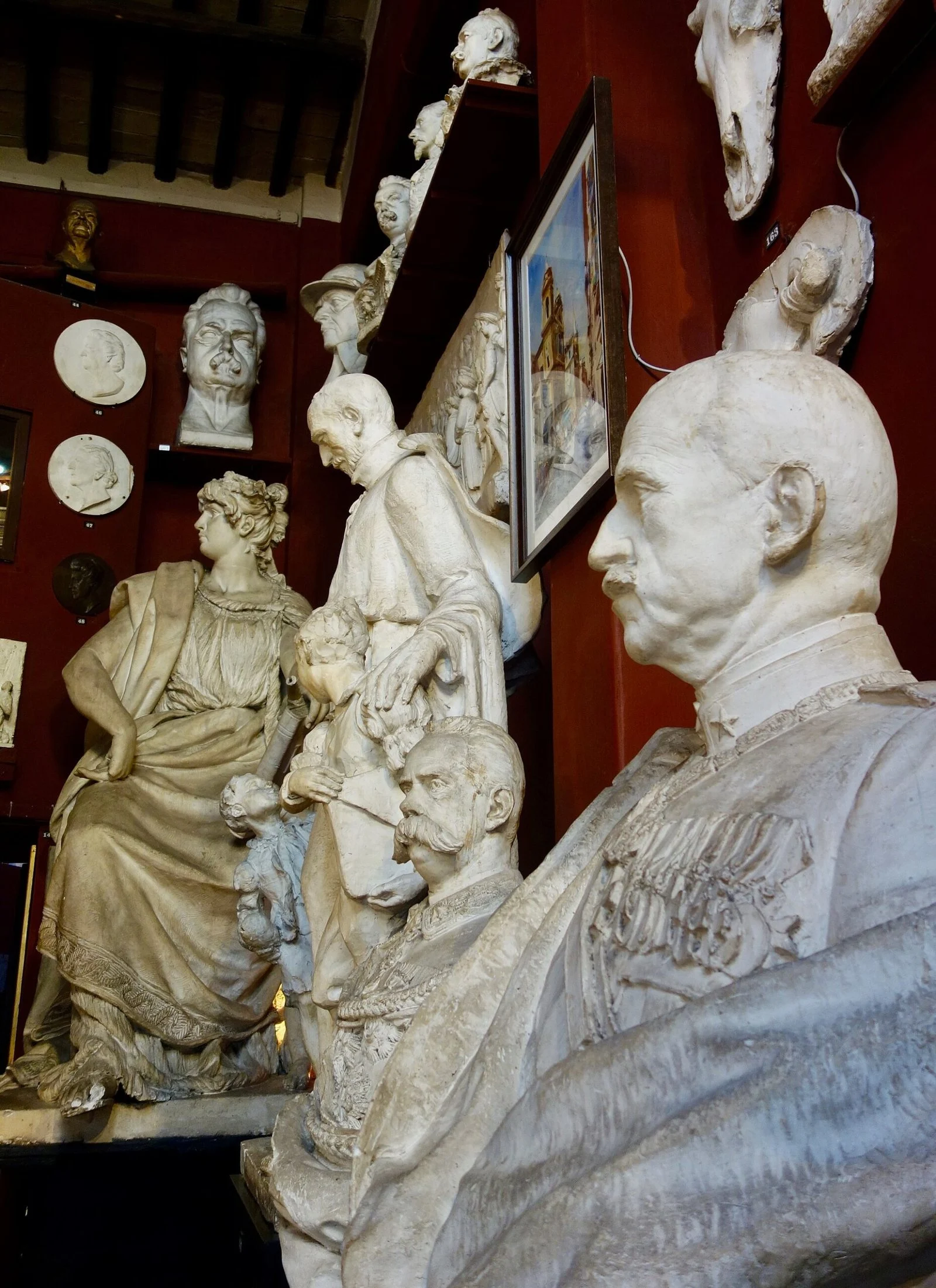
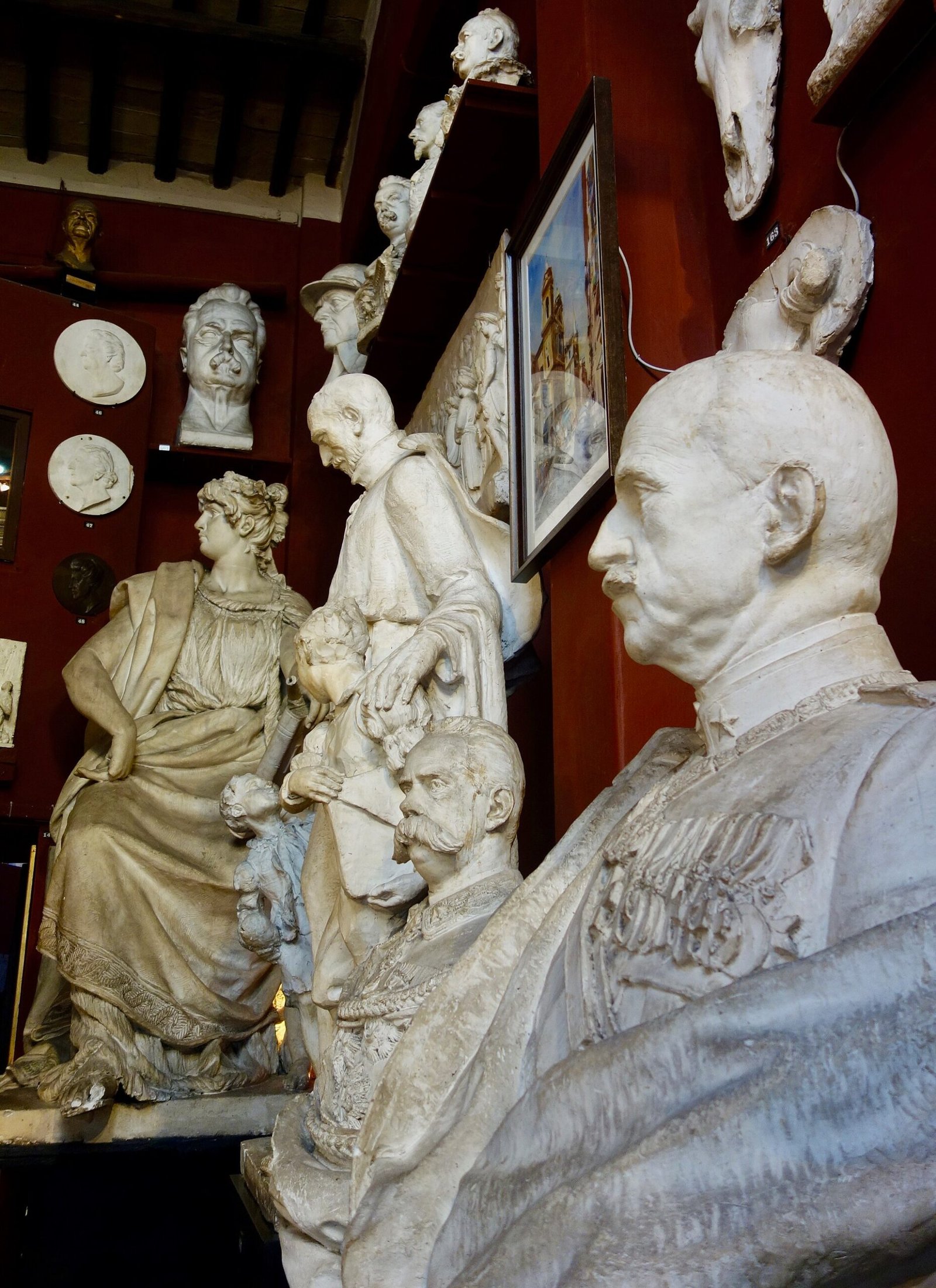
Atelier Canova Tadolini is at Via del Babuino 150/a, at the corner with Via dei Greci, in the heart of the Tridente, halfway between Piazza di Spagna and Piazza del Popolo. It is an early 19th-century sculpture studio that has remained almost intact: it was the workshop of Antonio Canova, then passed through four generations of the Tadolini family, and today it is at once a museum, a cafe and a restaurant, with hundreds of original plaster casts still hanging on the walls and resting on the shelves where they were left a century and a half ago. Anyone walking along Via dei Condotti for shopping who wants an experience different from the shop windows finds here, a few steps away, a piece of Roman art history that almost no one mentions in the more beaten-path guides. The page on Via dei Condotti tells the rest of the area.
Sitting at a table in Atelier Canova Tadolini means having a coffee under the gaze of dozens of plaster busts, popes, female saints and pagan deities resting on shelves that run along all the walls, in a setting that has none of the coldness of a traditional museum. It is one of the very few places in the world where visitors can observe up close, with no glass and no ropes, the working tools of one of the most important dynasties of sculptors in Europe, in a space that has lived through almost two centuries without ever entirely ceasing to be an atelier.
Where Atelier Canova Tadolini is and how to get there
Via del Babuino links Piazza di Spagna to Piazza del Popolo in an almost straight line, and it is one of the three streets that form the famous Tridente together with Via del Corso and Via di Ripetta. Number 150/a is in the northern half of the street, closer to Piazza del Popolo than to Piazza di Spagna, right at the intersection with Via dei Greci, a narrow side street that leads toward Via Margutta. The name of the street itself tells a curious story: it comes from a grotesque statue, now placed on a small fountain a few meters from the atelier's address, which the Romans nicknamed the baboon for its ungraceful shape, and which became one of the city's famous talking statues, where citizens secretly posted satirical verses against those in power.
Anyone arriving in this area for the first time notices the difference from the rest of the historic center right away: the streets are straight, wide by Roman standards, lined with 18th- and 19th-century buildings with the windows of antiques dealers, art galleries and auction houses on the ground floor. It is a deliberate urban layout, the result of centuries of papal planning designed precisely to receive in an orderly way the flow of pilgrims and travelers who arrived in Rome from the north, along Via Flaminia, and entered the city through Piazza del Popolo.
By metro and on foot
The most convenient stop is Spagna, on metro line A. From the exit on Piazza di Spagna you walk along Via del Babuino toward the north for about 600 meters, a walk of eight or 10 minutes at a tourist pace, with the windows of the art galleries and antiques dealers accompanying you for almost the whole route. Alternatively, from the Flaminio stop, also on line A, you cross Piazza del Popolo and take Via del Babuino from the opposite side. The distance is similar, but the view of the square on arrival is worth the detour.
By bus and on foot from the center
Several surface public transport lines run along Via del Corso and the Lungotevere, a few hundred meters from Via del Babuino. Those staying in the historic center, however, find it easier to reach the place on foot, crossing the network of streets that runs from Piazza Navona toward the Tridente in about 20 minutes of walking. Anyone coming from Piazza del Popolo has the advantage of walking slightly downhill along Via del Babuino, with number 150/a appearing on the right shortly after the intersection with Via dei Greci.
For those organizing a Roman stay with several stops in the Tridente and the neighboring districts, planning the itinerary with a service like italyplanner.com helps fit museums, historic workshops and walks together without wasting time on transfers. Those who prefer an expert guide on site can consider the routes curated by tourleaderpro.com, designed precisely to tell the story of corners like this with the level of detail they deserve.
Antonio Canova, the sculptor who brought ancient marble back to life
To understand the weight of a studio like this, you have to start with the man who founded it. Antonio Canova was born in Possagno, in the province of Treviso, in 1757, and trained as a stonecutter even before becoming a sculptor, in the family workshop specialized in stone working. He arrived in Rome as a young man, drawn like all the artists of his generation by the collections of ancient sculpture the city held, and it was from the direct study of classical marbles that he developed a style which his contemporaries judged capable of reviving the grace of Greek sculpture after centuries of Mannerism and Baroque.
Within a few decades Canova became the most sought-after sculptor in Europe, working for popes, emperors and sovereigns. He made funerary monuments for pontiffs in St. Peter's, portraits of the Bonaparte family, among them the famous portrait of Paolina Bonaparte Borghese as Venus Victorious now kept in the Galleria Borghese, and works destined for the courts of half of Europe. After the fall of Napoleon he was also commissioned to negotiate and organize the return to Rome of the artworks requisitioned by the French during the occupation, a role that consolidated his prestige with the Papal State as well. In the same period Canova also held official posts in Rome's artistic institutions, a recognition that testifies to how his figure was by then perceived not only as that of an artist of enormous talent, but as an institutional point of reference for the whole world of sculpture of his time.
A studio to carry on the work
With age and with the growing number of commissions, Canova needed an organized space where students and collaborators could work, capable of executing authorized replicas of his most requested works, in a market that demanded marble copies of the most famous sculptures with a demand impossible to satisfy with the master's hands alone. Via del Babuino, in the heart of the artists' district, was the natural location for an activity of this kind: close to the galleries, the antiques dealers and the grand hotels where foreign travelers stayed, looking for a sculpted memento of their Roman Grand Tour.
Canova's workshop on Via del Babuino and the origin of the studio
In 1818 Antonio Canova, the most famous Neoclassical sculptor in Europe, signed a contract for a property on Via del Babuino intended exclusively for the practice of sculpture. Canova was then at the peak of his fame: he had already made works in Rome such as Paolina Borghese as Venus Victorious, now in the Galleria Borghese, and was considered by his contemporaries the heir of great classical sculpture, to the point of being compared to Phidias. The studio on Via del Babuino was created to continue that production and to train students capable of carrying it forward.
Antonio Canova and the choice of the student
Among Canova's students, one in particular enjoyed his trust in a way that was not repeated with others: Adamo Tadolini, born in Bologna in 1788, had the rare privilege of reproducing the master's most famous works. Canova helped him start his own business on Via del Babuino itself, where Tadolini settled permanently in the early 1820s, inheriting in effect the space and the tradition of the workshop. It was a rare handover in the history of Roman sculpture: not the simple transfer of a property, but the transmission of a working method, of plaster models and of a network of patrons that included royal houses, the papal court and the great European families of the Grand Tour.
The bond between the two sculptors was not only professional but also personal: the sources of the time describe Adamo Tadolini as a sort of spiritual heir of Canova, the only student to whom the master entrusted without reservation the execution of authorized copies of his most famous works, a privilege that no other collaborator in his large circle of students ever obtained to the same extent. When Canova died in Venice in 1822, a few months after helping Tadolini start his independent business on Via del Babuino, the studio became the only Roman place where the production of his works could continue with the authority of a hand trained directly by the master.
What it meant to have a sculpture workshop in 19th-century Rome
A workshop like this was not an artist's studio in the modern sense of the term, but a real factory, with several workers, apprentices, blocks of marble arriving from Carrara, bronze-casting furnaces nearby and a work system organized in phases: the clay sketch, the full-size plaster model, the squaring of the marble with the pointing compass, the roughing out, the finishing. The plaster was not a simple preparatory study but the indispensable working tool for transferring the proportions from the model to the block of stone, and that is why 19th-century ateliers kept enormous collections of casts: they served to produce authorized replicas of the most requested works, in a market where princes and ambassadors competed for marble copies of the most famous sculptures of the time.
The four Tadolini generations who kept the workshop alive
After Adamo Tadolini, who died in 1863, the studio on Via del Babuino passed from father to son for another three generations, a case more unique than rare in the history of Roman art workshops, where as a rule the business ended with the death of the founder, leaving no heirs able or interested to continue it with the same continuity.
Adamo Tadolini, the founder of the line
Adamo Tadolini worked alongside Canova and made independent works of great scope, such as the statue of St. Paul in Piazza San Pietro and the statue of St. Francis de Sales in the Vatican basilica. At his side also worked his sons Scipione and Tito, who literally grew up among the chisels of their father's workshop.
Scipione, Giulio and Enrico Tadolini
On Adamo's death it was his son Scipione Tadolini who took over the studio, followed by the latter's son, Giulio Tadolini, and finally by Enrico Tadolini, the last of the dynasty to have worked there. Over almost 150 years, from 1818 to the 1960s, the four generations made hundreds of works in all, ranging from the Neoclassical taste inherited from Canova to a later style, 19th and early 20th century, suited to bourgeois portraiture and the funerary and celebratory sculpture the market of the time demanded. Among the best-known works made in the workshop is also the equestrian statue of Simón Bolívar in Lima, a sign of how far the fame of the Roman studio had crossed European borders.
A trade that spans the century
What strikes you, retracing the family's story, is the ability to adapt to changing taste without ever closing the workshop. Adamo Tadolini worked as a leading figure in the Neoclassical season, the one dominated by the pure lines and mythological subjects dear to Canova. Scipione and Giulio Tadolini lived through the full 19th century, with its growing demand for bourgeois portraits, funerary monuments in the monumental cemeteries of the great Italian and European cities, and religious commissions for newly built churches. Enrico Tadolini, finally, found himself running the studio in a century, the 20th, in which academic sculpture progressively lost ground to the avant-garde, until the definitive closure of the business. Very few European art workshops can claim such a long productive continuity, in the same building and under the same surname, from the Napoleonic wars to the years of the Italian economic boom.
From the closed workshop to today's museum cafe
The Tadolini family's activity in the studio on Via del Babuino continued until the 1960s, when the workshop closed its doors after about 150 years of uninterrupted work. The space remained inactive for more than 35 years, with the works still in their place, before being acquired by the Galleria Antiquaria Benucci.
The reopening in 2003
In October 2003 the studio reopened to the public with a new formula: a respectful restoration preserved the colors, materials, structures and original layout of the old workshop, turning it into a cafe and restaurant that coexists with the sculptures instead of replacing them. Not a museum in the traditional sense, with display cases and mandatory routes, but a space where the tables have been placed among the 19th-century plaster casts, letting the atmosphere of the workshop remain what it always was. It is an unusual solution for Rome, where most historic ateliers ended up dismembered among museum collections or dispersed on the antiques market, while here the entire set of models has remained together in the same place where it was created.
The choice to keep the plaster casts in their place, instead of moving them to a state museum or scattering them at auction, has a value that goes beyond tourist appeal: it means the visitor sees the collection in the same spatial context in which it was produced, with the same proportions of the room, the same arrangement of the windows and the same light that 19th-century sculptors used to judge how their works turned out. A traditional museum, however carefully run, always separates the object from its original context. Here, through a series of fortunate circumstances, that separation never happened.
What you see inside Atelier Canova Tadolini
Inside there are about 400 works, among sketches, preparatory models, marble and bronze sculptures, anatomical studies and archive documents, spread over several rooms that once corresponded to the different departments of the workshop. The number alone says little if you don't consider the variety of subjects: alongside the mythological themes typical of Neoclassical taste, deities, nymphs, classical heroes, there are portraits of pontiffs, monarchs and noble patrons, preparatory studies for funerary monuments destined for churches and monumental cemeteries, and even minor decorative elements, such as brackets, frames and architectural details, which testify to how wide the range of work was that a 19th-century workshop of this importance took on.
The plaster casts and the sketches
The ground floor houses the plaster casts of Canova, of the Dane Bertel Thorvaldsen, Canova's great rival and at the same time colleague in Neoclassical Rome, and of the Tadolini family sculptors themselves, Adamo, Scipione, Giulio and Enrico. The plaster casts are the most impressive part of the collection: faces of popes, archangels' wings, busts of sovereigns, saints and pagan deities stand side by side without a strict chronological order, in what visitors often describe as a fascinating arrangement precisely because of its apparent disorder, faithful to the way a working workshop accumulates its tools over time.
The anatomy room and the workshop's tools
On the upper floor is what is called the anatomy room, with the plaster anatomical studies that sculptors used to practice rendering the muscles and proportions of the human body before taking on an important work. In the other rooms, identified by names such as the Paolina room or the Adamo room, the workshop's original tools also remain visible: stone basins used for working plaster, stonecutter's tools, work benches. It is an aspect that escapes many visitors, distracted by the beauty of the sculptures: here you look not only at the result of two centuries of Roman sculpture, but also at the production process that made it possible, with the tools still in their place as if work could resume the next day.
How a plaster model became a marble sculpture
To fully appreciate what you see in the rooms of Atelier Canova Tadolini, it helps to know the procedure that connected a clay sketch to the finished marble statue. The sculptor first modeled a reduced version in clay or wax, then made a plaster model at the final size of the work. On this model small reference nails were fixed, the so-called points, arranged on a grid designed to carry the same coordinates over to the raw marble block with millimeter precision, thanks to an instrument called a pointing compass or sculptor's pantograph. The workshop's workers, often specialized precisely in roughing out, removed the excess material following the reference points, leaving the lead artist only the final finishing phase, the one that gave the marble surface the softness and translucency typical of the Neoclassical style. That is why the plaster casts kept on Via del Babuino are not simple decorations: they are the working molds from which came dozens of marble copies now scattered among museums, churches and private collections all over the world.
How the visit to Atelier Canova Tadolini works
It is not a state museum with a ticket office and a mandatory route: it is a private space that combines a museum function and a restaurant business, and this changes how you behave once you are inside. Understanding this hybrid nature before arriving avoids common misunderstandings, such as expecting a museum route with explanatory panels at every work or a ticket office at the entrance. Here the story of the place comes through the general atmosphere of the rooms more than through precise captions, and it is an experience that rewards those who arrive with some information about Canova and the Tadolini already in their pocket, instead of expecting to discover everything on site.
Hours and how to move among the tables
The bar and cafe service follows morning and afternoon hours, while the restaurant covers the span from lunch through the evening. It's always best to check the exact hours, which may vary by season or for extraordinary closures, on the venue's official website or by phone before planning the visit, especially if you arrive outside the usual meal times. Visitors can walk through the ground-floor rooms to look at the plaster casts even without stopping at a table, moving discreetly among the customers seated at lunch or dinner. Those who want to sit down, on the other hand, become fully part of the restaurant experience, with a menu that follows Roman and contemporary Italian cuisine.
The practical tip on when to go
The middle hours of lunch and weekend evenings are the times when the restaurant is fullest and the chance of moving freely among the rooms shrinks. Late morning on weekdays, with the bar open and the restaurant not yet serving, remains the most convenient time to look at the plaster casts calmly without feeling in the way of people having lunch. If you really want to stop and eat among the sculptures, booking a few days ahead avoids ending up with a table only at the least convenient times.
A curiosity about Atelier Canova Tadolini
Few people know that the historic address on Via del Babuino was never a public museum in the administrative sense of the term: throughout the 19th century and a good part of the 20th it remained a private workshop to all effects, open to patrons and art students, but not designed for the public of visitors. What today looks like a carefully arranged museum was, until the 1960s, simply the daily workplace of sculptors who delivered works to courts, churches and collectors of half of Europe. The curiosity lies precisely in this gap: today's visitors walk among plaster casts that were never meant to be displayed, but to be copied in marble and then shipped elsewhere, and what we see on the walls is in reality the working archive of one of the most prolific workshops of 19th-century Rome, left intact by sheer chance of history, because no one ever dismantled the collection after the business closed.
Another curious element concerns the studio's position relative to the main square of the district: while most of the antiques and gallery shops on Via del Babuino face directly onto the flow of passersby heading to Piazza di Spagna, the atelier is closer to Piazza del Popolo, on a stretch of the street walked by fewer hurried tourists and more by those who have already decided to move away from the most crowded center. This made it, for much of the 20th century and still today, a place you reach with a precise intention, not by chance walking past a window, and it is perhaps also for this reason that it has kept a more recollected atmosphere than other attractions in the district.
Something nobody tells you about Atelier Canova Tadolini
Most guides present the studio as a curiosity tied to Canova, but the name that appears most often on the plaster casts, if you look carefully, is not Canova's but that of the Tadolini themselves: the family did not just guard the master's legacy, it built a vast independent production, with hundreds of works signed Adamo, Scipione, Giulio and Enrico Tadolini scattered across churches, squares and private collections all over the world, from Peru to England. Another detail that almost always escapes notice: the space was never a single room, but a set of rooms with different functions, from the model storeroom to the marble workroom, and that is why today, walking among the restaurant tables, you pass from a room that looks like a bourgeois living room to one that still looks like a sculptors' worksite, with stone basins worn by use and stonecutter's tools set down as if work had been interrupted yesterday.
Not even the way the plaster casts are arranged is as random as it seems at first sight: many pieces are grouped by subject or by period of production, an ordering originally designed for the workshop's daily work, where a sculptor had to be able to compare several studies of the same theme quickly, not for a museum display designed for the public. Anyone who looks carefully still recognizes this internal logic today, which no curator wanted to correct in the passage from workshop to public venue, preferring to let the original order tell by itself how 19th-century sculptors worked.
My advice for visiting Atelier Canova Tadolini
The most useful advice is not to treat this stop as a quick break between Piazza di Spagna and Piazza del Popolo, but to set aside time of its own: 20 minutes are enough to walk through the rooms calmly, read the brief notes on the main works and look up close at the surface of the plaster casts, which still bears the marks of the tools used to transfer measurements from the model to the marble. Those with more time can combine the visit with a walk along Via Margutta, the parallel side street where painters and sculptors have had studios for two centuries, and end the route at Piazza del Popolo, a few minutes on foot away. Another practical suggestion concerns the time of day: the natural light coming in from the windows on Via del Babuino in the early afternoon shows off the white surface of the plaster casts far better than the artificial light of the evening, when the place fills up for dinner and attention inevitably goes to table service rather than to the sculptures.
One last piece of advice concerns combining it with the rest of your visit to the Tridente: anyone arriving from Via dei Condotti after a morning of shopping finds in Atelier Canova Tadolini a perfect place to stop and change register completely, going from the windows of the big fashion names to a setting where time seems to have stopped in the mid-19th century. Those who instead organize a more structured itinerary of the district, perhaps with several stops among museums, churches and historic workshops, will find it useful to rely on planning tools such as italyplanner.com, so as not to risk arriving at number 150/a at a time of peak crowding in the restaurant, when the chance of moving freely among the rooms shrinks.
Another well-known fact, yet rarely mentioned
Art historians know it, but it rarely reaches the ordinary visitor, that Antonio Canova and Bertel Thorvaldsen, the two greatest Neoclassical sculptors active in Rome in the same period, were not simply colleagues but true competitors for the same European commissions, from the royal courts to the museums being born in the 19th century. The fact that today, in the rooms of Atelier Canova Tadolini, there are casts attributable to both artists indirectly tells how tight the network of workshops, students and models was, exchanged along the Tridente in those years: Rome was not only the city where people came to see the ancient, but also the forge where the sculpture was produced that would furnish the great European capitals of the following century, and Via del Babuino, with its many workshops of artists, painters and antiques dealers, was one of the most coveted addresses of this productive network.
An equally rarely cited fact concerns the role of bronze casting alongside marble working: many of the works made by the Tadolini over the 19th century, especially those destined for public squares and celebratory monuments such as the equestrian statue of Simón Bolívar, required specialized foundries able to turn the plaster model into a large-scale casting, a complex technical process that the sculpture workshop alone could not handle internally. This means that the studio on Via del Babuino, although self-sufficient in the modeling and roughing-out phase, was part of a wider network of specialized craftsmen active in Rome, from founders to marble stonecutters, a craft ecosystem now almost entirely vanished but which in the 19th century made the city one of the most important centers of sculptural production in the world.
The right photo to take at Atelier Canova Tadolini
The photo that best conveys the place is not a close-up of a single sculpture, but a wide shot that takes in the plaster casts on the walls together with the set tables beneath them: it is that contrast, between the everyday use of the space and its artistic density, that really tells what this place is. A second interesting shot can be taken from the entrance on Via del Babuino, with the window that lets you glimpse the first rooms and the street flowing behind you: it conveys well how discreet, from the outside, the access to such a history-dense space is. It's better to avoid, out of courtesy to the business and to the other visitors, close-up photos of customers seated at lunch or dinner, and to prefer the quieter hours of late morning to have rooms free to frame.
Anyone with a lens that renders details well can look for a frame on the hands and faces of the largest plaster casts, where the marks of the sculptor's tools remain visible, without getting too close to the works however: they are fragile artifacts almost two centuries old, and respecting the minimum distance is the first rule of common sense to follow in such a densely arranged space. A shot from below looking up, including the ceiling and the highest shelves loaded with busts, also conveys well the feeling of being inside a working storeroom rather than a conventional exhibition hall, and is often the image that best tells the place to those who haven't visited yet.
Some important events that happened here in history
The signing of the 1818 contract, by which Antonio Canova set aside the space on Via del Babuino exclusively for the practice of sculpture, is the first founding act of the place and marks the beginning of a story more than two centuries long. The handover of the studio to Adamo Tadolini, in the early 1820s, is the second key moment: not a simple sale, but the transmission of a trade and of a heritage of plaster models from which the family's whole later production would be born. A third important passage is the long chain of successions within the Tadolini family, from Adamo to Scipione, from Scipione to Giulio and finally to Enrico, a case that is unique, more than rare, of artistic and productive continuity maintained for four generations at the same address. The closing of the workshop in the 1960s, after about 150 years of uninterrupted activity, marks the end of the productive phase and the beginning of more than 35 years in which the space stayed closed, with the works still in their place. The acquisition by the Galleria Antiquaria Benucci and the reopening to the public in October 2003, with the new museum-cafe formula, are the last great passage in the history of the place, the one that made possible the visit you can make today.
Among these main events two less documented but equally significant passages must also be placed. One is the death of Antonio Canova in Venice in 1822, shortly after helping Adamo Tadolini start his independent business, an event that made the studio on Via del Babuino the only Roman place where the direct hand of an authorized student kept producing replicas of the works of the departed master, at a time when Canova's fame, far from fading with his passing, kept growing across Europe and feeding the demand for copies and derivations of his most famous sculptures. The other is the return to Rome of the artworks requisitioned during the French occupation, negotiated by Canova himself in the years immediately before the founding of the studio, an episode that consolidated his prestige with the Papal State and made possible, indirectly, the obtaining of the property on Via del Babuino.
Who passed through Atelier Canova Tadolini
During the 19th century the studio on Via del Babuino was frequented by a network of patrons that included reigning houses, the papal court and the great European aristocratic families traveling on the Grand Tour, all interested in commissioning marble replicas of Canova's most famous works or new sculptures signed by the Tadolini. Among the works commissioned from the workshop are pieces destined for European royal residences, such as the sculptural group of Ganymede and the eagle made for Chatsworth House in England, and major public commissions, such as the statue of St. Paul for Piazza San Pietro and that of St. Francis de Sales in the Vatican basilica, both by Adamo Tadolini. The studio's fame reached beyond European borders as well, with the making of the equestrian statue of Simón Bolívar for Lima, Peru, commissioned from the Roman workshop in the mid-19th century: a sign of how well known the name of the sculptors working on Via del Babuino was far beyond the borders of the city that hosted them.
It should be remembered that, alongside the great names of the aristocratic and ecclesiastical clientele, generations of apprentices and stonecutters also passed through the workshop, of whom only indirect traces remain in the work registers: skilled labor that made possible the large-scale production demanded by the 19th-century market, and that today remains anonymous in collective memory but was decisive for the studio's survival through four generations. It is an aspect often overlooked when telling the story of a great art workshop: behind the name of the master who signs the work moved a small army of collaborators, without whose daily labor none of the big commissions would have been delivered on the agreed schedule.
Via del Babuino, the Tridente and Roman Neoclassicism
To understand why a sculpture studio of this level arose on Via del Babuino in particular, you have to look at the wider context of the Tridente, the triangle of streets that opens from the 16th-century Piazza del Popolo toward the rest of the city with Via del Corso, Via di Ripetta and Via del Babuino itself.
The district of artists and antiques dealers
Between the 18th and 19th centuries this area became the district of the foreign and Roman artists working in the capital, with workshops of painters, sculptors, engravers and antiques dealers concentrated on Via del Babuino, Via Margutta and the neighboring side streets. It was the Rome that Grand Tour travelers passed through to order views, portraits and marble copies of the great ancient works, in a flourishing art market that needed skilled labor and workshops able to produce to order with continuity. In this context the studio, first Canova's and then the Tadolini's, was an absolute point of reference, able to guarantee foreign patrons authorized replicas of the most admired works of the time, with the quality of execution that only a workshop run by the master's own students could offer.
The luxury hotels of the period, concentrated in the area between Piazza di Spagna and Via del Babuino, completed the picture of a district designed to receive, keep and serve foreign travelers for weeks or months. A Grand Tour stay in Rome was never a quick stop, but a prolonged period of study, purchases and artistic commissions, during which repeated visits to the sculpture studio to follow the progress of one's own personal commission were an integral part of the experience.
Piazza di Spagna, Piazza del Popolo and the rest of the Tridente
A few steps from Via del Babuino, Piazza di Spagna with its staircase was and still is one of the focal points of the district's social life, while Piazza del Popolo, at the opposite end of the street, was the point of entry into the city for those arriving from the north along Via Flaminia. Between the two poles the trade in art and antiques developed over the centuries, and it still characterizes the shop windows of Via del Babuino today. Walking the street that links the two squares today means retracing, almost without knowing it, the itinerary that hundreds of Grand Tour travelers followed to reach Canova's studio first and then the Tadolini's, in search of a sculpted memento of their Roman stay.
Neoclassicism as an international language
The Neoclassicism you breathe in at Atelier Canova Tadolini was not an isolated phenomenon, but the dominant artistic language across Europe between the late 18th century and the first decades of the 19th, fed by the archaeological discoveries at Herculaneum and Pompeii and by the systematic rediscovery of Greek and Roman art by scholars and collectors. Rome, with its ruins, its papal collections and its international academies, such as the French Academy then housed at Villa Medici, was the place where this language formed and spread to the rest of the continent, carried by the artists who stayed there for years of training. In this setting, a workshop like the one on Via del Babuino was not just a place of craft production, but a real laboratory where Neoclassical taste was translated into concrete objects, ready to be shipped to aristocratic residences all over Europe.
What remains of the 19th-century Tridente today
Despite two centuries of urban transformation, the Tridente still preserves the street layout and a good part of the buildings that Grand Tour travelers would have recognized: the same three streets fanning out from Piazza del Popolo, the same buildings with shops on the ground floor, the same network of narrow side streets linking Via del Babuino to Via del Corso. Atelier Canova Tadolini, with its plaster casts still in place and the restaurant tables set among the sculptures, is probably the point where this historical continuity is felt most strongly, because here it is not a renovated building that has changed function, but a space that has kept almost intact the original furnishings of its 19th-century function.
Anyone who compares an old print or a period photograph of the district with the current state of the street notices above all the differences in traffic and signage, much more than in architecture: the buildings are the same, the proportions of the street are the same, and this very urban stability still makes credible today, walking along Via del Babuino toward number 150/a, the idea of retracing the same route Grand Tour travelers took two centuries ago.
The Grand Tour district, among historic cafes and poets' houses
Anyone visiting Atelier Canova Tadolini walks through one of the areas of Rome densest in history tied to the foreign travelers of the 19th century. A few hundred meters away, on Via Condotti, is the famous Antico Caffè Greco, open since 1760 and frequented by generations of artists, writers and musicians visiting Rome: a place that, together with the studio of Canova first and the Tadolini after, formed the network of essential addresses for anyone arriving in the city with a travel notebook in hand.
It is no accident that in this small patch of streets between Piazza di Spagna and Piazza del Popolo the addresses most frequented by artists and foreign travelers were concentrated during the 19th century: literary cafes, sculpture workshops, painters' ateliers and bookshops specializing in prints and views of Rome formed a compact cultural ecosystem, walkable almost entirely in half a day, and this very concentration of addresses made the Tridente district an essential point of reference for anyone who, in the 19th century, wanted to say they had truly lived a Roman stay.
The English community and Keats's house
Right in Piazza di Spagna, a few steps from the studio, is the house where the English poet John Keats spent the last months of his life and died in 1821, now turned into a museum dedicated to him and to his friend and fellow poet Percy Bysshe Shelley. The presence of such a large community of Anglo-Saxon artists and writers was no accident: the Tridente area, with its hotels, its souvenir shops and its galleries, had become in the years between the 18th and 19th centuries the district of choice for foreigners passing through, and it is in this context that the workshop of Canova, then the Tadolini, found a substantial part of its clientele: English, German and Russian nobles in search of a sculpted memento of their Roman stay.
The concentration of foreign travelers in the area was such that Via del Babuino, together with the neighboring streets, also hosted post offices dedicated to correspondence abroad, bookshops selling volumes in English and French, and inns designed specifically for a clientele used to long stays: a fabric of services that supported, together with art workshops like that of Canova and the Tadolini, the whole economy of cultured 19th-century tourism.
Via Margutta and the artists' workshops
Parallel to Via del Babuino, Via Margutta has hosted studios of painters, sculptors and engravers for two centuries, and is still identified today with the image of the bohemian Roman artist, made famous also by postwar cinema. Strolling from Via Margutta toward Via del Babuino, with a stop at Atelier Canova Tadolini, gives a coherent picture of what this corner of the city was for two centuries: not a residential district like the others, but a productive district devoted entirely to art, with workshops, foundries, frame makers and paint shops that supported the work of the resident artists.
For those who want to explore this itinerary further with an expert guide, able to tell the link between the Tridente's historic workshops and the Grand Tour era with a level of detail that a simple information sign cannot offer, a service like tourleaderpro.com makes it possible to build a tailor-made route that includes Atelier Canova Tadolini along with the other stops in the artists' district, from Via Margutta to Keats's house, up to the galleries still active on Via del Babuino.
Frequently asked questions about Atelier Canova Tadolini
Where exactly is Atelier Canova Tadolini?
Atelier Canova Tadolini is at Via del Babuino 150/a, in Rome, at the corner with Via dei Greci, in the part of the Tridente closer to Piazza del Popolo than to Piazza di Spagna. The most convenient metro stop is Spagna, on line A, from which you walk about 600 meters along Via del Babuino.
Who founded the studio on Via del Babuino?
Atelier Canova Tadolini began as the workshop of Antonio Canova, who in 1818 signed a contract to set aside the space exclusively for sculpture. Shortly afterward the studio passed to his favorite student Adamo Tadolini, who settled there permanently and made it his own independent business.
How many generations of the Tadolini family worked in the studio?
Four generations of the family followed one another at Atelier Canova Tadolini: Adamo, founder of the line and Canova's student, then his son Scipione, then Giulio and finally Enrico Tadolini, the last of the dynasty to work there before the workshop closed in the 1960s.
When did it become a museum and cafe?
Atelier Canova Tadolini stayed closed for more than 35 years after the end of the Tadolini family's activity, before being acquired by the Galleria Antiquaria Benucci and reopened to the public in October 2003 in its current form of museum, cafe and restaurant.
What can you see inside?
Inside Atelier Canova Tadolini there are about 400 works among plaster casts, sketches, marble and bronze sculptures, anatomical studies and original workshop tools, spread over rooms that once corresponded to the different departments of the studio, including a room devoted to anatomical studies.
Do you have to pay a ticket to enter?
Atelier Canova Tadolini is not a state museum with a ticket office: it is a private space that works as a cafe and restaurant, and you can walk through the ground-floor rooms to look at the plaster casts even without stopping at a table, moving discreetly among the customers seated at their meals.
What are the opening hours?
Atelier Canova Tadolini follows bar and cafe hours in the morning and afternoon, with restaurant service from lunch through the evening. The precise hours should always be checked on the official website or by phone, because they can vary by season or for extraordinary closures.
Is it worth booking for lunch or dinner?
Atelier Canova Tadolini is a restaurant that is very busy at the classic meal times, so booking a few days ahead helps you find a table at a convenient time, especially on weekends. For those who only want to look at the plaster casts without sitting down, late morning on weekdays remains the quietest time.
How long does it take to visit Atelier Canova Tadolini?
About 20 minutes is enough to walk calmly through the rooms of Atelier Canova Tadolini and look up close at the main plaster casts. Those who want to combine a coffee or a meal among the sculptures can plan a longer stop, taking into account the restaurant's busiest hours.