Vatican City
In short. Vatican City is a sovereign state of 0.44 square kilometers enclosed within Rome, on the right bank of the Tiber, and you enter it from Piazza San Pietro without a passport, without customs and without a ticket.
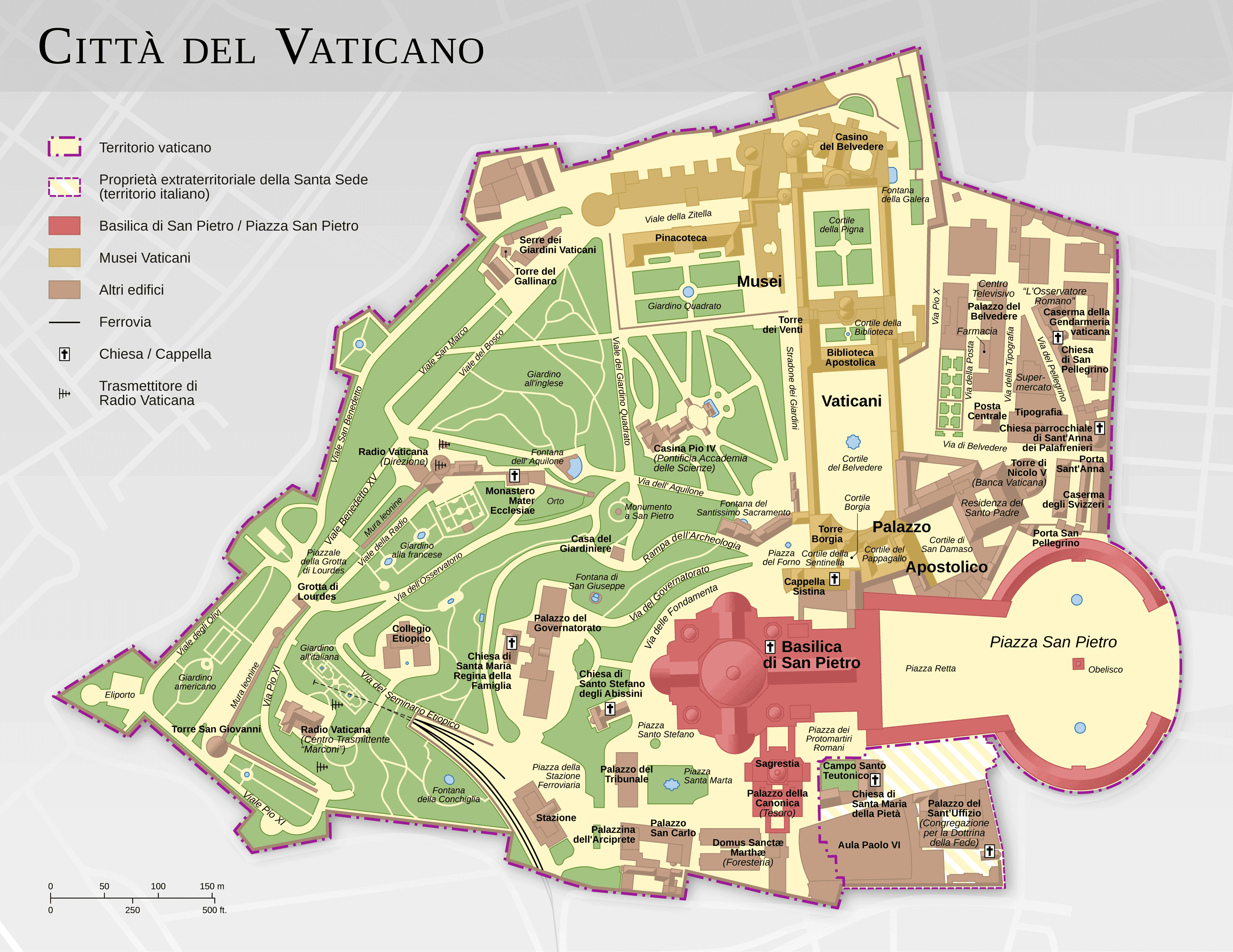
Vatican City is a sovereign state of 0.44 square kilometers enclosed within Rome, on the right bank of the Tiber, and you enter it from Piazza San Pietro without a passport, without customs and without a ticket. Take Metro line A to Ottaviano for the square and the basilica (10 minutes on foot along Via Ottaviano), or to Cipro for the entrance to the Vatican Museums on Viale Vaticano. Tram 19 reaches Piazza Risorgimento, buses 40 and 64 connect Termini to the Borgo area, and the 49 stops in front of the Museums. Entry to St. Peter's Basilica is free, with extended hours until 20:00 in summer. Access to the dome opens at 7:00 in summer and at 7:30 in winter. The Vatican Museums with the Sistine Chapel can be booked online on the official website, where prices and the calendar should be checked. The Wednesday papal audience is free, with tickets distributed by the Prefecture of the Papal Household. This guide is the overview of the smallest state in the world: for details on the individual monuments, I refer you to the pages dedicated to the St. Peter’s Basilica and the Vatican Museums.

Vatican City, the smallest state in the world
Vatican City, officially the State of the Vatican City (in Latin Status Civitatis Vaticanae), called Vatican for short and by antonomasia San Pietro, is the smallest sovereign state on the planet both by area, 44 hectares within the circle of the Leonine Walls, and by population: official counts range between 800 and 900 citizens and residents, and just over half of the citizens actually live inside the walls, because Vatican citizenship is functional, tied to the office held, and is lost when that office ends. It is an enclave in the territory of the Italian Republic, set into the urban fabric of Rome, and it is governed by what jurists define as an elective absolute monarchy of a theocratic nature: the sovereign is the Pope, who combines in himself the three powers, legislative, executive and judicial, and exercises them through the Governorate and the papal commissions.
The official language of the state is Italian, while Latin remains the language of the Holy See, which owns the state and is its raison d'être. The distinction between the two entities confuses even journalists, and I explain it later on. The state mints its own coins: under the monetary agreement with the European Union it uses the euro, and the eight denominations of metal coins carry on the national side either Vatican subjects or the coat of arms of the reigning pontiff. It also issues stamps valid for mail sent anywhere in the world, as long as the letter is sent from the Poste Vaticane. Commemorative sets of coins and stamps have been a small treasure for numismatists and philatelists for a century, and in our view they remain the most sensible souvenir you can take away from here, because they cost little and are genuinely impossible to find elsewhere.
The origins of the name Vatican
The place name is at least half a millennium older than the basilica. According to some ancient sources, including the Latin scholar Aulus Gellius, Vaticanus was the name of an archaic Roman deity. Others derive it from the Latin verb vaticinor, to predict, supposing that oracles and seers operated on the right bank of the Tiber. Sextus Pompeius Festus claimed the hill was a meeting place for Etruscan haruspices, and Pliny the Elder told of the existence, right here, of a holm oak believed to be the oldest tree in Rome, to whose trunk a bronze plaque with Etruscan letters was affixed and to which magical powers were attributed. The ager Vaticanus, in the classical age, was a flat area outside the city, unhealthy and of little worth, occupied by vegetable gardens, burial grounds and the circus built by Caligula and completed by Nero. It was the fate of a fisherman from Galilee, executed there around AD 64-67, that forever overturned the hierarchy of Rome's places.
The history of Vatican City: from Porta Pia to the Lateran Pacts
The state you visit today is young: it was born in 1929. For about a millennium the popes had governed the Papal States, which covered a large part of central Italy. On September 20, 1870, the Bersaglieri entered Rome through the breach of Porta Pia and that temporal power ended. Italian soldiers refrained from occupying the Borgo district, and in the following days the territory left to the pontiff was reduced to the Leonine Walls alone. It was the Cardinal Secretary of State, Giacomo Antonelli, himself who asked for this, so as not to make Pius IX the sovereign of a single district and to keep the wound of the spoliation open in the eyes of the world. With the royal decree of October 9, 1870, Rome was proclaimed capital of Italy and the temporal power was abolished.
Pius IX never recognized the occupation. He rejected the Law of Guarantees that Italy had unilaterally enacted to guarantee the spiritual independence of the pope. He declared himself a prisoner in the Vatican and never left it again. This gave rise to the Roman Question, which poisoned relations between the Kingdom of Italy and the Catholic Church for 59 years. During the long negotiations, a new miniature Papal State was considered more than once. The proposals ranged from just the area already under the Pope's control, to a territory with access to the Tiber or the sea, to an area extending as far as Villa Doria Pamphilj. All of them fell through, both because Mussolini decided not to cede any significant portions of territory and because Pius XI feared getting entangled in temporal problems.
The solution came on February 11, 1929, when in the Lateran Palace Benito Mussolini and the cardinal secretary of state Pietro Gasparri signed the Lateran Pacts: a treaty with an attached financial convention, and a concordat on their mutual relations. Article 3 of the treaty recognizes for the Holy See "full ownership and the exclusive and absolute sovereign power and jurisdiction over the Vatican," thereby creating "in this way Vatican City." The State was formally born on June 7, 1929, with the exchange of ratifications. The financial convention provided the means for the economic autonomy of the new state entity, and in 1948 the Pacts were referenced in Article 7 of the Constitution of the Italian Republic. A century later, that legal compromise still holds, and holds well.
What to Visit in Vatican City
Tourists enter three parts of the State: the square with the basilica, the Museums, the Gardens. The rest, palaces, offices, heliport and railway, can only be glimpsed from the top of the dome or on guided tours. It's good to know this beforehand, so you don't imagine free strolls among the papal palaces that no visitor can take.
St. Peter's Basilica and Bernini's Square
St. Peter's Square is the work with which Gian Lorenzo Bernini, in the seventeenth century, transformed an irregular open space into the most famous entrance hall in the world: two side colonnades with 284 Doric columns arranged in four rows, topped by 140 statues of saints 3.10 meters tall and six large coats of arms of Alexander VII Chigi. The major diameter of the ellipse measures 240 meters. At the center rises the Egyptian obelisk, more than 25 meters tall, which Caligula had brought to Rome for his circus and which Domenico Fontana moved here in 1586 in a legendary engineering feat. Climbing the staircase arranged by Bernini, you reach the portico by Carlo Maderno, 71 meters long, with five entrances that correspond to the basilica's five portals. Inside, at the far end of the central nave, the bronze statue of St. Peter blessing has a foot worn smooth by centuries of the faithful's caresses. In the first chapel of the right nave, Michelangelo's Pietà, sculpted by an artist not yet 25 years old, has been protected by glass since 1972. Above the papal altar twists Bernini's bronze baldachin. The building's real grandeur isn't perceived right away. It's a calculated effect of proportions, and to see through it, just look at the markers on the nave floor, where the lengths of the other great churches of the world are marked, all shorter. The listing for St. Peter's Basilica covers the interior chapel by chapel.
Michelangelo's Dome and the Climb, the Ritual I Recommend to Everyone
The main dome, a symbol of both the Church and the city of Rome, was designed by Michelangelo, who directed its construction until his death in 1564, and was completed by Giacomo Della Porta with Domenico Fontana in 1590. There are two ways up: on foot or by elevator to the terrace level, from which there are still hundreds of steps left in the passage between the two shells, narrow and sloping. Anyone who suffers from claustrophobia or has heart problems should think twice, because halfway up there's no turning back. As for hours, in summer you start at 7:00, and that's the only time the climb is a pleasure and not a sweaty procession. Tickets, separate for stairs and elevator, can be bought on site or on the basilica's official website, where it's worth checking current rates. From the lantern, the view takes in the entire State, the Gardens, the railway, the Governorate, and all of Rome up to the Castelli. It's the best lesson in Vatican geography available, and it costs less than an aperitivo in Borgo.
The Vatican Grottoes and the Necropolis: Going Down to Peter's Tomb
Under the floor of the basilica lie the Vatican Grottoes, which hold the tombs of dozens of popes and preserve fragments of the Constantinian basilica demolished in the 16th century. Admission is included in the basilica visit. Lower still, beneath the Grottoes, extends the Roman necropolis excavated at the will of Pius XII between 1939 and 1949: an alley of pagan and Christian mausoleums from the 2nd and 3rd centuries. At its end, archaeologists identified the funerary shrine venerated since antiquity as the tomb of the apostle, with the famous Greek graffito "Petros eni," meaning "Peter is here." The necropolis can only be visited in small guided groups. Requests must be sent well in advance to the Ufficio Scavi of the Fabbrica di San Pietro through the channels indicated on the basilica's official website. Places are few and sell out months ahead. For me, it is the most intense visit in all of the Vatican, more moving than the Sistine Chapel itself, precisely because it is limited in numbers and silent.

The Vatican Museums and the Sistine Chapel
Walking along the walls from Piazza San Pietro, it takes about 15 minutes to reach the entrance to the Vatican Museums, the art collection of the popes. It includes the Gregorian Egyptian Museum with sarcophagi, mummies and cuneiform tablets, the Pio Clementino Museum with the Laocoön and the Apollo Belvedere, the Galleria delle Carte Geografiche, and the Pinacoteca with works by Giotto, Beato Angelico, Perugino, Leonardo, Titian, Raphael and Caravaggio. In the papal palaces you pass through the Raphael Rooms, a cycle of frescoes begun by the painter from Urbino in 1508 for Julius II and completed by his workshop after the master's death in 1520. The destination is the Sistine Chapel, built for Sixtus IV. On its walls, Perugino, Botticelli, Cosimo Rosselli and Ghirlandaio worked in 1481-1482. The ceiling is by Michelangelo, who painted it between 1508 and 1512, and the Last Judgment behind the altar is also his, painted between 1536 and 1541. The masterpieces have their own pages: the Vatican Museums listing covers the route room by room, and the Sistine Chapel listing helps you read the frescoes scene by scene. One warning here: always book the Museums online on the official website, even in January, because the line without a reservation is the longest in Europe and there is nothing heroic about it.
The Vatican Gardens, the green half of Vatican City
Nearly half of the state's surface is green. The Vatican Gardens cover the hillside behind the basilica, with groves, 17th-century fountains, the Casina di Pio IV that houses the Pontifical Academy of Sciences, the Vatican Radio building and a replica of the Lourdes grotto. You can't enter freely. They can only be visited on guided tours or by minibus booked through the Vatican Museums, and daily spots are limited. It's the part of the Vatican that most people skip, and they're wrong to: from the upper paths you get the best view of all of the dome, the one with the lawn in the foreground that no square can offer. The Vatican Gardens listing explains routes and booking methods, while anyone who wants to see the pope's other green residence can find the Castel Gandolfo listing, which under Leo XIV has returned to being the pope's summer retreat.

The Wednesday papal audience: how to actually attend
The general audience is held every Wednesday morning, unless the pope has commitments or trips, in Piazza San Pietro or, in the cold months, in the Paul VI Audience Hall. Tickets are always free. They are distributed by the Prefecture of the Pontifical Household, to which requests are submitted following the procedures published on the official channels of the Holy See. Pickup usually takes place in the days immediately before. To be frank, be wary of anyone selling "tickets for the papal audience" for a fee. They are reselling, at a markup, a document that costs nothing. It only makes sense to pay for a declared additional service, such as an escort or a reserved seat on an organized tour. The ticket does not guarantee a specific place in line. Anyone who wants a spot at the barrier must arrive at the gates at least two hours early. For the Sunday Angelus blessing at noon, on the other hand, you don't need any ticket: you can enter the square freely, passing through security checks.
The Pontifical Swiss Guard, the army of Vatican City
The armed corps of the State is the smallest and the most photographed in the world. It was Pope Julius II, on January 22, 1506, who welcomed the first 150 Swiss mercenaries hired as his personal guard. Since then recruitment has never stopped, and it is still governed today by precise requirements: Swiss citizenship, Catholic faith, good conduct, military training in their home country, celibacy at the time of enlistment. The baptism of fire came on May 6, 1527, during the Sack of Rome by the Landsknechts. 147 guards fell to cover the escape of Clement VII along the Passetto di Borgo toward Castel Sant'Angelo, and in memory of that day the recruits swear their oath every year on exactly May 6, in the Courtyard of San Damaso. The gala uniform with yellow, blue and red stripes, which popular tradition attributes to Michelangelo, is actually a twentieth-century design by commander Jules Repond, inspired by Renaissance frescoes: a legend that dies hard, which the guards themselves patiently deny. Anyone who considers them extras is badly mistaken: they are trained soldiers, with real duties protecting the pontiff, and at the gates of the Bronze Door and the Arco delle Campane they perform genuine security duty, not choreography.

How Vatican City Works: Life Inside the Walls
Behind the monumental backdrop a complete State in miniature is at work, run by the Governorate, the white building you can see very well from the dome, behind the basilica. There is a railway with a monumental station from the 1930s, the result of the convention attached to the Lateran Pacts: a few hundred meters of track that cross the border on an arch opened in the walls, used today mostly for the tourist train to the papal villas of Castel Gandolfo. Anyone who wants to see the track from outside can walk the Passeggiata del Gelsomino, the pedestrian viewpoint that runs right alongside the Vatican station. There are the Vatican Post Office, extremely efficient, with offices right by the square. There is a pharmacy historically entrusted to the hospitaller order of the Fatebenefratelli, a daily destination for Romans looking for hard-to-find preparations. There are a shop, a workshop, the fire department, the Gendarmerie. State cars carry the SCV plate, citizens' cars the CV plate: a photo of the SCV 1 plate, the Pope's car, is a small classic of Roman photo collecting. The daily newspaper L'Osservatore Romano has been printed in the Vatican since 1861, Vatican Radio has broadcast since 1931, wanted by Pius XI and built by Guglielmo Marconi, and the Libreria Editrice Vaticana has operated since 1587, founded by Sixtus V, with its shop in the Braccio di Carlo Magno on St. Peter's Square. Radio, television and newspapers are now brought together in the multimedia portal Vatican News, which publishes in dozens of languages. Inside the walls there is also the Mater Ecclesiae monastery, where Benedict XVI lived after his resignation in 2013.

Holy See and Vatican City: The Difference That Confuses Everyone
The two terms are not synonyms. The Holy See is the sovereign entity under international law that answers to the Pope: it is the one that maintains diplomatic relations, sits as a permanent observer at the UN, signs treaties. Vatican City is the territory, the instrument created in 1929 so that this sovereignty would have a physical base independent of any other power. The embassies accredited "to the Holy See" are not located in the Vatican, where there would be no room, but scattered around Rome. And it is the only case in the world in which a country, Italy, hosts on its own territory the embassies accredited to another State. The diplomatic network has grown enormously: in 1978, at the election of John Paul II, the countries with full diplomatic relations were 84, at the end of his pontificate 174, under Benedict XVI Montenegro, the United Arab Emirates, Botswana and South Sudan were added, and today the count exceeds 180, to which are added the special relations with the State of Palestine and with the Sovereign Military Order of Malta and the representations at FAO, OSCE, WTO, the European Union, the Arab League and the African Union.
The Extraterritorial Zones of Vatican City
The Holy See's sovereignty extends well beyond the walls: the Lateran Pacts recognized a number of Italian properties as having an extraterritorial status similar to that of embassies, with exemption from expropriation and taxes. These include the basilicas of Saint John Lateran, Saint Mary Major and Saint Paul Outside the Walls with their annexed buildings, the Palazzo della Cancelleria, the Palazzo di Propaganda Fide, the papal villas at Castel Gandolfo and the Radio Vatican transmission center at Santa Maria di Galeria, on Via Braccianese. Adding it all up, they exceed 10 square kilometers, more than 20 times the territory of the State proper and more than five times the Principality of Monaco. The most curious case remains the Paul VI Hall, which I discuss below: the State border cuts it in two. For visitors, the practical consequence is a pleasant one: many of the most beautiful "Vatican" sites in Rome are outside the Vatican, and you can reach them with a regular ATAC ticket.
The Symbols of Vatican City: Coat of Arms, Flag and Anthem
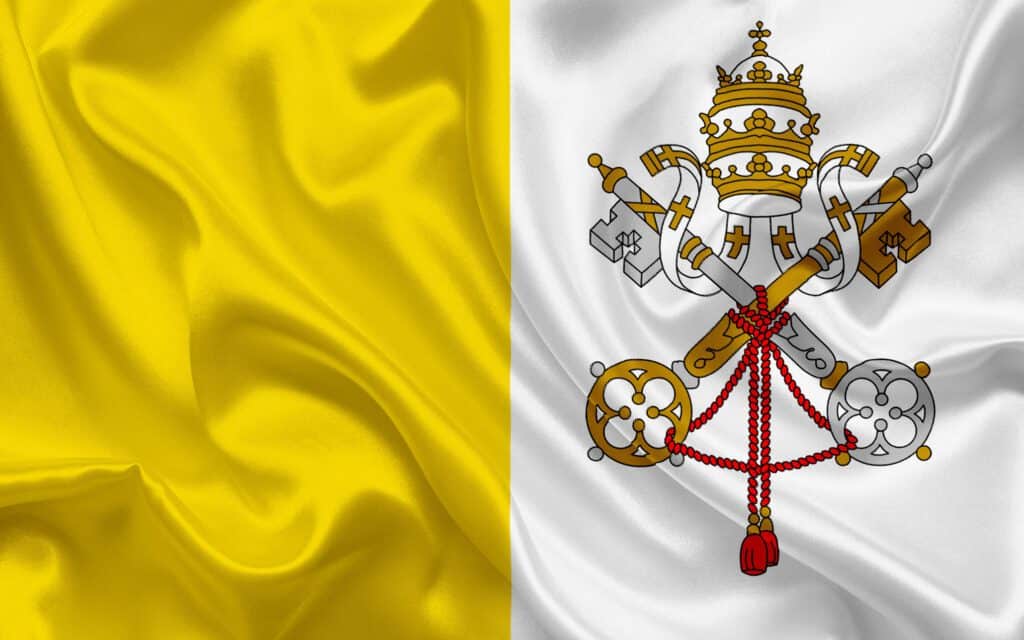
The coat of arms of the State, described in Annex B of the Fundamental Law, is a red shield with two crossed keys, that is, crossed in an X like the cross of Saint Andrew: one gold and one silver, tied together with a red cord, topped by the triregnum, the three-crowned tiara. The keys are the sign of the mandate that, according to the Gospel of Matthew, Christ entrusted to Peter, the custody of the keys of the Kingdom: the gold one alludes to power over the kingdom of heaven, the silver one to the spiritual authority exercised on earth, and in the State coat of arms the gold key points to the right, in an inverted position compared to the coat of arms of the Holy See, a heraldic detail that almost no one notices. The triregnum traditionally represents the triple Church, militant, suffering and triumphant, and the three powers of the pontiff. From the crowns hang two silver infulae fringed with gold and charged with small crosses. The flag, square, is divided into two fields, yellow at the hoist and white at the fly, with keys and triregnum in the white field. The official anthem is the Inno e Marcia Pontificale composed by Charles Gounod, the author of Faust, adopted on October 16, 1949 with Italian lyrics by Antonio Allegra. Calendar trivia: the national holiday falls on February 11, anniversary of the Lateran Pacts, and the Vatican civil calendar incorporates religious feasts, from June 29 of the patron saints Peter and Paul to the movable solemnities of Easter, Ascension, Pentecost and Corpus Christi, plus the anniversary of the election of the reigning pontiff, which with Pope Leo XIV is celebrated on May 8.
Papal Honors: The Sovereign Who Wears No Medals
The Pope is sovereign of the papal orders of chivalry, but by ancient tradition he neither receives nor wears any decoration: his office is considered the source of every honor, not its recipient, and a cardinal who is elected automatically loses the honors he received, which are absorbed into the title of Supreme Pontiff. The grand magisterium of the individual orders may be held directly by the pope or entrusted to a trusted cardinal. In the history of the Holy See, only two orders have had value as rank and ennoblement: the Milizia Aurata, or Speron d'Oro, which until 1841 was the only papal award that recognized and granted hereditary nobility, and the Ordine Piano, established by Pius IX, which kept that character until the denobilitation of 1939. These are matters for scholars, I admit, but they explain a scene anyone can see in the piazza: at official ceremonies the Pope is the only head of state present without a single decoration on his chest.
The Vatican After 2025: Pope Leo XIV
On April 21, 2025, Easter Monday, Pope Francis died, struck down by a stroke after 12 years of pontificate. The day before, he had appeared at the loggia for the Easter blessing. The funeral on April 26 brought more than 250,000 people to St. Peter's Square, along with dozens of official delegations. At his express wish, Francis does not rest in the Vatican Grottoes but in the Basilica of Santa Maria Maggiore, under a simple marble slab bearing only the name Franciscus. The conclave opened on May 7, 2025 and closed the next day, at the fourth ballot, with the election of Cardinal Robert Francis Prevost: born in Chicago in 1955, an Augustinian, for years a missionary and bishop in Peru, whose citizenship he also holds, he is the first American pope in history and chose the name Leo XIV. His first year intertwined the closing of the Jubilee, celebrated on January 6, 2026 after a holy year that, according to Vatican data, brought more than 30 million pilgrims to Rome, trips to Turkey and Lebanon following in the footsteps of the Council of Nicaea and then to Africa, and the return of Castel Gandolfo as the pope's summer residence, a custom Francis had interrupted. For visitors, the change of pontificate translates into a very concrete fact: the Wednesday audiences and the Angelus once again draw crowds worthy of major occasions, and a full square remains one of the most impressive free spectacles in Europe.
The list of buildings in Vatican City, for those who want the map in their head
Within 44 hectares there is a monumental density like no other. There is only one papal basilica, St. Peter's Basilica in the Vatican with the adjoining sacristy. The chapels of the Apostolic Palace are the Sistine, known as the Cappella Magna, the Pauline with Michelangelo's last frescoes, the Niccolina frescoed by Blessed Angelico, the Redemptoris Mater, and the chapel of Saints Peter and Paul. The minor churches tell the internal life of the state: Sant'Anna dei Palafrenieri, the residents' parish, by Vignola. Santo Stefano degli Abissini, the oldest church within the walls, is served in the Ethiopian rite. San Pellegrino, Sant'Egidio a Borgo, Saints Martin and Sebastian of the Swiss, chapel of the Guard, and Santa Maria Regina della Famiglia. Among the palaces: the Apostolic Palace with the papal apartments, which I cover in the entry for the Palazzo Pontificio, the Vatican Museums, the Governorate, the Tribunal, the Palazzo San Carlo, the Sacristy of the Canons, the Pre-seminary St. Pius X, and the Ethiopian College. The picture is completed by the Gregorian Tower and the Tower of St. John, the Paul VI Hall by Pier Luigi Nervi, the Casina of Pius IV, the Domus Sanctae Marthae where the cardinals stay during the conclave and where Francis chose to live, the Sala Regia and the Scala Regia by Bernini, the railway station, the Leonine Walls, the Gardens, the obelisk, the square, and two archaeological sites: the Vatican necropolis under the basilica and the Santa Rosa necropolis, which resurfaced while digging a parking lot. If you like this kind of inventory, the page on musei di Roma gives the overall picture of the city's collections.
How to get to Vatican City
From central Rome you can walk. From Piazza Navona it takes 25 minutes, passing Castel Sant'Angelo and Via della Conciliazione. It is the approach I always recommend, because the dome grows in front of you with every step. By public transport: Metro A, stops Ottaviano (for the square and basilica) and Cipro (for the Museums), tram 19 as far as Piazza Risorgimento, buses 40 express and 64 from Termini to Borgo, bus 49 which stops in front of the entrance to the Vatican Museums, buses 62 and 81 near Borgo Pio. Don't come by car. The area is a parking disc zone with merciless blue lines, and the parking garages in the Prati area cost more than a taxi. If you arrive from the San Pietro station on the regional railway, it takes 10 minutes on foot, passing the church of Santo Spirito in Sassia, which alone deserves a detour. One last practical note: you cross the state border without noticing. The white line on the pavement at the edge of St. Peter's Square is all that separates Italy from the Vatican.
When to Visit Vatican City and What to Wear
The golden rule is dawn or late afternoon. The basilica opens at 7:00: if you go in during the first half hour, you'll see it almost empty, with the light slanting across the naves, an experience that is simply impossible at 11:00. On Wednesday mornings the square is taken over by the audience: terrible for visiting the basilica, which opens to the public later and has long lines, great for the Museums, which are slightly less crowded. On Sundays the Museums are closed, except for the last Sunday of the month when admission is free, which I don't recommend to anyone who values their patience: the line can eat up hours. August is the toughest month, not because of closures but because of the heat: the square is an oven with no shade, and the climb to the dome becomes a physical test. November and February, outside of jubilee years, remain the mildest months. There's no room for negotiation on dress: in the basilica, as in the Museums and the Gardens, you enter with shoulders and knees covered, men and women alike, and the checkpoints really do turn away anyone who shows up in a tank top or shorts. In summer, it's enough to bring a scarf or a light shirt in your backpack. I'll add a tip on temperature that no guidebook prints: the basilica is ice-cold in winter, it's colder inside than outside, and the two hours of visiting in a light jacket you'll pay for.
A curiosity about Vatican City
The state border runs through a hall. The Aula Paolo VI, the great audience hall built at the end of the 1960s to a design by Pier Luigi Nervi, with its parabolic reinforced concrete roof that looks like a billowing sail, sits straddling the border line: the stage with the papal throne is on Vatican territory, while the seating area with its 6,000 seats extends almost entirely onto Italian territory. So anyone attending a winter audience spends an hour sitting in Italy, watching a sovereign speak from his state, about 20 meters away. It's not the only geographic paradox of the smallest state in the world: Piazza San Pietro is Vatican territory but, under the 1929 treaty, it remains normally open to the public, and routine policing is handled by Italian police forces up to the steps. Past that threshold, the baton passes to the Swiss Guard and the Vatican Gendarmerie. And the gilded bronze statue of Hercules found in the 19th century under the courtyard of Palazzo Pio Righetti, to give one example, surfaced a few meters from a border that didn't yet exist back then. That's the Vatican: a state drawn with a ruler inside a living city, with the paradoxes that follow, and the Aula Nervi is the exact spot where the paradox can be photographed.
Something nobody tells you about Vatican City
The smallest state in the world is building its energy independence in the countryside north of Rome. On July 31, 2025, at Palazzo Borromeo, the Holy See and Italy signed an agreement, which entered into force on May 27, 2026, to build an agrivoltaic plant in the extraterritorial area of Santa Maria di Galeria, on the Braccianese, where Radio Vaticana's antennas have been broadcasting since 1957. The stated goal is to fully cover the electricity needs of the State of Vatican City with renewable energy, powering both the radio center and the administration inside the walls: the project had been launched by Pope Francis with the motu proprio Fratello Sole of June 26, 2024, and the document's name says it all about its outlook, the Canticle of Francis of Assisi applied to the electricity bill. Once the project is fully operational, the Vatican could be the first state in the world powered entirely by renewable sources. The visitor won't see any of this, and that's exactly the point: the real life of Vatican City largely unfolds out of sight, in the extraterritorial zones, in offices, in storerooms, and every so often a news story like this opens a window onto how concrete, modern and down-to-earth the administration of a state that everyone imagines as made only of incense and marble is.
The advice I give you for visiting Vatican City
Treat it as two separate visits, on two different days. It's the most common mistake: the basilica, dome, Museums and Sistine Chapel squeezed into the same day, ending up in front of the Last Judgment with broken legs and a saturated mind, unable to look. The schedule that works is a different one. Day one: basilica at the 7:00 opening, dome right after, the Grottoes, and the morning is full. The afternoon is spent in the Borgo and at Castel Sant'Angelo. Day two: Vatican Museums booked for the first time slot, a direct route to the Raphael Rooms and the Sistine Chapel before they get clogged, then the collections backward at a leisurely pace. Those with the energy add the Gardens by reservation. If you have three days, fit Wednesday's audience in between the two: a packed square in the morning, more breathable Museums, and a memory no museum gives. I'll add a rule for your wallet: always book only through official channels, Museum tickets on the Vatican Museums website, dome and necropolis through the basilica, audience through the Prefecture, and beware of resellers who inflate prices at the entrance. The only line worth standing in on a full stomach is the early-morning one. All the others can be avoided with 10 minutes of planning.
Another well-known fact, yet rarely mentioned
Everyone knows the Vatican is a state. Few remember that for 59 years the popes considered themselves prisoners and never left these walls. From September 20, 1870, to February 11, 1929, from Pius IX to Pius XI, no pope set foot outside the Vatican. No processions through Rome, no blessings from the outer loggia, which stayed silent for decades, no travel. It was a voluntary imprisonment, a political protest against the Italian occupation, but with very concrete effects. Leo XIII, pope for 25 years, never saw the city of which he was bishop, and the Romans of his time never saw their pope. When Pius XI appeared on the outer loggia on the evening of his election in 1922 to bless the crowd, everyone understood the gesture as a sign of thaw. Seven years later the Lateran Pacts were signed. It's worth keeping this in mind as you cross the square. The image of the pope flying around the world, which we take for granted today, is less than a century old, and it begins right here, with the end of that confinement. The first pope to take possession of Rome again was Pius XI, with the Corpus Domini procession, and the first to fly was Paul VI in 1964. In a single human lifetime, one goes from the recluse pope to the global pope.
The right photo to take in Vatican City
I'll point out three, in order of subtlety. The first is an optical trick that Bernini hid in the pavement. Between the obelisk and each of the two fountains there is a porphyry disc marked “centro del colonnato.” Stand exactly on top of it, look at the nearest colonnade, and the four rows of columns line up into a single one, as if the portico were emptying out. It's a practical demonstration of Bernini's geometry, and the photo works even with a phone. Best in the early morning, when the square is clear. The second is the view of the square from the top of the dome. The colonnade forms two open arms embracing Rome, and the right light is that of early summer morning, when the sun is still low over the Janiculum. The third is the most counterintuitive. To photograph the facade with the whole dome, you have to step back, because up close the drum disappears behind Maderno's facade, a perspective flaw known for four centuries. The correct shooting point is halfway down Via della Conciliazione, or even from the bridge at Castel Sant'Angelo, with the Tiber in the foreground. Avoid the selfie pressed against the obelisk at midday instead. Backlit in summer, crowded all year, and it's the same photo everyone has already taken.
Some important events that happened here in history
On these 44 hectares, history has struck with a frequency unmatched anywhere in the world. Between 64 and 67 AD, in Nero's circus that occupied the Vatican plain, the apostle Peter was martyred. According to tradition he was crucified upside down and buried in a bare grave in the necropolis next to the circus's spina. Over that tomb, from around 320, Constantine had the first basilica built. On Christmas night of the year 800, in that Constantinian basilica, Leo III crowned Charlemagne emperor, the birth certificate of the very idea of medieval Europe. On April 18, 1506, Julius II laid the first stone of the new basilica, starting a construction site that would last 120 years and span 20 papacies. A few months earlier, he had recruited the Swiss Guard. On May 6, 1527, Charles V's Landsknechts swept through in the Sack of Rome, and 147 guards died to save Clement VII. On September 20, 1870, the breach at Porta Pia ended the millennium of temporal power. On February 11, 1929, the Lateran Pacts created the state as it exists today. Recent history is no less dense. There was the attack on John Paul II in the square on May 13, 1981. There was Benedict XVI's resignation in 2013. There was the rainy evening of March 2020 when Francis blessed an empty square during the pandemic. There was his death on April 21, 2025, and the conclave that gave the Church its first American pope on May 8. Then came the closing of the Jubilee on January 6, 2026. Here, events don't pass. They build up in layers.
Who has passed through Vatican City
The list starts with a fisherman and has never stopped. Peter of Bethsaida, who arrived in Rome and was executed under Nero, is the reason everything else exists. Charlemagne went up to the altar of St. Peter's in 800 to receive the imperial crown, and after him came a procession of emperors, kings and princes on pilgrimage or in penance. Artists have left more lasting traces than sovereigns: Michelangelo worked there in three different seasons of his life, the Pietà at 23, the Sistine ceiling at 33, the Last Judgment and the building of the dome as an old man. Raphael died there at 37 in 1520, leaving the Stanze half done. Bramante demolished and refounded there, earning the nickname maestro ruinante. Bernini built the square, the baldachin and the Scala Regia there. Christina of Sweden, the queen who abdicated to become Catholic, is one of the very few women buried in the Vatican Grottoes, next to the popes. The Grand Tour brought every cultured traveler in Europe here, from Montaigne to Goethe to Stendhal, and the twentieth century saw practically every head of state on the planet file through the Vatican, from Churchill to Kennedy to Gorbachev, received in private audience in the Sala Clementina or in the private library. Science, in its own way, has passed through here too: Galileo Galilei was summoned here, Marconi switched on the radio here, and the Specola Vaticana continues to observe the sky on behalf of the pontiff. Few addresses in the world can hold up to a guest list like that.
Quick Questions About Vatican City
How much does it cost to enter Vatican City?
Nothing, for the most famous part: St. Peter's Square and the basilica are free to enter, and you only pay in time, to get through the security checks. The Vatican Museums with the Sistine Chapel, the climb up the dome, the necropolis under the basilica and the guided tour of the Gardens all cost money. Current prices should be checked on the official websites of the Museums and the basilica.
Do you need a passport to enter Vatican City?
No. There are no customs or border controls: you cross the border on foot, at the edge of St. Peter's Square, often without realizing it. The checks you run into are security checks, with metal detectors, not document checks. The passport isn't stamped. If you want a souvenir, you can have a postcard stamped at the Vatican Post.
What are the opening hours of St. Peter's Basilica?
In the summer season the basilica is open from 7:00 to 20:00, with reduced hours in the winter months and closures during papal celebrations. The dome opens at 7:00 in the summer and at 7:30 in the winter, closing at 18:00 and 17:00 respectively. Before going, it's a good idea to check the liturgical calendar on the basilica's official website.
How much does it cost to climb St. Peter's dome?
There are two fares, one for climbing on foot and a higher one for the elevator up to the terrace. From there, hundreds of steps on foot remain for everyone anyway. Tickets are bought on site or on the basilica's official website, where you'll find the current amounts. My advice is still to climb at opening: same cost, half the line and half the heat.
How do you attend the Pope's audience in Vatican City?
The general audience is held on Wednesday morning, in St. Peter's Square or in the Paul VI Hall. Tickets are free and are requested from the Prefecture of the Papal Household following the procedures indicated by the official channels of the Holy See. Many parishes and dioceses get them for their own groups. No ticket assigns a seat: if you want to be up front, you arrive two hours early.
Do you need a ticket for the Sunday Angelus?
No. On Sunday at noon the Pope recites the Angelus from the window of the Apostolic Palace and the square is open to everyone: you go through the security checks and settle wherever you like. It's by far the simplest way to see the pontiff, and it lasts about 20 minutes: perfect for those traveling with children too.
How do you visit the tomb of St. Peter?
The Vatican Grottoes, with the burials of the popes, can be visited freely by entering from the basilica. The necropolis proper, with the aedicula identified as the tomb of the apostle, can only be seen on the guided tour of the Scavi Office of the Fabbrica di San Pietro: small groups, with a request to be submitted months in advance through the channels on the basilica's official website. It's the hardest booking in the Vatican and the most rewarding.
Can you visit the Vatican City Gardens freely?
No: the Vatican Gardens can only be seen on guided tours on foot or by minibus, booked through the Vatican Museums website, with limited daily places. A free stroll among the flowerbeds doesn't exist for anyone, not even for Romans. If you're left without a spot, you can fall back on the gardens of the papal villas at Castel Gandolfo, larger and easier to book.
Is there a dress code in Vatican City?
Yes, and it's enforced seriously: shoulders and knees covered to enter the basilica, the Museums and the Gardens, men and women alike. Tank tops, shorts and miniskirts stop the visitor at the checkpoint. In summer the solution is simple: a scarf or a light shirt in your backpack, to put on at the threshold and take off on the way out.
When are the Vatican Museums free?
Traditionally on the last Sunday of the month, with reduced hours and no reservation: the actual dates should be checked on the official website of the Museums. Free entry means waiting in line, often for hours, and anyone who has only one chance to see the Sistine Chapel does better buying a ticket for a weekday at the first time slot.
How long does a visit to Vatican City take?
A full day is the bare minimum, two days is the right amount: half a day for the basilica, dome and Grottoes, a little over half a day for the Museums and the Sistine Chapel, plus possibly the Gardens and an audience. Anyone with only two hours should choose the basilica with the square: it's free, immediate, and it remains the most powerful experience of the lot.
Is Vatican City wheelchair accessible?
Yes, the square and the basilica have ramps and dedicated routes. The Vatican Museums have accessible itineraries, elevators and wheelchairs available, with details on the official website. The climb to the dome, however, is not accessible, not even by elevator, because the final section is a narrow staircase between the two shells. The underground necropolis, by its nature, has severe limitations.
What is the metro stop for Vatican City?
Line A: Ottaviano for Piazza San Pietro and the basilica, 10 minutes on foot along Via Ottaviano, Cipro for the entrance to the Vatican Museums on Viale Vaticano. On the surface, the area is served by tram 19, buses 40 and 64 from Termini, the 49 in front of the Museums, and the 62 and 81 toward Borgo.
Can you take photos in Vatican City?
In the square and in the basilica, yes, without flash and without tripods, in the Vatican Museums, yes, always without flash. The absolute exception is the Sistine Chapel, where photographing and filming are completely forbidden, and the guards remind you of this constantly. In the necropolis routes and in the restricted areas, the guides' instructions apply.
Where can you mail a postcard with a Vatican stamp?
At the Poste Vaticane offices right next to Piazza San Pietro, where you can buy stamps and mail them directly: a Vatican stamp is valid worldwide only if the mail is posted from the State's mailboxes. A postcard stamped by the smallest postal service on the planet is a souvenir that costs a few euros and arrives surprisingly quickly.
Who is the Pope today and since when?
Leo XIV, in secular life Robert Francis Prevost, born in Chicago in 1955, an Augustinian, long a missionary and bishop in Peru: he was elected on May 8, 2025, on the fourth ballot of the conclave that followed the death of Pope Francis, and he is the first American pope in history. The Mass for the start of his pontificate was celebrated in Piazza San Pietro on May 18, 2025.
Where is Pope Francis buried?
Not in the Vatican: at his express wish, Francis is buried in the Basilica of Santa Maria Maggiore on the Esquiline, the Marian church he was very attached to, under a marble slab bearing only the name Franciscus. He was the first pope in more than a century to choose a burial outside St. Peter's, where a large part of his predecessors rest instead.
How many people live in Vatican City?
Official counts range between 800 and 900 people, citizens and residents, and not all citizens live within the walls. Vatican citizenship is tied to the role performed, from the Curia cardinals to the Swiss Guards, and it is lost when the appointment ends. No one is born a Vatican citizen: it is probably the only citizenship in the world entirely for a fixed term.
What is the difference between the Holy See and Vatican City?
The Holy See is the sovereign authority, the subject of international law, headed by the Pope, and it maintains diplomatic relations with over 180 States. Vatican City is the territory created in 1929 to give it an independent physical base. Embassies are accredited to the Holy See, not to the State, and are based in Rome, in Italian territory.
Can you watch the Swiss Guard change of guard?
The sentries can be watched freely at the gates, at the Portone di Bronzo under the right-hand colonnade and at the Arco delle Campane on the left of the facade, and photographing them is permitted. The changes take place at regular times without a public ceremony. The great solemn oath of the recruits takes place once a year, on May 6, in the Cortile di San Damaso, by invitation.
Is there a railway station in Vatican City?
Yes, the Vatican station from the 1930s, inside the walls, is connected to the Italian network by a short siding that enters the State through a gate that can be opened in the walls. It is among the shortest national railways in the world. Today it mainly serves the tourist train to Castel Gandolfo. The track can be seen well from the Passeggiata del Gelsomino, above the San Pietro station.
Is Vatican City suitable for children?
Yes, with judgment. The square, the guards in uniform, the elevator ride up to the dome and the postcard from the Poste Vaticane work very well. The Museums need to be paced, because seven kilometers of galleries tire out anyone, and with the youngest, it's best to head straight for the Carte Geografiche and the Sistina. The underground necropolis does not admit the youngest children: check the age limits with the Ufficio Scavi.
How long is the wait in line for St. Peter's Basilica?
It depends almost only on the time of day: at the 7:00 opening you get in within a few minutes, while mid-morning in high season the security line wraps around half the colonnade and can exceed an hour. In the late afternoon it goes down again. There is only one line, and you can't skip it by buying anything, because entry is free. Anyone selling "skip-the-line access to the basilica" is really selling a guided tour.
Is It Worth Visiting Vatican City on Wednesday?
Only if your goal is the papal audience. In that case Wednesday is the right day, and the Museums in the morning are slightly emptier than usual. For the basilica it's the worst day, because it stays affected by the audience until midday. For the rest of the week the rule is simple: weekdays are better than holidays, and early hours are better than anything else.
We'll close with a piece of advice almost nobody follows: give Vatican City one more morning than you had planned, and spend it without tickets, between the square at seven, the porphyry disc in the colonnade, a postcard from the Poste Vaticane and coffee in Borgo Pio. The smallest state in the world reveals itself far more in its slow hours than in its famous lines, and that morning, which costs not a single euro, is often the best memory people take home.
Article written by the editorial team at TourLeaderPro, contact them for Tours and Private/Corporate/V.I.P. Experiences.
Planning a trip to Rome? English-language guides to visiting the city are on ItalyPlanner.com.