Pontifical Palace of Castel Gandolfo
In short. The Pontifical Palace of Castel Gandolfo faces Piazza della Libertà, in the historic center of Castel Gandolfo, about 25 kilometers south of Rome, on the rim of the crater that holds Lake Albano.
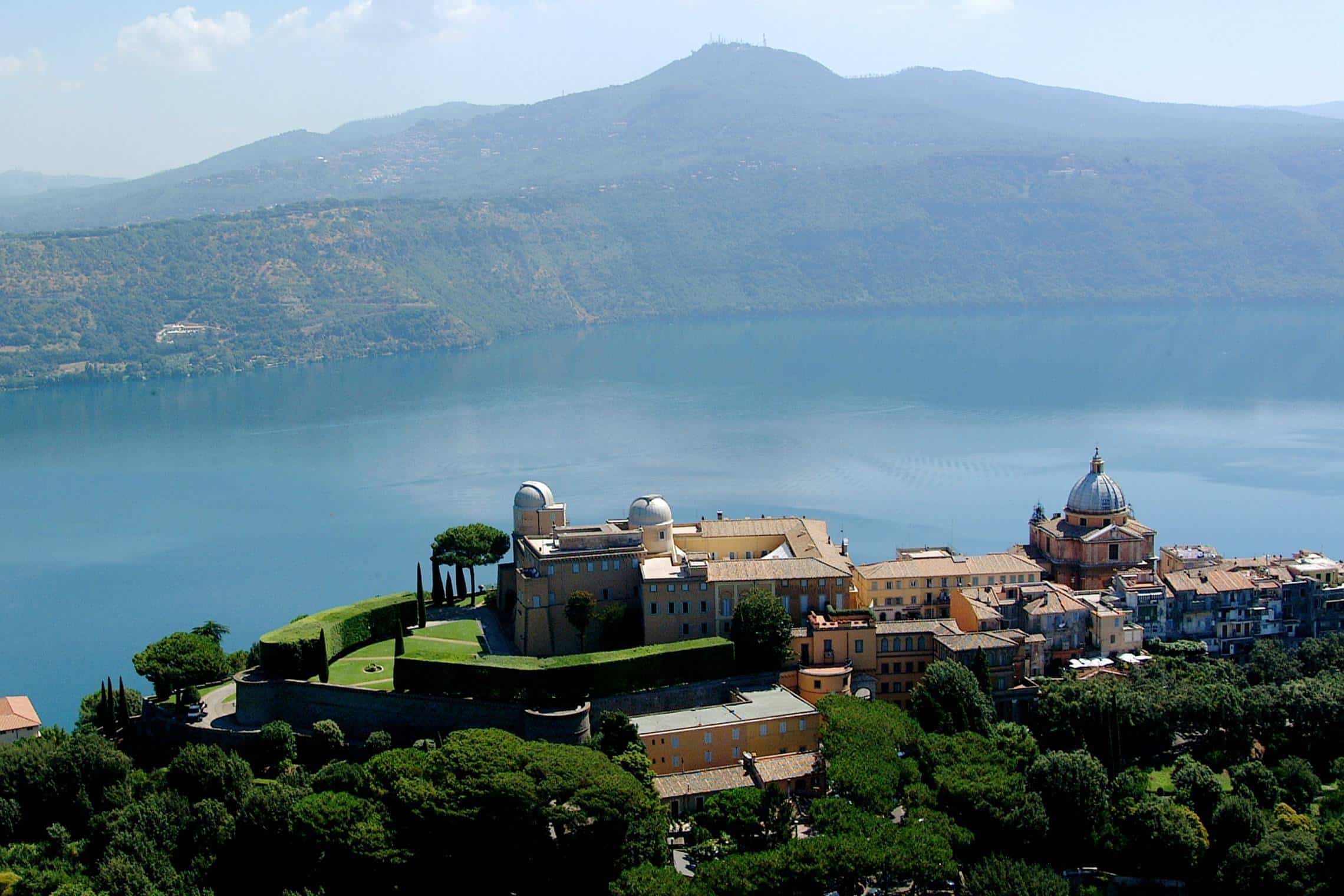

The Pontifical Palace of Castel Gandolfo faces Piazza della Libertà, in the historic center of Castel Gandolfo, about 25 kilometers south of Rome, on the rim of the crater that holds Lake Albano. You get there by train on the regional line FL4 from Roma Termini, direction Albano Laziale, getting off at the Castel Gandolfo stop, or by Cotral buses that leave from the Anagnina terminus of metro line A. The palace belongs to the Holy See and enjoys extraterritoriality: going in has never been like entering a civic museum. From 2016 to 2026 the main floor and the papal apartment stayed open to the public as a museum, with a full ticket at €12 and a reduced one at €6 for young people from 7 to 18, students up to 25, seminarians and pilgrim groups, with hours that differ by day, from 09:00 to 14:30 on weekdays and until 18:30 on Saturday and Sunday. In the summer of 2026 Leo XIV resumed the papal summer stay and chose this very building as his residence, and during the papal stays visitor access is suspended. Before setting out it's best to check availability on the official portal of the Vatican Museums, the only authorized booking channel: the calendar changes depending on the Pope's presence. The gardens of the Pontifical Villas and the Borgo Laudato Si route instead follow their own calendar, with guided visits on foot or by electric shuttle and entrance from Via Massimo D'Azeglio.
If the Pontifical Palace of Castel Gandolfo is the reason for the trip, it's worth reading first the page dedicated to the town, because the square, Bernini's collegiate church and the lake belvedere are part of the same picture: you'll find it at Castel Gandolfo.

How to get to the Pontifical Palace of Castel Gandolfo
The golden rule for the Castelli is only one: the train beats the car by three lengths. Castel Gandolfo has a long, narrow historic center, built on the edge of the crater, with few, contested parking spots. The train leaves you below the town and spares you the worst part of the day.
By train from Rome to the Pontifical Palace of Castel Gandolfo
The line is Trenitalia's FL4 for the Lazio Region, the Roma Termini branch toward Albano Laziale. The Castel Gandolfo station is a small stop, a single track with one platform and a modest passenger building, active since before 1902 and electrified since December 1947. From the platform to the palace you walk uphill. The climb is there, it's short but steep, and with suitcases or a heavy stroller it becomes tiring. Anyone with mobility problems should do the last stretch by taxi or be driven to Piazza della Libertà, where parking is regulated.
By bus and by car to the Pontifical Palace of Castel Gandolfo
The Cotral coaches link Anagnina, the terminus of metro line A, with the towns of the Castelli. It's the simplest solution for anyone staying in the southeast quadrant of the city. By car you leave the Grande Raccordo Anulare toward the Appia or toward Ciampino and go up to Albano. The last kilometer, on spring weekends, is a slow procession. The tip, banal and infallible: leave the car at Albano Laziale and do the last stretch by train or on foot along the holm oak gallery that runs beside the lake.
The train of the Pontifical Villas of Castel Gandolfo
Frequently asked questions about the Pontifical Palace of Castel Gandolfo
How much is the ticket for the Pontifical Palace of Castel Gandolfo?
The official price list of the Vatican Museums gives for the Pontifical Palace of Castel Gandolfo €12 for the full ticket, including the Papal Palace and the Secret Garden, and €6 for the reduced one. School groups pay €5 per student.
Who is entitled to the reduced ticket for the Pontifical Palace of Castel Gandolfo?
At the Pontifical Palace of Castel Gandolfo the reduced ticket goes to young people from 7 to 18, to students under 25 with proof of enrollment, to individual priests and religious, to seminarians and to university groups of up to 30 people with a maximum of three accompanying persons. People with certified disability from 67 percent up enter free.
How do you get to the Pontifical Palace of Castel Gandolfo from Rome?
It's best to get to the Pontifical Palace of Castel Gandolfo by train from Rome, with Trenitalia's FL4 line, because the historic center of Castel Gandolfo has few parking spots and they are often contested. The train leaves visitors directly below the town, sparing the hardest part of the day.
How long does the visit to the Pontifical Palace of Castel Gandolfo last?
For the Pontifical Palace of Castel Gandolfo alone with the Secret Garden you need about an hour and a half at a comfortable pace, two hours reading all the displays. The route in the gardens of the Pontifical Villas takes another two hours on foot, less with the electric shuttle, and with a stop in town you easily reach the whole day.
Is the Pontifical Palace of Castel Gandolfo always open to visitors?
No, the Pontifical Palace of Castel Gandolfo doesn't work like a state museum with fixed hours, because it's an extraterritorial property of the Holy See whose primary use, back in force in 2026 with the summer stay of Leo XIV, is as the Pontiff's residence. When the Pope is staying, the public doesn't enter, so it's always best to check the calendar before leaving.
Is the Pontifical Palace of Castel Gandolfo suitable for children?
The Pontifical Palace of Castel Gandolfo works better than expected with children, if you choose the points to see well. The room where 36 children were born during the war, the farm's stable, the domes of the Observatory and the electric shuttle in the gardens are the four elements that hold the attention of an elementary school child.
Is the Pontifical Palace of Castel Gandolfo accessible to people with disabilities?
The Pontifical Palace of Castel Gandolfo is a historic building on several levels, with sloping gardens on natural ground. People with certified disability from 67 percent up are entitled to free entry, while for the concrete conditions of access, elevators and shuttles it's best to contact the venue in advance through the contact given by the Vatican Museums.
What is the best time to visit the Pontifical Palace of Castel Gandolfo?
The best time for the Pontifical Palace of Castel Gandolfo is the second half of April and all of May, when the gardens are at their peak and the light lasts longer. July and August have to be handled with care, because they coincide with the papal residence and the possible closing of the palace to the public.
For years there has been a formula that foreign visitors like very much: a train that leaves from Roma San Pietro station in the morning and takes you directly to the Castelli using the track that enters Vatican City. The Vatican Museums' information document gives departure at 11:00 from Roma San Pietro and return at 17:24, on Saturday, with a full ticket of €20 including round-trip travel on electric trains, an audio guide in six languages and entrance to the Apostolic Palace. Family rates are provided and free entry for children up to five years. The formula depends on the calendar of the Pontifical Villas and the Pope's presence, so it has to be checked on the official portal before buying. Anyone traveling with a group who wants the day put together with the right timing will find it in the TourLeaderPro tour escort services directory.
Tickets, hours and bookings for the Pontifical Palace of Castel Gandolfo
The official price list of the Vatican Museums for the Papal Palace and the Secret Garden of Castel Gandolfo gives the full ticket at €12. The reduced ticket at €6 is for young people from 7 to 18, individual priests and religious, seminarians, students under 25 with proof of enrollment, university groups of up to 30 people with a maximum of three accompanying persons and pilgrim groups accompanied by a priest. School groups of first and second cycle pay €5 and have one free entry for every 10 students. Children under seven enter free, as do visitors with certified disability from 67 percent up and holders of an ICOM or ICOMOS card.
How to book the visit to the Pontifical Palace of Castel Gandolfo
A warning that saves embarrassment: the reduced ticket must be justified with a document on the day, otherwise it's canceled and has to be bought again at the full rate. The family rate, instead, can only be bought on site and not online. Booking goes exclusively through the official portal of the Vatican Museums. No other channel is authorized to sell entry to the palace, and the museum indicates on its site any authorized reseller. Be wary of anyone promising the same ticket at a higher price passing it off as a skip-the-line: here the line, simply, doesn't exist.
Hours of the Pontifical Palace of Castel Gandolfo
The official calendar of the Papal Palace for 2026 gives on weekdays entry from 09:00 to 13:00 and closing at 14:30, on Saturday entry from 09:00 to 17:00 and closing at 18:30 (in the winter months from 09:00 to 16:00 with closing at 17:30), on Sunday entry from 10:00 to 17:00 and closing at 18:30. Leaving the halls begins 30 minutes before closing. For the months of January and February, on Saturday and Sunday, the Moor's Garden and the Secret Garden stay accessible until 16:00 for reasons of natural light. Pay attention to the point that changes everything: with the return of the papal summer residence, the calendar is suspended in the periods when the Pontiff is staying at Castel Gandolfo. In 2026 the stays of Leo XIV fell between July 5 and 20 and in the second half of August, with a return to the Vatican on the 30th. The practical rule is one: look at the online calendar the day before, not the month before.
What the Pontifical Villas of Castel Gandolfo are
The Pontifical Palace of Castel Gandolfo is not an isolated building: it's part of a body of about 55 hectares, larger than the State of Vatican City. Three cores, once adjoining but separated by public roads, now form a single body: the Apostolic Palace, Villa Cybo and Villa Barberini. To these are added the gardens, the Vatican Observatory, the convent of the Poor Clares, the farm and, in recent years, the Borgo Laudato Si route.
The extraterritoriality of the Pontifical Palace of Castel Gandolfo and the Lateran Pacts
The territory was acquired by the Apostolic Chamber in July 1596, under Clement VIII, following a dispute with the Savelli, and was incorporated into the inalienable patrimony of the Holy See on May 27, 1604. The current legal status, however, comes from the Lateran Pacts of 1929: the papal villas of Castel Gandolfo, to which Villa Barberini was then added, were declared extraterritorial pontifical domain. In April 2014, together with 11 other properties, the complex obtained the confirmation of the privilege of extraterritoriality with exemption from expropriation and taxes. In concrete terms it means that, once past the gate, you leave Italian jurisdiction while remaining in the province of Rome. It's the same condition that governs the buildings of the Holy See in the city, a matter worth knowing also when visiting St. Peter's Basilica.
Why the Pontifical Villas are bigger than the Vatican
The figure always strikes groups: the 55 hectares of Castel Gandolfo exceed the 44 of the State of Vatican City. It's not a quiz paradox. The Vatican is an administrative capital compressed into an urban enclosure. Castel Gandolfo is a productive countryside, with olive groves, vegetable gardens, greenhouses, a stable and an orchard. Anyone who knows the Vatican Gardens will find here the same idea carried to an agricultural scale, without the pressure of the city around.
From the villa of Domitian to the Pontifical Palace of Castel Gandolfo
Under the papal palace there is another palace, much bigger and much older. The complex stands on the area of the Albanum Domitiani, the imperial residence of Domitian, emperor between 81 and 96 AD, which according to archaeological estimates occupied about 14 square kilometers between today's Castel Gandolfo and Albano. It was a body with palaces, terraces, a theater, a hippodrome, gardens and a water system fed by aqueducts. Domitian spent long periods there and held audiences and trials there, so much so that ancient sources call the villa his second court.
The cryptoporticus and the theater under the Pontifical Palace of Castel Gandolfo
Substantial parts of that layout remain inside the papal enclosure, especially in the gardens of Villa Barberini: the cryptoporticus, a covered, vaulted corridor used for walking out of the sun, and the remains of the theater. Walking today on the Barberini terraces means walking on Roman substructures, reused as foundations without too many compliments. The detail I recommend observing is the masonry: where the 17th century rests on the first, the change of texture can be read with the naked eye.
Alba Longa, the city that perhaps was there
Tradition has it that the acropolis of Alba Longa, the mother city of Rome founded according to myth by Ascanius, son of Aeneas, occupied this very spur on the lake. The location remains a debated hypothesis, supported by topography and literary sources more than by definitive archaeological proof. It should be told as tradition, not as established fact. What remains is the taste for overlap: an emperor's villa on top of the memory of a mythical city, and on top of the villa the palace of the popes.
The Gandolfi, the Savelli and the name of the town
Around 1200 the Gandolfi family built a castle on the summit, which gave the place its name. For about three centuries the fortress belonged to the Savelli, a powerful baronial house of Lazio, before passing to the Apostolic Chamber. Inside the walls of the current palace survive medieval frescoes of the Gandolfi castle. They are the oldest and least showy fragment of the visit, and almost nobody looks at them.

The building of the Pontifical Palace of Castel Gandolfo, pope by pope
The building history is an alternation of enthusiasms and abandonments, and it can still be read in the masonry.
Urban VIII, Carlo Maderno and the birth of the Pontifical Palace of Castel Gandolfo
Maffeo Barberini, elected pope in 1623 with the name of Urban VIII, decided almost immediately to transform the old fortress into a holiday residence, what the papers of the time call the suburban retreat. The project was entrusted to Carlo Maderno, the architect of the facade of St. Peter's, who carried it out with his assistants Bartolomeo Breccioli and Domenico Castelli by 1629. The paradox is documented: Urban VIII, promoter of the building, never lived in the palace, preferring the nearby Villa Barberini that belonged to his nephew Taddeo.
Alexander VII, Bernini and the square
The first pontiff to really spend summers there was the Sienese Fabio Chigi, Alexander VII, who completed the building with the main facade and the west wing. Gian Lorenzo Bernini worked for him at Castel Gandolfo, and his hand is better recognized outside the palace than inside: the collegiate church of San Tommaso da Villanova, on the same square, is his work between 1658 and 1661. Anyone who arrives thinking they'll find a second urban Palazzo Chigi will be thrown off: here the 17th century is sober, almost military, and the real luxury is the view. For the lavish side of the same family it's worth a detour to Palazzo Chigi in Ariccia, a few kilometers away.
Benedict XIV and Clement XIV
After Alexander VII the villa was neglected for about a century. It came back into favor in the 18th century with Benedict XIV, the Bolognese Prospero Lambertini, who renovated it, redecorated it and gave it the gallery that bears his name. Clement XIV, in 1773, bought the neighboring Villa Cybo for 18,000 scudi and turned Urban VIII's original garden into a park. It's the moment when the complex stops being a country house and becomes a system.
The French, the restorations and the long silence after 1870
Napoleonic troops occupied and badly damaged the residence. The restoration is owed to Pius VII and Pius VIII. Gregory XVI and, at least until 1870, Pius IX used it assiduously, adding improvements. Then the collapse of the Papal State interrupted everything: from 1870 the popes abandoned Castel Gandolfo like every other residence outside Rome and shut themselves in the Vatican in protest against the Kingdom of Italy. 60 years of closed shutters. The Roman Question closed in 1929, and the palace reopened with Pius XI.
Pius XI, Giuseppe Momo and the stitching together of the three villas
Achille Ratti, Pius XI, is the true refounder of the complex. He commissioned the architect Giuseppe Momo, the one of the helical staircase of the Vatican Museums, to link the three properties divided by public roads: a loggia joins the Apostolic Palace to Villa Cybo, an overpass connects the garden of Villa Cybo with that of Villa Barberini. In 1934 the same pontiff had the seat of the Vatican astronomical observatory set up on the top floor of the palace, under the tower. With the purchase of some land toward Albano the small farm finally came about that still supplies the Vatican canteens.
The visit of the Pontifical Palace of Castel Gandolfo, room by room
The museum route set up in 2016 follows the hierarchical order of the papal ceremonial: you climb by degrees, as an ambassador climbed, and each antechamber filtered a rank. Understanding this logic is the key to not finding yourself in front of a string of anonymous rooms.
The Audience Courtyard and the Grand Staircase
You enter from the inner courtyard, the one where John Paul II recited the Sunday Angelus before the faithful. From here the Grand Staircase leads to the main floor. Look at the proportions of the courtyard: they are those of an ennobled farm court, not of a royal palace. The papal 17th century, outside Rome, could be surprisingly measured.
The Hall of the Swiss of the Pontifical Palace of Castel Gandolfo
The first room of the main floor, it takes its name from the Swiss Guard who stood duty there. It was the blocking space: here whoever had no title to go on was stopped. The measure of the space is the measure of power, and the message arrived without the need for words.
The Hall of the Palafrenieri and the Hall of the Noble Guards
Two successive antechambers, intended for the armed and service corps of the papal court. The Palafrenieri were the attendants in the pope's retinue and personal service. The Noble Guards, a corps abolished by Paul VI in 1970, were recruited from the Roman aristocracy. They are rooms that tell of a world vanished in a couple of generations.
The Hall of the Chamberlains of the Cape and Sword and the Hall of the Bussolanti
You go up another degree. The Chamberlains of the Cape and Sword were laymen of noble family in the pontiff's service. The Bussolanti, whose name comes from the bussolo, the swing door, introduced visitors into the inner rooms. A nomenclature that sounds exotic today and was then a precise organization chart, with salaries, hierarchies and liveries.
The Throne Room of the Pontifical Palace of Castel Gandolfo
It's the point where the route changes temperature. Here the pope received heads of state and delegations in solemn form. The throne was not just any piece of furniture: it was the sign of jurisdiction, and the fact that one existed on holiday says how little, in practice, the pontiff stopped governing in summer.
The Consistory Hall and the Brussels tapestries
The Consistory Hall preserves Gobelin tapestries of Brussels manufacture. Tapestries, in papal palaces, had a double function: they insulated cold walls and moved the iconographic message onto a portable support. If you have little time and want just one thing to look at calmly in the Pontifical Palace of Castel Gandolfo, look at the back of the scenes in the tapestries: the preparatory drawing can be sensed in the outlines.
The Gallery of Benedict XIV and the portraits of the popes
On the first floor runs the gallery commissioned by Benedict XIV, which hosts the series of pontifical portraits from the 16th century onward. It's a sequence worth a history lesson in 20 minutes: you see the fashions of the official portrait change, from the hieratic pose to the hand on the armrest, from cardinal red to the dull whites of the 20th century. In the halls of the palace, works by Carlo Dolci, Paolo Veronese, Salvator Rosa, Pier Leone Ghezzi and Domenico Corvi are documented. It's a mixed core, arrived here by gift, by transfer or by adaptation of furnishings, not by a collection project.
The Papal Chapel of Urban VIII
Tied to the first phase of the building, it's the liturgical space of the palace. Don't expect a Roman court chapel: the dimensions are contained, and that is exactly what makes it interesting. It served for the daily Mass of the pontiff and his small retinue.
The Pope's private apartment in the Pontifical Palace of Castel Gandolfo
On the second floor you visit what no other papal palace lets you see: the private apartment, meaning the antechamber, the study reorganized under Pius XI, Clement XIV's dining room, the bedroom, the private chapel commissioned by Pius XI, the toilette room, the room of the secret sweeper and the steward's hall. The last two names deserve an explanation, because they make people laugh who don't know them: the secret sweeper was the person in charge of cleaning the private rooms, the steward the person in charge of the papal table. Behind obsolete words is the minute administration of a household.
The bedroom in which two popes died
The bedroom is the densest space of the palace. Here died Pius XII, on October 9, 1958, and Paul VI, on August 6, 1978. Two very long pontificates closed in the same room, 20 years apart, in front of the same window on the lake. In the museum route the room is presented soberly, and should be looked at in silence: it's the only point of the visit where even the chattiest groups lower their voices.
The Billiards Hall and the medieval frescoes
The tour ends with the Billiards Hall, a memory of a summer stay made also of empty hours. In the walls remain, as said, fragments of medieval frescoes of the Gandolfi castle. The verdict is clear: they are more important than half the paintings on display, and they are treated as a detail.
The Vatican Observatory above the Pontifical Palace of Castel Gandolfo
The two metal domes on the roof are not a whim. They house the astronomical observatory of the Holy See, moved here during the 1930s because the sky of Rome was by then too lit for precision astronomy. Pius XI had the seat set up under the tower in 1934, with Zeiss instruments. The Vatican observatory has kept working from Castel Gandolfo and, since the 1990s, also relies on a telescope in Arizona, where the dry desert sky offers better conditions.
The Observatory visitor center in the gardens
In the gardens of the Pontifical Villas a visitor center of the Vatican Observatory has been opened, with access to historic telescopes, astronomical instruments and exhibition materials. Booking goes through the Vatican Museums portal. Two historic telescopes are housed in domes in the garden, two others in the domes on top of the Apostolic Palace. For anyone traveling with middle or high school kids it's the part of the day that works best: astronomy run by Jesuits inside a papal residence upends any prejudice.
The gardens of the Pontifical Villas of Castel Gandolfo
If the palace is closed, the gardens remain the reason for the trip. They are four distinct spaces, of different eras and character.
The Moor's Garden and the Secret Garden
The Moor's Garden dates to the 17th century and is the area closest to the palace, the one the pontiff reached on foot in a few minutes. The Secret Garden, included in the Papal Palace ticket, is the reserved enclosure: geometric flower beds, boxwood, a quiet you feel physically as soon as you pass the gate. In January and February the hours are shortened because of the light.
The Barberini Gardens of the Pontifical Villas of Castel Gandolfo
Laid out starting in 1631 at the will of Taddeo Barberini, they are the landscape masterpiece of the complex: avenues of holm oaks pruned into galleries, terraces, the perspective toward the sea and, under your feet, the substructures of Domitian's villa. In the documents of the villa, works attributed to Bernini are reported. Walking here early in the morning, with low mist on the lake, is worth the ticket by itself.
The Magnolia Garden and the Belvedere
Two minor and beautiful spaces: the first takes its name from the tree specimens that characterize it, the second is the viewpoint overlooking the crater. From the Belvedere you measure with your eyes the shape of the Lazio volcano, and you understand why the Castelli Romani Park is a single great extinct caldera.
The Borgo Laudato Si and the papal farm
In recent years the Pontifical Villas have taken on a second identity: that of a training center on integral ecology, born around the encyclical of Pope Francis. The route crosses the gardens and the productive part of the complex, with more than 4,000 plants and about 300 botanical species recorded. Visits are made on foot with a guide or aboard electric shuttles, and there are formulas for groups, pilgrimages and school groups. The entrance is on Via Massimo D'Azeglio, in Castel Gandolfo, and booking is done online or by writing to the center's address.
Hours of the route in the gardens
The calendar published by the center gives, for the winter season between late October and late March, opening from 10:00 to 16:00 with last entry at 15:00, and on Tuesday from 09:00 to 14:00 with last entry at 13:00. From the end of March the schedule continues Monday to Saturday from 10:00 to 16:00 with last entry at 15:00. Dates vary from year to year and must be confirmed at the time of booking.
The farm that supplies the Vatican
The farm was born in the 1930s to cover the internal needs of the Holy See. It produces milk, eggs, oil, fruit and vegetables that end up in the Vatican canteens and shop. I find it the most telling detail of the whole complex: behind the rhetoric of the palace there's a stable that has been working for 90 years.

From residence to museum and back: the use of the Pontifical Palace of Castel Gandolfo
On October 21, 2016, by decision of Pope Francis, the palace shed its role as papal summer residence and officially became a museum: the papal apartment, until then accessible to very few, was opened to visitors. Francis, for that matter, never stayed there. 10 years later the pendulum has swung back. In the summer of 2026 Leo XIV resumed the papal summer stay at Castel Gandolfo, left Villa Barberini, where he had stayed before and which faces the road directly, and chose the Apostolic Palace, more protected and more convenient logistically. During the papal stays the public stays outside. In the periods when the Pontiff is in the Vatican the situation has to be checked on the official portal, because the scheduling of the Castel Gandolfo museum complex now depends on the calendar of the residence.
What it means for whoever organizes the trip
In practice, three rules. First: you don't buy a ticket for the Pontifical Palace of Castel Gandolfo weeks in advance without having seen the updated calendar. Second: you always build a plan B within the same day, and luckily here plan B is excellent, among gardens, lake and nearby towns. Third: if you're traveling with a large group, move with someone who can reorganize the day while you're already on the road, which the team of TourLeaderPro does for a living.
A curiosity about the Pontifical Palace of Castel Gandolfo
The most beautiful curiosity isn't about a fresco: it's about a birth register. Between January 1944 and the following year, while the Anzio and Cassino front ground through the Castelli Romani, up to 12,000 people found refuge inside the Pontifical Villas. On January 25, 1944 the management of the villas, with the consent of Pius XII, opened the gates to the displaced. The coordination of the reception was entrusted to Monsignor Giovanni Battista Montini, the future Paul VI, and to the director of the villas Emilio Bonomelli. The reception halls became dormitories, the corridors became inner streets, the gardens became survival vegetable plots. And when the women in labor no longer had anywhere to go, the pope had his own private apartment opened: in the bedroom and the adjoining rooms 36 children were born, including a pair of twins. Many families named their children Eugenio, Pio, Pio Eugenio, after the pontiff's baptismal name, Eugenio Pacelli.
You walk past it today with the tourist's gaze, looking for the historic bed and the two popes who died in it. The truth is that room changed function at least three times in a century: a sovereign's bedroom, an emergency delivery room, a museum showcase. In the Pontifical Palace of Castel Gandolfo great history and minor history live in the same square meter, and the second is the one visitors remember years later. If I had to choose a single fact to take home after the visit, I'd choose this one, not the 55 hectares.
Something nobody tells you about the Pontifical Palace of Castel Gandolfo
No guidebook writes it on the cover, but the weak point of the day isn't the ticket: it's the calendar. The Pontifical Palace of Castel Gandolfo doesn't work like a state museum with fixed hours and Monday closing. It's an extraterritorial property of the Holy See whose primary use, back in force in 2026, is as the Pontiff's residence. When the Pope is staying, the public doesn't enter, period. And the dates of the stays are announced a few weeks ahead, according to the Holy See's agenda.
The second thing nobody says is that the complex is visited in separate pieces, with different tickets and entrances: the Papal Palace with the Secret Garden on one side, the gardens of the Pontifical Villas and the integral ecology route on the other, the Observatory visitor center by reservation still separate, and the entrance of the Borgo on Via Massimo D'Azeglio, distinct from that of the palace on Piazza della Libertà. Anyone who arrives convinced they'll buy a single ticket and see everything in two hours goes home unhappy. The right day includes half a morning for the gardens, a lunch in town and the afternoon among palace, belvedere and lake. Anyone preparing the trip in English will find the Vatican rules on tickets well explained on the page of ItalyPlanner on Vatican tours, and it's worth reading before booking anything that carries the name of the Vatican.
My advice for visiting the Pontifical Palace of Castel Gandolfo
The advice is to reverse the order in which almost everyone approaches Castel Gandolfo. Most visitors arrive around 11:00, enter the palace, leave at 13:00 and head off. Do the opposite: first useful train from Roma Termini, arrival in town a little after 09:00, and start from the gardens with the low light and the still air on the lake. The holm oaks of the Barberini Gardens at that hour are a green corridor that looks like nothing else in Lazio. The palace, when it's open, is better visited in the second part of the morning, when the organized groups have already finished their tour.
Second tip, a practical one: bring real shoes. The route in the gardens is long, on natural ground and sloping, and the electric shuttle doesn't cover everything. Third: plan for lunch in town and not a sandwich on your feet. The fraschette and trattorias between Piazza della Libertà and the main street still have decent prices compared to Rome, and the porchetta of Ariccia, 10 minutes by car, remains one of the serious reasons to come to the Castelli. Fourth, and here I'm categorical: don't visit the Pontifical Palace of Castel Gandolfo on a Sunday if the Pope is in residence. The square fills up for the Angelus, the town becomes impassable and the day turns from a cultural visit into a rally. If instead the Angelus is exactly what you're after, then arrive two hours early and calmly give up the rest.
Another well-known fact, yet rarely mentioned
Everybody knows the Pontifical Villas are extraterritorial. Almost nobody connects that legal fact to its material consequences, which nonetheless filled the news of the 20th century. Extraterritoriality means the territory isn't Italian, and that whoever enters leaves the jurisdiction of the Italian State. It's the reason why, in 1944, opening the gates to the displaced had a precise meaning and wasn't a symbolic gesture. It meant shielding thousands of civilians from the passage of retreating units.
It also means, on the administrative side, exemption from expropriation and taxes, confirmed in April 2014 for the complex together with 11 other properties of the Holy See. And it means that inside the perimeter specific security and access rules apply. That's why the Pope's choice between Villa Barberini, facing the public road, and the Apostolic Palace, set back and protected, is an operational choice and not one of taste. The second well-known but rarely cited fact concerns size: the 55 hectares of the villas exceed the whole State of Vatican City. It's repeated as an aperitivo curiosity, while it's the sign of a function: Castel Gandolfo is the agricultural reserve and the lung of the Holy See, not a scenic whim.
The right photo to take at the Pontifical Palace of Castel Gandolfo
The photograph almost everybody takes is the facade on Piazza della Libertà, head-on, with the sun in your face: a document, not an image. The right photo is another one, and requires moving 50 meters. Stand at the mouth of the square, on the side of the collegiate church of San Tommaso da Villanova, and frame the palace in three quarters with the curve of the church's Bernini facade in the foreground. The juxtaposition between the civil architecture, severe, and the religious one, curved and soft, tells in a single shot what this square has been for four centuries.
The second photo, the one nobody posts, is taken from the Belvedere of the gardens when the visit allows it: the crater of Lake Albano opening below and, on the rim, the domes of the Observatory. Best light: early morning in winter, late afternoon in summer, when the water turns metallic. Avoid July noon, which flattens everything. A rule of behavior, worth double in a property of the Holy See: inside the palace you follow the staff's instructions on filming, and when the Pontiff is in residence common sense comes before the framing. If instead you're looking for the postcard image of the town, go down toward the lake and photograph the Pontifical Palace of Castel Gandolfo from the water, with the town above and the woods around: it's the view that Grand Tour painters replicated for two centuries.
Some important events that happened here in history
On February 10, 1944, around 09:15, Allied planes hit the territory of the Propaganda Fide villa and Villa Barberini, in an extraterritorial and theoretically protected zone. The civilian victims were more than 500, almost all displaced from the towns of the Castelli Romani. Among the dead were also 16 cloistered nuns of the convents in the area. It's the darkest page in the recent history of Castel Gandolfo, remembered every year with a peace march through the streets of the town and documented by photographs, films, testimonies and papers from the archive of the Pontifical Villas.
On October 9, 1958 Pius XII died in the palace. On August 6, 1978, the feast of the Transfiguration, Paul VI died there. Two conclaves opened starting from this hill. On July 23, 2001 John Paul II received here the President of the United States George W. Bush and his wife Laura, in one of the most politically delicate audiences of his pontificate. In 2010 the outer square hosted for the first time in history the Wednesday general audience, until then reserved for the Vatican. Between February 28 and May 2, 2013 the palace welcomed Benedict XVI after the renunciation of the Petrine ministry. From the balcony, on the evening of February 28, the pope emeritus greeted the crowd saying he would simply be a pilgrim. On October 21, 2016 Pope Francis turned the building into a museum. In the summer of 2026 Leo XIV brought the summer residence back here, celebrating among other things Mass in the parish church of San Tommaso da Villanova and the Angelus from Piazza della Libertà, and a Mass at the church of the Madonna del Lago, on the shore of the crater, where very few pontiffs before him have celebrated.
Who has passed through the Pontifical Palace of Castel Gandolfo
The list of popes is the backbone: Urban VIII, who built it without living in it. Alexander VII, first summer resident and patron of Bernini. Benedict XIV, who gave it the gallery. Clement XIV, who bought Villa Cybo in 1773. Pius VII and Pius VIII, restorers after the passage of the Napoleonic troops. Gregory XVI and Pius IX, last occupants before 1870. Pius XI, who reopened it and gave it an observatory. Pius XII, who died there after opening it to the displaced. John XXIII. Paul VI, who died there in 1978. John Paul I. John Paul II, who called it Vatican Two and frequented it in every season. Benedict XVI, who spent his first months as pope emeritus there. Francis, who opened it to the public without ever sleeping in it. Leo XIV, who in 2026 brought it back to its original function.
Then there are the laymen. Carlo Maderno, Bartolomeo Breccioli and Domenico Castelli on the 17th-century scaffolding. Gian Lorenzo Bernini between the palace and the collegiate church. Giuseppe Momo, who in the 1930s stitched the three villas together with a loggia and an overpass. Emilio Bonomelli, director of the villas and the material architect of the 1944 reception. Giovanni Battista Montini, then an official of the Secretariat of State, who coordinated the relief and who 34 years later would die in this palace as pope. There are the Jesuit astronomers of the Observatory, who from here took part in the great stellar catalogs of the 20th century. And there are the heads of state received in audience, from George W. Bush onward. Finally the Grand Tour travelers, who didn't enter but drew the palace from the lake: their views did for Castel Gandolfo what shared photographs do today.
What to see around the Pontifical Palace of Castel Gandolfo
The palace takes half a day. The Castelli fill the rest, and it would be a pity to leave right away.
The collegiate church of San Tommaso da Villanova in front of the Pontifical Palace of Castel Gandolfo
On the same square, facing the palace, the parish church designed by Gian Lorenzo Bernini between 1658 and 1661 for Alexander VII. Greek cross plan, compact dome, bright interior: it's the proof that Bernini could work on a smaller scale without losing control of the space. Free entry, hours tied to the services.
Lake Albano below the Pontifical Palace of Castel Gandolfo
You go down from the town in about 10 minutes by car, or on foot at a good pace. Lake Albano is a volcanic crater more than 160 meters deep, which in 1960 hosted the Olympic rowing events. The shores offer beach clubs, pedal boat rentals and walks in the shade. In summer the temperature drops a few degrees compared with Rome, and you can feel it.
Albano, Ariccia, Nemi, Marino
A step away are four towns that each deserve a day. Albano Laziale preserves the remains of the Castra Albana, the camp of the Legio II Parthica ordered by Septimius Severus, and Roman cisterns still in use. Ariccia lives around the monumental bridge, the Bernini square and the porchetta fraschette. Nemi looks down on its own lake and keeps the memory of Caligula's ships. Marino is famous for the October grape festival and for the fountains that, that day, run with wine. Add Genzano di Roma for the June infiorata and the picture of the Castelli is complete.
Frascati and Grottaferrata
On the opposite side of the caldera, Frascati offers the Tusculan villas and the white wine that made the town's name, while Grottaferrata preserves the Greek abbey of San Nilo, founded in 1004, with the chapel frescoed by Domenichino. Two destinations that, together with Castel Gandolfo, make up the classic three-day itinerary of the Castelli.
The Pontifical Palace of Castel Gandolfo with children
It works better than you'd expect, as long as you choose the pieces well. The room where 36 children were born during the war, the farm's stable, the domes of the Observatory and the electric shuttle in the gardens are the four points that hold the attention of an elementary school child. The court antechambers, with their complicated names, don't: cross them at a brisk pace and tell the hierarchy as a game of doors. Children under seven don't pay, and the family rate is done at the ticket office. A tip from someone who has seen many days spoiled: lunch has to be booked, because at Castel Gandolfo at 13:30 the tables run out.
Accessibility of the Pontifical Palace of Castel Gandolfo
The palace is a historic building on several levels and the gardens are sloping on natural ground. People with certified disability from 67 percent up are entitled to free entry according to the official price list. For the concrete conditions of access, elevators, alternative routes and availability of suitable shuttles, it's best to contact the venue in advance at the contact given by the Vatican Museums for the Pontifical Villas, because the answer changes depending on the route booked. The town's historic center, for its part, is all on a slight slope with basalt paving and sanpietrini: a wheelchair can move, but it needs a push.
When to go to the Pontifical Palace of Castel Gandolfo
The best moment is the second half of April and all of May: gardens at their peak, right temperatures, long light. September and October are just as good, with the advantage of the grape harvest in the nearby towns. July and August have to be handled with care, because they coincide with the papal residence and with the closing of the palace to the public, besides the heat. Winter has a severe charm, the lake steaming on cold mornings and the gardens with reduced hours. It's the season in which you visit in peace, without groups. Avoid the long weekends and the Angelus Sunday if you're looking for silence.
How long the visit to the Pontifical Palace of Castel Gandolfo lasts
For the palace alone with the Secret Garden count an hour and a half at a comfortable pace, two hours if you read all the displays. The route in the gardens of the Pontifical Villas takes another two hours on foot, less with the electric shuttle. Adding the Observatory visitor center and a stop in town you easily reach the whole day. Anyone who leaves Rome with the first train and returns in the late afternoon has a full day and not a rushed one. It's the recommended model, and you find it again in the setup of the ItalyPlanner three-day Rome itinerary, where the trip to the Castelli counts as the natural fourth day.
Quick questions about the Pontifical Palace of Castel Gandolfo
How much is the ticket for the Pontifical Palace of Castel Gandolfo
The official price list of the Vatican Museums gives €12 for the full ticket to the Papal Palace with the Secret Garden and €6 for the reduced one. School groups pay €5 per student.
Who is entitled to the reduced ticket
Young people from 7 to 18, students under 25 with proof of enrollment, individual priests and religious, seminarians, university groups of up to 30 people with at most three accompanying persons, pilgrim groups accompanied by a priest. The document must be shown on the day of the visit.
Who enters free
Children under seven, visitors with certified disability from 67 percent up, holders of an ICOM or ICOMOS card, museum directors and cultural heritage officials according to the conditions given in the official price list.
Is the Pontifical Palace of Castel Gandolfo open to the public
Since 2016 it has been open as a museum, but in 2026 it went back to being the Pontiff's summer residence and visitor access is suspended during the papal stays. Availability should be checked on the official portal of the Vatican Museums before leaving.
What are the hours of the Pontifical Palace of Castel Gandolfo
The official calendar of the Papal Palace for 2026 gives on weekdays entry from 09:00 to 13:00 and closing at 14:30, on Saturday entry from 09:00 to 17:00 and closing at 18:30 (in the winter months from 09:00 to 16:00 with closing at 17:30), on Sunday entry from 10:00 to 17:00 and closing at 18:30. In January and February, on Saturday and Sunday, the Moor's Garden and the Secret Garden stay accessible until 16:00.
Do you need to book for the Pontifical Palace of Castel Gandolfo
Yes. Booking is made exclusively online on the official portal of the Vatican Museums. The family rate is the exception and is bought at the ticket office.
How do I get from Rome to the Pontifical Palace of Castel Gandolfo
By regional train FL4 from Roma Termini toward Albano Laziale, stop Castel Gandolfo, or by Cotral buses from Anagnina. By car you leave the Grande Raccordo toward the Appia or Ciampino.
Does the Pope's train really exist
There is a service dedicated to the Pontifical Villas that leaves from Roma San Pietro and uses the Vatican track. The Vatican Museums' information document gives departure at 11:00, return at 17:24 and a full ticket of €20 with audio guide and entrance to the palace. The service follows the calendar of the villas and should be checked on the official portal.
How long does the visit to the Pontifical Palace of Castel Gandolfo last
An hour and a half or two for the palace with the Secret Garden, another two hours for the gardens of the Pontifical Villas. With the Observatory and a stop in town the day is filled.
Can you take photographs inside the Pontifical Palace of Castel Gandolfo
Filming follows the staff's instructions in the individual halls. Outside, in Piazza della Libertà and in the gardens open to visits, there are no particular limits.
Is the Pontifical Palace of Castel Gandolfo accessible in a wheelchair
It's a historic building on several levels with sloping gardens. Free entry for certified disability from 67 percent is provided by the price list. The practical conditions of the route should be agreed in advance with the venue through the contacts given by the Vatican Museums.
What is the difference between the Papal Palace and the Pontifical Villas
The Papal Palace is the building on Piazza della Libertà with the papal apartment. The Pontifical Villas are the whole of about 55 hectares that includes the palace, Villa Cybo, Villa Barberini, the gardens, the Observatory and the farm. Tickets and entrances are distinct.
What is the Borgo Laudato Si
It's the integral ecology route set up in the gardens of the Pontifical Villas, with more than 4,000 plants and about 300 botanical species, visited on foot with a guide or by electric shuttle. Entrance from Via Massimo D'Azeglio, booking online or by email.
Do you see the Pope at the Pontifical Palace of Castel Gandolfo
When the Pontiff is staying at Castel Gandolfo, the Sunday Angelus is recited from Piazza della Libertà and the celebrations are held in the parish church of San Tommaso da Villanova or in the nearby churches. On those days the palace stays closed to visitors.
Is the complex really bigger than the Vatican
Yes. The roughly 55 hectares of the Pontifical Villas exceed the area of the State of Vatican City.
What remains of Domitian's villa under the Pontifical Palace of Castel Gandolfo
In the gardens of Villa Barberini the cryptoporticus and the remains of the theater of the Albanum Domitiani are preserved, the imperial residence that occupied a vast area between Castel Gandolfo and Albano.
Where did Pius XII and Paul VI die
Both in the bedroom of the papal apartment of the palace: Pius XII on October 9, 1958, Paul VI on August 6, 1978.
Can you visit the Vatican Observatory
An observatory visitor center has been opened in the gardens, with historic telescopes and instruments, accessible by reservation through the Vatican Museums portal.
Is it worth combining Castel Gandolfo with the Vatican Museums on the same day
Only if you choose the dedicated train formula, which joins the two visits in an organized day. Otherwise no: the Vatican Museums alone need at least three hours, and adding the two routes produces a rushed day and no memories.
Where do you eat well at Castel Gandolfo
Between Piazza della Libertà and the main street there are trattorias and fraschette with reasonable prices. For porchetta it's best to go down to Ariccia. Book: on weekends the tables run out early.
Is there a cloakroom
Storage and ancillary services depend on the route booked and are given in the ticket's practical information. In any case the palace is not equipped for bulky luggage: whoever arrives from the station with a suitcase should leave it at the hotel.
How long do you wait in line
Little or nothing. Entrances are limited by time slots and the number of visitors is a fraction of that of the Vatican Museums. It's one of the few Vatican places where the word line makes no sense.
Is it worth going if the palace is closed
Yes, provided you reorganize the day around gardens, town, Bernini's collegiate church and lake. Anyone who comes only for the papal apartment and finds it closed has wasted the trip. Anyone who comes for Castel Gandolfo has not.
The verdict on the Pontifical Palace of Castel Gandolfo
Our verdict is this: the Pontifical Palace of Castel Gandolfo is not the most beautiful of the papal palaces, and nobody should come expecting the splendor of the Vatican. The halls are sober, the picture gallery is uneven, the 17th century here speaks in a low voice. What makes the place unrepeatable is the overlap: an imperial villa under your feet, a medieval fortress in the walls, a Baroque palace around, an astronomical observatory on the roof, a farm behind and, inside a single room, two papal deaths and 36 births of displaced children. There is no other building in Italy that holds all this together.
The final advice is to go now that the rules are changing, with the calendar in hand and no rigid expectations. Anyone organizing a visit for a group, a company or a large family should have the day built by a professional: two phone calls to the TourLeaderPro contacts are enough to avoid the wasted trip. And if you're preparing a first trip to Rome in English, the reasoned list of things to do in Rome on ItalyPlanner will tell you when it makes sense to break away from the center and go up to the Castelli.

Article written by the editorial team of TourLeaderPro, contact them for Private/Corporate/V.I.P. Tours and Experiences.
Planning a trip to Rome? The English guides to visiting the city are on ItalyPlanner.com.