Frascati (RM)
In short. Frascati lies about 20 kilometers southeast of Rome, spread over the first slopes of the Alban Volcano, the extinct volcanic complex that shaped all the Castelli Romani.
Frascati lies about 20 kilometers southeast of Rome, spread over the first slopes of the Alban Volcano, the extinct volcanic complex that shaped all the Castelli Romani. The administrative address is Frascati 00044, Rome Province, and the historic center can be reached in just over half an hour by train. Regional trains leave from Roma Termini station on the line to Frascati, the terminus of a branch of the Lazio rail network, with a ticket at metropolitan fare to be checked at the time of purchase. The Frascati station sits just below Piazza Marconi, the large panoramic terrace from which the town looks out over the Roman countryside as far as the dome of St. Peter's on clear days. By car you arrive from Via Tuscolana or from the Monte Porzio Catone exit of the Grande Raccordo Anulare, but parking in the historic center is limited: it's better to leave the car in the open areas down the slope and walk up. There is no single ticket for visiting Frascati, because it isn't a museum but a living town. The villas are partly private, partly converted into hotels or university seats, and many can only be visited by reservation or during the special openings of the Castelli Romani Regional Park.
To get your bearings in the area, it's worth keeping an eye on the page for the Castelli Romani Regional Park, the body that manages much of the trails, natural areas and special openings of the Tusculan monuments.
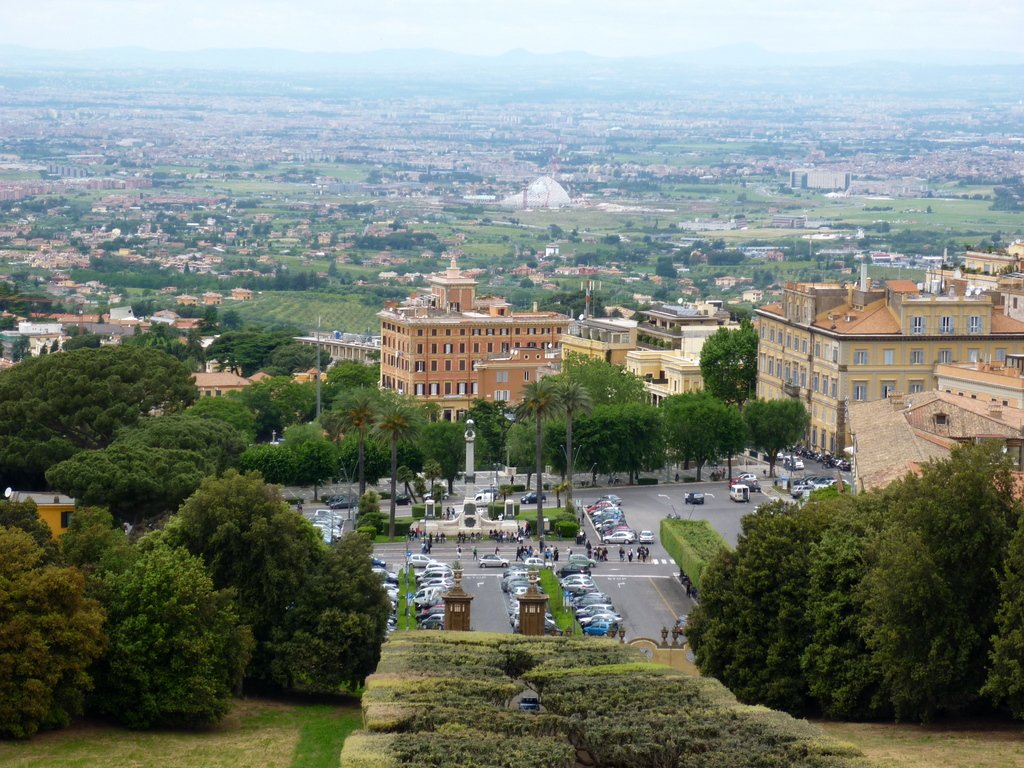
Frascati, the balcony of Rome over the Castelli Romani
Frascati is the recognized capital of the Castelli Romani, that crown of towns the Romans have always considered their weekend escape. Its fortune comes from a precise position: the town occupies the side of the hills that slopes down from the Tusculan hills toward the plain, high enough to enjoy fresh air even in August, and close enough to Rome to remain within the orbit of the papal court. It was this combination that attracted cardinals and the great families of the Curia between the 16th and 17th centuries. They built their summer residences here, later known in history as the Ville Tuscolane. The town's very name tells of uncertain origins. According to local tradition it derives from frasche, the leafy branches with which refugees from nearby Tusculum, razed to the ground in 1191, would have built their first makeshift shelters below the destroyed city. It is a hypothesis, not a documented fact, but it describes well the close bond between Frascati and the ancient city that overlooks it.
Anyone arriving today finds a compact center, made of sloping squares, Baroque palazzi and cellars dug into the tuff, where the local white wine goes with porchetta and the peasant cooking of the Castelli. The town paid a very high price in the Second World War, when the bombings of 1943 destroyed about half of it, villas and monuments included, and what you see is largely the result of reconstruction. But the urban layout, the design of the villas and the vocation for wine have survived, and they make Frascati one of the most complete quick day trips you can make from Rome.
How to Get to Frascati and How to Get Around
The simplest way to reach Frascati is still the regional train from Roma Termini, on the line that links it to the capital through Tuscolana and Ciampino. The trip lasts just over half an hour, and the arrival station is at the level of Piazza Marconi, that is, at the most scenic point of the town, with the balustrade overlooking the Roman countryside. From there the whole historic center can be reached on foot in a few minutes, which makes Frascati an ideal destination even for those who don't drive. The Rome-Frascati railway is not a novelty. It was inaugurated on July 5, 1856 under Pope Pius IX, and it was one of the first lines of the Papal States. The final stretch that brings the train up to the center was completed later, under the reign of Umberto I.
Those who prefer the car follow Via Tuscolana or leave the Grande Raccordo Anulare toward the Castelli, but they have to take into account the difficulty of parking in the historic center, where the streets are narrow and steep. For those visiting several towns in one day, the advice is to rely on the large parking areas down below and go up using the local bus lines, which since the postwar period have replaced the old tram system. Until 1954, in fact, a tramway connected Frascati to Rome and the other Castelli. The line, opened in 1906, was dismantled in favor of road transport, and a local branch from 1916 that reached the railway to Fiuggi through Monte Porzio Catone was destroyed in 1943 and never rebuilt.
The Ville Tuscolane of Frascati
The Tusculan Villas are the real reason Frascati's name entered art history textbooks. They are 12 summer residences built between the sixteenth and seventeenth centuries by the papal aristocracy, who sought the cool of the hills here and, at the same time, a way to display power and culture. They were not farmhouses but open-air theaters, architectural machines designed to amaze the guest with water games, perspectives, grottoes and terraced gardens. Some were destroyed or left unrecognizable after 1943, others became hotels or university seats, but the group as a whole remains one of the most important complexes of Renaissance and Baroque villas in Italy, and the landscape of the Tusculan hills still bears their mark.

Villa Aldobrandini in Frascati
Villa Aldobrandini is the most famous of the Tusculan villas and dominates Frascati from the top of its terrace, aligned with the axis that runs down toward the town and ideally continues all the way to Rome. It was built by Cardinal Pietro Aldobrandini between 1598 and 1602, and it was no whim: the villa was the gift with which his uncle, Pope Clement VIII, rewarded his nephew for bringing Ferrara back under the control of the Church. The first design is by Giacomo della Porta. After his death in 1602, the construction site passed to Carlo Maderno and Giovanni Fontana, who completed the hydraulic works and the terracing. The result is a monumental residence, with the palace dominating a double staircase and a park that climbs the slope. Even today the villa belongs to the Aldobrandini family, which is why the palace is closed to the public. Visitors can see the park, with access managed through the city tourist office, and it is from there that the real invention of the complex can be grasped, the Teatro delle Acque.

The Water Theater of Villa Aldobrandini
Behind the palace, set into the slope, opens the Teatro delle Acque, the nymphaeum that made Villa Aldobrandini a model for all of Europe in the seventeenth century. It is a semicircular exedra carved into the hill, with niches, statues and a backdrop crossed by cascades. The water came down from the wood above along a chain of fountains and once even powered a hydraulic organ, able to play using only the pressure of the water. The design of the theater is credited to Carlo Maderno with the collaboration of the hydraulic engineer Orazio Olivieri. Among the sculptures, the Polyphemus attributed to Jacques Sarrazin stands out, and Sarrazin also created other figures in the nymphaeum. The staging was designed for a specific audience, the distinguished guest who, climbing up from the palace, found this wall of water in front of them as the climax of the visit. Many of the original water games no longer work today, and the water does not flow with the force it once had, but the structure remains legible and continues to tell the story of Baroque summer villa ambition better than any description could.
Villa Falconieri, the Oldest of the Tusculan Villas in Frascati
Villa Falconieri holds the distinction of age: it is the oldest of the Tusculan Villas. It was founded around 1546 as Villa Rufina, named after the bishop Alessandro Rufini who had it built, and then passed to other owners until, in 1628, it reached the Falconieri family, who gave it its definitive name. It was Orazio Falconieri who called in Francesco Borromini around the middle of the seventeenth century, and Borromini reshaped the villa and marked its appearance with his unmistakable hand. Leading decorators, such as Ciro Ferri and Pier Leone Ghezzi, worked inside, and the park still preserves the famous small lake surrounded by cypresses, added in the eighteenth century, one of the most photographed views of the hills. The villa also had an eventful recent history: it was bought in 1907 by the banker Ernst von Mendelssohn-Bartholdy and donated to Kaiser Wilhelm II, and after World War I it was confiscated by Italy and hosted several public bodies. Since 2016 it has been home to the Accademia Vivarium Novum, an institute where Latin and ancient Greek are studied and spoken as living languages.

Villa Torlonia and Its Park in Frascati
Of Villa Torlonia, once among the most sumptuous of the Tuscolane, what survives today is mainly the garden. The palazzo was badly hit by the bombings of 1943 and was not rebuilt, while the park, with its monumental water theater, has become a public garden open to the city. It is the only one of the great Tuscolane complexes that can be visited freely and without booking, and for this reason it is the ideal starting point for understanding what these gardens were: the water scenography that runs down the central axis, the terraces, the view toward the plain. Frascati chose to hand over to its citizens the very villa that the war had turned into a ruin, turning the loss of the palazzo into the creation of an urban park that today hosts walks, concerts and town festivals.
Villa Mondragone, Where the Gregorian Calendar Was Born
Villa Mondragone is the largest of the Tuscolane and the one with the most history. It stands on the hill above Frascati, today within the municipality of Monte Porzio Catone, and was begun in 1567 for Cardinal Marco Sittico Altemps. Martino Longhi the Elder took part in the works, alongside Jacopo Barozzi da Vignola for the overall remodeling, and the building was completed in 1573. The name comes from the dragon in the Boncompagni family coat of arms: it was in fact Cardinal Ugo Boncompagni, who became Pope Gregory XIII, who tied the villa forever to an event that affects every person on Earth. It was right here, in 1582, that Gregory XIII issued the bull Inter gravissimas, which started the reform of the calendar still in use, the Gregorian calendar, with the famous removal of 10 days to realign the reckoning of time with the seasons. The villa later hosted a well-known Jesuit college, active until 1953, and it was here that in 1912 the scholar Wilfrid Voynich bought the coded manuscript that bears his name, still undeciphered today. Since 1981 Villa Mondragone has belonged to the University of Rome Tor Vergata, which uses it as a conference center: it can be visited on the occasion of events and by reservation.

Villa Tuscolana and Villa Grazioli, the Tuscolane That Became Hotels
Not all the Tuscolane villas have remained private residences or institutional seats. Villa Tuscolana, also known as La Rufinella, occupies a panoramic position on the slopes of Tusculum and is today a luxury hotel, which can be visited by booking a stay or an event. Villa Grazioli met the same fate, another cardinal's residence turned into a prestigious hotel, famous for the cycles of seventeenth-century frescoes that decorate its halls. The fact that two of the great villas have become hotels is not a betrayal of their history. Country holidays were their original function, and continuing to welcome guests is, after all, how these buildings survive and sustain themselves. Those who do not intend to stay overnight can still admire them from the outside, including them in a tour of the Tuscolane along with Aldobrandini, Falconieri and Torlonia.
The Religious Architecture of Frascati
Frascati has been a bishopric for over eight centuries: the diocese was moved there from Tusculum after the destruction of the ancient city in 1191, and it is one of the seven suburbicarian dioceses that surround Rome, the ones traditionally entrusted to cardinal bishops. This past left the city a notable heritage of churches, which the 1943 bombings hit hard but which reconstruction has largely recovered.

The Cathedral of San Pietro in Frascati
The Cathedral of San Pietro is the main place of worship in the city and dominates the square of the same name in the old core of Frascati. The travertine façade was built between 1698 and 1700 to a design by Girolamo Fontana, and with its two bell towers it has become the symbolic image of the historic center. The interior dates to the sixteenth century and is attributed to Ottaviano Nonni, known as Il Mascherino. The church was badly damaged by the 1943 bombings and later restored. Inside, the cathedral holds a memorial that surprises many visitors: the plaque commemorating Charles Edward Stuart, the last Catholic claimant to the throne of England, the famous Bonnie Prince Charlie. The link runs through his brother, Henry Benedict Stuart, Cardinal Duke of York, who was bishop of Frascati from 1761 and lived in the city for a long time, funding restorations and works. The Stuart presence in Frascati is one of those unexpected threads that connect a Castelli Romani town to the European dynastic events of the eighteenth century.
The Church of the Gesu in Frascati and the Painted Dome
The Church of the Gesù, late 16th century, is the surprise that awaits those who go in without knowing. Its fame is due to a perspective trick: the dome does not exist. What looks like a real dome, open toward the sky, is in fact a flat surface painted in trompe-l'oeil by Andrea Pozzo, the Jesuit master of architectural perspective, able to simulate depth and volume on a simple wall. It takes a few moments to understand the artifice, and that is exactly the intended effect. The church, tied to the Jesuit order, fits into the great season of Roman religious architecture between the 16th and 17th century, and the false dome of Frascati is one of the most cited examples of that illusionistic painting that in Rome finds in Pozzo its most famous interpreter.
Santa Maria in Vivario and the Medieval Bell Tower of Frascati
If the Cathedral and the Church of the Gesù tell of Baroque Frascati, Santa Maria in Vivario takes you back to the Middle Ages. It was the city's ancient cathedral before the title passed to San Pietro, and it preserves the oldest Romanesque bell tower in Frascati, datable to 1305, articulated on three tiers of two-light windows. It is one of the few medieval testimonies that survive in a town that the modern age and then the war transformed deeply, and it is worth the short detour for those looking for the oldest face of the city, the one before the season of the villas.
The Sanctuary of Capocroce, Patroness of Frascati
On the outskirts of the center stands the Sanctuary of the Madonna di Capocroce, tied to an episode of 1527, the year of the Sack of Rome. Tradition tells that the troops of the Landsknechts, marching toward the Castelli, were stopped or diverted at a votive image of the Virgin, and that in thanks the sanctuary was later built. The Madonna di Capocroce is venerated as patroness of Frascati, and her feast still marks the city calendar. It is a local, rooted cult, which says how much the memory of 1527 and of the wars that devastated the Roman countryside has remained alive in the consciousness of the city.
The Civil Architecture and Historic Center of Frascati
The center of Frascati is organized around two poles: the scenic Piazza Marconi, open onto the panorama, and the old core gathered around the Cathedral. Between the two stretches a fabric of palaces, courtyards and cellars that deserves to be walked, unhurried, letting the climbs carry you from one square to the next.
The Aldobrandini Stables and the Tusculan Museum of Frascati
The Scuderie Aldobrandini are the most successful example of how Frascati has known how to give new life to its historic buildings. They were the 17th-century stables of the cardinal's villa, and they were transformed into a modern cultural hub thanks to the project of the architect Massimiliano Fuksas, who reinterpreted the spaces with a contemporary intervention inaugurated on April 8, 2000. Today they house the Tusculan Museum, which gathers the finds from the excavations of ancient Tusculum and reconstructs the history of the territory from the Roman age to the modern one, together with the municipal library and spaces for exhibitions and events. The visit to the museum is the best way to connect today's Frascati to the ancient city above it: here you see up close the sculptures, inscriptions and architectural fragments that the Tusculan hill has yielded, before going up to walk among the ruins.
Piazza Marconi and the Bishop's Palace
Piazza Marconi is the living room of Frascati, the great terrace from which the city looks at Rome. Facing it are the monumental entrance of Villa Aldobrandini and the buildings that mark the city's life, and it is here that bars, events and the market are concentrated. A little higher up, in the old core, stands the Bishop's Palace, carved out of an ancient 15th-century fortress built between 1458 and 1464: a building that still bears the signs of its defensive origin and that testifies to Frascati's role as seat of the suburbicarian diocese. The center also preserves 16th- and 17th-century palaces, portals, fountains and uphill alleys that, despite the wounds of the war, give back the image of a city of court and vacation.
Tusculum, the Ancient City Above Frascati
Anyone who visits Frascati and doesn't go up to Tusculum misses the heart of its history. On the top of the hill that overlooks the city, at about 600 meters of altitude, stretch the ruins of Tusculum, the Latin city that preceded Frascati by more than 1,000 years. According to legend it was founded in the tenth century BC by Telegonus, son of Ulysses and the sorceress Circe. Beyond the myth, the settlement really did arise in very ancient times on the acropolis, in a dominant position over Via Latina and Via Labicana. Tusculum was for a long time an autonomous power, in relation now of alliance now of rivalry with Rome, before being absorbed by it. In the Middle Ages it became the stronghold of the powerful Counts of Tusculum, who for generations conditioned the election of the popes. Its end was sudden and final: in 1191 the Roman army razed the city to the ground, and it was never rebuilt. It is from that destruction that the fortune of Frascati is born, grown in the valley as natural heir of the lost city, so much so that the bishop's seat was moved from Tusculum to Frascati.
The Roman Theater and the Forum of Tusculum
The archaeological area of Tusculum preserves some of the most evocative ruins of the Castelli Romani. The Roman theater, of the imperial age, is the most legible structure: the semicircular cavea carved into the slope could hold about 1,500 spectators and served as a scenic backdrop for the forum below. The forum, with its colonnaded square, measured roughly 55 meters by 36 and was the center of the city's public life. Around it you can make out the remains of baths, a sanctuary, an amphitheater and the so-called Archaic Fountain, a very ancient hydraulic structure. All of it immersed in a landscape of meadows and woods that makes the climb to Tusculum as much an archaeological visit as a nature walk, with a panorama that ranges from the Roman countryside to the sea on clear days.
Cicero, Cato and the Tusculan Disputations
Tusculum is not only stones: it is one of the places of Latin literature. Here Marcus Tullius Cicero owned one of his favorite villas, the Tusculanum, and it is to this hill that one of his best-known philosophical works owes its title, the Tusculanae Disputationes, the dialogues on happiness, on pain and on death that the orator ideally sets in the quiet of his Tusculan residence. In an earlier age tradition also ties to the territory the gens Porcia, the family of Marcus Porcius Cato the Censor, the austere statesman and writer of the third and second century BC: the city was his place of origin, and his name has remained tied to these hills to the point that the neighboring town is still called Monte Porzio Catone. Walking among the ruins of Tusculum therefore means retracing the military history of ancient Latium and, at the same time, the places through which a part of Roman culture passed.
The Archaeological Area of Cocciano and the Villa of Tiberius
Not all of Frascati's Roman traces are at the top of the hill. In the locality of Cocciano, on the edge of the city, there is an archaeological area with the remains of a Roman villa that tradition attributes to the emperor Tiberius and to Livia Drusilla. The attribution is based on the discovery of lead pipes bearing stamps with imperial names, a type of evidence that archaeologists consider indicative of ownership. The area was acquired by the Municipality in 2006 and is a testimony to how dense, in the Roman age, the presence of aristocratic residences on these hills was, where the powerful of Rome came to seek the same coolness that centuries later would draw the cardinal builders of the Tusculan villas.
The Castelli Romani Regional Park Around Frascati
Frascati is part of the Castelli Romani Regional Park, a protected area that embraces the volcanic hills south of Rome with their chestnut woods, volcanic-origin lakes and trails that connect the towns. The park organizes guided visit programs that often allow access to places otherwise closed, including some of the villas and the area of Tusculum. For those who love walking, the Tusculan hills offer routes of every difficulty, from short loops around Tusculum to crossings that reach the neighboring towns. From Frascati you easily descend toward the lakes: Lake Albano and the small Lake Nemi, both housed in ancient volcanic craters, are a short distance away and complete a day in the Castelli well.
Frascati DOC Wine and the Fraschette
Saying Frascati means, for many Romans, saying white wine. The city gives its name to one of the oldest and best-known white wines of Lazio, the Frascati, produced on the volcanic soils of the Castelli mainly from Malvasia and Trebbiano grapes. It is a wine of very long tradition, so much so that Latin authors already praised the vineyards of these hills, and for centuries it was the wine of the papal court, to the point of being nicknamed the white wine of the Popes. Today production is protected by the Frascati DOC designation, joined by the more recent controlled and guaranteed designation of origin for the superior versions: anyone who wants to really get to know it can pair the visit to the city with a stop at one of the wineries of the area.
The Fraschette of Frascati, Where You Drink the New Wine
The most authentic way to drink Frascati remains the fraschetta. They are the traditional osterie of the Castelli, and their very name recalls the frasca, the leafy branch that was once hung at the entrance to signal that there was new wine to sell. In their original form the fraschette sold only wine: the customer brought the food from home, and you sat at wooden tables to eat your own porchetta, bread and olives accompanying them with the house white. Many fraschette today also serve food, with the poor and flavorful cooking of the Castelli, but the spirit has remained the same: shared tables, few pretensions, wine from the barrel and an atmosphere that in Rome you no longer find. Spending an evening in a fraschetta in Frascati is an experience that is worth the trip as much as the most monumental of the villas, and tells a side of the city that no museum can give back.
The Pupazza Frascatana, the Symbolic Sweet of Frascati
Besides its wine, Frascati has a sweet symbol that few visitors know before arriving: the pupazza frascatana. It's a traditional sweet made with flour, extra virgin olive oil, millefiori honey and orange flavoring, baked until dry and crunchy, and it keeps for a long time. Its shape is that of a woman with three breasts, and this very detail made the pupazza famous. The most widespread explanation is a relatively recent legend, born around the 1960s: the wet nurse used the extra breast to dispense Frascati wine, as well as milk, so as to keep the children quiet during the work in the fields. True or not as the origin may be, the pupazza is today recognized as a traditional agri-food product of Lazio and is unique among Italian anthropomorphic sweets for its three-breasted figure. You find it in the pastry shops of the center, and it's the right edible souvenir to take home after a trip to Frascati.
Frascati, a science hub at the gates of Rome
There is a Frascati that has nothing ancient and surprises those who know the city only for its villas and wine. On the Tusculan hills is concentrated one of the most important scientific research hubs in Italy. Here are based the Frascati National Laboratories of the National Institute of Nuclear Physics, where elementary particles are studied with accelerators built starting in the middle of the 20th century, the ENEA research center, active among other things on nuclear fusion, and ESRIN, the Italian site of the European Space Agency, which manages the data of Earth observation satellites. It's a contrast that says a lot about the character of the place: a few 100 meters from the ruins of Tusculum and from the vineyards that produce a wine praised already by the ancients, people work on particle physics and on the observation of space. Frascati is, in short, a city of two speeds, where the most remote history and frontier research live together on the same hill, and this double nature is itself a reason for interest.
The history of Frascati, from antiquity to today
The history of Frascati is that of a city born from the end of another. To understand it you have to hold together two places, the ancient hill of Tusculum and the modern city in the valley, and follow the thread that runs from the Latins to the bombings of the 20th century.
Frascati in ancient times
In ancient times the territory of Frascati gravitated around Tusculum, a powerful Latin city on the top of the hill. The plain and the slopes were dotted with Roman villas, among them the one linked to Tiberius in the locality of Cocciano, and the hills were already famous for their vineyards. The inhabited center that would become Frascati existed in a smaller form in the shadow of the greater city: its hour had not yet come.
Frascati in the Middle Ages
The decisive moment comes in 1191, when the Roman army destroys Tusculum. The surviving population moves down to the valley, and the small settlement of Frascati begins to grow until it inherits the role of the vanished city, including the transfer of the bishop's seat. In the 15th century the city acquires a fortress, later transformed into the Bishop's Palace, built between 1458 and 1464, a sign of the new rank reached. Frascati thus becomes one of the suburbicarian dioceses, those closest to Rome, and its history is tied ever more closely to that of the Curia.
Frascati in the modern age
The modern age is the golden age of Frascati. Between the 16th and 17th centuries cardinals and the great Roman families transform the hills into a garden of villas: Villa Falconieri around 1546, Villa Mondragone from 1567, Villa Aldobrandini between 1598 and 1602, and then Torlonia, Grazioli, Tuscolana and the others. It's in this period that at Villa Mondragone, in 1582, Pope Gregory XIII promulgates the calendar reform. The city lives on summer vacationing, wine and artistic commissions, attracting architects such as Giacomo della Porta, Carlo Maderno, Francesco Borromini and painters such as Andrea Pozzo and Domenichino. In 1798, on the wave of the French Revolution, Frascati also experiences a brief republican season, aligning itself with the Roman Republic.
Frascati in the contemporary age
The 19th century brings modern infrastructure to Frascati: the railway to Rome in 1856, electricity and public lighting at the start of the 20th century, the tramway in 1906. But the 20th century also holds in store for the city its greatest tragedy. During the Second World War Frascati becomes the seat of the German command of Field Marshal Albert Kesselring, and this turns it into a target. On September 8, 1943, the same day as the announcement of the armistice, the city is devastated by a very harsh bombing. After the war Frascati rebuilds itself, recovering the churches and part of the villas, and finds again its vocation as a city of wine and a tourist destination at the gates of Rome. Today it also hosts important scientific research centers, which make it a small hub of physics and technology, in a curious contrast with the ancient ruins that tower over it.
The bombings of September 8, 1943
The bombing of September 8, 1943 is the wound that still explains the look of Frascati today. That day a formation of 130 American B-17 bombers dropped about 1,300 bombs on the town, aiming to hit the German command of Kesselring, which was based there. The toll was terrifying: about 500 civilians and 200 German soldiers lost their lives, and half of the buildings were destroyed, monuments and villas included. It was the start of a long series of raids that struck the town again in the following months, until the arrival of Allied troops in June 1944. Anyone who walks through Frascati today and notices the contrast between old facades and more recent reconstructions has the trace of that day before their eyes: a large part of what you admire is the result of patient restoration work carried out after the war on a town reduced to a heap of rubble.
A Curiosity About Frascati (RM)
The curiosity few people know is that the calendar hanging on every wall in the world was born on these hills. Not in Rome, not in the Vatican, but in the quiet of a holiday villa above Frascati. It was at Villa Mondragone that, in 1582, Pope Gregory XIII signed the bull Inter gravissimas, launching the reform that bears his name. The Julian calendar, in use since Julius Caesar, had accumulated an error of 10 days over 16 centuries compared with the actual course of the seasons. The reform corrected the gap by erasing those 10 days outright. In the year of the decree, the calendar went directly from October 4 to October 15. Those 10 days simply never existed. That a decision capable of reorganizing time for half the world was made in a villa in the Castelli Romani, among fountains and gardens, is one of those paradoxes of history that make Frascati much more than a wine town. The next time you look at a date, remember that the way we count days was decided here.
Something No One Tells You About Frascati (RM)
What almost no one talks about is that the Frascati you visit today is, to a large extent, a reconstruction. The historic center has the compact, ancient look of a Castelli village, but half of the buildings were destroyed in 1943, and what you admire is often a postwar restoration, carried out with care but on ruins. Villa Torlonia lost its palace and keeps only the garden for exactly this reason. The Cathedral, the Church of the Gesù and many palaces bear scars that the distracted eye doesn't notice. Knowing this changes the way you look at the town. It is not an intact village that survived the centuries, but a community that chose to get back on its feet after total devastation, rebuilding its image stone by stone. There is a dignity in this that is worth keeping in mind as you stroll. Many of the facades that seem unchanging are in fact the sign of a will to start again.
The Advice I Give for Visiting Frascati (RM)
The advice is not to reduce Frascati to a food and wine stop, and to set aside at least a full half day, better if you combine the lower town with the Tusculum hill. Arrive by train in the morning, so you can leave the parking problem down in the valley, and start from the Villa Torlonia park and Piazza Marconi to understand the layout of the villas. Then climb to Tusculum. The walk between the Roman theater and the forum, with the view over the countryside, is the moment most visitors miss, and it is the one that stays with you. Save the wine for last. Toward evening, when the tour buses have left, sit down in a fraschetta and order the house white. Avoid high-season Sundays if you want peace and quiet, because Frascati is the favorite getaway of Romans and gets crowded. And don't plan on entering the private villas without preparing first. Aldobrandini can only be visited in the park and with regulated access. Mondragone and the others are open only by reservation or during events in the regional park.
Another Well-Known Fact, Yet Rarely Mentioned
Everyone knows Frascati is the town of wine, but few connect that wine to a specific geology. Frascati white is born on volcanic soils, those left by the Vulcano Laziale, the extinct volcano whose main crater today holds the lakes of Albano and Nemi. It is the volcanic soil, rich in minerals and well drained, that gives the Malvasia and Trebbiano grapes of these hills the character that sets them apart. The same volcano that shaped the landscape of the Castelli, with its basins and craters, is therefore also the origin of Frascati's winemaking fortune. It is a well-known fact among those who know wine, yet it is rarely explained to the visitor, who tends to separate the geology of the lakes from the cellar where they drink. In reality they are the same story. The ancient fire that built these hills is the same one you taste today in the glass.
The Right Photo to Take in Frascati (RM)
The photograph you take home from Frascati isn't the villa, but the panoramic views. You stand on the balustrade of Piazza Marconi, turn your back on the city and frame the Roman countryside sloping toward the horizon, with the silhouette of the dome of Saint Peter's just visible on days of clear air. It's the same view the cardinal builders of the villas were looking for, and it's the reason Frascati exists as a place for summer vacationing. The best light is that of late afternoon, when the low sun warms the plain and makes the profiles stand out against the light. For those who want the most classic image instead, the scenographic front of Villa Aldobrandini seen from below, aligned with the axis that rises from Piazza Marconi, is the Baroque postcard par excellence. And if you go up to Tusculum at sunset, the Roman theater with the countryside behind it gives a shot that none of the hurried visitors takes home.
Some important events that happened here in history
A few turning points of European history have passed over these hills. The oldest is the destruction of Tusculum in 1191: the Roman army razed the rival city to the ground, closing forever the arc of the Counts of Tusculum and in effect opening the way to the birth of Frascati. Four centuries later, in 1582, at Villa Mondragone Pope Gregory XIII promulgated the calendar reform, an act that still today governs the time of most of the planet. In 1527, the year of the Sack of Rome, the countryside around Frascati was crossed by the landsknechts, and tradition links the birth of the cult of the Madonna of Capocroce to that episode. In 1798 the city lived through its brief republican season in the climate of the French Revolution. But the event that has marked contemporary Frascati more than any other is the bombing of September 8, 1943, when 130 American flying fortresses struck the city, seat of Kesselring's command, causing deaths in the 100s and the destruction of half of the town. They are events extremely distant from each other in nature, but all have left a mark still visible today among these streets.
Who passed through Frascati (RM)
The list of those who passed through Frascati and Tusculum spans 2,000 years. In Roman times the hill hosted the villa of Cicero, who set his Tusculan Disputations here, and tradition links the family of Cato the Censor to the territory. Not far away stood the villa attributed to the emperor Tiberius. Between the 16th and 17th centuries the city became the gathering place of the papal aristocracy: here Cardinal Pietro Aldobrandini, nephew of Clement VIII, and Cardinal Marco Sittico Altemps built their villas, and at Villa Mondragone Pope Gregory XIII stayed. At the villa construction sites worked the greatest architects of the time, from Giacomo della Porta to Carlo Maderno, from Giovanni Fontana to Francesco Borromini, and painters such as Andrea Pozzo and Domenichino. In the 18th century Frascati was the city of Henry Benedict Stuart, cardinal Duke of York and bishop of Frascati, last representative of the Stuart dynasty, whose brother Charles Edward, the famous Bonnie Prince Charlie, is remembered by a plaque in the Cathedral. More recently writers and Grand Tour travelers stayed there, and even the Voynich manuscript passed through Villa Mondragone, purchased here in 1912. Few provincial cities can claim a catalog of guests so varied, running from an emperor to a bibliographic enigma.
What to see around Frascati, in the other Castelli Romani
Frascati is the ideal gateway to the Castelli Romani, and once here it's worth widening your gaze to the neighboring towns, each with its own identity. A few minutes away is Grottaferrata, famous for its Greek abbey founded by Saint Nilus, still officiated according to the Byzantine rite. Climbing toward the ridge you reach Monte Porzio Catone, which shares with Frascati the hill of Villa Mondragone and the wine tradition. Higher still stands Rocca di Papa, the highest town of the Castelli, overlooking the crater. Toward the lakes you descend to Castel Gandolfo, the summer residence of the popes on Lake Albano, and to Marino, the city of the famous Grape Festival. Continuing you meet Albano Laziale, Ariccia with its porchetta and its Baroque palaces, Genzano di Roma with the Infiorata and Nemi with its little lake and wild strawberries. All these centers are part, with Frascati, of the Castelli Romani Regional Park, and together they make up one of the richest day-trip itineraries you can do from Rome.
Quick questions about Frascati (RM)
How far is Frascati from Rome?
Frascati is about 20 kilometers southeast of Rome, on the slopes of the Tusculan hills. By regional train from Roma Termini the center is reached in a little over half an hour.
How do you get to Frascati by train?
From Rome Termini, regional trains run directly to Frascati, the terminus of a branch of the Lazio rail network. The arrival station is at street level in Piazza Marconi, in the most central and panoramic spot in town, and from there the whole center can be reached on foot.
How much does the train ticket to Frascati cost?
The route falls under the Lazio regional fare system, with a metropolitan-type fare. The exact price should be checked at the time of purchase, at the ticket offices or on the official channels of the regional rail service.
Can you visit Villa Aldobrandini in Frascati?
The Villa Aldobrandini palace is privately owned by the Aldobrandini family and remains closed to the public. You can visit the park, with the Teatro delle Acque, through regulated access arranged via the town tourist office.
How many Ville Tuscolane are there in Frascati?
The Ville Tuscolane are traditionally 12, built between the 16th and 17th centuries by the papal aristocracy. The main ones are Aldobrandini, Falconieri, Mondragone, Torlonia, Tuscolana and Grazioli.
Where was the Gregorian calendar signed?
The Gregorian calendar reform was promulgated by Pope Gregory XIII in 1582 at Villa Mondragone, the largest of the Ville Tuscolane, today in the territory of Monte Porzio Catone and owned by the University of Rome Tor Vergata.
What wine is drunk in Frascati?
Frascati gives its name to one of the best-known white wines of Lazio, produced mainly from Malvasia and Trebbiano grapes grown on volcanic soils. It is protected by the Frascati DOC designation, with higher versions under a guaranteed designation.
What are the fraschette of Frascati?
Fraschette are the traditional taverns of the Castelli. The name comes from the leafy branch hung at the entrance to signal new wine. Originally they sold only wine and the customer brought food from home. Today many also serve traditional local cuisine.
Can you climb to Tuscolo from Frascati?
Yes. The Tuscolo archaeological area, with its Roman theater and forum, is reached by climbing the hill above Frascati. It is part of the Castelli Romani Regional Park, which manages its enhancement and organizes visits.
Why is it called Frascati?
According to tradition, the name supposedly comes from frasche, the leafy branches used by refugees from Tuscolo to build the first shelters after the destruction of the ancient city in 1191. It is a local hypothesis, not a documented certainty.
What happened in Frascati during the war?
On September 8, 1943, Frascati, the seat of Kesselring's German command, was hit by a heavy American bombing raid: 130 bombers dropped about 1,300 bombs, with hundreds of victims and half of the city destroyed.
How much time do you need to visit Frascati?
For the lower town alone, half a day is enough. Adding the climb to Tuscolo and a stop at a winery or a fraschetta, it's best to plan a full day in Frascati.
Is Frascati suitable for a day trip with children?
Yes. The Villa Torlonia park is open and suitable for families, the walk to Tuscolo combines archaeology and nature, and the outdoor spaces make the visit comfortable even with small children.
What is the most important church in Frascati?
The Cathedral of San Pietro, with a facade built between 1698 and 1700 by Girolamo Fontana. Inside, a plaque commemorates Charles Edward Stuart, the last Catholic pretender to the English throne.
What can you see in the Scuderie Aldobrandini?
The Scuderie Aldobrandini, restored to a design by Massimiliano Fuksas and inaugurated in 2000, house the Museo Tuscolano with finds from the excavations at Tuscolo, along with the municipal library and spaces for exhibitions and events.
When is the best time to visit Frascati?
Spring and early autumn offer mild weather and vineyards at their best. Sundays in peak season are very crowded, because Frascati is the Romans' favorite day trip. Those looking for quiet should choose a weekday.
What is there to see near Frascati?
The neighboring towns of the Castelli Romani: Grottaferrata with its Greek abbey, Monte Porzio Catone, Rocca di Papa, Castel Gandolfo and Marino toward the lakes, and farther south Albano, Ariccia, Genzano and Nemi.
Does the Chiesa del Gesù in Frascati have a dome?
No, and that is exactly its famous feature. The dome is a false dome painted in perspective by Andrea Pozzo on a flat surface: a famous optical illusion that simulates a real vault open to the sky.
What is the pupazza frascatana?
It is the traditional dessert of Frascati, made with flour, oil, honey and orange, shaped like a woman with three breasts. A legend says the third was used by the wet nurse to give wine to children. You can buy it at the pastry shops in the center.
Are there research centers in Frascati?
Yes. Frascati is home to the Laboratori Nazionali di Fisica Nucleare, the ENEA research center and ESRIN, the European Space Agency's facility for Earth observation: one of Italy's main scientific hubs.
Can you visit the fraschette during the day too?
Many fraschette open mostly in the evening and on weekends, but some are also open at lunch. Hours vary from place to place: it's best to check them on site or call ahead before counting on them for a meal.
Is Frascati part of the Castelli Romani?
Yes, and it is considered the capital of the Castelli Romani, the group of towns on the volcanic hills south of Rome. From Frascati you can easily reach Grottaferrata, Monte Porzio Catone, Rocca di Papa and the towns on the lakes.
One last piece of advice before heading to Frascati
If I had to reduce Frascati to just one piece of advice, it would be this: don't treat it like a wine factory with a view, but as a city with many overlapping stories, and give it time to tell them. Beneath the surface of the quick day trip there is a Latin city razed to the ground, a calendar that regulates the world, an English dynasty in exile and a community that rebuilt itself after being wiped out by bombs. The glass of white wine, at the end of the day, means more if you drink it knowing all this. Take the train in the morning, walk up to Tusculum, come back down to the valley for sunset over Piazza Marconi, and let a fraschetta close the day. That is how Frascati should be experienced, and it is how Romans have been visiting it for centuries.
Article written by the editorial team of TourLeaderPro, contact them for Tours and Private/Corporate/V.I.P. Experiences.
Planning a trip to Rome? English guides for visiting the city are on ItalyPlanner.com.