Monte Porzio Catone (RM)
In short. Monte Porzio Catone (RM) is a municipality of the Metropolitan City of Roma Capitale, on the northern slope of the Alban Hills, between Frascati to the west and Monte Compatri to the east.
Monte Porzio Catone (RM) is a municipality of the Metropolitan City of Roma Capitale, on the northern slope of the Alban Hills, between Frascati to the west and Monte Compatri to the east. Town hall is at Via Roma 5, 00078 Monte Porzio Catone, switchboard 06 942831. By car you leave the A1 highway at the Monte Porzio Catone toll exit and climb for a few kilometers. Alternatively, you take Via Tuscolana to Frascati and from there continue along Via Frascati, the road that connects the two towns and on which the Tusculan villas face. By public transport the reference terminus is Anagnina, the last stop of metro line A, where the regional intercity buses to the Castelli depart. Up-to-date runs and schedules are on the regional carrier's website, because they change between the school period and summer. The town's railway station no longer exists: the line that served Monte Porzio was shut down during World War II. The historic center can be visited free of charge and on foot. For Villa Mondragone (Via Frascati 51, phone 06 72598950) guided visits must be booked. For the Observatory at Via Frascati 33, public openings are tied to the calendar of the institute's outreach initiatives. Prices and hours of the municipal museums should be confirmed with the Comune before leaving, because they follow seasonal shifts.
The municipal territory is entirely within the Castelli Romani Regional Park, and this is the key to understanding Monte Porzio Catone: a town of about 8,500 inhabitants that has, within its own borders, a Latin city destroyed in 1191, the villa where the reform of the calendar we all use was signed, a national astronomical observatory and one of the highest concentrations of wine cellars in the Castelli. It isn't a postcard village. It's a working town, with the vineyard under the house and astrophysics at the top of the hill.

Where is Monte Porzio Catone (RM) and how to plan your arrival
The town occupies a rise that closes the amphitheater of the Alban Hills to the north, the ancient extinct volcanic complex that produced the lakes of Albano and Nemi. From here the view covers the Roman Campagna all the way to the sea, and on north-wind days you can make out with the naked eye the buildings of EUR and the dome of St. Peter's. Anyone coming from Rome has three roads ahead and it's best to choose among them according to the time of day.
By car to Monte Porzio Catone (RM)
The dedicated highway exit makes the town one of the most convenient in the Castelli: from the A1 toward Naples you exit at Monte Porzio Catone and after a 10-minute climb you reach the first houses. The scenic variant goes through Frascati and takes Via Frascati eastward. It's the road of the villas, with Villa Mondragone, Villa Vecchia and Villa Parisi lined up one after another on the hillside. The practical advice is worth more than any description: the historic center has narrow lanes and scarce parking, so leave the car in the lots at the foot of the town and walk up. Anyone arriving on Sunday morning, when there's the market, without this precaution circles for half an hour for nothing.
By public transport
Metro A to Anagnina, then a regional intercity bus. It's the only direct connection from the center of Rome, and it's the one students and commuters use. The trip, traffic permitting, takes between 40 and 60 minutes from the terminus. Alternatively you take the regional train to Frascati from Termini station and finish with the local bus that connects Frascati to Monte Porzio Catone. It's the most elegant solution if you want to combine the two places on the same day, but it requires checking the connections, because evening runs thin out a lot. The local bus lines are run by a private carrier under concession, and the schedules are posted at the town's stops.
When it's best to come
From mid-September to mid-October, no argument. It's the grape harvest period, the light is right for photos from the panoramic terrace, the heat of the Roman Campagna has loosened its grip and the wine cellars are at their liveliest of the year. The week of Ferragosto, on the contrary, is the worst moment: many places close, the museums reduce their openings and the town empties. In winter the historic center is cold and windy but perfectly visitable, and lunches in the town's trattorias are more genuine than in July.
The name Monte Porzio Catone (RM): from Mons Porculi to Cato
The first written record is a bull of Pope Gregory VII from 1074, in which the monastery of Monte Porculi appears among the possessions of the abbey of San Paolo fuori le mura. The place name then recurs in the chronicle of the Cassinese monastery collected by Ludovico Antonio Muratori, where a church of Sant'Antonino in Monte Porculo, Tusculan territory, is mentioned, and in the chronicle of Sicard, which places the battle of 1167 apud Montem Portium.
Mons Porculi, or Porculus, is the form that circulates in the 11th century. Scholars read it as a popular corruption of Mons Porcii or Mons Portius, and link the name to the gens Porcia, the Roman family said to have owned a villa on these slopes. It's an attribution of learned tradition, not an archaeological fact: no inscription found on the spot has so far carried the name of the gens. It's worth knowing, because it's exactly the kind of detail hasty guides turn into certainty.
The second element of the name is very recent. Until 1872 the town was called simply Monte Porzio. The addition of Catone served to distinguish it from the namesake Monte Porzio delle Marche after the administrative unification of the Kingdom. Cato the Censor, the stern Roman statesman born in Tusculum in 234 BC, was the natural candidate: his native city is the one whose ruins lie today in large part in the territory of Monte Porzio. The name, in short, is a learned 1800s choice, not an ancient inheritance. Anyone who writes Monteporzio Catone as one word is wrong: the official spelling has the three words separate.
History of Monte Porzio Catone (RM): from the counts of Tusculum to the Borghese
The battle of 1167
On May 29, 1167, the day of Pentecost, on lands that the documents call Prata Porci, one of the most lopsided and most decisive battles of the medieval Lazio was fought. On one side the Roman communal army, with papal support: the chronicles speak of about 30,000 men, a figure to be read with the caution owed to medieval numbers. On the other a tiny imperial contingent, about 1,500 men between knights and Brabantine mercenaries, led by Christian of Buch, archbishop of Mainz, flanked by the troops of Rainald of Dassel, archbishop of Cologne, and by 300 knights of the counts of Tusculum.
It ended in a rout for the Romans. The Brabantine mercenaries gave way at the initial impact, the cavalry of Cologne held, and the attack from behind carried out by the Tusculans together with an imperial reserve broke the enemy line. The sources count around 10,000 dead and prisoners. The imperial army did not get the advantage it hoped for, because shortly afterward it was decimated by an epidemic in the Roman Campagna and had to retreat to Germany. The real bill was paid by Tusculum: the Romans never forgave the help given to the emperor, and in 1191 they razed the city to the ground. Walking today among the ruins on the hill, you walk inside the consequences of that day in May.
Annibaldi, Altemps, Borghese
In the 15th century the fief passed to the Annibaldi della Molara, one of the baronial families that divided up southern Lazio. In 1581 the Altemps took over, the family of Cardinal Marco Sittico, the patron of Villa Mondragone. In 1613 the territory was bought by Cardinal Scipione Borghese, nephew of Paul V and one of the most unscrupulous collectors in the history of European art. With the Borghese, Monte Porzio enters the great season of the Tusculan villas and stays in it for three centuries.
In 1666 Prince Giovan Battista Borghese, lord of the lands of Monte Porzio, had the parish church rebuilt from the foundations, dedicating it to San Gregorio Magno in honor of Pope Gregory XIII, who had lived and legislated at Mondragone. The town kept modest dimensions for a long time: in 1849 it counted barely 1,200 inhabitants. The modern growth, up to the current 8,500 or so, is entirely 20th century and has a lot to do with the closeness to Rome and with work in the wine cellars.

The duomo of San Gregorio Magno, the mother church of Monte Porzio Catone (RM)
Everyone calls it the duomo, even though it isn't a cathedral and never has been: it's the church of San Gregorio Magno, and it dominates the main square of the historic center. In 1666 the pre-existing 1500s church was demolished entirely to make room for the new building, designed by Carlo Rainaldi, the Roman architect of the twin churches of Piazza del Popolo and of the facade of Sant'Andrea della Valle. The construction was completed in 1672, with finishing work continuing until 1684. The consecration came much later, on June 1, 1766, at the hands of Cardinal Bishop Henry Benedict Stuart, the Cardinal of York, last direct descendant of the Stuart dynasty.
The facade and the bell towers
The facade is Baroque and reads like a textbook: a lower order with Doric pilasters framing the lintelled portal crowned by a curved pediment, an upper order with Ionic pilasters and a triangular pediment. On the sides two twin bell towers, each with a clock and bell chambers with four single-light windows. The interior plan is a Greek cross, a solution not common for a village parish church and a sign of princely patronage: whoever pays wants a church that looks like those of the capital.
Inside the duomo of Monte Porzio Catone (RM)
Inside are preserved works that deserve more visitors than they receive. There is an altarpiece by Ciro Ferri dated 1674, a pupil and continuator of Pietro da Cortona, one of the protagonists of Roman Baroque decoration in the second half of the century. There is a 1600s canvas with San Gregorio attributed to Giacinto Brandi, a prolific and uneven painter, excellent when he worked calmly. The holy water fonts are by the sculptor Francesco Fancelli. A 1700s Via Crucis and an 1800s organ complete the furnishings.
The 1980 earthquake and the return
The Irpinia earthquake of November 23, 1980, which was felt heavily in Lazio too, seriously damaged the building. The church was closed and restoration work began only in 1992, to end in 2011: 31 years between the shock and the complete reopening. Anyone who enters today sees a consolidated and readable interior, and that's the reason the visit is really worth it. A clear piece of advice: give the duomo at least half an hour, not the five minutes that most groups in transit to lunch grant it.

The Museo della Città of Monte Porzio Catone (RM)
The museum occupies four restored rooms of the 1600s core attached to the duomo, and tells the dynamics of settlement of a territory with a history thousands of years long. The exhibition is divided into three sections, and the collection is deliberately heterogeneous, because the history it has to tell is heterogeneous.
The archaeological section
Impasto pottery from the Iron Age, a polychrome mosaic of excellent workmanship, fragments of frescoes from the imperial age, architectural terracottas, statuary, inscriptions and coins. The materials come from Tusculum and from the Tusculan villas scattered across the municipal territory: they are the fragments of an elite residential landscape that between the first century BC and the second century AD covered the whole slope. Looking at the architectural terracottas you understand, better than from any digital reconstruction, how much color ancient buildings had.
The medieval and Renaissance section
Here the protagonist is a papal bull, a document that takes the visitor back to the same papers from which the town's name comes, and next to it appear polychrome majolica, paintings and original engravings. The jump from the archaeological fragment to the written document is abrupt, and the museum doesn't hide it: they are two different ways of knowing the same place.
The Grand Tour and the video room
The third section gathers original documentary material from the 17th, 18th and 19th centuries, including that relating to the Grand Tour, when European travelers climbed the Alban Hills in search of antiquity and landscape. A small video projection room allows you to go deeper into individual themes and works as an introduction to the visit of the archaeological and historical-artistic heritage of the district. On big numbers the Museo della Città doesn't compete with Rome, and that's not its job: it serves to read the territory before walking it, and it's an excellent first stop of the day.
The Museo diffuso del vino of Monte Porzio Catone (RM)
Inaugurated in 2000, it is one of the smartest museums of the Castelli Romani, and almost no Roman visitor knows it. It has no single seat: it is set up in three tinelli, the rooms traditionally used for the production and storage of wine, which face onto one of the streets of the historic center. Hence the formula of the museo diffuso, which forces the visitor to walk through the town between one section and the next and makes them see, necessarily, the urban fabric in which wine was made.
The tools and the trades
The collection gathers winemaking tools and equipment and illustrates the main steps of the supply chain, together with some traditional trades now gone or nearly so: the master cooper, who built and repaired barrels, and the wine carter of the Castelli Romani, the figure who carried the barrels toward the osterie of Rome on Via Tuscolana and on the Appia. They are trades that have left more traces in the Roman language and songs than in museums.
The voices of the winemakers
The route is equipped with QR codes and a wi-fi connection: with a smartphone you watch documentaries built on interviews with elderly winemakers collected in the project Travaso di Cultura. The result is that the exhibited tools stop being mute objects and take back the voice of those who used them. It's a museographic choice that many richer museums have not been able to make.
The tasting room
The visit ends in the tasting room, where you complete your knowledge of the local wines with a guided organoleptic analysis. Procedures, costs and any reservations should be asked directly of the museum or the Comune, because they change with the season and with the groups. If I had to choose a single thing to do in Monte Porzio Catone (RM) with two hours, I'd choose this one, and I'd pair it with a wine cellar.
The Barco Borghese: 16 hectares of mystery under your feet
Overlooking the Roman Campagna and Rome, the archaeological complex of the Barco Borghese is a vast quadrangular platform of about two hectares, on which a group of Renaissance farmhouses faces, built first by the Altemps, then by the Borghese, the same families that owned the nearby Villa Mondragone. The name comes from barco, the term used in the 1500s for a hunting reserve: around 1567 the Altemps turned the area into exactly that.
The 190 underground rooms
The western third of the esplanade is built on an articulated sequence of about 190 vaulted underground rooms of the Roman age, datable to the middle of the first century BC, built in opus caementicium. The surface involved is around 16,000 square meters. The visit takes place along an underground itinerary that crosses foundations, corridors and chambers, and shows up close Roman building techniques that usually stay invisible under the floors of famous monuments.
The charcoal inscriptions
The high point of the route is the epigraphic set preserved on the plaster of one of the innermost rooms: inscriptions traced with brush, charcoal and scratching, that is, the everyday writing of work sites, not the monumental writing of stone slabs. They are rare documents because they are extremely fragile, and that's why the visit is limited in numbers.
Villa or sanctuary?
Investigations along the outer northwest side have brought to light a monumental front articulated in halls decorated with Doric half-columns, today used as a stage backdrop for musical performances. On the functional interpretation of the complex, research is open: the traditional reading sees in the Barco the base of an enormous Roman villa, while a more recent hypothesis proposes instead a sanctuary. It isn't an idle academic dispute, because it completely changes the meaning of the monument. Whoever takes you on the visit should tell you that we don't know yet. If they tell it to you as a certainty, be wary. The complex is the subject of restoration and study, so opening conditions should be checked before showing up.
The Astronomical Observatory of Monte Porzio Catone (RM)
At Via Frascati 33 is one of the seats of the Rome Astronomical Observatory, now a facility of the Istituto Nazionale di Astrofisica. The institute was born in 1923 from the unification of two pre-existing Roman observatories, that of the Collegio Romano and that of the Campidoglio. The Monte Mario seat, inside the 1400s Villa Mellini, was inaugurated on October 28, 1938 with Giuseppe Armellini as first director.
A Rationalist building on top of a Roman villa
The Monte Porzio Catone seat was designed at the end of the 1930s and completed only in 1965: the work site went through the war and came out of it very slowly. The building, of Rationalist layout, stands on the remains of a Roman villa of the first century AD attributed to Matidia Augusta, niece of Trajan and mother-in-law of the emperor Hadrian. The overlap says a lot about this hill: the ancients came here for the air and the view, the 20th-century astronomers came back for the dark sky and the distance from the city lights.
AstroLAB, the telescope and the evenings under the stars
Born as a storage and technical facility for the equipment of the national observatory, the complex has been, since 1988, the main research hub of the institute. It hosts AstroLAB, the educational laboratory used for activities with schools, universities, groups and private individuals, and the Monte Porzio telescope. Guided visits and observation evenings are organized periodically and must be booked. The calendar is published on the observatory's official website, and the winter dates sell out fast.
The astronomical museum and the historical collections
The institute's historical heritage, gathered in the Museo astronomico e copernicano founded in 1873 by Arturo Wolynski, is kept at the Rome seat of Monte Mario: 1600s spyglasses, antique telescopes, astrolabes going back to the 12th century and a library of about 4,000 volumes with old editions of Copernicus, Ptolemy's Almagest and works by Galileo. It's worth knowing before leaving, so as not to go up to Monte Porzio expecting the display cases that are in Rome instead. The research carried out here concerns cosmology, extragalactic and stellar astrophysics, solar physics and the development of advanced instrumentation.
Fermi, Majorana and the movies
The link between this hill and 20th-century Italian physics is strong in collective memory too: the story of the boys of Via Panisperna, the group gathered around Enrico Fermi with Franco Rasetti, Emilio Segrè, Bruno Pontecorvo, Edoardo Amaldi and Ettore Majorana, under the direction of Orso Mario Corbino, reached the general public with Gianni Amelio's 1988 film devoted to that very group and to Majorana's disappearance. The racial laws and politics dissolved in a few years the most promising school of physics in Europe.

Villa Mondragone, the villa that changed the world's calendar
If Monte Porzio Catone (RM) has a monument of European importance, this is it. Villa Mondragone stands at about 416 meters above sea level, on the Tusculan slopes between Frascati and Monte Porzio, and it is the most monumental of the Tusculan villas. The address is Via Frascati 51, the phone 06 72598950.
Altemps, Longhi, Vignola
Work began in 1567 at the will of Cardinal Marco Sittico Altemps, who entrusted the design to Martino Longhi the Elder. During the work Longhi was joined by Jacopo Barozzi da Vignola, the greatest architect of the second half of the Italian 1500s. The construction was finished in 1573. The name comes from the dragon in the Boncompagni family coat of arms: when Cardinal Ugo Boncompagni, later Pope Gregory XIII, settled in the villa, the heraldic dragon gave its name to the mountain.
Inter gravissimas, 1582
On February 24, 1582, Gregory XIII promulgated the bull Inter gravissimas, the act that reformed the Julian calendar and introduced the calendar the whole planet still uses today. The bull bears the date of Mondragone. Every time someone, on any continent, writes today's date, they use the system that came out of this villa above Monte Porzio Catone. In the history of the Castelli Romani there is no other fact of comparable scope, and the paradox is that almost no Roman knows it.
The Voynich manuscript
The second European story of Mondragone is more recent and more obscure. From 1865 to 1953 the villa belonged to the Jesuits, who ran a boarding school there. In 1912 the antiquarian bookseller Wilfrid Michael Voynich bought here from the Jesuits the illustrated codex that has borne his name ever since: the Voynich manuscript, written in an alphabet that nobody has ever deciphered, full of plants that don't exist and incomprehensible astronomical diagrams. Today it is kept at the Beinecke Library of Yale University and is probably the most studied and least understood book in the world. It came out of here.
Popes, guests and Tor Vergata
Under the Borghese the villa reached its greatest splendor and hosted pontiffs, among them Clement VIII and Paul V. In 1858 the French writer George Sand stayed there, and left a trace of it in her fiction. In 1981 the Jesuits sold the villa to the Università degli Studi di Roma Tor Vergata, which since 1982 has housed there the university's congress and representation center, as well as library spaces. Today the villa is visited with guided tours by reservation, and has an elevator, disabled access, free parking and a bookshop. Practical advice: ask when booking whether the chosen date coincides with a congress, because in that case the visitable spaces are reduced.
The other Tusculan villas of Monte Porzio Catone (RM)
Villa Parisi
The central body was built between 1604 and 1605 for Monsignor Ferdinando Taverna. In 1614 the property passed to Cardinal Scipione Borghese, who entrusted Girolamo Rainaldi with the renovation: the side wings, the nymphaeum and the arms portal are due to him. The works of 1729 commissioned by Camillo Borghese followed, along with the later decorative additions of Marcantonio Borghese. Paolina Bonaparte, sister of Napoleon and wife of Prince Camillo Borghese, stayed there for a long time. Since 1896 the villa has belonged to the Parisi family, hence its current name, and it borders Villa Mondragone and Villa Vecchia. In recent years it has been used as a film set, among others for the international comedy shot in 2019 under the title Love Wedding Repeat, directed by Dean Craig.
Villa Vecchia
You come across it along the road that connects Frascati to Monte Porzio Catone. Its origins go back to the mid-16th century, to 1558 according to local tradition, and after many transformations and changes of ownership the building is now used as a hotel. It is a use that saved the complex: many minor villas of the Castelli, without an economic function, have been lost.
Palazzo Borghese
In the historic center the baronial palace of the Borghese is preserved, the urban sign of the lordship that governed the town from 1613. It does not have the fame of the villas outside the town, but it is the building that explains the shape of the center: the square, the duomo and the main streets are arranged around it. If you want to understand how a feudal town in Lazio worked, look at the sequence of palace, church, square, and you will have the answer in 30 seconds.
The Tusculan Hermitage of Camaldoli
Above the town, in an isolated position on the wooded slope, stands the Tusculan Hermitage of Camaldoli, founded in 1607 by the Congregation of the Camaldolese Hermits of Monte Corona. In 1613 the foundation was completed, reaching the definitive configuration that can still be recognized: the church, dedicated to Saint Romuald, founder of the Camaldolese, and the separate cells of the monks, arranged according to the eremitic rule that alternates individual solitude and communal life.
Hospitality to outsiders and pilgrims is guaranteed, but it is strictly conditioned by ancient rules, among them the one still in force that bars women from entering. It is a rule that surprises visitors and that you need to know before organizing a group outing: whoever accompanies mixed groups must know it, otherwise half the group ends up outside the gate. The conditions of the visit must be agreed directly with the monastic community.
Tusculum, the destroyed city above Monte Porzio Catone (RM)
The archaeological area of Tusculum is spread across the territories of Monte Porzio Catone, Frascati, Grottaferrata and Monte Compatri. It is the site that gives meaning to all the others: without Tusculum there would be neither the Roman villas, nor the counts who dominated the papacy, nor the name of the town.
Telegonus and the founding legend
Ancient tradition attributed the founding of the city to Telegonus, son of Ulysses and the sorceress Circe, and placed it in the 10th century BC. It is myth, not history, and that has to be said clearly. But it is an important myth, because it served the Tusculans to claim an origin equal to that of Rome. Latin cities also fought one another through genealogy.
The Latin League and Lake Regillus
Tusculum was one of the main centers of the Latin League. In the Battle of Lake Regillus, which the sources place in 499 or 496 BC, the Latin forces led by the Tusculan Octavius Mamilius were defeated by the Romans. From there began the absorption of the city into Rome's orbit. In 381 BC Tusculum obtained Roman citizenship and became a municipium, along a path that historians point to as a model of the Roman way of absorbing the conquered rather than annihilating them.
Cicero and the villas of the hill
In the late Republican and early imperial age the hill became the retreat of the Roman aristocracy. Cicero owned the Tusculanum here and set the Tusculan Disputations there, five books of moral philosophy written in 45 BC after the death of his daughter Tullia: grief, death and happiness are discussed in a villa on these slopes. Lucullus and the emperor Tiberius also had properties in the area. Anyone who walks today among the holm oaks of the hill walks in the midst of the foundations of those houses.
The counts of Tusculum and the popes
From the 10th century the family of the counts of Tusculum controlled the city and, for long stretches, the papacy itself: several popes came out of this house, in one of the most debated seasons in the history of the Church. The end came in 1191, when the Romans, with imperial consent, destroyed the city in reprisal for the support given to Frederick Barbarossa and for the defeat of 1167. The surviving inhabitants went down to the valley and contributed to the birth of the neighboring towns, Frascati first of all.
What you see today
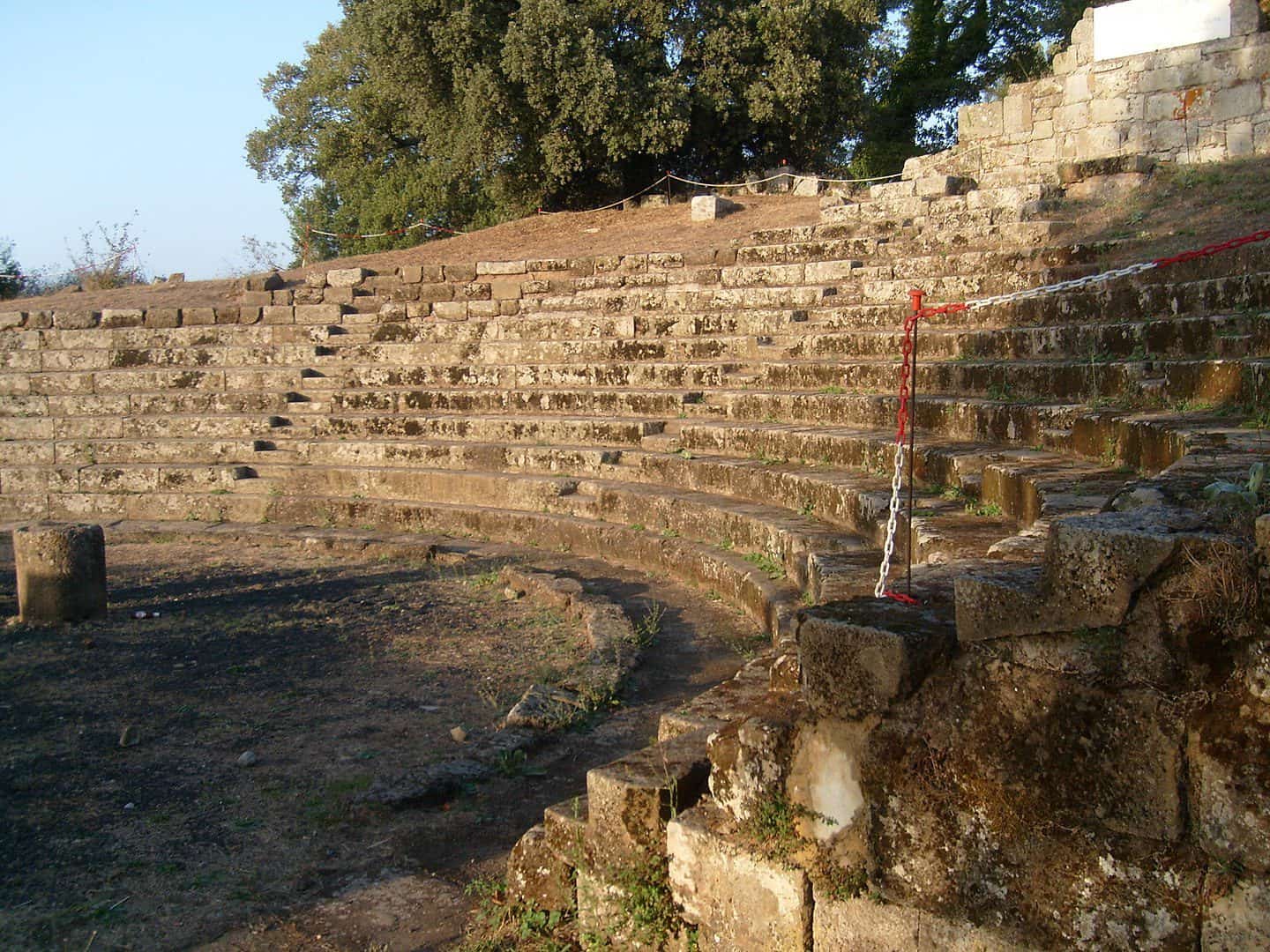
What remains is the Roman theater of the first century BC, the best preserved monument of the site, with the cavea set against the slope. The forum area, the heart of the ancient city. The remains of the amphitheater, which could hold about 3,000 spectators. The medieval quarter on the acropolis, with traces of the fortress. And stretches of paved road with tombs. Modern archaeological investigations between 1994 and 2009 were carried out by Spanish teams in collaboration with Italian institutions. Wear closed shoes: the ground is uneven and slippery in spring.

The Castelli Romani Regional Park around Monte Porzio Catone (RM)
The Castelli Romani Regional Park was established by Regional Law 2 of 1984 and protects about 15,000 hectares on the ancient complex of the Vulcano Laziale. It includes 18 municipalities, among them Monte Porzio Catone, Frascati, Grottaferrata, Marino, Castel Gandolfo, Albano Laziale, Ariccia, Genzano di Roma, Nemi, Rocca di Papa, Rocca Priora, Monte Compatri, Lanuvio, Lariano and Velletri.
Inside the protected perimeter are the two volcanic lakes, Lake Albano and Lake Nemi, the peak of the Maschio delle Faete and the archaeological site of Tuscolo with the Tusculan villas. The territory is not fenced and can be walked freely, with the exception of private properties and archaeological areas subject to protection and regulated access. From Monte Porzio start trails that climb toward Tuscolo and continue along the ridge. They are easy routes, but in summer they should be tackled early in the morning, because shade on the ridge is scarce.
The wine of Monte Porzio Catone (RM): Frascati DOC and DOCG
Viticulture is the main economic activity of the municipality, and that's not a figure of speech: the municipal territory falls entirely within the Frascati production zone.
The denominations
Frascati obtained the denominazione di origine controllata in 1966, approved on March 3 of that year. In 2011 the two denominazioni di origine controllata e garantita arrived: Frascati Superiore and Cannellino di Frascati, the naturally sweet version. The production zone includes the entire territory of Frascati, Grottaferrata and Monte Porzio Catone, plus portions of the municipalities of Rome and Monte Compatri, for about 8,300 hectares on the northern slopes of the Alban Hills.
The grape varieties
The production code requires at least 70 percent malvasia bianca di Candia and malvasia del Lazio, alone or together. Up to 30 percent may come from bellone, bombino bianco, greco bianco, trebbiano toscano and trebbiano giallo, and within this share a limited part may come from other white grapes suitable for cultivation in Lazio. The difference between an ordinary Frascati and a serious one almost always comes down to the percentage of malvasia del Lazio, the most aromatic and most difficult variety to grow.
The wine cellars of Monte Porzio Catone (RM)
The municipality has one of the highest concentrations of wine cellars in all the Castelli Romani. Among the historic and best-known producers of the territory are Santa Benedetta, Casal Pilozzo, Villa Simone, Fontana Candida, Cantina Ribelá and Poggio le Volpi. A large part of the product still goes to the Roman market today, the rest goes abroad. One piece of advice: call first. The cellars of the Castelli welcome people gladly, but almost none is equipped to receive visitors without notice, and at harvest they have other things to do.
Carducci, Enotrio Romano and wine
On a house in the historic center is posted a plaque with verses by Giosuè Carducci, signed with the pseudonym Enotrio Romano: "Pour the wine, O friends. May the foaming wine shake every torpor from the soft nerves, purge the clouds from the afflicted mind, drown the slothful tedium in the heart." The pseudonym itself is a program, because Enotria is the ancient Greek name for the land of wine. Finding the plaque takes a bit of patience and a willingness to ask for directions in town. It's one of the most photographed objects for the people of Monte Porzio and one of the least known to visitors.
The cuisine of Monte Porzio Catone (RM): serpette, manine and the rest
Wine is the main actor of Monte Porzio's gastronomy, but it doesn't perform alone. The sweet specialty par excellence is serpette and manine: the latter are puff pastries filled with cream, whose shape recalls a hand, hence the name. They are bought in the town's bakeries and vanish in an instant. For first courses the local cooking follows the Roman repertoire closely, with amatriciana and carbonara as the mainstays, accompanied by grilled meats and the porchetta of the Castelli.
The rule: you don't come here to eat fish. You come to eat what the territory produces, you drink white, and you accept that lunch lasts two hours. Anyone in a hurry should get a porchetta sandwich and eat it on the panoramic terrace looking at Rome. It works just as well, and costs a tenth as much.
Sant'Antonino Martire and the festivals of Monte Porzio Catone (RM)
The patron saint is Sant'Antonino Martire and the festival falls in September, when the town comes alive for a few days with religious celebrations and civic events. The saint already appears in the medieval papers tied to the place, a sign that the cult is as old as the settlement. The month of September in Monte Porzio Catone also concentrates the events tied to the grape harvest and wine: it's the main reason I recommend that period to anyone who can choose. The annual program of events is published by the Comune and changes from year to year, so it should be checked before setting a date.
A curiosity about Monte Porzio Catone (RM)
The date you read this morning on your phone was born here. On February 24, 1582, Pope Gregory XIII promulgated the bull Inter gravissimas, the act by which the Julian calendar was corrected and replaced by the calendar that today governs the flights, contracts, birthdays and harvests of almost the whole planet. The bull bears the date of Villa Mondragone, the residence on the Tusculan slopes that the pope had chosen as his summer home and workplace. The problem to be solved was centuries old: the Julian year lasted 11 minutes and 14 seconds longer than the real solar year, and that tiny difference, accumulated from the fourth century onward, had shifted the spring equinox by 10 days, throwing the date of Easter out of place. The solution, worked out by a commission of astronomers and mathematicians, was as brutal as it was effective: 10 days were deleted from the calendar, and October 4, 1582 was followed directly by October 15.
The detail that makes the curiosity even tastier is Europe's reaction. The Catholic countries adopted the reform almost immediately, the Protestant ones rejected it for more than a century because it came from Rome, and Great Britain accepted it only in 1752, when by then the gap had risen to 11 days. Russia came in 1918. For three and a half centuries, in short, Europe lived with two different dates on the same day, and the reason for the division had been signed in a villa above Monte Porzio Catone. The second curiosity of the place is complementary to the first: the name Mondragone comes from the dragon in the coat of arms of the Boncompagni, Gregory XIII's family. A heraldic dragon christened a mountain, and the mountain hosted the birth of modern time.
Something nobody tells you about Monte Porzio Catone (RM)
The most mysterious book in the world came out of this hill. In 1912 the antiquarian bookseller Wilfrid Michael Voynich, a Pole naturalized British, bought from the Jesuits who had their boarding school at Villa Mondragone a lot of old manuscripts. Among them was an illustrated codex, written in an unknown alphabet, filled with drawings of plants that match no existing species, astronomical diagrams, and female figures immersed in tubs connected by piping. Since then that book has been called the Voynich manuscript, and it is kept at the Beinecke Rare Book and Manuscript Library of Yale University.
Nobody has ever read it. American and British military cryptographers who during the two world wars had broken much more recent and much more sophisticated codes tried. Linguists and philologists tried, and in the last 20 years neural networks. Radiocarbon dating of the parchment has placed the support in the early 1400s, which eliminated the most convenient hypothesis, that of a 19th-century forgery put together for the antiquarian market. All the others remain open: a cipher, a constructed language, glossolalia, an elaborate Renaissance hoax.
What nobody tells you, when you go up to Monte Porzio Catone, is that you are visiting the place where that codex spent centuries in silence before becoming a worldwide obsession. There is no plaque, no dedicated room, no panel. There is only the villa. And that's the right way: the Voynich manuscript resists explanation, and an explanatory display case would be the only thing out of place in this story.
Frequently asked questions about Monte Porzio Catone (RM)
Where is Monte Porzio Catone (RM)?
Monte Porzio Catone (RM) is on the northern slopes of the Alban Hills, in the Metropolitan City of Roma Capitale, between Frascati to the west and Monte Compatri to the east, about 20 kilometers southeast of Rome. The town hall is at Via Roma 5. The town occupies a rise that closes the amphitheater of the Alban Hills to the north, the extinct volcano that produced the lakes of Albano and Nemi.
How do you get to Monte Porzio Catone (RM) from Rome without a car?
To get to Monte Porzio Catone (RM) from Rome without a car, you take metro A to Anagnina and from there a regional intercity bus headed to the Castelli Romani. Anyone arriving by car instead has three possible roads, to be chosen according to the departure time from Rome.
How much does it cost to visit Monte Porzio Catone (RM)?
The most beautiful part of Monte Porzio Catone (RM) is free: the historic center, the panoramic terrace and the trails of the Castelli Romani regional park have no ticket. The municipal museums and the guided visits to Villa Mondragone, the Barco Borghese and the Astronomical Observatory instead have rates that vary by type, age and season, and it's best to check them directly with the bodies that manage each site.
Is Monte Porzio Catone (RM) suitable for kids?
Yes, Monte Porzio Catone (RM) works well with kids thanks to three specific offerings: the astronomical observation evenings at the Observatory, the underground route of the Barco Borghese with its cave effect, and the Museo diffuso del vino, which with videos and QR codes entertains more than a parent expects. The Tuscolo hill can be tackled with a stroller only if it's sturdy, because of the terrain.
How much time do you need to visit Monte Porzio Catone (RM)?
Visiting Monte Porzio Catone (RM) in an hour, as often happens to those who include it as a stop between Frascati and the return to Rome, is not enough to see almost anything. The town should be taken as a base for a whole day, spending the early morning at Tuscolo with trekking shoes, when the hill is deserted and the light makes the structures of the ancient theater readable.
Why is Villa Mondragone so important in Monte Porzio Catone (RM)?
Villa Mondragone, on the Tusculan slopes at about 416 meters above sea level, is the monument of European importance in Monte Porzio Catone (RM): here on February 24, 1582, Pope Gregory XIII signed the bull Inter gravissimas, the act that gave birth to the calendar that today governs flights, contracts and birthdays in almost the whole world. Work on the villa began in 1567 at the will of Cardinal Marco Sittico Altemps.
When is the patron saint's festival of Monte Porzio Catone (RM) celebrated?
The patron saint of Monte Porzio Catone (RM) is Sant'Antonino Martire and the festival falls in September, with religious celebrations and civic events that enliven the town for a few days. The same month also concentrates the events tied to the grape harvest and wine, and that's why it's the period I recommend for a visit.
What to see in Monte Porzio Catone (RM) besides the historic center?
Besides the duomo of San Gregorio Magno, in Monte Porzio Catone (RM) these are worth a visit: the Museo della Città in the four 1600s rooms attached to the duomo, the Museo diffuso del vino set up in three tinelli along the town's streets, the archaeological complex of the Barco Borghese and the area of Tuscolo, the destroyed Roman city that is spread across the territories of several municipalities of the Castelli.
My advice for visiting Monte Porzio Catone (RM)
Don't come for an hour. It's the mistake I see made most often: Monte Porzio Catone ends up in programs as a 20-minute stop between Frascati and the return to Rome, and in 20 minutes you see nothing. The town should be taken as the base of a whole day, and the right order is this: early morning at Tuscolo, with trekking shoes, when the hill is deserted and the raking light makes the structures of the theater readable. Down into town around 11:00 for the Museo della Città, which will give you the key to interpret what you've just walked. A slow lunch in a trattoria in the center. An afternoon split between the Museo diffuso del vino and a wine cellar booked in advance. Sunset on the panoramic terrace.
The second piece of advice concerns reservations, and it should be taken literally. Villa Mondragone, the Barco Borghese, the Observatory and the wine cellars all work by appointment, with calendars independent of one another and shifts that change with the season. Whoever arrives improvising finds closed gates and then says that in Monte Porzio there is nothing to see. Two phone calls made the week before completely change the day. If you have to cut something for lack of time, cut the Hermitage of Camaldoli, not because it doesn't deserve it, but because it has tight access restrictions and is worth a dedicated visit of its own.
Third piece of advice, the least touristy of the three: talk to people. This is a town of 8,000 inhabitants where whoever works in a cellar is the child of someone who worked in a cellar, and where oral memory is still a working archive. A question asked at a bar counter about the Carducci plaque or about the vat rooms of the wine museum will take you further than any panel. If you are organizing a visit for a group and want a licensed guide who really knows the territory of the Castelli, the professional reference is the editorial team of TourLeaderPro, which works with authorized tour leaders in Rome and the province.
Another well-known fact, and yet rarely mentioned
Everybody knows that the Castelli Romani produce white wine. Almost nobody connects that wine to the geology that makes it possible, namely to the fact that Monte Porzio Catone (RM) is built on a volcano. The Vulcano Laziale, or Colli Albani volcanic complex, erupted repeatedly between 600,000 and 20,000 years ago, covering the Roman Campagna with tuffs, pozzolanas and ashes. The lakes of Albano and Nemi are craters filled with water. The hills on which the vineyards climb are pyroclastic deposits altered into deep, loose soils, rich in potassium and mineral elements, with excellent drainage and the capacity to warm up quickly in the sun.
This is the technical reason why Frascati exists and why it already existed in Roman times, when the amphorae of the Colli Albani supplied the city. It is not a tradition born by chance, it is the direct consequence of volcanic activity. The same geology also explains the architecture: the tuff blocks of the cellars, the rooms dug out to keep the wine at a constant temperature, the vat rooms of the dispersed museum. And it even explains the structure of the Barco Borghese, whose underground rooms exploit the stability of the volcanic bed.
The fact is well known, in the abstract: anyone who has studied geography knows that the Castelli are volcanic. But almost nobody, in front of a glass of Frascati, makes the connection. In front of the view over the Roman Campagna, with the two craters on the right and the vineyards under your feet, the wine begins to appeal even to those who did not appreciate it. The landscape is the best technical sheet there is.
The right photo to take at Monte Porzio Catone (RM)
The photo everyone takes is the one from the town's panoramic terrace toward Rome, with the Roman Campagna in between. It is a good photo and it should be taken, but at the right time: early in the morning, with the sun behind you, or in the last hour before sunset, when the raking light picks out the reliefs and the haze of the plain takes on color. In the middle hours of the day the same framing gives back a whitish mush in which nothing can be told apart. If there is a north wind, the day after rain, the dome of Saint Peter's can be seen with the naked eye and becomes the natural subject with a telephoto lens.
The best photo, however, is another one and nobody takes it. It is the shot looking up from below at the facade of the duomo of San Gregorio Magno with the two twin bell towers backlit, toward late afternoon, when the sun passes between the two towers. The symmetry of the Rainaldi layout holds up well in a frontal shot, and the two clocks give an immediate point of reading. Stand at the opposite edge of the square, bring the camera down to chest height so as not to distort the verticals, and wait for someone to cross: the human figure gives scale and the square stops looking empty.
Third option, for those with time and legs: from Tusculum, with the Roman theater in the foreground and the town in the background. It is the only framing that holds together the 3,000 years of this hill in a single frame. Avoid the flash inside the Barco Borghese and inside the museum rooms, and always ask before photographing inside the cellars: some allow it gladly, others don't, and courtesy costs little.
Some important events that took place here in history
The first is the battle of May 29, 1167. An imperial army of about 1,500 men, led by the Archbishop of Mainz Christian of Buch and supported by the knights of the counts of Tusculum, routed the Roman communal militia, which was much larger. The chronicles count around 10,000 Roman dead and prisoners. It is one of the gravest defeats ever suffered by the commune of Rome, and its consequences lasted until 1191, the year of the destruction of Tusculum in reprisal.
The second is from February 24, 1582: the promulgation of the bull Inter gravissimas at Villa Mondragone, the birth certificate of the Gregorian calendar. It is probably the document of the most universal scope ever signed in Lazio outside Rome.
The third is from 1666: the complete demolition of the 1500s church and the start of work on the new duomo to a design by Carlo Rainaldi, on the initiative of Prince Giovan Battista Borghese. The construction ended in 1672, the finishing in 1684, the consecration only in 1766 at the hands of Cardinal Henry Benedict Stuart. Exactly a century between the first stone and the rite of consecration: a rhythm that says a lot about how things were really built in the Papal State.
The fourth is from 1872, when the town took its current name of Monte Porzio Catone to distinguish it from the namesake municipality in the Marche: an administrative act that tied the name of the village forever to that of Cato the Censor and to the memory of Tusculum.
The fifth is from 1912: the sale to Wilfrid Voynich, by the Jesuits of Mondragone, of the manuscript that bears his name. The sixth is from 1965, with the completion of the astronomical observatory's seat on the hill, a work site opened at the end of the 1930s and dragged on through the war. The seventh is from 1981, when the Jesuits ceded Villa Mondragone to the University of Rome Tor Vergata, saving from abandonment a complex that risked final decay. The eighth is the long story of the Irpinia earthquake of November 23, 1980, which closed the duomo for decades and whose repair ended only in 2011.

Who has passed through Monte Porzio Catone (RM)
The first name is Marcus Porcius Cato, the Censor, born in Tusculum in 234 BC: the most uncompromising politician of republican Rome, the one who ended every speech in the senate by demanding the destruction of Carthage. The town has borne his name since 1872. On the hill Marcus Tullius Cicero had his villa, where he set the Tusculanae disputationes of 45 BC. Lucullus and the emperor Tiberius also had properties in the area.
Matidia Augusta passed through, and stayed, niece of Trajan and mother-in-law of Hadrian: the remains of her villa of the first century lie under the building of the astronomical observatory. There was Cardinal Marco Sittico Altemps, patron of Mondragone from 1567, and above all there was Ugo Boncompagni, Pope Gregory XIII, who reformed the calendar from here in 1582. The villa then hosted other pontiffs, among them Clement VIII and Paul V.
Among the Borghese, Cardinal Scipione, the collector who bought Monte Porzio in 1613 and Villa Parisi in 1614. Prince Giovan Battista, who rebuilt the church in 1666. Camillo, who in 1729 put his hand again to Villa Parisi. And with Camillo came to Monte Porzio Catone Paolina Bonaparte, sister of Napoleon and his wife, who stayed a long time at Villa Parisi: the same woman who in Rome posed for Antonio Canova in the Venere vincitrice of the Galleria Borghese.
The architects who have worked here make a first-rate list: Martino Longhi the Elder and Jacopo Barozzi da Vignola at Mondragone, Girolamo Rainaldi at Villa Parisi, Carlo Rainaldi at the duomo. Among the artists, Ciro Ferri and Giacinto Brandi in the duomo, Francesco Fancelli sculptor of the holy water fonts.
In the 1800s the French writer George Sand passed through, a guest at Mondragone in 1858. And the town hosts, engraved on a plaque, the verses of Giosuè Carducci signed Enotrio Romano. In 1912 Wilfrid Voynich arrived at Mondragone and left with the manuscript. Among the most recent passages are those of the movies: Villa Parisi has been a set for international productions, among them the comedy directed by Dean Craig in 2019. Not bad, for a town of 8,000 inhabitants 20 kilometers from Rome.
What to see around Monte Porzio Catone (RM)
The neighborhood is perhaps the best in Lazio. To the west is Frascati, with Villa Aldobrandini dominating the square and the cathedral of San Pietro. To the east Monte Compatri, the other town that shares the Tusculan ridge. Going south you reach Grottaferrata with its Greek abbey, and then the lakes: Lake Albano below Castel Gandolfo, and Lake Nemi with its wild strawberries. Rocca di Papa and Rocca Priora are the two highest towns of the Castelli, and from Rocca Priora, on clear days, you can see the sea. Marino is the home of the grape festival. Albano Laziale preserves the structures of the camps of the Second Parthian Legion. Ariccia has the palace and the bridge, besides the porchetta. Genzano di Roma has the flower carpet in June. Velletri closes the Castelli to the south.
Anyone organizing a day trip from Rome finds in this hill belt everything needed without ever going beyond 40 kilometers from the center. For those planning a trip to Italy and reading in English, ItalyPlanner keeps a guide devoted to day trips and one on things to do in Rome, useful for fitting the Castelli into a wider itinerary.
Monte Porzio Catone (RM) with kids and accessibility questions
Three things work with kids: the observation evenings at the observatory, when on the calendar, because looking at Saturn through an eyepiece is an experience nobody forgets. The underground route of the Barco Borghese, which has the cave effect. And the museo diffuso del vino, which with its videos and QR codes entertains more than a parent expects. Tuscolo can be tackled with a stroller only if it's sturdy and with patient adults: the terrain is uneven.
On accessibility the situation is uneven, as in all hill towns. Villa Mondragone has an elevator, access for people with disabilities, free parking and restrooms. The historic center has steep slopes and historic paving, so it has to be assessed case by case. For the underground rooms of the Barco and for the archaeological area of Tuscolo, access conditions should be asked about when booking, because they depend on the restoration work currently under way.
How much does a day in Monte Porzio Catone (RM) cost
The most beautiful part of the town is free: the historic center, the panoramic terrace, the park trails, the view. The municipal museums and the guided visits to Villa Mondragone, the Barco Borghese and the observatory have rates and procedures that should be asked directly of the respective bodies, because they vary by type of visit, age bracket and season. Cellar tastings are booked per person and generally cover a selection of wines with a food accompaniment.
The cost nobody counts is transport: anyone coming without a car will spend less than €10 round trip from Rome on public transport tickets, but will pay in time, because evening connections are sparse. Anyone traveling in a group who wants to optimize the day finds on the TourLeaderPro site the information to organize professional accompaniment, and for direct requests the contacts page.
Quick questions about Monte Porzio Catone (RM)
Where exactly is Monte Porzio Catone (RM)?
On the northern slopes of the Alban Hills, in the Metropolitan City of Roma Capitale, between Frascati to the west and Monte Compatri to the east, about 20 kilometers southeast of Rome. The town hall is at Via Roma 5.
How do you get to Monte Porzio Catone (RM) from Rome without a car?
Metro A to Anagnina and then a regional intercity bus to the Castelli. Alternatively a regional train to Frascati and a bus connection to Monte Porzio Catone. Schedules should be checked beforehand, because they vary between the school period and summer.
Is there a railway station in Monte Porzio Catone (RM)?
No. The line that served the town was shut down during World War II and was never reactivated. The nearest useful station is the one at Frascati.
How many inhabitants does Monte Porzio Catone (RM) have?
A little over 8,500. In 1849 the inhabitants were about 1,200: the growth is almost entirely 20th century.
Why is it called Monte Porzio Catone and not just Monte Porzio?
The current name dates to 1872 and served to distinguish the municipality from the namesake Monte Porzio in the Marche. Catone recalls Marcus Porcius Cato the Censor, born in Tusculum in 234 BC.
Is it written Monteporzio Catone as one word?
No, the official spelling is Monte Porzio Catone, in three separate words. The joined form is a common error, online too.
What can you see in half a day in Monte Porzio Catone (RM)?
The historic center, the duomo of San Gregorio Magno, the Museo della Città and the panoramic terrace: they are all within walking distance of one another and three hours at an easy pace is enough.
Can Villa Mondragone be visited?
Yes, with guided visits by reservation, by contacting the facility at Via Frascati 51. Since the villa is the congress center of the University of Tor Vergata, it's best to ask whether on the chosen date there are events that limit the visitable spaces.
Is it true that the Gregorian calendar was born in Monte Porzio Catone (RM)?
The bull Inter gravissimas of Gregory XIII, which introduced the Gregorian calendar, was promulgated on February 24, 1582 and bears the date of Villa Mondragone, in the territory of Monte Porzio Catone.
What is the Voynich manuscript and what does it have to do with Monte Porzio Catone (RM)?
It is an illustrated codex in an undeciphered alphabet, today at Yale University. In 1912 it was bought at Villa Mondragone by the bookseller Wilfrid Voynich, who got it from the Jesuits who owned the villa.
Can the Barco Borghese be visited?
The complex can be visited on a guided route through the underground rooms, but it is the subject of restoration and study: openings should be checked beforehand with the Comune, because they are limited in numbers.
Can women enter the Tusculan Hermitage of Camaldoli?
No. The rule still in force bars women from entering. It's an old restriction and should be known before organizing a group visit.
Is the observatory of Monte Porzio Catone (RM) open to the public?
It is a research seat of the Istituto Nazionale di Astrofisica, and opens to the public on the occasion of guided visits and observation evenings, by reservation and according to a calendar published by the institute.
Where are the observatory's ancient telescopes and astrolabes?
In the collections of the Museo astronomico e copernicano, which are at the Monte Mario seat in Rome, not at Monte Porzio Catone.
Are the ruins of Tuscolo in the municipality of Monte Porzio Catone (RM)?
In part yes: the archaeological area of Tusculum falls between the territories of Monte Porzio Catone, Frascati, Grottaferrata and Monte Compatri.
When was Tuscolo destroyed?
In 1191, at the hands of the Romans, in retaliation for the support given to the emperor and for the defeat suffered in the battle of 1167.
Is the wine of Monte Porzio Catone (RM) Frascati?
Yes. The whole municipal territory falls within the Frascati production zone, DOC since 1966, with the two DOCGs of 2011: Frascati Superiore and Cannellino di Frascati.
Which grapes make up Frascati?
At least 70 percent malvasia bianca di Candia and malvasia del Lazio. Up to 30 percent bellone, bombino bianco, greco bianco, trebbiano toscano and trebbiano giallo.
Can you visit the wine cellars of Monte Porzio Catone (RM)?
Many welcome visitors, but almost always by appointment. At harvest availability shrinks, so it's best to phone a few days ahead.
What are the typical sweets of Monte Porzio Catone (RM)?
Serpette and manine, puff pastries filled with cream whose shape recalls a hand. You find them in the bakeries of the center.
When is the patron saint celebrated?
Sant'Antonino Martire is celebrated in September. The program varies from year to year and is published by the Comune.
What is the best time to come to Monte Porzio Catone (RM)?
Between mid-September and mid-October, for the grape harvest, the light and the climate. The worst period is the week of Ferragosto, when many businesses close.
Is Monte Porzio Catone (RM) suitable for kids?
Yes, especially for the astronomical observation evenings, the underground route of the Barco Borghese and the museo diffuso del vino. The archaeological area of Tuscolo, however, requires trained legs.
Can you go trekking from Monte Porzio Catone (RM)?
Yes. The municipal territory is entirely in the Castelli Romani Regional Park, and from the town start trails toward Tuscolo and the ridge. In summer it's best to start early.
How long does the visit to the duomo of San Gregorio Magno take?
With attention to the works, half an hour. Opening hours follow those of the parish and should be checked, particularly outside the hours of the celebrations.
What's the difference between Monte Porzio Catone (RM) and Frascati?
Frascati is bigger, more touristy and better equipped with services. Monte Porzio Catone is more compact, more agricultural and keeps a direct relationship with the vineyard. The Tusculan villas are split between the two territories, and Tuscolo joins them.
The final advice
Of all the towns of the Castelli Romani, Monte Porzio Catone is the one that gives back the most to those who take the trouble to book. It doesn't have a scenic square that photographs itself, it doesn't have a lake, it doesn't have a festival that fills the buses. It has a villa from which the world's calendar came out, a hill full of Latin ruins, a national observatory above an imperial villa, and a town that actually makes wine instead of just selling it. Anyone who arrives without calling anyone sees half the town and leaves disappointed. Anyone who organizes the day with two calls goes home convinced of having found something others don't know. And is right.
Article written by the editorial team of TourLeaderPro, contact them for Private/Corporate/V.I.P. Tours and Experiences.
Planning a trip to Rome? The English-language guides for visiting the city are on ItalyPlanner.com.