Enrico Fermi Center – Historical Museum of Physics and Study and Research Center at the Viminale
In short. The Enrico Fermi Center has two addresses, and it's worth knowing that before leaving the house: the registered office and the historic building are at Via Panisperna 89 a, 00184 Rome, while the visitors' entrance is at Piazza del…
The Enrico Fermi Center has two addresses, and it's worth knowing that before leaving the house: the registered office and the historic building are at Via Panisperna 89 a, 00184 Rome, while the visitors' entrance is at Piazza del Viminale 1, on the side of the Ministry of the Interior building. The museum can only be visited by reservation, on set days and times, and the visit is free. For those who don't arrive with a school class or an organized group, the tool is the open day: two shifts, at 17:30 and 18:30, lasting about an hour, accompanied by researchers of the center, up to five people on a single reservation, and at the time of booking you need the first name, last name and date of birth of every participant, because you are entering a ministerial complex. Groups book from eight people up, on weekdays, in Italian or English. Schools in the morning on weekdays, from October to June. On weekends the museum is closed. Bookings reopen in September 2026. Phone +39 06 4550 2901, email info@cref.it, calendar and forms at museum.cref.it. You get there by metro line A, Repubblica stop, or metro line B, Cavour stop, or by buses 64, 70, 71, 117, 170 and H that run along Via Nazionale, stop Nazionale/Palazzo Esposizioni, four stops from Piazza dei Cinquecento in front of Termini.
To find your bearings among the other possible visits in the city, the page on tourist attractions in Rome collects the places you can visit neighborhood by neighborhood.
What the Enrico Fermi Center Really Is
The official name of the body is Museo Storico della Fisica e Centro Studi e Ricerche Enrico Fermi, and the acronym it signs its scientific work with is CREF. It is not a municipal museum, not a private foundation, not a university section: it is a public research body, born from a law passed by Parliament in 1999, number 62, and overseen by the Ministry of University. It has legal personality under public law and statutory, financial, patrimonial and accounting autonomy. Whoever expects the ticket office, the bookshop and the cloakroom will be thrown off: here you enter a research institute that also has a museum, not a museum that hosts a few researchers.
The double mission is written in the statute and is visible to the naked eye as soon as you pass the gate. On one hand the center preserves, studies and tells the scientific legacy of Enrico Fermi, and to do so it has set up a permanent exhibition path on the ground floor of the building. On the other it pursues research lines of its own, interdisciplinary, that apply the methods of physics to problems that have little to do with the nuclear physics of the 1930s. The third task, less conspicuous but decisive, is protecting the historical memory of the monumental complex of Via Panisperna: without that mandate the building would have remained an archive depot.
The Enrico Fermi Center is one of the few visits in Rome where the place and the content coincide to the centimeter. Nuclear fission is not told in just any room. It is told in the corridor where it was discovered.
Where the Enrico Fermi Center Is and How to Get There
The double address of the Enrico Fermi Center: Via Panisperna 89 a and Piazza del Viminale 1
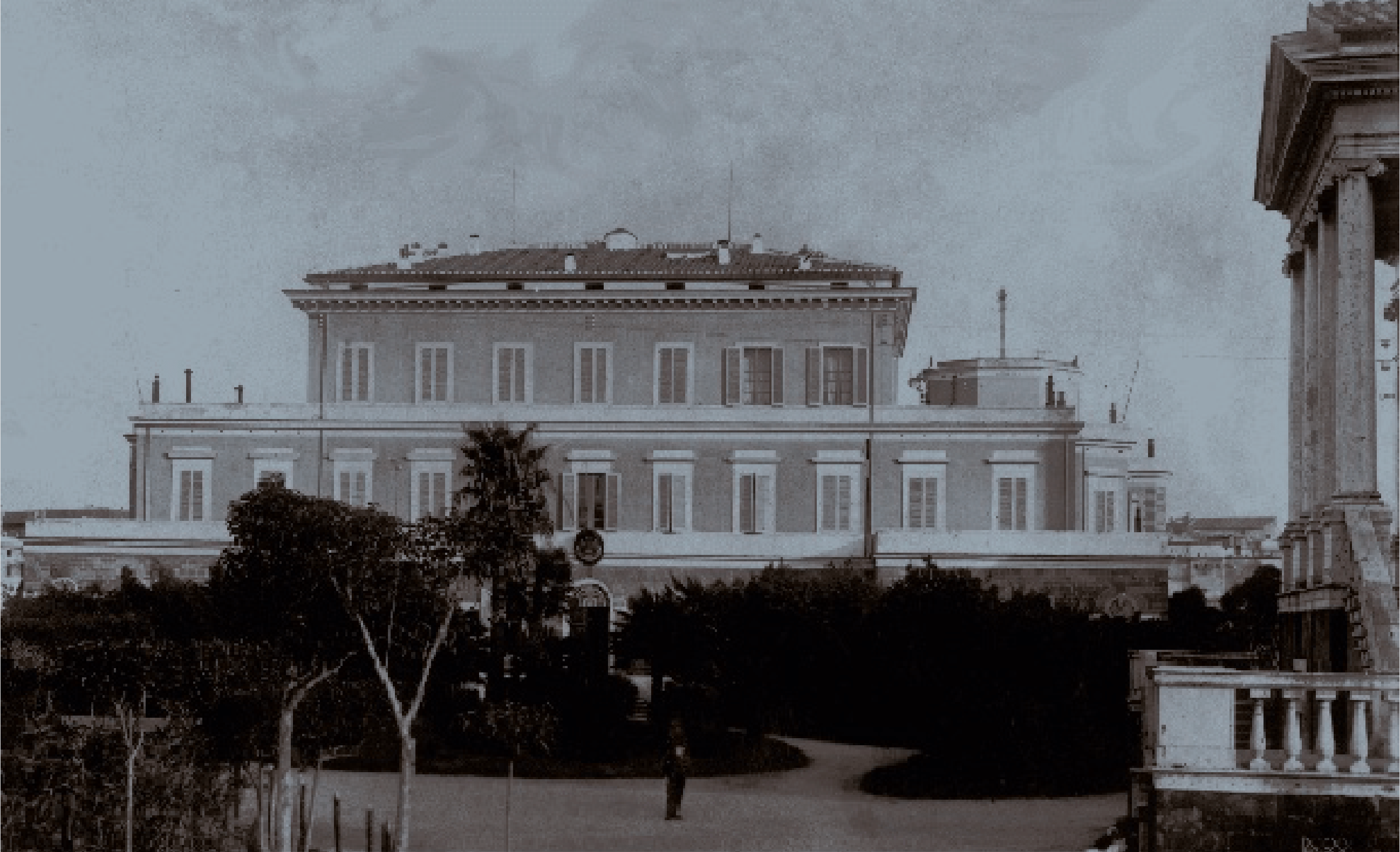
The building was constructed when Via Panisperna was still a street of vegetable gardens and convents that ran down from the Esquiline toward the Forums, and its historic street number is the one every physics book cites. The registered office and shipments in fact remain at Via Panisperna 89 a, 00184 Rome. Only that in the meantime, around the building, the Viminale palace has grown, and public access today goes through there: guest entrance at Piazza del Viminale 1, same postal code, on the opposite side from the 19th-century facade.
This double geography generates an impressive number of lost visitors. Whoever sets the navigator to Via Panisperna arrives in front of a closed portal and realizes they went to the wrong side of the block when they are already 10 minutes late. The advice is banal and worth gold: aim for Piazza del Viminale 1 and ignore the historic address, which serves for mail and not for the public.
Metro, bus and on foot to reach the Enrico Fermi Center
The district is Monti, the position is the saddle between the Esquiline and the Viminale, and this means you get there from practically anywhere. Metro line A stops at Repubblica, metro line B stops at Cavour: from both it's a few minutes' walk, moderately uphill from Cavour, downhill from Repubblica. The buses that climb Via Nazionale are the 64, the 70, the 71, the 117, the 170 and line H, and the useful stop is Nazionale/Palazzo Esposizioni, about four stops from Piazza dei Cinquecento in front of Termini station.
Whoever arrives by train can easily go on foot: from Termini you exit on Via Cavour side or onto Piazza dei Cinquecento, take Via Nazionale and in barely a quarter of an hour you are in front of the Viminale. It's a walk that crosses one of the most severe and least touristy urban stretches of the center, with the Umbertine facades, the Palazzo delle Esposizioni on the right and the bulk of the ministry closing the view. Private cars, instead, are an idea to drop right away: the limited traffic zone, the gates and the total absence of free parking make the undertaking more expensive than a taxi.
What you need to get into the Enrico Fermi Center
Here comes the point that sets this visit apart from any other in Rome. Entry happens through the perimeter of a ministerial complex, and the reservation requires the first name, last name and date of birth of each participant, communicated in advance. It is not a bureaucratic formality invented by the museum: it is the condition for the names to end up on the list at the gate. Whoever shows up without being on the list doesn't get in, whoever arrives with an unannounced friend leaves the friend outside.
The practical corollary is that you must bring an ID document, and bring the real one, not the photo on the phone. The second corollary is punctuality: the shift is single and the group enters together. On this there is no compromise: you arrive a quarter of an hour early, wait in the square, and go in without hurry and without a rush.
How to Visit the Enrico Fermi Center: Open Days, Groups, Schools
The open days of the Enrico Fermi Center
The museum is inside the Viminale complex and for this reason visits take place on set days and times, by reservation. To open the doors to the general public anyway, the center invented the open day formula: monthly appointments, usually in the late afternoon, with the guided visit entrusted directly to researchers of the body. The 2025 and 2026 calendar included November 11 and December 11, 2025, then January 27, February 24, March 18, April 21, May 20 and June 24, 2026. The recurring time is 17:30, with a second shift at 18:30 on the dates when demand justifies it.
The visit lasts about an hour and is free. You book from the online form, indicating the preferred time and your personal data. With a single reservation you can bring up to five people, and for small family or friend groups you list first name, last name and date of birth of each in the notes field. It must be said clearly: the open days published for the season just ended are all sold out. This is not a museum where you show up on a Saturday afternoon hoping for a free spot.
The calendar for the following season is published when bookings reopen, in September 2026. Whoever wants to get a head start signs up for the museum's newsletter, which is the tool the center uses to announce new dates, and puts a reminder in the diary for the first days of September. The places available are few and go fast: it is one of the rare Roman visits where the alarm at eight in the morning in front of the computer still makes sense.
Group visits to the Enrico Fermi Center
Groups book by filling in the dedicated form, with a minimum of eight people. Visits are held on weekdays, because on weekends the museum is closed, and the stated duration is about an hour. You can choose between Italian and English, and this makes the Enrico Fermi Center one of the few Roman destinations truly usable for a specialized international audience: university delegations, associations of science teachers, corporate study trips.
Whoever organizes must keep two things in mind. The first is the response time: the reservation goes through a form, not a switchboard, and confirmation arrives when the staff manages to process it. The second is the rigidity of the schedule, which depends on the life of the body and not on the needs of the group. A tour operator who slips this visit into the middle of a packed itinerary risks blowing up the rest of the day. The right way to fit it in is to put it at the close of the afternoon, with the return to the hotel right after.
The Enrico Fermi Center with schools
School classes are the historic and majority audience. Visits are held in the morning on weekdays, from October to June, by reservation only, and the request must be made specifying type of school, class, number of participating students and a preferred date. The museum states it is aimed above all at third-year middle school classes and the last three years of high school: classical, scientific and arts high schools, technical and vocational institutes. For non-Italian classes visits in English are available.
The school calendar has an internal logic of its own: Wednesday morning is the reference day, with additional openings on Tuesday and Thursday in peak request periods. For schools too, bookings reopen in September 2026. A teacher who wants to bring the class in spring would do well to write in the fall, not in April.
A clear opinion, from someone who has seen hundreds of classes visiting Rome: this is one of the few educational outings where the students of the last years of the science track really come out different from how they went in. Not because there is a show, but because the story of induced radioactivity is told at the exact spot where it happened, by people who practice physics for a living. It is the opposite of a field trip.
The Building on Via Panisperna: 140 Years in a Few Rooms
Blaserna and the first practical school of physics in Italy
The story begins in 1872, when Pietro Blaserna, a physicist born in Fiumicello in the Gorizia area in 1836, takes the chair of Experimental Physics at the Royal University of Rome and becomes the first director of its institute. Rome had been the capital for two years and badly needed to acquire the scientific infrastructure that the other European capitals had possessed for decades. In 1874 a ministerial commission chooses the Viminale hill as the site of the future physics institute: available land, good air, distance from the vibrations of traffic and from the fumes.
The building is constructed in the immediately following years and in 1881 the new Physics Institute of the Royal University of Rome is inaugurated on Via Panisperna. The novelty is not the wall, it's the method. Blaserna imports an idea that did not exist in Italy: the practical school, that is, a place where students are finally free to handle the instruments and conduct experiments on their own, instead of watching the professor demonstrate at the lectern. It is the first practical school of physics in Italy, and this detail alone explains why half a century later, in those same rooms, a group of 20-somethings felt entitled to take apart, reassemble and invent.
Blaserna does not stop at teaching. In 1897 he promotes the birth of the Italian Physical Society, the body that still today holds together the community of Italian physicists. He dies in 1918, leaving an equipped institute and a teaching tradition.
Orso Mario Corbino, the Almighty
On Blaserna's death Orso Mario Corbino takes over, a Sicilian from Augusta, born in 1876, in the chair of Experimental Physics and the direction of the Institute. Corbino is the figure who makes everything else possible, and in the current narrative he is systematically sacrificed to his more famous students. A serious wrong. He was a serious physicist, a formidable organizer and a man with excellent political connections, which in the 1920s meant being able to obtain chairs, grants and instruments where others obtained only pats on the back.
His insight was to understand that atomic and nuclear physics was about to become the decisive terrain and that Italy could enter it in time if it bet everything on very few, very young people. Corbino identifies Enrico Fermi, protects him, builds a chair around him and gives him free rein. Within the group the nickname that suited him was the Padreterno, the Almighty, and it was not a joke without foundation: without him there would have been no Via Panisperna in the sense in which we understand it today. Corbino dies in 1937, before seeing the dispersal of the team he had gathered.
The Boys of Via Panisperna and their nicknames
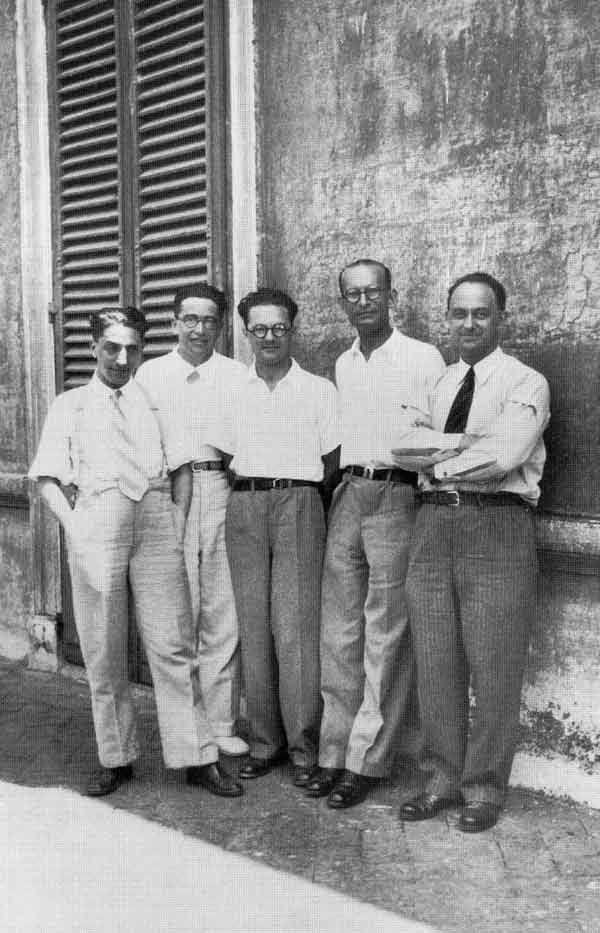
The group that works in the building between the late 1920s and the mid-1930s went down in history as the Boys of Via Panisperna, but inside the walls they called each other by curial nicknames, with a humor that says a lot about the Rome of those years. Enrico Fermi was the Pope, for the infallibility of his calculations. Franco Rasetti, who was Fermi's peer and accomplice since their years in Pisa, was the Cardinal Vicar. Emilio Segrè, with his prickly character, was the Basilisk. Edoardo Amaldi, the youngest and the most methodical, was the Abbot. Bruno Pontecorvo, who arrived still a kid, was the Puppy. Ettore Majorana, who demolished other people's hypotheses with two lines of calculation, was the Grand Inquisitor. And above them all, as has been said, the Padreterno Corbino.
The group also included Oscar D'Agostino, a chemist and not a physicist, a decisive and almost always forgotten figure: without his chemical separations of the irradiated elements, the neutron experiments would not have produced readable results. A museum that manages to tell the chemist too, and not just the physicists, is a museum that has understood how research really works.
It is worth recalling the ages. In 1934, the decisive year, Fermi was 33, Amaldi 29, Segrè 29, Majorana 28, Pontecorvo 21. They were a team of kids working in a building in the scientific provinces of Europe and who within 12 months put Italy at the center of world physics. Whoever visits the Enrico Fermi Center and does not keep this fact in mind misses the most moving part of the story.
The annus mirabilis 1934 at the Enrico Fermi Center
1934 is the year the museum calls, without exaggeration, annus mirabilis. In January the Joliot-Curies announce in Paris the artificial radioactivity obtained by bombarding light elements with alpha particles. Fermi reads, reflects and understands that the right particle is not the charged one but the neutron, which being electrically neutral is not repelled by the nucleus. In March the group obtains the first results of artificial radioactivity induced by neutrons, and in the following months begins to systematically irradiate all the elements of the periodic table it can lay hands on.
On October 20, 1934 comes the discovery that changes everything: the effect of paraffin in slowing down neutrons. Six days later, on October 26, the group proceeds to patent the process for producing artificial radioactive substances. A scientific discovery and an industrial patent within a week: a detail that says how little those kids were the absent-minded dreamers of the popular version.
From the move of 1936 to the State Police Archive
In 1936 the Physics Institute is moved to the new site at the University City of Rome, at Piazzale Aldo Moro. It is the moment when the building on Via Panisperna begins its long decline. The group disperses for reasons that have nothing to do with science: Majorana disappears in March 1938, the racial laws of 1938 hit Segrè and Pontecorvo directly and Fermi indirectly, whose wife Laura Capon was Jewish. Within a few months the strongest team in Europe falls apart among emigrations, flights and absences.
By 1943 the building has lost every scientific function. It passes into the hands of the interior administration and becomes the seat of the State Police Archive. For decades, therefore, the building in which the action of slow neutrons was discovered serves to store files. It isn't a colorful detail: it is the reason the building still exists. A property in use by a ministry is not demolished or turned into apartments, and this irony of history saved the building from the years of Roman building speculation.
The law of 1999 and the restoration of the monumental complex
In 1999 Parliament approves law 62, which establishes the Museo Storico della Fisica e Centro Studi e Ricerche Enrico Fermi, transforming the status of the old Physics Institute of Via Panisperna. The legislator's idea was explicit: to bring the building back to a scientific use that would honor the memory of the discoveries of Fermi's group made in that place, and to set up there a museum with the original artifacts of the experiments, supplemented by audiovisual systems capable of making those events understandable to later generations too.
Between the law and the ribbon cutting 20 years go by, which is the Italian average time between a good idea and its realization. The building undergoes a rigorous philological restoration, that is, an intervention that reconstructs the historical state of the rooms instead of reinterpreting them, and in October 2019 the museum opens to the public on the ground floor of the monumental complex. From that moment the building has resumed the scientific function it had lost 80 years earlier.
The thing that must be said without beating around the bush: the restoration is finished, the museum is open and works, and whoever reads around that the building is still a construction site is reading old news. What remains partial is access, which depends on the location inside the Viminale perimeter and not on ongoing works.
The Route of the Enrico Fermi Center, Station by Station
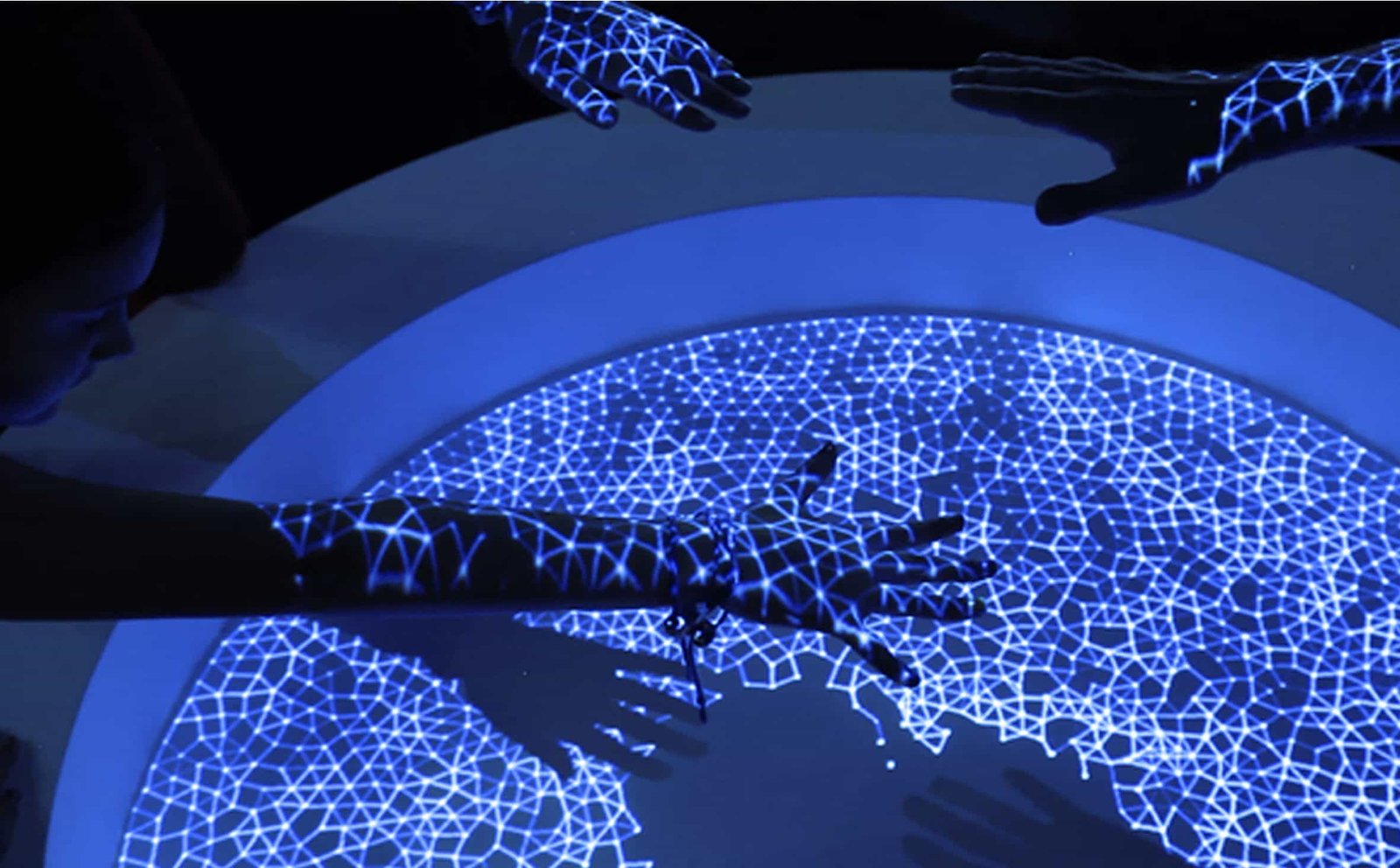
The exhibition path is titled The Scientific Legacy of Enrico Fermi and is divided into around 10 stations that retrace the scientist's life and discoveries, from Rome to America. The display combines traditional objects and panels with multimedia technologies: graphic visualizations, interactive panels, touch screens and holographic screens. The center has also made available a virtual version of the path, divided into eight stations, which is worth looking at before the visit, because the time on site is short and arriving prepared doubles the yield.
Welcome to the museum
The first station is a first-person presentation: the story is entrusted to the voice of Fermi, who explains how the museum is located in the building in which, together with his collaborators, he made some discoveries so important that they earned him the Nobel Prize in 1938. It is a risky narrative choice, because the historical first person can slip into little theater, and instead here it works: it serves to establish right away that the visitor is not in a generic science museum but inside a precise workplace.
In this section already appear the objects that will become the thread of the visit: the paraffin cube, some Geiger counters, the notebook, the Brunsviga analog calculator. The multidisciplinary approach of the original group is also underlined, which is the real methodological lesson of the place.
A historic building
The second station is dedicated to the building. It retraces the founding of the institute between 1871 and 1881, the figure of Pietro Blaserna and that of Orso Mario Corbino, and places the building in its urban context: Via Panisperna, Monti district, the saddle between the Esquiline and the Viminale. It is here that the museum explains the matter of the practical school, that is, the freedom given to students to use the instruments and conduct experiments autonomously, which was the real revolution introduced by Blaserna.
Whoever arrives with the idea that the place matters little leaves this room with the opinion turned upside down. The internal geography of the building, the long corridors, the garden with the pond, the distance between the rooms, all this materially conditioned the experiments of 1934. Experimental physics is also a matter of meters and seconds.
Fermions and bosons
The third station deals with the theoretical contribution that carries Fermi's name in every physics textbook in the world. In February 1926 Fermi publishes the theory on the behavior of the particles we now call fermions, and shortly after Paul Dirac independently arrives at the same result: hence the name Fermi-Dirac statistics. The museum explains the difference between the two families of particles with one of the best lines you can hear in an exhibition room: bosons always want to be together, while fermions refuse to be together.
The particles of matter are fermions, the particles of light such as photons are bosons. It sounds like a specialists' detail and instead it is the reason why matter takes up space, why tables can't be walked through and why chemistry exists. The room manages to get this passage across even to someone who has never opened a book on quantum mechanics, and that is thanks to the display and not to luck.
The first nuclear physics congress in Rome
In October 1931 Rome hosts the first international congress of nuclear physics, organized by the Royal Academy of Italy at the urging of Corbino and Fermi. The names that are rewriting the discipline arrive in the city, and the group photograph of that conference is one of the most cited documents of 20th-century physics. The room tells the scale of the operation: summoning to Rome the world community of nuclear physics at a time when the nucleus was still a largely mysterious object meant declaring that Italy intended to play that game.
It is also the congress where the nature of the nucleus is openly discussed before the neutron was identified by James Chadwick, the following year. Seeing this chronological sequence lined up on a panel gives the measure of how quickly things were running: in 1931 they conjectured, in 1932 the neutron was discovered, in 1934 at Via Panisperna it was used as a projectile.
Beta rays
The station dedicated to beta decay tells the theoretical work that many physicists consider Fermi's absolute masterpiece, superior in depth to the very experimental discoveries that earned him the Nobel. In 1933 Fermi proposes a theory of beta decay that introduces a new type of interaction between particles, the one we now call the weak interaction, and that finally makes sense of the apparently irregular behavior of the electrons emitted by radioactive nuclei.
The detail everyone tells, and that is true, concerns the fate of the article. Fermi proposed it to the journal Nature, which rejected it because it contained speculations judged too far from reality. Fermi did not insist and published the theory in Italian and in German. It is probably the most expensive editorial rejection in the history of scientific journals, and the room is right not to turn it into a joke: that rejection tells us how bold the idea was, not how obtuse the editor was.
Radioactivity induced by slow neutrons
This is the central room, the one the museum exists for. In 1934 the group systematically bombarded the elements with neutrons, then measured the induced radioactivity with Geiger counters. At a certain point an anomaly emerges that would have driven anyone crazy: the results changed depending on the table on which the apparatus rested. It was Bruno Pontecorvo who noticed that some wooden tables had apparently miraculous properties compared with marble tops.
Fermi drew the correct conclusion. On October 20, 1934, instead of the lead he should have used, he put a slab of paraffin between the neutron source and the silver target. Paraffin is rich in hydrogen, like wood. The measured activity shot upward. The mechanism, clarified in a few hours, is that neutrons slowed by collisions with hydrogen nuclei are captured much more easily by the target nuclei than fast neutrons.
The same afternoon the group repeated the test in the water of the goldfish pond in the institute's garden, because water too is rich in hydrogen and because it was the biggest water container within reach. The confirmation came. The fact that one of the founding discoveries of the nuclear era was verified in a garden fountain, with the fish inside, is the most Roman thing this story could have produced.
The Nobel
The Nobel room tells the story of 1938. The official citation of the prize, in the wording of the Swedish academy, recognizes Fermi for his demonstrations of the existence of new radioactive elements produced by neutron irradiation and for his discovery, connected to the previous one, of nuclear reactions brought about by slow neutrons. The affiliation recorded at the time of the award is still the University of Rome.
The trip to Stockholm in December 1938 was the way out. The racial laws had been promulgated that year and they affected Laura Capon, Fermi's wife. The family left for the ceremony and from Sweden continued to the United States, without returning. The room conveys well the duplicity of the moment: the highest international recognition and exile at the same time, in the same week.
The American period
The last station follows Fermi to the United States: Columbia University, then Chicago, then Los Alamos. The high point is December 2, 1942, when under the stands of Stagg Field at the University of Chicago, inside a repurposed squash court, the atomic pile Chicago Pile-1 reaches criticality and produces the first controlled nuclear chain reaction in history. The reactor was a stack of graphite in which blocks of uranium and uranium oxide were embedded in a cubic lattice, with control rods covered in cadmium.
George Weil, under Fermi's direction, pulled out the last control rod at 15:25. Fermi let the reaction run for 28 minutes and then shut it down by reinserting the rods. Arthur Compton communicated the result to James Conant with a coded phrase that became famous: "The Italian navigator has landed in the New World". Conant asked: "How were the natives?". Compton answered: "Everyone landed safe and happy".
The years of the Manhattan Project follow, of which Fermi was one of the technical directors, and the postwar period in Chicago. The room does not hide the uncomfortable part of the story, and it is right not to: a museum dedicated to Fermi that avoided the subject of the bomb would be a dishonest museum.
The Objects to Look at Closely at the Enrico Fermi Center
The paraffin cube
It is the museum's symbol object and the most anticlimactic you could imagine: a block of waxy substance, opaque, with no aesthetic quality at all. In front of a display case in an art museum nobody would give it a glance. Here it is the center of gravity of the whole collection, because it is the material that slows neutrons and that made possible everything that came after, from reactors to nuclear medicine. It is worth stopping for at least a full minute in front of this object, in silence: it is the best-executed exercise in scientific humility in all of Rome.
The Geiger counters
The instruments for measuring induced radioactivity were the real bottleneck of the experiment. They counted pulses, and each pulse corresponded to a decay. The problem was that the radioactivity produced decayed quickly, often in minutes or seconds, which means that between the moment of irradiation and the moment of measurement there could be no pauses. This technical detail explains the most famous scene of the building, that of the physicists running down the corridor with the sample in hand.
The notebook
The laboratory notebook is the object visitors tend to skip and that instead tells the method. In the practice of Via Panisperna every irradiation was recorded with the time, the element, the distance from the source, the counting time. No discovery would have been possible without that notarial discipline. Whoever brings kids on a visit should insist on this point much more than on the paraffin anecdote: genius shows in the choice of the slab, but science is done with the register.
The Brunsviga calculator
The Brunsviga mechanical calculator, with its crank and its drums, is the object that marks the distance between that world and ours. Every calculation that today is performed in a millisecond required turns of the crank and minutes of work. The paradox is that Fermi, who cut his teeth on that machine, would later be among the first in the world to sense the potential of electronic computers in research, as shown by the famous problem of Fermi, Pasta, Ulam and Tsingou, worked out at Los Alamos in the 1950s.
The Monumental Complex: Staircase, Grand Stairway, Corridors and Fountain
The goldfish fountain
In the garden of the building there is a basin with a fountain that the scientific literature calls, affectionately, the goldfish fountain. It is the only monument in the world to a discovery of nuclear physics that is also a drinking trough for cyprinids. Here, on the afternoon of October 20, 1934, the group replicated the paraffin experiment using water as the moderator, and obtained confirmation of the effect.
The fountain is an integral part of the museum route, not a decorative element of the courtyard. Whoever looks at it thinking of an ordinary Roman fountain has not understood where they are. Whoever looks at it knowing what happened in there remembers it for years.
The entrance staircase and the monumental grand stairway
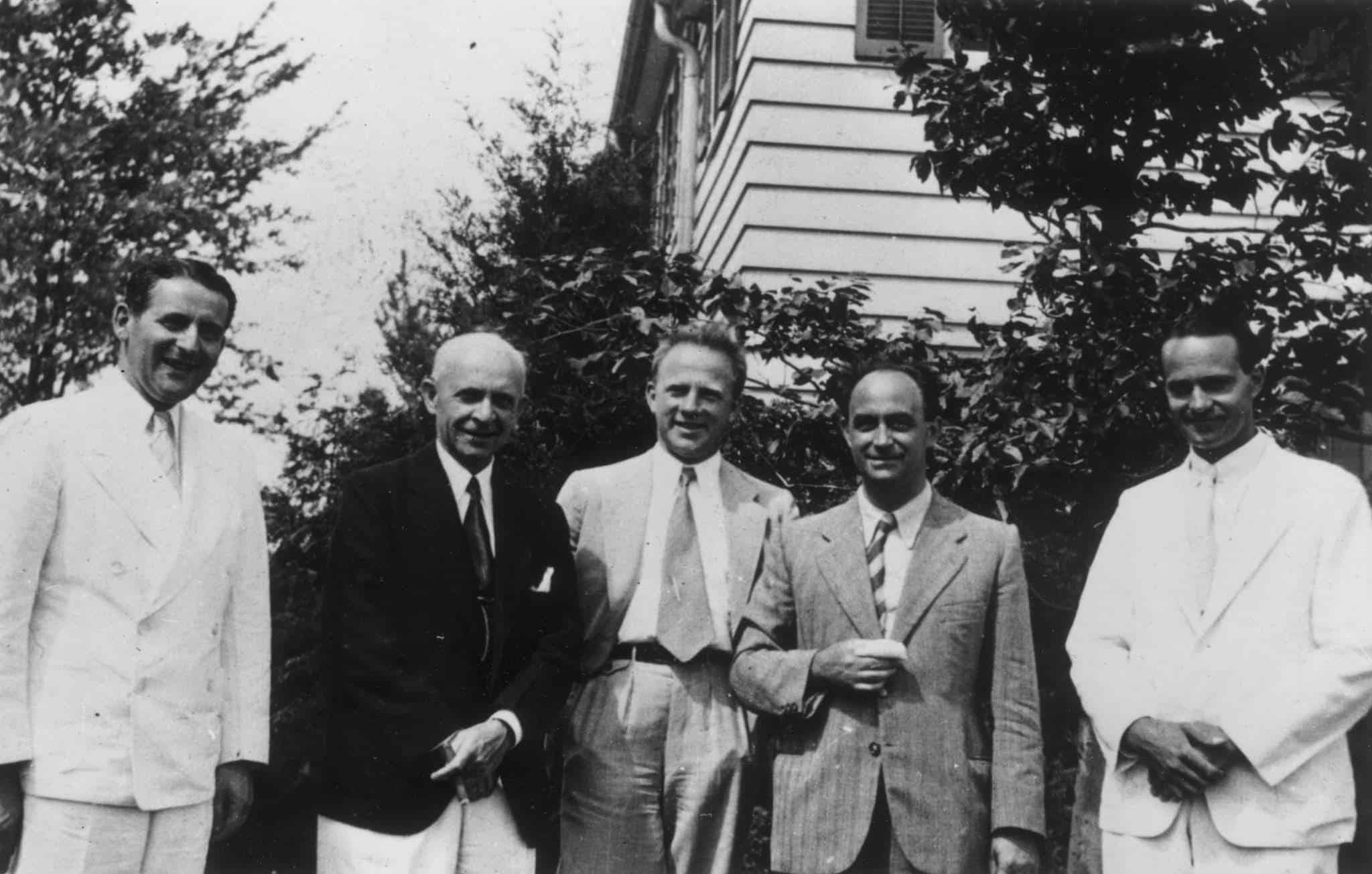
The outer staircase of the building is the backdrop of the group's most reproduced photograph, taken in 1931. Climbing those steps with that image in your head is one of the strongest experiences the museum offers, and it costs nothing. Inside, the monumental grand stairway preserves the 19th-century layout of the university institute, with the slightly stiff solemnity that Umbertine scientific buildings allowed themselves to claim a dignity equal to that of the humanities faculties.
The corridors of the first floor
The corridors on the first floor are the place where Corbino's boys ran between one element's irradiation and the next, with Fermi always in the lead. It is not folklore: it was the only way to carry the sample from the irradiation point to the counter before the induced activity ran out. The length of those corridors, measured in seconds of running, was part of the experimental design as much as the neutron source.
In here it is worth walking that stretch without talking, looking at the doors and the windows. It is the quickest way to understand that physics is not an abstraction that happens on a blackboard, but a trade made of bodies moving in a space.
Enrico Fermi, Master of 20th-Century Physics
The Roman years and the double talent
Enrico Fermi was born in Rome on September 29, 1901 and died in Chicago on November 28, 1954. An Italian physicist later naturalized American, he is known for his theoretical and experimental studies in quantum mechanics and nuclear physics, and among his major contributions are cited the theory of beta decay, Fermi-Dirac statistics and the results on nuclear interactions.
His rarest characteristic, the one his colleagues acknowledged without reservation, was the double talent. He was a theorist of the very first rank, as the theory of beta decay shows, and he was equally strong in the laboratory, where he proceeded with speed and with an intuition that seemed unfair. He himself attributed his Nobel to experimental speed, maintaining that the discoveries he had reached would have been made anyway by someone else, and that his merit had simply been getting there first. It's a modesty that, read today, sounds much sharper than any bragging.
To his favorite students he repeated a piece of advice that was at once a provocation and a lesson in method: never be the first, try to be second. A man who had beaten everyone on time advised the young not to become obsessed with primacy.
Fermi's death and the commemoration at the Lincei
Fermi died on November 28, 1954 in Chicago, of stomach cancer, and was buried in the city's Oak Woods Cemetery. He was 53. Eugene Wigner recalled that 10 days before the end Fermi told him he hoped it wouldn't last long, and that he had reconciled himself perfectly with his fate.
On March 12, 1955 Edoardo Amaldi commemorated him at a joint session before the Accademia dei Lincei. The sense of his speech was that Fermi's scientific work was so mighty, and the practical consequences of some of his works so grave, that whoever had not known him risked building an image of him very far from the truth. Amaldi insisted on the contrast between the exceptional qualities of the scientist and the simplicity of the man's tastes, way of life and character, and on the calm with which he faced problems. It is the portrait the museum, 60 years later, tries to give back in around 10 rooms.
What bears the name of Enrico Fermi today
Few scientists have left such a quantity of namings. An element of the periodic table bears his name, fermium, symbol Fm. A submultiple of the meter commonly used in atomic and nuclear physics bears his name, the fermi. One of the two classes of particles of quantum statistics bears his name, the fermions. And also: a lunar crater, the asteroid 8103 Fermi, the nuclear center of Vercelli, the gamma-ray space telescope formerly known as GLAST and now the Fermi Gamma-ray Space Telescope, besides stamps, schools, universities, research bodies and metro stations scattered around the world.
An observation: in this list the entry that makes you smile is the submultiple of the meter. Then one realizes that it means having given one's name to a unit of measure, that is, to a word that physicists will pronounce every day forever. It is a form of immortality more solid than statues.
A Curiosity about Enrico Fermi Center - Historical Museum of Physics and Study and Research Center at the Viminale
The real curiosity is not about the paraffin, which everyone tells by now, but about the table. In the fall of 1934 the group noticed that the measurements of induced radioactivity changed inexplicably depending on the surface the experimental apparatus rested on. On certain wooden tables the activity turned out noticeably greater than on marble tops. In an ordinary laboratory an anomaly like that ends up in the column of systematic errors to be eliminated: you pick a table, stick with it and move on.
At Via Panisperna the opposite happened. It was Bruno Pontecorvo, the youngest of the group, who noticed that those wooden tables had apparently miraculous properties. Instead of normalizing the anomaly, the group took it seriously. Fermi deduced that the factor at play was the hydrogen contained in the wood, replaced the planned lead with a slab of paraffin, very rich in hydrogen, and saw the activity multiply. It was October 20, 1934.
The curiosity, in short, is not that an epoch-making discovery was born from a banal anomaly. It's that it was born from a piece of furniture. The wood of a Roman laboratory table contains hydrogen, hydrogen slows neutrons, slow neutrons are captured better by nuclei. All of reactor physics descends from a chain that begins with the furnishings of a room.
There is a corollary that serves as a permanent lesson and that at the museum is said without rhetoric: the difference between a good laboratory and a mediocre one is not the quality of the instruments, it's what you do with strange results. The boys of Via Panisperna had modest instruments even by 1934 standards and a budget that today would make any department smile. But they had the habit of not throwing away measurements that didn't add up. The entire Enrico Fermi Center exists to transmit this single lesson, and it succeeds.
Something Nobody Tells You about Enrico Fermi Center - Historical Museum of Physics and Study and Research Center at the Viminale
That the museum is inside the Ministry of the Interior you read everywhere. What nobody says is that this location, today experienced as a bureaucratic obstacle, is the reason the building still exists. Between 1943 and the end of the century the building lost every scientific function and became the seat of the State Police Archive. A state-owned property in use by a ministry is not put on the market, not divided into apartments and not demolished to make room for a six-story building.
Anyone who knows the building history of Rome between 1950 and 1980 knows what would have happened to an empty 19th-century building, in a very central position, publicly owned but with no designated use. It would have vanished. The fact that today you can walk in the corridors where Fermi ran is owed to an archive of police files, not to a farsighted cultural heritage policy.
The second thing that isn't said concerns the numbers. In 2024 the museum welcomed over 4,600 visitors, 71 percent of them students. These are small-museum figures, and they need reading properly: it means that the general public who manage to get in during a year is on the order of a thousand people. With those numbers, the idea of finding a place at an open day by showing up at the last moment is simply unrealistic. Whoever wants to get in must plan months ahead, sign up for the museum's newsletter and book on the very day the calendar is published.
The third, which rarely appears in guides: the museum's declared privileged audience is not the tourist but the school. School visits fill the weekday mornings from October to June, Wednesday is the reference day, and in peak periods Tuesday and Thursday are added. It's not a flaw, it's an explicit choice. A research body that decides to invest its time in 17-year-olds instead of passing groups has a clear priority, and in our judgment it is right.
The Advice I Give You for Visiting Enrico Fermi Center - Historical Museum of Physics and Study and Research Center at the Viminale
The main advice concerns the calendar, not the visit. Mark September 2026 as the month when bookings reopen, sign up for the museum's newsletter now and keep an eye on the open day page. The dates of the previous season are all sold out, and no amount of good will fixes a full shift. Whoever arrives in Rome for a few days and discovers the existence of this place the day before will not get in: better to know it right away and plan for the next trip.
The second piece of advice concerns preparation. One hour is little for dense content, and the difference between a mediocre visit and a memorable one is made by what you already know when you walk in. Look first at the virtual route published by the center, which follows the same eight stations as the display. You'll arrive with the names already in your head and can use the time to ask real questions of whoever accompanies you, who is a researcher of the body and not a room attendant. Wasting that privilege by asking where the restrooms are is a pity.
Third: the matter of documents. First name, last name and date of birth must be communicated at the time of booking for each participant, and the document must be brought. If you book for five people, collect everyone's data before filling in the form, because an incomplete booking risks being dropped. Arrive a quarter of an hour early at Piazza del Viminale, not in front of Via Panisperna facade.
Fourth, and here I give an opinion you won't find elsewhere: don't bring small children. The museum states it is aimed above all at the third year of middle school and the last three years of high school, and it is right. Under 12 the route turns out long, verbal and conceptual, and the result is an hour of boredom for the child and embarrassment for the adult. For the little ones Rome offers better alternatives. For a 15-year-old who studies physics, instead, this is probably the most useful visit you could give them in the whole city.
Fifth: build an afternoon around it. If the open day is at 17:30, devote the preceding hours to the district. The Palazzo delle Esposizioni is 200 meters away, the basilica of Santi Silvestro e Martino ai Monti with its early Christian lower church is a little farther up, and Santa Maria Maggiore closes the climb of the Esquiline. Leaving the museum at 18:30 you'll still have the right light for a walk toward the remains of the Domus Aurea or toward Piazza Vittorio and its Porta Alchemica.
Another Well-Known Fact, Yet Rarely Cited
Everyone knows Enrico Fermi won the Nobel in 1938. Far fewer reflect on what exactly the citation says, and even fewer on what is embarrassing about that citation today. The Swedish academy's recognition rewards the demonstrations of the existence of new radioactive elements produced by neutron irradiation and, in connection with them, the discovery of nuclear reactions brought about by slow neutrons.
The second part is granite and still holds. The first instead contains a misunderstanding that the history of science clarified only in the following years. When Via Panisperna group bombarded uranium with neutrons, it believed it had produced transuranic elements, that is, elements heavier than uranium, never observed before. In reality, in at least part of those reactions, the uranium nuclei were splitting: it was nuclear fission, which would be identified and correctly interpreted only at the end of 1938 by the work of Otto Hahn, Fritz Strassmann, Lise Meitner and Otto Frisch.
The well-known fact, then, is that Fermi won the Nobel. The rarely cited fact is that part of the citation concerned an interpretation that within a few months would prove imprecise, and that nuclear fission passed literally through the hands of the boys of Via Panisperna without anyone recognizing it. It is one of the great missed appointments of 20th-century science, and it has a severe moral: the data were all there, in that building, in 1934. The right question was missing.
Why that question was not asked is still debated. The role of the aluminum foil that shielded the detectors and that would have prevented observing the fission fragments has been hypothesized, and there has been discussion of a warning from the German chemist Ida Noddack, who in 1934 suggested in writing the possibility that nuclei could split and who was not taken seriously by anyone. These are debated historiographical reconstructions, not established truths. What remains certain is the result: fission was seen in Rome and understood in Berlin.
The Right Photo to Take at Enrico Fermi Center - Historical Museum of Physics and Study and Research Center at the Viminale
The right photo is just one and it isn't inside the rooms: it's the entrance staircase of the building, framed head-on, from below. It is the exact backdrop of the group photograph taken in 1931, the one showing the boys of Via Panisperna and appearing in every book on the history of Italian physics. Putting the people with you on those steps, in the same arrangement, is a slightly schoolboy gesture and it always works: the comparison between your image and the one from 1931 tells 90 years of history in two seconds.
Technically little is needed. A moderate wide-angle lens, a position set back a few meters to catch the full width of the outer stairway, late-afternoon light if the visit is the 17:30 open day. In summer the raking light of seven in the evening on the facade is the best possible. In winter, at open day time, you are already working with artificial light and it's better to give up on the exterior and concentrate on the interiors.
The second photo, less obvious and more beautiful, is the basin with the fountain in the garden. Frame it from above, almost straight down, so that only the water, the stone rim and the reflection of the facade enter the frame. Nobody, looking at it, will understand what it is. That is exactly the point: it is the fountain in which on October 20, 1934 the neutron-slowing effect was confirmed, and it is probably the only ornamental body of water in the world with an entry in the history of nuclear physics.
Third option, for those who love objects: the paraffin cube in its case. Photograph it without flash, resting the lens on the glass to eliminate reflections, and leave the label in the frame. A block of opaque wax with its caption beside it is the most anti-rhetorical image you can take away from a science museum, and it's worth 10 selfies.
A practical recommendation worth more than all the others: before photographing anything, ask. You are inside a ministerial perimeter, there are areas where filming is not allowed, and the person accompanying you will tell you in 10 seconds what is and isn't permitted. A museum that opens its doors to you for free deserves this elementary courtesy.
Some Important Events That Happened Here in History
The first event is the inauguration itself, in 1881, of the new Physics Institute of the Royal University of Rome. It was not a local matter. In a country unified for 20 years and with a capital for 10, equipping itself with a modern physics institute, designed for experimentation and not for lecture-hall teaching, meant declaring that Italy intended to be part of European science. The ministerial commission had chosen the Viminale hill as early as 1874, and Blaserna transplanted there the first practical school of physics in Italy, where students were free to use the instruments.
The second event is October 1931, when Rome hosted the first international congress of nuclear physics. The world community of the discipline gathered in a city that until a few years earlier was considered peripheral, and did so at the initiative of Corbino and Fermi. The neutron had not yet been identified: it would come the following year, at Chadwick's hand. Discussing atomic nuclei under those conditions meant moving in the dark with a flashlight, and that congress was the flashlight.
The third event covers March 1934, when the group obtains the first results of artificial radioactivity induced by neutrons, and the following months of systematic irradiations. It is the least told phase and the most laborious: dozens of elements, repeated measurements, chemical separations entrusted to Oscar D'Agostino, runs down the corridors with samples in hand before the activity ran out.
The fourth is October 20, 1934, the discovery of the effect of paraffin on the slowing of neutrons, with confirmation in the water of the garden fountain in the afternoon of the same day. If there is a date that justifies the existence of this museum, it is this one. Six days later, on October 26, the group patents the process for producing artificial radioactive substances: the discovery and its industrial protection a week apart.
The fifth event is 1936, with the move of the Physics Institute to the new site of the University City at Piazzale Aldo Moro. It is the beginning of the end for the building, and it coincides with the beginning of the end for the group: the disappearance of Ettore Majorana in March 1938, the racial laws of the same year, Fermi's departure for Stockholm in December 1938 and his failure to return.
The sixth is 1943, when the building definitively loses its scientific function and is assigned to another use, later becoming the seat of the State Police Archive. 56 years of files.
The seventh and last event is twofold: law 62 of 1999, which establishes the Museo Storico della Fisica e Centro Studi e Ricerche Enrico Fermi, and October 2019, when the museum finally opens to the public on the ground floor of the building after a philological restoration. Between the law and the opening there are 20 years. They are typically Roman 20 years, and the final result pays them back.
Who Has Passed Through Enrico Fermi Center - Historical Museum of Physics and Study and Research Center at the Viminale
The first name is Pietro Blaserna, who was this building's scientific patron and first director, from 1872 until his death in 1918. A physicist from Gorizia trained between Vienna and Paris, he brought to Rome the model of the teaching laboratory and in 1897 founded the Italian Physical Society. He was also a senator of the Kingdom, which explains his ability to obtain funds in an Italy that had no research funds.
The second is Orso Mario Corbino, director from 1918, the man who chose Fermi and built around him the conditions to work. The group called him the Padreterno. He died in 1937.
Then come they. Enrico Fermi, the Pope, who here worked out the theory of beta decay in 1933 and here discovered the action of slow neutrons in 1934. Franco Rasetti, the Cardinal Vicar, a highly refined experimenter and passionate naturalist, who during the war years refused on moral grounds to work on the bomb project and who then devoted himself to paleontology and botany. Emilio Segrè, the Basilisk, future Nobel Prize winner in physics in 1959 for the discovery of the antiproton. Edoardo Amaldi, the Abbot, the only one who stayed in Italy and who in the postwar period rebuilt Italian physics from scratch, contributing to the birth of the European research bodies. Bruno Pontecorvo, the Puppy, who sensed the anomaly of the wooden tables and who would have a life like a novel, between the flight to the Soviet Union in 1950 and his pioneering work on neutrinos. Ettore Majorana, the Grand Inquisitor, the most feared mind of the group, who disappeared in March 1938 in circumstances never clarified. And Oscar D'Agostino, the chemist without whom none of those measurements could have been interpreted.
In October 1931 the building and scientific Rome hosted the first international congress of nuclear physics, which brought the world community of the discipline to the city. From here, directly or indirectly, passed the people who in the following decade would rewrite physics.
In recent times the flow has changed in nature but has not stopped. The museum hosts conferences, presentations and screenings: in spring 2026 there were the screening of the documentary dedicated to the girl of Via Panisperna, a conference in English with David Schwartz, author of the biography dedicated to Enrico Fermi, and the presentation of a volume on Ettore Majorana at the Senate Library. Whoever visits the Enrico Fermi Center today walks in a building that is not a mausoleum: it is a research institute in operation, where the public enters at set times because at other hours people work in it.
CREF Today: A Research Body Inside a Museum
The two missions of the Enrico Fermi Center
The first mission is educational outreach: to set up and maintain a museum dedicated to Fermi's scientific legacy, and to guarantee a wide dissemination of his life and discoveries. The second is research proper. The center conducts original and interdisciplinary lines of inquiry, inspired by the methods of physics but applied to domains that go beyond traditional physics, in the spirit that had distinguished Fermi's work. The center also promotes interdisciplinary projects, international cooperation among researchers and technological innovation in companies, making available to researchers the advanced instrumentation it has.
To the scientific mission is added that of protection: the preservation of the historical memory of the monumental complex of Via Panisperna, also through exhibitions dedicated to spreading scientific culture. It is the mandate that holds the other two together, and it is the reason this place is neither a pure museum nor a pure laboratory.
The numbers of the Enrico Fermi Center
In 2024 the museum recorded over 4,600 visitors, with a student share of 71 percent. It is a figure that needs interpreting: we are talking about a museum that opens by reservation, inside a ministry, with around 10 places per shift at open days and with weekday mornings taken up by schools. Related to the actual capacity, that number indicates a facility working close to saturation.
Whoever expects the numbers of the Capitoline museums or of the great archaeological sites is using the wrong yardstick. This is a niche museum by construction, not by weakness, and its effectiveness is measured by the type of audience it reaches, not by quantity.
The Enrico Fermi Center and the Other Science Museums of Rome
Rome has a network of university science museums that almost no tourist knows and that is worth an itinerary of its own. The natural complement to a visit to the Enrico Fermi Center is the Physics Museum of the Sapienza, which preserves historic instrumentation and materials tied to the same story: after 1936 that is where the Physics Institute moved, and the continuity between the two places is material, not only symbolic. Whoever wants to understand the story in full should see both, in the right chronological order: first Via Panisperna, then the University City.
In the same Sapienza area are other notable collections: the University Museum of Earth Sciences, the Giuseppe Sergi Museum of Anthropology, the Gipsoteca and the Contemporary Art Museum Laboratory. They are places with limited hours and scarce audiences, and precisely for that reason they give an idea of Rome that tourist circuits never touch.
What to See Around the Enrico Fermi Center Within a 10-Minute Walk
The position is privileged and underrated. Going down toward Monti you meet the basilica of Santi Silvestro e Martino ai Monti, with its extraordinary early Christian lower church, and farther down the neighborhood of alleys that descends toward the Forums. Going up you reach in a few minutes Santa Maria Maggiore, one of the four papal basilicas, and continuing you arrive at Piazza Vittorio with the Porta Alchemica and the Nuovo Mercato Esquilino, which is the most interesting place in Rome for understanding how the city has changed over the last 30 years.
On Via Nazionale, a short walk away, are the Palazzo delle Esposizioni and the Biblioteca Nazionale Centrale a little beyond. Going up toward the Quirinale you reach the Scuderie del Quirinale and the Quirinal Palace, while the National Museum of Musical Instruments deserves the detour toward Santa Croce in Gerusalemme.
The operational advice, for those with the open day in the late afternoon: devote the morning and early afternoon to one of these destinations, have lunch in Monti, and show up at Piazza del Viminale rested. Doing the opposite, that is, leaving the museum with the idea of squeezing in two more museums before dinner, only produces exhaustion. To organize the whole day you can use My Trip, which lets you line up the stops.
The Enrico Fermi Center with Kids and at School
The museum openly declares its ideal audience: the third year of middle school and the last three years of high school, with particular attention to classical, scientific and arts high schools and to technical and vocational institutes. Non-Italian classes can request the visit in English. The reservation requires the type of school, the class, the number of participating students and a preferred date.
The educational value is not in the disciplinary content, which any textbook contains, but in the coincidence between story and place. Explaining neutron capture in a classroom is an abstract exercise. Explaining it in a corridor where that measurement was made, pointing to the basin where it was confirmed, changes the cognitive register. The physics teachers who have brought classes here know it very well, and it is the reason the mornings are saturated.
For families with children under 12 I repeat the opinion already expressed: better to postpone. The route is verbal, dense and requires an attention threshold that small children don't have. It is not an interactive museum for children, even though it uses touch and holographic screens: those tools serve to clarify concepts, not to entertain.
Accessibility and Services at the Enrico Fermi Center
The museum occupies the ground floor of the monumental complex, which is good news for those with mobility difficulties, because it avoids the grand stairway. Access, however, goes through a ministerial perimeter and involves checks, and the building is a protected 19th-century structure: whoever has specific accessibility needs must report them at the time of booking, by calling +39 06 4550 2901 or using the contact form, so that the staff can organize the entry.
On services don't expect the facilities of a big museum: there is no ticket office, because the visit is free and reserved, and the structure is not organized like a civic museum with free flow. Bring little luggage, because in a ministerial perimeter the checks are faster if there are no bulky backpacks to open.
When to Go to the Enrico Fermi Center and When to Avoid It
The useful season for the general public coincides with the calendar of the open days, which runs from November to June. In July, August and September the doors for individual visitors are effectively closed, and in August it doesn't even make sense to try. Bookings for the new season reopen in September 2026: that is the moment to act.
If I had to name the best period I'd say November and January, for two reasons. The first is that the season-opening dates are less contested than the spring ones. The second is atmospheric: the building lit on a winter evening, with the bare garden and the still fountain, conveys the idea of a workplace better than a June afternoon with high light.
The period to avoid, for schools, is late spring, when requests pile up and availability runs out. A wise teacher writes in October for a February visit.

Enrico Fermi in Film and on Television
I ragazzi di via Panisperna, the film
The film that fixed the story of the building in the Italian collective imagination is I ragazzi di via Panisperna, from 1988, directed by Gianni Amelio, running about 180 minutes. The cast brings together Mario Adorf, Andrea Prodan, Laura Morante, Virna Lisi, Ennio Fantastichini and Cristina Marsillach. The story follows the group of young scientists gathered around Fermi in a Roman laboratory and puts at the center Ettore Majorana, the most brilliant and most enigmatic personality of the group, his relationship with Fermi and his disappearance on the eve of the war.
It is a slow film, stubbornly anti-spectacular, and for that reason it has aged much better than you'd expect. Amelio avoids the celebratory biopic and chooses the psychological portrait, with the result that whoever looks for a didactic reconstruction of the experiments will be disappointed and whoever looks for the moral climate of those years will come out shaken. My advice is to watch it after the visit and not before, so as not to arrive at the museum with the actors' faces superimposed on the real ones.
L'incredibile storia di Enrico Fermi
The second title is a documentary produced by RAI to celebrate the centenary of the scientist's birth, titled L'incredibile storia di Enrico Fermi, first aired on September 18, 2001 on Rai 1 as part of an episode of Speciale Superquark. It is the classic popularizing approach of the school of Piero Angela, and remains an excellent introduction for those starting from zero.
The museum as a place for meetings
Alongside visits, the Enrico Fermi Center offers a program of events that in spring 2026 included the screening of a documentary dedicated to the girl of Via Panisperna, a conference in English with the scholar David Schwartz, author of a biography of Fermi, and the presentation of a volume on Ettore Majorana hosted at the Senate Library. These are events booked in the same way as the visits and they go fast.
Quick Questions about Enrico Fermi Center - Historical Museum of Physics and Study and Research Center at the Viminale
Where exactly is the Enrico Fermi Center?
The registered office and the historic building are at Via Panisperna 89 a, 00184 Rome. The visitors' entrance, however, is at Piazza del Viminale 1, same postal code. To reach the museum you use Piazza del Viminale address.
How much does it cost to visit the Enrico Fermi Center?
The open day visit is free. There is no ticket office: you book and you go in.
Can you get into the Enrico Fermi Center without booking?
No. The museum is inside the Viminale complex and visits take place on set days and times, by reservation only.
How long does the visit to the Enrico Fermi Center last?
About an hour, both for open days and for group visits.
How do you book an open day at the Enrico Fermi Center?
You fill in the form published on the page of the chosen open day, indicating first name, last name, date of birth and the preferred time among the available shifts. With a single reservation you can include up to five people, listing each person's personal data.
Why are first name, last name and date of birth needed?
Because entry happens through the perimeter of a ministerial complex and the names must be communicated in advance. It is the same reason an ID document must be brought.
What time are the open days at the Enrico Fermi Center?
The recurring time is 17:30, with a second shift at 18:30 on the dates when it is activated.
Is the Enrico Fermi Center open on Saturday and Sunday?
No. On weekends the museum is closed and group visits are held on weekdays.
When do bookings reopen?
In September 2026, both for groups and for schools. The calendar of the new open day season is published in that period.
How many people are needed to book a group visit?
At least eight. Groups book through the dedicated form and the visit can be held in Italian or English.
How do schools book?
By filling in the form for schools, indicating type of school, class, number of students and a preferred date. Visits are held in the morning on weekdays, from October to June.
Is the Enrico Fermi Center suitable for children?
The museum is aimed above all at the third year of middle school and the last three years of high school. Under 12 the route turns out long and conceptual: better to choose something else.
Can you take photographs at the Enrico Fermi Center?
Ask whoever accompanies you before shooting. You are inside a ministerial perimeter and some areas may have restrictions.
Is the museum wheelchair accessible?
The exhibition occupies the ground floor, which avoids the monumental grand stairway. Access, however, goes through security checks in a protected historic building: specific needs must be reported at the time of booking, by calling +39 06 4550 2901.
Is the visit to the Enrico Fermi Center guided?
Yes. At the open days the accompanying is entrusted to researchers of the center, not to room staff.
Is the building on Via Panisperna still under restoration?
No. The philological restoration is finished and the museum has been open on the ground floor of the building since October 2019.
What is the difference between the Enrico Fermi Center and the Physics Museum of the Sapienza?
The first occupies the building where the Physics Institute worked until 1936 and is dedicated to Fermi's scientific legacy. The second is in the site the Institute moved to starting in 1936, in the University City. They are two consecutive chapters of the same story.
Do you see the goldfish fountain during the visit?
The monumental complex with the basin, the entrance staircase, the grand stairway and the first-floor corridors is an integral part of the museum route.
How many visitors does the Enrico Fermi Center receive?
In 2024 there were over 4,600, 71 percent of them students.
Is the Enrico Fermi Center a museum or a research body?
Both. The official name is Museo Storico della Fisica e Centro Studi e Ricerche Enrico Fermi, acronym CREF: it is a public research body overseen by the Ministry of University, established by law 62 of 1999, that also has a museum.
How do you get to the Enrico Fermi Center by public transport?
Metro A stop Repubblica, metro B stop Cavour, or buses 64, 70, 71, 117, 170 and H on Via Nazionale, stop Nazionale/Palazzo Esposizioni, about four stops from Piazza dei Cinquecento in front of Termini.
What do you concretely see in the museum?
Among the objects on display are the paraffin cube, some Geiger counters, the laboratory notebook and the Brunsviga analog calculator, together with traditional panels and multimedia technologies: graphic visualizations, interactive panels, touch and holographic screens.
Is there a virtual visit of the Enrico Fermi Center?
Yes, the center has published a virtual route divided into eight stations, which retraces the same stages as the display. It is the right way to prepare before going.
How far in advance is it best to book?
As soon as possible. The dates published for the season just ended are all sold out, and with a few dozen places per open day the useful window closes quickly.
Is the Enrico Fermi Center worth visiting if you don't understand anything about physics?
Yes, on one condition: that you are interested in the history of the 20th century. The story holds together science, fascism, racial laws, emigration and the atomic bomb, and it is understandable even to someone who has never solved an equation.
After so many visits in this city, I remain convinced that the Enrico Fermi Center is the Roman destination with the best ratio between difficulty of access and reward. It costs effort: you have to book months ahead, give your details, show up on time in front of a ministry and settle for an hour. In return you walk on the exact spot where, on October 20, 1934, seven people under 35 changed the century, and you do it accompanied by someone who still practices that physics today in those same rooms. If I had to point to one thing to look at carefully, I'd point to the basin in the garden. A block of wax and a fountain with fish: everything else, from reactors to X-rays, descends from there.
Article written by the editorial team of TourLeaderPro, contact them for Private/Corporate/V.I.P. Tours and Experiences.
Planning a trip to Rome? The English guides for visiting the city are on ItalyPlanner.com.