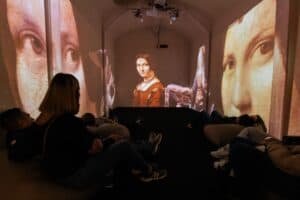
University Museum of Earth Sciences – MUST
In short. Before setting out it's good to know two things. The first: the museum observes a summer closure from July 31 to September 10, 2026, so on these August days the door of Mineralogy stays shut.

Before setting out it's good to know two things. The first: the museum observes a summer closure from July 31 to September 10, 2026, so on these August days the door of Mineralogy stays shut. The second: you don't get in here by walking past a ticket office, you get in only with a mandatory reservation, because the MUST is a university museum inside a working department, not a civic museum with a turnstile.
The postal address is Piazzale Aldo Moro 5, 00185 Rome, Città Universitaria, building CU005: the Mineralogy and Geology building, which faces Piazzale della Minerva, the big inner space of the campus. Entry is through the Mineralogy entrance of the Department of Earth Sciences. For individual visitors admission is free, always with a reservation. Groups of up to 25 people pay €110 per group, guided visit included. The Italian Sign Language service is free on reservation. You book at the museum's mobile, 324 8961999, active from 10:00 to 13:00 and from 14:30 to 15:30, or by writing to must@uniroma1.it. The reservations office also answers at 06 4991 4825. The museum is directed by Professor Marco Romano, with Professor Michele Macrì as area curator.
The MUST is part of the Sapienza Museum Hub, the network that brings together the scientific and archaeological collections of the university. If the subject excites you, the page on Rome's tourist attractions gathers the rest of the city, but the campus on Via Aldo Moro alone is worth a day. You get there by metro line B, stops Policlinico or Castro Pretorio, and by surface lines 3, 19, 71, 93, 163, 310, 443, 448, 492 and 512. From Termini, lines 310 and 492 drop you in front of the gate, and on foot it's barely 20 minutes.
How to get to the University Museum of Earth Sciences - MUST
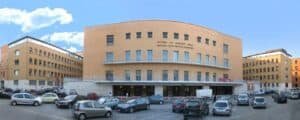
The University City occupies a rectangle between Viale Regina Elena, Viale dell'Università and the San Lorenzo neighborhood. The monumental gate on Piazzale Aldo Moro is the one everyone uses, and it is also the most convenient: you go in, keep straight along the central axis, pass the fountain basin and find yourself in front of the Rectorate with Arturo Martini's Minerva. The building you want closes the long side of the square on the right as you face the Rectorate. The door of Mineralogy is the one marked by the inscription on the architrave. Don't trust the street number, trust the words carved in the travertine, which Roman rationalism used as signage.
Metro line B is the most predictable way. Policlinico leaves you five minutes from the gate on Viale Regina Elena, Castro Pretorio eight or nine minutes from the main entrance, passing in front of the National Library. The surface lines serving the area are many, but at peak hours the traffic on Viale del Policlinico and Viale dell'Università is what it is: if you have an appointment at a fixed time, and here the appointment is always at a fixed time because the visit is by reservation, allow plenty of margin. One piece of advice: have people get off at Policlinico and not at Termini, because the walk from Termini is long, ugly and full of traffic lights.
By car it's a terrible idea. The whole area is paid parking, free spots are a mirage during class hours and the campus has no public parking. Anyone arriving by bicycle, on the other hand, has it easy: Viale dell'Università has a minimal slope and inside the campus you ride in peace, with racks in several places.
Booking a visit to the University Museum of Earth Sciences - MUST
The reservation isn't a bureaucratic formality. It's the way the museum guarantees a proper welcome, given that the staff is that of a university department and not a team of attendants on shift. The museum's mobile, 324 8961999, answers in the two windows given, 10:00 to 13:00 and 14:30 to 15:30. Outside those hours it rings unanswered, and there's no point insisting: better an email to must@uniroma1.it, which stays in writing and lets you attach the number of participants, the desired date and any accessibility needs.
For groups the fee is €110 for up to 25 people, and includes the guided visit led by the museum's staff. It is an honest price: do the math per person and you'll see that a specialist guide in earth sciences, inside its own collections, costs less than any admission in the center. School classes and organized groups must move well in advance, because the calendar depends on the availability of the researchers. The Italian Sign Language service is free and must be requested at the time of booking, not on the day itself.
A warning about the calendar: besides the summer closure from July 31 to September 10, 2026, the museum follows the rhythm of the academic year and the exam sessions. Ask for confirmation of the date when you book and ask also which spaces will be visitable, because the museum is in a phase of re-installation and the surface open to the public changes over time.
What the MUST really is: three museums turned into one
The MUST was officially born in 2016 from the merger of three historic museums of the Sapienza: Geology, Mineralogy and Paleontology. It isn't a front operation, it is a reunification. Those three museums were born between 1804 and 1928, each had its own chair, its own director, its own catalog, and for a century and a half they collected material by different criteria. Putting them together meant building a single inventory of more than 35,000 mineralogical samples, 7,000 geological and 100,000 paleontological, plus antique books, thematic maps and historic scientific instruments.
The oldest of the three is the mineralogical museum, whose collection begins in 1804, in the middle of papal Rome, when mineralogy was a new science and collecting crystals was at once an act of erudition and a diplomatic investment. The geological museum arrives in the mature 1800s, when Italian geology organizes itself around the practical need to know the territory: aqueducts, quarries, land reclamation, earthquakes. Paleontology split off last, with its own chair, when the study of fossils stopped being a chapter of geology and became an autonomous discipline.
A clear judgment, without beating around the bush: the merger of 2016 is the best thing to happen to the earth sciences in Rome in the last 50 years. Three separate, half-closed museums were three weaknesses. A single museum on four floors is a European project. The declared plan is to open all the rooms of the four levels, for a total of about 4,100 square meters almost entirely for exhibition, plus 300 square meters of shared laboratories, offices and storage. If the program succeeds, Rome will have the largest European museum entirely dedicated to the earth sciences. For now we see a piece of it, and the piece is already serious.
The Michelucci building that houses the University Museum of Earth Sciences - MUST
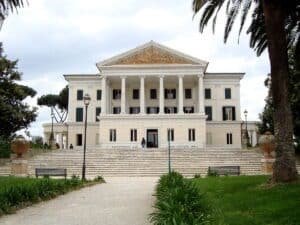
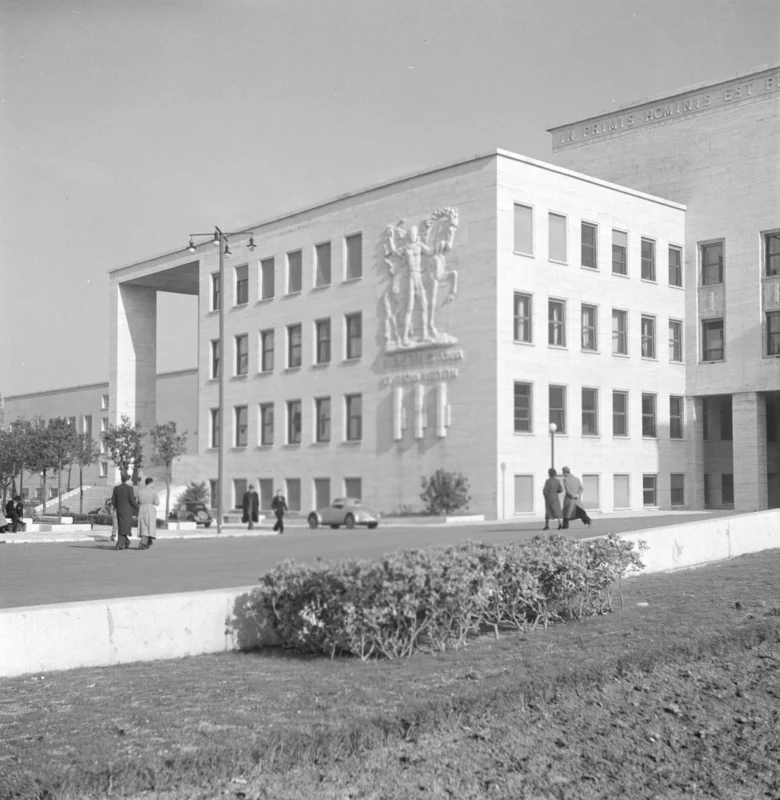
The building deserves a stop even before the display cases. The Institute of Mineralogy, Geology and Paleontology was designed by Giovanni Michelucci between 1933 and 1935, inside the great construction site of the University City coordinated by Marcello Piacentini. Michelucci, the Florentine who a few years earlier had signed the Santa Maria Novella station with the Tuscan group, works here in reinforced concrete and clads the main facade entirely in travertine. The other elevations are plastered, with bases and cornices in travertine. The layout is courtyard-based, or rather two successive courtyards that are not aligned, a solution that lets the large exhibition rooms be lit from both sides.
The building has three floors above ground plus a basement level. The original distribution was very clear: Mineralogy occupied the basement and the ground floor, Geology and Paleontology the upper levels, with the paleontological collection on the top floor of the wing on the main courtyard. Each institute had its own monumental portal, and this is the reason why the facade shows several solemn entrances instead of just one. Opposite, across Piazzale della Minerva, stands the Institute of Mathematics by Gio Ponti: two different ways of understanding rationalism, one drier and one more lyrical, looking at each other for 70 years.
Then came the war. The bombings of 1943, the ones that hit San Lorenzo and the eastern quadrant of the city, also marked the University City, and the museum installation Michelucci had designed in 1935 was dismembered. It is a loss that still weighs: the exhibition spaces designed as an integral part of the architecture were converted, divided, occupied by other functions. The re-installation underway today is, in a sense, the attempt to put back together an idea interrupted 80 years ago.
The numbers of the collections of the University Museum of Earth Sciences - MUST
Numbers, in a natural science museum, are not bragging. They tell you what kind of instrument you have in front of you. More than 35,000 mineralogical samples, 7,000 geological, 100,000 paleontological. It means the MUST is not a museum of selected pieces, it is an archive of matter. The difference is substantial. A museum of selected pieces shows the beautiful. An archive of matter lets you reconstruct how a mountain formed, how a sea changed, how a line of mollusks evolved over a million years. Many specimens are unique at national and international level, and this means scholars from outside come here to measure things they cannot measure elsewhere.
The minerals of the University Museum of Earth Sciences - MUST
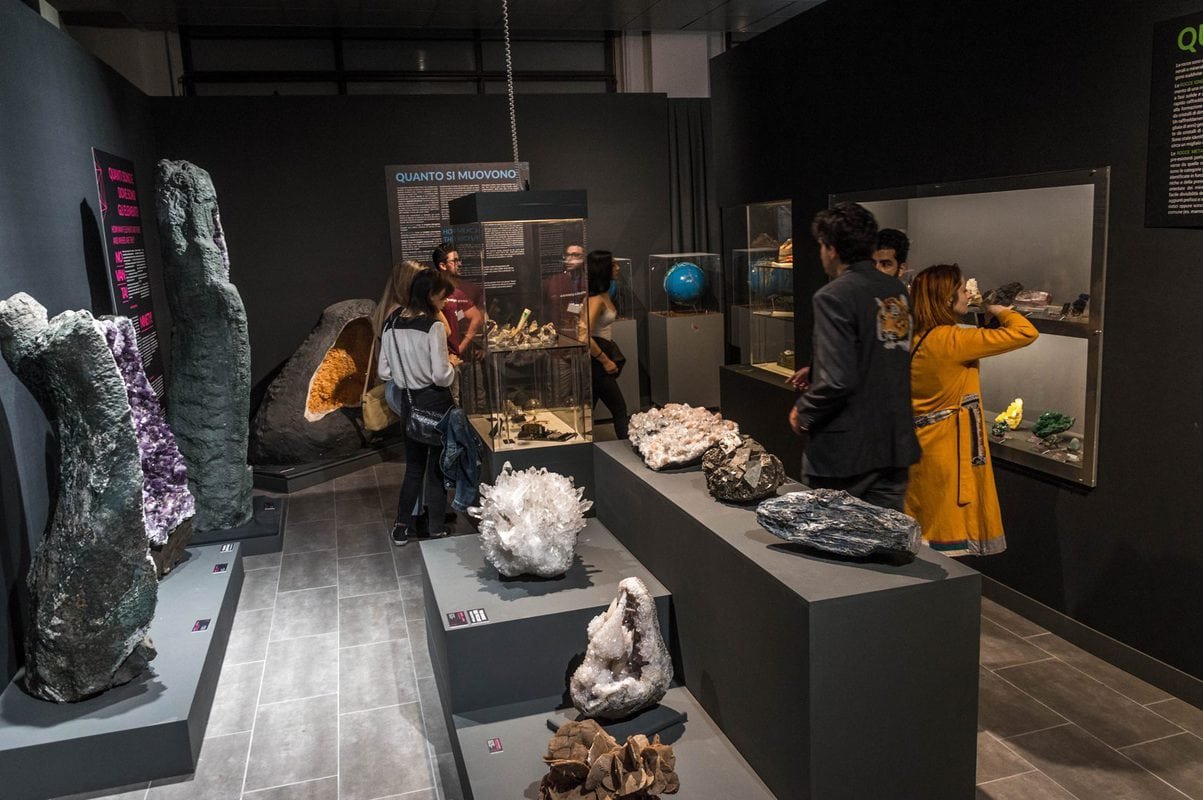
The mineralogical collection is the backbone. It includes systematic minerals arranged by chemical classes, gems, large crystals and samples of Lazio origin that tell of a very rich volcanic territory. Anyone who knows Italian mineralogy knows that Lazio is a mine of species tied to alkaline volcanism: leucite, analcime, potassium minerals that in the rest of Europe are rarities and here crop out half an hour from Rome. A university collection like this one keeps the type samples, the ones on which the original descriptions of the species were written.
The rocks and the geological samples
7,000 geological samples are, in practice, the lithological library of central Italy. Limestones of the Apennines, travertines of the Roman countryside, tuffs of the volcanic districts, Pliocene clays, sands and gravels of the Tiber terraces. They are the materials with which Rome was built, literally: the tuff of the Servian walls, the travertine of the Colosseum, the pozzolana that made Roman concrete possible. Seeing the rock sample in the case and then going out and seeing the same material in an ancient wall is the most effective teaching experience this city can offer.
The fossils and the paleontological collection
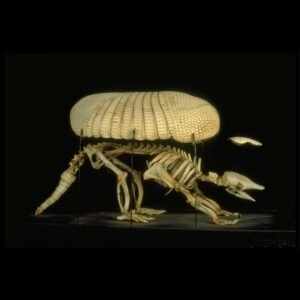
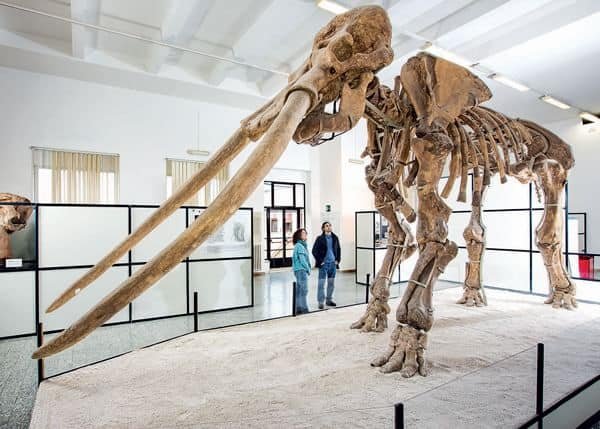
100 thousand paleontological finds are a heritage worthy of a great national museum. There are marine invertebrates in the tens of thousands, vertebrates of the Quaternary, plant remains, and above all there are the historic collections tied to specific names, which multiplies the scientific value: a fossil without a history is an object, a fossil with its 19th-century label and its publication is a document.
The meteorite collection of the MUST
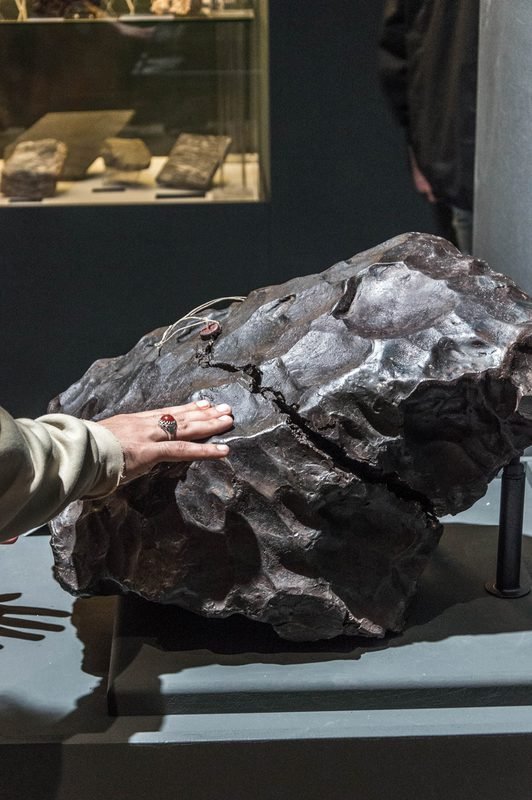
Here we touch the showpiece, and strangely it is the one we talk about least. The meteorite collection kept in the mineralogical museum of the Sapienza includes 360 samples from 211 different meteorites: 112 observed falls and 99 finds. 35 specimens come from Italian meteorites. To put it in perspective, this is one of the most significant meteorite collections in the country, built with patience over a century and a half.
The Italian falls kept at the University Museum of Earth Sciences - MUST
Among the Italian ones there are names that anyone who has studied meteoritics knows by heart. The Renazzo chondrite, which fell on January 15, 1824 in the Ferrara area, gave its name to an entire group of carbonaceous chondrites, the CR. It is one of those cases in which a village of the lower Po plain enters the world's scientific nomenclature. There is Vigarano, another name planetary scientists pronounce with respect. There is San Michele, the last meteorite seen falling and recovered in Italy. And there is Monte Milone, which fell on May 8, 1846 near Tolentino, of which the museum keeps the main mass, 2,044 grams.
The great names of world meteoritics
Alongside the Italian ones, the collection includes portions of meteorites that are milestones of the discipline: Allende, the Mexican carbonaceous meteorite that fell in 1969 and arrived just in time to get the laboratories that were waiting for the lunar samples calibrated. Orgueil and Mighei and Murchison, the carbonaceous ones rich in organic compounds over which prebiotic chemistry was debated for decades. Chassigny and Novo-Urei, which give their names to two groups. Sikhote-Alin, the Siberian iron shower of 1947. And Ensisheim, the Alsatian meteorite whose fall in 1492 is the oldest European meteorite event documented continuously. The museum also keeps 52 grams of L'Aigle, which fell on April 26, 1803: that fall, studied by Jean-Baptiste Biot, finally convinced the Academy of Sciences that stones really do fall from the sky.
The main masses kept in Rome
Three meteorites have their main mass here, that is, the largest existing fragment in the world: Bur-Gheluai, Monte Milone and Uegit, the latter with 252 kilograms of iron. Holding the main mass of a meteorite means every future study on that body goes through this building. If you are looking for a reason to consider the MUST a museum of international standing and not a teaching collection of a university, this is the reason.
Who built the meteorite collection
The collection was energetically promoted by Giovanni Strüver in the second half of the 1800s, the mineralogist who gave the Roman school a modern crystallographic method. It was then organized by Federico Millosevich, who published the first catalog in 1928. An updated catalog, with weights and types, was printed in 1975 by A. Maras. In the last 40 years the collection has grown through donations, acquisitions and exchanges, which is the normal way meteorite museums grow: you swap a fragment with another institute, and so two collections both become more complete.
The historic collections of the University Museum of Earth Sciences - MUST
This is the part that distinguishes a university museum from a popularizing museum. The historic collections bear the name of whoever put them together, and each name is a chapter in the history of science.
The Athanasius Kircher collection
The most striking name is that of the German Jesuit Athanasius Kircher, the 17th-century polymath who put together in Rome the most famous encyclopedic museum in Europe. Kircher had very wrong ideas and brilliant intuitions: he thought there was a system of interconnected channels of fire inside the Earth, and to verify it he had himself lowered into the crater of Vesuvius in eruption. His images of the underground world are the first great visual representation of internal geology. In the museum's installation the Kircher collection is also told through dioramas dedicated to volcanoes, which pick up that iconographic tradition.
The Spada, Watson, Belli and Dodwell collections
These are collections formed between the 1700s and 1800s, when collecting minerals and fossils was a learned and cosmopolitan practice. The name Dodwell points to Edward Dodwell, the traveler and antiquarian who toured Greece and lived for a long time in Rome in the first half of the 1800s, a typical figure of that world in which archaeology, mineralogy and the Grand Tour were the same trade. These collections tell the taste of an era even before the science of an era: the choice of the samples, the way of mounting them, the handwritten labels.
The Giuseppe Ponzi collection and the geology of the Roman countryside
Giuseppe Ponzi is the father of 19th-century Roman geology. He studied the volcanic and sedimentary deposits around the city at a time when stratigraphy was still a young science, and understood that the Roman countryside was the result of a struggle between volcanoes and rivers. His collection, kept here, is the material basis of that reconstruction: if today we know why the Seven Hills have that shape, it is also thanks to whoever collected those samples hammer in hand in the countryside between Prima Porta and the Castelli.
Michelotti, Meli, De Angelis d'Ossat
Giovanni Michelotti was a paleontologist of the Tertiary terrains. Romolo Meli worked on the Roman collections between the late 1800s and early 1900s. Gioacchino De Angelis d'Ossat combined applied geology and studies of the territory, in years when Rome was expanding and every construction site opened a window on the subsoil. They are names that tell non-specialists little and specialists everything, because their labels appear in the bibliographies of works still published today.
The Serafino Cerulli Irelli collection and the fossils of Monte Mario
Cerulli Irelli collected and studied the fossil mollusks of the Pleistocene marine deposits of Monte Mario, the hill that closes Rome to the northwest and that preserves, under the green of the Monte Mario Nature Reserve, a marine succession of international importance. His major work, the "Fauna malacologica mariana", came out in eight volumes between 1907 and 1916. The point is this: those tiny shells, cataloged one by one, document the sea that covered the Rome area and its gradual disappearance. A collection of fossil shells that looks like an exercise for scholars is instead the archive of a climatic and tectonic change that happened under our feet.
The Dactyliotheca and the Rovis collection
The Dactyliotheca is a collection of impressions and reproductions of engraved gems, a typical object of European antiquarian culture: it served to study ancient glyptics without owning the original stones. The Rovis collection, acquired in 2009, is instead made of giant crystals, and has an immediate scenic effect: they are the specimens in front of which even the most distracted visitor stops. A smart museum uses precisely those pieces as a front door, and then leads the visitor toward the systematic display case that, at first sight, seemed less attractive.
The visit today to the University Museum of Earth Sciences - MUST
We need to be clear about proportions. The complete museum will occupy four floors. The part the public has seen in recent years is a room of about 480 square meters, the one that hosted the thematic exhibition opened on October 8, 2018, "Terra: che sorpresa!", now concluded. The other spaces are being re-installed. Anyone arriving expecting the Natural History Museum of London will be thrown off. Anyone arriving knowing they are entering an open scientific work site, with a guide who knows every sample by name, leaves very happy.
The route built in that room is an excellent example of serious geological popularization. It covered, in order, the formation of the planet, the origin and classification of meteorites, the genesis of minerals and rocks, tectonic processes, volcanic systems, the evolution of the Earth's surface, the appearance and evolution of life, the processes of fossilization, geological hazards, energy sources, environmental sustainability, and finally the very history of scientific museums from the 1800s onward. That last chapter is the one I prefer: a museum that explains what a museum is, and why for two centuries we have been collecting rocks.
The interactive labs of the University Museum of Earth Sciences - MUST
The lab part isn't the usual touch screen station. Real instruments are used: polarizing microscopes, with which a thin section of rock becomes a piece of colored glass and minerals are recognized by their interference colors. Binocular stereoscopes, to observe microfossils and small crystals. Geiger counters, to measure the natural radioactivity of certain samples. And demonstrations of mineral luminescence. The fluorescence lab lasts about 15 minutes and has a guaranteed theatrical effect: the light goes off, the ultraviolet lamp goes on and gray, anonymous stones start to glow green, orange, blue. Bored teenagers change expression here in three seconds.
Among the routes the museum has offered is the guided visit to the exhibition, lasting an hour, paired with the short fluorescence lab. During special openings the museum has also offered labs dedicated to the geology of Rome and the minerals of Lazio, plus an activity for the youngest where they dig and identify finds as a paleontologist would. Ask which activities are available when you book: they change with the calendar and the availability of the researchers.
What you learn at the University Museum of Earth Sciences - MUST
It's worth arriving prepared, because the difference between looking at a case of minerals and understanding it lies entirely in the few notions that follow. You don't need specialist studies, you need a mental order.
How a mineral is born
A mineral is a natural solid substance with a defined chemical composition and an ordered atomic structure. That ordered structure is the reason for the flat faces of crystals: the external shape we admire in the case is the macroscopic reflection of an atomic lattice that repeats. Crystals grow where they have time and space: in a cavity of an igneous rock, in a fracture crossed by hot fluids, in a basin that slowly evaporates. When cooling is rapid, crystals stay microscopic or don't form at all, and you get a volcanic glass such as obsidian. The practical rule to take home: big crystal means long time.
The three great families of rocks
Igneous rocks derive from the cooling of a magma, and divide into intrusive ones, crystallized at depth and coarse-grained like granite, and effusive ones, cooled at the surface and fine-grained like basalt. Sedimentary rocks form by accumulation and cementation of debris, shells and chemical precipitates: sandstones, limestones, clays, travertines. Metamorphic rocks derive from the solid-state transformation of preexisting rocks under pressure and temperature: Carrara marble is a recrystallized limestone, slate a compressed clay. This three-part scheme sorts 90 percent of what you will see in the cases.
Plate tectonics explained properly
The Earth's lithosphere is divided into rigid plates that slide over a ductile mantle. Where plates move apart, new oceanic crust is born along the ridges. Where they converge, one plate sinks under the other in a subduction zone, and mountain chains, oceanic trenches, volcanic arcs and deep earthquakes are born. Where they slide past each other, strike-slip faults form. Italy is a textbook case: the Apennines are a chain built by the convergence between Africa and Eurasia, the volcanoes of Lazio and Campania are children of subduction, while the earthquakes of the central Apennines come from a more recent extension that is widening the chain. Whoever understands this understands why Rome stands on a tuff plateau.
How a bone becomes a fossil
Fossilization is a statistical accident. Out of billions of organisms that lived, an infinitesimal fraction has reached us, and almost always thanks to two conditions: rapid burial and absence of oxygen. Then the processes come into play: permineralization, when fluids deposit minerals in the pores of bone or wood. Replacement, when the original matter is replaced molecule by molecule by silica or pyrite. Carbonization, typical of leaves. And the simple preservation of imprints and casts. The lesson to take away: a paleontological museum doesn't show the life of the past, it shows the tiny part of life that had the luck to end up under the mud at the right moment.
Rome seen by a geologist: why this museum is in Rome
Rome is a city built on top of and inside its own geology, and this museum is the right place to understand it. The deep substrate is made of Pliocene marine clays and sands. Above are the gravels and sands deposited by the Tiber and its tributaries. Above those still, the products of the two great volcanic districts that in the Quaternary buried the countryside under tens of meters of pyroclastic deposits: the Alban Hills to the southeast and the Sabatini Mountains to the northwest. Then the rivers cut into that plateau, and the tongues of tuff left between the valleys became the hills on which the city was born.
From here everything else follows. Tuff is cut with simple tools and hardens in the air: hence the walls, hence the quarries under the city, hence the catacombs dug in the bank of pozzolana. Pozzolana, mixed with lime, produces a mortar that sets even underwater: hence Roman concrete, hence the dome of the Pantheon. The travertine of the Acque Albule near Tivoli, a limestone deposited by thermal springs, is the cut stone of Rome: from the Colosseum to the Baroque facades and, precisely, to the cladding of Michelucci's building that houses the museum. And the clays of the hills, impermeable, are the reason why certain landslides and certain subsidences repeat always in the same places.
Anyone who visits the MUST and then walks around Rome sees a different city. If you want a coherent excursion, the Museo di Casal de' Pazzi preserves in situ a Pleistocene river deposit with remains of an ancient elephant and stone tools, that is, exactly the Quaternary chapter that you see in the case at the university museum.
A curiosity about the University Museum of Earth Sciences - MUST
The most beautiful curiosity isn't about a fossil but about a 17th-century Jesuit. Among the museum's historic collections appears the name of Athanasius Kircher, the man who in Rome, at the Collegio Romano, built the most visited museum of wonders in Europe. Kircher wrote the "Mundus Subterraneus", published in Amsterdam in two volumes between 1664 and 1665, a work in which he imagined the interior of the planet as a tangle of channels of fire and water, with volcanoes as the vents of a single system. He was wrong about almost everything, and right about one fundamental thing: that the interior of the Earth is hot, mobile and connected, and that surface phenomena are the manifestation of something happening below.
The part few know is how he arrived at that idea. Between 1637 and 1638 Kircher made a long journey in southern Italy, through Malta, Sicily and Calabria, and in 1638 he climbed Vesuvius to observe the crater in person. He declared the method himself, in Latin, and it is the method of a modern geologist: he demanded autopsy, that is, direct vision of every single phenomenon, instead of quoting the ancient authors. The engraving of the crater that opens the first volume of the work shows exactly what he had seen that year. Tradition has it that he had himself lowered by a rope into the smoking mouth. If it really went that way it is tale, not document, but a man in a cassock perched on the rim of an active volcano taking notes is already enough.
That a piece of that tradition ended up inside a 20th-century university department, next to polarizing microscopes and Geiger counters, says something exact about science: it isn't born from laboratories, it is born from the curiosity of whoever has himself lowered into the volcano. In the museum's installation the dioramas on volcanoes tied to the Kircher collection pick up precisely this line, and they are the point where the public understands that geology was, for centuries, an adventurous business.
The virtual tour of the University Museum of Earth Sciences - MUST
The department provides a virtual tour of the rooms, reachable from the museum's page on the website of the Department of Earth Sciences of the Sapienza, together with a trailer of the exhibition. It doesn't replace the visit, and whoever tells you otherwise has never looked at a crystal in the right light. It serves two concrete purposes, though: preparing a class before bringing it on a visit, and letting those who cannot climb stairs see the spaces anyway. For a teacher who has to organize an outing it is a serious working tool, to use always before booking, to decide which topics to focus on during the hour of the guided visit.
Something nobody tells you about the University Museum of Earth Sciences - MUST
Nobody tells you that the experience depends on who accompanies you, and that here the human factor weighs more than in any civic museum. In a municipal museum you can do the visit alone, with the panel and the audio guide, and the result is predictable. Not here. The open rooms are few, many collections are still in storage, and what transforms the visit is the person who opens the door for you: a researcher who works on those materials, who tells you why a sample entered the collection and who collected it. Booking as a group and paying the €110 of the guided visit, splitting it among 25, is the smartest choice you can make.
The second thing nobody says concerns the timing. This isn't a half-hour museum and not a three-hour romp either: the department's indications speak of a visit that, in its full version with labs, comes close to two and a half hours. If you arrive with the idea of taking a quick look before lunch you have the wrong place and the wrong museum.
The third, the least obvious: you are inside a working department. In the corridors students pass with their course notes, through the half-open doors you glimpse microscopes and thin sections, on the notice board there are the exam notices and the seminars of the month. For a kid thinking of enrolling in Geological Sciences this is a better orientation day than any open day, and nobody advertises it as such.
The advice I give you for visiting the University Museum of Earth Sciences - MUST
Book early in the morning, at the start of the phone window, and ask explicitly for two things: which rooms will be accessible that day and whether the fluorescence lab is available. They are the two variables that change the quality of the visit. If you have a group, really fill it up to 25 people: the fee is per group, and at 25 it becomes a trivial sum per head to have a specialist all to yourselves.
Second piece of advice, on the order of the day. Do the museum first, in the morning, and keep the afternoon for walking. The University City campus is a chapter of 20th-century Italian architecture that deserves a good hour: Piacentini's Rectorate with Arturo Martini's Minerva, Gio Ponti's Mathematics building, Physics, Chemistry, and the building you have just visited. Then you go out the gate and in 10 minutes on foot you reach the basilica of San Lorenzo fuori le Mura, which is a lesson in architectural stratigraphy: two churches joined together, a Cosmatesque floor, the Lombard apse and the wounds of the war.
Third piece of advice, the one nobody follows and everyone should: bring a magnifying lens of 10x, the geologist kind, which costs little and fits in a pocket. In front of a case of minerals a lens completely changes the experience. You'll see crystal faces, twins, inclusions, and you'll understand why mineralogy is a science done with the eyes before the instruments. And forget about hurrying: here the reward is proportional to the time you give each sample, not to the number of cases you walk past.
Another well-known fact, and yet rarely cited
That the MUST was born from the merger of three museums in 2016 you read everywhere. What almost nobody tells is that the merger repaired a war wound. Michelucci's building had been designed in 1933 with the exhibition rooms as an integral part of the architecture: separate portals for the three institutes, a double courtyard to bring natural light into the galleries, paleontology on the top floor because the big specimens needed height. It was a museum conceived by the architect together with the building, not placed inside the building.
Then the bombings of 1943 hit this quadrant of the city, and the installation was dismembered. The rooms were divided, converted into classrooms, labs, offices. The collections ended up in storage and in scattered cabinets. The three museums survived as separate, half-closed entities, open intermittently, known almost only to specialists. For 70 years the largest geological and paleontological heritage in Rome has remained in a warehouse condition.
The re-installation underway, with the declared goal of opening all the rooms on four floors, is therefore not just a modern museographic project: it is the reconstruction of an idea of 1935 interrupted by a war. Put this way, the slowness of the work becomes less irritating. Putting back on display 142,000 samples with current scientific criteria, cataloging them in a single inventory, is a job of decades, not of seasons. And it is worth waiting for.
The right photo to take at the University Museum of Earth Sciences - MUST
Forget the panorama of the room: exhibition rooms with mixed light and reflective glass are enemies of amateur photography. The right photo here is just one, and it's the close-up of a crystal. Bring the lens close to the glass until you almost touch it, so as to eliminate reflections, turn off the flash, which on glass only produces a white flare, and rest the phone or the camera against the case for stability. Look for a crystal with well-developed faces, focus on an edge and let the background blur.
If the fluorescence lab is scheduled during the visit, that's where you take home the memorable image: minerals that under ultraviolet lamp light up in improbable colors. You need a technical trick, though, otherwise you get a shapeless green blotch. Lock the exposure and reduce it by one or two stops, because the camera tries to lighten the surrounding black and burns the colors. If the phone has a pro mode, raise the sensitivity and keep the shutter time around one eighth of a second, with your elbow braced.
The third photo, the one nobody takes and that instead tells the place best of all, is shot outside. Go out onto Piazzale della Minerva and frame the travertine facade of Michelucci's building at an angle, with the horizontal windows marking the four registers and the monumental portal in the foreground. With the raking light of late afternoon the travertine turns golden and the shadows draw the cornices. It is the photograph that explains, without captions, what kind of museum you have just visited: a scientific museum inside a piece of Italian rationalist architecture.
Some important events that happened here in history
The first event is the birth itself of the mineralogical collection, in 1804, in a Rome still papal that was about to be overwhelmed by the Napoleonic occupation. Founding a museum of minerals at that moment meant declaring that the Papal States too wanted a seat at the table of European natural sciences, next to Paris, Vienna and Freiberg. The collection starts there, and from there it has never stopped growing.
The second is the 19th century of Roman geology. While the city prepared to become a capital, geologists mapped the countryside, and Giuseppe Ponzi understood that the hills of Rome were the result of the river incision of a volcanic plateau. In the same season Giovanni Strüver built the meteorite collection and brought the German crystallographic method to Rome. The museum you visit is the sediment of that generation.
The third is 1935: the inauguration of the University City and of Michelucci's building, with the three institutes brought together under the same roof and the collections finally displayed in rooms designed to measure. It is the moment of greatest ambition, and it lasts very little.
The fourth is the war. The bombings of 1943 on the San Lorenzo quadrant and on the University City lead to the dismemberment of the museum installation. From there begins the long period in which the collections survive in storage.
The fifth is 1928, which must be cited for two reasons: paleontology obtains an autonomous structure and Federico Millosevich publishes the first catalog of the meteorites. The sixth is 2009, with the acquisition of the Rovis collection of giant crystals, the signal that the institution was buying again and not only preserving. The seventh is 2016, with the merger into the MUST. The eighth is October 8, 2018, when the exhibition "Terra: che sorpresa!" opens and the Roman public finally sees again an earth sciences room set up with contemporary criteria, in the University City, after decades of half-open doors.
Who has passed through the University Museum of Earth Sciences - MUST
The first name is that of Giovanni Strüver, the mineralogist who in the second half of the 1800s gave the Roman school a rigorous crystallographic method and promoted with determination the collection of meteorites. Without him, Rome today would not keep 360 samples from 211 different meteorites.
Then Federico Millosevich, who gave that collection its order and its science, publishing its first catalog in 1928: a meteorite catalog is thankless and fundamental work, because without a catalog a collection is just a heap of stones. And A. Maras, who in 1975 printed the updated version with weights and types.
Giuseppe Ponzi belongs to the previous generation: a geologist of the Roman countryside, a man of the Risorgimento 1800s, he left here the collection that bears his name. Serafino Cerulli Irelli, born in Teramo in 1873, trained at the Sapienza, studied the fossil mollusks of Monte Mario and published between 1907 and 1916 the eight volumes of the "Fauna malacologica mariana", later becoming president of the Italian Geological Society. Beside them Giovanni Michelotti, Romolo Meli and Gioacchino De Angelis d'Ossat, whose materials still today make up the reference collections.
Through the historic collections also pass figures who never set foot here: Athanasius Kircher, the Jesuit of the "Mundus Subterraneus", and Edward Dodwell, the traveler and antiquarian who between Greece and Rome embodied the spirit of the Grand Tour. And then there is the one who built the walls of this place: Giovanni Michelucci, the architect of the Florence station, who here between 1933 and 1935 signed one of the most successful buildings of the University City, opposite Gio Ponti's Mathematics building. Today the museum is directed by Professor Marco Romano, a paleontologist, with Professor Michele Macrì as area curator.
The University Museum of Earth Sciences - MUST with children
It works, and works better than you'd expect, under two conditions. The first is age: under six a case of systematic minerals is furniture, over seven it becomes a treasure hunt. The second is the guide: with a researcher who can tell a story, an eight-year-old stays hooked for a good hour, because the earth sciences have three subjects that always win, and they are volcanoes, dinosaurs and stones that come from space.
Meteorites, in particular, are a sure hit. Explaining to a child that that piece of rusty iron crossed the solar system for millions of years and fell in a field in the Ferrara area in January 1824 produces an attentive silence that no cartoon achieves. The fluorescence lab, when available, ends the visit the right way: darkness, ultraviolet lamp, stones that light up. During special openings the museum has also offered an activity in which the youngest dig and identify finds as a paleontologist would.
Practical advice: prepare the children with two questions, not a lecture. Where does the stone Rome is made of come from, and how does a dead animal become stone. If they arrive with those two questions in mind, the visit fits together on its own. And if you are looking for another science outing for the same age group, the Museo Civico di Zoologia on Via Ulisse Aldrovandi is the most obvious complementary choice, while the Physics Museum of the Sapienza plays on the same university field.
Accessibility of the University Museum of Earth Sciences - MUST
The museum offers free of charge, on reservation, a visit service in Italian Sign Language. It is a fact to underline, because few Roman museums guarantee it in a structured way and with no extra cost. It must be requested when you book, not on the day itself, because it requires the presence of an interpreter.
On architectural barriers the matter is more delicate and should be handled by phone. The building is a palace of the 1930s on several levels, with the exhibition spread among the basement, the ground floor and the upper floors, and the museum is in a phase of re-installation: access conditions can vary depending on the rooms open. Anyone who uses a wheelchair, or accompanies a person with mobility difficulties, must state it at booking and ask to be told the entrance and the practicable route. It is the only way not to make a trip for nothing.
For those who have difficulty standing for long, on the other hand, an honest consideration: the guided visit lasts about an hour, and the complete route with the labs reaches two and a half hours. Ask whether a shorter version is possible, and keep in mind that an exhibition room doesn't have many seats. The campus, though, is full of benches and lawn in the shade of pines, and for a break before or after it is one of the quietest places in Rome.
How long the visit to the University Museum of Earth Sciences - MUST takes
The department's indications speak of a complete route of about two and a half hours, while the guided visit to the exhibition is an hour and the fluorescence lab lasts about 15 minutes. In practice, for an interested adult, the right time is 90 minutes. For a school class, an hour and a half including the lab. For a specialist who wants to look properly at the cases of systematic minerals, half a day is not enough.
The maximum group is 25 people. It's a reasonable limit and shouldn't be forced: in a room of 480 square meters, with cases and instruments, beyond 25 you can no longer hear the guide and can no longer see anything. If you have a larger party, split it in two shifts. Better two happy groups than one unhappy one.
Tickets and museum cards: how a university museum works
Here we need to be precise, because it is the most frequent source of misunderstanding. The MUST is not a civic museum and not a state museum: it is a university museum, owned by the Sapienza, part of the university's Museum Hub. Three practical consequences follow from this.
First: the cards and passes designed for the museums of the City of Rome have no validity here, nor do the cards of the state circuit. There is no turnstile, there is no circuit.
Second: the free Sunday of the state circuit, which concerns the museums of the Ministry of Culture, does not concern this museum, which by the way is already free for individual visitors.
Third: the free admission for individuals is real, but it is subject to reservation. Anyone who shows up at the door without an appointment doesn't get in, and not because someone is rude: simply there is nobody assigned to welcome them. Groups of up to 25 people pay €110 in total with the guided visit included. If you have read different individual fares elsewhere, at booking have the amount confirmed together with the date: it is the moment when all doubts are cleared with a single phone call.
What to see around the University Museum of Earth Sciences - MUST
The University City is an open-air museum of Italian architecture of the 1930s, and crossing it is already half a day. Marcello Piacentini's Rectorate closes the square with Arturo Martini's bronze Minerva. To the right and to the left line up the institutes signed by some of the best Italian architects of the time, each with its own interpretation of the rationalist language. The Gipsoteca of the Sapienza and the Museo Laboratorio di Arte Contemporanea are a few steps away, inside the same enclosure.
Going out the gate on Viale dell'Università, 10 minutes on foot to the east take you to San Lorenzo, the most lively working-class and university neighborhood of the area, with the basilica of San Lorenzo fuori le Mura and the monumental museum context of the Sapienza behind you. To the west, barely a quarter of an hour away, are the National Central Library and the Castro Pretorio neighborhood, with the remains of the Praetorian camp incorporated into the Aurelian Walls. To the north, Viale Regina Elena leads to the Policlinico Umberto I complex and, a little farther, to the Nomentano neighborhood.
If you have energy and want to keep the theme, the Botanical Garden on the Lungara closes the circle of the Sapienza's scientific collections on the other side of the city, while whoever has acquired a taste for minerals should know that in Latina there is the Museo di Arte e Giacimenti Minerari, also belonging to the Roman university.
The other museums of the Sapienza Museum Hub
The Sapienza Museum Hub brings together about 20 museums, and is, taken all together, one of the most substantial scientific and archaeological heritages in Italy. Inside the University City there are, besides the MUST, the Museo di Chimica Primo Levi, Museo di Fisica, the Museo Erbario, the Museum of Etruscan and Italic Antiquities, the Museo del Vicino Oriente, Egitto e Mediterraneo, Museo di Arte Classica with its plaster cast gallery, Museo delle Origini and Museo di Antropologia Giuseppe Sergi.
Outside the campus, in the Policlinico and San Lorenzo area, there are the Museo di Anatomia Comparata Battista Grassi on Via Borelli, Museo di Anatomia Patologica on Viale Regina Elena and Museo di Storia della Medicina on Viale dell'Università. They are museums with particular hours and often by appointment, exactly like this one. The Sapienza owns a museum wealth that not even Romans know, and the limit isn't the quality of the collections but the difficulty of getting in. Whoever has the patience to book sees things that don't exist in the tourist circuits.
When to go to the University Museum of Earth Sciences - MUST and when to avoid it
The best period is autumn, between October and December, and spring between March and May: the university is in full activity, the researchers are there, the campus is alive and visits are organized without difficulty. To avoid, unless verified: the summer closure, which in 2026 runs from July 31 to September 10, the central weeks of the exam sessions in January and June, when the staff is busy, and the Christmas holiday period.
Within the day, the morning is the natural slot: the museum works on the schedule of a university department, not that of a tourist museum. An advantage nobody considers: the University City first thing in the morning, with the light cutting across the travertine and the students coming up from the gate, is one of the most beautiful and least photographed urban sights in Rome.
Finally, watch for special openings: the museum takes part in the initiatives of the Museum Hub, such as the museum nights and the university programs, and on those occasions the visits take place without reservation, in a continuous cycle, with labs and evening seminars. They are the best evenings for a first time, because you breathe the atmosphere of the department in celebration. They are also the most crowded, and if you are looking for silence and free cases they are not for you.
Quick questions about the University Museum of Earth Sciences - MUST
How much does it cost to enter the University Museum of Earth Sciences - MUST
For individual visitors admission is free, with mandatory reservation. Groups of up to 25 people pay €110 in total, and that sum includes the guided visit led by the museum's staff. There is no ticket office with over-the-counter sales: everything goes through the reservation.
Do you need to book to visit the MUST
Yes, always, and it's not a formality. Reservation is mandatory because the museum is inside a working university department and the welcome has to be organized. Anyone who shows up at the door without an appointment doesn't get in. The exception is special openings tied to university events, during which visits take place in a continuous cycle without reservation.
How do you book a visit to the University Museum of Earth Sciences - MUST
At the museum's mobile, 324 8961999, active from 10:00 to 13:00 and from 14:30 to 15:30, or by writing to the address must@uniroma1.it. The reservations office also answers at 06 4991 4825. For groups it's best to write, giving the date, desired time, number of participants and any accessibility needs.
Where is the University Museum of Earth Sciences - MUST
In the University City of the Sapienza, Piazzale Aldo Moro 5, 00185 Rome, building CU005, home of the Department of Earth Sciences. The building faces Piazzale della Minerva, the inner space of the campus in front of the Rectorate, and entry is through the Mineralogy entrance.
How do you get to the MUST by public transport
By metro line B, stops Policlinico or Castro Pretorio, both a few minutes on foot. On the surface, lines 3, 19, 71, 93, 163, 310, 443, 448, 492 and 512 serve the area. From Termini, lines 310 and 492 reach the main gate, and anyone who prefers to walk takes about 20 minutes.
How long does the visit to the University Museum of Earth Sciences - MUST take
The guided visit to the exhibition lasts about an hour. The complete route with the lab activities comes close to two and a half hours. The mineral fluorescence lab lasts about 15 minutes. For an interested adult, 90 minutes is the right measure.
Is the MUST open in August
No. The museum observes a summer closure that in 2026 runs from July 31 to September 10. Anyone who wants to visit in summer must plan before the end of July or wait for the reopening in September.
What does the acronym MUST mean
MUST is the acronym of Museo Universitario di Scienze della Terra. It is the museum born in 2016 from the merger of the three historic museums of the Sapienza dedicated to Geology, Mineralogy and Paleontology.
How many pieces does the University Museum of Earth Sciences - MUST keep
More than 35,000 mineralogical samples, 7,000 geological and 100,000 paleontological, to which are added antique books, thematic maps and historic scientific instruments. Many specimens are unique at national and international level.
Does the MUST really have meteorites
Yes, and they are one of its strong points. The collection includes 360 samples from 211 different meteorites, of which 112 observed falls and 99 finds. 35 specimens come from Italian meteorites. The museum also keeps the main masses of Bur-Gheluai, Monte Milone and Uegit, the latter of 252 kilograms.
Can you take photographs at the University Museum of Earth Sciences - MUST
Shooting for personal use is normally allowed in university museums, but the conditions are set by the staff who welcome you: ask when you enter, and in any case give up the flash, which on the glass of the cases only produces reflections. For professional shooting or for publications, prior authorization is needed.
Is the University Museum of Earth Sciences - MUST suitable for children
Yes, roughly from seven years up, and much more if the visit is guided. Meteorites, volcanoes and fossils are subjects that catch the attention of kids, and the mineral fluorescence lab, when available, is the moment they remember longest.
Is the MUST wheelchair accessible
The building dates to the 1930s and the museum is in a phase of re-installation, with spaces spread over several levels: access conditions must be checked at booking, stating the specific needs, so that the staff can indicate the practicable entrance and route.
Is there a Sign Language service at the University Museum of Earth Sciences - MUST
Yes. The museum offers free of charge the visit in Italian Sign Language on reservation. It must be requested in advance, together with the booking of the date, because it requires the presence of an interpreter.
Are the Rome museum cards valid at the MUST
No. The MUST is a university museum of the Sapienza, not a civic or state museum, so the cards and passes of the municipal and ministerial circuits are not valid. The matter is of little relevance anyway, given that for individuals admission is free on reservation.
Is the MUST free on the first Sunday of the month
The free Sunday concerns the museums of the state circuit and not this museum, which follows the rules of the Sapienza Museum Hub and opens on reservation during the activity hours of the department.
What was the exhibition Terra: che sorpresa!
It was the thematic exhibition opened on October 8, 2018 in the room of about 480 square meters open to the public, now concluded. It dealt with the formation of the planet, meteorites, the genesis of minerals and rocks, tectonics, volcanism, the evolution of life, fossilization, geological hazards, energy and environmental sustainability.
Is there a virtual tour of the University Museum of Earth Sciences - MUST
Yes. The Department of Earth Sciences provides online a virtual tour of the rooms and a trailer of the exhibition, reachable from the museum's page on the department's website. It is useful above all to teachers who want to prepare a class before the outing.
Who directs the University Museum of Earth Sciences - MUST
The direction is entrusted to Professor Marco Romano. The area curator is Professor Michele Macrì, and the office for reservations is run by Catia Pietracatella.
Is the MUST part of the Sapienza Museum Hub
Yes, it is one of the museums of the university's Museum Hub, the network that brings together the scientific, medical and archaeological collections of the Sapienza, from Chemistry to Physics, from the Herbarium to Etruscan and Italic Antiquities, up to Orto Botanico on the Lungara.
How big is the University Museum of Earth Sciences - MUST
The museum spreads over four floors for about 4,100 square meters destined for the most part to exhibitions, to which are added about 300 square meters of shared research labs, offices and storage. The portion open to the public in recent years has been a room of about 480 square meters, while the other spaces are being re-installed.
What is the difference between the MUST and a natural history museum
A natural history museum tells the whole living and mineral world with an installation designed for the general public. The MUST is a university museum of earth sciences, that is, a research archive open to visits, where the main value lies in the completeness of the collections and their scientific documentation. The public gains in depth what it loses in spectacle.
Is the University Museum of Earth Sciences - MUST worth visiting
Yes, as long as you know what you are going to see: not a great finished and fully installed museum, but a first-rate scientific heritage that is becoming visible again one piece at a time, told by those who study it. For those who love minerals, fossils and geology, it is one of the most interesting mornings Rome can offer.
Are there other Sapienza museums to see on the same day
Yes, and it's worth taking advantage. Inside the University City you find Museo di Chimica Primo Levi, Museo di Fisica, Museo Erbario, Museo delle Antichità Etrusche e Italiche, Museo del Vicino Oriente, Egitto e Mediterraneo, Museo delle Origini, Museo di Arte Classica and Museo di Antropologia Giuseppe Sergi. Almost all require reservation: organize two visits in the same morning and you'll have a memorable day.
The final advice on the University Museum of Earth Sciences - MUST
If I had to choose a single Roman museum to recommend to someone who claims science is boring, I'd choose this one, and not for the size of the open rooms, which is modest, but for the quality of the matter. A piece of iron fallen from the sky in 1846 near Tolentino, a mollusk shell collected at Monte Mario by a man who died in 1946, a crystal grown in a volcanic cavity of the Alban Hills when Rome did not yet exist: these are objects that speak of time scales before which our affairs shrink considerably. Book, bring a lens, and ask the guide to tell you where the stone the city you are in is made of comes from. You'll leave looking at walls differently, which is the only result worth asking of a visit.
Article written by the editorial team of TourLeaderPro, contact them for Private/Corporate/V.I.P. Tours and Experiences.
Planning a trip to Rome? The English guides to visiting the city are on ItalyPlanner.com.
Contact Information
Nearby
 Sapienza University City100 m
- Aula Magna of Sapienza University100 m
- Museum of the History of Medicine100 m
- Museum of Pathological Anatomy100 m
- Museo del Vicino Oriente, Egitto e Mediterraneo200 m
- Museo Laboratorio d’Arte Contemporanea, MLAC200 m
Upcoming events nearby
- IUC Concert Season 2026-2027 at Aula Magna della Sapienza, October 17, 2026 to May 8, 2027100 m
- Mario Brunello at the Aula Magna of the Sapienza, January 19, 2027100 m
- Marc-André Hamelin at the Aula Magna of the Sapienza, January 23, 2027100 m
- Janoska Ensemble at Aula Magna, Sapienza University, January 26, 2027100 m