Mario Brunello at the Aula Magna of the Sapienza, January 19, 2027
In short. Mario Brunello plays solo cello on Tuesday, January 19, 2027 at 20:30 in the Aula Magna of the Palazzo del Rettorato of the Sapienza, in the University City at Piazzale Aldo Moro 5 (00185 Rome), for the Minerva cycle of the IUC Season.
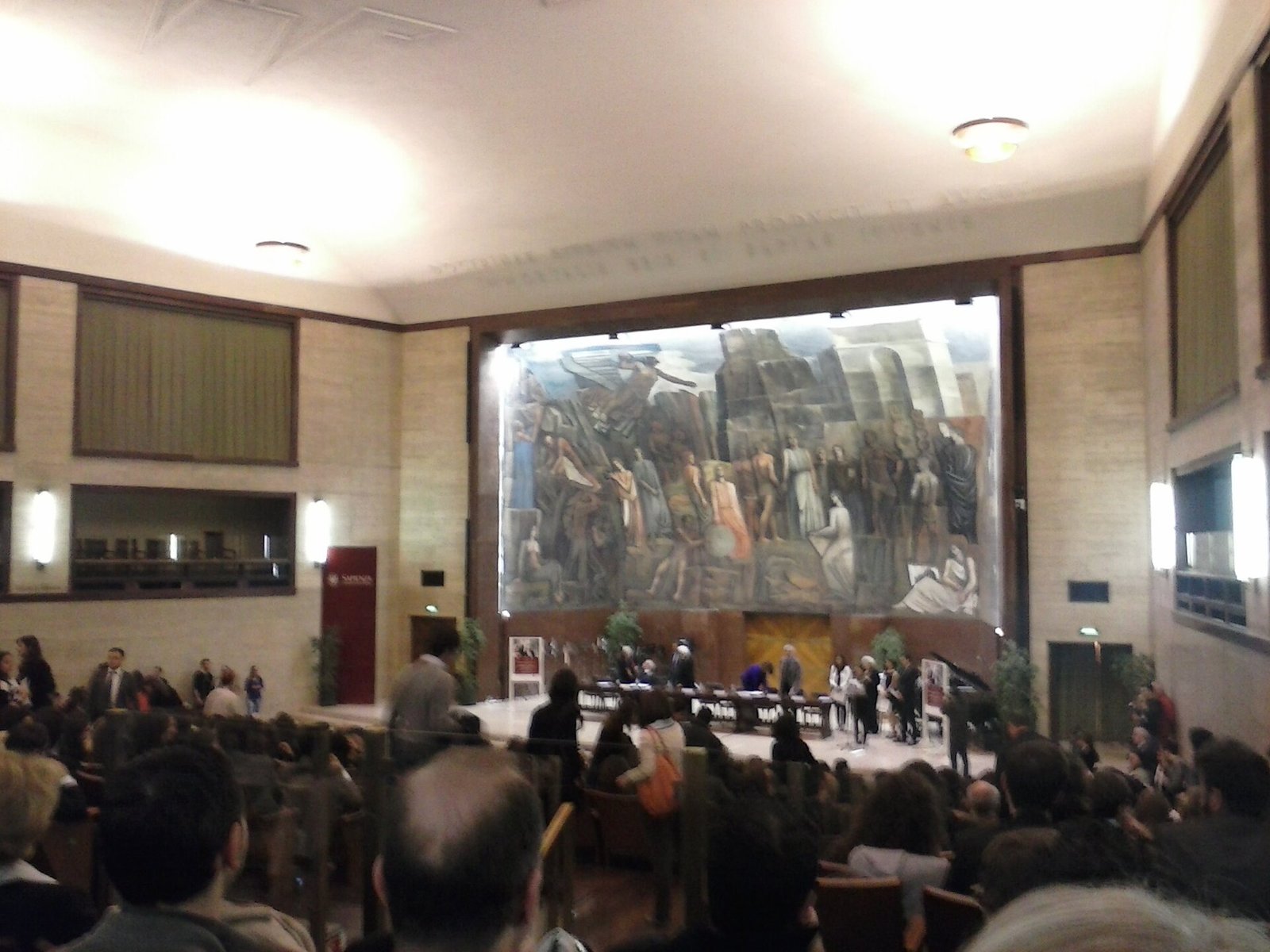
Mario Brunello plays solo cello on Tuesday, January 19, 2027 at 20:30 in the Aula Magna of the Palazzo del Rettorato of the Sapienza, in the University City at Piazzale Aldo Moro 5 (00185 Rome), for the Minerva cycle of the IUC Season. The concert is titled La giusta distanza (II) (literally "The Right Distance"), the second of a cycle of three, and alternates two Bach suites for solo cello with two sonatas by Mieczysław Weinberg. You get there by metro line B, Policlinico or Castro Pretorio stops, by trams 3 and 19 or on foot from Termini station. Access, including on foot, is only from Piazzale Aldo Moro 5. IUC Season tickets cost 26 euros in the first section, 21 in the second and 15 in the third, plus a 10% presale fee. Under-30s pay 8 euros and under-18s 5 euros. They are bought at the IUC office at Lungotevere Flaminio 50, by phone, at the Aula Magna box office from an hour before the concert and on the authorized presale network indicated by the official concert page.
One cello, two composers, two and a half centuries apart: Bach and Weinberg. It is the kind of program that only a musician with Brunello's history can afford without seeming austere. For anyone in Rome who wants to hear solo cello the way you listen to a novel, it is one of the most interesting evenings of the winter.
Mario Brunello at the IUC: La giusta distanza (II)
Mario Brunello's concert of January 19, 2027 is the second chapter of La giusta distanza, a cycle of three solo cello concerts presented by the Istituzione Universitaria dei Concerti in the Minerva cycle, the Tuesday evening one.
Date, time and length
The IUC's official calendar lists Tuesday, January 19, 2027 from 20:30 to 22:30. It is an approximate time, but it gives the idea of a full evening, with a program of four great pages for solo instrument.
The Minerva cycle
In the IUC 2026/2027 Season the Minerva cycle brings together the Tuesday concerts at 20:30, and the Calliope cycle those on Saturday at 17:30. The name Minerva evokes the goddess of wisdom, whose bronze statue greets those arriving in front of the Rettorato: an institution born inside the university chose a name from home.
A season around Beethoven
The IUC Season 2026/2027, the 82nd, counts 35 concerts between October 17, 2026 and May 8, 2027 and celebrates the Beethoven bicentenary. Brunello's recital is a deliberate detour from that thread: no Beethoven, but two composers the cellist sets in direct dialogue.
The program: Bach and Weinberg in relay
Mario Brunello's program alternates Bach and Weinberg: Suite No. 3 in C major BWV 1009, Weinberg's Sonata No. 2 Op. 121, Suite No. 4 in E-flat major BWV 1010 and Weinberg's Sonata No. 4 Op. 140bis.
A relay
Brunello presents the program as almost a relay between two composers who opened unimaginable paths and built metaphysical architectures, and who remain, in his words, "meteors traveling into the future." The choice to alternate the two composers, instead of dividing them into two halves, forces the listener to move continually from one world to the other.
Bach, Suites No. 3 and No. 4
Of Bach's suites for solo cello, Brunello writes in the presentation that it is impossible not to be fascinated by the mastery with which the composer expresses the said and the unsaid. The Third, in C major, and the Fourth, in E-flat major, are two of the six suites that Brunello has recorded in full more than once in his career.
Weinberg, Sonatas Op. 121 and Op. 140bis
Mieczysław Weinberg, who lived from 1919 to 1996, is the least frequently played composer in the program. In Brunello's presentation the cello in his music speaks of despair and hope at the same time, in works of extraordinary personality. For many in the audience it will be the first time hearing these two sonatas live.
The right distance
The cycle's title lends itself to several readings: the distance of two centuries between Bach and Weinberg, that between performer and works, that between the cello and the audience in a hall like the Aula Magna. In our view the strength of the program lies in making two far-apart composers feel close.
Who Mario Brunello is
Mario Brunello is an Italian cellist born in Castelfranco Veneto on October 21, 1960. In 1986 he won first prize at the Tchaikovsky International Competition in Moscow in the cello section, the first European to do so according to the IUC presentation.
Training
He studied at the Conservatory of Venice with Adriano Vendramelli and Antonio Janigro. The victory in Moscow, at 25, took him onto international stages, with a style the IUC calls authentic and passionate.
With the great conductors
He has played with conductors such as Antonio Pappano, Myung Whun Chung, Yuri Temirkanov, Zubin Mehta, Ton Koopman, Manfred Honeck, Riccardo Muti, Daniele Gatti, Riccardo Chailly and Claudio Abbado, and among orchestras with the London Symphony and the London Philharmonic, the Philadelphia Orchestra, the San Francisco Symphony, the NHK of Tokyo, the Orchestre Philharmonique de Radio France, the Filarmonica della Scala, the Münchner Philharmoniker and the Accademia di Santa Cecilia, of which he is a member.
Chamber music and the small cello
He is very active in chamber music, with partners such as the pianists Andrea Lucchesini and Massimo Somenzi and the violinists Gidon Kremer, Salvatore Accardo and Frank Peter Zimmermann. The IUC also describes him as a conductor and a pioneer of new sounds with his violoncello piccolo. He is the founder and director of the Orchestra d'archi italiana.
Beyond classical
He has taken part in jazz festivals with Vinicio Capossela, Claudio Fasoli, Uri Caine and Gian Maria Testa, has created theater shows with Maddalena Crippa and Marco Paolini, and a project devoted to Bach, Pensavo fosse Bach. Since the first edition he has taken part in Suoni delle Dolomiti, the festival that brings music to high altitude.
Teaching and projects
He teaches at the summer advanced courses of the Accademia Chigiana in Siena, and since 2008 he has been artistic director of the Premio Paolo Borciani International String Quartet Competition in Reggio Emilia. In Castelfranco Veneto he gives concerts and masterclasses at the Capannone Antiruggine, an old ironworks turned into a concert hall.
The Bach records
He recorded Bach's six suites in 1993 and 1994 live at the Auditorium of the Turin Conservatory, and again in a triple album from 2009 for Egea. Among his other records are the complete Beethoven for cello and piano with Andrea Lucchesini, the Haydn concertos with I Solisti di Zagabria, and the Vivaldi concertos.
Brunello's cello
Mario Brunello plays a 17th-century Maggini cello, which belonged to Benedetto Mazzacurati and then to Franco Rossi, the cellist of the Quartetto Italiano.
An instrument with a history
A 17th-century cello has lived through the whole history of music for its instrument, including the era when Bach was writing the suites. Hearing Bach and Weinberg on the same wood is, in a sense, hearing the right distance of the title in a single object.
The link with the IUC
The Quartetto Italiano, of which Franco Rossi was the cellist, was among the protagonists of the 1959/60 IUC season, the one in which the Aula Magna also hosted the complete Chopin with Nikita Magaloff and the 32 Beethoven sonatas with Wilhelm Kempff. The instrument Brunello brings to the Aula Magna has therefore already passed, in other hands, through the history of this institution.
A curiosity about Mario Brunello at the Aula Magna of the Sapienza, January 19, 2027
The nicest curiosity is about the cello. Mario Brunello's instrument, a 17th-century Maggini, belonged to Franco Rossi, cellist of the Quartetto Italiano. The Quartetto Italiano played for the IUC in the 1959/60 season, one of the most celebrated in the institution's history. On January 19, 2027 that wood returns, with another performer, to the same hall in which the IUC built its fame.
The second concerns the Tchaikovsky Competition. Brunello won it in 1986, and the IUC presents him as the first European to win it. Those following the Roman season find that competition elsewhere too: a few days later, on February 3, Alexandre Kantorow plays at Auditorium Parco della Musica, the first Frenchman to win it, in 2019.
Third curiosity, the most Roman: Brunello is a member of the Accademia di Santa Cecilia, the institution that organizes the Auditorium's symphonic season. His recital at the IUC ideally joins the city's two main concert societies, one born among Sapienza students, the other based at Auditorium Parco della Musica.
The Aula Magna of the Sapienza
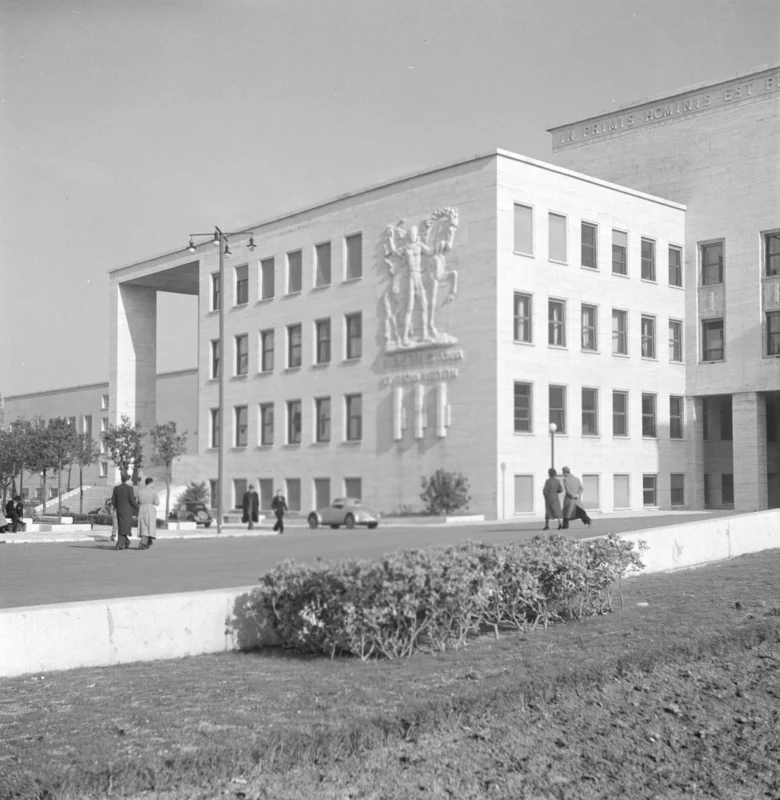
The Aula Magna is in the Palazzo del Rettorato, designed by Marcello Piacentini for the University City of the Sapienza, built between 1933 and 1935 and inaugurated on March 31, 1935 in the presence of King Victor Emmanuel III.
Piacentini's Rettorato
Piacentini drew the general plan of the campus and the Rettorato, which houses the rector's offices, the Biblioteca Alessandrina and the Aula Magna. It is the building that closes the perspective of the entrance avenue, preceded by Arturo Martini's bronze Minerva at the center of a pool.
Sironi's fresco
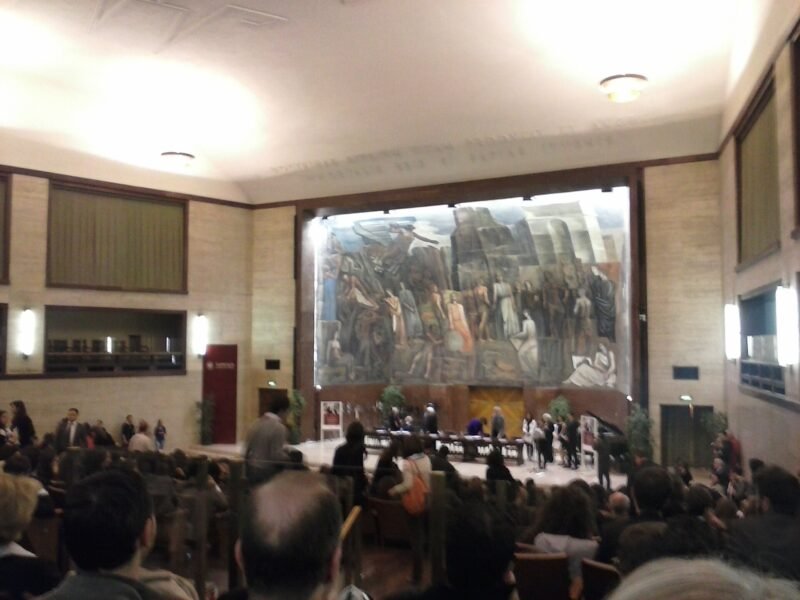
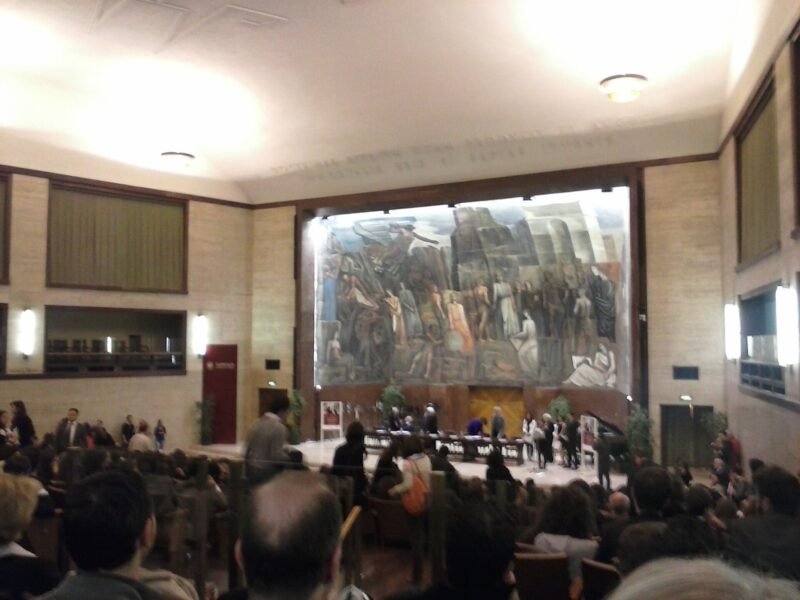
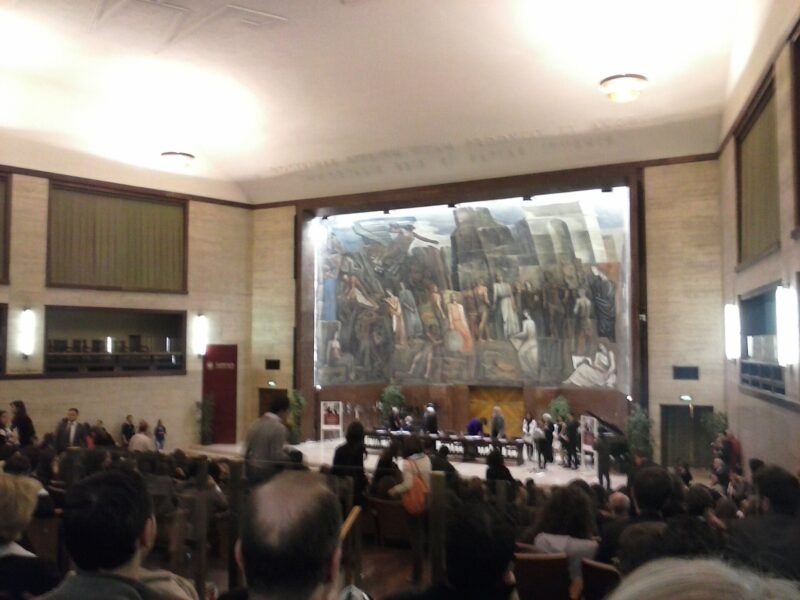
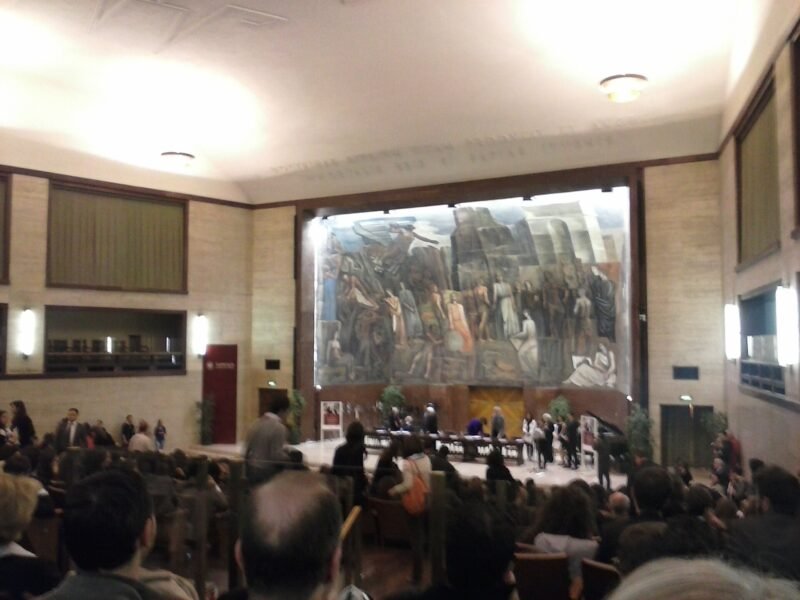
The back wall of the Aula Magna is occupied by Mario Sironi's 1935 fresco, L'Italia tra le arti e le scienze. During Brunello's recital, a lone man with a cello in front of that painted wall is an image that stays with you.
The city of architects
Around the Rettorato the buildings were entrusted to leading architects: Mathematics by Gio Ponti, Physics by Giuseppe Pagano, Chemistry by Pietro Aschieri, Mineralogy by Giovanni Michelucci, Letters and Law by Gaetano Rapisardi. The monumental entrance on Piazzale Aldo Moro is by Arnaldo Foschini.
The campus museums
The University City also contains the MLAC, the Sapienza's contemporary art museum in the same Rettorato, the Gipsoteca and the Giuseppe Sergi Museum of Anthropology.
Something nobody tells you about Mario Brunello at the Aula Magna of the Sapienza, January 19, 2027
Almost nobody mentions it, but for IUC concerts there is free parking inside the University City, for cars, motorcycles, bicycles, taxis and vehicles with a disability permit. Access is from Piazzale Aldo Moro 5, from about an hour before the concert. The IUC warns that for reasons beyond its control it may not be available every time. It is an advantage to know about, not a guarantee.
Second thing: the entrance, even for those arriving on foot, is only from Piazzale Aldo Moro 5. The University City has several gates, and in the evening those coming from the San Lorenzo side risk finding them closed and having to go around. It is best to head straight for Foschini's monumental entrance.
Third: discounts for young people are valid in any section. A person under 30 sits in the first section for 8 euros, the same price as the third. For a solo cello concert, where closeness to the stage matters, it is a notable advantage.
The advice I give you for visiting Mario Brunello at the Aula Magna of the Sapienza, January 19, 2027
My advice is to arrive knowing at least one of the two Bach suites on the program, the Third or the Fourth, in any recording. Weinberg will be a discovery for almost everyone. Having a fixed point in Bach lets you follow the relay without getting lost, and hear better how a 20th-century composer answers the 18th.
Second piece of advice: choose a central seat that is not too far. A solo cello in a large hall demands attention, and from the first or second section the sound arrives with all its thickness. For a young person, with the 8-euro ticket valid in every section, the choice is obvious.
Third: enter the University City with half an hour to spare. The avenue from the entrance to the Rettorato is longer than it seems, and in January the evening walk among Piacentini's buildings, with the Minerva lit, is part of the evening.
Finally, after the concert, don't rush to the metro: San Lorenzo is 10 minutes away, and a glass of wine to talk over Weinberg is the right way to close.
Tickets for Mario Brunello at the IUC
The ticket for Mario Brunello's concert, as for the whole IUC Season, costs 26 euros in the first section, 21 in the second and 15 in the third, with a 10% presale fee. Under-30s pay 8 euros and under-18s 5 euros, in any section.
Reductions
The Family Card, for two parents with at least one child under 14, provides 10 euros for each parent and 5 for each child. For the Sapienza and partner institutions and universities the prices are 21, 17 and 12 euros. A carnet of at least six concerts of your choice gives a 10% discount. Discounts cannot be combined.
Where to buy
At the IUC office at Lungotevere Flaminio 50, Monday to Friday from 10:00 to 13:00 and from 14:00 to 17:00, closed on Tuesday during the season. By phone at 06 3610051 and 06 3610052. At the Aula Magna box office, open from an hour before the concert. Online on the presale network indicated by the IUC's official website.
The office's Tuesday
The concert is on a Tuesday, the day when during the season the IUC office at Lungotevere Flaminio is closed. Those who want to buy in person without going through the evening box office must do so on the preceding days.
How to get to the Aula Magna for Brunello
The Aula Magna of the Sapienza is reached by metro line B, Policlinico or Castro Pretorio stops, by trams 3 and 19, or on foot from Termini station. Access for concerts is only from Piazzale Aldo Moro 5.
Metro line B
Policlinico and Castro Pretorio are the nearest stops. From both it is a few minutes' walk to the entrance on Piazzale Aldo Moro. For an evening Tuesday concert the metro is the simplest solution for the return too.
Trams 3 and 19
Trams 3 and 19 cross San Lorenzo and pass next to the University City. The 19 links it with the Policlinico and Viale delle Belle Arti, the 3 with Porta Maggiore, San Giovanni and the Colosseum.
On foot from Termini
From Termini station you exit on the side facing Via Marsala and continue toward Piazzale Aldo Moro: about a quarter of an hour at an easy pace.
By car
For concerts the Sapienza provides free internal parking, with access only from Piazzale Aldo Moro 5, from about an hour before. Availability is not guaranteed for every concert.
Another well-known fact, yet rarely mentioned
It is well known that the University City of the Sapienza is one of the great architectural works of the 1930s. Much less often cited is that it was hit in the first Allied bombing of Rome, on July 19, 1943, along with the Policlinico Umberto I, the Verano and the Basilica of San Lorenzo fuori le mura. The campus had been inaugurated eight years earlier.
A second fact, known to those who know the IUC's history and almost never told to the public: the Aula Magna was for 25 years a lost hall. In 1968 it was declared unsafe and nine concerts were cancelled. The public season lived elsewhere, mostly at the Auditorio San Leone Magno. Only with the agreement with the university of October 3, 1992 did the IUC bring all its activity back to the Aula Magna, starting in 1993/94.
Those who hear Brunello in this hall therefore sit in a reconquered place, and music for a solo instrument, which lives on silence, is perhaps the best way to feel it.
How to plan the evening of Brunello's recital
For Mario Brunello's recital it is best to be at the entrance at Piazzale Aldo Moro 5 at least half an hour before 20:30. The Aula Magna box office opens an hour before the concert, and those who need to pick up or buy a ticket on site have all the time only by arriving early.
The route through the campus
From Foschini's entrance you follow the avenue to the Minerva square: the Rettorato is the building at the end. The box office for subscriptions is under the portico. The avenue is longer than it looks from the entrance, and in the evening, with the campus almost empty, it is best not to be late.
The length
The official calendar gives the expected end around 22:30. The position of any intermission is not published. With four pieces for solo instrument, the program is that of a full recital.
The return
On the way out you go back toward Piazzale Aldo Moro for the metro line B or the trams. Those who used the internal parking leave through the same entrance, and in the minutes after the concert the line of cars toward the square is normal.
The right photo to take at Mario Brunello at the Aula Magna of the Sapienza, January 19, 2027
The right photo is taken before the concert, with the hall filling up: a chair and a music stand at the center of the stage, and behind them Sironi's fresco, L'Italia tra le arti e le scienze. For a solo cello recital it is the perfect image, a single point of attention in front of a wall crowded with figures. No photographs during the concert.
The second is taken on arrival, from the end of the avenue, with Arturo Martini's Minerva at the center of the pool and the Rettorato lit. In January at 20:00 it is full dark, and the lights on Piacentini's facade draw the building like a theater backdrop.
The third is on the way out, on Foschini's monumental entrance seen from inside the campus, with the avenue empty: on a Tuesday night, after the concert, the University City has a metaphysical air.
Some important events that took place here in history
On March 31, 1935 the University City was inaugurated in the presence of Victor Emmanuel III, and in the same year Mario Sironi completed the fresco of the Aula Magna. On July 19, 1943 the first Allied bombing of Rome hit San Lorenzo and also damaged the campus.
In 1946, after an idea born at the end of 1945, a group of Sapienza students founded the Istituzione Universitaria dei Concerti. In the 1959/60 season the Aula Magna hosted the complete Chopin piano works with Nikita Magaloff, the 32 Beethoven sonatas with Wilhelm Kempff, the Quartetto Italiano, Andrés Segovia, and the young Salvatore Accardo and Uto Ughi.
In 1968 the hall was declared unsafe. From 1977/78 it hosted a free activity for professors and students again, and with the agreement of October 3, 1992 the IUC brought the entire season back to it from 1993/94. On October 17, 2026 the 82nd season opens there, of which Brunello's recital is one of the central moments.
Who has passed through Mario Brunello at the Aula Magna of the Sapienza, January 19, 2027
Through the Aula Magna, in the IUC seasons, have passed some of the greatest performers of the 20th century: the pianists Nikita Magaloff, Wilhelm Backhaus, Edwin Fischer, Alfred Cortot, Wilhelm Kempff, Géza Anda and Aldo Ciccolini, the violinists Georg Kulenkampff, Yehudi Menuhin, Gioconda De Vito and Adolf Busch, the cellist Pierre Fournier, Andrés Segovia and the Quartetto Italiano.
For a cellist, Fournier's name weighs: his passage in the IUC's pioneering years is part of the history Brunello inherits by stepping onto this stage. The IUC also gave Maurizio Pollini its trust for years, when few institutions reconfirmed him.
The hall also carries the names of those who built it, Marcello Piacentini, Mario Sironi and Arturo Martini, and of those who made it a concert hall, such as Piero Rattalino, artistic director from 1969/70. In the 2026/2027 season Marc-André Hamelin, Angela Hewitt, Roger Muraro, Tabea Zimmermann and the Quartetto di Cremona also pass through.
The Istituzione Universitaria dei Concerti
The Istituzione Universitaria dei Concerti is one of the major Italian concert associations, founded in 1946 by a group of Sapienza students and tied to the university ever since.
Students in the postwar years
According to the reconstruction by the musicologist Piero Rattalino published by the IUC, the idea was born at the end of 1945, alongside the Centro Universitario Sportivo, the Centro Universitario Cinematografico and the Centro Universitario Teatrale. In the postwar years a new public of students, young workers and professionals was looking for music, and the old concert societies were no longer enough.
A season of recitals and chamber music
Today the IUC offers recitals, quartets, baroque ensembles, jazz and choral music, at some of the lowest prices in Rome for young people. Brunello's solo cello recital is fully within this tradition.
Accessibility and families
The IUC Season is among the most economically accessible in Rome: under-30s pay 8 euros, under-18s 5, and the Family Card brings a child to the concert for 5 euros.
Reduced mobility
The Sapienza's internal parking is open to vehicles with a disability permit, from the entrance at Piazzale Aldo Moro 5. For seats in the hall and specific routes it is best to phone the IUC before the concert.
With young people
A two-hour solo cello recital is demanding for a child, but it can be a revelation for a teenager who studies a string instrument. With the 5-euro ticket for under-18s the risk is minimal.
Students
For Sapienza students under 35 the UNIIUC subscription costs 50 euros for the whole season and 30 for a single cycle: the Minerva cycle, Brunello's, is a natural choice.
San Lorenzo and the surroundings
The University City borders San Lorenzo, the district born in the late 19th century outside the Aurelian Walls and become the main university district of Rome.
The district
The houses built between 1884 and 1888 for railway workers and laborers, the streets named after the ancient Italic peoples, the former Pastificio Cerere turned into a contemporary art center: San Lorenzo is the natural complement to an evening in the Aula Magna.
San Lorenzo fuori le mura and the Verano
A few minutes away are the Basilica of San Lorenzo fuori le mura, one of the seven pilgrimage churches of Rome, and the Verano Cemetery, to visit by day for those staying in Rome.
Porta Maggiore
With tram 3 you reach in a few minutes Porta Maggiore and the underground basilica, one of the most singular places of ancient Rome.
Where to eat before or after the concert
San Lorenzo, a stone's throw from the Aula Magna, is one of the Roman districts with the most choice: trattorias, pizzerias, osterias and student venues, with prices generally lower than the center.
Before the 20:30 concert
For a Tuesday concert at 20:30 you eat beforehand: a long aperitivo on one of the streets named after the Italic peoples, Via dei Volsci, Via dei Sabelli, Largo degli Osci, or a quick pizza, and then 10 minutes on foot to Piazzale Aldo Moro.
After the concert
The concert ends around 22:30. In San Lorenzo many venues are still open, and a glass after the recital is possible even on a Tuesday.
January in Rome, a week of music
The second half of January 2027 is one of the musically richest weeks of the Roman winter. On January 19 Brunello plays at the Aula Magna. From the 21st to the 23rd Tugan Sokhiev conducts Bach and Tchaikovsky at Auditorium Parco della Musica. On Saturday the 23rd at 17:30 Marc-André Hamelin returns to the Aula Magna for the IUC, and on Tuesday the 26th the Janoska Ensemble makes its Rome debut, again at the Aula Magna.
The weather
January evenings are cold: the avenue from the entrance to the Rettorato must be walked in a coat, and the dampness of a Tuesday night can be felt.
Frequently asked questions about Mario Brunello at the IUC
When does Mario Brunello play at the Aula Magna?
Mario Brunello plays on Tuesday, January 19, 2027 at 20:30 in the Aula Magna of the Sapienza, Piazzale Aldo Moro 5, for the Minerva cycle of the IUC Season 2026/2027. The concert is titled La giusta distanza (II) and is the second of a cycle of three.
What does Brunello play on January 19?
Mario Brunello's program alternates Bach and Weinberg: Suite No. 3 BWV 1009, Sonata No. 2 Op. 121, Suite No. 4 BWV 1010 and Sonata No. 4 Op. 140bis. They are all pieces for solo cello, without accompaniment.
How much does the ticket cost?
The ticket for Mario Brunello at the IUC costs 26 euros in the first section, 21 in the second and 15 in the third, plus a 10% presale fee. Under-30s pay 8 euros and under-18s 5 euros in any section. The Family Card provides 10 euros per parent and 5 per child.
Where do you buy IUC tickets?
Tickets for Brunello's concert are bought at the IUC office at Lungotevere Flaminio 50, by phone at 06 3610051 or 06 3610052, at the Aula Magna box office from an hour before, and online on the presale network indicated by the IUC's official website.
How do you get to the Aula Magna of the Sapienza?
You reach the Aula Magna of the Sapienza by metro line B, Policlinico or Castro Pretorio stops, by trams 3 and 19 or on foot from Termini in about a quarter of an hour. Access to the concerts, including on foot, is only from Piazzale Aldo Moro 5.
Is there parking for the concert?
For IUC concerts the Sapienza provides free parking inside the University City, with access from Piazzale Aldo Moro 5 from about an hour before. The IUC warns that it may not be available for every concert.
Who is Mario Brunello?
Mario Brunello is a cellist born in Castelfranco Veneto in 1960, winner of the Tchaikovsky Competition in Moscow in 1986, a member of Santa Cecilia and founder of the Orchestra d'archi italiana. He has played with Abbado, Muti, Pappano and Chailly and has also collaborated with Vinicio Capossela and Marco Paolini.
The final advice on Mario Brunello at the IUC
A cellist who won in Moscow and played with Abbado, a 17th-century instrument that passed through the hands of the Quartetto Italiano, Bach and Weinberg in relay, a hall with Sironi's fresco and a history of music 80 years long: in our view it is one of the densest recitals of the Roman winter. The advice is to listen to one of the two suites first, sit close and arrive early to cross Piacentini's campus in the evening.
Article written by the editorial team of Tour Leader Pro, contact them for Private/Corporate/V.I.P. Tours and Experiences.
Planning a trip to Rome? The English-language guides to visiting the city are on ItalyPlanner.com.
Contact Information
Nearby
 Sapienza University City100 m
- Aula Magna of Sapienza University100 m
- Primo Levi Chemistry Museum100 m
- Museo del Vicino Oriente, Egitto e Mediterraneo100 m
- Museo Laboratorio d’Arte Contemporanea, MLAC100 m
- Gipsoteca – Museum of Classical Art100 m
Upcoming events nearby
- Renata Prunas. Materia risorta at the MLAC of Sapienza, October 8 to November 5, 2026100 m
- IUC Concert Season 2026-2027 at Aula Magna della Sapienza, October 17, 2026 to May 8, 2027100 m
- Marc-André Hamelin at the Aula Magna of the Sapienza, January 23, 2027100 m
- Janoska Ensemble at Aula Magna, Sapienza University, January 26, 2027100 m
You might also like
- Angela Hewitt at Aula Magna della Sapienza, February 20, 2027
- Lucie Horsch, Metamorphosis at the Aula Magna of the Sapienza, February 6, 2027
- Kyle Alessandro at Monk in Rome, January 27, 2027
- Talco Freek Tour 2027 at Hacienda Roma, April 2, 2027
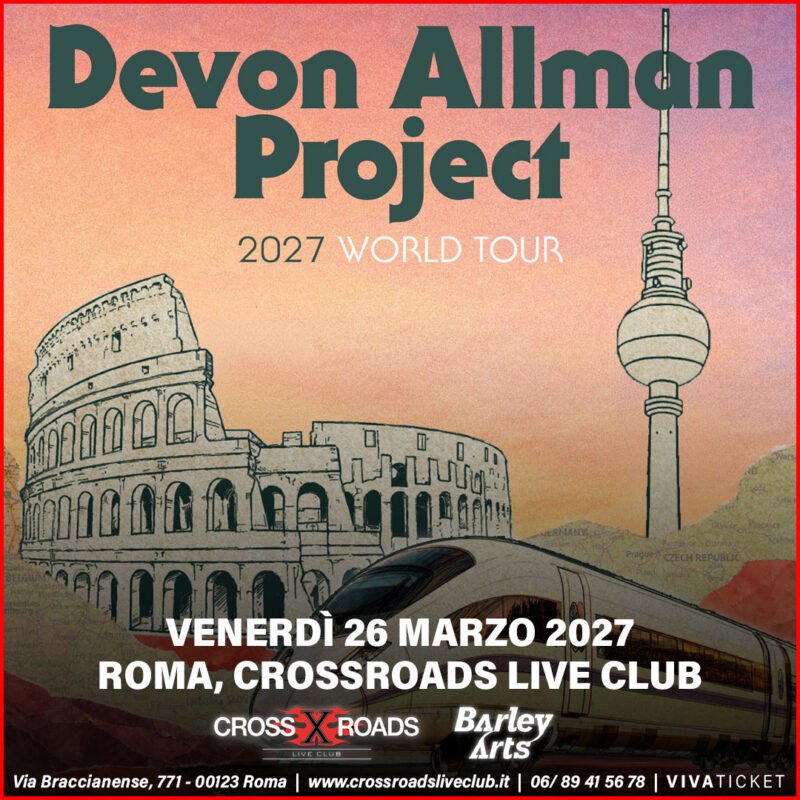
- The Devon Allman Project at CrossRoads Live Club: March 26, 2027
- Voyage 35 (ex Porcupine Tree) at CrossRoads Live Club, March 10, 2027