IUC Concert Season 2026-2027 at Aula Magna della Sapienza, October 17, 2026 to May 8, 2027
In short. The IUC Concert Season 2026-2027, the 82nd of the Istituzione Universitaria dei Concerti, opens on Saturday, October 17, 2026 at 17:30 and closes on Saturday, May 8, 2027 in the Aula Magna of Palazzo del Rettorato, in Sapienza…
The IUC Concert Season 2026-2027, the 82nd of the Istituzione Universitaria dei Concerti, opens on Saturday, October 17, 2026 at 17:30 and closes on Saturday, May 8, 2027 in the Aula Magna of Palazzo del Rettorato, in Sapienza University's Città universitaria, Piazzale Aldo Moro 5 (00185 Rome). The Calliope series concerts are generally on Saturdays at 17:30, the Minerva series on Tuesdays at 20:30. You get there on Metro B, Policlinico or Castro Pretorio stops, on trams 3 and 19, or on foot from Termini station, and entry, including on foot, is from Piazzale Aldo Moro 5. Tickets cost €26 in the first section, €21 in the second and €15 in the third, plus a 10% presale fee, while under-30s pay €8 and under-18s €5. They're sold at the IUC office at Lungotevere Flaminio 50, by phone at 06 3610051 and 06 3610052, at the Aula Magna box office from an hour before each concert and online on the authorized presale network listed on the official website.
The IUC Concert Season 2026-2027 in brief
The IUC Season 2026-2027 has 35 concerts in the Aula Magna between October 17, 2026 and May 8, 2027, split into two series, Calliope and Minerva, with some dates shared by both.
Calliope, Saturday afternoons
The Calliope series usually runs on Saturdays at 17:30. It's the season for those who prefer music before dinner, and for families. The exception is Lucie Horsch's recital on February 6, 2027, set for 20:30.
Minerva, Tuesday evenings
The Minerva series is on Tuesdays at 20:30. It's named after the goddess whose bronze statue stands in front of the Rettorato: a homegrown choice, for an institution born inside the university.
The Beethoven thread
2027 marks the 200th anniversary of Beethoven's death, and IUC celebrates it from the opening concert. The composer runs through the season: the Second Symphony and the Violin Concerto at the opening, and the complete sonatas for violin and piano over two evenings.
Venues
All the season's concerts are in the Aula Magna at Sapienza. IUC also organizes the free Note in Biblioteca series in Rome's libraries and events at Teatro Ateneo, outside the main program.
The October 17 opening: Beethoven with the Orchestra da Camera Canova
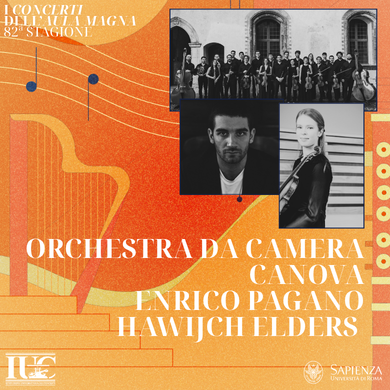
On Saturday, October 17, 2026 at 17:30 the Orchestra da Camera Canova, conducted by Enrico Pagano, opens the season with violinist Hawijch Elders in an all-Beethoven program: the Violin Concerto in D major, Op. 61 and the Symphony No. 2 in D major, Op. 36.
The Second Symphony
IUC's presentation calls it one of the less often performed symphonies, yet already driven by the communicative urgency that would become the hallmark of Beethoven's work. It's a good opening choice: those who know the Fifth and the Ninth discover a different, younger Beethoven, with the same energy.
The Violin Concerto
The Op. 61 Concerto, also in D major, is one of the great concertos of the violin repertoire. For the Orchestra Canova it's a long-postponed project, closing the cycle of artistic residency the orchestra founded and led by Enrico Pagano began with IUC six seasons ago.
Hawijch Elders
Hawijch Elders is a Dutch violinist born in 1998, considered by IUC one of the great talents of her generation. In June 2025 she won First Prize at the Premio Internazionale Antonio Mormone. October 17 is her Roman chance to take on one of the most exposed concertos in the repertoire.
October 20: Arsenii Moon and the Colloredo Ensemble
On Tuesday, October 20, 2026 at 20:30 pianist Arsenii Moon and the Colloredo Ensemble open the Minerva series with three works by Mozart: the Cassation No. 2, K. 99, the Piano Concerto No. 12, K. 414 and the Divertimento No. 15, K. 287.
The program
It's a journey between the Salzburg years and the first Vienna years, built on the border between entertainment and art. Cassations and divertimentos were occasional music, to be played outdoors or in salons, and the K. 414 Concerto is one of the first Viennese concertos. The thread is Mozart turning popular music into masterpieces.
Arsenii Moon
Arsenii Moon won the 64th Ferruccio Busoni International Piano Competition, with First Prize, the Arturo Benedetti Michelangeli Prize, awarded only unanimously and given for the first time in almost 30 years, and the Audience Prize. Since then he has played at the Vienna Konzerthaus, Hamburg's Elbphilharmonie, Zurich's Tonhalle and Leipzig's Gewandhaus, with recording projects for Deutsche Grammophon.
The Colloredo Ensemble
The ensemble takes its name from Prince-Archbishop Colloredo, in whose service Mozart wrote precisely this repertoire in Salzburg. The lineup is that of the period: two violins, viola, bass instruments, two oboes and two horns. It has worked with Patricia Kopatchinskaja and Alexander Melnikov, and sits between historically informed practice and today's concert dramaturgy.
The full program of the IUC Season 2026-2027
The program published by IUC for the 2026-2027 season includes pianists, quartets, Baroque ensembles, jazz and choral music, from October 17, 2026 to May 8, 2027.
October and November 2026
After the two openings: on Saturday, October 24 the Grupo de Música Barroca La Folía, on Tuesday, October 27 Alexandra Dovgan, in her Rome debut, on Saturday, October 31 Antonio Ballista with La Paura fa 90, and on Tuesday, November 3 Pincini and Venturi with Au Revoir. On Saturday, November 7 a large chamber group with Lonquich, Gringolts, Bronzi, Lonquich and Kavčič, and on Tuesday, November 10 Widmann and Carcano in the first part of Beethoven's complete sonatas for violin and piano.
Late November and December
On Saturday, November 14 pianist Yifan Wu, on Tuesday, November 17 the Quartetto di Cremona in the third stage of the Schumann Bartók cycle, on Saturday, November 21 the JACK Quartet, winner of the Premio Abbiati for best ensemble of 2024, on Tuesday, November 24 Un angelo del paradiso, and on Saturday, November 28 violinist Julian Kainrath with Lilya Zilberstein. On Tuesday, December 15, for both series, cellist Santiago Cañón Valencia with pianist Naoko Sonoda.
January and February 2027
On Tuesday, January 19 Mario Brunello with La giusta distanza (II), on Saturday, January 23 Marc André Hamelin, and on Tuesday, January 26 the Janoska Ensemble with Best of. On Saturday, February 6, at 20:30, flutist Lucie Horsch with Metamorphosis, her Rome debut, on Tuesday, February 9 LiberTANGO, on Saturday, February 20 Angela Hewitt, on Tuesday, February 23 the Quartetto Indaco, and on Saturday, February 27 the Markus Stockhausen Quintet.
March 2027
On Tuesday, March 2 pianist Arielle Beck opens the Fortuna FuturClassica 2027 series, on Saturday, March 6 the Kuss Quartet with Quartetto teatrale, on Tuesday, March 9 the Orchestra Femminile del Mediterraneo with Compositrici e compositori a confronto, on Saturday, March 13 the second part of Widmann and Carcano's complete Beethoven, on Tuesday, March 16 the Cellofellos, on Saturday, March 20 guitarist Anabel Montesinos for the Roma Guitar Series, and on Tuesday, March 23 Zlata Chochieva with Chopin's 27 études.
April and May 2027
On Tuesday, April 6 Roger Muraro, on Saturday, April 10 Tabea Zimmermann on viola with Javier Perianes on piano, on Tuesday, April 13 Voces8 with Give me your stars, on Saturday, April 17 the Quartetto di Cremona opens the complete Schubert quartets, and on Tuesday, May 4 Nicola Sani with Piano Landscapes. On Saturday, May 8, 2027 comes the closing concert, shared by both series, whose program will be published on the official website.
The IUC Season concerts I recommend
Out of 35 concerts, some deserve to be marked right away: for the name, for the project, or because elsewhere in Europe they'd be big-hall events.
The pianists
Marc André Hamelin on January 23, Angela Hewitt on February 20, Roger Muraro on April 6: three recitals that alone would justify a subscription. Add Zlata Chochieva with Chopin's 27 études, a technical and expressive feat, and two young pianists making their Rome debuts, Alexandra Dovgan and Arielle Beck.
The quartets
The Quartetto di Cremona returns twice, with the Schumann Bartók cycle and the start of the complete Schubert. The JACK Quartet, Premio Abbiati 2024, is the benchmark for contemporary quartet music. Then the Kuss Quartet and the Quartetto Indaco: this is, first and foremost, a season of quartets.
The complete cycles
Widmann and Carcano's two evenings of Beethoven's violin and piano sonatas, on November 10 and March 13, are the project that gives meaning to the anniversary. If you attend both, you come away with a complete portrait of a Beethoven less familiar than the symphonic one.
Outside the canon
The Markus Stockhausen Quintet, Voces8, the Janoska Ensemble, LiberTANGO: IUC has always said it ranges from classical to jazz, from Baroque to contemporary. These are the concerts where it really does, and they often draw the most varied audiences.
The Istituzione Universitaria dei Concerti: its history
The Istituzione Universitaria dei Concerti is one of Italy's leading concert societies, founded in 1946 on the initiative of a group of students at Sapienza University of Rome and linked to the university ever since.
Postwar students
According to musicologist Piero Rattalino's account, published by IUC, the idea took shape in late 1945 among very young students, alongside the university's sports, film and theater centers. After the war a new audience of students, young workers and professionals was hungry for music, and the old concert societies were no longer enough.
The big names of the early years
Already in 1945/46 the season rested on three pianists: Nikita Magaloff, Wilhelm Backhaus and Edwin Fischer. In the following years came Alfred Cortot, Georg Kulenkampff, Yehudi Menuhin, Gioconda De Vito, Adolf Busch, Pierre Fournier and Wilhelm Kempff, along with young players destined for great careers like Géza Anda and Aldo Ciccolini.
1959/60
The peak of that first phase was the 1959/60 season: Chopin's complete piano works with Magaloff, Beethoven's 32 sonatas with Kempff, the Quartetto Italiano, Andrés Segovia, and the young Salvatore Accardo and Uto Ughi. IUC, Rattalino says, kept faith with Maurizio Pollini for years after his win at the Chopin Competition in Warsaw, when very few institutions were reengaging him.
Exile from the Aula Magna
In 1968 the Aula Magna was declared unfit for use: nine concerts were canceled and the season was scattered among other halls. In 1969/70, the year Rattalino became artistic director, concerts moved between Teatro dell'Opera, Teatro Eliseo, the Ridotto dell'Eliseo and Auditorio San Leone Magno, where Oreste Fortuna decided to move the activity permanently.
Two tracks and the return
From 1977/78 IUC worked on two fronts: the public season at San Leone Magno and a free program in the Aula Magna reserved for professors and students. A new agreement with the university, signed on October 3, 1992, brought all activity back to the Aula Magna from 1993/94. It's the home base, and IUC has stayed there.
The Aula Magna at Sapienza, home of the IUC Season
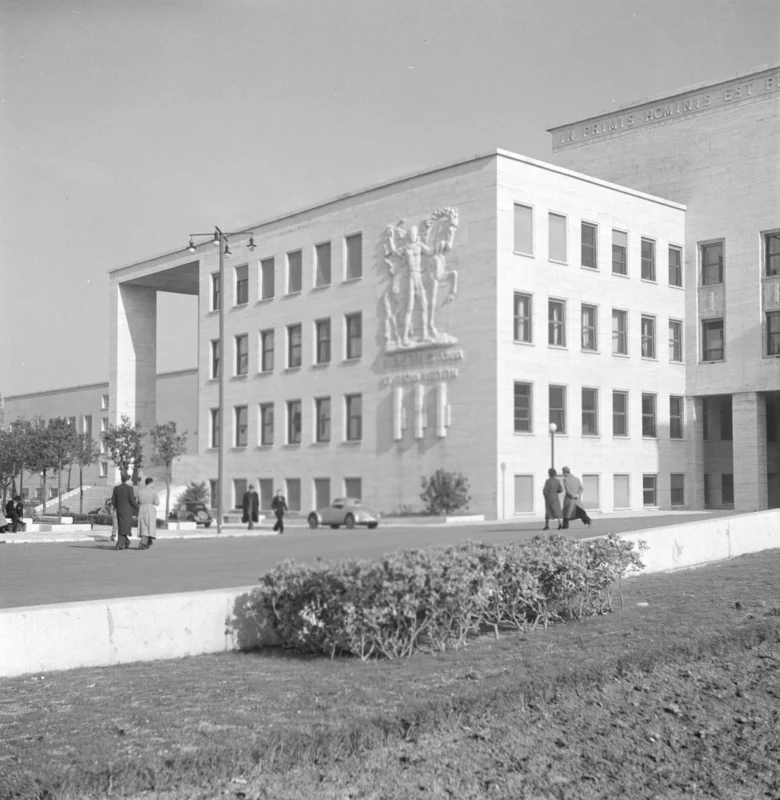
The Aula Magna is in Palazzo del Rettorato, designed by Marcello Piacentini for Sapienza's Città universitaria, built between 1933 and 1935 and inaugurated on March 31, 1935 in the presence of King Victor Emmanuel III.
Piacentini's Rettorato
Piacentini drew the campus master plan and the Rettorato, which houses the rector's offices, the Biblioteca Alessandrina and the Aula Magna. It's the building that closes the view down the great entrance avenue, fronted by Arturo Martini's bronze Minerva at the center of a pool.
Sironi's fresco
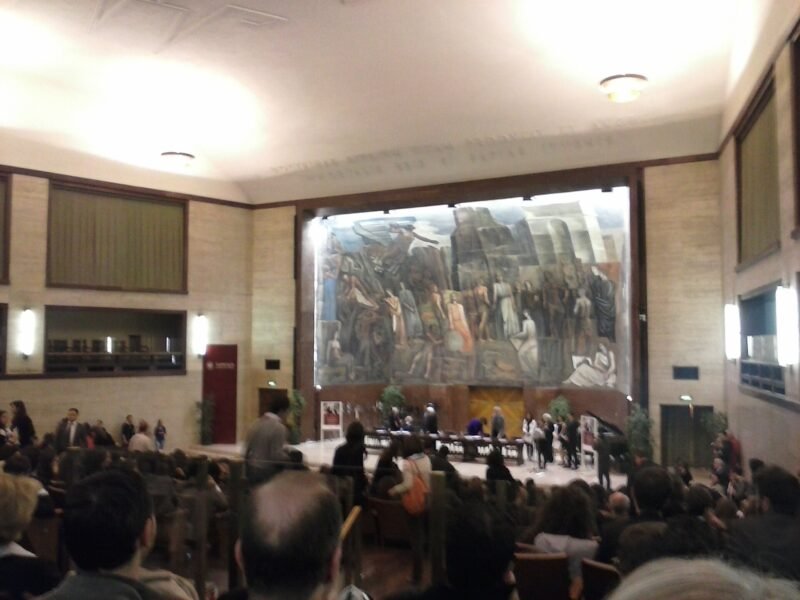
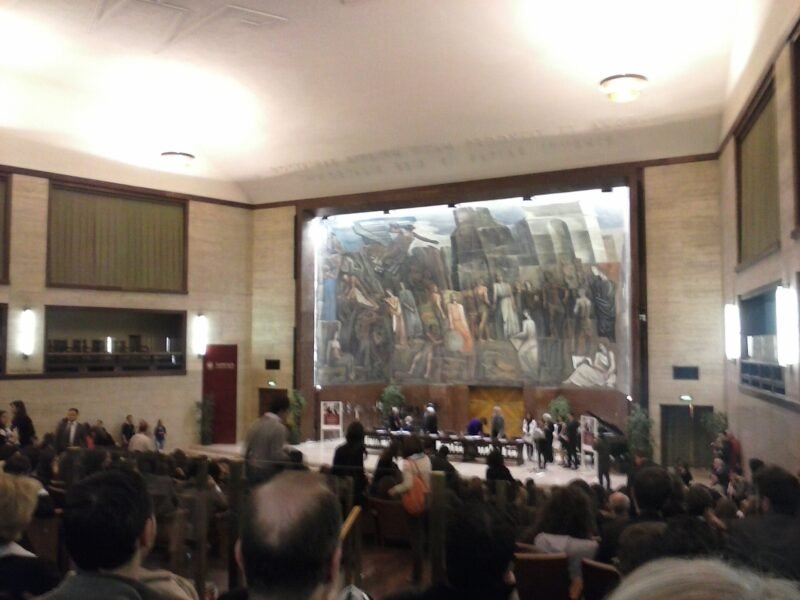
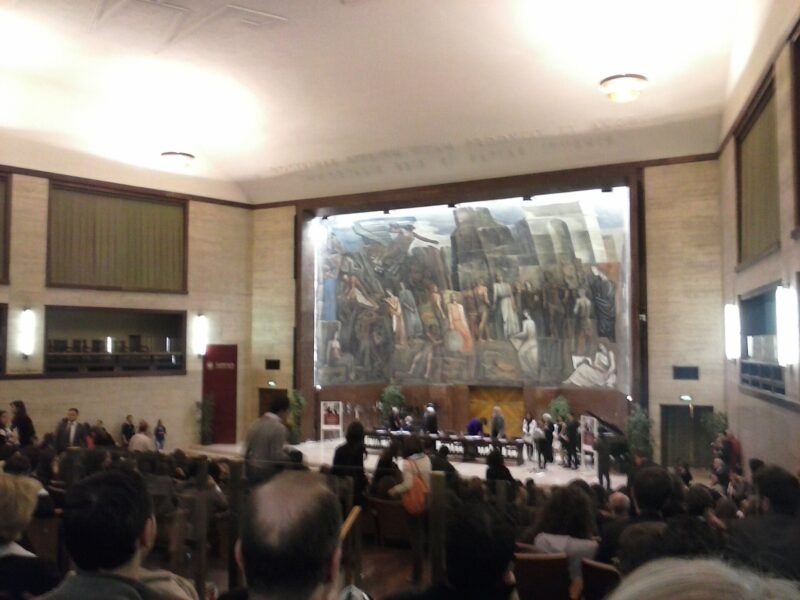
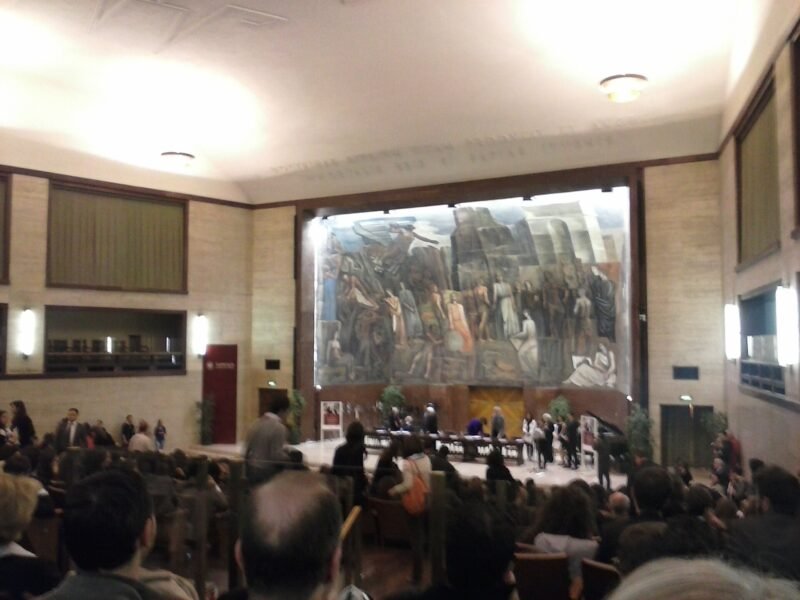
The back wall of the Aula Magna is filled by Mario Sironi's 1935 fresco, L'Italia tra le arti e le scienze, Italy between the arts and the sciences. Concertgoers have it in front of them throughout the program: it's one of the great painting cycles of 20th-century Italy, and few concert halls in the world have anything like it.
A city of architects
Around the Rettorato, the buildings were entrusted to leading architects: Gio Ponti's Mathematics building from 1934, Giuseppe Pagano's Physics, Pietro Aschieri's Chemistry, Giovanni Michelucci's Mineralogy, and Gaetano Rapisardi's Letters and Law. The monumental entrance on Piazzale Aldo Moro is by Arnaldo Foschini. Walking across this campus to a concert is already an architecture lesson.
Teatro Ateneo and the museums
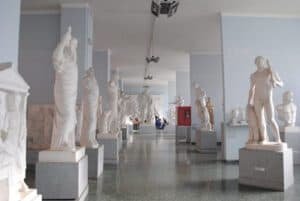
The Città universitaria also has the Nuovo Teatro Ateneo, built as a workers' recreation club to a design by Gaetano Minnucci, where IUC hosts some concerts, and several museums: the MLAC in the Rettorato itself, the Gipsoteca plaster cast gallery and the Giuseppe Sergi Museum of Anthropology.
Tickets and subscriptions for the IUC Season 2026-2027
A ticket for an IUC Season concert costs €26 in the first section, €21 in the second and €15 in the third, with a 10% presale fee, and under-30s pay €8 in any section.
Discounts
Under-18s pay €5. The Family Card, for two parents with at least one child under 14, costs €10 per parent and €5 per child. For Sapienza and partner institutions and universities the prices are €21, €17 and €12, and subscribers can bring a companion for €19, €16 or €11. The carnet, of at least six concerts of your choice, gives 10% off. Discounts can't be combined.
Fixed-seat subscriptions
The Full Season, 35 concerts, costs €360, €345 or €320 depending on the section (reduced €320, €300, €270). A subscription to a single series, Calliope or Minerva, 19 concerts, costs €310, €295 or €235. The mini subscription Invito alla musica, eight concerts in one series, costs €160, €150 or €140. Reduced rates are for Sapienza, teachers and partner institutions.
Open seating and UNIIUC
With open seating and mandatory online booking, the Full Season costs €255 and half a season €210. The UNIIUC subscription for Sapienza costs €50 for the full season for students under 35, or €30 for a single series. There are also dedicated rates for other partner universities and for under-30s and under-18s.
Where to buy
At the IUC office at Lungotevere Flaminio 50, Monday to Friday from 10:00 to 13:00 and from 14:00 to 17:00 (during the season the office is closed on Tuesdays), by phone at 06 3610051 and 06 3610052, at the Aula Magna box office, open from an hour before the concert, and online on the network listed on the official website, where you can also use the Carta del Docente teacher's card. For last season's subscribers, the renewal deadline with seat confirmation was September 30, 2026.
How to get to the Aula Magna at Sapienza
The Aula Magna at Sapienza is reached by Metro B, Policlinico or Castro Pretorio stops, by trams 3 and 19, or on foot from Termini station, and entry for concerts is only from Piazzale Aldo Moro 5.
Metro B
Policlinico and Castro Pretorio are the nearest stops on line B. From either one it's a few minutes' walk to the Piazzale Aldo Moro entrance. For the Tuesday evening concerts the metro is the simplest choice for the ride home too.
Tram
Trams 3 and 19 cross San Lorenzo and pass next to the Città universitaria. The 19 links it on one side with the Policlinico and Viale delle Belle Arti, the 3 with Porta Maggiore, San Giovanni and the Colosseum.
On foot from Termini
From Termini station, exit on Via Marsala side and continue toward Piazzale Aldo Moro: a quarter of an hour at an easy pace. If you're arriving by train from outside Rome for a Saturday afternoon concert, it's the handiest option.
By car: the on-site parking
IUC notes a large free parking area inside Sapienza for afternoon and evening concerts, for cars, motorbikes, bicycles, taxis and vehicles with a disability permit. Entry is only from Piazzale Aldo Moro 5, from about an hour before the concert. IUC warns that the parking may not be available for every concert, for reasons beyond its control.
Inside the Città universitaria
From Foschini's entrance, walk down the avenue to the Minerva square: the Rettorato is the building at the end. The subscription box office is under the portico. Allow a few minutes' margin, because the avenue is longer than it looks from the entrance.
San Lorenzo and the area around Sapienza
The Città universitaria borders San Lorenzo, the working-class district born in the late 19th century outside the Aurelian Walls and now Rome's main university neighborhood.
The neighborhood
The balcony-access tenements built between 1884 and 1888 for railway workers and laborers, the streets named after ancient Italic peoples, the former Pastificio Cerere pasta factory turned contemporary art center: San Lorenzo is the natural complement to an afternoon in the Aula Magna.
San Lorenzo fuori le mura and the Verano
A few minutes away are the basilica of San Lorenzo fuori le mura, one of the seven pilgrimage churches of Rome, and the Verano Cemetery. Before a Saturday concert at 17:30 there's time for a visit.
Porta Maggiore
Tram 3 takes you in a few minutes to Porta Maggiore and its underground basilica, one of the most unusual places in ancient Rome, and then to Holy Cross in Jerusalem.
Where to eat before or after IUC concerts
San Lorenzo, a stone's throw from the Aula Magna, is one of the Roman neighborhoods with the most choice: trattorias, pizzerias, osterias and student spots, with prices generally lower than in the center.
After the Saturday concert
Calliope concerts end around 19:30: just the right time for dinner in San Lorenzo. On Saturday night the neighborhood is full of young people and tables at the well-known trattorias need booking.
Before the Tuesday concert
For the Minerva concerts at 20:30 you eat beforehand: a long aperitivo on one of the streets named after the Italic peoples, Via dei Volsci, Via dei Sabelli, Largo degli Osci, or a quick pizza, then 10 minutes on foot to Piazzale Aldo Moro.
Accessibility, families and young people
The IUC Season is one of the most affordable in Rome: under-30s pay €8, under-18s €5, and the Family Card brings a child to a concert for €5.
Reduced mobility
Sapienza's on-site parking is open to vehicles with a disability permit, from the Piazzale Aldo Moro 5 entrance. For seats in the hall and specific routes, phone IUC before the concert.
With children
The Saturday afternoon Calliope series suits families best. For a first time I'd choose short, lively concerts: the Cellofellos, Voces8, the Baroque ensemble La Folía, LiberTANGO's tango.
Students
IUC was born for students and it shows in the prices: the UNIIUC full-season subscription costs €50 for Sapienza students under 35. For an out-of-town student it's the cheapest way to hear Hamelin, Hewitt and the Quartetto di Cremona in a single year.
A curious fact about the IUC Concert Season 2026-2027 at Aula Magna della Sapienza, October 17, 2026 to May 8, 2027
IUC wasn't born in a conservatory or an academy, but among university students from other faculties. In Piero Rattalino's account, the idea took shape in late 1945 alongside the university's sports, film and theater centers. A concert society made for the university and inside the university: according to Rattalino it's the only organization in Italian musical life rooted inside a university.
The second curious fact concerns the names of the two series. Minerva is the goddess of wisdom, and her statue by Arturo Martini greets those arriving in front of the Rettorato. Calliope is the muse of epic poetry. A goddess and a muse: the season presents itself as a child of the classical culture Piacentini's campus set out to celebrate.
Third curious fact: in the early years IUC had to queue for everything, Rattalino says, even a good piano, because after the war instruments in good condition were rare. Today the piano is the star of the season, with recitals by Hamelin, Hewitt, Muraro and Chochieva.
Something nobody tells you about the IUC Concert Season 2026-2027 at Aula Magna della Sapienza, October 17, 2026 to May 8, 2027
What almost nobody tells you is that there's free parking inside the Città universitaria for the concerts. In Rome, in a neighborhood like the Policlinico's, that detail changes your evening. Entry is from Piazzale Aldo Moro 5, from about an hour before the start, and IUC warns it isn't guaranteed for every concert: better not to count on it blindly, but it helps to know.
The second thing is that entry, even on foot, is only from Piazzale Aldo Moro 5. The Città universitaria has several gates, and if you arrive from the San Lorenzo side or Viale dell'Università you may find them closed in the evening. Always head for Foschini's monumental entrance.
Third: the youth discounts apply in any section of the hall. Someone under 30 can sit in the first section for €8, the same price as the third. It's a rare policy, and many parents paying full price don't know their university-age child can sit next to them for a third of the cost.
My tip for the IUC Concert Season 2026-2027 at Aula Magna della Sapienza, October 17, 2026 to May 8, 2027
My tip is not to buy a subscription blind, and not to stop at a single concert. The right formula, if you live in Rome or pass through often, is the carnet of at least six concerts of your choice with 10% off: take the three big piano recitals, a Beethoven evening with Widmann and Carcano, a quartet and a concert outside the canon like Voces8 or the Stockhausen Quintet.
Arrive half an hour early. The avenue of the Città universitaria at sunset, with the Minerva and Piacentini's Rettorato, is worth the walk, and in the hall you'll have time to take in Sironi's fresco before the lights go down.
For groups wanting to combine a concert with a guided visit of the Città universitaria and San Lorenzo, Tour Leader Pro organizes tailor-made private experiences.
Another well-known fact, yet one rarely mentioned
It's well known that the Città universitaria is one of the great architectural works of the 1930s. Much less often mentioned is that it was hit by the first Allied bombing of Rome, on July 19, 1943. Published accounts of the bombing list the Città universitaria among the places damaged, along with the Policlinico Umberto I, the Verano and the basilica of San Lorenzo fuori le mura. The campus had been inaugurated eight years earlier.
Another well-known but rarely mentioned fact: IUC lost its hall for 25 years. From 1968, when the Aula Magna was declared unfit for use, the public season lived elsewhere, mostly at Auditorio San Leone Magno, and only from 1993/94, thanks to the agreement of October 3, 1992, did it return entirely to the Aula Magna. Rattalino writes that losing the hall means losing the audience used to its numbered seat, its coat check, its neighbor to swap impressions with. When you go to the Aula Magna today, you're sitting in a reclaimed hall.
The right photo to take at the IUC Concert Season 2026-2027 at Aula Magna della Sapienza, October 17, 2026 to May 8, 2027
The right photo is taken before the concert, with the hall filling up and Sironi's fresco on the back wall. L'Italia tra le arti e le scienze above the empty stage, with the piano waiting, is an image that captures the spirit of IUC well: music, university, the 20th century. No photos during the concert.
The second photo is taken as you arrive, from the end of the avenue, with Arturo Martini's Minerva at the center of the pool and Piacentini's Rettorato behind. For the Saturday 17:30 concerts, in fall and spring, the afternoon light warms the travertine and stretches the shadows of the porticoes.
The third is for architecture lovers: Arnaldo Foschini's monumental entrance on Piazzale Aldo Moro, in the evening, when the streetlights outline its columns. On Tuesdays, leaving after the concert, the empty campus has a metaphysical air.
Some important events that happened here in history
On March 31, 1935 the Città universitaria was inaugurated in the presence of Victor Emmanuel III. That same year Mario Sironi completed the Aula Magna fresco. On July 19, 1943 the first Allied bombing of Rome hit San Lorenzo and also damaged the Città universitaria.
In 1946 a group of Sapienza students founded the Istituzione Universitaria dei Concerti. In 1959/60 the Aula Magna hosted Chopin's complete piano works with Nikita Magaloff and Beethoven's 32 sonatas with Wilhelm Kempff, two cycles that made IUC one of Italy's benchmark concert societies. In the same period Andrés Segovia, the Quartetto Italiano, Salvatore Accardo and Uto Ughi played here.
In 1968 the Aula Magna was declared unfit for use and nine concerts were canceled. From 1977/78 the hall hosted a free program for professors and students again, and with the agreement of October 3, 1992 IUC brought its entire season back there from 1993/94. On October 17, 2026 the 82nd season opens there, marking Beethoven's bicentennial.
Who has passed through the IUC Concert Season 2026-2027 at Aula Magna della Sapienza, October 17, 2026 to May 8, 2027
Some of the greatest performers of the 20th century have played the Aula Magna in IUC seasons. In the early years Nikita Magaloff, Wilhelm Backhaus, Edwin Fischer, Alfred Cortot and Wilhelm Kempff, violinists Georg Kulenkampff, Yehudi Menuhin, Gioconda De Vito and Adolf Busch, and cellist Pierre Fournier. Then Géza Anda, Aldo Ciccolini, Andrés Segovia, the Quartetto Italiano, the young Salvatore Accardo and Uto Ughi, and Maurizio Pollini, whom IUC backed for years.
The hall has also seen those who built it: Marcello Piacentini, who designed the Rettorato, Mario Sironi, who frescoed its wall, and Arturo Martini, who sculpted the Minerva in front of the entrance. And in IUC's history, Piero Rattalino, artistic director from 1969/70, and Lina and Oreste Fortuna, with whom IUC went through the San Leone Magno years and the idea of decentralization.
In the 2026-2027 season the Aula Magna welcomes Marc André Hamelin, Angela Hewitt, Roger Muraro, Tabea Zimmermann, Mario Brunello, Alexander Lonquich, Ilya Gringolts, the Quartetto di Cremona, the JACK Quartet, Voces8 and Markus Stockhausen: a season that holds its own next to those of Europe's great halls.
Note in Biblioteca and other IUC initiatives
Alongside the season in the Aula Magna, IUC brings live music to Rome's libraries with Note in Biblioteca, a series of free concerts while seats last, in collaboration with Biblioteche di Roma.
Note in Biblioteca
The stated aim is to combine literature and music and bring high-level concerts close to home. The calendar, with venues and programs, is published on IUC's official website, and the 2026 venues include the Biblioteca Flaminia, the Biblioteca Renato Nicolini and the Biblioteca Vaccheria Nardi.
Fortuna FuturClassica
The Fortuna FuturClassica series, devoted to young performers, opens in the Aula Magna on March 2, 2027 with pianist Arielle Beck. It's part of the season and open to subscribers of both series.
October to May: concert season in Rome
The IUC Season covers the months when Rome lives indoors: from mid-October, when the summer arenas close, to May, when the courtyards reopen.
Other seasons
Rome has a rich concert life, with Auditorium Parco della Musica and its symphonic and chamber institutions. IUC fills a specific niche: chamber music and recitals in an intimate hall, at low prices, with an audience where students and longtime subscribers sit side by side.
The weather
For Tuesday evening concerts in winter the Città universitaria is cold: walk the avenue from the entrance to the Rettorato in your coat. In spring, in April and May, the Saturday afternoon concert becomes an excuse for a stroll in San Lorenzo in the long light.
Frequently asked questions about the IUC Season 2026-2027
When does the IUC Concert Season 2026-2027 begin?
The IUC Concert Season 2026-2027 begins on Saturday, October 17, 2026 at 17:30 in the Aula Magna at Sapienza, with the Orchestra da Camera Canova, Enrico Pagano and violinist Hawijch Elders in a Beethoven program. It ends on Saturday, May 8, 2027 with the closing concert.
How much are tickets for IUC concerts?
Tickets for IUC concerts cost €26 in the first section, €21 in the second and €15 in the third, plus a 10% presale fee. Under-30s pay €8 and under-18s €5 in any section, and the Family Card costs €10 per parent and €5 per child.
Where is the Aula Magna at Sapienza?
The Aula Magna at Sapienza is in Palazzo del Rettorato in the Città universitaria, Piazzale Aldo Moro 5, 00185 Rome. For IUC concerts entry, including on foot, is only from the Piazzale Aldo Moro 5 entrance, and the box office opens an hour before each concert.
How do you get to IUC concerts by public transit?
You get to IUC concerts at the Aula Magna by Metro B, Policlinico or Castro Pretorio stops, by trams 3 and 19, or on foot from Termini station in about a quarter of an hour. For evening concerts Metro B is the handiest choice for the ride home too.
Is there parking for IUC concerts at Sapienza?
For IUC concerts Sapienza provides free parking inside the Città universitaria, for cars, motorbikes, bicycles and vehicles with a disability permit, with entry from Piazzale Aldo Moro 5 from about an hour before. IUC warns it may not be available for every concert.
What's the difference between the Calliope and Minerva series?
In the IUC Season the Calliope series generally takes place on Saturdays at 17:30 and the Minerva series on Tuesdays at 20:30. Each series includes 19 concerts, some shared, and the Full Season subscription includes both, for 35 concerts.
How much is an IUC Season subscription?
A fixed-seat subscription to the IUC Season 2026-2027 costs from €320 to €360 for the Full Season and from €235 to €310 for a single series, depending on the section. With open seating the full season costs €255, and for Sapienza students under 35 the UNIIUC subscription costs €50.
Who plays in the IUC Season 2026-2027?
The IUC Season 2026-2027 features, among others, Marc André Hamelin, Angela Hewitt, Roger Muraro, Tabea Zimmermann with Javier Perianes, Mario Brunello, the Quartetto di Cremona, the JACK Quartet, Voces8, Arsenii Moon with the Colloredo Ensemble and the Markus Stockhausen Quintet.
Our verdict on the IUC Season 2026-2027
Where can you hear serious chamber music without spending a fortune? There's one answer: at the Aula Magna, with IUC. This 82nd season has a program that stands comparison with Europe's great halls, movie-ticket prices for young people and a hall with a Sironi fresco behind the performers. Choose six concerts, get the carnet, and arrive early to cross the campus at sunset.
Article written by the editorial team of Tour Leader Pro, contact them for Private/Corporate/V.I.P. Tours and Experiences.
Planning a trip to Rome? The English-language guides for visiting the city are on ItalyPlanner.com.
Contact Information
Nearby
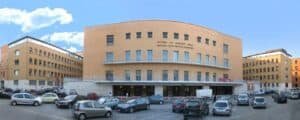
 Sapienza University City100 m
- Aula Magna of Sapienza University100 m
- Primo Levi Chemistry Museum100 m
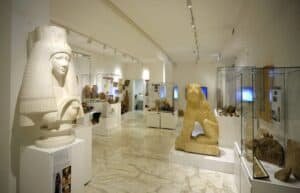
- Museo del Vicino Oriente, Egitto e Mediterraneo100 m
- Museo Laboratorio d’Arte Contemporanea, MLAC100 m
- Gipsoteca – Museum of Classical Art100 m
Upcoming events nearby
- Renata Prunas. Materia risorta at the MLAC of Sapienza, October 8 to November 5, 2026100 m
- Mario Brunello at the Aula Magna of the Sapienza, January 19, 2027100 m
- Marc-André Hamelin at the Aula Magna of the Sapienza, January 23, 2027100 m
- Janoska Ensemble at Aula Magna, Sapienza University, January 26, 2027100 m
You might also like
- Talco Freek Tour 2027 at Hacienda Roma, April 2, 2027
- The Devon Allman Project at CrossRoads Live Club: March 26, 2027
- Voyage 35 (ex Porcupine Tree) at CrossRoads Live Club, March 10, 2027
- Angela Hewitt at Aula Magna della Sapienza, February 20, 2027
- Spike and the Gimme Gimmes at Traffic Club, November 24, 2026
- The Molotovs at Hacienda Roma, November 11, 2026