Janoska Ensemble at Aula Magna, Sapienza University, January 26, 2027
In short. Janoska Ensemble makes its Rome debut on Tuesday, January 26, 2027 at 20:30 in the Aula Magna of the Rectorate building at Sapienza, University City, Piazzale Aldo Moro 5 (00185 Rome), with the program Best of, for the Minerva series of the IUC Season.
Janoska Ensemble makes its Rome debut on Tuesday, January 26, 2027 at 20:30 in the Aula Magna of the Rectorate building at Sapienza, University City, Piazzale Aldo Moro 5 (00185 Rome), with the program Best of, for the Minerva series of the IUC Season. On stage are Ondrej and Roman Janoska on violins, František Janoska on piano and Julius Darvas on double bass, with arrangements of Brahms, Bizet, Beethoven, Bartók, Bach, the Beatles and Cole Porter and their own compositions. You get there by Metro line B, stops Policlinico or Castro Pretorio, by trams 3 and 19 or on foot from Termini. For concerts the only entrance, even on foot, is at Piazzale Aldo Moro 5. IUC Season tickets cost €26 in the first sector, €21 in the second and €15 in the third, plus a 10% presale fee, with €8 for under 30 and €5 for under 18. You buy them at the IUC office at Lungotevere Flaminio 50, by phone, at the Aula Magna box office from one hour before and on the authorized presale circuit indicated by the official concert page.
Three brothers from Bratislava and their brother-in-law, an exclusive contract with Deutsche Grammophon, a first album that went gold and a style that already has a name, the "Janoska style." The quartet comes to the Aula Magna for the first time with a program designed to win over even those who approach classical music with suspicion.
Janoska Ensemble at IUC: Best of
The Janoska Ensemble concert is scheduled for Tuesday, January 26, 2027 at 20:30 in the Aula Magna at Sapienza, in the Minerva series of the IUC Season 2026/2027. The official calendar gives the expected end around 22:30. It is the ensemble's Rome debut.
A debut
The IUC stresses that this is the ensemble's first time in Rome. For a group that has played at Carnegie Hall, at the Elbphilharmonie in Hamburg and at the Sydney Opera House, arriving in a university hall with a Sironi fresco behind them is an unusual encounter, and for the audience an occasion not to put off.
The Minerva series
The Minerva series brings together the Tuesday evening concerts at 20:30. The Calliope series is for the Saturday afternoon ones. Minerva is the goddess of wisdom, and her bronze statue by Arturo Martini welcomes those arriving in front of the Rectorate.
Beyond the canon
In the IUC Season 2026/2027, alongside recitals and quartets, there are concerts that go beyond the borders of classical music: the Janoska Ensemble, Voces8, LiberTANGO, the Markus Stockhausen Quintet. They are often the evenings with the most varied audience, and this is the ensemble's first.
The program: from classical to pop
The Janoska Ensemble's Best of program includes Brahms's Hungarian Dance No. 1 in G minor, Souvenir pour Elise and Leo's Dance by František Janoska, the Carmen Fantasy by Bizet and Franz Waxman, Yesterday by Lennon and McCartney, Cole over Beethoven, Bartók's Romanian Dances in Janoska style, 9 Symphonies in 9 Minutes and the final Allegro of Bach's Harpsichord Concerto BWV 1052.
Brahms and Bartók
The concert opens with Brahms's Hungarian Dance No. 1, a piece that for a Slovak and Hungarian ensemble has a taste of home. Bartók's Romanian Dances appear instead in an openly personal version, "in Janoska style," as the program puts it.
Beethoven three ways
In the bicentennial year, the Janoska Ensemble too pays homage to Beethoven, in its own way: Souvenir pour Elise, based on Für Elise. Cole over Beethoven, which crosses Beethoven and Cole Porter. And 9 Symphonies in 9 Minutes, a paraphrase by František Janoska on the nine symphonies. It is the most irreverent tribute of the whole Rome season.
Carmen and Yesterday
Bizet's Carmen Fantasy in Franz Waxman's version is a page of violin virtuosity that Sergej Khachatryan already recorded on his first album. Yesterday by Lennon and McCartney brings the evening into pop. The Beatles are nothing new for the ensemble: their repertoire also includes Let It Be and Penny Lane.
Bach to finish
The program closes with the Allegro from Bach's Harpsichord Concerto No. 1 in D minor BWV 1052. Closing with Bach a concert that starts from Brahms and passes through the Beatles is a statement of method: for the Janoska Ensemble everything comes from there.
The Janoska style
The IUC defines "Janoska style" as the way the ensemble raises well-known pieces from a repertoire that runs from classical to pop to the highest artistic level, turning them into something recognizable yet new.
Improvisation
Free improvisation, a common practice in the Baroque, is the ensemble's distinctive trait, along with sustained tempo and the virtuosity of the four musicians. They are not afraid of popular genres such as Romani music, tango or pop.
Their own arrangements
The ensemble arranges the pieces it plays itself. Many original compositions come from family dedications or from famous works of the repertoire: titles like Melody for Melody or a Rumba for Amadeus point to the musicians' children and, at the same time, to Mozart.
Energy in the hall
According to the IUC's description, at every concert the audience is infected by a great positive energy, and with their virtuosic improvisations the four manage to win over even the most skeptical listeners. That is the promise of the evening, and it is also its risk: the Janoska Ensemble is not a group to listen to with detachment.
Who the musicians of the Janoska Ensemble are
The Janoska Ensemble is a Slovak and Hungarian instrumental ensemble founded in 2013 by three brothers of the Janoska family together with their brother-in-law. The group includes two violins, piano and double bass, and the musicians, originally from Bratislava and Constance, live in Vienna.
Ondrej Janoska, violin
Born in Bratislava in 1985, at age 10 he was already in Jozef Kopelman's class at the Bratislava Conservatory. From 2000 he studied in Vienna and Graz, where his teacher was Boris Kuschnir. From 2008 to 2012 he played in the Vienna State Opera orchestra and with the Wiener Philharmoniker. He plays a 1760 violin by Carlo Ferdinando Landolfi, on loan from the Goh Family Collection.
Roman Janoska, violin
Born in Bratislava in 1989, he studied at the Bratislava Conservatory and in Vienna in Pavel Vernikov's class. He has played as a classical and jazz violinist, among others with Bobby McFerrin, Michel Camilo, Biréli Lagrène and Roby Lakatos. From 2012 to 2017 he was a member of the Philharmonix.
František Janoska, piano
Born in Bratislava in 1986, he studied piano at the Bratislava Conservatory and at the University of Music in Vienna. In 1998 he won first prize at the European Competition for Young Talents, was a finalist at the Martial Solal competition in Paris and in 2002 won first prize at the International Franz Liszt Competition in Hungary. He is a member of the Roby Lakatos Ensemble and has played with Michel Camilo, Arcadi Volodos and Bobby McFerrin. He is the author of many pieces in the Rome program.
Julius Darvas, double bass
Born in Constance in 1976 into a Hungarian family of musicians in which the double bass has been played for more than three generations, he had his father as his first teacher. He studied at the Feldkirch Conservatory and in Vienna with Alois Posch. He won first prize in the foreign category of the jazz double bass competition in Budapest. From 2001 to 2023 he was a member of the stage orchestra of the Vienna State Opera, playing as a regular substitute with the Wiener Philharmoniker.
Records, halls and concerts
The Janoska Ensemble records exclusively for Deutsche Grammophon. The first album, Janoska Style, went gold right away, as the IUC recalls.
Four programs, four albums
The ensemble offers four programs, each with a Deutsche Grammophon album: Vivaldi's Four Seasons in Janoska style. The Big B's, with Bach, Beethoven, Brahms, Bartók, Bernstein and Brubeck. Revolution, with Mozart, Kreisler, Wieniawski, Bach, the Beatles and their own compositions. Janoska Style.
The halls
The ensemble has played at the Konzerthaus and the Musikverein in Vienna, at the Elbphilharmonie in Hamburg, at Carnegie Hall and at the Sydney Opera House, and on tour in Japan, Taiwan, Australia, the United Arab Emirates and the United States. The Austrian broadcaster ORF called it one of the most successful crossover groups of recent years.
Year-end concerts
New Year's concerts are a tradition of the ensemble: in 2017 a New Year's Eve evening at the Konzerthaus in Vienna with the soprano Daniela Fally and the trumpeter Thomas Gansch, in 2022 the New Year's concert Janoska Style goes Symphonic with the Berliner Symphoniker, with music by Mozart, Paganini, Brahms, Sarasate, Strauss and McCartney.
Festivals in Europe
In Europe the ensemble has played, among others, at the Beethoven Frühling, at the Graz Opera, at the Rosenfest in Baden bei Wien, at the Sion Festival in Switzerland, at the Schnittstellen Festival in Aachen, at the Mikkeli festival in Finland and at the Herbstgold Festival in Eisenstadt, where it performed with the cimbalom player Giani Lincan.
For peace
On March 20, 2022 the four musicians took part at the Wiener Stadthalle in Stimmen für den Frieden, a crossover event in support of Ukraine.
Teaching
The ensemble also brings its idea of improvisation to workshops and masterclasses, in Hong Kong, at the Kronberg Academy, at the Gstaad Menuhin Festival and at the Amadeus Festival in Vienna.
A curiosity about Janoska Ensemble at Aula Magna, Sapienza University, January 26, 2027
The funniest curiosity is about the staging. The Janoska Ensemble takes great care of the visual side of concerts and videos: for Bach's Violin Concerto the two violinist brothers faced off, alternating with two fencers, and on one stage they played with a stag with big antlers lying down to listen. On their website they appear in ruffs and frock coats of Baroque cut. Who knows what they will come up with for the Aula Magna.
The second is about family. The ensemble is made up of three brothers and their brother-in-law, and the original compositions often come from dedications to their children, like Melody for Melody or the Rumba for Amadeus. The name of one child, Amadeus, already says a lot about the family's relationship with music.
Third: two members of the ensemble were for a long time part of the Vienna State Opera orchestra and have played with the Wiener Philharmoniker. The irreverent style of the concert rests on an orchestral training among the most rigorous in Europe.
The Aula Magna at Sapienza, the hall of the debut
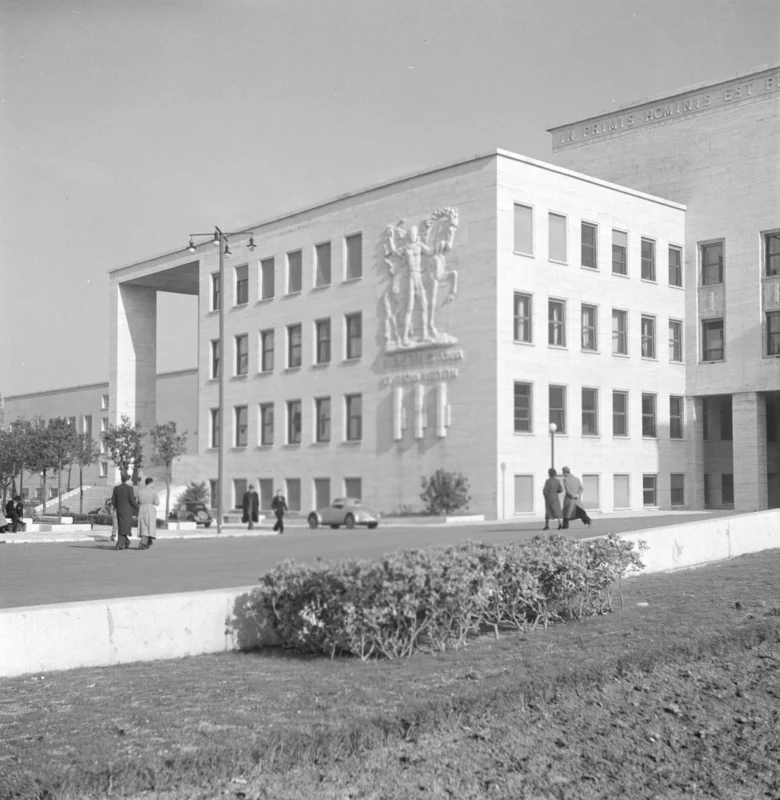
The hall that hosts the Rome debut of the Janoska Ensemble is the Aula Magna of the Rectorate building, designed by Marcello Piacentini for the Sapienza University City, built between 1933 and 1935 and inaugurated on March 31, 1935 in the presence of Victor Emmanuel III.
The Rectorate
The Rectorate closes the perspective of the campus's grand entrance avenue and houses the offices of the rector, the Alessandrina Library and the Aula Magna. In front, in the middle of a fountain basin, is the bronze Minerva by Arturo Martini.
Sironi in the back
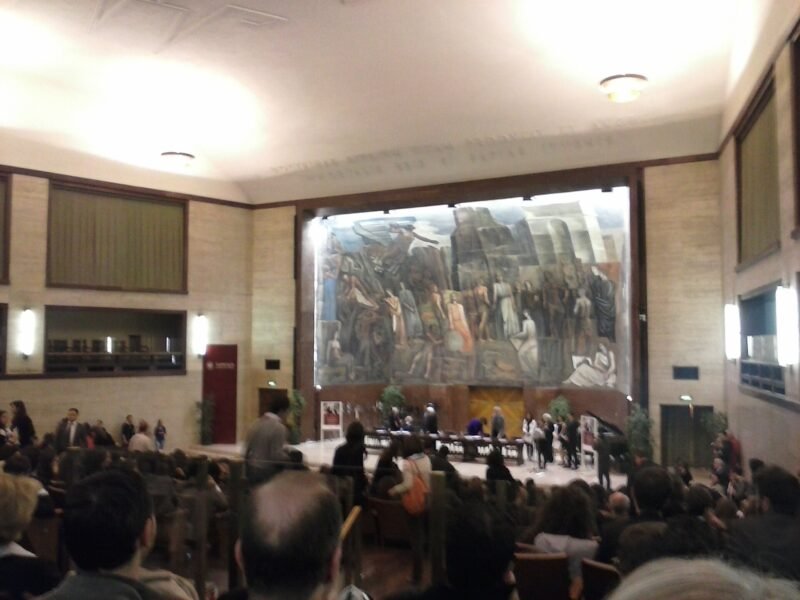
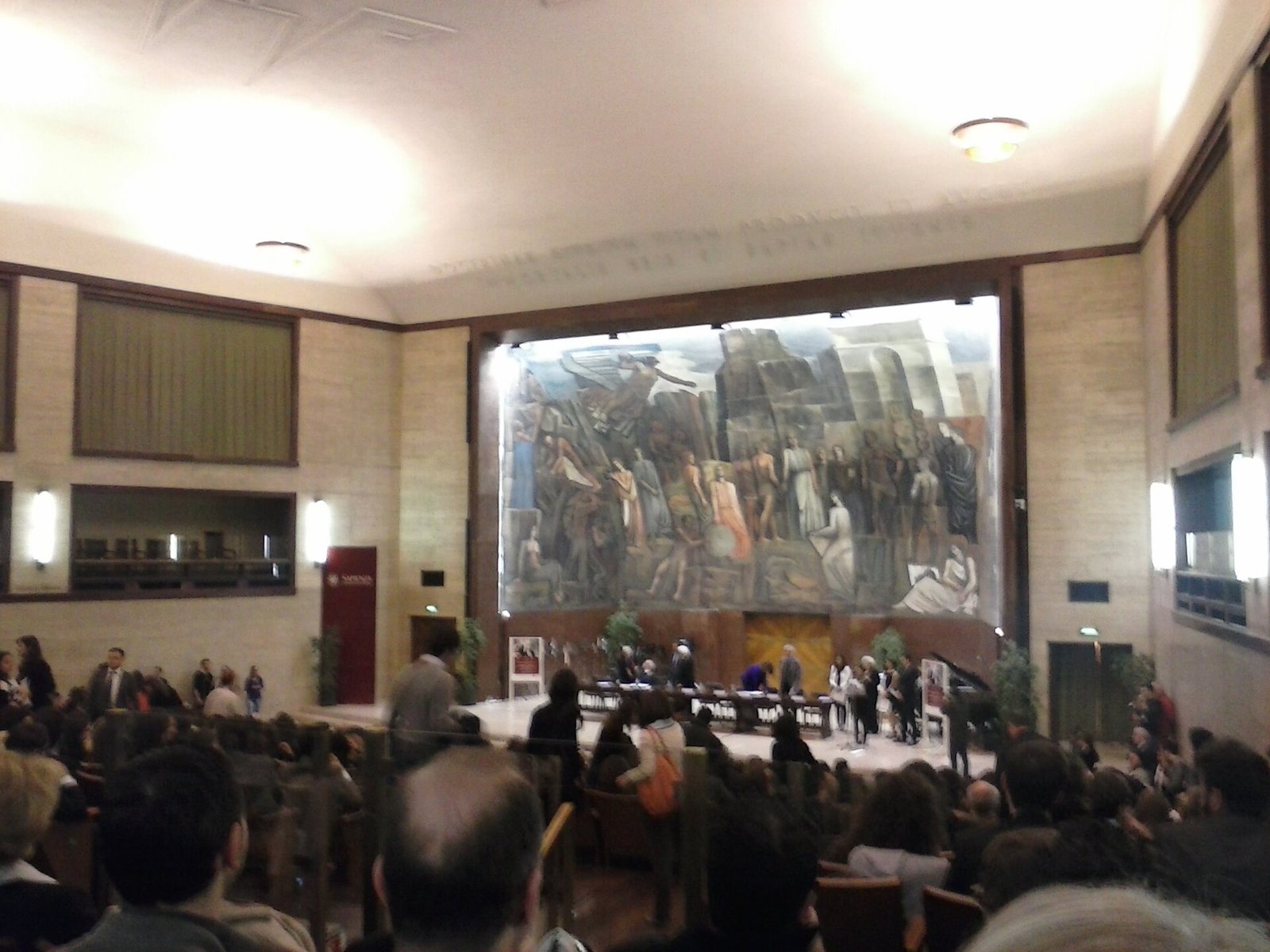
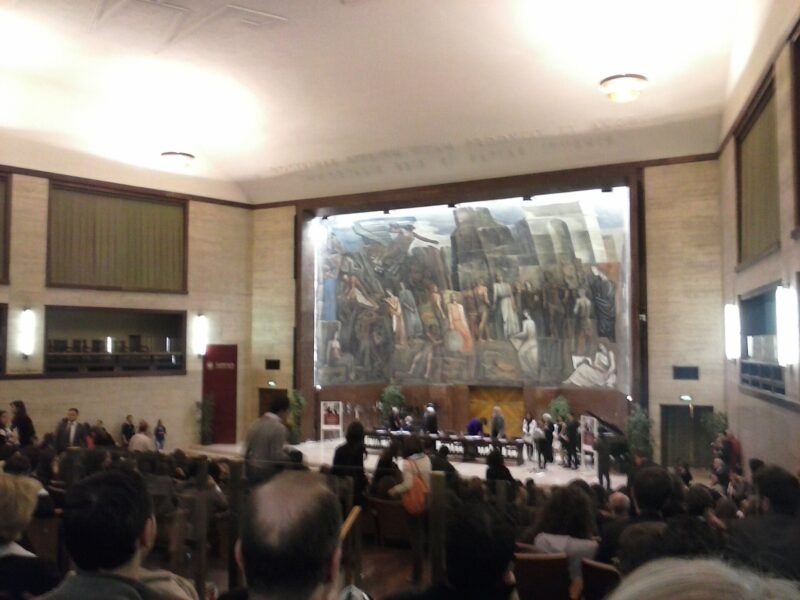
The back wall is occupied by Mario Sironi's 1935 fresco, L'Italia tra le arti e le scienze. Four musicians improvising on Bach and the Beatles in front of that painted cycle: the contrast is part of the charm of the evening.
The city of architects
Around the Rectorate are buildings by Gio Ponti, Giuseppe Pagano, Pietro Aschieri, Giovanni Michelucci and Gaetano Rapisardi. The monumental entrance on Piazzale Aldo Moro is by Arnaldo Foschini. On the campus there are also the MLAC and the Gipsoteca.
One thing nobody tells you about Janoska Ensemble at Aula Magna, Sapienza University, January 26, 2027
Few people know it, but for IUC concerts Sapienza opens free parking inside the University City, for cars, motorcycles, bicycles, taxis and vehicles with a disability permit. You enter from Piazzale Aldo Moro 5 from about one hour before the concert. The IUC warns that for reasons beyond its control it may not be available every time.
Second thing: on Tuesday, the day of the concert, the IUC office at Lungotevere Flaminio is closed during the season. If you want to buy in person without going through the evening box office, you have to do it on the previous days, or rely on the phone or online sales.
Third: in the evening the University City has more closed gates than open ones. The entrance to the concerts, even for those on foot, is only the monumental one at Piazzale Aldo Moro 5: if you arrive from San Lorenzo, you would do well to know this beforehand.
The advice I give you for visiting Janoska Ensemble at Aula Magna, Sapienza University, January 26, 2027
My advice is to come with someone who never listens to classical music. The Janoska Ensemble is the ideal concert for a first time: Yesterday and Carmen, Beethoven condensed into nine minutes, a double bass that swings. People who have never set foot in a concert hall often leave wanting to come back.
Second piece of advice: for those who already know the repertoire well, listen again beforehand to Für Elise and Hungarian Dance No. 1. The fun of the Janoska style is in recognizing the original under the transformation.
Third: take advantage of the prices for young people. With €8 for under 30 in any sector and €5 for under 18, bringing children or grandchildren costs little, and the ensemble's language is among the most suited to a young audience in the whole season.
Finally, arrive with time to spare: the avenue of the University City in the evening, with Minerva lit up, is worth the walk.
Tickets for the Janoska Ensemble
The ticket for the Janoska Ensemble concert costs €26 in the first sector, €21 in the second and €15 in the third, with a 10% presale fee. Under 30 pay €8 and under 18 pay €5, in any sector.
Discounts
With the Family Card, designed for two parents with at least one child under 14, each parent pays €10 and each child €5. Sapienza, affiliated institutions and universities have prices of €21, €17 and €12. The carnet of at least six concerts of your choice gives a 10% discount. Discounts cannot be combined.
Where to buy
At the IUC office at Lungotevere Flaminio 50, Monday to Friday from 10:00 to 13:00 and from 14:00 to 17:00, closed on Tuesday during the season. By phone at 06 3610051 and 06 3610052. At the Aula Magna box office, from one hour before the concert. Online on the presale circuit indicated by the official IUC website, also with the Carta del Docente.
How to get to the Aula Magna for the Janoska Ensemble
For the Janoska Ensemble concert at the Aula Magna at Sapienza you take Metro line B, stops Policlinico or Castro Pretorio, or trams 3 and 19. From Termini you can also walk. You enter only from Piazzale Aldo Moro 5.
Metro line B
From the Policlinico and Castro Pretorio stops a few minutes on foot bring you to the Piazzale Aldo Moro entrance. For a Tuesday evening concert it is the most comfortable choice for the ride home as well.
Tram
The 3 and the 19 cross San Lorenzo and run along the University City: the 19 toward the Policlinico and Viale delle Belle Arti, the 3 toward Porta Maggiore, San Giovanni and the Colosseum.
On foot
From Termini station you exit on Via Marsala side and reach Piazzale Aldo Moro in about 15 minutes.
By car
For concerts the free internal parking at Sapienza is available, barring surprises, with access from Piazzale Aldo Moro 5 from about one hour before.
Another well-known fact, yet rarely mentioned
It is well known that the IUC is an institution of great classical music, the music of Magaloff, Kempff, Menuhin and the Quartetto Italiano. It is less often mentioned that from the beginning it declared its aim to range from classical to jazz, from Baroque to contemporary, and that it was born among students of other faculties, not in a conservatory. A concert like the Janoska Ensemble's, which mixes Bach and the Beatles, is consistent with that origin more than it seems.
A second fact, known to the history of the IUC and little told: for 25 years the Aula Magna was not its hall. Declared unsafe in 1968, with nine concerts canceled, the hall hosted the whole season again only from 1993/94, after the agreement with the university of October 3, 1992. The Rome debut of the Janoska Ensemble takes place in a reconquered hall.
Third fact: the University City, inaugurated in 1935, was hit by the first Allied bombing of Rome, on July 19, 1943, together with the Policlinico, the Verano and the basilica of San Lorenzo fuori le Mura.
How to plan the evening of the Janoska Ensemble
For the Rome debut of the Janoska Ensemble it is best to be at the entrance at Piazzale Aldo Moro 5 at least half an hour before 20:30. The Aula Magna box office opens one hour before the concert, and those who buy or pick up their ticket on site do it more calmly by arriving early.
From the gate to the hall
From Foschini's monumental entrance you follow the avenue to the Minerva square. The Rectorate is the building at the end, and the ticket office for subscriptions is under the portico. The avenue is longer than it looks from the gate.
How long it lasts
The official IUC calendar gives the expected end around 22:30. Any intermission is not indicated. With a program of nine pieces, the evening has the length of a full concert.
Afterward
On the way out you walk back toward Piazzale Aldo Moro, for Metro line B or the trams. Those who used the internal parking leave by the same entrance. San Lorenzo, for a last drink, is a few minutes on foot.
The right photo to take at Janoska Ensemble at Aula Magna, Sapienza University, January 26, 2027
The right photo is the one of the stage ready before the concert: the piano, the double bass leaning, two music stands, and in the background Sironi's fresco, L'Italia tra le arti e le scienze. During the concert no photographs, out of respect for the musicians and the audience.
The second is taken on arrival, from the end of the campus avenue: Arturo Martini's Minerva in the middle of the basin and the Rectorate lit up behind. At 20:00 in late January the campus is dark and Piacentini's facade stands out like a backdrop.
The third at the exit, on Foschini's monumental entrance seen from inside, with the empty avenue: on a Tuesday evening the University City has a metaphysical air, which contrasts with the energy of the concert that has just ended.
Some important events that took place here in history
The Sapienza University City was inaugurated on March 31, 1935 in the presence of Victor Emmanuel III. In the same year Mario Sironi completed the fresco in the Aula Magna. On July 19, 1943 the first Allied bombing of Rome hit San Lorenzo and also damaged the campus.
In 1946 some Sapienza students founded the Istituzione Universitaria dei Concerti. In the 1959/60 season the Aula Magna hosted Chopin's complete piano works with Nikita Magaloff, the 32 Beethoven sonatas with Wilhelm Kempff, the Quartetto Italiano, Andrés Segovia and the young Salvatore Accardo and Uto Ughi.
In 1968 the hall was declared unsafe and nine concerts were canceled. From 1977/78 it hosted free activity for professors and students again, and from 1993/94, after the agreement of October 3, 1992, the whole season again. On January 26, 2027 the Janoska Ensemble makes its Rome debut there.
Who has played at Janoska Ensemble at Aula Magna, Sapienza University, January 26, 2027
Some of the greatest violinists of the twentieth century have played at the Aula Magna for the IUC: Yehudi Menuhin, Georg Kulenkampff, Gioconda De Vito, Adolf Busch, and later the young Salvatore Accardo and Uto Ughi. For the two violinist brothers of the Janoska Ensemble it is a demanding lineage.
With them, the pianists Nikita Magaloff, Wilhelm Backhaus, Edwin Fischer, Alfred Cortot, Wilhelm Kempff, Géza Anda, Aldo Ciccolini and Maurizio Pollini. The cellist Pierre Fournier. Andrés Segovia. The Quartetto Italiano. And those who built and decorated the hall: Marcello Piacentini, Mario Sironi, Arturo Martini, as well as Piero Rattalino, artistic director of the IUC from 1969/70.
In the same week as the Janoska Ensemble debut, Mario Brunello, on January 19, and Marc-André Hamelin, on the 23rd, also play at the Aula Magna: three very different concerts in eight days, in the same hall.
Accessibility and families
The IUC Season is among the most affordable in Rome: €8 for under 30, €5 for under 18, and a Family Card with €5 for each child under 14.
Reduced mobility
The internal parking at Sapienza is open to vehicles with a disability permit, from the entrance at Piazzale Aldo Moro 5. For seats in the hall and routes it is best to phone the IUC before the concert.
With teenagers
Among the concerts of the season, this is perhaps the most suitable for a teenager: recognizable pieces, rhythm, improvisation, a touch of show. The 20:30 start on a Tuesday should be weighed for the youngest, but for a teenager it is a perfect evening.
Students
Sapienza students under 35 can subscribe with UNIIUC at €50 for the whole season or €30 for one series. The Minerva series, with Brunello and the Janoska Ensemble one week apart, is a natural choice.
San Lorenzo and the surroundings
The University City borders San Lorenzo, a district born between 1884 and 1888 for railway workers and laborers outside the Aurelian Walls and today the heart of Rome's university life.
The district
Streets named after ancient Italic peoples, railing-balcony houses, the former Pastificio Cerere turned into a contemporary art center: the district is the natural extension of an evening at the Aula Magna.
By day
If you stay in Rome you can visit San Lorenzo fuori le Mura, one of the seven pilgrimage churches of Rome, the Verano Cemetery and, with tram 3, Porta Maggiore.
Where to eat before or after the concert
San Lorenzo offers trattorias, pizzerias, osterias and student places, with prices generally lower than in the center.
Before the concert
For a Tuesday concert at 20:30 it is best to eat beforehand: a long aperitivo on Via dei Volsci, Via dei Sabelli or Largo degli Osci, or a quick pizza, and then a 10-minute walk to Piazzale Aldo Moro.
After the concert
The concert ends around 22:30. Many places in San Lorenzo are still open, and a drink to talk over the 9 Symphonies in 9 Minutes is almost obligatory.
Late January in Rome
The last week of January is one of the quietest times to visit Rome: museums you can enjoy, lower prices, music seasons in full swing. In the days of the Janoska Ensemble the city also offers Tugan Sokhiev at Auditorium Parco della Musica, from January 21 to 23, and at the beginning of February the recital by Sergej Khachatryan and Alexandre Kantorow in Sala Sinopoli.
Three concerts in eight days
If you love the Aula Magna you can follow three very different evenings in eight days: Mario Brunello's solo cello with Bach and Weinberg on Tuesday, January 19, Marc-André Hamelin's recital on Saturday the 23rd at 17:30 and the debut of the Janoska Ensemble on Tuesday the 26th. With the IUC carnet of at least six concerts, the 10% discount applies to all three.
The weather
The evenings of late January are cold and the campus avenue is exposed: a heavy coat is better for the walk between the entrance and the Rectorate.
Frequently asked questions about the Janoska Ensemble in Rome
When does the Janoska Ensemble play in Rome?
The Janoska Ensemble plays on Tuesday, January 26, 2027 at 20:30 in the Aula Magna at Sapienza, Piazzale Aldo Moro 5, for the Minerva series of the IUC Season 2026/2027. It is the ensemble's debut in Rome, with the program Best of.
What music does the Janoska Ensemble play?
The Janoska Ensemble plays its own arrangements of classical and pop pieces, in the "Janoska style": in Rome Brahms, Bizet, Bartók, Bach, Beethoven, the Beatles' Yesterday and Cole Porter, plus compositions by František Janoska such as 9 Symphonies in 9 Minutes.
How much do tickets cost?
The ticket for the Janoska Ensemble at the IUC costs €26 in the first sector, €21 in the second and €15 in the third, plus a 10% presale fee. Under 30 pay €8 and under 18 pay €5 in any sector. The Family Card provides €10 per parent and €5 per child.
Where do I buy tickets?
Tickets for the Janoska Ensemble are bought at the IUC office at Lungotevere Flaminio 50, by phone at 06 3610051 or 06 3610052, at the Aula Magna box office from one hour before and online on the presale circuit indicated by the official IUC website.
Who is in the Janoska Ensemble?
The Janoska Ensemble is made up of the brothers Ondrej and Roman Janoska on violins and František Janoska on piano, born in Bratislava, and the brother-in-law Julius Darvas on double bass. The ensemble was founded in 2013, lives in Vienna and records for Deutsche Grammophon.
How do I get to the Aula Magna at Sapienza?
You get to the Aula Magna at Sapienza by Metro line B, stops Policlinico or Castro Pretorio, by trams 3 and 19 or on foot from Termini. For IUC concerts the entrance, even for pedestrians, is only from Piazzale Aldo Moro 5.
Is the concert suitable for teenagers?
The Janoska Ensemble concert is among the most suitable for teenagers in the IUC Season, with recognizable pieces, improvisation and rhythm. Under 18 pay €5 in any sector. The 20:30 start on a Tuesday should be weighed for small children.
The final advice on the Janoska Ensemble in Rome
Four virtuosos with Wiener Philharmoniker training, a repertoire that runs from Bach to the Beatles, a Rome debut in a hall with Sironi's fresco and movie-ticket prices for young people: in our opinion it is the concert of the IUC Season to recommend to someone who has never been to a classical concert. My advice is to bring someone new, listen again beforehand to Für Elise and arrive early for the walk across the lit campus.
Article written by the editorial team of Tour Leader Pro, contact them for Private/Corporate/V.I.P. Tours and Experiences.
Planning a trip to Rome? The English guides to visiting the city are on ItalyPlanner.com.
Contact Information
Nearby
 Sapienza University City100 m
- Aula Magna of Sapienza University100 m
- Primo Levi Chemistry Museum100 m
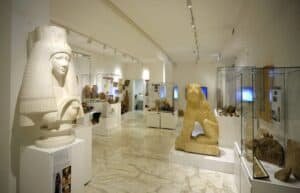
- Museo del Vicino Oriente, Egitto e Mediterraneo100 m
- Museo Laboratorio d’Arte Contemporanea, MLAC100 m
- Gipsoteca – Museum of Classical Art100 m
Upcoming events nearby
- Renata Prunas. Materia risorta at the MLAC of Sapienza, October 8 to November 5, 2026100 m
- IUC Concert Season 2026-2027 at Aula Magna della Sapienza, October 17, 2026 to May 8, 2027100 m
- Mario Brunello at the Aula Magna of the Sapienza, January 19, 2027100 m
- Marc-André Hamelin at the Aula Magna of the Sapienza, January 23, 2027100 m
You might also like
- Angela Hewitt at Aula Magna della Sapienza, February 20, 2027
- Lucie Horsch, Metamorphosis at the Aula Magna of the Sapienza, February 6, 2027
- Kyle Alessandro at Monk in Rome, January 27, 2027
- Talco Freek Tour 2027 at Hacienda Roma, April 2, 2027
- The Devon Allman Project at CrossRoads Live Club: March 26, 2027
- Voyage 35 (ex Porcupine Tree) at CrossRoads Live Club, March 10, 2027