Primo Levi Chemistry Museum
In short. The Primo Levi Chemistry Museum is inside the Sapienza University City, at Piazzale Aldo Moro 5, and occupies the ground floor of the Chemistry building, the one the campus labels with the code CU014 and the name of Stanislao Cannizzaro.
The Primo Levi Chemistry Museum is inside the Sapienza University City, at Piazzale Aldo Moro 5, and occupies the ground floor of the Chemistry building, the one the campus labels with the code CU014 and the name of Stanislao Cannizzaro. You can visit by appointment only: it has no ticket office, no continuous opening hours, and you don't get in by happening to pass by. You request the appointment by email at museodichimica@uniroma1.it, which is also the channel the museum itself gives for guided visits. The director is Professor Donato Monti (donato.monti@uniroma1.it), and the area curator is Dr. Darica Paradiso (darica.paradiso@uniroma1.it). The tourist portal of Roma Capitale publishes the phone number 06 49694318. No admission fee is published on the museum's site, so the terms of the visit are set when you fix the date. You get there by Metro B, Policlinico stop. From Termini, the surface lines 310 and 492 work, and trams 3 and 19 serve the university area. From Termini on foot it's about 20 minutes. The museum is part of the Sapienza Museum Hub, the network that brings together about 20 museums of the university. If you're putting together a tour of lesser-known Rome museums, the page on tourist attractions helps you fit the schedules together.
Where the Primo Levi Chemistry Museum is and how to get there
The administrative address is that of the whole Sapienza, Piazzale Aldo Moro 5, and it isn't enough to find it. The campus is a city within the city: right-angled avenues, light-colored rationalist buildings, a rectorate with Minerva in front. The Chemistry building is on the right side of the main avenue as you proceed from the monumental entrance, recognizable because it carries Cannizzaro's name on the facade. The museum is on the ground floor, inside the Department of Chemistry. You enter from the department's atrium, and without a fixed appointment the front desk has no reason to let you through.
By subway and bus to the Primo Levi Chemistry Museum
The useful stop is Policlinico, on Line B. From there you follow the wall of the university complex and in five or six minutes you're at the gate. Castro Pretorio, also on B, is the alternative if you're coming from Termini and want to break up the trip with a walk. The surface lines the university indicates for reaching Piazzale Aldo Moro from Termini are the 310 and the 492. The 310 is one of the busiest routes in the city toward the north east, and the 492 connects Tiburtina to the center passing through here. Trams 3 and 19 serve the San Lorenzo and Verano area and drop you a few minutes on foot away. By car it's a terrible idea: the campus has parking reserved for staff and the area around is saturated because of the Policlinico Umberto I.
On foot from Termini to the Primo Levi Chemistry Museum
20 minutes of flat walking, no hills, along Via Marsala and then Via dei Mille or Via Palestro. It's the way I recommend when the visit is set for the morning: you cross the Castro Pretorio neighborhood, pass the wall of the Praetorian camp reused in the Aurelian Walls, and reach the campus from the right side, the main entrance on Piazzale Aldo Moro. If you're coming from Tiburtina it takes more or less the same time, going down Via dei Reti and crossing San Lorenzo.
How to visit the Primo Levi Chemistry Museum
The format is that of Italian university museums: opening by appointment, accompaniment by the people who work on the collection, small groups. You write an email saying how many of you there are, what kind of visit you're after and which dates you have available. The museum answers with a proposed day and time. It's not a bureaucratic workaround, it's an advantage: the person who opens the display cases is the one who knows the instruments one by one, and the difference compared with an audio guide is enormous.
Schools are the historic audience. The museum works with the programs for transversal skills and orientation, takes part in the Piano Lauree Scientifiche with orientation workshops, and hosts seminars on the history of chemistry and themed exhibitions. For a group of adults who aren't specialists the experience works just as well, as long as you arrive with a few questions in your pocket. Here the value is in the explanation, not in the staging.
How long the visit to the Primo Levi Chemistry Museum lasts
A good hour if you just look, two if you start asking how a cryoscope worked and why an ebullioscope was used to determine a molecular weight. The time always stretches, never the other way around. Nineteenth-century scientific instruments have a hypnotic quality, brass, blown glass, graduated scales engraved by hand, and nobody resists the temptation to understand what they were for.
The Chemistry building of the University City
The container deserves as much as the contents. The Chemistry building was designed by Pietro Aschieri for the University City. The initial design called for a composition with four-story blocks topped by a C-shaped tower for the laboratories, a solution later scaled back in 1935 to conform to the register of the campus's other buildings. It housed the Institutes of General Chemistry, Inorganic Chemistry, Geochemistry and Physical Chemistry, covered about 5,300 square meters and had 271 rooms. The inauguration took place on October 31, 1935, although the interior finishing was completed only in 1938.
The war passed through here directly: the building suffered the damage caused by the San Lorenzo bombing of July 1943, in the neighborhood that begins a few hundred meters from the university enclosure. Interventions to add floors followed, and in the 1970s the construction of a New Chemistry Building to absorb the growth of the institutes. Whoever enters today sees a stratification, not a pure artifact. That is the reason the museum, born in spaces planned on the first floor, ended up placed on the ground floor.
Why the building is called Cannizzaro
Because modern Roman chemistry begins with Stanislao Cannizzaro, and the campus has recorded him in its internal place names. The code CU014 is the one you find on the campus maps and on the signs. The full name is the one you read on the facade. Knowing both saves you 10 minutes of wandering around on the day of the appointment.
History of the Primo Levi Chemistry Museum
The museum was created in 1986 on the initiative of Professor G. Di Maio, and the work continued with Professor E. Zeuli. Opening to the public came in 1992. It's a date that says a lot about the climate of those years: Italian universities were discovering that their storerooms held a first-rate scientific heritage, often one step from being scrapped, and that cataloging it was a cultural duty before it was a nostalgic operation.
The first acquisitions came from the Department itself, including thermometers by the firm Goulaz of Paris dated between 1882 and 1887. From the earlier site on Via Panisperna came the bulk: densitometers, scales, cryoscopes, ebullioscopes. 40 didactic wall charts by G. Schroeder on the industrial chemical plants of the nineteenth century were also recovered, with a first edition dating to the period 1884-1887. In March 2013 the museum took part in a ministerial project by entering 225 objects in the Sigec cataloging platform: university teaching instruments, donations, equipment from well-known manufacturers, and pieces built directly by the university's professors.
The dedication to Primo Levi
On March 25, 2010, on the initiative of Professor L. Campanella, the museum was dedicated to Primo Levi, the chemist and writer who bore witness to the Shoah, chosen as a symbol of the interaction between scientific and humanistic knowledge. It's a dedication that holds up, and that's not a given: many museum dedications are plaques without consequences, whereas this one defines the cultural program of the whole place.
Why the Primo Levi Chemistry Museum has this name
Primo Levi was born in Turin on July 31, 1919 and graduated in chemistry from the University of Turin in July 1941, with the racial laws already in force. Arrested on December 13, 1943 while joining the partisan resistance, he was deported to Auschwitz on February 22, 1944. He was liberated on January 27, 1945 and returned to Turin on October 19 of the same year. From 1947 to 1975 he worked as a chemist at the SIVA factory. He published Se questo è un uomo in 1947, reprinted in 1958, La tregua in 1963, Il sistema periodico in 1975 and I sommersi e i salvati in 1986. He died in Turin on April 11, 1987.
The book that explains the dedication is Il sistema periodico: 21 chapters named after as many elements, where chemistry is not a metaphor but a trade, with the smell of reagents and the toil of analyses. A museum that keeps analytical balances and cryoscopes finds its literary justification in that book. Whoever arrives here having read the chapter on carbon looks at the display cases with different eyes, and it's worth rereading it the evening before.
Stanislao Cannizzaro and the origins of the collection
The historical core of the Primo Levi Chemistry Museum comes from the institute founded by Stanislao Cannizzaro, born in Palermo on July 13, 1826 and died in Rome on May 10, 1910. In 1858 he published the Sunto di un corso di filosofia chimica, the text in which he set out the criterion for determining atomic weights. In September 1860, at the international congress in Karlsruhe, that reasoning was handed out to the participants and changed the way the scientific community distinguished atomic weight from molecular weight. Before Rome he taught in Alessandria, in Genoa from 1855 and in Palermo from 1861. Appointed senator on November 15, 1871, he obtained in 1872 the chair of chemistry at the Roman university, which he held for 40 years, and he organized the chemical institute in the old convent of San Lorenzo in Panisperna. He is also responsible for the reaction that bears his name and a long season of research on santonin, between 1873 and 1896.
The objects that belonged to Cannizzaro and his group, starting from 1872, are the reason this is not just any teaching museum but a material archive of Italian chemistry. Among the students and collaborators who came out of that institute are Paolo Tassinari, Giovanni Carnelutti, Domenico Amato and Raffaello Nasini. In 1896, for Cannizzaro's seventieth birthday, 49 Italian chemists had themselves photographed together in his Roman institute: a group photograph that counts as a census of a discipline.
The tour of the Primo Levi Chemistry Museum, case by case
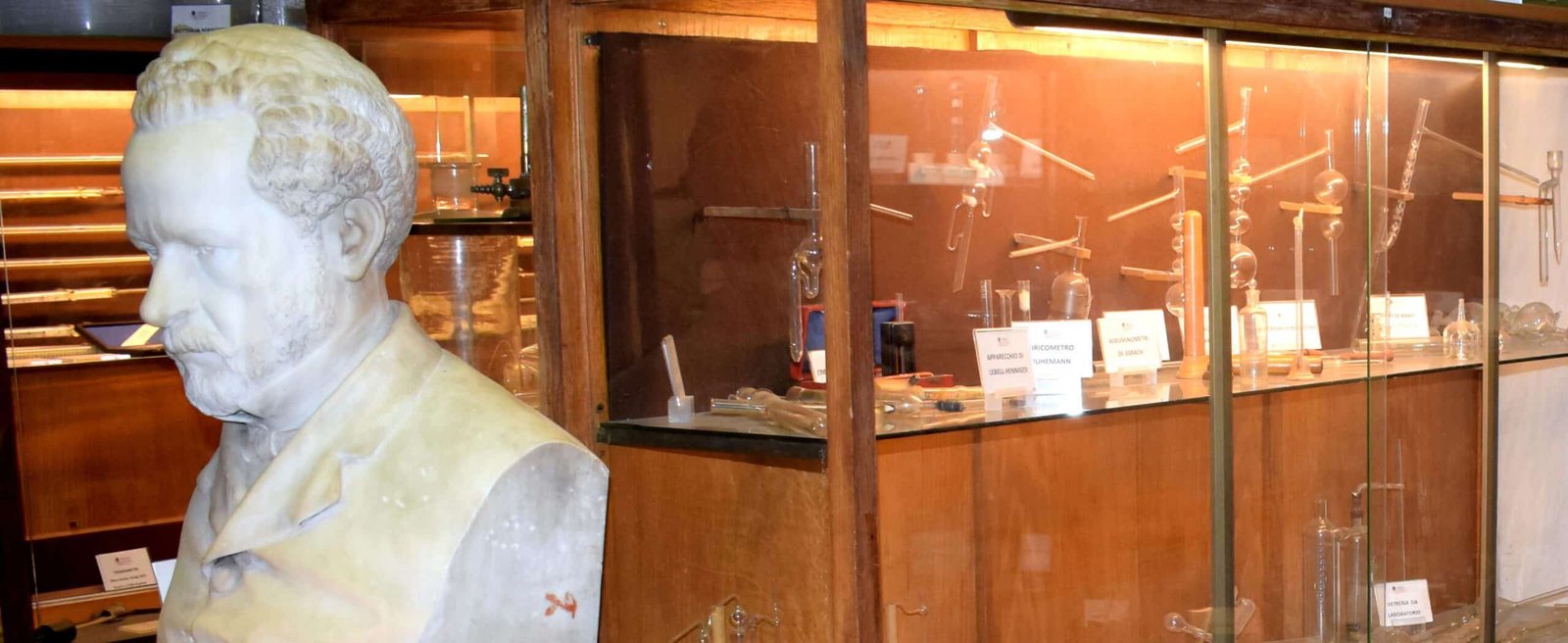
The museum holds scientific instruments, teaching equipment, collections of chemical substances and documents ranging from the late nineteenth century to the last century. The route isn't organized like an art gallery, with one masterpiece per room, but as a succession of families of instruments. Here is what you see, group by group.
Cryoscopes and ebullioscopes
These are the pieces I explain first, because they tell the story of an era. Cryoscopy and ebullioscopy measure by how much the freezing point of a solvent drops and the boiling point rises when a substance is dissolved in it. From that tiny gap you work back to the molecular weight of the dissolved substance. It means that to weigh a molecule, before mass spectrometers, you looked at a thermometer. The specimens kept here come in large part from the old site on Via Panisperna and are objects of brass and glass, with insulating jackets and manual stirrers.
Thermometers and scales
The collection includes thermometers by the firm Goulaz of Paris dated 1882-1887, among the museum's first acquisitions, and the scales from the nineteenth-century institute. An analytical balance of the period is a piece of furniture, not an accessory: a case of wood and glass against drafts, hanging pans, agate knife edges, a box of calibrated weights handled with tweezers. The act of weighing was slow and ritual, and whoever studied chemistry before electronics remembers it with affection mixed with annoyance.
Elemental analysis and colorimeters
The old instruments for elemental analysis are the backbone of nineteenth-century organic chemistry: burn a sample, collect carbon dioxide and water, weigh them, work out the minimal formula. Each analysis was a day's work, and a published result was equivalent to weeks of toil. The colorimeters kept here belong instead to the season of quantitative analysis by visual comparison: two columns of colored liquid were placed side by side and the height was adjusted until the color looked identical to the operator's eye. The value of the data depended, literally, on the eyesight of whoever was measuring.
The spectroscopes of the Primo Levi Chemistry Museum
The spectroscope is the instrument that turned chemistry into a science able to recognize elements from a distance. Each element, brought to incandescence, emits lines of color in fixed positions. Reading those lines means saying what is inside a sample without touching it. The museum's specimens, with their tripod, prism and adjustable little telescopes, let you explain in three minutes why we know what the Sun is made of. It's the right piece with school groups when attention starts to drop.
Equipment for measuring radioactivity
The museum displays equipment for measuring radioactivity built by Gian Alberto Blanc, who worked in the same institute in the early twentieth century. Blanc, born in New York on June 24, 1879 and died in Rome on December 31, 1966, graduated in physics in 1904 with a thesis on radioactivity applied to the sediments of hydrothermal springs in Savoy, obtained his libera docenza in 1908 and in that same year attended the laboratories of the Curies in Paris. In 1928 he became the first full professor of geochemistry in Italy. Seeing the instruments he built means having in front of you the artisanal phase of Italian nuclear physics, when a researcher made for himself the electrometer he needed. Among the collections there are also period shielding pieces: today they make an impression, back then they were the last word in safety.
The 40 wall charts by von Schroeder
They are the most photogenic part of the Primo Levi Chemistry Museum and the least predictable. 40 large didactic wall charts signed von Schroeder, first edition 1884-1887, depict industrial chemical plants of the second half of the nineteenth century and even older technologies: furnaces, absorption towers, columns, lead chambers for sulfuric acid, drawn with the precision of engineering plates and the caption of a manual. They were used to teach industrial chemistry to students who would never set foot in a factory. Today they are worth as a document of industrial archaeology and as a graphic object. If you're interested in nineteenth-century technical drawing, this is reason enough to ask for the appointment.
Chemical substances and dyes
The collections of chemical substances kept in hand-labeled flasks and ampoules are the least showy and most moving aspect of the holdings. They contain synthetic dyes, the products that between the nineteenth and twentieth centuries built the fortune of the European chemical industry, and reagents that are now off the market. The labels, in the handwriting of the lab preparers, are worth as much as the contents: they are the signature of daily work that no scientific publication records.
Ancient distillation finds
Here the museum steps outside the nineteenth-century enclosure. Among the materials kept are distillation finds from the Chinese Ming dynasty period, the ancient Mongol civilization and ancient Mesopotamia, with a chronological range given between 4000 and 3000 BC. Distillation is one of the few technologies that cross whole millennia changing very little in principle: separating by difference in volatility. Seeing a Mesopotamian apparatus placed next to a late-nineteenth-century ebullioscope is the most effective lesson in the history of science the museum can offer.
The historical library
The book holdings include the Selmi Chemical Encyclopedia of 1868 and the Guareschi Encyclopedia of Chemistry of 1922. They are the two great Italian reference works of the discipline, half a century apart, and set side by side they show how much chemistry changed in 50 years: in the Selmi the vocabulary is still uncertain, in the Guareschi the discipline already has the structure we recognize today.
Interactive chemistry experiences
The museum has developed a program of chemistry experiences that visitors can try directly. It's the part designed for schools and for people who arrive without scientific training: you touch, you watch a reaction, you understand a principle without going through a formula. Don't expect the spectacular setup of a science center. Expect something rarer: someone who explains why a reaction does what it does, while it's doing it.
The archive of the Royal Institute of Chemistry
Alongside the display cases the museum keeps the archive of the Regio Istituto di Chimica: documents, registers and papers covering the institute's activity from 1872 to 1940, the year of the move to the new University City. The largest section concerns economic matters, with correspondence with the supplier firms for the purchase of scientific materials. Two protocol registers cover the period 1910-1936. There are annual reports on the state of ongoing research, the registers of publications acquired by the library, the correspondence for the volumes, and then postcards, photographs, pamphlets and small volumes.
The archive can be freely consulted at the museum after contacting the director, the inventory can be downloaded from the museum's site and the collection is listed in the Archivi della scienza portal. For anyone doing research in the history of science it's firsthand material: the suppliers' invoices tell which instruments were bought and at what price, that is, the economic history of a laboratory, which usually nobody writes.
Temporary exhibitions at the Primo Levi Chemistry Museum
The museum produces themed exhibitions. From April 5 to May 20, 2024 it hosted CHEM-ART. La Chimica e l'Arte si incontrano, a project built on the border between chemical reactions and artistic processes, with six sculptures and two video installations by the artist Alessio Manfredi, born in La Spezia in 1977, curated by Leonardo Giaccari and Matteo Giaccari with the curatorial collaboration of Serena Francone. Among the works on display were Cura (2024), an installation with marble, steel and hydrochloric acid, Hidden. Nascosto (2021-2022) with lanthanum, the video installation In memoriam Primo Levi (2020), Genius Loci (2022) on metallurgical casting, The Rare-Earth Element Age (2020) with electrolytic baths and GEM (2019), made with contaminated soil.
The calendar of initiatives changes from year to year and it's best to ask about it along with the appointment: it happens that an ongoing exhibition completely transforms the visit.
The Primo Levi Chemistry Museum for schools and students
The museum makes available supplementary material that can be downloaded free of charge, designed for chemistry students: worksheets on balancing redox reactions in aqueous solution, notes on the new International System of units of measurement, a text on Cannizzaro's contribution to the determination of atomic weights and the periodic table of the elements in the IUPAC version. It also takes part in the programs for transversal skills and orientation and in the Piano Lauree Scientifiche with orientation workshops, and it hosts seminars on the history of chemistry.
For a high school teacher it's a concrete resource: the visit can be tied to the final-year curriculum, and the museum already has the materials ready. Our opinion: bringing a class here after doing redox in the classroom works far better than the other way around.
The Sapienza Museum Hub around the Primo Levi Chemistry Museum
The museum belongs to the Sapienza Museum Hub, which brings together about 20 university museums. Among them are the Museo di Anatomia Comparata "Battista Grassi", the Museum of Pathological Anatomy, the Museum of Etruscan and Italic Antiquities, the Museum of Anthropology "G. Sergi", the Museum of Classical Art with its plaster cast gallery, the Contemporary Art Laboratory Museum, the Museum of Art and Mining Deposits, the Herbarium Museum, the Physics Museum, the Museum of Geography, the Museum of Hydraulics, the Museum of Commodity Science, the Botanical Garden, the Museum of Origins, the University Museum of Earth Sciences, the Museum of the History of Medicine, the Museum of the Near East, Egypt and the Mediterranean and the Museum of Zoology.
How to build a day on campus starting from the Primo Levi Chemistry Museum
Almost all these museums share the same appointment rule, so the day is planned by email a few weeks ahead. The pairing I recommend is chemistry plus physics: two collections of scientific instruments 200 meters from each other, and a morning that tells how the world was measured before digital sensors. If you're traveling with middle schoolers, you'll prefer to pair it with the Museum of Comparative Anatomy, which has the visual impact of mounted skeletons. Outside the campus, to stay on the theme of science well told, there is the Museum of Mathematics.
A curiosity about the Primo Levi Chemistry Museum
The curiosity is in the dates, and no guide tells it. The museum was created in 1986, but opened to the public only in 1992: six years between the decision and the open door. In between there is a very Italian story of spaces that change purpose. The rooms meant for the museum were planned on the first floor of the Chemistry building, where Aschieri had imagined the laboratories. In the end the collection found its place on the ground floor, where it is today. A science museum that moves before it even exists says everything about the pressure a university department puts on its square meters.
There is a second layer of curiosity, just as little known. The core of the collection doesn't come from a purchase or a private bequest, but from a recovery: instruments the Department had discarded, material that arrived from the old site on Via Panisperna, teaching charts saved from a storeroom. The first thermometer entered in the inventory carries the mark of the firm Goulaz of Paris and is dated between 1882 and 1887, which makes it older than the building that houses it by about half a century. In March 2013 the ministerial cataloging fixed 225 objects on the Sigec platform, among teaching instruments, donations, devices from known manufacturers and pieces handmade by the university's professors. That last category is the most fascinating: objects unique in the world, born because a measurement was needed that no commercial catalog offered.
Something nobody tells you about the Primo Levi Chemistry Museum
That the oldest piece in the collection has nothing to do with nineteenth-century Europe. Among the materials kept are distillation finds from the Chinese Ming dynasty period, the ancient Mongol civilization and ancient Mesopotamia, with dates given between 4000 and 3000 BC. In a museum that everyone imagines is devoted to the test tubes of white-bearded professors, the oldest display case comes from the prehistory of technology.
The second thing that usually nobody mentions concerns the archive. Below the surface of the instruments there is a documentary collection of the Regio Istituto di Chimica covering the years from 1872 to 1940, and it can be freely consulted after contacting the director. The largest part is not the scientific papers: it is the bookkeeping, the correspondence with the supplier firms for buying materials. Anyone who studies the history of science knows how much that is worth: a purchase order tells which instruments a laboratory could afford, and therefore which experiments it could really carry out. Two protocol registers cover the period 1910-1936, and there is also minor material, postcards, photographs, pamphlets, which usually nobody catalogs and which here has instead been kept. The collection is listed in the Archivi della scienza portal and the inventory can be downloaded from the museum's site. That means you can arrive at the appointment already knowing what to ask, and that doesn't happen often in a university museum.
My advice for visiting the Primo Levi Chemistry Museum
Write the email at least two weeks ahead and propose two or three alternative dates yourself, saying how many of you there are and what interests you: the industrial charts, Cannizzaro's instruments, Blanc's radioactivity, the hands-on experiments. A museum that opens by appointment organizes the visit around your request, and a generic email produces a generic visit. It's the single measure that changes the quality of the morning the most.
Second tip, a practical one: arrive with 10 minutes to spare and look for the building by its code, not by its name. On the Sapienza campus the CU codes are everywhere, on the maps and on the signs, and CU014 takes you exactly in front of the right door. Asking a humanities student for the Chemistry building often doesn't work. Third: don't schedule anything else in the following hour. Guided visits led by the person who looks after the collection always run long, and cutting them short to run elsewhere is a shame.
The last thing is a blunt opinion. This is not a museum for just any afternoon: it's a museum for someone with a question. If chemistry left you with a bad memory from school, take the place without prejudice and ask to see the spectroscope and von Schroeder's charts. If instead you studied chemistry, bring the curiosity of the trade and ask about the instruments the professors built themselves: that's where the museum is at its best.
Another well-known fact, yet rarely cited
That the building housing the museum has a precise birth date and a precise wound. Inaugurated on October 31, 1935 to a design by Pietro Aschieri, with about 5,300 square meters and 271 rooms for the Institutes of General Chemistry, Inorganic Chemistry, Geochemistry and Physical Chemistry, its interiors were completed only in 1938. Five years later it suffered the damage of the San Lorenzo bombing of July 1943. The neighborhood that was hit begins on the other side of the railway, a few minutes on foot, and the university campus was not spared the effects of the attack.
It's a fact that circulates in the texts on Roman architectural history, yet almost nobody connects it to the visit: you enter a chemistry museum thinking the history concerns only the instruments in the display cases, and instead it concerns the walls too. Aschieri's original design, moreover, was more ambitious than the one built: it called for four-story blocks topped by a C-shaped tower for the laboratories, scaled back in 1935 to line up with the uniform language wanted for the University City. The later added floors and the New Chemistry Building built in the 1970s added further layers. Whoever looks at the facade with these facts in mind reads a building of several stages, not a compact block of the 1930s.
The right photo to take at the Primo Levi Chemistry Museum
The right photo is not the panorama of the room. It's the close-up detail of an instrument in brass and glass against the dark background of the display case: a cryoscope with its long-scale thermometer, or the spectroscope with the little telescopes converging on the prism. They are objects built when the beauty of an instrument was part of its prestige, and the raking light of the cases rewards them. Hold the phone against the glass to eliminate reflections, turn off the flash, which is unforgiving on glass, and raise the exposure slightly because the dark background fools the automatic metering.
The second photo, the one nobody takes, is von Schroeder's wall charts: 40 large teaching sheets with nineteenth-century industrial plants drawn like engineering plates. Frame one whole, head-on, without cutting the border, and then a detail of the machine drawn. They also work very well in black and white. Outside, before going back in, the facade of the Cannizzaro building with the engraved name is worth a look: clean verticals, light plaster, the Roman rationalism of 1935 that at mid-morning gets a flat light ideal for architecture. Ask for permission to photograph anyway when you set the appointment: in university museums the rules change from collection to collection.
Some important events that happened here in history
The first event is the birth of the institute itself, from which the collection comes: in 1872 Stanislao Cannizzaro, just called to the Roman chair, organized the Regio Istituto Chimico in the old convent of San Lorenzo in Panisperna. Generations of Italian chemists came out of that institute, and in 1896, for the founder's seventieth birthday, 49 chemists gathered there for a group photograph that counts as the birth certificate of a national scientific community.
The second event is the move. In 1935 the institute leaves Via Panisperna for the newly built University City: the Chemistry building is inaugurated on October 31 of that year, the institute's archive documents the activity up to 1940, and the instruments of the old site, densitometers, scales, cryoscopes and ebullioscopes, travel together with the professors. Many of those objects are now in the display cases here.
The third is the war: in July 1943 the San Lorenzo bombing damages the building. The fourth is the founding of the museum in 1986 on the initiative of Professor G. Di Maio, continued by Professor E. Zeuli, with the opening to the public in 1992. The fifth is March 25, 2010, when on the initiative of Professor L. Campanella the collection is dedicated to Primo Levi. The sixth, less solemn but decisive, is March 2013: the cataloging of 225 objects in the ministerial Sigec platform, that is, the moment when the collection stops being an orderly storeroom and becomes a registered heritage.
Who has passed through the Primo Levi Chemistry Museum
The honest way to answer is to distinguish between those who walked these rooms and those who live in them through their objects. Stanislao Cannizzaro belongs to the second category: he died in Rome on May 10, 1910, 25 years before the University City building existed, and yet the equipment, teaching instruments and documents of his and his group, starting from 1872, are the heart of the collection. The senator who in 1860 at Karlsruhe convinced chemical Europe to distinguish atomic weights and molecular weights is present here in the form of brass and paper.
Gian Alberto Blanc, on the other hand, did frequent the institute for real: he worked in the building in the early twentieth century, built with his own hands the radioactivity measuring equipment the museum displays, and brought to Rome a method learned in 1908 in the laboratories of the Curies in Paris. From 1928 he was the first full professor of geochemistry in Italy. Through the Roman institute also passed Cannizzaro's students and collaborators, from Raffaello Nasini to Paolo Tassinari, from Giovanni Carnelutti to Domenico Amato.
On the last name, the one of the dedication, the truth is subtler: Primo Levi passed through here as a symbolic figure, chosen on March 25, 2010 to represent the meeting between scientific and humanistic knowledge. And then every year the school groups pass through, the students of the orientation workshops and the doctoral students who in 2024 curated the exhibition on the relationship between chemistry and art. A university museum lives on this continuous passing, not on plaques.
The Primo Levi Chemistry Museum with kids
It works from age 10 up, and it works much better if whoever is leading declares the group's age in advance: the program of interactive chemistry experiences was created precisely for this audience. Under 10 the collection risks being a row of incomprehensible display cases, except for the hands-on part. What wins over young kids, in my experience, isn't spectacular reactions but the self-built instruments: discovering that a professor made for himself the device he needed overturns the idea that science is only about buying expensive machines.
Accessibility and services at the Primo Levi Chemistry Museum
The museum occupies the ground floor of the Chemistry building, a favorable condition for people with mobility difficulties, and the Sapienza campus is flat and walkable. The specific access conditions, the presence of elevators along the internal route and the availability of services are agreed when you book. Since it's a facility that opens by appointment, any particular need should be communicated in the initial email, when there is still room to organize. There is no coat check, cafe or museum bookshop. The campus bars, though, are a few steps away and priced like a university canteen.
When to go to the Primo Levi Chemistry Museum
During class periods the campus is crowded with students and very lively, and it's the time when the place works best: you feel the university at work, not a container of artifacts. In the academic breaks of August and between Christmas and Epiphany availability shrinks, as in all university facilities. Morning is preferable to afternoon, both for the light on the display cases and because whoever leads the visit has fewer teaching commitments behind them. Always verify the opening period when you write for the appointment: the calendar follows the university's.
What to see near the Primo Levi Chemistry Museum
A 10-minute walk away begins San Lorenzo, the neighborhood the July 1943 bombing marked more than any other in Rome and which today lives on students, beer halls and independent spaces. On its edge opens the Verano Cemetery, the city's great monumental graveyard, which is also an open-air museum of nineteenth-century sculpture and deserves an hour. On the opposite side of the campus you reach Castro Pretorio and the remains of the Praetorian camp incorporated into the Aurelian Walls. Staying on campus, the Physics Museum and the University Museum of Earth Sciences complete the science theme. And if you're interested in the other Sapienza, the historic one in the center, the great hall of the old Studium is inside the church of Sant'Ivo alla Sapienza, with Borromini's spiral dome on Corso del Rinascimento.
Quick questions about the Primo Levi Chemistry Museum
Where is the Primo Levi Chemistry Museum?
In the Sapienza University City, Piazzale Aldo Moro 5, on the ground floor of the Chemistry building labeled CU014 and named after Stanislao Cannizzaro.
How do you book a visit to the Primo Levi Chemistry Museum?
By email at museodichimica@uniroma1.it, which the museum also gives for guided visits.
Is the Primo Levi Chemistry Museum open every day?
No. It can be visited exclusively by appointment, so there are no opening hours open to the public.
How much is a ticket to the Primo Levi Chemistry Museum?
The museum doesn't publish an admission fee on its site: the terms are set when you fix the appointment.
Do you need to book for the Primo Levi Chemistry Museum?
Yes, always. It's the only way of access provided.
What is the phone number of the Primo Levi Chemistry Museum?
The tourist portal of Roma Capitale gives the number 06 49694318. The channel the museum gives for bookings is still email.
Who runs the Primo Levi Chemistry Museum?
The director is Professor Donato Monti. The area curator for the science and technology museums is Dr. Darica Paradiso.
Is the Primo Levi Chemistry Museum part of the Sapienza Museum Hub?
Yes, it is one of the museums of the Sapienza Museum Hub, the network that brings together about 20 university collections of the university.
When was the Primo Levi Chemistry Museum founded?
It was created in 1986 on the initiative of Professor G. Di Maio, with the continuation of Professor E. Zeuli, and opened to the public in 1992.
Why is the museum named after Primo Levi?
The dedication dates to March 25, 2010, on the initiative of Professor L. Campanella: Levi, chemist and writer, witness to the Shoah, was chosen as a symbol of the interaction between scientific and humanistic knowledge.
What can you see at the Primo Levi Chemistry Museum?
Scientific instruments, teaching equipment, collections of chemical substances and documents from the late nineteenth century to the twentieth: cryoscopes, ebullioscopes, thermometers, equipment for elemental analysis, colorimeters, spectroscopes, devices for measuring radioactivity and 40 wall charts by von Schroeder.
How long does the visit to the Primo Levi Chemistry Museum last?
Between one hour and two hours, depending on how far you go into the detail of the instruments.
Can you take photographs at the Primo Levi Chemistry Museum?
It's best to ask when you fix the appointment: in university collections the rules vary from museum to museum.
Is the Primo Levi Chemistry Museum suitable for children?
From age 10 up it works well, above all thanks to the program of interactive chemistry experiences developed by the museum.
Is the Primo Levi Chemistry Museum accessible to people with mobility disabilities?
The museum is on the ground floor of the Chemistry building and the campus is flat. The specific conditions should be communicated in the appointment request.
How do you get to the Primo Levi Chemistry Museum by public transport?
Metro B to Policlinico. From Termini, surface lines 310 and 492. Trams 3 and 19 serve the university area. From Termini on foot it's about 20 minutes.
Can you get to the Primo Levi Chemistry Museum by car?
Not recommended: the campus parking is reserved and the area around the Policlinico is saturated.
Does the museum organize visits for schools?
Yes. It works with the programs for transversal skills and orientation, takes part in the Piano Lauree Scientifiche with orientation workshops and hosts seminars on the history of chemistry.
Can you consult the archive of the Regio Istituto di Chimica?
Yes: it can be freely consulted at the museum after contacting the director, and the inventory can be downloaded from the museum's site.
What period does the archive kept at the Primo Levi Chemistry Museum cover?
The years from 1872 to 1940, with two protocol registers for the period 1910-1936.
Which Cannizzaro instruments are kept at the Primo Levi Chemistry Museum?
Scientific equipment, teaching instruments, collections of substances and documents that belonged to Cannizzaro and his group, starting from 1872.
Who was Gian Alberto Blanc?
A scholar born in New York on June 24, 1879 and died in Rome on December 31, 1966, who graduated in physics in 1904 with a thesis on radioactivity, attended the laboratories of the Curies in 1908 and from 1928 was the first full professor of geochemistry in Italy. The museum displays radioactivity measuring equipment that he built.
What are von Schroeder's charts?
40 didactic wall charts, with a first edition between 1884 and 1887, that depict industrial chemical plants of the second half of the nineteenth century and older technologies.
Does the Primo Levi Chemistry Museum host temporary exhibitions?
Yes. From April 5 to May 20, 2024 it hosted the exhibition CHEM-ART, devoted to the meeting of chemistry and art, with works by Alessio Manfredi.
Are there downloadable teaching materials?
Yes: worksheets on balancing redox reactions, notes on the new International System, a text on Cannizzaro's contribution to the determination of atomic weights and the IUPAC periodic table.
What other museums can you combine with the visit?
On campus, the Physics Museum, the University Museum of Earth Sciences, the Museum of Anthropology and the plaster cast gallery of the Museum of Classical Art. Outside, the Verano Cemetery and the San Lorenzo neighborhood.
A museum by appointment is intimidating: it seems reserved for someone else. It isn't. Write the email, give two dates, explain who you are. Within a few days a person answers who knows every object in the collection and will be glad to open the display cases for you. In return, arrive on time and leave the afternoon free, because an hour in front of a spectroscope from 1890 is worth more than three museums crossed at a run.
Article written by the editorial team of TourLeaderPro, contact them for Private/Corporate/V.I.P. Tours and Experiences.
Planning a trip to Rome? The English guides for visiting the city are on ItalyPlanner.com.