Museum of the History of Medicine
In short. The Museum of the History of Medicine of the Sapienza is at Viale dell'Università 34a, 00185 Rome, in a small Rationalist building set against the northern edge of the Città Universitaria: you enter from the avenue, not through the…
The Museum of the History of Medicine of the Sapienza is at Viale dell'Università 34a, 00185 Rome, in a small Rationalist building set against the northern edge of the Città Universitaria: you enter from the avenue, not through the monumental gate of Piazzale Aldo Moro. Open Monday to Friday, from 9:00 to 18:00. Free admission. Booking is required and must be made at least one day ahead through the online form published on the museum's official website: anyone who arrives without a booking risks finding the door closed, because the reception staff works from lists. The booking is followed by a confirmation email to keep and show at the entrance. Phone 06 4991 4766, email museo.stomed@uniroma1.it. On Saturday and Sunday the museum is closed, and during the university's closing periods, late December and early January, it's best to check the calendar on the official website before setting out. Metro B, Policlinico stop, then a 10-minute walk. Trams 3 and 19. Buses 71, 140, 141, 310, 492, 649. From Termini it's a good quarter of an hour's walk. For the full visit of the three exhibition levels allow an hour and a half. With the audio guide or with a companion who stops at the display cases, a full two hours.
This is a long guide, because the museum deserves it: it's one of the most important Italian collections of objects connected with the healing arts, and in Rome it has no rivals. If you're building an itinerary among the city's less-trodden museums, the page on the museums of Rome is the place to start, and it's worth reading together with this one: the Museum of the History of Medicine belongs to a university circuit that almost no visitor crosses and that is worth, on its own, a whole day.
The Museum of the History of Medicine in two minutes: hours, tickets, booking
First the information you really need, because here more than elsewhere the risk is turning up in front of a glass door and finding it locked. The museum is part of the Polo museale Sapienza, which brings together 19 scientific and humanistic collections between the Città Universitaria and other university sites. The opening regime is not that of a civic museum: no ticket seller, no turnstile, no line. There's an office, there's a curator, there's an academic calendar. The practical consequence is simple: you get in when the staff knows you're coming.
The hours of the Museum of the History of Medicine
Monday to Friday, from 9:00 to 18:00. No weekend opening, no ordinary evening opening. The best slot, from experience, is the morning between 9:30 and 11:30: the light coming in through the high windows of the first floor is still raking and the display cases of surgical instruments can be read without reflections. Late afternoon, after 16:00, is the slot when it's easiest to find the rooms empty, if you prefer silence to light. During periods when teaching activities are suspended, typically the week between Christmas and Epiphany, opening is interrupted: the updated calendar is on the museum's official website and on that of the Polo museale Sapienza.
How much it costs to get into the Museum of the History of Medicine
Nothing. Admission is free, as for almost all the collections of the Polo museale Sapienza. There are no full, reduced, combined or family tickets, no presale, no online reseller to look for. This is one of the very few Roman museums of international level where the only currency required is time, and where the first Sunday of the month changes nothing, because on Sunday the museum is closed anyway. The free admission, it must be said frankly, is not a whim: it's the sign of an institution that considers itself first of all a teaching and research tool, and only secondarily an attraction.
How to book the visit to the Museum of the History of Medicine
Booking is required, at least one day ahead of the chosen date, and is done by filling in the online form reachable from the dedicated page of the official website. The system replies with a confirmation email: that email is your entry pass, and must be kept and shown to the reception staff. For organized groups and school classes it's best to move with more margin, because guided visits and educational activities are arranged with the museum's office and with the Polo museale. Anyone who wants to book an accompanied visit will find the procedures, museum by museum, on the booking page of the Polo museale, where the Museum of the History of Medicine appears among those for which booking is required.
How long it takes to visit the Museum of the History of Medicine
An hour and a half for an honest tour of the three levels. Two hours if you read the captions, and here it's worth reading them. Three hours, without irony, if you are a doctor, a medical student, a pharmacist, a historian of science or simply a person who, in front of a case of early 19th-century amputation instruments, stops to count the teeth of the saw. The museum is small in area and extremely dense in content: the ratio between square meters and information is one of the highest I know in Rome. If you're short on time, do the basement and the first floor and skip the second, which is the most discursive and the most reliant on panels.
Where the Museum of the History of Medicine is and how to get there
The address is Viale dell'Università 34a. The street number matters: the avenue runs along the side of the Città Universitaria and the museum occupies a free-standing building, recognizable by its light cladding and aligned windows. It's not inside the monumental enclosure of the campus, but on its edge, and this confuses quite a few people who enter from Piazzale Aldo Moro and then wander among the institutes looking for a sign.
By metro
The reference stop is Policlinico, on Line B. On exiting you take Viale Regina Elena and in about 10 minutes at a normal pace you're in front of the museum. Line B also serves Castro Pretorio, on the other side of the Città Universitaria, and is a convenient alternative for those arriving from Termini: from Castro Pretorio you follow the campus boundary wall and come out on Viale dell'Università. Those traveling on Line A get off at Termini and continue by bus 310, or on foot: a good quarter of an hour's walk, largely in a straight line, along Via Marsala and Via dei Mille.
By trams 3 and 19 and by bus
Trams 3 and 19 run along Viale Regina Elena and are, by far, the most civilized way to reach this quadrant: you get off a short distance from the Policlinico Umberto I and continue on foot. The useful surface lines are 71, 140, 141, 310, 492 and 649. The 492 links Tiburtina and the Vatican quadrant passing through here, and for those arriving by train at Tiburtina station it's the most direct solution, with a 20-minute walk as an alternative. A warning: at peak hours the 492 is very crowded and in Rome trams 3 and 19 have unreliable frequencies. If you have an appointment with the museum, set out with 20 minutes of margin.
By car, by bicycle, on foot
Arriving by car is not recommended: Viale dell'Università is narrow, parking in the Policlinico area is a lottery and the wild parking around the university institutes is a depressing sight. By bicycle, on the other hand, you get there well, because the climb from Termini is minimal and the neighborhood has wide streets. On foot, from Termini, the route is pleasant only if you approach it with the right mindset: you cross the Castro Pretorio quadrant, follow the barracks, pass next to the Biblioteca Nazionale Centrale, and in barely 20 minutes you're at the entrance. Those coming from the historic center should consider that there's nothing scenic here: it's an early 20th-century city, orderly and severe, that has its character but gives no discounts to the tourist looking for postcards.
The Città Universitaria around the Museum of the History of Medicine
You can't understand this museum without understanding where it was born. The Città Universitaria is a construction site of the regime, designed by Marcello Piacentini starting in 1932 and built in the following years on a layout that Piacentini himself described in almost liturgical terms: a main axis that leads from the monumental entrance to the Rectorate building, as a nave leads to the apse. The geometric module is a square of 60 meters. The distribution logic looks to American campuses. The language is that of Italian Rationalism tempered by State monumentalism.
The architects of the campus
Piacentini was chief architect and general director of the works, but he did not work alone: Giuseppe Pagano, Gio Ponti, Giovanni Michelucci, Pietro Aschieri, Giuseppe Capponi, Gaetano Minnucci, Arnaldo Foschini and Gaetano Rapisardi took part in the project with individual buildings. It's a circumstance worth keeping in mind while crossing the campus: within a few hundred meters live side by side some of the most important names of Italian interwar architecture, called to work within a unified plan and forced into a compromise that critics still discuss today. Foschini signed the monumental entrance on Viale delle Scienze. The overall result, read today, is a lesson in authoritarian urban planning: rigorous in layout, rigid in grammar, progressively eroded by parking lots, prefab buildings and additions that have eaten up the green space the project provided for.
The small building at Viale dell'Università 34a
The building that houses the Museum of the History of Medicine does not belong to the first season of the campus. It's postwar: works began in 1953 and the site was inaugurated on September 13, 1954. The language, however, dialogues with that of the 1930s, so much so that whoever sees it for the first time takes it for an institute contemporary with the others. It's a sober little building, of domestic proportions, conceived from the start as a container for three intertwined functions: the university institute, the specialized library, the museum. This is the right key to reading it. Here an existing building was not adapted as a museum: a building was constructed so that a museum could exist, and it's a rare circumstance in Roman museum history.
Adalberto Pazzini, the man who invented the Museum of the History of Medicine
Adalberto Pazzini was born on February 23, 1898 and died on May 10, 1975. He graduated in medicine in Rome in 1922 with a thesis in experimental physiology conducted under the guidance of Silvestro Baglioni, and from there his career took a direction that in the Italy of the time was almost eccentric: instead of staying in the laboratory, he devoted himself to the history of his own discipline. From 1931 he taught an elective course in the history of medicine at the Sapienza, obtained his teaching qualification in 1932, became a contract professor in 1936-37 and a full professor in 1955. He presided over the Società Italiana di Storia della Medicina from 1956 to 1965 and the International Society for the History of Medicine from 1964 to 1968. He signed over 500 publications, including a two-volume Storia della medicina of 1947 and a book whose title says everything about his way of understanding the profession, Demoni, streghe e guaritori, of 1951.
Three pharmacy jars and a borrowed room
The museum began in the most modest way imaginable. It had no premises of its own: the first objects Pazzini gathered were placed in a room on the ground floor of the Istituto di Igiene that simultaneously held the directorship, the library, the card files and the students. Three pharmacy jars were the first nucleus. The space had been granted by Dante De Blasi, then director of the Istituto di Igiene, who cultivated the idea of giving the university a complete institute with a library and a museum. In 1938, the year the museum takes as its founding date, larger premises arrived that also occupied a portion of the basement of the Istituto di Igiene, and the University contributed financially to building the shelves needed to display the collections.
The museum that was becoming a warehouse
De Blasi's successor, Vittorio Puntoni, granted more space, but the pace of acquisitions always outran the pace of concessions. Pazzini bought, asked, obtained donations, collected everywhere. The storerooms filled with precious material and the museum was turning into a depot of statues, paintings, objects, models and instruments. Anyone who has worked in a university museum recognizes the phenomenon immediately: the founder's passion generates a critical mass that the institution is not equipped to hold, and collecting produces, paradoxically, invisibility.
1943: the bombs on the Città Universitaria
In 1943 the war reached this far. The bombings that hit the eastern quadrant of Rome also struck the Città Universitaria, and the museum, which occupied the basements of the Istituto di Igiene, found itself exposed to a direct threat. In 1945 those same underground rooms were turned into an air-raid shelter: the windows were walled up, and three thick anti-splinter walls were raised inside. The collections survived, but paid the price of survival in damp, disorder and inaccessibility. At the end of the conflict the damage was repaired and Pazzini resumed the search for new material with a stubbornness that, reading it now, has something touching about it.
The new site: 1949, 1953, 1954
Since the end of the 1930s Pazzini had been working to obtain a worthy site. The opportunity came in 1949, when the Ministry of Public Works allocated a fund for the construction of university buildings: Pazzini flooded anyone who could decide with requests, arguing that a documentary museum of the history of medicine should be included among those buildings. He got his way. Works started in 1953 and on September 13, 1954 the new seat of the Istituto di Storia della Medicina, with the library and the museum, was inaugurated at Viale dell'Università 34/a. What strikes you, retracing the story, is the coherence of the design: Pazzini didn't want a showcase, he wanted a place where the object, the book and the teaching were in the same building.
The decline and the return
When Pazzini died, in 1975, the museum entered a slow and serious decline, the kind that compromises preservation even before public access. The reversal came in the second half of the 1990s, when Luciana Rita Angeletti took over its direction and started a program of restorations, revisiting of the display, educational and scientific updating, and systematic inventorying and cataloging. It's thanks to that season that the museum regained weight in the international research network on the history of medicine and of the biomedical sciences. The direction then passed to other scholars, and the museum today belongs permanently to the Polo museale Sapienza, with a dedicated area curator.
Pazzini's display method, and why it still shows
Pazzini had a precise museological idea, and an innovative one for the time: the reconstruction of environments as a narrative and teaching tool. He didn't believe in the display case as a catalog, he believed in the scene. The conviction that underpinned that method, typical of the museology of the first half of the 20th century, was that emotion was the crowbar of the cognitive process: whoever enters a reconstructed apothecary understands what an apothecary was better than someone reading a caption under an isolated albarello. The basement of the museum is still today the place where that idea can be seen in its pure state, and it's the reason why, for me, the basement is the most beautiful part of the whole route.
Evan Gorga, the tenor who filled the Museum of the History of Medicine
Here begins the part that makes this museum different from any other. The most precious core of its collections was not put together by a doctor, nor a professor, nor a superintendency: it was put together by a tenor. His name was Evangelista Gennaro Gorga, known on stage as Evan Gorga, born on February 6, 1865 in Brocco, today Broccostella, in the province of Frosinone, died in Rome on December 5, 1957 and buried at Verano.
Rodolfo, the evening of February 1, 1896
Gorga entered music history for a single evening. On February 1, 1896, at the Teatro Regio in Turin, the world premiere of Giacomo Puccini's La Bohème took place: Arturo Toscanini was on the podium, Mimì was Cesira Ferrani, and the first Rodolfo in history was him. Giulio Ricordi had hired him for that role. Gorga's career was short and intense: debut in 1895, the great Italian theaters, the repertoire of Verdi, Mascagni and Puccini, and then retirement in January 1899 after a performance of La Bohème in Verona. He was 34. It's rare to be able to say, in front of a case of 16th-century surgical instruments: the first Rodolfo bought these.
10 apartments on Via Cola di Rienzo
Having left the stage, Gorga devoted himself to collecting with a fury that has few precedents. He bought everything: musical instruments, weapons, ceramics, archaeological material, glass, medical objects, ivories, coins, textiles. His collections came to occupy 10 connecting apartments on Via Cola di Rienzo, in the Prati district. The phenomenon, read today, has two faces. On one side there is the omnivorous early 20th-century collector, who saves from the antiques market and from dispersal entire sectors of material culture that no institution was collecting. On the other there is the man who ruins himself: in 1929 the collections were placed under administrative seizure for the debts accumulated, and in 1950 the Italian State became their owner.
What came to the Sapienza
The Gorga collections were broken up among several institutions. The musical part ended up in the Roman state collections, other material flowed into the Museo Nazionale Romano, and the medical core, the most coherent and the richest, arrived here in 1947. Since then it has formed the heart of the Museum of the History of Medicine: about 8,000 items, according to the current estimate. It's a figure that, said like that, tells you nothing. Try instead to break it down, and you'll understand what we're talking about.
The verdict on Gorga
People have often written about Gorga with a kind of moved indulgence, as if he were a likable eccentric who ate through a fortune. I disagree. Gorga was a collector of systematic taste, not a hoarder: the internal coherence of the medical collection, which covers pharmacy, surgery, obstetrics, dentistry, optics and alchemy, is not the product of a whim, it's the product of a project. That the project then devoured its author is another matter, and it's not the first time it has happened in the history of Italian collecting. The museum owes him everything and should say so louder.
The collections of the Museum of the History of Medicine, core by core
The exhibited collections come from the sum of three main cores and a few later donations. The first core is Pazzini's, formed between the 1930s and 1954. The second is the Gorga collection. The third is the Egyptian deposit of 1951. To these are added, with a more specialized profile, the Sarnelli collection and the Neuschuller collection.
Over 700 pharmacy jars
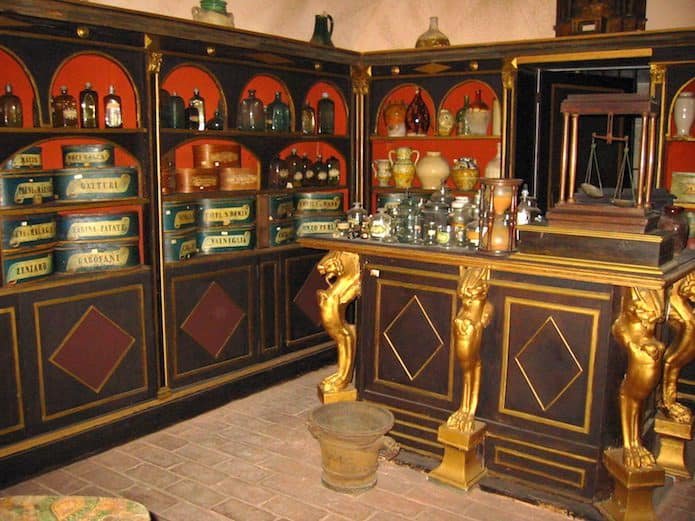
The pharmaceutical ceramics are the numerically most imposing section: over 700 pieces. Albarelli, hydriae, pitchers, pill jars, jugs, containers with a narrow neck for syrups and with a wide neck for electuaries. They are Italian manufactures datable between the 17th and 19th centuries, with origins that include Faenza, Deruta, Caltagirone, Cafaggiolo and Grottaglie. Those who don't follow ceramics walk past these display cases with the distracted respect reserved for orderly things. Those who stop, instead, discover that these jars are documents. The writing on the cartouche says what the jar contained, and the names of the substances tell a whole pharmacopoeia: theriac, mithridate, diascordium, populeum ointment, electuary of roses.
The albarello has a shape that today we consider decorative and that was in fact functional: the central narrowing served to grip it with one hand when pulling it off a tall, narrow shelf, and the upper rim could hold a parchment tied with string in place of a lid. Look at them in a row, in the reconstruction of the apothecary: you'll understand that the alphabetical order of the cartouches was the real operating system of an old-regime pharmacy.
The portable pharmacies
Among the most curious pieces of the Gorga collection are the portable pharmacies, equipped chests and caskets built between the 17th and 19th centuries with a craftsman's skill that is worth, on its own, the time of the visit. They are the direct predecessors of the country doctor's bag: shaped containers, with slots for bottles, small scales, miniature mortars, spatulas. They served those who traveled, those who had an estate far from the town, ship captains, armies. Looking at their size you understand something that books tell badly: until the 19th century medicine was carried on the body, because the patient did not go to the doctor, the doctor went to the patient.
The surgical instruments
The collection of surgical instruments covers general surgery, dentistry and obstetrics, and it's the one that strikes most the visitors with no grounding in the history of medicine. There are knives and cutting forceps for anatomical dissection, amputating instruments, saws, drills, scissors, forceps, hooks, probes. The lesson you take away is brutal and instructive: before anesthesia and antisepsis, the merit of a surgeon was speed. The instruments are designed to work fast, not to work gently. The ebony or ivory handles, which to us look like a luxury, had a precise function: to guarantee a grip even with wet hands, in an era when nobody washed their hands before operating.
The alfonsini
Among the pieces that deserve a stop are the 16th-century alfonsini, instruments for extracting bullets from firearms. The name comes from Alfonso Ferri, a surgeon active in Rome in the 16th century, who described their use and to whom tradition attributes the invention: a hollow shaft with three branches that open like pincers inside the wound, close around the bullet and extract it. It's the object that documents the entry of gunpowder into the history of surgery. Until the end of the 15th century a European surgeon treated cut and puncture wounds. From the 16th century on he has to deal with a deep, dirty foreign body that drags in shreds of cloth. War surgery is born there, and it's born with instruments like these.
The microscopes of the 17th, 18th and 19th centuries
The collection of microscopes, some of them handmade, covers three centuries and tells the passage from object of wonder to working tool. The first compound microscopes were philosophical toys for curious gentlemen, with leather-covered cardboard tubes and modest optics. The 19th-century ones, in brass and with a micrometer screw, are precision machines meant for the laboratory. Between the two extremes lie 200 years of the history of sight, and the invention of two entire disciplines, histology and microbiology.
The alchemical and pharmaceutical glassware
There are about 600 pieces: alembics, retorts, pelicans, matrasses, cucurbits, vessels with very long necks that served to condense vapors. This is the part of the museum that communicates most immediately with the imagination, and the part that risks being misunderstood. The alchemist was not a magician: he was a technician who worked by distillation, sublimation and calcination, with a mistaken theory of matter and with experimental procedures from which modern chemistry really derived. Those who want to see what that story became two centuries later can continue, within the same Città Universitaria, to the Primo Levi Museum of Chemistry.
The Sarnelli collection and the Neuschuller collection
Alongside the major collections are two minor, specialized ones. The Sarnelli collection is made up largely of medicinal plants, and should be seen as the plant counterpart of the ceramic pharmacy: the substances that filled the albarelli came from there. The Neuschuller collection includes mostly pharmacy jars and ophthalmic instruments, and opens a window on a specialty, ophthalmology, that lived through a very rapid revolution in the 19th century. Those interested in botany applied to medicine will find a natural complement in the Sapienza Herbarium and in the Botanical Garden of Rome, which still preserves the layout of the garden of simples from which European pharmacy was born.
The Egyptian deposit of 1951
In 1951 the museum received on deposit, from the Soprintendenza alle Antichità of Turin, a group of Egyptian finds relating to the art of embalming and to funerary goods. It's a small but fundamental core in the economy of the route, because it allows the Egyptian section to rest on real objects and not on reproductions. Those who want to go deeper into the archaeological context of Egypt and the Near East will find, also at the Sapienza, the Museum of the Near East, Egypt and the Mediterranean.
The anatomical ex-votos
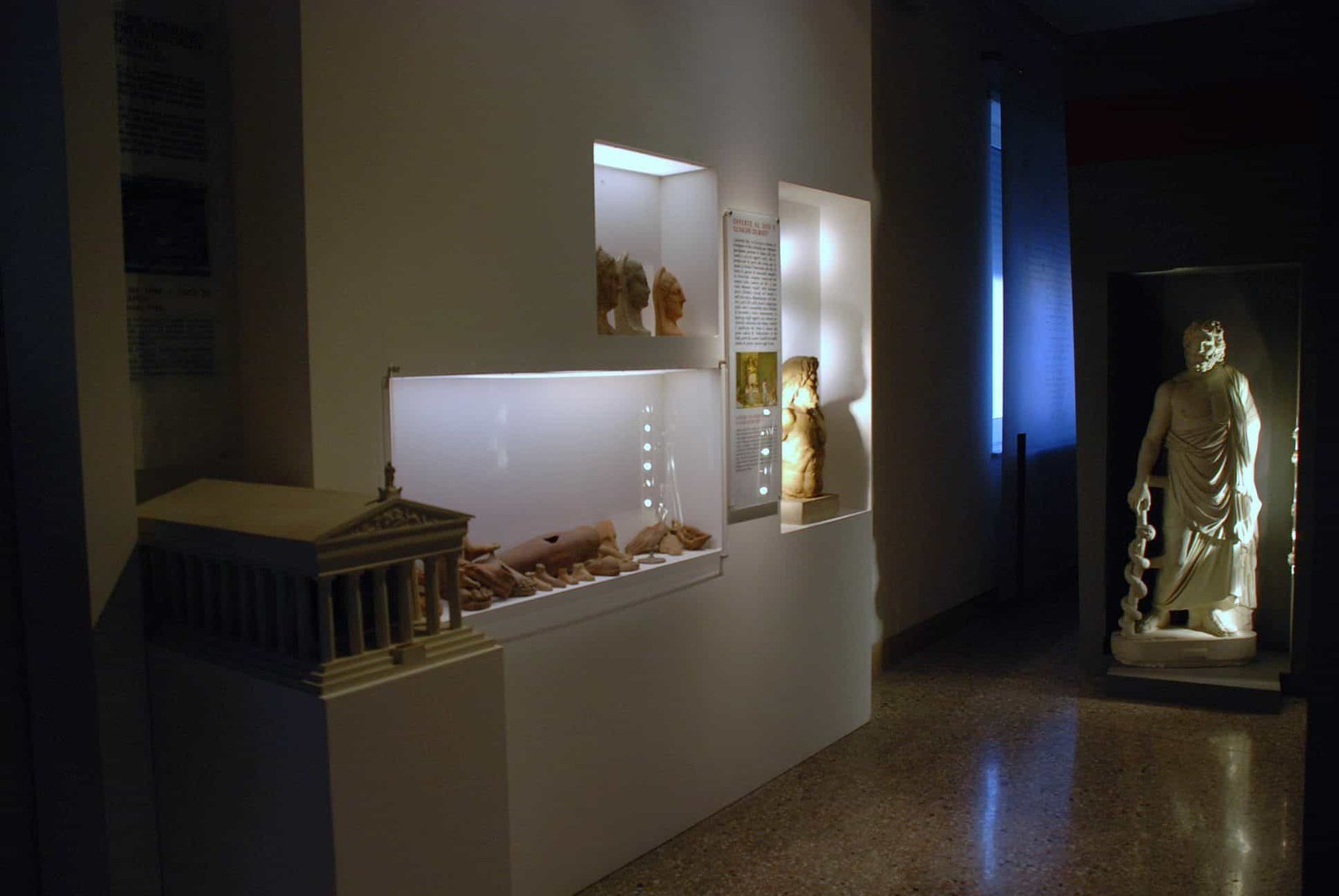
The museum preserves an important collection of ex-votos of the Roman era, and it's one of the sections I most gladly explain. They are terracotta reproductions of body parts: heads, eyes, ears, hands, feet, uteri, whole limbs, viscera. They were deposited in sanctuaries as a request for healing or as thanks for a healing obtained. The documentary value is double. On one side they tell what ailments people suffered from, because the frequency of the anatomical types reflects the frequency of the pathologies. On the other they tell what people knew about their own body, because some models of viscera show a surprisingly precise anatomical knowledge in a world that did not practice human dissection on a large scale. Looking at a votive uterus of the 3rd century BC and recognizing its shape is an experience that cuts down to size many certainties about the linear progress of knowledge.
Paintings, furniture, furnishings
The collection also includes objects of material history that are not instruments: paintings, furniture, pharmacy furnishings, shelving. They are the connective tissue of the environment reconstructions and, from the museological standpoint, the most characteristic legacy of Pazzini's approach. An apothecary cabinet is not a neutral container: it's a piece of furniture designed around a classification system, and reading it means reading the way an old-regime pharmacy organized knowledge.

The visit to the Museum of the History of Medicine: how the route is organized
The museum is arranged on three exhibition levels plus the service ground floor. On the ground floor are the directorate, the library, the reading room, a large hall for conferences and the archive: they are not part of the ordinary route, but their presence explains the nature of the institution. The basement houses the environment reconstructions. The first floor covers the span from archaic medicine to the scientific revolution of the 17th century. The second floor tells the last two centuries, from anatomical dissection to genomics. The correct chronological order, therefore, would be first floor, second floor, basement. The right emotional order is the opposite, and almost everyone starts from below. Do as you prefer, but decide beforehand: going up and down the same stairs twice is more tiring than it seems.
The basement of the Museum of the History of Medicine: the environment reconstructions
The underground level is the part least touched by recent redisplays, and for that very reason the most interesting from the standpoint of the history of museology. Here you see the museum as Pazzini conceived it: reconstructed environments the visitor physically enters, with authentic objects arranged according to a scenic logic.
The medieval little square and the apothecary's corner
You begin with a reconstructed medieval square, with the apothecary's corner. It's a display dated in technique and very powerful in effect: fake stone, arcades, the sign, the counter. The reason it works is that it gives back the urban context of care before the modern hospital. In the medieval city the sick person met a chain made up of apothecaries, barbers, surgeons, charlatans and doctors with degrees, and the square was the physical place where that chain showed itself. Whoever reads this reconstruction as a stage set misses the point: it's an interpretive model built with real objects.
The alchemist's laboratory
The next room is the one visitors remember for years. The alchemist's laboratory is set between the 16th and 17th centuries, and Pazzini arranged there in person alchemical glassware, metal distillers, stuffed crocodiles hung from the vault, rostra of sawfish of the Pristidae family and a unicorn horn. These objects have to be explained, otherwise they remain a sideshow. The crocodile hanging from the ceiling was the canonical sign of apothecaries' and naturalists' shops all over Europe: it signaled that exotic materials were handled inside and that there was access to knowledge about distant things. The sawfish rostrum and the so-called unicorn horn belong to the same family of productive misunderstandings: the unicorn horn of European collections is almost always a narwhal tusk, and it was attributed the power to reveal poisons. The old-regime materia medica was full of substances of this kind, sold at their weight in gold and completely ineffective.
The interesting historical truth is another, though. The alchemical laboratory is also the place where the techniques that chemistry would inherit are worked out: fractional distillation, water bath, precipitation, calcination. Paracelsus, in the first half of the 16th century, shifts the goal of alchemy from the transmutation of metals to the preparation of medicines, and from there iatrochemistry is born. The room you are looking at is the point of friction between two worlds: natural magic and experimental pharmacology lived at the same counter.
The 18th-century apothecary and the boxes of simples
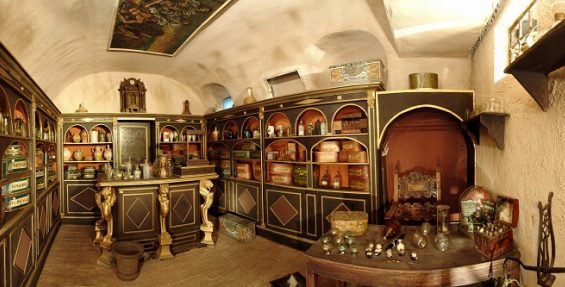
The room devoted to the reconstruction of an 18th-century apothecary is, for me, the masterpiece of the museum. The shelving is protected by grilles, the shelves hold albarelli, pitchers, pill jars and majolica containers of Italian manufacture, and in the middle of all this is preserved a collection of wooden boxes that served to hold the simples. The term deserves an explanation, because it is the hinge of all premodern pharmacy: simples were the substances of animal, plant or mineral origin used in their pure, not compound, state. From the simples, by mixing them, the compounds were made: syrups, electuaries, ointments, pills, theriacs. The garden of simples, that is the botanical garden, was born exactly to cultivate the raw material of this chain, and it's the reason why the first European university botanical gardens are creations of medical faculties.
A detail to notice: look at the grilles. They were not a decorative whim. The apothecary kept expensive substances and dangerous substances, and the physical separation between the public and the goods was a control measure. The modern pharmacy, with the counter that separates and the shelf that stands behind, descends in a direct line from this architecture of suspicion.
The ex-voto room
The basement also houses the room devoted to ex-votos, which cover a very long span, from the Greco-Roman age to the Middle Ages. Seeing them all together, in a closed room with low light, produces an effect no isolated display case could achieve: you perceive the quantity, and the quantity is the historical fact. Thousands of people, for centuries, entrusted their hope of healing to a terracotta object left in a sanctuary. Rational medicine and votive medicine did not follow one another, they coexisted for millennia, and they still coexist today in forms that anyone who has spent time in an Italian hospital recognizes without difficulty.
The dental clinic and the urologist's office
In the same band of reconstructed environments are two 20th-century professional offices: a dental clinic and the office of a Roman urologist, Ciddio. These are the rooms visitors over 60 look at with the most emotion, because they knew them. The chair, the belt-driven drill, the instruments lined up on the enameled trolley, the examination couch: it's the medicine of family memory, that of grandfather and the neighborhood doctor. The museum makes a smart choice in including it, because the border between history and memory is the point where the non-specialist public truly comes into contact with a scientific collection.
The first floor of the Museum of the History of Medicine: from prehistory to the 17th century
The first floor is the real chronological route: from archaic medicine, through Egypt, Etruria, Greece, Rome and the Arab world, up to the first great acquisitions of modern anatomy. It's the floor I recommend to anyone who has only an hour and wants to understand something, instead of just looking.
Paleopathology and the two skulls
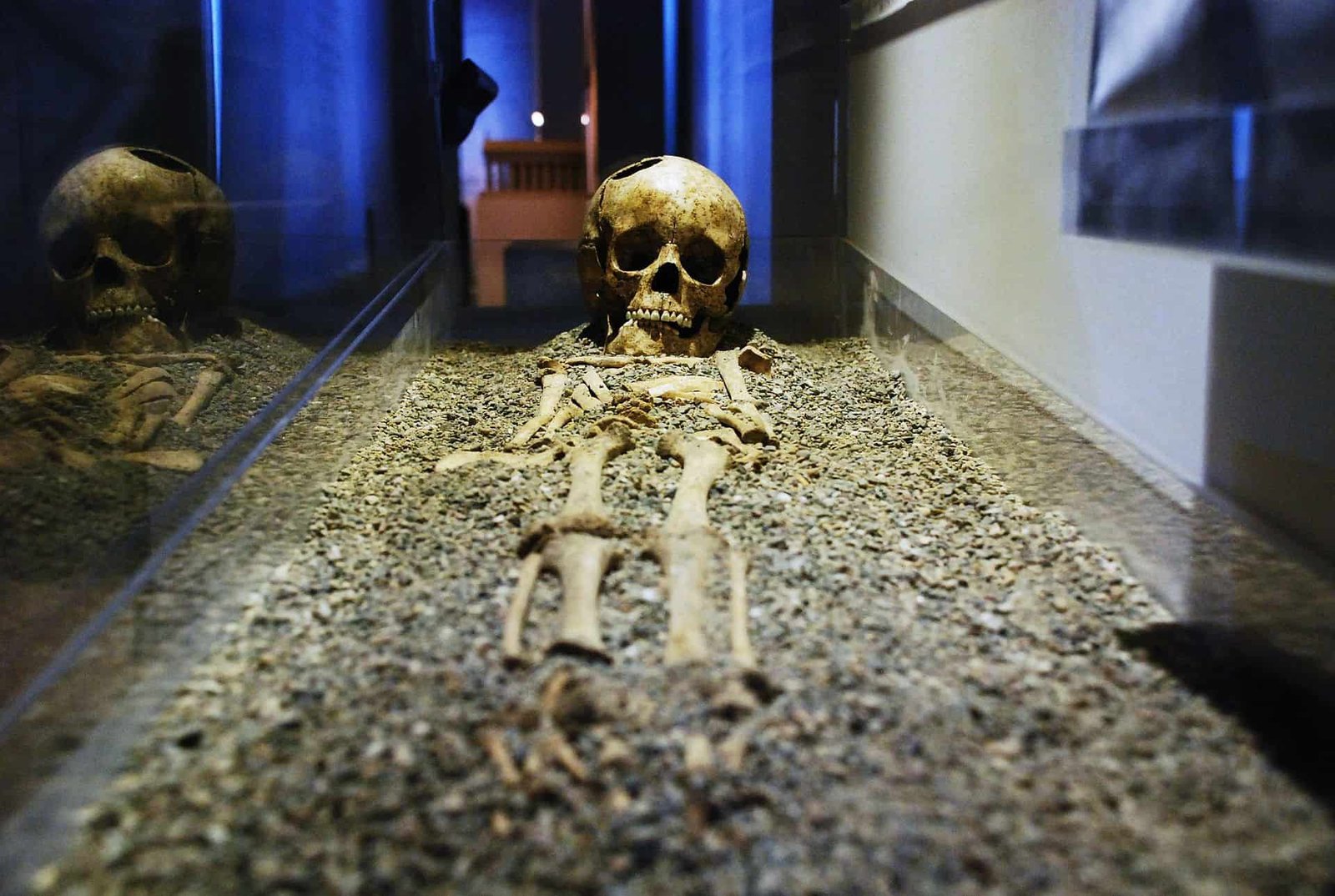
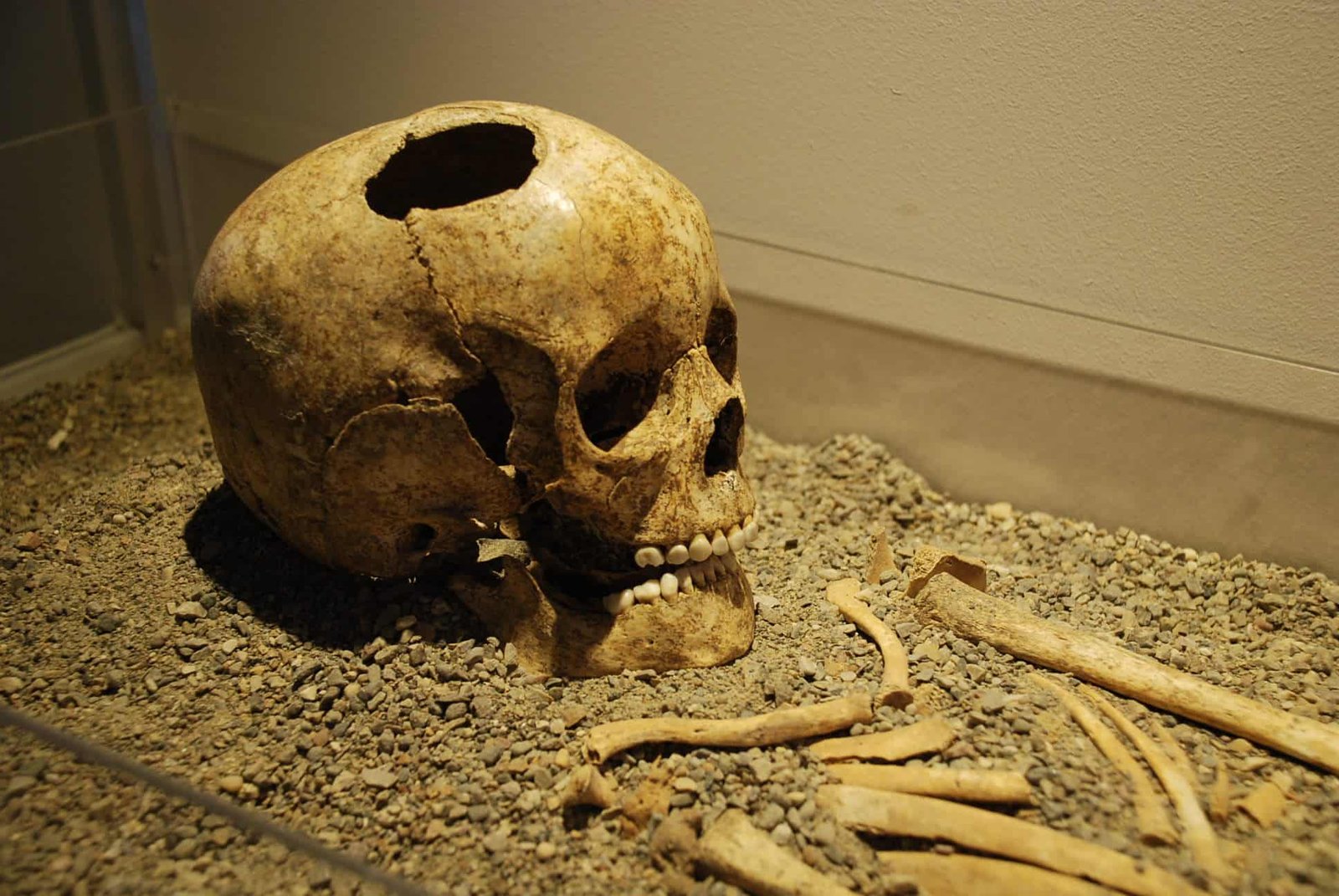
At the entrance to the first floor you meet the paleopathology section. In the upper part of the display case two skulls are shown, and they are two lessons in method. The first comes from a Roman cemetery and clearly shows the lesions left on the cranial vault by syphilis: corroded surfaces, characteristic formations that the paleopathologist reads like a signature. The second, datable to the 2nd century AD and coming from a rural area of Roman territory, belongs to a child who underwent cranial trepanation.
Paleopathology is a relatively young and extraordinarily useful discipline, because it is the only one that can tell us what humanity really fell ill with before health records. Ancient written sources describe symptoms with categories of their own, often untranslatable into ours. Bone, instead, speaks a language that the pathologist of today recognizes. This display case, small as it is, contains the theoretical core of the whole museum: disease has a natural history, and that history can be reconstructed.
Egyptian medicine
The Egyptian section is documented by papyri that testify to the dual nature of medicine in Pharaonic Egypt. On one side invocations, prayers, practices and purification rituals, that is a magico-religious medicine. On the other, diagnostic formulations built on the recording of symptoms, that is the sketch of a clinical method. Anyone who knows the Edwin Smith papyrus knows how impressive that structure is: title of the case, examination, diagnosis, prognosis, treatment. 3,500 years ago an Egyptian physician was already writing a medical record.
The display shows finds from the typical funerary goods: ointment jars, containers for food and drink meant to nourish the deceased in the afterlife, figurines of servants who were to accompany him, reproductions of the deities of the underworld. And then the material relating to embalming, which is the reason why Egyptian medicine holds a special place in the history of anatomy: the embalmers handled the inside of the human body daily, with a technical skill that the Greek physicians of the classical period never had.
Etruscan medicine and dental prostheses
The Etruscan section stands on two legs: a divinatory component, tied to haruspicy and the reading of entrails, and a practical knowledge documented by funerary goods. The objects on display include ointment containers, razors and paterae. But the showpiece is something else: the human remains that document Etruscan skill in dentistry. A people of highly refined metalworkers, the Etruscans built dental prostheses with animal or human teeth anchored by gold and silver wires and bands.
This is one of those pieces of news that overturn the common perception of the past. In Italy in the 7th and 6th centuries BC a working prosthetic dentistry existed, with technical solutions that would reappear only many centuries later. Those who want to understand who the Etruscans were beyond the cliché of the mysterious people will find the general picture at the Etruscan Museum of Villa Giulia, and at the Sapienza itself the Museum of Etruscan and Italic Antiquities.
Greek medicine: Asclepius, Epidaurus, Hippocrates
A model of the temple of Asclepius at Epidaurus introduces the section devoted to Greek theurgic medicine, the kind practiced in sanctuaries. The mechanism was called incubation: the sick person slept in the sacred area, the god appeared in a dream and indicated the cure, and the priests interpreted it and applied it. The display also shows the Aesculapian snake, the serpent sacred to the god, which is a real animal, Zamenis longissimus, and which in the Roman tradition traveled from Epidaurus to the Tiber Island.
Alongside the medicine of the sanctuaries, the section documents Hippocratic medicine through a 16th-century edition of some works of the Corpus Hippocraticum. Here it's worth being precise, because the popular version oversimplifies. The Corpus Hippocraticum is not the work of one man: it's a collection of some 60 writings by authors, eras and orientations that differ, gathered under the name of Hippocrates of Kos in the library of Alexandria. The revolution those texts contain does not concern the therapies, which were often useless, but the postulate: disease has natural causes and must be observed, described and prognosticated. The famous treatise on the sacred disease, that is epilepsy, opens by stating that it is neither more divine nor more sacred than the others and that it has a natural cause like everything else. In the fifth century BC it's an explosive statement.
Roman medicine and the Child of Fidene
The Roman section shows instruments that show the refinement of surgical techniques in parallel with the specialization of the medical disciplines. The Greek influence is declared, from the cult of Asclepius, imported to Rome in 291 BC and settled on the Tiber Island, to the Hippocratic-school medicine practiced by Greek physicians in Rome, largely freedmen and foreigners.
The piece that dominates the section, added with the recent reworking of the route, is the Child of Fidene. The find comes from a burial ground of 29 trench graves uncovered at Fidene, along Via Salaria, in the 1995 excavations. The child was five or six years old and the burial is dated between the end of the 1st and the 2nd century AD. Paleopathological analysis revealed that, before dying, the child underwent a cranial trepanation. The display presents it in the same position in which it was found, stretched out on a bed of river sand, and this display choice, which to some will seem cruel, is instead the only honest one: that child is an archaeological, anthropological and clinical document all at once, and separating it from the context of the burial would mean amputating its meaning.
Arab medicine and the bimaristan
The flowering of Arab medicine dates to the 7th century and occupies a section that, in Italy, very few museums tell. The fulcrum is the bimaristan, whose plan is reproduced on the tent displayed in the room. The bimaristan is the oldest structured institution devoted both to the care of the sick and to the teaching of medicine: separate wards by pathology, salaried staff, an internal pharmacy, an archive of cases, and a principle of free admission that did not exist in Europe in the same period.
In the display case you find reproductions of surgical instruments taken from the iconography of the medical-surgical work of Abu al-Qasim al-Zahrawi, the surgeon of Córdoba whom the Latin West called Albucasis. His encyclopedia, the Kitab al-Tasrif, devotes an entire book to surgery accompanied by drawings of the instruments, and is the first illustrated treatise on surgical instruments in history. Translated into Latin by Gerard of Cremona in the 12th century, it remained in use in European universities for 500 years. Anyone who believes the Middle Ages were a dark parenthesis should stop here for 10 minutes.
The progress of anatomy and the Oplomoclion
The rest of the first floor documents, with displays and cases, the evolution of anatomical knowledge and surgical techniques from the Renaissance onward. It's the century of Vesalius, who in 1543 publishes the Fabrica and overturns the method: no longer the reading of Galen's text while an attendant cuts, but the professor who dissects with his own hands and corrects the text.
The emblematic piece of the section is the Oplomoclion, a figure taken from the Pentateuchos cheirurgicum of Girolamo Fabrici d'Acquapendente, printed in 1592, in which a human body appears entirely covered and supported by orthopedic devices: corsets, splints, braces, supports for every segment. It's the graphic synthesis of all the orthopedic knowledge of the time condensed into a single image, and it's also, in its way, a manifesto: the body as a correctable mechanical structure. Fabrici, who in Padua was the teacher of William Harvey and who described the valves of the veins, belongs to that generation of anatomists who made the discovery of the circulation of the blood possible. The exhibition on the first floor closes with instruments and objects relating to therapy and to the preparation and administration of medicines.
The second floor of the Museum of the History of Medicine: from dissection to genomics
The second floor covers the last two and a half centuries, and changes register: fewer rare objects, more ordered series, more panels, more video. It's the floor where the museum behaves like a contemporary science museum, and where those with a medical background find more to work with.
Military medicine and the birth of modern dentistry
The floor opens, at the top of the stairs, with two display cases: one on the practice of military medicine, the other on the birth of modern dentistry. The pairing is not accidental. Military medicine is the forced laboratory in which Western surgery learned almost everything: triage, rapid amputation, hemostasis, transport of the wounded, reconstructive surgery. Many innovations we now consider civilian were born on a battlefield, and the museums of the history of medicine that stay silent about this passage are telling a fairy tale.
The evolution of the scalpel and the amputation cases
Some display cases show surgical instruments arranged by an evolutionary criterion, and the most instructive is the one devoted to the scalpel: you see the blade change shape, material, mounting and sterilization system over the span of two centuries. The decisive leap is the passage from the handle in organic material, porous and not sterilizable, to metal that is entirely washable and then boilable: it's the translation into an object of the antiseptic revolution of Joseph Lister, who in the 1860s introduced carbolic acid and brought down postoperative mortality.
Next to it are the cases with the instruments specific to individual operations, among them the one for the amputation of limbs. Opening one of these velvet-lined chests with your eyes is the most instructive experience on the floor: saws, long-bladed knives, ligatures, hooks, needles. Before 1846, that is before ether, that set of instruments was used on a conscious patient, held down by two or three men. Anyone who looks at it thinking about today's surgery understands nothing. Anyone who looks at it thinking about the time a surgeon needed to take off a leg, 90 seconds in the best cases, understands everything.
Preserved organs and anatomical reproductions
Some display cases contain reproductions of organs and of the human body, others real preserved organs: a pathological heart and kidney, with macroscopic lesions easily observed, and heart valves. It's the part some visitors cross at a brisk pace, and I understand why. The value, however, is precise: modern medicine is born when disease stops being an imbalance of humors and becomes a lesion localized in an organ. That passage has a name and a date, Giovanni Battista Morgagni and the De sedibus et causis morborum of 1761, and those display cases are its direct illustration. Those who want to see how far this approach goes can continue, still at the Sapienza, to the Museum of Pathological Anatomy.
Pharmacology in a bottle
Display cases of small bottles and boxes, accompanied by videos and photographs, retrace the history of pharmacology: from the Galenic preparation made up in the pharmacy to the industrial drug packaged, standardized and patented. It's a story that radically changes the job of the doctor and that of the pharmacist between the 19th and 20th centuries, and one that reads very well in the objects: the printed cardboard box replaces the albarello, the dosage moves from the handwritten slip to print, the commercial name replaces the name of the substance.
Anesthesia, pain and its abolition
A section is devoted to the search for methods of relieving pain: from the first anesthetics to intravenous anesthesia. It's the most important chapter in the whole history of surgery and the one the public underestimates most. Before October 16, 1846, when William Morton publicly demonstrated ether anesthesia at Massachusetts General Hospital in Boston, surgery was limited by pain much more than by skill. Afterward, in 30 years, the combination of anesthesia and antisepsis opened the abdominal cavity, the chest and the skull. The rest of modern medicine descends from there.
Neuroscience, bacteriology, genetics
The route continues with cellular pathology, gynecology, clinical medicine, the evolution of pharmacology, neuroscience, bacteriology and microbiology, genetics and eugenics. For the description of the neuron, of how the nervous system works and of the synapse the museum uses images and video. The same goes for the explanation of the genome and of some diseases caused by gene mutations, with sickle cell anemia as an example.
I appreciate that the section includes eugenics instead of removing it. It's the uncomfortable part of the history of biomedicine, the one in which science put itself at the service of selection policies and produced legislation, forced sterilizations and, in the extreme version, extermination. A university museum that takes on telling it does its civic duty, and in a country that in 1938 promulgated the racial laws that duty has a particular specific weight, in a building constructed a few hundred meters from where those laws were applied to Jewish students and faculty.
The electroencephalograph
The floor is enriched by an old electroencephalogram machine, and it's worth stopping. Human electroencephalography was born in 1929 with Hans Berger. In Italy the Roman school was a leading protagonist of it, and pen-writing devices like this one dominated clinical neurophysiology for over half a century. It's a machine that writes: thought, reduced to potential differences, turning into a trace on graph paper. Few other inventions have produced such a powerful image of the mind.
The library of the Museum of the History of Medicine
On the ground floor are the specialized library, the reading room and the archive. Its holdings are considerable: almost 40,000 volumes, including an old collection that can be consulted on request. It's not a library for a tourist visit, it's a research tool, and its presence in the same building as the museum was the central point of Pazzini's project. Anyone preparing a thesis, a research project or even just a serious deeper study should make a reasoned request to the directorate: it's the kind of place where a well-posed question opens doors no ticket could open.
A curiosity about the Museum of the History of Medicine
In the alchemist's laboratory, in the basement, a stuffed crocodile hangs from the ceiling, and in the display case you find sawfish rostra and a unicorn horn. They are three objects that the hurried visitor files away as folklore and that instead tell a serious chapter in the history of European pharmacy.
The hanging crocodile was the standard sign of apothecaries' and naturalists' shops from the 16th to the 19th century, from Venice to Amsterdam. It meant a precise thing: in here exotic materials are handled, there are dealings with long-distance trade, the drugs that arrive from the Levant and the Indies are known. It was, in modern terms, a certification of commercial standing hung from the ceiling.
The unicorn horn deserves a discussion of its own, because it's one of the biggest deals in the history of materia medica. The alicorn, as it was called, was held to be a universal antidote and a detector of poisons: dipped into a poisoned cup it was supposed to sweat or change color. At European courts it was worth more than gold by weight, and the great princely houses kept fragments of it in their own pharmacies. In the vast majority of documented cases it was the spiral tusk of the narwhal, an Arctic cetacean, brought to Europe by northern merchants who took good care not to explain its origin. The sawfish rostrum, that is the toothed blade of the Pristidae, belonged to the same family of marketable marvels.
The interesting part is not the deception. It's that these objects coexisted, in the same environment and on the same counter, with alembics and distillers that served technically correct and reproducible operations. The alchemist's shop was at once a place of commercial superstition and a laboratory in which fractional distillation, calcination and precipitation were worked out: the same procedures that, cleaned of the mistaken theory, would become chemistry. Paracelsus, in the first half of the 16th century, shifts the goal of the art from the transmutation of metals to the preparation of mineral medicines, and from that deviation iatrochemistry is born.
The Museum of the History of Medicine is one of the very few places in Italy where this ambiguity can be seen physically, in a single room, without mediation. And it's, incidentally, the reason I can't stand visits that dismiss the basement in five minutes as a movie set: that room is a historiographical argument, not a backdrop.
One thing nobody tells you about the Museum of the History of Medicine
The Child of Fidene survived the operation. Not forever, but long enough for the bone to begin to repair: around the hole made in the cranial vault a bony callus formed, and the regrowth can be quantified. The reconstructions proposed speak of about 40 days of life after the intervention. This fact completely changes the meaning of the find.
A trepanned skull, in itself, only proves that someone made a hole. A trepanned skull with a bony callus forming proves much more: that the operation was performed on a living patient, that the patient survived the procedure and the immediate infection, that someone cared for him in the following weeks. It proves, in a word, that a surgical competence and postoperative care existed in a rural area of the Roman suburbium between the end of the 1st and the 2nd century AD. Not in a great city, not at the court of an emperor: at Fidene, along Via Salaria, in a small burial ground of 29 trench graves.
The child was five or six years old. We don't know why he was operated on: a head trauma, a depressed fracture from a fall or a blow, are the most economical hypotheses and the most frequent in paleopathology. We don't know who operated on him. We know the intervention was technically successful and that the little patient died of another cause, or of a late complication, a few weeks later.
There is a second element that almost no guide tells, and it's the display choice. The museum did not isolate the skull in a case: it reconstructed the burial as it appeared at the moment of discovery, with the body stretched out on a bed of river sand. It's a museographic decision that has caused discussion and that should be defended without hesitation. Separating that skull from its context would have produced an anatomical object. Leaving it in its tomb produces a historical document, and forces whoever looks to remember that we are talking about a child and a family, not a catalog piece.
I'll add a practical note that nobody will tell you and that is worth knowing: this is a research museum, and anyone who arrives with a serious question almost always finds someone willing to answer. If you have a specific interest, declare it when you book. The difference between the standard tour and the one given by someone who knows what you have in mind is enormous.
The advice I give you for visiting the Museum of the History of Medicine
First piece of advice, the most concrete: book for the morning, better between 9:30 and 10:30 on a Tuesday or a Wednesday. On Monday the university staff is under the pressure of the start of the week, and on Friday afternoon, across the whole Città Universitaria, activity drops. Morning light, then, is decisive in a museum where 90 percent of the objects are behind glass.
Second piece of advice: invert the recommended order. The chronological logic would call for first floor, second floor, basement. It's better to do the opposite and start from the basement, because the environment reconstructions create the emotional and sensory context within which everything else makes sense. Anyone who has already seen the apothecary and the alchemist's laboratory looks at the albarelli on the first floor with different eyes. Anyone who does the route in reverse arrives in the basement tired and crosses it as a final curiosity, which is exactly the worst way to use it.
Third piece of advice: bring a notebook, not just the phone. This museum is full of names, dates and technical words that get forgotten within an hour. Theriac, alicorn, bimaristan, alfonsino, simples, Oplomoclion. Write them down: they are the keys with which, back home, you can read something serious.
Fourth piece of advice, and it concerns timing: don't pair this visit with a rigid commitment in the following two hours. Not because the museum is huge, but because it's the kind of place where, if you happen on the right moment, the curator or a doctoral student stops to talk with you and the visit stretches by an hour. In civic museums this almost never happens. Here it happens often, and it would be absurd to have to leave for an appointment.
Fifth piece of advice: pair the visit with another Sapienza museum and make it a half day. The Battista Grassi Museum of Comparative Anatomy is the natural complement, because it completes the discussion of anatomy by widening it to the whole animal kingdom. Alternatively the Gipsoteca of the Museum of Classical Art, which is a few hundred meters away and which, with its casts, offers a perfect counterpoint: there the human body idealized by Greek sculpture, here the human body sick, treated, dissected.
Sixth piece of advice, against the grain: don't bring children under 10 hoping they'll have fun. Some sections contain preserved pathological organs and human osteological material, and more than one parent has regretted improvising. From age 11 or 12 up, on the other hand, it's one of the most effective museums I know for making people understand what the scientific method is.
Another well-known fact, yet rarely cited
The Sapienza has a museum system of 19 museums, and almost no Roman knows it. It's not a secret: it's written on the university's website, the museums have hours, curators and catalogs, and almost all have free admission. And yet the Polo museale Sapienza remains the most underrated cultural institution in the city.
The list is impressive. Comparative Anatomy, Pathological Anatomy, Etruscan and Italic Antiquities, Anthropology, Classical Art, the Museo Laboratorio di Arte Contemporanea, Art and Mineral Deposits, Chemistry, Herbarium, Physics, Geography, Hydraulics, Commodity Science, the Botanical Garden, the Museum of Origins, the University Museum of Earth Sciences, the Museum of the Near East, the Museum of Zoology and the Museum of the History of Medicine. 19 collections covering archaeology, the life sciences, the earth sciences, physics, chemistry, commodity science and art, built over two centuries of university teaching.
The reason they remain invisible is structural, and it's worth saying clearly. These are not museums born for the public: they were born as teaching tools, grew up inside research institutes, were funded as laboratories and not as attractions. They have no ticket office, no bookshop, they run no communication campaigns, often they don't even have a sign at the campus entrance. Their opening depends on available staff and the academic calendar. Whoever gets there has to want to get there.
There is a second element rarely cited: the Sapienza is by number of enrolled students one of the largest universities in Europe, and its Polo museale is therefore, potentially, one of the most important university museum systems on the continent. The gap between this potential and its real visibility is one of the most glaring cultural failures of contemporary Rome. No mayor talks about it, no tourist campaign mentions it, and meanwhile on Viale dell'Università there is a collection of 8,000 medical objects that in any other European capital would be a national museum with a line at the entrance.
The practical consequence, for the reader, is all positive: you visit museums of international level for free, without crowds, often with a curator who has time to talk. It won't last forever. Take advantage of it now.
The right photo to take at the Museum of the History of Medicine
The photograph to take home is just one: the wall of albarelli of the 18th-century apothecary, shot vertically, with the grilles in the foreground slightly blurred and the perspective of the shelves vanishing into the dark at the back. It's an image that works because it contains the whole museum: the serial repetition of the jars, the warm color of the majolica, the geometry of the grille, the darkness of the old regime.
How to do it, in practice. No flash, and not only out of respect: flash on a display case produces a white blotch in the middle of the frame and kills the photo. Rest the lens or the body of the phone directly against the glass, so as to eliminate reflections: it's the simplest and most effective trick in museum photography. If the glass is dirty, move 20 centimeters away and tilt the shooting axis by 15 or 20 degrees relative to the surface, so the reflections slide out of the frame. The room lights are warm: if your phone allows it, correct the color temperature toward 3,000 kelvins, otherwise the white of the majolica will turn orange.
The second photo I recommend is the alchemist's laboratory shot from below looking up, with the stuffed crocodile hanging at the top and the glassware in the background. It's the only framing in the museum that holds up in square format, and the only one that gives a real effect of disorientation. Watch the exposure: in a dark room the phone tends to overexpose and the glassware becomes a milky blotch. Tap the screen on the brightest point and lower by one stop.
The third, for those with patience, is a detail: a single surgical instrument with a handle in organic material, shot as close as possible. In macro you can read the workmanship of the grip, and you understand with your eyes what the captions explain in words.
Two warnings. The first: the Child of Fidene is photographed with the head before the camera. It's the burial of a five-year-old child, and there are ways and ways of shooting it. The advice is not to do it at all, or to do it without ever framing the skull in close-up. The second: photography for personal use is one thing, photography for publication or commercial use is another and must be authorized by the museum. Ask the staff before shooting, always. In a university museum courtesy is the currency and opens more doors than any badge.
Some important events that happened here in history
1938. Adalberto Pazzini obtains larger premises on the ground floor and in the basement of the Istituto di Igiene, and the museum takes this date as its founding year. The University funds the construction of the shelving that makes it possible to display the first collections to the public. It's the birth certificate of an institution that until then had existed as a private accumulation inside a borrowed room.
1943. Allied bombings hit the eastern quadrant of Rome and strike the Città Universitaria. The museum, housed in the basements of the Istituto di Igiene, finds itself within range of events. The war enters the history of this collection not as a backdrop, but as a direct threat to its material survival.
1945. The museum's underground rooms are turned into an air-raid shelter: the windows are walled up and three thick anti-splinter walls are raised inside. For a period, therefore, the most important Roman collection on the history of medicine shares its space with the most elementary function a basement can have, that of saving lives. It's an episode no display case tells and that would deserve a panel of its own.
1947. The Evan Gorga collection arrives, the most precious core of the museum: about 8,000 items among pharmaceutical ceramics, surgical instruments, alchemical glassware, microscopes, ex-votos, paintings and furnishings. In one stroke the collection changes scale and moves from the rank of teaching collection to that of national collection.
1949. The Ministry of Public Works allocates a fund for the construction of university buildings. Pazzini makes request after request so that a documentary museum of the history of medicine will be included among those buildings, and he gets his way. It's an episode of academic lobbying worth remembering: without that insistence, today there would be no building.
1951. The Soprintendenza alle Antichità of Turin grants on deposit a group of Egyptian finds relating to funerary goods and the art of embalming. The Egyptian section finally acquires authentic objects.
September 13, 1954. After a year of works begun in 1953 and a display set up in very tight time, the new seat of the Istituto di Storia della Medicina at Viale dell'Università 34/a is inaugurated, with the library and the museum. It's the date every visit should keep in mind: the small building you are walking through was built to hold these things.
1975. Adalberto Pazzini dies, on May 10. With him the drive that had held together collection, institute and library stops, and two decades of decline begin that compromise the preservation of the collections.
Second half of the 1990s. Luciana Rita Angeletti takes over the direction and starts restorations, redisplays, scientific updating and a systematic program of inventorying, filing and cataloging. It's the season that brings the museum back into the international research circuit. The redevelopment work continues in the early 2000s.
Recent years. The reworking of the museum route brings the Child of Fidene into the Roman section, with the full reconstruction of the burial. The museum enters the Polo museale Sapienza on a permanent basis, adopts mandatory online booking and supports the exhibition with a continuous educational and outreach activity.
Who has passed through the Museum of the History of Medicine
The first name is that of the founder, and it's not a formality. Adalberto Pazzini (1898-1975) did not pass through here: he lived here for 40 years of his professional life. He chose the objects, bought them or had them donated, personally arranged the glassware and the crocodiles in the alchemist's laboratory, obtained the building from the Ministry, directed the institute, founded a school. President of the Società Italiana di Storia della Medicina from 1956 to 1965 and of the International Society for the History of Medicine from 1964 to 1968, he brought into these rooms a network of international relations that in postwar Italy was a rarity.
Evan Gorga (1865-1957), the tenor who created the role of Rodolfo at the world premiere of La Bohème at the Teatro Regio in Turin on February 1, 1896, under the direction of Arturo Toscanini, does not appear among the famous visitors: it was his collections that arrived here, after the seizure of 1929 and the passage to the State in 1950. But the museum, in fact, is his most coherent and most visible legacy, and in 1954, when the new seat was inaugurated, Gorga was still alive. He died in Rome three years later and rests at Verano, a few tram stops from here.
Dante De Blasi, hygienist and microbiologist, director of the Istituto di Igiene, is the man who granted Pazzini the first room and who cultivated the idea of an institute equipped with a library and a museum. Without that concession there would have been nothing. His successor Vittorio Puntoni enlarged the spaces assigned to the collection when the material was by then overflowing.
Silvestro Baglioni, a physiologist of great name, was the supervisor of Pazzini's degree thesis in 1922 and belongs to the same academic area in which the museum was born. It's useful to remember him because it explains the scientific, not antiquarian, matrix of this institution: whoever founded it came from the laboratory, not from the archive.
Luciana Rita Angeletti is the woman to whom the museum owes its second life. She took over the direction when the collections were in serious condition and within a few years turned their fate around with restorations, redisplays and a cataloging program. Anyone visiting today sees, in very large part, the result of her work.
Among the directors and curators of the following seasons are Valentina Gazzaniga, historian of ancient medicine, and Gilberto Corbellini, historian of medicine and biology. The area curator is Alessandro Aruta, who has also signed exhibition projects devoted to the founder. In 2025 the Rocca Malatestiana of Verucchio hosted an exhibition on Pazzini curated by Sara Masinelli, Stefano De Carolis, Maria Conforti and Aruta himself, in collaboration with the Sapienza: a sign that this institution does not limit itself to preserving, but keeps studying its own history.
Then there are the thousands of nameless people who really did pass through these rooms: generations of Sapienza medical students, to whom the museum has taught that their profession has a history, and the classes of Roman high schools, who here see an 18th-century scalpel for the first time. In a university museum this is the public that counts, and it's the reason admission is free.
The other Sapienza museums around the Museum of the History of Medicine
Anyone who gets this far almost always makes the same mistake: visits one museum and leaves. The Città Universitaria and its immediate surroundings contain a density of scientific collections that has no equal in Rome, and with a well-organized half day you can see three or four. Access arrangements vary from museum to museum, and almost all require advance contact: organize yourselves ahead of time, writing to the respective offices or to the Polo museale.
The Battista Grassi Museum of Comparative Anatomy
It's the natural complement to the Museum of the History of Medicine, and the best pairing. The Museum of Comparative Anatomy widens the discussion from man to the whole animal kingdom: skeletons, preparations, comparative series that show how the same structure changes from one species to another. Seeing first the sick and treated human body, and right afterward the animal body in its evolutionary variability, produces a cognitive effect neither museum alone manages to give. The museum bears the name of Giovanni Battista Grassi, the zoologist who demonstrated the role of mosquitoes of the genus Anopheles in the transmission of malaria: a name that belongs by right to the history of medicine too.
The Museum of Pathological Anatomy
The Museum of Pathological Anatomy is the direct continuation of the second floor on Viale dell'Università. There you see the theoretical passage from humoral medicine to organ-based medicine. Here you see what that passage means in the practice of a pathological anatomist. It's not a place for everyone, and I say this without rhetoric: anyone who has trouble with human anatomical preparations should avoid it. Those who study medicine or the history of science will find it indispensable.
The Gipsoteca and the Museum of Classical Art
The Sapienza's Gipsoteca preserves one of the largest European collections of plaster casts of Greek and Roman statuary. The contrast with the Museum of the History of Medicine is almost theatrical: on one side the idealized, athletic body, ageless and free of disease, of ancient sculpture. On the other the real body, with syphilis on the cranial vault and the kidney with the macroscopic lesion. Do them in the same afternoon and you'll understand how hard Western culture worked to keep those two images of the body apart.
The Giuseppe Sergi Museum of Anthropology
The Giuseppe Sergi Museum of Anthropology preserves osteological and anthropological collections of enormous documentary value and, together with them, an uncomfortable chapter in the history of Italian science, that of 19th-century physical anthropology and its drifts. It should be visited with this awareness: it's a museum that also speaks of the errors of the discipline that created it.
Physics, chemistry, mathematics, earth sciences
Within a few minutes' walk you find the Museum of Physics, with the instruments of Via Panisperna school and the memory of Fermi and his boys. The Primo Levi Museum of Chemistry, which closes the circle opened by the alchemist's laboratory in the basement. The collection of the Museum of Mathematics, with 19th-century geometric models. And the University Museum of Earth Sciences, which brings together the university's historic collections of mineralogy, geology and paleontology in a single route: the ones many Romans still call, out of habit, the mineralogy museum and the paleontology museum.
Commodity science, herbarium, contemporary art, Near East
The picture is completed by the Museum of Commodity Science, which documents raw materials and trade products from a perspective we would today call global material history. The Herbarium Museum, with hundreds of thousands of dried specimens. The Museo Laboratorio di Arte Contemporanea, which on campus plays the part of the living and unpredictable element. The Museum of the Near East, Egypt and the Mediterranean and the Museum of Art and Mineral Deposits. 19 museums, all a few hundred meters from one another. Try to think which other European city offers something like this and never talks about it.
What to see around the Museum of the History of Medicine
The neighborhood is not the postcard kind, but it has a lot to give to anyone who walks with open eyes.
The Policlinico Umberto I and Viale Regina Elena
A short distance away stands the Policlinico Umberto I, inaugurated at the beginning of the 20th century to a design by Giulio Podesti: a pavilion layout immersed in greenery, following the hygienist doctrine of the time, which held that the separation of wards and the circulation of air were the first measures against contagion. Strolling along Viale Regina Elena and looking at the pavilions is the natural continuation of the museum visit: in there is the theory, out here is its urban application.
San Lorenzo and the Verano
To the east begins San Lorenzo, the working-class and university neighborhood that on July 19, 1943 paid the highest price of the bombing of Rome. You get there on foot in a quarter of an hour. The basilica of San Lorenzo fuori le Mura, gravely damaged on that occasion and then restored, is one of the most layered churches in the city, with two basilicas welded together and a reused colonnade of the very first order. Next to it opens the Verano Cemetery, which is an open-air museum of funerary sculpture and one of the most instructive places in Rome for understanding how the Italian bourgeoisie between the 19th and 20th centuries represented itself in the face of death. For those coming from the Museum of the History of Medicine, the connection is evident.
Castro Pretorio, the walls, Termini
To the south you meet the Castra Praetoria, the camp of the Praetorian Guard built by Sejanus under Tiberius, later incorporated into the Aurelian Walls: the stretch of wall still visible is one of the most imposing in the city. A little farther on you reach Termini, and so two museums that complete the day well: Palazzo Massimo alle Terme, with the frescoes of the Villa of Livia and the bronzes, and the Baths of Diocletian, with the Octagonal Hall not far away.
Where to eat, in brief
In the university area the offering is what you'd expect: cafeterias, pizza-by-the-slice places, bars crowded between 13:00 and 14:30. Quality improves noticeably as you move to San Lorenzo, where there is a tradition of trattorias and student hangouts that still holds up. Practical tip: eat after 14:00, when the university rush has withdrawn.
The Museum of the History of Medicine with teenagers and schools
This museum works very well with high-school classes and with kids from age 12 up, and works badly with small children. It's not a matter of boredom: it's that some sections contain human osteological material and preserved organs, and the reaction of a six-year-old is unpredictable.
With a teenager, on the other hand, the museum has a teaching power that few Roman places possess. The reason is that here the scientific method is seen as a historical process, with its errors: the alicorn that cured nothing, the humoral theory that held up for 2,000 years before collapsing, the eugenics that presented itself as science. A kid who walks through these rooms understands, without anyone telling him, that science is not a list of truths but a method for correcting errors, and it's the most useful lesson he can take home.
For classes it's best to contact the museum's office well in advance and arrange a guided visit: the Polo museale manages educational activities and booking, for this museum, is mandatory anyway. A suggestion for teachers: assign the kids three words to look for during the visit, for example simples, bimaristan and trepanation, and ask them to explain them to the class the next day. It works better than any written report.
Accessibility of the Museum of the History of Medicine
The exhibition route runs over three levels connected by stairs, in a building from the 1950s. Anyone with mobility difficulties, who uses a wheelchair or who accompanies a person with reduced mobility must say so when booking and check with the staff the conditions of access to the individual floors: it's the only way to get reliable and up-to-date information on the situation of the building. The Sapienza has a service dedicated to students and visitors with disabilities, and the Polo museale is the reference for organizing accessible visits.
For those with visual or hearing difficulties, the museum provides an audio guide and multimedia tools distributed along the route. Here too, the right way is to declare the need at the booking stage: in a university museum, where the relationship with the staff is direct, a request made in advance is almost always accepted.
When to go to the Museum of the History of Medicine
The best season, absolutely, is autumn: between October and November the university is fully active, the staff is present, the calendar is regular and Rome has the best light of the year. The period between March and May is good too. To avoid: the week between Christmas and Epiphany, when the university closes, and the heart of summer, when university activities wind down and it's best to check the opening before setting out.
During the week, as already said, Tuesday and Wednesday mornings are the best windows. During the day, early morning for the light and late afternoon for the quiet. One last observation from someone who knows the rhythm of this city: during exam sessions the Città Universitaria is an anthill and finding parking or a seat in a bar becomes an undertaking. The museum, however, remains a quiet island. It's one of the few places in Rome where the crowd around doesn't produce a crowd inside.
Quick questions about the Museum of the History of Medicine
How much is a ticket to the Museum of the History of Medicine?
Nothing: admission is free. There are no paid tickets, discounts or passes, and no presale to buy online.
Do you need to book to visit the Museum of the History of Medicine?
Yes, booking is required and must be made at least one day ahead through the online form on the official website. After booking, a confirmation email arrives to keep and show at the entrance.
What are the hours of the Museum of the History of Medicine?
Monday to Friday, from 9:00 to 18:00. On Saturday and Sunday the museum is closed. During the university's closing periods, for example between Christmas and Epiphany, opening is interrupted: it's best to check the official website before setting out.
Is the Museum of the History of Medicine open on Sunday?
No. It's closed on both Saturday and Sunday, and this automatically excludes it from first-Sunday-of-the-month initiatives, which concern other museum circuits.
Where exactly is the Museum of the History of Medicine?
At Viale dell'Università 34a, 00185 Rome, on the northern edge of the Sapienza's Città Universitaria. The entrance is on the avenue, not through the monumental gate of Piazzale Aldo Moro.
How do you get to the Museum of the History of Medicine by public transport?
Metro line B, Policlinico stop, then about a 10-minute walk. Trams 3 and 19. Buses 71, 140, 141, 310, 492 and 649. From Termini you can also walk, a good quarter of an hour, or take bus 310.
How long does the visit to the Museum of the History of Medicine take?
An hour and a half for a full tour of the three levels, two hours reading the captions, three hours for those with a medical or scientific background who stop at the display cases.
Can you take photographs at the Museum of the History of Medicine?
Photography for personal use is generally allowed, but you should always ask the staff at the entrance, because conditions may vary. For editorial or commercial use the museum's authorization is needed. Flash is to be avoided in any case, both for conservation and because it ruins the images.
Is the Museum of the History of Medicine suitable for children?
From age 12 up it's excellent. Under 10 I advise against it: some sections contain human remains and preserved organs and not all children react well.
Is the Museum of the History of Medicine wheelchair accessible?
The route is spread over three levels in a building from the 1950s. Anyone with accessibility needs must say so at the booking stage and arrange the access procedures with the museum staff or with the Polo museale.
Are there guided tours at the Museum of the History of Medicine?
Yes, guided visits and an audio guide are available. Accompanied visits and activities for groups and schools are arranged in advance with the museum's office and with the Polo museale Sapienza.
What's the difference between the Museum of the History of Medicine and the Museum of Pathological Anatomy?
The first tells the history of medical knowledge and practices through objects, instruments and environment reconstructions, from prehistory to genomics. The second is a collection of pathological preparations meant for teaching pathological anatomy. The first is a history museum, the second a museum of a discipline.
How many objects does the Museum of the History of Medicine hold?
The Evan Gorga collection alone counts about 8,000 items, and to this are added the core gathered by Adalberto Pazzini, the Egyptian deposit of 1951 and the Sarnelli and Neuschuller collections. The pharmaceutical ceramics exceed 700 pieces, the alchemical and pharmaceutical glassware is around 600.
Who founded the Museum of the History of Medicine?
Adalberto Pazzini, in 1938, when he was teaching the history of medicine at the Sapienza. The current seat, built on purpose, was inaugurated on September 13, 1954.
What is the Child of Fidene?
It's the burial of a child of five or six, found in 1995 in a burial ground of 29 trench graves at Fidene, along Via Salaria, and dated between the end of the 1st and the 2nd century AD. Paleopathological analysis revealed that the child underwent a cranial trepanation and survived the operation for a few weeks. The museum displays it by reconstructing the burial as it was found.
Is there a luggage storage or coat check at the Museum of the History of Medicine?
Don't count on it: it's a small university museum, without the services of a civic museum. Show up light, with no wheeled suitcase and no bulky backpacks.
Does the Museum of the History of Medicine have a bookshop or a cafe?
No. For a coffee or a sandwich you head to the bars of the university area or to San Lorenzo. The scientific publications of the museum and the institute are found through academic channels.
Can you visit the library of the Museum of the History of Medicine?
The specialized library, with almost 40,000 volumes and an old collection, is on the ground floor of the same building. It's not part of the ordinary visit route: consultation, including that of the old volumes, must be requested from the directorate.
Which other Sapienza museums can you visit on the same day?
The Museum of Comparative Anatomy, the Museum of Classical Art with its Gipsoteca, the Museum of Anthropology, the Museum of Physics, the Museum of Chemistry, the University Museum of Earth Sciences, the Museum of the Near East and several others. Check the access arrangements for each, though: the hours are different and many require advance contact.
Is the Museum of the History of Medicine of interest to people who aren't doctors?
Absolutely, and they may be the audience that gets the most from it. No technical competence is needed to understand an 18th-century apothecary, a terracotta ex-voto or a unicorn horn: all you need is the curiosity to ask how our ancestors treated illness and why they believed what they believed.
Is the Museum of the History of Medicine worth crossing half of Rome for?
If you're coming to Rome for three days and have never seen the Colosseum, no. If you're returning for the third or fourth time, if you study or teach something related to the life sciences, or if you're interested in the history of material culture, then yes, without hesitation: it's one of the densest and least predictable visits the city offers.
The final verdict on the Museum of the History of Medicine
There's one precise moment when the visit changes. It doesn't happen in front of the surgical instruments, impressive as they are. It happens in the 18th-century apothecary, when someone reads a scroll label out loud and realizes that the name written on the jar is that of a substance that no longer exists, for a disease we used to call something else, prepared according to a completely wrong theory of the human body that lasted 2,000 years. At that moment people stop looking at the objects as antiques and start looking at them as attempts. It's the greatest gift this museum knows how to give.
If I had to name a flaw, I'd say it without hesitation: the museum tells its story too little and communicates badly, and it pays the price of an academic culture that considers advertising vulgar. A collection of this level, in a European capital, should have an audience 10 times larger. In the meantime, the advantage is all yours: book a day ahead, show up in the morning, start from the basement and give yourself two hours. You'll walk out onto Viale dell'Università knowing something serious about the human body and about how humanity learned, by making mistakes for 20 centuries, to take care of it.
Article written by the editorial team of TourLeaderPro, contact them for Private/Corporate/V.I.P. Tours and Experiences.
Planning a trip to Rome? The English guides to visiting the city are on ItalyPlanner.com.