Museum of Mathematics
In short. Rome's Museum of Mathematics, full name I Racconti di Numeria, is visited at the University City: activities, workshops and guided tours take place in the Guido Castelnuovo Department of Mathematics of Sapienza, Piazzale Aldo Moro 5,…
Rome's Museum of Mathematics, full name I Racconti di Numeria, is visited at the University City: activities, workshops and guided tours take place in the Guido Castelnuovo Department of Mathematics of Sapienza, Piazzale Aldo Moro 5, building CU006, the white building designed by Gio Ponti that closes off the Minerva plaza on the viale dell'Università side. Admission is free and the guided visit is free, but only by reservation: the contacts given by the museum are the number 06 49913282 (alternatively 06 49913284) and the email address iraccontidinumeria@libero.it, with hours Monday to Friday from 9:00 to 18:00. Visits are arranged one by one, so the phone call or the email is not a bureaucratic detail: it's the way the museum exists. The languages available for the accompaniment are Italian, English, French and Spanish. The venue intended for years for the museum, the Castelletto of Villa Sciarra between viale delle Mura Gianicolensi 11 and via Dandolo 45, on the Monteverde Vecchio side, cannot be visited. The park around it can, every day from 7:00 until sunset, and it's worth the stroll even without the museum. Metro line B, Policlinico stop, five minutes on foot. Line B also at Castro Pretorio, a little farther. Termini station is a quarter of an hour's walk.
To place it in the city's panorama, the right place to start is the page on the museums of Rome, where this small institute lives alongside giants of a million visitors a year.
What the Museum of Mathematics really is
It's best to say it right away, because it saves disappointment: the Museum of Mathematics is not a building with a ticket office, a bookshop and an arrow showing the route. It's an institute, born in 1999 as the first Roman civic museum dedicated to the history of exact thought and to the popularization of mathematical culture, and by vocation it works in the form of a workshop. The formula that has accompanied it since its founding says that here mathematics isn't demonstrated, it's shown. Translated for those who walk in: nobody fills a blackboard with formulas and asks you to follow along. There are objects to hold in your hands, mechanisms to set turning, tables to put together, and a person who accompanies you while you do it.
Its birth is tied to an exhibition. In 1999 the Capital hosted an exhibition titled I Racconti di Numeria, designed to take mathematics out of the classrooms and into a public conversation. It worked better than expected. From the material gathered on that occasion, and on others that followed, came the idea of turning an event into a permanent institution, and the Capitoline Superintendency of Cultural Heritage did something no Italian municipal administration had done before: it took charge of a museum dedicated not to a painter and not to an archaeological collection, but to a way of thinking.
The name is not an advertising whim. Numeria is a minor Roman deity, one of those the pontiffs listed in the indigitamenta and who had very precise areas of competence. The museum adopts her as its narrating figure and arranges its own sections as if they were her tales. It's a choice that solves a real teaching problem: mathematics told as a story gets in where mathematics presented as theory bounces off.
In our judgment the Museum of Mathematics works precisely because it is small and because you visit it accompanied. The enormous science museums, with 100 flashing exhibits, produce a tourism of buttons pressed and nothing remembered. Here, if the group is 15 people and the guide feels like talking, you leave knowing why a cubic surface has 27 lines and not 28. Which is no small thing.
Where the Museum of Mathematics is
The geography of this museum is double, and needs explaining well, because two different addresses circulate online and anyone who trusts the wrong one takes a tram for nothing.
The operational address, the one where the museum works, receives school groups, holds seminars and keeps the collections, is the Guido Castelnuovo Department of Mathematics of Sapienza, Piazzale Aldo Moro 5. Inside the University City the department occupies the building cataloged as CU006, named precisely for Guido Castelnuovo, plus the faculty offices block CU036. You enter through the monumental gate of Piazzale Aldo Moro or from viale dell'Università 38. The Mathematics building is on the right as you face the Rectorate, recognizable by its travertine cladding in square slabs and by the large glazed opening above the portal.
The institutional address, the one that appears in the official listings and in the printed guides, is instead the Castelletto of Villa Sciarra, the neo-Gothic turret built between 1908 and 1910 inside the park that descends from the Janiculum toward Monteverde. The street number that recurs is viale delle Mura Gianicolensi 11. Other sources give via Dandolo 45, which is simply another of the villa's three entrances, together with via Calandrelli. The difference between the two addresses is not a formality: the Castelletto cannot be entered.
How to get to the Museum of Mathematics by metro
Line B is the most convenient way. Policlinico stop: you come out, take viale dell'Università and in barely five minutes you're at the gate. Castro Pretorio stop, also line B, is the alternative if you're arriving from the south and it suits you to change earlier. From there the walk is about 10 minutes through via dei Ramni or along viale Castro Pretorio and via delle Scienze. From line A you get off at Termini and change to B, or you do the 15 minutes on foot that separate the station from the campus, which on winter days are even pleasant and cross the San Lorenzo neighborhood.
A warning from someone who goes there often: the University City is an enclosure, and the gates are not all open all the time. The safe entrance is the monumental one at Piazzale Aldo Moro. If you find yourself on the side of viale Regina Elena and it's closed, don't insist: go around.
Buses and trams to the Museum of Mathematics
The surface lines serving the campus, according to the department's directions, converge from four fronts. On viale dell'Università run the 310, the 649 and the 88. On viale del Policlinico pass the 140, the 490, the 491, the 495, the 61 and the 649 again. From via Cesare de Lollis, on the San Lorenzo side, you arrive with the 204, the 492, the 71 and the C2. Piazzale del Verano, the big hub in front of the monumental cemetery, is served by the 163, the 19, the C3, the 204, the 2, the 30, the 443, the 448, the 492, the 71 and the 88: from there to the department it's less than 10 minutes on foot.
If you arrive by train at Termini you have the 310 and the 492 as direct lines. If you arrive at Tiburtina you can use the 492, the 71 or the C3, or walk for half an hour. The advice, if you come with a school group: get off at the Verano and do the last stretch on foot, because unloading 25 kids in front of the monumental gate at rush hour is a small urban tragedy.
The Castelletto of Villa Sciarra, the venue that never opened
It's worth understanding how this double residence came about, because it's an exemplary Roman story. Villa Sciarra is a park of 63,500 square meters that occupies the southern flank of the Janiculum, between Trastevere and Monteverde Vecchio. The area was vegetable gardens and vineyards since antiquity. It passed to Monsignor Innocenzo Malvasia in 1575, to the Barberini from the middle of the 17th century, to Cardinal Pietro Ottoboni, then to the Sciarra who left it their name. At the beginning of the 20th century it was bought by a couple of American collectors, George Wurts and Henrietta Tower, who reshaped it according to a reconstructed Baroque taste, importing fountains, statues, exedras and nymphaea. In 1930, two years after her husband's death, Henrietta Tower Wurts donated the villa to the Italian State with the condition that it become a public park.
Inside the park, besides the Casino Barberini, there is the Castelletto: a neo-Gothic building raised between 1908 and 1910, small, with a tower and mullioned windows, exactly the kind of building a mid-sized museum dreams of. For years it has been indicated as the permanent home of the Museum of Mathematics. In July 2015 the Council of Municipio Roma I Centro unanimously approved a motion asking for its opening, noting that the restoration of the building was reported as completed and that the structure nonetheless remained closed to the public. Since then the ownership picture has changed: in February 2024 Villa Sciarra passed free of charge into the assets of the City of Rome, and the Capitoline administration has allocated more than 11 million euros of National Recovery and Resilience Plan funds to a restoration program that includes rebuilding the Belvedere Fountain, collapsed for 40 years, and recovering the Esedra dei Mesi.
A clear judgment: the Castelletto is a beautiful building and a small container, and anyone who goes to Villa Sciarra hoping to find a mathematics exhibition there loses a morning. Go for the villa, which deserves it: for the satyr fountains, for the exedra, for the lookout over Trastevere and the dome of St. Peter's, and for the fact that at noon on a Tuesday in November you're almost alone. Then, for the mathematics, take metro B and get off at Policlinico.
A curiosity about the Museum of Mathematics
The real curiosity concerns the name, and almost nobody tells it in full. Numeria is not a promotional invention: she is a Roman deity attested in the ancient scholarly tradition, one of those tiny figures the Romans multiplied to cover every single act of life. Varro cites her in connection with the praenomen Numerius, explaining that it was given to children born quickly and without complications. The goddess presided over swift childbirth and, by extension, over counting, because in Latin numerare and counting are the same mental act. The praenomen Numerius is rare, so much so that feminine attestations can be counted on the fingers: a Numeria Atilia appears in a funerary inscription found at Palestrina, and the Liber de praenominibus, a short treatise traditionally attributed to Valerius Maximus, records its use.
Here is the point that makes the museum's choice intelligent. Ancient Roman religion had a catalog of functional deities, the indigitamenta, which the pontifical college kept and which Christian writers, Augustine first among them, would mock precisely for their pedantry: a goddess for the first suckling, one for the first step, one for the door and one for the hinge. They were, in effect, a classification system. The Romans did not produce great theoretical mathematicians, and there's no need to go around that. But they did produce an administrative mentality that breaks down, lists, numbers, records and catalogs. Numeria is the goddess of that mentality. Naming a mathematics museum in Rome after her means saying, without writing it on a sign, that Roman mathematics was practical before it was speculative: censuses, land registers, aqueducts, interest tables, ballista shots.
Then there's the linguistic detail that is worth the ticket, if there were a ticket. The word calcolo comes from the Latin calculus, the little pebble: the pebbles that were moved on the grooved abacus. Whoever closed the accounts in a Roman bank was literally moving stones. The same root produced in Italian the word for a kidney stone, by an ancient medical analogy: the little stone that forms in the body. When a professor writes integral calculus on the blackboard he is using, without thinking about it, the name of a pebble that someone moved in a shop in the Forum. This is the form of wonder the Museum of Mathematics tries to trigger, and it's also the reason a visit here, done well, changes the way you look at the ancient objects in the city's other museums.
If you have children between nine and 13, the story of Numeria and the pebbles is worth more than 10 pages of a textbook. Tell it before going in. The rest of the visit works better.
Numeria, the indigitamenta and the Roman taste for specialized deities
One more chapter on this point, because it's the most misunderstood. The Roman functional deities were not minor gods in a hierarchical sense: they were operational names. The priest who had to perform a rite on a field, on a newborn, on a door needed to call the exact power responsible for that act. The indigitamenta were the formularies containing those names, and their logic closely resembles that of an analytical index or a classification tree.
The historically honest point is that only indirect fragments of those catalogs remain, filtered above all through Varro and through the Christian authors who cited them to refute them. Many of the deities listed in modern reference works are second-degree scholarly reconstructions. Numeria belongs to this zone: she is documented, but indirectly and in a tradition that must be handled with caution. The museum knows it and uses her as a character, not as an artifact.
What do you get out of it, practically, when you walk in? That mathematics is first of all a way of giving names to things so that the names stay stable. A number is a name that doesn't change when the person pronouncing it changes. A theorem is a sentence that remains true even if the person who said it dies. The sections of the museum that tell the story of Greek thought, the ones where Pythagoras, Plato and Archimedes appear, serve to show the moment when that need for stability becomes proof. The passage from bookkeeping to geometry is the real leap of human history, and it's more dramatic than any school textbook makes it seem.
The seven sections of the Museum of Mathematics
The museum's presentation arranges the route into seven sections, designed as so many tales of the goddess, and allows you to cross them with different itineraries depending on who walks in: a third-year middle school class doesn't get the same tour as a group of teachers or a party of curious adults. The sections are not rooms in the classic museum sense, with a door and a custodian. They are thematic nuclei, each with its own objects and its own hands-on experiences. The three the museum puts in the window are also the three most successful, and it's worth describing them one by one.
The dawn of Greek mathematical thought
It's the opening section and, if time is short, the one to insist on. You enter at the moment when calculation stops being a workshop technique and becomes proof. The names are the ones everyone has heard and almost nobody can place: Pythagoras, Plato, Archimedes. The museum's added value is that those names arrive attached to objects, and objects are what stays in the mind.
With Pythagoras you work on the most famous theorem in the world, which in school practice is reduced to a formula to memorize and which is instead a violent statement: there exist lengths that cannot be written as a ratio of two whole numbers. The diagonal of a square with side one is one of them. Tradition says the discovery of incommensurables was experienced as a scandal by the Pythagorean school. On the legendary detail of the Pythagorean thrown into the sea for divulging it, it's best to stay cautious, because it's late anecdote, but the conceptual crisis was real and changed the course of Greek mathematics.
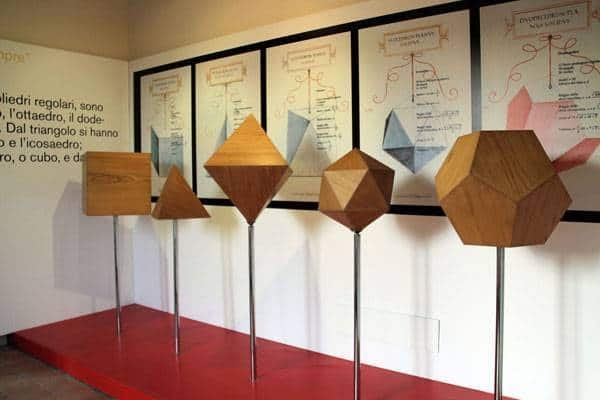
With Plato you get to the five regular solids, tetrahedron, cube, octahedron, dodecahedron and icosahedron, which in the Timaeus become the structure of the elements. The fact that the regular solids in three-dimensional space are exactly five, and that this can be proved in half a page, is one of those things that in front of a wooden model you grasp in a minute and in a book you never grasp. With Archimedes you enter measurement: the calculation of the ratio between circumference and diameter by successive approximations, the volume of the sphere inscribed in the cylinder, whose image the scientist of Syracuse wanted on his own tomb, and the lever, which is a theorem disguised as a tool.
A deeper dive that finds the right objects here: Greek mathematics was born in a civilization that had no algebraic notation, had no zero, had no equals sign. Everything we write in three symbols, they said in a sentence and drew in a figure. When you complain about the difficulty of formulas, remember that formulas were invented to make things easy.
Calculating tires even great mathematicians
The title is a small masterpiece of popularization, because it dismantles the prejudice that those who are gifted at mathematics do sums quickly. It isn't so, and it never was. The section lines up the instruments born for one reason only: to save effort for those who had to multiply long numbers.
The first protagonist is Galileo Galilei with the geometric and military compass, a sophisticated and versatile calculating instrument that allowed a very wide range of geometric and arithmetic operations. It isn't a drawing compass: it consists of two legs joined by a pivot, with scales engraved on the faces, a graduated quadrant fixed with wing nuts and a locking slider. It works by exploiting the proportionality between the corresponding sides of two similar triangles. With it you extracted roots, converted units of measurement, calculated areas, solved artillery problems. Galileo published its manual in Padua in 1606, with the title The Operations of the Geometric and Military Compass, and the instrument was presented to Grand Duke Cosimo II together with a copy of the booklet. The following year, in 1607, Baldassarre Capra claimed the invention in a work of his own, and Galileo answered with a Defense that is one of the fiercest documents ever to come from his pen. Anyone who imagines the scientist as a serene figure would do well to read it.
The second protagonist is the Scotsman John Napier, whom Italians have renamed Nepero. In 1614 he published the work that introduces logarithms as a mathematical device to lighten calculations: the simple and revolutionary idea of turning multiplications into additions. In 1617 came the Rabdologiae, which describes the rods or sticks that bear his name, a set of rods with the multiplication tables engraved on them that let you multiply large numbers by sliding pieces of wood and reading diagonals. The relationship with the Englishman Henry Briggs then led to decimal logarithms, the ones that filled the numerical tables over which generations of students sweated until the arrival of the pocket calculator.
In the museum you find Napier's bones, a table of logarithms from that tradition and a proportional compass of the Galilean type with the related drawings: they are objects to handle, and handling them is the only way to truly understand why people considered them magical. A clear criterion: if they let you try the bones and you don't feel like multiplying six-digit numbers just for the pleasure of it, the guide explained badly. Ask to go around again.
The integral of wine
The section with the best title in the whole museum, and with the most beautiful story. In 1613 Johannes Kepler, whom Italians call Keplero, remarried in Linz, Austria. He bought wine for the banquet and watched the procedure by which the merchant set its price: he pushed a graduated stick into the bunghole, at the center of the barrel, until it touched the opposite edge of the bottom, and read the wet length. Kepler protested, because that method is geometrically wrong: a narrow, tall barrel and a wide, low barrel can give the same stick measurement while holding very different volumes.
From the quarrel with the innkeeper a book was born. In 1615 came the Nova stereometria doliorum vinariorum, the new stereometry of wine barrels, in which Kepler systematically tackles the calculation of areas and volumes with infinitesimal techniques and gives the volume, exact or approximate, of more than 90 solids of revolution. The method consists of cutting the solid into very thin slices, treating each as a cylinder and adding up. Anyone who has studied calculus recognizes the scene: that is, in embryo, the definite integral, half a century ahead of Newton and Leibniz.
Why does this story work in a museum? Because it shows, without rhetoric, that the great passages of mathematics are born from ridiculously concrete problems. Not from contemplation: from the fact that someone feels cheated on the price of wine. The next time you order a demijohn, remember that behind it there's a piece of integral calculus.
The wooden polyhedra of the Museum of Mathematics
The largest nucleus of the collection is made of wooden polyhedron models, over 100, of different sizes. It seems the least spectacular part and it's the one that does the most work. A polyhedron held in the hand is turned, counted, compared: the vertices, the edges, the faces. And it's with that counting that you arrive at Euler's formula, by which in a convex polyhedron the number of vertices minus the number of edges plus the number of faces is always two. It's one of the few mathematical truths that an ordinary person can verify alone, on 20 different objects, in 10 minutes, coming away convinced. It's worth more than a semester of lectures.
The series includes the regular ones, the Archimedean ones with faces of two or more types, the prisms, the antiprisms, the stellations. Anyone who has seen the dome of the Pantheon with its coffers or the Cosmatesque floors of the Roman basilicas finds here the grammar of those designs, and understands that the medieval Roman marble workers worked on a highly refined practical geometry, handed down by workshop and never written.
The Roman abacus and the trade of counting
Among the oldest objects in the collection is an abacus of the Roman age, a teaching instrument for learning to do sums. It's the piece that links the museum to the city it stands in. The Roman grooved abacus was a tablet with parallel grooves in which buttons or pebbles slid, each groove corresponding to an order of magnitude. Next to the grooves for units, tens and hundreds there were those for duodecimal fractions, because the Roman as was divided into 12 ounces and the monetary and weight system worked in twelfths.
Anyone looking at a Roman abacus understands two things at once. The first: Roman numerals were not made for calculating, they were made for recording. Nobody multiplied MDCCLXIV by XXIII by writing: they moved the pebbles and then transcribed the result. The second: the appearance of the Indian positional system, which arrived in Europe through the Arab world and was spread in Italy by Leonardo Pisano's Liber abaci in 1202, was not a typographical detail. It was the moment when calculation left the hands of a guild of specialists and became accessible to anyone with paper and pen. The Tuscan cities that first adopted the new arithmetic built their banking accounting on it.
The tables, the paintings and painted mathematics
The collection is completed by about 100 works, tables and paintings built to explain mathematical concepts visually: diagrams, proofs by figure, representations of curves and sequences. They are teaching materials and should be looked at as such, without expecting masterpieces of art. Their interest is in the history of schooling. Looking at how a proportion was explained in 1900 and how it's explained today says a great deal about what a society expects of its young people.
Something nobody tells you about the Museum of Mathematics
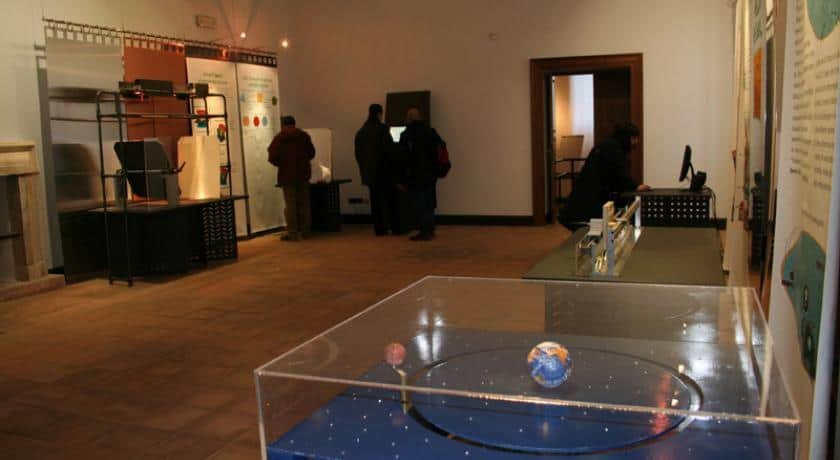
Here is the information that changes the day for those who know it and ruins it for those who ignore it: this museum is not visited by just showing up. There's no door with posted hours that you walk through the way you walk into a gallery. Reservation is the condition of the visit's existence, and the visit is always accompanied. The number to dial is 06 49913282, alternatively 06 49913284, the email address is iraccontidinumeria@libero.it, and the hours given are Monday to Friday from 9:00 to 18:00. If you write an email, put the word mathematics in the subject and in the body the number of people, the age, the language and two possible dates: it's the way to get a useful answer on the first try.
The second thing almost nobody says concerns the address. Many tourist listings, printed and online, still give as the venue the Castelletto of Villa Sciarra, with the street number viale delle Mura Gianicolensi 11. Whoever goes there finds a magnificent park and a closed building. The museum's activities take place at the University City, in the Guido Castelnuovo Department of Mathematics, where the museum was born and where it was housed for a long time. Keep this duality in mind also when you speak with someone on the phone: the administrative venue and the operational venue don't coincide, and it's normal for the directions to seem contradictory.
The third, which concerns the calendar: the museum works to the rhythm of the academic year. From mid-July through August the University City empties out, the university museums observe the summer break, the department library reduces its hours. The good period for booking runs from October to May, with the tail of June. If you have Rome planned for August and were hoping for an afternoon of polyhedra, change your plans: go to the Museo Civico di Zoologia, which in summer is open and air-conditioned, and put off the mathematics until autumn.
The fourth thing, and I say it with some harshness because I see it every year: you don't come here with a party of 40 people. The space is that of university classrooms and halls, the formula is the workshop, and above 20 people the workshop dies. If you have two classes, book two shifts.
Museum of Mathematics
The plaster and string models, when formulas were built
The collection includes a nucleus of 19th-century plaster models, mathematical sculptures designed for teaching, tied to the tradition of Felix Klein. They are the most fascinating objects you can meet in a mathematics museum, and they deserve a whole chapter, because their story explains a century of scientific thought.
What mathematical models are
They are three-dimensional objects built to bring out the notable properties of the surfaces and curves under study: they were born as teaching tools, not as ornaments. The materials vary according to the need of representation: plaster cast in molds, silk threads stretched between metal frames, turned wood, folded cardboard, metal sheets. Plaster is used for solid surfaces, where the overall shape and the position of the singularities matter. String is used for ruled surfaces, those generated by the movement of a line, where the eye must be able to pass through the object and see the two families of generators that cross.
The production season runs from the second half of the 19th century to the 1950s. The reference catalog is the one that comes from the workshop started in the 1870s of the last century at the Polytechnic of Munich by Felix Klein and Alexander Brill. In 1899 the enterprise passed to Martin Schilling, who continued its publication. Alongside that school worked the German mathematician Hermann Wiener, whose models are described in the repertories of 1905 and 1912. The catalogs were bought the way software licenses are bought today: a university institute ordered the series, received it in padded crates and displayed it in wooden cases along the corridors.
Why they were built
The reason is technical and beautiful. In the second half of the 19th century geometry pushes into objects that intuition can no longer handle: algebraic surfaces of the third and fourth degree, with double points, cusps, contained lines, behavior at infinity. The equations exist. The ability to see what they describe does not. The physical model is the answer to a problem of knowledge, not to a problem of communication: it serves the mathematician before the student.
The textbook case is the general cubic surface, on which lie exactly 27 lines. It's a result proved in the mid-19th century and utterly counterintuitive: a curved surface that contains 27 perfectly straight lines. In front of the string model the question is seen in a second. Another classic case is the Kummer surface, of the fourth degree, with 16 isolated double points, which in plaster resembles an organic sculpture and on paper is a nightmare of calculations. Then there are the quadrics, the surfaces of the second degree, the most orderly family: ellipsoid, elliptic paraboloid, hyperbolic paraboloid, hyperboloid of one sheet, hyperboloid of two sheets, cone, cylinders. The hyperbolic paraboloid and the hyperboloid of one sheet are doubly ruled, and the string models make it evident: the same curved surface is crossed by two families of lines, and each point has one from each family.
Finally there are the twisted curves, the curves that don't lie in a plane, like the twisted cubic in three-dimensional space. Representing them in a drawing means lying by projection. Building them in brass wire means showing them. When a 15-year-old walks around a model like this and sees the curve change appearance at every step, he has learned silently what projection means, and has learned more descriptive geometry than would stay with him from a chapter of a book.
Why they stopped building them
Production fades between the two wars and ends altogether in the 1950s. There are three reasons and it's worth listing them, because they tell of a change of paradigm. The first is economic: the models were expensive, fragile, bulky. The second is conceptual: 20th-century algebraic geometry becomes abstract and algebraic, works over any fields and any dimensions, and a plaster model of ordinary space stops being the right tool. The third is technological: from the 1960s computer graphics lets you rotate a surface on the screen, change its parameters, slice it.
The result is that thousands of models ended up in the basements of Italian university institutes, and that in the last 20 years many departments have found them again, restored them and put them on display. The Roman collection belongs to this story. No three-dimensional animation replaces plaster. On the screen the surface is an image and you look at it. The model you turn in your hand, and the hand remembers what the eye forgets. If during the visit they let you touch a model, touch it carefully and take 30 seconds in silence. It's the only moment when a formula becomes an object.
The link with 20th-century artists
There's a side chapter that makes these objects even more interesting. In the display cases of the mathematics institutes, between the two wars, artists saw them. It was Max Ernst who discovered the collection of the Institut Henri Poincaré in Paris and pointed out its aesthetic value to the other Surrealists. In 1936 Man Ray photographed a series of them under the title Mathematical Objects, published that same year in Cahiers d'Art with an essay by Christian Zervos. From there the line of contagion widens to sculpture: Naum Gabo drew direct inspiration from the models, his brother Antoine Pevsner worked in the mid-1930s on the series of developable surfaces, Barbara Hepworth knew the Oxford collection and in 1939 made Helicoids in a Sphere, which recalls Steiner's Roman surface, and Henry Moore stated that the use of strings in his own sculptures, starting in 1937, had been suggested to him by the models in the Science Museum in London. Tell it to a teenager who has told you mathematics has nothing to do with art, and enjoy the look on his face.
The advice I give you for visiting the Museum of Mathematics
The main piece of advice is one and it's worth putting in writing: call ahead and ask two precise things, namely which sections will actually be accessible on the date they propose and whether the visit includes the hands-on part. It's not pedantry. An institute that works inside a university department follows the department's calendar: exam sessions, conferences, maintenance work, room closures. Knowing in advance what you'll see radically changes the yield of the morning.
Second piece of advice: bring the wrong person. I mean, don't bring the nephew who already loves mathematics and gets nines: he'll have fun anyway. Bring the other one, the one who got a four on the test and has convinced himself he's not cut out for it. The museum's teaching machine is built exactly for him, because it starts from objects and not from definitions, and because the first result it achieves is to remove performance anxiety. It happens that kids who said they hated geometry start counting faces and vertices and don't want to leave.
Third piece of advice, a practical one. Combine the visit with a walk around the University City, because that campus is an open-air architecture museum and almost no tourist sets foot in it. The master plan is by Marcello Piacentini, the buildings are signed by some of the best Italian architects of the 1930s, and Gio Ponti's Mathematics building is the finest piece of all. In a couple of hours add the Gipsoteca della Sapienza, which holds casts from antiquity, and if the calendar allows the Physics Museum, where instruments that made the history of Italian science are kept.
Fourth piece of advice, on time. An hour and a half is the minimum for a visit worth the name. Two hours is the right measure. Beyond two and a half hours, with kids, attention is lost. If you have a group of passionate adults, explicitly ask to devote more time to a single section instead of rushing through all seven. The sliding-through visit is the worst form of visit that exists, and in a museum like this it's a waste.
Last piece of advice, and it holds for life beyond the museum: arrive with a question. Just one, yours, maybe a trivial one. Why prime numbers never end. Why you can't divide by zero. Why a sphere can't be flattened without deforming it, and therefore why all maps lie. Whoever guides in a science museum is waiting for exactly that, and a good question turns a visit into a conversation.
The Italian school of algebraic geometry, born where the Museum of Mathematics is
To understand why a mathematics museum grew up inside that very department you need to know what that department has been. Between 1890 and 1938, the mathematics institute of the University of Rome was one of three or four places in the world where the mathematics that mattered was done. It's not national pride: it's a fact that German, French and American colleagues recognized at the time.
Corrado Segre and the Turin seed
The starting point is Turin. Corrado Segre, born in Saluzzo on August 20, 1863 and died in Turin on May 18, 1924, graduated in 1883 with a thesis on quadric surfaces and in 1888 obtained the chair of higher geometry at the University of Turin, which he held for 36 years. His strong idea was the geometry of hyperspaces, that is, the systematic study of figures in spaces of any dimension, used as a working tool and not as a curiosity. He introduced antiprojectivity, a variety was named after him, and he contributed to the invariant that bears his name alongside Zeuthen's.
Segre was not only a researcher: he was a builder of a school. Among his students were Guido Castelnuovo, Francesco Severi, Gino Fano and, in fact, also Federigo Enriques. In 1891 he traveled to Germany, met Felix Klein and spread the Erlangen program in Italy. He kept 40 handwritten notebooks with the course material, prepared every summer: those who have seen them say they are a monument to professional seriousness. The same seriousness, and this is the point, that drove Klein and Brill to found the model workshop.
Guido Castelnuovo and Federigo Enriques, the pair who rewrote geometry
Guido Castelnuovo was born in Venice on August 14, 1865 and died in Rome on April 27, 1952. He graduated at Padua in 1886 with Giuseppe Veronese, spent a year of advanced study in Rome with Luigi Cremona, was an assistant in Turin from 1887 to 1891 and taught at the Academy of Artillery and Engineering. In 1891, at 26, he won the chair of analytic and projective geometry at the University of Rome. He taught there for 44 years: the last lecture was on May 28, 1935.
Federigo Enriques was born in Livorno on January 5, 1871 and died in Rome on June 14, 1946. He trained in Pisa at the Scuola Normale with Enrico Betti and Ulisse Dini, graduated with distinction in 1891 and in 1892 arrived in Rome for advanced study with Cremona. There he met Castelnuovo, six years older. From 1894 he taught at Bologna, first as lecturer in projective and descriptive geometry, then as professor from 1896, and stayed there 28 years, the most fruitful period of his research. In 1922 he moved to Rome to the chairs of higher mathematics and higher geometry.
The joint work of the two is the most remarkable thing produced by Italian mathematics. Castelnuovo recounted that Enriques was a mediocre reader, who preferred to discuss while walking instead of studying from texts: they built the theory of algebraic surfaces strolling around Rome, in long walks where one proposed and the other took apart. The result was the classification of algebraic surfaces, one of the structural theorems of the 20th century, and the invention of a battery of numerical invariants that are still called by their names today: the geometric genus, the arithmetic genus, the plurigenera. Enriques divided surfaces into four families on the basis of the behavior of the 12th plurigenus.
Anyone who has never studied algebraic geometry can stop here and take home an image. Imagine having to put in order all the possible shapes that an equation can describe in space, and wanting to do it the way Linnaeus did with plants: classes, orders, families. They succeeded. And they did it before modern algebraic tools existed, reasoning geometrically, with a mix of rigor and intuition that in the 1930s American mathematicians would harshly criticize and in the 1960s would recognize as correct, once the proofs were rebuilt in the new language.
With Francesco Severi the group widened: Castelnuovo, Enriques and Severi worked between 1904 and 1905 on irregular surfaces, and the memoir by Enriques and Severi on hyperelliptic surfaces won in 1907 the Bordin Prize of the Paris Academy of Sciences. A French prize to two Italians, at a time when France was the mathematical capital of the world, measures well the position reached.
Enriques the philosopher, and the quarrel with Croce
An aspect the Museum of Mathematics has an easy time recounting, because it touches the Italian school at its sore spot. Enriques was not only a geometer: he directed the mathematics section of the Enciclopedia Italiana, directed the Periodico di matematiche from 1922 to 1946 raising its level a great deal, presided over the Mathesis society from 1922 to 1934 and founded at the University of Rome the National Institute for the History of Science, convinced that without history scientific concepts remain incomprehensible.
In 1911 he had with Benedetto Croce a controversy that has marked Italian culture for a century. Croce held that science contained only pseudoconcepts of practical usefulness, without true cognitive value. Enriques, who in the Problems of Science of 1906 had written that ultimately an ontology is a subjective representation of reality, defended the philosophical value of scientific thought. At the time it seemed a defeat for Enriques. In the long run even Giovanni Gentile recognized the cognitive value of science. But the Italian liceo, with its implicit hierarchy that puts Greek above mathematics, is a child of that season. A personal opinion, and I stand by it before anyone: a large part of the math anxiety of Italian adults comes from there, not from the numbers.
Vito Volterra, the mathematician who said no
Vito Volterra was born in Ancona on May 3, 1860 and died in Rome on October 11, 1940. He is buried at Ariccia. He studied in Florence with the physicist Antonio Roiti, then at the Scuola Normale of Pisa, where he graduated on June 30, 1882 with a thesis on hydrodynamics under Enrico Betti. He taught rational mechanics at Pisa from 1883 to 1893, at Turin from 1893 to 1900, and from 1900 to 1932 he held the chair of mathematical physics and celestial mechanics at the University of Rome.
His scientific legacy is enormous: he is one of the fathers of functional analysis and of the theory of integral equations, and between 1926 and 1936 he built the mathematical model of competition between species, the predator and prey equations, one of the founding moments of mathematical ecology, born from the data on Adriatic fishing that his biologist son-in-law had brought him. A model of fish populations that becomes a chapter of pure mathematics: it's the kind of story that works very well in a museum.
In the First World War he volunteered in May 1915, at 55, and from January 1917 headed the Inventions Office, dealing with the armament of airships and scientific cooperation among the allies. After the founding of the National Research Council in 1923 he was its first president. He presided over the National Academy of the XL between 1919 and 1920 and the Accademia dei Lincei from 1920 to 1926.
Then the no. In November 1931 the regime imposed on university professors the oath of loyalty to Fascism. Across Italy the professors who refused it were 12. Volterra was one of those 12. In 1932 he was removed from university service, in 1934 expelled from the academies, and in the following years his erasure from Italian public life was systematic. He kept working abroad, where he was considered a master. He died in Rome in 1940, when Italy was already at war.
12, in a whole country, out of an academic body of over a thousand chairs. In front of the University City, this changes the air. There's no need to comment on it.
Tullio Levi-Civita and the mathematics Einstein needed
Tullio Levi-Civita was born in Padua on March 29, 1873 and died in Rome on December 29, 1941. He graduated at Padua in 1894 and became a student and then collaborator of Gregorio Ricci-Curbastro. Together they wrote the most celebrated exposition of tensor calculus of the pre-relativistic era. Levi-Civita taught at Padua from 1897, first rational mechanics and then also higher mechanics. In January 1919 he moved to Rome with the chair of higher analysis, and from 1921 to 1938 he held that of rational mechanics.
His deepest contribution is the notion of parallel transport on a Riemannian manifold, the concept that lets you compare vectors applied at different points of a curved space. Without that idea general relativity cannot be written. Levi-Civita corresponded with Albert Einstein during the elaboration of the gravitational field equations in 1915 and was the main Italian supporter of the theory in an academic environment that regarded it with suspicion.
In 1938 the anti-Semitic laws removed him from teaching and expelled him from the national academies. Invitations from foreign institutions kept arriving. He did not accept them and died in Rome three years later. Anyone strolling through the University City today finds no sign to remind them of him, and it's an omission.
Mauro Picone, calculation that becomes a trade
Another figure who explains why a mathematics museum makes sense in Rome. Mauro Picone was born in Lercara Friddi, in the province of Palermo, on May 2, 1885 and died in Rome on April 11, 1977. He entered the Scuola Normale of Pisa in 1903, studied with Ulisse Dini and Luigi Bianchi, and graduated in 1907. In the First World War, as an artillery second lieutenant, he found himself solving the problem of calculating firing tables for mountain artillery: he was promoted captain in 1917 and decorated with the War Cross in 1918. That experience taught him that numerical calculation is a serious and concrete thing.
In 1927, in Naples, he set up a numerical analysis laboratory at the university. In 1932 he moved to the University of Rome and in the same year managed to found, within the National Research Council, the National Institute for the Applications of Calculus. He stayed there until retirement in 1960. In 1975 the institute took his name. The leap came in 1955, when the institute became the second Italian center equipped with an electronic computer.
Bruno de Finetti and probability as opinion
Bruno de Finetti completes the Roman picture, born in Innsbruck on June 13, 1906 and died in Rome on July 20, 1985. Enrolled at the Politecnico di Milano in 1923, he graduated in mathematics at the University of Milan in 1927 with Giulio Vivanti. He taught probability theory at Trieste from 1935, then financial and actuarial mathematics, and in 1950 became a professor at Trieste. In 1954 he moved to the faculty of economics of the University of Rome and from 1961 to 1976 held the chair of probability theory in the faculty of mathematical sciences.
His thesis, formulated around 1930, is one of those that can be explained in a sentence and digested in 10 years: probability is not an objective property of the world, it's the degree of confidence someone places in the occurrence of an event. Among his works are Probabilismo of 1931, La prévision of 1937, the Matematica logico intuitiva of 1959 and the Teoria delle probabilità in two volumes of 1970. From Castelnuovo, who had published in 1919 a treatise on probability theory later rewritten in two volumes between 1925 and 1928 and in a third edition in 1948, to de Finetti, Rome has a continuous probabilistic tradition that statistics enthusiasts ought to know better.
Another well-known fact, yet rarely cited
That in 1938 Fascism expelled Jews from Italian schools and universities, everyone knows. What is cited far less is what it concretely meant for Italian mathematics and for the institute where this museum has its home. The Roman school was decapitated in an afternoon. Guido Castelnuovo, Federigo Enriques and Tullio Levi-Civita, that is, three of the names that had brought Italy to the top of world geometry, were shown the door. Vito Volterra had already been thrown out in 1932 for refusing the oath. Castelnuovo was struck off from the Accademia dei Lincei on October 16, 1938. Enriques was suspended from teaching from 1938 to 1944. Levi-Civita was excluded from the national academies and died in 1941 without ever teaching again.
What followed is the part that deserves to be told well, because it's a story of silent resistance carried out with the only weapon those men had: teaching. Castelnuovo worked so that young Jews could follow university courses in Switzerland and organized a clandestine university in Rome. The courses, cautiously called Corsi Integrativi di Cultura Matematica, began on December 1, 1941 with 25 enrolled students, who were formally registered at the Higher Technical Institute of Fribourg. The first year included analytic geometry, algebraic analysis, experimental physics, general chemistry and drawing. The second added rational mechanics and the science of construction.
The faculty was made up of expelled Jewish professors and non-Jewish anti-Fascists who accepted the risk: Maria Piazza for chemistry, Angelo Di Castro for architecture, Giulio Supino for hydraulic construction, Vito Camiz for technology, and then Giulio Ugo Bisconcini, Raffaele Lucaroni, Nestore Bernardo Cacciapuoti. During the Nazi-Fascist occupation Castelnuovo lived under a false name. In 1944 Minister Guido De Ruggiero recognized the two years of coursework the students had attended and readmitted them to Italian universities: one of the few timely reparations of that period.
There is a family detail that closes the circle with the museum. Guido Castelnuovo's daughter, Emma, born in Rome on December 12, 1913 and died on April 13, 2014, had graduated in mathematics in 1936 and had won a teaching post in 1938, only to be suspended from it immediately by the racial laws. She taught in the clandestine Jewish schools of Rome between 1938 and 1943 and wrote textbooks under a pseudonym to protect herself. She would become the most important mathematics educator of 20th-century Italy, with the Geometria intuitiva of 1949 and the Didattica della matematica of 1963, and with the conviction, repeated for 70 years, that to begin geometry you must start from the concrete, from reality. In 1971 and 1974 she organized mathematics exhibitions built by kids, later taken around Europe. In 2009 she received the honor of Grand Officer. In 2014 the international commission on mathematics instruction established a medal in her name.
This is the point almost nobody connects: a museum that has middle school kids handle polyhedra, inside the institute named for Guido Castelnuovo, is the direct continuation of his daughter's method. The line is not ideal, it's material. Anyone who guides a class here and doesn't know it misses the deep meaning of the place.
The library and archive of the Guido Castelnuovo Department
Next to the museum, in the same building, is one of the most important mathematics libraries in Europe, and it deserves a chapter because it's the true treasure of the house. Its origin goes back to the collection of the Pontifical School of Engineers of Rome, established by Pius VII on October 23, 1817. After several moves it consolidated only after 1870 on the initiative of Luigi Cremona, and in 1876 it was placed in the former refectory of the friars at San Pietro in Vincoli. In 1935 it followed the institute to the new Gio Ponti building.
The numbers: over 100,000 volumes, of which about 55,000 monographs and 1,300 periodical titles, on 640 square meters organized in two large sections. The rare book collection counts about 2,500 works published between 1482 and 1830, with nine incunabula and 140 sixteenth-century editions. The most famous piece is the first printed edition of Euclid's Elements, issued in Venice in 1482: the longest-lived textbook in human history, printed barely 26 years after the Gutenberg Bible.
The holdings were also built through donation: collections of Guido Castelnuovo, Vito Volterra, Tullio Levi-Civita, Francesco Severi and Federigo Enriques have come to the library. Since 2019 the ordering of the archives has been under way, including the Amaldi, Cremona and Marcolongo collections, and more recently a donation of Russian books belonging to the mathematician Alfonso Vignoli has been added, presented in May 2024. The library is open Monday to Thursday from 9:00 to 16:00 and Friday from 9:00 to 14:00. The inner reading room remains inaccessible until September 30, 2026 for renovation work. Contacts are at the address biblioteca@mat.uniroma1.it, and the reference page is that of the library of the Department of Mathematics.
It's worth knowing that these volumes leave their room now and then. Between October 2021 and February 2022, for the exhibition Tre stazioni per arte scienza at the Palazzo delle Esposizioni, the library lent Euclid's Elements of 1482, Kepler's Mysterium cosmographicum in the 1621 edition, Cardano's Liber de ludo aleae of 1662, Jakob Bernoulli's Ars conjectandi of 1713 and a 1910 issue of the journal Scientia. In 2019 it lent the Istituto Centrale per la Grafica a Descartes of 1662 for the exhibition on animated books. If you follow the calendar of the Palazzo delle Esposizioni, every so often those books resurface downtown.
The Gio Ponti building that houses the Museum of Mathematics
The building deserves a visit even from those who want to know nothing about mathematics. The University City was designed under the direction of Marcello Piacentini and inaugurated in 1935. The building of the School of Mathematics was designed by Gio Ponti in 1932, built between 1934 and 1935 and inaugurated on March 31, 1935.
The plan is the notable thing: three volumes, two with a concave profile and one a parallelepiped with the main entrance, arranged so as to create a semicircular courtyard that acts as a hinge between the straight front and the curved body behind. That curve is not a whim: the building occupies the head of the ideal transept of the Minerva plaza, and its concavity gathers the longitudinal and transverse routes of the campus. Ponti worked on the materials with an attention that is rare in Italian rationalism: travertine on the main front, in square slabs laid with joints aligned vertically and horizontally, so as to declare that the stone is a cladding hung on a framed structure and not a load-bearing wall. Lithoceramic on the inner elevation. Painted plaster on the rest. The furnishings were custom designed for the entire building, the great hall and library included.
Above the entrance portal was set a polychrome stained-glass window of 10.58 by 4.56 meters, designed by Ponti and made by the firm Fontana Arte in July 1935 with special colored glass, decorated and high-fired, bound in lead, and engraved crystal. The composition showed five female figures arranged vertically and, at the top, an angel holding a tablet, with a range of blues, reds, yellows, pinks and grays. It is probable, according to a hypothesis formulated in 2008, that Pietro Chiesa, very close to Ponti and to Fontana Arte, took part in its making, even though his name does not appear in the official documents.
The window was destroyed in 1943 by the bombing of the San Lorenzo neighborhood and was never rebuilt: the large opening is still there, empty of decoration. In 2017 a lighting project made it possible to virtually reproject its design on the facade. If you pass by in the evening and see it lit, you've been lucky.
A detail I like: the library holds the wooden model of the building, the study model. In 2022 the photographer Marina Paris drew from it a work exhibited at Sapienza's Museo Laboratorio di Arte Contemporanea, 15 macro shots of the model set beside original postcards of the campus from the 1940s and 1950s. A building photographed as if it were a landscape.
The right photo to take at the Museum of Mathematics
First the rule, which holds in any university institute and which too many forget: ask. You are inside a department where people work, not in a public exhibition hall. Photographing the objects, as a rule, is not a problem. Photographing people, blackboards with research in progress, screens and archive documents is another matter. A question put to the guide solves everything in three seconds.
The best photo, from a purely visual point of view, is that of a plaster mathematical model shot up close, from a three-quarter angle, with a side, raking light source. Plaster has a matte surface that returns shadows softly, and raking light brings out the lines of curvature, the ridges, the singular points. The result resembles an abstract sculpture of the 1930s, and it's exactly what Man Ray saw. If you shoot with your phone, turn off the flash and rest your elbows: close focus on a white object is the situation in which the automatic camera goes wrong most.
The second photo is that of the string models, and it should be shot backlit. Ruled surfaces built with silk or brass threads stretched between two frames can only be read when the light comes from behind and the threads stand out like a graphic weave. A hyperboloid of one sheet shot backlit, with the two families of generators crossing, is an image that needs no caption: anyone who looks at it understands that this curved thing is made of straight lines.
The third photo is not about the objects but the building, and it's the one I recommend to those who do architectural photography. Step out onto the plaza and shoot the facade of the School of Mathematics head-on, with the travertine in square slabs and the large glazed opening above the portal, the one that since 1943 has remained without its original design. The cladding in slabs with joints aligned vertically and horizontally makes the facade a perfect grid: frame it with the horizon in the center and you'll get an image that looks like a geometry exercise, which is what Ponti wanted. The right light is late afternoon, when the travertine turns warm and the shadows draw the depth of the portico.
The fourth, for those with time and an eye: the semicircular courtyard at the back, where the curved front of the building generates a concave perspective. You stand in the center, point the lens toward the curve and wait for someone to pass: the human figure gives the scale and breaks the symmetry. Photos of rationalist architecture without people are technically correct and deadly boring.
A piece of advice worth more than all the others put together: don't photograph everything. In a small museum the temptation to document every display case is strong and produces 40 images that nobody will ever look at again. Pick three. If you have kids with you, give them a precise assignment, for example to photograph a curve, a surface and a symmetry: they'll come back with better images than yours and, what matters more, they will have looked at the objects instead of just framing them.
If you then want the postcard photograph, it isn't at the department: it's at the Castelletto of Villa Sciarra. The neo-Gothic turret of 1908 among the holm oaks, with the sunset light arriving from the Janiculum, is one of the most beautiful and least beaten subjects in Rome. The building is closed, but the park is open and nobody forbids you from photographing its exterior.
Some important events that happened here in history
The history of this place is made of dates that are rarely found gathered in one place. Here they are in a row, because read in sequence they tell a century and a half of Italy.
1817 and 1873, the foundations
On October 23, 1817 Pius VII establishes the Pontifical School of Engineers of Rome: from that book collection comes the library that is today in the department. After unification, in 1873, Luigi Cremona is called to Rome and refounds the Royal School of Engineers, merging it with the mathematics section of the Faculty of Sciences. In 1876 the library is placed in the former refectory of the friars at San Pietro in Vincoli, where the Faculty of Engineering still is today. Cremona is the progenitor: the Roman mathematical school is born from him.
April 6-11, 1908, the world congress of mathematicians
It's the biggest event in Italian mathematics. The fourth International Congress of Mathematicians is held in Rome from April 6 to 11, 1908, after Zurich in 1897, Paris in 1900 and Heidelberg in 1904. The opening session takes place on the Capitoline Hill, in the Hall of the Horatii and Curiatii, in the presence of the king. The organization is in the hands of three mathematicians: Guido Castelnuovo, Giovan Battista Guccia and Vito Volterra. The choice of Rome is the international recognition of Italy as the third mathematical power in the world at the start of the 20th century, and in the hall are the names that made the century, from Poincaré to Hilbert to Mittag-Leffler.
Those who visit the Capitoline Museums and cross the Hall of the Horatii and Curiatii, the one with the bronzes and the 16th-century frescoes, almost never know that in there, in April 1908, people were discussing analytic functions and the foundations of geometry. The overlap between the two Romes, that of the marbles and that of the theorems, is one of the intellectual pleasures this city gives.
March 31, 1935, the new building
The University City designed under the direction of Marcello Piacentini is inaugurated in 1935. The building of the School of Mathematics, drawn by Gio Ponti in 1932 and built between 1934 and 1935, opens on March 31. A few weeks later, on May 28, 1935, Guido Castelnuovo gives his last lecture, after 44 years of holding the chair. The building that would carry his name greets him and dismisses him almost at the same moment.
1938, the year the school breaks
The racial laws empty the institute. Castelnuovo is struck off from the Lincei on October 16, 1938. Enriques is suspended from teaching. Levi-Civita is excluded from the national academies and from teaching. In a few months Roman mathematics loses its generation of masters, and with it the continuity of a school that was passed on by direct contact, in seminar and in corridor. The rupture was never truly mended: these are the things that happen when a country decides that belonging matters more than competence.
December 1, 1941, the first clandestine lesson
The Corsi Integrativi di Cultura Matematica organized by Castelnuovo begin, with 25 students formally enrolled at Fribourg. Two years of university under the regime's nose, with expelled professors and anti-Fascists. In 1944 Minister Guido De Ruggiero will recognize them and readmit the students to Italian universities.
1943, the lost stained-glass window
The bombing of the San Lorenzo neighborhood destroys the large polychrome stained-glass window designed by Ponti and made by Fontana Arte in July 1935: 10 and a half meters by four and a half of colored glass fired at high heat, five female figures and an angel with a tablet. It was never rebuilt. Anyone looking at the facade today sees a large transparent rectangle and cannot imagine what it contained. The basilica of San Lorenzo fuori le Mura, not far away, bears the scars of the same bombing, and so does the Verano cemetery.
1945-1953, the reconstruction and the name
Castelnuovo is reinstated at the Lincei on April 12, 1945 and on December 13, 1946 becomes its first president after the reconstitution. In 1944 he had taken the post of general commissioner of the National Research Council and then the presidency of the committee for mathematics. On December 5, 1949 President Luigi Einaudi appoints him senator for life. He dies on April 27, 1952. On December 12, 1953 the Mathematical Institute of the University of Rome is named after him.
December 13, 1955, Rome's first computer
A few tens of meters from the department, at the headquarters of the National Research Council, the FINAC is inaugurated in the presence of the President of the Republic Giovanni Gronchi, the first electronic computer assembled in Rome and the second in Italy after the one at the Politecnico di Milano. The machine, of English make Ferranti, had been bought by the National Research Council for the National Institute for the Applications of Calculus directed by Mauro Picone. The assembly, carried out by Ferranti technicians together with Giorgio Sacerdoti, took almost six months, and to install it on the fourth floor the floors had to be reinforced. 20-bit word, primary memory of Williams tubes of 832 words, magnetic drum of 32,000 words, about 1,011 operations per second, 4,000 thermionic valves, over two tons in weight. It stayed in service until 1965 and was dismantled in June 1967.
Do the math: that two-ton machine did a thousand operations a second. The phone in your pocket does a few billion. If you're looking for a way to make a teenager understand what exponential progress means, this is the best I know, and it has the advantage of having happened 200 meters from where you are.
1982 and 1999, the department and the museum
In 1982, with the university reform, the Mathematical Institute becomes the Department of Mathematics, keeping the name of Guido Castelnuovo for the value of a scientific tradition a century long. In 1999 the Museum of Mathematics I Racconti di Numeria is born, out of a successful exhibition, the first Italian civic museum dedicated to the popularization of mathematical culture, wanted and run by the Capitoline Superintendency of Cultural Heritage and housed right in those rooms.
2015 and 2024, the question of the venue
In July 2015 the Council of Municipio Roma I Centro unanimously approves a motion asking for the opening of the museum at the Castelletto of Villa Sciarra, noting that the restoration of the building is reported as completed and that the structure is nonetheless closed. In February 2024 Villa Sciarra passes free of charge into the assets of the City of Rome, with more than 11 million euros of National Recovery and Resilience Plan funds destined for the restoration of the park, the rebuilding of the Belvedere Fountain and the recovery of the Esedra dei Mesi. The game over the permanent venue remains open.
Who passed through the Museum of Mathematics
The question deserves a double answer, because in a place like this the illustrious presences are of two kinds: those who made the place and those who came to it.
Who made the place
Through these rooms have passed, as professors, some of the most important mathematicians of 20th-century Europe. Luigi Cremona, called to Rome in 1873, is the founder of the school. Guido Castelnuovo taught here from 1891 to 1935. Federigo Enriques arrived here in 1892 as a young postgraduate, returned in 1922 with the chair and stayed until the expulsion of 1938, to be reinstated in 1944 and die in 1946. Vito Volterra held the chair of mathematical physics and celestial mechanics from 1900 to 1932. Tullio Levi-Civita taught higher analysis from 1919 and rational mechanics from 1921 to 1938. Francesco Severi was the third name of the triad of Italian algebraic geometry. Mauro Picone arrived in 1932 and stayed until 1960, founding the institute that brought automatic calculation to Italy. Bruno de Finetti held the chair of probability theory from 1961 to 1976.
There is also an indirect presence worth recounting, because it says how much Castelnuovo weighed in Italian scientific life: it was he who pushed for the establishment, in Rome, of the first chair of theoretical physics, the one to which Enrico Fermi was called. Without that decision the story of the boys of via Panisperna would have been different. A geometer who opens the way for physicists: in the Rome of the 1920s it happened.
Who came to it
The building was signed by Gio Ponti, one of the great Italian architects of the century, born in 1891 and thus just over 40 when he laid down the design in 1932: anyone who knows the mature Ponti of the Pirelli tower will struggle to recognize him here, and for exactly that reason the visit is worth it.
Among recent scientific guests, on May 11 and 12, 2023 the department celebrated Ingrid Daubechies, winner of the Wolf Prize for mathematics in 2023 and awarded an honorary doctorate: in the library hall books on the themes of her research were displayed, that is, wavelets, the mathematical tools that lie inside the digital image compression we all use every day.
In May 2024 the donation of the Russian books belonging to the mathematician Alfonso Vignoli was presented, offered by Dr. Lucilla Vespucci: a collection that tells of Soviet mathematics of the last century, one of the great schools of the 20th century. In 2022 the photographer Marina Paris worked on the wooden model of the building kept in the library, with a project exhibited at Sapienza's Museo Laboratorio di Arte Contemporanea. And every spring, on the occasion of Open House Roma, the library opens its doors to a non-university public with a selection of old volumes: in 2022 visitors could listen to descriptive audio about the volumes through QR codes.
Then there are the passages that make no news and matter the most: thousands of middle and high school kids from Rome, brought here by their teachers, who for the first time saw an algebraic surface instead of reading its name. It's not a courtesy: they are the illustrious visitors of this museum. A research institute that agrees to open the door to a third-year middle school class doesn't do it for image, it does it because someone inside believes in it, and that someone usually works for free beyond the hours.
The Museum of Mathematics with children and schools
It's the public the museum was born for and the one it serves best. The stated aim since its founding is to bring children, kids and adults closer to mathematical thought and scientific culture through direct involvement, handling objects and having experiences, instead of listening to an explanation. On this the formula works, on two conditions.
The first condition is age. Under seven the museum gives little: small children have fun with the polyhedra the way they would with any building set, and the content passes over their heads. The golden range is between nine and 14, that is, the last grades of elementary school and middle school, which is exactly the age at which it's decided whether a person will spend life saying mathematics isn't for them. In high school it works very well with the first two years. With the last three years it's best to agree in advance on a higher cut, for example algebraic surfaces or the history of infinitesimal calculus, otherwise the kids get bored.
The second condition is preparation. A school group that arrives knowing nothing uses half the time to get oriented. A class that arrives having already heard of Numeria, of the pebbles, of Kepler's wine and of the 27 lines of the cubic surface arrives loaded with questions, and the visit becomes something else. Half an hour of preparatory lesson is enough. A tip for teachers: have the kids choose, before leaving, one question each, and bring them written down.
The museum also offers free seminars for teachers and cultural workers, with practical exercises on the teaching use of the collections: if you teach and are passing through Rome, you'd do well to ask whether they are on the calendar. It's worth more than many refresher courses.
A practical tip for families: if you have two children of very different ages, don't come together. Bring the older one here and the little one to Explora, Rome's children's museum, which is calibrated for ages three to 12 and which in Rome remains the right address for the very youngest. It's not snobbery: it's that workshops only work if the group is homogeneous.
Workshops, exhibitions and popularization around the Museum of Mathematics
The popularization life of the department where the museum works is richer than you might imagine, and anyone living in Rome can tap into it without booking anything.
Every year, on the occasion of the team Mathematics Competitions, the library sets up the exhibition Math is Fun, with texts on mathematical topics aimed at the general public made available to visitors for consultation: a tradition that has gone on since 2014. In spring, for Open House Roma, the library opens with a selection of old volumes and a route devoted to the architecture of Gio Ponti. In 2022 visitors could listen to descriptions of the volumes through QR codes. Then there are the presentations of collections, like that of the Vignoli donation on Russian mathematics of the last century in May 2024, and the days of scientific celebration, like the two days with Ingrid Daubechies in May 2023.
The museum, for its part, has a long tradition of meetings: the cycles of afternoon lectures, participation in the Week of Scientific and Technological Culture, the popularization events that over the years have touched on subjects like the Antikythera mechanism, the Greek analog calculator recovered from the sea at the beginning of the 20th century, which is the perfect subject for a mixed audience: a geared machine that calculated the positions of celestial bodies, built when Europe did not yet know the water wheel.
The museum also makes online materials, lessons and games available, and offers routes and courses for teachers. If you work in schools and want to use them, the way is always the same: you write to the museum's address and ask.
How long a visit to the Museum of Mathematics takes and how to organize it
An hour and a half is the useful minimum, two hours the right length, two and a half hours the maximum a group of kids can bear. Keep in mind that the route is not an obligatory sequence of rooms: you agree with the guide on an itinerary among the seven sections, and the difference between a mediocre visit and an excellent one is almost all there.
A suggested day, for a curious adult coming from outside Rome: reservation at the museum for 10:00, leave around noon, lunch in San Lorenzo, which is five minutes on foot and is one of the neighborhoods where you eat best while spending a fair amount, and the afternoon devoted to the other museums of the University City or to the Verano. Anyone with only one day who wants to maximize can instead head downtown on metro B and finish at the Palazzo delle Esposizioni.
For a school group: arrival at 9:30, visit until 11:30, sandwich in the University City park or on the steps of the Minerva plaza, and return. Don't add a second museum the same day. Trying isn't worth it: the second visit is always wasted.
Accessibility, services and practical matters
The museum states free admission and a free guided visit, with accompaniment in Italian, English, French and Spanish. For everything else, from wheelchair accessibility to backpack storage, the answer has to be asked at the time of booking, because it depends on the spaces actually used that day: a university department has classrooms, seminar rooms and halls that change purpose during the academic year. The question to ask on the phone, plainly, is this: can the rooms planned for our visit be reached without stairs.
On the building in general: the University City is a modern campus, with flat, wide routes, and overall it's the kind of place you cross without difficulty. The interior parking is reserved for staff. Anyone arriving by car finds parking on the surrounding streets, which are paid and full all morning. The advice, bluntly, is to forget the car: metro B stops at Policlinico and saves you half an hour of circling.
Don't expect a bookshop, museum café or coat check: there are none here. There are the university bars, which in summer and during closure periods may be closed too. Bring water.
When to go to the Museum of Mathematics and when to avoid it
The calendar is the academic one, and anyone who ignores it takes the wrong trip. The best months run from October to May, with June as an acceptable tail. July is already thin. August is absolutely the wrong month, because the University City empties out, the museums of the Sapienza Museum Hub observe the summer break and the department library reduces its activity. In 2026 the library's inner reading room remains inaccessible until September 30 for renovation work, and from September the opening hours are Monday to Thursday from 9:00 to 16:00 and Friday from 9:00 to 14:00.
In the exam-session weeks, that is roughly January and February and then June and July, the department is full of students tense as violin strings: the visit happens all the same, but the available spaces are fewer. The perfect period, from experience, is November: the academic year is under way, the campus is alive, there are few tourists in the city and the late-afternoon light on Ponti's travertine is the best of the year.
A warning that holds for all of Rome and counts double here: on transport strike days the University City becomes awkward to reach. If you've booked with a group, check the strike calendar before confirming.
What to see around the Museum of Mathematics
The advantage of this address is that it sits inside one of the least frequented and richest museum complexes in the city.
The other museums of the University City
The Sapienza Museum Hub gathers about 20 museums and collections, organized by thematic areas, with entrances from Piazzale Aldo Moro 5 and from viale dell'Università 38. A few minutes on foot from the mathematics department you find the Museo di Fisica, with the instruments of the Roman school. The Primo Levi Museum of Chemistry. The Giuseppe Sergi Museum of Anthropology. The Museo Universitario di Scienze della Terra, with a first-rate mineralogical collection. The Battista Grassi Museum of Comparative Anatomy. The Museo di Storia della Medicina, which is one of the most impressive in Italy. The Museum of the Near East, Egypt and the Mediterranean. The Gipsoteca with its casts from antiquity, which for a visitor fresh from the plaster models of mathematics is a perfect pairing.
A clarification that avoids a common mistake: the Museo Civico di Zoologia, which many take to be part of the campus, belongs to the municipal circuit and is at Villa Borghese, on the other side of viale Regina Margherita. Check the address before setting off.
San Lorenzo, the Verano and surroundings
The San Lorenzo neighborhood borders the campus and is worth a stroll: born as a working-class neighborhood at the end of the 19th century, hit hard by the bombing of July 1943, today it's the university neighborhood par excellence, with its osterias, craft workshops and murals. The basilica of San Lorenzo fuori le Mura is one of the seven pilgrimage churches of Rome and keeps a 13th-century portico and a Cosmatesque floor that, after an hour spent on polyhedra, you look at with different eyes: those geometric designs are mathematics applied to marble. Next to it, the Verano cemetery is an open-air museum of 19th-century sculpture.
If instead you went to Villa Sciarra
If you're on the Janiculum you have one of the most beautiful areas of Rome around you. A few steps from the park are the Museo della Repubblica Romana e della memoria garibaldina, inside the Porta San Pancrazio, and the Janiculum Hill with the terrace of the Fontanone and the noon cannon. Going down toward the river you reach the Villa Farnesina, with the frescoes of Raphael and Peruzzi, the Botanical Garden and Palazzo Corsini. In 10 minutes of descent you're at Santa Maria in Trastevere and at the Museo di Roma in Trastevere.
A note for enthusiasts of applied geometry: the Villa Farnesina is, among other things, a manual of constructed perspective. Baldassarre Peruzzi's Hall of Perspectives is an exercise in descriptive geometry that precedes by a century the treatises on the subject. If the museum has sparked your interest in how space is represented, that hall is the next lesson.
Mathematics in Rome, 2,000 years before the Museum of Mathematics
A mathematics museum in Rome has a starting problem worth facing openly: Rome is not Alexandria, it's not Syracuse and it's not Athens. The great Greek mathematics was not born here, and the Romans, as a culture, were rather indifferent to theoretical mathematics: of geometry they cared about what served to measure fields, raise arches and bring water. And yet the city has a notable mathematical history, provided you look for it where it really is.
The practical mathematics of the empire
Roman calculation was a trade. The grooved abacus, the tokens, the duodecimal fractions that made it convenient to divide by two, three, four and six. Gromatics, that is, the discipline of the land surveyors who laid out the grid of the centuriations with the groma, a cross-shaped instrument with plumb lines. The treatises of the Latin surveyors, which are practical geometry written by technicians for technicians. Anyone who has seen a Roman aqueduct knows that those minimal gradients, maintained for tens of kilometers, are a leveling problem solved with elementary instruments and superhuman patience. It's not abstract geometry: it's engineering that presupposes a geometry.
The Collegio Romano and the calendar
The moment when Rome returns to the center of European mathematics is the 16th century, and the protagonist is a German Jesuit. Christopher Clavius, born in Bamberg in 1537 and died in Rome in 1612, taught mathematics at the Collegio Romano, the institution of the Society of Jesus that trained the Catholic ruling classes for two centuries. He was called the Euclid of the 16th century for his Latin edition of the Elements, which became the text from which Catholic Europe learned geometry. He took part in the reform of the Gregorian calendar of 1582, the operation that led to suppressing 10 days to realign the civil year with the astronomical one, and it's the reason the calendar we use is still called Gregorian today.
Clavius also wrote a Gnomonices devoted to sundials and gnomonic projection. And in 1611 he welcomed Galileo Galilei to Rome, when the scientist from Pisa came to present his celestial discoveries to the community of the Collegio Romano: the Jesuit mathematicians confirmed the observations. It was the most serene moment of the relationship between Galileo and Rome, and it ended badly, but that meeting really happened, and it happened a few hundred meters from the Pantheon.
Cremona and the mathematics of unified Italy
The last chapter before the story told above is the Risorgimento one. Luigi Cremona, born in 1830 and died in 1903, was called to Rome in 1873, three years after the breach of Porta Pia, with the task of building the higher technical education of the new capital. He refounded the Royal School of Engineers, merging it with the mathematics section of the Faculty of Sciences, put the library together, and trained the students who would make the Italian school of geometry. Guido Castelnuovo and Federigo Enriques both passed through his Roman advanced course. Everything you see today in that department begins there: from a mathematician who agrees to become an organizer in order to build a school that outlives him.
Quick questions about the Museum of Mathematics
How much is a ticket to the Museum of Mathematics?
Nothing. The museum states free admission and a free guided visit. Free, though, doesn't mean open access: the visit is booked, and without a reservation you don't get in.
Do you need to book to visit the Museum of Mathematics?
Yes, always. It's the central rule of the place. The contacts given are the number 06 49913282, alternatively 06 49913284, and the email address iraccontidinumeria@libero.it. In the request write how many people you are, how old they are, in which language you want the visit and two alternative dates.
Where exactly is the Museum of Mathematics?
The activities take place in the Guido Castelnuovo Department of Mathematics of Sapienza, Piazzale Aldo Moro 5, building CU006, inside the University City. The entrance to the campus is from the monumental gate of Piazzale Aldo Moro or from viale dell'Università 38.
Is the Museum of Mathematics at Villa Sciarra?
The institutional venue given in the official listings is the Castelletto of Villa Sciarra, between viale delle Mura Gianicolensi 11 and via Dandolo 45. That building is not open to the public. Anyone who wants to see the museum goes to the University City. Anyone who wants to see the Castelletto finds it among the trees of the park and looks at it from outside.
How do you get to the Museum of Mathematics by metro?
Metro line B, Policlinico stop, five minutes on foot along viale dell'Università. Alternatively Castro Pretorio, also line B, with about 10 minutes of walking. From Termini you can also do the quarter of an hour on foot passing through San Lorenzo.
How long does a visit to the Museum of Mathematics take?
Between an hour and a half and two hours. With a group of kids don't go over two and a half hours: beyond that threshold attention collapses and the workshop becomes a line of bored people.
Is the Museum of Mathematics suitable for children?
Very, but not for all. The best range is from nine to 14. Under seven it yields little. For the very youngest, in Rome, the right address remains Explora.
Can you take photographs at the Museum of Mathematics?
Ask the guide. Objects, as a rule, can be photographed without problems. People, research blackboards and archive documents cannot. Flash is always to be avoided, also because on the plaster models it spoils the result.
Is the Museum of Mathematics wheelchair accessible?
The University City is a modern campus with wide, flat routes, and the buildings are equipped. The rooms the museum uses, though, vary over the academic year, so the question should be put at the time of booking, explicitly asking whether the planned rooms can be reached without stairs.
What do you see at the Museum of Mathematics?
Seven thematic sections, over 100 wooden polyhedron models, Napier's bones with a table of logarithms from that tradition, a proportional compass of the Galilean type with the related drawings, a Roman-era abacus, a collection of 19th-century plaster models tied to the tradition of Felix Klein and about 100 tables, works and paintings on mathematical subjects.
Are there visits in English?
The museum states accompaniment in Italian, English, French and Spanish. The language has to be agreed when you book, because it depends on who is available that day.
Is the Museum of Mathematics open in August?
August is the worst month to try. The campus empties out, the university museums observe the summer break, the department's activity is reduced to a minimum. If you have Rome only in August, plan something else and come back in autumn.
Is the Museum of Mathematics open on Saturday and Sunday?
The stated hours are Monday to Friday, from 9:00 to 18:00. The weekend is not part of ordinary operation. Any special openings are tied to initiatives like the open days of the university museums, and should be verified each time.
Is it free the first Sunday of the month?
The question comes from the initiative concerning paid civic museums and state museums. It isn't needed here: admission is free anyway. What is needed, always, is the reservation.
Who runs the Museum of Mathematics?
It's a civic museum, born in 1999 as the first museum wanted and run by the Capitoline Superintendency of Cultural Heritage, and it is part of the circuit of the city's science museums. The activities take place inside the Sapienza Department of Mathematics, where the museum was born and was housed for a long time.
Why is the Museum of Mathematics called I Racconti di Numeria?
Because Numeria is a minor Roman deity tied to counting and swift childbirth, cited by Varro in connection with the praenomen Numerius. The museum uses her as a narrating voice: the sections are built as tales that this figure addresses to the visitor, and the choice serves to make accessible a subject that frightens.
How many sections does the Museum of Mathematics have?
Seven. Among the most cited are L'alba del pensiero matematico greco, devoted to Plato, Archimedes and Pythagoras, Calcolare stanca anche i grandi matematici, with Galileo and Napier, and L'integrale di vino, built around Kepler and the calculation of the volume of barrels.
What is the difference between the Museum of Mathematics and the other museums of Sapienza?
The museums of the Sapienza Museum Hub are university museums, with collections born from the research and teaching of each department, from physics to mineralogy to anthropology. The Museum of Mathematics is instead a civic museum, of the City, housed inside the university: it was born with a mission of popularization aimed at the city, not of preserving an academic heritage. In practice, whoever enters here finds fewer display cases and more workshop.
Can you visit the library of the Guido Castelnuovo Department?
The library is a university service facility, open Monday to Thursday from 9:00 to 16:00 and Friday from 9:00 to 14:00, with its own access rules. In 2026 the inner reading room remains inaccessible until September 30 for works. The general public meets it mostly during special openings, for example on Open House Roma days or in the Math is Fun exhibitions. For serious consultation, write to biblioteca@mat.uniroma1.it.
Is there a bookshop or a café at the Museum of Mathematics?
No. No bookshop, no museum café, no coat check. There are the bars of the University City, with the hours and closures of a campus.
How long is the wait in line at the Museum of Mathematics?
Zero. There is no line, because there is no free entry without an appointment: you go in at the agreed time. It's the positive flip side of a museum you can't visit on impulse.
Is the Museum of Mathematics good for a high school class?
Yes, especially for the first two years. For the last three years it's best to agree in advance on a more advanced cut, for example algebraic surfaces, the history of infinitesimal calculus or the birth of automatic calculation in Italy, otherwise the risk of repeating things already known is high.
Are there activities for teachers?
The museum offers free seminars for teachers and cultural workers, with practical exercises on the teaching use of the collections, and offers routes and materials devoted to schools. They have to be requested by writing to the museum.
What are the plaster models of the Museum of Mathematics?
They are three-dimensional objects built between the second half of the 19th century and the first half of the 20th to show the notable properties of surfaces and curves studied by geometry. The reference catalog comes from the workshop started at the Polytechnic of Munich by Felix Klein and Alexander Brill, which from 1899 passed to Martin Schilling. They served mathematicians before students: in front of a surface of the fourth degree with 16 double points, the equation alone is not enough to grasp what shape it has.
Can you park near the Museum of Mathematics?
Badly. The campus's interior parking is reserved for staff, and the surrounding streets are paid and full from the morning. Metro B is the solution, no argument.
Is it still worth going to Villa Sciarra?
Absolutely yes, but for the villa. 63,500 square meters between the Janiculum and Monteverde, with the fountains brought by the Wurts couple at the beginning of the 20th century, the exedra, the nymphaea and the lookout over Trastevere. The park is open every day from 7:00 until sunset, and the entrances are on via Calandrelli, via Dandolo and viale delle Mura Gianicolensi.
Will the Castelletto of Villa Sciarra open as the venue of the Museum of Mathematics?
The question has been open for over a decade. In 2015 Municipio Roma I Centro asked with a unanimous motion to open it, noting that the restoration of the building was reported as completed. In February 2024 the villa passed into the assets of the City of Rome, with over 11 million euros of National Recovery and Resilience Plan funds destined for the recovery of the park. What will happen to the Castelletto, today, has not been decided.
Is the Museum of Mathematics of interest to people who aren't good at mathematics?
They are the ideal audience. The museum is built for those who have an unsettled account with this subject, and its weapon is handling: you count, you turn, you compare, and the definitions come afterward. Those who already have a degree in mathematics will enjoy themselves for different reasons, especially in front of the plaster models and the history of the institute.
Which other museums can be combined with a visit to the Museum of Mathematics?
In the same University City there are the Museo di Fisica, the Primo Levi Museum of Chemistry, the Giuseppe Sergi Museum of Anthropology, the Museo Universitario di Scienze della Terra, the Museo di Storia della Medicina, the Museum of the Near East and the Gipsoteca. Outside the gate, San Lorenzo, the basilica of San Lorenzo fuori le Mura and the Verano cemetery.
Why the Museum of Mathematics is worth the trip
The places that stay with you are not the big ones, they're the ones where someone explains something you didn't know you could understand. The Museum of Mathematics belongs to this second category. It doesn't have the scenery of the Capitoline museums, it doesn't have a line, it doesn't even have a door with posted hours. It has a phone number to dial, a person who opens up for you and a table of objects on which, if you feel like it, you can change your mind about a subject that high school made you detest.
Ask to see the plaster models and take your minute of silence in front of a surface of the fourth degree. It's an object built by someone who, 140 years ago, had an equation and no way to see it, and decided to cast it in plaster. That gesture is worth the whole rest of the museum.
Article written by the editorial team of TourLeaderPro, contact them for Private/Corporate/V.I.P. Tours and Experiences.
Planning a trip to Rome? The English guides for visiting the city are on ItalyPlanner.com.