Civic Museum of Zoology
In short. The Civic Museum of Zoology is at Via Ulisse Aldrovandi 18, 00197 Rome, on the northern edge of Villa Borghese, with the entrance a few steps from the gates of the Bioparco.
The Civic Museum of Zoology is at Via Ulisse Aldrovandi 18, 00197 Rome, on the northern edge of Villa Borghese, with the entrance a few steps from the gates of the Bioparco. You get there on trams 3 and 19, which run along Via Aldrovandi and stop in front of the zoological garden, or by metro line A, getting off at Flaminio and continuing by tram. On foot it's about 15 minutes from Porta Pinciana, crossing the park. The full ticket costs €10.50, the reduced one €5.50, and since February 2026 admission is free for those who live in Rome and the Metropolitan City by showing an ID card at the ticket desk. The museum is open Tuesday to Sunday from 9.00 to 19.00, with last entry one hour before closing. It is closed on Mondays, on May 1, and on December 25, while on December 24 and 31 the hours are shortened to 9.00-14.00. Buying online in advance carries a presale fee of €1.00. Tickets can also be bought by phone, at 060608, active every day from 9.00 to 19.00, or directly at the ticket office. For groups of 11 to 25 people plus a guide, booking is free at 060608, with advance purchase of at least five tickets.
The Civic Museum of Zoology belongs to the system of the Musei di Roma Capitale, the municipal network that includes the Capitoline Museums, the Ara Pacis, the Centrale Montemartini, and about 20 other venues. Those who hold the MIC card, the €5 annual card reserved for residents and students of the city, get in without paying by collecting the free ticket at the ticket office or by calling 060608. The institution's official website is museocivicodizoologia.it, and it's the right place to check notices before setting out: at the moment, for example, the internal elevator is temporarily out of service.

Where the Civic Museum of Zoology is and how to get there
The geography of this museum already explains half of its story. The building occupies the eastern edge of Villa Borghese, in that stretch of park that slopes down toward the Parioli and that the City, at the beginning of the twentieth century, set aside for the zoological garden. The museum and the zoo are neighbors: they share an enclosure, an administrative history, and, as we'll see, a good part of the specimens kept. Whoever arrives from Via Aldrovandi sees first the perimeter wall of the Bioparco and then the sober facade of the museum, which does nothing to get noticed.
By tram, by metro, and on foot to the Civic Museum of Zoology
The most convenient way is trams 3 and 19, which go up Via Aldrovandi and have a stop at the height of the Bioparco: you get off and you've arrived. The 19 connects the area with Piazza Risorgimento and the Prati neighborhood via Valle Giulia, while the 3 comes from Trastevere and the Aventine, cutting across half the city. By metro you get off at Flaminio, on line A, and from Piazzale Flaminio you take the tram, or walk up Viale delle Belle Arti. Those coming from the historic center can make a nicer choice: arrive at Porta Pinciana and cross Villa Borghese via Piazzale delle Canestre and the Giardino del Lago, a quarter hour's walk under the pines that is worth more than any time saved.
By car and by bicycle
Via Aldrovandi is inside the green belt and close to the limited traffic zone of the Parioli. Street parking exists, but it's almost all paid and at peak hours there's little to be found. The practical advice is trivial and it works: leave the car elsewhere and finish the last stretch by tram. By bicycle the climb from Piazzale Flaminio toward the Parioli is less gentle than it looks on the map, but the internal avenues of the villa are passable and reach almost to the gate.
Tickets, hours, and free admission at the Civic Museum of Zoology
The current price list is simple. Full €10.50, reduced €5.50, free for the categories provided by the current Sistema Musei fare schedule. The novelty that really changes the way people use this place arrived in February 2026: those who live in Rome and the Metropolitan City get in free by showing an ID card at the ticket desk. It's not an accounting detail. A museum that costs 10 and a half euros gets visited once in a lifetime, while a free museum gets visited 20 times, maybe half an hour at a time, and becomes a part of the neighborhood.
The MIC card and the other options
The MIC card costs €5 and is valid for 12 months across the whole Sistema Musei of Roma Capitale, with discounts on paid exhibitions. It's reserved for those who live or study in Rome, and whoever holds it still collects a free entry ticket, by phone or at the ticket office. For visitors from outside there is the Roma Pass, offered in two sizes, 48 hours at €38.00 and 72 hours at €62.90, which includes transport and reduced admissions in the city circuit. If you plan two or three municipal museums and a lot of travel it can make sense. If you come here and nowhere else, no.

Hours and closing days of the Civic Museum of Zoology
Open Tuesday to Sunday, from 9.00 to 19.00, with last entry at 18.00. Weekly closing on Monday. Annual closings on May 1 and December 25. On December 24 and 31 you can enter from 9.00 to 14.00. On January 1, 2026, the opening was set from 11.00 to 20.00, and for later holidays it's always best to check the updated calendar. The ticket office closes one hour before the rooms: it's the rule that sends home the most disappointed visitors in all of Rome, and it applies here too.
From the popes' cabinet to the 1932 agreement: the history of the Civic Museum of Zoology
1932 is the founding date, but it's not the date the objects were born. The collections that fill the storerooms on Via Aldrovandi have behind them a century and a half of Roman history, and passed through three different institutions before arriving here.
The papal chair and the museum of the Archiginnasio
The thread begins in 1804, when Pius VII establishes at the Roman Archiginnasio the chair of Natural History and Mineralogy. In 1824, 20 years later, that chair gave rise to the Museo del Gabinetto di Zoologia e Zootomia: a teaching collection, as was the custom then, made of anatomical preparations, skeletons, and stuffed animals used for instruction. In 1853 Pius IX made it autonomous under the name Museo di Zoologia, assigned it a director, Luigi Metaxà, and a seat of its own in the eighteenth-century Palazzo della Sapienza, a short walk from Sant'Ivo alla Sapienza and the Pantheon. Rome was still the capital of the Papal State, and natural history was a subject for the court as well as for the university.
Antonio Carruccio and the season of the great collections
In 1883 the direction passed to Antonio Carruccio (1839-1923), called from Modena, who remained in office until 1914. These are the 30 years in which the museum truly grew: Carruccio set up a program that joined the growth of the collections and permanent teaching, that is the idea that those specimens serve not only scholars but also those who come in to learn. It's the season when huge private collections, bought or donated, arrived in Rome, and when Italian zoology equipped itself with an instrument comparable to those of the great European museums.
1932 and the separation of the collections
In 1914 Federico Raffaele founded the Institute of Zoology at Palazzo Carpegna. Between 1920 and 1927 the institute found a home in the Zoological Garden of Villa Borghese itself, then moved to the Policlinico, where it stayed until 1971, when under Pasquale Pasquini (1901-1977) it took its permanent seat on Viale dell'Università. In the midst of this coming and going falls the date that interests us: in 1932 an agreement between the University and the City of Rome transferred the museological collections to the new Civic Museum of Zoology, located next to the Zoological Garden. From that moment the specimens collected by the papal naturalists and by the professors of the Royal University became municipal heritage, and the museum began its autonomous life.
Why the street is called Ulisse Aldrovandi
The address is a small programmatic tribute. Ulisse Aldrovandi (1522-1605) was the Bolognese naturalist who put together, in the sixteenth century, what is considered the first modern natural history museum: thousands of specimens cataloged, drawn, described, with a method that anticipates scientific museology by two centuries. Naming the street of Rome's zoological museum after him is one of those place-name choices that makes no noise and says everything.

The exhibition route of the Civic Museum of Zoology, room by room
The theme that holds the whole exhibit together is biodiversity in the animal world: not a parade of species in systematic order, but a reasoning about forms, strategies, and adaptations. The rooms cover more than 1,000 square meters with multimedia stations, three-dimensional reconstructions, and multisensory stations, and you move through them following a thread that starts from behaviors and arrives at bones. Here is the route, room by room.
Bestial loves: reproduction as the engine of forms
The room dedicated to reproduction is the one that throws adult visitors off the most, because it tells without embarrassment the heart of the matter: sexual selection. Courtships, dimorphisms, costly ornaments, mating strategies that defy the animal's economic common sense. Here you understand why a male bird of paradise invests in feathers that make it more visible to predators, or why certain insects pay with their lives for a single mating. The interpretive key is Darwinian and post-Darwinian, and it holds up very well: it's the room I recommend looking at calmly even to those who think they already know everything.
Living on the edge: animals of extreme environments
The second large thematic section tackles adaptations to impossible environments: polar cold, desert, high altitude, ocean depths, caves. It's the part of the exhibit that works best with middle schoolers, because it lines up concrete problems and concrete solutions. How to keep heat when it's 40 degrees below zero outside. How to breathe where oxygen is half. How to see where there's no light, and why many cave-dwelling species have simply given up their eyes. The implicit message is that biology doesn't reward perfection but sufficiency: it's enough to work well enough.
The coral reef
The reconstruction of the coral reef is one of the most photographed sections and one of the most instructive when you read it all the way through. The reef is the textbook example of an ecosystem built by the organisms themselves: coral polyps build the substrate on which everything else lives, and the density of species per square meter has no equal outside tropical forests. In the display cases coexist corals, mollusks, echinoderms, fish. If you have time for only one display case, choose the one with the tropical shells: the variety of forms that a single function, protecting oneself, has produced over millennia of evolution is a better biology lesson than many books.
The wetlands of the Roman countryside
This is the room that Romans should look at first, and that almost everyone rushes through. It tells the fauna of the marshes, ponds, and marane of the territory around the city: a landscape that in the nineteenth century reached almost to the walls and that the twentieth-century land reclamations have largely erased. Herons, coots, amphibians, aquatic insects, marsh turtles: the list of what was there serves to measure what has been lost and what, in some surviving reserve between the coast and the Litorale Romano Reserve, still holds out. Go out of here and look at the lake of Villa Borghese with different eyes.
The skeleton hall of the Civic Museum of Zoology
It's the room everyone remembers, and rightly so. The skeleton hall is a tall gallery in which animal bones are mounted and lined up as in a nineteenth-century anatomy classroom: elephants, giraffes, cetaceans, primates, birds, reptiles. The scenographic effect is undeniable, but the real value is comparative. Look at one front limb at a time and follow the same pattern of bones that lengthens, shortens, fuses: humerus, radius, ulna, carpus, metacarpus, phalanges. The cetacean's flipper and the human arm are the same hand, rewritten. There is no better way to understand homology than to spend 10 minutes in this room with your head up.
The whale room and the great cetaceans
The museum's osteological collection includes a section dedicated to cetaceans, and it's the highlight of the route: the skeleton of the rorqual, which the museum's presentation gives as around 16 meters in length, is the largest object on display and one of the largest visible in Rome in any museum. It's worth getting close to the ribs and looking for the small holes where the vessels passed: a cetacean's bone is spongy and light relative to its mass, because the water supports what on land would have to be supported by the skeleton. There's also one thing you can't see and that counts as information: skeletons of marine mammals keep arriving, because the museum collects and prepares animals stranded on the Lazio coasts. The room is not a closed exhibit, it's a work in progress that keeps updating.
The great African mammals
The mammal halls house the most imposing mounted specimens: elephants, felines, African ungulates, primates. The museum's theriological collection numbers about 800 specimens representing 290 species and all orders of mammals, and a substantial part of the historical material comes from the former Italian colonies in Africa, acquired through ISIAO. This needs saying: many of these animals are here because Italy had a colonial empire, and the natural history of the 19th and 20th centuries is inseparable from the history of conquest. Among the preserved specimens are species at high risk of extinction, from the monk seal to the European otter, from the lynx to the Marsican brown bear, from the Alpine ibex to the snow leopard, all the way to lemurs, tropical primates and the platypus.

The bird halls and the Arrigoni degli Oddi collection
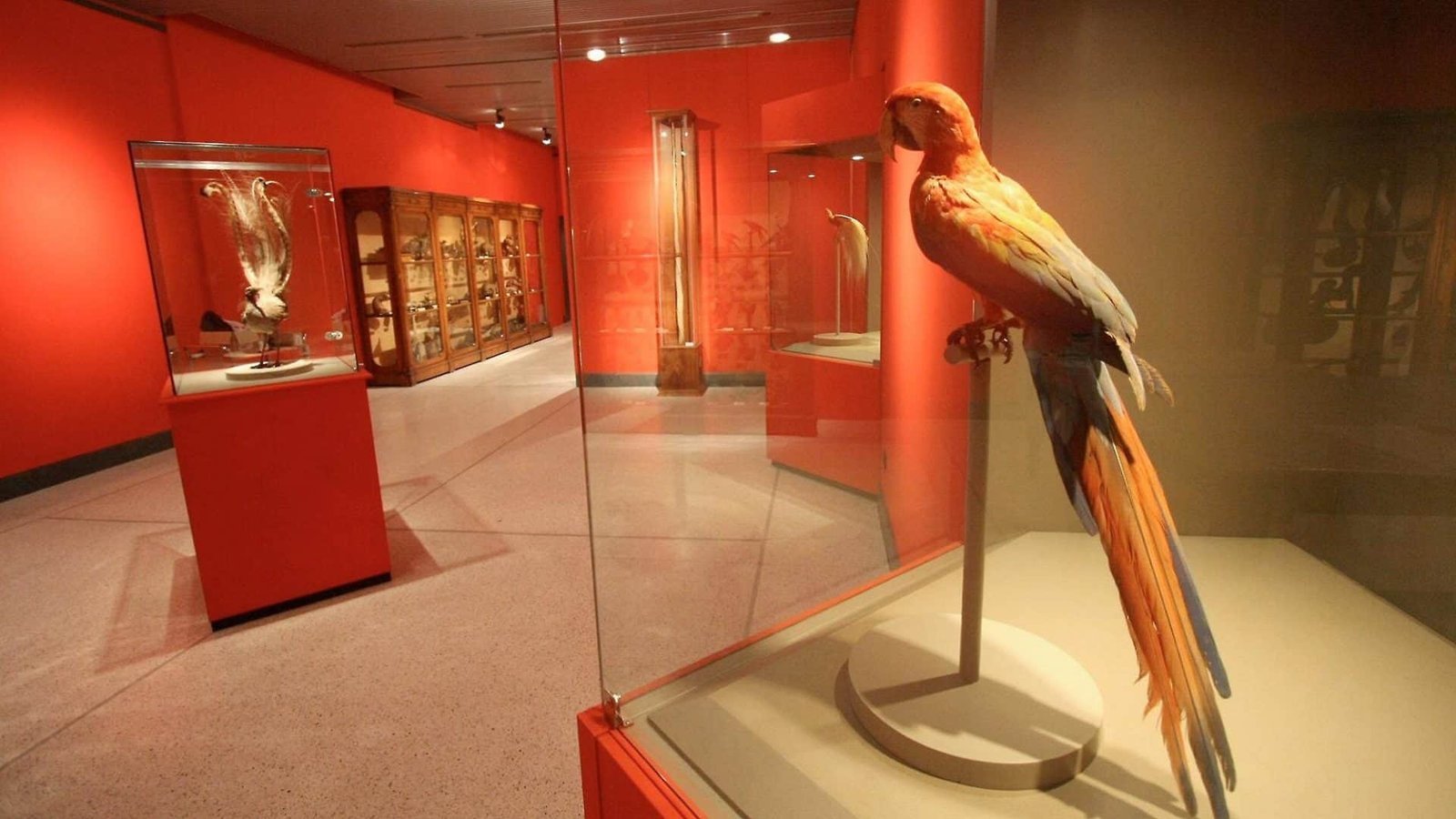
The ornithological section is historically the institution's flagship, and the numbers confirm it: about 16,000 specimens collected in Italy and in different regions of the world, with representatives of all orders. The most famous core is the collection of Count Ettore Arrigoni degli Oddi (1867-1942), the leading Italian ornithologist of his generation, author of the handbook that for decades was the bible of naturalists here in Italy: nine type specimens of the Roman collection come from him. Alongside are the university collections, the Vinci, Giaquinto and Loria collections, and the Chigi della Rovere collection, which carries the name of one of the Roman patrician families most tied to ornithology. Among the preserved material the museum also counts a specimen of the great auk, the North Atlantic seabird that went extinct around the middle of the 19th century: one of very few in the world, and one of those presences that alone justify the existence of a natural history museum.
Reptiles and amphibians
The herpetological collection includes about 6,500 specimens of amphibians and reptiles collected in Italy and in different countries of the world, with all orders represented and some type specimens. Most are preserved in liquid, in the glass jars that are the very image of the natural history museum, but dry, taxidermied preparations are not lacking. The material comes through three channels: the collections of the Istituto e Museo Zoologico of the Regia Università di Roma, those of the former Istituto di Zoologia "F. Raffaele" of Sapienza, and the private collections donated by Roman researchers and herpetologists. In the hall you see the mounted pieces. The bulk stays in storage, and that is where researchers go to look for the historical populations of a species to compare them with today's.
Invertebrates and shells
The section of displayed invertebrates is less spectacular and denser. The museum's malacological collections, that is, the mollusks, number about 2,800,000 specimens and over 400 types, and they are where this institution truly leads: very few European museums have a comparable shell collection. The entomological collections come close to a million specimens preserved dry, with over 500 types. The collections of marine and continental invertebrates amount to around 50,000 pieces, with about 190 types, almost all Mediterranean. In the display cases you see a minimal selection. The rest is laboratory material. The tip: stop in front of the Mediterranean shells and read the labels, because many give Roman and Lazio localities that are now ports, seafront promenades and bathing establishments.
The evolution hall and the origin of forms
The part of the route devoted to evolution and the appearance of animal forms is the key to reading everything else: here it is explained how the structural plans that we then find in the following halls derive from the first body organizations. Bilateral symmetry, segmentation, coelom, internal and external skeleton: these are abstract concepts, and the exhibit tries to make them tangible with models and reconstructions. It works halfway. Someone with a scientific background comes out enriched, someone without one risks skimming the captions without getting hooked. If you come with kids, this is the hall where it's better to explain out loud instead of reading.
The dioramas of the Museo civico di Zoologia
The dioramas are the most 19th-century part of the exhibit and at the same time the best loved: environments reconstructed to scale with the animals mounted in the pose and the context in which they live, painted backdrops, vegetation, ground. They are a very powerful teaching tool, because they restore the relationship between the animal and its environment that the isolated display case erases. They are also, openly, a fiction: the pose is chosen, the scene is composed, the lighting is theatrical. Look at them knowing you are looking at a painting, not a photograph, and they will give you twice as much.
The collections you don't see: the biodiversity archive
Here is the real reason this museum exists, and it doesn't concern the public. The part on display is a tiny fraction of the holdings: the overwhelming majority of the specimens is kept in equipped storerooms, available to researchers who make a reasoned request, and goes into the display cases only on particular occasions. A natural history museum is first of all an archive, and this one is eminently so.
What a type specimen is, and why it matters
The technical word is "type." When a zoologist describes a new species, he must designate a physical specimen that will carry the name forever: that individual, kept in a museum and accessible to the scientific community, is the reference everyone will return to in order to check if another animal belongs to the same species or not. Types are not beautiful objects, they are the legal objects of science. The Museo civico di Zoologia keeps over 400 among the mollusks, over 500 among the insects, about 190 among the invertebrates, nine among the birds of the Arrigoni degli Oddi collection, and some among amphibians and reptiles. Every time a taxonomist, in Tokyo or Berlin, has a doubt about one of those species, the answer is in a drawer on Via Aldrovandi.
The malacological collections
They are the most imposing part by far: about 2,800,000 specimens, over 400 types, and particular attention to the marine mollusks of the Mediterranean, alongside marine and continental material of worldwide provenance. The material comes partly from the Museo Zoologico of the Regia Università di Roma, partly from later purchases and donations. The names of the historical collections are a piece of the history of Italian scientific collecting: Monterosato, Rigacci, Settepassi, Piersanti, Meli, Pizzini, Boemi-Ghislandi, Blanc and Baschieri, besides the type collection. The collection of the Marquis of Monterosato, the great Sicilian malacologist, is the one that alone makes the difference, and it in turn includes the Brugnone material.
The entomological collections
About a million specimens preserved dry, from all the biogeographic regions of the planet, with almost all the orders of insects represented and over 500 types. The collections have proper names: the Luigioni Coleoptera and the Rasetti Coleoptera, the Lepri and Biegeleben Hymenoptera, the Picco Hemiptera, the Riera Lepidoptera, the Pozzi collection, the Cassola Cicindelidae, the Coleoptera of the southern hemisphere, and then the Diptera, the Odonata and the Orthopteroids. Whoever holds an entomological box from 100 years ago holds an environmental document: the labels say where and when that species lived, and the comparison with today measures the transformation of the territory better than any report.
The osteological collections
About 1,600 skeleton specimens of mammals, birds, reptiles and amphibians. The provenance divides into two eras: the pieces from the late 19th and early 20th century come from the Istituto di Zoologia of the Regia Università di Roma, while from 1932 onward the bulk comes from animals that died in the former Giardino Zoologico di Roma. Current additions come from the recovery of wildlife in the territory, in particular reptiles and marine mammals. The museum calls this collection unique of its kind in Italy, and that is not press-office bragging: an osteological series this large, with sections devoted to primates and cetaceans, allows comparative studies that cannot be done elsewhere in Italy.
The ornithological, herpetological, ichthyological and invertebrate collections
16,000 birds, 6,500 amphibians and reptiles, 50,000 invertebrates, plus the ichthyological collection: these are the numbers that complete the picture. Adding up the sections declared by the museum gives around 4 million specimens, while the figure that circulates in popular presentations is 5 million: the difference depends on how the lots of small invertebrates are counted and on materials not yet inventoried. The substantial point doesn't change: it is one of the largest zoological repositories in the Mediterranean, included by the Ministry in the list of scientific museums of national importance.
Research, the tissue bank and the curators
Behind the display cases work curator zoologists who inventory, preserve and expand the collections through field campaigns, donations and purchases. Modern work doesn't stop at skin and bone: from a fresh specimen, tissue samples are taken which, stored at very low temperature, allow DNA to be extracted even decades later. It is the reason a natural history museum is worth more today than yesterday: the same collection that in the 19th century served to compare forms now serves to compare genomes, to reconstruct vanished populations, to date the arrival of alien species. A drawer full of shells from 1880 is a genetic time machine, and nobody notices as they walk down the hallway.

The taxidermy museum today: what holds up and what doesn't
On this point it's best to be blunt and not beat around the bush. The museum of stuffed animals is an exhibition model born in the 19th century for a society that had no color photography, no cinema, no documentaries, no internet. The only way to show a Roman kid what a leopard looked like was to put a dead, mounted leopard in front of him. That need doesn't exist anymore. Anyone can watch a live leopard hunting in high definition in three seconds.
It follows that the demonstrative function of taxidermy is over. What isn't over, and has actually grown, is everything else: the documentary value of a dated, localized specimen, its genetic value, its comparative value. A mounted animal doesn't compete with a documentary and shouldn't. It's a historical document, like a parchment. The problem, if anything, is that many Italian natural history displays keep presenting specimens as if they were still a window onto living nature, and not what they have become, that is, relics of a history of science.
Then there's a question that can't be avoided, and it concerns provenance. A substantial part of the historical specimens in this museum and in almost all European museums comes from sport hunting, from colonial expeditions, from exchanges among collectors of an era in which taking down a rare animal was a merit. That's a fact, not a retroactive accusation: those people worked with the scientific morals of their time. But a museum that displays a snow leopard in 2026 has a duty to say where it comes from, when it was killed and why that species is protected today. The Museo civico di Zoologia does this in part, and it's the aspect where the display could grow the most.
The right way to visit it, then, is to read it on two levels at once. The first level is zoological: forms, adaptations, kinship. The second is historical: who collected these animals, when, by what means, for what idea of science. Whoever walks in with this double lens comes out with twice as much. Whoever walks in expecting an aquarium or a theme park comes out disappointed, and he's right: it's not that, and it doesn't have to be.
How to visit the Museo civico di Zoologia: duration and route
The museum isn't big, and that's good news. A careful visit to all the rooms takes between an hour and an hour and a half. With small children who stop at every display case it easily stretches to two hours. Whoever only wants the skeleton hall and the whale gets through it in 40 minutes. The route is linear and doesn't require a reservation: you buy your ticket at the desk and go in.
The order I recommend is counterintuitive. Many people head straight for the skeleton hall, stand there open-mouthed and then cross the rest with their attention already used up. Do the opposite: start with the thematic rooms, take your time on adaptations and reproduction, and get to the skeletons last. The final view is worth more if you already have the tools in your head to read it, and leaving with that image is better than leaving with the image of a display case of shells.
The Museo civico di Zoologia with kids
It's one of the Roman museums that works best with kids, and I say that with a note about ages. Under four, the visit boils down to a tour among big animals: fun, but there's no understanding. Between five and seven it starts to really work, because the scale of the animals and the strangeness of the forms catch their attention and the questions come on their own. Between eight and 11 is the ideal moment: you can explain adaptation, kinship among species, the difference between a mammal and a reptile, and the dioramas become stories. From 11 up, interest depends a lot on how you guide them. A kid left alone in front of an insect display gets bored in 30 seconds, while the same kid, told that those labels say where that butterfly lived in 1912, stops and looks.
An honest warning for parents: here the animals are all dead, and the more sensitive kids notice and ask. It's best to arrive prepared and simply answer with the truth, which is that they're dead animals preserved so they can be studied. Anyone looking for live animals has the Bioparco di Roma (Rome Zoo) 200 meters away, and combining the two in one day is one of the best things Rome offers families.

Education, workshops and schools at the Museo civico di Zoologia
The educational activity is one of the reasons this museum is alive. The offerings for schools are part of the "Patrimonio in Comune" catalog of the Sistema Musei di Roma Capitale, reserved for students and teachers of schools of every level in Rome and across the whole country: guided visits to the permanent collections and temporary exhibitions, itineraries in the city, readings of works, workshops. The catalog can be consulted on the dedicated portal scuole.museiincomuneroma.it, where you'll also find the updated booking procedures.
Alongside the programs for classes, the museum offers meetings with its specialists, which are the most successful formula of its educational program. Spending half an hour with an entomologist who opens a box of beetles and explains how a specimen is prepared is worth more than 10 generic guided tours. Among the 2026 offerings there's also "Gli animali a portata di mano," a tactile and sensory program available on request all year round.
Temporary exhibitions at the Museo civico di Zoologia
Alongside the permanent collections, the museum runs a program of temporary exhibitions, generally with a natural history or photographic focus, and takes part in the big Sistema Musei initiatives. The best-attended annual event is the Notte dei Musei. In the 2026 edition, on May 23, the rooms stayed open from 20.00 to 2.00 with last entry at 1.00, at the symbolic price of 1 euro for residents of Rome and the Metropolitan City and 2 euros for non-residents, free for MIC card holders, with a theater and music performance devoted to the relationship between humans and nature. The calendar of current exhibitions and events can be checked on the official website, which also publishes notices of partial room closures.
Accessibility at the Museo civico di Zoologia
The museum declares wheelchair accessibility and offers dedicated projects, including services for blind and visually impaired people and tactile routes such as "Gli animali a portata di mano." One practical circumstance has to be pointed out, though: the internal elevator is currently out of service for the time being, and this may affect access to some levels. Anyone with specific needs does well to call 060608 before leaving and have the situation for that day confirmed.
When to go to the Museo civico di Zoologia
The best time is a weekday morning, right after the 9.00 opening, when the school groups haven't arrived yet. The worst time is a weekday morning in mid-November or mid-March, when the school groups are all there at once. The museum gets extremely loud and the small rooms clog up. On weekends attendance goes up but stays manageable, and on Sunday afternoon, after 16.00, you walk around almost alone.
Seasonally, this is one of the rare Roman museums that makes sense in both summer and winter, for opposite reasons. In summer because you stay cool a couple of steps from the avenues of Villa Borghese, in winter because it's an hour and a half indoors that fits well into a short day. In August, when half of Rome is closed, it stays open on its usual schedule. It's one of the few things you can do in the city without standing in line.
What's around the Museo civico di Zoologia
Few Roman museums have such a rich surrounding area within a 10-minute walk. The quadrant between Villa Borghese and Valle Giulia concentrates a density of cultural institutions that in other cities would be enough for a whole neighborhood.
The Bioparco
It borders the museum, and the combination is the natural one: live animals on one side, the history of animals on the other. The Bioparco is the old Zoological Garden opened in 1911, now converted into a conservation and environmental education facility. For a family with kids between five and 10, the double bill is the perfect day, as long as you put the zoo in the morning and the museum after lunch, when legs ask to be indoors.
Villa Borghese and its places
The park around it is worth a walk in itself: the Giardino del Lago, Piazza di Siena, the Giardini Segreti di Villa Borghese near the Palazzina, the Casa del Cinema with its summer arena. For the youngest kids there's the Casina di Raffaello, the municipal play center inside the park, and a short distance away, on via Flaminia, Explora il Museo dei Bambini di Roma.
Valle Giulia: Villa Giulia and the Galleria Nazionale
Heading down toward viale delle Belle Arti, in 10 minutes you reach the Museo Etrusco di Villa Giulia, the largest museum in the world devoted to Etruscan civilization, housed in the 16th-century villa of Pope Julius III. Across from it, the building by Cesare Bazzani houses La Galleria Nazionale, with Italian art of the 19th and 20th centuries. These are two institutions that have nothing to do with zoology, and that, lined up in the same day, show how much this corner of the city was designed as a district of culture between the 19th and 20th centuries.
The Galleria Borghese
On the other side of the park, a quarter of an hour's walk away, is the Galleria Borghese, with the Berninis and Caravaggios of Cardinal Scipione's collection. Careful, though: there, entry is limited by time slots and booking is mandatory, so you plan it first and build the rest of the day around it, not the other way around.

A curiosity about the Museo civico di Zoologia
In a drawer on via Aldrovandi lives a mouse with a Roman name. It's called Fukomys ilariae, it belongs to the family Bathyergidae, the African burrowing rodents known as mole-rats, and it's a type specimen of the museum's theriological collection. Put like that, it sounds like a catalog note. In reality it's the most demanding thing a natural history museum can safeguard.
When a zoologist realizes he or she is holding a never-described species, there are two things to do: publish the description and deposit in a public museum the individual on which the description is based. That individual becomes the holotype, the official bearer of the name. From that moment on, forever, anyone in the world who wants to know exactly what that scientific name means must be able to go back to that physical specimen. Not to a photograph, not to a drawing, not to a DNA sequence: to the animal. The museum that keeps it takes on a perpetual obligation toward the international scientific community.
The Museo civico di Zoologia has more than 1,200 obligations of this kind, adding up the types of its different sections: more than 400 among the mollusks, more than 500 among the insects, about 190 among the invertebrates, nine birds of the Arrigoni degli Oddi collection, some amphibians and reptiles, and that African rodent. It means that every year study requests arrive here from foreign universities and museums, and that the staff prepare the pieces, document them, and sometimes ship them out on loan with the precautions used for works of art.
Here's the real curiosity, the one you don't read on the captions: the scientifically most important piece in this museum isn't the 16-meter whale that everybody photographs. It's a 20-centimeter rodent shut in a container, which no visitor will ever see, and without which a scientific name would lose its anchor in the real world.
Something nobody tells you about the Museo civico di Zoologia
Many of the skeletons you admire in the hall belong to animals that lived 200 meters away, behind the wall of the zoological garden. The museum's documentation says it openly: from 1932 on, the osteological collection grew above all thanks to animals that died in the former Zoological Garden of Rome. The elephant looking down at you, in all likelihood, spent its adult life in the enclosure next door, in front of generations of Roman kids.
It's information that changes the meaning of the visit. The museum is not only the repository of faraway expeditions and colonial hunts. It is also, materially, the memory of its next-door neighbor. Every animal that died at the zoo, instead of vanishing, crossed to the other side of the wall and became an anatomical document. It continues today in different forms: current additions to the collection come above all from the recovery of wild fauna in the area, in particular reptiles and marine mammals, that is, animals found dead in the Lazio countryside or stranded on the coasts.
The practical consequence is that rooms that seem unchanged for 90 years are in fact constantly updated, but below the level of the visible. The skeleton of a sea turtle recovered on the Fiumicino coast now enters a series that in 20 years will make it possible to measure plastic ingestion, growth, the spread of the species. The museum works as a very long-term monitoring station, and nobody tells the visitors.
A useful observation: look at the labels and look for the dates. When you find a specimen with the collection date and the locality, you have in front of you a certified environmental data point from that day and that place. It's the only form of proof biology has about the past, and it all sits in pen handwriting on a yellowed card.
The advice I give you for visiting the Museo civico di Zoologia
The most useful advice concerns the mindset you walk in with, as already mentioned: read the museum on two levels, the zoological one and the historical one. But here I'll add three practical points, which apply to the actual day.
The first: if you live in Rome or the Metropolitan City, since February 2026 you get in free with your ID card, and this should be used the right way. Stop thinking of it as a single, total visit. Go four times a year for 40 minutes, one section at a time, maybe fitting it into a walk in Villa Borghese. A science museum digested in small doses stays in your head much longer than a two-hour marathon done once.
The second: bring something to read on the shoulders of others, that is, a minimum of preparation. Five minutes to understand what homology means, and the skeleton hall stops being a stage set and becomes an argument. Five minutes on what a type specimen is, and the insect displays stop being pins and become documents. This museum gives back exactly in proportion to what you bring to it.
The third, the most concrete: arrive at the 9.00 opening on a weekday and ask at the ticket office whether there are booked classes. If there are three, come back another day. It's not snobbery, it's acoustics: the rooms are relatively small and tall, the reverberation is considerable, and with two school groups going around you can't even hear what the person next to you is saying. The Museo civico di Zoologia visited in silence and the Museo civico di Zoologia visited among 70 kids are two different experiences, and one of the two isn't worth the trip.
Another well-known fact, yet rarely cited
That the museum was founded in 1932 is written by everyone. Almost nobody adds the important thing, which is that 1932 is the date of an administrative move and not of a cultural birth. The collections that became municipal that year were already more than a century old, and came from an institution that is hard even to imagine today: the scientific museum of the popes.
The sequence is documented. In 1804 Pius VII established the chair of Natural History and Mineralogy at the Archiginnasio romano. In 1824 that chair gave rise to the Museo del Gabinetto di Zoologia e Zootomia, a collection both for teaching and for research. In 1853 Pius IX granted it autonomy, a director, Luigi Metaxà, and its own premises in the Palazzo della Sapienza, the 18th-century building between corso del Rinascimento and piazza Sant'Eustachio that today houses the Archivio di Stato. After 1870 the institution passed to the Regia Università, and in 1883 Antonio Carruccio (1839-1923) arrived from Modena, directed it until 1914 and made it a museum of European standing.
Then the 20th century scrambled everything: in 1914 Federico Raffaele founded the Zoology Institute at Palazzo Carpegna, between 1920 and 1927 the institute found shelter right inside the Zoological Garden of Villa Borghese, then moved to the Policlinico. In 1932 the agreement between University and Municipality separated their destinies: the museum collections stayed at Villa Borghese and became the Museo civico di Zoologia, while the university institute went its own way and in 1971, with Pasquale Pasquini (1901-1977), arrived at the viale dell'Università site.
The rarely cited fact, then, is this: a good part of the animals you see on via Aldrovandi passed through the hands of naturalists who worked under the papal government, in a Rome where natural history was a court discipline. The municipal museum invented nothing in 1932. It inherited, and it had the merit of not dispersing.
The right photo to take at the Museo civico di Zoologia
The obvious photograph is the whale framed from the side, in full, from the back of the room. Everyone takes it, nobody pulls it off. 16 meters of skeleton inside a closed room almost never fit in the frame without distortion, and the typical result is a muddled image in which you can't make out either the scale or the subject.
The right photo is a different one, and it requires getting closer. Stand under or beside the rib cage, with a wide-angle lens pointed along the line of the ribs. The rhythm of the bones repeating and shrinking toward the back builds the perspective on its own, and in an instant you read the size of the animal without having to show all of it. If you manage to get a person into the frame, even a small, blurry one, you have the scale and you have the photo.
The second shot I recommend is vertical, and it's the neck of the giraffe in the skeleton hall: seven vertebrae, exactly like ours, each as long as a forearm. Shoot them from below, in portrait orientation, with the ceiling of the hall closing the top. It's an image that explains an anatomical concept better than a caption.
Technically: no flash, always, both because of the rules and because it flattens the subject and produces reflections on the glass. The rooms are lit theatrically and unevenly, so raise your sensitivity without fear. 800 or 1,600 ISO on a recent sensor does no harm. Lean against a post or a display case to steady yourself. On glass, bring the lens almost up to it and tilt it very slightly, and the reflections disappear. And if you're photographing a diorama, leave out the frame: the painted backdrop only works if you can't see where it ends.
Some important events that happened here in history
The chronology of this place is made of administrative steps that look like bureaucracy and are in fact decisions of fate for hundreds of thousands of objects.
The first event is the shelter of the 1920s. Between 1920 and 1927 the Zoology Institute of the University of Rome, left without adequate premises, was hosted inside the Zoological Garden of Villa Borghese, inaugurated in 1911. It's in those seven years that the physical bond between Roman academic zoology and this corner of the park was sealed, and everything else would be born from that bond.
The second, and the most important, is the 1932 agreement between the University and the Municipality of Rome. The museological collections, that is, the preserved specimens, were transferred to the new municipal institution set up next to the zoo, while the university institute went its own way. The separation between the museum and the laboratory, which seems obvious today, was a cultural policy choice at the time. It meant recognizing that a natural history collection has an autonomous public value apart from university teaching.
The third event is the arrival, in the middle decades of the 20th century, of the African material from the former Italian colonies, which ended up here through the ISIAO. It's a chapter that has to be named for what it is: Italian natural history of those years was also an instrument and a product of colonial expansion, and the animals that bear its mark are in the mammal rooms.
The fourth is the adoption, in recent times, of the new exhibition layout built around biodiversity, which replaced the traditional systematic arrangement with a thematic route over more than 1,000 square meters, with multimedia and multisensory stations. It's the moment when the museum stopped presenting itself as a collection and started presenting itself as an argument.
The fifth is very recent and concerns those who live here: since February 2026 admission has been free for residents of Rome and the Metropolitan City. It looks like a fare measure, and yet it's the decision that more than any other can change the relationship between the city and this museum.
Who has passed through the Museo civico di Zoologia
The names that matter in a natural history museum aren't those of illustrious visitors but those of the collectors: the people who spent their lives searching, cataloging and preserving, and whose surnames are written today on the cabinets.
The first is Luigi Metaxà, director of the Zoology Museum when Pius IX made it autonomous in 1853. He's the man with whom Roman zoology leaves its dependence on the chair and becomes an institution. The second is Antonio Carruccio (1839-1923), who arrived from Modena in 1883 and held the post until 1914. He set up a program of growth of the collections and permanent teaching to which the current size of the historical collections is due. Then come Federico Raffaele, founder of the Zoology Institute in 1914, whose name remains tied to part of the herpetological material, and Pasquale Pasquini (1901-1977), who in 1971 ended the university institute's long wandering by bringing it to its final site.
Among the collectors, the most famous is Count Ettore Arrigoni degli Oddi (1867-1942), the leading Italian ornithologist between the 19th and 20th centuries, author of the handbook that trained generations of naturalists. Nine type specimens of the Roman ornithological section come from his collection. Next to him is the Marquis of Monterosato, the Palermo malacologist whose shell collection, with the Brugnone material inside, makes up by itself the core of almost 3 million specimens that makes this museum a Mediterranean reference point. And then the Chigi della Rovere, a Roman patrician family tied to ornithology, and the names that recur in the entomological boxes: Luigioni for beetles, Lepri and Biegeleben for Hymenoptera, Picco for Hemiptera, Riera for Lepidoptera, Rasetti again for beetles, Cassola for tiger beetles, and the Pozzi, Baschieri, Chimenz, Starkoff, Brunelli, Berlinguer collections among the invertebrates.
These are the surnames of scholars, aristocrats, doctors, officials, who over the span of two centuries built piece by piece a heritage that none of them could have put together alone. The Museo civico di Zoologia is the sum of their private obsessions, turned into a public good. Put another way: those who have passed through here, in the true sense, are them, and they have never left.
Quick questions about the Museo civico di Zoologia
How much does a ticket to the Museo civico di Zoologia cost?
The full-price ticket costs €10.50 and the reduced ticket €5.50. A presale fee of €1.00 applies to online advance purchase. The categories provided for by the current fare schedule of the Sistema Musei di Roma Capitale remain free.
Is it true that Rome residents get in free?
Yes. Since February 2026 admission has been free for those who live in Rome and the Metropolitan City, by showing an ID card at the desk. That's the reason it's worth treating it as a neighborhood museum to visit several times, instead of a single stop.
What are the opening hours of the Museo civico di Zoologia?
Open Tuesday to Sunday from 9.00 to 19.00, with last entry one hour before closing, so at 18.00. On December 24 and 31 the hours are reduced to 9.00-14.00.
When is the Museo civico di Zoologia closed?
It closes every Monday, on May 1 and on December 25. For other holidays and any partial closures of rooms, it's best to check the notices page on the official website before setting out.
Do you need to book to visit the Museo civico di Zoologia?
No, not for an individual visit: you buy your ticket at the desk and go in. Booking is required for groups of 11 to 25 people plus a guide, and it's free at 060608 with the advance purchase of at least five tickets.
Where do you buy tickets for the Museo civico di Zoologia?
Online on the Musei in Comune circuit, by phone by calling 060608, or directly at the museum ticket office. Purchase at the desk for the same day is done in cash or by card and does not include the presale fee.
Is the MIC card valid at the Museo civico di Zoologia?
Yes. The MIC card costs €5, lasts 12 months and is reserved for those who live or study in Rome. Holders collect the free entry ticket at the ticket office or by calling 060608, and get discounts on paid exhibitions.
How long does a visit to the Museo civico di Zoologia take?
An hour and a half for a careful visit to all the rooms, a good two hours with small children who stop everywhere, 40 minutes for those who only want the skeleton hall and the whale.
Where exactly is the Museo civico di Zoologia?
At Via Ulisse Aldrovandi 18, 00197 Roma, on the edge of Villa Borghese toward the Parioli, next to the Bioparco.
How do you get to the Museo civico di Zoologia by public transportation?
By trams 3 and 19 along via Aldrovandi, stopping at the Bioparco. By subway you get off at Flaminio, line A, and continue by tram or on foot along viale delle Belle Arti. From Porta Pinciana it's about 15 minutes on foot through the park.
Is the Museo civico di Zoologia suitable for kids?
Very much so, especially between five and 11. Under four it stays a tour among big animals, pleasant but without understanding. From 11 up, almost everything depends on how you guide them.
Are the animals at the Museo civico di Zoologia real?
Yes: they're real animals, dead and preserved, mounted with taxidermy techniques or reduced to a skeleton. With the more sensitive kids it's best to say so beforehand, because the question always comes and the honest answer works better than any roundabout phrasing.
What's the difference between the Museo civico di Zoologia and the Bioparco?
The Bioparco is the zoological garden, with live animals. The museum preserves and displays dead animals, skeletons and scientific collections. They border each other and complement each other: the zoo shows behavior, the museum shows structure and history.
Can you take photos at the Museo civico di Zoologia?
Yes, for personal use and without flash. Flash is forbidden and in any case counterproductive, because it flattens volumes and reflects off the glass of the display cases.
Is the Museo civico di Zoologia wheelchair accessible?
The museum declares accessibility and offers dedicated projects, but at the moment the internal elevator is temporarily out of service. Anyone with mobility needs does well to call 060608 and have the situation confirmed the day before leaving.
Are there routes for blind or visually impaired people?
Yes. Among the 2026 offerings is "Gli animali a portata di mano," a tactile and sensory route available on request all year round.
How many specimens does the Museo civico di Zoologia hold?
Adding up the declared sections gives around 4 million specimens: about 2,800,000 mollusks, about a million insects, 50,000 invertebrates, 16,000 birds, 6,500 among amphibians and reptiles, 1,600 skeletons, 800 mammals, plus the ichthyological collection. Popular presentations often give the figure of 5 million.
What is a type specimen?
It's the physical individual on which the description of a new species is based and which carries its name forever. The museum holds more than 1,200 across all sections, and for this reason it receives study requests from all over the world.
How long is the whale at the Museo civico di Zoologia?
The museum's presentation gives a length of around 16 meters. It's the largest object on display and the reason almost all visitors remember the skeleton hall.
Can you visit it together with the Bioparco on the same day?
Yes, and it's the best combination for a family. The practical advice is to put the zoo in the morning, when the animals are more active and legs hold up, and the museum after lunch, indoors.
Are there temporary exhibitions at the Museo civico di Zoologia?
Alongside the permanent collections, the museum runs a program of exhibitions and takes part in the Sistema Musei initiatives, starting with the Notte dei Musei in May. The updated calendar can be checked on the official website.
What happens at the Notte dei Musei?
In the May 23, 2026 edition the museum stayed open from 20.00 to 2.00, with last entry at 1.00, at a price of €1 for residents of Rome and the Metropolitan City and €2 for non-residents, free with the MIC card, and with a theater and music performance on the relationship between humans and nature.
Does the museum organize activities for schools?
Yes. The offerings are part of the "Patrimonio in Comune" catalog of the Sistema Musei di Roma Capitale, open to schools of every level in Rome and all of Italy, and include guided visits, itineraries and workshops. The catalog can be consulted on the portal scuole.museiincomuneroma.it.
What is the best time to go to the Museo civico di Zoologia?
A weekday morning right after opening, or Sunday afternoon after 16.00. Avoid mid-November and mid-March mornings, when school groups concentrate and the rooms get loud.
What can you see in the surrounding area?
The Bioparco borders the museum. Villa Borghese surrounds it with the Giardino del Lago, Piazza di Siena, the Giardini Segreti and the Casina di Raffaello. 10 minutes toward Valle Giulia are the Museo Etrusco di Villa Giulia and La Galleria Nazionale. A quarter of an hour away on the other side of the park is the Galleria Borghese, which however requires mandatory booking.
Is it worth it for an adult without kids too?
Yes, on one condition: go in knowing you're looking at a historical museum of science, not a three-dimensional documentary. Whoever has this key comes out enriched, whoever expects a show comes out disappointed.
Farewell to the Museo civico di Zoologia
It's wise to distrust museums that everyone likes at first sight. This one isn't liked by everyone, and that's exactly why I defend it. It's an uncomfortable place, full of animals killed by people who believed they were doing good for knowledge, and at the same time it's one of the most important biological archives in the Mediterranean, with a million insects in drawers nobody sees and almost 3 million shells waiting for the right researcher. Go without expecting easy wonder and with the desire to understand how knowledge is built. It's the only way €10.50, or zero if you live here, are well spent. And stop under the whale for at least five minutes, in silence. It's not often you get to stand under the ribs of a 16-meter animal.
Article written by the editorial team of TourLeaderPro, contact them for Private/Corporate/V.I.P. Tours and Experiences.
Planning a trip to Rome? The English-language guides to visiting the city are on ItalyPlanner.com.