Casina di Raffaello
In short. You find the Casina di Raffaello in the heart of Villa Borghese, in Rome, at the address Viale della Casina di Raffaello 19, in the Pinciano district, a stone's throw from the upper part of Via Veneto and from the Pincio terrace.

Where the Casina di Raffaello is
You find the Casina di Raffaello in the heart of Villa Borghese, in Rome, at the address Viale della Casina di Raffaello 19, in the Pinciano district, a stone's throw from the upper part of Via Veneto and from the Pincio terrace. It's one of those corners of the park that people without kids often cross without noticing, and which for thousands of Roman families is instead a precise point of reference. It's best to get there on foot, walking up from the Porta Pinciana area: a few minutes' walk among the pines and holm oaks and you find yourself in front of a low, elegant building immersed in greenery, which seems made on purpose for the scale of the very young.
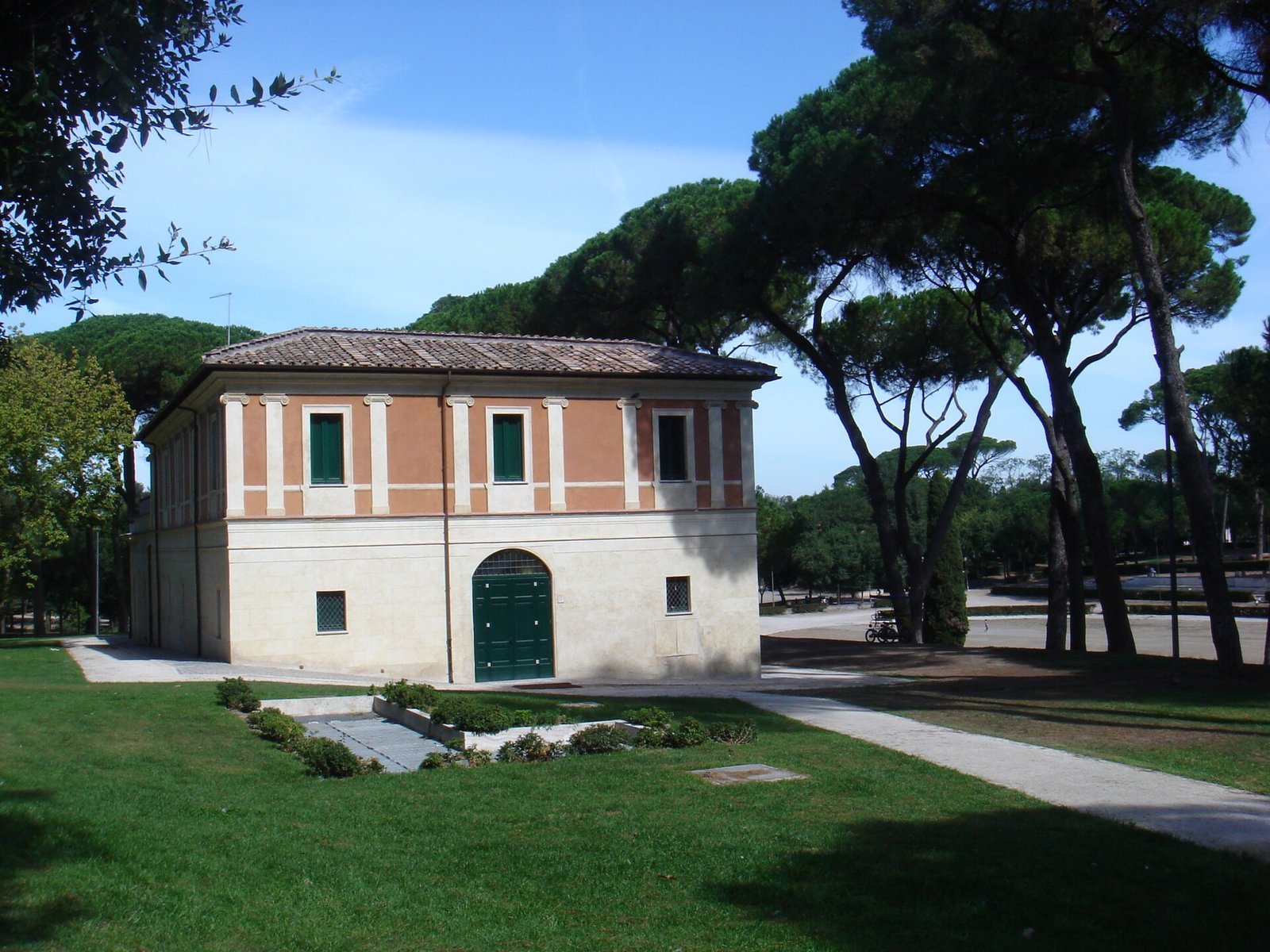
The location of the Casina di Raffaello is its first great stroke of luck. Villa Borghese is the most beloved historic park in the city, a good 80 hectares of tree-lined avenues, clearings, fountains and architecture, and the Casina sits right in the central stretch, near Piazza di Siena, the little lake and the Giardino del Lago. This means a visit here is never an isolated event: it's the start or the end of a day outdoors, inside one of the most beautiful green lungs in Europe. For those with small kids there is a rule: you don't go to the Casina di Raffaello only for what's inside, but for what surrounds it.
From a practical point of view, the building can be reached from the main entrances of Villa Borghese. From Porta Pinciana, at the top of Via Veneto, you enter the park and in about 10 minutes on foot you are in front of the Casina di Raffaello. Those coming from the Pincio, after enjoying the view over Piazza del Popolo, can cross the inner avenues and descend toward the center of the villa. Also from Via Pinciana, on the Galleria Borghese and Bioparco side, the distance is short. It's a place meant to be approached slowly, at kid pace, without hurry.
It's worth remembering that the address itself carries the name of the place: Viale della Casina di Raffaello. It's a detail that says a lot, because it means the building gave its name to the road that crosses it, a sign of how rooted it is in the toponymy of the park. When you look for directions inside Villa Borghese, keep this in mind: asking about the Casina di Raffaello of those who frequent the garden is almost always more effective than relying on generic maps, because it's a reference point known to all Roman parents. And once you've found the avenue, the building is there, recognizable, immersed in its greenery.
Why it's called Casina di Raffaello
A clarification is needed right away, because it's the most frequent question: the Casina di Raffaello has, as far as is documented, no real and proven link with Raphael Sanzio, the great painter from Urbino of the Renaissance. The name belongs to tradition, not to certain history. It's one of those names that in Rome are handed down from generation to generation, settle into the toponymy of the park and end up becoming "true" in common use, even when the archive papers don't confirm them.
Careful, then, not to build castles on fragile foundations. There is no evidence that Raphael lived here, or painted here, or that this building is directly tied to his figure. The villa and its gardens were born in the 17th century by the will of the Borghese family, a century after the painter's death, which occurred in 1520. The chronology alone is enough to dismantle the most fanciful legends. When someone tells you "Raphael's studio was here", you can smile and take the story for what it is: a nice popular tale, not a fact.
Why this name, then? The hypotheses are several and none is definitive. Some link the name to a generic cultural homage, typical of the 18th- and 19th-century taste for naming garden pavilions and casini after great names of the arts. Some trace it back to decorative suggestions or to an oral memory now lost. The honest truth is that the Casina di Raffaello bears a beautiful, mysterious name, and its charm lies partly in this small fog. I like it this way: a place dedicated to children that bears the name of the "gentlest" painter of the Renaissance, with no need for notarial proof.
Villa Borghese, the setting of the Casina di Raffaello
You can't understand the Casina di Raffaello without understanding Villa Borghese, because the first is the child of the second. Villa Borghese was born in the early years of the 17th century by the will of Cardinal Scipione Borghese, nephew of Pope Paul V, one of the great collectors and patrons of Baroque Rome. Scipione wanted a "villa of delights" at the gates of the city, a place to unite tamed nature, art and aristocratic otium. Thus were born geometric gardens, groves, fountains, ancient statues and the famous casino nobile that today houses the Galleria Borghese.
For centuries the villa remained the family's private property, which enriched and transformed it following the fashions of the time. The most visible turning point came at the end of the 18th century, when Marcantonio IV Borghese had large portions of the park redesigned according to the taste of the "English" garden, with soft lawns, little lakes, small temples and romantic fake ruins. It's in that season of great landscape works that the park takes on much of the face we still know today, made of winding avenues and architectural surprises scattered in the greenery. The Casina di Raffaello belongs to this world of small architectures immersed in the garden.
The great passage from private to public ownership happened at the beginning of the 20th century: the State bought the villa and its extraordinary collection, and in 1903 the park was transferred to the Municipality of Rome, which opened it to the citizens. Since then Villa Borghese belongs to everyone, and this is perhaps its deepest revolution: a garden born for the pleasure of a cardinal has become the green space of the Romans, of children learning to ride a bike, of lovers on the boats of the little lake, of families looking for shade in August. The Casina di Raffaello, as a space dedicated to childhood, is the natural continuation of this popular and generous vocation.
The history of the Casina di Raffaello, a building to read with caution
I'll be honest with you, because it's the best way to tell the story of the Casina di Raffaello: the documented history of this specific building is scarce and fragmentary. There is no great consolidated narrative, with certain dates and illustrious protagonists, as there is instead for the Galleria Borghese or for other major architectures of the park. Much of what circulates online is repetition of repetitions, and here only what can reasonably be sustained is reported, without filling the void with inventions.
What we can say with confidence is that the Casina di Raffaello belongs to the category of "casini" and garden pavilions that dot Villa Borghese: minor constructions, for service or leisure, conceived as architectural episodes within the park's great design. Buildings of this kind have often had long and changing lives, changing function according to eras and needs: storerooms, lodgings, spaces for the caretaker, rooms for small activities. It's a destiny common to many minor structures of historic gardens, and there is nothing belittling in it: these buildings are precisely what gives the park its intimate rhythm.
What matters, for today's visitor, is that this historic building found in the 20th century and in the new millennium a happy destination, consistent with the public spirit of Villa Borghese: that of a space dedicated to children. Instead of falling into ruin or becoming a forgotten warehouse, the Casina di Raffaello was given back to the city as a place of play, reading and learning. I prefer to tell you about this living continuity rather than a chronology I don't have. The stone here is the frame, the content is the voices of the children.
The Casina di Raffaello today, the play center of the Municipality of Rome
Today the Casina di Raffaello is, to all effects, the play center and children's space of the Municipality of Rome inside Villa Borghese. It is here that the true heart of the place lies: not a museum to cross in silence, but an environment designed for childhood, where kids can play, listen to stories, experiment, take part in workshops and visit small exhibitions created expressly for them. Anyone looking for a traditional tourist attraction may be thrown. Anyone who arrives with a child by the hand understands right away that they are in the right place.
Public management gives the Casina di Raffaello a particular character. It's not a commercial playground nor a private center: it's a cultural service of the city, with a curated program, designed for precise age groups and with an educational attention you can feel. Activities revolve around reading, play, manual creativity, the discovery of nature and art, always in a language suited to the very young. It's the kind of place a civilized city offers its families, and Rome does it here in its most beautiful park.
One detail I appreciate a lot is the coherence between container and content. The Casina di Raffaello is a kid-sized building, immersed in greenery, where the passage between inside and outside is fluid: you come out of the workshops and find yourself under the pines of Villa Borghese. This continuity between protected space and big open garden is exactly what a small child needs, who needs a sheltered place as much as the freedom to run. In this the Casina manages to be both nest and springboard.
There is also a social aspect not to be overlooked. The Casina di Raffaello is a meeting place for families, a place where parents swap advice, kids make new friends and that small informal community forms which revolves around public spaces dedicated to childhood. In a big and sometimes dispersive city like Rome, having a quality gathering point, free to enter and careful in its content, is a value that goes beyond the single activity. It's the kind of service that holds together the fabric of a neighborhood and a city, one afternoon at a time.
The workshops at the Casina di Raffaello
The real engine of the Casina di Raffaello is the workshops. They are structured activities, led by operators and educators, designed to stimulate kids' manual skill, imagination and curiosity. They change over the year and often follow the themes of current exhibitions, the seasons, the holidays: there is the workshop tied to autumn and the park's leaves, the one on colors, the one on illustrated stories, the one that interweaves art and play. The program is alive and has to be consulted each time, because it's designed never to repeat itself the same.
What distinguishes the workshops of the Casina di Raffaello is attention to age groups. The offerings are precisely calibrated: there are activities for the youngest, from two or three years, and others designed for school-age kids, up to about 10 or 11 years. This division isn't a formality: anyone who works with children knows that a successful workshop is one that speaks the right language to the right age, neither too simple nor too complex. At the Casina this measure is felt, and parents notice it by how their kids stay focused.
The advice is not to improvise: the workshops of the Casina di Raffaello often require booking and have limited places, precisely because quality depends on small numbers. It's worth checking the calendar in advance and securing a place, especially on weekends, when demand is high. A well-chosen workshop turns an ordinary Sunday into a memory, and kids come out with something in hand and something in their head: both count.
I also find the role of the operators precious. A workshop is not the sum of its materials, but the quality of who leads it: the ability to hold the attention of a group of kids, to adapt to their rhythms, to turn a small hitch into a chance for play. At the Casina di Raffaello this professionalism is perceptible, and it's what distinguishes a true educational activity from a mere pastime. The most attentive parents notice it right away and come back precisely for this, because they know their kids are in competent and passionate hands.
Readings and storytelling at the Casina di Raffaello
Alongside the workshops, the Casina di Raffaello devotes great space to reading and animated storytelling. For me it's one of the most precious things the place offers, because building readers from an early age is one of the greatest gifts you can give a child. Read-alouds, stories told with voice and body, illustrated books leafed through together: here all this is not filler, but a pillar of the educational offering.
The storytelling at the Casina di Raffaello is designed to be participatory. It's not about listening in silence to an adult reading, but about entering the story, answering, imagining, often extending the tale with a small related manual workshop. It's the best approach for today's kids, raised among screens and constant stimuli: here they rediscover the slow, deep pleasure of a story well told, which no device can replace.
I find it significant that this happens inside Villa Borghese, a park that is itself a great book of stories. Coming out of a reading at the Casina di Raffaello and finding yourself among the statues, fountains and centuries-old pines of the garden means passing seamlessly from the imagined story to the lived story. Children, who by nature don't separate fantasy and reality as we adults do, grasp this magic better than anyone.
If I may offer a suggestion to those with small kids: use the readings at the Casina di Raffaello as a starting point to continue at home. A picture book discovered here, a story listened to well, can become the bedtime book for weeks. The place, in this, sows more than it harvests in the immediate term: it builds habits, opens windows, ignites curiosities that sprout later, far from the park. It's the sign of educational work done well, the kind that doesn't end when the door closes but continues in the family's daily life.
Exhibitions for children at the Casina di Raffaello
The Casina di Raffaello regularly hosts exhibitions and installations designed specifically for kids. They are not miniature exhibitions for adults, but paths designed with the language, heights, timing and sensitivity of childhood. They often revolve around illustration, the picture book, the big themes of nature, seasons, emotions, and become the common thread around which workshops and readings are then organized. It's an intelligent way to make the whole ecosystem of the place turn around a shared theme.
The merit of these exhibitions is that they treat kids as a serious audience. Too often "for children" means dumbed down. At the Casina di Raffaello it means instead carefully thought out, with respect for the intelligence of the little ones. A six-year-old is capable of reading an image, grasping an atmosphere, asking questions: the Casina's exhibitions start from this trust and repay it. Parents, often, come out more amazed than their kids.
Here too the golden rule of the place applies: the program changes. The exhibitions at the Casina di Raffaello have a defined duration and alternate over the year, so it's always best to check what is on display in the period you intend to go. It happens that a particularly successful exhibition becomes the very reason for the visit, and that kids ask to go back. When that happens, you know you've found a good place.
Free play at the Casina di Raffaello
Not everything, at the Casina di Raffaello, is structured activity. There is also room for free play, the kind in which the child follows no program but explores, chooses, invents. It's a fundamental dimension of growth, the one in which the adult steps back and lets the child lead. In an age when the little ones' days are often hyper-organized, having a space where play can simply be play is a value not to be underestimated.
Free play at the Casina di Raffaello takes place in a designed and safe environment, where materials and spaces are selected with judgment. It's not the chaos of just any playground, but neither the rigidity of a classroom: it's a happy middle, in which the child feels free but held. Parents can stay, observe, take a breath, while their kids immerse themselves in their favorite activity in the world. It's one of those places where for an hour you can let your guard down.
Here too, the contiguity with Villa Borghese multiplies the possibilities. After indoor play, the great outdoor play is within reach: lawns to run on, trees to look at, avenues to ride on bikes or scooters. The Casina di Raffaello works better if you think of it as a base, a point of departure and return within a wider day spent in the park. That's how families who know it well use it.
One last thought on free play: it's also a precious moment for parents. While the kids immerse themselves in their activity, adults can watch them from a serene distance, see how they play, with whom, what they choose. You learn many things about your kids by watching them play freely, things that escape in the daily frenzy. The Casina di Raffaello, by offering this protected space, indirectly gives moms and dads too a time of observation and breathing room worth more than you'd think.
Who the Casina di Raffaello is really useful for
Let's clear up a misunderstanding: the Casina di Raffaello is not a stop for the adult tourist in search of masterpieces. If you are in Rome for three days and want to see Bernini and Caravaggio, your place is the Galleria Borghese, a few hundred meters further on. The Casina di Raffaello is instead very useful to a very precise audience: families with kids, especially in the range from age two to 11. For them it's a concrete resource, not a decorative attraction.
It's useful to Roman families as a recurring appointment: a rainy weekend when the park alone isn't enough, an afternoon when you're looking for a quality activity, a birthday to celebrate in a different way. And it's useful to families visiting Rome who travel with small kids and look, between one museum and the next, for a moment truly designed for their children. After a morning of churches and monuments, an hour at the Casina di Raffaello and a run in Villa Borghese can save the day and everyone's mood.
It's useful, finally, to schools, which in the Casina di Raffaello find a structured partner for educational outings and projects. The place is designed to host school groups with proposals calibrated for the different cycles, from nursery to middle school. If you are a teacher or a class parent representative, keep it in mind: it's the kind of destination that unites content and pleasure, which is not a given for a school trip.
How to access the Casina di Raffaello and useful information
Access to the Casina di Raffaello is naturally through Villa Borghese, which is an open and free public park. Reaching the building costs nothing. What is paid for, if anything, are the individual activities, workshops and specific offerings, according to the calendar and arrangements of the moment. It's good to keep the two things separate: strolling up to the Casina is free, taking part in a workshop generally requires registration and, often, booking.
The opening hours of the Casina di Raffaello follow a seasonal logic and are updated periodically: broadly, opening is spread between Tuesday and Sunday, with Monday as the weekly closing day and with hours that get longer on weekends and holidays compared with weekdays. Precisely because these time bands change over the year, the invitation is always the same: before going, check the updated hours and the program. A wasted trip with a tired child is an experience easily avoided with a phone call or a look at the website.
For practical information, the Casina di Raffaello relies on the channels of the Municipality of Rome: the city contact center (the single number 06 0608) is the reference for information and, often, bookings, while the official site gathers calendar, exhibitions and events. The address, as I said, is Viale della Casina di Raffaello 19, inside Villa Borghese. Note these two anchors (the site and the number) and you'll always have the right information, without relying on second-hand sources.
The Casina di Raffaello and the Bioparco
One of the great advantages of the Casina di Raffaello is its proximity to the Bioparco, the historic zoological garden of Rome, founded in 1911 in the northern part of Villa Borghese. For a family, this closeness is gold: you can easily imagine a day that combines the morning at the Bioparco, among the animals and the big spaces, and the afternoon at the Casina di Raffaello, with a workshop or a reading, or vice versa. Two different but complementary worlds, both dedicated to kids, a few minutes from each other.
The Bioparco, over more than a century of life, has gone from being an old-style zoo to a park that today focuses heavily on conservation, environmental education and animal welfare. This evolution makes it an ideal travel companion for the Casina di Raffaello: both share the idea that kids learn better when they have fun, and that nature and culture are not subjects to study but experiences to live. It's no surprise that many families visit them together.
A logistical tip: if you plan the double stop, consider the child's time and energy. Bioparco and Casina di Raffaello demand different attention, one is all walking and visual stimuli, the other is concentration and manual skill, and alternating them wisely can make the day balanced. It's best to put the more tiring activity in the morning and keep for the afternoon the Casina's more collected moment, when kids need to slow down.
The Casina di Raffaello and the Galleria Borghese
A short distance from the Casina di Raffaello is one of the most extraordinary museums in the world: the Galleria Borghese, housed in the casino nobile commissioned by Cardinal Scipione. This is where the sculptural masterpieces of Gian Lorenzo Bernini are kept (Apollo and Daphne, the Rape of Proserpina, David), together with paintings by Caravaggio, Titian, Raphael and the famous Paolina Borghese sculpted by Antonio Canova. A concentration of genius that alone justifies a trip to Rome.
Why do I talk about it in a page devoted to kids? Because the closeness between the Galleria Borghese and the Casina di Raffaello is a precious opportunity for families who want to reconcile different needs. The Galleria Borghese is visited by booking, with staggered entries at fixed times and a limited stay: a formula that, managed well, lets one parent devote an hour to art while the other takes the little ones to the Casina or the park, then meet up again. It's no small detail for those traveling with kids.
There is also an educational value in this contiguity. A child who grows up frequenting the Casina di Raffaello, immersed in a context where art is at home, arrives at the Galleria Borghese prepared, curious, less intimidated. Beauty, like reading, is a habit built early. Villa Borghese, with its extraordinary density of cultural offerings fit for every age, is perhaps the place in Rome where this education of the eye can happen in the most natural way.
I care about one clarification, for fairness: the Casina di Raffaello and the Galleria Borghese are two distinct realities, with different management, purposes and ways of access. The first is the space dedicated to childhood. The second is one of the great state museums, with mandatory booking and its own rules. Don't confuse them and don't take for granted that one ticket is valid for both: they are worlds close in space but separate in organization. Knowing this avoids misunderstandings and lets you plan the day well, giving each what it deserves.
The Casina di Raffaello and the Cinema dei Piccoli
Still inside Villa Borghese, not far from the Casina di Raffaello, there is one of the city's tenderest little delights: the Cinema dei Piccoli, along Viale della Pineta. It's a tiny movie theater, recognized as one of the smallest cinemas in the world, with barely a few dozen seats. It was born in the 1930s as a small cinema for children and since then, through alternating fortunes, it has kept screening films in an intimate, fairy-tale dimension that kids adore.
The Cinema dei Piccoli and the Casina di Raffaello are two different twins: both tiny, both dedicated to childhood, both able to give experiences the big multiplexes can never offer. Their closeness inside the same park is almost moving and tells of a Villa Borghese designed, in many of its folds, precisely to the measure of children. Combining a screening at the Cinema dei Piccoli with a visit to the Casina di Raffaello is one of the most beautiful days you can give a child.
Here too the advice is to check the program and availability in advance: the cinema's small size means few seats, and screenings for children often sell out. But it's precisely this tiny scale that makes everything special. In an age of giant screens and huge halls, sitting in a little room the size of a living room to watch a film together is a countercurrent experience and, for that reason, unforgettable.
The Casina di Raffaello and Piazza di Siena
A stone's throw from the Casina di Raffaello opens Piazza di Siena, the large oval clearing that is perhaps the most iconic image of Villa Borghese: a natural amphitheater of lawn surrounded by maritime pines, which takes its name from the Sienese origins of the Borghese family. It's a scenic space that takes your breath away, especially in the golden hours of late afternoon, when the light filters through the pines and lengthens the shadows on the grass.
Piazza di Siena is famous worldwide for its international horse show, held here since the 1920s and become a historic fixture of equestrian sport. But beyond the sporting event, for a family with kids the piazza is above all an immense lawn to run on, play, have a picnic in the shade. After a workshop at the Casina di Raffaello, letting kids burn off energy on this great green carpet is almost an obligation, and a pleasure.
Piazza di Siena is a bit the "open-air living room" of the Casina di Raffaello. It's where the energy accumulated during an indoor activity finally finds release, where the stories heard turn into invented games, where parents can sit for a moment while their kids draw circles running on the grass. The combination of the Casina's collected space and the great openness of Piazza di Siena is, for me, the perfect formula for a family day in Villa Borghese.
The historic greenery around the Casina di Raffaello
Around the Casina di Raffaello stretches one of the most significant green landscapes of Rome. Villa Borghese isn't just any park: it's a historic garden, layered over the centuries, where the 17th-century Baroque layout, the English-taste landscape transformations of the late 18th century and the 19th- and 20th-century interventions coexist. Walking here means crossing the history of the European garden, even without knowing it.
The botanical protagonists of this greenery are the stone pines, with their umbrella crowns that are by now a symbol of Rome, but also centuries-old holm oaks, plane trees, oaks and ornamental species introduced in the different remodelings. To these are added the garden's architectures: fountains, small temples like the one of Aesculapius on the little lake, statues, nymphaea and fake ruins built on purpose to evoke that sense of poetic melancholy so loved by Romantic taste. The Casina di Raffaello lives inside this jewel box.
For a child, all this is an open-air classroom. Recognizing trees, watching the seasons change the color of the leaves, discovering a statue hidden among the bushes: these are experiences that perfectly complete the work done inside the Casina di Raffaello. Not by chance many workshops draw precisely on elements of the park (leaves, seeds, colors, shapes), turning the walk back into a small naturalistic treasure hunt. The greenery here isn't background: it's the living matter of play.
Then there is the dimension of the garden's care, which deserves respect. A historic park like Villa Borghese requires constant and delicate maintenance: pruning, protection of monumental trees, management of lawns and waters. Teaching kids, from an early age, that this greenery must be respected and not mistreated is part of the educational value of the whole experience around the Casina di Raffaello. It's not only about playing in nature, but about learning to take care of it. It's a silent lesson that the place transmits to anyone who crosses it with attentive eyes.
A family day around the Casina di Raffaello
If I had to draw the perfect day with kids starting from the Casina di Raffaello, I would imagine it like this. Arrival in the morning from Porta Pinciana or the Pincio, calmly, enjoying the initial walk among the pines. First stop of your choice depending on age and mood: a booked workshop at the Casina, or a visit to the Bioparco if the kids feel like animals and big spaces. Morning is the time of high energy, better to use it well.
At midday, a packed lunch on a lawn (Piazza di Siena or the Giardino del Lago are ideal) or at one of the park's refreshment points. Resting outdoors, with the kids rolling on the grass, is an integral part of the experience and shouldn't be sacrificed to hurry. Villa Borghese is made to be lived slowly, and kids, who don't have our sense of the clock, gladly remind us.
The afternoon I would keep for the more collected moment: a reading or an exhibition at the Casina di Raffaello, or a screening at the Cinema dei Piccoli if something is on. And before leaving, a last run in the park, maybe to the little lake to look at the turtles and the boats. It's a day that costs almost nothing, that unites nature, culture and play, and that kids remember for a long time. The Casina di Raffaello is its ideal pivot.
Of course this ideal day has to be adapted to the kids' age and the season. With the youngest, under three, better to reduce distances and focus on a single collected activity plus outdoor play. With the older ones you can dare more, adding the Bioparco or a visit that requires more attention. The beauty of Villa Borghese is that it lends itself to a thousand versions of the same day, all different, all beautiful. The Casina di Raffaello remains the thread that holds them together, the fixed point to start from and return to when you need a moment of order and calm.
Schools and educational projects at the Casina di Raffaello
An important chapter of the Casina di Raffaello concerns the relationship with schools. The place is also designed as a teaching resource for the city's institutes and beyond, with an educational offering articulated for the different school cycles: from nurseries to preschools, from elementary to middle school. Each age group finds proposals calibrated to goals and languages suited to the age, which makes the Casina a serious partner for teachers.
The strength of these proposals lies in uniting educational rigor with a playful dimension. A class arriving at the Casina di Raffaello doesn't attend a frontal lesson moved outdoors, but takes part in workshops, readings, thematic paths that turn learning into experience. It's the kind of teaching that leaves a mark, the kind kids take home and tell their parents about in the evening. And the Villa Borghese setting adds the inestimable value of contact with a historic garden and its natural and artistic richness.
It's worth emphasizing how the Casina di Raffaello manages to speak to very different age groups, calibrating language, duration and complexity each time. A group of three-year-olds and a class of 12-year-olds don't receive the same proposal in disguise: they receive paths designed for them, with different goals. This ability to modulate is perhaps the hardest skill in educational work, and seeing it applied seriously inside a historic park is a small luxury Roman schools would do well not to take for granted.
For interested teachers, the school program of the Casina di Raffaello is generally presented at the beginning of the year and requires booking. The advice, as always, is to move in time, because requests are many and places limited. A trip to the Casina di Raffaello, well prepared in class and then revisited on return, can become one of those moments that stay in the memory of a whole group of kids. It doesn't happen often with school outings.
Private events and parties at the Casina di Raffaello
Beyond the activities open to the public, the Casina di Raffaello is sometimes also offered as a venue for events aimed at families and, in certain forms, at organizations and companies. I'm thinking above all of birthday parties and moments dedicated to kids, which find here a truly special setting: celebrating inside Villa Borghese, in a space designed for childhood and immersed in historic greenery, is a whole different thing from the usual hall.
The value of this possibility lies, once again, in the context. A birthday at the Casina di Raffaello is not just a party: it's an experience inside a monumental park, with the possibility of combining indoor play and outdoor freedom, guided activities and runs on the lawn. For many Roman families it has become a beloved alternative to more commercial and repetitive formulas, precisely because it unites educational quality and the magic of the place.
As for everything else, the arrangements, availability and conditions of these events have to be verified directly through the official channels of the Casina di Raffaello and the Municipality of Rome. Offers change over time and it's best to ask early, especially for the most requested dates. But if you are looking for a different and memorable way to celebrate your kids in Rome, keep it among the options: few places have the same combination of beauty, care and nature.
It remains to say something about the deeper meaning of a private event in such a place. Celebrating your children inside Villa Borghese, under pines that have seen centuries of Roman history pass, means inscribing a personal moment inside a collective and monumental frame. It's not rhetoric: kids may not realize it right away, but growing up associating their parties with a historic garden, with art and nature, leaves a mark on how they will look at their city as adults. The Casina di Raffaello, in this too, does a job that goes beyond the single day.
How to reach the Casina di Raffaello by public transport
Getting to the Casina di Raffaello is easy even without a car, which, considering Roman traffic, is a blessing. Villa Borghese is served by several entrances well connected to the center. The official site indicates metro line A, with the Barberini or Flaminio stops. On the same line there is also Spagna: from there a system of escalators climbs the hill and leads directly to the Pincio terrace, from which you enter the park and reach the Casina with a pleasant walk along the tree-lined avenues. It's the best route, because it combines a comfortable arrival with the beauty of crossing the garden on foot.
Another natural gateway is Porta Pinciana, at the top of Via Veneto, reachable by many surface buses. From here you enter the park and in a few minutes you are in the central area where the Casina di Raffaello stands. Those moving from the Flaminio area and Piazzale delle Belle Arti can come up through the northern entrances, those closest to the Bioparco and the Etruscan Museum of Villa Giulia. The park has many gates, and this makes it approachable from almost every direction of the city.
For those arriving by car, the advice is to factor in the difficulty of parking in the streets around the villa, especially on weekends and fine days, when all of Rome seems to meet in the park. There are car parks in the area, but the most serene solution is almost always public transport. Remember also that inside Villa Borghese you get around on foot: the Casina di Raffaello, like everything else, is reached by walking, and rightly so. The park should be lived at the slow pace it deserves.
For families with strollers or very small kids, it's worth choosing the less steep access points: the entrance from the Pincio with the escalators from Spagna and the flat ones toward the center of the villa are the most comfortable. The internal distances, though not huge, are felt when you push a stroller up and down the avenues, so planning the route in advance avoids useless effort. Once inside, anyway, the main avenues leading to the Casina di Raffaello are well kept and passable without difficulty: it's one of those parks where even with a newborn in tow you move with relative ease, as long as you choose the right entrance gate.
The seasons of the Casina di Raffaello and the Roman summer
The Casina di Raffaello changes its face with the seasons, and knowing the rhythm helps choose the right time to go. Autumn, with its leaves turning red and gold, is perhaps the most poetic season: many workshops draw precisely on the park's materials, and the walk under the pines becomes a small natural show. Spring, with the blooms and the lengthening days, brings families back to the lawns and multiplies the desire for outdoor activities. Every season, at Villa Borghese, has its light and its mood.
Summer deserves its own discussion, because in Rome it's the season of widespread events, of that tradition of outdoor cultural initiatives that animates the city in the warm months. Villa Borghese, with its shade and its spaces, becomes in those months a precious refuge from the heat, and the Casina di Raffaello continues to offer kids a cool and protected point of reference. Planning a visit in the cooler hours of the day, early morning or late afternoon, is the right strategy to enjoy everything without suffering the sun.
The value of this seasonal variety is that the Casina di Raffaello is never really the same. Those who frequent it regularly see it transform over the year, following the calendar of exhibitions, activities and holidays. It's one of those places you can visit many times without tiring of it, because every return brings something new. For a family living in Rome, it becomes almost a fixed appointment, a way of marking the time of growing kids.
Practical tips for parents at the Casina di Raffaello
From someone who frequents the park often, a few practical tips for parents bringing kids to the Casina di Raffaello. The first concerns clothing: dress the kids comfortably and for getting dirty, because manual workshops involve paint, glue, assorted materials, and a child who can't make a mess is a child who is having half the fun. Comfortable, practical shoes are a must, since the Casina almost always goes with a walk in the park.
The second tip concerns timing. Don't overload the day. The temptation, when inside Villa Borghese, is strong to want to do everything (the Casina, the Bioparco, the little lake, the Cinema dei Piccoli, the Galleria Borghese), but kids have a threshold beyond which tiredness ruins the fun. Better to choose two or three things and live them well, leaving room also for simple free play on the lawn, which for a child is worth as much as any organized activity.
Third tip: bring water, something to eat and the right amount of patience. Villa Borghese is big, and with small kids the distances stretch. Allowing for breaks, snacks and moments of rest is part of good planning. And finally, the golden rule: book the Casina di Raffaello activities in advance when you can, especially on weekends. Showing up and finding a spot is not guaranteed, and nothing disappoints a child more than a closed door after you've promised a special afternoon.
The pond and the immediate surroundings of the Casina di Raffaello
A short distance from the Casina di Raffaello you'll find one of the most delightful corners of Villa Borghese: the Lake Garden, with its artificial pond and the little temple dedicated to Aesculapius that seems to float on the water. It's a place of perfect quiet, where you can rent small rowboats and glide among the turtles and the ducks, under the gaze of the little neoclassical temple. For kids it's pure magic, and for adults a rare moment of peace in the heart of the city.
This pond, like much of the Lake Garden, belongs to that great season of landscape transformation of the late 1700s that gave Villa Borghese its romantic atmosphere. The little temple of Aesculapius, god of medicine, is one of those architectural "follies" designed to stir emotion and wonder, typical of the taste for the English garden. Combining a visit to the Casina di Raffaello with a walk to the pond means completing the picture: from the intimate space of the children to the scenic opening of water and greenery.
All around, the immediate surroundings of the Casina di Raffaello offer more to see: fountains, statues, monumental avenues, nearby Piazza di Siena, and farther on the Bioparco and the museums. It's this density of beautiful things a few steps from one another that makes the area so precious for families. There is no other spot in all of Rome where you can find nature, art, play and culture, designed for the little ones too, in so little space. The Casina di Raffaello sits right in the middle of this treasure.
If you have time to spare, spend a few minutes simply watching the life of the park around the pond: the improvised fishermen, the Sunday painters, the elderly people reading in the shade, the tourists getting happily lost. The Casina di Raffaello lives inside this peaceful bustle of humanity, and it's part of what makes it special. It's not a closed island, but one piece of an urban ecosystem made of people who choose, every day, to spend their time in the most beautiful garden in Rome. Bringing a child here means handing them, without saying it, the idea that a city can also be this: green, slow, shared.
A curiosity about Casina di Raffaello
The best curiosity about Casina di Raffaello is contained in its very name, which still misleads even the most cultured Romans. A place entirely devoted to small children carries the name of one of the greatest painters in the history of art, Raphael, without having, as far as is documented, any real link to him. It's a fascinating short circuit: the sublime of the Renaissance giving its name to a space of ring-around-the-rosy, stories and workshops with paper and glue.
I find an unintentional poetry in this. Raphael is, among the greats, the one with the sweetest and most "gentle" grace, the painter of serene Madonnas and harmonious faces. That his name ended up, by mysterious routes that can't be fully reconstructed, above the door of a children's house in Villa Borghese has something right about it, almost predestined, even though history doesn't confirm it.
Who knows how many times this curiosity has served as a starting point to tell kids who Raphael really was, the painter, explaining the difference between a handed-down name and a historical fact. It's a small lesson in critical thinking given by the place itself: learning that not everything people say is true, and that legends, however lovely, must be told apart from reality. Few tourist curiosities offer, without meaning to, such a precious lesson.
Something nobody tells you about Casina di Raffaello
Something nobody tells you about Casina di Raffaello is that its value lies not so much in the building as in what surrounds it and what happens inside it. Many arrive looking for a "monument" to photograph and are a little disappointed: it's a low, discreet structure, not an architectural marvel. But that's exactly the point. The Casina di Raffaello shouldn't be measured by the yardstick of monumental tourism. It should be measured by the yardstick of families.
Whoever understands this changes approach completely. They stop looking for the postcard facade and start watching the kids coming out of a workshop with a drawing in their hands, the orderly line for a reading, the parents exchanging information about upcoming events. The Casina di Raffaello is a living place, a service, a community, more than a building to visit. It's the least secret and most precious secret of the place.
I'll add a second thing few people will tell you: the Casina di Raffaello rewards those who come back. On a first visit, maybe, you stay on the threshold, curious but not yet inside its rhythm. It's with repeat visits that the place reveals itself, that you learn to read the calendar, to choose the right activities for your kids, to fit the visit into days that are always different in the park. It's not a "quick in and out" kind of place, it's a place to cultivate. And like all cultivated things, it gives back much more than it seems to promise at first glance.
The advice I give you for visiting Casina di Raffaello
The advice I give you for visiting Casina di Raffaello is simple but decisive: don't show up blind, check first. Look at the calendar of activities, the updated hours, any need to book for workshops, readings or exhibitions. The Casina di Raffaello runs on scheduling, and the difference between a successful visit and a wasted one almost always lies in this minimal preparation. A call to the City's contact center, at 06 0608, or a look at the official website saves you from unpleasant surprises.
The second piece of advice is to think of the Casina di Raffaello as part of a day, not as an isolated stop. Combine it with Villa Borghese, the Bioparco, Piazza di Siena, the Cinema dei Piccoli, the pond: build around it a route that alternates intimate moments and open spaces, guided activities and free play. That's how the place gives its best, and that's how kids come home tired in the right way, the happy way.
The third piece of advice, perhaps the most important, is to leave room for the unexpected. Don't fill every minute: give the kids time to get a little bored, to choose on their own, to follow a curiosity that comes up on the spot. The Casina di Raffaello and Villa Borghese are generous places precisely because they allow this freedom. The best days aren't the ones planned to the minute, but the ones where a workshop that ended well turns into a run across the lawn, a stop at the pond, an unplanned discovery. Trust the place: it knows how to do its job.
Another well-known fact, yet rarely mentioned
A well-known fact, yet rarely mentioned, is that entering Villa Borghese, and so simply reaching the Casina di Raffaello, is completely free, because the park is public and open to everyone. Many take for granted that getting close to a place inside such a famous garden comes with a cost, but strolling right up to the Casina, enjoying the greenery and breathing in the atmosphere of the park costs nothing. What you pay for, if anything, are the individual structured activities.
This distinction matters because it changes how you experience the place. You can decide to come to the Casina di Raffaello just for the pleasure of the setting, without signing up for anything, and turn the visit into a walk among the pines with the kids. Or you can plan a workshop and make the place the heart of the day. Either way, Villa Borghese welcomes you without asking for an entrance ticket: it's a generosity that, in a big city, is never a given.
There's a small paradox in all this that is worth noting. Precisely because access is free and the place is so immersed in the park, many walk past the Casina di Raffaello without understanding what it is, mistaking it for a service building or a closed one. It's the fate of discreet places: they hide in plain sight. But whoever takes the trouble to find out discovers a whole world behind that sober facade. That's why I write these lines with a certain passion: because the Casina di Raffaello deserves to be known for what it really offers, not ignored for what it looks like at a first distracted glance.
It should be said, for completeness, that this free access coexists with careful management of the park and its facilities. Villa Borghese is a protected, monumental historic garden, and the Casina di Raffaello is a public service that is also supported by its paid activities. The two sides don't contradict each other: the setting belongs to everyone and is free, while the curated content, meaning workshops, guided readings and exhibitions with staff, has a cost proportional to the educational value it offers. Knowing how to tell the two apart helps you experience the place with the right awareness.
The right photo to take at Casina di Raffaello
The right photo to take at Casina di Raffaello is not the frontal shot of the building, which risks coming out anonymous. Much better is the image that catches the Casina immersed in its greenery, framed by the stone pines, with light filtering through the crowns: a shot that conveys the sense of the place, a small refuge for childhood inside a large historic garden. Look for late afternoon, when the light in Villa Borghese turns golden and warm.
But the photo really worth taking home is another one: the kids in action, maybe as they come out of a workshop proudly showing what they've made, or as they run across the lawn of Piazza di Siena not far away. That's where the soul of the Casina di Raffaello is concentrated. A building can be photographed in a thousand ways. The expression of a happy child after a good day in the park is an image that never repeats and that, years later, is worth more than any postcard.
If you want a third subject, aim at the details of the garden around the Casina di Raffaello: the dark, scaly bark of the pines, a statue peeking out of the greenery, the play of light and shadow on the avenues. These are images that tell the character of the place better than any wide shot, and that, set side by side, make up the real album of a day at Villa Borghese. The most honest photograph of the Casina, in the end, is the one that doesn't isolate it but shows it for what it is: a small heart inside a large garden.
Some important events that happened here in history
Speaking honestly, the history of the "important events" tied to the Casina di Raffaello has to be placed within the larger history of Villa Borghese, of which the building is part. The most relevant historical passage that made everything happening here today possible is the transformation of the park from the private property of the Borghese family into a public good: the purchase by the State in the early 1900s and the transfer to the City of Rome in 1903 opened the garden to the city and made it the great shared space we know.
On this premise comes the event that concerns the Casina di Raffaello most closely: its use as a space devoted to childhood. This is the historically most significant "fact" of the place, the one that determined its present identity. A minor building of the park, which could have had a thousand fates, was returned to the citizens in the most beautiful form possible, that of a children's house. Everything else revolves around this choice: workshops, readings, exhibitions, generations of young Romans.
I prefer to stop here, without inventing dates and ceremonies that I can't document. The greatness of the Casina di Raffaello doesn't need grand events. It lies in the everyday life of thousands of visits, in the silent accumulation of happy afternoons, in the stories listened to and the drawings taken home. It's a history made of small things that, added up, count for more than many celebrated dates.
Who has passed through Casina di Raffaello
Those who have passed through Casina di Raffaello, more than illustrious names to list, are generations of Roman children and families visiting from all over the world. It's a place crossed by an anonymous and precious public: the little ones who heard their first reading aloud outside the home here, those who built their first hands-on workshop project, those who celebrate a birthday among the pines of Villa Borghese. They are the true protagonists of this place.
Around the Casina di Raffaello, then, the great history of Villa Borghese and its illustrious visitors has passed. In the park that surrounds it, the Borghese and their patronage left their mark, along with the artists who filled the Gallery with masterpieces and the figures of Rome from every era who chose this garden as a place for leisure and meeting. The Casina lives in this wake, as a minor but coherent episode of a much larger story.
But if I have to tell you who really matters among those who have passed through here, I go back to the children. Because a place devoted to childhood is measured by the number of eyes it has made shine, not by the list of its famous guests. In this the Casina di Raffaello is very rich: it has seen an incalculable number of happy children pass through, and it keeps doing so every week. It's the kind of legacy no archive records, but it is the truest of all.
Quick questions about Casina di Raffaello
Where is the Casina di Raffaello
You'll find it inside Villa Borghese, in Rome, at Viale della Casina di Raffaello 19, in the Pinciano neighborhood. It's in the central stretch of the park, near Piazza di Siena, the pond and the Lake Garden. From Porta Pinciana, at the top of Via Veneto, you get there in about 10 minutes on foot. If you get lost among the avenues, ask the people who frequent the garden: Roman parents all know it.
How to get to the Casina di Raffaello by public transport
The official website indicates metro line A, stops Barberini or Flaminio. On the same line there's also Spagna: from there the escalators climb the hill up to the Pincio terrace, you enter the park and reach the Casina on foot along the avenues. Alternatively, enter from Porta Pinciana, the closest entrance: at the S. Paolo del Brasile stop, buses 61, 89, 160, 490, 495, 590 and C3 pass. By car, count on the difficulty of parking around the villa, especially on weekends. With a stroller, choose the less steep entrances, like the one from the Pincio.
Do you pay to enter the Casina di Raffaello
Getting right up to the Casina costs nothing, because Villa Borghese is an open, free public park. What you pay for, if anything, are the individual activities, meaning workshops, guided readings and exhibitions with staff, according to the calendar and arrangements of the moment. Rates change with the activities: you'll find them on the official website or by calling the Rome City contact center at 06 0608.
Do you need to book the workshops
Often yes. The workshops have limited spots and generally require registration and, often, a reservation, because they run with small numbers. It's best to check the calendar in advance and secure your spot, especially on weekends, when demand is high. For information and reservations the reference is the Rome City contact center, at 06 0608, along with the official website with exhibitions and events.
When is the Casina di Raffaello open
In general it's open from Tuesday to Sunday, with Monday as the weekly closing day. Hours are longer on weekends and holidays than on weekdays. The time slots, however, follow a seasonal logic and are updated through the year, so before heading out with a child check hours and programming on the official website or with a call to 06 0608.
What age is the Casina di Raffaello suited to
It's designed for families with children from about two to 11 years old. The activities are divided by age group: there are offerings for the youngest, from two or three years old, and others for school-age kids. Inside you'll find workshops, animated readings, exhibitions for children and free play. If you're an adult looking for masterpieces, it's not the right stop: for that there's the Galleria Borghese, not far away.
Article written by the editorial team of TourLeaderPro, contact them for Private/Corporate/V.I.P. Tours and Experiences.
Planning a trip to Rome? The English-language guides to visiting the city are on ItalyPlanner.com.