Secret Gardens of the Borghese Gallery
In short. The Secret Gardens of the Borghese Gallery are the four walled enclosures set against the Casino Borghese, inside Villa Borghese, and are reached at Piazzale Scipione Borghese 5, 00197 Rome.

The Secret Gardens of the Borghese Gallery are the four walled enclosures set against the Casino Borghese, inside Villa Borghese, and are reached at Piazzale Scipione Borghese 5, 00197 Rome. You can't walk in freely from the park: you visit them by passing through the museum, and the museum can only be seen with a mandatory reservation for a time slot. The Gallery's official website lists the full ticket at €16, reduced for ages 18 to 25 at €2, free under 18, with a €2 booking fee that is always paid. The last shift at 17:45 costs €11. Open Tuesday to Sunday from 9:00 to 19:00, closed on Mondays, closed on December 25 and January 1, ticket office from 8:30 until one hour before closing. Shifts start every hour and last two hours, except the one at 17:45. Reservations at 06 32810, information on the visit at ga-bor.info@cultura.gov.it, switchboard 06 8413979. The most convenient entrance to Villa Borghese is the one on Via Pinciana, and the bus stop that serves the museum is Pinciana/Museo Borghese, on the same street.
The fact that matters, and that changes everything compared with 10 years ago: since April Giardino dell'Uccelliera is open to the public again and access is included in the price of the museum ticket. No supplement is needed, no separate guided tour is needed, no luck is needed. You only need to remember that the garden exists, because 90 percent of people leave the Gallery without having looked for it.
If you want to place the bigger context, you'll find the park that contains all this on the Villa Borghese page, and the 20 rooms of the museum with Bernini and Caravaggio on the Borghese Gallery page.
Where the Secret Gardens of the Borghese Gallery are and how you get in
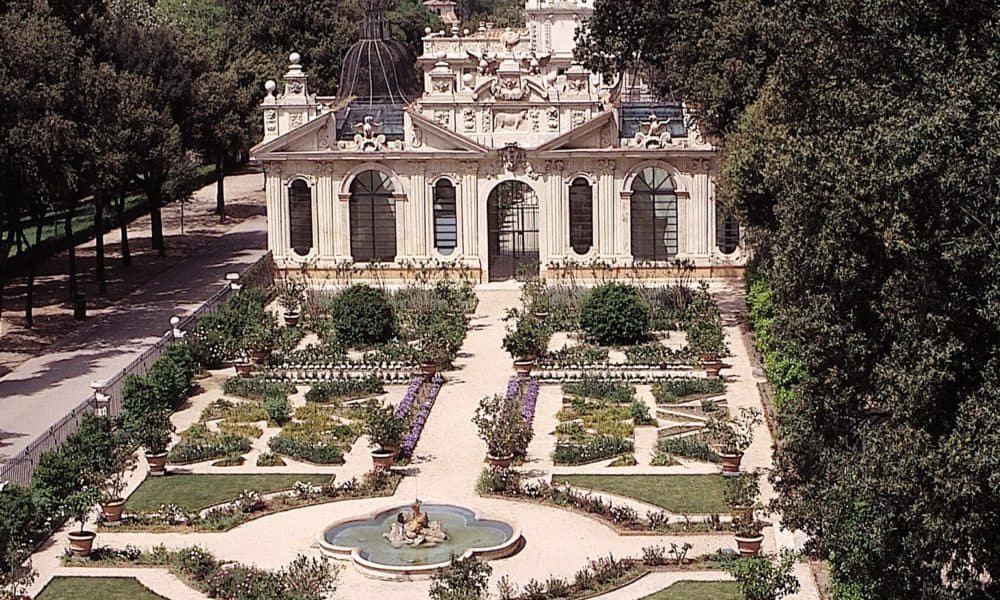
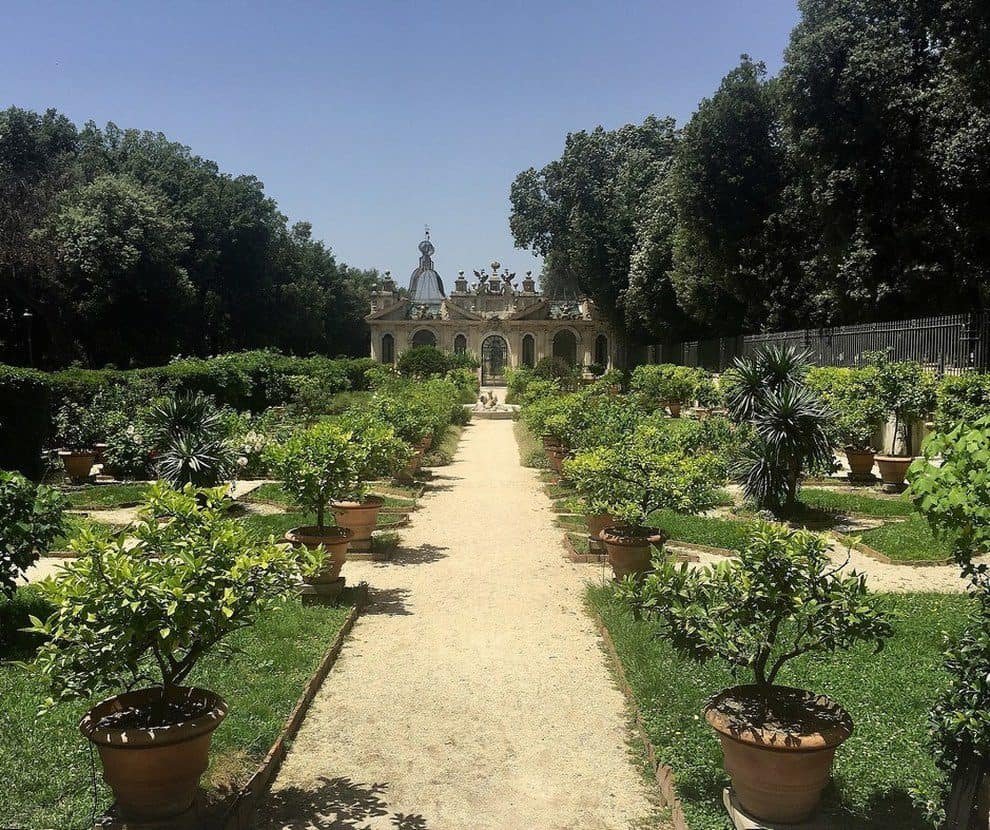
The geography is simpler than it seems, and almost nobody explains it. Picture the Casino Borghese as a white parallelepiped set on a raised platform. On the side toward Via Pinciana and on the opposite side, toward Viale dell'Uccelliera, run the walled enclosures. They are open-air rooms: walls as high as one floor, gravel and geometric flower beds inside, sky above. In the language of the 1600s a secret garden is not a garden whose existence is kept quiet. It is a closed, reserved garden, separated from the public park. The secret is the threshold, not the mystery.
The address and the lines to get to the Secret Gardens of the Borghese Gallery
The official address is Piazzale Scipione Borghese 5, and it should be written out in full when you give it to a taxi driver, because inside Villa Borghese there are at least five piazzales that navigation systems readily confuse. If you arrive by bus, get off at Pinciana/Museo Borghese, on Via Pinciana: from there to the gate it is about 300 meters of tree-lined avenue, slightly uphill, walkable in a good five minutes. If you arrive by metro you have two options, both with a walk: the Spagna stop on line A, going up with the elevators to Viale del Muro Torto and then crossing the park, or Flaminio, entering from the Pincio and cutting diagonally. In both cases allow 20 minutes on foot, and allow them for real: the park is big, uphill, and on gravel you walk more slowly than you think. Parking is paid with blue lines on Via Pinciana and the streets around, and on weekends it is a lottery that you almost always lose.
A warning worth gold: the Gallery does not let you in late. The shift starts at the exact hour and entry happens only at the beginning of the hour, for reasons of security and capacity. If your shift is at 11:00 and you show up at 11:20, the argument at the desk is already lost from the start. Arrive 30 minutes early and use them well, because those 30 minutes are exactly the time needed for the coat check.
The ticket, the hours and the reservation
Reservation is mandatory, period. On site, according to the official website, only a few Last minute tickets remain, on sale at the ticket desk from minute 20 of each hour for a visit of an hour and a half: availability is limited and on free days there are none. The museum works in hourly shifts with a capped number of people, and this is the reason why the Borghese Gallery remains one of the few important museums in Rome where you look at a painting without someone else's shoulder in your ear. The full price listed by the official website is €16, plus the €2 booking fee that is never discounted, not even when the ticket is free. The reduction to €2 applies to European Union citizens between 18 and 25. Under 18 you enter without paying for the ticket but paying the booking fee. On the first Sunday of the month admission is free and the booking fee remains due: this means that on that day the visit costs €2 and that the tickets, put on sale 10 days before the date, sell out fast.
You get the ticket on the museum's official website or by phone, 06 32810, active Monday to Friday from 9:30 to 18:00. The museum also authorizes an online reseller listed on its official pages: if a different channel comes before your eyes, verify it there before leaving your card details. On prices and hours, a last-minute check on the Gallery's website is always worthwhile: the time slots change on exhibition days and on special evenings.
How long the visit to the Secret Gardens of the Borghese Gallery really lasts
The shift lasts two hours. It seems like a lot and it is little, because in the 20 rooms of the museum there is a density of masterpieces with almost no equal in Europe, and anyone who arrives unprepared burns an hour in the first three rooms. The recommendation is brutal and it works: give the gardens the last 25 minutes, not the first. If you put them at the start you will realize halfway through that you are in a hurry and you'll remember them badly. If you put them at the end they become the decompression, the moment when the eye stops being assaulted by marble and rests on the green. 25 minutes are enough for Giardino dell'Uccelliera at a truly calm pace, seated, without counting steps.
What the Secret Gardens of the Borghese Gallery are
They are four enclosures, built at two different moments 70 years apart, which together form the central sector of the villa: the one where the two pavilions of the Uccelliera and the Meridiana are found. They are not gardens in the sense in which we understand them today, that is, spaces of rest. They were devices of display. They served to show a selected guest a botanical collection that was worth as much as a collection of paintings, and that like a collection of paintings cost fortunes, was renewed, was boasted about and was stolen.
Why they are called secret
The term is technical and old, and in Italian it predates the 1600s by quite a bit: giardino segreto translates the medieval hortus conclusus, the garden closed by walls. In the Roman suburban villa the segreto indicates the part reserved for the owner and his guests, distinct from the barco, the wooded part open also to outsiders. Villa Borghese, it should be remembered, was conceived from the start as a partially accessible villa: Scipione Borghese cared about being seen as munificent, and the outer park could be walked through. The walled enclosures were the exception, the place where munificence stopped and privilege began. Whoever entered a secret garden was receiving a political message, and understood it perfectly.
The 1600s, the century of flowers
There is a precise historical reason why these enclosures were born precisely then. The 1600s are the century in which Europe goes mad for bulb flowers. They arrive from the East through the Low Countries, they arrive from the Americas, they arrive from the ports of the Levant, and they become objects of collecting, of study, of financial speculation. The Dutch tulip mania of the 1630s, with bulbs traded at the price of real estate, is the most famous episode of a much wider phenomenon. In Rome the fever takes the form of secret gardens inside the cardinals' villas: closed enclosures where rare bulbs are cultivated safe from thieves and shown to guests as one would show a Titian. Narcissus, hyacinths, anemones, ranunculus and above all tulips. In the Rome of the Borghese a streaked tulip of a new color was news that circulated in letters between embassies.
This is the key to understanding the gardens of the Borghese Gallery without misreading them. They were not decoration. They were a showcase scented with flowers and colors open to the fortunate guests of the court of Scipione Borghese, and that word, court, has to be taken literally: whoever was admitted here belonged to a circle, and the circle knew it.
Giardino dei Melangoli, the oldest of the Secret Gardens of the Borghese Gallery
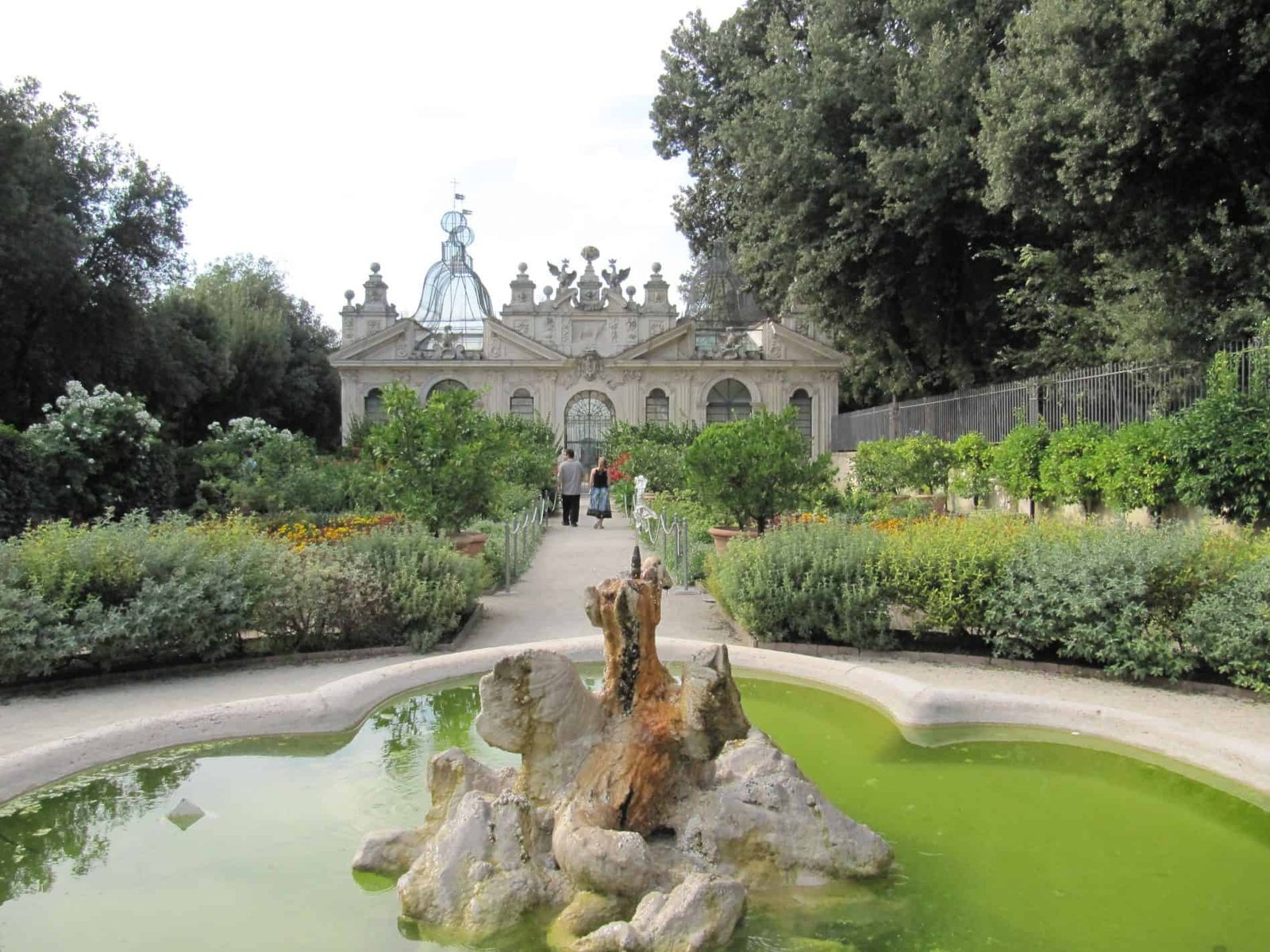
The first enclosure, the one toward Via Pinciana, is called Giardino dei Melangoli, and in the archive documents it also appears as Giardino Vecchio, because it preexisted the cardinal's interventions: it was already there when the Borghese got their hands on these lands, and Scipione readapted it to the taste of his own time instead of razing it to the ground. Melangolo is the old name for the bitter orange, Citrus aurantium, and it says everything about the vocation of the space.
The sources on the original stock speak of 144 potted citrus trees. The number deserves a second of attention, because it conveys the order of magnitude of the undertaking: 144 pots had to be moved, sheltered in winter, pruned, fertilized, and each one cost money. Potted citrus trees in the Roman villa of the 1600s are not plants, they are movable furnishings arranged the way chairs are arranged before a reception. The learned reference, for those who arrived here with a classical education on their back, was the garden of the Hesperides, with its golden fruits guarded and inaccessible. A cardinal who lined up rare citrus trees inside a walled enclosure was quoting a myth, and his guests caught the quotation.
The garden housed two fountains in African marble with dragons, later removed, and in 1776 the Fontana dell'Aquila was placed there, which can still be seen today. The dragon and the eagle are the two heraldic emblems of the Borghese: anyone crossing these spaces saw the family's coat of arms repeated everywhere, on the fountains, on the walls, on the vases. The whole villa is an exercise in dynastic self-promotion carried out with a talent we would today call advertising.
Giardino dei Melangoli has been the subject of extraordinary openings in which it was entered free of charge and without reservation, with a contemporary installation of hand-painted glazed terracotta seating designed by Studio Sartogo Architetti. The openings of this enclosure are scheduled and not continuous: before counting on it, check on the Gallery's official website whether it is accessible in that period.
Without diplomacy: the Melangoli is the most beautiful of the four and the least photographed. It has a quality of light that the others don't have, because the wall toward Via Pinciana bounces the sun back at it all afternoon, and the smell of citrus on a hot day is something you don't forget. If you happen to find it open, go in.
Giardino dei Fiori and Giardino dell'Uccelliera
On the opposite side, between the Casino Nobile and the Uccelliera pavilion, opens the second of the ancient enclosures, the one the sources call Giardino dei Fiori. Together with the Melangoli it makes up the original pair, the core established in the early 1600s on the two sides of the Casino Borghese. This is the enclosure of the bulb plants, the real showcase, the one for which visitors asked to be received.
The Uccelliera pavilion
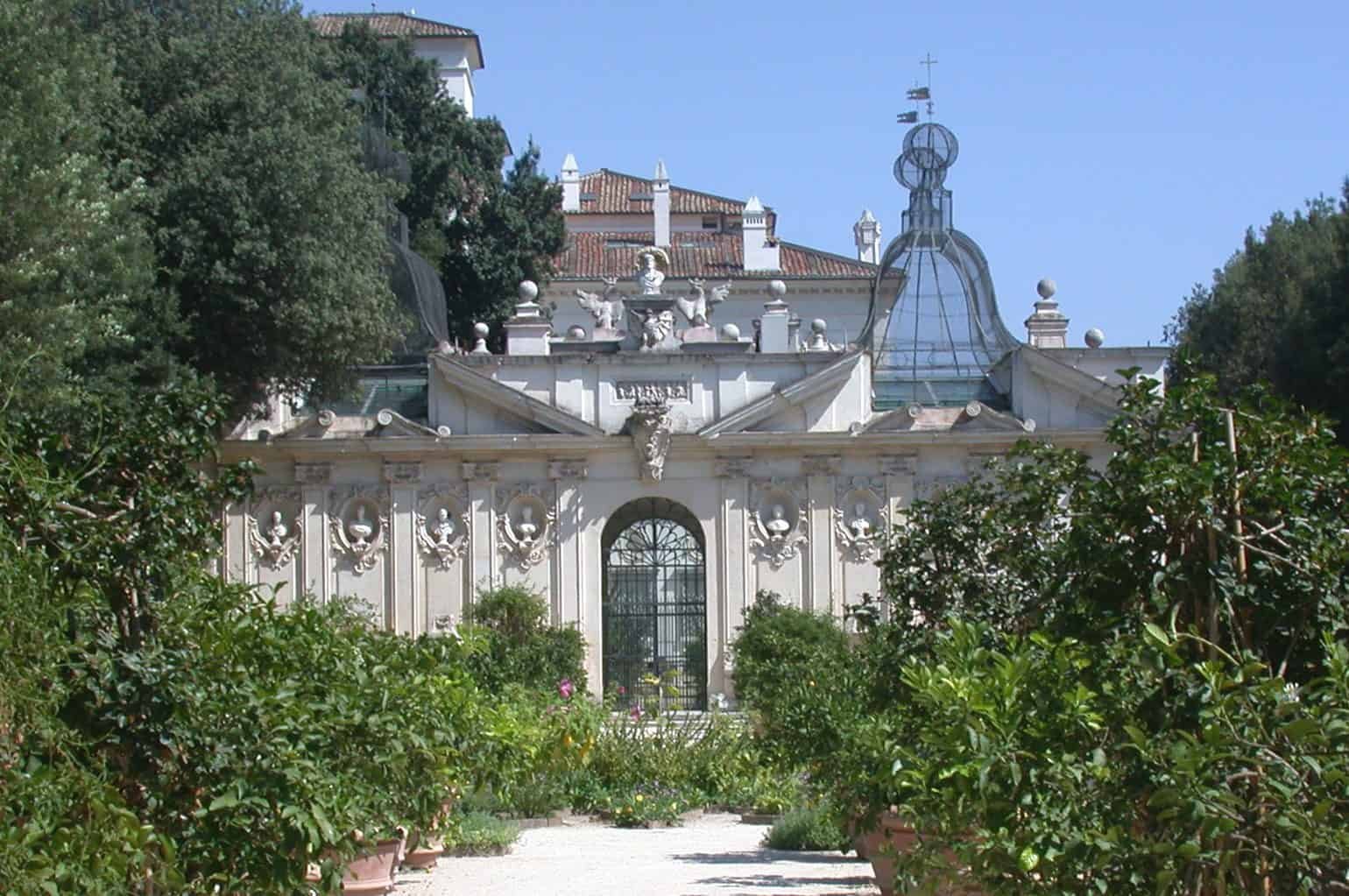
The Uccelliera is the building that gives its name to the avenue and that anyone who has walked in Villa Borghese has seen without knowing what it was. It is a low, elegant pavilion, with a front marked by niches and by ancient reliefs set into the wall, which belongs to the season of the villa's construction. It has two rooms, and the two rooms are the reason for its fame: they are frescoed to imitate an arbor populated by birds, and they were closed with a net structure because the rare birds collected by the cardinal lived in there.
Let's pause for an instant on this, because it is one of the most refined inventions of the Roman Baroque and it is dismissed in two lines by all the guides. The visitor entered a room painted as an arbor, with vines, leaves and fake birds on the walls and on the vault. In the same room, behind the net, real birds flew, imported, expensive, often of species never seen in Rome. The eye no longer distinguished the painted from the living. It was an illusionistic game, certainly, but it was also a declaration: the cardinal possessed nature to the point of being able to reproduce it and to cage it, and the two things were equivalent. You'll find the same idea again, on a monumental scale, in the rooms of the museum, where the restored ancient sculptures and the modern sculptures of Bernini are arranged so that you can't tell right away which is which.
The frescoes of the arbor and the Cardinal's birds
On the contents of the aviary the information is fragmentary, and whoever recites to you the precise list of species is embroidering. What the sources document with certainty is the function: display of rare birds, in a context where zoological rarity was exactly as prestigious as botanical rarity. The collecting of exotic birds accompanies the whole Roman 1600s, and the Borghese Uccelliera is the architecturally most complete example that remains to us in the city.
It is worth adding something concerning the interior of the museum. Room 14, the Loggia di Lanfranco, was originally an open loggia that looked precisely toward the secret gardens, and was closed and turned into a room only in the 1700s. It means that the relationship between the painted rooms and the flowering enclosures was direct, visual, designed: you passed from painting to green with the gaze, without a break. Today that continuity is interrupted by a wall and a glass window, and reconstructing it in your mind while you are inside Room 14 is one of the most beautiful exercises you can do in this museum.
The tulips, the narcissus, the hyacinths
The main showcase for the display of exotic flowers such as narcissus, hyacinths and precious tulips was the scenic space around the Uccelliera. The museum's official pages speak of prized and exotic flowers, very fashionable at the time, bulb plants and old cultivars derived from the selections of the florists of the day. This last detail is more interesting than it seems: old cultivars means that the restoration did not plant modern nursery tulips, but sought historically compatible varieties, the ones a Roman florist of the 1600s could really have obtained.
The practical result, for visitors, is that the flowering is short and seasonal. The bulbs give their best between March and May, with a variation that changes from year to year depending on the winter. Anyone who comes in July will find a green, orderly, geometric enclosure and substantially without showy flowers. It is not a defect: it is the nature of a bulb garden, which in the 1600s was shown precisely in the few weeks when it was spectacular and for the rest of the year remained a worksite of waiting.
Giardino della Meridiana and the Casino della Meridiana
The two original enclosures, around 1680, were expanded with a third garden, and in the same span of years the Casino della Meridiana arose, the pavilion decorated with rich stuccoes that closes the central sector of the villa toward the north. The new enclosure, which the sources call Giardino della Meridiana, occupies the space between the Uccelliera pavilion and the Casino della Meridiana, and completes the sequence: two twin buildings, three walled gardens, a single symmetrical layout.
The third garden and the expansion of 1680
70 years separate the first layout from the second, and it is an interval that can be read in the forms. The enclosures of the early 1600s have a simple, quadripartite geometry, that of a botanical garden made noble. The late 17th-century expansion is more theatrical, more aware of the scenic effect, built so that the visitor sees a perspective and not a list of flower beds. The villa in those years was already famous all over Europe and received a constant flow of foreigners: the expansion is, in part, an adjustment to the expectations of an international public.
The stuccoes and the attribution to Carlo Rainaldi
The construction of the Casino della Meridiana is traditionally attributed to Carlo Rainaldi, one of the architects who truly count in the Rome of the later 1600s: the layout of the two twin churches of Piazza del Popolo is his, the facade of Sant'Andrea della Valle is his, and a substantial part of the urban profile that we take for granted today is his. It must be said precisely: this is an attribution consolidated by the tradition of studies, not a fact that can be closed with a contract document at hand, and in this field caution is required because the Borghese worksite employed dozens of workers and the handovers were frequent.
The name of the pavilion comes from the meridiana, that is, the gnomonic instrument that was placed there. This too is a trait of the period: in the Baroque villa the scientific instrument is an intellectual ornament, like the rare book in the library. Time measured by the sun, in a garden built to display blooms that last three weeks, is a rather elegant comment on the transience of things, and contemporaries read it that way.
Giardino di Propagazione, the nursery of the Secret Gardens of the Borghese Gallery
The fourth enclosure is the least known and the most instructive: Giardino di Propagazione, which worked as a nursery. Here plants were multiplied, bulbs were raised, and the reserves were kept to replace, in the show gardens, the specimens that had faded or died. It is the service room of a system that, seen from outside, seemed spontaneous.
It is worth dwelling on this because it is the point where the villa stops being a fairy tale and becomes a business. A bulb garden that has to look perfect on a precise April afternoon, in front of an ambassador, requires an agronomic machine behind it: seedbeds, reserve pots, specialized staff, bookkeeping. Giardino di Propagazione is that machine. When you walk in the flowering enclosures and everything seems natural, remember that the naturalness was the finished product, and that it was manufactured a few meters away.
Who built the Secret Gardens of the Borghese Gallery
Flaminio Ponzio and Giovanni Vasanzio
The great project of the villa and its central sector bears the names of Flaminio Ponzio and Giovanni Vasanzio. Ponzio, from Lombardy, trusted architect of Paul V Borghese, directed the construction of the Casino between 1607 and 1613 and died before seeing it finished. He was succeeded by Giovanni Vasanzio, who was the Italianized name of Jan van Santen, a Fleming, a cabinetmaker by training and then an architect: it was he who completed the building and oversaw the construction of the gardens, which the museum's sources place around 1620.
Vasanzio's origin is not a biographical detail. A Fleming working in Rome in the early 1600s brings with him a culture of the bulb garden that in the Low Countries was already mature, and brings the commercial contacts to obtain the bulbs. The fact that the Borghese secret gardens are overseen by a Dutch architect, in the same years in which in Haarlem and Leiden tulips become a religion, is not a coincidence to be dismissed.
Domenico Savini da Montepulciano, the gardener
Then there is the name that no plaque remembers and that instead deserves the place of honor: Domenico Savini da Montepulciano, gardener, commissioned by Cardinal Scipione Borghese to transform these lands. In the 1600s the gardener of a cardinal's villa is not a laborer: he is a technician who knows the cycles, the exposures, the soils, the suppliers, and who keeps up the correspondence to obtain living material. The distinction between who designs the wall and who decides what grows inside it is, in a secret garden, entirely artificial. Savini is a co-author, and calling him anything else is historiographical laziness.
Scipione Borghese, the patron
Scipione Caffarelli Borghese, nephew of Pope Paul V, made cardinal at 27, is the engine of the whole operation. He is the man who in 20 years put together one of the most formidable art collections in Europe, with methods that ranged from princely purchase to inelegant pressure, and who built in the villa the container suited to showing it. The botanical collection belongs to the same design as the sculpture collection: a cardinal nephew had to prove he was the center of the cultured Roman world, and he proved it with ancient marbles, with Bernini and with tulips. Whoever separates the two things has not understood the character.
The restoration and the 250 species
The 1897 inventory and the papers of the Borghese archive
What you see today did not survive through inertia: it is the result of a work of philological reconstruction concluded at the end of 1999. The documentary basis was the papers of the Borghese archive and an inventory of 1897, which listed the botanical presences of the villa shortly before its passage to the State. From those materials a layout was reconstructed that the sources describe with more than 250 ornamental species, distributed in annual cycles so that each season has a programmed bloom.
The number has to be read properly. 250 varieties does not mean 250 plants in flower at the same time: it means a calendar. The Baroque garden worked by successions, and the restoration reconstructed the succession, not a snapshot. For the visitor the consequence is simple: two visits in two different months show two different gardens, and whoever returns in different seasons has an experience that someone who comes only once cannot even imagine.
What blooms and when
The strong period is spring, from March to May, when the bulb plants give their maximum and the Uccelliera enclosure becomes what it was meant to be. June and July bring the summer blooms and the citrus trees laden with fruit. Autumn is the season of architecture, when the geometries of the flower beds can be read bare and the design is finally understood. Winter is for the sheltered citrus trees and for a low light that brings out the stuccoes of the pavilions. The best season, against all expectations, is the end of October: nobody around, silence, and the design of the garden visible as on a plan.
A curiosity about the Secret Gardens of the Borghese Gallery
The curiosity I prefer concerns a linguistic misunderstanding that has lasted for centuries and that concerns the very name of the enclosures. Almost everyone, on entering, thinks that segreto means hidden, occult, forgotten. It is the romantic idea of the garden lost behind a wall, and it sells very well. The documentary reality is another: in the vocabulary of Italian villas between the 1500s and the 1700s the secret garden is a technical category, defined by contrast. The villa was divided into the barco, the wooded and semi-wild zone where people hunted and strolled, and the secret gardens, the reserved walled enclosures. Segreto comes from the Latin secretus, past participle of secernere, to separate: it means separated, set apart, not hidden.
The consequence is that the secret gardens were not at all secret in the current sense. They were very well known. Anyone in Rome who could read knew that Cardinal Borghese had the rarest tulips in the city, and descriptions of the villa circulated in print. What was reserved was not the information, it was the access. And here the matter becomes modern in an almost embarrassing way: the mechanism is identical to that of contemporary clubs, where the value does not derive from the fact that nobody knows the place exists, but from the fact that everyone knows and few can get in. Scipione Borghese had understood in 1610 something that luxury marketing would formalize four centuries later.
The funniest detail: the wall that made the garden secret also served, very prosaically, to protect against theft. Rare bulbs were worth serious sums and disappeared. Some Roman villas went so far as to keep guards on the flowering gardens. The Baroque enclosure is both a philosophical idea and an anti-theft device, and this duplicity is the most 1600s thing you can take home from here.
One thing nobody tells you about the Secret Gardens of the Borghese Gallery
That the museum ticket already includes the garden, and that tens of thousands of people a year therefore pay for something they then don't use. Giardino dell'Uccelliera has been reopened to the public since April and access is included in the cost of the museum ticket: the Gallery's official website says so, with no supplements and no additional reservations. Yet the vast majority of visitors leave by the main door without having set foot outside on the garden side, because nobody tells them at the desk, because the internal route does not naturally lead there, and because in two hours, with Bernini on the agenda, green seems like a luxury that can be put off.
The second thing nobody says concerns the layout of the spaces. The four enclosures are not equivalent in terms of accessibility: the reopening concerns first of all Giardino dell'Uccelliera, while other enclosures, like Giardino dei Melangoli, have had scheduled openings, with conditions that have changed several times over the years. Anyone who arrives convinced they can walk through all four in a row ends up disappointed, and the disappointment depends on a wrong expectation, not on the museum. The right question to ask the staff at the entrance, and I advise you to ask it exactly like this, is: today which of the secret gardens is accessible and where do you go through to get there. Phrased this way it gets a useful answer in 10 seconds.
Third thing, the most practical of all: the garden has no mandatory route and nobody accompanies you. It means that you manage the time yourself, within your two-hour shift. Nobody moves you along, nobody counts you. In a museum that is entirely built on controlling the flow, the garden is the only space where you can stay as long as you like, and this makes it, paradoxically, the freest part of the visit.
My advice for visiting the Secret Gardens of the Borghese Gallery
Book the 9:00 shift on a Tuesday in April, and do it a month in advance. It is not an aesthetic preference, it is arithmetic. Tuesday is the first opening day after Monday's closure and absorbs fewer organized groups than the weekend. 9:00 is the shift when the light enters the enclosures at a low angle and when the museum is a third full compared with 11:00. April is the center of the bulb bloom. The combination of these three factors is worth more than any generic advice about the season.
Second piece of advice, and here I go against what almost all the guides will tell you: don't try to see the museum in order. The canonical route has you burn your best energy in the first rooms, where there is also a crush because everybody does the same thing. Go in, go straight up to the first floor, enjoy the picture gallery with half the people around, come back down toward the sculpture rooms when the bulk of the shift has gone up, and finish with the garden. You will leave with the feeling of having seen everything without running, which in two counted hours is a small organizational miracle.
Third: bring the bare minimum. The museum does not admit bags and bulky backpacks in the rooms and accepts only clutches and small purses within 21 by 15 centimeters. Everything else goes to the coat check, and the coat check at peak shifts is a line that eats 10 minutes of your time. Anyone who arrives with just a phone in their pocket gets in in three minutes. Anyone who arrives with a daypack gets in in 15, and loses them from their own shift, not from anyone else's.
Fourth and last: if you notice that your shift is full of school groups, reverse everything and go to the garden first. School groups follow a rigid route and almost never go out into the enclosures. 20 minutes outside while they cross the rooms give you back a workable museum when you return. It is the simplest trick I know and it works every time.
Another well-known fact, yet rarely cited
That Villa Borghese we walk through today as a public park is, from the historical point of view, a remnant. Everyone knows the villa belonged to the Borghese and that today it belongs to the Municipality. Almost nobody reflects on what that means in concrete terms for the secret gardens. The complex was born as a unitary organism: the Casino with the collections, the walled enclosures with the botanical collections, the barco around it as a landscape frame, and a single direction that held the three things together. The passage of the whole to the State in the early 20th century, and then the handing of the park over to the city, split that unity into two different administrations: the museum with its enclosures on one side, the urban park on the other.
The consequence is visible to the naked eye and nobody mentions it. Leaving the secret garden and walking toward Viale dell'Uccelliera, within 20 meters you go from a space maintained with philological criteria to a space maintained with public green space criteria. These are two worlds, with two budgets, two pruning calendars and two ideas of what a garden is. This isn't a polemic. It's Italian administrative history turning into landscape. And understanding it as you walk through completely changes how you read what you see.
There's a second aspect, equally well known and equally little thought about: the villa was heavily reworked in the 1700s, under Marcantonio IV Borghese, under the direction of Antonio Asprucci. That intervention gave the Casino the decorative layout we still see today in the rooms, and redesigned parts of the park according to the taste of late 18th-century landscaping. The 17th-century enclosures survived that season as a foreign body, islands from another era inside a new project. That they have come down to us, after a reworking like that and after two centuries of public use, is the truly remarkable thing about this place.
The Right Photo to Take at the Secret Gardens of Galleria Borghese
The right photo is not the flower. The flower in the foreground with a blurred background is the photograph anyone takes home from any garden in the world, and in a month you won't know where you took it. The photo that tells the story of this place is the one that holds three elements at once: the enclosure wall, the geometric flowerbed and a piece of the pavilion. Wall, design, architecture. Because that is exactly the concept of a secret garden, and a photograph that contains the three elements explains it better than a paragraph.
Technically: stand in a corner of the enclosure, as far as possible from the pavilion, crouch down to about a meter off the ground and frame the shot diagonally toward the building. Crouching lets the geometry of the flowerbeds read, because at human eye level they flatten out and become a green blur. The diagonal brings the wall into one side of the frame, which is the element nobody photographs and which is in fact the protagonist. If you have a moderate wide-angle lens, this is the moment to use it.
The right time is the first slot of the morning shift, when the sun comes in low from the east and the wall casts a long, sharp shadow on the gravel. That shadow is your best compositional ally: it gives depth to a space that, at noon, becomes flat and washed out. At noon in July, to be clear, you don't take good photographs here. You take good photographs at nine in the morning and in the last hour of the afternoon, and the rest of the time you look.
A second image worth looking for is the detail of the ancient reliefs set into the front of the Uccelliera. They are fragments of Roman sculpture inserted into the wall as ornament, following a practice that in 17th-century Rome was normal and that today seems almost violent to us. Photograph them up close, with side light that brings out the modeling. They are the material proof that this villa was built with antiquity inside its walls, not only inside its display cases.
One last practical warning: inside the museum rooms the rules on photography are stricter than outdoors and change with the exhibitions on. In the outdoor enclosures you can photograph freely, without a tripod and without getting in other people's way. A tripod, in a timed slot with 40 people rotating through the same space, is not so much forbidden as socially unsustainable.
Some Important Events That Happened Here in History
The first event is the founding itself, and it should be told as an operation, not as a poetic idea. In the first decade of the 1600s Cardinal Scipione Borghese acquires and combines plots of land on the hill outside Porta Pinciana, commissions Domenico Savini da Montepulciano to transform them and entrusts the architectural project to Flaminio Ponzio. Between 1607 and 1613 the Casino goes up. When Ponzio dies, Giovanni Vasanzio takes over, completes the building and oversees the gardens, which the museum's sources place around 1620. In 13 years an agricultural hill becomes the most famous villa in Europe. The speed of that construction site, with the means of the time, is still impressive.
The second event is the late 17th-century expansion: around 1680 a third enclosure is added to the two original ones, and the Casino della Meridiana rises with its stucco work. This is the moment when the villa adapts to an audience that is by now international and shifts the emphasis from botanical display to architectural scenography. Anyone who looks closely sees the seam between the two seasons: the rhythm of the walls changes, the scale changes.
The third event is the great 18th-century remodeling carried out under Marcantonio IV Borghese, under the direction of Antonio Asprucci, in the 1770s. The rooms of the Casino receive the decorative apparatus that still determines the look of the museum, with ancient and modern sculptures integrated into a unified program. The park is partly reshaped according to the landscape taste of the time. The 17th-century enclosures remain, but they become a legacy inside a project that speaks another language.
The fourth event is the placement of the Fontana dell'Aquila in Giardino dei Melangoli in 1776, with the removal, at a moment that can't be pinned down, of the two African marble fountains with dragons that had occupied that space. It's a tiny and perfect episode: two heraldic emblems of the family, the dragon and the eagle, taking turns in the same enclosure generations apart.
The fifth is the great change of ownership straddling the 1800s and 1900s, when the villa leaves the hands of the Borghese and enters the public patrimony. The inventory of 1897, which would later become one of the key documents of the 20th-century restoration, belongs to precisely this season of surveys: a written photograph of the state of the place shortly before the break.
The sixth event is the philological restoration of the enclosures, completed at the end of 1999, with the reconstruction of a planting scheme of more than 250 ornamental species arranged in seasonal cycles, based on the papers of the Borghese archive and on the 19th-century inventory. It is the act that brought back to life not Scipione's plants, which of course died centuries ago, but the system that governed them.
The seventh and most recent is the reopening to the public of Giardino dell'Uccelliera, which took place in April, with access included in the museum ticket. After decades in which these spaces were seen only on special occasions and by reservation, the enclosure has gone back to being part of the ordinary visit. It is the best news to come from this museum in recent times.
Who Has Passed Through the Secret Gardens of Galleria Borghese
The first name is of course that of the master of the house: Scipione Caffarelli Borghese, nephew of Paul V, a cardinal at 27, died in 1633. He wanted these enclosures, paid for them and used them, and he used them as an instrument of representation: receiving a guest here meant telling him he had arrived at the center. The correspondence and the descriptions of the villa recount a constant coming and going of cardinals, ambassadors, prelates and foreigners of note, admitted to the flowering enclosures according to a strict hierarchy that the majordomo knew by heart.
Then there are those who physically made the villa. Flaminio Ponzio, the Lombard architect of Paul V, who directed the construction site from 1607 until his own death. Giovanni Vasanzio, that is Jan van Santen, the Fleming who succeeded him and who oversaw the construction of the gardens: a man who came from cabinetmaking and who brought to this construction site a taste for detail and for joinery that you can recognize in the fronts of the pavilions. Domenico Savini da Montepulciano, the gardener entrusted by Scipione with the transformation of the land, who passed through here every day for years and is the only one of the three without a memorial stone.
In the later 1600s the scene shifts to Carlo Rainaldi, to whom the scholarly tradition assigns the Casino della Meridiana: one of the architects who gave Rome the face we recognize, from the twin churches of Piazza del Popolo to Sant'Andrea della Valle. In the 1700s Antonio Asprucci arrives, director of the great remodeling commissioned by Marcantonio IV Borghese, the man who decided the look the museum still has today.
Then there is the category of illustrious passersby, and this is where you have to be honest to the point of boredom. Villa Borghese was, for two centuries, one of the obligatory stops of the Grand Tour, and practically every cultured traveler who arrived in Rome passed along its streets and avenues. Attributing to each of them a documented visit inside the walled enclosures themselves, however, is another matter: the secret gardens were access-controlled, and presence in the park does not imply presence in the enclosure. I prefer to stop here rather than fill the paragraph with famous names resting on nothing.
Those who have passed through these gardens in very recent times, and with visible effects, are the contemporary artists the Galleria has invited to work in the outdoor spaces. Zhang Enli created for the museum an installation titled Bird Cage: A Temporary Shelter, hosted in the Uccelliera and in the secret garden of Tramontana, as well as in some interior rooms. Giuseppe Penone, one of the protagonists of Arte Povera, had in the secret gardens the setting for his own intervention for the Galleria, with the exhibition Gesti Universali extended to the ground-floor spaces where the relationship between inside and outside is most intense. That a museum with this collection chooses the 17th-century enclosures as a place for the contemporary says something precise about how it considers them: not a backdrop, but a room.
Contemporary Art in the Secret Gardens of Galleria Borghese
It's worth insisting, because it is the most interesting line of programming at this museum and almost nobody follows it. Galleria Borghese has gotten into the habit of entrusting its spaces to living artists, and of entrusting a part of them to the walled enclosures and the pavilions. It is neither decoration nor filler. It is a curatorial choice that puts back into circulation the original idea of the place, that the garden is a space for display and not a space for rest.
Zhang Enli's installation in the Uccelliera is, from this point of view, almost programmatic from the title onward: a temporary shelter inside a bird cage, in a building born to exhibit live animals in a room painted like an arbor. The overlap between the contemporary gesture and the 17th-century function is total and nobody had to explain it. As for Penone, whose work has always revolved around the tree, growth and the imprint of the hand on living matter, the secret gardens are the most coherent place that could be offered to him in this city.
The practical advice that follows: before booking, check on the Galleria's official website what is going on. An exhibition in the outdoor spaces radically changes the visit to the enclosures, for better or worse depending on taste, and it also changes the hours and the access conditions. At the moment the museum is hosting a major exhibition dedicated to Ovid and the arts, with a program of talks and weekend visits for families.
How to Really Visit: Route, Duration, Season
The two-hour slot is the unit of measure for everything. Inside those two hours there are 20 rooms with Scipione's collection, the picture gallery on the first floor and, for those who look for it, the garden. You can't do everything with the same depth and anyone who tries takes nothing home. A division of time that works: 50 minutes on the ground floor among the sculptures, 40 on the first floor in the picture gallery, 25 in the garden, five for the cloakroom and the exit. It works, and it is calibrated for normal people who stop to look.
With Kids at the Secret Gardens of Galleria Borghese
The outdoor enclosures are the salvation of any family visit, and I say it with the certainty of someone who has watched six-year-olds collapse in front of the fourth room of marbles. A kid can handle 40 minutes of museum, not 120. Taking him outside halfway through, letting him walk on the gravel, having him count the flowerbeds and look for the dragons and eagles on the coats of arms, and then going back in, is the difference between a successful visit and a ruined afternoon. Under 18 the ticket is free and you only pay the reservation fee, which makes the whole thing economically painless. On weekends the museum also offers guided tours designed for families, tied to the current exhibition: you book them on the official website.
Accessibility
The Casino has an accessible route and the museum keeps a page dedicated to accessibility on its website, which is the right place to check the updated conditions and to book assistance if needed. In the outdoor enclosures the real variable is the surface: compacted gravel is manageable in a wheelchair with some effort and with the help of a companion, much less so alone. Anyone with mobility problems should also consider the difference in level between the park and the museum forecourt, which is not dramatic but exists. For a visit with specific needs it's worth writing in advance to ga-bor.info@cultura.gov.it and arranging everything before you leave.
When to Go and When to Avoid the Secret Gardens of Galleria Borghese
Go in April, at opening time. Avoid spring Sunday afternoons, when the park is full and the museum is working at full load. Avoid July and August afternoons: the enclosures are exposed, the wall stores heat all day and gives it back, and at three in the afternoon in a walled Roman garden you get sunstroke without noticing. October and November are excellent and unjustly deserted. The special evenings the museum organizes in the summer in the garden, with extended opening until late in the evening, are a different experience and worth it, but they are tied to specific calendars to be checked each time on the official website.
How Much It Costs and How to Save
The full price for an adult is €18: €16 for the ticket plus €2 for the reservation. A young person aged 18 to 25 who is a citizen of the European Union pays €4 in all. A minor pays €2, that is, just the reservation fee. The last slot at 17:45 costs €11 for the ticket and is shorter than the others: it's a good deal for those who already know the museum and want to go back to see three specific things, and a wrong choice for those coming for the first time.
On the first Sunday of the month you get in free by paying only the €2 reservation fee. That said, and here I give advice that goes against saving money: if you can afford the €18 of a Tuesday morning, spend it. On the first Sunday of the month the Galleria is at maximum permitted capacity and the garden, which is the reason you are reading this, becomes a corridor. €16 for two hours in one of the most beautiful museums in the world remains, in proportion to anything else you buy in Rome, an honest price.
One last element of the calculation: the museum authorizes online sales through the channels listed on its official pages, and the €2 reservation fee is always due, even when admission is free. Be wary of any offer that promises to let you skip it.
What's Around the Secret Gardens of Galleria Borghese
Within a 10-minute walk there is a concentration of things to see that you won't find inside a park in any other European city. To the north, beyond Viale dell'Uccelliera, you reach the Bioparco di Roma (Rome Zoo), which occupies the part of the villa historically intended for animals and which therefore, with Scipione's aviary, has a precise conceptual kinship. A little farther on is the Etruscan Museum of Villa Giulia, with the Sarcophagus of the Spouses, and farther along the Galleria d'Arte Moderna.
Inside the park, a few minutes away, are the Museo Pietro Canonica, housed in the Fortezzuola, and the Museo Carlo Bilotti in the former Aranciera, two small museums, free or nearly so, and astonishingly empty. On the side of the little lake and the open-air theater you'll find the Casa del Cinema and the Gigi Proietti Globe Theatre, which in summer fills Roman evenings with Shakespeare.
To the south you go down to the Pincio and from there, by the staircase, to Piazza del Popolo, with the church of Santa Maria del Popolo and the two Caravaggios of the Cerasi Chapel: anyone who has just seen the Caravaggio at Galleria Borghese and completes the day there is following one of the smartest itineraries you can build in this city. Not far away is Villa Medici, with its gardens, and on the other side you reach Via Veneto and Piazza di Spagna.
If the theme that interests you is the historic garden itself, the other Roman appointments of the same family are the Botanical Garden in Trastevere, the Rome Rose Garden on the Aventine, and the historic parks of Villa Torlonia and Villa Doria Pamphilj.
Quick Questions About the Secret Gardens of Galleria Borghese
Where exactly are the Secret Gardens of Galleria Borghese?
They are the walled enclosures built against the Casino Borghese, inside Villa Borghese, along Viale dell'Uccelliera and on the side of Via Pinciana. The museum's address is Piazzale Scipione Borghese 5, 00197 Roma.
Can you visit the Secret Gardens of Galleria Borghese?
Yes. Giardino dell'Uccelliera has been open to the public since April and access is included in the museum ticket. The other enclosures have access conditions that vary: it's best to check the Galleria's official website to see what is accessible during your visit.
Do you need a reservation for the Secret Gardens of Galleria Borghese?
Yes, and it is mandatory to enter Galleria Borghese, so also to reach the gardens. You book on the museum's official website or by phone at 06 32810, Monday to Friday from 9:30 to 18:00. The reservation fee costs €2 and is always paid.
How much does a Galleria Borghese ticket cost?
The official website lists €16 for the full price, €11 for the last slot at 17:45, €2 reduced for ages 18 to 25, and free under 18. The €2 reservation fee is added to all of these amounts.
Is there a separate ticket just for the gardens?
For Giardino dell'Uccelliera, no: access is included in the museum ticket price. Some special openings of other enclosures have been free and without reservation, but they are tied to specific calendars.
What are the opening hours of Galleria Borghese?
The Galleria is open Tuesday to Sunday from 9:00 to 19:00, with last entry at 17:45 and the ticket office from 8:30 until one hour before closing.
When are the Secret Gardens of Galleria Borghese closed?
On Monday, December 25 and January 1.
How long does the visit to Galleria Borghese last?
Slots start every hour and last two hours, except the 17:45 one, which is shorter. At the gardens, 20 or 25 minutes inside that slot is enough.
Can you get in late if you miss your slot?
Entry happens only at the start of each hour, for capacity reasons. Showing up after the slot has started means seriously risking not getting in: arrive at least half an hour early.
What is the best time to see the Secret Gardens of Galleria Borghese in bloom?
Spring, roughly from March to May, when the bulbs are at their peak. Fall is excellent for reading the design of the flowerbeds and for the quiet.
Can you take photographs at the Secret Gardens of Galleria Borghese?
In the outdoor spaces yes, without a tripod. In the museum rooms the rules are stricter and change with the exhibitions on: check on site.
Are the Secret Gardens of Galleria Borghese suitable for children?
Very. They are the open space that lets you break up a museum visit that would otherwise be long for a child. Under 18 the ticket is free and you only pay the reservation.
Are the Secret Gardens of Galleria Borghese accessible by wheelchair?
The museum has an accessible route and a page dedicated to accessibility on the official website. Outdoors, the gravel surface requires a companion. For specific needs write in advance to ga-bor.info@cultura.gov.it.
Is there a cloakroom?
Yes, and it is mandatory for bags and backpacks: in the rooms you can only carry clutches and small purses up to 21 by 15 centimeters. At peak slots the line at the cloakroom takes about 10 minutes.
Is there a bar or a cafe?
Yes, the museum has a cafe and a bookshop, and the cafe is accessible even without a ticket.
Is admission to Galleria Borghese free on the first Sunday of the month?
Yes, admission is free but the €2 reservation fee is still due. Spots sell out well in advance and it is the busiest day of the month.
How many Secret Gardens of Galleria Borghese are there?
Four: Giardino dei Melangoli, Giardino dei Fiori, Giardino della Meridiana and Giardino di Propagazione. The first two belong to the original layout of the early 1600s, the other two to the expansion of around 1680.
Why are they called secret?
Because secret, from the Latin secretus, means separate: they were the walled enclosures reserved for the master and his guests, distinct from the barco, the wooded part open to everyone. It doesn't mean hidden.
What is the difference between the Secret Gardens of Galleria Borghese and the park of Villa Borghese?
The park is public, free, always open and run by the city. The walled enclosures are part of the museum, are visited with a ticket and a reservation, and are maintained with historical restoration criteria. They are two neighboring and very different worlds.
What flowers can you see in the Secret Gardens of Galleria Borghese?
The restoration rebuilt a planting scheme with more than 250 ornamental species distributed in annual cycles: bulbs, old cultivars, citrus. The historical sources speak of narcissus, hyacinths and tulips as the stars of the 17th-century showcase.
Who designed the Secret Gardens of Galleria Borghese?
The general design of the villa bears the names of Flaminio Ponzio and Giovanni Vasanzio, who oversaw the construction of the gardens around 1620. The transformation of the land was entrusted by the cardinal to the gardener Domenico Savini da Montepulciano.
Who built the Casino della Meridiana?
The scholarly tradition assigns it to Carlo Rainaldi, with the expansion of around 1680. The pavilion is decorated with rich stucco work.
What is the Uccelliera?
A pavilion with two frescoed rooms imitating an arbor populated with birds, closed off with a net structure to house the rare birds collected by Cardinal Scipione Borghese.
Is it worth coming specifically for the Secret Gardens of Galleria Borghese?
Specifically for them, no, if you don't already have the museum ticket. Together with the museum, absolutely, and that's the reason you should remember them: you're paying for that too.
How far in advance do you have to book?
For a spring morning slot, a month. For the first Sunday of the month, tickets come out only 10 days before the date, and it's best to get them right away. For a weekday in November, a few days are enough.
Are there guided tours?
The museum has a section dedicated to guided tours and groups on its official website, and on weekends it offers family tours tied to the current exhibition.
Is anything going on at this time?
The museum is hosting a major exhibition dedicated to Ovid and the arts, with a program of lectures and related events. The updated calendar is on the Galleria's official website.
One last thing. Galleria Borghese is a place that defends itself well: mandatory reservation, the two-hour slot and limited numbers have saved it from the crush that has ruined other Roman museums. But that same discipline produces a side effect nobody predicts, namely time anxiety: you go in with a stopwatch in your head and come out without having breathed. The walled enclosures exist for exactly this. They are the only point of the visit where the museum stops pushing you. Go there last, sit down, look at the wall and the flowerbeds for 10 minutes without photographing anything, and then leave. You'll take home Galleria Borghese, not the list of things you saw inside it.
Galleria Borghese - buy your ticket online HERE to visit the museum
Article written by the editorial team of TourLeaderPro. Contact them for Private/Corporate/V.I.P. Tours and Experiences.
Planning a trip to Rome? The English guides for visiting the city are on ItalyPlanner.com.
Contact Information
Nearby
 Borghese Gallery100 m
- Pietro Canonica Museum at Villa Borghese400 m
- MACRI – Environmental Crimes Museum400 m
- Piazza di Siena400 m
- Casina di Raffaello400 m
- Bioparco di Roma (Rome Zoo)400 m


Upcoming events nearby
- Bioparco per il Pianeta: One Health Days, November 8, 15, 22, 28, 29, December 6 and 8, 2026400 m
- Like a Man by Davide Cocozza at the Rome Office of CBA Studio Legale, Through June 4, 2027400 m
- Ciakpolska Film Festival 2026 at Casa del Cinema, November 19 to 22, 2026500 m
- The Adventures of Robinson Crusoe by Luis Buñuel at Casa del Cinema, November 12 and 24, 2026500 m