MACRI – Environmental Crimes Museum
In short. The MACRI - Environmental Crimes Museum is inside the Bioparco di Roma, in Villa Borghese, with the entrance at Viale del Giardino Zoologico 20, 00197 Rome (the Foundation also gives Piazzale del Giardino Zoologico 1 as the reference for the square in front).
The MACRI - Environmental Crimes Museum is inside the Bioparco di Roma, in Villa Borghese, with the entrance at Viale del Giardino Zoologico 20, 00197 Rome (the Foundation also gives Piazzale del Giardino Zoologico 1 as the reference for the square in front). You get there by tram 19, Bioparco stop, or by buses 3, 52, 53, 217, 360, 926 and 910: line 910 stops in front of the entrance only on Saturdays, Sundays and holidays. By metro, get off on line A at Flaminio or Spagna and cross Villa Borghese on foot, a good 20 minutes of park. The museum has no ticket of its own: admission is included in the Bioparco ticket, which costs €19 full price and €14 reduced (children over one meter tall up to age 10, and over 65), €11 for people with a disability under 100 percent, free for children under one meter and for those with a 100 percent disability with a companion. There are two rates almost nobody uses and that are actually worth it: €9 for over 65s on Wednesday and €9 with the last-minute ticket in the two hours before closing. Groups of 15 paying visitors or more pay €14 each. The park opens every day at 9:30 and closes at 17:00 in winter, at 18:00 in the middle season and at 19:00 on Saturdays, Sundays and holidays between the end of March and early October. Last entry and the closing of the ticket offices are set one hour earlier. It closes only on December 25. No booking is needed for a self-guided visit, but it is needed for schools and groups: the dedicated office answers at 06 3614015 and at scuolegruppi@bioparco.it Monday to Friday, from 9:30 to 16:00. Seasonal hours and rates change from year to year: before leaving, it's best to check them on the official Bioparco website.
To get your bearings in the facility that hosts it, the page dedicated to the Bioparco di Roma (Rome Zoo) gathers everything else: routes, species, services, parking areas.
A necessary premise, because it avoids disappointment. The MACRI - Environmental Crimes Museum is not a stand-alone museum with its own facade and its own ticket desk: it's an exhibition hall of about 400 square meters placed inside the zoological garden, and to reach it you must first enter the Bioparco. Anyone who arrives at Villa Borghese thinking they'll find a front door with a sign comes away empty-handed. Anyone who enters the Bioparco and doesn't know the museum exists often walks right past it without noticing, pulled by the kids toward the giraffes. This piece is mainly for the second category.
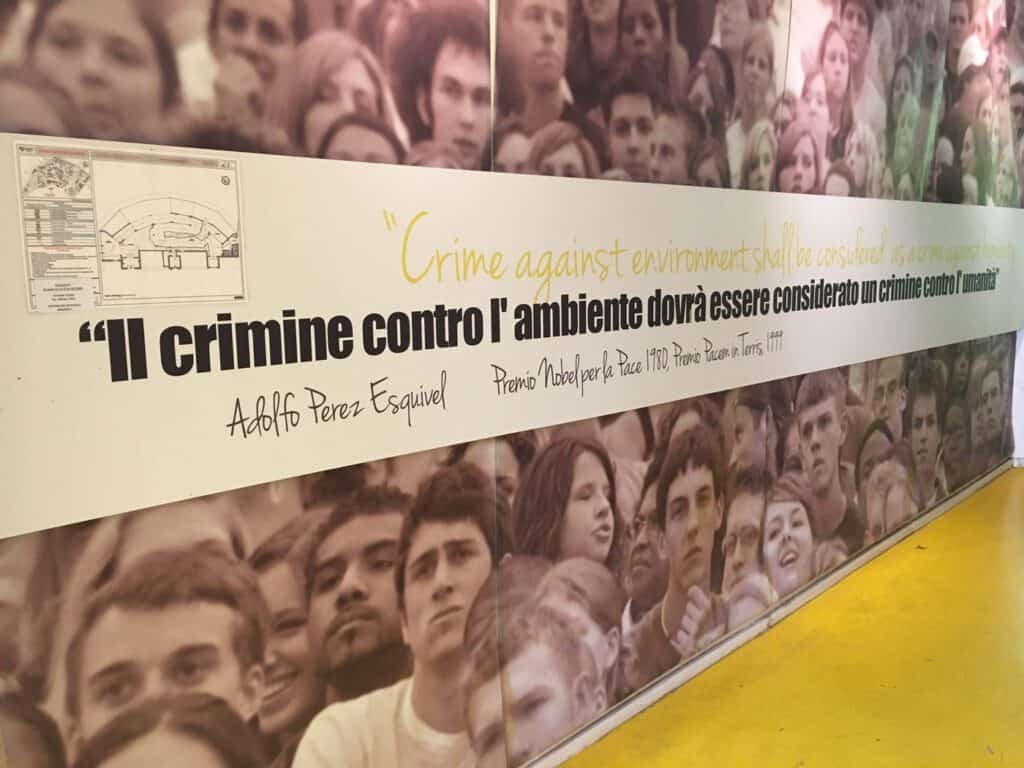
What the MACRI - Environmental Crimes Museum really is
It's a museum of evidence. This is the most honest definition I know, and it's worth keeping in mind throughout the visit. The elephant tusks in the cases were not bought from an antiques dealer, the rhino horns don't come from an 1800s collection, the big cat skins are not gifts from a traveler. They are material seized by the judicial police in operations carried out in Italy and abroad over about 20 years, then gathered into an exhibition route open to the public. The holdings the museum draws on exceed 71,000 items. A fraction of them is on display in the cases, rotated and selected, but the number conveys the scale of the phenomenon better than any panel.
The route occupies about 400 square meters and reconstructs the environmental settings of the different criminal phenomena: the burned forest, the illegal dump, the poacher's bird-netting tower, the container of the trafficking in protected species. The themes addressed are seven in the original core (fires, pollution and waste, poaching, illegal logging, CITES, animal cruelty, investigative techniques) and over time sections on mountain safety and on food safety have been added. The panels are bilingual, Italian and English, and alongside the legal data they give the biological explanation: what that species is, where it lives, why trading it is banned.
In our view it's the toughest and most useful exhibit you can visit in Rome with a 12-year-old. There is nothing consoling. There is no rhetoric of the cute animal. There is a row of objects that someone manufactured, sold and bought, and next to it the explanation of what had to be killed to obtain them. A teenager walks out of there with a question in mind, and the question is worth more than 10 lessons of civic education.
The double name of the MACRI - Environmental Crimes Museum
The acronym stays the same, the words don't. Born in 2014 as the Environmental Crimes Museum, the exhibit is now designated by the Bioparco Foundation as the Environment and Crime Museum, with the abbreviation M.A.CRI., and bears the dedication to Danilo Mainardi. The coexistence of the two names explains why, when looking for information, you come across pages that call the same space in two different ways. They are not two museums: it's the same one, in two seasons of its institutional life.
Why the MACRI - Environmental Crimes Museum is named after Danilo Mainardi
Danilo Mainardi, born in Milan on November 25, 1933 and died in Venice on March 8, 2017, was one of the founders of Italian ethology as an academic discipline and, at the same time, one of the few scientists able to speak to an enormous audience without lowering the level. With a degree in Biological Sciences from Parma in 1956, he taught for a long time at the same university before moving to Ca' Foscari, in Venice, as full professor of Behavioral Ecology. From 1973 he directed the International School of Ethology at the Ettore Majorana center for scientific culture in Erice. He was national president of LIPU in 1996 and then honorary president. Millions of Italians knew him on television alongside Piero Angela, in the different seasons of Quark and Superquark, where he drew animals by hand while explaining them.
Naming a hall that displays evidence of crimes after him is a less obvious choice than it seems. Mainardi was not a man of judicial denunciation: he was a scholar of behavior, and his cultural battle concerned the way human beings imagine other animals. Putting his name above the cases means asserting that environmental crime is born first in the head and only then in the forest. It's a demanding thesis, and the museum supports it well.
The birth of the MACRI - Environmental Crimes Museum
The museum opened to the public on March 6, 2014, after an installation effort that involved craftsmen, specialized technicians and set-design professionals. The project was born from the meeting of two very different parties: the State Forestry Corps, which held the investigative watch over environmental crimes and physically kept the seized items, and the Bioparco di Roma Foundation, which had the public and the space. The first had the warehouse, the second had the stage.
Attending the opening ceremony were the then Minister of Agricultural, Food and Forestry Policies Maurizio Martina, the head of the State Forestry Corps Cesare Patrone, the president of the Bioparco Foundation Federico Coccia, the director general for the protection of nature and the sea Renato Grimaldi and Athos De Luca, then president of the Environment Committee of Roma Capitale. In the hall there were also two classes from the Emilio Sereni agricultural technical institute: a detail that is not a courtesy, because the museum was conceived from day one as a school tool more than as an institutional showcase.
The formula used then, and repeated by all the reports, was that it was the first museum of its kind in Europe. It's worth specifying what that means. Natural history museums with collections of protected species exist everywhere, and so do collections of criminology. What did not exist in 2014 was a permanent place, open to the general public, in which the natural specimen was displayed as the body of the crime and the route was built on the criminal chain that had produced it.
Federico Coccia and the educational idea
The creator of the exhibit, Bioparco Foundation president Federico Coccia, has explained on several occasions that the goal was to leave something with the children who enter the park: not an emotional memory, but an operational notion. A child who has seen the display case of ivory bracelets is much more likely, as an adult on vacation 2,000 kilometers from here, not to buy one. Conservation, in this reading, is not played out only in the countries of origin of the species: it is played out in the destination markets, that is in ours.
From the State Forestry Corps to the Forestry Carabinieri: who supplies the MACRI - Environmental Crimes Museum
Those who built the museum, formally, no longer exist. The State Forestry Corps was absorbed into the Carabinieri by legislative decree of August 19, 2016, number 177, implementing the delegation on the reorganization of public administration: on October 25, 2016 the Forestry, Environmental and Agri-food Units Command was established at the Salvo D'Acquisto barracks in Rome, and on January 1, 2017 6,754 personnel units transferred into the Carabinieri. It was one of the most debated reforms of those years, contested by part of the corps and defended by the government as rationalization. There is no need to relitigate that debate: what matters, for the visitor, is that the museum's cases tell the work of an institution that in the meantime has changed uniform.
The Forestry, Environmental and Agri-food Units Command is today divided into four commands: forestry and parks protection, environmental protection and energy security, agri-food protection, biodiversity protection. Beneath them are 14 regional commands, 83 groups, hundreds of territorial units, the detachments dedicated to national parks and the ecological operations units. The direct management of 130 state nature reserves also falls under the structure, a heritage few Italians know they own. Anyone wishing to understand how the historical memory of the Carabinieri works can stop by the Historical Museum of the Carabinieri, which tells another side of the same institution.
The CITES Group, which supplies the cases of the MACRI - Environmental Crimes Museum
Within the Biodiversity Protection Command operates the Carabinieri CITES Group, the unit that applies the Washington Convention in Italy. It has a central operational section and units spread across the territory, including the posts in airports and ports, where the largest share of the traffic passes. It is from this structure, and from its forestry predecessors, that the museum's raw material comes. Whoever looks at a case is looking at the result of a customs check, a search, an anonymous tip.
A curiosity about the MACRI - Environmental Crimes Museum
The real curiosity concerns the legal status of the objects on display, and it's a point that escapes almost all visitors. In an archaeological museum the object in the case belongs to the State by law, in an art museum it belongs to a collection or a lender. Here the object arrived in the case at the end of a criminal or administrative process: seizure, possible confiscation, destination. A confiscated CITES specimen cannot be sold, cannot be returned, cannot be destroyed without reason. It must be kept or assigned to scientific, educational or museum purposes. The Bioparco museum is, in the proper sense, one of those destinations.
A consequence follows that changes the way you look at the cases. Every piece has a procedural history behind it, with a place, a date and a case file. The worked tusk is not there to illustrate elephant anatomy: it's there because someone brought it into Italy in a suitcase and someone else found it. The museum doesn't state this piece by piece, and that's a shame: a caption with the year and place of the seizure would make the exhibition even sharper.
There is then a second level of curiosity, entirely Italian. The law of February 7, 1992, number 150, the one that governs the offenses relating to the application of the Washington Convention in our legal system, does not limit itself to punishing trade: it also introduces the ban on keeping specimens of mammals and reptiles dangerous to public health and safety, and obliges dealers in protected species to keep registers. It's a rule born for international trafficking that ends up regulating even the living room at home. Many of the seizures that feed the museum are not born at the airport: they are born in an apartment.
One last thing that amuses groups. Among the items are traditional medicine products made from rhino horn, a substance that chemically is keratin, the same as human fingernails. The market value of that material, in the illegal Asian circuits, was for years compared to that of gold. A whole animal killed for a substance that each of us trims in the bathroom on Saturday morning.
The visit to the MACRI - Environmental Crimes Museum, section by section
The route is linear and takes an hour if you read it, 20 minutes if you walk through it. I recommend the first way. What follows is the thematic order of the exhibit: on site the layout may vary, because the cases are rotated and some sections have been added over time.
Fires: the section that opens the MACRI - Environmental Crimes Museum
You start with fire, and it makes sense: in Italy forest arson is the environmental crime with the highest criminal yield relative to the effort required. All it takes is a lighter and a windy day. The section reconstructs the environment after the flames have passed and explains the difference between negligent fire and willful fire, which in the penal code have different names and penalties. Alongside appear the ignition devices most recurrent in investigations, banal objects that become evidence.
Here lives one of the two groups of live animals present in the exhibit: the marginated tortoises, chosen as a symbol of the victims of forest fires. The choice is exact and cruel. The tortoise is slow, fire runs at 20 kilometers an hour in the scrub with a tailwind: there is no contest. In front of that tank it's worth stopping longer than at any case, because it's the only point where the victim is alive and looks at you.
The regulatory framework the panel summarizes is the law of November 21, 2000, number 353, the framework law on forest fires. Its article 10 is the heart of the prevention system: on wooded areas and pastures swept by fire, building structures is banned for 15 years, the previous land uses cannot be changed for 10 years, and municipalities have the obligation to survey and delimit the burned areas every year, updating a dedicated register within 90 days of the fire being put out. Put in plain words: burning a forest to build on it is not worth it, if the register is kept. The conditional is the painful part of the Italian story, and the panels don't hide it.
Pollution and waste at the MACRI - Environmental Crimes Museum
The second area tackles the most lucrative chapter of Italian environmental crime: the waste cycle. The environmental reconstruction shows the contaminated watercourse and soil, with the sampling and analysis apparatus used by the operators. In this zone are housed the avocets, birds with a thin bill curved upward, chosen as the image of the victims of wetland pollution. It's an animal worth a freeze-frame even for the bill alone, one of the most refined fishing tools of European fauna: it moves it sideways through the mud like a scythe, filtering invertebrates.
The panel on illegal trafficking tells the offense that changed Italian judicial history in this field. Today it is article 452-quaterdecies of the penal code, organized activities for the illegal trafficking of waste, and it is the crime used to hit structured chains: the producer who wants to save money, the intermediary who falsifies the codes, the transporter, the operator of the complicit plant. It's not a crime of dirt: it's a crime of accounting.
Poaching at the MACRI - Environmental Crimes Museum: traps, bow snares and lures
The section dedicated to poaching is the one that strikes adults most, because it displays the tools. Bird nets, cage traps, metal bow snares, electronic acoustic lures. The bow snares in particular deserve a pause: they are spring traps built with a few cents of material, placed by the dozens along trails, and they kill by crushing or by slow agony. They don't select: they catch whatever passes.
The reference rule is the law of February 11, 1992, number 157 on the protection of warm-blooded wildlife and on hunting, which establishes which species can be hunted, which are protected and which are particularly protected, and which expressly bans bird netting and non-selective means. The museum explains it with no discounts either for legal hunting or for poaching: they are two distinct things, and confusing them does a favor only to poachers.
Illegal logging and timber at the MACRI - Environmental Crimes Museum
Illegal logging is the least told environmental crime and one of the vastest in the world. The section approaches it on two levels: the tropical one, with the woody species listed in the appendices of the Washington Convention and their commercial derivatives, and the Italian one, with off-plan cuts in coppice woods and on collective properties. On the first level Italy is a consumer country: we import, process, re-export. On the second we are a producer country, and the reports by the Forestry Carabinieri concern thousands of hectares every year.
Alongside the timber samples appear the identification tools: whoever inspects must be able to tell a protected rosewood from a similar-looking wood of free trade, and does so with dichotomous keys, lenses, anatomical references of the wood. It's lab work, not patrol work, and the case makes it evident.
The CITES section of the MACRI - Environmental Crimes Museum
The central cases are the ones everyone photographs and nobody forgets: taxidermied specimens, skins, furs, trophies, shells, corals, worked ivory, pharmaceutical products derived from protected species. They come from judicial police operations carried out at national and international level over about 20 years. It's the core of the museum's display and deserves half of the visit time.
A reading tip. Don't look at the animals, look at the workmanship. A raw tusk says little. A carved tusk says there was a workshop, a client, a sales channel, a price. The violence against the animal is the first link. The rest of the chain is economics, and economics is fought with controls, not with indignation.
Animal cruelty and crime in agriculture at the MACRI - Environmental Crimes Museum
One section deals with animal cruelty and the infiltration of organized crime in the agri-food and livestock sector. They are two themes that seem distant and instead touch each other: the illegal livestock chains, the clandestine slaughtering, the trafficking of counterfeit products. In the current design of the Carabinieri organization there is an entire command dedicated to agri-food protection, and its presence in here serves to say that environmental crime reaches all the way to the plate.
Mountain safety and the Meteomont service
One case is dedicated to mountain safety and to the Meteomont service, the system for monitoring and forecasting avalanche danger. It isn't a crime, it's prevention, and its presence in the route throws off anyone expecting only display cases of seized items. It has its own logic, though: the same structure that chases poachers collects snow data, manages the reserves, watches over the mountains. The territory is one, and so is the staff.
Investigative techniques at the MACRI - Environmental Crimes Museum: how an environmental crime is proven
The concluding section is the one that high school students appreciate most, because it flips the point of view: from the crime to the investigation. Survey instruments, sampling materials and mobile lab equipment are shown, and it is explained how you build the proof of an offense that often has no corpse and no witness. Proving waste trafficking means cross-checking waste forms, weighings, loading and unloading registers. Proving a CITES crime means identifying a species from a fragment. It's applied science, and the museum tells it well.
The audiovisual room and the interactive totems of the MACRI - Environmental Crimes Museum
The route includes an audiovisual space with films on the work of the units engaged in protecting ecosystems, and several touchscreen totems distributed along the rooms, with images, videos and thematic deep dives. There is also a photo area designed for children. The totems are the most fragile part of any modern exhibit, the one that ages first: if you find one turned off, don't make a drama of it and move on, the strong content is in the display cases.
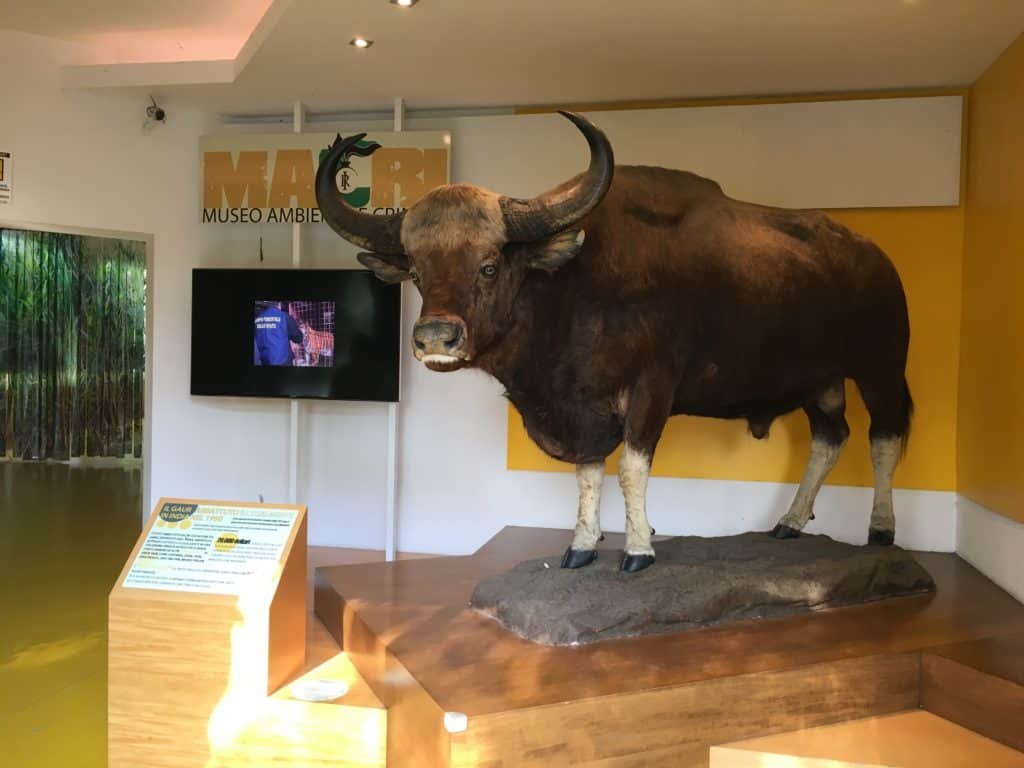
Something nobody tells you about the MACRI - Environmental Crimes Museum
That inside a museum of seized items there are live animals, and they're not there for show. The avocets and the marginated tortoises are part of the exhibit as living figures of speech: they represent, respectively, the victims of pollution and those of fires. It's a rare exhibition choice in criminology museums, and it shifts the level of the discourse. In a taxidermy case the crime has already happened: you look at the result. In front of a live tortoise the crime is still possible, and responsibility comes back to the present.
The second piece of information that almost nobody gives concerns school logistics. The museum is not an automatic stop on the Bioparco's educational routes: it falls within a specific offer. The route titled "6 a rischio", aimed at the upper elementary grades and at middle and high schools, comes in two lengths, an hour and a half or two and a half hours, and the museum is included in the long version. A class that books the short version doesn't see it. Put like that it sounds like a bureaucratic detail: in practice it's the difference between a trip to the zoo and a lesson the kids remember for years. If you're booking for a school, explicitly ask for the two-and-a-half-hour formula.
Third thing, less comfortable to say. The museum has no independent entrance and is not signposted from the outside of Villa Borghese: whoever wants to visit only that pays the full park ticket anyway. For a class this gets diluted in the cost of the day, for a single adult interested in the topic it's not a small expense. This is where the €9 last-minute ticket, valid in the two hours before closing, becomes the smartest solution: 400 square meters can be visited well in an hour, and the rest of the park you look at while walking toward the exit.
Fourth and last. The museum still exists, can be visited and is part of the current offer of the Bioparco Foundation: I say it because pages about facilities born as institutional projects often describe spaces closed for years, and the double name has fed the idea that the 2014 exhibit had been dismantled. It hasn't. It was renamed, expanded and maintained, and it holds up against much more recent exhibits.
CITES explained properly, the heart of the MACRI - Environmental Crimes Museum
Half of the museum is incomprehensible if you don't know what CITES is, and it's worth explaining at length, because it's one of the most successful international conventions of the 1900s and one of the least known to the general public.
The Washington Convention, March 3, 1973
The Convention on International Trade in Endangered Species of Wild Fauna and Flora was opened for signature in Washington on March 3, 1973 and entered into force on July 1, 1975. Today 185 States and regional economic integration organizations are parties to it, and the protection covers more than 40,000 animal and plant species. The principle is as simple as it is effective: exploitation is not banned, unsustainable exploitation is banned, making international trade subject to the issuing of documents certifying the legality and sustainability of the harvest.
The appendices and the European annexes
The species are divided into three appendices, with decreasing degrees of protection: in the first those threatened with extinction, whose international trade for primarily commercial purposes is banned. In the second those that could become so if trade were not regulated. In the third those flagged by individual States that ask for them to be controlled. The European Union adopted the system with four annexes, A, B, C and D, where the first three correspond roughly to the three appendices and the fourth serves for monitoring. This difference between three appendices and four annexes is the reason why, in front of a case, you sometimes read different codes for the same animal.
CITES in Italy: law 874 of 1975 and law 150 of 1992
Italy ratified the Convention with the law of December 19, 1975, number 874, deposited the instrument of ratification on October 3, 1979 and saw it enter into force for its own legal system on December 31, 1979. Four years to ratify, four to deposit: a pace that says a lot about the priority given to the matter in those years. The sanctions regime came much later, with the law of February 7, 1992, number 150, which introduced the criminal offenses and administrative sanctions, the ban on keeping dangerous mammals and reptiles and the register obligations for dealers. Responsibilities in this area are split among several central administrations, with the controls entrusted to the CITES units of the Carabinieri and to the Guardia di Finanza.
How many checks are really carried out
One figure helps size the phenomenon. According to the CITES controls indicator produced by ISPRA, in 2023 in Italy 4,063 checks were carried out, with 769 violations found, of which 483 administrative and 286 criminal, and administrative sanctions of €1,471,413. The historical comparison is even more interesting: the annual average of violations in the period 2018-2023 was 769, against an average of about 299 in the period 2012-2017. It doesn't necessarily mean that more crime is committed: it means that checks are better and the phenomenon emerges. Anyone who wants to read the text of the Convention can start from the official CITES page.
The case of the chimpanzee who arrived at the Bioparco
In November 2025 the Carabinieri of the CITES unit of Catania and Cassibile, together with the veterinarians of the Siracusa health authority, seized a chimpanzee about three and a half years old, kept illegally in a home in the Siracusa area. The animal received its first care at the veterinary hospital of the University of Messina and was then transferred to the Bioparco di Roma, where a group of ethologists started the process of reintroducing it to social life with other individuals of its species.
The story deserves to be told in this article for a precise reason: it closes the circle between the case and the cage. The museum's display cases show the part of the trafficking that ends badly. A few dozen meters away, in the chimpanzee area, a live individual walks who went through that trafficking. A primate torn from its group in the early years of life carries deep behavioral damage, and reintegration is never a given. It's the strongest argument you can use against those who consider the exotic animal a living-room whim.
The advice I give you for visiting the MACRI - Environmental Crimes Museum
Go last, not first, and go with the time counted. It sounds like a paradox and yet it's the strategy that works best with any kind of group. If you enter the Bioparco at 9:30 and dive straight into the museum, the kids fidget because they know the elephants are outside and drag you away in 10 minutes. If instead you do the animals first and arrive at the museum toward the end, when tiredness has already lowered the revs, attention concentrates and the route is read seriously. With high school kids the opposite holds: museum first, with a fresh mind, then the park as a reward.
The second piece of advice concerns the wallet. If the museum is the main reason for the visit and the rest of the park interests you relatively little, the €9 last-minute ticket in the two hours before closing is the most rational choice: 400 square meters can be read at leisure in 50 minutes and the walk toward the exit does the rest. If you are over 65, on Wednesday admission costs €9 all day, and it's the day with the fewest families around. If instead you bring small children, remember that under one meter tall they don't pay, and that the reduced rate covers the range up to age 10.
Third, the season. From June to August Villa Borghese is an oven from 11:00 to 16:00, and an enclosed exhibition space is a precious resource in the middle of the day: it's the only case in which I suggest you flip the rule and use the museum as a central thermal refuge. In winter the opposite holds: the park closes at 17:00, the last entry is at 16:00, and whoever arrives at 15:30 thinking of doing everything ends up rushing.
Fourth, and here I become unpleasant. Don't bring a child under six expecting them to understand. They won't, and will see only still animals inside the glass, which risks being simply sad. The museum works from third grade up, and gives its best between 12 and 18 years old. Below that threshold, the Bioparco offers better: the tanks, the aviaries, the tactile routes. An hour badly spent in a right museum is still an hour badly spent.
Ecomafia: the word that explains the MACRI - Environmental Crimes Museum
The word that holds the whole museum together does not appear in its name, but it's the one the visitor takes home. Ecomafia is an Italian neologism, coined by Legambiente in 1994 in a document titled "Ecomafie. Il ruolo della criminalità organizzata nell'illegalità ambientale". It served to name something that at the time had no name: the meeting of irregular business, complicit public administration and criminal organizations on the terrain of waste disposal, earthmoving, quarries, concrete.
Nunzio Perrella and the sentence that opened the file
At the judicial origin of the phenomenon is a statement made in the early 1990s by a Neapolitan state's witness, Nunzio Perrella, who explained to investigators how waste trafficking was more profitable and infinitely less risky than drug trafficking. The formula with which he summed up the concept, "la monnezza è oro", trash is gold, has become the implicit title of 30 years of investigations. Behind it was an elementary business reasoning: disposing of hazardous waste by the rules costs. Disposing of it in a disused quarry costs almost nothing. The difference is margin.
What the most recent Ecomafia Report says
The annual Legambiente report remains the reference source for the quantitative dimension of the phenomenon. The 2025 edition, which processes the data for 2024, records 40,590 environmental crimes found in Italy, up 14.4 percent from the previous year: an average of 111.2 offenses per day. The people reported are 37,186. The estimated economic value of the ecomafia business is €9.3 billion.
The breakdown by sector is the part I recommend reading most carefully, because it contradicts the common idea. The first sector is not waste: it's concrete, with 13,621 offenses, up 4.7 percent. Next comes the waste cycle with 11,166 crimes, up almost 20 percent. Crimes against animals are 7,222, with an increase of 9.7 percent. On the territorial level Campania remains first with 6,104 offenses, equal to about 15 percent of the national total, followed by Puglia with 4,146, Sicily, Calabria with 3,215 and Lazio with 2,654. From 1995 to 2024 the report counts 389 clans involved in eco-criminal activities.
Lazio in fifth place is not an abstract statistic for those who live in Rome. It's the fires in the storage yards of the eastern outskirts, the illegal dumps along the Aniene, the spills in the ditches of the Roman countryside, the untreated discharges on the coast. A Roman who visits this museum is not looking at a southern problem: he's looking at his own neighborhood.
Law 68 of 2015 and the crimes against the environment
For 20 years Italian environmental criminal law was made almost only of misdemeanors: low penalties, fast statutes of limitations, payments in lieu of prosecution. The turning point is the law of May 22, 2015, number 68, which inserted into the penal code title VI-bis, "Dei delitti contro l'ambiente". The main offenses are environmental pollution under article 452-bis, punished with imprisonment from two to six years and a fine from €10,000 to €100,000, and environmental disaster under article 452-quater, punished with imprisonment from five to 15 years. Next come the negligent cases of article 452-quinquies, the trafficking and abandonment of highly radioactive material in article 452-sexies, the obstruction of controls in article 452-septies, the failure to clean up in article 452-terdecies, punished with imprisonment from one to four years and a fine from €20,000 to €80,000.
The leap is not only in sanctions, it's evidentiary and cultural. With the felony come longer limitation periods, sharper investigative tools, mandatory confiscation. In the museum this passage is represented indirectly, through the section on investigative techniques: without the new regulatory framework, much of that lab work would have no proportionate procedural outcome.
Another well-known fact, yet rarely cited
Everyone knows that illegal trafficking in protected species is one of the largest criminal markets on the planet, regularly placed in the rankings right behind arms, drugs and waste. The figure has circulated for years at conferences. What is cited much less is Italy's position in that market: we are not a country of origin, we are a country of transit and above all of consumption. Our role is not that of the African or Asian poacher. It's that of the buyer.
This radically changes the meaning of the visit. The museum doesn't display someone else's guilt, far away and poor: it displays the demand that starts from here. The ivory bracelet bought on vacation and slipped into a suitcase, the rosewood furniture without papers, the tortoise bought in a shop without a certificate, the sturgeon caviar bought on the black market, the coral harvested and taken away from the sea. Every piece in those cases had a European buyer, and in many cases an Italian one.
The second little-cited element concerns the relative weight of the numbers. In 2023, of the 769 CITES violations found in Italy, 483 were administrative and 286 criminal. The absolute majority of the violations, that is, is not the work of criminal organizations: it consists of missing documents, registers not kept, expired certificates, specimens held in good or bad faith without title. Organized trafficking exists and does the greatest damage, but the bulk of the daily caseload is a gray zone of widespread irregularity, fought with knowledge of the rules more than with handcuffs.
The third element is institutional, and visitors almost always find it surprising: the body that created this museum was dissolved three years after the opening. The State Forestry Corps, born in the 1800s and present in every Italian province, ceased to exist as an autonomous corps on December 31, 2016, and from January 1, 2017 its personnel merged into the Carabinieri. The museum has outlived the institution that wanted it, and is today one of the few public places where that body of investigative work remains visible to those who don't wear a uniform.
Waste, fires and the Terra dei fuochi in the rooms of the MACRI - Environmental Crimes Museum
The museum's waste section opens a question that in recent years has reached Strasbourg. On January 30, 2025 the European Court of Human Rights, deciding the case Cannavacciuolo and Others v. Italy, convicted our country of violating article 2 of the Convention, the right to life, in connection with the management of pollution in the Campania area commonly called Terra dei fuochi: a territory that includes about 90 municipalities between the provinces of Naples and Caserta, inhabited by almost 3 million people. The Court adopted the pilot judgment mechanism, asking the Italian authorities to prepare adequate remediation measures and reserving a check after two years.
It's a decision worth keeping in mind while walking past the cases, because it marks a conceptual shift. For decades environmental damage was treated as a property or health matter to be compensated. Here it is traced back to the right to life, that is the strongest protection the European legal order knows. The burning of waste in a field on the outskirts becomes, legally, a problem of the same order of magnitude as an omission that kills.
Malagrotta, the Roman wound
Rome has its own page, and no museum displays it. For 45 years the Malagrotta landfill, in the Valle Galeria west of the city, received between 4,000 and 5,000 tons of waste a day, coming to occupy about two and a half square kilometers with heaps almost 100 meters high: the largest in Europe. It was closed in 2013 under pressure from protests by local committees and a European infringement procedure. In 2014 the Court of Justice of the European Union convicted Italy for the management of waste delivered without preliminary treatment. The analyses of the regional environmental protection agency have documented over the years a widespread contamination of groundwater by metals and organic compounds.
Today the site is the object of a securing intervention financed with about €250 million of funds from the National Recovery and Resilience Plan, which provides for the waterproof capping of the heaps, a biogas capture system with hundreds of wells and the containment of leachate. The historical owner of the plant was arrested in 2014 and convicted in 2024 to six years and four months for negligent environmental disaster. The company that managed the site went under judicial administration.
If I had to name a single reason why a Roman should visit this museum, I'd name it here. The cases speak of ivory and rhinoceroses, and the mind goes far away. But the heaviest chapter of Italian environmental crime, in volumes and in health consequences, is eight kilometers from the Grande Raccordo Anulare, in a valley that almost nobody in the city has ever seen. Anyone who wants to understand what a piece of still-intact Roman countryside looks like can walk in the Valle dell'Aniene Nature Reserve or in the Parco della Caffarella: the comparison with the Valle Galeria is instructive and bitter.
Arson fires and the concrete cycle
The two chains touch more than people think, and the museum lets you sense it by placing them almost in sequence. Forest arson has historically had three motives: speculation on land, the economic interest tied to firefighting and reconstitution activities, retaliation. The first motive is the one that the 2000 framework law tried to neutralize with the 15-year ban on building on surfaces swept by fire and with the obligation of the municipal register of burned areas. The rule works where the register is kept and updated. Where it isn't kept, the ban becomes paper.
The concrete cycle, with its 13,621 offenses a year recorded by the latest report, is the first sector of Italian environmental crime by number of crimes. It includes illegal building in the proper sense, illegal subdivisions, landscape violations, irregular earthmoving, quarries. It's the least spectacular chapter and the most devastating: no dead animal in a case, but eroded coasts, buffer areas built over, riverbeds occupied. When the flood comes, hydraulics presents the bill.
An observation, and it counts as a firm opinion. In Italian public storytelling environmental crime has a toxic and industrial image: the buried drums, the trucks at night, the black smoke. It's true, but it's the minority part. The majority part is made of permits, exemptions, amnesties and pardons, that is of administrative acts. The museum, which was born from a police corps, necessarily shows the investigable part of the phenomenon. The political part has no display cases, and it would be the most useful to exhibit.
Poaching in Italy, beyond the cases of the MACRI - Environmental Crimes Museum
The poaching section is the most physical of the route, and to understand its weight you need a concrete case. The operation called Pettirosso, conducted by the Forestry Carabinieri with the support of specialized units and LIPU volunteers, is repeated every autumn in the critical poaching areas of Italy. In the 2022 edition the tally counted one arrest and 141 people reported, over 1,700 traps seized, 175 bird nets for a total length of more than a kilometer and a half, 40 acoustic lures, over 3,000 wild birds recovered: 1,326 alive and about 1,750 dead. The hardest-hit provinces were Bergamo, Brescia and Mantova, historically included among the critical areas of the national plan against offenses against wild birds.
Numbers like these, repeated year after year on a relatively narrow front, say that Italian poaching is not a folkloric remnant: it's an organized activity with a downstream market, that of clandestine restaurants serving small birds with polenta. Law 157 of 1992 bans it without ambiguity, and non-selective means are banned even when the species could be hunted. In the Lazio reserves there is one rule: if you find a bow snare or a net, don't touch them and call the single emergency number. Removing them yourself destroys the scene and produces no report.
Poaching also has a less-told Mediterranean face, that of marine species: date mussels, undersized sea urchins, fry, fishing with banned gear. It's the terrain where the Coast Guard intervenes, with its specialized units, and it directly concerns the Roman coast. Anyone who spends a day on the coast between Ostia and Torre Astura passes through areas where these checks are routine: the Roman coast is a state reserve, not just any beach.
The right photo to take at the MACRI - Environmental Crimes Museum
The photograph that works in here is not the one of the object: it's the one of the quantity. A single worked tusk photographed up close becomes a beautiful piece of craftsmanship, and the message turns against the museum's intentions. The same tusk framed together with the others, in a row inside the case, with the repetition filling the frame, tells exactly what it needs to tell: that it's not an isolated case, that it's a production. Widen the field, don't tighten it.
On the technical side it's one of the hardest environments to shoot in. The cases are lit by direct spotlights, the glass reflects and the surroundings are dark: the worst combination for a phone. Three tricks solve almost everything. First, turn off the flash, always: besides being forbidden for the conservation of organic materials and out of respect for the live animals, it bounces off the glass and gives you back a white blotch in the middle of the frame. Second, rest the lens almost in contact with the surface of the glass, so the reflection has no room to form. If you have a dark sleeve, use it as a screen around the lens. Third, shoot vertically: the cases are tall and narrow, and the vertical format avoids including the corridor.
For the two live species, the story changes. The marginated tortoises stay still and let themselves be photographed, so the only problem is focusing through the glass: tap the screen on the shell and wait for the phone to figure it out. The avocets, on the other hand, move constantly, and the curved bill is the subject: you need a fast shutter speed and patience. If you have 15 minutes, wait for one to turn in profile with its bill dipped in the shallow water. It's the most beautiful image you take home from this visit, and it contains not a single element of violence.
A composition tip for classes: photograph the panels too, not just the objects. A big number printed on a wall, framed at an angle with a case in the background, is the photograph that then works on a school poster or in a presentation. The caption does half the work, and here the captions are well written, in Italian and in English.
One thing not to do, instead. Avoid smiling portraits in front of the taxidermied specimens. It happens on every visit, and it makes people uncomfortable. Those animals are there because someone killed them to sell them: the thumbs-up in front of the case is an error of tone, and in a place like this tone matters.
The sea, the Coast Guard and crimes on the coast
The museum was born from a land-based corps and its imprint is forestry, but Italian environmental crime has an equally heavy marine leg, and it's worth telling visitors about it, because it concerns every Roman summer. The untreated discharges that trigger swimming bans, the illegal occupation of maritime state property, fishing with banned gear, the harvesting of protected species such as the date mussel, waste trafficking by ship: these are all matters where the Port Authorities Corps, the Coast Guard, intervenes, with its own operational units and with judicial police powers.
On the Lazio coast this translates into checks on treatment plants, on beach establishments, on fishing boats and on restocking areas. The date mussel deserves an extra word because it's the textbook case: its harvest has been banned for decades, not because of the rarity of the mollusk itself, but because to extract it you have to break the limestone rock where it lives, irreversibly destroying the substrate and with it the whole biological community living on top of it. A kilo of date mussels leaves behind square meters of dead seabed for decades. It's the perfect example of an environmental crime in which the damage is not proportionate to the loot: it is enormously larger.
Anyone who wants to see what a protected and managed coast means can spend a day in the Tenuta di Castelporziano or walk the areas of the Decima Malafede reserve: they are the two pieces of countryside and Mediterranean scrub that survived the urban growth of Rome, and they remain so because someone put restrictions on them in time.
Some important events that happened here in history
The first event is the opening itself, on March 6, 2014. It wasn't a routine ribbon cutting. Bringing 400 square meters of seized items into a zoological garden, a place by definition dedicated to animal life, meant accepting a considerable communication risk: showing death inside a place of families. The Bioparco Foundation and the State Forestry Corps ran it together, and the then Minister of Agricultural Policies, Maurizio Martina, summed up the operation with a formula that you can share or not but which is exact in its intent, that of raising the bar of public awareness. In the hall were the students of an agricultural institute: the choice of audience already said everything about the destination of the project.
The second event is from 2017, and is twofold. That year the museum took the name Environment and Crime Museum and the dedication to Danilo Mainardi, who died on March 8 of the same year, with the rationale of his contribution to the study of animal behavior and to spreading a culture of respect for nature. In the same period the institutional passage that had dissolved the State Forestry Corps was being completed: the museum changed its name and changed, at the same time, the uniform of its suppliers of items. Few Italian exhibition venues have gone through such a clean institutional transition while staying open.
The third event is not a date but a flow: the thousands of school groups that have passed through here in over a decade. It's the only figure that really counts for a museum born with educational aims, and by eye, from the size of the groups crossing paths on spring mornings, it's a steady flow. You measure it by a detail: the noise level. In almost all areas of the Bioparco the kids shout. In the room of the CITES cases they lower their voices on their own, without anyone asking. It's the most sincere compliment an exhibit can receive.
The fourth concerns the facility that hosts the museum, and it's good to know it because it explains the shape of the place. The Rome zoological garden was inaugurated on January 5, 1911 on a layout by Carl Hagenbeck, the man who had revolutionized the conception of European zoos by replacing cages with moats. Between 1933 and 1935 the architect Raffaele De Vico expanded it to its current 17 hectares, adding the reptile house and a large geodesic aviary. After a long decline, in 1994 the project of transformation into a Bioparco was born, carried out in 1998, and in 2004 management passed to a Foundation. The museum belongs to the last of these seasons, the one in which the institution chose to define itself as a center for conservation, research and education.
The fifth event is very recent and concerns an individual, not an institution. In November 2025 the Bioparco took in the three-and-a-half-year-old chimpanzee seized in the Siracusa area by the Carabinieri of the CITES unit. An animal that illegal trafficking had torn from its social group arrived in the same place that, a few dozen meters away, displays the cases of that trafficking. It doesn't often happen that a museum and the reality it tells coincide in the space of an afternoon.
Who has passed through the MACRI - Environmental Crimes Museum
Present at the inaugural day on March 6, 2014 were the then Minister of Agricultural, Food and Forestry Policies Maurizio Martina, who shortly after would tie his public image to the Milan Expo of 2015 and to food themes. Cesare Patrone, head of the State Forestry Corps, the last to lead that corps in its autonomous form before the absorption into the Carabinieri. Federico Coccia, president of the Bioparco di Roma Foundation, veterinarian and creator of the exhibition project. Renato Grimaldi, director general for the protection of nature and the sea of the Ministry of the Environment. Athos De Luca, then president of the Environment Committee of Roma Capitale, a historic figure of Rome's institutional environmentalism. With them, in the hall, two classes of the Emilio Sereni agricultural technical institute of Rome.
The presence that counts most, though, is that of a man who in all likelihood never entered this hall: Danilo Mainardi. The museum has carried his name since 2017, the year of his death, and his presence here is of the kind that weighs more than a visit. Mainardi had spent his life explaining that animals have cultures, local traditions, social learning, and that the boundary between us and them is much less sharp than Western philosophy has claimed for centuries. A museum that displays the remains of animals killed for trade is the logical consequence of that thesis: if the animal is not a thing, reducing it to merchandise is a serious matter, and not just ecological damage.
Two categories of visitors then pass through this museum every year that are worth naming. The first is students, from fifth graders to high school seniors, who are the audience the exhibit was designed for. The second is practitioners: police forces in training, veterinarians, students of natural sciences and environmental law, staff of wildlife recovery centers. For them the cases are not images: they are identification references, that is working tools.
One last honest note on the question that recurs on every visit: which famous people have visited these rooms. There is no public register of illustrious visitors, and I prefer not to attribute presences that don't result from verifiable records. The documented figures are those of the inaugural day and the institutional ones who over the years have renewed the collaboration between the Bioparco and the Forestry Carabinieri for environmental education. In a museum that displays judicial evidence, accuracy is a form of respect.
The MACRI - Environmental Crimes Museum with schools
It's the natural audience of this place, and the programming reflects it. The Bioparco's schools and groups office answers at 06 3614015 and at scuolegruppi@bioparco.it Monday to Friday between 9:30 and 16:00. Booking is mandatory and it's best to do it well in advance for the months of March, April and May, which concentrate almost all of Rome's educational outings.
The "6 a rischio" route and the visit to the MACRI - Environmental Crimes Museum
The educational route that includes the museum is called "6 a rischio" and is aimed at the upper elementary grades and at middle and high schools. It includes observing endangered species housed in the park, among them the Sumatran tiger, the Cape penguin, the rhinoceros, the Komodo dragon and the Asiatic lion, and a guided discussion on the role of zoological gardens in the conservation of biodiversity. It is available in two lengths, an hour and a half or two and a half hours, and the visit to the museum is included in the long version. The museum is run in collaboration with the Forestry Carabinieri, and you can feel this in the approach of the guided tour.
How to prepare the class before coming
I give advice that is worth more than any teaching material. Before the outing, have the kids look up three recent local environmental news stories: a fire, a spill, a seizure, an illegal dump in their municipio. Then, in front of the cases, ask them to link the story to the corresponding section. The difference in attention between a class prepared like this and a class brought in cold is impressive, and it turns 45 minutes of visit into an hour and a half of discussion.
For high schools with a legal or scientific focus, the museum allows finer work. The section on investigative techniques lends itself to a lesson on the chain of custody of evidence. The CITES section lends itself to a lesson on the relationship among international law, European law and domestic law, with three regulatory levels overlapping on the same animal. I don't know many other places in Rome where you can give a lesson like that in front of a physical object.
The MACRI - Environmental Crimes Museum with children
Here we have to be clear, because the subject is delicate. The exhibit contains taxidermied animals, skins, trophies, capture tools. A child of four or five doesn't have the tools to put it in context, and the concrete risk is that they take home only fear or sadness. From third grade up, instead, things change: at that age the sense of justice is very much alive and the typical reaction is not fright, it's indignation. Which is exactly the useful reaction.
Two concrete handholds work with children. The first is the live animals, avocets and tortoises, which offer a neutral and restful point of observation inside a tough route. The second is the interactive totems and the photo area designed for the youngest: they serve to release tension and catch your breath. A smart adult alternates case and screen, and doesn't do the tour all in one go.
If you're looking for a museum designed entirely for the under-six age range, in Rome the right choice is another: Explora, the children's museum of Rome, a stone's throw from Piazzale Flaminio. I would keep the Bioparco museum for the second stage of growing up, the one in which the questions start to become uncomfortable.
How long the visit to the MACRI - Environmental Crimes Museum takes
40 minutes if you look, an hour and a quarter if you read, an hour and a half if you're in a group and stop to discuss. It's 400 square meters: the surface is not the problem, the density of information is. The panels are dense and bilingual, and reading them all takes more time than the average visitor is willing to give in the middle of a day at the zoo.
The full day at the Bioparco, museum included, is well built on three and a half or four hours. Under three hours something gets cut. Whoever has only two hours and wants to see the whole museum should make a clean choice: museum plus one sector of the park, without trying the complete tour. The Bioparco, over 17 hectares, can't be dispatched in an hour, and rushing is good neither for the animals nor for the legs.
Accessibility and services at the MACRI - Environmental Crimes Museum
The Bioparco is overall an accessible environment: the main routes are on flat avenues or with contained slopes, and the facility offers reduced rates for people with disabilities, with free admission for those with a 100 percent disability and for the companion. Tickets for people with disabilities are bought at the ticket offices and not online. The museum, being an indoor, single-level exhibition space, is the easiest part to tackle in a wheelchair or with a stroller.
The park closes some areas ahead of the general closing time, and it's worth knowing so you aren't caught out: reptile house and big cats an hour before closing, chimpanzees 45 minutes before, giraffes, bears, rhinoceroses and elephants half an hour before. Whoever enters with the last-minute ticket must therefore allow that some areas may no longer be visitable, while the museum stays accessible until the general closing. It's another argument in favor of an end-of-day visit for those who come mainly for the exhibit.
In case of adverse weather, strong wind or an alert issued by civil protection, the Foundation reserves the right not to open the park or to close it early. Villa Borghese is full of mature umbrella pines, and with strong wind the risk of falling branches is real: the caution is justified, not bureaucratic.
What to take home: recognizing an illegal product when you travel
This is the practical part the museum teaches and that almost no visitor brings into focus. The cases don't serve only to outrage: they serve to train the consumer's eye. Here are the categories that appear most often in seizures and that you really meet in tourist markets.
Ivory and substitutes
Bracelets, statuettes, jewelry boxes, handles, netsuke. Elephant ivory has a characteristic internal structure, with crossed lines forming a diamond pattern visible in section. It is often passed off as bone, as resin or as antique ivory, and the recurring sales line is that it's a family piece. The practical rule for a traveler is simple: any ivory item requires documentation, and without documentation it doesn't go in the suitcase. The risk is not theoretical, airport checks on this merchandise are among the most attentive.
Skins, furs and reptiles
Bags, belts, boots and wallets in reptile skin are among the most seized products of all. Crocodiles, pythons, monitor lizards and caimans belong in large part to species listed in the appendices of the Convention, and their sale requires certificates that accompany the individual specimen. The tourist buys an elegant object and ignores its legal status. At customs the object becomes a problem.
Corals, shells and sea souvenirs
It's the category that touches the most Italians, because it seems harmless. Hard corals, giant clams, large shells: many of these species are protected, and harvesting is often banned even in the country of origin. In the museum they appear in the cases alongside much bloodier materials, and at first visitors are surprised. Then they read the panel and understand that a coral reef grows a few millimeters a year.
Traditional medicine and animal derivatives
Preparations containing rhinoceros horn, bear bile, felid bones, pangolin scales. It's the sector where demand is most rigid and prices highest, and the one where trafficking is most organized. The museum displays seized samples, and reading the panels clarifies the scientific point: none of these derivatives has demonstrated therapeutic efficacy, and for rhinoceros horn the composition is that of keratin.
Live animals
Turtles, parrots, raptors, primates, reptiles. It's the category that produces the most dramatic seizures, because the animal's suffering during transport is added to the illegality. Keeping a protected specimen without documentation is sanctioned by law 150 of 1992, and for some dangerous species there is an absolute ban on private keeping. Before buying an exotic animal, asking for the certificate is not excessive caution: it's the only way not to finance a criminal chain.
When to go to the MACRI - Environmental Crimes Museum and when to avoid it
The best days are weekdays in April and October, with the park in order, a manageable climate and the classes concentrated in the morning. If you choose a weekday, enter after 13:30: the school groups at that hour have already packed up and the museum empties out.
The worst days are spring Sundays, the Easter holiday period and the afternoons of long weekends. Villa Borghese on those days is full, the Bioparco works at maximum capacity and the museum room, which isn't big, becomes a corridor. It's not impossible to visit, but the quality of the reading drops considerably.
In summer the reasoning is the reverse of the rest of the city. Rome empties its museums in July and August but fills the parks in the evening. The Bioparco remains a daytime environment and in the middle hours of a July day it's hard on everyone, animals included. The museum, an enclosed space, then becomes the most comfortable part of the day. If you have children, organize the visit so as to enter it between 12:30 and 15:00.
One last note on the sector closures ahead of time. Whoever arrives an hour before closing will find the reptile house and big cats already closed, and will have to give up part of the park. For a visit focused on the museum the problem doesn't exist. For a first visit to the Bioparco with children, it does.
What to see around the MACRI - Environmental Crimes Museum
The museum is in Villa Borghese, which is the luckiest way to be located in Rome. Within 10 or 15 minutes on foot there is a cultural density that few European capitals can match, and it's best to build the day so that the Bioparco is not the only stop.
Five minutes from the park entrance is the Museo Civico di Zoologia, which shares the block with the Bioparco and the theme with the Bioparco museum: historical natural history collections, skeletons, dioramas, and a section dedicated to biodiversity that rounds out the discussion on protected species. If you have a whole afternoon and an interested kid, the pair of Bioparco plus Museo di Zoologia is the best science program Rome offers at a modest cost.
Walking south you reach the Galleria Borghese, which requires mandatory booking and has timed-slot entries, and the Secret Gardens of Villa Borghese, the formal garden sector that Cardinal Scipione had designed next to the main casino. A little farther, the Museo Pietro Canonica occupies the Fortezzuola and preserves the sculptor's studio, while the Museo Carlo Bilotti, in the former orangery, hosts 1900s works and temporary exhibitions. For the evening, the Casa del Cinema in the Casina delle Rose schedules series and outdoor screenings.
To the north, beyond Viale Bruno Buozzi, the Etruscan Museum of Villa Giulia ideally closes the quadrant with the villa of Julius III and the most important Etruscan collection in Italy. Anyone who wants instead to continue along the thread of nature has two options within bus reach: Villa Ada, with its woods and little lakes, and the Monte Mario Reserve, the last strip of natural forest overlooking the city. And, for those who want to understand what a well-managed urban protected area looks like, the Botanical Garden on the Lungara is the plant-based complement to this visit.
The complete picture of Roman destinations, to build a made-to-measure day, is on the page of Rome's tourist attractions.
Why the MACRI - Environmental Crimes Museum makes sense, and why we'd need more
To close, a debatable position. Italian natural history museums tell biodiversity as if it were an accomplished fact: here are the species, here are the habitats, here are the 1800s display cases with the birds in a row. It's a beautiful and static story. This museum does something different and more uncomfortable: it tells biodiversity as a contested good, that is as something someone is actively destroying for money while you read the panel. The passage from the display case to judicial evidence changes the verb tense, and with it the meaning of the visit.
The limit of the operation is just as clear. A museum built by a police corps shows the part of the phenomenon that the police can pursue: the poacher, the trafficker, the trucker, the dealer without certificates. The part that no case can contain is that of easy permits, amnesties, impact assessments written to measure, repeated pardons. The concrete cycle is the first sector by number of environmental crimes in Italy, and in the exhibition route it takes up less space than its relevance would deserve. It's the chapter I would add, if asked.
That said, the balance remains largely positive. An exhibit born in 2014, survivor of the dissolution of the body that created it, maintained and expanded for over a decade inside a facility that lives on ticket sales, is a rarity in the Italian museum landscape, where institutional initiatives last on average as long as the legislature that wanted them.
Quick questions about the MACRI - Environmental Crimes Museum
Where is the MACRI - Environmental Crimes Museum
Inside the Bioparco di Roma, in Villa Borghese, with the entrance at Viale del Giardino Zoologico 20, in the Pinciano district. The Foundation also gives Piazzale del Giardino Zoologico 1 as the reference for the area in front.
How much does it cost to visit the MACRI - Environmental Crimes Museum
It has no ticket of its own: admission is included in the Bioparco's, which costs €19 full price and €14 reduced. There is a €9 last-minute ticket in the two hours before closing and a €9 rate for over 65s on Wednesday.
Is the MACRI - Environmental Crimes Museum still open
Yes. It can be visited and is part of the current offer of the Bioparco Foundation, under the name Environment and Crime Museum dedicated to Danilo Mainardi. The double name confuses, but the space is the same one inaugurated in 2014.
Do you need to book to visit the MACRI - Environmental Crimes Museum
For an individual visit no, the Bioparco ticket is enough. For schools and groups booking is mandatory and is done through the dedicated office, at 06 3614015 or at scuolegruppi@bioparco.it, Monday to Friday between 9:30 and 16:00.
What are the hours of the MACRI - Environmental Crimes Museum
They coincide with those of the Bioparco: opening at 9:30 every day, closing at 17:00 in the winter months, at 18:00 in the middle season and at 19:00 on Saturdays, Sundays and holidays between the end of March and early October. Last entry and closing of the ticket offices one hour earlier. The park closes only on December 25.
How long the visit to the MACRI - Environmental Crimes Museum takes
From 40 minutes to an hour and a half, depending on how much you read. It's about 400 square meters with a very high density of panels.
Can you take photographs inside the MACRI - Environmental Crimes Museum
Photographs for personal use pose no problem, but flash should be avoided: it damages organic materials, disturbs the live animals and produces reflections on the cases. For professional or commercial use you need to contact the Foundation.
Is it suitable for small children
Under six I advise against it: it contains taxidermied animals, skins and capture tools, and the ability to put things in context is missing. From third grade up it works very well, and gives its best with middle and high school kids.
Are there live animals inside the MACRI - Environmental Crimes Museum
Yes, two groups: the avocets, chosen to represent the victims of wetland pollution, and the marginated tortoises, associated with the victims of forest fires.
How many items does the MACRI - Environmental Crimes Museum hold
The holdings the exhibition draws on exceed 71,000 items, the result of seizures made over about 20 years in national and international operations. A selection of them is on display in the cases.
Who created the MACRI - Environmental Crimes Museum
The Bioparco di Roma Foundation together with the State Forestry Corps, with the inauguration on March 6, 2014. Since 2017, after the absorption of the Forestry Corps into the Carabinieri, the collaboration continues with the Forestry Carabinieri.
Why is it also called the Environment and Crime Museum
Because in 2017 the exhibit took on this name together with the dedication to the ethologist Danilo Mainardi, keeping the abbreviation M.A.CRI. The two formulas indicate the same space.
What is CITES
It is the Convention on International Trade in Endangered Species of Wild Fauna and Flora, opened for signature in Washington on March 3, 1973 and in force since July 1, 1975. There are 185 parties to it and it protects more than 40,000 species.
Is the MACRI - Environmental Crimes Museum wheelchair accessible
The exhibition space is indoors and on one level, and is the easiest part of the visit to the Bioparco. Tickets for people with disabilities are bought at the ticket offices and not online. With a 100 percent disability, admission is free for the companion too.
How do you get there by public transport
Tram 19, Bioparco stop. Buses 3, 52, 53, 217, 360, 926 and 910, with the 910 stopping in front of the entrance only on Saturdays, Sundays and holidays. Metro line A, Flaminio or Spagna stations, and cross Villa Borghese on foot.
Can you visit only the museum without entering the Bioparco
No. The museum is inside the park and has no independent entrance: you need the Bioparco ticket.
How much time do you need for the whole Bioparco, museum included
From three and a half to four hours. The park covers 17 hectares and some areas close earlier than the general closing time.
Which areas close first
Reptile house and big cats an hour before the park closes, chimpanzees 45 minutes before, giraffes, bears, rhinoceroses and elephants half an hour before.
Is the museum included in school visits
Only in those that include the right route. The "6 a rischio" route includes it in the two-and-a-half-hour version, while the hour-and-a-half version does not include it: it's best to specify this when booking.
What is the difference between the MACRI - Environmental Crimes Museum and the Museo Civico di Zoologia
The Museo Civico di Zoologia is a natural history museum with historical collections, skeletons and dioramas, and tells biodiversity as such. The Bioparco museum displays seized items and tells the crimes that hit that biodiversity. They are complementary, and are a few minutes apart on foot.
What does ecomafia mean
It is a term coined by Legambiente in 1994 to indicate the tangle among organized crime, irregular business and complicit public administration in the sectors of waste, concrete, quarries and illegal trafficking of species and animals.
How many environmental crimes are there in Italy
The annual Legambiente report, in the 2025 edition referring to 2024 data, counts 40,590 environmental crimes found, up 14.4 percent, with 37,186 people reported and an estimated turnover of €9.3 billion.
Is there a cloakroom or luggage storage
The Bioparco is an outdoor facility and does not provide a cloakroom in the museum sense of the term. It's best to arrive light, with water and a hat in the warm season.
How long is the wait in line
At the Bioparco ticket offices the wait can exceed half an hour on spring Sundays and on long-weekend days. On weekdays it's almost always negligible. At the entrance of the museum, which is inside the park, there are no lines.
Are there guided tours of the MACRI - Environmental Crimes Museum
The museum is visited freely with the park ticket. Accompanied formulas fall within the offer for schools and groups, which must be arranged with the dedicated office.
Are tickets bought online
Yes, through the official channel of the Bioparco Foundation. The reduced rates for people with disabilities, on the other hand, are bought exclusively at the ticket offices.
Is the museum suitable for a visit in the rain
It's one of the few enclosed areas of the Bioparco, so yes. It's worth remembering, though, that in case of a weather alert or strong wind the Foundation may decide not to open the park or to close it early.
What is the Meteomont service
It is the system for monitoring and forecasting avalanche danger to which one of the sections of the route is dedicated, together with the theme of mountain safety. It falls among the tasks of the Carabinieri's forestry units.
One last thing. We have enough museums that explain how beautiful nature is. We have very few places that show, with real objects and verifiable numbers, what it costs to destroy it and who profits. If you have a child between 10 and 18, bring them, and don't be afraid of the harshness of some cases: the harshness is the point. Whoever leaves there having understood that an ivory bracelet bought on vacation is the last link of a chain that starts with a dead elephant has learned more than they will learn in a year of good intentions.
Article written by the editorial team of TourLeaderPro, contact them for Private/Corporate/V.I.P. Tours and Experiences.
Planning a trip to Rome? The English guides to visiting the city are on ItalyPlanner.com.