Aniene Valley Nature Reserve
In short. The Aniene Valley Nature Reserve is the regional protected area that accompanies the Aniene River into Rome for 650 hectares, from the Grande Raccordo Anulare to the confluence with the Tiber, and it can be visited free of charge every…
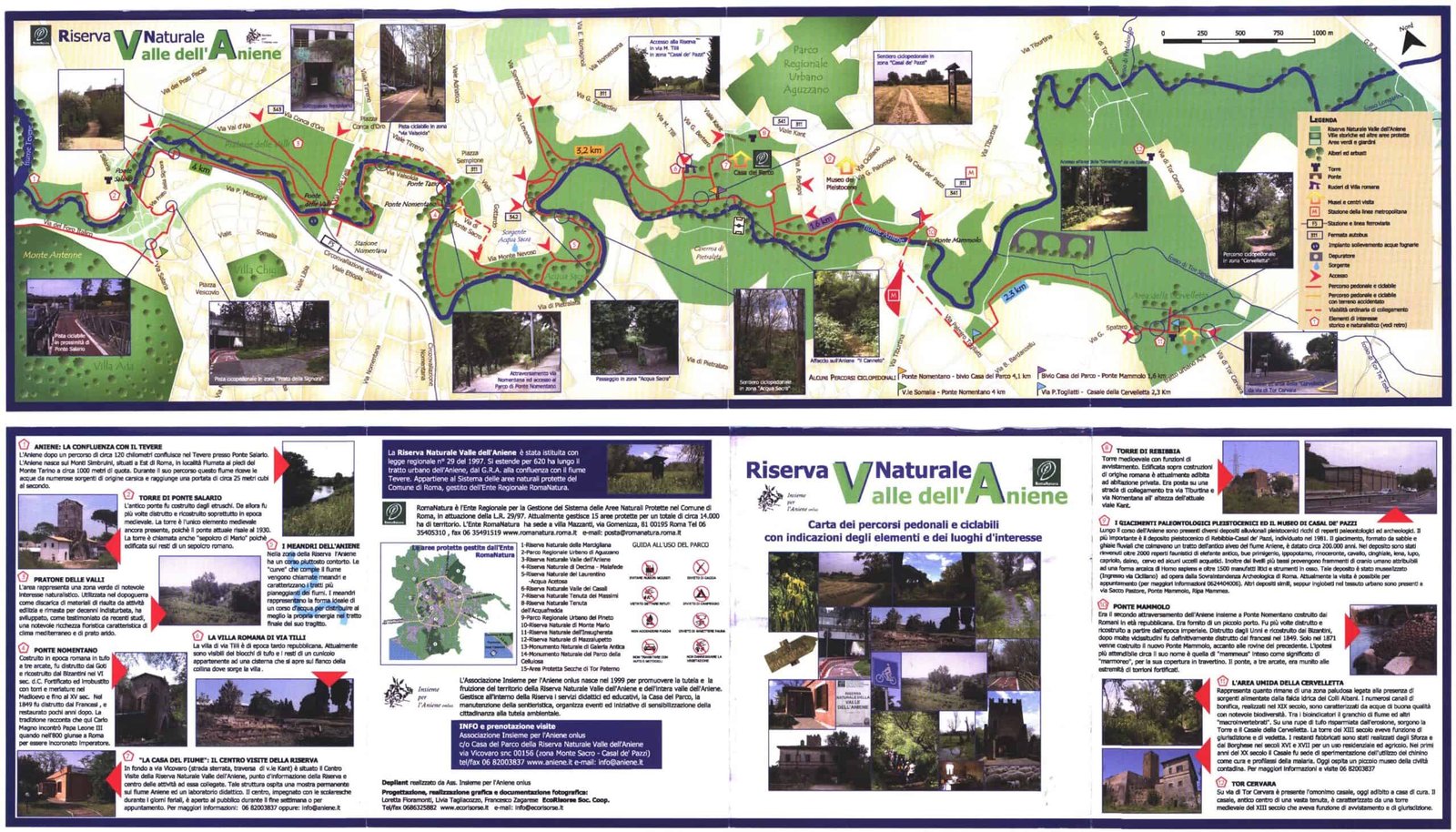
The Aniene Valley Nature Reserve is the regional protected area that accompanies the Aniene River into Rome for 650 hectares, from the Grande Raccordo Anulare to the confluence with the Tiber, and it can be visited free of charge every day, with no ticket, no gates and no hours: it is an urban park with free entry, not a fenced archaeological site. The managing body is RomaNatura, based at Villa Mazzanti, Via Gomenizza 81, 00195 Rome, telephone 06 35405310. The operational outpost in the field is the Casa del Parco on Via Vicovaro snc, 00155 Rome, telephone 06 82003837, home of the association Insieme per l'Aniene, which runs guided visits, environmental education and urban gardens. The most convenient access points by public transport are the Metro Line B stations Ponte Mammolo, Rebibbia, Santa Maria del Soccorso and Pietralata, all a few minutes' walk from the banks. Inside the perimeter of the reserve there are two places with their own hours and rules: the Museo di Casal de' Pazzi, at Via Egidio Galbani 6, free admission with mandatory reservation at 060608, open Tuesday to Friday from 9:00 to 14:00 and Saturday and Sunday from 10:00 to 14:00, closed Monday, May 1 and December 25, and the Cervelletta complex, which is instead outdoors and freely walkable.
Anyone who wants to place the reserve within the system of Roman parks will find a solid starting point in the page on Valli Park, which is the western gate of the Aniene Valley, and in the one on Cervelletta Park, which is its wet heart.

What the Aniene Valley Nature Reserve Really Is
Anyone who arrives here imagining a closed park, with a ticket office and a laminated map at the entrance, is thrown off in the first five minutes. The Aniene Valley Nature Reserve is not an enclosure: it is a long, thin strip that follows the bends of the river, widens where the land allows it and narrows to a few meters where the city has pushed in. From Prati Fiscali to the Longarina ditch the perimeter winds, and this elongated shape explains everything else, including its flaws. A protected area shaped like this has a hugely disproportionate border compared with its surface, and every meter of border is a point where the city enters.
What comes out of it is an anomalous park, which coexists with the pylons of the ring road, with spontaneous gardens, with soccer fields and with warehouses. Anyone looking for untouched nature should prepare for disappointment. Anyone who instead wants to understand how the relationship between Rome and its water really works finds here the most instructive case study in the city, much more than the postcard Roman countryside seen elsewhere.
A Protected Area as Long as a River
The territory of the reserve runs along both banks. It is not a bureaucratic detail: it means that almost everywhere the river is visible from two sides, and that a round-trip route can change perspective completely just by crossing a bridge. The urban stretch of the Aniene stands out for its remarkable length and for the number of meanders, which the river has carved into a flat valley floor that is easy to erode.
The practical consequence is that distances as the crow flies and real ones never coincide. Two points that look close on the map can take 20 minutes of walking because between them the river has drawn a whole bend. Keep this in mind when planning the day.
The Three Areas of Greatest Natural Value in the Aniene Valley Nature Reserve
Inside the perimeter three cores of higher interest can be recognized. The first is the wetland of the Cervelletta, at the eastern end, where the network of canals and the standing water have preserved a marsh environment that has disappeared elsewhere. The second is the riparian strip proper, that is, the vegetation that accompanies the river from bank to bank, and which is the remnant of the woodland that once covered the entire valley floor. The third is the Parco delle Valli, toward Conca d'Oro, the most urbanized and most frequented end.
The three historic local associations born around these three areas joined together in 1999, giving rise to the association Insieme per l'Aniene, which since then has managed the park on behalf of RomaNatura. It is an uncommon model in Italy: a regional protected area administered in the field by an associative body born from the neighborhood. It works better than you would expect, and the limits it has do not depend on who manages it.
The Pratone delle Valli
Within the reserve, the Pratone delle Valli is of particular importance, the large grassy clearing that opens toward Monte Sacro. It's the place where the reserve looks most like a country meadow, and where, on sunny days, Romans gather to run, walk their dogs or simply spread out a blanket. It isn't an area of exceptional botanical value, but it serves a function that no other part of the park can serve: it absorbs the pressure of the public and keeps it away from the more fragile zones. An urban park needs a lawn to trample, otherwise people trample the reed beds.
The Law That Established the Aniene Valley Nature Reserve
The reserve was established by Lazio regional law of October 6, 1997, number 29, published in the Official Bulletin of the Lazio Region of November 10, 1997, number 31, ordinary supplement number 2. It's the framework law with which Lazio reorganized the entire subject of protected natural areas, and several of the Roman reserves now run by RomaNatura were created on the same occasion.
The date matters more than it seems. 1997 is the year Rome acknowledged that fringe green space could no longer be treated as a leftover waiting to be built on. Until then, the Aniene Valley was, from an administrative point of view, a sequence of compromised farmland, disused quarries and lots awaiting development. The protection froze the situation, and in many places it froze the decay too, but it prevented the neighborhoods from merging into one built-up mass.
Who Manages the Aniene Valley Nature Reserve Today
Ownership lies with the Regional Agency RomaNatura, which is based at Villa Mazzanti, at Via Gomenizza 81, and manages the system of protected natural areas within the territory of the City of Rome. The phone number the agency lists is 06 35405310, with a second number, 06 35405350, for the offices. On the ground, as mentioned, Insieme per l'Aniene operates from the Casa del Parco on Via Vicovaro.
If you want to join a guided visit, a bike outing or a river descent, you should write or call the Casa del Parco: the calendar of activities changes constantly and includes environmental education, summer camps, sports, water quality monitoring and visits accessible with the joelette for people with mobility difficulties. The contact is info@aniene.it, phone 06 82003837.
How to Get to the Aniene Valley Nature Reserve
Here the reserve plays its best card. No other protected area in Rome is served so well by public transportation, because Metro Line B runs parallel to the river for a long stretch and crosses over it.
By Metro Line B
There are four useful stops. Pietralata and Santa Maria del Soccorso serve the central sector, the one with the former quarries and the more industrial banks. Ponte Mammolo, opened in 1995, is the most convenient gateway to the eastern sector and for reaching the Casa del Parco. Rebibbia, the terminus of the branch since 1990, is the closest access to the Casal de' Pazzi Museum and Via Galbani area.
The practical advice is simple: get off at one stop, walk along the river and get back on at another. Avoid going out and back along the same route, which in the Aniene Valley is the worst choice because the landscape changes a lot within a few kilometers and walking it in reverse adds nothing.
By Bicycle Along the Aniene
The bike path that follows the river is, for cyclists, the main reason to come. The valley floor is flat and the slopes are negligible, which makes the route suitable even for people who are out of shape and for children riding on their own. The Parco delle Valli has two bike paths, one of which connects the Villa Ada area and Via Nomentana, and from there the connection to the rest of the valley is made up of stretches of uneven quality.
It must be said frankly, because it's what visitors discover on the spot, to their annoyance: the continuity of the bike path isn't guaranteed along the whole urban course. There are perfect stretches and interrupted ones, detours onto the road, underpasses flooded after rain and points where the route gets lost. Anyone who sets out convinced they'll find a continuous bike route from the Raccordo to the Tiber will be disappointed. Anyone who sets out knowing they'll have to improvise a few connections has a lot of fun.
By Car and Where to Park
The Parco delle Valli has a parking lot with more than 200 spaces, and it's the simplest option for those arriving by car from outside Rome. Other access points have street parking, with the predictable difficulties in residential neighborhoods. The Casal de' Pazzi Museum has its own vehicle entrance from Via Adolfo Marco Boroli. Our opinion is that bringing the car here is a waste: Metro B drops you at the river and spares you the problem of getting back to your starting point.
The Aniene River, Protagonist of the Aniene Valley Nature Reserve
You can't understand the reserve without understanding the river that creates it. The Aniene is 98.5 kilometers long and is the second most important left-bank tributary of the Tiber after the Nera. At the confluence it brings the Tiber a flow on the order of 31 cubic meters per second: it's not a ditch, it's a real river, and the difference shows on flood days.
From the Simbruini Springs to the Outskirts of Rome
The river rises from two branches. The first springs up at around 1,200 meters of elevation on the southern slope of Monte Tarino. The second, the Simbrivio, collects the waters of the springs of Monte Autore in the territory of Vallepietra and joins the main branch near Trevi nel Lazio. From there the river runs down a valley that has been, in succession, the shepherds' road, the valley of the Benedictine monasteries of Subiaco, the landscape of the Roman villas of Tivoli and, since 1884, the Italian cradle of hydroelectric power.
The waterfall that made the Aniene famous is the one at Tivoli, tamed in the Parco Villa Gregoriana. Anyone who knows that waterfall and then arrives at Ponte Mammolo has trouble recognizing the same watercourse: here the river is slow, wide and murky, and flows between low banks.
The Water That Built Rome
Starting from the middle of the 2nd century BC, the abundance of the Aniene's waters was put at the service of the city through a series of aqueducts, among them the Acqua Marcia, which still supplies Rome. Anyone who wants to see the surviving arches of that system has to go to the Aqueducts Park, on the other side of the city: it's the other half of the same hydraulic story, and the two visits complement each other.
It's worth pausing a moment on this point, because it's the one the distracted visitor skips. The Aniene Valley isn't green by chance and isn't suburbs by chance: it's the line along which Rome drew its drinking water for centuries, and the reason the neighborhoods here were born late is that the valley floor was malarial, floodable and therefore unsellable. The history of Roman urban planning reads very well while walking these banks.
The Confluence with the Tiber
The end of the reserve is where the Aniene flows into the Tiber, near Ponte Salario, at the height of the Prati Fiscali. It's a point that's not very spectacular and very significant. The two waters have different colors and for a few dozen meters you can see the line of separation, which then disappears. Anyone with patience who arrives in the late afternoon, in the raking light, catches the phenomenon better.
From here on, the Tiber continues toward the historic center and becomes the river everyone knows, the one of the bridges and the lungotevere. The Aniene, which has run for almost 100 kilometers, vanishes without anyone noticing. I find it one of the most melancholy scenes in Roman geography.
The Neighborhoods Crossed by the Aniene Valley Nature Reserve
Here the river doesn't just divide two banks: it marks the administrative and mental boundary of half of the northeastern quadrant of Rome. The reserve represents the edge of very different neighborhoods, and crossing it means passing from one piece of the city to another with no gradual transition. The names that matter are La Rustica, Tor Cervara, Tor Sapienza, Colli Aniene, Ponte Mammolo, Casal de' Pazzi, Pietralata, Monte Sacro and Trieste.

Monte Sacro, the Parco delle Valli and Conca d'Oro
At its western end the reserve runs into the fabric of Monte Sacro and Conca d'Oro, in Municipio III. Here the green space is more tamed and used daily: people walking dogs, older people on benches, kids on the small fields. The Parco delle Valli is considered the big park of the district and offers three drinking fountains, a children's playground, a market area, a senior center with a bocce court and, since May 2018, a sports facility built with CONI thanks to the collaboration of the local association Amici di Conca d'Oro.
It's the sector to choose if you come with small children or with older people: the services are there, the paths are well worn, the risk of finding yourself in the middle of nowhere is low. It's also the least interesting sector from a naturalistic point of view, and anyone looking for the wild river has to move eastward.
Pietralata, the Tiburtino and the Industrial Banks
In the central sector the reserve crosses Pietralata and skirts the Tiburtino. Here the landscape is that of Rome's productive edge: warehouses, depots, the railway, the ring road. The river runs sunken between banks that bear the marks of a century of industrial work, and the green has an almost clandestine character, sprouting up in the spaces left free.
In recent years Pietralata has changed its face, with a cultural life that has found space in disused buildings. Anyone passing through in summer may come across neighborhood festivals and events, like those hosted at the DAF di Pietralata, which is one of the liveliest outposts in the quadrant.
Ponte Mammolo and Rebibbia
The name Ponte Mammolo comes from the bridge that crossed the Aniene here on the ancient Via Tiburtina, and the place name has been documented for centuries. Today it's above all an interchange hub: terminus for suburban bus lines, metro station, park-and-ride lot. A few hundred meters further on, the river catches its breath and the reserve becomes a green place again.
Rebibbia is the terminus of the branch of Line B and the entry gate to the sector where the reserve keeps its archaeological surprises. Anyone who gets off here and walks toward Via Galbani reaches, in a quarter of an hour, a museum worth the trip by itself.
Casal de' Pazzi and Colli Aniene
Casal de' Pazzi is a neighborhood of recent construction built on one of the most important paleontological discoveries in Rome, discussed further on. Colli Aniene, on the other bank, is the neighborhood born in the 1960s and 1970s that borders directly on the Cervelletta area: the mobilization of its residents in the 1980s is one of the reasons the farmhouse and its wetland still exist.
Tor Cervara, Tor Sapienza and La Rustica
At the eastern end the park brushes against Tor Cervara, Tor Sapienza and La Rustica, that is, the Rome of the postwar historic outskirts and the borgate. This is the stretch least visited by casual visitors and the one where the reserve shows most starkly the contradiction between protection on paper and the reality on the ground. It's also the stretch where, by contrast, you meet the most interesting wildlife.
The Parco delle Valli, the Western Gateway to the Aniene Valley Nature Reserve
The Parco delle Valli deserves a chapter of its own because it's the piece of the reserve that Romans call by a different name and use as if it were an independent park. Formally it falls within the perimeter of the Aniene Valley Nature Reserve. In practice it has a social life of its own, a neighborhood public and a higher level of facilities than the rest.
The area is municipally owned, management is by RomaNatura, cleaning is entrusted to a private operator and surveillance is carried out by the agency's staff. Neighborhood associations and volunteer groups revolve around the park and organize environmental education activities with a continuity that's missing in other sectors of the reserve.
What You Find at the Parco delle Valli
All the basic facilities are there: large green areas, two bike paths, one of them linking to the area of Villa Ada and Via Nomentana, three drinking fountains, the playground, the market, the parking lot with more than 200 spaces. The senior center with the bocce court suffered a fire and can't be used: it's the kind of detail no guide reports and that you should know before arriving with the idea of playing bocce.
Why the Parco delle Valli Is the Right Place for a First Visit
If you've never set foot in the Aniene Valley and you have two hours, this is where you should start. Not because it's the most beautiful stretch, but because it's the one where you understand the geography of the place: you see the river, you see the Pratone, you see how the city faces the water. Then, on your second outing, you go toward the Cervelletta and discover the rest.
The Cervelletta Area
The Cervelletta area is the part of the Aniene Valley Nature Reserve with the greatest overall value, because it combines a wetland of European importance and an architectural complex that tells 800 years of Roman farming history. It lies on the edge between Colli Aniene and Tor Sapienza.
The Tower and the Farmhouse
The tower is the oldest structure: it dates to the 12th century, reaches a height of about 30 meters and is crowned with Guelph crenellations, a sign of the defensive and lookout function for which it was built. In the Middle Ages the property was ecclesiastical. In the 16th century it passed to the Sforza. In 1628 Cardinal Scipione Borghese bought the estate, and from 1630 the family began transforming the farmhouse into a country residence, developing the farm at the same time.
In 1835 the Salviati took over and carried out reclamation works, organizing the system of canals that still shapes the valley floor around the farmhouse today. In 2001 the complex was bought by Rome's city administration. The area had already been included in the perimeter of the protected area in 1997.
Quinine, Malaria and the Scientists at the Cervelletta
At the end of the 19th century the Cervelletta hosted an experimental station for quinine prophylaxis against malaria. Among those who worked and stayed there were the hygienist Angelo Celli and his wife Anna Fraentzel Celli, protagonists of the campaign that led Rome and the Agro to be freed of the disease. It's a chapter in the history of medicine that almost no one associates with this piece of the outskirts, and that nevertheless explains why the Aniene valley floor remained unpopulated until well into the 20th century.
The complex's decline begins in the postwar period and continues throughout the 1970s. In the 1980s the mobilization of the residents of Colli Aniene is what saves the structure from final ruin and leads, in 1997, to its inclusion in the protected area. Today the farmhouse remains one of the last fragile witnesses of Rome's historic agrarian landscape, and anyone who sees it up close understands how fragile the adjective is.
The Cervelletta Wetland
The Cervelletta's natural value isn't in the farmhouse, it's in the water around it. The network of ditches and canals connected to the Aniene maintains permanently damp conditions, and those conditions support a community of invertebrates with few equals in Rome. From an entomological standpoint, the Cervelletta wetland is considered among the most significant in the entire municipal territory.
If you go, walk slowly along the canals and look down. The freshwater crab and the fish of the smaller network are only seen if you stop. Anyone who rides through the Cervelletta by bike at a brisk pace sees absolutely nothing, and then goes home convinced there's nothing to see.

The Casal de' Pazzi Museum Inside the Aniene Valley Nature Reserve
In the Rebibbia sector, inside the perimeter of the reserve, is the most underrated museum in Rome. The Casal de' Pazzi Museum preserves in situ a portion of an ancient riverbed dated to about 200,000 years ago, and preserves it exactly where it was found, under a covering built around the excavation.
What Happened Here 200,000 Years Ago
The deposit corresponds to the bed of a Pleistocene watercourse, at a time when the landscape of the valley floor was completely different from today's. The water carried and accumulated bones of large mammals, pebbles and stone artifacts, sealing them in the sediments. What you see is the result of that transport: a carpet of remains concentrated in a few meters of thickness.
Among the materials on display are elephant tusks and Paleolithic stone tools, together with pebbles shaped by the water. The museum supplements the finds with virtual reconstructions of the prehistoric environment, and this is the part that works best with kids, because the leap between the gray deposit of the excavation and the landscape populated with animals is enormous.
Hours and Tickets for the Casal de' Pazzi Museum
The address is Via Egidio Galbani 6, 00156 Rome, with the parking lot entrance from Via Adolfo Marco Boroli. It's open Tuesday to Friday from 9:00 to 14:00 and Saturday and Sunday from 10:00 to 14:00, with last entry one hour before closing. It's closed on Monday, May 1 and December 25. Admission is free for everyone, full-price and reduced included, but booking is mandatory and is done at 060608, available every day from 9:00 to 19:00. During opening hours the direct number 06 67107 7007 also answers, and the email address is info@museocasaldepazzi.it.
The Pleistocene garden and the walkway overlooking the deposit are currently not open to visitors: updated notices are published on the museum's official website, which you should check before leaving. Groups of five to 25 people with a group leader book at the same number. Guided tours in several languages and workshops are paid and must be requested separately. The museum offers tactile and sensory routes on request.
The blunt verdict: it's the best ratio between what you learn and what you pay in all of Rome, because you pay nothing. A full hour, phone booking, and you come out knowing what the valley you're walking in looked like before there was a Rome. The page dedicated to the Casal de' Pazzi Museum collects the visit details.
Ponte Nomentano, the Monument of the Aniene Valley Nature Reserve
Among all the built elements the reserve encloses, Ponte Nomentano is the one that has left the most trace in art. The bridge carries Via Nomentana across the Aniene at the point where, in all likelihood since prehistory, the transhumant herds headed for the sea crossed. Today it's squeezed into the Monte Sacro neighborhood, but it keeps its presence intact.

The Roman Structure
The original structure dates to the Republican era and was rebuilt after the destruction tied to the Gothic War and the passage of Totila. The ancient construction used squared tuff blocks with travertine archivolts and was articulated in three arches, of which the central one spanned the river's course. Ponte Nomentano belongs to the small group of the great extra-urban bridges of ancient Rome, together with Milvian Bridge and Ponte Salario.
On the Roman structure an effigy with a bovine head and a club is preserved, which recalls the cult of Hercules, protector of herds and trade. It's no random ornament at a ford used for transhumance: the link between Hercules, livestock and transit routes is one of the sturdiest threads of archaic Roman religion.
An erudite tradition traces the bridge's origin to the time of Menenius Agrippa: it should be taken for what it is, a tradition, not a documented fact. The dating that scholarship places between the end of the 2nd and the beginning of the 1st century BC for the tuff-block phase is the soundest indication one can give to someone looking at the stones.
The Medieval Tower and the Popes
In the 8th century, under Pope Adrian I, the bridge was fortified with two towers. The defensive system was reinforced with masonry structures between the 12th and 13th centuries, and the tower was raised under Pope Nicholas V, in the 15th century: the present appearance of the complex is largely due to that 15th-century work, although later centuries brought damage and alterations.
The bridge passed through different owners, and among the holders was the Pazzi family in the years of the Florentine conspiracy. From 1532 the tower functioned as the city's customs house: anyone entering Rome from the north along the Nomentana paid here. In 1849, during the French siege of the Roman Republic, the structure suffered damage that was repaired seven years later.
Ponte Nomentano Today
Until 1924, the year the nearby Ponte Tazio was built, the Nomentano remained the obligatory passage between Rome and the north. In 1997 it was closed to vehicle traffic for conservation reasons, and in the early 2000s it underwent a conservative restoration accompanied by the recovery of the surrounding environment, as part of the works for the Jubilee. Today it's crossed only on foot.
Generations of painters depicted it imposing and isolated in the solitude of the Agro, animated only by the passing of carts and flocks. Looking at it today, with the buildings of Monte Sacro behind it, is an exercise in mental subtraction that's worth the effort.
The Flora of the Aniene Valley Nature Reserve
The reserve's vegetation is a residual strip of the vast riparian woodlands that once lined the banks of the Aniene. Residual is the right word: what you see isn't a natural forest that survived intact, it's what is left after centuries of cutting, farming, reclamation and urbanization.
Riparian Vegetation
Poplars and willows make up the main tree component of the strip along the river. White willow, elm and ash have joined the company thanks to the presence of water, in a setting that by morphology would otherwise be dominated by oak woods. It's a formation that changes appearance quickly through the year: in winter it lets you see the river, in high summer it hides it almost completely.
Common Reed, Cattail and Duckweed
In the flooded areas common reed is abundant, a grass recognizable by its plumed flower cluster, and so is cattail, with its bare stem, compact rust-colored spike flower cluster and long parallel-veined leaves. Those leaves had a specific use for centuries in the household economy: they were used to cover flasks with straw and to make mats.
The common reed and the small duckweed perform a purifying function, filtering and cleaning the water. This isn't a poetic note: it's the ecological reason the reed bed should be left where it is, and why every stretch of bank leveled worsens the water quality downstream.
Flowers and Marsh Species
In spring the yellow flag iris blooms, the showiest yellow in the reserve in April and May. Also widespread are papyrus, iris, elderberry and the algae and plants typical of marsh ecosystems. Anyone who arrives in May finds the best moment of the year botanically. Anyone who arrives in August finds a dusty reed bed and little else.
The Oak Woods of the Valley Floor
The territory is mostly flat, and this feature has favored the establishment of oak woods: pedunculate oak, Turkey oak, downy oak and Hungarian oak are the species present. The Hungarian oak in particular is an oak that outside central Italy and the Balkans isn't easily found, and its presence on the Roman valley floor is one of the least publicized assets of the Aniene Valley Nature Reserve.
The Fauna of the Aniene Valley Nature Reserve
Given the environment, the most interesting animals in the reserve are tied to water. It's a fauna that doesn't force itself on your attention: there are no deer here, no spectacular raptors, nothing a child would recognize from 50 meters. There are, instead, species that say a lot about water quality, and that's why it's worth learning to recognize them.
The Kingfisher and the Gray Heron
The kingfisher is the reserve's symbol animal. You see it perched on a branch jutting out over the water, motionless, waiting for the moment to dive. The color is unmistakable and the flight, low and straight, is a blue flash along the line of the current. The gray heron, much bigger, frequents the same waters in a completely different style, standing in the shallows.
The kingfisher is protected by the Community directive on natural and semi-natural habitats and on wild flora and fauna, and its stable presence along the urban course of the Aniene is the best answer to those who claim the river is dead.
The Freshwater Crab, the Rovella and Crayfish
In the cleaner floodplain areas and in the network of canals connected to the Aniene lives the rovella, a small freshwater fish also protected by the same European directive. The freshwater crab is a crustacean easily observed in the reserve's canals: it lives on the bottom of the ditches, where it feeds on the organic particles in the substrate. Like the rovella, it indicates the presence of clean water, and for this reason the two are considered top-quality ecological indicators.
Crayfish are also present, among them the American crayfish, an alien species that causes serious problems in Italian watercourses. Among the fish of the main course is the brown trout. Frogs and amphibians complete the picture in the wetlands.
The Penduline Tit and the Pond Turtle
The same environments host the penduline tit, a small passerine that builds on the banks of watercourses a flask-shaped nest hanging from branches: one of the most extraordinary animal-made structures you can see in Italy, and one of the least observed because it requires looking up at the right spot. Among reptiles, the pond turtle is present, increasingly localized and increasingly rare.
The Mammals of the Aniene Valley Nature Reserve
Among mammals, the porcupine, the nutria, the Roman mole, the hazel dormouse and the fox are reported. The nutria is a recent and problematic introduction, which digs into the banks and speeds up erosion. The porcupine, by contrast, is a native animal, nocturnal and discreet, of which daytime visitors see only the quills dropped along the paths. Bat colonies are also present, hunting over the water's surface on summer evenings.
Insects, the Real Hidden Treasure
The wealth of arthropods is the least known and most significant aspect of the reserve. The Cervelletta wetland is considered among the most significant areas of the Roman territory from an entomological standpoint. Right here, following specific research on Diptera, the presence of a stratiomyid was reported in 2002, a genus and species recorded for the first time in Italy.
A discovery of this kind in a valley floor surrounded by apartment buildings says everything about the area's potential. It also says how little studied it is: things are found when someone looks for them, and in the Aniene Valley systematic research has been scarce.
The Geology of the Aniene Valley Nature Reserve
Under the green lies the volcano. The reserve's territory rests for the most part on the pyroclastic products of Lazio volcanism, made up above all of tuffs and pozzolanas, deposited by the eruptions that shaped the entire sector in the oldest periods of the Quaternary.
The Tuff Quarries Between Pietralata and Salone
Those materials have been exploited as building stone since antiquity. The ancient tuff quarries were active from the 2nd century BC until the early imperial age, and exploiting them was made convenient by the possibility of using the river as a transport route to the urban building site. The result is that the lower course of the Aniene, between Pietralata and Salone, had for centuries a landscape marked by excavation.
Despite modern exploitation and later backfilling, many underground spaces remain with supporting pillars and deep vertical walls where the marks of quarry tools are still clearly visible. They aren't open to the public and shouldn't be looked for on your own: they're unstable environments and exploring them is for those with the authority to do so.
The Artists' Festival at the Tor Cervara Quarries
The Tor Cervara quarries had particular fame because at the end of the 19th century they hosted the artists' festival, the event with which the international colony of painters resident in Rome greeted the arrival of spring. It's one of the few cases in which a quarry becomes a place of cultural memory, and it's still a superb hook today for telling a group what the Campagna Romana was for foreigners in the 19th century.
The Extra-Urban Stretch of the Aniene Valley Nature Reserve
Beyond the Grande Raccordo Anulare the landscape changes register and the morphology of the Roman countryside predominates. Here are three elements of great interest that the urban visitor almost always ignores.
The Springs of the Acqua Vergine
The springs of the Acqua Vergine are the head of a thread that reaches the center of Rome: it's the aqueduct that feeds the Trevi Fountain and the Barcaccia in Piazza di Spagna, the only ancient aqueduct that has always remained in operation. Seeing the point where that water comes out of the ground, in the middle of an anonymous farm landscape, is an experience that overturns the city's tourist hierarchy.
The Crater of the Ancient Lake Castiglione
The crater of the ancient Lake Castiglione, drained in modern times, is the large volcanic basin near Gabii. Its circular shape is still legible today, and the story of its reclamation is one of the chapters of Lazio's hydraulic engineering that deserve more attention.
Pantano Borghese
The Pantano Borghese area completes the picture: the place name alone declares the original nature of the place. Anyone who wants to get an idea of what the Campagna Romana was like before the reclamations will find in this sector, and in the nearby Parco della Mistica, the last legible fragments.
The Urban Gardens of the Aniene Valley Nature Reserve
Since November 2011, next to the Casa del Parco, in Via Vicovaro area, one of the most substantial urban gardening projects in Rome has been in operation. The first core occupies about 4,000 square meters and includes more than 100 plots assigned to citizens and collaborators. At the end of 2016 a second phase, called Ortinsieme and tied to a European project, added more than 60 plots. The total today exceeds 160 plots spread over three areas devoted to urban gardening.
Assignment is requested by filling out a form available at Via Vicovaro office or by email. Cultivation must follow organic farming methods, according to the City of Rome urban gardens regulation approved in October 2024.
Why the Gardens Matter More Than They Seem
A long, narrow protected area in the middle of the city has a structural problem: it doesn't have enough eyes. The gardens solve exactly that. Where there is a gardener who arrives every morning, opens the gate and works, decay recedes. It isn't a sentimental consideration about community: it's an operational observation that anyone who frequents Rome's urban margins can verify in half an hour of walking.
How to Really Visit the Aniene Valley Nature Reserve
Here you need a change of mindset compared with a traditional park. Nobody visits the Aniene Valley Nature Reserve in its entirety in one day, and anyone who tries ends up walking a lot and seeing little. You pick a sector, walk it calmly, and come back another time for the next.
How Much Time You Need
For the Parco delle Valli sector, two comfortable hours are enough. For the Cervelletta sector you need three, because the value of the area can only be appreciated by slowing down. The Casal de' Pazzi Museum takes a full hour, booking included. Ponte Nomentano can be seen in 20 minutes, but it's worth giving it a long stop with the river below.
The marked route that RomaNatura indicates as the main itinerary links Ponte Nomentano to Via Vicovaro, and it's a good reference axis for walkers. The Casa del Parco hands out material on the routes and organizes guided outings on foot and by bike.
The Aniene Valley Nature Reserve with Children
It works, on two conditions. The first is choosing the Parco delle Valli or the equipped area closest to the entrance, where there are drinking fountains, play equipment and open spaces. The second is having something to look for: the penduline tit's nest, the crab in the canals, the tool marks in the tuff walls. A child taken to walk along a river with no goal gets bored in 10 minutes.
The combination I recommend to parents is museum plus river: first the free visit to Casal de' Pazzi, with the elephant tusks and virtual reconstructions, then the walk along the water. After seeing what it was like 200,000 years ago, the valley floor gains a whole different depth even for an eight-year-old.
Accessibility
The situation is uneven. The paths of the Parco delle Valli and the equipped stretches are largely flat and passable. Many bankside trails aren't, because of natural surface, roots and short but sharp changes in elevation. The association that manages the park offers outings accessible with the joelette, the vehicle that lets people with mobility difficulties be taken into nature: it's the most realistic way for those who want to reach the unequipped stretches. The Casal de' Pazzi Museum offers tactile and sensory routes on request.
Dogs, Bikes and Rules
The reserve is a protected area and not a public garden: dogs must be kept on a leash, wildlife isn't to be disturbed, bankside vegetation isn't to be cut and no fires are to be lit. Bikes are allowed on the bike paths and service roads, not in the reed bed. These are basic rules that are little respected here, and the result shows.
When to Go to the Aniene Valley Nature Reserve
The season changes everything. It's not a place that behaves the same way 12 months a year, and getting the timing wrong means taking home an unfair impression.
Spring and fall
April and May are the best time: the riverside vegetation has burst out but hasn't yet closed off the view, the water iris blooms, the birds are active and the temperatures allow long walks. October and November are the second choice, with low light and a river that is often fuller.
Summer, the worst time
July and August are hard here. The shade of the riparian strip doesn't cover the paths continuously, the mosquitoes in the wetlands are plentiful and the low river concentrates the smells. If you can, avoid it. If you can't, go out at dawn and be back by 10:00.
Winter and floods
Winter has an unexpected advantage: without leaves the river can be seen from every point and the shape of the bends becomes readable. The drawback is mud, which after every rain makes the bank paths slippery and in some stretches impassable.
On floods a clear word is needed. The Aniene in flood is a dangerous river: the valley floor is its natural expansion area, the bank paths end up underwater and the underpasses flood. On alert days and in the 24 hours after heavy rain the reserve is not a place to go for a walk, and the municipal civil protection's instructions must be followed without argument. It isn't excessive caution: it's the reason this valley floor has stayed free of houses.
Degradation, the problem no guide talks about
Anyone writing about this reserve has two options: pretend it's an immaculate oasis, or say how things stand. I prefer the second. In several stretches of the Aniene Valley you come across abandoned trash, informal settlements, degraded stretches of bank, discharges and interrupted paths. Not everywhere, not always, but often enough that you have to take it into account.
The reasons are structural and by now clear. A protected area 30 kilometers long and in places only a few tens of meters wide, wedged between dense neighborhoods and productive zones, has a perimeter-to-surface ratio that makes thorough control impossible with the resources available. Added to this is that part of the valley floor has fragmented ownership and some areas have in fact been abandoned for decades.
The picture, however, isn't static. The associations working on the river carry out water quality monitoring, reforestation, collective cleanups and environmental education with a consistency that has produced measurable results. And the stable return of the kingfisher along the urban stretch, the first to disappear when the water worsens, says that on the decisive aspect the direction is the right one.
The practical advice for the visitor: choose the managed sectors, that is the Parco delle Valli, the Casa del Parco area and the Cervelletta area. Avoid venturing into isolated stretches without knowing them, especially alone and especially toward evening. It isn't a dangerous place. It's a place on the margin, which requires the common sense you use in any urban margin.
A curiosity about the Aniene Valley Nature Reserve
200,000 years ago, where the buildings of Casal de' Pazzi stand today, a branch of the Aniene flowed, carrying elephant carcasses downstream. Not generic elephants: the ancient elephant, an animal bigger than today's African elephant, which populated the valley together with rhinoceroses, aurochs, giant deer and hippopotamuses. The river gathered the bones and piled them up inside its own bed, and that bed stayed sealed in the sediments until, during construction work in the neighborhood, it came back to light.
The real curiosity isn't the elephant: it's that the deposit was preserved instead of destroyed. A paleontological deposit discovered in a residential construction site has, statistically, little chance of surviving, and the stories that end with the concrete pour are infinitely more common than those that end with a museum. Here it went differently: part of the riverbed was kept in place, covered and turned into the museum that you visit today free of charge.
There's a second level of curiosity that concerns the observer. When you walk along the Aniene at Rebibbia, the valley floor you see is the latest version of a series of valley floors that have followed one another in the same spot for hundreds of thousands of years, each with its own fauna, its own climate and its own sea level. The Aniene Valley Nature Reserve doesn't protect a landscape. It protects a geological device that keeps working. It's a difference that changes the way you look at the brown water flowing under the bridge.
A detail that always strikes: in the deposit, next to the bones, there are chipped stone tools. Someone was here, working stone and frequenting these banks at a time when Rome didn't even exist as an idea. The continuum of human presence in this valley floor is measured not in centuries or in millennia, but in hundreds of millennia.
Something nobody tells you about the Aniene Valley Nature Reserve
The thing nobody says is that this reserve has no entrance. It seems a trivial observation and yet it's the key to everything. A protected area without a door has no moment when the visitor realizes they've entered, and so lacks the ritual that in every national park, every museum, every archaeological site prepares the mind to look in a certain way. You go from the sidewalk to the trail seamlessly, and you keep looking at the place with the eyes you use to look at the street.
The practical consequence is that most of the Romans who pass through it don't know they're inside a protected natural area of 650 hectares established by regional law. They use it as a shortcut, as a running track, as a parking lot, as a place for the dog to let off steam. And since they don't know they're in a reserve, they behave as if it were no man's land. The decay discussed in the previous chapter is born in large part here, well before lack of surveillance.
The second thing nobody says is that the value of this reserve isn't scenic. Anyone coming in search of beauty, in the conventional sense, would do better to go to the Parco dell'Appia Antica or the Caffarella Valley. The value of the Aniene Valley is functional and ecological: it's a corridor, that is, a continuous passage along which animals and plants can move between the outer countryside and the heart of the city. Without this corridor, many species now observed inside the Grande Raccordo Anulare wouldn't be there.
Third unsaid thing, and the most useful in practice: the reserve is enjoyed far more from the water than from the bank. The guided river descents organized by the association that manages the park show a landscape invisible from the banks, because the riparian vegetation blocks the view and because the perspective from the water's surface completely eliminates the city. A few dozen people a year do it. It's the best thing you can do in here.
Frequently Asked Questions About the Aniene Valley Nature Reserve
How Much Does It Cost to Enter the Aniene Valley Nature Reserve?
Nothing. Access to the Aniene Valley Nature Reserve is open and free, with no ticket and no booking. The Casal de' Pazzi Museum, which is inside the reserve's perimeter, also has free admission, but with mandatory booking at 060608.
How Do You Get to the Aniene Valley Nature Reserve by Metro?
You get to the Aniene Valley Nature Reserve easily on Line B of the Rome metro, which runs parallel to the river for a long stretch. The useful stops are Pietralata and Santa Maria del Soccorso for the central sector, and Ponte Mammolo for the stretch farther downstream.
How Big Is the Aniene Valley Nature Reserve?
The Aniene Valley Nature Reserve covers 650 hectares, distributed along the river's urban course from the Prati Fiscali to the Longarina ditch, with a narrow, elongated perimeter that adapts to the city around it.
What Is There to See in the Aniene Valley Nature Reserve?
In the Aniene Valley Nature Reserve you'll find Ponte Nomentano, one of the monuments most painted by vedute painters between the 18th and 19th centuries, the historic Cervelletta complex with its 12th-century tower, and the Casal de' Pazzi Museum, which preserves in situ an ancient riverbed dated to about 200,000 years ago.
How Long Does It Take to Visit the Aniene Valley Nature Reserve?
Nobody visits the Aniene Valley Nature Reserve in its entirety in one day, and it's better to choose one sector at a time. For the Parco delle Valli two comfortable hours are enough, while the Cervelletta sector takes more time, to be planned as a separate visit.
Is the Aniene Valley Nature Reserve Safe and Well Kept?
It must be said honestly that in several stretches of the Aniene Valley Nature Reserve you come across abandoned trash, informal settlements, degraded banks and interrupted trails, not everywhere and not always, but often enough that you should factor it in before planning the visit.
When Is the Best Time to Go to the Aniene Valley Nature Reserve?
April and May are the best time for the Aniene Valley Nature Reserve: the riparian vegetation has burst out but hasn't yet closed off the view, the yellow flag iris blooms and the birds are active. October and November also offer good conditions for a visit.
The Advice I Give You for Visiting the Aniene Valley Nature Reserve
There's only one piece of advice and it's worth more than any other: build the day around the metro, not around the car, and walk in one direction only. Get off at Rebibbia in the morning, with the booking at the Casal de' Pazzi Museum already made, give the museum the hour it deserves, then head down to the river and continue westward. Get back on at the Ponte Mammolo stop or, if you have the legs and time, keep going to Santa Maria del Soccorso and Pietralata. That's two or three hours of easy walking, never retracing your steps, with a free museum in the middle and the metro closing the circle.
The second piece of advice concerns shoes and water. The surface of the bankside trails is natural, after rain it becomes mud and in summer it becomes dust: city shoes aren't enough and sandals are out. There are drinking fountains at the Parco delle Valli, but along the river you can walk a long time without meeting one: bring a liter per person in summer.
Third, and here I go against the current of almost all guides: don't come alone the first time. Not for safety reasons, but because this is a reserve you read, not one you look at, and without someone to point out the penduline tit's nest, the tool marks in the tuff, the difference between reed and cattail, you risk going home with the feeling of having walked for two hours along a brown river. The guided outings from the Casa del Parco cost little or nothing and completely transform the experience. If you prefer to get around on your own with a professional, the certified tour leaders of TourLeaderPro in Rome organize tailor-made outings even outside the classic circuits.
Fourth and last: pick a weekday. On weekends the equipped sectors fill up with families and cyclists, and the noise drives the animals away from the most accessible banks. On Tuesday morning the same bank is another planet.
Another Well-Known Fact, Yet Rarely Cited
Everybody knows that the Aniene fed Rome's aqueducts. It's written in every textbook and all the guides repeat it in front of the arches at Porta Maggiore. What almost no one connects is the urban-planning consequence of that fact for the valley floor that is now a protected area.
Starting in the middle of the 2nd century BC, the abundant waters of the Aniene were tapped for a series of aqueducts, among them the Acqua Marcia, which still serves Rome. But the intakes were upstream, in the stretch of valley between Tivoli and the Simbruini, where the water was clear and cold. The terminal stretch, which is today the reserve, was exactly the opposite: murky water, unstable banks, stagnant pools, malaria. It was the discarded part of the river.
This ancient hierarchy, between the noble mountain river and the discarded valley river, is the reason a protected natural area of 650 hectares exists today a few kilometers from the center of a European capital. Nobody built here because it flooded and because people got sick. The quarries dug, the shepherds passed through, the mills ground, but the city kept its distance. When malaria was eradicated and building techniques made it possible to build anywhere, it was already well into the 20th century, and the urban growth of this quadrant was organized in separate neighborhoods on both banks, leaving the valley floor in between.
The conclusion is almost paradoxical and worth keeping in mind while walking: the Aniene Valley Nature Reserve exists because for 2,000 years this place was considered uninhabitable. Roman green space is never born from the will to conserve, it almost always comes from an obstacle. It holds for the Agro, it holds for the noble estates, it holds here in exemplary fashion.
The Right Photo to Take at the Aniene Valley Nature Reserve
The photograph to take home is Ponte Nomentano shot from the bank, down low, with the water in the foreground and the tower closing the composition. You go down from street level and move onto the riverbed: from there the backdrop of Monte Sacro buildings leaves the frame and only the bridge remains, as the vedute painters painted it for three centuries. It's the same image found in 19th-century prints, and that coincidence is why it works.
The right light is that of a late winter afternoon, when the low sun lights the masonry from the west and the bare vegetation doesn't cover the structure. In summer, with the riparian strip at its fullest growth, the bridge is poorly visible from the bank and the photo suffers.
The second framing I recommend is entirely different: the Cervelletta farmhouse with its crenellated tower above the plane of the canals, shot from far away to include the meadow. It works on foggy winter mornings, which form here on the valley floor with a frequency that surprises anyone who doesn't live in the area. It's the photo that says better than any caption what the Campagna Romana was.
One technical warning and one ethical. The technical one: the river is almost always murky and in photographs comes out an unpleasant brown, so it's best to compose with little water and a lot of vegetation, or look for reflections that change its color completely. The ethical one: you don't chase the kingfisher. You stay far from it, still, and wait. Anyone who approaches for the photo makes it fly away and ruins the wait for those who arrived earlier.
Some Important Events That Happened Here in History
For centuries the Aniene valley floor at the gates of Rome was the point where anyone arriving from the north and east had to stop, negotiate or fight. A river to cross is always a place of decisions.
The Secession of the Plebs on Monte Sacro
The Roman annalistic tradition places the first secession of the plebs right on this bank, on the hill that has borne the name Monte Sacro ever since, with the plebeians withdrawing outside the city and the mediation that led to the creation of the tribunes of the plebs. The story of the speech about the limbs and the stomach, attributed to Menenius Agrippa, belongs to the literary tradition and not to a contemporary chronicle: it should be told for what it is, that is, the founding myth of a political balance, not official minutes. That collective memory fixed the episode here, on the bank of the Aniene, nonetheless says how central this crossing was in the mental geography of the Romans.
The Gothic War and the rebuilding of the bridge
In the sixth century the war between the Byzantines and the Goths devastated the outskirts of Rome, and Ponte Nomentano was caught up in the destruction linked to Totila's passage. The rebuilding that followed is what handed the structure down to the following centuries. Anyone who looks at the masonry today sees the layering of those phases, which no restoration has erased.
The Carolingian and papal fortification
In the eighth century, under Pope Hadrian I, the bridge was fitted with two towers: a choice that turns a road work into a military outpost and that tells of the insecurity of the Roman territory after the end of the ancient world. Between the 12th and 13th centuries the fortifications were reinforced with masonry structures, and in the 15th century Nicholas V had the tower raised.
The customs house and the fiscal border
From 1532 Ponte Nomentano became the city's customs house. This means that Rome's tax line ran through here: goods coming down from Sabina and Abruzzo were stopped, weighed and taxed. The Aniene valley floor was therefore also an economic border, and the memory of that role survives in place names and in the very structure of the tower.
1849 and the French siege
During the French invasion of 1849, which put an end to the Roman Republic, the bridge suffered considerable damage, repaired seven years later. The banks of the Aniene saw troop movements and clashes on the edges of the siege: it is one of the least told Risorgimento chapters of Rome, overshadowed by the events on the Janiculum.
The anti-malaria campaign of the late 19th century
At the end of the 19th century the experimental station for quinine prophylaxis housed at the Cervelletta became one of the sites of the scientific campaign that freed the Agro Romano from malaria. It was a public health operation of national scale, with the distribution of state quinine and a network of rural schools. The Aniene valley floor was both its laboratory and its beneficiary: without that campaign, these neighborhoods would never have been born.
The discovery of the Casal de' Pazzi deposit
The finding of the Pleistocene riverbed during building work in the neighborhood is the most important scientific event to have happened in the valley in the contemporary era. It brought to light a deposit with remains of large mammals and stone tools from about 200,000 years ago, and led to the decision, anything but a given, to preserve a portion of the excavation in place and make it open to visitors.
The closing of the bridge and the restorations
In 1997 Ponte Nomentano was closed to vehicle traffic, after bearing for 70 years a load it had not been intended for. At the beginning of the 2000s the conservation restoration, accompanied by the environmental recovery of the surroundings as part of the Jubilee works, returned the monument to pedestrian use only. In that same year, 1997, the regional law established the reserve: two separate decisions, made in the same year, which together changed the fate of the valley floor.
The birth of Insieme per l'Aniene
In 1999 the three historic territorial associations of the Cervelletta, the riverside area and Parco delle Valli joined together to create the association that has managed the park on behalf of RomaNatura ever since. It is an administrative event that no chronicle celebrated and that left more of a mark on the ground than many inaugurations: without that merger, the valley floor today would be governed by no one.
Who has passed through Aniene Valley Nature Reserve
The Aniene valley floor has hosted neither courts nor popes on vacation, and this has kept it out of the celebratory guidebooks. But those who passed through here really did pass through, and in some cases left their mark.
The veduta painters and the painters of the Roman Campagna
Ponte Nomentano is one of the recurring subjects of Roman landscape painting between the 18th and 19th centuries. Generations of Italian and foreign artists portrayed it isolated in the Agro, animated only by carts and flocks, with the tower standing out against the sky. Those views are documents today: they show a landscape that the 20th century erased and let us measure exactly what was lost and what, instead, is still in place.
The international colony of painters that lived in Rome in the 19th century habitually frequented this valley floor, and the Tor Cervara quarries were the setting of the artists' festival that greeted spring at the end of the century. It was not an occasional aesthetic pilgrimage: it was the place where that community recognized itself.
Angelo Celli and Anna Fraentzel Celli
Among the figures who stayed at the Cervelletta are the hygienist Angelo Celli and his wife Anna, engaged in research on malaria and in testing quinine prophylaxis. Celli is one of the protagonists of the European fight against the disease, and his wife was a central figure in organizing the schools for the peasants of the Agro. Walking past the farmhouse knowing that a health battle of this magnitude was fought in those rooms changes the way you look at it.
The Borghese, the Sforza and the Salviati
The Cervelletta estate has passed through some of the greatest Roman and Italian families. The Sforza in the 16th century, Cardinal Scipione Borghese from 1628, with the transformation of the farmhouse into a country residence begun in 1630, and the Salviati from 1835, who carried out the land reclamation. Scipione Borghese is the patron who gave Rome the Galleria Borghese: his name next to a valley-floor farmhouse is a reminder that the great Roman collections were also financed by the farm income of lands like this one.
The Pazzi family
Ponte Nomentano is recorded as having passed into the ownership, at one stage of its history, of the Pazzi family, the one of the famous Florentine conspiracy against the Medici. The place name Casal de' Pazzi, which today indicates a neighborhood and a paleontological museum, comes from the presence of that family on these lands.
The builder popes
Hadrian I in the eighth century and Nicholas V in the 15th century are the two pontiffs who left the most visible trace: the first with the fortification of the bridge, the second with the raising of the tower. Nicholas V is the pope who starts the urban renewal of Renaissance Rome, and finding his imprint on a bridge on the outskirts helps us understand how far that program extended into the territory, not limited to the walled city.
The Romans who saved it
The last name is not a single name. In the 1980s the residents of Colli Aniene mobilized for the Cervelletta farmhouse when it was reduced to a ruin. In the following years the committees of the three areas built the association that manages the park. Since 2011 more than 160 families have taken charge of a vegetable garden plot. These are less photogenic steps than a 17th-century cardinal, and they determined far more than what is visible on the ground today.

What to see near Aniene Valley Nature Reserve
The reserve combines well with other protected areas of Rome, because the RomaNatura system makes it possible to build themed itineraries over several days.
The other protected areas of the northern quadrant
The Aguzzano Park is adjacent and can be reached on foot from the Rebibbia area: it is smaller, better kept and great for those short on time. The Marcigliana Park, further north, offers the real Roman countryside, with farmhouses and arable fields. The Nomentum Nature Reserve continues along the same line toward Mentana.
The system of Roman parks
To understand how Rome's protected green space works, it is worth seeing also the Pineto Park, on the western side, the Valle dei Casali Nature Reserve and the Cellulosa Park. They are four different landscapes that tell four different stories of the same phenomenon.
Summer events along the river
In summer the valley floor and the nearby parks host outdoor events: one of the longest-running is the Aniene Festival at Parco Nomentano, which brings music and theater a short walk from Ponte Nomentano. Those who visit the reserve between June and September can end the day there.
Where to go to learn more
Those arriving from abroad and preparing a broader Roman itinerary will find on ItalyPlanner the English guide to the things worth seeing in the city, and a three-day itinerary that helps in understanding where to place a half day of urban nature like this one. For organized groups and outings with a certified tour leader the reference is TourLeaderPro.
Quick questions about Aniene Valley Nature Reserve
How much does it cost to enter Aniene Valley Nature Reserve?
Nothing. Access to the protected area is free and open, with no ticket and no reservation. The Casal de' Pazzi Museum, which is inside the perimeter, also has free admission, but with mandatory reservation at the number 060608.
How big is Aniene Valley Nature Reserve?
The area is 650 hectares, spread along the urban course of the Aniene from the Grande Raccordo Anulare to the confluence with the Tiber. The elongated shape makes the reserve much longer than wide.
When was Aniene Valley Nature Reserve established?
By Lazio regional law of October 6, 1997, number 29, published in the Official Bulletin of the Lazio Region on November 10, 1997, number 31, ordinary supplement number 2.
Who manages Aniene Valley Nature Reserve?
The owning body is RomaNatura, based at Villa Mazzanti, Via Gomenizza 81, telephone 06 35405310. Operational management on the ground has been entrusted since 1999 to the association Insieme per l'Aniene, based at the Casa del Parco on Via Vicovaro (no street number), telephone 06 82003837.
What are the hours of Aniene Valley Nature Reserve?
The protected area has no opening and closing hours: it is an open space that can be walked freely. The Casal de' Pazzi Museum and the activities organized by the Casa del Parco have their own hours.
How do you get to Aniene Valley Nature Reserve by public transportation?
By Metro Line B: the useful stops are Pietralata, Santa Maria del Soccorso, Ponte Mammolo and Rebibbia, all a short walk from the riverbanks. Ponte Mammolo is also an interchange with the intercity buses.
Can you ride a bicycle in Aniene Valley Nature Reserve?
Yes, and it is one of the best ways to cover it, because the valley floor is flat. Parco delle Valli has two bike paths, one of which connects to the Villa Ada area and Via Nomentana. Continuity of the route along the whole urban course is not guaranteed everywhere, however: some stretches are interrupted or diverted onto the road.
Is Aniene Valley Nature Reserve suitable for children?
Yes, especially in the Parco delle Valli sector, where there is a playground, drinking fountains and open spaces. The most effective combination with children is the free visit to the Casal de' Pazzi Museum followed by the walk along the river.
Can you bring dogs?
Yes, on a leash. The reserve is a protected natural area and wildlife must not be disturbed: the banks and the reed beds host species that nest on the ground or a few centimeters from the water.
Is Aniene Valley Nature Reserve wheelchair accessible?
Partly. The equipped routes of Parco delle Valli are flat and largely passable, while the riverbank trails have a natural surface and are not. The association that manages the park offers accessible outings with the joelette to reach the unequipped stretches as well. The Casal de' Pazzi Museum offers tactile and sensory routes on request.
Do you need to reserve to visit Aniene Valley Nature Reserve?
No for the protected area, which is freely accessible. Yes for the Casal de' Pazzi Museum, where reservation is mandatory, and for the guided tours and activities organized by the Casa del Parco.
How long does a visit to Aniene Valley Nature Reserve take?
It depends on the sector. Two hours for Parco delle Valli, three for the Cervelletta estate, about an hour for the Casal de' Pazzi Museum. A crossing from Rebibbia to Pietralata along the river takes two or three hours of easy walking.
What is the best time to visit Aniene Valley Nature Reserve?
April and May, when the riparian vegetation is lush but has not yet closed off the view of the river and the water iris bloom is at its peak. October and November are the second choice. July and August are the least favorable period, because of heat and mosquitoes.
Can you swim in the Aniene?
No. The river is not swimmable in the urban stretch, the currents during floods are dangerous and the banks are unstable. Water activities take place only in organized form and with qualified staff.
What animals can you see in Aniene Valley Nature Reserve?
Kingfisher, gray heron, penduline tit, European pond turtle, freshwater crab, roach, brown trout, shrimp, frogs, and among the mammals crested porcupine, nutria, Roman mole, hazel dormouse, fox and bat colonies.
What can you see at the Casal de' Pazzi Museum?
A portion, preserved in place, of a riverbed from about 200,000 years ago, with remains of large mammals including elephant tusks, pebbles shaped by the water and Paleolithic stone tools, accompanied by virtual reconstructions of the Pleistocene landscape.
What are the hours of the Casal de' Pazzi Museum?
Tuesday to Friday from 9:00 to 14:00, Saturday and Sunday from 10:00 to 14:00, with last entry one hour before closing. Closed on Mondays, May 1 and December 25. The address is Via Egidio Galbani 6.
Can you cross Ponte Nomentano?
Yes, on foot. The bridge has been closed to vehicle traffic since 1997 and was restored at the beginning of the 2000s: today it can be crossed on foot only.
Can you visit the inside of the Cervelletta farmhouse?
The area of the estate can be walked outdoors. For access to the rooms of the farmhouse and for any special openings, it is best to contact the Casa del Parco or consult the official RomaNatura website, because conditions vary over time.
How do you get an urban garden plot in Aniene Valley Nature Reserve?
By submitting an application with the form available at Via Vicovaro office or by email. Cultivation must follow organic farming methods according to the municipal regulation on urban gardens. The total plots exceed 160, spread over three areas.
Is Aniene Valley Nature Reserve safe?
In the managed and well-frequented sectors, such as Parco delle Valli, the Casa del Parco area and the Cervelletta estate, attendance is normal and common sense is enough. On isolated stretches, the caution that applies in any urban-edge area holds: better not to go alone and not to stay after sunset.
What is the difference between Aniene Valley Nature Reserve and Parco delle Valli?
No difference in legal nature: Parco delle Valli is a sector inside the reserve, the best equipped and most visited, located between Monte Sacro and Conca d'Oro. The different name reflects local usage, not a different protection regime.
Are there restrooms and drinking fountains?
Parco delle Valli has three drinking fountains and the facilities connected to the equipped areas. Along the riverbank paths water points are scarce: in summer it is best to bring something to drink.
Can you visit Aniene Valley Nature Reserve with a guide?
Yes. The Casa del Parco organizes guided tours on foot and by bicycle, river descents, environmental education activities and accessible outings. For groups and specific needs, you can turn to licensed tour leaders and tour guides.
What should you do if the river is in flood?
Give up. The riverbank paths end up underwater, the underpasses flood and the river's natural expansion area is exactly the valley floor you walk on. On alert days and in the hours after heavy rain, the reserve should be avoided.
The Aniene Valley is the most honest place in Rome. It doesn't sell you anything, it doesn't hide anything, it doesn't play the part of paradise. It shows you a river that built a capital and that the capital then dumped, and it lets you decide what to make of it. If you have half a day and want to understand Rome instead of photographing it, come here on a Tuesday in April, get off at Rebibbia and walk toward the Tiber. You won't forget it.
Article written by the editorial team of TourLeaderPro, contact them for Private/Corporate/V.I.P. Tours and Experiences.
Planning a trip to Rome? The English guides to visiting the city are on ItalyPlanner.com.