Cervelletta Park
In short. To visit Parco della Cervelletta you need a premise first, one that puts things in the right perspective: this is not a designed garden, and it is not a historic villa with graveled paths and hedges trimmed square.

To visit Parco della Cervelletta you need a premise first, one that puts things in the right perspective: this is not a designed garden, and it is not a historic villa with graveled paths and hedges trimmed square. Parco della Cervelletta is a piece of the Agro Romano that survived inside the city, a wedge of countryside left stuck between the apartment buildings of Tor Sapienza, the public housing of Colli Aniene and the large Rebibbia complex, straddling Municipio IV and Municipio V. It's a place you need to understand before you visit it, otherwise you risk walking through it without seeing it, mistaking for neglect what is really the intact memory of how the countryside around Rome looked before the city ate it.
In every season there is something worth telling: the profile of the medieval tower that pops up suddenly from behind a row of poplars, the meadows that flood in winter and become a mirror for the herons, the strange silence that falls as soon as you move 200 meters away from the road. In this guide we put together what is known, with the honesty to say also what doesn't work, because Parco della Cervelletta is also a long story of civic battles, broken promises and half-finished restorations.
Where exactly is Parco della Cervelletta and how to find your way around
Parco della Cervelletta extends across the northeastern quadrant of Rome, in an area between Via Tiburtina, Via Prenestina and the course of the Aniene. Administratively it straddles two municipi: Municipio IV, which includes Tor Sapienza, Casal Bertone, Pietralata and Colli Aniene, and Municipio V, which runs down toward Prenestino and Centocelle. This border position explains a lot, including the fact that for years nobody really took care of it: it was the periphery of the periphery, no man's land between two administrations.
Anyone arriving for the first time has trouble making sense of it because there is no monumental entrance, no gate with a sign and not even a ticket office. You enter from several points, the most recognizable of which is the one near the Roma Serenissima railway station, on the line that connects Rome to Sulmona and Pescara. From there you take a dirt path and within a few minutes the noise of traffic fades, giving way to the rustle of the reed beds and, in the right season, the croaking of frogs in the ditches.
To get your bearings, keep three visual landmarks in mind: the tower of Casale della Cervelletta, which is the highest and oldest point of the area and works like a lighthouse, the Aniene River, which runs to the north and marks the natural boundary of the park, and the railway, which cuts through the area and serves as the limit to the south. With these three fixed points it's almost impossible to get lost, also because the overall surface, though large by urban standards, is not so vast as to disorient: it is a few dozen hectares, mostly flat, which you can comfortably cover on foot in a couple of hours.
Casale della Cervelletta, the historic heart of Parco della Cervelletta
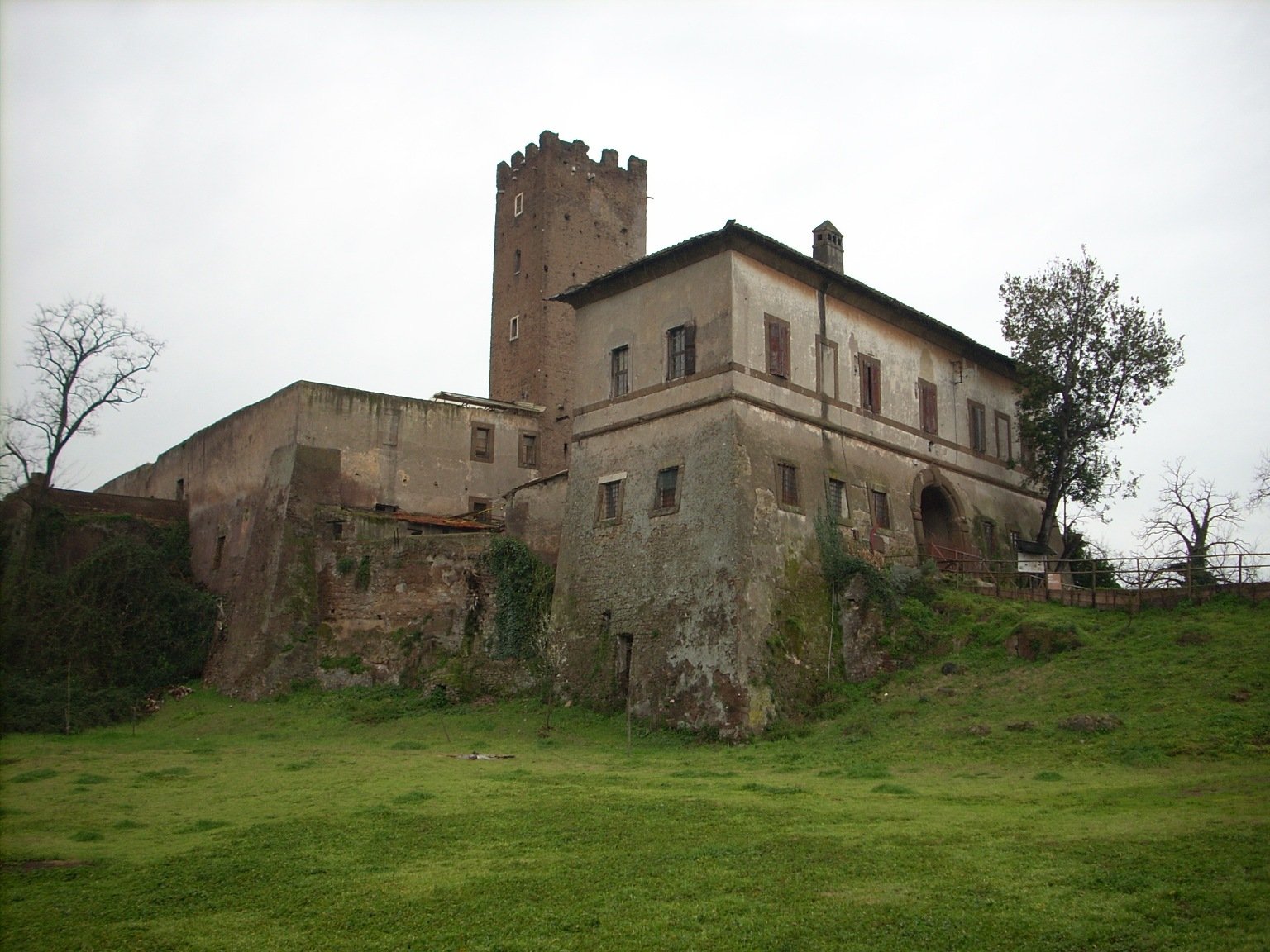
If the park has a heart, it is Casale della Cervelletta. I say it without hesitation because the whole history of the place revolves around this complex, and its image is the one I take home every time. It is not a simple country farmhouse, of which there are dozens in the Agro Romano, but a true fortified rural complex, one of the best preserved in all the countryside around Rome, a layered building organism that tells at least seven centuries of farming life.
The complex is organized around a medieval tower, the oldest and most imposing element, several floors high and built with that facing of tuff and reused blocks typical of the towers of the Agro. Around the tower, over the centuries, the other buildings gathered: the main farmhouse itself, the haylofts, the stables, the grain storehouses, the quarters for the workers, and a small church. Everything is arranged around a central threshing floor, the open space where grain was once threshed and where much of the work of the estate took place. Anyone who steps onto the threshing floor immediately feels inside a closed, self-sufficient world, as an estate of the Agro Romano must have been when it was still active.
What makes Casale della Cervelletta so precious in the eyes of those who study this type of architecture is precisely its completeness. Many farmhouses of the Agro have reached us reduced to ruins, or distorted by heavy renovations that erased their original layout. Here instead, despite the damage of time and abandonment, the overall structure is readable: you can still tell where the noble rooms ended and the service rooms began, you recognize the productive logic that held tower, farmhouse, little church and threshing floor together in a single organism. That is why scholars cite it as one of the most intact examples of a fortified rural complex surviving in the Roman area. Reading this building organism is like leafing through a book of stone: each building corresponds to a function, each layer to an era, and the whole tells the slow evolution of a farming estate from the Middle Ages to the threshold of the contemporary age. It is not common, in the Agro, to be able to read such a long story in a single place, and it is this continuity that makes Cervelletta a precious case study as well as a nice place to visit.
The medieval tower of Casale della Cervelletta
The tower deserves a chapter of its own, because it is the element that gives character to all of Parco della Cervelletta and is its most recognizable mark on the landscape. The towers of the Agro Romano were not built on a whim: they were part of a defensive system and a way of controlling the territory that in the Middle Ages propped up the countryside around Rome, when the great baronial families fought over the estates and danger, in the form of raids or armies passing through, could arrive at any moment.
The Cervelletta tower belongs to this family of buildings. It served as a lookout point and a refuge, but also as a statement of ownership: a tower visible from far away told everyone who ruled over those lands. Over the centuries the tower lost its military function and was absorbed into the farming complex, becoming an integral part of the farmhouse, but its vertical mass continues to dominate the whole and to signal the presence of the complex from afar. Seen from the meadows, standing against the sky with that austere profile that concedes nothing to decoration, it gives the impression of something older than the city around it.
The name itself, Cervelletta, seems to be a diminutive tied to the Cervelli family or to similar place names documented in the area, following a habit typical of the Agro Romano where estates took the names of the owners who succeeded one another over the centuries. It is not rare, in this part of Rome, to come across place names that preserve the memory of families and landowners now forgotten, and Cervelletta fits into this geography of names that are themselves historical documents.
The farming estate and the Agro Romano around Parco della Cervelletta
To really understand Parco della Cervelletta you have to imagine what this territory was like before the building expansion of the 20th century. Until little more than a century ago, the whole belt around Rome was occupied by the Agro Romano: an immense expanse of land farmed for grain, pastures, marshes and estates that belonged to a few great families and to church bodies. It was a harsh countryside, marked by the malaria that rose from the wet ground and kept permanent inhabitants away, populated mostly by butteri, shepherds and seasonal farm laborers who came down from the mountains for the harvest and then went back up.
The Cervelletta estate was one of these productive units. The farmhouse was not a vacation residence but the operating center of a farm that used the surrounding lands for grain growing and livestock. The rhythm of life was set by the seasons: sowing in autumn, the long wait of winter, the summer harvest on the scorching threshing floor, the threshing of the grain. A small community of workers revolved around the farmhouse, and the little church served to provide religious comfort to those who lived far from the towns.
This world disappeared within a few generations. Land reclamation first and urbanization afterward radically transformed the landscape, erasing almost everywhere the traces of the historic Agro. Parco della Cervelletta is one of the few fragments in which that world is still readable: the meadows, the farmhouse, the tower and the river make up a picture that, with a small effort of imagination, takes you back a century and a half. This is the deep reason why it is worth protecting: not so much for beauty in the strict sense, as for its value as a record, for its ability to tell the story of an agricultural Rome that elsewhere has been completely removed.
Land reclamation and the transformation of the Cervelletta territory
The chapter of land reclamation is central to the history of this part of Rome. The lands along the Aniene were naturally prone to becoming marshy: the river flooded regularly, the ditches stagnated, and wide areas stayed waterlogged for much of the year. This condition, which today we look at with a naturalist's eye, appreciating the wet meadows and the wildlife, was for centuries a serious health problem, because standing water was the domain of mosquitoes and therefore of the malaria that decimated anyone who tried to settle.
Between the 19th and 20th centuries the great works of hydraulic reclamation changed the face of the Agro. Drainage canals were dug, watercourses were regulated, marshy zones were dried out to make them farmable and livable. This immense labor made intensive agriculture possible and, right after it, the expansion of the city: the neighborhoods that surround Cervelletta today stand on land that without reclamation would have been uninhabitable.
In the case of Cervelletta, however, reclamation did not entirely erase the wet character of the area. The meadows of the park continue to flood in the rainy season, and this persistence of water is today one of its most valuable traits from an ecological point of view. It is one of those paradoxes that make the history of the territory fascinating: what for generations was fought as a threat is today protected as a value. The wet meadows of Cervelletta are a remnant of that original environment which reclamation eliminated almost everywhere, and for this very reason they attract the attention of naturalists.
The Valle dell'Aniene Nature Reserve and Parco della Cervelletta
From the point of view of protection, Parco della Cervelletta is part of the Valle dell'Aniene Nature Reserve, one of the protected areas that make up the system managed by RomaNatura, the regional body that administers the protected natural areas of the municipality of Rome. This framework is important because it means the area is not simply a plot of land left uncultivated, but a territory officially recognized for its environmental value and subject to a protection regime.
The Valle dell'Aniene Nature Reserve protects the urban stretch of the Aniene River and the green areas that accompany it, forming an ecological corridor that crosses the northeastern city. Cervelletta is one of the most significant pieces of this corridor, because it joins to the naturalistic value of the meadows and the river the historic and architectural value of the farmhouse. It is this combination that makes it special: not many places in Rome put together, within the same perimeter, a medieval tower and a protected wetland habitat.
Belonging to the RomaNatura system also means that the area is subject to protection rules and management projects, at least on paper. In reality, as we will see, managing such a complex area, wedged between two municipi and surrounded by dense urban fabric, has proved anything but simple, and many of the park's potentials are still unexpressed. But recognition as a nature reserve is nonetheless the legal premise that has prevented, over the years, this area from ending up like so many other portions of the Agro, sacrificed to concrete.
The wet meadows and vegetation of Parco della Cervelletta
Walking in Parco della Cervelletta you pass through different plant environments, and learning to recognize them helps a lot in appreciating what you are seeing. The most characteristic part is the wet meadows, the grassy expanses that in winter and spring hold water and turn into temporary marshes. Here grow the typical species of wet environments: reeds, rushes, cattails along the ditches, and at the right times the ground is covered by that low, dense vegetation that loves soils saturated with water.
Next to the meadows there are the riparian formations that accompany the course of the Aniene: rows of poplars and willows, whose crowns mark the path of the river from afar and offer shelter and nesting to many species of birds. These trees have a precise ecological function, because they stabilize the banks, filter the water and create shade and microclimate along the watercourse. In summer, when the meadows dry out and turn yellow, the green strip along the river remains the only cool place in the park.
There are also areas of dry grassland and leftover cultivated fields, where the landscape becomes more similar to that of the historic Agro, with tall grass bending in the wind and thistles blooming at the edges of the paths. This variety of environments concentrated in a few dozen hectares is what gives the park its ecological value: diversity of habitats means diversity of species, and indeed anyone with an eye for these things finds at Cervelletta a richness of flora and fauna that is surprising for an area so close to the center of Rome.
The wildlife you meet at Parco della Cervelletta
One of the reasons I often come back to Parco della Cervelletta is the wildlife, which in an urban area of this size is truly remarkable. The credit goes to the wet meadows and the river, which create the conditions for the presence of water birds and species tied to wet environments, hard to observe elsewhere in the city. In the cold seasons, when the meadows flood, it's not rare to see gray herons posted motionless waiting for prey, little egrets with white plumage scouting the pools, and flocks of wild ducks stopping along the river.
The course of the Aniene and its reed beds host a great variety of small birds, from the passerines that nest among the reeds to the insect-eating birds that feed along the banks. On spring and summer evenings the park fills with the calls of frogs and toads, which find in the ditches and pools the ideal environment to breed, and with them come the predators that feed on them. Small mammals are not missing, from hedgehogs to weasels, which frequent the thickest, most sheltered areas away from the paths.
It must be said honestly that watching wildlife takes patience and the right hours: dawn and dusk are the best moments, while in the middle hours of a crowded Sunday most of the animals retreat to the less visited areas. Anyone who comes with the idea of seeing herons and ducks right away might be disappointed. Anyone who has the patience to sit in silence at the edge of a flooded meadow, on a winter morning, is rewarded with a show that in Rome you wouldn't expect to find so close to a bus stop.
The Aniene River and its role in Parco della Cervelletta
The Aniene River is the great silent protagonist of Parco della Cervelletta, the thread of water around which the whole ecology of the area is organized. The Aniene is the main tributary of the Tiber, a river that rises in the mountains of the Lazio Apennines and runs down toward Rome collecting along the way the waters of a vast basin. In its urban stretch, before flowing into the Tiber, the Aniene crosses precisely the northeastern quadrant of the city, and Cervelletta overlooks one of its most evocative bends.
The river has shaped the landscape of Cervelletta over the millennia: its floods deposited the fertile sediments that made the lands of the estate farmable, and at the same time created the conditions of humidity that still characterize the meadows today. Along its banks the riparian vegetation already described developed, and its waters guarantee the survival of the wet ecosystem even in the driest summers. Without the Aniene, Cervelletta would not be what it is: it would be a dry meadow like many others, not a protected wetland habitat.
There is also a flip side, and it is right to tell it. The urban Aniene has suffered and still suffers from problems of pollution, uncontrolled discharges and degraded banks, a legacy of decades in which city rivers were treated as open-air sewers. The battles to protect the Valle dell'Aniene are also battles for the quality of the river's water, and those who frequent the park know it: the health of the Aniene is the health of Cervelletta, and the two fates are inseparably linked.
The civic battles to restore Casale della Cervelletta
You cannot tell the story of Parco della Cervelletta without talking about the civic battles that have accompanied its recent history, because it is thanks to these battles that the place has reached us. For decades the farmhouse remained in a state of abandonment, exposed to decay, vandalism and the risk of collapse, while big promises of restoration followed one another without turning into concrete facts. In this institutional void it was the citizens, the neighborhood associations and the local committees who kept attention on the fate of Cervelletta alive.
The grassroots mobilization has taken different forms over time: petition drives, sit-ins, cultural initiatives organized in the area of the farmhouse to claim its public use, reports of the state of decay to the competent bodies. People who live in Colli Aniene, in Tor Sapienza and in the surrounding neighborhoods have developed over the years a strong bond with this place, recognizing it as a common heritage to defend against indifference and against the periodic threats of improper uses. The park has thus become, besides an environmental and historic asset, a symbol of active citizenship.
These battles have achieved important results, starting with the recognition of the protection restriction that has shielded the area from building, but they have not yet led to the complete restoration of the complex. It is a story made of small steps forward and long waits, of projects announced and postponed, which continues today. Anyone who visits Cervelletta should know that what they see is the fruit of tenacious resistance: without the commitment of the citizens, in all likelihood the farmhouse would have collapsed or been wiped out by some speculation.
The current state of the farmhouse and the partial restorations at Cervelletta
I come here to the most delicate point, the one on which I prefer to be completely honest because I believe a serious guide should not hide the shadows. The state of Casale della Cervelletta is, still today, that of a complex only partially restored. Some portions have been the subject of consolidation and restoration work, which secured the most at-risk structures and saved the whole from collapse. Other parts, instead, are still in precarious condition, closed to the public, waiting for resources and projects that are slow to arrive.
This means that anyone arriving at Cervelletta imagining they will find a fully restored farmhouse, with visitable spaces, exhibitions and services, will be disappointed. The reality is rawer: you can admire the whole from the outside, appreciate the tower and the layout of the complex, walk around the threshing floor, but access to the interiors is limited or barred, and in several places you notice the signs of time and neglect. It is a heritage saved but not yet put to value, frozen in a condition of waiting that has dragged on for too long.
It's not a reason to skip the visit, but rather one more reason to come: seeing the state of the farmhouse with your own eyes helps you understand what is at stake and why these battles matter so much. A place like this also lives on the attention of those who frequent it, and every aware visitor is, in a sense, a small ally of its protection. Cervelletta is not a finished monument to be consumed, it is an open construction site of memory, and it should be looked at with this awareness.
The Agro Romano in cinema and the atmosphere of Parco della Cervelletta
There is one aspect of Cervelletta and the surrounding Agro that fascinates in a particular way, and it is their relationship with cinema. The Roman countryside, with its farmhouses, its towers and its bare horizons, was for decades a favorite backdrop for Italian cinema, especially in that extraordinary season when directors looked in the periphery and the Agro for authentic settings to tell the story of a changing Italy. The landscapes on the edges of Rome, suspended between city and countryside, offered natural scenery that no set could have rebuilt.
The expanses of the Agro Romano, with their desolate geometries and their particular light, served as a backdrop to stories of marginalization, dreams and harshness, becoming a narrative element in their own right. Cervelletta, with its tower and its meadows, belongs visually to that repertoire of landscapes that cinema has made familiar even to those who have never seen them in person: anyone who knows the atmospheres of certain films set in the Roman suburbs finds at Cervelletta the same quality of light, the same sense of suspension between the urban world and the rural one.
Strolling through these places with those images in mind adds a layer of suggestion to the visit. There's no need to pinpoint the exact scene shot in this or that spot: it is the atmosphere as a whole that evokes that cinema, the ability of the landscape to tell a human and social condition on its own. Cervelletta preserves this expressive force, and it is one of the few places in Rome where you can still breathe the air of that cinematic Agro before it disappeared entirely under concrete.
How Parco della Cervelletta is lived today, between events and associations
Beyond history and nature, Parco della Cervelletta today is above all a space lived in by the residents of the surrounding neighborhoods, and this everyday dimension is perhaps the most precious. On nice days the park fills with families strolling, people running along the paths, groups who come to enjoy the green away from traffic. It is a precious lung in a densely populated area, where open spaces are scarce and every square meter of nature is worth double.
Over the year the farmhouse area hosts cultural, environmental and social initiatives promoted by local associations: guided walks, environmental education activities, moments of collective celebration also meant to bring attention back to the fate of the complex and to claim its public use. These are the same groups that carry on the battles mentioned earlier, and that in the meantime animate the park and keep it alive. It's worth checking these events before going, because a visit during an event often offers the chance to get into spaces that are otherwise closed and to hear from people who know the place from the inside.
Spending time at Cervelletta also means accepting its rough, untamed nature. It is not an urban park equipped with kiosks, playgrounds and services at every corner: it is a wilder environment, where the paths are dirt, the grass is tall and in certain spots you can still feel the signs of neglect. Anyone looking for comfort will find better elsewhere. Anyone looking for authenticity, silence and real contact with a surviving piece of the Agro Romano finds at Cervelletta exactly what they want. It is a place that asks something of those who visit, a minimum of curiosity and respect, and that gives back to those who grant it much more than it promises at first sight. Places like this are not consumed but frequented, and the bond with Cervelletta grows visit after visit, season after season.
How to get to Parco della Cervelletta and practical tips
Getting to Parco della Cervelletta is easier than its secluded atmosphere suggests, because the area is well served by public transport. The most convenient reference point is the Roma Serenissima railway station, on the regional line, from which you reach the park in a few minutes on foot. Alternatively, the area is connected by several bus lines serving the neighborhoods of Tor Sapienza, Colli Aniene and Rebibbia, and the Rebibbia metro station, the terminus of line B, is not too far for those who don't mind a walk.
Anyone arriving by car should keep in mind that the area is typical of the Roman periphery, with parking possible along the streets of the surrounding neighborhoods but not always easy at peak hours. The advice is in any case to favor public transport, both for convenience and because arriving on foot, crossing the fabric of the neighborhoods and then entering the green gradually, is part of the experience and helps you catch the contrast between the built city and the surviving countryside.
As for clothing and equipment, keep in mind that you walk on dirt paths and on meadows that in the wet seasons can be muddy or flooded: sturdy shoes are a must, preferably waterproof in winter. In summer bring water and sun protection, because shade is limited to the strips along the river. Binoculars transform the visit if you are interested in wildlife, and a camera is almost indispensable for the tower and the flooded meadows. Entry to the park is free, since it is a public green area, and no ticket of any kind is required.
The neighborhoods around Parco della Cervelletta: Tor Sapienza, Colli Aniene and Rebibbia
Parco della Cervelletta cannot be fully understood without knowing the neighborhoods that surround it, because its recent history is intertwined with that of these pieces of city that grew in the 20th century. Tor Sapienza began as a workers' borgata in the first decades of the last century, a settlement born from a cooperative initiative far from the center, which over time has fused with the rest of the city while keeping a strong identity as a working-class neighborhood. Colli Aniene, by contrast, is a more recent neighborhood, the result of the great season of public residential building, with its large housing complexes and its planned green spaces.
Rebibbia, for its part, is known to most for the large penitentiary complex that bears its name, but it is also a populous and lively neighborhood, the terminus of the metro and gateway to the northeastern quadrant. These three neighborhoods, together with the surrounding areas, form the human context of the park: it is their residents who live it, defend it and fill it with life, and it is from their mobilization that the protection of Cervelletta was born. The park is, in a sense, the shared garden of this whole part of the city.
Visiting Cervelletta is therefore also an opportunity to get to know a different Rome from the one on postcards, the Rome of the peripheral neighborhoods that have a dense and often little-told history. It is the Rome of the borgate and the public housing, of the struggles for services and for quality of life, a city that rarely enters tourist itineraries but has a lot to say to those who know how to look. The park, with its ancient farmhouse set among the buildings, is the point where all these stories meet.
The little church and the religious life of the Cervelletta estate
Among the buildings that make up the complex of Casale della Cervelletta, the small church is the one that more than any other tells the human, everyday dimension of the estate. On the big farms of the Agro Romano the presence of a place of worship was not a luxury but a necessity: the estates were far from the towns, often hours of walking from the nearest parish, and the community of workers who lived there permanently needed a space for prayer, for the sacraments, for the moments that marked life back then, from baptisms to funerals.
The little church of Cervelletta performed this function, offering religious comfort to those who lived and worked in the isolation of the countryside. It was a modest building in size, consistent with the rural character of the complex, but central to the life of the community: the families of the farm laborers gathered around it on Sundays and feast days, and its bell, when there was one, marked the times of the day along with those of work in the fields. In a world where time was ruled by the sun and the seasons, the call of the church was one of the few collective signals that united the small community scattered across the estate.
Today the little church shares with the rest of the complex the story of abandonment and partial restoration, and its presence remains a precious piece for understanding the complete organism of the farmhouse. Looking at it, even just from the outside, helps you imagine that vanished community life, made of hard work, faith and solidarity among people who shared a harsh condition on the edge of the great city. It is one of those details that, once noticed, turn a stroll into a trip through time, giving humanity back to stones that would otherwise stay mute.
The seasons at Parco della Cervelletta and how the landscape changes
One of the things I love most about Parco della Cervelletta is how deeply it changes with the seasons, so much that it sometimes seems a different place depending on the month you visit. In winter, as already said, it is the kingdom of water: the meadows flood, the air is clear, water birds populate the temporary pools and the tower of the farmhouse is reflected in still puddles. It is the season of its greatest naturalistic appeal, the one in which the wet character of the area emerges in all its force.
Spring brings an explosion of vegetation: the meadows are covered in intense green and blossoms, the reed beds along the Aniene thicken, the birds enter the full breeding season and the park fills with song and movement. It is perhaps the most vital and colorful moment, the one in which the area's biodiversity shows at its best, and the still cool days make it pleasant to walk for a long time. Anyone who wants to appreciate the park's botanical richness should choose precisely the spring weeks, when every corner teems with life.
Summer, on the contrary, is the harshest season for the landscape: the meadows dry out and turn yellow, the ground cracks, shade shrinks to the strips along the river and the sun beats down relentlessly on the threshing floor of the farmhouse as it must have beaten on the harvesters of old. It is the driest and most severe Cervelletta, the one that most resembles the historic Agro in the scorching afternoon hours. Autumn, finally, closes the cycle by bringing back the rains, which little by little wake the meadows and prepare the return of the winter water. Knowing this cycle lets you choose the moment of the visit based on what you are looking for, and maybe come back in different seasons to catch the many faces of the same place.
The ecological corridor of eastern Rome and the role of Parco della Cervelletta
To understand the environmental value of Parco della Cervelletta you have to look at it not in isolation but as part of a wider system. The area is in fact part of that ecological corridor that follows the course of the Aniene through the northeastern city, linking together different green areas and allowing wildlife to move, feed and breed along a line that crosses the urban fabric. In a densely built city like Rome, these corridors are vital: without them the green areas would remain isolated islands, too small to support stable animal populations.
Cervelletta, with its wet meadows and its river strip, is one of the most significant nodes of this corridor. It works like a station along the route, a place where migratory birds can stop, where resident species find suitable habitats, where the continuity of the green allows the ecological exchanges that keep the ecosystem alive. Its importance, therefore, goes well beyond its borders: protecting Cervelletta means protecting a link in a longer chain, contributing to the ecological health of all of eastern Rome.
This overall view is also what gives meaning to the battles to protect the area. It's not only about saving a nice meadow or an ancient farmhouse, but about preserving a piece of an environmental mosaic that makes the city more livable for everyone, humans and animals. Every piece of Agro that survives, every riverbank that isn't paved over, every wet meadow that stays that way is an investment in the quality of urban life and in the ecological resilience of Rome. Cervelletta, in this picture, is not a luxury but a necessity, a piece of green infrastructure the city cannot do without.
The place names of the Agro and the names around Parco della Cervelletta
One of the subtlest pleasures of spending time at Parco della Cervelletta is reading the landscape through its names, because the place names of the Agro Romano are a mine of history. The name Cervelletta itself, as I was saying, seems to derive from place names or families tied to the long history of the estate, following that habit typical of the Roman countryside whereby every piece of land carried the name of the owners who had succeeded one another there. In this part of Rome place names are not neutral labels but true historical documents settled into language.
All you have to do is look at the names of the surrounding places to notice it. Tor Sapienza, with that Tor that points to the towers of the Agro like the one at Cervelletta, the names tied to the Aniene, which recall the constant presence of the river in the life of the territory, the references to the old estates and farmhouses that dotted the countryside. Every name tells a fragment of the history of the place, and learning to read them turns a simple stroll into an exercise in linguistic archaeology, able to give back the historical depth of a territory that at first glance would seem only recent periphery.
This layering of names is proof that the Rome of the eastern peripheries was not born out of nothing in the 20th century, as is sometimes believed, but has its roots in a very ancient history, that of the Agro with its towers, its estates and its farmhouses. Cervelletta is the point where this history becomes visible and tangible, where the name finds its confirmation in the stones of the tower and in the layout of the farmhouse. Walking with this awareness among the meadows and the surrounding neighborhoods means recognizing in every corner the continuity of a memory that concrete has not managed to erase entirely.
A detailed walking itinerary for Parco della Cervelletta
For anyone who wants a concrete route to visit Parco della Cervelletta, here is a tested itinerary for a first visit. You start from the most recognizable entrance, the one near the Roma Serenissima railway station, where the passage from the urban fabric to the green is sharp and surprising: a few steps and the noise of traffic dies away, replaced by the rustle of the reed beds. From here it's best to head straight for the tower of the farmhouse, which works as a compass for the whole visit.
Once you reach the farmhouse complex, it's worth giving it time: walk around the threshing floor, look at the tower from different angles, pick out the different buildings, the little church, the storehouses, and try to rebuild in your mind the productive logic that held the organism together. It is the historic heart of the park and deserves the longest stop. From there the itinerary opens toward the meadows, which should be walked slowly following the dirt paths, keeping an eye on the ditches where animal life concentrates and, in the wet season, admiring the flooded stretches of water.
The third stage is the descent toward the Aniene River, where the riparian vegetation offers shade, coolness and the greatest concentration of wildlife. Along the banks, if you proceed in silence, you can spot water birds and enjoy glimpses of river vegetation that bring back the countryside of the past. The return can close the loop by crossing a different portion of the meadows, to catch other views of the tower and the landscape. Overall it's a walk of a couple of hours, with no difficulty except the mud in rainy seasons, which gives a complete picture of the park in its different components: historic, naturalistic and riverine.
The possible future of Casale della Cervelletta
Looking at the future of Casale della Cervelletta means moving between hope and caution, because recent history teaches you to distrust easy announcements. The potential of the complex is enormous: a fully restored farmhouse could become an environmental education center, a cultural space serving the neighborhoods, a reference point for discovering the Agro Romano and the Valle dell'Aniene Reserve. I often imagine what an extraordinary resource it would be for eastern Rome to have here a living, open place, able to join the enhancement of the historic heritage with that of the natural environment.
The road to this future, however, is paved with difficulties. The complete restoration of such an articulated complex requires large resources, solid projects and a political will that lasts over time, three conditions that so far have rarely lined up. Shared management among different parties, bureaucratic complexity and the chronic shortage of funds for peripheral heritage have slowed every attempt, leaving the farmhouse in that condition of waiting that has dragged on for too many years. It's right to be honest about this: the bright future the complex would deserve is by no means guaranteed.
What makes the difference, as always in the story of Cervelletta, is the attention of the citizens. As long as the associations keep watch, as long as people keep visiting the park and claiming its public use, as long as Cervelletta stays in the heart of the neighborhood, the hope of a full restoration will stay alive. That is why I invite everyone to visit it and learn its history: every aware visitor is a small piece of that civic pressure which, alone, can push institutions to keep their promises. The future of the farmhouse, after all, also depends on how many people learn to love it.
Why Parco della Cervelletta is different from other parks in Rome
Rome is a city rich in green, from the great historic villas of the center to the archaeological parks of the Appia, and anyone who knows Cervelletta often wonders how this place stands apart from the others. The answer lies in its hybrid nature and its rough authenticity. The great Roman villas, Villa Borghese, Villa Doria Pamphilj, Villa Ada, are historic gardens, designed, tended, equipped, conceived for delight and leisure, with their avenues, fountains and monumental buildings. Cervelletta is the exact opposite: it is not a garden but a fragment of countryside, it is not designed but grown, it is not tended but left largely to its wild nature.
This difference is not a flaw but a character, and it is precisely what makes Cervelletta unique in the panorama of Roman green. While in the great villas you breathe the air of noble and papal Rome, here you breathe that of the peasant Agro, of work in the fields, of hard life on the edge of the city. It is a green that doesn't console with its orderly beauty but questions with its authenticity, that doesn't offer the show of the Italian garden but the witness of a vanished world. Anyone looking for the scenic will find better elsewhere. Anyone looking for the real finds at Cervelletta something that few other green areas of Rome can offer.
Then there is the naturalistic dimension, which sets Cervelletta further apart. Few Roman urban parks can claim wet meadows, a river like the Aniene and wildlife so tied to aquatic environments. This combination of historic value, given by the fortified farmhouse, and ecological value, given by the protected wetland habitat, is extremely rare. It is as if two different Romes were condensed in a single place, the medieval one of the towers of the Agro and the natural one of the river corridors, offering those who know how to look a two-layered experience that no other park in the city replicates in the same way.
A fragment of the Agro Romano inside the city at Cervelletta
If I had to sum up in one sentence what Parco della Cervelletta represents, I would say it is a fragment of the Agro Romano left miraculously wedged inside the city. This image, of the surviving fragment, is the key to understanding everything else. For centuries the Agro Romano was the immense ring of countryside surrounding Rome, and within a few generations it was almost entirely devoured by the urban expansion of the 20th century. What today is built-up periphery was, little more than a century ago, an expanse of grain and pastures dotted with towers and farmhouses.
Cervelletta is one of the very few places where that vanished landscape is still readable in its entirety, with the farmhouse, the tower, the meadows and the river making up a coherent picture. Walking inside it is like opening a window on the past, escaping for a few hours from the contemporary city to find the atmosphere of a countryside that elsewhere has been completely erased. It's an experience with something moving about it, because it puts us face to face with the fragility of the memory of places and with how little it takes for an entire world to disappear without leaving a trace.
For this very reason Cervelletta must be defended and visited with awareness. It's not just any park, it is a living document, one of the last records of an agricultural Rome that risks being forgotten entirely. Every visit is a way to keep its memory alive, to recognize the value of this surviving fragment and to contribute, even just with your presence, to its survival. In a city that runs toward the future while often forgetting its humblest past, Cervelletta reminds us where we come from, and for that reason it deserves to be loved and protected as the discreet treasure it is.
A curiosity about Parco della Cervelletta
The curiosity concerns the almost paradoxical relationship between Parco della Cervelletta and water. For centuries the dampness of these lands was considered a curse: it was the cause of malaria, the reason the Agro stayed unpopulated, the enemy to be fought with land reclamation. Generations of farm laborers cursed these flooded meadows and these stagnant ditches, and huge resources were spent to drain and dry them.
Today the perspective has completely flipped. That very persistence of water which was once a scourge has become the ecological treasure of Cervelletta: the wet meadows that survive reclamation are a rare and precious habitat, protected and studied, that hosts the herons and ducks I was talking about. What our great-grandparents fought as a misfortune, we protect as a value. I find there is a lesson in this reversal: the way we look at nature changes with time, and what appears to one generation as a problem can turn out, to another, to be a richness to safeguard.
Something nobody tells you about Parco della Cervelletta
The thing almost nobody says is that Parco della Cervelletta is best lived in winter, not summer. The vast majority of people associate parks with the good season, with summer strolls, with spring picnics, and indeed Cervelletta in those periods is pleasant. But its moment of grace is another: the cold, clear winter mornings, when the meadows flood, the still water reflects the sky and the tower of the farmhouse, and water birds populate the temporary pools.
On those days Cervelletta reveals its true nature as a wetland, the one that in summer stays hidden under the dry, yellowed grass. The silence is deeper, the low winter light brings out every detail of the landscape, and there is an almost Nordic quality to those flooded meadows dotted with motionless herons. It's an image few people expect to find at the gates of Rome, and it disproves the idea that the park is just any piece of countryside. Anyone who comes only in the good season, in short, misses the best part: my advice, against the grain, is to mark down a clear morning in January or February and go when it's cold.
My advice for visiting Parco della Cervelletta
The most valuable advice I can give is to arrive early, at dawn or shortly after, and to take the time to stand still. Parco della Cervelletta is not a place to rush through, ticking a stop off a list: it is a place to let settle, which gives itself only to those with the patience to slow down. In the early morning hours the park is almost deserted, the wildlife is active, the light is the best for photographs and the silence lets you hear the sounds of nature, from the calls of the birds to the rustle of the reed beds.
The ideal itinerary starts from the entrance near the station, heads straight for the tower of the farmhouse to fix the visual reference, then widens out toward the wet meadows and finally goes down along the Aniene River, where the riparian vegetation offers shade and the greatest concentration of wildlife. Bring water, shoes suited to mud and, if you can, binoculars. Check in advance whether the local associations have any initiative scheduled, because on those occasions you can get into spaces that are otherwise closed and hear from people who really know the place.
One last suggestion, which is more an invitation to an attitude than to an action: come to Cervelletta with the right expectations. Don't look for the perfect, equipped park, don't expect the farmhouse to be fully restored and open to visitors. Accept the place for what it is, a fragment of the Agro Romano saved with great effort, with its beauties and its wounds, and you will get an experience much more authentic than the one offered by many gardens that are more tended but less true.
Another well-known fact, yet rarely mentioned
The fact is this: Casale della Cervelletta is considered one of the best preserved fortified rural complexes in all the Agro Romano, yet this exceptional status is known almost only to specialists and to the residents of the neighborhood. It is a point that scholars of the architecture of the Agro repeat, but that rarely reaches the general public, used to looking for the treasures of Rome inside the walls or in the great historic villas, not in the eastern peripheries.
And yet you only need to look at the layout of the complex to realize it: the coexistence of the medieval tower, the farmhouse, the little church and the threshing floor in an organism that is still readable is a rarity. A great many farmhouses of the Agro have been destroyed, reduced to ruins or distorted by renovations. Cervelletta has kept its overall structure, and this makes it a precious document for understanding how a farm of the Agro worked in past centuries. It is a heritage of considerable historic and architectural value, which would deserve far more attention than it receives.
The paradox is that this recognition, clear on the scientific level, has not translated into adequate enhancement on the practical level. The complex remains largely inaccessible and only partially restored, as if its value were a secret kept by a few. Telling its story, bringing people here, making its history known is also a way to close this distance between what Cervelletta is and what is commonly known about it.
The right photo to take at Parco della Cervelletta
The right photo at Cervelletta is only one, and it must be sought with care: the tower of the farmhouse reflected in a flooded meadow, on a clear winter morning, in the low raking light of the sun. It is the image that sums up the whole character of the place, because it brings together the historic element, the medieval tower, and the naturalistic element, the water of the wet meadows, in the light that best shows off both. If you manage to catch it, you will have taken home the essence of Parco della Cervelletta in a single shot.
To get it you have to choose the moment carefully. You need the wet season, when the meadows hold water, and you need a day of clear sky right after rain, when the air is clean and the reflections are sharp. The best time is first thing in the morning, when the sun is low on the horizon and the light comes in sideways, bringing out the profile of the tower and creating those golden reflections on the water that turn a flooded meadow into a mirror. Position yourself so that you have the tower and its reflection in the same frame, and wait for the water to be perfectly still.
If it isn't the season of flooded meadows, don't despair: the tower offers good shots also standing out against the sky from the meadows, and the strip along the Aniene gives glimpses of riparian vegetation with the rows of poplars reflected in the river. But the memorable photo, the one to frame, remains the tower in the winter pool of water. Set it as a goal and organize the visit accordingly: it's worth the dawn alarm and the feet in the mud.
Some important events that happened here in history
The history of Parco della Cervelletta is not made of big events from a school textbook, but of long processes that shaped the territory. The first big chapter is the medieval one, when the Agro Romano became studded with towers and fortified farmhouses like the one at Cervelletta, in an age of insecurity in which the great baronial families fought over control of the countryside around Rome. The tower was born in that context, as an outpost and a statement of ownership over a farming estate.
The second big chapter is the long farming life of the estate, which runs through the centuries marked by the rhythm of the seasons, by the harvest on the threshing floor and by the presence of that small community of workers who animated the farmhouse. Then comes, between the 19th and 20th centuries, the great transformation: the hydraulic reclamation that drains the Agro and defeats malaria, followed by the urbanization that during the 20th century surrounds the estate with neighborhoods, erasing the countryside almost everywhere and leaving Cervelletta like an island.
The most recent chapter, and in some ways the most dramatic, is that of abandonment and the battles for protection. The farmhouse slides into decay, risks collapse, becomes the object of broken promises and citizen mobilizations. Recognition as a protected area within the Valle dell'Aniene Nature Reserve and the later partial restoration works mark the stages of a resistance that continues today. These are the events that really count in the history of Cervelletta: not dates of battles, but the slow interweaving of nature, human labor, abandonment and redemption that has made this place what it is.
Who has passed through Parco della Cervelletta
Those who have passed through Parco della Cervelletta over the centuries are above all an anonymous crowd of people who left no name in the history books but who made this place live day after day. The farm laborers and butteri of the Agro Romano, who came down from the mountains for the harvest and worked the fields of the estate. The shepherds who led their flocks along the river. The families of the workers who lived in the farmhouse and attended the little church. They are the true protagonists of the story of Cervelletta, even if collective memory tends to forget them.
Then came the families who owned the estate, the houses of the Roman aristocracy and landowning class who succeeded one another over the centuries in possession of these lands, sometimes leaving their name imprinted in the place names. And, in times closer to us, came the directors and film crews who looked in the Agro Romano for authentic settings for their stories, helping to fix in the collective imagination those landscapes suspended between city and countryside to which Cervelletta belongs.
But the protagonists of recent history, the ones who deserve the most sincere recognition, are the citizens of the surrounding neighborhoods: the residents of Tor Sapienza, Colli Aniene and Rebibbia who took the fate of the farmhouse to heart, the associations and committees that defended its protection, the ordinary people who keep visiting the park and keeping it alive. It is they who, by passing through Cervelletta and taking care of it, have prevented this fragment of the Agro Romano from disappearing. It is to them, more than to any illustrious name, that Parco della Cervelletta owes its survival. And perhaps this is the most beautiful lesson I take home every time: that places are saved from below, with the daily care and stubborn affection of those who live them, much more than with big projects dropped from above. Cervelletta belongs to those who love it, and every person who learns to know it becomes part of that long chain of anonymous guardians who, from generation to generation, have managed to keep alive, with patience, this precious fragment of the Agro Romano.
Article written by the editorial team of TourLeaderPro, contact them for Private/Corporate/V.I.P. Tours and Experiences.
Planning a trip to Rome? The English guides to visiting the city are on ItalyPlanner.com.