Porta Pinciana
In short. Porta Pinciana can be seen free from the street at any hour: it stands at the top of Via Vittorio Veneto, where the street meets the Aurelian Walls and, beyond the arch, Villa Borghese begins.
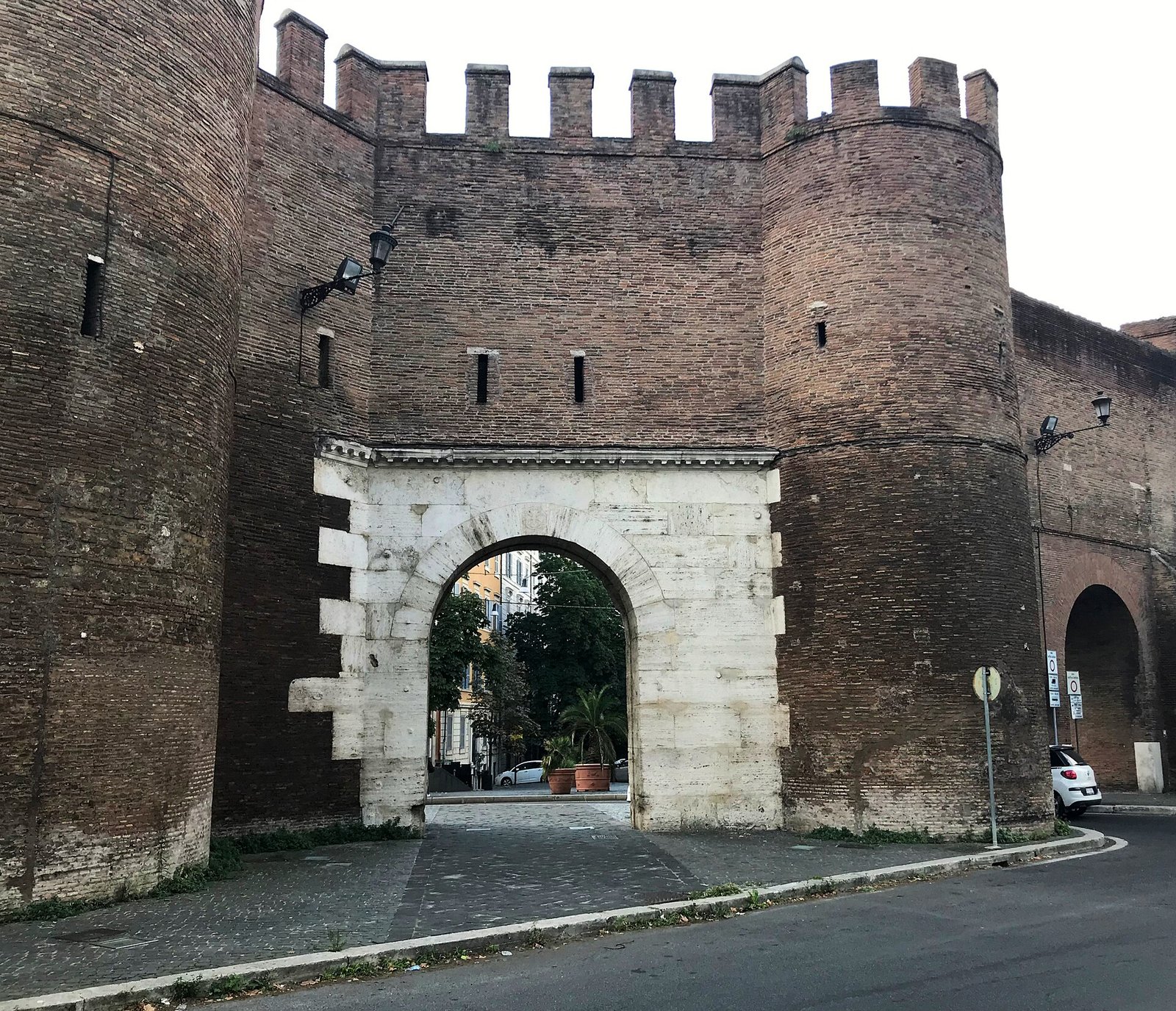
Porta Pinciana can be seen free from the street at any hour: it stands at the top of Via Vittorio Veneto, where the street meets the Aurelian Walls and, beyond the arch, Villa Borghese begins. It has no ticket office, no opening hours, and you can't go inside the towers. The monument is part of the city walls entrusted to the Capitoline Superintendency, and the Rome Capital tourism portal gives Via Vittorio Veneto 196 as the reference address.
It's a gate that began small. At the end of the 3rd century, when Emperor Aurelian enclosed Rome within the new circuit, there was only a postern here, a secondary passage. About a century later Emperor Honorius enlarged it, faced it in travertine and flanked it with the two towers on a semicircular base that you can still see. Today cars pass under the archways opened in modern times, between Via Veneto, Corso d'Italia and the villa.
Data checked on September 29, 2026 on the Rome Capital tourism portal and on the Capitoline Superintendency pages dedicated to the Aurelian Walls walkway on Via Campania and to the itineraries along the walls. You look at the gate from the sidewalk without booking anything. The only thing you pay for is the elevated walkway that starts next to it, by reservation at 060608, and the themed visits that the Superintendency organizes along this stretch of wall are free, again by reservation.
In brief: address, hours, ticket
- Where: at the top of Via Vittorio Veneto, between the Ludovisi district and Villa Borghese. Reference address given by Turismo Roma: Via Vittorio Veneto 196.
- Operator: Capitoline Superintendency of Cultural Heritage, which looks after the city walls of Rome.
- How to enter: you don't. You pass through the gate on foot or by car and look at it from the street. The interior of the towers does not appear to be open to the public.
- Price: free for the gate. Via Campania walkway costs €4 full price and €3 reduced, free for residents of Rome and the metropolitan area and for MIC card holders.
- Hours: none for the gate. For the walkway you book at 060608, every day from 9:00 to 19:00, according to the operator's calendar.
- How to get there: from below, going up Via Veneto from Piazza Barberini, or by crossing Villa Borghese.
- Accessibility: Via Campania walkway is not accessible to people with disabilities, according to the Superintendency.
Where it is and what you really see
Coming up from Piazza Barberini along Via Veneto, with its grand hotels, cafés with tables and embassies, you see the gate appear at the end of the climb. It is the point where the street ends against the Aurelian Walls. Beyond the arch open Piazzale Brasile, the entrances of Villa Borghese and the start of Via Pinciana. To the east, outside the walls, Corso d'Italia begins, one of the busiest roads in the center, while to the west the wall descends along the Muro Torto.
The ancient part is recognizable right away. In the middle is a simple arch of travertine, light-colored, squeezed between two round towers. On the sides, in the wall, open the modern archways, that is, the arches added in recent times to let traffic through, which are easy to tell apart from the ancient one. The Rome Capital tourism portal stresses that the towers are asymmetrical, and it takes only a little attention to notice: they are not twins, even though the first impression makes them look that way.
What you don't see, but matters, is the original function. The gate sits on the edge of the hill, at the point where the walls, after following the Pincio hill, bend east toward Porta Salaria and Porta Pia. It was a service passage, tied to an ancient road toward the Salaria, and the medieval name Salaria vetus, that is, old Salaria, still recalls it.
The gate has two very different faces. The inner one, toward Via Veneto, is the most photographed because you walk up to it head-on. The outer one, toward Piazzale Brasile and the villa, is the more interesting. Here the travertine arch preserves a sign from the Byzantine era and the towers read better, without the cars and the tables of Via Veneto in front. To understand the gate you have to pass through it and turn around.
From the outer side, on the right as you exit, the walls continue toward Via Campania. This is the stretch where the walkway opened to the public in 2021 is found, which the Superintendency describes as a route with two tiers of arches from the time of Honorius, between Porta Pinciana and Via Marche. On the other side the walls climb back toward the Muro Torto and the Pincio, along the edge of Villa Borghese, as far as Porta del Popolo.
The gate, in short, is not in an archaeological park. It stands in the middle of traffic, squeezed between a late 19th-century district and the largest historic park in the center. That is its normal condition, and it has to be accepted. Pedestrians walk through it, cyclists and scooters pass through to enter the villa, cars and taxis go up from Via Veneto toward Corso d'Italia. Nobody fences it off, nobody guards it.
On the inner side it's also worth looking at the street that runs along the walls, Via di Porta Pinciana. Going down from here toward Via Sistina you walk with the Aurelian wall on one side and the buildings of the district on the other, and you understand how the modern city leaned against the ancient circuit without tearing it down. It's a little-visited stretch, quieter than Via Veneto, and it takes you in about 10 minutes toward the Trinità dei Monti.
A curiosity about Porta Pinciana
On the outer face of the travertine arch a Greek cross is carved, with four equal arms. You find it at the keystone, that is, in the central stone at the top of the arch. It is one of the few signs left by the Byzantine era on the gates of Rome. The encyclopedia entry on the gate links it to the episode of the siege by the Goths of Vitiges, between 537 and 538, when the Byzantines were defending the city, although the exact dating of the cross remains uncertain.
A cross on the keystone of a gate was not simple decoration. In a Christian city under siege it most likely had the meaning of a protection entrusted to heaven, as well as to weapons. Porta Pinciana preserves one that is clearly legible, as long as you look for it from the right side. Anyone who arrives from Via Veneto and stops at the first glance doesn't see it, because it's on the face that looks at the villa, not the one that looks at the city.
The simplest way to find it is to walk out through the central arch, move onto the sidewalk of Piazzale Brasile and look up. With the sun from the side the sign reads better, with the flat midday light it blends in with the veining of the travertine. A small camera lens or the zoom of your phone helps a lot, and also lets you see the blocks of the archivolt, well squared and well preserved.
Something nobody tells you about Porta Pinciana
Porta Pinciana wasn't named after the Pincio in the strict sense. The Rome Capital tourism portal explains that the name comes from the Pinci family, landowners in the area in the 4th century, the same family that left its name to the hill. Over the centuries the gate has had others: Salaria vetus, for the old road, Turata, because it was walled up several times, and Belisaria, for the legend of the Byzantine general.
What almost nobody says is that this last name is the child of a false story. The encyclopedia entry on the gate is blunt: Belisarius never begged here and died in Constantinople, well-off. Yet the name Porta Belisaria survived, and with it the inscription that in the 19th century someone said they could read on the gate. The legend has had more success than the true story, which would have been enough on its own.
The contrary position, in our judgment, is this: Via Veneto is not the best way to reach Porta Pinciana. It's the most famous road, but it leads you in front of the less interesting face and into the worst traffic. It's better to arrive from inside Villa Borghese, going down toward Piazzale Brasile. You see the outer side first, with the cross and the towers, and only afterward do you pass under the arch toward the city.
From postern to gate: what did Honorius do?
When Aurelian had the walls built, at the end of the 3rd century AD, Rome had not had an effective defensive circuit for centuries. The old Servian Walls had been outgrown by the city on every side. The new circuit had main gates on the great consular roads and minor passages for local traffic. Here, according to the Rome Capital portal, there was only a postern, a pedestrian service opening.
The leap came with Honorius. The encyclopedia entry places his intervention in 403 AD, and the Capitoline Superintendency dates the Honorian arches of the nearby Via Campania walkway to the years 401-403. It was the moment when fear of invasions pushed to raise the whole circuit and reinforce the gates. Porta Pinciana was enlarged, given a travertine arch and flanked by the two towers on a semicircular base.
The towers are not identical, and the difference is noticeable even to the naked eye. The encyclopedia entry calls them strangely asymmetrical, and the Rome Capital portal makes the same observation. The reason is not explained. It's possible that the two towers were built or rebuilt at different times, but the fact is not published with certainty, and it's best to leave it as an open question in front of the monument.
The travertine arch, instead, has stayed as it was. The tourism portal describes it as a simple and elegant arch that has kept its original character, and the encyclopedia entry adds that Porta Pinciana is one of the few gates of Rome where restorations have not heavily changed the ancient appearance. It's a judgment that stands up to direct comparison with gates much more reworked, like Porta Pia itself, redesigned in the 16th century.
Behind the gate, in the same campaigns of work, the walls were raised and given internal galleries. Via Campania walkway is a readable example: two tiers of superimposed arches, that is, a wall that was not just a barrier but a building the defenders could live in. Looking at the gate and then at the stretch beside it helps you understand that Honorius's work was a system, not an isolated restoration of a single opening.
The advice I give you for visiting Porta Pinciana
My advice is not to treat it as a passing stop between Via Veneto and Villa Borghese, but to give it a real 20 minutes. You look at the inner face from the high sidewalk of Via Veneto, you walk under the central arch when the traffic light allows, and then you stop on the outer side, away from the cars, to read towers, cross and patches. From there you decide if you enter the villa or follow the walls.
If you have time for an extra hour you can follow the walls from the outside. Toward the east, along Corso d'Italia, you skirt from the outside the stretch with Via Campania walkway and continue toward the area of Porta Salaria and Porta Pia. Toward the west, inside Villa Borghese, the wall follows the edge of the park to the Pincio and the terrace above Piazza del Popolo. They are two different walks, one urban and one in the green.
The best time is early Sunday morning, when the traffic on Via Veneto and Corso d'Italia eases. On weekdays, in the morning and late-afternoon rush hours, the gate is a funnel of cars, taxis and tourist buses, and stopping to look becomes awkward. In the evening, with the public lighting, the travertine takes on a warm color, but the cross at the keystone gets lost.
If you want to understand the stretch of wall with someone explaining it on the spot, you can follow the free itineraries of the Capitoline Superintendency. One of them, titled the walls from Porta del Popolo to Porta Pinciana, took place on August 8, 2025, in English at 17:00 and in Italian at 18:00, lasting 90 minutes and with mandatory reservation at 060608. New dates should be looked up on the Superintendency's website.
If you also want to go up on Via Campania walkway, it's wise to book in advance, because the groups are small, at most 10 people, and the dates for individual visitors follow a calendar. A practical idea is to fix the walkway for mid-morning and organize the rest around it: first the gate from the outer side, then the visit on the walls, finally the descent toward Via Veneto or the entrance into the villa.
Do you pay anything, and can you go inside?
For the gate you pay nothing and book nothing. You pass through and look at it from the street, day and night. The interior of the towers does not appear to be open to the public, and the operator does not list visits to the rooms of the gate. If you want to go up on the walls along this stretch there is only one documented possibility: Via Campania walkway, which starts next to the gate and runs to Via Marche.
The Capitoline Superintendency gives for the walkway a ticket of €4 full price and €3 reduced, with free entry for residents of Rome and the metropolitan area and for holders of the MIC card. Reservation is mandatory at 060608, open from 9:00 to 19:00. Visits are organized in groups of at most 10 people, and for individual visitors the operator indicates a dedicated calendar. All the details are on the official walkway page.
A warning that the Superintendency itself puts in writing: the site is not accessible to people with disabilities. The walkway is a route inside the structure of the walls, on two tiers of arches. People with mobility difficulties can still look at the gate and the wall from the sidewalk of Corso d'Italia and from inside Villa Borghese, and pass through the gate by the side archways.
There are no alternative channels for tickets to consider. No products are listed on the tourist-activity platforms dedicated specifically to Porta Pinciana or Via Campania walkway, and a generic Via Veneto tour does not replace the operator's visit. The right channel remains 060608, the Rome Capital contact center, which also handles the reservations for the free itineraries along the walls.
Another well-known fact, yet rarely cited
Many people know that the gates of Rome were also toll booths. Less often cited is how much a secondary gate like this one earned. The encyclopedia entry reports that in 1474 Count Stefano Maccaroni won in a single lot the collection at Porta Pinciana and Porta Salaria, for 79 florins. A figure that suggests regular goods traffic, much more than a simple passage of peasants headed to the vineyards.
The second little-told fact concerns the closures. The gate was walled up several times, so much so that it earned the name Turata. The encyclopedia entry recalls a closure as early as the 8th century, of which neither the precise date nor the reason is known, and another in 1808. The definitive reopening came in 1887. For almost 80 years, then, anyone who wanted to leave from here toward the countryside had to go around.
The name Salaria vetus also tells something that is usually overlooked. The Rome Capital portal links it to the ancient salt road, that is, the Salaria, the road that left the city toward the north-east. The adjective vetus, old, suggests a route older than the one that passed through the nearby Porta Salaria, a little farther east along the walls. The small Aurelian postern, in short, seems to rise on a path older than the gate itself.
1887 is not just any date. These are the years when the area between Porta Pinciana and Porta Salaria was changing its face completely, with the subdivision of the great private gardens and the birth of the Ludovisi district. The Superintendency recalls that the stretch of wall on Via Campania was reused as the boundary wall of Villa Boncompagni Ludovisi, and then, from the early decades of the 20th century, as the site of artists' studios.
The right photo to take at Porta Pinciana
The photo that tells the story of the gate is the one from the outer side, from Piazzale Brasile, with the travertine arch in the center and the two towers on the sides in full. It's best to stand far enough back to include a piece of wall on the right and on the left too, so you understand that the gate is an opening in a circuit and not an isolated arch. If you have a wide-angle lens, use it here, watching for cars coming out.
The second photo is a detail: the Greek cross at the keystone. You need the zoom, and you need side light that makes the carving stand out from the travertine. The light changes a lot between morning and afternoon on this face, and it's best to try at both times before deciding. With an overcast sky the contrast drops and the cross is hard to read, while the travertine becomes uniform and flat.
The third photo is the one that gives context, from Via Veneto. The upper stretch of the street, with its wide sidewalks and tables, frames the gate as the backdrop of the road. It's the most classic postcard, the one that ties the gate to the district born at the end of the 19th century. It works best in the early morning hours, when the street is empty and the cars don't cover the archways. In the evening, with the street lamps lit, it takes on a more cinematic tone.
One last possibility, less obvious, is the photo along the wall. From the sidewalk of Corso d'Italia, looking toward the gate, the wall runs in perspective and the towers appear at the end, with the trees of the villa above. It's the framing that best conveys the scale of the Aurelian Walls, and the gate appears in it for what it was: an opening in a defense kilometers long. Watch out, here, for fast traffic and parked cars.
One rule holds for all the framings: no photos in the middle of the roadway. Under the archways pass cars, taxis, buses and scooters, often at high speed, and the margins for pedestrians are narrow. The best images are taken from the sidewalks and the pedestrian islands of Piazzale Brasile, calmly. If you want the gate free of traffic you have to aim for the early hours of Sunday, when the city is still quiet.
How do you get there from the center of Rome?
The simplest route is on foot from Piazza Barberini, going up Via Veneto along its whole length. It's a steady but gentle climb, a quarter of an hour at an easy pace. Piazza Barberini has the stop of the same name on Metro Line A. Alternatively you arrive from above, crossing Villa Borghese from the Pincio or from the area of the Galleria Borghese, with a walk almost entirely in the green.
From Piazza di Spagna the most pleasant road passes by the Trinità dei Monti, Via Sistina and then Via di Porta Pinciana, which runs inside the walls to the gate. If you prefer the green, go up to the Pincio and continue in the villa. The surface buses that pass on Corso d'Italia and Via Veneto often change route because of works and events, and it's best to check them on the ATAC site the same day.
If you arrive from Termini station you can choose between the metro, with Line A to Barberini, and a walk of a bit under half an hour through the streets of the uphill districts, toward Via Veneto. If you arrive from Piazza del Popolo you have the most pleasant option of all: go up to the Pincio by the ramp and cross Villa Borghese to Piazzale Brasile, where you come out right in front of the outer face of the gate.
By car, honestly, it's not worth it. Via Veneto and Corso d'Italia are heavily trafficked roads at every hour, and parking in the area is scarce and expensive. If you're coming from outside Rome it's better to leave the car near a metro station. Scooters and bicycles also work, but on Corso d'Italia the traffic is heavy and fast, and the bike lanes do not cover the whole route.
Some important events that happened here in history
The first event is the construction of the Aurelian circuit, at the end of the 3rd century. Rome, for the first time in centuries, was enclosing itself within a wall, and at this point the project provided only a postern. The Aurelian Walls were born for a city that feared barbarians at the frontiers, and the minor opening on the edge of the Pincio was meant for local traffic, not for armies.
The second event is Honorius's work in the early years of the 5th century. The circuit was raised, the gates reinforced, the postern turned into a real gate with a travertine arch and towers. A few years later, in 410, Alaric's Visigoths entered Rome through Porta Salaria, a little farther east along the same stretch of wall. The strengthening was not enough to save the city from that sack.
The third event is the siege by the Goths of Vitiges between 537 and 538. The Byzantine general Belisarius defended Rome with far inferior forces, and the Rome Capital tourism portal recalls that the position of Porta Pinciana, on the Pincio, was decisive. The encyclopedia entry reports that Belisarius repelled the assaults in the area between the Muro Torto and the Castro Pretorio. From this came the later name Porta Belisaria.
A more recent event concerns the stretch beside it. On July 3, 2021, according to the Capitoline Superintendency, the Aurelian Walls walkway on Via Campania opened to the public for the first time. After centuries of military use, then as the boundary wall of a villa and finally as a row of artists' studios, the arches of Honorius have become walkable again. For the gate it was an important change: from a monument only to be looked at to the starting point of a visit.
The fourth event is the long series of closures and reopenings. The gate was walled up in the 8th century, reopened, walled up again in 1808, and reopened in 1887. In between is the century of the tolls, with the 1474 contract to Count Maccaroni. Of the reasons for the early medieval closure the sources say nothing. The gate, in any case, survived all these phases without losing its ancient arch.
The last event is modern and artistic. In January 1974, according to the Rome Capital tourism portal, the artists Christo and Jeanne-Claude wrapped both sides of the wall next to the gate in nylon sheets, in the stretch between Via Veneto and Villa Borghese. It was a temporary work, which stayed in the city's memory longer than many restorations. For a brief period the walls disappeared under the fabric, and a monument that nobody looked at anymore suddenly became the subject of photographs and discussion.
Who passed through Porta Pinciana
The first name is that of Emperor Honorius, who turned the postern into a gate. He was the son of Theodosius, and ruled the West in years of continuous invasions. There is no record that he physically passed through here, but the gate you see bears his building signature: the travertine, the towers, the raising of the walls. It is he, more than Aurelian, who is the real author of Porta Pinciana as we know it.
Aurelian, though, should be remembered. It was he, in the 270s, who decided to enclose Rome in a new circuit, after centuries in which the city had grown without defenses. At this point his project provided a simple postern, a minor opening. Without that first choice, though, there would have been nothing here to enlarge. The gate is thus born of two emperors, about a century apart.
The second is Belisarius, the general of Emperor Justinian, who defended Rome in the siege of 537-538. On the other side of the walls was Vitiges, king of the Goths, who was trying to retake the city. The two names are tied to the gate by the sources on the Gothic War, even before the legend. The Greek cross at the keystone, according to the encyclopedia entry, probably refers to precisely that period.
The third name is that of a contractor: Count Stefano Maccaroni, who in 1474 won the collection at Porta Pinciana and Porta Salaria. He is not a famous figure, but he tells well the daily life of a gate: for centuries carts stopped here, goods were weighed, a fee was paid. The gates of Rome were offices before they were monuments, and the contract for the fees was a business put up for auction.
Then there are the artists. From the early decades of the 20th century, according to the Capitoline Superintendency, the arches of the walls on Via Campania were used as artists' studios, until reopening as a public walkway in 2021. The Rome Capital portal places the start of this use as early as the 19th century, and the sources do not agree on the date. In 1974 came Christo and Jeanne-Claude, with their temporary wrapping of the wall next to the gate.
Finally, indirectly, the French painter Jacques-Louis David. The Rome Capital tourism portal recalls that the legend of the begging Belisarius was fixed in a painting of his from the 18th century, dedicated to the general reduced to asking for alms. David did not paint the gate, but he contributed more than anyone else to spreading across Europe the image of the old blind commander, the one still told today in front of the arch.
The begging Belisarius: what is documentation, tradition and legend?
What the documents say is clear. Belisarius, a Byzantine general in the service of Justinian, defended Rome from the siege of the Goths of Vitiges between 537 and 538, and the sector of Porta Pinciana was one of the key points of the defense. The encyclopedia entry places the hardest resistance in the area between the Muro Torto and the Castro Pretorio. Belisarius, afterward, died in Constantinople, in comfortable circumstances according to the same entry.
What tradition says is that the gate was called Belisaria in memory of the general. The name is attested among the historical names of the gate by the Rome Capital tourism portal and by the encyclopedia entry, alongside Pinciana, Salaria vetus and Turata. Tradition, that is, ties the place to Belisarius for his defense, and there is nothing invented in that: the general really did fight on these walls.
Then there is the legend, of medieval origin. The general, fallen from favor, blinded and reduced to poverty, supposedly begged right on the threshold of Porta Pinciana. An inscription, which according to the encyclopedia entry was said to still be visible in the 19th century, supposedly asked passersby for a coin for Belisarius, with the words Date obolum Belisario. The Rome Capital tourism portal reports the same formula, attributing it to medieval tradition.
The legend is false. The encyclopedia entry says so explicitly, recalling the general's death in wealth. Yet it has had enormous success, up to becoming the subject of a painting by Jacques-Louis David in the 18th century. The reason is easy to understand: the story of the great man betrayed by power and forced to ask for alms is a perfect moral tale, and the gate offered the right stage.
There is also a more concrete reason why the legend settled right here. Gates were places of obligatory passage, where anyone entering or leaving the city stopped for the payment of the toll and for checks. For those asking for alms they were the best spots in the city. A story that puts an illustrious beggar on the threshold of a gate therefore has its own logic, even when the facts don't support it at all.
In front of the arch, then, it's best to keep the three levels separate. The cross at the keystone and the walls are documents. The name Porta Belisaria is tradition, with a real foundation in the war. The blind beggar is legend, born centuries later and spread by painting. Anyone who tells the story of the gate by mixing the three levels does wrong to Belisarius himself, who really did fight here and won, with no need to move anyone with a bowl in his hand.
Via Campania walkway: what is it like and when do you visit?
The Aurelian Walls walkway on Via Campania is the only documented way to go up inside the walls along this stretch. The Capitoline Superintendency describes it as a route from Porta Pinciana to Via Marche, with two tiers of arches dating to the time of Honorius, between 401 and 403. The site was opened to the public for the first time on July 3, 2021, after a century of private uses.
The history of the stretch is a sequence of reuses. After the military phase, the walls became the boundary of Villa Boncompagni Ludovisi, one of the great gardens of the area. Then, from the early decades of the 20th century, the arches were turned into artists' studios. The route you visit today is therefore the result of three successive lives: military defense, boundary of a noble villa, workshop of painters and sculptors, before opening to the public.
On the practical side, you enter only by mandatory reservation at 060608, open from 9:00 to 19:00. The groups are at most 10 people, and for individual visitors the Superintendency indicates a specific calendar. The ticket costs €4 full price and €3 reduced, free for residents of Rome and the metropolitan area and for MIC card holders. The route is not accessible to people with disabilities.
In our judgment it's the visit to make if you have time, more than the stop in front of the gate. From inside the arches you understand what it meant to defend a city with a high, hollow wall crossed by galleries on several levels. It's an experience closer to that of the Museum of the Walls at Porta San Sebastiano than to that of a simple monument on a street, and it costs very little.
Porta Pinciana among the other gates of the Aurelian Walls: what changes?
The gates of the Aurelian Walls are not all alike. Some were large gates on consular roads, like Porta San Sebastiano on the Appian Way or Porta San Paolo on Via Ostiense. Others were minor passages, born as posterns. Porta Pinciana belongs to the second group, and its story is that of a secondary opening that circumstances made important, first with Honorius and then with the siege of the Goths.
The most useful comparison is with the nearby gates. To the west, at the foot of the Pincio, Porta del Popolo was transformed into a monumental facade between the 16th and 17th centuries. To the east, Porta Pia bears Michelangelo's design on the inner side and the memory of the breach of 1870 not far away. Porta Pinciana, between the two, is the one that has best kept its late antique appearance.
For a comparison with the best-preserved large gates, look at Porta Maggiore, where the walls incorporated the aqueducts, and Porta San Sebastiano, which houses the museum dedicated to the circuit. Pinciana is smaller and more sober, but it is readable in its Honorian form: central arch, two towers, wall on the sides. Anyone who has seen those large gates recognizes the same grammar here, on a reduced scale.
The oldest circuit also deserves a comparison. On the Esquiline the Arch of Gallienus is what remains of the Esquiline Gate of the Servian Walls, a gate many centuries older than Porta Pinciana. Putting them in a row helps you understand how Rome grew in rings, each with its own gates, and how the Aurelian Walls gathered an inheritance longer than their stones.
When is it hard to see and what shouldn't you expect?
The gate never closes, but there are moments when it is hard to see. The weekday rush hours turn it into a traffic knot, and stopping on the sidewalk becomes awkward and unsafe. Demonstrations and road closures affecting Via Veneto and Villa Borghese can also change access on foot. On weekends with events in the villa it's best to check traffic changes on the Rome Capital website.
Don't expect detailed panels, a visitor center or a marked route around the gate. Porta Pinciana is a monument on a street, and you have to bring the story with you. Don't expect to climb the towers either: the interior of the gate does not appear to be open to the public, and the only documented climb on the walls along this stretch is Via Campania walkway, by reservation and with a limited number of places.
One last warning concerns restorations. The operator publishes no news of ongoing works on the gate, but the Aurelian Walls as a whole are a continuous construction site, and scaffolding or barriers can appear without notice. Before organizing a visit for a school group or an association, it's best to call 060608 and ask if there are works or closures on the stretch between Porta Pinciana and Via Campania.
The Superintendency's free itineraries along the walls also do not follow a fixed calendar. They are held on dates announced from time to time on the operator's website, with mandatory reservation at 060608 and limited places. Anyone planning a trip to Rome months ahead will almost never find the dates already published. It's best to check the website in the weeks immediately before and, for the walkway, to call the contact center directly.
Eating near Via Veneto and Porta Pinciana
Via Veneto still lives off its myth, and the prices reflect it. The outdoor tables along the upper stretch, the hotel bars, the venues with photos of the old street on the walls work mainly on passing trade. The signals to recognize are always the same: photo menus in 4 languages, touts on the sidewalk, items without a price, kitchens open continuously from morning to night with no break.
Other signals hold here as elsewhere: the window with the lady rolling fresh pasta in front of passersby, which is a scene more than cooking, the menu that differs between inside and outside, prices that adapt to the customer. None of these elements is illegal. Put together they say that the venue counts on your not coming back. Romans, for this reason, eat little on Via Veneto and choose the side streets of the nearby districts.
The kiosks and refreshment points inside Villa Borghese deserve a separate mention, handy for a coffee or a bottle of water but meant for people strolling, not for a real lunch. The prices are those of a very busy park. People with children appreciate the convenience, people looking for Roman cooking are better off looking elsewhere. The rule is simple: the farther you get from the flow of visitors, the better the ratio between price and quality becomes.
The simplest solution, on a nice day, is a packed lunch inside Villa Borghese, where you find water at the city's nasoni. If you prefer to sit down, you're better off going down toward the residential districts outside the walls, where prices go back to normal. To choose without surprises, a starting point is the list of addresses on Google Maps, with venues selected across Rome and Lazio.
What to combine in a day
The natural pairing is with Villa Borghese, which begins just beyond the arch. A few minutes on foot away is the Casa del Cinema, then the Galleria Borghese with the Secret Gardens, whose entry terms should be checked on the museum's website. Farther on, inside the villa, Piazza di Siena, the Museo Pietro Canonica and the Casina di Raffaello for those with children.
Going down Via Veneto you reach Piazza Barberini, with Bernini's Triton Fountain in the middle. A few minutes away is Palazzo Barberini, home of the National Gallery of Ancient Art, and in its gardens the Barberini Mithraeum, an underground sanctuary of the imperial age. Going up toward the Quirinal you meet the Quattro Fontane and Borromini's San Carlo.
Toward the west, along the villa, you reach the Pincio, with the obelisk and the terrace over Piazza del Popolo. From there you go down to Santa Maria del Popolo and the Porta del Popolo, closing the loop of the walls on the western side. If you prefer, you can continue toward Villa Medici and the Trinità dei Monti staircase.
Below the staircase is Piazza di Spagna, with the Barcaccia and, in nearby Piazza Mignanelli, the Column of the Immaculate Conception. The route from Porta Pinciana to Piazza di Spagna, via Villa Borghese and the Pincio, is one of the most pleasant walks in the center, almost all in the green and almost all downhill, best done in the afternoon.
To the north, beyond the villa, modern art: the National Gallery of Modern and Contemporary Art and the Etruscan Museum of Villa Giulia, in the Valle Giulia area. To the east, along Via Salaria, Villa Albani Torlonia, the Coppedè district and Villa Ada. For a picture of all the gates and the preserved stretches there is our page on the Aurelian Walls, and for zero-cost ideas free Rome.
Frequently asked questions
Do you pay for Porta Pinciana?
No. You pass through the gate and look at it from the street with no ticket and no reservation, at any hour. It is part of the city walls looked after by the Capitoline Superintendency. The only thing you pay for is Via Campania walls walkway, which starts next to it: €4 full price, €3 reduced, free for residents of Rome and the metropolitan area and for holders of the MIC card, with reservation at 060608.
Can you go inside the towers?
No. The interior of the towers and of the rooms of the gate does not appear to be open to the public, and the operator does not list visits. The only documented climb on the walls along this stretch is Via Campania walkway, which runs from Porta Pinciana to Via Marche, with two tiers of arches from the Honorian period. It is visited by mandatory reservation, in groups of at most 10 people, according to the Superintendency's calendar.
Why is it called Porta Pinciana?
The Rome Capital tourism portal derives the name from the Pinci family, landowners in the area in the 4th century, the same family that gave its name to the Pincio hill. The gate has also had other names: Salaria vetus, for the old road toward the Salaria, Turata, because it was walled up several times, and Belisaria, tied to the Byzantine general Belisarius and to the legend of the beggar.
Is it true that Belisarius begged for alms here?
No, it's a medieval legend. Belisarius really did defend Rome from the Goths of Vitiges between 537 and 538, and the sector of Porta Pinciana was one of the key points. But he was never blinded nor reduced to begging here: according to the encyclopedia entry on the gate he died in Constantinople in comfortable circumstances. The story spread anyway, as far as a painting by Jacques-Louis David in the 18th century.
Who built Porta Pinciana?
At the end of the 3rd century, with Aurelian's circuit, there was only a postern here, that is, a secondary pedestrian passage. The gate as you see it was built by Emperor Honorius in the early years of the 5th century: the encyclopedia entry gives 403, the Superintendency dates the Honorian arches of the nearby walkway to the years 401-403. Honorius added the travertine arch and the two semicircular towers.
Where is the Greek cross?
On the outer face of the travertine arch, the one facing Villa Borghese and Piazzale Brasile, at the keystone, that is, in the central stone at the top. Anyone arriving from Via Veneto doesn't see it, because it is on the opposite side. You have to pass under the arch and turn around. The encyclopedia entry links it probably to the era of the siege by the Goths of Vitiges, when Rome was defended by the Byzantines.
How much time do you need to see it?
For the gate 20 minutes is enough, including passing under the arch and stopping on the outer side for the cross and the towers. With Via Campania walkway you add the time of the visit, according to the booked group. If you want to follow the walls on foot from Porta Pinciana to Porta del Popolo, inside Villa Borghese and across the Pincio, allow a good extra hour.
What did Christo and Jeanne-Claude do at Porta Pinciana?
In January 1974, according to the Rome Capital tourism portal, the two artists wrapped both sides of the wall next to the gate in nylon sheets, in the stretch between Via Veneto and Villa Borghese. It was a temporary work, like all of their works of this kind, and today only the photographs remain. It remains one of the most remembered episodes in the recent history of the walls.
Who wrote it and from what sources
The text comes from the editorial team of Tour Leader Pro, the Rome-based organization that designs itineraries, visits and cultural events across Rome and Lazio. The fares, hours and reservation methods given here come from the official sources named in the text as of the date given at the start: the Capitoline Superintendency pages on Via Campania walkway and on the itineraries along the walls, and the Rome Capital tourism portal. Let us know what you find changed.
Organizing a visit to Porta Pinciana, for yourself or for a group, mostly means choosing the right time for the traffic, booking Via Campania walkway in good time, since it has small groups, and deciding if you tie the gate to Villa Borghese or to the other gates of the walls. For those who organize group trips to Rome, with themed itineraries on the ancient city and its defenses, a useful resource is Tour Leader Pro.
The Aurelian Walls are only one chapter in the long history of the fortifications of Rome and Lazio, which continues with the Renaissance bastions, the fortresses of the Castelli Romani and the walls of the villages an hour from the capital. If you want to look beyond the city you will find many other gates and walls to discover in the region. To put together a trip of several days, a useful resource for building an itinerary is Italy Planner.