Nasoni (Rome’s Drinking Fountains)
In short. The nasoni of Rome are the public cast-iron drinking fountains scattered across the whole city, from the historic center to the outskirts: you drink for free, at any hour, without asking anybody.
The nasoni of Rome are the public cast-iron drinking fountains scattered across the whole city, from the historic center to the outskirts: you drink for free, at any hour, without asking anybody. There is no single address and there are no hours. The water network that feeds them is run by Acea, which has mapped them in a free app now called Acquea, the same one released in 2020 under the name Waidy and then renamed Acea Waidy Wow.
The first nasone dates to 1874, on the initiative of Mayor Luigi Pianciani, and in 2024 Acea and Roma Capitale celebrated the 150 years by inaugurating three new fountains along Via Sacra, in the Parco archeologico del Colosseo. On the current number the sources do not agree: the City's tourist portal speaks of about 2,500 working nasoni, Acea of over 3,000 fountains across Rome, and in 2024 the press reported the figure of 2,800.
Data checked on September 29, 2026 on the page Acea devotes to the nasoni, on the Turismo Roma portal of Roma Capitale and on the March 2024 press reports on the 150 years. None of these sources publishes hours, because the water flows continuously, nor a calendar of closures for faults or works. To report a broken nasone or one without water, the channel is Acea, through the contacts of the water service. Everything else you find out by walking, with a water bottle in your hand.
In brief: address, hours, ticket
- Address: Rome, fountains spread throughout the city. There is no single address, each nasone has its own street or square.
- Operator: Acea, the company that runs Rome's water service, together with Roma Capitale.
- How to get in: there is no entrance, the nasoni are found on sidewalks, squares, parks and public villas.
- Price: free water, always.
- Hours: none, the water flows day and night barring faults or closures decided by the operator.
- How to find them: free Acquea app by Acea, for Android and iOS, with the geolocated map of the fountains and of the water houses.
Where it is and what you really see
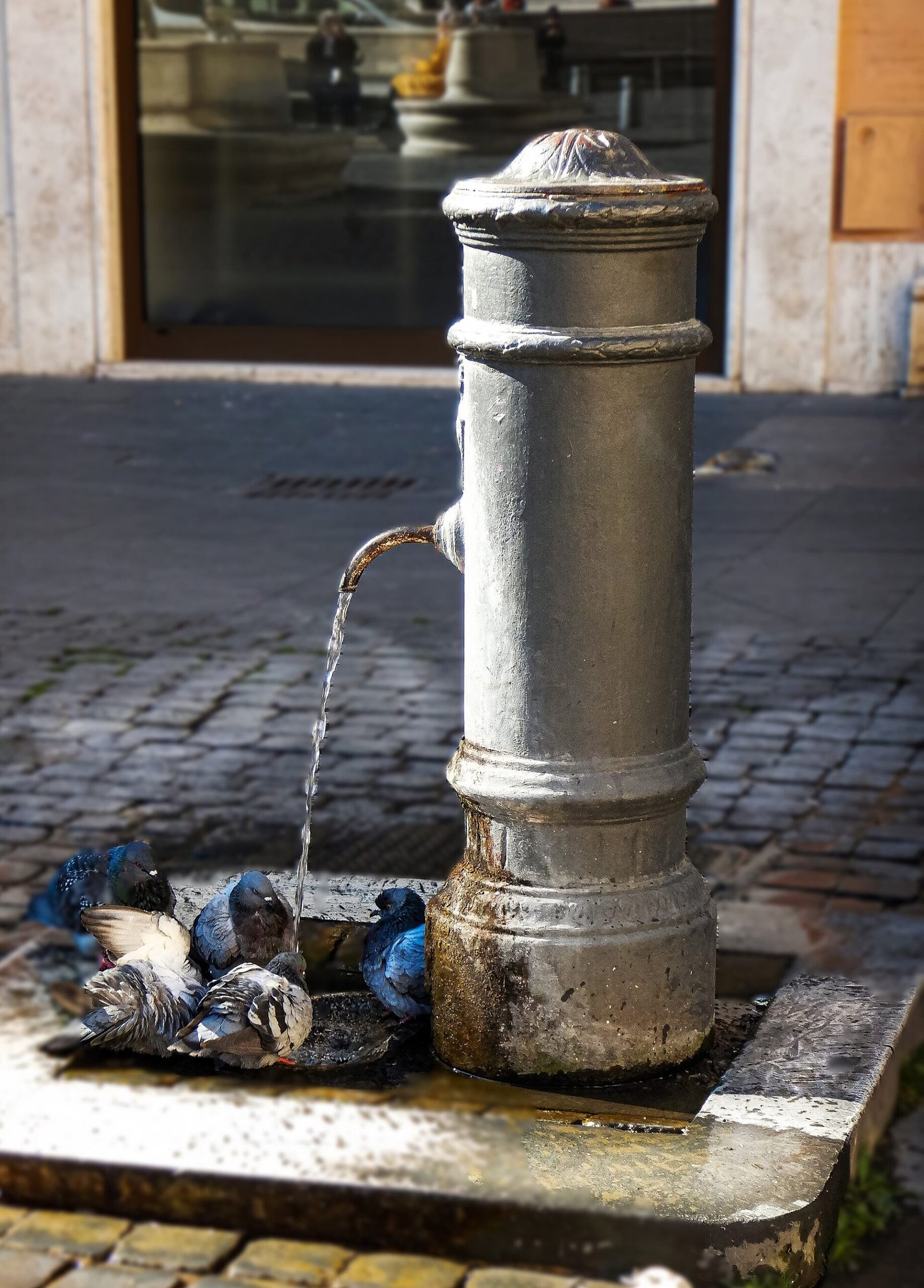
A nasone is a cylindrical cast-iron column, dark, a little over a meter tall, with a curved spout halfway up from which the water comes out without stopping. Below, a grate carries the leftover water into the sewer network. The Turismo Roma portal gives for the first models a height of about 120 centimeters and a weight of about 100 kilograms. The name comes precisely from the spout, which in profile resembles a long nose bent downward.
According to Acea and to the City's portal, the historic center has more than 200 of them, to which are added about 90 artistic fountains and drinking fountains that give drinking water. The rest is scattered across the neighborhoods, the historic villas, the square gardens and along the consular roads. Whoever walks between the Pantheon, Piazza Navona and Campo de' Fiori crosses several without looking for them, often at the corner of a square or next to a bus stop.
What you really see is a minimal object. No sculpture, no monumental inscription, often just the crest or an initialism in relief and the rust on the edge of the grate. That is why the nasoni go unnoticed by those arriving in Rome for the first time and become indispensable from the second day of heat onward. In our judgment they are the most successful public service in the city: they have worked for 150 years on the same principle.
Next to the classic cast-iron model there are lesser-known variants. The Turismo Roma portal points to about 70 travertine fountains from the 1920s and 1930s, with the brass she-wolf head from which the water comes out, and places them mostly in the parks and in the Olympic Village. There remain also some examples with the dragon heads of the first models, in a few spots of the center. In public villas, like Villa Borghese, it's worth paying attention to which model is in front of you.
A useful warning to avoid mistakes. The nasone is always on public ground: sidewalk, square, park avenue. The fountains you glimpse in building courtyards, beyond an open door or inside a cloister, belong to the condominiums, convents or offices, and are not available to passersby. You don't need to enter anywhere to find water: if a fountain requires you to go through a gate, it is not a nasone, and it's best to look for the nearest one on the street.
A curiosity about the nasoni of Rome
On the spout of almost every nasone there is a small hole, at the top, that many don't notice. The Turismo Roma portal describes it this way: if you plug the main outlet with a finger, the water rises from the little hole and forms an upward jet, handy for drinking without putting your mouth on the metal. It is the gesture that tells at a glance who lives in Rome from who has just arrived and bends under the stream with cupped hands.
The trick also has a hygienic logic, which the City's portal underlines. Drinking from the upward jet, nobody touches the spout, and the fountain stays clean for whoever comes next. The advice is to plug the outlet with the index finger, not with the palm, and to keep your head slightly to the side, because the jet starts with some force. The first few times you get your shirt wet. From the third on, the movement comes naturally.
The name too has its story. The City's portal explains that the first models had three dragon-shaped spouts, and that only later came the single smooth spout, the one that gave rise to the nickname. Nasone, that is big nose, is a Roman word that became official through use: today Acea, the City and the city's tourist portal all use it, without quotation marks.
Something nobody tells you about the nasoni of Rome
The continuous flow is not a waste left there out of laziness. According to the Turismo Roma portal, from the start the nasoni served two purposes: giving free drinking water to the center and the districts, and acting as a relief valve for the water network. The water that runs without stopping keeps the pipes moving, and the most widespread encyclopedia entry adds that this prevents water from stagnating in the pipes, with the hygiene risks that follow.
There is also a matter of numbers that always gets lost in summer discussions. The same encyclopedia entry reports that about 1 percent of the water lost in the city passes through the nasoni, while the share lost from old pipes comes close to half. In July 2017, when Acea began shutting them off because of the drought, the Roman press headlined precisely on this figure. Our opinion is that the idea of the wasteful nasone is overrated.
The topic of saving remains open anyway, and Acea tackles it in another way. On the page dedicated to the fountains the operator writes that some nasoni have timed taps to limit waste, and presents a project called Nasone 4.0, born in its in-house innovation lab, which checks the water every day and transmits the data to optimize the network. How many nasoni are already equipped with these systems, the operator does not say.
The cost too is lower than you'd imagine. The English-language encyclopedia entry estimates the running cost of a nasone at between three and five euros a day, a figure the operator does not publish and which should be taken as an order of magnitude. Multiplied by a few thousand fountains it remains a real item in the water service's budget, but small compared to what the nasoni give back to the city: free water on the street, for everyone, at any hour.
Where do the nasoni come from and why exactly in 1874?
The City's portal attributes the initiative to Mayor Luigi Pianciani and to the assessore Rinazzi, in 1874, four years after the entry of the Italian troops into Rome. The new capital of the Kingdom was growing fast, with ministries, new districts and thousands of clerks arrived from all over Italy. Bringing free drinking water into the streets was a practical choice, and in our judgment a political one too: the new administration had every interest in looking modern, even with drinking fountains.
On the exact date of the first nasone the sources don't fully agree. Acea, the City and the 2024 news reports indicate 1874, and the 150-year celebrations were held on this date. The English-language encyclopedia entry notes that some sources speak instead of 1872. The difference of two years doesn't change the substance: the nasoni were born with Rome as capital, in the first season of unified Italy, when the city was redoing streets, sewers and aqueducts.
Rome, after all, already had a long history of public water. The ancient aqueducts, whose arches remain in the Aqueducts Park, brought enormous volumes into the city for the baths and the fountains. From the sixteenth century onward the popes reactivated some conduits and celebrated them with monumental display fountains, like the Fountain of Moses for the Acqua Felice and the Fountain of the Acqua Paola on the Janiculum. The nasoni are the democratic chapter of this story.
The difference from the display fountains is evident. The great papal fountains were made to be looked at, with statues, crests and inscriptions recording who had paid for the work. The nasone is made to be used: it costs little, repeats identically in every district, bears nobody's name. According to the City's portal, the declared aim was to give free drinking water to the center and the districts, that is to bring it also where the monumental fountains did not reach.
My advice for visiting the nasoni of Rome
The advice is simple: go out with an empty water bottle and forget about bottled water. Whoever walks around the center in summer spends a few euros every day on mineral water at the kiosks in front of the monuments, where the price adapts to the tourist, while a few meters away there is a nasone with cool, free water. In our judgment buying bottled water in Rome is the most common and most pointless mistake in a visitor's day.
Before leaving it's worth downloading Acea's Acquea app, available on Google Play and the App Store, which locates nasoni, drinking fountains and water houses. Whoever prefers to do without the phone can rely on the Romans' practical rule: many squares in the center have their own nasone, and in the parks the fountains are usually found along the main avenues. In the open archaeological areas, on the other hand, water points are sparser, and there a full water bottle makes the difference.
A common-sense caution concerns use. The nasone is for drinking and for filling bottles or water flasks, not for washing dishes, bicycles or scooters, nor for rinsing your feet after the beach. Whoever fills an entire drum blocks the line of those who are thirsty. Roma Capitale has presented a joint initiative between the municipal Civil Protection and Acea's app precisely to support residents and tourists during the summer months.
Finally, drink even when you're not thirsty. On July and August days the center of Rome often exceeds 30°C, with the sun reflected by the travertine and the sampietrini. A sip at every nasone you meet is the simplest strategy for reaching evening without a headache. Whoever travels with children finds other ideas on our pages about Rome with kids, where free water is a precious resource.
On the water bottle there is a rule of common sense. Fill it under the main jet, without resting the neck on the metal of the spout, and close it right away. An insulated bottle keeps the water cool for hours even on the hottest days, and between one nasone and the next it makes the difference. Whoever prefers plastic bottles can always reuse the same one for the whole vacation: the network water is the same you would buy at the kiosk, and in our judgment there is no reason to pay for it.
How much does it cost and how do you find the nearest nasone?
It costs nothing. The nasoni are public fountains and the water is free for anyone, resident or visitor, with no cards, tokens or reservations. No ticket and no paid service gives access to the fountains, and whoever sells a map of the nasoni is selling a product that Acea makes available free to everyone. A particular case is that of the three nasoni on Via Sacra, which are inside the paid archaeological area of the Colosseum and can be reached only with the Park's ticket.
The official channel is the page Acea devotes to the nasoni and drinking fountains, from which you get to the Acquea app, the current version of the app launched in 2020 under the name Waidy. According to the March 2024 reports, the app, then called Acea Waidy Wow, geolocated all the nasoni of Rome and over 150,000 water points in Italy. For general tourist information the Turismo Roma portal of Roma Capitale remains the reference.
The app also shows on the map the water houses, which are something other than the nasoni. According to the most widespread encyclopedia entry, in 2015 Acea installed 10 of them, described as high-tech nasoni, with free still and sparkling water, tourist information and phone charging. They are fixed points, fewer in number, useful for those who prefer carbonated water. For the updated map of their locations the reference is the app, not the lists circulating on travel sites.
Another well-known fact, yet rarely cited
That the water of the nasoni is good all Romans know, and they repeat it to every tourist who hesitates. The less-cited detail is that it is the same water that arrives in homes. Acea writes it explicitly on the dedicated page: the water of the nasoni corresponds to that distributed in homes and is subject to strict quality controls. The City's portal adds that it is very cool precisely thanks to the continuous flow that renews it without stopping.
A practical consequence follows that few consider. Whoever in Rome drinks tap water in a hotel or a rented apartment drinks the same water as the nasone on the street, with the only difference being temperature. Whoever instead buys mineral water out of fear of public water spends on a precaution that the operator does not consider necessary. For technical data on quality the reference is the Acea Ato 2 page on water quality and potability.
Another little-cited fact concerns the numbers of the past. According to the English-language encyclopedia entry, at their peak the nasoni of Rome reached about 5,000, twice as many as are active today. The operator doesn't publish a historical series, and the sources don't explain in detail how the reduction came about. The figure still serves as a reminder that the current network is the result of a century and a half of additions, relocations and removals, not a design frozen in 1874.
If you come from a city with very soft water, you may notice a taste different from the one at home, and there's nothing strange about that. Limescale leaves white traces on the spout and on the grate, which is why some holes get clogged. It's not a sign of poor quality. For up-to-date analytical parameters, the reference is the Acea Ato 2 page dedicated to water quality, not the rankings that circulate on commercial sites.
One rule of basic hygiene remains. Don't put your mouth on the spout, even if that's what many people do, and don't let children put their hands inside. Drinking from the jet that rises from the little hole avoids the problem at the root. If the nasone is dirty with leaves or mud around the grate, the water coming out of the spout is still the water from the network: the dirt only affects the puddle below.
The Right Photo to Take of the Nasoni of Rome
The photo that really tells the story of a nasone is the one of the gesture, not of the object. A hand blocking the spout, the jet rising in an arc, a person bent over to drink: whoever looks understands right away how it works. You need raking light, early in the morning or in the late afternoon, because midday sun flattens the dark cast iron and burns out the water. With a fast shutter speed the jet stays sharp, with a slow one it becomes a white thread.
The second photo is the one of the nasone with the monument behind it. The most photographed is probably the one in front of the Pantheon, in Piazza della Rotonda, where according to the City's portal one of the models with dragon heads remains. Get low, at the height of the spout, and leave the facade of the temple blurred in the background. Avoid peak hours: the square is full, and the nasone almost always has someone in front of it.
For a less obvious photo, it pays to look for the variants. The travertine fountains with the she-wolf head, in the parks, have a sturdier shape and tell of another era of the city. The three dragon spouts of the oldest models are a nice detail to shoot up close, with the water coming out of the jaws. Respect those waiting in line to drink: the nasone is a service, and photographing it doesn't give you the right to block it for five minutes.
If you like photo series, you can build one while walking. One nasone per rione, with the same framing and the same shooting height, shows how the same column changes look depending on the context: sampietrini, asphalt, the gravel of a park, the travertine of a Baroque square. The map of the 22 rioni of Rome helps you organize the route. The result is a portrait of the city seen from below, at the height of someone who is thirsty.
In the evening the dark cast iron almost disappears, and you recognize the nasone only by the sound of the water on the grate. A night photo works if there's a streetlamp nearby that lights the jet from the side: the water becomes a light line on a black background, and the column stays in shadow. You need a stable support for the camera or phone, or a steady hand. Frontal flash, on the other hand, flattens everything and reflects off the puddle, and it's best to leave it off.
How Do You Drink from a Nasone Without Getting Wet?
The technique has three steps. You stand to the side of the spout, not in front of it, so you don't get splashed on your shoes. You block the main outlet with a finger, pressing firmly, and the water comes out of the little hole at the top in an arc-shaped jet. You bring your mouth to the jet, without touching the metal, and drink. When you take your finger away the jet stops suddenly and the water falls back toward the grate.
The most common mistakes are two. The first is blocking badly, letting water escape from the side: the jet splits and wets everything. The second is pressing too high on the spout, closing the little hole as well. If the jet doesn't rise, check where you put your finger. Some nasoni have the hole clogged by limescale or damaged, and in that case all that's left is to drink with cupped hands, as people did before.
With small children it's best to act as the plug for them and let them drink from the jet, holding them steady. To fill a water bottle you don't need the hole: just put the neck under the main spout and wait. If you have a dog, you'll often see it drink from the puddle above the grate, and it's a common use in the city. In 2017, during the drought, the press reported precisely the protests of those who feared for stray animals and for homeless people.
How Do You Get to the Historic Nasoni of the Center?
The three models with dragon heads that the Turismo Roma portal says are still in place are found in Piazza della Rotonda, Via di San Teodoro and Via delle Tre Cannelle. You can combine them in a one-hour walk, without any transport. From Piazza della Rotonda, in front of the Pantheon, you head down toward Piazza Venezia, pass by Trajan's Column and climb toward Via delle Tre Cannelle, near Trajan's Markets.
From Via delle Tre Cannelle you return toward the Capitoline Hill and descend into the valley between the Palatine and the Capitoline, where Via di San Teodoro runs, behind the Roman Forum. At the end of the street you find the basilica of San Giorgio in Velabro and the area of the Forum Boarium, with the Mouth of Truth a little farther on. The final stretch is almost all flat, among ancient remains and medieval churches.
To reach the starting point, the Pantheon can be reached on foot from almost all of the historic center, or by the buses that stop at Largo di Torre Argentina. Lines change often with roadworks and detours, and the up-to-date reference is the route planner on the Atac site. Going by car makes no sense: the center is protected by the limited traffic zone and parking is rare. Nasoni are a subject for comfortable shoes, not for a steering wheel.
The three new nasoni of 2024 are a case apart. They are located along Via Sacra, in the stretch that leads toward the Colosseum, and according to the news of the inauguration they are the first drinking fountains installed inside an archaeological area, made of cast iron and with the Acea logo. To reach them you need a ticket for the Colosseum Archaeological Park, to be bought on the Park's official channel. Inside the area, in summer, they are a precious resource.
If you don't have time for the full tour, you can limit yourself to the first nasone, the one in Piazza della Rotonda, and include it in your visit to the Pantheon. A minute is enough to look at the dragon spouts and compare them with the modern drinking fountains you meet in the surrounding streets. The comparison makes the change of design in the late 19th century clearer than any explanation, and it's a way to turn an everyday gesture, drinking on the street, into a small lesson in urban history.
Some Important Events That Happened Here in History
In 1874 the City of Rome, with Mayor Luigi Pianciani and councilor Rinazzi, launched the network of public cast-iron drinking fountains. The first models have three dragon spouts, weigh about 100 kilos and are about 1.2 meters tall. In the following years the design is simplified and the single, smooth spout of the nasone is born. Between the 1920s and 1930s the travertine fountains with the brass she-wolf head appear.
In 2015, according to the most widely circulated encyclopedia entry, Acea installs the first 10 water houses, with free still and sparkling water. In July 2017 the drought lowers the level of Lake Bracciano, one of the city's water reserves, and Acea begins closing some of the nasoni, about 30 a day according to Roman press headlines, amid protests from associations and citizens. In August 2020 Acea launches the Waidy app to find fountains, nasoni and water houses.
On March 19, 2024, for the 150th anniversary, Acea and Roma Capitale inaugurate three nasoni along Via Sacra, in the Colosseum Archaeological Park, and present the geolocated map of all the drinking fountains in the Acea Waidy Wow app. Today the app is called Acquea. In the meantime the operator presents the Nasone 4.0 project, designed to monitor the water every day. The cast-iron column, in substance, remains the one of 1874.
The thread linking these dates is simple. With every water crisis the nasone returns to the center of public debate, with some seeing it as a waste and others as a right. With every anniversary it returns instead as a symbol of the city. In between remains the daily service, which nobody celebrates: thousands of people who every day fill a water bottle, cool their wrists or drink on the fly before walking on.
Looked at in sequence, the dates also say something else. In 150 years the nasone has changed its spout, its material in some variants, the way it is looked for, from the memory of residents to the map on the phone, but it has never changed its function. It has remained free, open to everyone and without opening hours. Few urban services born in the 19th century can say the same, and in our view this is the real reason why Romans defend them at every crisis.
Who Has Passed By the Nasoni of Rome
The first name is that of Luigi Pianciani, mayor of Rome just become capital, who according to the City's portal wanted the network of drinking fountains together with councilor Rinazzi. For Rinazzi the portal gives only the surname and the office. Then there are the workers and foundry men who for decades produced and installed the cast-iron columns, who remained anonymous, and the technicians who still repair them today on behalf of the water service operator.
At the March 2024 ceremony for the 150th anniversary, according to the press, those present were the Roma Capitale councilor for Public Works Ornella Segnalini, the president of the Acea Group Barbara Marinali, the president of Municipio Roma I Lorenza Bonaccorsi and the director of the Colosseum Archaeological Park Alfonsina Russo. A drinking fountain entering an archaeological area of that level needs many signatures, and the ceremony showed it clearly.
The real protagonist, however, is collective. Romans of every era have stopped at the nasoni, as well as pilgrims, soldiers, kids coming back from the game, morning runners, cyclists, families on outings in the villas. In 2017 the press also gave a voice to those who depend on the drinking fountains more than anyone, homeless people, and to those who look after stray animals, who get from the nasoni the water to survive the summer.
And then the visitors, more every year. For those who come from cities where public water on the street doesn't exist, the nasone is a discovery, and often becomes one of the most concrete memories of the trip. The City's tourist portal dedicates a whole page to it, Acea a map, and many travelers go home with the photo of the jet rising from the little hole. Few objects in the city have such a wide and so little celebrated audience.
What Do the Documents Say and What Is Told?
The documents, that is the pages of Acea and of the City's portal, say few certain things: the date of 1874, the name of Mayor Pianciani, the first cast-iron models with three dragon spouts, the move to the single spout, the travertine fountains with the she-wolf, the same water as in homes, the hole for drinking from the jet. On the current number the official sources diverge, between about 2,500 working and over 3,000 drinking fountains across Rome.
Tradition adds the rest. The name nasone, first of all, born on the street and become official. The habit of drinking by blocking the spout, which Romans teach their children when they are small. The idea that every rione has its favorite nasone, the one with the coldest water, and that the water of certain fountains is better than others. On this the operator makes no distinction: the water of the nasoni is the same as the network water that reaches homes, and neighborhood preferences remain personal attachments.
Then there is legend. On travel blogs and social media, rankings circulate of the oldest nasone, the coldest, the most photogenic. No institutional source confirms them, and they should be taken as bar talk. The same goes for the maps of secret nasoni that circulate online: the operator provides a complete, free map, and there are no hidden drinking fountains worth searching for on your own.
One case apart concerns the date of birth. The 2024 celebrations fixed 1874 as the reference year, and Acea, the City and the press agree on this. The English-language encyclopedia entry notes that some sources instead indicate 1872. Until there is documentary proof to the contrary, the reference remains 1874, because it is the date chosen by the operator and the administration that are responsible for the service.
When Is a Nasone Closed and What Shouldn't You Expect?
A nasone can be closed because of a fault, roadworks or a decision by the operator. Acea doesn't publish a calendar of closures, and the only way to know is to go there. The app does show where the nearby drinking fountains are. At construction sites it happens that the column is removed and put back months later, sometimes in a slightly different spot. If a nasone you know has disappeared, look for the nearest one on the map.
The best-known case of mass closure dates back to the summer of 2017. With the level of Lake Bracciano falling sharply because of the drought, Acea began closing the nasoni in stages, about 30 a day according to press headlines, which also reported the lists of the drinking fountains excluded from the closure. The decision set off controversy: associations and citizens objected that the drinking fountains counted for little in the overall losses of the network. A similar situation could happen again in another summer of water crisis.
Don't expect a uniform service. In the center the nasoni are dense, in the suburbs sparser, and in the parks it happens that some stay out of use for a long time. Don't expect ice-cold water in every season either: in the middle of August, at points exposed to the sun for hours, the first water that comes out can be lukewarm, and it's best to let it run a few seconds. Finally, don't expect drinking fountains in closed archaeological areas: there you have to bring your own water.
One last warning concerns respect for the place. The drinking fountains are meant for drinking, not for bathing your feet or for filling buckets and jerry cans to pour over yourself. In monumental squares the nasone is often next to an artistic fountain, and the temptation to climb over to get wet is strong: the monumental fountains of Rome are not swimming pools, and the City protects them. The nasone is more than enough to cool your face and wrists.
On the hottest days, finally, the nasoni of the center often have a line. In front of the most visited monuments you sometimes wait a few minutes while the person ahead fills two or three bottles. The unwritten rule is simple: whoever only needs to drink goes ahead of whoever is filling a large container, and nobody washes their hands while others are waiting. If the line is long, there is almost always another nasone a few dozen meters away, outside the main square.
What Is the Difference Between a Nasone and a Monumental Fountain?
The difference is one of function before form. Monumental fountains, like the Trevi Fountain, the Fountain of the Four Rivers or the Fountain of the Naiads, are protected works of art, created to celebrate the arrival of an aqueduct or the glory of a pope. They are not made for drinking, and often the water that animates them is recirculated. The nasone is instead a distribution point for drinking water, connected to the network.
There is, however, an intermediate zone. The City's portal notes that, besides the nasoni, in the center there are about 90 artistic fountains and drinking fountains that give drinking water, and it cites as examples the Barcaccia by the Berninis in Piazza di Spagna and the wall fountain in Via della Fontanella di Borghese. They are fountains to look at and to use at the same time, with spouts from which you can drink without entering the basin.
Among the minor fountains tied to public water there is also the Fontanella degli innamorati, linked to the Trevi Fountain and its traditions. And there are the 16th and 17th century square fountains, like the Turtle Fountain, which also had a practical function for the rione. The nasone inherits that function and brings it to every street, with no more need for sculptors.
The talking statues also have to do with water. The Facchino of Via Lata, one of the figures told in our pages on the talking statues of Rome, is a small wall fountain. In the Rome of the popes, wall fountains brought water into the streets of the rioni, each with its own shape. In our view the leap of 1874 was making them serial, all identical and spread everywhere.
Where Do You Find Nasoni in Parks and Villas?
In the large public villas the nasoni are a lifesaver, because cafes are few and distances long. At Villa Borghese, Villa Doria Pamphilj and Villa Ada the drinking fountains are usually found along the main avenues and near the entrances. The exact position changes with works and faults, so before a run or a long picnic it's best to check on the app where the ones closest to your route are.
The travertine drinking fountains with the she-wolf head, according to the City's portal, are found mostly in parks and in the Villaggio Olimpico. The model recalls the 1920s and 1930s, and the brass she-wolf refers to the symbol of the city. In the area of the Foro Italico, which the most widely circulated encyclopedia entry lists among the places with travertine nasoni, it's best to look for them along the pedestrian paths around the sports facilities.
In the Appia Antica Park and in the Parco degli Acquedotti distances are long and shade is scarce, and the water points are not as dense as in the city. The advice is to start with a full water bottle and refill it at the first nasone you meet at the entrance. The same goes for the Circus Maximus, a large, open space with little shade, where in summer the sun beats down all day.
For those who do sports outdoors, running or cycling, the nasoni of the villas are the natural stopping point. The advice is to plan the ride around the drinking fountains, not the other way around: mark on the app the ones along the route, and keep in mind that some may be out of order. In the hottest hours of July and August it's best in any case to avoid long efforts in the sun, and choose early morning or evening, when the avenues fill with Romans doing the same.
What to Combine in a Day
The nasoni theme pairs well with a route along the waters of Rome. You start from Piazza della Repubblica with the Acqua Marcia exhibition, head down toward the Fountain of Moses and then to Piazza Barberini for the Triton Fountain. From the Quattro Fontane you continue toward Trevi. Along the whole route the nasoni let you drink without stopping at cafes, and the day costs only lunch.
If you prefer a longer theme, you can follow the water up to the Janiculum, where the Fontanone dell'Acqua Paola stands, and then descend toward Trastevere, where drinking fountains are not lacking in the squares of the rione. It's a walk that is uphill at the start and downhill at the end, suited to late afternoon, when the light on the Fontanone is warmer and the view of the city clearer.
For a zero-cost day, the nasoni are the perfect complement to the suggestions collected in our pages on free Rome and on free museums in Rome. A water bottle, a pair of comfortable shoes and a map are enough to cross the center from morning to evening. In the Monti rione and around Termini station the nasoni also help those arriving by train in the heat with a suitcase.
With children, finally, the nasone is a game. Blocking the spout and watching the jet rise entertains the little ones for minutes on end, and makes summer walks less tiring. If you alternate museums and parks, you can use the villas with their drinking fountains as breaks between one visit and the next, for example between the museums of the center and Villa Celimontana, a secluded park on the Celian Hill with shaded avenues.
If you venture outside the center, you can dedicate a morning to the Parco degli Acquedotti, where the ancient arches tell how water arrived in imperial Rome, and compare them with the cast-iron column that today brings the same resource to your doorstep. The route is long and exposed, so what was said about parks applies: full water bottle at the start, a hat, and the first useful nasone marked on the app. In the afternoon you can return toward the center by metro.
Frequently Asked Questions
How many nasoni are there in Rome?
The sources don't agree on the exact number. The tourist portal of Roma Capitale indicates about 2,500 working nasoni, the Acea page speaks of over 3,000 drinking fountains across Rome, and press reports of March 2024 for the 150th anniversary gave the figure of 2,800. In the historic center, according to Acea and the City, there are more than 200, plus about 90 artistic fountains and drinking fountains with drinking water.
Is the water from the nasoni drinkable?
Yes. Acea, which runs Rome's water service, writes that the water of the nasoni is the same that reaches homes and is subject to strict quality controls. The continuous flow keeps it fresh and moving. If a drinking fountain has a sign forbidding its use, an obvious fault or cloudy water, it's best to move on to the next one and report the problem to Acea through the water service contacts.
How do you drink from a nasone?
You block the main outlet of the spout with a finger, and the water rises from a small hole in the upper part forming an arc-shaped jet, from which you drink without touching the metal. It's the method described by the City's portal and used by Romans, more hygienic than drinking with your mouth on the spout. To fill a water bottle you don't need to block anything: just put it under the main jet and wait a few seconds.
Why are they called nasoni?
Because of the shape of the spout, long and bent downward like a big nose. According to the City's portal, the first models of 1874 had three dragon-shaped spouts, and the nickname came later, with the arrival of the single, smooth spout that you still see today in almost all of the city. The name has entered common use and today Acea and the administration use it too in official communications.
Is there an app to find nasoni?
Yes. Acea offers the free Acquea app, for Android and iOS, which locates nasoni, drinking fountains and water houses. It's the current version of the app launched in August 2020 under the name Waidy and later called Acea Waidy Wow. According to the news of March 2024 the app has geolocated all the nasoni of Rome. For faults, however, the channel remains Acea's water service.
Why don't nasoni have a faucet?
Because the continuous flow is part of the system. According to the City's portal, from the beginning the nasoni also served to vent the water network, and the most widely circulated encyclopedia entry adds that moving water avoids stagnation in the pipes. Acea notes, however, that some nasoni have timed faucets to reduce waste. The losses attributed to the nasoni, according to the same entry, are a minimal share of those of the network.
Where are the oldest nasoni in Rome?
The Turismo Roma portal indicates some examples with the dragon heads of the first models still in Piazza della Rotonda, in front of the Pantheon, in Via di San Teodoro, behind the Roman Forum, and in Via delle Tre Cannelle, near Trajan's Markets. It also notes about 70 travertine drinking fountains from the 1920s and 1930s, with the brass she-wolf head, mostly in parks and in the Villaggio Olimpico.
Why were the nasoni closed in 2017?
In July 2017 the drought had lowered the level of Lake Bracciano, one of the city's water reserves, and Acea began closing some of the nasoni, about 30 a day according to Roman press headlines. The choice sparked controversy: associations and citizens argued that the drinking fountains counted for little in the overall losses of the network and feared for homeless people and for animals. The case remains the reference point for every summer discussion about water in Rome.
Can you fill a water bottle at a nasone?
Yes, and it's the most sensible use for those visiting the city. Just put the bottle under the main spout, without blocking the hole, and wait for it to fill, avoiding resting the neck against the metal. The water is the same as the home network, according to what Acea states. Common sense only asks that you not fill jerry cans and drums when other people are waiting, and not use the drinking fountains to wash objects or vehicles.
Who Wrote This and on Which Sources
The text comes from the editorial team of Tour Leader Pro, the Rome-based outfit that designs itineraries, visits and cultural events across Rome and Lazio. Fares, hours and booking methods reported here come from the official sources cited in the text as of the date given at the opening: for the nasoni, they are the Acea page on drinking fountains, the Turismo Roma portal of Roma Capitale and the press news of March 2024 on the 150th anniversary. Let us know what you find changed.
Organizing a day in Rome in summer, for yourself or for a trip with several people, means first of all managing water, shade and breaks. The nasoni solve the first point for free, as long as you know where they are and start out with a water bottle each. It's best to mark the drinking fountains along the route in advance, especially in parks and near archaeological areas. For those planning outings in the city, a useful resource for those who organize group trips is Tour Leader Pro.
The nasoni are the last stretch of a journey of water that begins far from Rome, in the springs of the Apennines and in the valleys of Lazio, and passes through ancient and modern aqueducts. Following that water out of the city leads toward Tivoli, Subiaco and the Simbruini Mountains, areas to visit slowly over several days. To put together city and province, a useful resource for building a multi-day itinerary is Italy Planner.