The Talking Statues of Rome
In short. The talking statues of Rome are six sculptures scattered around the historic center on which, from the 16th century onward, Romans secretly posted satirical notes against popes, cardinals, governors, and powerful families: Pasquino in…
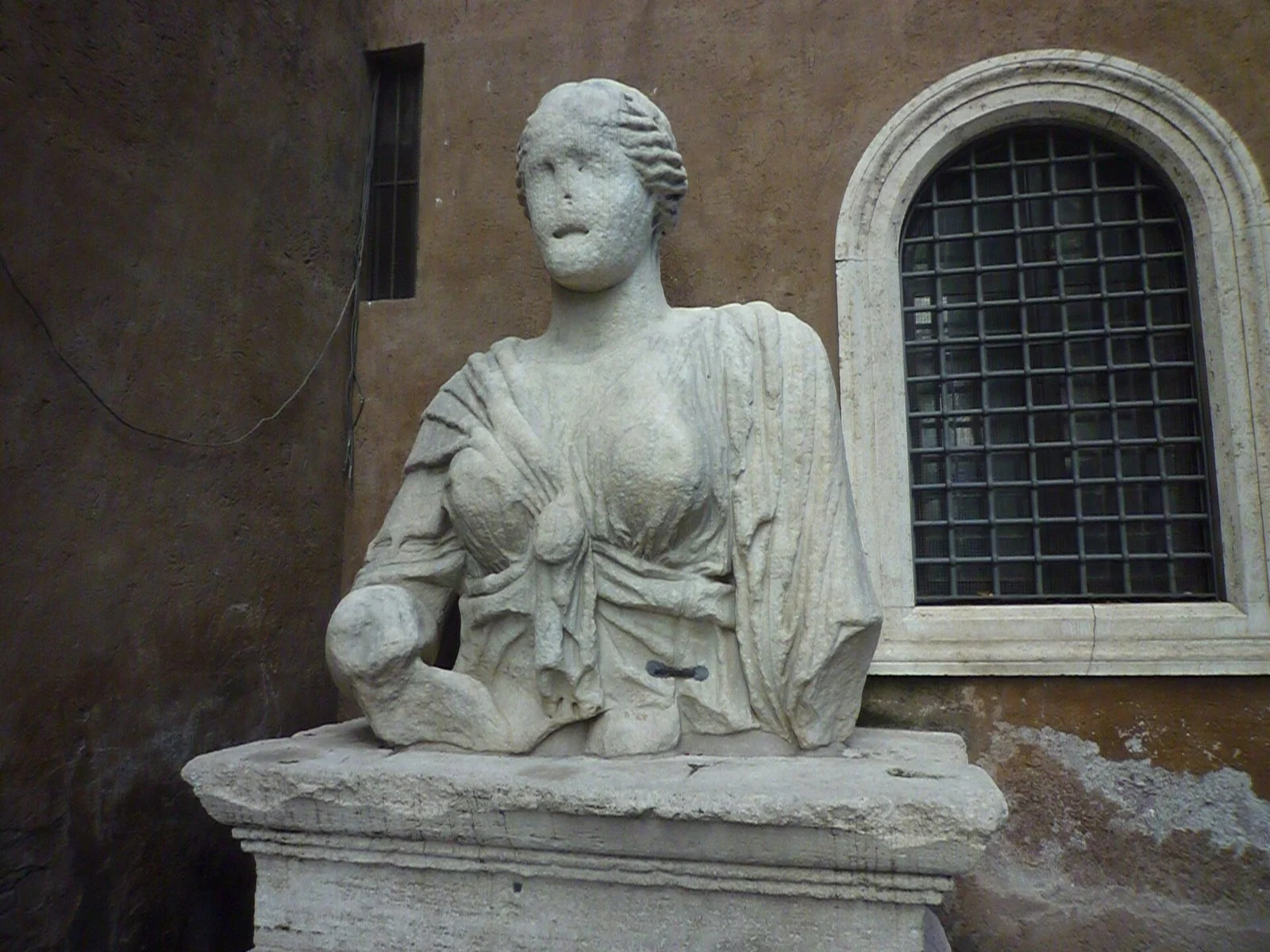
The talking statues of Rome are six sculptures scattered around the historic center on which, from the 16th century onward, Romans secretly posted satirical notes against popes, cardinals, governors, and powerful families: Pasquino in Piazza di Pasquino, Marforio now in the courtyard of Palazzo Nuovo at the Capitoline Museums, Madama Lucrezia in Piazza San Marco at the corner of Palazzo Venezia, l'Abate Luigi in Piazza Vidoni, il Babuino on Via del Babuino, and il Facchino on Via Lata, a few meters from the Corso. Five of these six are ancient, fragmentary sculptures that were reused: mutilated torsos, eroded busts, figures without arms or without heads, pulled out of the ground during Renaissance building sites and set at street corners as urban furniture. Only one, the Facchino, is a 16th-century sculpture made as a fountain from the start. The popular name almost never has anything to do with the figure depicted: calling a silenus Babuino or a probable Isis Madama Lucrezia is already a small pasquinade in itself. From those statues came a word that entered the Italian language and half of Europe, pasquinata, and a mechanism of anonymous satire that the popes tried to extinguish with prison, confiscation, and even the gallows, without ever succeeding. The lines that follow tell about them one by one and then line them up as a walking itinerary: about three and a half kilometers of historic center, six stops, a single story.
What the talking statues of Rome really are
The talking statues of Rome are six, and five of them are sculptures from the Roman era that resurfaced from the subsoil between the 15th and 16th centuries: they were never conceived to speak, and none of them was born as a monument to satire. The collective name is a label the people stuck on after the fact to a group of heterogeneous objects, united by only one thing: they stood at heavily trafficked crossing points, where a sheet hung up at night was read by hundreds of people before the guards arrived to take it down.
Reused ancient fragments: Pasquino, Marforio, Madama Lucrezia
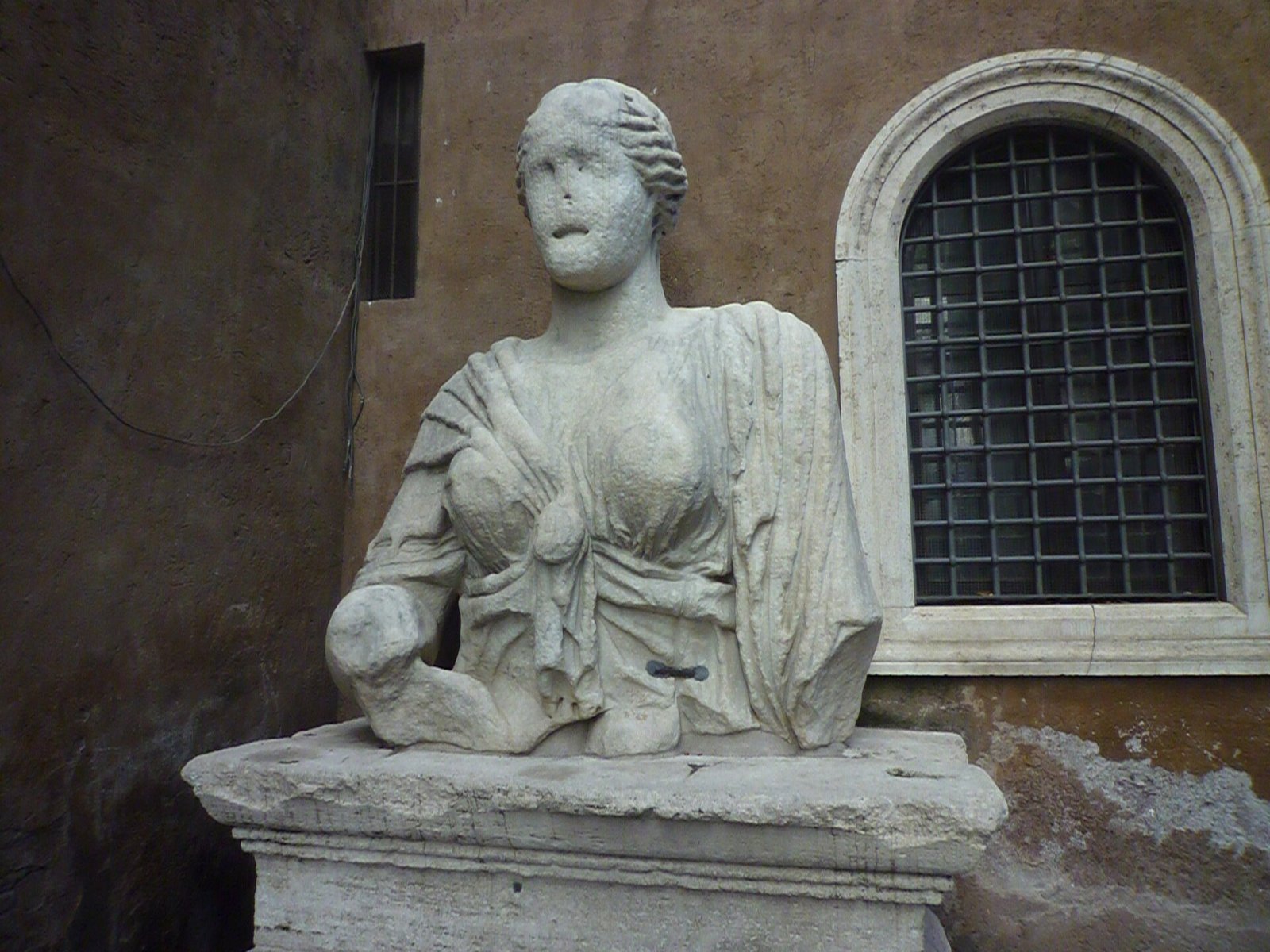
Pasquino is the fragment of a Hellenistic sculptural group, in all likelihood a Roman copy of the group of Menelaus supporting the body of Patroclus, attributed in its original version to the sculptor Antigonos and datable to the early Hellenistic age, around the 3rd century BC. More complete replicas of that group survive elsewhere today, starting with the one in the Loggia dei Lanzi in Florence. In Rome what remains is a mutilated torso, without arms, with a corroded face and a second figure barely legible in the same block of marble. Marforio is a colossal statue of the 1st century AD, a semi-reclining male figure that the iconography links to a water deity: it measures 610 centimeters by 242, and the shell it holds in its right hand, which fixed its identification as Oceanus, is not ancient but an addition from the restoration of 1594. Madama Lucrezia is a colossal bust that exceeds three meters with its base, with facial features almost completely eroded and a wavy hairstyle still legible. The most accepted hypothesis identifies her with the goddess Isis in her Sothis form, because of the knot of the garment on the chest, a typical attribute of that manifestation, and has her come from the Iseum Campense, the great Isiac sanctuary in the Campus Martius.
The six talking statues one by one: where they are and what they are
The six talking statues are all in the historic center of Rome, in a quadrilateral between Via del Babuino to the north and the Capitoline Hill to the south, and can be reached one after the other on foot along a route of about three and a half kilometers. Five are freely visible on the street, at any hour of day and night. Only one, Marforio, is inside a museum and requires a ticket.
Pasquino, Piazza di Pasquino
Pasquino leans against the corner of Palazzo Braschi, in the small square that from 1501 on ended up taking his name, about 50 meters from Piazza Navona. The statue was found right there, during the excavations for the street paving and for the renovation of the palace, which then belonged to the Orsini, and the first interpretations made it part of the ornament of the Stadium of Domitian, the ancient building buried under the neighboring square. Cardinal Oliviero Carafa, who was to take up residence in the palace, insisted on saving it even though many judged it a worthless ruin, had it set in the corner where it still stands, and applied the family coat of arms and a celebratory scroll. The palace behind it is no longer the one of that time: in place of the Orsini residence stands Palazzo Braschi today, built at the end of the 18th century, which houses the Museo di Roma.
Marforio, courtyard of Palazzo Nuovo at the Capitoline Museums
Marforio is the only one of the six talking statues that is today indoors and behind a fee: it occupies the center of a fountain in the covered courtyard of Palazzo Nuovo, within the visiting route of the Capitoline Museums, where it can be seen just past the entrance. Until 2008 the courtyard could be entered freely. Since then it has been included in the ticket. It was found around 1510 in the area of the Forum of Augustus, near the temple of Mars Ultor, and placed at the foot of the clivus argentarius, so that the slope took the popular name Salita di Marforio. Pope Sixtus V had it moved first to Piazza San Marco, next to Madama Lucrezia, then to the square of the Capitoline Hill, as the ornament of a fountain designed by Giacomo Della Porta. In the mid-17th century Innocent X moved it again, to make room for the Palazzo Nuovo building site, and the group ended up in the courtyard where it is today. The large circular basin that the statue adorned made a different journey: left abandoned for a long time and used as a watering trough, in 1816 it was transferred to the foot of the obelisk in Piazza del Quirinale, where it still stands.
Madama Lucrezia, Piazza San Marco
Madama Lucrezia is the only female figure of the group and stands at the corner between Palazzo Venezia and the Basilica of San Marco, in Piazza San Marco, a step from Piazza Venezia. The circumstances of the discovery are not known. The popular name comes by tradition from Lucrezia d'Alagno, lover of Alfonso V of Aragon, who after the death of the king of Naples had moved to Rome and lived in those parts. In support of this explanation it has been observed that in the 15th century the title of madama was in use in Naples and not in Rome. It remains a hypothesis of tradition, not a documented fact. One suggestive theory holds that the famous Pie' di Marmo, the colossal foot that gives its name to the street near Santo Stefano del Cacco, originally belonged to the same statue: the sandal still visible on the foot would be part of the dress of the Isiac priestesses, and the size and quality of the marble would be compatible. This too, for now, remains a proposal by scholars and not a certainty. Next to the statue is the entrance of the National Museum of Palazzo Venezia, which is a visit in itself and should not be confused with the stop in front of the bust.
L'Abate Luigi, Piazza Vidoni
L'Abate Luigi stands in Piazza Vidoni, set against the side of the Basilica of Sant'Andrea della Valle, a few steps from Corso Vittorio Emanuele II. It has been there since 1924, and the present position is very close to the spot where the statue was found in the 16th century, under Palazzo Vidoni Caffarelli. Before arriving in the square, it had lived inside the palace, then for a brief period in the 19th century in the courtyard of Palazzo Chigi, then again in a niche of the monumental staircase of Palazzo Caffarelli Vidoni. The nickname, according to the explanation handed down, came from its resemblance to the sacristan of the nearby church of the Sudario, who was in fact called Luigi. On the base there is an inscription in verse in which the statue presents itself as a citizen of ancient Rome and claims to have won, together with Marforio and Pasquino, eternal fame in urban satires, closing with the wish for a new and finally safe life. The wish did not come true: l'Abate Luigi has been decapitated several times, and today it appears headless.
Il Babuino, Via del Babuino
Il Babuino stands to the left of the church of Sant'Atanasio dei Greci, along Via del Babuino, the street that links Piazza del Popolo to Piazza di Spagna and that took its name from the statue. The relationship between statue and street, in this case, was reversed: the street was first called Via Clementina and then Via Paolina, and it was the popularity of the reclining figure that made the place name change. The fountain was born in 1571, when Pope Pius V granted a few ounces of water from the renovated Vergine aqueduct to the palace of Alessandro Grandi, who in honor of the pontiff had a fountain made for public use, placing the statue as the ornament of the basin. By 1576 it must have been finished. In 1738 the complex was set into a niche with two pilasters and two dolphins, set against the palace that had passed to the Boncompagni. That niche still exists, at number 49a. In 1877, for sewer network works, the complex was dismantled: the basin ended up as a watering trough on Via Flaminia and the statue in the courtyard of the palace. Only in 1957, after a campaign by some Roman citizens, did il Babuino return to the street that bears its name. The last restoration dates to 2015.
Il Facchino, Via Lata
Il Facchino is set into a windowsill on the side of Palazzo De Carolis Simonetti, on the side facing Via Lata, the little side street that opens onto Via del Corso next to the Basilica of Santa Maria in Via Lata and almost opposite the church of San Marcello al Corso. Originally, at the wish of Gregory XIII, it was a public fountain along the Corso itself, serving as a watering trough. In the 18th century it was transferred to the main facade of the palace, and in 1874 moved to the side, to a more out-of-the-way position, to protect it from damage. The face is ruined and the nose is lost, and the traditional explanation of that fury is that passersby mistook it for a portrait of Martin Luther. With the last move the original shell basin, the marble frame, and a jokey epigraph were also lost, which attributed the figure to a certain Abbondio Rizio, most skilled at tying up bundles, who died unwillingly while carrying a barrel of wine on his shoulder and another inside his body. The very comic tone of the epigraph leads one to doubt that the identification was serious. In 1751 Luigi Vanvitelli attributed the sculpture to Michelangelo: an attribution rejected today.
The walking itinerary among the six talking statues of Rome
The complete itinerary among the six talking statues of Rome measures about three and a half kilometers on foot and is covered in a bit under 50 minutes of walking alone, to which you must add the stops and the visit to the Capitoline Museums, the only paid stop of the route. The times given below are walking estimates at a normal pace, calculated on the real street route and not as the crow flies: if you walk slowly, stop to take photos, or run into the crowd on the Corso, allow a little more.
The route in brief
The direction I recommend is from north to south and then toward the west: you start from il Babuino, the statue most isolated from the others, and finish with Pasquino, which is the heart of the story and the only one of the six still in service today. This way the longest leg comes at the start, with fresh legs, and the finale is in the most beautiful and least trafficked part of the route. The sequence is this: il Babuino on Via del Babuino, il Facchino on Via Lata, Madama Lucrezia in Piazza San Marco, Marforio at the Capitoline Museums, l'Abate Luigi in Piazza Vidoni, Pasquino in Piazza di Pasquino.
Stop 1: il Babuino, on Via del Babuino
You start with il Babuino because it's the statue farthest from the other five and the one you risk skipping if you leave it for last. The most convenient starting point is the Spagna stop on metro line A: from there you come out onto Piazza di Spagna, take Via del Babuino, and in two minutes you reach the church of Sant'Atanasio dei Greci, recognizable by its twin bell towers. The fountain is to the left of the church, at sidewalk level, protected by a small railing. It's worth crossing the street to look also at the empty 18th-century niche, at number 49a, with the two pilasters and the dolphins: it's the place where the statue was for over a century, and the comparison between the elaborate niche and the present arrangement tells by itself what happened to this piece of the city. Anyone coming from Piazza del Popolo walks the same street in the opposite direction, about 10 minutes on foot.
From Via del Babuino to Via Lata: the longest leg
This is the demanding stretch of the route: about a kilometer and a half, between 18 and 20 minutes on foot. The simplest way is to go back up to Piazza di Spagna, pass by the Barcaccia Fountain, take Via dei Condotti, and reach Via del Corso, then go down the Corso in the direction of Piazza Venezia. It's a commercial and crowded stretch, but it passes two points that deserve a minimal detour: Piazza Colonna with the Column of Marcus Aurelius, and a little farther on the mouth of the little streets that lead to the Pantheon. Anyone who prefers to avoid the crush of the Corso can go down Via di Ripetta and then cut toward the center, adding a few minutes.
Stop 2: il Facchino, on Via Lata
Arriving from the Corso in the direction of Piazza Venezia, the landmark is the Basilica of Santa Maria in Via Lata, on the right: right next to it opens Via Lata, a short little street. Il Facchino is there, on the side of the palace, set into a windowsill not far above the ground. It's the statue easiest to miss on the whole itinerary, because it doesn't face a square and because the street is narrow and in shade: anyone walking the Corso looking at shop windows doesn't see it. It's worth looking at it up close, because the trade depicted, that of the water carrier who brings the barrel to your door, is a piece of the social history of Rome before modern aqueducts. On the other side of the Corso, about 30 meters away, is the entrance of the church of San Marcello al Corso.
Stop 3: Madama Lucrezia, in Piazza San Marco
From il Facchino to Madama Lucrezia it's a little over 300 meters, four or five minutes: you continue along the Corso to Piazza Venezia and turn right alongside Palazzo Venezia. The bust rests on a base at the corner between the palace and the Basilica of San Marco, at the mouth of the little square. It's a short stop because there isn't much to see in terms of detail: the face is illegible, the marble is eroded. What you see well is the scale: three meters with the base, a remarkable physical presence in a narrow space. Anyone with time can go into the Museo Nazionale del Palazzo Venezia, which however is a visit in itself and shifts the whole day.
Stop 4: Marforio, inside the Capitoline Museums
From Piazza San Marco to the Capitoline Hill it's a little over 300 meters, four or five minutes on foot, but with an uphill climb: you go along the side of the Vittoriano and take the cordonata that leads to the square designed by Michelangelo. The entrance of the Capitoline Museums is in the Palazzo dei Conservatori, on the right looking at the square from the top of the cordonata. Marforio is in the courtyard of Palazzo Nuovo, on the other side, reached through the underground gallery that links the two buildings. It's the best-preserved and most impressive of the six statues, and the contrast with il Facchino set into the wall or with the headless l'Abate Luigi is brutal: Marforio stopped being a talking statue at the very moment it became a museum piece. This is the only stop of the itinerary that costs a ticket and has opening hours: anyone who doesn't want to go in can skip it and limit themselves to the five street statues, knowing however that they're leaving out the co-star of the dialogue with Pasquino.
Stop 5: l'Abate Luigi, in Piazza Vidoni
Piazza Vidoni is a small side square, on the left side of Sant'Andrea della Valle coming from Piazza Venezia: you turn behind the basilica and the statue is there, set against the wall, on a high base. It's the stop where it's worth really reading the inscription, because it's the only one of the six statues that presents itself in the first person as a member of the satirical company, explicitly naming Marforio and Pasquino. The fact that it presents itself headless adds to the scene an irony that nobody designed. From here to Pasquino it's less than 500 meters.
Stop 6: Pasquino, in Piazza di Pasquino
From l'Abate Luigi to Pasquino it's a five or six minute walk: you cross Corso Vittorio and continue north through the alleys, or you follow the corso up to Palazzo Braschi and turn right. Piazza di Pasquino is a small widening 50 meters from Piazza Navona, of which it is in practice the anteroom on the west side. The statue is at the corner of the palace, fenced by travertine bollards. Next to it is the board on which, for some years now, the notes are posted: that's where you read the living part of this whole story, and it changes from week to week. Ending the itinerary here has a precise meaning: it's the only one of the six statues in front of which the habit discussed for three kilometers is still, literally, going on.
Since when and why the use of satirical notes began
The use of posting satirical notes on the talking statues of Rome began at the start of the 16th century and started from Pasquino, the statue that Cardinal Oliviero Carafa had placed in 1501 at the corner of his palace. The first official measure against those sheets dates to 1523 and is by Pope Adrian VI: in a little over 20 years, then, a sculpture saved from the scrap heap had become a public order problem.
1501, the cardinal, and a ruin saved by chance
It should be stressed how much the whole affair is the child of chance. The building site that gave Pasquino back to the world was an ordinary Renaissance building site, with Bramante among the people involved. The torso, mutilated and illegible, was judged by many to be material to discard. If Carafa had sided with those who wanted to throw it away, the word pasquinata wouldn't exist today, and the phenomenon would probably have attached itself to another statue with another name. The cardinal, instead, had it raised on a pedestal, put the family coat of arms and a scroll next to it: that is, he turned it into a public object, looked at, equipped with a writable surface a few centimeters from the eyes of passersby. It was that decision, more than the statue itself, that created the conditions.
The feast of San Marco and the first epigrams
Carafa instituted an annual celebration around the statue, on April 25, the day of San Marco. On that occasion the torso was disguised year after year with papier-mache stuffing, drapes, and colors, dressed up as a different character, and around it Latin epigrams were posted that alluded to the disguise. They were scholastic and courtly compositions, written by humanists, curia men of letters, and students: exercises in virtuosity, not political satire. Printed collections of these pamphlets exist, with a documented series running from 1509 to 1525, and they are proof that the practice was born inside the learned, Latinizing environment of the curia, not in the street. Madama Lucrezia too had her own April 25 observance, the day of the titular saint of the basilica behind her, and on that occasion she was dressed as a noblewoman with fake fabrics and draperies.
The dialogue between Pasquino and Marforio: how it worked
The dialogue between Pasquino and Marforio is the most original mechanism in the whole story of the talking statues of Rome: one statue posed the question, the other, on the other side of the city, answered. Anyone passing in front of Marforio read an apparently innocent question. Anyone going to Pasquino found the answer that turned that question into an accusation. It wasn't an instant conversation and it wasn't orchestrated by a single direction: it was a format, and like all successful formats it was adopted by anyone who had something to say.
Question here, answer on the other side of the city
The distance between the two statues is the key. From the Capitoline Hill to Piazza di Pasquino it's a good quarter of an hour's walk: enough that nobody could read question and answer together, little enough that within a morning the word circulated through the whole center. The joke was built in pieces, spread by word of mouth, and became common property before evening. Whoever posted the sheet on Marforio, what's more, might not even be the same person who posted the one on Pasquino: the dialogue was an open infrastructure.
Why a second interlocutor was needed
From a rhetorical point of view, the fake question serves to build expectation and make the answer sharper. From a practical point of view, it served to dilute responsibility: half of the message, taken alone, was often harmless, and the two sheets appeared in two different places on the same night. From a narrative point of view, finally, the dialogue gave the statues a character. Marforio, a semi-reclining and apparently naive colossus, played the part of someone who doesn't understand and asks for explanations. Pasquino, a mutilated and sarcastic torso, played that of someone who knows and answers with the line that hurts. It's a comic pair before it's a political one.
What was said, without inventing quotations
Many famous pasquinades circulate today in different versions, with uncertain attributions and texts reworked by centuries of transcription, and reporting them verbatim as if they were documents is one of the most common mistakes in guidebooks. The sense, however, can be reconstructed with confidence from the collections and the studies: the recurring targets were nepotism, that is the distribution of offices and wealth to the relatives of the reigning pope, the building greed of the papal families, new taxes, the corruption of the courts, the double morality of the clergy, and the private life of the cardinals. A whole strand concerns newly elected popes, another newly dead popes, with the abrupt shift from flattery to mockery overnight.
Who really wrote the pasquinades
The image of the commoner who posts the sheet at night is in part a 19th-century idealization. The pasquinades were not only a release from below: in many cases they were tools of political struggle inside the curia, commissioned and paid for. There is record of compositions commissioned from professional men of letters such as Pietro Aretino and Giambattista Marino, and the moment when the machine ran at full speed was the conclave, when spreading slander about rivals served to build or destroy a candidacy. In those cases it wasn't opposition to power, but a feud between pieces of power that used the wall of the statue as a battlefield.
A curiosity about the talking statues of Rome
The most surprising curiosity about the talking statues of Rome is that almost none of them is named after the figure it depicts, and that the popular names are almost always wrong in an instructive way. Madama Lucrezia is in all likelihood the goddess Isis or one of her priestesses, but she bears the name of a 15th-century Neapolitan noblewoman. Il Babuino is a silenus or a satyr, and the nickname comes from his ugliness, from the resemblance to a monkey. There is however an alternative hypothesis, suggestive but unproven, according to which babbuino would be a variant of the popular term babbione, itself derived from the Latin bambalio, which meant doddering old fool and charlatan. L'Abate Luigi is a high Roman magistrate who takes his name from a 19th-century sacristan. Marforio has a name still under discussion: it could come from Martis forum, the Forum of Mars where it was found, or from an inscription MARE IN FORO reported in a document of 1588 whose existence however is not certain, or again from the name of a family, Marioli or Marfuoli, who owned properties near the Mamertine Prison. There are even those who derive it from Nar Fluvius, the Latin name of the river Nera. Even the name Pasquino is uncertain: some trace it to a tailor, some to a schoolmaster who lived nearby, attested from 1509, some to a barber, some to an innkeeper. The only exception is il Facchino, who really does depict a porter, although for centuries the Romans believed it a portrait of Martin Luther and threw stones at it accordingly.
One thing nobody tells you about the talking statues of Rome
The thing almost no guide says is that today five talking statues out of six no longer talk at all, and that the only one still in service no longer receives notes on its body. Pasquino is the only one of the six on which pasquinades continue to be posted, and for some years it has no longer been possible to attach them directly to the statue or the base: a board was set up at the foot of the monument for the purpose. The reason is conservation, and anyone who has seen what glue, tape, and repeated tearing do to ancient marble understands why that decision was taken, but the result is paradoxical: a gesture born to be unauthorized, nocturnal, and clandestine now has a dedicated, official, and authorized surface.
Five statues in retirement
Marforio is inside a museum, behind a ticket and opening hours, and since 2008 not even the courtyard that houses it has been freely accessible. Madama Lucrezia and il Babuino are on the street but haven't received notes for generations. Il Facchino is set into a wall, in a position designed precisely to protect it from contact. L'Abate Luigi is the only case of a talking statue that has uttered a documented line in recent times: in 1966, after yet another decapitation, a pasquinade in romanesco appeared addressed to the thief, with the invitation to bring the head back immediately to keep the statue, headless as it was, from ending up working in the government.
The word pasquinata and the repression by the popes
The term pasquinata derives from the name of the statue of Pasquino and has entered the Italian language permanently with the meaning of biting and anonymous satire against a public figure, passing then into other European languages. It is one of the rare cases in which a physical object of Rome generated a common noun in everyday use, and the fact that the word has survived much longer than the habit that generated it says how deeply that mechanism had marked the imagination.
Adrian VI and the Tiber: the first attempt
The first measure against the posting of sheets on Pasquino dates to 1523 and bears the signature of Pope Adrian VI, a Dutchman, the last non-Italian pontiff before John Paul II, whose pontificate lasted less than two years, from 1522 to 1523. Tradition has it that he even wanted to physically get rid of the statue by having it thrown into the Tiber, and that he was dissuaded at the last moment by the curia cardinals, who sensed that a frontal attack on the Roman taste for satire would produce more damage than advantage. The scene of the pope pondering drowning a marble torso is reported by many sources, but belongs to the register of the handed-down anecdote rather than the document: take it for what it is.
Niccolò Franco, the only one who lost his life
The gravest case is that of the man of letters Niccolò Franco, arrested on September 1, 1568 and hanged on the morning of March 11, 1570 on the bridge of Castel Sant'Angelo, under the pontificate of Pius V. One thing must be made clear, because many guides and several online sources tell it imprecisely: Franco was not executed for a pasquinade posted on a statue, but for a violent libel against Paul IV and his family, the Commento sopra la vita et costumi di Giovan Pietro Carafa, written on commission from the fiscal prosecutor Alessandro Pallantieri. The production of pasquinades was among the charges, and his name has remained tied to that practice, but the file that took him to the gallows was broader. One detail makes the story even more bitter: he was condemned under a law that Pallantieri himself, when he was governor of Rome, had helped promulgate. It should also be noted that some popularizing sources date the execution to 1566: the correct date is 1570, with the arrest in 1568.
Benedict XIII and the death penalty in writing
The harshest measure of all came in the 18th century. Benedict XIII, pope from 1724 to 1730, issued an edict providing the death penalty, confiscation of goods, and infamy for anyone guilty of pasquinades. Writing two lines on a sheet and sticking it to a statue became, on paper, a capital crime. The disproportion between the threat and the gesture is the best clue to how much power feared that mechanism: not the individual jokes, but the fact that a channel existed in which word circulated without passing through any authorization.
Why the repression never worked
None of the measures managed to close the matter, for a structural reason: anonymity was guaranteed by darkness and the crowd, and the removal of the sheets always happened after someone had read them. The guards arrived every morning, took down the notes, and every morning someone had already carried the joke away in their head. The end of the phenomenon came not through repression but through a change of regime: the production of pasquinades faded drastically after the breach of Porta Pia in 1870 and the end of the temporal power of the popes, when the historic target ceased to exist. It has also been observed that the baton had already passed to others: the sonnets of Giuseppe Gioachino Belli, written in the first half of the 19th century, did in language and spirit the same work, with a literary quality that Pasquino could not match.
The advice I give you for visiting the talking statues of Rome
The most concrete advice for visiting the talking statues of Rome is to do the itinerary early in the morning, starting from il Babuino by half past nine, to reach the Capitoline Museums with a wide margin before the last entry and finish at Pasquino in the early afternoon, when Piazza di Pasquino is in shade and Piazza Navona isn't yet at peak crowding. The five street statues are visible at any hour, but the light changes everything: il Facchino on Via Lata is almost always in shade and has to be looked at up close, il Babuino gets sun only at certain hours, Madama Lucrezia is set against a wall and reads better in diffuse light than in direct sun.
The stop at the Capitoline Museums needs planning
The Capitoline Museums are open every day from 09:30 to 19:30, with last entry one hour before closing, and are closed on May 1 and December 25. On December 24 and 31 the hours are reduced and end at 14:00. The address is Piazza del Campidoglio 1. The museum recommends online booking and invites you to check the notices section before leaving, because there may be extraordinary closures or changes. Anyone who wants to see only Marforio should know that the courtyard that houses it is inside the visiting route and has not been freely accessible since 2008: there is no reduced ticket for the statue alone.
What it costs and who gets in free
On the official site of the Capitoline Museums the current ticket is listed at €16.50 full price and €11 reduced in the formula that also includes the exhibitions on view, with different rates for individual temporary exhibitions. Entry is free for children under 6 and reduced for citizens of the European Union between 6 and 25 and over 65. Since February 2026 entry is free for residents of Rome and the Metropolitan City, on showing a valid document. These rates change as the exhibitions on the program change, and it's best to verify them on the museum's site before leaving, because a page like this cannot guarantee real-time updating.
By public transport
One end of the route is served by the Spagna stop on metro line A, a step from Via del Babuino. The other end, Piazza di Pasquino, has no nearby metro stop and is reached by the buses that run along Corso Vittorio Emanuele II, or on foot from Largo Argentina. Piazza Venezia, halfway along the route, is one of the best-served surface hubs in the city and is a good point to enter or leave the itinerary midway. The stretch between il Babuino and il Facchino, which is the longest, can be shortened by taking a bus along the Corso at hours when traffic allows, but on foot it takes less than 20 minutes and is simpler.
Another well-known fact, yet rarely cited
The well-known fact that almost nobody puts in the right place is that the pasquinades were not only the voice of the people against power: very often they were an instrument of power against itself. The romantic reading, that of the anonymous commoner who challenges the pope at night, is true only in part and arises largely in the 19th century, when Roman satire was reread in a Risorgimento and anticlerical key. The documented reality is more complicated and, in its way, more interesting.
Satire on commission
The same representatives of power who as a category were habitual targets of barbs used the pasquinades for propaganda purposes against inconvenient adversaries, relying on professional men of letters who lent themselves to the game, presumably for a fee: among the names that recur are Pietro Aretino and Giambattista Marino. The juiciest occasion was the conclave, when spreading slander about rivals served to build or demolish a candidacy.
The most famous pasquinade, and its attribution
The Latin phrase everyone cites when this subject comes up, the one according to which what the barbarians didn't do, the Barberini did, is probably the most celebrated pasquinade ever: it struck Pope Urban VIII and his family for the building work carried out at the expense of ancient monuments, starting with the removal in 1625 of the bronze beams of the portico of the Pantheon, melted down for the baldachin of Saint Peter's and for the cannons of Castel Sant'Angelo. It must be said, however, that its history is less linear than it is told: the author has been identified as Monsignor Carlo Castelli, agent of the duke of Mantua, and the quip was already circulating at the papal court earlier, attributed to Urban VIII's personal physician, Giulio Cesare Mancini, according to an avviso di Roma dated September 20, 1625. Several historical studies have discussed the soundness of the accusation contained in the motto. In short: Rome's most famous pasquinade is at once authentic as a text and problematic as a document, and a good reminder of how carefully all this material must be handled.
The right photo to take at the talking statues of Rome
The right photo to take of the talking statues of Rome is not the frontal portrait of a sculpture, which with eroded fragments like these almost always gives a poor image: it's the frame that holds the statue and its public, that is the wall, the sheets, the street. The photograph that truly tells this story is that of Pasquino's board with the posted notes, shot from the side so that the ancient torso and today's paper are seen together.
Pasquino with the notes
You stand to the side of the corner of the palace, with the statue on the left and the board on the right, and frame vertically, including a piece of paving too. The early hours of the afternoon give indirect and readable light: the dark marble and the white paper have a difficult contrast in full sun. Remember that the posted texts are by third parties and change constantly, so if you publish the photo it's best to avoid close-ups of content offensive to identifiable people.
L'Abate Luigi without a head
The second strong image of the tour is l'Abate Luigi shot from below, so that above the severed neck you see the sky or the bulk of Sant'Andrea della Valle. It's a photo that works precisely because the absence is the subject, and with the inscription on the base included in the frame it acquires a double meaning that no caption could explain better.
Some important events that happened here in history
The chronology of the talking statues of Rome begins with the discovery of Pasquino in 1501 and runs up to the restorations of the 21st century, crossing five centuries of city history. These are not events that all happened in the same place, because the six statues are scattered around the center, but a single story that links them.
The 1500s: the birth and the first repression
In 1501 Pasquino is found and placed by Oliviero Carafa in the corner where it still stands. Around 1510 Marforio is found in the area of the Forum of Augustus. From 1509 to 1525 the printed collections of the epigrams of the feast of San Marco are documented. In 1523 Adrian VI issues the first measure against the posting of sheets. In 1571 Pius V grants the water that will give life to the fountain of il Babuino, finished by 1576. In 1580 il Facchino is sculpted. In 1588 Sixtus V moves Marforio, which in 1594 is restored with the reconstruction of part of the face, the right foot, and the left hand, and with the addition of the shell that will fix its identification as Oceanus. In 1570, under Pius V, Niccolò Franco is executed.
The 1600s and 1700s: the moves and the edict
In 1591 Pope Gregory XIV, near death, has himself transferred to Palazzo Venezia hoping for an improvement that doesn't come, and tradition attributes to Madama Lucrezia the comment about death coming in through the gates. In the mid-17th century Innocent X moves Marforio into the courtyard of Palazzo Nuovo for the Capitoline building site. In 1738 il Babuino is set into the niche with the dolphins. Between 1724 and 1730 Benedict XIII issues the edict providing death penalty, confiscation, and infamy for the authors of pasquinades. In 1751 Vanvitelli wrongly attributes il Facchino to Michelangelo.
The 1800s: the Roman Republic and the moves
In 1799, during the Roman Republic, the people in revolt knock the bust of Madama Lucrezia to the ground, and on her shoulders appears a writing declaring that it can't stand to see her anymore. In 1816 the original basin of Marforio is transferred to the foot of the obelisk in Piazza del Quirinale. In 1874 il Facchino is moved to the side, onto Via Lata, to protect it from damage. In 1877 the complex of il Babuino is dismantled for sewer network works. In 1870, with the breach of Porta Pia, the temporal power of the popes ends and the production of pasquinades drops drastically.
The 1900s and today
Between the end of the 19th century and the first decades of the 20th, Madama Lucrezia is the protagonist of the Ballo dei Guitti, a popular May 1 festival in which garlands of garlic, onions, and chili peppers were hung around her neck. In 1924 l'Abate Luigi arrives in Piazza Vidoni. In 1938, for the preparations for Hitler's visit to Rome, Pasquino speaks again after a very long silence, with verses in romanesco that mock the empty pomp of the decorations. In 1957 il Babuino returns to Via del Babuino. In 1966 l'Abate Luigi utters his last documented line, after a decapitation. In 2007 the fountain of il Babuino is restored, and in 2015 the statue is the object of a new intervention financed by a private party. From 2008 the courtyard of Palazzo Nuovo with Marforio enters the paid route of the Capitoline Museums. At the end of 2009 Pasquino, damaged by smog and neglect, is restored, and on March 10, 2010 it is inaugurated together with a new fence with travertine bollards. In 2013 l'Abate Luigi loses its head for the last time and it is decided not to restore it.
Who passed through the talking statues of Rome
Through these six statues has passed, in the most literal sense, the political history of papal Rome: popes, cardinals, curia men of letters, men condemned to death, revolutionaries, and simple passersby who stuck up a sheet at night. It's a list that begins with the cardinal who saved Pasquino and ends with the Romans who still write on the board at its feet today.
The cardinal and the popes
Oliviero Carafa is at the origin of everything: it was he, in 1501, who saved the torso and instituted the annual feast of April 25. Among the pontiffs, Adrian VI is the one of the first measure and of the Tiber anecdote. Pius V is the one under whom Niccolò Franco ended up on the gallows and also the one who in 1571 granted the water for the fountain of il Babuino. Sixtus V moved Marforio and tried in vain to get rid of Pasquino. Gregory XIII had il Facchino installed along the Corso. Clement VIII was another of the popes who tried. Innocent X moved Marforio again. Urban VIII was the target of the most celebrated pasquinade of all. Benedict XIII was the one of the harshest edict. A curious note, and not without irony: the pope hit by the libel for which Niccolò Franco was hanged, Paul IV, belonged to the same Carafa family as the cardinal who had put Pasquino on his pedestal.
The men of letters
Pietro Aretino and Giambattista Marino appear in the sources as authors of satirical compositions tied to this environment, written on commission. Niccolò Franco is the extreme case, paid for with his life. Giuseppe Gioachino Belli was not an author of pasquinades, but his sonnets in romanesco picked up their legacy with far more refined literary means, to the point that it has been said they ended up distracting Pasquino from his trade.
Frequently asked questions about the talking statues of Rome
What are the six talking statues of Rome?
The six talking statues of Rome are Pasquino in Piazza di Pasquino, Marforio in the courtyard of Palazzo Nuovo at the Capitoline Museums, Madama Lucrezia in Piazza San Marco, l'Abate Luigi in Piazza Vidoni, il Babuino on Via del Babuino, and il Facchino on Via Lata. Five are sculptures from the Roman era that resurfaced between the 15th and 16th centuries. Only il Facchino is a 16th-century work, sculpted in 1580.
How much time do you need to see all the talking statues of Rome?
To see all six talking statues of Rome on foot you need between an hour and a half and two hours, including stops and the entrance to the Capitoline Museums for Marforio. The complete route measures about three and a half kilometers, with about 50 minutes of walking alone. Anyone who also wants to visit the rest of the Capitoline Museums must add at least two hours and consider splitting the itinerary into two half days.
Can you see the talking statues of Rome for free?
Five of the six talking statues of Rome are visible for free on the street at any hour: Pasquino, Madama Lucrezia, l'Abate Luigi, il Babuino, and il Facchino are all on public ground and have no closed fences or opening hours. The only exception is Marforio, which since 2008 has been inside the visiting route of the Capitoline Museums and therefore requires the museum ticket.
How much does the Capitoline Museums ticket cost to see Marforio?
To see Marforio you need the regular Capitoline Museums ticket, because there is no reduced rate for the statue alone: on the official site the current rate is listed as €16.50 full price and €11 reduced in the formula that includes the exhibitions on view, free for children under 6 and, since February 2026, for residents of Rome and the Metropolitan City with a document. Rates vary with the exhibitions on the program and should be verified on the museum's site.
Why are they called pasquinades?
They are called pasquinades from the name of Pasquino, the first and most famous of the talking statues of Rome, on which the habit of posting anonymous satirical notes began at the start of the 16th century. The term then extended to the sheets hung on all the other statues and entered the Italian language with the meaning of biting and anonymous satire against a public figure. The terms babuinate and facchinate also existed, now out of use.
Are pasquinades still posted on Pasquino today?
Yes, notes are still posted on Pasquino today, and it is the only one of the six talking statues of Rome on which the practice has never fully stopped. For some years, however, it has no longer been allowed to attach them directly to the statue or its base, for reasons of preserving the marble: a board was set up at the foot of the monument for the purpose, where the content changes constantly.
How did the dialogue between Pasquino and Marforio work?
The dialogue between Pasquino and Marforio worked like an exchange of retorts at a distance: on one of the two statues a sheet with a question appeared at night, on the other, on the other side of the center, the answer that turned the question into an accusation. Nobody could read the two parts together, but within a morning the complete joke circulated by word of mouth through the whole city, without anyone having signed it.
Why does l'Abate Luigi have no head?
L'Abate Luigi has no head because the statue was decapitated several times by acts of vandalism and, after the last theft in 2013, it was decided not to restore it. Already in the 1970s the Soprintendenza archeologica di Roma had made a cast of the head to be used for restorations, which means that for decades the statue displayed a copy and not the original.
Are the talking statues of Rome accessible to people with mobility difficulties?
Five of the six talking statues of Rome are on sidewalks or squares in the historic center and can be approached without particular architectural barriers, with the limit of the sampietrini paving and some narrow sidewalks. The critical stop is Marforio, which requires reaching Piazza del Campidoglio and entering the Capitoline Museums: for the arrangements for facilitated access it's best to contact the museum before the visit.
Anyone arriving in Rome for a few days tends to build the itinerary around the big names, and a tour like this looks like a luxury for a second trip. It's the opposite: the six talking statues are all along routes you end up taking anyway, among Piazza di Spagna, the Corso, Piazza Venezia, the Campidoglio, and Piazza Navona, and fitting them in costs a few minutes of detour each. The value of the itinerary is not in the sculptures taken one by one, which are modest fragments, but in the thread that joins them: a city that for three and a half centuries had a system of public speech made of paper, glue, and darkness.
Anyone organizing a broader itinerary in the historic center, lining up these six stops with the squares and museums met along the way, can find useful planning tools on Tour Leader Pro, while for a wider picture of transport and destinations in Lazio a good resource is Italy Planner.