Church of San Marcello al Corso
In short. The Church of San Marcello al Corso faces a small recessed square along via del Corso, in the Trevi rione, halfway between Palazzo Venezia and the Column of Marcus Aurelius.
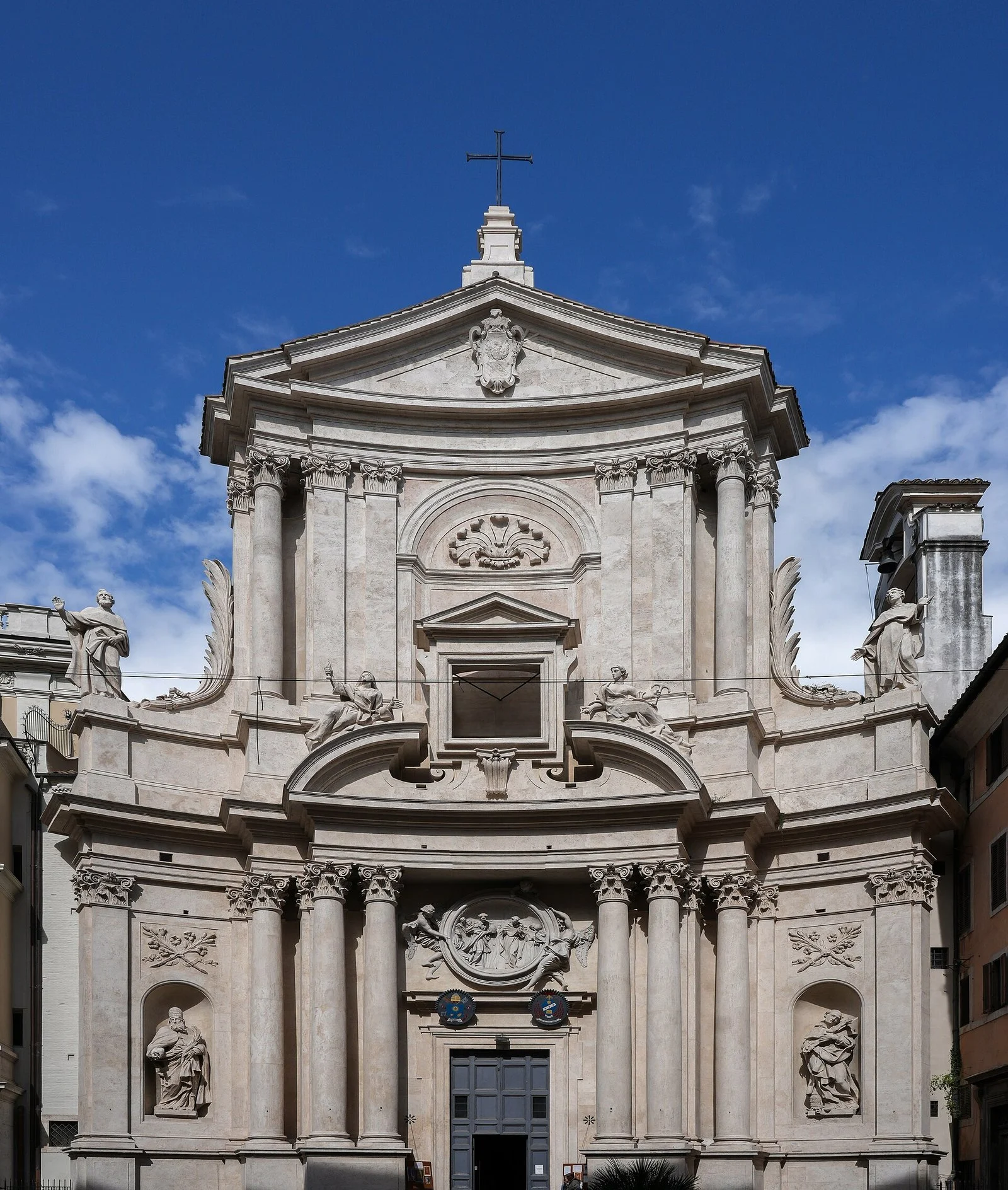
The Church of San Marcello al Corso faces a small recessed square along via del Corso, in the Trevi rione, halfway between Palazzo Venezia and the Column of Marcus Aurelius. It is one of the oldest churches in Rome by title, documented as early as 418, but what you see today from the street is a concave travertine facade designed by Carlo Fontana in the 1680s: one of the most elegant pages of late Roman Baroque, and also one of the most intelligent, because it solves with a curve an urban planning problem that seemed unsolvable. Inside is kept a large wooden crucifix that on May 22, 1519 survived the fire that destroyed the whole rest of the building, and that three years later, during the plague of 1522, was carried in procession through the streets of the city: since then that crucifix has been tied to Rome in a way no other object of civic devotion truly equals. The lines that follow tell the story of the titulus, the fire and the reconstruction entrusted to Jacopo Sansovino, the frescoes that Perin del Vaga left interrupted in 1527 and took up again only 12 years later, Fontana's facade and the way the church is visited today.
Anyone looking instead for an account of the street as a whole, with the barbary horse races, the palaces and the shops, will already find a page on the site devoted to via del Corso: this page concentrates only on the church, its facade and what it keeps.
Where the Church of San Marcello al Corso is and how to get there
The Church of San Marcello al Corso has the address piazza di San Marcello 5, 00187 Rome, in the Trevi rione, and can be reached on foot in a few minutes from piazza Venezia walking north along via del Corso. The church does not open directly onto the street line: it sets back a few meters from the line of facades, creating in front of itself a narrow, irregular little square that is at once its churchyard and its only chance of being seen. Anyone walking distracted along the Corso risks passing it without noticing, because the street at that point is crowded with shop windows and the rhythm of the stroll carries the gaze ahead, not to the side.
On foot from the landmarks of the center
The simplest way to get there is to start from piazza Venezia and go up via del Corso: the church appears on the right after a few hundred meters, just past the mouth of the street that climbs toward piazza dei Santi Apostoli. From the Trevi Fountain it is five or six minutes of walking down toward the Corso. From the Basilica of Santi XII Apostoli it is even less, because the two churches are little more than a block apart and the square of San Marcello looks right in that direction. From the Pantheon the route is about 10 minutes through the web of alleys between via del Corso and piazza della Minerva.
By public transport
There is no metro station on via del Corso: the nearest stops are those of line A at Barberini and at Spagna, both about 10 to 15 minutes' walk depending on your pace. Piazza Venezia, a few minutes' walk from the church, remains the great surface-transport hub of the center, where many bus lines converge from all directions of the city. The stretch of via del Corso in front of the church is largely pedestrian or under heavily restricted traffic, so you should plan on the last few minutes on foot in any case, whatever means you choose.
What the Church of San Marcello al Corso is: a very ancient titulus behind a Baroque facade
The Church of San Marcello al Corso is a titular and conventual church run by the Servants of Mary, whose cardinalatial title goes back to the origins of Roman ecclesiastical organization and whose first certain documentary attestation dates to 418. This is the gap that makes the church interesting: from the outside it looks like an entirely Baroque building, a child of the most mature Roman 17th century, while in reality that facade is only the last layer of a stratification that reaches back into late antiquity and runs without interruption through the whole history of the city.
The first mention: the letter of the prefect Symmachus of 418
The oldest certain piece of information about the church comes from a letter that the prefect of Rome Symmachus sent to the emperor Honorius to report on a papal election held in the church of Marcellus: the election of Boniface I, which the sources place at the end of December 418. The document certifies that by that date a place of worship dedicated to Marcellus already existed and was important enough to host a pontifical election, that is, one of the most delicate and contested acts in the life of the Roman Christian community of those years.
Marcellus I, the catabulum and the stables of the imperial post
Hagiographic tradition ties the place to a specific episode in the life of Pope Marcellus I, who died in 309: the emperor Maxentius is said to have condemned him to work in the stables of the catabulum, the central station of the imperial postal service that stood in this area of the Campus Martius, where the pontiff is then said to have died exhausted by the labor. The church is said to have been built on the stables of that station. It must be said clearly that this is hagiographic material, not a verified archaeological fact: the existence of the catabulum in this area is, however, a recurring element in the ancient topography of the eastern Campus Martius, and the coincidence between the function of the place and the account of the pope's passion is at the very least suggestive.
The Servants of Mary from the 14th century to today
Since the 14th century the church has been entrusted to the Order of the Servants of Mary, the Servites, who still serve it today and who have placed their general curia here. The sources consulted do not agree perfectly on the year: some give 1369, with the assignment by Pope Urban V, others 1375. In both cases we are in the second half of the 14th century, that is, in the period immediately after the long absence of the popes from Rome, when religious orders were called on to repopulate and reorganize city churches left for decades in difficult condition.
The fire of 1519: the night that destroyed the church and spared the crucifix
On the night between May 22 and 23, 1519, a fire destroyed the Church of San Marcello al Corso, reducing the medieval building and its furnishings to ashes. It is the event that splits the history of this church in two: everything you see today, from the single-nave plan to the concave facade, comes from that night, because the reconstruction started from zero and even changed the orientation of the building.
What burned and what remained
The chronicles report that almost nothing usable was left of the medieval complex, and that the next morning, among the still-hot rubble, the friars found intact the large wooden crucifix that decorated the high altar, with a lamp still lit in front of it. The scene, as handed down, has all the features of a devotional tale, and as such it should be read: it is the narrative the community built around a material fact, the survival of a wooden object in a fire that had consumed the rest. That a wooden sculpture could survive a fire in which ceilings and furnishings collapse is not in itself impossible, but the way the episode was told and received belongs to the history of devotion, not to technical chronicle.
The Crucifix of San Marcello: the object that ties the church to the city
The Crucifix of San Marcello is a large polychrome wooden sculpture, made according to the most recent studies around 1370 in a Roman milieu, and it is the object that has made this church a reference point for Rome well beyond its role as a parish. Some popular sources date it generically to the 15th century: the dating to the third quarter of the 14th century, supported by the most up-to-date art-historical studies and taken up in catalog entries, is the one most accredited today, but it is worth knowing that both indications are found in books and on websites.
What you see
It is a carved wooden crucifix, with traces of gilding, belonging to the type of large devotional crucifixes that spread across the peninsula in the 14th century in connection with the spirituality of the Passion: the abandoned body, the bowed head, the expression of composed suffering. Scholars relate it to an older crucifix kept at San Lorenzo in Damaso and to the devotional current tied to the revelations of Bridget of Sweden, which in those same decades deeply shaped the iconography of the Passion in Rome and beyond.
The plague of 1522 and the procession through the rioni
In the summer of 1522 Rome was struck by a plague epidemic, and the crucifix was carried in penitential procession through the city's rioni to the Basilica of St. Peter in the Vatican, under the guidance of the Spanish cardinal Raimondo Vich. On the duration the sources do not agree: some speak of 16 days, giving August 4 and 20 as dates, others of 18 days. They agree instead on the account that took hold right afterward, according to which the epidemic gradually stopped in the rioni crossed by the procession, until it ceased at the end of the procession.
The Company and later Archconfraternity of the Most Holy Crucifix
From the episode of 1522 a confraternity devoted to the crucifix was born, approved by Pope Clement VII in 1526 and destined to become one of the most influential in Rome. For centuries the company organized the procession of the crucifix on Holy Thursday, one of the fixed appointments of the city's religious calendar in the modern age, and in 1568 it moved to its own seat, the Oratory of the Most Holy Crucifix, built a few steps from the church and decorated with a cycle of frescoes that tells precisely the story of the crucifix and its miracles.
The crucifix's outings over the centuries and in 2020
Over the centuries the crucifix has been carried out of the church several times on the occasion of Holy Years and exceptional moments, including the Jubilee of 2000. In March 2020, during the health emergency, Pope Francis went on foot to via del Corso to pray before the crucifix, and on March 27 of the same year the sculpture was carried to the churchyard of St. Peter's Square for the extraordinary prayer celebrated by the pontiff in an empty square under the rain. It is a recent, documented fact, which brought the object to the attention of a public enormously wider than that of Roman worshippers.
The reconstruction by Jacopo Sansovino and the change of orientation
The reconstruction of the Church of San Marcello al Corso after the fire of 1519 was entrusted to Jacopo Sansovino, who flipped the building's orientation, bringing the main entrance onto via del Corso: an urban planning decision before an architectural one, and the reason the church presents itself to the street today the way we see it.
Why flip a church
The early Christian and medieval church had its entrance on the opposite side, toward today's piazza dei Santi Apostoli, and its apse toward the via Lata, the ancient Roman route that corresponds to via del Corso. In the 16th century the city's center of gravity had shifted: the via Lata, by now via del Corso, had become the main axis of the built-up center, the street used by cortèges, processions and daily traffic, while the square behind it now counted for much less. Flipping the building meant recognizing this shift and bringing the church back to the side where people passed.
The flip, however, left behind a problem that would become central a century and a half later: the church thus reoriented is not perfectly perpendicular to the street, and the little square in front is narrow, irregular and does not let you step back far enough to look at the facade head-on. Whoever had to design that facade, when the moment finally came, faced a site that was anything but convenient.
Sansovino, the Sack of Rome and the relay of building sites
Jacopo Sansovino did not finish the job: during the Sack of Rome of 1527 he left the city and never came back, moving to Venice where he would build the most famous part of his career. The site passed to Antonio da Sangallo the Younger, and then, according to the reconstructions of local sources, to other architects among them Giovanni Mangone and Annibale Lippi, to whom the arrangement of the apse is attributed. In 1530 a flood of the Tiber damaged the works again, adding one more interruption to an already fragmented building history.
The result is an interior that scholars call Sansovinian in plan, single-naved with five chapels per side marked by arches, and which was substantially finished by the end of the 16th century, while the facade had to wait almost another century. This asynchrony between the 16th-century interior and the late Baroque front is exactly what makes San Marcello a case study: a Renaissance church wearing a mask of the mature 17th century, and the mask is a masterpiece.
Carlo Fontana's facade: how to solve a church set crosswise
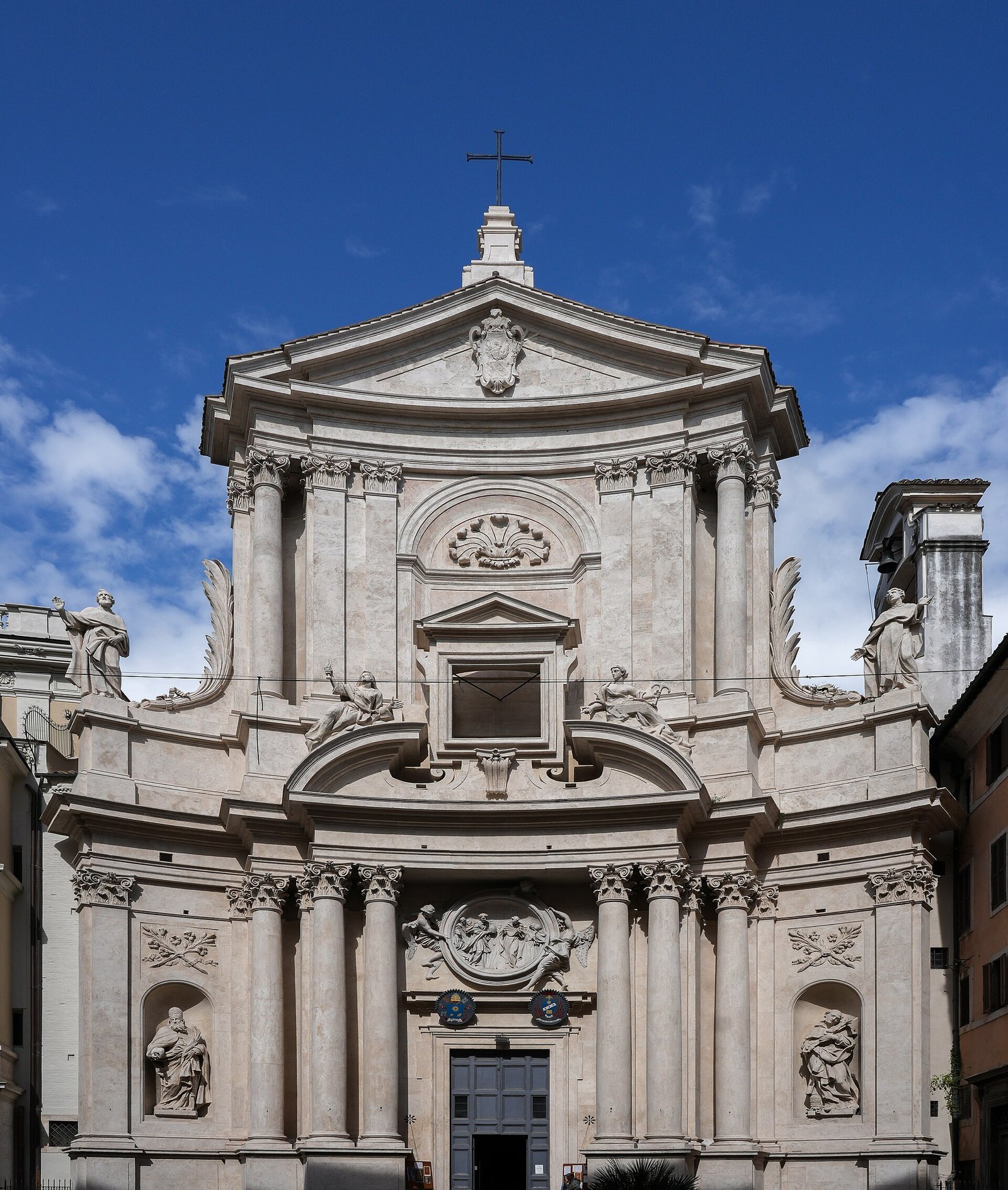
The concave travertine facade of the Church of San Marcello al Corso is the work of Carlo Fontana and was built in the 1680s, with 1683 the most frequently cited reference date for the central phase of the work. It is considered one of the most successful facades of late Roman Baroque, and the reason is not only aesthetic: it is the answer of a first-rate architect to an almost unsolvable problem of space.
The problem: a square too narrow and a crooked axis
Imagine the situation Fontana faced. The church, reoriented in the 16th century, presents its front to a little square set back from via del Corso, narrow and with an irregular geometry: there is not the distance needed to look at a flat facade from the front, and anyone walking the Corso almost always sees it at an angle, arriving from the right or the left, never head-on. A flat facade, in those conditions, would have come out squashed, unreadable, reduced to a decorated wall that nobody manages to frame.
Fontana's solution is concavity. By curving the front inward, the facade does two things at once: it optically widens the little square, because the wall recedes at the center gaining a few meters of breathing room, and it welcomes the gaze of anyone arriving from the side along the Corso, always offering a portion of surface turned toward the observer. Put another way, the curve turns the impossibility of a frontal view into a dynamic view, one that composes itself as you walk.
How the facade is built
The front rises on two Corinthian orders. The lower order concentrates paired free columns in the central part, which create a strong plastic thickening around the portal and which, thanks to the curvature, cast deep, shifting shadows over the course of the day. The upper order is marked by pilasters and closes with a triangular pediment bearing the coat of arms of the patron, attributed to the Boncompagni Cataldi family, whose ecclesiastical member oversaw the completion of the work as commissioner of the building.
A detail that architectural historians always point out is the replacement of the side scrolls, the canonical link between lower and upper order in facades of the 16th-century tradition, with bundles of palm branches. It is a choice both iconographic and formal: the palm alludes to martyrdom, and at the same time produces a softer, less geometric link, consistent with the curvilinear tension of the whole design. Anyone who looks closely also notices an empty central niche, a void that in the composition works as a pause.
The sculptures: Cavallini, Raggi, Fucigna
The sculptural decoration was entrusted to first-rank workshops. The travertine statues are attributed to Francesco Cavallini, who worked on them around 1686. The relief above the entrance, with the scene of Saint Philip Benizi renouncing the papal tiara, is the work of Antonio Raggi, one of the closest collaborators of Gian Lorenzo Bernini, and is dated to the years 1683 and 1684. Further sculptural work is attributed to Andrea Fucigna and placed in 1703. The choice of the relief's subject is programmatic: Philip Benizi, prior general of the Servants of Mary, according to the order's tradition refused the papal tiara, and putting that scene over the door means declaring to anyone passing along via del Corso which religious family the church belongs to.
The conflicting dates of the building work
On the exact dates of the facade the sources diverge, and it is worth giving them all instead of choosing just one: the parish site gives the two years 1681 and 1683, some encyclopedia entries give the span 1681 to 1687, others 1682 to 1686, while English-language entries place the overall completion of the church between 1692 and 1697. The differences are easily explained: design is one thing, building the masonry structure another, and placing the sculptures and closing the building's accounts yet another. In any case the core of Fontana's work falls in the 1680s, and 1683 remains the most cited reference year.
Why this facade matters in the history of architecture
Carlo Fontana is the figure who bridges the generation of Bernini and Borromini and the European 18th century: trained in Bernini's workshop, he became the teaching and professional reference for an entire generation of architects who came to Rome to learn from him from half of Europe. The facade of San Marcello is one of his most recognizable Roman works precisely because it is not a show of strength but a show of intelligence: it works on an awkward space and draws from it an effect of breadth that the space would not have had. Anyone who compares this solution with the great contemporary facades, from the Church of the Gesù to Sant'Andrea della Valle, immediately grasps the difference of approach: there the facade dominates a square, here it builds one.
Perin del Vaga, the Crucifix chapel and the building site interrupted by the Sack of Rome
Perin del Vaga, that is, Pietro Buonaccorsi, frescoed the vault of the Crucifix chapel of the Church of San Marcello al Corso in two phases separated by more than a decade, interrupted by the Sack of Rome of 1527: it is one of the clearest and best-documented cases of how a political event physically broke a Roman artistic building site.
The contract and the first phase, between 1523 and 1527
The biographical sources place the initial commission in 1523, with a contract for the decoration of the chapel, while the painting of the first phase is generally dated between 1525 and 1527. In those years Perino painted on the vault the Creation of Eve and began the series of the Evangelists, completing the figures of Mark and John. The language is that of a pupil of Raphael who has looked long at the Sistine vault: the figures have Michelangelo's monumental structure, the elegance of the drawing is Raphaelesque, and the synthesis of the two models is exactly what would define the Roman maniera for the rest of the century.
1527 and the flight
In May 1527 the imperial troops entered Rome and sacked it for months. All the building sites stopped, the artists scattered, many left the city for good. Perin del Vaga interrupted the work on the vault and ended up leaving Rome, then finding commissions elsewhere, above all in Genoa in the service of Andrea Doria. The chapel was left with the vault incomplete, with two Evangelists painted and two not, in a church that was itself still an open building site after the fire of 1519.
The return of 1539 and the completion in 1543
On April 12, 1539 Perin del Vaga signed a new contract to resume the decoration of the chapel, having returned to Rome after the Genoese years. The vault was completed by May 1543, when the artist supplied the drawings for the two missing Evangelists, Matthew and Luke, which were physically executed by Daniele da Volterra, at the time a young collaborator and destined to become one of the protagonists of the Roman scene of the full 16th century.
The result is that the vault of a single Roman chapel tells 16 years of Italian history: two Evangelists painted before the Sack, two painted after, to the design of the same master but by the hand of another painter, with the flight, the Genoese exile and the return in between. Few places let you read a historical passage with this chronological precision, and almost nobody points it out to the visitor.
A clarification on the names of the chapels
A clarification is needed here, because confusion is frequent in guides and on websites. In San Marcello there is a chapel called Frangipane, on the left side, dedicated to the conversion of Saint Paul: the altarpiece is by Federico Zuccari, datable between 1560 and 1565, the frescoes are attributed to his brother Taddeo Zuccari between 1563 and 1566, and it holds the busts of Muzio, Roberto and Lelio Frangipane sculpted by Alessandro Algardi around the 1630s. The frescoes of Perin del Vaga are instead in the Crucifix chapel, on the right side, the one that keeps the crucifix that escaped the fire. The two chapels are often confused because both are tied to aristocratic 16th-century commissions and because the name Frangipane appears at several points in the building's history: it is best to keep them distinct so as not to attribute to Perino a work that belongs to the Zuccari.
A curiosity about the Church of San Marcello al Corso
The facade of the Church of San Marcello al Corso replaces the classic connecting scrolls between the two orders with bundles of palm branches carved in travertine: a detail almost nobody notices and one of the most elegant departures from the standard grammar of Roman facades.
Why the scrolls matter
In two-order church facades, from the 16th century on, the recurring problem is linking the width of the lower order, which corresponds to the nave plus the chapels, with that of the upper order, which corresponds to the central nave alone. The canonical solution, codified already in the Renaissance and become almost obligatory, is the scroll: a large stone spiral that covers the jump and guides the eye upward. You find it everywhere in Rome, with endless variations.
A facade you see only by walking
The third curiosity is perceptual and concerns the very way the facade works. If you try standing in the middle of the little square you discover there is no way to take in the whole front with your eyes without bending your neck: the space is not enough. The facade is designed to be perceived in motion, while you walk along via del Corso and the curve slowly turns before your eyes. It is architecture conceived for a moving observer, not a still one, and this brings it closer to theatrical scenery than to the static Renaissance composition.
One thing nobody tells you about the Church of San Marcello al Corso
The Church of San Marcello al Corso is oriented the opposite way from how it was born: the entrance on via del Corso occupies the place that in the early Christian and medieval building belonged to the apse, and the 16th-century flip made the church in effect a new building inside a very ancient title.
What the flip implies
Many guides mention the fact in passing, without explaining the consequences. Flipping a church means that the worshipper who enters today walks in reverse the route people took a thousand years ago, that the presbytery area is where the entrance used to be, and that the relationship between the building and the surrounding urban fabric has changed completely. The old church faced the area that is today piazza dei Santi Apostoli, where the Basilica of Santi XII Apostoli stands and where baronial and then papal power had one of its poles. The modern church faces the Corso, that is, commerce, the stroll, the city on the move.
The oblique relationship with the street
There is also an aspect even less told, which is that the flip did not produce a perfectly orthogonal relationship with via del Corso. The building keeps the orientation inherited from the previous structure and from the surrounding building fabric, and the little square in front has an irregular shape that is its direct consequence. Fontana's concave facade is therefore not just a late Baroque exercise in style: it is the technical answer to an inherited condition, the way a 17th-century architect reconciled a 16th-century building with a street that is not parallel to it.
A sarcophagus under the altar
A third, little-cited element concerns the ancient material that survived inside the modern church. The catalog entries note the presence of a funerary cippus of the 3rd century, decorated with military insignia, reused as an altar table and then covered with a 12th-century opus sectile decoration. The sources differ on its exact location, some placing the 13th-century opus sectile at the high altar, others at the altar of the Crucifix chapel: in both cases the fact is the same, that beneath the Baroque surface there survives a reused Roman fragment later clad in the Middle Ages, the stratigraphy of the city compressed into a single liturgical furnishing.
The advice I give you for visiting the Church of San Marcello al Corso
The practical advice for visiting the Church of San Marcello al Corso is to go in mid-morning or late afternoon on a weekday, when the light crosses the nave without the harsh contrast of midday and the church is not occupied by services: entry is free, as in all parish churches in Rome, and no booking is needed.
Check the hours before leaving
On opening hours the available information is conflicting: tourist portals and local sites give different time slots, and like almost all Roman parish churches San Marcello closes in the middle hours of the day and changes its hours for services, holidays and particular periods of the liturgical year. The right way to proceed is to consult the parish site or phone before setting out, avoiding trust in hours found on aggregators that nobody updates. This holds especially if the reason for the visit is to see the crucifix, which on some occasions is moved.
The right order for the visit
Inside, resist the temptation to go straight to the crucifix chapel. A more effective route starts from the inner facade wall, where you find the large Crucifixion by Giovanni Battista Ricci da Novara with the upper register of the 14 episodes of the Passion frescoed by 1613: that cycle prepares the eye and explains the theme the whole church develops. Then you walk the nave going up one side and down the other, raising your eyes to the coffered ceiling of the 1590s, and you reach the Crucifix chapel when you have by now understood the context in which that object sits.
Another well-known fact, yet rarely cited
The Church of San Marcello al Corso is the seat of the general curia of the Order of the Servants of Mary, present here without interruption since the 14th century: a fact that appears in every entry and that almost nobody connects to what is seen inside, namely a decorative program built almost entirely around the saints of the order.
The chapels of the Servite saints
Going around the nave you meet, one after another, the chapel of the Seven Holy Founders with the altarpiece by Agostino Masucci dated 1728, the chapel of Saint Philip Benizi with the canvas by Pier Leone Ghezzi of 1725, the chapel of Saint Peregrine Laziosi with 18th-century works including pieces attributed to Aureliano Milani, and the chapel of Our Lady of the Seven Sorrows, a Marian title typical of the Servites. Adding Antonio Raggi's relief on the facade, again with Philip Benizi, you get a coherent program that declares the order's identity from the outside to the inside.
The Roman nativity scene
A second well-known and little-told element is that each year the church sets up an artistic nativity scene with a Roman setting, that is, a nativity scene in which the Nativity is placed inside a recognizably urban landscape of the city instead of the usual Palestinian setting. It is a tradition with several examples in Rome and it makes this church, at Christmastime, a recurring stop for those who follow the circuit of nativity scenes in the center, together with the Basilica of Santa Maria in Aracoeli.
The right photo to take at the Church of San Marcello al Corso
The best photograph at the Church of San Marcello al Corso is not the frontal one of the facade, which the space does not allow, but the one taken at three-quarters from the opposite sidewalk of via del Corso, with the curve of the travertine receding and the paired columns casting sharp shadows: it is the only framing that gives the concavity instead of flattening it.
Where to shoot from outside
Standing on the opposite side of the Corso, slightly off the axis of the little square, you get the oblique view for which the facade was conceived: the curved surface reads as curved, the free columns stand out from the background and the relief above the portal comes into frame. A wide-angle lens helps, but without overdoing it, because the perspective distortion of an extreme wide angle optically straightens the curve and cancels exactly what you want to show.
The light
Via del Corso is a narrow street with tall buildings on both sides, so the facade stays in shadow for much of the day and receives direct light in a limited time window. The most favorable moment is when the sun, fairly high, lights the front at a raking angle, bringing out the relief of the columns and sculptures: long shadows are the main ally, because a Baroque facade photographed in flat light loses half its interest. On overcast days the best effect comes from working on the travertine, whose warm grain stands out even without direct sun.
The details that deserve a framing of their own
Three close subjects repay more than the overall view: the bundles of palm branches that replace the scrolls, shot from below against the sky. The relief with Saint Philip Benizi above the portal, which isolates well from its surroundings with a medium telephoto lens. And the empty niche, which in a tight composition becomes an almost abstract subject. Inside, the inner facade wall with the large Crucifixion and the sequence of Passion scenes offers a vertical reading that works well in portrait format.
Some important events that happened here in history
In the Church of San Marcello al Corso, a number of episodes took place or began that belong to the general history of Rome: a papal election in 418, a penitential procession of Pope Gregory the Great in the 6th century, the display of the body of Cola di Rienzo in 1354, the fire of 1519 and the procession of the crucifix during the plague of 1522.
The body of Cola di Rienzo in 1354
In 1354 the body of Cola di Rienzo, the tribune who had tried to restore to Rome a popular government inspired by the ancient republic and who was killed during a city uprising, was displayed for two days in front of the church, which then faced piazza dei Santi Apostoli. It is one of the grimmest episodes of Roman communal history and ties this building to a political affair that would have an enormous echo in later centuries, up to the 19th-century rediscovery of the figure of Cola as a forerunner of national unity, celebrated with the monument at the foot of the Capitoline Hill.
The Sack of Rome of 1527
The Sack of 1527 did not strike the church directly as the fire did, but it marked it deeply all the same: it halted the reconstruction site, drove away Jacopo Sansovino who would never return, and interrupted Perin del Vaga's frescoes in the Crucifix chapel, which would resume only in 1539. The church therefore keeps, in its surfaces, the material sign of one of the most traumatic events of 16th-century European history.
The Tiber flood of 1530 and the 19th-century restorations
In 1530 a flood of the Tiber damaged the works in progress again, adding a further delay to a site already interrupted: the river's floods, before the construction of the embankment walls in the 19th century, regularly hit this part of the center. Much later, between 1861 and 1867, Virginio Vespignani carried out a general restoration that involved the ceiling and the apse area, and in 1862 Silverio Capparoni painted the Glory of Saint Marcellus in the apse: these are the last major interventions that gave the church the appearance it has today.
Who passed through the Church of San Marcello al Corso
Through the Church of San Marcello al Corso have passed, as patrons, artists or burials, some of the greatest names of Roman art and politics: Jacopo Sansovino, Antonio da Sangallo the Younger, Perin del Vaga, Daniele da Volterra, Francesco Salviati, Taddeo and Federico Zuccari, Alessandro Algardi, Antonio Raggi, Carlo Fontana, Pietro Bracci and, among the buried, Cardinal Ercole Consalvi.
The architects
The sequence of architects is in itself a manual of Roman architectural history: Jacopo Sansovino lays out the building in 1519 and abandons it in 1527. Antonio da Sangallo the Younger continues. To Giovanni Mangone and Annibale Lippi the local sources attribute further phases, including the arrangement of the apse. Carlo Fontana closes the story with the facade almost two centuries after the fire. Four generations of designers on the same building, from the full Renaissance to the late Baroque.
The painters
On the painting side the church lines up Perin del Vaga and Daniele da Volterra in the Crucifix chapel, Francesco Salviati with the Grifoni chapel frescoes dated 1563, Taddeo and Federico Zuccari in the Frangipane chapel, Giovanni Battista Ricci da Novara with the Crucifixion on the inner facade wall and the Marian stories of the presbytery within the first quarter of the 17th century, and then a sizable series of painters of the Roman 18th century, from Agostino Masucci to Pier Leone Ghezzi, from Giacomo Triga to Domenico Corvi and Gregorio Guglielmi, the latter the author of scenes with the miracles of Saint Juliana Falconieri placed around 1750 and 1751.
The sculptors
Among the sculptors you meet Andrea and Jacopo Sansovino, to whom the funerary monument of Cardinal Giovanni Michiel and his nephew Bishop Antonio Orso is attributed, with a time span that the catalog entries place between 1511 and 1527. Alessandro Algardi with the Frangipane busts. Antonio Raggi and Francesco Cavallini on the facade. Pietro Bracci with the monument to Cardinal Fabrizio Paolucci, dated around 1726. Tommaso Righi and Rinaldo Rinaldi, the latter the author in 1831 of the monument to Cardinal Ercole Consalvi.
Ercole Consalvi, the cardinal of the Restoration
Among the figures tied to the church the most relevant politically is Cardinal Ercole Consalvi, secretary of state to Pius VII, negotiator of the concordat with Napoleon and, at the Congress of Vienna, protagonist in the recovery of the papal territories and of part of the artworks taken to France. His monument in San Marcello, the work of Rinaldo Rinaldi in 1831, stands alongside the better-known monument dedicated to him in the Pantheon: his memory is therefore split between two places in the center a few minutes' walk apart.
The popes and the city
Finally the pontiffs: Boniface I elected here in 418, Gregory the Great who sets out a procession from here, Leo X who orders the reconstruction in 1519, Clement VII who approves the crucifix confraternity in 1526, Urban V who entrusts the church to the Servites in the 14th century. And, in very recent times, Pope Francis, who in March 2020 came on foot along via del Corso to pray before the crucifix before it was carried to the churchyard of St. Peter's Square.
The chapels and works to see inside the church
The interior of the Church of San Marcello al Corso has a single nave with five chapels per side, marked by arches: 10 chapels in all, almost all with altarpieces and decorations covering a span of time from the full 16th century to the middle of the 18th.
The inner facade wall and the ceiling
Entering and turning around you see the large Crucifixion by Giovanni Battista Ricci da Novara, toward which the 14 episodes of the stories of the Passion frescoed in the upper register by 1613 converge. Over the nave runs the wooden coffered ceiling made between 1592 and 1594 to a design by Carlo Lambardi for Monsignor Giulio Vitelli, repainted during the 19th-century restoration.
The right side
On the right side you meet, in order, the chapel with the funerary monument of Cardinal Michiel and Bishop Orso, the Annunciation chapel with the altarpiece by Lazzaro Baldi and a fresco attributed to Tarquinio Ligustri of 1607, the Grifoni chapel with the frescoes by Francesco Salviati of 1563, the Crucifix chapel with the vault by Perin del Vaga and Daniele da Volterra, the ciborium made in 1691 by Carlo Bizzaccheri and the monument to Consalvi, and finally the chapel of Saint Peregrine Laziosi with the monuments to Cardinals Fabrizio and Camillo Paolucci.
The left side
On the left side are the chapel of the Seven Holy Founders with the altarpiece by Agostino Masucci, the chapel of Saint Mary Magdalene with a work by Giacomo Triga, the chapel of Our Lady of the Seven Sorrows with works attributed to Pietro Paolo Baldini and to Pietro Paolo Naldini, the Frangipane chapel dedicated to the conversion of Saint Paul with the altarpiece by Federico Zuccari, the frescoes by Taddeo Zuccari and the busts by Alessandro Algardi, and the chapel of Saint Philip Benizi with the canvas by Pier Leone Ghezzi of 1725.
Presbytery and apse
In the presbytery area the high altar keeps the relics of Pope Marcellus I together with those of Saint Digna and Saint Emerita, with the 12th-century opus sectile decoration that the sources place, not entirely in agreement, at the high altar or at that of the Crucifix chapel. The apse basin bears the Glory of Saint Marcellus painted by Silverio Capparoni in 1862, while the stories of the life of the Virgin are the work of Giovanni Battista Ricci from the first quarter of the 17th century.
Around the church: what to see within a 10-minute radius
The Church of San Marcello al Corso stands at one of the densest points of Rome's historic center: within a 10-minute walk there are at least six first-rate monuments, and the church works well as a connecting stop among them.
Toward piazza Venezia
Going south you reach Palazzo Venezia and the Altar of the Fatherland in a few minutes, with the climb to the Capitoline Hill and the Basilica of Santa Maria in Aracoeli right behind. It is the most photographed monumental front in the city, and the contrast with the intimate little square of San Marcello, a few hundred meters away, is one of the sharpest in the center.
Toward the Pantheon and the northern Corso
Going west you enter the web of streets leading to the Pantheon, the Basilica of Santa Maria sopra Minerva and the Church of Sant'Ignazio di Loyola. Going up the Corso northward instead you meet Palazzo Doria Pamphilj, the Column of Marcus Aurelius, the Basilica of San Lorenzo in Lucina and, at the far end, Piazza del Popolo with Santa Maria del Popolo.
Frequently asked questions about the Church of San Marcello al Corso
How much does it cost to enter the Church of San Marcello al Corso?
Entry to the Church of San Marcello al Corso is free of charge, as in all parish churches in Rome, and requires no ticket or booking. Many side chapels, however, have coin-operated devices to switch on the lighting of the vaults and altarpieces for a while: having a few coins in your pocket improves the visit a lot, especially for seeing the frescoes.
What are the opening hours of the Church of San Marcello al Corso?
The hours of the Church of San Marcello al Corso should be checked directly with the parish, because the sources available online give time slots that differ from one another and are not up to date. Like almost all Roman parish churches it closes in the middle hours of the day and changes its hours during services and in particular liturgical periods: a phone call or a visit to the parish site avoids wasted trips.
How do you get to the Church of San Marcello al Corso by public transport?
The Church of San Marcello al Corso is reached on foot in a few minutes from piazza Venezia, which is the main bus hub of Rome's historic center. There is no metro stop on the Corso: the nearest stations are Barberini and Spagna on line A, both 10 to 15 minutes' walk away, and the last stretch has to be done on foot anyway because the street is pedestrian.
Why is the crucifix of San Marcello al Corso considered miraculous?
The crucifix of San Marcello al Corso is considered miraculous because it survived intact the fire that destroyed the church on the night between May 22 and 23, 1519, and because in August 1522 it was carried in procession through the rioni of Rome during a plague epidemic that stopped at the end of the procession. The survival of the fire is a documented fact, the miraculous interpretation belongs to devotional tradition.
What period is the crucifix of San Marcello al Corso from?
The crucifix of San Marcello al Corso is a polychrome wooden sculpture that the most recent studies date around 1370, in a Roman milieu. Some popular sources place it generically in the 15th century: the dating to the third quarter of the 14th century is the one most accredited today by catalog entries and specialist literature, but online you find both indications.
How long does it take to visit the Church of San Marcello al Corso?
Between 20 and 40 minutes is enough to visit the Church of San Marcello al Corso. 20 minutes are enough for the nave, the inner facade wall with the Crucifixion of 1613 and the crucifix chapel. 40 are needed if you want to look one by one at the 10 side chapels, the funerary monuments and the apse area, stopping at the wooden ceiling of 1592.
Can you take photographs inside the Church of San Marcello al Corso?
In the Church of San Marcello al Corso amateur photography without flash is generally tolerated as in other Roman churches, but not during services and never in an intrusive way in the crucifix chapel, which remains a place of active prayer. For tripods, professional equipment or video you must ask permission directly from the parish, which sets its own conditions.
Is the Church of San Marcello al Corso suitable for children and accessible?
The Church of San Marcello al Corso is a short visit and therefore suitable for children too, who usually respond well to the gilded ceiling and, at Christmastime, to the artistic nativity scene with a Roman setting put up every year. For accessibility for people with mobility disabilities it is best to check with the parish, because the church sits back from street level and the entry conditions are not reliably documented online.
Who designed the facade of the Church of San Marcello al Corso?
The concave travertine facade of the Church of San Marcello al Corso is the work of Carlo Fontana, built in the 1680s with 1683 as the most frequent date for the central phase of the work. The sculptures are attributed to Francesco Cavallini and Andrea Fucigna, while the relief with Saint Philip Benizi above the portal is by Antonio Raggi.
One last tip for those planning the itinerary
The Church of San Marcello al Corso works best as a stop within a stroll along the Corso, not as an isolated destination: 20 minutes are enough to see it well, and the natural route places it between piazza Venezia and the Column of Marcus Aurelius, with the option of detouring toward the Trevi Fountain or the Pantheon depending on the time available. The best moment remains a weekday outside service times, when the nave is silent and Fontana's facade gets the raking light that makes it work.
Anyone building a wider itinerary in central Rome, lining up the churches of the Corso with the other stops of the Trevi rione and the Campo Marzio, can find useful planning tools on Tour Leader Pro, while for a wider picture of transport and destinations in Lazio a good resource is Italy Planner.