Basilica of Santi XII Apostoli
In short. The Basilica of Santi XII Apostoli is in Piazza dei Santi Apostoli, a few steps from Piazza Venezia and the Altare della Patria, in the Trevi district, the same neighborhood as the Trevi Fountain.
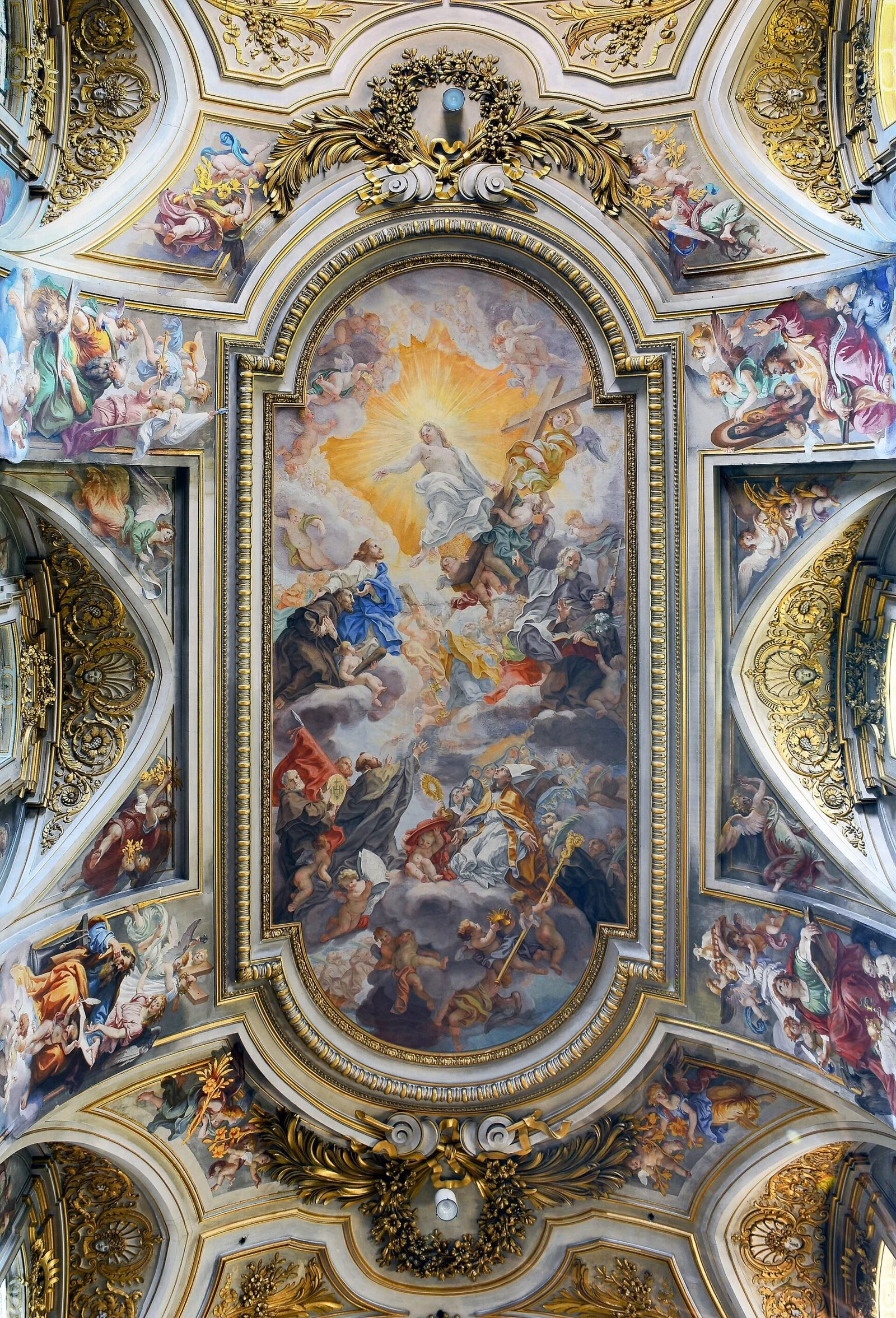
The Basilica of Santi XII Apostoli is in Piazza dei Santi Apostoli, a few steps from Piazza Venezia and the Altar of the Fatherland, in the Trevi district, the same neighborhood as the Trevi Fountain. The eastern side of the square is occupied by Palazzo Colonna, whose story has been intertwined with that of the basilica for more than six centuries. Behind a 15th-century portico with nine arches hides a church that has changed its face at least three times: born in the early Christian era, rebuilt in baroque forms in the 18th century and closed by a neoclassical facade signed by Giuseppe Valadier in the 19th century. Inside, the funerary monument to Clement XIV sculpted by Antonio Canova remains one of the most cited works of Roman neoclassical sculpture, while the crypt under the main altar holds the relics of the apostles Philip and James the Less. Anyone planning an itinerary in the heart of Rome can combine the visit with Piazza Colonna and the Museo Nazionale di Palazzo Venezia, both reachable on foot in a few minutes.
Where the Basilica of Santi XII Apostoli is and how to get there
The address is Piazza dei Santi Apostoli 51, in the Trevi district, about 200 meters from Piazza Venezia and the Vittoriano, and less than 500 meters from the Trevi Fountain. The central position makes the basilica a natural stop for those walking between the Campidoglio, the Quirinal and the Corso, and is one of the reasons it often stays out of organized itineraries: people who come to Rome to see the great classical monuments pass a few meters from the portico without noticing, drawn by the bulk of the Vittoriano or the din of the most photographed fountain in the city.
On foot from the historic center
From Piazza Venezia you reach the basilica going up Via Cesare Battisti or Via IV Novembre, both walkable in three or four minutes. From Piazza di Spagna and the Trevi Fountain the route goes along Via del Corso or along the streets that descend toward Largo Chigi and Piazza Colonna, with about 10 minutes of walking through a network of pedestrian streets busy with shops and cafes. If you come from the Roman Forum and the Campidoglio you can go up from Piazza d'Aracoeli, running along the side of the Vittoriano.
By subway, bus and tram
The nearest subway stop is Barberini, on Line A, from which you go down toward Piazza Venezia in about 15 minutes on foot or with a short bus ride. The surface network serving Piazza Venezia is the densest in the city: dozens of lines converge on that hub, including the lines that run along Via del Corso and those that climb from Termini along Via Nazionale. As there is no dedicated terminus in front of the basilica, the practical advice is to get off at any stop on Piazza Venezia and finish the last stretch on foot, quicker than any change of vehicle in the traffic of the center.
By car and parking
The historic center around Piazza Venezia falls within the limited traffic zone, with electronic gates active during daytime hours on weekdays: anyone who is not a resident or authorized risks a fine if they enter without a permit. The simplest solution for those arriving by car is to leave the vehicle in one of the paid garages outside the ZTL, for example toward Via del Tritone or around Termini, and continue on foot or by public transport. Those staying at a hotel in the area can generally count on a temporary permit issued by the property, to be checked anyway with the reception before moving by car.
From Termini and the airports
If you arrive at Roma Termini you can reach the basilica on foot in about 20 minutes going down Via Nazionale to Piazza Venezia, a route that crosses one of the most commercial stretches of the center, or take a surface bus that goes down to the same intersection. From Fiumicino the fastest connection remains the Leonardo Express train to Termini, followed by the walk or bus ride just described. From Ciampino the shuttle or taxi to the center is better, with times that depend a lot on traffic on Via Appia Nuova and on the Raccordo Anulare. In both cases, the last stretch toward Piazza dei Santi Apostoli is comfortably done on foot, because the pedestrian zone around the Corso makes any rubber-tired vehicle impractical at peak hours.
The early Christian origins and the first reconstructions
The history of the basilica begins at a point in the sources where scholars do not fully agree, and it is honest to say so right away instead of flattening the story onto a single date. One tradition, also reported by the Liber Pontificalis, traces a first place of worship on the site to Pope Julius I, in the first half of the 4th century, with the name Basilica Iulia. A second reconstruction, supported by a good part of more recent historiography, attributes the foundation of the present church to Pope Pelagius I, in the middle of the 6th century, at a precise moment in the history of Rome: the end of the Gothic War.
Narses's victory and the dedication to the apostles
In 552 the Byzantine general Narses defeated Totila's Ostrogoths in the Battle of Taginae, in Umbria, ending 20 years of war that had devastated Italy and Rome itself. To celebrate the victory, Pelagius I started the construction of a basilica-plan church dedicated to the apostles, on the spot where probably an older building stood. The work continued under his successor, Pope John III, who brought it to completion around 570: an inscription recalled the joint work of the two pontiffs, “Pelagius began it, Pope John completed it, the work of both, equal the reward that shines”. In the church were laid the relics of two apostles, Philip and James the Less, which had come to Rome from the East: hence the title of basilica of the Holy Apostles, originally referring to the two of them and only later extended, by popular usage, to the whole apostolic college in the form Santi XII Apostoli.
Damage, earthquakes and Martin V's restoration
Pope Hadrian I, in the second half of the 8th century, recalls its rich mosaic decoration, a sign that the church had kept its prestige for two centuries. Roman Middle Ages, however, were a succession of earthquakes, fires and fights between factions, and the basilica did not come out unscathed: a quake in 1348, the same one that seriously damaged other great buildings of the city, hit this church hard as well. The restoration came with Pope Martin V, of the Colonna family, who in 1417 worked on the building, marking the beginning of a bond between the basilica and his family destined to last centuries, helped by the nearness of the family palace on the square in front.
It should be added that, between the early medieval foundation and the 15th-century restoration, the basilica went through a century and a half scarcely documented in the sources. Historians agree that the building kept throughout the period its function as a titulus, that is a presbyteral church with its own college of clergy, but the scarcity of surviving documents makes it hard to reconstruct in detail the daily life of the community that gathered there. It is a documentary gap common to many Roman churches of the period between the fall of the Western empire and the full establishment of the popes' temporal power, an age in which Rome lost much of its population and many places of worship survived more by inertia than by an organic maintenance plan.
Baccio Pontelli's portico and the Loggia of the Blessings
The element most photographed from outside the basilica, and at the same time the oldest still visible on the facade, is the two-order portico that precedes the entrance. It was built between 1475 and 1478 on commission from Cardinal Giuliano della Rovere, the future Pope Julius II, who in those years held the basilica's cardinal title and promoted a deep renewal of it, extended also to the adjacent convent entrusted to the Conventual Friars Minor from 1474.
The nine arches and the octagonal pillars
The design of the portico is attributed to the architect Baccio Pontelli, a leading figure of early Renaissance architecture in Rome and Florence, also active in Urbino and in Rome on the construction site of the Sistine Chapel. The portico develops over nine arches set on octagonal pillars, with triple-ring archivolts, and supports on the upper level a covered loggia, the Loggia of the Blessings, from which originally the pontiffs and the basilica's titleholders could look out over the square below on the occasion of public ceremonies. It is an architectural solution that echoes other Roman porticoes and benedictional loggias of the 15th century, designed to join liturgical function with the public representation of ecclesiastical power.
In the works of these years, according to some sources, Giuliano da Sangallo also took part, who would have followed further interventions on the convent complex. On the portico there is also a relief with an eagle, heraldic symbol of the Della Rovere family, recalling the commission of Cardinal Giuliano.
The portico did not have only a decorative function. In 15th-century Rome, the great porticoes in front of the titular churches served as a place to pause and meet, a filter between the public square and the sacred space inside, where the faithful could shelter from rain or sun before going in, and where papal bulls or civic announcements were sometimes read publicly. The Loggia of the Blessings, on the upper level, had instead a more purely ceremonial role: loggias of this type, found in several Roman basilicas, allowed the titleholder of the church or a papal representative to address the crowd gathered in the square without having to come down among the people, an architectural solution that joined visibility and hierarchical distance according to a symbolic language very clear to contemporaries.
The 18th-century rebuilding by Francesco and Carlo Fontana
At the beginning of the 18th century the basilica presented itself as an organism layered by centuries of interventions, and Pope Clement XI decided to undertake a complete reconstruction of the interior, keeping the 15th-century portico as an element to preserve. The work was started in 1702 by Francesco Fontana, who however died in 1708 leaving the site unfinished.
The handover to Carlo Fontana and Nicola Michetti
Carlo Fontana took over the direction of the site, one of the protagonists of Roman baroque architecture of the late 17th century, who redesigned the interior with a great single nave covered by a barrel vault, side chapels and a scenographic layout designed to receive the basilica's decorative apparatus. Fontana was in turn replaced in 1712 by Nicola Michetti, who brought the work to an end. The consecration of the renewed church took place on September 17, 1724 at the hands of Pope Benedict XIII, a sign of how long and complex the work had been, carried out amid continuous structural checks and adjustments along the way.
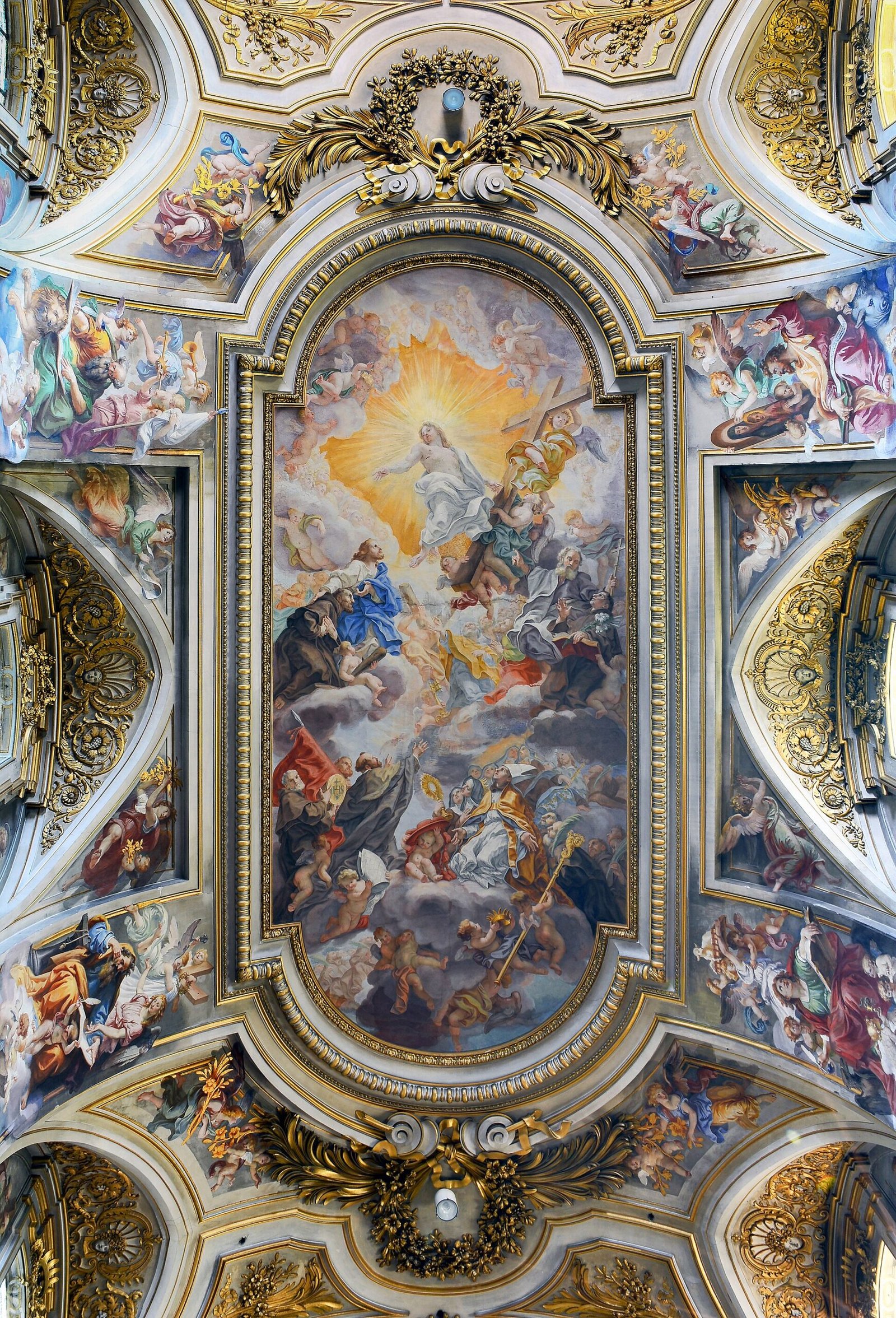
The result is the interior you still see today: a bright nave, marked by pilasters and crowned by the great frescoed vault, with a layout that favors the overall effect over minute detail, according to the Roman baroque taste of the first decades of the 18th century.
The decision to proceed with a complete reconstruction, rather than a simple restoration, should be read in the wider context of Clement XI's building policy, which in the first two decades of the 18th century promoted similar interventions on several Roman titular churches, in an attempt to give a more unified and modern face to the city's ecclesiastical heritage. Not all Romans of the time welcomed this season of rebuildings favorably: several contemporary testimonies lament the loss of medieval and early medieval elements considered today, through the eyes of art history, of great documentary value. The basilica of the Santi Apostoli, with the disappearance of the 15th-century apse and its fresco, is one of the most cited cases of this debate, which still divides historians between those who value the architectural result obtained and those who regret what was lost.
The neoclassical facade by Giuseppe Valadier
The face the basilica shows today toward the square, above the 15th-century portico, is the work of Giuseppe Valadier, the architect who in the first half of the 19th century redesigned several symbolic places of Rome, from Piazza del Popolo to the Pincio. Valadier completed the new facade in 1827, on commission from Duke Giovanni Torlonia, a banker and patron who financed the work and who is recalled in an inscription placed on the facade itself.
The scheme is the one typical of Valadier's neoclassical language: four Corinthian pilasters or pillars framing the central part, a pediment closing the front at the top and a balance of horizontal and vertical lines designed to dialogue with the Renaissance portico below without contradicting it. It is an instructive example of how Roman architecture has often proceeded by superimposition rather than demolition: under the 19th-century facade the 15th-century portico still coexists, and above both the baroque vault of the 18th century, three centuries of architectural history readable in a single front.
The patron of the facade, Duke Giovanni Torlonia, belonged to a family of bourgeois origins that within two generations had become one of the richest in Rome, thanks to banking activity and a remarkable nose for real estate investments and artistic patronage. Financing the facade of an ancient and prestigious basilica like this was, for a family like the Torlonia, a direct way to inscribe their name beside those of the great Roman noble houses, a use of architectural commissions as an instrument of social ascent that accompanies much of the building history of Rome between the 18th and 19th centuries.
The interior of the basilica and the vault frescoes
Past the portico, the interior opens into a single wide and bright nave, flanked by side chapels that hold works from different eras, from the 15th to the 19th century. The element that first catches the eye, on entering, is the vault.
Baciccio's Triumph of the Franciscan Order
The great fresco running along the whole barrel vault was made in 1707 by Giovan Battista Gaulli, better known as Baciccio, the same Genoese painter who created the famous vault of the Gesù. At Santi Apostoli, Baciccio painted the Triumph of the Franciscan Order, an illusionistic composition that opens the space of the vault upward with clouds, allegorical figures and saints of the order, according to the quadratura technique typical of late Roman baroque. It is one of the painter's last great decorative cycles, made when he was already an established interpreter of the style he had helped define in the previous decades.
The scattered traces of Melozzo da Forlì's Ascension
A separate chapter is deserved by the 15th-century apse, which before the 18th-century rebuilding housed a fresco of the Ascension painted around 1480 by Melozzo da Forlì, one of the protagonists of perspective painting in the second half of the Italian 15th century. The work, of grandiose design, with musician angels painted from below upward, is considered by many art historians a direct antecedent of the perspective solutions Michelangelo would adopt decades later in the vault of the Sistine Chapel. When the church was rebuilt in the early years of the 18th century, the fresco was taken down, in 1711, and its fragments scattered among different collections: some musician angels are now kept in the Vatican Museums, other fragments in other museum venues. In the present basilica the original work therefore does not remain, but its memory is an integral part of the building's history, and is one of the reasons art historians continue to study it.
The side chapels
Along the nave open several side chapels, enriched over the centuries by Roman families who financed their decoration in exchange for the right of burial or patronage. There you find canvases and sculptures by artists active between the 17th and 18th centuries, less famous than the great works of the central nave but still evidence of how the basilica was, for a long time, a coveted place for its devotional and social prestige. Some chapels still keep the coats of arms of the families that had them decorated, an indirect but effective way to read, walking along the side aisles, the map of the alliances and rivalries among the Roman families that gravitated around this corner of the city.
The funerary monument to Clement XIV by Antonio Canova
On the right side of the nave is the most famous work held in the basilica: the funerary monument to Pope Clement XIV, made by Antonio Canova between 1783 and 1787. It was the sculptor's first great public commission in Rome, when he had arrived in Rome only a few years earlier, and the success of the work contributed decisively to establishing him as the greatest sculptor of his time, opening the way to even more important commissions, including the monument to Clement XIII in Saint Peter's.
Temperance and Clemency, the two allegories
The monument shows the pope seated on a throne, in the act of blessing, following an iconographic scheme established for papal funerary monuments. At the sides of the sarcophagus, Canova placed two female allegorical figures, Temperance and Clemency, sculpted with that softness of surfaces and that classical composure that would become the hallmark of his mature neoclassical style. Critics of the time and later ones have repeatedly stressed how in these two figures Canova went beyond the still late baroque language of earlier Roman funerary monuments, introducing a formal balance inspired by ancient sculpture reread with modern sensibility.
Not far from the papal monument there is also a funerary stele, again in the Canovian sphere, dedicated to the engraver Giuseppe Volpato, further evidence of how the basilica was, between the 18th and 19th centuries, a burial place coveted by figures of the Roman artistic and cultural world.
Why the monument to Clement XIV is considered a turning point
To understand the importance of this monument you have to remember the state Roman funerary sculpture was in when Canova arrived in the city, at the end of the 1770s. The great papal monuments of the previous century, from Bernini onward, had favored a strongly theatrical language, rich in moving draperies and surprise effects. Canova, on the contrary, proposed for Clement XIV a more controlled composition, with polished surfaces and a compositional balance that looks openly to ancient Roman sculpture, reread however with a new sensibility, less arid than a certain contemporary academic classicism. The immediate success of the work, appreciated by the cultivated public and by less expert contemporaries alike, in fact opened the season of Roman sculptural neoclassicism, of which Canova would remain the undisputed protagonist for the following four decades.
The chapel of Cardinal Bessarion
Among the most surprising discoveries linked to the basilica is a 15th-century chapel that stayed hidden for centuries behind the Odescalchi chapel, brought back to light only in 1959 during restoration work. It is the chapel decorated at the behest of Cardinal Bessarion, the humanist and Byzantine scholar, later converted to Catholicism and made a cardinal, a key figure in the transmission of Greek culture to the Latin West in the 15th century.
The frescoes of Antoniazzo Romano
The chapel, completed around 1483, keeps frescoes attributed to Antoniazzo Romano, the most important Roman painter of the second half of the 15th century, and in part, according to some scholars, to Melozzo da Forlì. The scenes represent episodes tied to the archangel Michael, with vivid colors that recall, in chromatic intensity, Renaissance maiolica. The lower register of the frescoes was unfortunately damaged by water infiltration over the centuries. Cardinal Bessarion, who died in 1472, was initially buried elsewhere. His remains were moved to this basilica only in 1957, shortly before his chapel became visible again. A red marble tondo with his portrait, datable to the 16th century, still recalls his figure today.
Cardinal Bessarion deserves a broader mention, because his story explains well the cultural climate in which the chapel was decorated. Born in Trebizond, trained in the Byzantine theological tradition, he took part in the Council of Florence of 1438 and 1439 with the aim of mending the schism between the Eastern Church and the Western Church. Converted to Catholicism, he was created a cardinal and became one of the most cultured figures of the Roman curia of the 15th century, a tireless promoter of the study of Greek texts at a time when the Latin West was rediscovering Hellenic classical culture with enthusiasm. His personal library, donated to the Republic of Venice, is considered one of the founding nuclei of the Biblioteca Marciana. Having a chapel frescoed at his own expense in a basilica like this was, for a figure like him, a way to leave a tangible mark of his role in the Rome of the humanist popes.
The crypt and the relics of the apostles Philip and James
Under the main altar you go down into the crypt, a space that holds in a few square meters the oldest history of the basilica. The present crypt was built between 1869 and 1871 by the architect Luigi Carimini, at a time when many Roman churches were revising their underground spaces to make them accessible to the faithful according to the neo-early-Christian taste widespread in the 19th century.
A 1873 excavation and the discovery of the original burial place
A few years after the construction of the 19th-century crypt, an excavation carried out in 1873 brought to light the remains of the primitive U-plan shrine dating to the 6th century, with the stone base on which a Greek cross in relief was carved: the place where, according to the tradition confirmed by the investigations, the relics of the apostles Philip and James the Less, brought to Rome from Constantinople at the time of Pelagius I, had been laid from the beginning. The remains were examined again in 1879 and today rest in a reliquary of red marble and verde antico, placed within a niche covered by a barrel vault. In the crypt are also kept relics of other saints, transferred from the Roman catacombs in the early medieval period, following a practice common to many city basilicas between the 8th and 9th centuries.
The walls of the crypt are decorated with tempera paintings that recall, in style and subjects, early Christian cemetery art, in a circular route that accompanies the visitor from the entrance to the core with the relics, giving a more recollected and silent atmosphere than the great nave above.
A widespread model in 19th-century Rome
The choice to bring to light and enhance the oldest remains in a specially built crypt was not an isolated case: in the second half of the 19th century several Roman basilicas, including some of the largest in the city, made confessions and crypts inspired by a neo-early-Christian taste that looked with nostalgia to the age of the catacombs and the first centuries of Christianity. It was a way for the Roman Church to reaffirm, at a moment of deep crisis of the popes' temporal power culminating with the end of the Papal State in 1870, its direct historical continuity with the apostolic origins, showing the faithful and pilgrims relics and spaces that told of an unbroken link with the first centuries of the Christian faith in Rome.
The convent of the Conventual Friars Minor
From 1474, by the will of Pope Sixtus IV, the care of the basilica was entrusted to the Conventual Friars Minor, the branch of the Franciscan order that has never left the complex since. In the building adjacent to the church is still the seat of the General Curia of the Order of Friars Minor Conventual, the mother house that coordinates the order's provinces around the world: a detail that explains, among other things, why the great fresco of the 18th-century vault is dedicated precisely to the Triumph of the Franciscan Order.
The convent complex, expanded over the centuries around the 15th-century cloister, also houses a historic library and representation spaces not always open to the public. The basilica works to all effects as the district's parish, with a community of the faithful who gather there daily for celebrations: an aspect to keep in mind for those who visit as a tourist, because it remains first of all an active place of worship, not a museum monument.
A curiosity about the Basilica of Santi XII Apostoli
Few, passing under Baccio Pontelli's portico, know that the eagle sculpted between the arches is not a simple heraldic ornament, but the signature of a cardinal destined to become one of the most powerful popes of the Renaissance. Giuliano della Rovere, titleholder of the basilica before rising to the throne as Julius II, had the portico built also as a calling card for his house: the Della Rovere eagle, the same one that appears on so many of his other Roman building sites, from the Sistine Chapel to Santa Maria del Popolo. Anyone who visits Santi Apostoli is therefore looking, without knowing it, at one of the first architectural investments of a man who would later change the face of all Rome, calling Michelangelo and Raphael to work for him.
Another curiosity concerns the double dedication of the basilica: born as the church of the two apostles Philip and James the Less, over time it ended up being commonly called Santi XII Apostoli, as if it gathered in itself the whole apostolic college. The extended name is a popular usage consolidated over the centuries, not an original official dedication, but it is the one by which the basilica is by now indicated also in signage and in current ecclesiastical documents.
Something nobody tells you about the Basilica of Santi XII Apostoli
Almost no guide tells you that the most important fresco ever painted in this basilica can no longer be seen, and that its disappearance is tied to a decision taken without too many scruples in the middle of the 18th-century works. Melozzo da Forlì's Ascension, considered an absolute masterpiece of 15th-century perspective painting and a direct forerunner of Michelangelo's solutions in the Sistine, was detached from the apse in 1711 to make room for the new baroque layout wanted by Clement XI. The fragments were divided among different venues, and some of the most famous musician angels are now kept in the Vatican Museums, far from the place for which they were conceived. Looking at the present apse, without that work, you are actually looking at an emptiness: the place of one of the most influential paintings of the Roman Renaissance, sacrificed to the taste of another era.
A second little-told detail concerns the Bessarion chapel: for almost five centuries it remained walled up and forgotten behind another chapel, and nobody knew for certain what was hidden behind that wall until a restoration in 1959 brought it back to light almost intact. The frescoes by Antoniazzo Romano that can be admired today survived precisely because they were hidden: if the chapel had stayed exposed, it would hardly have come through unharmed the baroque and neoclassical rebuildings that transformed the rest of the church.
My advice for visiting the Basilica of Santi XII Apostoli
Better not to treat the basilica as a quick stop to tick off between Piazza Venezia and the Trevi Fountain, because it deserves at least 20 minutes at a calm pace, ideally in a morning time slot away from the tourist bustle that invades the area in the early afternoon. Enter through the 15th-century portico, stopping a moment to look at the arches and the upper loggia before crossing the threshold: it's the point where you see best the layering between the Renaissance and the 19th century, with Pontelli's portico under Valadier's facade.
Once inside, look up right away at the vault for Baciccio's fresco, then move to the right side of the nave for Canova's monument to Clement XIV: it is a work to be observed from different distances, because from afar you catch the compositional layout, from close up the treatment of the marble in the two allegorical figures. Finally go down into the crypt, often quieter and less crowded than the upper nave: the crypt's opening hours are reduced compared with those of the church, so it's best to check them before leaving, so as not to find the door closed. If you have time, on the way out, take a turn around the square and look at the facade of Palazzo Colonna: the link between the family and the basilica is read better from outside, looking at the two buildings together facing the same urban space.
Another well-known fact, yet rarely cited
It is well known that Michelangelo Buonarroti died in Rome in 1564, but few remember that his body, before being secretly transferred to Florence at the will of his nephew and buried in Santa Croce, was temporarily interred in this very basilica. It was a passing burial, not a final one, but the fact that it took place here, a stone's throw from Piazza Venezia, remains a detail that links the basilica's history once again to the great events of Roman art of the 16th century, a century in which the church underwent no significant architectural interventions but continued to be a place of illustrious burials.
Another fact equally well known to historians, but less cited in tourist guides, concerns the heart of Maria Clementina Sobieska, wife of James Francis Edward Stuart, the Jacobite pretender to the throne of England: it was buried in this basilica, with a monument sculpted by Filippo della Valle, while the rest of the body rests in Saint Peter's. Divided burials, common among the great families of the European aristocracy of the modern age, make Santi Apostoli a small archive of stories that intertwine with the courts of half of Europe, not only with the history of the Roman Church.
The right photo to take at the Basilica of Santi XII Apostoli
The most effective photo is taken from the center of the square, stepping back just enough to frame Pontelli's portico and Valadier's facade together: the light of late afternoon, when the sun goes down behind the buildings of Via del Corso, lights the arches from the side and brings out the depth of the octagonal pillars, an effect that is lost in the middle hours of the day, when the light is flat.
Inside the church, the best subject is the monument to Clement XIV, but it should be photographed from the side, not head-on: from an angled position you see better together the face of the blessing pope and the two allegorical figures of Temperance and Clemency, while a frontal shot flattens the composition Canova intended. For those who love details, a close-up of the octagonal capitals of the outer portico is worth it, a subject almost nobody photographs and which tells better than others the quality of the 15th-century intervention.
Some important events that happened here in history
The square in front of the basilica was for centuries the stage of public events tied to the power of the Colonna family, owner of the palace of the same name facing the same space. In the 15th century and for part of the 16th, the Feast of the Apostles was celebrated here on May 1: from the windows of Palazzo Colonna coins, food and even live animals were thrown, including a little pig lowered on a rope, while jets of water were poured from above to make the hunt for the booty harder and more entertaining for the nobles watching from above. It was a ritual of controlled distribution of wealth, typical of the great Roman baronial families, and the basilica's square was its natural stage.
The same square was the stage of a far grimmer episode in 1354, when the body of Cola di Rienzo, the tribune who had tried to restore a popular government in Rome, was displayed hanging from the walls of Palazzo Colonna after his killing, as a warning to anyone who might try to challenge the power of the great baronial families. Basilica and palace, facing the same square, were for centuries the two poles around which the public life of the neighborhood revolved, a place of festivities as much as of settling scores.
Over the course of the 16th and 17th centuries the square continued to host public ceremonies tied as much to the basilica as to Palazzo Colonna, from religious processions to the triumphal entries of persons of rank, occasions in which the two architectures, the sacred and the noble, went back to functioning as a single urban scenery. Even in more recent times the square has kept a vocation as an important public space for the city, occasional site of demonstrations and gatherings, a sign of a functional continuity that crosses the centuries without ever fully breaking.
Who has passed through the Basilica of Santi XII Apostoli
Among the figures who left a direct mark on the basilica, first of all Giuliano della Rovere should be recalled, titular cardinal before becoming Pope Julius II, who commissioned the portico and stamped it with his family's coat of arms even before undertaking the great architectural enterprises of his pontificate. Centuries later, another great protagonist of Italian art, Antonio Canova, left there the work that helped launch his Roman career, the funerary monument to Clement XIV, made when the sculptor was barely over 30.
Among the figures buried or remembered in the basilica, Cardinal Bessarion stands out, the Byzantine humanist who converted to Catholicism, was one of the leading figures of the Council of Florence and one of the great cultural mediators between East and West in the 15th century. His chapel, rediscovered only in the 20th century, still preserves his direct memory today. Michelangelo passed through here, so to speak, in death, before the transfer to Florence, while the heart of Maria Clementina Sobieska links the basilica to the story of the Jacobite court in exile in Rome in the 18th century. These are presences that differ in era and in role, but all of them confirm how much this church, though less well known than other great Roman basilicas, was for centuries a point of reference for the Rome of the popes, the cardinals and the great aristocratic families.
Piazza dei Santi Apostoli and Palazzo Colonna
The square the basilica faces has the same name as the church and is, in a certain sense, its urban extension: an elongated rectangle enclosed between the 15th-century portico on one side and the bulk of Palazzo Colonna on the other. The palace, which grew through successive acquisitions and expansions between the 15th and 18th centuries until it took on its present appearance around 1730, houses the famous Galleria Colonna, one of the most important private collections in Rome, open to the public on limited days and hours.
For centuries the palace worked almost as a private appendix of the basilica: the Colonna family had its own family chapel there and paid for a large part of the public celebrations connected with the church. Even today, anyone who walks across the square with a minimum of attention can read in this relationship between the two buildings one of the clearest examples of how, in Rome, religious power and the power of the great noble families were physically intertwined in the urban space, not only in the historical documents. From here, heading down toward the Corso, you reach in a few minutes both Piazza Colonna with its Antonine column and the Museo Nazionale di Palazzo Venezia, two stops that round out a morning devoted to this corner of Rome.
The Galleria Colonna and its limited hours
The Galleria Colonna, set up in the palace's reception rooms, preserves one of the most significant private painting collections in Rome, with works ranging from the 16th to the 18th century, and one of the most sumptuous halls visible in a noble palace in the city, decorated with frescoes celebrating the family's military feats. Unlike the basilica, which welcomes visitors every day, the gallery can be visited only on reduced days and hours during the week, with a paid ticket. It is a detail to check carefully if you want to combine the two visits on the same day, because tourists often show up in front of the palace on a day when it is closed, not knowing that access follows a much tighter calendar than that of the basilica next door.
The neighborhood around the basilica: from the Corso to Piazza Venezia
The Basilica dei Santi XII Apostoli stands in one of the densest points of history and daily life in the center of Rome, where great monumental architecture lives alongside shops, offices and private homes in an urban fabric that has remained essentially compact despite the large-scale demolitions that, in the late 19th and early 20th centuries, transformed a good part of the city center to make room for the Vittoriano and the new connecting avenues.
Piazza Venezia and the Altare della Patria
A few steps from the basilica opens Piazza Venezia, the most important traffic and symbolic hub of modern Rome, dominated by the great white bulk of the Altare della Patria, built at the turn of the 20th century to celebrate the unification of Italy and King Victor Emmanuel II. The contrast between the sobriety of the basilica's 15th-century portico and the theatrical monumentality of the Vittoriano tells in an effective way of two opposite ways of understanding celebratory architecture, four centuries apart, and walking from one to the other in a few minutes is one of the quickest ways to grasp the layering of styles that characterizes the center of Rome.
Toward Via del Corso and the Trevi Fountain
On the opposite side, the basilica leads into the network of streets that go toward Via del Corso, the city's ancient commercial axis linking Piazza Venezia to Piazza del Popolo, and toward the Trevi district, where in a few minutes on foot you reach the Trevi Fountain, one of the most photographed destinations in the world. It is an itinerary that many visitors walk without knowing that along the way they are passing through one of the most layered religious complexes in the city. A stop at the basilica, if you have time, usefully breaks up the sequence of shops and cafes that characterizes this part of the historic center, giving back for a few minutes a different, more recollected rhythm.
Hours and admission for the Basilica dei Santi XII Apostoli
The basilica is generally open to the public every day, with morning and afternoon hours interrupted by a break in the middle of the day. Admission to the church is free, as for most Roman basilicas open for worship. Hours can change for liturgical celebrations, special services or restoration periods, so it's always best to check them on the basilica's official website or by phoning the parish before you plan your visit, especially if you want your entrance to coincide with the opening of the crypt, which has shorter hours and doesn't always match those of the church.
During services, access for tourists may be temporarily suspended or limited to the side areas of the nave, out of respect for the faithful gathered in prayer. It is a rule common to all churches still used for worship and worth keeping in mind so you don't plan your visit right at the time of a Mass. If you are organizing a longer stay in Rome, with several stops among museums, churches and monuments, you may find it useful to compare opening hours with those of the other basilicas in the historic center and build a walking itinerary that starts here and continues toward the Pantheon or the Quirinale, both within walking distance.
For those organizing the trip as a whole, with transfers, accommodation and multi-day itineraries in Rome, broader planning can rely on tools such as ItalyPlanner, useful for lining up the city's stops in a coherent route. If instead you organize groups, schools or parties and need an expert guide to explain on site the historical layering of a place like this, you can consider the support of a professional guide through TourLeaderPro.
Frequently asked questions about the Basilica dei Santi XII Apostoli
Can you enter the Basilica dei Santi XII Apostoli for free?
The Basilica dei Santi XII Apostoli has free admission, as is the case for almost all Roman churches open for worship. No ticket is required to enter the main nave. In-depth guided visits or access to particular areas of the convent complex can instead be arranged separately, on request.
How should you dress to visit the basilica?
The Basilica dei Santi XII Apostoli, being an active place of worship, requires sober dress: covered shoulders and knees for both sexes are the most widespread rule in Roman churches. Tank tops, swimwear and overly low-cut clothes are not suitable for the visit, especially in the summer months when the temptation to dress lighter is greater.
Can you take photos inside the basilica?
In the Basilica dei Santi XII Apostoli photography without flash is generally allowed, so as not to disturb the faithful at prayer and to protect the frescoes from repeated direct light. During liturgical services it is better to avoid taking any pictures, out of respect for the community gathered in prayer.
How long does it take to visit the Basilica dei Santi XII Apostoli?
A visit to the Basilica dei Santi XII Apostoli takes on average 20 to 30 minutes, including a look at the frescoed vault, at Canova's monument and a short descent into the crypt, when it is open. If you also want to linger on the Bessarion chapel and the details of the 15th-century portico, you can easily reach 45 minutes.
Is the basilica's crypt always open to visitors?
The crypt of the Basilica dei Santi XII Apostoli has shorter opening hours than the upper church and is not guaranteed at every time of day. It's best to check the updated hours before the visit, especially if your main interest is the relics of the apostles Philip and James kept in that space.
Is the basilica suitable for a visit with children?
The Basilica dei Santi XII Apostoli lends itself well to a visit with children, because the space is large, bright and free of complicated routes or waiting lines comparable to those of the big Vatican museums. The descent into the crypt, with its painted walls and the almost labyrinthine route, often intrigues even the youngest visitors.
What are the monuments not to miss inside?
Inside the Basilica dei Santi XII Apostoli there are three main points of interest: the funerary monument to Clement XIV sculpted by Antonio Canova, the vault fresco with the Triumph of the Franciscan Order by Baciccio, and the chapel of Cardinal Bessarion, with 15th-century frescoes rediscovered only in 1959. The crypt with the relics of the apostles Philip and James completes the visit.
Is it worth visiting the basilica together with Palazzo Colonna?
The Basilica dei Santi XII Apostoli and Palazzo Colonna, facing the same square, lend themselves well to a combined visit, but the hours must be checked separately because the palace's gallery opens only on limited days and time slots of the week, unlike the basilica, which stays open almost every day. It's best to check the gallery's calendar in advance before planning the day.
Are Masses still celebrated in the basilica?
Yes, the Basilica dei Santi XII Apostoli is an active parish entrusted to the Friars Minor Conventual, with Masses celebrated daily and a fuller schedule on Sunday. Before planning the visit at a specific time of day, it's better to check the schedule of the services so you don't overlap with one in progress.