Palazzo Venezia
In short. Palazzo Venezia stands in the heart of Piazza Venezia, between the Capitoline, the Forums and Via del Corso, and is the oldest great Renaissance palace in Rome: it was built by the Venetian cardinal Pietro Barbo starting in 1455, and…
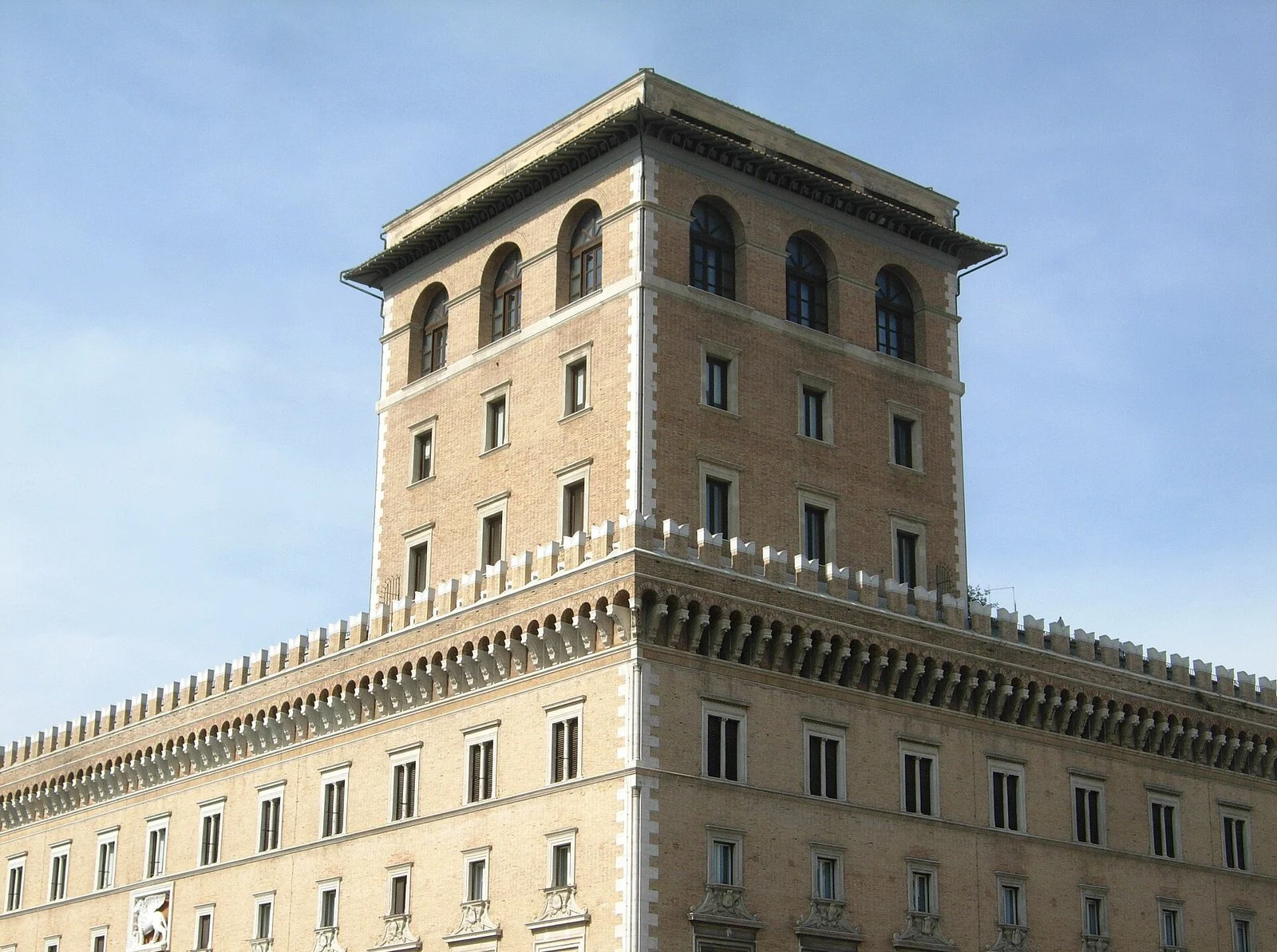
Palazzo Venezia stands in the heart of Piazza Venezia, between the Capitoline, the Forums and Via del Corso, and is the oldest great Renaissance palace in Rome: it was built by the Venetian cardinal Pietro Barbo starting in 1455, and when he became pope under the name Paul II he turned it into a papal residence, and since then the building has gone through six centuries of history without ever ceasing to be a place of power. It was the seat of the embassy of the Republic of Venice, then of the Austrian one, and finally, from 1929, the office of Benito Mussolini, who moved there permanently and spoke several times to the crowd from the famous balcony over the square. Today the complex also houses the National Museum of Palazzo Venezia, which gathers Renaissance and medieval applied arts: this page instead tells the story of the building itself, its history, the garden and the spaces you can see even just walking through Piazza Venezia, while for the hours and tickets of the museum collections it's best to read the dedicated entry. Not far away are also the Altar of the Fatherland and the Basilica of Santi XII Apostoli, both reachable on foot in a few minutes. Walking around Palazzo Venezia means, in a few steps, crossing almost six centuries of Italian and European history: the humanist Rome of the Renaissance popes, the long season of the embassies of the ancien régime, the Rome capital of the Kingdom of Italy after 1870 and finally the 20 years of the Fascist regime, with its most radical urban transformations. Few squares in the city manage to condense so many different layers into such a contained space.
Where Palazzo Venezia is and how to get there
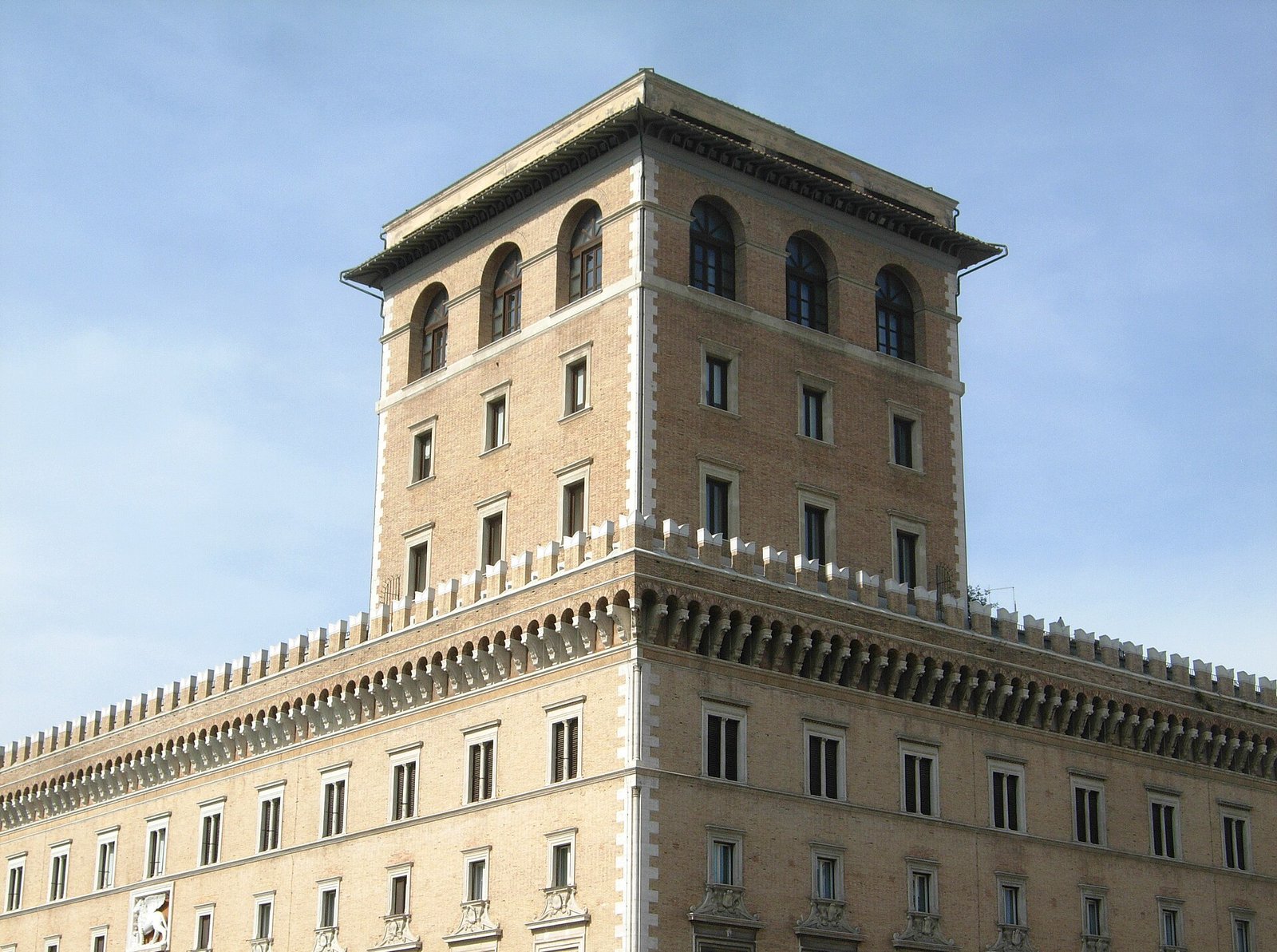
The main entrance of the palace, the museum's one, opens on Via del Plebiscito 118, with a second access on Piazza San Marco 49, right at the corner between Piazza Venezia and Via del Plebiscito. The monumental facade, however, faces directly onto the square, with the balcony in the center of the front and the Torre della Biscia, built in 1470, marking the corner toward the Corso. Piazza Venezia is one of the busiest junctions in Rome and is easily reached on foot from almost the whole historic center: from the Pantheon it takes 10 minutes, from the Colosseum a quarter of an hour along the Imperial Forums, from Piazza Navona a little more.
By bus and on foot
Many bus lines converge on Piazza Venezia, including the H, the 40, the 46, the 60, the 62, the 64, the 70, the 87, the 170, the 492, the 628 and the 916. Keep in mind that the construction site of the Venezia station of metro line C, open since autumn 2023, periodically moves the stops around the square, so it's best to check the route on the day of the visit on a transit app.
By metro and train
The metro does not yet come this far: the nearest station remains Colosseo, on line B, about a quarter of an hour on foot along Via dei Fori Imperiali. Anyone arriving by train at Termini station can take a direct bus or walk for about 25 minutes across Via Nazionale and Via IV Novembre. Once completed, the new Venezia station on line C will change this scenario, but the opening times of such a complex construction site in the archaeological heart of the city remain hard to predict precisely, so it's always best to check the state of the works before planning the trip.
By car and parking
Piazza Venezia is inside the restricted traffic zone of the historic center of Rome, so getting there by private car is not the simplest solution for anyone who doesn't live or work in the area. Anyone traveling by road anyway finds some paid parking on the neighboring streets and a couple of covered facilities a few hundred meters away, but the most practical advice remains to leave the car in one of the park-and-ride areas near the metro stops and continue on foot or by public transit to the square.
What Palazzo Venezia really is: from the cardinal's house to the papal palace
Pietro Barbo, born in Venice in 1417 and nephew of Pope Eugene IV, became a cardinal deacon in 1440 and, 11 years later, cardinal titular of the basilica of San Marco, the church that stands next to the future palace. It was he who had the work begun, in 1455, to build himself a cardinal's residence worthy of the title he bore: a building severe on the outside, almost an urban fortress, and at the same time refined in its interior spaces, with courtyards, loggias and a garden. When in 1464 Barbo was elected pope under the name Paul II, the construction changed scale: a second phase of work, begun the following year and documented by commemorative medals, turned the cardinal's house into a true papal palace, with reception apartments and a Renaissance loggia on the adjoining basilica. The attribution of the design remains debated among historians of architecture: tradition assigns it to Leon Battista Alberti, while the most recent research points to Francesco del Borgo, documented as architect of the building site from November 1465 until his death in 1468. Beyond the debate over who designed it, the fact remains that Palazzo Venezia is one of the first great examples in Rome of fully Renaissance civil architecture, able to combine the defensive function still present in the cardinal residences of the early 15th century with a classical language made of measured proportions and regular courtyards. For this reason historians of architecture consider it a point of passage between two eras, in which the severe forms of medieval fortified dwellings begin to give way to a new way of understanding the lordly palace, able to be at once secure and representative.
The Barbo name and the memory of the cardinal
The surname of the Barbo family, originally from Venice, still appears today at several points of the complex: the Appartamento Barbo, one of the historic rooms of the piano nobile, takes its name precisely from the founder's house, while coats of arms and heraldic symbols tied to the family recur in the sculptural decorations of the garden and the loggia. Paul II died in 1471, only seven years after becoming pope, without seeing completed all the work he had begun: it was his nephew Marco Barbo, a cardinal in turn, who continued the work in the following years, in particular in the part concerning the garden and the loggia that bounds it. The Barbo family, of Venetian patrician origins, had already given the Church another pope, Eugene IV, uncle of Pietro Barbo himself: a family tie that partly explains the speed with which the young Pietro, named cardinal at only 23, managed to build himself a leading position in the Roman curia of the 15th century.
A collector pope
Paul II was not only a building patron, but also one of the greatest collectors of ancient art of his time: inside the walls of the palace he gathered an extraordinary holding of coins, engraved gems and precious vases, among them the famous Tazza Farnese, a Hellenistic cameo in sardonyx agate now kept in Naples. That collection, put together in a few years of pontificate, bears witness to the cultural climate of the humanist Rome of the second half of the 15th century, in which the rediscovery of classical antiquity also went through the construction of residences able to host such collections.
The facade, the courtyards and the Torre della Biscia
The eastern facade of the palace, the one that faces the square, measures about 77 meters and reaches a height of a little over 30 meters, not counting the tower. The northern wing, less visible from Piazza Venezia because it faces the Capitoline, extends instead for about 122 meters, confirming the imposing size of the whole complex, which today occupies a little over a hectare. Inside, two large courtyards mark out the distribution of the spaces: the one that today houses the Giardino Grande and a second, more intimate courtyard, tied to the oldest core of the cardinal's residence. At the corner toward Via del Corso rises the Torre della Biscia, built in 1470 and for centuries one of the most recognizable visual landmarks of that area of the city, well before the square took on its current appearance with the construction of the Vittoriano.
The embassy of Venice and then that of Austria
In 1564 Pope Pius IV granted the use of the palace to the Republic of Venice, which set up its embassy to the Holy See there: hence the name by which the building is still known today, while the cardinal titular of San Marco continued to reside there. The Venetian presence lasted more than two centuries, until, after the Treaty of Campo Formio of 1797 which sealed the end of the Republic of Venice, the palace passed to Austria, which kept its embassy there for over a century. It was precisely in the Austrian period, in the course of the 19th century, that an ancient 15th-century courtyard was turned into a garden, following the taste of the time, with the introduction of botanical species that still characterize the green space today. The Austrian parenthesis closed only in 1916, in the middle of the First World War: Italy having entered the conflict against Austria-Hungary the year before, the Kingdom of Italy requisitioned the building as enemy property and since then Palazzo Venezia has belonged to the Italian State. The change was not only formal: it also meant the end of an uninterrupted diplomatic use dating from the 16th century, and the beginning of a new phase in which the palace would become first a museum seat, then, for 20 years, the administrative heart of an authoritarian government.
A curiosity about Palazzo Venezia
Few people know that, to make room for the Vittoriano, a piece of the 15th-century complex was literally dismantled and moved elsewhere. Between 1466 and 1469, next to the main palace, the so-called Palazzetto Venezia had been built, an elegant three-story cloister that faced the square. When at the start of the 20th century the demolitions began to build the monument to Victor Emmanuel II, the small building stood exactly where the wing of the Vittoriano was to rise: in 1910 it was taken apart stone by stone and rebuilt about 100 meters farther west, where you can still see it today, on Piazza San Marco.
The operation, by the standards of the time, was a far from trivial technical undertaking: every architectural element, from the columns to the capitals to the blocks of the arcades, was numbered and cataloged before being reassembled in the new location, so as to preserve as much as possible the original appearance of the small 15th-century building. It is an episode that tells well how, already at the start of the 20th century, the protection of ancient monuments coexisted with the will to radically transform the urban fabric of the capital of the Kingdom of Italy. Anyone strolling around the Vittoriano, then, is looking at an authentic piece of the 15th century that has simply changed address.
Another little-known detail concerns the very name of the square, which for a long time indicated not a generically Roman urban area, but a true foreign possession in the heart of the city: until 1916 anyone entering Palazzo Venezia entered, from the diplomatic point of view, a piece of Austria, protected by the same rules of extraterritoriality that still apply today to embassies. Only the First World War brought the building back under the full sovereignty of the Italian State.
The Giardino del Cardinale and the Giardino Grande
Pietro Barbo's original plan did not include only the palace and the basilica, but also a small secret garden, the viridarium, conceived as a green loggia reserved for the cardinal and then the pope: from there, according to the sources, Paul II watched the Carnival festivities, which he himself moved to Piazza Venezia in 1466. This is the core that popular tradition continues to call the Giardino del Cardinale, the most intimate and ancient heart of the green spaces of the complex. The Roman Carnival, before being moved to Piazza Venezia, took place along Via del Corso and at other points of the city, but it was Paul II who made it a public event concentrated around his own palace, with horse races and masks that drew enormous crowds: a distant antecedent, though not without historical irony, of the great gatherings that centuries later would be held in the same place for very different reasons.
The Giardino Grande open today
Different, in history and location, is the Giardino Grande that you visit today: it comes from the 19th-century transformation of a 15th-century courtyard, carried out when the palace was the seat of the Austrian embassy. The botanist Pietro Romualdo Pirotta, a native of Pavia who lived from 1853 to 1936, had some palms planted there that remain among the tallest in Rome, in the center of the main flower bed. At the center of the garden is a fountain with the sculptural group of Venice wedding the sea, commissioned in 1730 by the ambassador Barbon Morosini from the sculptor Carlo Monaldi, a clear tribute to the ancient Venetian ceremony of the wedding to the sea. The west side of the garden was rebuilt in 1733 at the will of Cardinal Angelo Maria Querini, with a statue dedicated to Saint Pietro Orseolo, the first doge of Venice, canonized just two years earlier. The Giardino Grande can be visited for free, without needing the museum ticket.
The two-tier loggia and the sculptural fragments
On the northeast side of the garden runs a two-tier loggia, traditionally attributed to Paul II and to his nephew Marco Barbo, who in the years after his uncle's death oversaw its completion: the most recent studies tend to assign the authorship of the work precisely to Marco Barbo, who would have added papal heraldic symbols as a tribute to the memory of his cardinal uncle who had become pontiff. Along the walls and in the spaces of the garden there are also several ancient sculptural fragments, coming in part from the antiquarian collection put together by Paul II, evidence of how the taste for classical archaeology accompanied the life of these green spaces from the beginning.
The basilica of San Marco, next to the palace
The palace encloses and in part embraces the basilica of San Marco Evangelista, one of the oldest churches in Rome: it was built in 336 by Pope Mark on the site of an earlier oratory and is dedicated to the evangelist who, according to tradition, visited Rome in the first century. Restored by Pope Adrian I in 792 and rebuilt by Gregory IV in 833, the church already appears as the titulus Marci in the acts of the synod convened by Pope Symmachus in 499, a sign that it had been a cardinal titular church since time immemorial. It was precisely as cardinal titular of San Marco that Pietro Barbo began, between 1465 and 1470, the construction of the Renaissance-style benediction loggia that today characterizes the facade: a work traditionally attributed to Alberti and more recently assigned to Francesco del Borgo. The current appearance of the basilica, with its Baroque forms, is instead due to interventions between the 17th and 18th centuries. Paul II granted the church to the community of Venetians resident in Rome between 1465 and 1470, thus strengthening the bond between the basilica and the palace that stands beside it.
A cardinal title that has lasted for centuries
The cardinal title of San Marco, already documented in the synod of Symmachus in 499, has run through the whole later history of the palace: it was precisely as titular of that church that Pietro Barbo chose to build his residence next to it, and it is for the same reason that the basilica, while remaining an autonomous place of worship, cannot be told separately from the palace that encloses it on two sides. Even today the basilica remains consecrated for worship and accessible with its own hours, different from those of the museum, a useful detail for anyone who wants to visit both spaces on the same day.
The apse mosaic and the ceiling of Paul II
The apse preserves a mosaic made in 833 at the wish of Gregory IV, with Christ in the center flanked by a sequence of saints, among them Pope Mark himself, Saint Agapitus, Saint Agnes, Saint Felicissimus and, in a position traditionally reserved for Saint Peter, Saint Mark the Evangelist: an iconographic choice that scholars link to the transfer of the evangelist's relics to Venice, which took place in precisely those years, between 830 and 831. Beneath the figures runs a band with 12 lambs representing the tribes of Israel, while the apse arch shows Saints Peter and Paul beneath the clipei with Christ and the four evangelists. The wooden ceiling of the nave, instead, was commissioned by Paul II between 1465 and 1470 and still bears his coat of arms: it is one of only two original 15th-century wooden ceilings left in Rome, along with that of Santa Maria Maggiore. In the nave there are also paintings and sculptures added between the 17th and 18th centuries, signed among others by Pier Francesco Mola, Carlo Maratta and Antonio Canova.
One thing nobody tells you about Palazzo Venezia
Under the representative rooms of the palace lies an unfinished bunker, discovered only at the end of 2010 during restoration work. It was built to be an air-raid shelter for Mussolini during the Second World War, but the work was never completed: today it remains as a silent testimony to an interrupted project, closed to the public and visible only on particular occasions tied to deeper looks at 20th-century history. It is a detail that rarely appears in tourist guides, yet it tells more than many plaques about how much the palace remained, to the end, a place conceived for power and for its defense.
Striking, about this discovery, is also its timing: the bunker emerged from a building that in the meantime had already become a state museum, open to the public for decades, evidence of how many different layers of history can coexist, often invisible, under the same vaults. It is not an isolated case: many of the great palaces of the center of Rome hide underground spaces tied to historical phases later than their original construction, and Palazzo Venezia, for the length and variety of its story, is a particularly dense example.
The advice I give you for visiting Palazzo Venezia
Before arriving, it's best to find out about the state of the Sale Storiche of the piano nobile, that is, the Sala del Mappamondo, the Sala Regia, the Sala delle Battaglie and the Appartamento Barbo: they are temporarily closed for a restoration with a declared horizon of 2026, so anyone coming specifically to see them would do well to phone the museum ticket office in advance. In the meantime the best way to appreciate the palace remains the outdoor route: cross Piazza Venezia without hurry, observe the facade and the balcony from different angles, then enter the Giardino Grande for free, which offers a secluded viewpoint on the building and a moment of silence a few steps from the traffic of the square. Anyone organizing a wider tour of the center can pair this stop with a walk toward the Capitoline or toward the Forums, so as to break up the visit with different and less crowded spaces.
A visiting order that works
A practical order, if the time available is limited, is this: first the outside loop of the square to photograph the facade and the balcony at leisure, then the free entry to the Giardino Grande, and only at the end, if the rooms are open and time allows, the museum collections route. This way, even someone with only half an hour free between one appointment and another still manages to take away a complete idea of the place, without having to give up the visit entirely for lack of time. Anyone with a whole morning, on the other hand, can pair the stop with a deeper visit to the museum, when the rooms are open, also devoting time to the specialized library of archaeology and art history kept inside the complex, a lesser-known but valuable resource for anyone working on Renaissance art history.
Avoiding the busiest hours
Piazza Venezia is crossed all day by very heavy pedestrian and vehicle traffic, especially in the middle hours of the day and on weekends. Anyone looking for photos without too many people around, or simply a quieter moment to observe the facade, would do well to choose early morning, when the light is also more favorable and the organized groups haven't yet arrived. In the evening too, after sunset, the square empties progressively compared with the daytime hours, and the night lighting of the facade offers an alternative viewpoint, less crowded but just as evocative, especially in the months with milder weather when staying outdoors is pleasant even after dinner.
The Sala del Mappamondo and the balcony: the years of the regime
The largest room of the piano nobile is the Sala del Mappamondo, so called for the ancient geographic map that once decorated one wall: it was this room, together with the balcony that opens from it over the square, that became the symbol of Fascist power between the wars. Even before becoming Mussolini's office, the room had already hosted representative functions since the time of the embassies, first Venetian and then Austrian, confirming how the largest and most solemn rooms of the palace have always been reserved for functions of power, whatever the power of the moment. Its imposing dimensions, originally conceived to host papal audiences and official ceremonies, made it suitable without major architectural changes to become, centuries later, the place chosen to represent visually the strength of a government that bet heavily on the staging of power.
Mussolini's move into the palace
Mussolini moved to Palazzo Venezia permanently on September 16, 1929, reserving the Appartamento Barbo for himself and turning the rest of the building into the representative seat of the government, while other spaces remained devoted to the museum. Between 1924 and 1936 the palace was the object of a broad renovation, which included among other things the construction of a new grand staircase and the adaptation of some rooms to the needs of the private apartment. The Sala del Mappamondo became his office: the desk was deliberately placed far from the entrance door, at the back of the room, so that anyone entering had to cross the entire room before reaching it.
The balcony over the square
The balcony, facing directly onto the square below, offered the possibility of gathering very large crowds in front of the building, and for this reason it became the point from which the regime communicated its public announcements, from the proclamation of the empire in May 1936, after the campaign in Ethiopia, to the annexation of Albania in 1939 and the declaration of war of June 1940. In May 1938, on the occasion of Adolf Hitler's visit to Rome, a photograph portrayed Mussolini greeting the crowd from the balcony of the Sala del Mappamondo itself. These are images that belong to the historical documentation of two decades of authoritarian regime and mass propaganda, and must be read as such, without any form of nostalgia.
The Grand Council of Fascism and the night of July 25, 1943
Between July 24 and 25, 1943 the palace hosted the last meeting of the Grand Council of Fascism, chaired by Mussolini himself in the Sala del Pappagallo. In that session the order of the day presented by Dino Grandi was put to a vote, asking for the return of full constitutional powers to the king, to the Chambers and to the Grand Council itself: the order of the day was approved by majority, and the next day Victor Emmanuel III had Mussolini arrested, opening the phase of the regime's fall. That meeting, held within the walls of the palace that for 14 years had been the symbol of Fascist power, thus also marked the political end of that power.
Telling those years without rhetoric
The years in which Palazzo Venezia was the seat of the Fascist government belong to the documented history of 20th-century Italy, with its precise responsibilities: the racial laws of 1938, the alliance with Nazi Germany, the entry into a war that cost millions of victims. Telling the story of the palace also means telling this, without turning it into an anecdote and without giving back space to the propaganda that was broadcast from that balcony: facts, dates and places remain the most honest way to make anyone visiting Rome today understand what really happened in those rooms.
Another well-known fact, yet rarely cited
It is known that Mussolini spoke from the balcony of Palazzo Venezia, but it is less often remembered that the building, before becoming the headquarters of the regime, had already been for centuries a diplomatic seat: first of the embassy of the Republic of Venice, from 1564, then of the Austrian one, from 1797 to 1916. For most of its history, in short, Palazzo Venezia was not the home of an Italian head of state, but the representation of foreign powers in the heart of Rome: a detail that helps explain why the building still bears the name of the lagoon city, and not that of the Barbo who built it. Even in 19th-century administrative documents, when Austria had by then resided there for decades, the building continued to be indicated by the original name tied to Venice, a sign of how deeply that first use had marked the identity of the place in the eyes of the Romans.
It is also worth remembering that the Republic of Venice itself, the one that gave the palace its name, ceased to exist in 1797, the very year in which the building passed to Austria: the palace thus continued to bear the name of a State that no longer existed, a paradox that has been preserved to this day and that few visitors notice while strolling through the square.
The right photo to take at Palazzo Venezia
The most effective photo is taken from the opposite side of the square, around noon, when the light strikes the facade from the side and brings out the Torre della Biscia and the profile of the balcony without creating backlight. A tighter shot is obtained by entering the Giardino Grande and photographing the two-tier loggia that closes the northeast side, with the palms in the foreground: it is a view that very few visitors to Piazza Venezia know, because it stays hidden behind the walls of the palace. Anyone who wants to include the urban context as well can climb a few steps toward the Capitoline and photograph from there the whole made up of the palace, the basilica of San Marco and the square below.
On the clearest days, late afternoon also gives interesting results: the raking light strikes the Torre della Biscia from the side, lengthening the shadows on the square and rendering well the three-dimensionality of the battlements and the windows of the piano nobile. Anyone who prefers to avoid the crowd can try photographing the building from Via del Plebiscito side, where pedestrian traffic is lighter and the side facade, less photographed than the main one, still offers a good viewpoint on the Torre della Biscia and on the corner toward Piazza San Marco.
Some important events that happened here in history
In 1455 begins the work commissioned by Cardinal Pietro Barbo for his residence next to the basilica of San Marco. In 1464 Barbo becomes Pope Paul II and turns the building site into a papal palace, with a second phase of work begun the following year. In 1466 the Roman Carnival is moved to Piazza Venezia at the will of Paul II himself, who follows its course from the palace's viridarium. In 1536 Antonio da Sangallo the Younger builds a temporary triumphal arch for the visit to Rome of Emperor Charles V. In 1564 Pope Pius IV assigns the palace to the Republic of Venice for its embassy to the Holy See. In 1797, after the Treaty of Campo Formio, the building passes under Austrian control. In 1910 the Palazzetto Venezia is dismantled and rebuilt farther west to make room for the Vittoriano. In 1916, with Italy at war against Austria-Hungary, the Kingdom of Italy requisitions the palace, which becomes the property of the State. In 1921 the museum is established, occupying much of the spaces of the palace no longer used for diplomatic representation. On September 16, 1929 Mussolini moves there permanently, starting the years in which the building serves as the representative seat of the Fascist government, and the same year the museum is closed to make room for government offices. In 1933 the palace receives as a bequest about 3,000 pieces of the Wurts collection, an important core of artworks and decorative objects that will remain preserved until the reopening of the museum. Between July 24 and 25, 1943 the last meeting of the Grand Council of Fascism is held in the Sala del Pappagallo, which votes no confidence in Mussolini, and in that same year 1943, with the regime fallen, the museum finally reopens to the public.
Who has passed through Palazzo Venezia
Pietro Barbo, first a cardinal and then Pope Paul II, is the figure from whom everything originates: from patron of his own residence to owner of one of the most important antiquarian collections of the Roman 15th century, kept right in these rooms. At his side, in the final phase of the garden works, stands his nephew Marco Barbo, to whom the most recent studies attribute a large part of the completion of the Renaissance loggia. Francesco del Borgo, an architect active until his death in 1468, and the tradition that carries the name of Leon Battista Alberti remain the two main references when speaking of the overall design of the building.
In 1536 the guest of honor, though only for the visit tied to the arch erected in his honor by Antonio da Sangallo the Younger, was Emperor Charles V, passing through Rome after the Tunis campaign. For more than two centuries the palace saw the succession of the ambassadors of the Republic of Venice to the Holy See, among them Barbon Morosini, who in the 18th century commissioned the garden fountain, and Cardinal Angelo Maria Querini, who in 1733 had its western side rebuilt. After 1797, with the passage to Austria, it was the diplomatic representatives of the Habsburg empire who occupied the same rooms, bringing with them also a botanical taste that contributed to the transformation of the garden in the course of the 19th century.
In the 20th century, besides Mussolini, who lived and worked there for 14 years, the palace was crossed by foreign heads of state and government on official visits, among them Adolf Hitler in May 1938, and by the members of the Grand Council of Fascism, including Dino Grandi, who in July 1943 held their last, decisive meeting there before the fall of the regime and the arrest of Mussolini at the will of King Victor Emmanuel III.
Piazza Venezia around the palace: a square remade several times
The palace we see today facing a wide and orderly square has survived two great seasons of urban transformation that deeply changed everything around it, while leaving it substantially intact.
The construction of the Vittoriano
Between 1885 and the mid-1930s the monument to Victor Emmanuel II was built, to a design by the architect Giuseppe Sacconi, officially inaugurated on June 4, 1911 for the 50 years of the unity of Italy even though the work continued for a long time afterward. To make room for the monument, between 1884 and the end of the century, whole streets of the medieval quarter that occupied that area were demolished, including historic streets such as Via della Pedacchia and Via di Testa Spaccata, as well as part of the Aracoeli convent complex: about 19,000 square meters of ancient urban fabric were erased forever. It was in this context, as already mentioned, that the Palazzetto Venezia was dismantled and rebuilt farther west, while Palazzo Venezia itself, though remaining in its place, saw the square in front of it widen between 1900 and 1906 to adapt to the new monumental proportions of the Vittoriano.
The opening of Via dell'Impero
The period photographs kept in the city archives show well the difference between the narrow, irregular square before the work and the wide, squared-off space we know today, with Palazzo Venezia as the only architectural element to remain substantially still while everything else changed around it. A second radical intervention came in the 1930s, when between 1924 and 1932 the new road linking Piazza Venezia to the Colosseum was laid out, inaugurated by Mussolini on April 9, 1932 under the name Via dell'Impero, now Via dei Fori Imperiali. Here too the work entailed the demolition of an entire neighborhood, that of Via Alessandrina, with medieval and Renaissance buildings, three churches and the homes of hundreds of families among the poorest in the city. From that moment Palazzo Venezia, which already since 1929 had housed the offices of the Fascist government, found itself at the mouth of the great artery conceived for military processions and parades, becoming even more central in the geography of power of the Rome of that time.
The restoration and the VIVE institute: the future of Palazzo Venezia
Since 2014 Palazzo Venezia has been part of the autonomous institute VIVE, which brings the Vittoriano and Palazzo Venezia together under a single direction, with the aim of giving coordinated management to two monumental complexes that face the same square while having completely different histories. The creation of the institute also brought a general rethinking of the visitor routes, with tickets shared among the different sites and a program of temporary exhibitions that rotates among the available spaces.
An open building site on the piano nobile
The most significant chapter of recent years concerns precisely the restoration of the Sale Storiche of the piano nobile, closed to the public with a declared horizon of 2026: a necessary intervention for a building that has gone through centuries of very different uses, from cardinal's residence to diplomatic seat to government office, each of which left traces in the plasters, the systems and the masonry structures. In the meantime the rest of the complex, including the ground-floor collections and the Giardino Grande, remains regularly open to visitors, so that the closure of one part of the route does not prevent you from getting an overall idea of the palace. Restorations of this scale, on layered buildings like Palazzo Venezia, take a long time also because every intervention must deal with masonry structures of different eras, systems added in the course of the 20th century and the need to document every phase carefully before intervening, so as not to compromise the historical evidence laid over one another across the centuries.
A property that belongs to the city
Beyond the museum value of the collections it holds, Palazzo Venezia remains above all a public asset that belongs to the collective history of Rome: a building that has seen cardinals, popes, ambassadors and heads of government succeed one another, and that today continues to be a visual landmark for anyone crossing Piazza Venezia, even without ever stepping across its threshold. Its story, precisely because it crosses so many centuries and so many different uses, lends itself to being told from very different perspectives: that of Renaissance architecture, that of the European diplomacy of the ancien régime, that of the political history of 20th-century Italy. None of these readings alone exhausts the meaning of the place, and it is perhaps precisely this layering that makes Palazzo Venezia one of the buildings most dense with history in the whole center of Rome.
The museum and the Sale Storiche: what you see inside
The collections of the Museo Nazionale del Palazzo Venezia occupy a large part of the ground floor and the piano nobile and include ceramics, tapestries, sculptures and objects of applied art from early Christianity to the early Renaissance. The Sale Storiche, that is, the rooms tied most closely to the political life of the palace, such as the Sala del Mappamondo, the Sala Regia, the Sala delle Battaglie and the Appartamento Barbo, are at the moment closed for a restoration with a declared horizon of 2026: anyone who wants to see them in particular should check the reopening before organizing the visit. Among the rooms that can be visited are collections of Italian and foreign ceramics, Flemish tapestries, Renaissance bronzes and a collection of polychrome wooden sculptures among the most important kept in an Italian state museum, as well as paintings covering a very wide chronological span, from the late Middle Ages to the early 17th century. The exhibition route occupies for the most part the ground-floor rooms and some first-floor rooms not included in the restoration of the Sale Storiche, so it remains possible to get a consistent idea of the collections even while the piano nobile is closed. An important part of the original core of the collections comes from the Wurts bequest of 1933, about 3,000 artworks and decorative objects donated to the museum at a moment when the institution had already been closed to make room for government offices, and which became visible to the public again only after the reopening of 1943. The museum ticket is single for the whole VIVE institute and allows access to each of the linked sites, that is, Palazzo Venezia, the Terrazza Panoramica of the Vittoriano, the Sommoportico and the Museo Centrale del Risorgimento. For updated hours, ticket prices and booking arrangements, the page dedicated to the museum remains the most complete reference, because here the focus remains on the palace as a building and as a historic place, more than on the museum offering in itself.
When to go to Palazzo Venezia
Piazza Venezia is busy in every season, but the hottest months of the Roman summer, between July and August, bring intense heat that makes it unpleasant to linger outdoors for long in the middle hours of the day: better to choose early morning or late afternoon, when the light is also more favorable for photographs. In spring and autumn the square can be walked at leisure at any time of day, while in the winter months, with shorter days, it's best to arrive with a margin of time before sunset to still enjoy the natural light on the facade. It should also be considered that Piazza Venezia, because of its central position, is often crossed by civic events and official commemorations, in particular on dates tied to republican history, when the area in front of the Altare della Patria may be temporarily affected by traffic changes: one more reason to check ahead for any route variations, if the visit falls on a national holiday.
Palazzo Venezia with children
The free garden is the part best suited to a family visit, because it offers shaded spaces and a more secluded setting compared with the traffic of the square. The museum collections, when the rooms are open, are aimed more at an adult audience passionate about art history, but the route remains short and manageable even with school-age children, especially if accompanied by some stories about the history of the palace and its balcony.
Accessibility
Piazza Venezia, with its wide sidewalks, is easy to walk even for those with strollers or mobility difficulties. Inside the palace, on the other hand, the presence of historic stairs and level changes typical of a 15th-century building makes it necessary to check in advance, through the museum ticket office, which routes are actually accessible at the time of the visit.
What's around Palazzo Venezia
Piazza Venezia is the point where some of the most visited places in Rome converge. Right across from it stands the monument to Vittorio Emanuele II, known as the Altar of the Fatherland, with its panoramic terraces and the Unknown Soldier. A few steps away, along Via del Corso, is the Basilica of Santi XII Apostoli, one of the oldest religious buildings of the rione, with a portico that holds evidence from the Roman era. Climbing the Michelangelo cordonata you reach the Campidoglio, with the Capitoline Museums and the square designed by Michelangelo, a privileged vantage point also on Palazzo Venezia itself and on the back of the Vittoriano. In the opposite direction open the Imperial Forums, with the long archaeological walk that leads to the Colosseum, and the Pigna rione, a network of narrow alleys that still preserves a medieval urban fabric despite the proximity of one of the busiest squares in the capital. Here you find small craft workshops, lesser-known churches and glimpses that tell of a Rome different from the monumental one of the main square. The rione takes its name from an ancient bronze pinecone that according to tradition originally decorated a building in the area, and it is one of the smallest historic rioni of Rome, wedged between Piazza Venezia, the Pantheon and the Campidoglio, with a concentration of churches and small palaces that surprises anyone expecting only residential streets. Those who still have time can continue toward the Pantheon, a 10-minute walk away, or go down toward the Teatro di Marcello and the Jewish Quarter, both reachable on foot in about a quarter of an hour. For those planning a wider itinerary in the area, or wanting to look more closely at the connections between the different sites of the historic center, the guides of Tour Leader Pro offer useful tools for those who work in tourist accompaniment, while Italy Planner is a practical resource for building a visiting program for Rome that also includes the less frequented stops.
Frequently Asked Questions About Palazzo Venezia
Where exactly is Palazzo Venezia?
Palazzo Venezia is in Rome, in Piazza Venezia, with the museum entrance on Via del Plebiscito 118 and a second access on Piazza San Marco 49. The main facade, with the famous balcony, faces the square directly, between the Campidoglio and Via del Corso.
How much does the ticket cost?
The ticket for Palazzo Venezia covers only the museum collections and not the building itself, which can be admired freely from the outside. The cost, discounts and any free admissions change periodically, so it's always best to check the museum's official page before the visit.
Can you see the garden?
The Giardino Grande of Palazzo Venezia can be visited free of charge, without needing the museum ticket, and it is open during the same hours as the complex. The small 15th-century viridarium, on the other hand, is not part of the normal public route and can be seen only on special occasions.
Can you go up on the balcony?
The balcony of Palazzo Venezia is not accessible to the public during the ordinary visit, because it is part of the historic rooms of the piano nobile, currently closed for restoration. You can, however, observe it comfortably from the square below, from which the whole facade is clearly visible.
Why is it called Palazzo Venezia?
Palazzo Venezia takes its name from the Republic of Venice, which from 1564 housed its embassy to the Holy See there. The name remained even after the passage to Austria and then to the Italian State, becoming the one used to designate the whole surrounding square.
What is the difference between Palazzo Venezia and the Museo Nazionale del Palazzo Venezia?
Palazzo Venezia is the 15th-century building as a whole, with its history as a cardinal's residence, embassy and seat of government. The Museo Nazionale del Palazzo Venezia is instead the state institution that occupies part of those same spaces and displays their art collections, with its own hours and tickets.
Are the historic rooms open?
The Historic Rooms of Palazzo Venezia, including the Sala del Mappamondo, are temporarily closed for a restoration with a declared horizon of 2026. Those who especially want to see them should find out about the reopening before planning the visit.
Is Palazzo Venezia connected to the Vittoriano?
Palazzo Venezia and the Vittoriano are today part of the same museum institute, called VIVE, with a single ticket that gives access to both sites and to other connected spaces. They remain two distinct buildings, however, built in very different eras and with their own histories.
How much time do you need to see Palazzo Venezia from the outside and the garden?
To admire the facade of Palazzo Venezia from the square and to visit the Giardino Grande at leisure, 30 to 45 minutes is generally enough. The time gets longer if you also add a visit to the museum, which deserves at least an hour more.