Church of the Gesù
In short. The Church of the Gesù faces a narrow square halfway between Palazzo Venezia and Largo di Torre Argentina, at one of the most crossed and least looked-at points of central Rome.
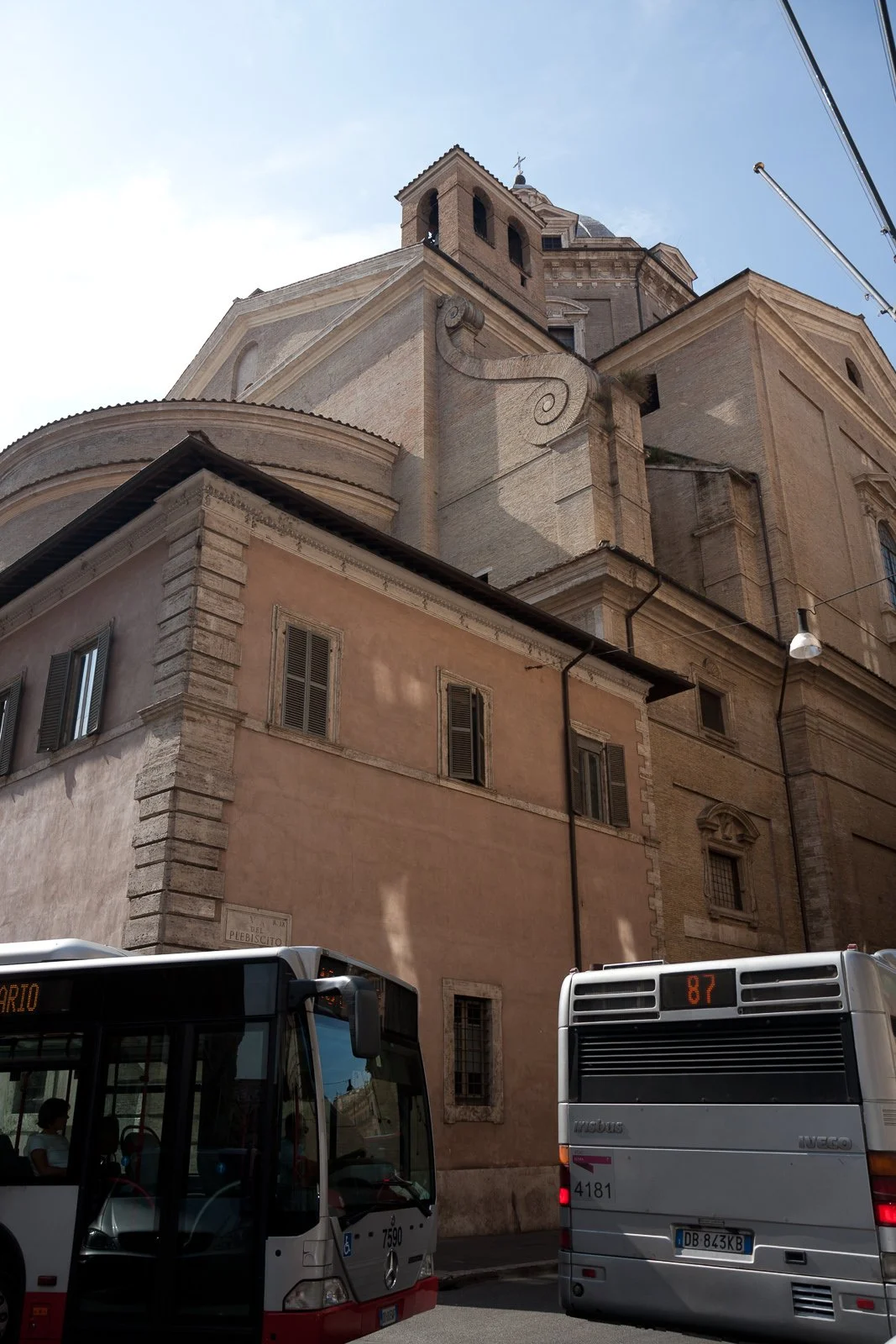
The Church of the Gesù faces a narrow square halfway between Palazzo Venezia and Largo di Torre Argentina, at one of the most crossed and least looked-at points of central Rome. It is the mother church of the Society of Jesus, the order founded by Ignatius of Loyola and approved by Paul III in 1540, and it holds the founder's tomb. But the reason this building appears in every history of architecture textbook is another: between 1568 and 1584, under the direction first of Jacopo Barozzi known as Vignola and then of Giacomo Della Porta, a church scheme was worked out here that over the next two centuries would be repeated, adapted and copied from Lisbon to Manila, from Antwerp to Cusco. A single, very wide nave, side chapels in place of aisles, a barely projecting transept, a dome over the crossing, a facade of two orders joined by scrolls. Whoever enters today, though, does not look at the plan: they look up, because a century after the consecration the vault was covered by the Triumph of the Name of Jesus by Giovan Battista Gaulli known as Baciccio, and the stuccoes of Antonio Raggi made the painted figures spill over the frame and end up, literally, inside the space of the church. Next to the nave, at the end of the left arm of the transept, there is then the Chapel of St. Ignatius by Andrea Pozzo, one of the most expensive altars ever built in Rome, and in the adjoining Casa Professa the rooms survive where Ignatius lived the last 12 years of his life. The lines that follow tell how this building came to be, who decorated it, what you see today, how to visit it and which are the things that almost no guide has the time to explain.
Where the Church of the Gesù is and how to get there
The Church of the Gesù is in Piazza del Gesù, at the intersection of Via del Plebiscito and Via degli Astalli, about 300 meters from Piazza Venezia and the same distance from Largo di Torre Argentina. You reach it on foot only for the last stretch, because the square is a pedestrian island in practice, wedged between the traffic of Via del Plebiscito and the severe side of Palazzo Altieri.
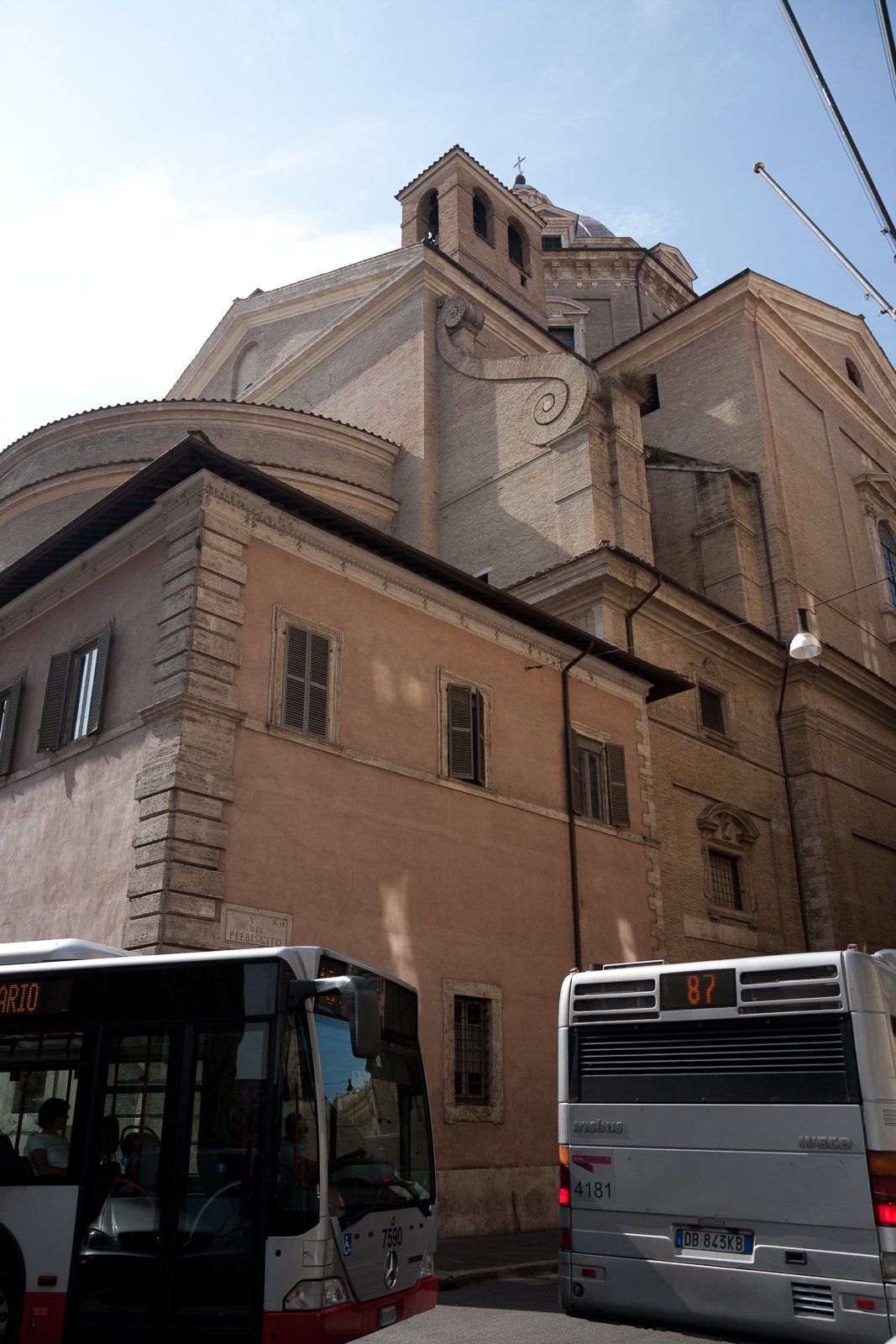
On foot, from the landmarks of the center
If you start from Piazza Venezia, you only have to take Via del Plebiscito and walk for 3 or 4 minutes keeping to the left: the facade appears all of a sudden, on a square that opens to the side of the street and for this reason escapes anyone walking distracted. From Largo di Torre Argentina the route is symmetrical, along the same artery, with the only difference that you arrive seeing the side of the church first and then the facade. From the Pantheon it takes about 10 minutes going past the Basilica of Santa Maria sopra Minerva and Via del Piè di Marmo, which is also the best way to get there, because it crosses the heart of the district of Roman convents and colleges.
By public transport
There is no subway station right next to the church: the nearest ones, on Line A and Line B, still require a quarter of an hour's walk, and the usual way to get to the area is the bus. Via del Plebiscito, Corso Vittorio Emanuele II and Largo di Torre Argentina are three of the best-served axes of the historic center, and almost all the lines that cross Rome from east to west stop a few dozen meters from the square. The lines and terminals in this area change often, partly because of construction sites, so it is best to check the updated route on the transport company's app on the day of the visit, instead of trusting lists of numbers read elsewhere.
Opening hours and access rules
The rectory publishes a winter schedule and a summer one, with declared changeover dates: the winter period runs from the last Sunday of September to June 29, the summer one from June 30 to the last Saturday of September. In the winter schedule the church is listed as open Monday to Friday from 7:30 to 12:30 and from 16:30 to 19:30, on Saturday with an evening closing at 20:00, on Sunday and holidays from 8:30 to 13:30 and from 16:30 to 20:00. In the summer schedule the morning opening shortens (7:30-12:00) and the afternoon one shifts forward, from 17:00. There is then a rule that throws many visitors and that the rectory states explicitly: tourist visits are suspended during services, and visitor access ends 30 minutes before the start of each Mass. Since weekday Masses are several over the course of the day, the window really useful for looking at the church in peace is narrower than the opening hours suggest, and it is always best to recheck the updated hours on the rectory's website before setting out.
Admission, tickets and accessibility
Admission to the Church of the Gesù is free and requires no ticket: it is a church in active use, not a museum, and this is also the reason why access follows the liturgical calendar and not the tourist one. The main entrance is on the square, at the top of a short flight of steps. There is a side entrance that reduces the difference in level, but anyone with specific accessibility needs does well to phone the sacristy before showing up, because the availability of the secondary entrances depends on the hours and on the services in progress.
What the Church of the Gesù is: the mother church of a worldwide order
The full name of the church is Church of the Most Holy Name of Jesus at Argentina, and it is the mother church of the Society of Jesus, that is, the reference building of the religious order founded by Ignatius of Loyola and approved by Pope Paul III in 1540. It is not a papal basilica or a cathedral: it is an order's church, and this apparently bureaucratic detail explains almost everything about how it is made.
Why the Jesuits needed a different church
The Society of Jesus was born as an order of preachers, teachers and missionaries, not as a monastic order: it has no choir of monks singing the office at fixed hours, it has no need of a reserved space behind the altar, and it has instead a pressing need to get a preacher's voice to hundreds of people at the same time. Hence the choice that defines the building: a single, very wide nave, with no colonnades breaking the view, with the chapels carved out of the thickness of the side walls instead of being aisles. Whoever enters sees the high altar immediately, hears the preacher from any point and has nothing blocking the view. The form of the building, put another way, descends directly from a pastoral choice, matured at a precise moment: the construction site opened in 1568, 5 years after the close of the Council of Trent, when the Catholic Church was redefining how a space of worship should be organized and what sacred images should do. Maximum visibility of the altar, ample space for preaching, side chapels meant for the particular devotions of the families that financed them: the Gesù answers that climate point by point.
The size and scale of the building
The sources give the building a length of around 75 meters and a width of around 35 meters, measurements that make it one of the largest churches built in Rome in the second half of the 16th century. The impression on entering, however, is of a more intimate space than the numbers say, and the reason is that the single nave concentrates all the volume in one room: there are no side corridors to dilute the perception, and the eye runs straight from the door to the altar without hindrance.
Vignola and Giacomo Della Porta: two architects, one building site, two different ideas
The Church of the Gesù is the result of the work of two architects who followed each other on the same site with ideas that were not identical: Jacopo Barozzi da Vignola, who directed the works from 1568 until his death in 1573, and Giacomo Della Porta, who brought them to completion in the following years, signing the facade and the dome.
The designs before the building site
The story of the design is longer than the building site. Ignatius of Loyola had wanted a church as early as around 1551, but the lack of money blocked everything as long as he lived: the saint died in 1556 without seeing a stone laid. In the meantime, designs by Nanni di Baccio Bigio had circulated and, according to the tradition documented by the sources, an intervention by Michelangelo himself around 1554, never carried out. The turning point comes when Cardinal Alessandro Farnese, grandson of Paul III and one of the richest men in Rome, decides to finance the undertaking in full: it is he who sets up the construction fund and chooses Vignola, his family's trusted architect, already engaged for the Farnese at Caprarola.
The tug-of-war over the vault
Between the patron and the order there was a disagreement that left deep traces in the building: the Jesuits, for acoustic reasons, would have preferred a flat wooden ceiling, a solution they considered better for the preacher's voice. Cardinal Farnese instead imposed a masonry barrel vault, more monumental and more durable. The cardinal won, since he was paying. The consequence, entirely unintended, is that a century later that barrel vault offered Baciccio the continuous surface on which to paint the Triumph of the Name of Jesus: had the order won, with its coffered wooden ceiling, one of the masterpieces of Roman Baroque painting simply would not exist.
Vignola's rejected facade
There was a change of course on the facade too. Vignola had worked out a solution of his own, which we know today through an engraving: a more articulated front, with a play of projecting planes and a less compact rhythm. That design was not accepted, and the facade that was built is the one by Giacomo Della Porta, chosen by Cardinal Farnese and the Jesuits. It is one of those cases in which the more celebrated architect loses the decisive game: Vignola is remembered as the designer of the plan, but the face that the world then copied a thousand times is not his.
The consecration of 1584
The church was consecrated on November 25, 1584, 16 years after work began: a short construction time by Roman standards, if you think that the building of St. Peter's went on for over a century. The credit goes to the availability of money, to a design that was simple to execute and to the decision to put off all the interior decoration to better times, which indeed arrived almost 100 years later. The inscription on the facade recalls the patron and gives the date of 1575, fixing forever in marble the name of the cardinal who paid for everything.
The facade as prototype: the most imitated model of the Counter-Reformation
The facade of the Gesù, designed by Giacomo Della Porta and completed around 1575, is the most replicated church facade model in the Catholic world between the 16th and 18th centuries: two superimposed orders, the lower one wider and the upper one narrower, joined by two large side scrolls and crowned by a triangular pediment.
The problem that facade solves
The architectural problem is purely geometric and comes from the plan itself. A single-nave church with side chapels has a very wide front at the bottom, where the chapels are, and much narrower at the top, where there is only the central nave. So you have to connect two rectangles of different width without the result looking like one building set on top of another. The solution of the Gesù consists in doubling the rhythm of the pilasters, in placing against the center a projection that juts out slightly and in masking the lateral jump with two scrolls that descend from the upper order to the lower one like two large inverted brackets. Seen from below, the facade looks like a single organism instead of a sum of two floors.
Why it was copied everywhere
The reason for its spread is not only aesthetic. The Society of Jesus built churches all over Europe and on all the continents reached by its missions, often with local workers and architects of little experience, and it needed a transmissible model: a scheme that could be explained with a drawing and realized with different materials, from stone to brick to plaster. The facade of the Gesù is exactly this, a system of proportional rules that works at any scale. From Rome the model spread well beyond the order's churches, so much so that the expression Jesuit has become in architecture a generic label, often used imprecisely, for any single-nave church with a facade of two orders and scrolls.
A clarification that art historians have been repeating for decades
It must be said, though, that the idea of a Jesuit style imposed from above is a late simplification, born in the 19th century and long since scaled back by scholarship: the Society never had a mandatory architectural manual, and the order's churches scattered around the world show very different solutions, adapted to materials, climates and local building traditions. The Gesù was an authoritative and available model, not a binding norm. The difference matters, because it explains why the church of St. Ignatius of Loyola in Campo Marzio, built by the same Jesuits a century later a few minutes' walk from here, looks so different.
A curiosity about the Church of the Gesù
The official name of the building is Church of the Most Holy Name of Jesus at Argentina, and that Argentina has nothing to do with the South American country or with the precious metal: it comes from the Torre Argentina that stood not far away, whose name in turn goes back to Argentoratum, the Latin name of Strasbourg, the home city of the prelate who had that tower built in the neighborhood in the 16th century. The place name then gave its name to Largo di Torre Argentina, to its archaeological area and, by extension, to the whole zone: to the point that the Jesuits' mother church carries in its own official name, without almost anyone noticing, an indirect reference to a city on the Rhine.
The confusion is so widespread that it is worth clearing up the other recurring mix-up as well: the Teatro Argentina, the sacred area with the Republican temples and the famous cat sanctuary of Largo Argentina all owe their name to the same tower, and not to the nation. It is one of those cases in which a banal etymology is systematically replaced in the collective imagination by an exotic and wrong explanation.
The vault: Baciccio's Triumph of the Name of Jesus
The barrel vault of the nave is occupied by the Triumph of the Name of Jesus, frescoed by Giovan Battista Gaulli known as Baciccio during the 1670s, almost a century after the consecration of the church. It is unanimously considered the artist's masterpiece and one of the peaks of Roman Baroque painting.
Who wanted it and who recommended it
Baciccio, Genoese by birth and Roman by training, was a protégé of Gian Lorenzo Bernini, who had already recommended him for the decoration of the pendentives of Sant'Agnese in Agone in Piazza Navona and who introduced him to the Jesuits by getting him the commission for the Gesù. Some scholars have gone further, hypothesizing for Bernini an actual direction of the entire decorative scheme, which in fact reasons like a unified stage set of painting, stucco and architecture, exactly the way the sculptor reasoned. The sources name Cardinal Giovanni Francesco Negrone as the patron and the material financer of the undertaking.
The dates: a point on which the sources disagree
On the exact dates of execution the sources diverge, and it is worth reporting that instead of arbitrarily picking a number. Some indicate a span of work from 1674 to 1679, others the period 1676-1679, still others date the vault fresco to the two years 1678-1679, which is probably the final phase of the painting. What is certain is that Baciccio's overall undertaking at the Gesù, which includes the nave vault, the dome, the pendentives, the apse basin and the transept vault, kept the painter busy for a large part of that decade, and that in the same years other fresco painters were also working in the church, among them Giovanni Andrea Carlone, a pupil of Carlo Maratta, documented in the years 1673-1678.
What it depicts
At the center of the composition is the IHS monogram, the first letters of the name of Jesus in Greek, which is also the emblem of the Society: from there a golden light radiates across the whole vault. Toward that light rise the blessed and the elect, suspended on clouds. On the opposite side the damned and the personified vices plunge downward, upside down and disordered. The theme is that of the Pauline verse in the letter to the Philippians according to which at the name of Jesus every knee should bend, in heaven, on earth and under the earth: the vault translates that threefold level literally into three bands of composition, with glory above, humanity in the middle and the fall below.
The spot to look at it from
A fresco built on such an extreme perspective really works from only one point, and in the church there is a mark that indicates it: on the floor of the nave the IHS monogram is set in, and that is the ideal viewing position. Whoever enters and stops there, raising their gaze, sees the composition come back together as the painter calculated it. Whoever looks from a different point perceives instead a slippage, because the figures were deformed from the start to correct for the curvature of the vault. It is the first practical piece of advice to give anyone entering here for the first time, and it costs 10 seconds of attention.
Antonio Raggi's stucco: how to break through a frame
The most surprising part of the vault of the Gesù is not painted: it is modeled in stucco by Antonio Raggi, known as il Lombardo, a sculptor from Ticino trained in Bernini's workshop, who worked from a design by Baciccio himself together with Leonardo Reti.
What exactly happens along the frame
The fresco is enclosed in a gilded frame that marks the boundary between the painting and the coffered ceiling. The point is that this boundary is deliberately violated. The figures of the damned don't stop at the edge: they come out of the frame, step over it and continue projecting onto the real ceiling, where they are no longer paint but three-dimensional volumes of stucco. Whoever looks from below, 20 meters away and with the light coming from the large side windows, cannot tell where the painting ends and the sculpture begins: it is exactly the effect sought. On top of that, the painter paints on the real ceiling the shadows that those stucco figures cast, adding a second level of deception.
Why it works
The mechanism is simple to explain and extremely difficult to execute. The frame is the element that declares to the viewer that this is a picture, that is, a bounded fiction. The moment something crosses the frame, the fiction invades real space and the pact is broken. Roman Baroque made this crossing its signature, and here it does so in the most literal way possible: the bodies of the damned fall toward the nave, toward the heads of those standing below, as if the vault had given way. The idea of a heavenly glory breaking through the roof and of a damnation falling on the faithful was, for a 17th-century Jesuit preacher, a rhetorical tool of the first rank.
One thing nobody tells you about the Church of the Gesù
The church you see today is not the one its builders saw: for about a century, between the consecration of 1584 and the decorative undertakings of the second half of the 17th century, the Gesù was an essentially white interior, plastered and bare, much closer to the austere idea of the Counter-Reformation than to the splendor attributed to it today.
A hundred years of white church
The building was designed and built when the money was enough for the structures and not for the surfaces: the painted decoration arrives in the second half of the 17th century, the marble cladding of the nave is later still, and the completion of the ornamentation drags on until the middle of the 19th century. This means that the equation between Jesuit church and Baroque excess, repeated continually, is historically upside down: the Gesù was born as a sober container and became Baroque much later, when the order had accumulated resources and when Roman taste had changed direction.
The 19th-century marbles almost nobody notices
The marble cladding of the nave walls, which today gives the church its warm, uniform color, is a late intervention, tied to the patronage of Prince Alessandro Torlonia, and belongs to the completion phase that the sources place around the years 1858-1861. The high altar, the work of Antonio Sarti, is also 19th-century: it dates to 1843, and the altarpiece placed there, with the Circumcision of Jesus, is by Alessandro Capalti. Many visitors instinctively attribute to the 17th century everything they see, and they are wrong by two centuries on a substantial part of what is in front of them.
The high altar has a mechanism too
A detail that almost always goes unnoticed: the machine that uncovers a statue by lowering a painting is not only the famous one in the Chapel of St. Ignatius. The 19th-century high altar is also fitted with a similar mechanism, which makes it possible to lower the canvas and uncover a statue of the Sacred Heart. It is a case of internal imitation: the device invented by Andrea Pozzo for the founder's chapel was so successful that two centuries later, when remaking the main altar, they chose to replicate its principle.
The Chapel of St. Ignatius: Andrea Pozzo's altar
In the left arm of the transept opens the Chapel of St. Ignatius, which holds the remains of the founder of the Society and which the sources agree in dating between 1696 and 1700, designed by the Jesuit Andrea Pozzo, winner of a public competition announced for the occasion.
A competition, not a commission
The altar was not assigned by authority: it was put out to competition, and Pozzo won it. The circumstance says a lot about how the order managed its artistic undertakings at the end of the 17th century, when the canonization of Ignatius was by then three quarters of a century in the past and the task was to give the founder a monumental setting worthy of the power the Society had reached. That the winner was a Jesuit, that is, a member of the commissioning order, is not a secondary detail: Pozzo was a painter, architect, stage designer and theorist of perspective, and he knew from the inside the visual language the order wanted to speak.
The materials: a catalog of precious stones
The most immediate feature of the altar is the accumulation of costly materials. The sources list gold in abundance, lapis lazuli in the niche and a large globe of lapis lazuli at the top, and then alabaster, polychrome marbles, onyx, amethyst, crystal. The lapis lazuli globe, in particular, is often cited as one of the largest ever worked, although the measurements circulate in different versions and it is wise to distrust the too-neat numbers you read around. The overall sense of the operation is clear in any case: the altar was meant to be perceived as the richest point of the church, and by extension as the sign of the founder's centrality.
The silvered statue and what happened in 1798
In the central niche, behind the large canvas, is the statue of St. Ignatius. The original, in silver, was made by the French sculptor Pierre Le Gros the Younger at the end of the 17th century. That statue, however, no longer exists: it was melted down in 1798, during the French occupation of Rome, to meet the war reparations imposed on the Holy See by the Treaty of Tolentino of 1797. Rome lost an enormous quantity of sacred silverware in those years, and the St. Ignatius of the Gesù was one of the most famous pieces sacrificed. The statue you see today is a reconstruction from the early 19th century: the missing parts were redone in silvered stucco, and the work is linked to the studio of Antonio Canova, with an attribution that the sources indicate as probably to Adamo Tadolini. This is why anyone who hears of a silver statue and then reads of stucco finds not a contradiction but a story: that of a work destroyed and put back together.
The sculptural groups at the sides
On either side of the altar two marble groups face each other, among the most debated sculptures of the late Roman Baroque: on one side the Religion Triumphing over Heresy by Pierre Le Gros, on the other the Triumph of Faith over Idolatry by Jean-Baptiste Théodon. They are openly militant works, meant to illustrate unmistakably the role assigned to the Society in the struggle against the Protestant Reformation and in the mission among non-Christian peoples. The program is completed by other groups and reliefs dedicated to the approval of the Society, attributed to Angelo De Rossi, and to the canonization of Ignatius, referred to Bernardino Cametti. Four gilded bronze statuettes, referred to Ciro Ferri and dated around 1688-1689, depict St. Francis Xavier, St. Philip Neri, St. Teresa of Avila and St. Isidore the Farmer, that is, the saints canonized together with Ignatius by Gregory XV on March 12, 1622.
The urn with the remains
The remains of Ignatius of Loyola rest under the altar in a gilded bronze urn, a work the sources attribute to Alessandro Algardi. The saint had died in Rome on July 31, 1556, in the rooms of the Casa Professa that are a few meters from here, and this is why the church and the rooms form in effect a single place of memory, even though they are visited separately and under different rules.
The Baroque machine that uncovers the painting
The Chapel of St. Ignatius houses the device that more than any other has made this church famous among Romans: a counterweight mechanism, designed by Andrea Pozzo, that lowers the large canvas of the altar and uncovers the statue of the saint hidden behind it.
How it works
The principle is that of the balance beam: the canvas, painted with St. Ignatius receiving from the risen Christ the banner with the IHS monogram, is neither rolled up nor moved aside, but sinks into the altar like a curtain going down, while a decorated panel rises. When the movement is complete, the niche stays open and the silvered statue appears lit. The whole chapel turns for a few minutes into a theater, and not as a figure of speech: Pozzo was the author of ephemeral apparatuses and sacred stage sets, and this altar is a permanent stage set that repeats the same staging every day. There is no shortage of people who have called it, with some exaggeration but not without reason, an ancestor of the movie screen.
The schedule, and what can be said with certainty
Popular sources, Italian and foreign, agree in giving 17:30 as the time when the machine goes into action, accompanied by music, singing and lights, and they describe it as a daily appointment. It must be said clearly, though, that the official schedule published by the rectory gives the opening hours of the church, of the Masses and of confessions, but does not explicitly list the appointment of the Baroque machine: the 17:30 information circulates in guides, articles and reviews, not in a rectory document easily consulted online. On top of this, in the summer period the church reopens in the afternoon at 17:00 and the liturgical calendar may overlap with the appointment. Consequently, anyone who wants to see the Baroque machine does well to phone the sacristy the same day and ask for confirmation of the time and the day, instead of showing up assuming it will happen. Showing up 20 minutes early is a good idea in any case, because in the high-season months the chapel fills up.
What you really see
Anyone who arrives expecting special effects is often thrown: the movement is slow, silent, almost imperceptible in the first seconds, and the spectacular part is the contrast between the absolute stillness of everything else in the chapel and that one element coming down. It is an experience that works much better if you have understood beforehand what you are looking at: a piece of 17th-century theatrical technology, designed to give the viewer the sensation of witnessing an apparition, still working after more than three centuries. The mechanism underwent a restoration at the end of 2007, which covered both the canvas and the counterweight system.
The advice I give you for visiting the Church of the Gesù
The most useful advice for the Church of the Gesù concerns the schedule, not the itinerary: the church closes in the middle of the day, reopens in the afternoon and suspends tourist visits 30 minutes before every Mass, so the difference between a successful visit and a frustrating one depends almost entirely on the moment you step through the door.
Arriving with the right light
Baciccio's vault needs abundant natural light to be read: the windows of the nave light the fresco from the side, and it is that raking light that makes the gap between the painted figures and the stucco ones perceptible. In the early hours of the morning, when the church is open but little visited, the fresco is perfectly visible and there is no one around. In the late afternoon the light fades quickly, especially in winter, but in compensation the artificial lights come on, which are calibrated to show off the saint's chapel. They are two different visits, and anyone with time can do both on the same day, taking advantage of the closing interval to have lunch nearby.
Stopping on the monogram
The gesture that no printed guide manages to impose and that changes everything is simple: go in, walk down the nave to the spot on the floor marked with the IHS monogram, stop there and look up, staying still for at least a minute. From that point the perspective of the fresco comes back together. Anyone who crosses the church walking and looking up sees a succession of deformed images and leaves convinced the fresco is confused.
Another well-known fact, yet rarely cited
In the right arm of the transept, symmetrical to the one of St. Ignatius, opens the Chapel of St. Francis Xavier, which keeps under the altar a reliquary with the saint's right arm, brought to Italy in 1614 by order of the Superior General of the Society, Claudio Acquaviva.
Why the right arm
Francis Xavier, a companion of Ignatius from the first hour, died in 1552 on an island off China after preaching in India, Indonesia and Japan, and is considered the greatest missionary of the modern age. The body stayed in Goa, where it still is today. To Rome was brought the right arm, that is, the one with which, according to the order's tradition, the saint had baptized tens of thousands of people. The choice was not devotional in a generic sense: it was a message, and it said that the center of that worldwide missionary network was here, in the mother church.
The chapel and Carlo Maratta's altarpiece
The chapel was designed by Pietro da Cortona and Carlo Fontana, two names that alone indicate the level of the investment, and it houses an altarpiece by Carlo Maratta with the Death of St. Francis Xavier, which the sources date to 1679, that is, to the same years in which Baciccio was completing the vault. The comparison between the two arms of the transept, one dedicated to the founder and the other to the missionary, sums up in an almost schematic way the double identity of the Society: organization and mission.
The rooms of St. Ignatius and Andrea Pozzo's perspective corridor
Next to the church, inside the Casa Professa, the rooms survive where Ignatius of Loyola lived from 1544 until his death on July 31, 1556: they are 4 rooms, all that remains of the original building, preserved intact when the old house was demolished and rebuilt at the end of the 16th century.
What you see
There are 4 rooms: the little study where Ignatius slept and wrote, with the desk on which he composed the Constitutions of the Society and a thousand letters or so. A larger room, originally meant to receive guests and later turned into a chapel. An intermediate room that served as a waiting room. And the room of the lay brother who assisted him. Autograph documents are preserved, the cabinets used as an archive by the secretary Juan de Polanco and the chair placed by the window from which the saint looked at the night sky. A restoration campaign between 1989 and 1991, supported also by American benefactors, prepared the rooms for the Ignatian celebrations of those years.
The corridor painted by Andrea Pozzo
The showpiece, for anyone arriving with an art historian's eye, is the corridor that precedes the rooms, frescoed by Brother Andrea Pozzo toward the end of the 17th century: a gallery in which the painted architecture extends the real one and the walls open into illusory perspectives that tell of the saint's glory. It is the same Pozzo of the altar in the church and of the vault of Sant'Ignazio in Campo Marzio, and here he works in a narrow, low space, that is, in the most difficult conditions for a quadratura painter: the effect, for this very reason, is even more surprising than in the big vaults.
How to visit, and what is worth checking
The visit to the rooms is separate from that of the church and follows its own rules. The rectory gives as the booking channel a dedicated email address, to write to in order to arrange a visit or to celebrate the Eucharist in the rooms, and refers to a code to scan for updated hours. Several popular sources report a daily afternoon opening in a window around 16:00-18:00, but these are not recent indications and are not confirmed by the official website in the same form: anyone who wants to go in must write or phone beforehand, without assuming it will be open. The entrance is not from the church but from the door of the residence, on the side of the complex, and these are small rooms, where large groups do not fit.
The right photo to take at the Church of the Gesù
The photograph that really tells the story of the Church of the Gesù is not that of the facade, which is hard to frame because the square is narrow and the building too wide, but that of the vault taken from the spot marked on the floor with the IHS monogram, holding the frame vertical and including the frame.
Why the frame has to be in the shot
A photo that captures only the center of the fresco yields a beautiful painting and nothing else. The meaning of this work, instead, is at the edge: the gilded frame and the coffered ceiling have to enter the shot, because only that way do you see that the figures step over it and become stucco. Whoever looks at the photo should be able to go through the same effort that you make in person to understand where the painting ends.
The second photo: the chapel with the canvas lowered
The second shot, for those who watch the machine open, is the Chapel of St. Ignatius with the canvas lowered, with the silvered statue lit in the lapis lazuli niche. You need a camera that handles low light, because using a flash in church is always to be avoided, both out of respect and because it completely flattens the reflections of the silver and gold, which are the only reason it is worth shooting.
Some important events that happened here in history
The history of the Church of the Gesù largely coincides with that of the Society of Jesus, which for centuries had its symbolic center in this building: from the consecration of 1584 to the suppression of the order in 1773, from the Napoleonic plunder of 1798 to the restitution of 1814.
1540-1556: before the church
Paul III approves the Society in 1540 and assigns the Jesuits a small preexisting church in this area, the Madonna della Strada, whose parish title was later transferred to the nearby Basilica of San Marco when the pope granted the building to Ignatius. The saint plans a new church as early as 1551, but the money doesn't arrive. He dies in 1556 without seeing anything. The houses the Jesuits lived in during those years are the ones in which the founder's rooms survive.
1622: the canonization of the founder
On March 12, 1622, Pope Gregory XV canonizes together Ignatius of Loyola and Francis Xavier, along with Teresa of Avila, Philip Neri and Isidore the Farmer: a ceremony that in the history of the modern Church has few equals for density of figures. From that moment the church stops being only the seat of the order and becomes the shrine of two saints of universal importance, with everything that this entails in terms of pilgrimages, donations and, in the long run, decoration.
1674-1700: the great decorative building site
Between the 1670s and the end of the 17th century the church changes its face: Baciccio frescoes the vault, dome and pendentives, Antonio Raggi and Leonardo Reti model the stuccoes, Carlo Maratta paints the altarpiece of the Chapel of St. Francis Xavier, and finally Andrea Pozzo builds the Chapel of St. Ignatius between 1696 and 1700. In a little over 25 years the austere interior of the 16th century becomes one of the most sumptuous in Rome.
1773: the suppression of the Society
1773 is the blackest year: Pope Clement XIV, under pressure from the Bourbon courts, suppresses the Society of Jesus throughout the Catholic world. The order that had built this church ceases legally to exist, its property is dispersed or assigned to others, and the church passes under different administrations. It is a story that concerns European politics far more than theology, and that has left material traces here too, in the dispersal of furnishings and fittings documented by the rectory's sources.
1814 and the 19th century: the return and the completion
In 1814 Pius VII reestablishes the Society of Jesus, which regains possession of its mother church. The 19th century is then the century of decorative completion: the high altar by Antonio Sarti in 1843, the marble cladding of the nave financed by Prince Alessandro Torlonia and the ornamentation completed around the years 1858-1861. The church takes on in that period the substantially definitive look that it keeps today.
The 20th century and the recent restorations
In the 20th century the complex remains the Roman heart of the Jesuits, with the General Curia moved elsewhere but the Casa Professa always active. The founder's rooms are restored between 1989 and 1991. The canvas and the mechanism of the Baroque machine are restored at the end of 2007. In the most recent years the rectory is carrying forward, together with the Superintendency and the Fondo Edifici di Culto of the Ministry of the Interior, the setting up of a museum in the rooms beneath the old sacristy, meant to gather the furnishings and to host temporary exhibitions.
Who has passed through the Church of the Gesù
Through this church and the house next to it have passed, in four and a half centuries, some of the protagonists of European religious, cultural and scientific history: from the founder of the order to the generals who led it, from the artists who decorated it to the missionaries who set out from here for the other end of the world.
Ignatius of Loyola and the first companions
Ignatius lived here for the last 12 years, writing the Constitutions of the Society and an imposing mass of correspondence: from his rooms went out instructions for colleges and missions scattered over three continents. In the same small circle moved Francis Xavier, who left for the East in 1541 and never came back, and Diego Lainez and Francis Borgia, who succeeded him at the head of the order. The church was wanted and built precisely under Borgia's generalate.
The artists
Vignola and Giacomo Della Porta for the architecture. Giovan Battista Gaulli for the painting, with Gian Lorenzo Bernini in the role of guarantor and perhaps director of the entire program. Antonio Raggi and Leonardo Reti for the stuccoes. Pietro da Cortona and Carlo Fontana for the Chapel of St. Francis Xavier. Carlo Maratta for the altarpiece. Andrea Pozzo for the founder's altar, for the corridor of the rooms and for some canvases of the side chapels. Alessandro Algardi for the urn. Pierre Le Gros and Jean-Baptiste Théodon for the marble groups. It is a list that alone covers a century and a half of Roman art history, and that intersects with those of Sant'Andrea della Valle, of San Carlo alle Quattro Fontane and of Santa Maria della Vittoria, the other great Baroque building sites of the city.
Popes, pilgrims and Romans
For centuries the church has hosted the great celebrations of the order, with the frequent presence of popes, and in the 20th century and the 2000s it hosted Ignatian anniversaries that drew pilgrims from all over the world. Outside the anniversaries, though, the Gesù is above all a neighborhood church and a church of passage: it is entered by people who work in the offices of Via del Plebiscito, by people waiting for a bus at Largo Argentina, by people crossing the center on their way from Campo de' Fiori to the Capitoline Hill. This too, in the end, is the sign of a building that never became only a monument.
The Chapel of the Madonna della Strada
Besides the two poles of the transept, the nave holds six side chapels, three per side, and at the end of the nave, to the left of the high altar, the Chapel of the Madonna della Strada, which keeps the oldest image of the whole complex.
The image that precedes the church
The Madonna della Strada is a medieval fresco of the Virgin and Child, from the small church of the same name that stood on this site and was demolished to make room for the present building. It is therefore the only element the Jesuits inherited from the place instead of bringing it there: a fragment of medieval Rome set inside the machine of the Counter-Reformation. The chapel that keeps it was conceived in the 16th century with a decorative apparatus tied to the name of Giuseppe Valeriani, a Jesuit painter and architect.
What to see around the Church of the Gesù
The Church of the Gesù stands at the point where the monumental center and the inhabited historic center touch, and within a 10-minute walk there are more things to see than in any other sector of the city.
Everything that's 10 minutes away
Going out and turning left, in a few minutes you reach Largo di Torre Argentina with its sacred area and the four Republican temples, and from there the Crypta Balbi, the museum that explains better than any other how Rome passed from antiquity to the Middle Ages. In the opposite direction, in 3 minutes, are Palazzo Venezia and the climb to the Capitoline Hill, while toward the Corso you meet Palazzo Doria Pamphilj, the richest private gallery in the city.
The Jesuit itinerary
Anyone who wants to follow a thematic thread can build an entirely Jesuit morning: the Gesù with Baciccio's vault, the rooms of St. Ignatius with Pozzo's corridor, then the district of the Collegio Romano and the church of Sant'Ignazio di Loyola in Campo Marzio with the vault and the fake dome by Pozzo himself. It is less than 2 kilometers in all and covers the whole arc of Roman Baroque illusionism, from the figures that leave the frame to the painted architecture that breaks through the roof.
Frequently asked questions about the Church of the Gesù
How much does it cost to enter the Church of the Gesù?
Admission to the Church of the Gesù in Rome is free and requires neither a ticket nor a reservation. It is a church in active use and not a museum, so access follows the hours of the services: tourist visits are suspended during services and end 30 minutes before the start of every Mass. The visit to the rooms of St. Ignatius, instead, is separate and requires contacting the rectory first.
What are the hours of the Church of the Gesù?
The Church of the Gesù follows two schedules, a winter one and a summer one, declared by the rectory. In the winter period, which runs from the last Sunday of September to June 29, it opens Monday to Friday from 7:30 to 12:30 and from 16:30 to 19:30, on Saturday until 20:00, on Sunday from 8:30 to 13:30 and from 16:30 to 20:00. In summer the morning closes at 12:00 and the afternoon begins at 17:00. It is always best to recheck the hours on the rectory's website.
What time does the Baroque machine of the Church of the Gesù open?
Popular sources agree in giving 17:30 as the daily time at which, in the Chapel of St. Ignatius of the Church of the Gesù, the machine designed by Andrea Pozzo lowers the large canvas and uncovers the silvered statue of the saint, amid music and lights. The appointment does not appear, however, in the official hours published by the rectory, so it is best to phone the sacristy the same day to get confirmation of the time and the day before showing up.
How long does it take to visit the Church of the Gesù?
To visit the Church of the Gesù attentively, 30 to 45 minutes is enough: the time to stop on the monogram in the floor to look at Baciccio's vault, to walk past the six side chapels and to study the two arms of the transept. Anyone who also wants to see the Baroque machine has to add the wait and about 20 minutes, and anyone who visits the rooms of St. Ignatius has to count at least another hour.
How do you get to the Church of the Gesù by public transport?
The Church of the Gesù can be reached on foot in a few minutes both from Piazza Venezia and from Largo di Torre Argentina, the two best-served transport hubs of the historic center, both crossed by many surface lines along Via del Plebiscito and Corso Vittorio Emanuele II. There is no subway station in the immediate vicinity, and the construction sites of the future Venezia station of Line C often change routes and stops: it is best to check the route the same day.
Can you visit the rooms of St. Ignatius?
The rooms of St. Ignatius, that is, the 4 rooms in which the founder of the Society lived from 1544 to 1556, are visited next to the Church of the Gesù but with their own access and calendar, and the rectory gives booking through a dedicated email address. Some popular sources report a daily afternoon opening around 16:00-18:00, but it is not confirmed in the same form by the official website: better to write or phone first.
Can you take photographs in the Church of the Gesù?
In the Church of the Gesù you can normally take photographs for personal use without flash and without a tripod, as in most Roman churches, but not during services. Since the Masses here are frequent and tourist visits are suspended 30 minutes before each one, the useful window for photographing the vault in natural light is narrower than it seems. For professional shooting a permit from the rectory is needed.
What is the difference between the Church of the Gesù and Sant'Ignazio di Loyola?
The Church of the Gesù and the church of Sant'Ignazio di Loyola in Campo Marzio are two distinct Jesuit churches, about 10 minutes' walk from each other. The first is the order's mother church, from the 16th century, with Baciccio's vault and the tomb of Ignatius. The second is from the 17th century and houses Andrea Pozzo's vault and celebrated painted fake dome. Seeing them on the same day is the best way to understand Baroque illusionism.
Is the Church of the Gesù accessible to people with mobility difficulties?
The main entrance of the Church of the Gesù is preceded by a short flight of steps, while the interior is on a single level with no differences in height, which makes the nave and the chapels passable without obstacles once inside. There is a side entrance that reduces the difference in level, but its availability depends on the hours and on the services: anyone with specific needs does well to phone the sacristy before showing up.
One last piece of advice for those planning the itinerary
The Church of the Gesù is one of those stops that is best scheduled according to the hours and not the geography: its best moment is early morning, for the vault, or late afternoon, for the lit chapel and for the possible opening of the machine. Fitting it in in the middle of the day, when the church is closed, is the most common mistake of those who arrive in Rome for a few days and think only in terms of distances.
Anyone building a broader itinerary in the historic center, lining up churches, museums and squares in the same afternoon, can find useful planning tools on Tour Leader Pro, while for a broader picture of transport and destinations in Lazio, Italy Planner is a good resource.