Rome with Kids: What to Do and Where to Go
In short. Rome with kids works well on one condition: that the itinerary is built around the age of the person walking, not the person who bought the tickets.
Rome with kids works well on one condition: that the itinerary is built around the age of the person walking, not the person who bought the tickets. The city has a real children's museum, a zoo inside a historic villa, a municipal planetarium, an amusement park sized for the very small, kilometers of free public parks and a lot of ruins that kids like much more than adults expect. But it also has stairs everywhere, sampietrini that wreck stroller wheels, subways with elevators that don't always work, lines in the sun and kitchen hours that don't match the hunger of a five-year-old. The pages that follow lay out what really holds up, divided by age group, with data verified on official sites, the places worth skipping with the youngest, the ones that turn out to be a surprise, and the practical information no tourist guide writes: where to change a diaper, where to nurse, where to eat at six in the evening without being told the kitchen opens at half past seven.
Rome with kids: age decides everything
The difference between a successful trip and three days of arguments almost always comes down to a choice made before leaving: how many kilometers on foot you can ask for, how many hours in line you can take, how many explanations a child can listen to before shutting down. Rome is a city you visit on foot, because the historic center is largely closed to traffic and surface public transport is slow. That makes it beautiful for adult legs and tiring for short ones.

Ages zero to three: the stroller is in charge
With a child under three, the deciding factor is not interest, which doesn't exist at that age for monuments, but logistics. The plan is built around naps, meals and the surface of the ground. The historic villas win over everything: Villa Borghese, Villa Doria Pamphilj and Villa Ada have wide paths, paved or packed dirt, shade, lawns where you can spread a blanket and public restrooms. The historic center, by contrast, is a minefield of sampietrini and of sidewalks 40 centimeters wide occupied by café tables.
At this age, places where the child can be safely put down on the ground to watch something move also work: the Bioparco, the 0-3 section of Explora, ponds with ducks. Guided visits at fixed times, catacombs, lines and museums with works on the walls do not work. A practical rule that many parents confirm: only one structured stop per day, everything else outdoors.
Ages four to seven: play before history
This is the age group Rome has equipped the most for. Explora is built for exactly this age, the Casina di Raffaello in Villa Borghese runs workshops split by age band starting at 18 months, the Bioparco holds up very well, and Luneur Park has minimum height limits designed for little kids rather than against them. Ruins, at four, are just rocks: the Roman Forum under the July sun with a five-year-old is a mistake you pay for the rest of the day.
What works very well at this age, instead, are concrete and slightly absurd details: the Mouth of Truth that bites the hand of liars, the turtles of the Turtle Fountain, the cats among the ruins, the coins in the Trevi Fountain. Rome told as a treasure hunt of single objects, rather than as a succession of eras, holds up much better.
Ages eight to 12: the golden age
Between eight and 12, Rome gives its best. The child walks, understands, asks questions, remembers. They can handle a visit of an hour and a half if it is told well, tolerate a short line, and get excited about gladiators, emperors, war machines, skeletons and underground places. This is the age when the Colosseum, the catacombs, the Domus Aurea and Ostia Antica with its whole streets still standing work, and when the Capuchin museum with its ossuary crypt becomes the most talked-about memory back at school.
Teenagers: stop making the plan for them
With a teenager the model changes radically. Activities designed for children are felt as an insult, and the municipal tech playroom Technotown, in Villa Torlonia, has in fact redefined its offer for ages 12 and up. What works are places with a strong element: underground sites, ossuaries, the Cinecittà film studios, the MAXXI and the MACRO for those with a visual interest, the roller coasters of Cinecittà World.
The museums that really work with kids
Rome has only one museum built entirely for childhood, Explora, and several general museums that work with kids better than their name suggests. The difference between the two categories is not quality but permission to touch: where you can touch, kids last for hours. Where you can't, they last for minutes.
Explora, the Children's Museum of Rome
Explora is located at Via Flaminia 82, a few minutes from the Flaminio stop of metro line A, and is open Tuesday to Sunday with four shifts at fixed times: 10:00-11:45, 12:00-13:45, 15:00-16:45 and 17:00-18:45. It is closed on Monday. Each shift lasts an hour and 45 minutes, the visit is not guided and the number of places is limited, which means that on weekends and during school vacations booking online is not a suggestion but a necessity.
Rates are organized by age: children under 12 months get in free, from 12 to 36 months the ticket costs €8, from three years up it costs €12, and €12 is also the price for the accompanying adult. On Thursdays there is a reduced admission of €8 for all ages, and for groups of 15 people the rate drops to €10. Anyone entering after the shift has started, after the first hour, pays €10. The museum lists free entry for accompanied minors with a certified disability and for adults with a disability above 74 percent.
To know before you go: adults cannot enter without children and children cannot enter without adults, re-entry after leaving is not allowed and there is no eating inside. The age range where it pays off most is two to seven. At 10, a child already finds it a bit small.
Technotown at Villa Torlonia: careful, it's now for teens
Technotown is the science and technology playroom of the City of Rome, housed in the Villino Medievale of Villa Torlonia, at Via Lazzaro Spallanzani 1/A, and today it presents itself explicitly as a creative science hub for an audience aged 12 and up. It is an important change of course from how many guides still describe it: whoever brings a six-year-old expecting a playroom for little ones finds something else. It is open Tuesday to Sunday from 9:30 to 19:00, closed on Monday, and the admission ticket costs €1, bought directly at the ticket office. The activities, which include creative workshops, meetings and demonstrations, require no booking and are followed in order of arrival until places run out.
The advantage of the place is its setting: Villa Torlonia is a public park with an unusual density of things to see, from the Casina delle Civette with its stained glass to the underground bunkers Mussolini had built when he lived in the villa. A teenager who turns up his nose at a museum usually reacts well to an air-raid shelter.
The Museo Civico di Zoologia
The Museo Civico di Zoologia occupies the building next to the Bioparco, inside Villa Borghese, and holds skeletons, taxidermied animals and natural history collections in 19th-century halls. It works with kids for a simple reason: real whales and elephants, even as skeletons, have an effect that no reproduction can match. It is also one of the few indoor alternatives when it rains and you are already in the area. Hours and rates follow the system of the civic museums of Roma Capitale and should be checked on the official portal before leaving, because evening openings and free-admission days change over the year.
The Planetario di Roma
The Planetario di Roma is located at Piazza Giovanni Agnelli 10, in EUR, in the same complex that houses the Roman archaeology collections, and is open Tuesday to Sunday from 9:30 to 21:30, with last entry an hour before closing. It is closed on Monday, January 1, May 1 and December 25. On December 24 and 31 it keeps reduced hours, from 10:00 to 14:00. The ticket office and bookshop close before the building, at 18:00 on the winter schedule.
The shows under the dome have fixed times and limited seats, and the calendar changes week to week between titles for adults and titles designed for the youngest: booking online is the right way to organize, because showing up at the ticket office hoping for a seat at the next show rarely works on weekends. Keep in mind something that surprises many parents: under the dome you stay in the dark, leaning back, for about 40 minutes. Children from six up like it a lot, three-year-olds often don't.
The Time Elevator case
The Time Elevator, the multisensory cinema near Via del Corso that for years was one of the classic stops of Rome with kids, should be checked before you put it in the plan. The tourist portal of the City of Rome lists it among the movie theaters with an explicit note of temporary closure, while the venue's own site keeps presenting shows and tickets. The two sources don't agree, and in a situation like that the only sensible thing is to call or write to the venue the day before instead of showing up at the entrance with two children. If it turns out to be closed, the closest alternative in kind of experience is the multimedia visit of the Domus Romane di Palazzo Valentini, where reconstructions projected onto the ruins tell the story of a Roman patrician house in a language that children from eight and up follow without effort.
Adult museums that hold up very well with kids
Some museums created for an adult audience work with kids better than many activities openly aimed at families. The Centrale Montemartini displays ancient statues inside a decommissioned power plant, with the original machines still in place: the contrast between the diesel engines and the marble gods is an idea children grasp right away. The Capitoline Museums have the she-wolf, the gigantic fragments of a colossal statue and a terrace over the Forum. The Museo delle Civiltà in EUR, which also includes the prehistoric and ethnographic collections of the Pigorini, lines up flints, mummies and tools of faraway peoples in a monumental building with wide spaces, where you walk without feeling caged.
The Bioparco: prices, hours and how to organize it
The Bioparco di Roma occupies a portion of Villa Borghese with its entrance at Viale del Giardino Zoologico 20 and is open every day of the year except December 25. Opening time is always 9:30, while closing follows three seasonal bands: until March 28 it closes at 17:00, from March 29 to October 24 at 18:00, and from October 25 to the end of the year again at 17:00. On Saturdays, Sundays and holidays between March 29 and October 4 closing moves to 19:00. Ticket offices close and last entry is allowed an hour before closing time, a detail that ruins the afternoon of anyone who arrives at 17:15 in the middle of August convinced there is time.
What it costs
The fixed-date ticket costs €19 full price and €14 reduced, which applies to children taller than one meter up to age 10 inclusive and to people 65 and over. Children under one meter in height get in free: the threshold is height, not age, and it's worth knowing before arguing at the ticket office. Group rates, from 15 visitors, are €14. For visitors with a disability below 100 percent the ticket costs €11, while a 100 percent disability entitles both the person and the companion to free entry. There is also a last-minute rate at €9 in the two hours before closing, and the open ticket, valid six months and usable on a day of your choice, which costs €20 full price and €16 reduced.
How to organize the day
The Bioparco can be walked in full in three or four hours at an easy pace, and the route is almost all flat and suitable for strollers. What makes the difference is arrival time: animals are active early in the morning and in the late afternoon, while between noon and three, especially in summer, most of them sleep in the shade and kids get bored. Arriving at opening means seeing twice as much and walking without the heat. Inside there are refreshment points and picnic areas, and being inside Villa Borghese lets you continue the day outdoors without taking transport.
Parks and villas: the free and best part of Rome with kids
The historic villas of Rome are public parks with free entry, open every day from dawn to dusk, and they are the most underrated resource for anyone visiting the city with children. They are free, shady, have restrooms and drinking fountains, and let you break up the day without spending anything.
Villa Borghese and the lake boats
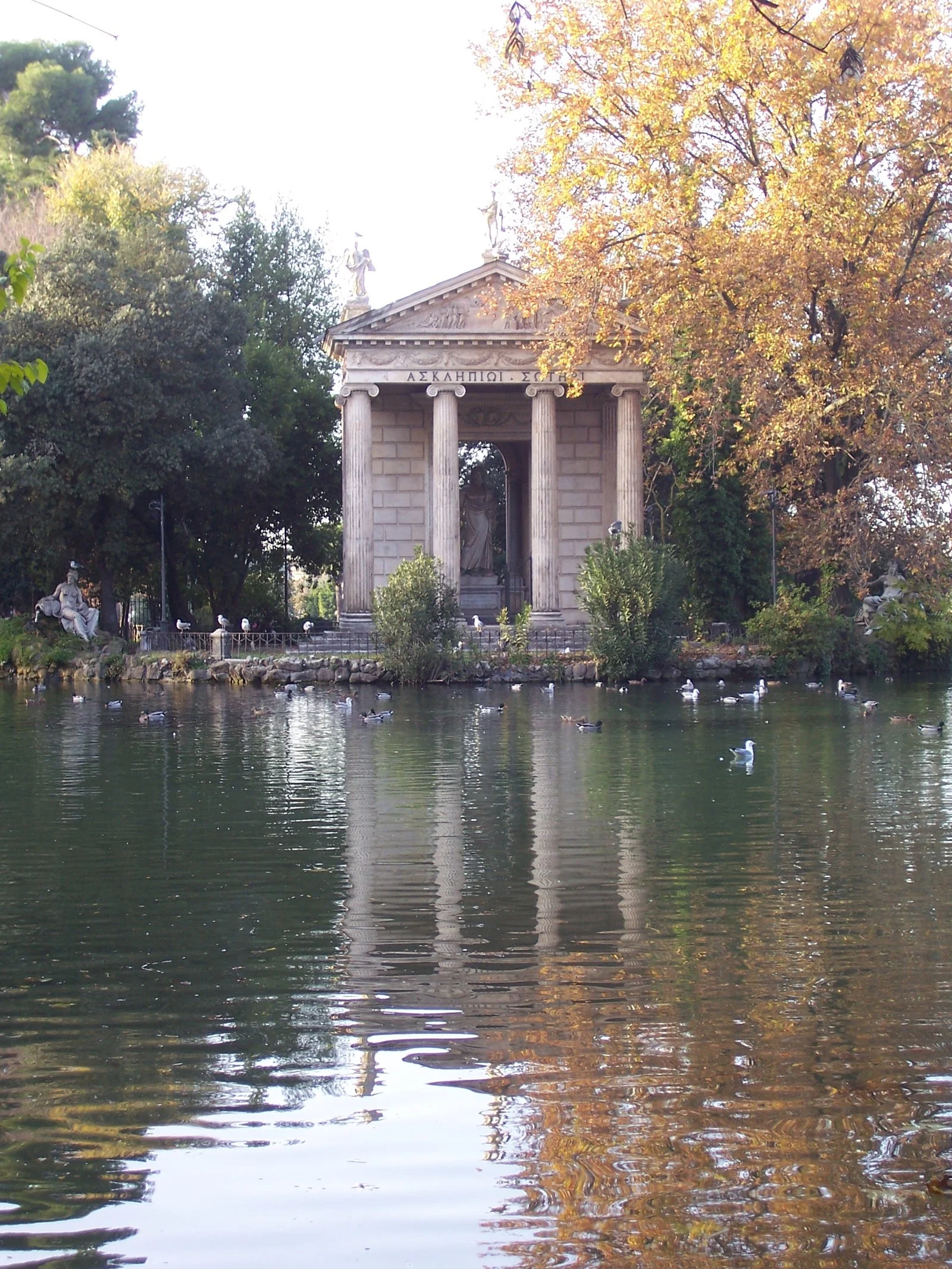
Villa Borghese is the kids' villa par excellence, because it concentrates in 80 hectares the Bioparco, the Museo di Zoologia, the Casina di Raffaello, the Casa del Cinema, a historic puppet theater on the Pincio, bicycle and rickshaw rental and, above all, the small lake of the Giardino del Lago with its rowboats. The lake has at its center the neoclassical little temple dedicated to Aesculapius, and the rowing crossing is one of those experiences kids remember more than the Sistine Chapel. The rental is paid on the spot for a turn of limited length, on the order of 20 minutes, and the service depends on weather and season: rate and hours should be asked directly at the kiosk, because they change over time and no online source updates them reliably.
The Casina di Raffaello
The Casina di Raffaello is the City of Rome playroom inside Villa Borghese, at Viale della Casina di Raffaello 19, and runs workshops divided by band: 18 to 36 months, four to five years, six to 10 years and 11 to 14 years. In the period between September 1 and October 31, 2026 it is open Tuesday to Friday from 10:00 to 18:00 and on Saturday, Sunday and holidays from 10:00 to 19:00, closed on Monday. The activities, which include animated readings, hands-on workshops and music sessions, have limited places and their own calendar: the program should be consulted beforehand, because it is not a permanent free-entry space but a schedule of appointments.
Villa Doria Pamphilj, the biggest park
Villa Doria Pamphilj is the largest public park in Rome, about 180 hectares on the Janiculum, and it is the right place when you need real space: huge lawns, a lake with turtles, very long tree-lined avenues, play areas. It is frequented mostly by Romans, which keeps it quiet even in the months of peak tourist crowds. The limit is its position, outside the circuit of central transport: you get there by bus and the walk from the main entrance to the heart of the park is not short. On the other hand, an afternoon here is worth three museums in terms of general mood.
Villa Torlonia, Villa Ada, Villa Celimontana
Villa Torlonia, on Via Nomentana, is the densest in surprises: the Casina delle Civette, the Casino Nobile, the underground bunkers, Technotown, a play area and a bar with outdoor tables. Villa Ada, in the north quadrant, has a small lake, wooded paths and routes for biking, and is one of the few Roman villas where you really feel outside the city. Villa Celimontana, on the Celian Hill, is small, shaded and a short walk from the Colosseum: it's the place to take kids to let off steam after the visit to the amphitheater, and its play area saves many days. Villa Sciarra, on the side of the Janiculum toward Trastevere, adds fountains, statues and aviaries in a compact space.
Ancient Rome told to kids under 12
Ruins work with children only if someone explains what happened inside them: a wall is a wall, but a grandstand where 20,000 people were screaming is something else. The difference between a successful visit and a failed one, in archaeology, is almost all in the story and the length.
Colosseum, Roman Forum and Palatine
The Colosseum is the only ruin that explains itself even to a six-year-old, and it remains the stop with the best ratio of effort to payoff. The ticket is a single one for the Colosseum, the Roman Forum and the Palatine, and access to the amphitheater is by booked time slot: buying online in advance is not an optimization, it is the only way not to spend two hours in line. Rates and formulas change fairly often and should be checked on the official site of the Parco archeologico del Colosseo, which also manages the free admissions provided by law for minors.
The Circus Maximus, which kids need explained
The Circus Maximus today is a big elongated lawn, and without an explanation it disappoints. Explained as the track where chariots raced in front of an enormous crowd, with the turns where the carts flipped over, it becomes the place where kids start running on their own along the spina. It is free, open, with no barriers, and works as a natural link between the Aventine and the Palatine. Not far away, the Baths of Caracalla offer very tall walls and grand spaces that work well with kids, especially if you tell them it was a gigantic public swimming pool with a library and a gym.
Ostia Antica, the whole city
Ostia Antica is probably the archaeological visit that works best of all with kids, and almost nobody puts it in the plan. It is a Roman city preserved with streets, shops, insulae, public baths with mosaics and a theater where you can sit: instead of imagining, you walk inside. You get there from Porta San Paolo station, next to the Piramide stop of metro line B, with the urban train for Lido, and the trip takes half an hour. The area is vast and largely without shade, so you need water, a hat and a choice of a morning that isn't scorching. Next to the archaeological area is the medieval village with the castle, which adds a second chapter to the day.
The Aventine: the keyhole and the Bocca della Verità
The Aventine packs into half a kilometer three things that all work with kids, and that you do on foot one after another in an hour and a half without paying anything: a hole you look through, a garden with a view and a marble face that bites hands.
The keyhole
The keyhole is in Piazza dei Cavalieri di Malta, on the door of the Villa del Priorato di Malta, seat of the Order of Malta. Looking through the keyhole you see the tree-lined path of the garden framing exactly the dome of St. Peter's at the end of the perspective: an effect children find magical, because it is literally a telescope hidden inside a door. Looking costs nothing and the door is on a public street, but there is almost always an orderly line, longer at sunset when the light is better and organized groups concentrate. The inner garden is not freely visitable: any openings are managed by the Order and should be checked directly with its secretariat, not taken for granted.
The Giardino degli Aranci and Santa Sabina
A few steps away, the Orange Garden, officially Parco Savello, is a tree-lined rectangle with a panoramic terrace over the whole city and a lawn where kids can play while the adults look at the Tiber. It is free and open to the public with hours that vary with the season, longer in summer. Next to it, the basilica of Santa Sabina keeps the fifth-century wooden door with one of the oldest known depictions of the crucifixion: for kids it can be offered as a hunt for the right panel among the 18 that survive, which works much better than a frontal explanation.
The Bocca della Verità: what to really expect
The Bocca della Verità is under the portico of the basilica of Santa Maria in Cosmedin, at Piazza Bocca della Verità 18, and is a large marble disk with a bearded face and an open mouth, almost certainly originally a Roman-era sewer cover or well curb, reused and made famous by the medieval legend that it bites the hand of whoever lies. The legend should be told for what it is, a popular tradition with no historical basis, but with kids that is exactly its strength.
The basilica is open every day from 9:30 to 17:50 and closes only on January 1. What it's worth knowing is that in front of the portico a line forms that in the middle hours can exceed half an hour, because every visitor wants the photo with a hand in the mouth and organized groups queue up in a block. Arriving at opening, or in the last half hour before closing, cuts the wait to a few minutes. The inside of the church, medieval and austere, with its Cosmatesque floor and the tallest Romanesque bell tower in Rome, deserves to be seen regardless of the mask.
Catacombs with kids: which ones hold up and which don't
The Roman catacombs can only be visited with a guide, in a group, along lit underground routes, and this is the first fact to consider: you can't leave early, you can't run ahead, you can't change pace. With a four-year-old it's a problem. With a nine-year-old, almost always, it's the high point of the trip.
How a catacomb visit works
The ticket always includes the guide, groups leave at staggered times and the visit lasts on average 40 minutes. The temperature in the galleries stays around 15 degrees all year, which in August is a relief and in January calls for a sweatshirt. The routes are narrow, with stairs and uneven floors: the stroller does not go in and must be left on the surface, so with a small child you need a sling or a baby carrier backpack.
The Catacombs of San Callisto
The Catacombs of San Callisto, at Via Appia Antica 110, are the largest among those open to the public, with a network of galleries that comes close to 20 kilometers on several levels. They are open from 9:00 to 12:00 and from 14:00 to 17:00, with weekly closing on Wednesday: the last morning visit leaves at 12:00 and the last afternoon one at 17:00. The complex is also closed on January 1, Easter Sunday and December 25, and every year observes a winter closing period of a few weeks between January and February, whose exact dates should be checked on the site because they change from year to year. Visits leave every half hour and last about 40 minutes.
The full ticket costs €10, the reduced ticket €7 and applies to children from seven to 16 years, school groups, university students of related subjects up to 25 years and religious personnel. Children up to six years inclusive get in free. The site requires online booking and groups must have at least two people.
San Sebastiano, Domitilla and Priscilla
The Catacombs of San Sebastiano, at Via Appia Antica 134, have a specific advantage with kids: besides the galleries you visit three pagan mausoleums of the second century with original frescoes and stucco, that is, little painted houses of the dead, much more readable than a corridor of empty burial niches.
The Catacombs of Domitilla, in the Sette Chiese area near Garbatella, are the most extensive in overall development, with four stacked levels and more than 12 kilometers of galleries, and have the particular feature of preserving a semi-underground basilica inside. The hours are 9:00-12:00 and 14:00-17:00 with closing on Tuesday, the full ticket costs €10 and the reduced €7 for minors between seven and 16. Next to the entrance there is a small museum with finds from the city's Christian hypogea. The Catacombs of Priscilla, on Via Salaria, are the closest to the north center of the city and preserve very ancient frescoes, including a female figure with a child often cited as one of the oldest known Marian images.
When it's better to give up
With children under six, and in particular with children who are afraid of the dark or of tight spaces, the catacombs should be skipped without regret: the group doesn't stop, the route is long and going back alone is not possible. As an alternative, for the same dose of underground with far less claustrophobia, the basilica of San Clemente works well, where you descend through three stacked levels of 2,000 years of city until you hear the water flowing, and so does the Stadium of Domitian under Piazza Navona, where you see the foundations of the arena that gave the square its shape.
The spooky places kids like
Between ages eight and 15 there is a category of places that almost always works, and that family guides tend to avoid: macabre spots. Rome has several, all authentic and all visitable.
The Capuchin crypt
The Museo dei Frati Cappuccini, on Via Veneto, includes the famous ossuary crypt, five small chapels decorated with the bones of thousands of friars arranged in ornamental patterns: rosettes made of vertebrae, arches of femurs, chandeliers of bones. The effect on a kid is guaranteed, and the message the friars left engraved at the entrance, an explicit memento mori, opens interesting conversations. Photography is forbidden inside, which paradoxically helps concentration. With very small or particularly impressionable children it is better to avoid it.
The Mamertine Prison
The Mamertine Prison, at the foot of the Capitoline Hill, is the state prison of ancient Rome, an underground cell into which the condemned were lowered through an opening in the ceiling. It is small, takes little time to visit, and is exactly the kind of concrete and cruel place kids remember. It is a short walk from the Forum and the Altare della Patria, so it fits easily into a day already set around the archaeological center.
The Domus Aurea and Nero's tunnels
The Domus Aurea, Nero's palace buried under the Oppian Hill, can only be visited by reservation, with a helmet on your head and a guide, through a permanent restoration site: you walk in underground rooms, cold and damp, and on some days the visit includes a virtual reality reconstruction of the halls as they were in the first century. It is spectacular and not suitable for the very small. Openings are limited and change, so the official calendar should be checked well ahead: it is one of the Roman places where showing up without a reservation means staying outside.
Castel Sant'Angelo and the Wax Museum
Castel Sant'Angelo is the safest choice of all for the eight-to-12 group: it is a real castle, with a helical ramp, prisons, an armory, a covered passage toward the Vatican and a terrace at the top with a view over all of Rome. It works even with those who get bored in museums, because you climb, you descend and you explore instead of looking at display cases.
Amusement parks and theme parks: one in the city, two outside
Of the three parks that parents ask about most often, only one is inside Rome: the other two require a car or an organized transfer, and this changes the planning of the day completely.
Luneur Park, inside the city
Luneur Park has its entrance at Via delle Tre Fontane 100, in EUR, and is the oldest permanent amusement park in Italy, born in 1953 and relaunched in 2016 with an approach completely different from that of the big theme parks. The substantial difference is the height threshold: here most rides admit children from 80 or 90 centimeters if accompanied by an adult, and several attractions also have a maximum height, that is, they exclude kids who are too tall.
You get there on metro line B, stops EUR Palasport or EUR Fermi, with a walk of about 10 minutes, or with the surface lines 31, 671, 707, 714 and 791. On tickets there are two logics: entry only, with single rides paid as you go through the park's internal currency, and the unlimited rides formula. Rates and opening calendar change by season and include summer evening openings and winter themed setups: they should be checked on the park's official calendar before leaving, because in the cold months opening may be limited to some days of the week.
Cinecittà World: outside Rome, toward Castel Romano
Cinecittà World is not in the city of Rome, but on Via Irina Alberti, in Castel Romano, in the southern part of the municipal territory, about 20 kilometers from the center. It is the theme park dedicated to cinema, opened in July 2014, and today also includes Roma World, dedicated to ancient Rome, and the water section Aqua World. By car you leave the Grande Raccordo Anulare at exit 26 toward State Road 148 Pontina, continuing to the Castel Romano exit.
For those without a car there is a dedicated shuttle that leaves from the EUR Palasport metro station, on line B, with a single departure at 10:30, at a cost listed as €5 each way, bookable online and with limited seats and priority to those who bought in advance. These are three serious constraints: a single departure time, limited numbers, advance purchase. Before building the day around the shuttle it's worth checking on the official site that the service is running on the chosen date, because it follows the park's seasonal calendar.
On heights, which is what decides if the day works: Altair, the flagship roller coaster, requires at least 140 centimeters and admits at most 195. Inferno, the dark coaster, starts at 110 centimeters with mandatory accompaniment under 140. With a six-year-old who is 1.10 meters tall, a good part of the big attractions stays out of reach: it's a fact to know before spending on the ticket.
Zoomarine: outside Rome, toward the sea
Zoomarine is not in Rome, but in Torvaianica, in the municipality of Pomezia, about 30 kilometers from the capital toward the coast. It is a park that combines the zoological part, with more than 400 animals and about 40 species, with the water part with pools and slides, and a prehistoric-themed area. You get there by car along Via Pontina or Via Cristoforo Colombo toward the sea. By public transport the connection is not direct and requires at least one change, so the car or an organized service remains the realistic solution.
The deciding point is the calendar: it is a highly seasonal park, with the water part open only in the warm months and closing days in the cold months, plus themed events that change the hours. The calendar and rates should be checked on the official site for the exact date, because showing up on a closing day is a frequent mistake. Another aspect should also be said plainly: it is a facility with dolphins in tanks, and this is a topic on which positions legitimately differ. It's worth knowing beforehand, and not discovering it in front of the show.
Strollers, public transport and sampietrini
Rome is a complicated city for strollers, and it's better to know it before arriving than to discover it the first afternoon with a sleeping child and a staircase ahead. The problem is not the historic center itself, which is almost all flat, but the paving and the width of the sidewalks.
Sampietrini and the right wheels
Sampietrini are the basalt blocks that pave much of the center, and they are irregular surfaces with wide joints: a light city stroller, with small rigid wheels, vibrates to the point of waking a sleeping child and tiring whoever is pushing. If you have the choice, fit in your suitcase a stroller with big wheels and suspension, or seriously consider the sling or baby carrier backpack for days in the center.
Subway, elevators and escalators
The Rome subway network has three lines, A, B and C, and not all stations have working elevators at all times. The stations of line C, the newest, are fully accessible. Those of line A, the oldest, are the most problematic, and some central stops have only stairs. Information on the status of the equipment is published by the transport company and is worth checking on days when your route really depends on the elevator. In the cars there is room for the stroller outside rush hours, while between 8 and 9:30 and between 17:30 and 19 the situation becomes difficult.
Buses, trams and the choice to walk
City buses accept strollers through the middle door and have a dedicated space, but frequency is irregular and in traffic hours a three-kilometer trip can take 40 minutes. Trams, in particular the lines serving Trastevere, the San Lorenzo neighborhood and the north area, are often faster and more comfortable.
Where to change, where to nurse, where to find a restroom
This is the information missing from every guide, and with a child under three it determines the day more than the cultural program. Rome, on this front, has improved but remains uneven: the new facilities are equipped, the historic center much less.
Museums and equipped facilities
Explora is the place in Rome best designed for the very small, with spaces for changing and nursing, and the same goes for recently built or fully renovated facilities: the MAXXI, the Bioparco, the big theme parks. Among civic and state museums the situation varies a lot from site to site, and in historic palaces space for a changing table often simply doesn't exist. The practical rule that works in Rome is to use the big stops as logistic bases: you change and nurse where you have just entered, before setting off again, instead of counting on what you'll find on the street.
Nursing in public
Nursing in public in Rome is not a problem, legally or socially: it's done in parks, on benches, in cafés, in churches, and nobody intervenes. Those who prefer a sheltered setting find in the historic villas plenty of shaded, secluded benches, and in churches a quiet and a temperature that in summer are a relief. The major basilicas, which are huge and cool, work in practice as climate shelters in the middle hours of July and August.
Water: the fountains
Rome has about 2,500 public cast-iron fountains, called nasoni for the shape of their curved spout, which supply running, free drinking water throughout the city. They are the solution to one of the costliest problems of the Roman summer with kids: you walk around with a water bottle and fill it everywhere. The trick every Roman knows is to plug the lower hole of the spout with a finger, so the water comes out of a small upper hole forming a jet you can drink from without bending down. For kids, being shown it the first time is as good as a monument.
Eating with kids without drama
The problem of eating in Rome with small children is not the quality of the food, which is high and as suited to children's tastes as few other cuisines, but the timing. Italian kitchens open for lunch around 12:30 and close around three, reopening in the evening around half past seven or eight. A four-year-old who is hungry at six in the afternoon, in a traditional restaurant, finds the doors closed.
Pizza al taglio, the real solution
Pizza al taglio is the Roman institution that solves the problem: you find it in every neighborhood, it is open continuous hours, you buy it by weight indicating the portion you want, you eat it standing or walking, it costs little and every kid in the world likes it. The basic version, pizza bianca with salt and oil, is the Roman snack par excellence and is taken away in a napkin. For a visiting family it is, very concretely, the tool that lets you not plan meals with Swiss precision.
Trattorias and restaurants: how to choose
Roman trattorias are generally welcoming with children: the high chair is not guaranteed everywhere but is frequent, and a pasta with tomato sauce or plain butter is prepared without discussion even if it isn't on the menu. The traditional dishes that work best with the youngest are pasta cacio e pepe, which is simply cheese and pepper, and meatballs. What often doesn't work are the quinto quarto dishes, that is, offal, which remain an important local specialty but rarely meet children's taste.
The neighborhood markets
Covered markets are an excellent idea for lunch with kids: you eat at flexible hours, choose among different stalls and the little ones can watch the fish, the fruit and the cheeses while you wait. The Nuovo Mercato Testaccio, in the neighborhood that is also the cradle of Roman popular cooking, is the best suited: it is modern, covered, with food stalls and tables, and is a short walk from Monte dei Cocci and the former Mattatoio. Testaccio, for a family, is a much more manageable neighborhood than the monumental center.
Gelato and the picnic
Artisanal gelato in Rome is a very powerful bargaining chip in negotiations with tired kids. The picnic, finally, is the move Romans have always made: you buy pizza bianca, mortadella, fruit and water, go up to a villa and eat on the lawn. At Villa Pamphilj, at Villa Ada or on the Janiculum it costs a fraction of a restaurant lunch and kids can get up from the table whenever they want, which is exactly the point.
Frequently asked questions about Rome with kids
What is the best museum in Rome for small children?
Explora, the Children's Museum of Rome, at Via Flaminia 82, is the only Roman museum designed entirely for childhood and remains the best choice between ages two and seven. It is visited in fixed-time shifts of an hour and 45 minutes, Tuesday to Sunday, with limited places and online booking strongly recommended. The ticket costs €12 from three years up and for adults, €8 between 12 and 36 months, and is free under 12 months.
How much does the Bioparco di Roma cost and who gets in free?
The Bioparco di Roma costs €19 for the full fixed-date ticket and €14 for the reduced one, which applies to children taller than one meter up to age 10 and to anyone aged at least 65. Children who do not exceed one meter in height get in free, because the criterion is height and not age. There is also a last-minute rate at €9 in the two hours before closing, and an open ticket valid six months at €20.
Are the catacombs of Rome suitable for kids?
The catacombs of Rome are visited only in a group with a guide, along underground routes of about 40 minutes, and work well roughly from age eight up. Under six they are not recommended: you can't leave early, the corridors are narrow and dark and there are no restrooms along the route. At the Catacombs of San Callisto the full ticket costs €10, the reduced €7 from seven to 16 years, and up to six years you get in free.
Is Technotown at Villa Torlonia suitable for small children?
Technotown, the technology playroom of the City of Rome inside Villa Torlonia, now explicitly addresses an audience aged 12 and up, so it is not the right choice for elementary school children. It is open Tuesday to Sunday from 9:30 to 19:00, closed on Monday, and the ticket costs €1 at the ticket office. The activities require no booking and are followed in order of arrival. For the youngest, in Villa Borghese, the Casina di Raffaello offers workshops starting from 18 months.
Are Cinecittà World and Zoomarine inside Rome?
No: neither Cinecittà World nor Zoomarine is in the center of Rome, and for both you need to plan a trip out of town. Cinecittà World is in Castel Romano, about 20 kilometers from the center, reachable by car from exit 26 of the Raccordo or by a shuttle that leaves from the EUR Palasport metro at 10:30 for €5 each way, with limited seats. Zoomarine is in Torvaianica, in the municipality of Pomezia, about 30 kilometers away, and realistically can be reached only by car.
Is it easy to get around Rome with a stroller?
Rome is a difficult city for strollers in the historic center, where sampietrini and narrow sidewalks make the route tiring, while it is very comfortable in the historic villas and in modern neighborhoods like EUR. The solution most used by families is mixed: sling or baby carrier backpack among the monuments, stroller in the parks. On the subway, elevators are not guaranteed at all stations, especially on line A, so it's better to check the route beforehand.
How much does it cost to see the Bocca della Verità?
The Bocca della Verità is under the portico of the basilica of Santa Maria in Cosmedin, at Piazza Bocca della Verità 18, and the basilica is open every day from 9:30 to 17:50, closed only on January 1. The real cost is time: in the middle hours the line for the photo with a hand in the mouth can exceed half an hour, because organized groups queue up in a block. Arriving right at opening or in the last half hour cuts the wait to a few minutes.
What can you do in Rome with kids when it rains?
When it rains, Rome offers several indoor alternatives that work well with kids: Explora, the Museo Civico di Zoologia inside Villa Borghese, the Planetarium in EUR with its shows under the dome, the Centrale Montemartini with its ancient statues among the diesel engines, the Domus Romane di Palazzo Valentini with its multimedia reconstructions and the underground levels of the basilica of San Clemente. The catacombs, being entirely underground, are also indifferent to the weather.
How many days do you need to visit Rome with kids?
With kids, three full days in Rome are the reasonable minimum and four or five are decidedly better, because the pace has to be cut in half compared to a trip among adults. The one rule that saves vacations is a single stop with a ticket and a line per day, plus at least two hours in a park. Squeezing the Colosseum, the Vatican Museums and the historic center into 48 hours, with children under 10, almost always produces a final day ruined by tiredness.
Anyone who works with groups and accompanies families visiting Rome knows how much the difference weighs between an itinerary designed around the age of the participants and one built only around monuments: on tourleaderpro.com you will find tools, materials and professional reflections dedicated precisely to those who lead groups and families in the field, from managing time to choosing the stops that really hold up with kids.
Anyone organizing a trip to Italy on their own, and wanting to fit Rome with kids into a broader itinerary among art cities, sea and countryside, will find on italyplanner.com practical planning guides, with real distances, travel times and advice on how much to slow down when traveling with children.