Luneur Park
In short. Luneur Park is the amusement park of EUR, on Via delle Tre Fontane, and at the same time it is the oldest permanent park in Italy: its first core dates to 1953, and since then, with a name changed along the way and eight years of…
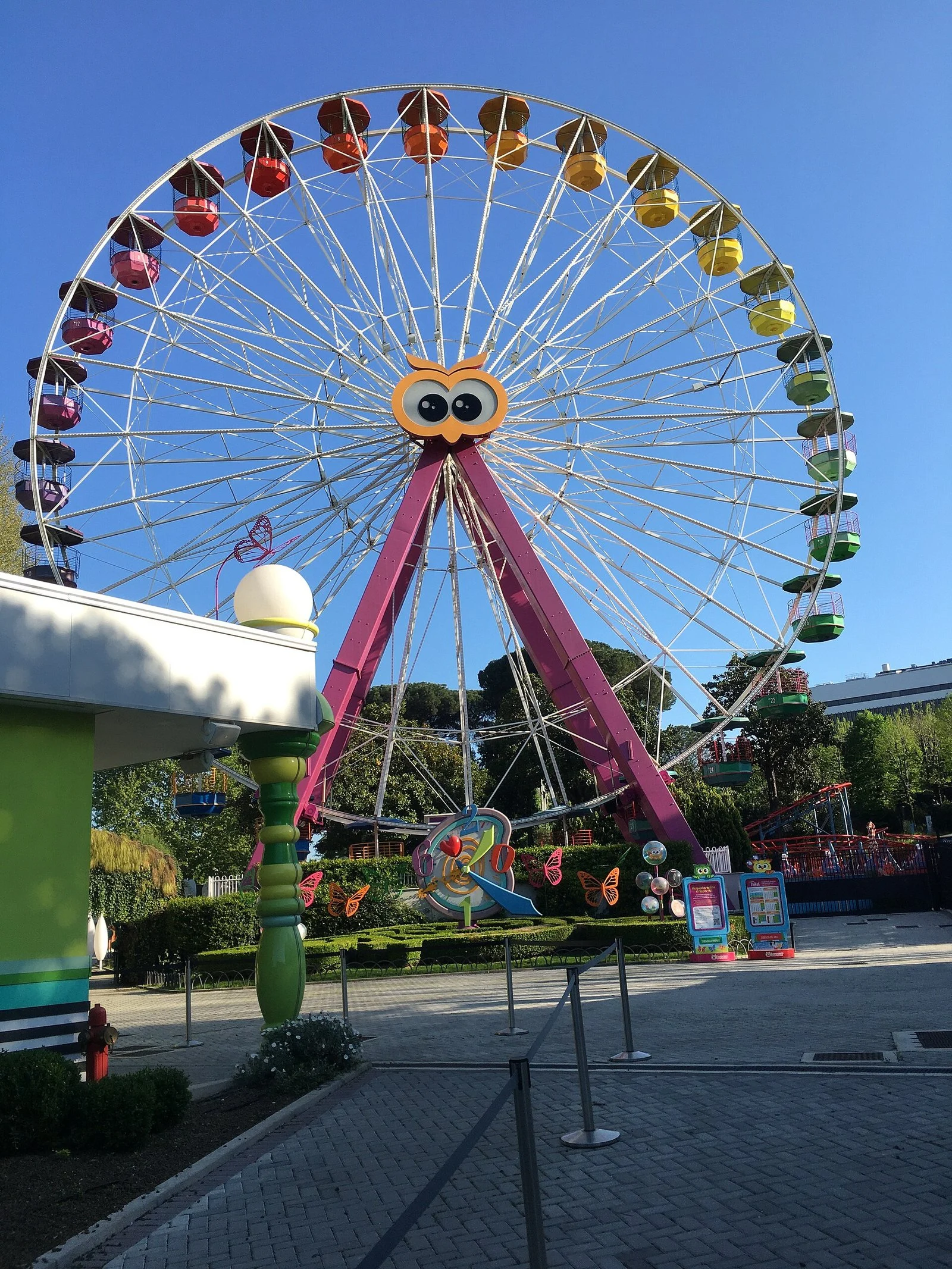
Luneur Park is the amusement park of EUR, on Via delle Tre Fontane, and at the same time it is the oldest permanent park in Italy: its first core dates to 1953, and since then, with a name changed along the way and eight years of closure in between, it has occupied the same piece of the city. For two generations of Romans the LunEur was simply the luna park, with the Ferris wheel visible from Via Cristoforo Colombo and the noise of the rides reaching right into the buildings of the area. Then, on April 19, 2008, it closed. It stood idle for years, with the rides dismantled and the structures under tarps, while the announced works did not start. It reopened on October 27, 2016 with a new name, Luneur Park, and above all with a completely different formula: no longer the park for teenagers in search of thrills, but a park designed for small children and families, built inside a garden with hundreds of plant species and tree-lined paths. This, more than the rides, is what sets it apart today from all the other parks in the Rome area. The lines that follow tell how it was born, why it ended up in the collective memory of the city, what happened during the years of abandonment, how it changed with the reopening, what the areas and attractions are today, and how to really organize a visit, taking into account that it is a seasonal park with an opening calendar that keeps changing.
Where Luneur Park is and how to get there
Luneur Park has its entrance at Via delle Tre Fontane 100, in the Europa district, the one everybody calls EUR, in Rome's Municipio IX. The park area lies between Viale della Pittura, Viale dell'Industria, Viale dell'Artigianato and Via delle Tre Fontane, in a block that borders the Parco degli Eucalipti and is a short distance from the Palazzo dei Ricevimenti e dei Congressi, the building that Romans call the Palazzo dei Congressi. It is not a peripheral location as one might think: EUR is served by the metro, is crossed by Via Cristoforo Colombo and has wide avenues that make it much easier to get around by car than the rest of the city.
By metro
Metro line B serves EUR with three closely spaced stops. The park's official directions give EUR Palasport and EUR Fermi as the reference stops, with a walk on the order of 10 minutes to reach the entrance. Those traveling with small children should allow for the fact that 10 minutes of EUR avenues, under the July sun or in the rain, is a real stretch: the sidewalks are wide and comfortable for strollers, but shade is not guaranteed along the whole route. Those coming from Termini take line B toward Laurentina, with a trip from the center that takes about half an hour, waiting times included. It is worth remembering that line B splits into two branches to the north, but to the south, in the direction that matters for EUR, the route is single and no mistakes are possible.
By bus
The surface lines the park indicates are 31, 671, 707, 714 and 791, with stops on Viale dell'Arte or along the Colombo at the height of Via delle Tre Fontane. Routes change because of roadworks and detours, so it is best to check the line before leaving: the 714 is often the most direct solution, because it links Termini to EUR via San Giovanni.
By car and where to park
EUR is reached from the Grande Raccordo Anulare by exiting at EUR and going down Via Cristoforo Colombo. The park declares the presence of free parking inside its own area: it is a condition to verify at the time of the visit, because on days of heavy attendance and during special events the spaces can run out quickly and the alternative becomes street parking in the neighborhood's roads. EUR, unlike the historic center, has no limited traffic zone on its main avenues, which makes the car a workable choice for those coming from outside Rome with children, car seats and strollers in tow.
On foot from the rest of EUR
Those who have already organized a day in EUR can reach the park on foot from several points of the district. From the EUR lake you walk along tree-lined avenues in a good 10 minutes, from the Square Colosseum, that is, the Palazzo della Civiltà Italiana, the route is a bit longer but all flat, and from the Basilica of Saints Peter and Paul you come down across the upper part of the district. It is a smart way to build the day: EUR is not a district you visit in an hour, and putting the park at the end of a morning of Rationalist architecture works much better than making the trip just for the rides.
What Luneur Park is today: a park for small children, not an adrenaline park
The point to clarify right away, before anything else, is that the Luneur Park reopened in 2016 has almost nothing in common with the LunEur that Romans remember. Those who arrive expecting roller coasters, the free-fall tower or the high-impact attractions found in the other parks of Lazio will be disappointed, and are right to be: that park no longer exists and was not rebuilt. The owner of the area, EUR S.p.A., and the company that won the concession deliberately chose a different positioning, what in the industry is called a family park, that is, a park calibrated for a low age range, indicated by the management itself as children from zero to 12, and on the idea that the adult accompanies the child instead of looking for a strong attraction of their own.
What it means in concrete terms
It means that almost all the rides have a low minimum height, often 80 or 90 centimeters if the child is accompanied by an adult, and that several attractions also have a maximum height, that is, they exclude kids who are too tall. The Magicirco, for example, is listed by the park with a minimum of 80 centimeters and a maximum of 150: a 12-year-old who has grown a bit can't get on. The Piccolo Safari has a maximum of 130 centimeters, the Banzai a maximum of 145. It is exactly the opposite of the logic of traditional parks, where the height limit serves to exclude the smallest. Here the limit, in several cases, serves to protect the experience of the smallest.
The Lunalire system
The park's attractions work with a system of virtual tokens called Lunalire: each ride has a cost expressed in Lunalire, ranging from 3 for the simplest attractions to 6 for the Ferris wheel and the skating rink. Those who buy an entry-only ticket then pay for individual rides in Lunalire, while those who buy the unlimited-rides option don't need to count them. It is a mechanism worth understanding before reaching the ticket window, because the difference between the two options completely changes a family's final bill: with very small children, who will take three or four rides in all and spend the rest of the time on the lawn, the pay-as-you-go option may make sense. With a child of six or seven who wants to ride everything, the unlimited option is almost always the rational choice.
The LunEur of EUR: how it began in 1953
The date that matters is 1953, not 1960. The first core of the luna park was born in 1953 on the initiative of the Ente Autonomo Esposizione Universale di Roma, the public body that managed the areas of EUR, on the occasion of the International Agriculture Fair held in the district. It wasn't meant to last: it was a temporary installation, an amusement park set up to accompany a trade fair, as were put up all over Europe in those years. The difference is that this one was not taken down.
A district still under construction
EUR had been born as the site of the 1942 Universal Exposition, never held because of the war, and had remained for years an interrupted construction site, with monumental buildings left half finished and roads laid out in the middle of the countryside. The construction of the district was completed only at the end of the 1950s, the official transformation of the area into a district of Rome came with a resolution in 1961 and the name Europa was assigned in 1965, without anyone ever stopping saying EUR. The luna park, therefore, arrived in a part of the city that was still being invented.
The carnival ride operators who founded it
Among the carnival ride operators who contributed to the 1953 initiative, Adalberto Mirabito and Antonio Frezzato are remembered, together with Gino Guglielmi and Ornella Preziotti. These last two names mean little to most people, but they are the maternal grandparents of Virginia Raffaele: the actress grew up inside the LunEur, where her parents ran the shooting gallery and the goldfish stall, and from that childhood she drew material for her theater work. It is a detail worth keeping in mind because it tells the nature of the place: not a park built by an entertainment company, but an aggregation of families of ride operators, each with its own attraction, who had settled on public land and built a trade and a life there.
From temporary installation to permanent concession
The success of the 1953 initiative convinced the body to make permanent what was supposed to be temporary. The concession of the area for the luna park to become permanent came in connection with the Games of the XVII Olympiad, that is, the 1960 Rome Olympics, which brought to EUR the Palazzo dello Sport, the Velodrome and a season of public investment without precedent for the district. Here we must be precise, because a simplified and wrong version circulates on this point: the park was not born for the 1960 Olympics. It was born in 1953 for an agricultural fair, and the Olympics were the occasion on which its presence was consolidated and made stable. Some sources indicate that the permanent concession was formalized in the years immediately after 1960, and on the detail of the exact year of the concession the reconstructions do not entirely agree.
Why it is called that
The name LunEur is the contraction of luna park and EUR, written for decades exactly like that, with the capital in the middle. After the 2016 reopening the official spelling became Luneur Park, all lowercase after the initial L, with the addition of the word Park. Many Romans continue to say the LunEur, and when they say it they almost always mean the park of before, the one with the roller coasters and the pirate ship, not the one of today.
A curiosity about Luneur Park
The most solid curiosity concerns the record: Luneur Park is considered the oldest permanent amusement park in Italy, and is also listed among the oldest in Europe. Roma Capitale, on the page of its tourism portal, defines it as the first Italian amusement park and places it among the top five in Europe. It is a record that depends, however, on how you count things, and it is worth explaining, because it is the kind of claim that gets repeated without ever being clarified.
What exactly oldest means
The record does not concern the age of the idea of the luna park, which in Italy has much older precedents among fairs and traveling rides, but the continuity of a permanent park on a fixed site. In Europe the comparisons are with much older structures: Tivoli Gardens in Copenhagen opened in 1843, and the Prater in Vienna has a history going back to the 18th century as a public area. Hence the expression among the top five, which does not mean founded among the first five in absolute chronological order, but places the park high in the ranking of permanent European parks still in operation.
The eight years that interrupt continuity
There is, however, a detail that nobody underlines when citing the record: between April 19, 2008 and October 27, 2016 the park remained closed. That is eight and a half years of total interruption of activity. From the point of view of the legal continuity of the area and of the concession the story does not break, because the land always remained designated for an amusement park and the tender for the relaunch had already been issued before the closure. From the point of view of those who went there, however, the break is total, and this explains why many Romans speak of today's Luneur as something other than the LunEur of before.
An owl as mascot
The mascot of the reopened park is Luna, a stylized owl. The choice is not random: the owl is the animal that gives its name to the park's entrance square, Piazza delle Civette, and recurs in the internal place names and in those of the refreshment points, like the Civetteria. It is a small system of names built at a desk to give coherence to a park that, before, was simply a jumble of rides rented to different families, each with its own sign and its own style.
Something nobody tells you about Luneur Park
What is almost never told is that the eight years of closure were not eight years of work. They were, for the most part, eight years of nothing. The park closed on April 19, 2008, but the renovation work started only in January 2016: almost eight years in which the area stood still, with the structures abandoned and the Ferris wheel motionless above the district.
The reason for the standstill
The reason, according to the journalistic reconstructions of the time, was a dispute with the previous management, which for years prevented the new concessionaire from entering the area. In December 2007 EUR S.p.A., owner of the land, had issued a tender to renovate and relaunch the park to international standards. The tender was won in February 2008 by Cinecittà Entertainment, which set up the company Luneur Park for the occasion. Then everything stopped, and in the following years announcements of reopening followed one another, never kept: 2013 was mentioned, then 2015, and each time the date slipped.
What happened to the area in those years
In the meantime the LunEur became one of the symbolic places of Roman urban abandonment, photographed and written about by sites devoted to industrial archaeology and disused places. The idle rides, the vegetation reclaiming space, the faded signs: a precise imagery, which in 2012 ended up in a science fiction short film shot inside the park before the work began, awarded a special mention at that year's Torino Film Festival. It is a detail that says a lot: for a few years the park of rides was more interesting dead than alive, as a set of contemporary ruin.
What was kept and what was not
When the work finally started, the choice was to demolish almost everything and rebuild. Of the historic attractions a limited number were recovered and put back into operation: the Roma Capitale sources speak of six renovated historic attractions, among them the Brucomela, the Jumbo, a horse carousel and the Ferris wheel. Everything else, including the stronger attractions that Romans remember, did not come back. The pirate ship, the tower, the roller coasters: gone. Those looking for them have to look elsewhere, and further on in this page it is explained where.
The Ferris wheel, the piece everyone remembers
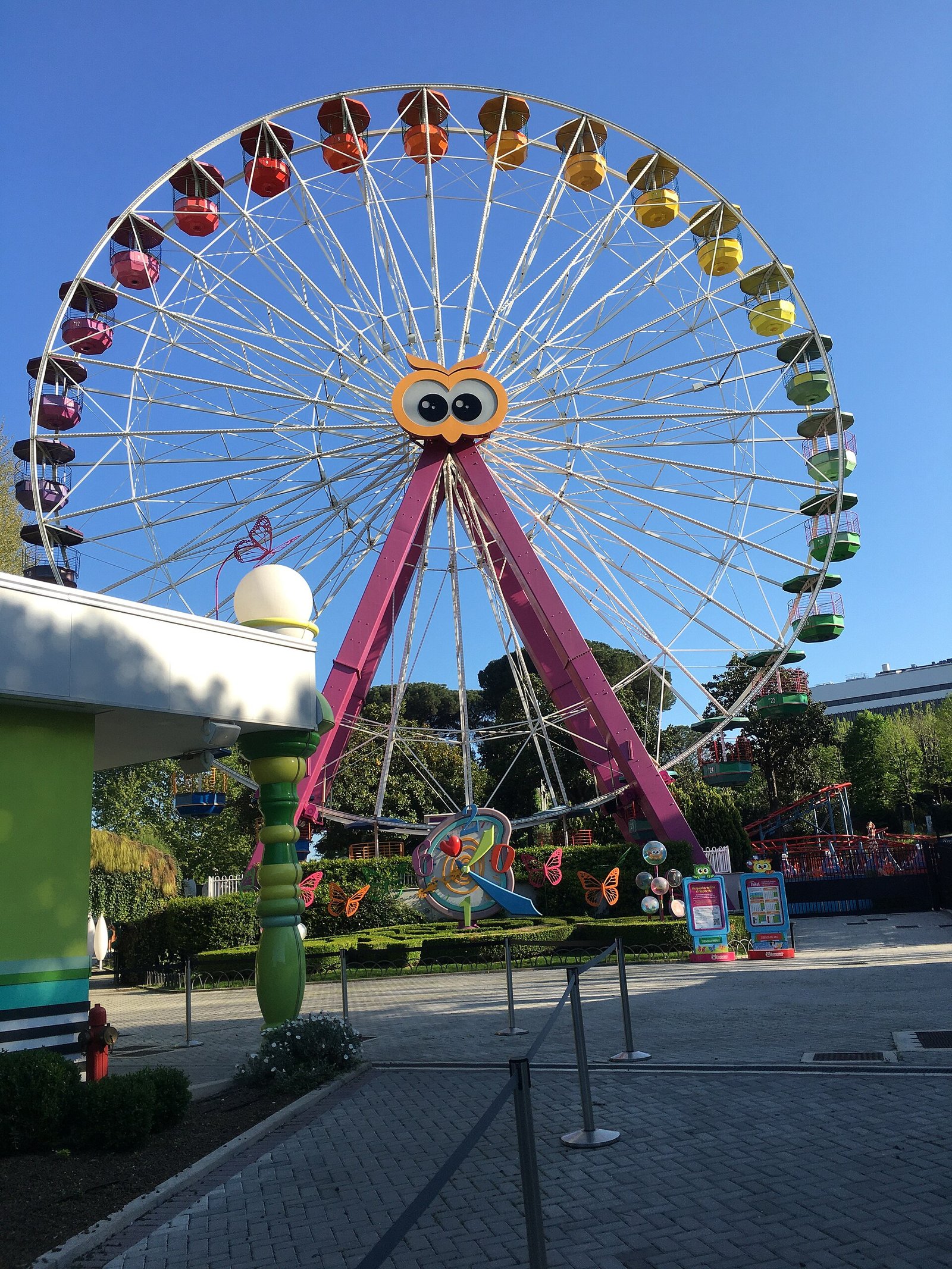
If there is one image that sums up the LunEur in the memory of Romans, it is the Ferris wheel that rose above the trees of EUR, visible from afar to those driving along the Colombo and recognizable in the evening when it was lit. It is the attraction that was kept and put back into operation, and it is the one the park uses as its graphic symbol.
When it started turning again
The park reopened on October 27, 2016, but the Ferris wheel was not yet operational: it started turning again on December 27, 2016, two months later, and on that occasion the ride was offered free for a few days. The gap between the two dates is not a bureaucratic detail: putting back into service a Ferris wheel that had stood idle for eight years requires structural checks, tests and certifications that can't be improvised, and it is reasonable to think that the work on the wheel simply took longer than that on the rest of the park.
What it is like
The Roma Capitale page describes a wheel with 28 colored gondolas. The park classifies it among the most expensive attractions in Lunalire, 6, at the same level as the skating rink, and sets for the ride a minimum height of 90 centimeters with an adult and 150 centimeters to ride alone. It is a rule worth reading carefully: a child of 90 centimeters can ride, but only accompanied, and a kid who doesn't reach a meter and a half can't take the ride alone even if old enough to want to.
What you see from above
From the top of the wheel a view of EUR opens up that you can't get from any other accessible point of the district: the straight avenues, the bulk of the Palazzo dei Congressi, the crowns of the trees of the Parco degli Eucalipti and, on clear days, the distant profile of the city to the north. It is not the postcard Rome of domes and rooftops: it is a view onto the Roman 20th century, and that is why it is worth it. Those who visit EUR for architectural interest will find in the wheel the most useful observation point of the day.
Is it the original wheel?
Caution is needed here. The available sources define it as a historic attraction of the park and a historic wheel, and place it among the six attractions recovered from the old LunEur, but none of the consultable sources states precisely the year of construction of the wheel, the manufacturer and the extent of the reconstruction work carried out before the reopening. It is therefore correct to say that the wheel is presented as the park's historic attraction put back into operation, and it is prudent not to claim that it is the same machine from 1953 or 1960 without documentation to prove it.
The advice I give you for visiting Luneur Park
The most useful advice, and also the most boring, is just one: check the calendar before leaving home. Luneur Park is a seasonal park, it is not open every day of the year, and the calendar changes depending on the period, the day of the week and special events. The management itself writes it plainly on its website, warning that hours vary according to season and events and inviting you to consult the updated calendar on the purchase page by choosing the day of the visit. Those who show up at the gate on a Tuesday in November trusting that it is an amusement park in a European capital run a serious risk of finding it closed.
How to read the calendar
The park's sales system works with a calendar in which each individual date is marked as open or closed, with the opening and closing time of that specific day and any special event under way. This means there is no standard schedule to memorize: there is the schedule of that day. It is an honest system, because it avoids publishing generic hours that then don't hold, but it obliges you to check before leaving, especially if you are coming from outside Rome.
Measure the child before paying
The second practical piece of advice concerns height. Since almost all the attractions have a minimum threshold, and several also have a maximum one, a family's real experience depends drastically on how many centimeters the child measures. A child of 80 centimeters accompanied can get on many attractions. Below that threshold the possibilities shrink enormously, even though entry is free. Above 130 or 150 centimeters, on the contrary, some rides close off. The park's website provides a tool that, once you enter the height, shows how many and which attractions are accessible: it is the fastest way to understand in advance if the day is worth the ticket.
The right time of day
With small children the good window is opening time, when the lines are short and the heat hasn't arrived yet. On summer days the park becomes tiring in the middle hours, and there the garden makes the difference compared with other parks: you move into the shade of the trees instead of standing in line on a forecourt. In fall and winter, on the contrary, it is better to aim for the afternoon and stay until the lights come on, because the lit park is a different thing from the daytime one and children perceive it immediately.
Eating inside or bringing lunch
The park has several refreshment points inside, from the café with homemade sweets to offerings of pizza by the slice, hamburgers, first courses and gelato. Families who want to contain costs should find out in advance about the rules on bringing in food from outside, which in amusement parks is almost always governed specifically and may change: better to ask the venue than to take it for granted.
The park's areas and today's attractions
The park is organized into four themed areas, which the official site lists as Piazza delle Civette, Prato delle Girandole, Regno del Saggio Gufo and Terrazza del Sole. They are not themed worlds in the sense of the big international parks, with total scenery and staff in costume: they are rather zones of the garden with a different vocation, connected by paths.
Piazza delle Civette
It is the main entrance and the heart of the park, the zone you reach right after the turnstiles and where the services are concentrated. Here you also find the Dolceria, a small venue devoted to sweets made, according to the park's description, in collaboration with a baker from Trastevere. It is the natural gathering zone: those going with several families together will do well to set the meeting point here, because it is the only landmark everyone has to pass through.
Prato delle Girandole
It is the area devoted to the smallest, the one where the attractions with the lowest height thresholds are concentrated. For a family with a child of three or four it is the zone that takes up most of the day, and it is also the one that makes the park's design choice evident: lawn, trees, rides sized for the child.
Regno del Saggio Gufo
It is the area of the park's most recognizable and symbolic attractions, those that in the communication are called iconic. It is here that the park raises the level slightly for older children, while staying within the limits of a family park.
Terrazza del Sole
It is the food and relaxation area, the one designed for a break. The park's refreshment points are spread over several locations, but it is here that the function of pause is concentrated, with the Gnam Gnam Station Pasta & Grill located, according to the official description, right after the Saggio Gufo and adjacent to the relaxation area.
The attractions, one by one
The list published by the park includes attractions with names made up on purpose, almost all playing on assonance and compound words. There are the Brucomela, which is the caterpillar on rails recovered from the old park, and the Jumbo, the little elephant that spins. There are the Grande Alberone, the Bosco di Maia, the Montesogno, the Torrefronda, all names that evoke the garden theme. Then there are the Banzai, the Barcamatta, the Buffoplano, the Giò Caschetto, the Giocatonda, the Grande Frisbee, the Lunarace, the Magicirco, the Pedalibus, the Piccolo Safari, the King Arthur carousel, the Rock'n'roll, the Spinner, the Sudigiri, the Tififone, the Volasu, as well as the Ferris Wheel and a skating rink. It is useful to know that each attraction has its own cost in Lunalire, generally between 3 and 6, and its own height rules, which the park publishes next to the name.
How many there really are
On the overall number the sources don't agree, and it is best to say so. The list published by the park counts 24 entries. The official site elsewhere indicates 24 attractions. The Roma Capitale page speaks of 21 attractions in all. The Italian encyclopedia entry gives 25, including games, paths, workshops and a cinema. The discrepancy almost certainly depends on what is counted as an attraction: a skating rink, a play area and an educational workshop enter the count in some sources and not in others. In any case the order of magnitude is that: a little over 20.
The Splash Zone
In the warm season the park opens a water area called the Splash Zone, which according to Roma Capitale exceeds 2,100 square meters of water. It has its own calendar, which typically covers the central part of summer and closes in the first days of September, and its own rules distinct from the park's general ones. Those going in summer counting on the water must check that the area is actually open on the chosen day, because the opening and closing dates change from one year to the next.
Another well-known fact, yet rarely mentioned
The well-known fact is that Luneur Park is a garden. The official communication says so, calling the park the Garden of Wonders. The Roma Capitale page says so, speaking of hundreds of plant species and themed paths. Anyone who walks in sees it. And yet almost nobody mentions it when choosing where to take the children, because in everyone's mind an amusement park is a forecourt with rides on it, and the idea that greenery is the main feature doesn't occur.
How much green, really
On the size the sources give different numbers, and it is worth reporting them all instead of picking one. The Italian encyclopedia entry gives an area of 68,000 square meters, that is, about 6.8 hectares. The Roma Capitale tourism page speaks of an area of over 60,000 square meters. The park's own communication goes as far as citing 70,000 square meters of green, that is, seven hectares. The differences are probably explained by what is included in the count: the total area under concession, the area actually open to the public and the green area do not coincide. In any case we are talking about an area between six and seven hectares, which for a park inside the urban fabric of a capital is a lot.
The border with the Parco degli Eucalipti
The park is adjacent to the Parco degli Eucalipti, one of the public green areas of EUR, and this partly explains the quality of the setting: it is not an enclosure planted in the middle of concrete, but a piece of a wider green band that crosses the district and also includes the gardens around the lake. Those arriving on foot from that direction notice it immediately: the passage from the public park to the paid park happens without the landscape changing.
The workshops and the environmental theme
The 2016 reopening brought into the park an educational approach that did not exist in the old LunEur: eco-sustainable workshops, themed paths, activities devoted to biodiversity and environmental education, with an offering aimed specifically at schools. The park sells packages for classes with educational routes, tutors and dedicated time slots. It is a part of the activity that the general public doesn't see, because it takes place on weekdays during the school year, but that weighs on the identity of the venue and explains why the park insists so much on the garden theme.
The garden: what sets Luneur apart from the other parks in Lazio
The question every Roman family asks is which park to choose. In Lazio the offering is broad and the parks are not interchangeable: they have different audiences, different prices and different logics. An honest comparison helps more than any enthusiastic description.
Compared with the theme parks of Lazio
Cinecittà World, on Via Pontina, is a theme park built around cinema, with strong attractions and shows, suitable also for teenagers and adults. Rainbow MagicLand, in Valmontone, is the big theme park of Lazio, with roller coasters and an offering calibrated for a broader and older audience. Zoomarine, in Torvaianica, combines a water park and an area with marine animals, and is a full day out of town. Luneur Park doesn't compete with any of the three on that ground, and it would be foolish to expect it to: it competes on a different ground, that of the kindergartner or the first years of elementary school, for whom the other parks are often too big, too long and too intense.
Compared with the alternatives inside Rome
Inside the city the comparison is with other experiences for children: the Bioparco at Villa Borghese, Explora, the children's museum, the Casina di Raffaello with its workshops, and of course the lawns of Villa Borghese. Compared with all of these, Luneur is the only one that combines real rides with greenery, and it is this combination that explains its positioning: those who want only greenery have in Rome an immense and free offering, those who want only rides find better outside the city, those who want both in one afternoon have essentially this.
Shade, strollers and breaks
There are practical consequences of the park being a garden, and they are the ones families notice most. You walk on tree-lined paths instead of open asphalt, which in July is an enormous difference. There are lawn spaces where a small child can simply be, without waiting in line for something. The stroller moves easily. And the day can be short: two or three hours is a sensible time for this park, while in the big theme parks a three-hour visit is money thrown away.
The right photo to take at Luneur Park
The right photo is the Ferris wheel seen from below, against the light, with the colored gondolas cutting the sky and the crowns of the trees framing the shot from the edge. It is the only image that conveys together the two souls of the place, the luna park and the garden, and it works because the structure of the wheel is geometric while the vegetation around it is not.
Where to stand
It is best to get close to the base of the wheel and shoot upward, accepting the perspective distortion instead of fighting it: the spokes become a radial design and the gondolas distribute themselves around the circle. The best variant lets a branch into the frame in the foreground, so the eye understands that the wheel is inside a wooded park and not on a forecourt.
What doesn't work
The panoramic photo of the park from the top of the wheel doesn't work: it seems the obvious idea and instead almost always yields a confused image, with the kiosk roofs and the paths seen from above with no clear subject. From the top of the wheel it is better, if anything, to photograph EUR, not the park: the Palazzo dei Congressi and the geometry of the avenues are much stronger subjects. And, as in any place frequented by children who are not your own, the elementary rule applies of not framing the faces of minors you don't know.
Some important events that happened here in history
The park's history reads well as a sequence of dates, because each one corresponds to a change in the nature of the place.
1953: the International Agriculture Fair
The first core of the luna park is born, as a temporary installation accompanying the fair, on the initiative of the Ente Autonomo Esposizione Universale di Roma and with the contribution of families of ride operators. It is the moment when EUR, a district still unfinished, receives its first great place of popular entertainment.
1960: the Olympics and the stabilization
With the Games of the XVII Olympiad EUR becomes one of the city's Olympic hubs and receives an endowment of facilities and infrastructure that changes its face. In this context the owning body grants the area in concession so that the luna park becomes permanent. The provisional status of 1953 ends here.
The 1980s and 1990s: the golden age
These are the years when the LunEur is, for Roman kids, the place to go. The park also appears in the movies: in La cicala by Alberto Lattuada, from 1980, and in Innamorato pazzo by Castellano and Pipolo, from 1981, where some of the park's historic attractions can be recognized. It is the era in which is consolidated the collective memory that still today makes Romans of a certain age say that they remember the LunEur well.
December 2007 and February 2008: the tender
EUR S.p.A., owner of the land, issues in December 2007 a tender to renovate and relaunch the park. The tender is awarded in February 2008 to Cinecittà Entertainment, which sets up the company Luneur Park to manage the concession.
April 19, 2008: the closure
The park closes to allow the modernization work to begin. The date marks the end of 55 years of continuous activity and the beginning of a phase that nobody imagined would be so long.
2008-2015: the abandonment
The years of the standstill. The dispute with the old management prevents the start of the construction site, reopening dates are announced and missed several times, the area deteriorates. In 2012 scenes of a short film awarded at the Torino Film Festival are shot there.
January 2016: work begins
The construction site finally opens. The total investment for the reopening is given as about €21 million.
October 27, 2016: the reopening
The park reopens with the name Luneur Park and with the new formula devoted to children up to 12. The reports of the following days record very high attendance, above expectations.
December 27, 2016: the wheel turns again
The Ferris wheel, idle for eight years, starts operating again. For a few days the ride is offered free. It is the moment when, for many Romans, the reopening becomes real.
Who has passed through Luneur Park
A luna park doesn't have a list of illustrious visitors like a museum. But it has something more interesting: people whose biography is truly intertwined with that place.
Virginia Raffaele
The Roman actress and impersonator is the figure most directly tied to the park. Her maternal grandparents, Gino Guglielmi and Ornella Preziotti, were among the ride operators who took part in the founding of the luna park in 1953. Her parents ran at the LunEur the shooting gallery, known as Tiro al Cinzano, and the goldfish stall. Virginia Raffaele grew up in there and has told of that childhood more than once, going so far as to build on it the theater show Samusà, which stages the world of the luna park and the life of those who work in it. It is a valuable testimony precisely because it comes from the opposite side of the ticket: not the memory of those who went on Sundays, but that of those who lived there every day.
Italian cinema
The old LunEur appeared in some Italian films as a recognizable place. In La cicala by Alberto Lattuada, from 1980, the hands of the dragon's mouth appear, one of the most remembered attractions. In Innamorato pazzo by Castellano and Pipolo, from the following year, the pirate ship and the Matterhorn are seen. They are brief appearances, but they helped fix the image of the park in the national imagination, not just the Roman one. Those interested in cinema and Rome find a natural route between this place and Cinecittà, on the other side of the city.
Generations of Romans
The truth is that the most important name here is collective. For 55 years the LunEur was the place where children were taken on Sundays, where you went with school, where kids took their first bus alone. The fact that the 2016 reopening recorded record attendance is not explained by the quality of the new attractions, which nobody yet knew: it is explained by that memory. And it also explains the disappointment of part of the adult public, who came back looking for their own park and found another.
Tickets, hours and calendar: how it really works
This is the part where it is easiest to find wrong information around, because rates and calendars change often and the pages that copy them stay frozen. That is why here we explain the structure of the system, which is stable, and not the numbers, which are not: the numbers should be read on the official site, on the purchase page, the day you decide to go.
The entry options
The park distinguishes between an entry-only ticket, which gives access to the area but does not include the rides, and a ticket that includes entry and unlimited rides. Those who choose entry only then use Lunalire for the individual attractions. There are also family packages and season passes, as well as options devoted to birthday parties and school groups. The conditions of each option, any minimum participant thresholds and the rules on combining promotions are published by the park along with the price.
Free admission
Two rules are declared explicitly and consistently by the venue, and they are the ones that weigh most on a family's bill. The first: entry is free for accompanied children under 80 centimeters in height. The second: free admission is provided for minors with disabilities under Law 104, with the relevant documentation, rides included. Above 80 centimeters, and up to 18 years, the child rate applies. Since the conditions may be updated, it is best to check them anyway in the rules published by the park before buying.
Hours
There is no fixed schedule to report, and anyone who publishes one as definitive is oversimplifying. The park has a calendar that varies by season, day of the week and event under way, with closing days in low-season periods. The management itself invites you to consult the updated calendar by choosing the date of the visit. This holds for the park in general and even more for the Splash Zone and for themed events like Halloween, Carnival and the Christmas villages, which have their own hours and rules.
What to see around, in EUR
Going to Luneur and then going home is a waste, especially for those coming from outside Rome: EUR is one of the most interesting districts of the city for anyone interested in 20th-century architecture, and all of it can be covered on foot.
Rationalist architecture
The Palazzo della Civiltà Italiana, which everyone calls the Square Colosseum, is the symbol building of the district and can be reached on foot from the park. The Basilica of Saints Peter and Paul, with its dome visible from afar, closes off the upper axis of the district in scenic fashion. The overall picture of the urban planning project, from the never-held Exposition of 1942 to the completed city of the 1960s, is reconstructed in the page devoted to EUR.
Greenery and water
The EUR lake with its gardens is the district's natural walk, free and suitable for strollers, and works very well as a half-day complement to the park. In the summer season the district also hosts outdoor events: the Eur Social Park and the Fiesta al Parco Rosati village are two examples of how the area transforms from June to September.
If the day is for the kids
Those building a whole weekend designed for the smallest can alternate the park with different experiences in other parts of the city: Explora for the hands-on and science side, the Bioparco for the animals, the Casina di Raffaello for the workshops inside Villa Borghese. And for a day entirely outside the city, Ostia Antica remains the best choice for children already old enough to walk among ruins.
Frequently asked questions about Luneur Park
How much is a ticket for Luneur Park?
The price of a ticket for Luneur Park is not fixed and changes depending on the option chosen, the date and the promotions under way: the park sells an entry-only ticket, without rides, and a ticket with entry and unlimited rides, as well as family packages and season passes. Since rates are updated frequently, the only reliable figure is the one published on the purchase page of the official site for the day of the visit.
What are the opening hours of Luneur Park?
Luneur Park has no fixed schedule valid all year: it is a seasonal park with a calendar that changes by period, day of the week and special events, and with closing days. The management itself invites you to consult the updated calendar by choosing the date of the visit, so it is always best to check opening and hours before leaving.
Is Luneur Park open every day?
No, Luneur Park is not open every day of the year. In low-season periods openings are concentrated on certain days of the week and on weekends, while in summer and during themed events the calendar expands. Showing up without having checked the date exposes you to the real risk of finding the park closed.
How do you get to Luneur Park by public transport?
Luneur Park is reached by metro line B, getting off at EUR Palasport or EUR Fermi and walking about 10 minutes to the entrance at Via delle Tre Fontane 100. On the surface the park lists bus lines 31, 671, 707, 714 and 791, with stops on Viale dell'Arte or along Via Cristoforo Colombo at the height of Via delle Tre Fontane.
Is Luneur Park suitable for small children?
Yes, Luneur Park is designed precisely for small children: since the 2016 reopening the park's formula is aimed at the age range from zero to 12, with attractions with low height thresholds and, in several cases, a maximum height that excludes older kids. Entry is free for accompanied children under 80 centimeters.
How long does it take to visit Luneur Park?
To visit Luneur Park two or three hours are generally enough with a preschool-age child, while a family with children between six and 10 who want to try all the attractions can take up half a day. It is not a park for a full-day visit like the big theme parks of Lazio, and this shorter scale is precisely one of its strengths.
Are there roller coasters at Luneur Park?
No, at Luneur Park there are no roller coasters or high-intensity attractions: the strong rides of the old LunEur, from the pirate ship to the more spectacular structures, were not rebuilt after the 2016 reopening. Those looking for that kind of experience should turn to the theme parks of Lazio such as Cinecittà World or Rainbow MagicLand.
Why was Luneur Park closed for so many years between 2008 and 2016?
Luneur Park closed on April 19, 2008 for modernization work, but the construction site started only in January 2016 because of a dispute with the previous management, which prevented the new concessionaire from entering the area. The park reopened on October 27, 2016, after an investment given as about €21 million, and the Ferris wheel started turning again on December 27 of the same year.
What is the difference between the old LunEur and today's Luneur Park?
The difference between the old LunEur and today's Luneur Park is substantial: the first was a traditional luna park run by families of ride operators, with strong attractions and an audience of teenagers and adults. The second is a family park devoted to children up to 12, built inside a garden with hundreds of plant species and organized into four themed areas. Few attractions of the historic park were recovered, among them the Brucomela, the Jumbo, a horse carousel and the Ferris wheel.
One last piece of advice for those planning the day
Luneur Park works very well if you take it for what it is and very badly if you take it for what it was. Those who arrive with a four-year-old, a free afternoon and the willingness to walk among trees too will find a pleasant, shaded park of human size, inside a district that deserves a separate walk. Those who arrive with a 13-year-old looking for adrenaline have come to the wrong address and would do better to aim for the theme parks outside the city. The smartest thing to do, in any case, remains the same: open the official calendar, choose the date, read that day's hours and measure the child before buying the ticket.
Those planning a broader itinerary among the EUR district, the coast and the family destinations around Rome can find useful planning tools on Tour Leader Pro, while for a broader picture of transport and destinations in Lazio Italy Planner is a good resource.