Cinecittà Studios
In short. Cinecittà Studios is the film studio complex at Via Tuscolana 1055, in the southeast quadrant of Rome, just under nine kilometers from Piazza Venezia: 40 hectares of soundstages, workshops and outdoor sets that have been producing films…

Cinecittà Studios is the film studio complex at Via Tuscolana 1055, in the southeast quadrant of Rome, just under nine kilometers from Piazza Venezia: 40 hectares of soundstages, workshops and outdoor sets that have been producing films since 1937 and that, since 2011, are partly open to visitors with the Cinecittà si Mostra museum route. You can get there on Metro Line A, Cinecittà stop, which opens right in front of the entrance gate. The museum is open every day except Tuesday from 10:00 to 18:00, with the ticket office closing at 16:30. The annual closures are December 24, December 25, and January 1. Tickets for Cinecittà si Mostra cost €10, tickets for the MIAC cost €10, and the combined ticket for both routes costs €15. The reduced ticket is €8 and applies to young people under 26, people over 65, and journalists, while children aged five to 10 pay €5. The family ticket costs €45 for two adults and two children up to 18, with €5 for each additional child, and it is sold only at the physical ticket office. The guided tour that includes the permanent ancient Rome set costs €15, rises to €20 if you add both exhibition routes, and drops to €14 per person for groups of 15 or more. Under-fives enter for free, as do companions of people with disabilities, licensed European Union tour guides, and ICOM members. Bookings for individuals and families can be made through the email address visit@cinecitta.it or by calling the ticket office at 06 72293269. Tickets can also be bought online, through the authorized sales channel listed on the official website. Outdoor sets can't be visited freely: you enter them only on the guided tour, which lasts between 60 and 70 minutes, and you should check the departure schedule on the official website before you set out.

A premise that's worth more than any description: Cinecittà Studios is not a theme park, and it is not a film museum the way you might picture one. It's a working factory. As visitors walk down the central avenue, someone is actually shooting behind the soundproofed doors of the soundstages, and the area open to the public changes from week to week precisely because production takes priority. Visitors who arrive expecting a full, unchanging tour are left disappointed. Those who arrive knowing they are entering a workplace leave feeling they've seen something almost no one sees.
Where Cinecittà Studios Is and How to Get There
The Address of Cinecittà Studios
The public entrance is at Via Tuscolana 1055, in Municipio VII, between the Don Bosco neighborhood and the neighborhood that took its name from the studios. The house numbering on the Tuscolana along that stretch runs high because the road starts at Porta Furba and continues toward the Castelli. Number 1055 is a monumental gate, recognizable by its lettering and the low administration building, and it has nothing of a museum entrance. In front of it opens Piazzale di Cinecittà, the historic terminus for vehicles that came up from Rome.
The complex occupies a huge rectangle between Via Tuscolana, Viale Palmiro Togliatti, and the railway. Anyone looking at it from above, for example on satellite maps, immediately recognizes the rooftops of the soundstages lined up like industrial sheds and the irregular patch of the backlot, where the fake architecture looks like a real city photographed badly. That is exactly what they are.
How to Get to Cinecittà Studios by Metro Line A
Line A of the metro has a stop called Cinecittà right in front of the complex: it's the best way to get there, no question about it. From Termini it's about 10 stops toward Anagnina, a little under 20 minutes. From Ottaviano, that is, from the Vatican, you stay on the same line with no transfers. The exit leads directly onto Via Tuscolana, and the gate is a few steps away, with a signaled pedestrian crossing.
This stop is not a matter of urban planning luck. When the section of Line A opened in February 1980, the station was planned right in front of the studios, in recognition of the weight the studios had in the geography of Rome's working life. Before the metro, the connection had been provided by a STEFER tram line, built in the 1950s, which branched off from the Castelli Romani tram and ran as far as Piazzale di Cinecittà. Earlier still, after the war, a bus line had been set up that stopped in front of the studios: you can see it in a scene from Luchino Visconti's Bellissima, where the mothers of the aspiring actresses get off together in front of the gate.
Bus, Car and Parking at Cinecittà Studios
The piazzale in front of the studios is served by several surface lines that run up Via Tuscolana, and by those that travel along viale Palmiro Togliatti. Those coming from the southeast neighborhoods get a direct connection, while those coming from the center are quicker taking the metro. Lines change over time, and the only check that matters is the one on the transport company's trip planner on the day itself.
By car, you can reach it from the Grande Raccordo Anulare, exiting toward the Tuscolana, or from the Appia. But during rush hour the Tuscolana is one of the slowest roads in Rome. The outside parking is not unlimited, and on weekends with guided tours running it fills up quickly. One tip: if you arrive by car, leave it in one of the park-and-ride lots on Line A farther out, for example at Anagnina, and take the metro for the last stretch. You lose 10 minutes and gain half an hour.
Frequently asked questions about Cinecittà Studios
How much is the ticket for Cinecittà Studios?
The ticket for Cinecittà si Mostra costs €10, the one for the MIAC costs €10, while the combined ticket that covers both routes costs €15. There is also a reduced fare of €8. The guided tour of the ancient Rome set costs €15, or €20 if combined with both exhibition routes.
What days and hours is Cinecittà Studios open?
Cinecittà Studios is open every day except Tuesday, from 10:00 to 18:00. The ticket office closes before the site does, so it's best to arrive with some time to spare, especially if you also want to take the guided tour of the permanent sets.
How do I get to Cinecittà Studios?
The public entrance to Cinecittà Studios is at via Tuscolana 1055, in Municipio VII, between the Don Bosco and Cinecittà neighborhoods. The complex is nine kilometers from central Rome and can be reached by metro, which has a stop dedicated to the studios.
How long does it take to visit Cinecittà Studios?
With the combined ticket and the set tour, a full visit to Cinecittà Studios takes a full half day: allow at least three and a half hours, or four if you stop to read the panels at the MIAC. The guided tour of the permanent sets alone lasts between 60 and 70 minutes.
Is it worth booking the guided tour of the Cinecittà Studios sets?
Yes. The guided backlot tour is the part of Cinecittà Studios that is really worth the visit, because it depends on limited availability and you can't make it up any other way, unlike the exhibition routes, which are always open. It's best to book a morning departure, ideally the first one.
Is it true that you can see film sets at Cinecittà Studios at any time?
Not always. Cinecittà Studios is an active production facility, and productions always take priority over visitors. If an international series is using the backlot, the tour of the permanent sets may be skipped or shortened, and the updated schedule is published on the official website.
What can you actually visit inside Cinecittà Studios?
Visitors enter Palazzina Presidenziale and Palazzina Fellini, where the exhibition routes are set up, the MIAC building and, with the guided tour, the outdoor sets and some production areas. The rest of the complex's more than 40 hectares remains a production area that is not open to the public.
What can you see near Cinecittà Studios?
A few metro stops away, or a 20-minute walk from Cinecittà Studios, you reach Parco degli Acquedotti, inside Parco dell'Appia Antica, where the arches of the Aqueduct Claudia and the Acqua Felice cross the countryside. It is one of the most cinematic places in Rome.
For those planning a visit to Cinecittà Studios as part of a wider itinerary, with transfers and timing to fit together, it's best to rely on licensed professionals. The network of guides at TourLeaderPro a Roma regularly works in this area and knows the real travel times between the center and the Tuscolana.
Tickets, hours and bookings at Cinecittà Studios
How much does a ticket for Cinecittà Studios cost
The price list is simple, and it's worth knowing it before you reach the ticket desk, because your choice changes how long the visit lasts. Cinecittà si Mostra alone costs €10. The MIAC alone costs €10. The combined ticket that covers both routes costs €15, and this is the option that makes the most sense for those coming from outside Rome: a difference of five euros to double the content is an obvious bargain. The guided tour that includes the permanent ancient Rome set costs €15. The same tour combined with Cinecittà si Mostra and the MIAC costs €20. Groups of 15 people or more pay €14 each.
Discounts and free admission at Cinecittà Studios
The reduced fare is set at €8 and applies to young people under 26, visitors over 65 and journalists, while children from five to 10 years old pay €5. Free admission applies to children under five, companions of people with disabilities, accredited journalists, licensed European Union tour guides and ICOM members. This is a strict free-admission policy. The free Sundays at state museums don't apply here, because the complex is run by a public company that sells tickets on its own terms.
The family ticket for Cinecittà Studios
The family package costs €45 and covers two adults and two kids up to 18, with €5 for each additional child. One warning that makes a difference: the family ticket is only sold at the physical ticket office, not online. If you book from home and plan to apply it later, you'll end up paying the total of the individual tickets. For a family of four that wants to see everything, do the math with a calculator before choosing how to buy.
Hours and closing days at Cinecittà Studios
Open every day except Tuesday, from 10:00 to 18:00. The ticket office closes at 16:30, so if you show up at 17:00 hoping for a quick visit, you'll find the gate closed to ticket sales. The fixed closures of the year are December 24, December 25 and January 1. The official website also reports changes on some holidays, for example Easter, April 25 and May 1, and these should be checked each time. Tuesday closing is the classic trap: it's the same day many Italian museums close, and anyone who plans a Rome itinerary without checking the calendar ends up with a Tuesday full of holes in the schedule.
Booking your visit to Cinecittà Studios
For individuals and families, booking goes through the email address visit@cinecitta.it. The ticket office answers at 06 72293269. Tickets can also be bought online through the authorized sales channel that the official website lists on the visit page. The official website recommends booking for the guided tours of the outdoor sets, which have limited places and a variable schedule. They're the only way into the backlot, and they sell out on weekends. Anyone who arrives without a booking can almost always visit the indoor exhibition routes, but has no guarantee of access to the sets.

What You Can Visit at Cinecittà Studios
Visitors enter a specific part of the complex: Palazzina Presidenziale and Palazzina Fellini, where the exhibition routes are set up, the MIAC building and, with the guided tour, the outdoor sets and some production areas. The rest of the more than 40 hectares remains a production zone. The visit is organized into four main routes, plus the temporary exhibitions that rotate through the year.
Cinecittà si Mostra, the permanent route
It's the exhibition that has been telling the story and development of the studios and Italian cinema since 2011, and it gives its name to the entire public opening operation. The route lines up photographs, documents, sketches, movie cameras, posters and original costumes, organized by phase: the founding, the years of the colossals, the Fellini era, the crisis, the recovery. It's not a row of display cases: a large part of the materials is mounted on installations that ask visitors to look in a certain direction, the way a lens would.
Girando a Cinecittà e Backstage
The Girando a Cinecittà route reconstructs the history of production through images, footage and original costumes. Backstage, on the other hand, is the educational section of the exhibition: it explains film jobs one by one, from the chief electrician to the director of photography, from the set designer to the location sound mixer, from the costume designer to the special effects technician. It's the section adult visitors tend to skip, even though it's the most useful, because without understanding who does what, the rest of the visit is just a walk among objects.
Felliniana, Ferretti Dreams Fellini
The route dedicated to Federico Fellini bears the signature of Dante Ferretti and Francesca Lo Schiavo, a production designer and a set decorator, both Oscar winners. It isn't a documentary exhibition: it's an interpretation. Ferretti, who worked with Fellini starting in the 1970s, built a series of spaces that reinterpret the director's imagination instead of illustrating it. Anyone who knows the films finds constant references there. Anyone who doesn't leaves wanting to catch up on them, which is the best result an exhibition can get.
The S-33 Submarine and the Props
Among the pieces on display is the set of the submarine S-33, built for the film U-571, which you walk through inside the hull. There is Pinocchio's rocking horse, the mysterious head of Venusia from Fellini's Casanova (1976), and original sculptures from La Dolce Vita and from Ludwig. These are objects that last just seconds on screen and that, in person, reveal their nature as artifacts: wood, papier-mâché, paint, a handcraft that digital has not yet fully replaced.
The Permanent Outdoor Sets at Cinecittà Studios
The backlot is the reason to book the guided tour. Across 10 hectares of open ground, three large permanent sets survive, and walking through them is an experience no exhibition hall can convey: the facades are tall, the perspectives are trompe l'oeil, and the silence is that of an abandoned city.
The Ancient Rome Set at Cinecittà Studios
The set of ancient Rome is the most celebrated and the most visited. It was built for the TV series Rome, co-produced by HBO and Rai, which aired between 2005 and 2007, and it reproduces a neighborhood of the Republican city with the Forum, shops, alleys, and insulae with their upper floors. It is not a philological reconstruction, and it's fair to say so: it is a plausible Rome built for the camera, with facades painted to imitate marble and electoral graffiti reproduced on the walls. The guided tour of the permanent sets lasts between 60 and 70 minutes, and this is where the guide explains how the trick works: where the construction ends and the backdrop begins, why the streets are narrower than they really are, and how depth is created with a staircase that doesn't exist.
In 2018 part of the Rome set was damaged by a large fire. The rebuilt sections can be recognized if you look closely at the materials, and the guide usually points them out.
Renaissance Florence at Cinecittà Studios
The second permanent set reproduces a Renaissance Florence: paved streets, palazzi with rusticated stonework, loggias, an Tuscan urban fabric rebuilt in the middle of the Roman countryside. It serves productions that need an Italian historic center without closing a real city to traffic, and over the years it has hosted historical fiction and international productions. In person, the difference in scale from ancient Rome is striking: here the streets are narrower and the heights more regular, because the urban model is a different one.
The Temple of Jerusalem at Cinecittà Studios
The third permanent set is the Temple of Jerusalem, with its large staircase and monumental facade. It is the most photogenic of the three and the most theatrical: stage architecture designed to be filmed from below, which, seen up close, immediately reveals its nature as a lightweight construction. The three settings are the only part of the complex accessible only with a guide, and the reason is practical before it is commercial: they are stage structures, not buildings, and without someone to say where you can put your foot, they become a safety problem.

Teatro 5, the Cathedral of Cinecittà Studios
If Cinecittà Studios has a sacred place, it is Teatro 5. It measures 79.94 meters by 35.94 and is the largest sound stage in Europe: an empty volume in which half of Italian film history has been built, dismantled and rebuilt. Federico Fellini considered it his second home and worked there for much of his career, to the point that the bond between the director and that space has become a chapter of Roman mythology.
Inside Teatro 5, Via Veneto of La Dolce Vita was born, rebuilt in full because shooting on the real street would have meant stopping Rome's traffic for weeks and giving up control of the light. It is the most instructive paradox of the whole matter: the sequence that the world considers the authentic image of Rome during the boom was shot inside a hangar on Via Tuscolana, eight kilometers from the sidewalk it imitated. Anyone strolling today along Via Veneto is looking for a scene that never happened there.
Teatro 5 is not part of the regular route, because it is a working space and its availability depends on current productions. When it is accessible, usually during special openings, the queue grows long: it is the only part of Cinecittà Studios worth queuing for. The rest can be seen at a relaxed pace.
The Birth of Cinecittà Studios
The Cines Fire and the Decision to Build
The story begins with a disaster. On the night of September 26, 1935, at two in the morning, a fire destroyed theaters three and four of Cines, the production company that occupied the studios on Via Veio, in Appio. The causes were never fully clarified, and the chronicles of the time spoke of a mysterious fire. Italian cinema suddenly found itself without its main production facility, and the regime decided that the rebuilding had to be a foundation: not rebuilding the burned theaters, but building from scratch a complex larger than any other in Europe.
Luigi Freddi, the Man Who Had Seen Hollywood
The political architect of the operation was Luigi Freddi, director general for cinema, who had made a study trip to the United States to observe up close how the Hollywood studios worked. He came back convinced that Italian cinema needed not scattered subsidies but an integrated factory, where screenwriting, filming, development and printing all took place within the same enclosure. The American model was transplanted onto the Tuscolana with remarkable technical fidelity and with one substantial political difference: in the United States the studios were competing private companies, while here they were an instrument of power.
Carlo Roncoroni and the 600,000 Square Meters of the Tuscolana
On the business side, the man was Carlo Roncoroni, who owned the Cines studios and was a personal friend of Freddi. In 1936 Roncoroni bought 600,000 square meters of land along Via Tuscolana, then open countryside dotted with vineyards and farmhouses. The company had been registered on January 29, 1935. Roncoroni led Cinecittà until his death, which came in 1938, one year before the inauguration. After him, the complex, running a budget deficit, was taken over by the State.
The Construction Site and Architect Gino Peressutti
Work began on January 30, 1936, with the laying of the first stone. After 15 months, on April 28, 1937, Mussolini and Giacomo Paulucci di Calboli inaugurated a complex of 73 buildings, 21 soundstages, power plants and administrative offices. The project was by architect Gino Peressutti, who designed the first 12 soundstages and the general layout: a spare, functional rationalism, with the representative buildings facing the entrance avenue and the sheds lined up behind, following a logic of production chain. The timeline of 15 months for 40 hectares of studios remains, in the construction record, a figure worth keeping in mind.
The workforce arrived en masse from the old Cines: workers who joined the stage crews, technicians and engineers, those who had made the first Italian sound film, La canzone dell'amore by Gennaro Righelli, and the great cinematographers, also from Cines, who trained a generation at Cinecittà.
Getting to Cinecittà Studios Before the Subway
In the early years, Via Tuscolana was narrow and was the only access road. Employees reached the studios on foot or by bicycle, in any weather. Public transport arrived after the war with a bus line that stopped in front of the gate, then in the 1950s with the STEFER tram, and finally in February 1980 with the metro. Three phases of public transport in 40 years tell the story of the neighborhood better than any chronicle: from countryside to production suburb, and from suburb to city.
Cinecittà Studios During the War Years
The hardest chapter in the history of the studios is also the one the public knows least. Between 1943 and 1944, under German occupation, the studios were converted into an internment camp for civilians. On April 17, 1944, during the roundup of Quadraro, the working-class neighborhood bordering the studios, about 1,000 men were gathered and passed through Cinecittà before being deported to Germany. The roundup of Quadraro was one of the largest repressive operations carried out in Rome during the occupation, and the fact that the collection center was a dream factory built seven years earlier remains one of the most violent short circuits in the city's history.
After the liberation, the Allies requisitioned the complex and set up a camp for refugees and displaced people, which remained active for years. The people camped in the soundstages and offices burned archival documents to keep warm: a serious loss from a historical standpoint, which left a permanent gap in the documentation of the early years. Those who study the founding of Cinecittà today work from fragmentary sources for this reason too.
Production slowly resumed. The first film shot at the studios after the war was Cuore by Duilio Coletti, in 1947, and the mere fact that it was an adaptation of De Amicis's book shows how much the country needed to start again from something familiar.

Cinecittà Studios After the War: Hollywood on the Tiber
The First American Film and the Profits Law
In 1948 the first American film arrived, Prince of Foxes from 20th Century Fox. From there began a season that could not be repeated. The driving force was not only the economic competitiveness of the Roman studios, where crews cost a fraction of those in California: it was above all a rule that prevented foreign producers from exporting the earnings they made in Italy, effectively forcing them to reinvest those earnings locally. The dollars blocked in Italian bank accounts turned into colossal productions shot at the Tuscolana. Giulio Andreotti, then undersecretary for Industry and Commerce, who followed film matters closely, also played a role in the overall plan.
Quo Vadis, Ben Hur and the Sandaloni
In 1951 Mervyn LeRoy shot Quo Vadis?, and in 1959 William Wyler made Ben Hur. These are the two titles that fixed the image of Cinecittà Studios in the world's imagination: peplum, meaning costume films set in antiquity, which the local crews affectionately and ironically nicknamed sandaloni. Thousands of Romans worked as extras, so much so that for an entire generation being an extra at Cinecittà was a recognized seasonal job, with its own rules and its own go-betweens.
In 1963 Cleopatra arrived from 20th Century Fox, with Elizabeth Taylor and Richard Burton: the most expensive and most troubled production of the era, moved to Rome after its start in England, which filled the studios with monumental sets and the newspapers with society gossip. It was in that atmosphere that the word paparazzo was born, from the character of the photographer in Fellini's La Dolce Vita.
The Eldorado Myth and the Would-Be Actresses
In those years Cinecittà became an Eldorado dreamed of by girls from all over Italy, and the phenomenon entered the films that portrayed it from the inside: Luchino Visconti's Bellissima, from 1951, shows a mother dragging her young daughter to an audition at the Tuscolana, Federico Fellini's Roma, from 1972, revisits the same imagery 20 years later. In that period the film industry had a real economic weight for the city, with a supply chain that tied together production, craft workshops, distribution and commerce.
The End of the Golden Age
The turning point came at the end of the 1950s: in 1959 the contraction of American productions led to the layoff of about 1,500 employees. From the late 1960s onward, with the growth of television, the exhaustion of the historical colossal genre and the parallel crisis of the Italian film industry, Cinecittà Studios gradually lost the technical and production primacy it had held. It never closed, but it stopped being the center of the world and became one of many European hubs.
The Recent History of Cinecittà Studios
The 1980s, the Warehouse Fire and the Lost Costumes
In 1978 the headquarters of Istituto Luce in Piazza Cinecittà was transferred to the City of Rome and assigned as the administrative office of what was then the tenth district, today Municipio VII. In 1982 the presidency of Cinecittà went to Antonio Manca, who later served as general director of Istituto Luce from 1985 to 1990. A year after his appointment, next to the Centro Sperimentale di Cinematografia, a fire destroyed some warehouse sheds: the firefighters worked for more than 24 hours. An unknown number of costumes and set materials went up in smoke, an irreplaceable historical and artistic heritage. In the history of Cinecittà Studios, fire returns with an unsettling regularity: in 1935 at the Cines, in 1983 at the warehouses, in 2013 at the reality show house, in 2018 on the set of Rome.
Privatization and the Return to Public Control
From 1997 the complex was converted into a joint-stock company and managed by a private group led by Luigi Abete, with investors such as Diego Della Valle and Aurelio De Laurentiis entering the capital. The private chapter ended on July 3, 2017, when Istituto Luce Cinecittà acquired the Cinecittà Studios business branch, bringing the studios back under public control. Today coordination is entrusted to Cinecittà S.p.A., a company wholly owned by the Ministry of Economy and Finance and operating within the policies of the Ministry of Culture, which oversees its expansion and enhancement.
The Major International Productions of Recent Decades
The sound stages continued to host major productions. The Black Stallion by Carroll Ballard in 1977, The Godfather Part III by Francis Ford Coppola in 1990, Daylight by Rob Cohen in 1996, The English Patient by Anthony Minghella in that same 1996, Gangs of New York by Martin Scorsese, The Life Aquatic with Steve Zissou by Wes Anderson, The Passion of the Christ by Mel Gibson, and the television series Rome between 2005 and 2007.
Gangs of New York deserves a paragraph of its own, because it is the most striking case of a city rebuilt: Scorsese had the mid-19th-century Manhattan built on the Tuscolana backlot, the Five Points, the muddy streets, the wooden signs. A New York built in Rome by Roman crews, with the production design contribution of Dante Ferretti. Anyone watching the film today sees New York's Irish neighborhood, but is actually looking at the southeast outskirts of Rome.
In 2008 the studios hosted the shooting of the second episode of the 30th season of the British science fiction series Doctor Who, set in Pompeii in 79 AD. The ancient Rome set worked as a Vesuvian city with a few adjustments. In 2015, the simultaneous production of the remake of Ben-Hur and Zoolander 2 brought the studios to a record turnover and a return to profit after taxes.
In the following years, Cinecittà Studios returned to the center of international serial production with The Young Pope by Paolo Sorrentino, where the Sistine Chapel and the Vatican apartments were rebuilt on the sound stages, because filming in the Vatican isn't allowed. It's the same principle as Teatro 5 and Via Veneto: when reality won't let itself be used, you build it.
The reality show house and the two fires
Inside the complex, protected and not very visible, the house where the contestants of the Italian edition of Grande Fratello were locked up was set up starting in 2000. It was destroyed in a fire in the night between December 13 and 14, 2013, and was rebuilt for the following season of the show. It's the chapter film buffs like least, and yet it says something true: the studios went through half a century of changes in audiovisual language, adapting each time, and general television paid a lot of bills when cinema couldn't make ends meet.

Facilities and services at Cinecittà Studios
The sound stages at Cinecittà Studios
The complex covers about 400,000 square meters, or 40 hectares, nine kilometers from the center of Rome, and it is one of the largest production communities in the world, second only to Hollywood. The sound stages originally designed were 21. The ones operating today are 19, because due to an old superstition in the industry, Teatro 17 isn't numbered in use. Sizes range from a minimum of 15 by 30 meters up to the 79.94 by 35.94 of Teatro 5.
All the stages are acoustically soundproofed and equipped with air conditioning, electrical and lighting systems, catwalks, walkways, overhead cranes, and waterproof trap doors for special effects. Each one has a series of service rooms: dressing rooms, offices, makeup rooms, prop rooms, and storage rooms. That's why a production can set up here and not leave the grounds for months.
The backlot and pool at Cinecittà Studios
The complex also includes a 10-hectare backlot, meaning the open area where exterior sets are built, and an outdoor pool of 7,000 square meters, two meters deep, with a total volume of 13,500 cubic meters of water, topped by a blue back backdrop 80 meters wide and 20 meters high. The pool is used for sea shoots and large water effects: the blue backdrop makes it possible to replace the horizon with whatever is needed in post-production. Seen in person, without water and without a crew, it's one of the most unsettling things the complex has to offer.
Labs and post-production at Cinecittà Studios
On the grounds there are technical facilities for film and television post-production: development, printing, and film restoration labs, digital post-production labs, and audio post-production labs. And then there are the labs for building the set structures: carpentry, metalwork, sculpture lab, and artistic painting lab. These last ones are the craft heart of the studio, the place where a marble column becomes a piece of stuccoed and painted wood that can't be told apart from the original in a long shot.
The services complete the picture: rooms for film screenings and conferences, security service for celebrities, canteen, restaurant, green areas, bar, and parking. A small self-sufficient city, which is exactly what the name promised in 1937.
The MIAC, Museo Italiano dell'Audiovisivo e del Cinema at Cinecittà Studios
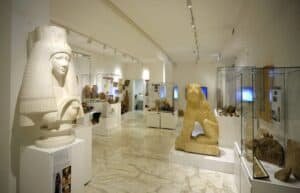
In December 2019, the MIAC, the Museo Italiano Audiovisivo e Cinema, opened inside the studios. The museum occupies an area of over 1,600 square meters in the building that housed the Development and Printing Laboratory: a place where, over the decades, a large part of the history of Italian cinema passed through millions of meters of film. The choice of location is not an administrative detail. It is a statement of method: the museum of moving images was born in the hall where the image was physically fixed onto film.
What the MIAC Tells
The route traces Italian audiovisual heritage from the origins of cinema to the footage that made up the great national archives, up to the arrival of television and the birth and development of digital imaging. The heritage is seen in its relationships with history, with the social and cultural life of the country, and with the changes in visual language throughout the 20th century and the new century. At its base are hundreds of films and archival footage from the holdings of Istituto Luce and Teche Rai and from partner archives, together with documents, photographs, interviews, title sequences, behind-the-scenes material, graphics, and radio materials.
The selection criterion does not aim at completeness in the history of media. It aims to convey the energy and richness of a heritage that placed Italy at the top of global audiovisual production. It is a clear curatorial choice, and it pays off: a museum that tried to be exhaustive would have become a warehouse of dates.
The MIAC Exhibition Route, Room by Room
The route unfolds across 12 main rooms, each dedicated to a theme: the relationship between image and power, the enchantment of landscapes, the role of language, film scores, and so on. The approach is immersive and emotional, with a multimedia and interactive story that moves across themes rather than chronologically.
Visitors are welcomed by a wall of over 30 meters with the Timeline, an animated graffiti that lets you discover the key dates and events of audiovisual media in Italy. It is the piece worth looking at first and slowly, because it provides the coordinates for everything else.
Next is the Interactive Table, made from the original roller of over 40 meters that for decades carried the films destined for processing through these rooms. The belt was not dismantled. Today it sends the thoughts written by visitors traveling across luminous screens. It is the smartest way to reuse an industrial machine that you can see in a Rome museum.
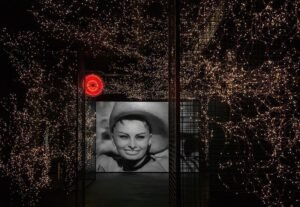
The Actors room lines up a mosaic of sequences and close-ups of famous faces, enclosed in three frames made of 100 light bulbs each, with the effect of a theater dressing room. The History Room connects archival materials with the country's events. The Kaleidoscope room closes the route: entirely covered in mirrors, without any dimensional references, with light trails that interact with a video column in the center. Anyone who suffers from vertigo should know this before going in.
The Media Library and the Tullio Kezich Reading Space
The MIAC houses a media library for research in the Luce Archive, a cinema room for screenings, a conference space, and the Tullio Kezich Reading Space, which is built around the personal library of the film critic: a collection of over 5,000 volumes donated to the museum by Alessandra Levantesi Kezich. For anyone studying cinema, it is a practical resource, not decoration.
The museum also hosts a Conservation and Restoration Laboratory specialized in the analog restoration of film. The museum is conceived as a structure in progress, able to change over time, and it hosts temporary exhibitions, installations, screenings, and meetings.
Who Made the MIAC
The museum was wanted and funded by the Ministry of Cultural Heritage and Activities and Tourism, and it is produced by Istituto Luce Cinecittà in partnership with Rai Teche and with the CSC, Centro Sperimentale di Cinematografia, in collaboration with the Cineteca di Bologna, the AAMOD Archivio Audiovisivo del Movimento Operaio e Democratico, Museo Nazionale del Cinema di Torino, Fondazione Cineteca Italiana, the Cineteca del Friuli, and Mediaset, under the patronage of SIAE. Curation is entrusted to Gianni Canova, Gabriele D'Autilia, Enrico Menduni, and Roland Sejko. The exhibition design is conceived, planned, and managed by NONE collective. Alongside the museum, a series of training activities for young people, run in Erasmus format with international exchanges and residencies, are carried out in collaboration with the Centro Sperimentale di Cinematografia and other industry institutions.


How to Really Visit Cinecittà Studios
How long the visit to Cinecittà Studios takes
With the combined ticket and the guided tour of the sets, the full visit takes a solid half day: plan on at least three and a half hours, or four if you stop to read the MIAC panels. The guided tour of the permanent sets lasts between 60 and 70 minutes. Cinecittà si Mostra on its own takes a good hour and a half. The MIAC takes one hour, but it's the kind of exhibit where you lose track of time happily. Anyone who arrives at 15:00 thinking they'll do everything before closing is miscalculating: the ticket office closes at 16:30, and by 18:00 you have to leave.
When to go to Cinecittà Studios and when to avoid it
The best season is the in-between one, April or October: the outdoor sets are visited on foot, with no shade, and in July the backlot turns into a frying pan. In winter the opposite problem is the light, which fades by 16:30 and takes a lot away from photographs. The absolute worst moment is the long weekend with the guided tour on the calendar: spots run out and the line at the ticket office gets longer. The best moment is a Thursday morning in October at 10:00, right when it opens, with the tour booked days ahead.
Cinecittà Studios with kids
It works, and it works better than parents expect. The ancient Rome set is a huge game of declared make-believe, and kids get it instantly. You can walk through the submarine. The MIAC is interactive. From October to June the complex also offers Cinebimbicittà, with activities, readings and events for the youngest visitors. The limit is the distance to cover on foot: with a child under four years old, a stroller is essential, and on the backlot the ground isn't always smooth. Also factor in the reduced ticket for kids aged five to 10 and the family package, which at the in-person ticket counter changes the cost significantly.
Accessibility at Cinecittà Studios
The indoor exhibition areas and the MIAC are laid out on routes that the organization declares accessible, and companions of people with disabilities enter for free. On the outdoor sets the question is different and must be asked when booking, because the ground is uneven and some parts of the sets have stage steps. The ticket office, contacted in advance at 06 72293269 or at visit@cinecitta.it, will say which tours are wheelchair accessible in the period you're interested in. Asking first is the only way to avoid finding yourself facing a flight of steps.
Photos, cloakroom and rules at Cinecittà Studios
Photos for personal use are normally allowed in the areas open to the public. Professional shoots, tripods and drones are another matter and require authorization. Inside the sound stages where productions are underway, you can't enter or take photos, for obvious reasons of contractual confidentiality. Bulky backpacks and large luggage aren't suited to a route that includes tight spaces like the submarine. If you arrive from the station with a suitcase, figure out beforehand where to leave it, because the complex isn't designed as a storage facility.
What's around Cinecittà Studios
The area is more interesting than the Tuscolana suggests. A few metro stops away, or a 20-minute walk, you reach the Aqueducts Park, where the arches of the Acquedotto Claudio and the Acqua Felice cross the countryside within Parco dell'Appia Antica. It's one of Rome's most cinematic places, and not without reason it appears in the opening sequence of La Dolce Vita, when the helicopter carries the statue of Christ over the ruins. In the park there are also summer outdoor cinema series such as Roma Cinema Arena.
A little further west lies the Caffarella Valley, with its farmhouses, flocks and the Nymphaeum of Egeria. To the south, along the Appia, the Villa of the Quintilii preserves the most imposing imperial baths outside the city. Anyone taking Line A toward the center finds the Basilica of Saint John Lateran a few stops away, and a bit further on, the Colosseum, which has a rather amusing relationship of mutual imitation with the Ancient Rome set. The Parco Appio, right up against the studios' perimeter walls, is the neighborhood green space where local Romans take their kids.
To fit all of this into a three-day program without rushing, the step-by-step itinerary of Rome in 3 Days remains the most practical reference for foreign visitors.
Toward the Castelli, by metro to Anagnina and then the bus, you reach Frascati: half a day more, a different landscape. For those who want to stay on the cinema theme, the Casa del Cinema at Villa Borghese and the Festa del Cinema di Roma complete the picture on the other side of the city.
A curiosity about Cinecittà Studios
Overall, the designed sound stages were 21, but the ones productions call by number are 19: Stage 17 doesn't appear in everyday use because of a superstition of the trade, the same one that in Roman buildings skips the seventeenth floor and on airplanes removes the corresponding row. In Italian tradition, 17 carries the Latin XVII, which when anagrammed gives VIXI, meaning "I have lived," a formula that on ancient gravestones means, in plain terms, "I am dead." In a line of work where the financial risk of a single shooting day is measured in tens of thousands of euros, superstition is not folklore: it is a way of managing collective anxiety.
The curiosity, however, doesn't end with the number. The truly surprising element is how much the superstition has survived the change of ownership, of technology and of generation. Cinecittà Studios has lived through Fascism, the German occupation, the refugee camp, the age of colossal films, privatization and the return to public ownership, it has seen digital and serial production for the platforms arrive, and that number still goes unspoken. Telling it always has the same effect: the visitor who until a minute earlier saw the studios as a factory realizes they have entered a professional community with its own rituals.
There is a second detail worth adding, because it completes the picture. The studios' outdoor pool, 7,000 square meters by two meters deep, holds 13,500 cubic meters of water, and the blue back that towers over it measures 80 meters long by 20 high. It serves to shoot the sea without the sea. In a country with 8,000 kilometers of coastline, Italian cinema has preferred to build itself an ocean eight kilometers from Piazza Venezia, because the real sea doesn't let itself be lit, doesn't keep schedules and above all doesn't stop when the director says cut.
Something nobody tells you about Cinecittà Studios
That the visitable area changes. It's not a fine-print clause: it's the very nature of the place. Cinecittà Studios is an active production facility, and productions have absolute priority over visitors. If an international series occupies the backlot, the tour of the permanent sets is skipped or shortened. If a sound stage is being set up, that stretch of road is closed. The official site publishes the tour schedule precisely because it isn't taken for granted, and anyone who sets off from Milan to see the Ancient Rome set without having booked risks finding only the indoor routes.
The second thing nobody mentions concerns the nature of the sets. Many visitors arrive convinced they'll find the physical remains of the great films of the past, Ben Hur's chariot, the Cleopatra columns, Via Veneto of La dolce vita. That isn't the case, and it couldn't be: film sets are temporary structures, built in wood, plaster, papier-mâché and polystyrene, and at the end of filming they are dismantled because the stage is needed for the next production. What survives is what someone decided to keep as an exhibit, or what was built to last a few seasons outdoors. The three permanent sets exist because they are still needed, not because they are relics.
Third thing, practical and systematically ignored: the family ticket for €45 can only be bought at the physical ticket office. A family of four who books online pays the sum of the individual tickets and discovers the discounted formula when they already have the document in hand. Anyone traveling with two or more children should do the math first and decide whether it's worth going directly to the box office, accepting the risk of not finding a place on that day's guided tour.
My advice for visiting Cinecittà Studios
Book the guided tour of the permanent sets and build your day around it, not the other way around. It's the only part of the visit that depends on limited availability and can't be made up any other way: the exhibition routes are always there to see, the backlot isn't. Choose a morning departure, preferably the first one, for two concrete reasons. The first is the light: outdoor sets photograph well with the low sun and turn flat at noon. The second is the heat, which from June to September on the backlot is a serious matter, because there isn't a tree among the facades.
Second tip: get the combined ticket for €15. The five-euro difference over the single route is the best money you'll spend all day, because the MIAC isn't a decorative extra but the piece that gives historical meaning to everything else. Anyone who visits only Cinecittà si Mostra leaves with a collection of anecdotes, those who add the MIAC leave having understood why Italian cinema was what it was.
Anyone traveling with friends or relatives who read English will find a reasoned version of Rome's priorities in the guide The Best Things to Do in Rome, useful for working out where the studios fit into a three- or four-day program.
Third, and here I go against the grain: don't come to Cinecittà Studios as the first thing on your trip to Rome. Come after you've seen the Colosseum, the Forums and the center. The ancient Rome set works as an experience only if you have the real city in your eyes, because the pleasure of the visit lies in comparing the original and the copy, the stone and the painted wood. Those who arrive here on day one see fake facades, those who arrive on day four see the craft.
Last, for those organizing groups: the rate for 15 people or more drops to €14 per person, but the real saving is time, because with a booked group the tour departure is arranged in advance and you don't depend on the public time slots. To build an itinerary that combines the studios and the Appia quadrant, it's best to work with licensed guides, like those in the TourLeaderPro network, who handle transfers and downtime better than any app.
Another well-known fact, yet rarely mentioned
Everyone knows that more than 3,000 films were shot at the Tuscolana studios and that nearly 90 of them received an Oscar nomination, with dozens of statuettes won. The figure gets repeated everywhere. What is almost never said is the precise economic reason behind the miracle, and it wasn't Italian genius: it was a law. After the war, foreign producers could not export the earnings from distributing their films out of Italy. That money stayed locked in Italian bank accounts, and the only way to use it was to spend it here. That is how Hollywood on the Tiber was born.
The American majors found themselves with frozen capital and with a country offering excellent craftsmen at very low costs, sun for nine months a year, extras by the thousands and a 40-hectare equipped complex. The result was Quo Vadis in 1951, Ben Hur in 1959, Cleopatra in 1963, and a long series of productions that left a real industrial spin-off in Rome: carpenters, sculptors, seamstresses, electricians, technicians who trained other technicians. The golden age of Cinecittà Studios was an industrial policy that succeeded by accident, or more precisely, succeeded as a side effect of a currency measure.
The corollary is just as rarely mentioned, and it's a bitter one. When the rule changed and economic conditions lined up with those of other countries, the flow stopped quickly: in 1959 the downsizing led to the layoff of about 1,500 people. An industrial city that depends on a single client base falls when that client stops buying, and in the sixties and seventies the studios learned the lesson the hardest way. Today the strategy is the opposite and more solid: domestic production, international production, series for streaming platforms, and opening to the public. Diversifying isn't a trendy word, here it's a scar.
The right photo to take at Cinecittà Studios
The photo worth the trip is the one on the ancient Rome set, taken from a side alley and not from the main square. The reason is technical. The backlot facades are built with forced perspectives and heights designed for the camera: framed head-on from the square, they immediately reveal the braces, the seams, and the lack of depth. Taken instead from an alley, with two rows of facades closing in and a strip of sky above, the same set becomes a believable city street, and the photo works exactly the way it did for HBO in 2005.
The right time is early morning, when low light carves the stucco reliefs and throws long shadows across the set paving. At noon the high sun flattens everything and shows what the facades really are, which is painted panels. In autumn, with a moving sky, the result gets even better: a backdrop of clouds adds the depth the set design does not have.
A second shot I recommend, which is less obvious, is the one behind the scenes: walk around the corner of a facade and photograph the back, with the wooden scaffolding, the counterweights, and the numbers painted on the panels. It is the most honest photo you can take away from Cinecittà Studios, because it shows the craft instead of the illusion.
Inside MIAC, the Caleidoscopio room, lined with mirrors and with no scale references, produces spectacular but difficult photos: without a tripod and with moving lights you need a camera that handles high ISO well, and a phone does better than you might expect. Keep in mind that professional shoots and tripods must be authorized, while personal photos are normally allowed in the spaces open to the public. In the sound stages that are in production, however, photography is not allowed under any circumstances.
Some Important Events That Happened Here in History
The first event is the birth itself, and it came out of a fire. On the night of September 26, 1935, at 2 a.m., a blaze destroyed Cines Stages 3 and 4 on via Veio: the reports called it a mysterious fire, and Italian cinema lost its main facility within a few hours. The response was the Tuscolana construction site, which opened on January 30, 1936, and closed on April 28, 1937, with the opening of 73 buildings. 15 months.
The second event is the most serious and the least discussed. Between 1943 and 1944 the studios were turned into an internment camp for civilians under German occupation. On April 17, 1944, during the Quadraro roundup, about 1,000 men from the neighboring district passed through here before being deported to Germany. Just a few hundred meters separate the studio gate from the streets where Germans went door to door that morning. After the liberation, the Allies assigned the complex as a camp for refugees and displaced people, who lived in the sound stages and burned archive documents to keep warm: the records from the early years were lost that way.
The third event is the boom. In 1948 the first American film, in 1951 Quo Vadis, in 1959 Ben Hur, in 1963 Cleopatra: within 15 years, the Tuscolana became the world's second-largest production hub, and the neighborhood filled with extras, seamstresses, carpenters, and photographers. In 1959 that same boom hit a crisis, and 1,500 people lost their jobs. During the same years, inside Stage 5, Fellini had the via Veneto of La Dolce Vita built.
The fourth event is a series of fires. In 1983 fire devastated the warehouse sheds next to the Centro Sperimentale di Cinematografia: firefighters worked for more than 24 hours, and an unknown number of costumes and props were lost. On the night between December 13 and 14, 2013, the reality TV house, active since 2000 and later rebuilt, burned down. In 2018 a fire damaged part of the set of the series Rome.
The fifth event is institutional and recent. On July 3, 2017, Istituto Luce Cinecittà acquired the Cinecittà Studios business unit, closing the private chapter that began in 1997 and returning the studios to public control. In December 2019, the opening of MIAC in the former Development and Printing Lab added a permanent museum function to the complex. These are two dates that sound bureaucratic but actually decided whether this place would survive as a factory or as a ruin.
Who Has Passed Through Cinecittà Studios
The list of Italian directors who worked at the Tuscolana studios almost coincides with the history of national cinema: Federico Fellini, who made Stage 5 his second home, Luchino Visconti, who in 1951 with Bellissima depicted the would-be actresses lining up for auditions at Cinecittà, Sergio Leone, Ettore Scola, Vittorio De Sica, and Pier Paolo Pasolini. In front of the cameras have also stood Anna Magnani, Sophia Loren, Gina Lollobrigida, Claudia Cardinale, and then Alberto Sordi, who was the most ferocious and most affectionate portraitist of Rome.
From the international side, the list is no less weighty. Mervyn LeRoy for Quo Vadis in 1951, William Wyler for Ben-Hur in 1959, the production of Cleopatra in 1963 with Elizabeth Taylor and Richard Burton, Francis Ford Coppola for The Godfather Part III in 1990, Anthony Minghella for The English Patient in 1996, Rob Cohen for Daylight that same year, Martin Scorsese for Gangs of New York, Wes Anderson for The Life Aquatic with Steve Zissou, Mel Gibson for The Passion of the Christ. In 2015, the contemporary shoot of the Ben-Hur remake and of Zoolander 2 brought the studios back to their record revenue.
Among the set trades, the name that comes up most often is Dante Ferretti, a set designer who won an Oscar together with set decorator Francesca Lo Schiavo. He trained alongside Fellini and then became a regular collaborator of Scorsese. His is the reconstruction of New York's Five Points on the Roman backlot, and his is the signature on the Felliniana route you can visit today in the studios. It's the clearest case of continuity between the Cinecittà of the past and today's, because the same person built the set and then the museum that tells its story.
Then there are the less predictable moments. In 2008, the British crew of Doctor Who shot the episode set in Pompeii here, using the ancient Rome set as a Vesuvian city. Paolo Sorrentino rebuilt the Sistine Chapel and the Vatican apartments in the soundstages for The Young Pope, because you don't film in the Vatican. And then there are the thousands of nameless people who were the real substance of this place: the extras of the sword-and-sandal films, the carpenters, the seamstresses, the stagehands, the electricians, three generations of families from Quadraro and Don Bosco for whom Cinecittà Studios was not a myth but a workplace.
Quick questions about Cinecittà Studios
How much is the ticket for Cinecittà Studios?
Cinecittà si Mostra costs €10, the MIAC costs €10, and the combined ticket for the two exhibition routes costs €15. The reduced fare is €8. The guided tour with the ancient Rome set costs €15, or €20 if combined with both exhibition routes.
What are the opening hours of Cinecittà Studios?
Open every day except Tuesdays, from 10:00 to 18:00. The ticket office closes at 16:30.
When is Cinecittà Studios closed?
On Tuesdays, December 24 and 25, and January 1. Some holidays, including Easter, April 25, and May 1, come with schedule changes listed on the official website.
How do you get to Cinecittà Studios by public transport?
Take metro line A to the Cinecittà stop, which opens in front of the entrance at Via Tuscolana 1055. From Termini it's about 20 minutes in the direction of Anagnina.
What is the address of Cinecittà Studios?
Via Tuscolana 1055, Rome, Municipio VII. The ticket office answers at 06 72293269.
Do I need to book to visit Cinecittà Studios?
For the indoor exhibition routes, normally no. For the guided tours of the permanent sets, yes, because places are limited and the schedule varies. Bookings for individuals and families go through visit@cinecitta.it.
Can I visit the outdoor sets of Cinecittà Studios on my own?
No. The permanent sets of ancient Rome, Quattrocento Florence, and the Temple of Jerusalem can only be visited on the guided tour, which lasts between 60 and 70 minutes.
How long does a visit to Cinecittà Studios take?
With the combined ticket and the guided tour of the sets, you need at least three and a half hours. The exhibition routes alone take two and a half hours or more.
Can the family ticket for Cinecittà Studios be bought online?
No, only at the physical ticket office. It costs €45 for two adults and two children up to 18 years old, with €5 for each additional child.
Who gets in free at Cinecittà Studios?
Children under five, companions of people with disabilities, accredited journalists, licensed European Union tour guides, and ICOM members.
Who is entitled to the reduced ticket at Cinecittà Studios?
Young people under 26, people over 65, and journalists, with the reduced fare of €8. Children from five to 10 years old pay €5.
Are there group discounts at Cinecittà Studios?
Yes, from 15 participants up, the guided tour rate drops to €14 per person.
Can I take photos at Cinecittà Studios?
Photos for personal use are normally allowed in the open areas. Professional shoots, tripods, and drones require authorization. In soundstages in production, you may not enter or take photos.
Is Cinecittà Studios suitable for children?
Very much so. The ancient Rome set, the S-33 submarine, and the MIAC's interactive installations work well with little ones, and from October to June, the Cinebimbicittà program offers dedicated activities and events.
Is Cinecittà Studios wheelchair accessible?
The indoor exhibition areas and the MIAC are accessible. The outdoor sets have uneven ground, and some parts have set steps. It's best to ask the ticket office when booking which tours are accessible.
What is the difference between Cinecittà si Mostra and the MIAC?
Cinecittà si Mostra tells the story of the studios and Italian cinema through objects, costumes and set documents. The MIAC is a multimedia museum on the whole of Italy's audiovisual heritage, cinema and television together, laid out in 12 themed rooms.
Can you really see films being shot at Cinecittà Studios?
No. The sound stages occupied by productions are not open to visitors, for contractual and safety reasons. What you see is the museum route and, with the guide, the backlot.
Where is Stage 5 at Cinecittà Studios, and can you visit it?
Stage 5 is inside the complex and measures 79.94 meters by 35.94. It is the largest sound stage in Europe and the one associated with Fellini's name. It is not part of the standard route and opens only on special occasions, when it isn't occupied by a production.
Was Via Veneto from La Dolce Vita filmed at Cinecittà Studios?
Yes, rebuilt inside Stage 5. The real street would not have allowed control of the light and traffic management for the weeks needed.
How many films have been shot at Cinecittà Studios?
More than 3,000. Nearly 90 received an Oscar nomination, and several dozen won the statuette. Sources disagree on the exact number of awards.
How big is Cinecittà Studios?
About 400,000 square meters, or 40 hectares, of which 10 are backlot. It is the second-largest production hub in the world by size after Hollywood.
Who runs Cinecittà Studios today?
Cinecittà S.p.A., a public company wholly owned by the Ministry of Economy and Finance. The business branch was bought by Istituto Luce Cinecittà on July 3, 2017.
Is there a restaurant inside Cinecittà Studios?
The complex has a canteen, a restaurant and a bar serving the productions and the public, as well as screening rooms and conference spaces.
Can you get to Cinecittà Studios by car?
Yes, with an outdoor parking lot of limited capacity. During rush hour Via Tuscolana is slow, so it's better to leave your car at a park-and-ride lot on Line A and take the metro for the last stretch.
Is Cinecittà Studios the same as Cinecittà World?
No, they are two different and distant places. Cinecittà Studios is the production facility and museum at Via Tuscolana 1055, served by Metro A.
What can you see on the ancient Rome set at Cinecittà Studios?
A neighborhood of Republican Rome built for the series Rome between 2005 and 2007: the Forum, shops, alleys, insulae. It is not an archaeological reconstruction. It is a believable Rome designed for the camera.
When is the best time to visit Cinecittà Studios?
In the shoulder seasons, in April or October, with the morning tour. The light is better for outdoor sets, and temperatures in the backlot are bearable. In summer, the backlot has no shade.
Our opinion on Cinecittà Studios
People who leave here usually fall into two groups: those who expected a theme park and those who wanted to understand how a film is made. The first group is left puzzled, because there are no rides and no characters in costume. The second group walks out with their heads full. Cinecittà Studios doesn't sell ready-made wonder. It sells the back side of things, the wood behind the marble, the counterweight behind the facade. It is worth the €15 combined ticket, and it is worth it in full, as long as you arrive prepared and with the set tour already booked.
One last piece of advice, the most practical I can give: put the studios on the fourth day of your Rome trip, not the first, and that same day walk down toward Parco degli Acquedotti in the late afternoon. The passage from the papier-mâché Rome to the real arches of the Aqueduct Claudius, one kilometer away, is the best history lesson this city has to offer, and it costs nothing.
Article written by the editorial team of TourLeaderPro, contact them for Tours and Private/Corporate/V.I.P. Experiences.
Planning a trip to Rome? English-language guides for visiting the city are on ItalyPlanner.com.
Contact Information
Nearby
 MIAC – Italian Audiovisual and Cinema Museum400 m
- Csoa Corto Circuito1.1 km
- Villa dei Sette Bassi1.1 km
- Cinecittà Basketball Polaris1.2 km