VoloAlto Nature Park
In short. VoloAlto Nature Park is a private countryside park located in the agro area northwest of Rome, in the sector between Boccea, Santa Maria di Galeria and the countryside that slopes down toward Osteria Nuova.
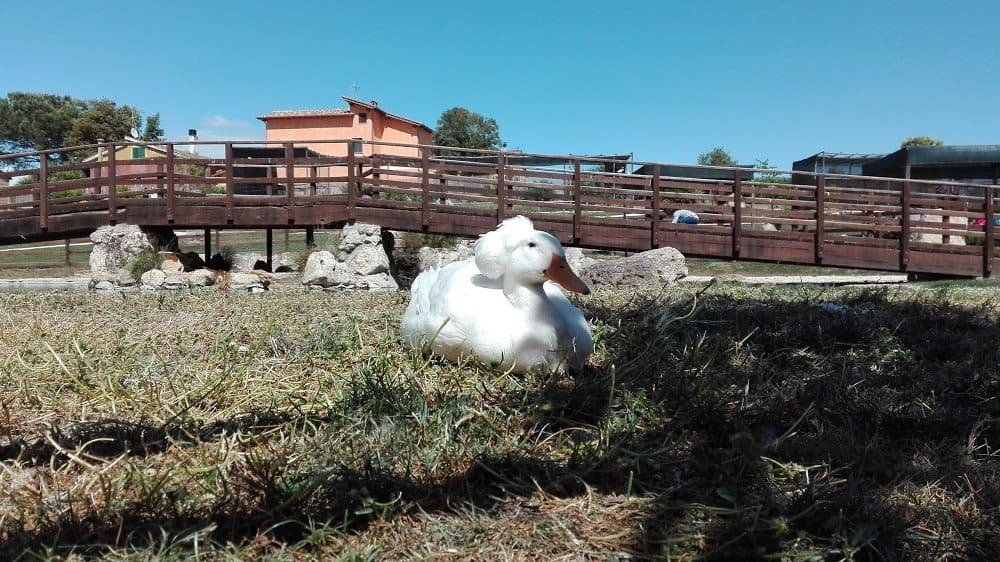
VoloAlto Nature Park is a private countryside park located in the agro area northwest of Rome, in the sector between Boccea, Santa Maria di Galeria and the countryside that slopes down toward Osteria Nuova. It is not a regional reserve, not a municipal garden and not a zoo: it is a facility founded in 2015 by a group of people who already worked with animals and who decided to combine aviaries, a vegetable garden, a farm and educational activities in a single countryside enclosure. The surface area declared by the managers is around two hectares, among fields of wheat and sunflowers, on the edge of a wood. You get there by car, because public transport in that area serves the towns and not the farmsteads, and you enter by reservation, because almost everything that happens inside is organized for groups, school classes, families or private parties. Anyone who arrives expecting an adventure park with Tibetan bridges and zip lines between the trees will be thrown off: here the name VoloAlto refers to birds of prey, not harnesses. The visit takes place on foot, along a marked route that passes the large aviaries of eagles, vultures and owls, the area of herbs and succulents, the water pond of waterbirds and finally the farm with goats, donkeys and rabbits. For those thinking in terms of day trips with kids, in the same stretch of Roman countryside there are also Parco Natura La Selvotta in Formello, the fattoria didattica C’era Una Volta and the Castel di Guido Oasis.
Where VoloAlto Nature Park is and how you really get there
The first thing to clarify concerns geography, because it is the reason many families arrive late or don’t arrive at all. VoloAlto Nature Park is not inside Rome nor in a town: it sits in open countryside, in that network of provincial and local roads that starts from Via di Boccea and climbs toward Santa Maria di Galeria, Cesano and the plain leading to Lake Bracciano. On the map published by the managers the point falls northwest of the Grande Raccordo Anulare, in an area of farmsteads and farmhouses where the houses are far apart and the roads change name every kilometer. The GPS will get you there, but it’s better to set it on the exact name of the facility and not on an address reconstructed from memory, because in the same stretch of countryside there are other agriturismi and farms with similar place names.
By car: the routes that work
The two natural routes are Via di Boccea and Via Aurelia. Those starting from western Rome take Boccea, follow it past the Raccordo, cross the string of borgate and then enter the real countryside, where the fields open up and the buildings thin out. Those coming from the Aurelia, for example from the coast or the Castel di Guido area, head inland along the cross roads that connect the two consular roads. In both cases the last stretch is on narrow roads, often without a shoulder, where the surface can be uneven and signage is scarce. It’s not a safety issue, it’s a time issue: allow at least a quarter of an hour more than the phone app promises, because on those roads you don’t drive at the speed the software imagines.
The parking is the typical kind found at countryside facilities: a dirt or grass-covered clearing, with no marked spaces, no attendant, and capacity that depends on how many people are expected that day. On private party days or school visit days the space fills up quickly and cars end up along the road. Anyone driving a low vehicle should be careful after rain, because the ground holds water and puddles hide potholes. Anyone arriving with a camper or a long van should ask first, because maneuvering in those clearings is not always possible.
By public transport: the uncomfortable truth
There is no line that goes to the gate. Urban buses in the western zone reach the terminus of the borgate of Boccea and Casalotti, the suburban service stops in towns such as Anguillara and Cesano, and the regional railway line that heads up toward the lake stops at the stations of the villages. From none of these points can you reach the park on foot in a reasonable time, because there are no sidewalks and because the kilometers of countryside to cover are many. Anyone without a car has three realistic options: have someone drive you, take a taxi or a car with driver from the nearest station, or join an organized visit that includes transport. Saying so plainly helps prevent someone from setting off by train with two kids and ending up on a provincial road with no way out.
How much time the trip takes
From the center of Rome the real travel time, traffic included, falls between 40 minutes and a good hour depending on the time and the starting point. From the northern quadrant of the city, from Via Cassia or Via Flaminia, it's better to cut through the countryside instead of going down onto the Raccordo. From the coast at Fregene or Maccarese you go up through the interior in just under half an hour. The late-afternoon return on weekdays is the worst window, because Via di Boccea and Via Aurelia get congested together: anyone leaving the park at 18:00 finds the line, anyone leaving at 16:00 almost always avoids it.
What VoloAlto Nature Park really is: a private facility, not a reserve
This distinction changes the whole way you plan the day. Lazio's protected areas, like the Insugherata Nature Reserve or the Veio Park, are public territories where you enter freely, walk the trails and pay nothing. VoloAlto Nature Park works the opposite way: it's fenced private property, with a gate, service hours and a management that decides who comes in and when. The logic is that of an educational farm or a wildlife center, not that of a public wood. Anyone who shows up at the gate on any given day, without having called, risks finding it closed or finding the park taken over by a birthday party or a visiting school group.
The practical consequence is just one and it's worth repeating: first you contact the facility, then you put the outing in your calendar. The managers list phone, email and social pages as channels, and through those channels you agree on day, time, number of people and type of activity. I'm not publishing rates, opening hours or closing days here, for a simple reason: in a private facility of this kind they change from season to season and sometimes from month to month, and a wrong figure read on some random page turns into an argument at the gate. Information on costs should be asked of whoever sets them.
The difference between a nature park, a zoo and an adventure park
Three categories that everyday language mixes up and that actually follow different rules. A zoo, like the Bioparco di Roma (Rome Zoo), is a recognized zoological garden, with large collections, international conservation programs, continuous ticketing and published hours. An adventure park is a sports facility: suspended courses, harnesses, helmets, instructors, access rules tied to height and weight. A nature park like VoloAlto is a third thing: a family-scale facility, built around a core of animals, in which the main product is the accompaniment, that is, the person who walks with you and tells the story. Anyone who confuses the first category with the third is disappointed by the numbers. Anyone who confuses the second with the third shows up in the wrong sneakers and looks for bridges between the trees that aren't there.
Who built it and why
The project was born in 2015 and is presented by its founders as the result of a shared passion for nature, animals and the environment, with the stated goal of passing it on to visitors and especially to the youngest. The intentions put in writing by the managers include four lines of work: the conservation of threatened species, the rescue of animals in difficulty, research and environmental education. These are ambitious goals for a facility of two hectares, and they should be read for what they are: a statement of intent from a private entity, not an institutional function assigned by a public body. The real value, the one you can touch during the visit, is the second part: the ability to keep a six-year-old half a meter from an eagle owl without either of them getting scared.

The Route Inside VoloAlto Nature Park: Aviaries, Vegetable Garden, Water, Farm
The visit follows a defined path, designed to be covered in full by anyone, including people with mobility difficulties and those pushing a stroller. This is one of the points the operators insist on the most, and it deserves to be taken seriously, because in the countryside declared accessibility often just means that the gate is wide. Here the route is clearly laid out and is presented as accessible in every corner, with code-compliant restrooms that can also be used by people with a motor disability. Anyone with specific needs, though, should still make a phone call first: the answer from whoever runs the place is worth more than any generic description read elsewhere.
The Large Aviaries
The heart of the park is the birds of prey aviaries. Diurnal on one side, nocturnal on the other, with eagles, vultures and owls of different species, coming according to the operators from different parts of the world. The structures are large and built tall, because a bird of prey needs to move vertically and to have perches at different heights. Anyone who has seen the old fairground cages understands the difference right away: here the animals have room to open their wings and to stay away from the netting when they want. My advice, when you reach an aviary, is to stop in silence for a couple of minutes before talking. An owl that isn't disturbed turns its head and looks: that's the moment kids remember, not the explanation.
One thing is worth saying about the relationship between these animals and the public. The individuals housed in centers of this kind are almost never animals that could return to the wild: they are specimens born in captivity or animals that arrived with permanent injuries. It's a fact the operators tell during the visit and it's the most educational part of the whole day, because it explains to kids that a bird of prey injured by a power line or a gunshot never flies again. Anyone who wants to go deeper into the science of the birds of Lazio can pair the outing with a visit to the Civic Zoology Museum, which holds important ornithological collections.
Medicinal Herbs and Succulents
After the aviaries the route enters the botanical area, divided between medicinal herbs and succulents. It's the part adults underestimate and that works extremely well with school groups, because you touch and smell: rosemary, sage, lavender, mint, and then the succulent collection that kids like for reasons all their own, namely the thorns. Anyone with a serious passion for botany will naturally find much larger collections at the Botanical Garden of Rome, but here the point is different: the herbs serve as an introduction to the talk about the vegetable garden and agriculture, they are not a collection for its own sake.
The Waterbird Pond
The route then crosses the wetland area with the waterbirds. It's a built environment, not a natural lake, and it should be looked at as such: a basin with vegetated banks that lets you observe ducks and other water birds up close. On windy days, with the surface rippled, it's the spot where kids stay the longest. It's best to hold them by the hand at the edge, because the bottom of artificial basins slopes in a way that's hard to read.
The Farm
The route ends where the kids would like to start: the farm, with bunnies, goats and donkeys. Here the contact is direct, and that is the reason many families come back. The operators present the farm as the place where you learn activities that are disappearing, animal husbandry and agriculture, and this is not rhetoric: for a child raised in an apartment in Rome's western quadrant, understanding that milk doesn't come from the carton is a real discovery. The same formula is found at other facilities in the province, from Il girotondo degli animali Educational Farm to the previously mentioned C'era Una Volta, each with its own approach.
A curiosity about the VoloAlto Nature Park
The curiosity concerns the name. VoloAlto is not a play on words about the height of the trails, nor a reference to some suspended attraction: it is a statement of purpose about birds of prey, that is, about the animals the project puts at its center. Anyone who arrives expecting pulleys and Tibetan bridges among the oaks has misread the name, and this is a more common mistake than you'd think, because in Italy over the last 15 years the word park paired with a verb of movement has almost automatically come to evoke the idea of the acrobatic course. Here the flight is that of birds, and the height is that of the aviaries.
There is a second curiosity, less obvious, that concerns the landscape. The park sits in a strip of countryside that, from an agricultural standpoint, is still the one described by the maps of the 1800s: wheat and sunflowers, remnant rows of trees, patches of woodland along the ditches. Rome's northwest quadrant has resisted concrete development more than the eastern one, partly because of the presence of large farming estates, partly because of constraints linked to the proximity of plants and technical installations, and partly because the road network never favored speculation. The result is that 20 kilometers from the center of the capital you can still cross real fields, with the stubble that burns with color in July and the sunflowers that all turn their heads in the same direction. This setting, which nobody advertises, is half of the value of the trip.
Third curiosity, of a practical nature: the Boccea countryside is one of the few areas of the Rome region where in a single day you can line up a park with animals, a forgotten archaeological site such as Galeria Antica and a walk through a large green area such as the Parco della Cellulosa, without ever covering more than about 20 kilometers between stops. Few areas of Rome offer a similar density so close to the Raccordo.
Educational programs, workshops and activities for schools
The part that financially sustains a facility like this is not the Sunday afternoon visit: it's schools, groups and organized activities. It's worth understanding this, because it explains how booking works and why the park is booked on certain days. The operators offer a range of options that includes guided visits, educational and creative workshops, activities caring for the animals and the vegetable garden, plus a service they bring directly into classrooms. The model is the established one of the educational farms of Lazio: the school books, arrives by bus, the group is split up, and each subgroup rotates through a station.
The workshops
In the workshops, the child does something with their hands. It can be sowing seeds in pots, preparing food for the farm animals, building a feeding trough, identifying feathers and plumes, or handling aromatic herbs. The educational value of these activities depends almost entirely on who leads them, which is why it's worth asking when you book who will lead the group and with what approach. A small facility has the advantage that the person on the phone is often the same person who will then guide the kids: in two minutes you can tell whether the approach is the one you're looking for.
Summer camps
Among the listed activities are summer camps, which according to information provided by the operators are aimed at children between the ages of four and 11, with a playful and recreational program built around the animals and the vegetable garden. This age range should be taken as a general guideline published by the facility and checked at the time of registration, because the age limits for summer camps change from year to year depending on available staff and regional regulations on services for minors. Anyone planning their children's summer should make a phone call in spring: spots at places like this fill up quickly, and registration often opens months in advance.
Scout groups and group activities
The park is also used by scout groups and associations, who find in its two fenced hectares the combination that is hard to find elsewhere: open space, perimeter security, adults in charge, restrooms. Anyone organizing a day for a large group should keep in mind that the space, however well laid out, has finite dimensions: 40 children in a two-hectare park is a completely different density than 40 children in a regional reserve like the Valle dei Casali. The upside, in return, is that no one gets lost and everything stays under visual control.
Private parties and exclusive use of the park
Among the formulas offered is the option of booking an area for exclusive use for private parties: birthdays, but also christenings and other family celebrations. This is the main reason why on a Saturday in May the park may be unavailable for open visits. Anyone who wants to organize a party should ask precisely what the formula includes, because in facilities of this type the difference between a reserved area and the whole park is substantial, and the same applies to catering, tables, rain coverage and duration. The operators also mention areas for picnics and barbecues, which follow their own rules and must be arranged in advance: open fires in the countryside in summer are subject to seasonal restrictions that no facility can ignore.
One thing nobody tells you about VoloAlto Nature Park
The thing that is almost never said is that a facility like this lives on a fragile balance, and that this balance has direct consequences for those who visit it. A private park with animals has fixed costs that never stop: the animals eat every day, the vet has to be paid, the aviaries need upkeep, insurance has to be renewed, qualified staff cost money. All of this relies on a limited number of visitors and on a fierce seasonality, concentrated between March and June for schools and between June and July for summer camps. In the cold months very little comes in. The practical consequence for anyone planning a trip is that availability is never guaranteed and that access conditions can change with little notice: not because of poor organization, but because the facility has to adapt to whatever allows it to stay open.
The second thing nobody says concerns the animals and expectations. Many families arrive imagining a rescue center where animals come in injured and leave healed, as in documentaries. The reality of Italian wildlife centers is harsher: the percentage of wild animals that return to nature after being taken in is low, the timelines are long, and most of the specimens visible to the public stay in the facility because they could not survive outside. Telling the children during the visit is the most useful thing you can do, and operators who do it well turn a stroll into a lesson that stays with them.
Third point that is rarely told: the countryside around is not a garden. Outside the fence there are farm fields that belong to others, private farm roads, guard dogs at the farms, agricultural vehicles passing through. There is no network of public trails connected to the park, and the idea of completing the visit with a walk through the surrounding fields does not work: those fields are private property and must be respected as such. Anyone looking for a real walk after the visit should head to areas equipped for that, such as the Parco del Pineto or the Castel di Guido Oasis.
Fourth and last: the weather weighs more here than elsewhere. An outdoor park without extensive covered structures depends entirely on the sky. A rainy day cannot be recovered with an indoor hall, and the countryside ground, after a thunderstorm, stays impassable for hours. Anyone booking in autumn or spring should take into account the possibility of postponing, and ask in advance: knowing whether there is a policy for rescheduling the date avoids arguments later.
The advice I give you for visiting VoloAlto Nature Park
The main advice is just one, and it is worth more than all the others put together: call ahead, always, even when you are convinced you have understood everything. This is no formality. In a facility that works by reservation, the call is used to find out whether the park is open to the public that day or reserved for a group, how long the visit lasts, whether a guide is included, what to bring, where to park, and how things work in case of rain. Five minutes on the phone solves problems that would otherwise be discovered at the gate with two children in the car.
The right time of day
Early morning is the best time, for a reason that concerns the animals and not the visitors. Birds of prey are active in the first hours, the farm animals are handled in the morning, and temperatures, from May onward, are the only variable that really ruins a trip to the countryside. At 11 in July, out in the fields there isn't enough shade for anyone. If you can choose, in summer arrive at opening, in winter, prefer the central part of the day, when the sun has dried the grass and warmed the air.
What to pack in your backpack
Closed shoes, always, even in summer: the ground is uneven, there are stones and loose soil, and sandals with open toes are the most common reason for tears halfway through the visit. Hat and sunscreen from April to September. A sweatshirt even on hot days, because in the countryside the temperature drops suddenly as soon as the sun goes down. More water than seems necessary. A full change of clothes for small children, because a farm is a farm. Insect repellent for evenings in late spring. And no thin strollers with small wheels: if you need one, better one with wide wheels, which don't get stuck on unpaved ground.
How to behave around the animals
Simple rules that adults forget more often than children. Don't stick your fingers through the aviary mesh: a bird of prey can't tell a finger from prey. Don't bring food from home for the animals, because each species has a precise diet and bread or cookies do serious harm. Don't shout in front of the cages. Don't use flash. On the farm, you pet where whoever is guiding you points, and you wash your hands before eating anything: it's a basic health rule that serious facilities remind you of at the entrance.
Advice for those bringing very young children
Under three years old, the visit only works halfway. The farm and the barnyard animals capture everyone, the birds of prey aviaries much less, because they require attention and silence. If you have a child under three, plan a shorter stay, focus on the final part of the route, and don't try to see everything. Those with children between 5 and 10, on the other hand, have the perfect audience for this kind of facility.
Accessibility, services and safety for the youngest visitors
When it comes to services, the park lists a specific set of facilities: restrooms that are up to code and accessible to people with disabilities, shaded areas, play areas designed for children, and refreshment stops. These are four elements that make the difference in the countryside between a successful outing and a difficult afternoon, and they're worth discussing one by one with a bit of realism.
Real accessibility
The route was designed to be passable for people who use a wheelchair, and this is a rare feature in rural facilities in the Rome area, where accessibility often stops at the parking lot. That said, an accessible trail in the countryside is still a trail on a natural or semi-natural surface, subject to weather conditions: after days of rain the compacted surface can be soft and thin wheels struggle. If you're accompanying someone with limited mobility, ask the operators directly how the route is in that particular week. It's a practical question that a small facility can answer better than any web page.
Shade, heat and season
The shaded areas exist, but two hectares of countryside in July are still two hectares of countryside in July. Heat is the real limit of the facility in the central summer months, and it's the reason summer camps schedule activities during the protected parts of the day. A family arriving at noon in late July will have a short, sweaty visit. The same family in late September will have a perfect day. For the same reason, if you're planning a seaside trip as an alternative, you'll find options on the nearby coast like Macchiagrande, which in summer offers the shade of a pine grove.
Play areas and supervision
The play areas are described as safe and sized for the youngest children. The point to clarify, because it concerns responsibility and not the quality of the facility, is that in a private park, supervision of children remains with parents or designated companions, except in services where the facility explicitly takes on that role, such as summer camps. During a family visit, no one watches your children for you. It seems obvious, yet it is the most common cause of minor accidents in all facilities of this kind.
Refreshment stops and meals
There are refreshment stops, and areas are provided for packed lunches and barbecues. What is actually available on a given day depends on the calendar and on how many visitors there are: at a facility of this size, the kiosk isn't open all year round. It's worth asking when booking whether you can count on a refreshment stop or whether you need to bring lunch. If someone in your family has allergies or intolerances, bring your own food anyway, because a countryside kitchen with reduced volumes can rarely guarantee separate supply chains.

Another well-known fact, yet one rarely mentioned
The well-known fact is that the northwestern Agro Romano is one of the best-preserved farmland areas bordering a European capital. Agronomists know it, urban planners know it, and the zoning plan documents repeat it. What almost nobody says, when talking about a countryside trip around here, is why this preservation happened, because the explanation is not romantic at all. The countryside northwest of Rome survived through a combination of factors that were largely accidental: large historic landholdings that were never subdivided, technical constraints linked to utility installations, a road network that remained inadequate to support large residential neighborhoods, and the presence of areas of archaeological interest that blocked projects in several places. The landscape you cross on the way to the park today is the result of these constraints, not of a deliberate conservation choice.
The second part of the fact, even less often cited, concerns wildlife. This countryside is home to a remarkable community of wild birds of prey: buzzards perched on telephone poles along any farm lane, kestrels hovering over the arable fields, barn owls and little owls tied to abandoned farmhouses, and kites passing through in the right seasons. Anyone who visits a park with captive birds of prey and then, heading back toward Rome, spots a buzzard on a pole has understood the point of the day better than anyone who only listened to the explanation. That is the reason to take the trip back slowly, eyes out the window, instead of looking for the fastest route.
The third element, which concerns history rather than nature, is that this area preserves traces of ancient settlements that almost nobody talks about: the abandoned medieval village of Galeria Antica, scattered necropolises, and the routes of the minor consular roads. An area that looks empty but is as layered as the center of Rome, with the difference that here nobody waits in line to see it.
The right photo to take at VoloAlto Nature Park
The right photo isn't the one everyone takes, that is, the child petting the goat. That photo is worth taking, of course, but it's the same on every educational farm in Italy, and 10 years from now nobody will be able to say where it was taken. The photo that's worth the effort is a different one, and it takes patience: a close-up portrait of a nocturnal raptor through the aviary mesh, with a blurred background.
How to do it technically
The problem is the wire mesh. The way to make it disappear is to bring the lens as close as possible to the mesh, while staying a safe distance from the animal, and to use the widest aperture available. With a phone, you can get something by turning on portrait mode and almost resting the lens against the mesh, with a camera fitted with a bright telephoto lens, the mesh disappears completely. You need light, so morning or late afternoon, and the animal needs to be facing you. No flash, for any reason: it harms the eyes of a nocturnal raptor and is banned in any reputable facility.
The other two photos I recommend
The second photo is the reverse shot nobody takes: the park seen from outside, with a wheat or sunflower field in the foreground and the facility in the background. It's the image that explains what this place really means, that is, an enclosure of organized nature inside a sea of farmland. In June, with the sunflowers in bloom, it works on its own. Take it from the road, without entering other people's fields.
The third is a different kind: the detail of the hands. A child's hands holding a fistful of feed, hands touching a donkey's muzzle, hands dirty with soil after the workshop in the vegetable garden. These are photographs that age better than posed portraits, because they tell of a gesture instead of a constructed smile. If you then want the full family picture, stand with your backs to the centuries-old woods that close off the horizon: in the late afternoon, the low light on that line of trees is the best of the day.
Some important events that happened here in history
You have to be honest about the scale of the facts. VoloAlto Nature Park is a recent facility: it opened in 2015, and its own history is measured in seasons, not centuries. The important events that directly concern it are those of any family business: choosing the land, building the aviaries, the arrival of the first animals, the first school group, the first summer camp, and the period of forced closure between 2020 and 2021 that hit all facilities open to the public in Italy, and that was particularly hard for parks with animals, because the animals kept needing to eat while visitors could not come in. Anyone who wants to reconstruct this timeline precisely should ask those who run the place: it is a story the owners tell gladly and that no archive keeps.
The history of the land, which goes back much further
The land the park sits on, however, has a history that reaches quite far back. This strip of countryside was part of the ancient Agro Romano, crossed by the routes that linked Rome to southern Etruria and dotted with rustic villas from the Republican and Imperial ages, traces of which still surface in the plowed fields. In the medieval period the landscape was organized around castles and fortified farmhouses. The best-known case in the area is Galeria, a settlement that was gradually abandoned in the 1800s and that today remains as a ruin swallowed by vegetation, one of the most striking ghost towns in Lazio.
From malaria to land reclamation
For centuries the northwestern Agro Romano was land of pasture and malaria, with very few permanent residents and extensive farming run by large church and noble estates. The change came between the late 1800s and the early decades of the 1900s, with land reclamation and agrarian reform, which brought families of tenant farmers to these fields, often from Veneto and the Marche, and turned pasture into arable land. The fields of wheat and sunflowers you cross today on the way to the park are the direct result of that transformation, not of an unchanging landscape.
The 1900s and the expansion of Rome
After the Second World War, Rome grew westward along the via di Boccea and the via Aurelia, generating the borgate and then the neighborhoods that now reach as far as the Raccordo. The countryside beyond the Raccordo has held out, as mentioned, because of a combination of restrictions and circumstances. In the last 30 years this strip has seen a new phenomenon: the birth of small multifunctional farm businesses, agriturismi, educational farms, riding stables, and wildlife centers, which have found their customer base in being close to a city of nearly 3 million residents. VoloAlto Nature Park fully belongs to this generation of facilities, and that is its place in the history of the territory: one piece of the conversion of the Agro Romano from land of production to land of services and education.
Who has passed through VoloAlto Nature Park
A clear warning is needed here, because on pages like this one it's easy to find lists of famous figures put together to order. VoloAlto Nature Park is not a historic site that popes, emperors, or famous artists have passed through, and there is no documented list of notable visitors. The people who come here are a different kind of audience, and describing them accurately is more useful than any name thrown in to pad the list.
School groups
By far the largest group. Classes from the preschools and elementary schools in Rome's western neighborhoods, Aurelio, Boccea, Casalotti, Torrevecchia, Primavalle, but also schools from towns in the northern province, from Anguillara to Formello to Cesano. For many of these children the park is their first close contact with a farmyard animal, and for a not negligible part it is also their first contact with a cultivated field. Parco Natura La Selvotta in Formello, or the educational farms scattered between the Castelli and the Agro Pontino, serve the same function in their respective areas.
Families from the western quadrant
The second regular audience is families who live between the Raccordo and the countryside, those looking for a Sunday morning out of the apartment without having to make a trip. Many of these families come back several times, and they are the reason a facility like this can survive: not big numbers, but loyalty.
Scout groups, associations, work groups
Then there are the organized groups: scout troops that use the space for patrol activities, associations that bring kids with disabilities, parish groups, groups of grandparents with grandchildren. The park is also used for family occasions, with the exclusive-area formula.
Who works with birds of prey
Finally there is the world, small and passionate, of those in Italy who work with birds of prey: falconers, bird enthusiasts, veterinarians specializing in wildlife, volunteers at rescue centers. It is a small network, in which the facilities all know one another and in which animals, advice and experiences circulate. Visitors who ask the right questions of whoever is showing them around will discover they are part of this network, which is the most interesting and least visible part of the place.
When to visit VoloAlto Nature Park and when to avoid it
The seasonality of an outdoor park in the Roman countryside is clear-cut, and it pays to know it before choosing a date, because the difference between the right period and the wrong one is huge.
Spring: the best time
From mid-March to late May, everything good is concentrated. Temperatures are pleasant, the countryside is green, the wheat fields are still tall and pale, the animals are active, and in the aviaries it is the time of year when the birds of prey show themselves the most. It is also the season when schools are running trips, so on weekdays the park can be filled with groups: families should choose the weekend and book in advance, because Saturdays fill up in April and May.
Summer: it depends on the time of day
June is still good in the morning. July and August are hard during the central hours, because of the heat and the lack of continuous shade. In these months the facility works mainly with summer camps, which take up the mornings. A family visit in summer only makes sense very early or in the late afternoon, and even then it's worth checking availability. Anyone who wants a cool alternative in the same area can consider a day on Lake Bracciano or a walk in the Bosco Macchia Grande di Manziana, where beech and Turkey oak keep the temperature several degrees lower.
Autumn: the second good window
September and October are an excellent time, often better than spring in terms of light. The countryside changes color, temperatures drop, school groups have not yet started their outing programs, and the park is freer. The only risk is the weather: a September thunderstorm makes the ground impassable for the rest of the day.
Winter: to be assessed case by case
From November to February the Roman countryside is cold, often damp, and the days end early. An outdoor facility reduces its activity in these months, and availability should be checked every time. Anyone who goes anyway should choose a sunny day, the central part of the afternoon, and dress the way people who work in the countryside dress: in layers, with waterproof shoes. The reward is an almost empty park and a very low winter light that has an effect on plowed fields you never see in summer.
Days to avoid
Weekends of the spring holidays, when facilities of this kind across the whole province become overloaded. The days immediately following heavy rain. The sirocco days of July. And any date not confirmed by phone, which remains the most important rule of all.
What's around VoloAlto Nature Park
The advantage of this location is that it sits in the middle of an area rich in things to see and short on tourists. Anyone planning a full day can easily build a route with two or three stops without long trips.
A few kilometers away
The ruins of Galeria Antica are the most evocative stop in the area: an abandoned medieval village, covered by vegetation, reached on foot along a path. It requires proper shoes and caution, because the structures are unstable, but for those who love abandoned places the trip is worth it on its own. The Parco della Cellulosa, on the Casal Selce side, instead offers a large, well-equipped green area for walking and cycling, little visited and almost unknown even to Romans themselves.
Toward the coast
Heading down the Aurelia, you'll come to the Castel di Guido Oasis, one of the best managed nature areas in the entire city of Rome, with visitor trails and activities for families. Continuing on brings you to the sea at Fregene and Maccarese, where you'll find Macchiagrande, and farther north, the Etruscan coast with its beaches.
Toward the lake and to the north
Going up, you enter the territory of the Veio Park, with its gorges, waterfalls and Etruscan archaeological areas. A little further on you'll find the Cascate di Monte Gelato, which always work with kids, and the Treja Valley Park. On the lake side there are Bracciano and the villages around it.
If the day needs to change
When the weather ruins your plans and you need an indoor option with kids, the choices in the area are clear: Explora, il museo dei bambini di Roma, the Civic Museum of Zoology or, staying on the animal theme but at a completely different scale, the Bioparco and Zoomarine. If you want to stay outdoors but inside Rome, you can switch to the Monte Mario Nature Reserve or the Riserva della Marcigliana.
Quick questions about VoloAlto Nature Park
Is VoloAlto Nature Park an adventure park with treetop courses?
No. It's a nature park with birds of prey aviaries, a botanical area, a wetland and an educational farm. The name refers to birds flying and not to acrobatic courses. There are no sports installations suspended between the trees.
Can you walk in freely, or do you need to book?
It's a private facility that works by reservation and on organized activities. The visit must be arranged in advance through the facility's official channels.
How much does a ticket cost?
Prices aren't published here because they vary depending on the type of activity, the number of participants and the season. They need to be requested directly from the facility, which communicates costs together with the availability of the date.
What are the opening hours and days?
They depend on the period and the activity schedule. The only reliable way to know is to contact the managers before you go.
Are there age limits for children?
No age limits for the visit are declared. For the summer camps, the managers indicate the range between four and 11 years old, to be confirmed at the time of registration. Any specific requirement should be asked of the facility, because it's the only reliable source.
Is the path accessible to people with motor disabilities?
The managers state that the path is laid out and accessible throughout, with restrooms that comply with regulations and are accessible. However, the condition of the ground depends on recent weather, so it's best to check by phone.
How big is the park?
The official website mentions about two hectares. Some older descriptions in circulation say three hectares. The reliable figure is the one provided by the facility.
Can you bring dogs?
In a facility with birds of prey and farmyard animals, dogs are almost always subject to restrictions, for safety reasons and to avoid stressing the animals housed there. Ask first and don't assume it's allowed.
Can you have lunch inside the park?
There are refreshment points and areas for picnics and barbecues, with conditions that must be arranged. Fire use follows the seasonal restrictions set for agricultural areas.
How do you contact the facility?
The channels indicated by the managers are phone, email and official social media profiles, as well as the official VoloAlto Nature Park website, where you'll also find the map and up-to-date contact details.
How long does the visit last?
It depends on the option you choose. A guided tour of the path usually takes a morning or an afternoon. A workshop or group activity takes longer. With small children, it's still best to plan for half a day, and no more.
VoloAlto Nature Park should be judged for what it is, not for what it doesn't claim to be. It's not a theme park, it doesn't have the numbers of a large facility, it doesn't offer acrobatic courses and it doesn't compete with zoos. It offers two hectares of organized countryside, a group of birds of prey you can observe up close, a real farm and people who work with those animals every day. For a child between five and 10 years old, it's exactly the right scale: small enough not to tire them out, rich enough to fill a morning. For an adult, the added value is the round trip through a countryside that nobody imagines exists inside Rome. Call first, arrive early, wear closed shoes and don't expect signs. Here, the story is told by the person who takes you around.
Frequently asked questions about VoloAlto Nature Park
Is Parco Natura VoloAlto an adventure park with tree-top courses?
No, Parco Natura VoloAlto is not an adventure park with zip lines or Tibetan bridges among the oak trees. It is a Nature park with bird of prey aviaries, a botanical area, a wetland zone and a educational farm: the name refers to the flight of birds, not to acrobatic courses suspended between the trees.
Can you enter Parco Natura VoloAlto freely?
No, Parco Natura VoloAlto is a private, fenced property, with a gate, service hours and management that decides who enters and when, unlike the public protected areas of Lazio such as the Riserva Naturale dell'Insugherata or the Parco di Veio. The site works by reservation and on organized activities.
Is the route at Parco Natura VoloAlto wheelchair accessible?
Yes, the visit to Parco Natura VoloAlto follows a defined route, designed to be walked in full by anyone, including people with mobility difficulties and those pushing a stroller. It is one of the points the operators insist on most, in a rural setting where declared accessibility is often only formal.
What is the best time to visit Parco Natura VoloAlto?
From mid-March to the end of May, the best of Parco Natura VoloAlto is concentrated: the temperatures are pleasant, the countryside is green, the wheat fields are still tall and pale, the animals are active, and the aviaries offer the most interesting period for observation.
What can you see at Parco Natura VoloAlto?
The route at Parco Natura VoloAlto passes through bird of prey aviaries, a vegetable garden area, a zone dedicated to water and a farm sector. The park also offers guided tours, educational and creative workshops and animal care activities, aimed mainly at schools and organized groups.
When did Parco Natura VoloAlto open?
Parco Natura VoloAlto opened in 2015, so it is a recent facility whose history is measured in seasons, not centuries. It is not a historic site that famous figures have passed through, but a family project that grew along with the building of the aviaries and the arrival of the first animals and the first school groups.
Are there facilities for children at Parco Natura VoloAlto?
Yes, Parco Natura VoloAlto has restrooms that are compliant with regulations and accessible to people with disabilities, shaded areas, play areas designed for children and refreshment points. In a countryside setting, these four elements make the difference between a successful outing and a complicated afternoon.
What is near Parco Natura VoloAlto?
A few kilometers from Parco Natura VoloAlto is the ruin of Galeria Antica, the most atmospheric stop in the area: an abandoned medieval village, covered by vegetation, which you reach on foot along a path through the countryside northwest of Rome.
Article written by the editorial team of TourLeaderPro, contact them for Private/Corporate/V.I.P. Tours and Experiences. For a day organized in the Roman countryside, with a licensed tour escort and transport included, start from the TourLeaderPro contact page. Tour operators who build itineraries for families in Lazio will find the consulting service in the section dedicated to tour operators.
Planning a trip to Rome? English-language guides for visiting the city are on ItalyPlanner.com. For those thinking in terms of days out of the city, there is the guide to the best day trips from Rome, while those traveling with kids will find practical tips in the guide to Rome with kids.