Il girotondo degli animali Educational Farm
In short. The Fattoria Didattica Il girotondo degli animali (Il girotondo degli animali Educational Farm) is a small farm in the Pontine plain that decided, at a certain point in its history, to open its gates to school groups and families.
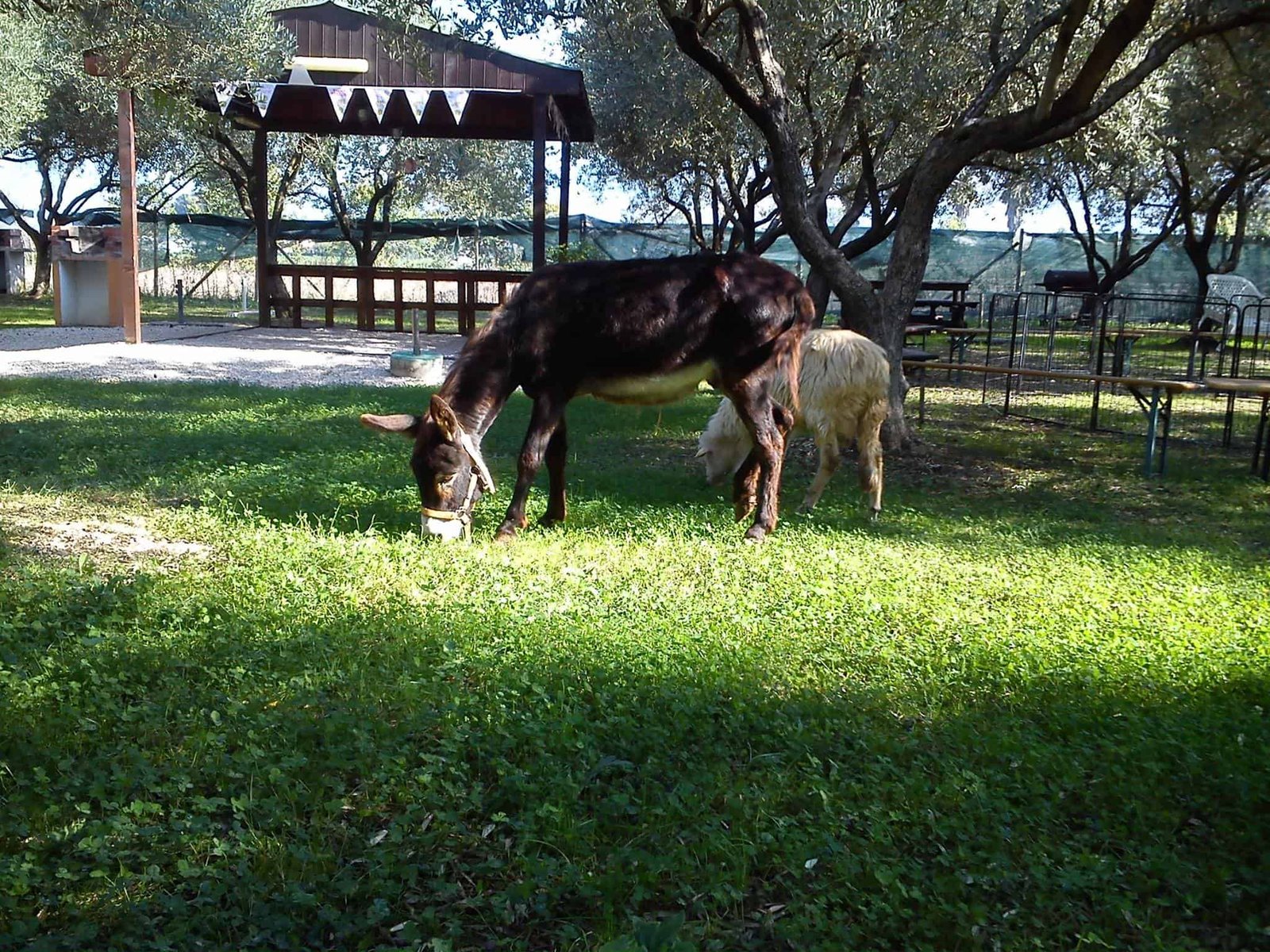
The Fattoria Didattica Il girotondo degli animali (Il girotondo degli animali Educational Farm) is a small farm in the Pontine plain that decided, at a certain point in its history, to open its gates to school groups and families. It is a few minutes from Latina, on a surface that the farm itself puts at around 20,000 square meters, a large part of which is occupied by an olive grove. It isn't an amusement park, it isn't a zoo, it isn't a protected area: it is a real working farm, with a vegetable garden that produces, with hives that yield honey and with a reference olive mill that turns the olives into extra virgin olive oil with a protected designation of origin. The animals, which in the name of the place are the main draw, live there because they are part of the farm's daily operation and not because they were gathered to be put on display. The difference seems subtle and instead changes everything: it changes how the day is organized, it changes what the children see, it even changes the noise you hear when you get out of the car. Anyone looking for rides will be disappointed. Anyone looking for a morning in the countryside with someone who explains how oil is born, how bees work and why a hen scratches the way she does will find exactly what is needed. For those thinking in terms of day trips with children in southern Lazio, the same kind of visit also includes the C’era Una Volta educational farm, Parco Natura La Selvotta and VoloAlto Nature Park, all private facilities that work by reservation and with organized groups.

Where Fattoria Didattica Il girotondo degli animali is and how to really get there
The first piece of information to fix is geographical, because it is the one that most often throws off the organization of the day. The farm is not inside Latina, it is not in a village and it is not along a main road with a clearly visible sign: it is in the countryside, in the grid of farm roads and consortium roads that the land reclamation drew on paper in the 1930s and that still today cuts the plain into regular squares. This grid has a feature that someone from outside the area doesn't expect: the roads are straight, long, all identical to each other, with the same rows of eucalyptus and the same drainage canals on either side. A wrong turn means driving two or three kilometers before finding a place to turn around without ending up in a ditch.
The urban reference is Latina, which the farm states is a few minutes away by car. Latina isn't an ancient city: it was born as Littoria, with the laying of the first stone on June 30, 1932 and the solemn inauguration on December 18 of the same year, and took its current name on June 7, 1945. Its municipal territory includes a dozen founding villages, from Borgo Sabotino to Borgo Podgora, from Borgo Piave to Borgo Grappa, from Borgo Faiti to Borgo San Michele, and the farms of this belt almost always rely on one of those villages as an orientation point. Whoever organizes the visit will do well to ask the farm directly which is the reference village and which road to take, because it is the only way to avoid the trap of repeated place names.
By car: the routes that work
The great axis of the whole plain is Via Pontina, which descends from Rome toward Latina and continues beyond. Those leaving the capital pick it up at the level of EUR and follow it for about 70 kilometers, passing Pomezia, Aprilia and Campoverde, with a final stretch where the roadway narrows and the average speed drops quite a lot. The second route is Via Appia, the historic one, which runs further inland at the foot of the Lepini Mountains and serves those arriving from Velletri, from Cisterna and from the Castelli Romani. The third is the coast road, which connects Anzio and Nettuno to Latina passing through Foce Verde and the lido: those arriving from the sea will use that one.
Once off the main routes, the part that counts begins. The roads of the Pontine countryside are paved but narrow, with no usable shoulder, often with the edge dropping straight into the canal. There is no lighting. On foggy days, which here in autumn and winter are frequent because the humidity of the reclaimed ground rises as soon as the temperature drops, visibility falls abruptly. It is best to allow at least a quarter of an hour more than what the phone app promises, because on those roads you don't travel at the speed the software imagines and because tractors, in season, take up the whole roadway.
The parking is the typical kind of farms: a dirt or grassy patch, inside or in front of the gate, with no lines and no attendant. The farm lists parking among its services, and this is better news than it seems, because it means school buses have somewhere to stop and families don't have to leave the car on the farm road. Anyone driving a low vehicle should be careful after rain: the Pontine soil is clayey, holds water, and the puddles hide the ruts left by farm vehicles.
By public transport: the uncomfortable truth
There is no public transport line that takes you to the gate of an educational farm in the middle of the fields, and it is worth saying so clearly instead of leaving it to be guessed. Latina's railway station is at Latina Scalo, about 10 kilometers north of the city center, and is served by the line that connects Rome to Naples. From the station buses leave for the center and for the villages, with frequencies that work on weekdays and thin out a lot on holidays. From any village stop to the farm there are still kilometers of countryside with no sidewalk, to be covered on roads where cars travel fast.
Those without a vehicle of their own have three concrete possibilities. The first is to get a ride from someone. The second is to take a taxi or a car with driver from the station or from the center of Latina, also arranging the return, because in the Pontine countryside you won't find a taxi passing by. The third, which is the one that works best for groups, is to organize the visit with a bus: school classes do this routinely and groups of families can do the same, splitting the cost. Saying so serves to prevent someone from setting out by train with two small children and ending up walking along a provincial road.
How much time it takes to get there
From Rome, leaving from the southern part of the city, the real travel time is between an hour and an hour and a half depending on traffic on the Pontina, which at rush hour becomes seriously congested in the stretch between the Raccordo and Pomezia. From the Castelli Romani, coming down by the Appia, you arrive in about an hour. From Anzio and from Nettuno, following the coast road, about 40 minutes is enough. From Terracina and from the southern side of the province you come up in a good half hour. From the center of Latina, as the farm states, it is a matter of a few minutes, and it is precisely this closeness to the provincial capital that makes the place convenient for the city's schools, which can leave after roll call and be back for lunchtime.
What Il girotondo degli animali really is: a farm that opens its gates
The company name says it all: it is an Azienda Agricola (farm business) that has added an educational function alongside its productive activity. This isn't a bureaucratic formula, it is the heart of the model. Educational farms were born in Europe in the last decades of the 20th century, in Belgium, France, Germany, Spain and Italy, as a response to two simultaneous problems: on one side small farms that struggle to sustain themselves on the income from products alone, on the other generations of city-raised children who know the cycle of food only from the supermarket shelf. The solution found was to put the two things together: the farm keeps producing and, at the same time, tells how it produces to those who come to see it.
In Italy the picture was consolidated with the law on the orientation of the agricultural sector, which recognized the so-called multifunctionality: the farmer isn't only a farmer, he can also receive, host, train. The regions then built their own registers and their own quality charters, with requirements for safety, hygiene, staff training and the design of the educational routes. Those who bring a class to an educational farm therefore aren't entering an improvised place: they are entering a business that has agreed to submit to further rules beyond those that already apply to agricultural production.
20,000 square meters and an olive grove
The size figure stated by the farm is about 20,000 square meters, that is two hectares, partly occupied by an olive grove. It is worth translating these numbers into concrete experience, because two hectares is a surface that disorients whoever reads it without context. Two hectares is roughly three regulation soccer fields placed side by side. It is enough to hold a productive olive grove, a vegetable garden, the animal shelters, an equipped picnic area and a play space, and at the same time it is small enough that a six-year-old can cover it without exhausting his energy by mid-morning. It is exactly the right scale for teaching: big enough to contain different things, small enough not to lose anyone.
The olive grove deserves a discussion of its own because it isn't a decorative element. The olive trees of the Pontine plain and of the hills that close it off to the east are in large part of the Itrana cultivar, the one that also gives the table olive known as Oliva di Gaeta. An adult olive grove has a rhythm that children can follow with their eyes over the school year: the flowering in spring, the fruit set, the summer swelling of the fruit, the veraison that darkens it in autumn, the harvest between October and December.
The animals: who lives here and why
The name of the place promises animals and the farm states many. The list the farm itself publishes includes little goats, rabbits, a mare, geese, ducks, hens, guinea fowl, turkeys, a donkey, pigs, sheep, chinchillas, Peruvian guinea pigs, water and land tortoises, mallards, swans, little fish, peacocks, chicks, earthworms, dogs and cats. A list like this has to be read for what it is: a snapshot of what the farm has declared, not a guaranteed catalog. The animals of a real farm are born, grow old, are sold and replaced, and the composition changes from season to season. Whoever comes with a child who has a specific animal in mind and doesn't intend to settle for anything else will do well to ask beforehand if that animal is there at the moment.
The olive grove, the PDO Colline Pontine oil, the honey and the vegetable garden
The productive part of the farm is what gives substance to everything else, and the farm states it precisely: extra virgin olive oil with the protected designation of origin Colline Pontine, honey from its own bees, vegetable garden products, all with organic methods. They are three different supply chains, with three different calendars, and each offers the children a different hook.
The oil with protected designation of origin
The Colline Pontine designation was recognized in 2010 and concerns an area that includes 25 municipalities in the province of Latina, among them Aprilia, Bassiano, Campodimele, Castelforte, Cisterna di Latina, Cori, Fondi, Formia, Itri, Lenola, Maenza and Minturno. The reference cultivar is the Itrana, also known as Oliva di Gaeta, Trana, Oliva Grossa or Cicerone: a dual-purpose variety, that is one suited both to oil production and to processing into table olives, which in the Italian olive-growing landscape is not at all a given.
A protected designation of origin isn't a commercial label. It is a commitment written in a specification that establishes where the olives may be grown, which varieties can be used and in what percentages, when to harvest, within how many hours of harvest the olives must be crushed, at what temperature the olive paste is worked and which chemical and organoleptic parameters the oil must meet in order to bear the name. Every step is traced and checked by a third-party body. For a small farm, joining such a system means accepting constraints and costs that are not mandatory: nobody prevents you from selling an excellent oil without a designation. If a farm chooses to do it, it is because it intends to play on a field where quality is declared and verified by someone else.
In the educational visit this becomes the route that the farm calls, in its own words, the journey of oil from the plant to our table. It works well because it is linear and because every step has a concrete object to look at: the tree, the fruit, the net spread under the canopy, the comb or the shaker that shakes the branches, the perforated crates, the olive mill, the paste, the oil coming out. And it works above all in autumn, when the harvest is really under way and the child isn't looking at a reconstruction but at work in progress.
The bees and the honey
The farm states honey of its own production and a guided route dedicated to the world of bees. Beekeeping is perhaps the most effective educational subject that exists on a farm, for a precise reason: the hive is a collective organism that behaves as if it were a single individual, and this concept, which for adults requires an explanation, children grasp almost immediately. A colony of bees counts tens of thousands of individuals with defined roles, a single queen who lays, workers who change tasks with age passing from cleaning the cells to caring for the brood, then to producing wax, then to guarding the entrance and finally to foraging outside, and drones who appear only in the reproductive season.
Of course bees sting, and the management of safety in a beekeeping route is a matter for whoever leads the activity. The hives are observed from a safe distance, with the guide deciding how close to go. Close observation is generally done through a protected frame or a teaching hive with a transparent wall. Anyone with an allergic family member to hymenoptera venom must report it before booking, without waiting to be on site: it is an elementary precaution that applies on any farm with an apiary.
The vegetable garden and the organic method
The third pillar is the vegetable garden, and the farm offers a seasonal route dedicated to discovering the crops. Seasonal is the key word: a vegetable garden in April and the same garden in October are two different places, with different plants, different colors and different jobs. In the Pontine plain the climate allows a very wide range, because the winter is mild and water isn't lacking. The province of Latina produces vegetables in industrial quantities, from artichokes to zucchini to watermelons, and holds a huge share of national kiwi production, protected since 2002 by a protected geographical indication.
A curiosity about Fattoria Didattica Il girotondo degli animali
The curiosity concerns the name, and it is the kind of detail nobody stops to consider because it seems too obvious. Il girotondo degli animali immediately evokes the children's rhyme, the one of giro giro tondo. What almost nobody knows is that it is one of the few truly pan-European childhood formulas, present with an almost identical structure in dozens of different languages, and that the explanation almost everyone gives of it is false.
The English version, Ring a Ring o’ Roses, appears in print for the first time in the mid-19th century: a variant is found in the novel The Old Homestead by Ann S. Stephens in 1855, the best-known version is fixed by Kate Greenaway in the volume Mother Goose or the Old Nursery Rhymes of 1881, and in 1883 William Wells Newell in his Games and Songs of American Children collects several forms of it, one of them with a melody traced back to about 1790 in Massachusetts. In the German area an almost overlapping rhyme was printed already in 1796 and flows into the famous collection Des Knaben Wunderhorn. In Italy a version with the line gira gira rosa is recorded in Venice in 1874. In the Netherlands there is the form Roze roze meie, with a melody very similar to the English one. In Switzerland the children circle around a real rose bush.
And here comes the part that takes apart the legend. For some decades the explanation has circulated everywhere that the rhyme is a coded memory of the plague: the red ring on the skin as the first sign, the little bunch of flowers in the pocket to cover the smell, the sneeze as a symptom and the final fall as death. It is a fascinating reading and completely without foundation. The two greatest scholars of children's rhymes in the world, Peter and Iona Opie, demolished it by pointing to four objections that admit no reply: the explanation doesn't appear anywhere before the mid-20th century, the symptoms of plague don't match the text, the oldest versions contain neither the sneeze nor the ashes, and in the European and 19th-century variants the verb that indicates the fall describes a bow, that is a curtsy that closes the dance, and not a collapse.
What does all this have to do with a farm in the Pontine plain? It matters because the name chosen by the farm puts at the center the idea of the circle, and the circle is exactly the shape the agricultural cycle takes: you sow, you cultivate, you harvest, you sow again. The bees go out and come back. The olives ripen, fall, grow back. A round dance of animals is, without meaning to be, the most exact metaphor for what happens inside a farm. And the methodological lesson holds for the adults accompanying the children too: the most suggestive explanation is almost never the right one, and in the countryside as in history it is always better to ask those who really work there before repeating the version that is going around.
The educational routes and how they work
The farm publishes a rather wide range of routes, and it is worth going through them one by one because each has its own logic and a different ideal audience. The common premise, stated by the farm, is that all the routes include tasting: you taste what you have seen being born, and it is the closing of the circle that makes the visit memorable.
Let's discover the vegetable garden
It is the seasonal route dedicated to discovering the garden's crops. It changes completely depending on the month in which you book, and this is a feature to exploit rather than endure. In spring you see sowing, transplanting, the first germination. In summer you see full production, with the plants loaded. In autumn you see leaf crops and the preparation of the soil for winter. For a class that returns twice in the same school year, once in autumn and once in spring, the comparison between the two visits is worth more than any theoretical lesson.
Let's learn about oil from the plant to our table
It is the farm's signature route, the one that relies directly on the olive grove it owns and on the Colline Pontine designation. It follows the whole supply chain. The best moment to book it is autumn, coinciding with the harvest, because in that period everything that is told really happens on the farm. Out of season the route remains valid but becomes more narrative and less hands-on, and it is worth knowing in advance so as not to arrive with the wrong expectations.
The bees and the honey
The farm presents it as a guided route to learn about the world of bees. It is the one with the greatest surprise effect and also the one that requires the most organizational attention, because of the question of allergies and the management of distances. The best season runs from late spring to early summer, when the colony is at its peak development and flight activity in front of the hive entrance is continuous.
Let's make pizza, from the dough to baking in the wood-fired oven
It is the route children remember longest, and not for gastronomic reasons. Kneading is a totally tactile activity: you sink your hand into the flour, you feel the dough change consistency under your fingers, you sense the warmth of the yeast at work. Then there is the wood-fired oven, which introduces a theme that has disappeared from modern homes: real fire, wood, heat that isn't regulated with a knob but by moving the embers. A child who has rolled out his own disk of dough and watched it puff up in 80 seconds in front of the oven mouth has learned something about the transformation of food that no worksheet conveys. It has the further advantage of working all year round and in any weather, because it takes place indoors.
Let's feel with our feet, the sensory route
The farm describes it as a barefoot walk on a natural track, to recognize different materials through touch: wood, straw, pebbles and more besides. It is the route adults underestimate the most and which instead has the most solid pedagogical foundation. The sole of the foot contains a very high density of receptors, and in city children that sensory channel stays almost always unused because the shoe isolates it from morning to night. Walking barefoot on surfaces that change every two meters produces a load of information that the brain must process in real time, with effects on balance, proprioception and concentration. For children with attention difficulties it is often the moment of the day when the most evident changes are seen.
The aromatic herbs route
Rosemary, sage, thyme, mint, lavender, bay, oregano: Mediterranean aromatics grow in the Pontine plain without effort and have the characteristic of releasing their essential oils when you rub the leaf between your fingers. It is a route with a very low barrier to entry, suitable even for the smallest groups, and it connects the field to the kitchen in an immediate way. A crushed rosemary leaf held up to the nose is a complete botany lesson that lasts three seconds.
The animal world
It is the route that carries the name of the farm, dedicated to getting to know the animals up close. It is best to arrive with the correct expectation: getting to know them up close doesn't mean free access to the pens, it means guided approach, explained and regulated, with precise hygiene rules and with respect for the animals' timing. Barnyard animals have reactions of their own, the youngest get frightened, females with their young defend, and a guide who knows his animals knows when it is time to let a group come near and when it is better to observe from the fence.
The additional activities
The farm also mentions themed evenings, nights under the stars and activities to learn English. They are formulas that step outside the scheme of the school morning and open up a different use of the place: the group that stays on in the evening, the summer camp, the language workshop in an agricultural setting. The night under the stars, in particular, makes precise sense in that territory: the Pontine countryside, far from the lights of the provincial capital, preserves night skies of decent quality, and the difference between the sky seen from a city balcony and the sky seen from a farm is a discovery that children don't expect.
All these formulas have to be agreed with the farm. Number of participants, duration, time of year, age of the children, presence of special needs: they are variables that determine the organization and that no web page can fix in advance. The farm's official contacts remain the only valid channel to define them.

Something nobody tells you about Fattoria Didattica Il girotondo degli animali
The thing nobody says concerns the ground you walk on, and it isn't a poetic detail: it is the key to understanding why this farm exists and why a century ago it could not have existed. The farm is in the Agro Pontino, that is one of the few Italian plains that were literally manufactured by man in less than 10 years. Until the 1920s that plain was a marsh. Not a scenic wetland: a malarial swamp, with stagnant water, with a sparse population that lived in seasonal huts called lestre and that in summer went up toward the mountains so as not to die of fevers.
The problem was ancient. The Latins and the Volsci had tried to drain the area with underground channels. In the 15th century Pope Martin V approved a reclamation project. In the 16th century Leonardo da Vinci studied the hydraulic system of the area without his project ever being carried out. At the end of the 18th century Pope Pius VI started the works that produced the canal known as the Linea Pia, begun in 1777 under the direction of the engineer Gaetano Rappini and continued for about 20 years with thousands of workers. None of these attempts settled the question for good, because the problem wasn't digging a canal but governing an entire hydraulic system in a territory that in many points lies below sea level.
The solution came between 1926 and 1937 with the integral land reclamation. The figures of that operation remain impressive: 50,000 workers employed, more than 18 million working days, 416 kilometers of roads built and 2,392 farmhouses built from scratch. From 1931 the Opera Nazionale Combattenti took the project in hand. On October 27, 1932 the first trains of settlers arrived, largely from the Veneto, Friuli, Emilia and Romagna, who were assigned a farm, a house, livestock and technical assistance. In 1932 Littoria was born. In the years immediately after came Sabaudia, Pontinia, Aprilia and Pomezia, designed according to the canons of rationalist architecture.
Here is the point nobody tells the children on a visit, and which is instead the most interesting thing of all: that grid of straight roads, those parallel canals, those rows of eucalyptus planted to dry the soil, those farmhouses identical to one another at regular intervals, are all elements of a single project, drawn on paper and carried out in a few years. The Pontine countryside didn't grow: it was built. When you drive the road that leads to the farm you cross a work of territorial engineering, and the farm itself, with its regular shape and its sharp boundaries, is one tile of that design.
There is also a flip side that deserves to be told honestly. The land reclamation destroyed an ecosystem unique in Europe. Of that world of waters, flooded woods and extraordinary birdlife, only what the Circeo National Park, established in 1934, managed to save remains: the Selva di Terracina, which with its roughly 3,300 hectares is the largest natural lowland forest in Italy, the coastal lakes of Fogliano, Monaci, Caprolace and Paola, the coastal dune 22 kilometers long. It is a perfect irony of history: the same regime that was draining the marsh established the park that preserved a fragment of it. A family that visits the farm in the morning and in the afternoon goes down to Lago di Fogliano makes, without realizing it, the journey that explains the whole story.
And there is a technical detail that works as a closing note: the Pontine plain stays dry only because there are pumping stations that pump the water away day and night, with an installed power of more than 4,000 kilowatts, because in large portions of the territory the water cannot drain by gravity. The ground on which the farm's little goats graze is dry thanks to a system that never stops. Telling a 10-year-old child this produces a silence worth the whole visit.
The advice I give you for visiting Fattoria Didattica Il girotondo degli animali
The main advice is only one and must be said before all the others: call. Don't send a message and wait, don't rely on an automatic booking, don't show up at the gate hoping it's open. An educational farm is a farm business with a limited number of people running it, and the same people who accompany the groups in the morning prune, milk, harvest or tend the hives in the afternoon. The day on which a group can be received has to be agreed, and the content of the visit too. A five-minute phone call settles in advance everything that would otherwise become a problem on site.
What to ask when you call
There are six questions worth preparing before dialing the number. The first concerns the route: which of those offered is available in the chosen period, because the garden and the oil follow the seasons and the bees have a calendar of their own. The second concerns the actual duration, because a half day and a full day require different organization, above all for lunch. The third concerns lunch itself: if the group brings a packed lunch, if the farm provides something, if the barbecue and the gazebo can be used and under what conditions. The fourth concerns the age of the participants, because the same route told to kindergarten children and to middle schoolers isn't the same activity. The fifth concerns special needs: allergies, food intolerances, mobility difficulties, children who need assistance. The sixth concerns access: how exactly to get there, where to park, if a bus can enter or has to stop outside.
How to dress and what to bring
Closed shoes, always, for everyone, without exceptions. Not sandals, not ballet flats, not light canvas shoes. The ground of a farm contains stones, surfacing roots, irrigation pipes, hollows and animal droppings, and nothing ruins a morning like a child who slips or who gets a foot wet in the first quarter of an hour. The shoes must be shoes that can get dirty: whoever arrives in new footwear will spend the visit worrying about them instead of looking at the animals. For the barefoot sensory route you then need a pair of spare socks and a small towel, which weigh nothing and change the experience.
Clothing should be built in layers, because the Pontine countryside has stronger morning temperature swings than the city: at 9:00 in the morning in March, with the humidity rising from the canals, it is quite a bit colder than the thermometer says, and by 11:00 the temperature has already changed. In summer you need a hat and sunscreen, because between the garden and the pens the shade is scarce and the sun of the plain, reflected off the light-colored ground, is more aggressive than that of the city. In winter you need a waterproof jacket: the clayey ground holds water for days after rain, and the mud is part of the experience.
The most common mistakes
The first mistake is showing up without notice. The second is arriving with the expectation of a zoo and being disappointed because the animals don't put on a show. The third is feeding the animals without asking: food that comes from visitors' pockets is one of the main causes of digestive problems in barnyard animals, and the diet is decided by whoever raises them. The fourth is letting children run free among the pens: a donkey or a goat isn't dangerous, but a child who comes up behind an animal that hasn't seen him risks an instinctive reaction.
The picnic area, the playground and the family services
Among the services stated by the farm are an equipped green area for picnics with an adjoining playground, the barbecue, the gazebo, the umbrellas and the parking lot. It is a list worth reading carefully because it describes precisely the kind of day the place allows.
Why the picnic area changes the visit
An area equipped for packed lunches isn't a logistical detail, it is what turns a two-hour visit into a full day. In the Pontine countryside, outside the towns, places to eat are sparse and often far away. Without a place to sit and eat, a group has to get back in the car at noon and the day is broken up. With tables available, instead, lunch becomes part of the experience: you eat where you spent the morning, the children stay in the same setting, and the afternoon can go on without moving.
The barbecue, the gazebo, the umbrellas
The presence of the barbecue opens up the formula of the day among families or friends, which is a different thing from the pure educational visit. The gazebo and the umbrellas serve a precise and very concrete function: creating shade. In a plain farmed with vegetable gardens and young olive groves natural shade is scarce, and between June and September, in the central hours, a shaded spot where the children can sit makes the difference between a break and a torment. Whoever organizes a summer visit should ask explicitly how many seats in the shade there are for the number of people they bring.
The playground
The playground attached to the green area has a function that adults often don't consider: it serves to let off steam. After an educational route in which the children were asked to pay attention, not to run, to listen and not to touch, half an hour of free play is the best way to close the day without the last half hour of the car trip becoming complicated. It is therefore best to keep it for the end and not for the beginning: a group that starts from the slide is a group that will not listen to anything for the rest of the morning.
Another well-known fact, yet rarely cited
The well-known fact is that the province of Latina produces food in enormous quantities. What is almost never said is how out of scale those quantities are compared with the area of the territory, and how much this depends precisely on the artificial nature of the plain.
The most striking figure concerns the kiwi: the Pontine area alone produces about three quarters of Italy's entire national production, and Italy is historically among the top producers in the world of this fruit, which comes from East Asia and was introduced to Europe in very recent times. The kiwi of the Agro Pontino is protected by a protected geographical indication obtained in 2002. Whoever crosses the plain to reach the farm sees the kiwi pergolas without recognizing them: they are those low, regular structures, with concrete posts and taut wires, that cover whole hectares and that in winter, bare, look like geometric skeletons.
Why does all this matter to someone bringing a child to an educational farm? Because it places the visit in a context and takes away its character as a folkloric parenthesis. The farm you go to visit isn't a remnant of a vanished world preserved out of nostalgia: it is a small unit inside a living and very powerful production system, which supplies the market stalls of half of Italy. The child who tastes the farm's oil or honey isn't tasting a souvenir: he is tasting a sample of a real supply chain. And the farm's choice to work organically, on two hectares, with a protected designation of origin, has to be read exactly within this picture: it is a positioning choice in a territory where quantity isn't lacking, and where therefore the game is played elsewhere.
There is then a corollary concerning water. All this production depends on the hydraulic system built with the land reclamation: canals, embankments, sluices, pumping stations. It is an infrastructure that requires permanent maintenance and that, if it stopped, would bring back the marsh in a few seasons. When you look at an artichoke field in the Pontine plain you are looking at an actively maintained balance, not a natural state of things. This too is a lesson that an educational farm can give better than any classroom.
The right photo to take at Fattoria Didattica Il girotondo degli animali
The right photo isn't the close-up of the donkey and it isn't the child holding the rabbit. Those are the photographs everyone takes home and that after a week no longer say anything. The photo that really tells this place is built by putting two planes together: in the foreground the agricultural detail, in the background the geometry of the plain. A branch of olive laden with fruit in focus, and behind, blurred, the regular row of trees and the straight line of the field that reaches the horizon without a ripple. That image contains the farm and contains the land reclamation. You need low light though, the first hour of the morning or the last of the afternoon: at noon the plain flattens, because there is no relief to generate shadows, while with raking light the rows draw the grid of the farm.
The second image to look for is that of hands. Child hands in flour, hands holding a frame, hands gripping a rosemary leaf, bare feet on the sensory route. They are photographs that don't require the face, so they pose no consent problem when it comes to school groups, and they convey the experience better than any portrait. The third, if the season offers it, is the net spread under the olive tree with the olives dotting it: it is the visual synthesis of the entire supply chain.
Some important events that happened here in history
Talking about historical events that took place within the boundaries of a two-hectare farm would be a forced operation, and I won't do it. What can be said with precision concerns the territory in which the farm sits, and these are events that changed the geography of Italy.
The first is the integral land reclamation, carried out mainly between 1926 and 1937, with the Opera Nazionale Combattenti leading the operation from 1931. Before that date the area was a malarial marsh. After, it was cultivable plain divided into assigned farms. On October 27, 1932 the first trains of settlers arrived from the Veneto, Friuli, Emilia and Romagna, the families who gave rise to the Veneto-Pontine community still recognizable today in surnames and in certain inflections of the local speech.
The second is the founding of the city: first stone on June 30, 1932, inauguration on December 18, 1932 with the name of Littoria. Then Sabaudia, Pontinia, Aprilia and Pomezia in the years immediately after. In 1944 the name became Latinia and on June 7, 1945 it took the current form of Latina.
The fourth is the Second World War. In 1944 the Pontine plain was the scene of the Allied landing at Anzio and Nettuno and of the months of fighting that followed. The pumping stations were stopped and in some areas the marsh returned, with a resurgence of malaria that had been almost eradicated. The hydraulic system was put back into operation in the post-war period. Those who want to go deeper into this chapter will find material at the Anzio Landing Museum, while the story of the land reclamation and colonization is told at the Museum of the Pontine Land in Latina.
Who has passed through Fattoria Didattica Il girotondo degli animali
Every year thousands of people pass through an educational farm who appear on no list: kindergarten and primary school classes, summer camp groups, groups of families, birthdays, parish groups, associations. They are the visitors who count, and the farm states explicitly that it addresses groups of children and school groups, private groups and families. There are no documented visits by famous people, and inventing them would be foolish.
If instead you widen your gaze to the territory, the names are not lacking. The Pontine plain and its surroundings have been crossed by a notable number of people who left written traces. Leonardo da Vinci studied the hydraulic system of the marshes in the 16th century. Pope Pius VI committed a considerable part of the resources of his pontificate to it. Goethe traveled the Appia along the edge of the marshes during his journey in Italy. In the 20th century, Sabaudia and the Pontine coast were the summer refuge of writers, directors and intellectuals: Pier Paolo Pasolini spent long periods there and Alberto Moravia had a house there for years, in that strip of dunes between the sea and the lake that was then almost deserted.
And then there is the category nobody ever mentions and that really made this landscape: the peasant families who arrived by train in 1932 and in the following years, who were handed a farm, a house and a stable in a territory they didn't know and in which many fell ill. An educational farm in the Agro Pontino is, declared or not, the direct heir of that history.
When to go and when to avoid
Spring, from March to the end of May, is the best season of all: the climate holds up, the garden is in full sowing and transplanting, the bees are in full activity, the animals often have their young. It is also the period of greatest demand from schools, so it should be booked well in advance.
Autumn, from mid-September to November, is the second window and for the oil route it is the first: the olive harvest in the area falls between October and December, and seeing the harvest under way completely changes the value of the visit.
Summer has to be managed. July and August in the Pontine plain mean humid heat and direct sun with no natural shade: a visit in those weeks works only in the early hours of the morning or in the late afternoon. The evening formulas offered by the farm, such as themed evenings and the night under the stars, make sense precisely in this period.
Winter is the quietest and least visited season. The climate of the plain is mild, but the morning fog and the sodden ground after rain are real variables. The indoor routes, the pizza one in particular, hold up very well even in January. The day to avoid is the one after heavy rain: the clayey ground stays impassable for a couple of days and the visit loses in comfort what it gains in nothing.
What's around Fattoria Didattica Il girotondo degli animali
The location lets you build double days in four different directions. Toward the sea, a handful of kilometers away, is the Lido di Latina, with its wide beach and its beach clubs. Continuing along the coast you reach Lago di Fogliano and, further south, the Torre Paola beach in Sabaudia, the Bufalara beach and the San Felice Circeo beach, all inside or on the edges of the Circeo National Park.
To the north you go to Anzio and Nettuno, with the medieval village, the basilica and the Landing Museum, or to Torre Astura and the Torre Astura grove.
Toward the interior, at the foot of the Lepini Mountains, the hill villages open up: Sermoneta with its castle, Norma overlooking the plain, Cori with the museum of the city and the territory, Priverno with its museums and Lake Giulianello. A few minutes from Sermoneta is the Garden of Ninfa, which remains one of the most memorable visits in all of Lazio.
To the south, finally, the coast continues toward the Terracina beach and the coves of Sperlonga. For those looking instead for another day with animals and children, the same kind of visit includes Zoomarine in Torvaianica and, in the countryside north of Rome, Parco Natura La Selvotta and VoloAlto Nature Park.
Quick questions about Fattoria Didattica Il girotondo degli animali
Where exactly is it?
In the countryside a few minutes from Latina, in the Agro Pontino. The precise address and the road directions should be requested directly from the farm: in the grid of farm roads of the land reclamation the GPS alone isn't enough.
Can you go in without booking?
The place works for groups of children and school groups, private groups and families, with organized activities. Access and arrangements have to be agreed in advance with the managers.
Which routes can you do?
The farm offers the vegetable garden route, the one on oil from the plant to the table, the one on bees and honey, the pizza workshop with baking in a wood-fired oven, the barefoot sensory route, the one on aromatic herbs and the one dedicated to the animal world, as well as themed evenings, nights under the stars and activities in English. All the routes include tasting.
Are there areas for lunch?
The farm states an equipped green area for picnics with playground, barbecue, gazebo, umbrellas and parking. Conditions of use and capacity are agreed at the time of booking.
What does the farm produce?
Extra virgin olive oil with the protected designation of origin Colline Pontine, honey from its own bees and vegetables, all from organic production, on a surface of about 20,000 square meters partly occupied by an olive grove.
Is it suitable for very young children?
The small size and the sensory routes make it workable even with the youngest, but duration and content have to be calibrated and agreed with whoever accompanies the group.
In our view this farm should be judged for what it is: two hectares of Pontine countryside, an olive grove that produces an oil with a designation, an apiary, a vegetable garden and a collection of barnyard animals, kept by people who work that land every day. It doesn't offer the numbers of a big facility and doesn't pretend to. It offers the right scale for a child between four and 10 years old, an agricultural story that stands on its own and a territorial context, that of the plain built by man, that no other place in Italy can tell in the same way. Call first, go in spring or autumn, wear closed shoes and give the children the time to get bored for a moment in front of a pen: that is where they usually learn something.
Frequently asked questions about Fattoria Didattica Il girotondo degli animali
What is Fattoria Didattica Il girotondo degli animali?
Il girotondo degli animali is a farm in the countryside near Latina, in the Agro Pontino, that adds an educational function for children and families alongside its productive activity. The farm grows, with organic methods, extra virgin oil with the protected designation of origin Colline Pontine, honey from its own bees and vegetable garden products, and offers guided routes that always end with a tasting.
Where exactly is the farm?
Fattoria Didattica Il girotondo degli animali is in the countryside a few minutes from Latina, in the Agro Pontino, in the grid of farm and consortium roads drawn by the land reclamation in the 1930s. The precise address and the road directions should be requested directly from the farm, because in this network of roads the GPS alone isn't enough.
Can you go in without booking?
No, you don't go into Fattoria Didattica Il girotondo degli animali without booking. The place works for groups of children and school groups, private groups and families, with organized activities, and the explicit advice given by the farm is to call in advance instead of showing up at the gate hoping it's open.
What can you do at Il girotondo degli animali?
At Fattoria Didattica Il girotondo degli animali you can follow educational routes such as Let's discover the vegetable garden, dedicated to the seasons of the crops, as well as observe the olive grove, the bees and the farm's animals. All the routes include a final tasting of the farm's products, with the idea of letting the children taste what they have seen being born.
Are there spaces for picnics and can children play?
Yes, Fattoria Didattica Il girotondo degli animali states among its services an equipped green area for picnics with an attached playground, as well as barbecue, gazebo, umbrellas and parking, designed to make the visit a full day and not just a short stop.
When is the best time to go to Il girotondo degli animali?
Spring, from March to the end of May, is the best season to visit Fattoria Didattica Il girotondo degli animali: the climate holds up, the garden is in full sowing, the bees are active and the animals often have their young. It is also the period of greatest demand from schools, so it is best to book well in advance. Autumn is the second recommended window.
What is near the farm?
Near Fattoria Didattica Il girotondo degli animali, toward the sea, is the Lido di Latina, with its wide beach and its seaside beach clubs. Continuing along the coast you reach Lago di Fogliano and, further south, the Torre Paola beach in Sabaudia and the San Felice Circeo beach, inside or on the edges of the Circeo National Park.
Article written by the editorial team of TourLeaderPro, contact them for Private/Corporate/V.I.P. Tours and Experiences. For an organized day in the Agro Pontino, with a licensed tour guide and transport included, start from the TourLeaderPro contact page. Tour operators who build itineraries for families in Lazio will find the consulting service in the section dedicated to tour operators.
Planning a trip to Italy? The English guides are on ItalyPlanner.com. For those thinking in terms of days out of the city there is the guide to the best day trips from Rome, while those traveling with children will find practical tips in the guide to Rome with kids.