Basilica of Neptune
In short. The Basilica of Neptune is the great Roman hall abutting the Pantheon on its rear side, and you look at it from Via della Palombella, in the Rione IX Pigna, a short step from Piazza della Rotonda, 00186 Rome.

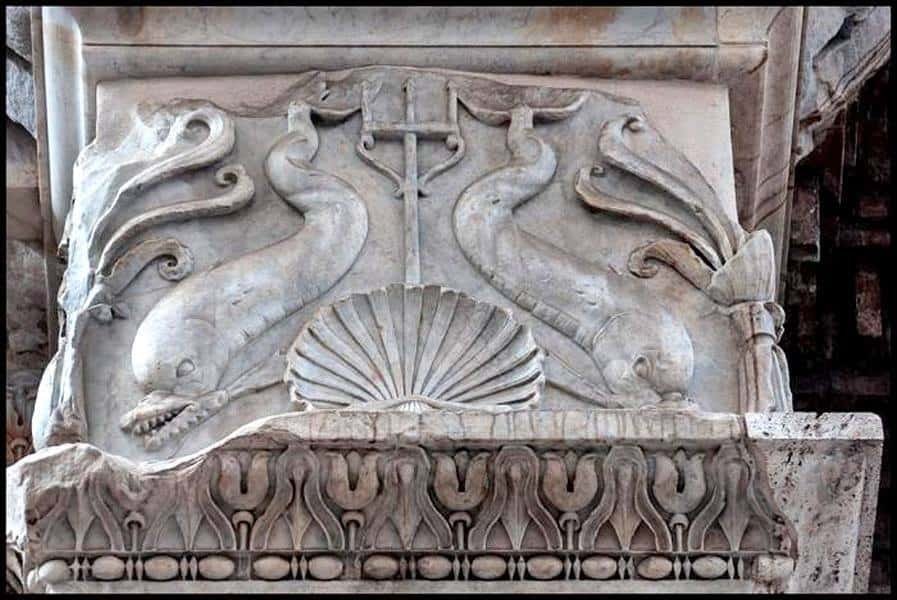
The Basilica of Neptune is the great Roman hall abutting the Pantheon on its rear side, and you look at it from Via della Palombella, in the Rione IX Pigna, a short step from Piazza della Rotonda, 00186 Rome. From the outside it is always visible, free of charge, at any hour: the brick wall about 10 meters high, the semicircular niche and, at the top, the marble frieze with dolphins, tridents and shells are there, above the heads of passersby, and nobody asks for a ticket to raise your eyes. From the inside the matter changed on November 25, 2025: from that date the Directorate of National Museums of the City of Rome opened the rooms of the Basilica of Neptune to the public with the route titled Beyond the Pantheon, 45 minutes, groups of 25 people at most, every day except the first Sunday of the month, meeting point right on Via della Palombella. The supplement for the special visit is €10, free for under-18s, and it is added to the Pantheon ticket, which the official site gives as €7 full price and €2 reduced for European Union citizens between 18 and 25, with free admission for those under 18. It is best to recheck the amounts at the time of purchase. Booking is compulsory and goes exclusively through the Musei Italiani platform and app. Tour guides with their own group have dedicated slots at 06 39967950. The Pantheon opens every day from 9:00 to 19:00, with the ticket office open until 18:00 and last entry for individual tickets at 18:30, and it closes on December 25 and January 1 except for extraordinary openings. Telephone +39 06 68300230, email dms-rm.pantheon@cultura.gov.it, official website direzionemuseiroma.cultura.gov.it/pantheon. For those with mobility difficulties a newly installed internal elevator makes the route through the rooms of the basilica accessible, while entry to the Pantheon for visitors with disabilities is from the external ramp on the side of Via della Minerva. There is no useful metro: the surface hub is Largo di Torre Argentina, five minutes on foot, where tram 8 arrives and where the bus lines that cross the center along Corso Vittorio Emanuele II and Via Arenula stop. Anyone who wants to place this address within the rest of the city will find an orientation on the page on Rome's tourist attractions.
What the Basilica of Neptune really is
It is best to clear away at once the misunderstanding that strikes nine visitors out of 10. The Basilica of Neptune is not a church. The word basilica, before becoming an ecclesiastical title, meant in Rome a civil building: a covered hall, wide, served by columns, where business, lawsuits and public affairs were handled sheltered from rain and sun. The Basilica Ulpia in Trajan's Forum, the Basilica Aemilia in the Roman Forum, the Basilica of Maxentius on the Velia are buildings of this kind, and none of them ever had a Christian altar. The Basilica of Neptune belongs to this family, and the name of the sea god that it bears points to a dedication, a decorative program and a memory of naval victories, not to a parish cult.
The second thing to clarify concerns the position. Many arrive in Piazza della Rotonda, photograph the portico with its 16 granite columns and leave convinced they have seen the whole complex. The Pantheon is instead the front part of a larger organism, and the Basilica of Neptune is its tail: a rectangular hall that runs along the southern flank of the rotunda, with its long axis perpendicular to that of the temple. Whoever leaves Piazza della Rotonda and goes around the building by Via della Minerva or by Via del Seminario ends up in Via della Palombella, a narrow gut where few set foot, and there the Roman wall rises on the right like a brick backdrop. It is the same complex, simply seen from behind.
The third clarification is chronological, and it is worth saying without shortcuts. What you see today is not Agrippa's building. It is the Hadrianic reconstruction, that is, of the first half of the 2nd century AD, raised on the ruins of an Augustan building burned in the fire of AD 80. The brick, the masonry facing, the proportions of the niches, the marble frieze: everything speaks the language of Hadrian's building sites, the same one that produced the dome of the Pantheon. The horizontal measure, however, remains the Augustan one: the Hadrianic basilica follows the plan and floor level of the earlier basilica, and this fidelity to the original trace is one of the reasons why the identification of the building has held up through almost a century of discussion.
Where the Basilica of Neptune is and how to get there
The exact address of the Basilica of Neptune
Via della Palombella is a street barely 60 meters long that links Via della Minerva to Piazza della Rotonda passing behind the Pantheon. On the northern side of the street is the flank of the rotunda. On the southern side, abutting and partly absorbed into the modern buildings, is the Basilica of Neptune. No sign, no totem, no ticket office: the first time you pass, if you do not know what to look for, you mistake the Roman wall for any backdrop of the historic center. The coordinates of the point are 41 degrees 53 minutes 53 seconds north and 12 degrees 28 minutes 36 seconds east, and anyone using the phone map would do well to search for Via della Palombella and not the name of the building, because the navigator tends to take everyone in front of the portico.
How to get to the Basilica of Neptune by public transport
The historic center of Rome has no metro, and it is the first thing to know as soon as you get off at Termini. The nearest stations of Line A, Barberini and Spagna, are a good quarter of an hour's walk away, and the route is not comfortable. The reasonable solution is surface transport: Largo di Torre Argentina is the hub that serves all this area, tram 8 arrives there going up from Trastevere along Via Arenula, and the bus lines that run along Corso Vittorio Emanuele II stop there. From Largo di Torre Argentina to Via della Palombella you walk a good five minutes along Via dei Cestari, the street of sacred vestments, with shop windows full of cassocks and chalices that are worth the detour on their own. The other option is to come down along Corso del Rinascimento and cut through by Salita de' Crescenzi.
Walking to the Basilica of Neptune from the other attractions
Central Rome is measured in minutes, not in kilometers. From Piazza Navona to the Basilica of Neptune it is six minutes. From the Trevi Fountain nine. From Largo di Torre Argentina five. From Piazza Venezia 10. The practical advice is never to arrive from the front. Whoever enters Piazza della Rotonda from Via del Pantheon plunges into the worst crowd of the day and loses the sense of direction. Whoever instead takes Via dei Cestari and comes out in Via della Palombella meets first the Roman back, then the square, and understands the building in an order that makes sense. This reversal of the route is the single choice that changes the quality of the visit most.
Parking and the car
You do not get there by car, and insisting is an expensive mistake. The whole area falls within the limited traffic zone of the Historic Center, with electronic gates active in the daytime on weekdays and in the evening on weekends. The fines arrive at your home months later. Taxis can drop passengers at Largo di Torre Argentina or on Corso del Rinascimento, not in Piazza della Rotonda. Whoever arrives from outside Rome is quicker leaving the car in a park-and-ride and completing the journey by public transport.
Agrippa, the Campus Martius and the building site from which the Basilica of Neptune is born
Who Marcus Vipsanius Agrippa was
Without Agrippa the district you are in does not exist. Marcus Vipsanius Agrippa was a contemporary and schoolmate of Octavian, then his general, then his son-in-law: he married Julia, the emperor's only daughter, and his sons were adopted by Augustus as heirs. In a city where power was displayed by building, Agrippa was the official builder of the Augustan regime, and the southern Campus Martius became his personal building site. The chronology is known: in 33 BC he took up the aedileship, the magistracy that oversaw roads, aqueducts and public buildings, and he exercised it with a private expenditure that no aedile had ever sustained. Between that year and 25 BC the complex took shape of which the Basilica of Neptune is one tessera.
The money came largely from Octavian's military campaigns in Illyricum, conducted between 35 and 33 BC. It is a detail worth keeping in mind when you look at the marine frieze: those shells were paid for with the booty of a war, like almost all the marble of this city.
The building program of the Campus Martius
The project did not envisage a building, but a system. On the area owned by Agrippa, which extended west of Via Flaminia, there arose in a few years the Pantheon, the Saepta Iulia, the Baths of Agrippa, the Basilica of Neptune, the stagnum with its euripus and the aqueduct that fed it all, the Aqua Virgo, completed in 19 BC. The Campus Martius was still, for the most part, an alluvial plain outside the pomerium, ground for military exercises and electoral assemblies. Agrippa set up there the first monumental district of Rome conceived as a coherent whole, with axes, alignments and services. Baths, basilica and temple were arranged in a row from south to north on the same axis, and an enclosed square paved in travertine separated the Pantheon from the basilica.
Anyone who knows Rome knows that this way of reasoning, by whole blocks and not by single monuments, will reappear only with Trajan and Hadrian. Agrippa's district is the dress rehearsal of imperial urban planning, and the Basilica of Neptune is its least studied piece and the one most mistreated by the following centuries.
Why Neptune in particular
The dedication is not a mythological whim. Agrippa had won for Octavian three naval battles that decided the civil war: Mylae and Naulochus in 36 BC against Sextus Pompey, and Actium in 31 BC against Mark Antony and Cleopatra VII. A man who owes his position to the sea thanks the god of the sea, and does so in public, with a building that bears his name and displays its attributes in the decoration. It is the same mechanism by which Augustus dedicated a temple to Apollo on the Palatine after Actium: the theology of victory, translated into stone and placed where people walk.
It must be said that in Roman culture Neptune was an uncomfortable deity, little loved, associated with storms and horses more than with commercial navigation, and with very few sanctuaries inside the city. A public building of this scale dedicated to him is an anomaly, and the fact that it stayed standing and was restored by emperors for at least four centuries says how much its patron counted.
The fire of AD 80 and the Hadrianic reconstruction of the Basilica of Neptune
The night the Campus Martius burned
In AD 80, under Titus, a fire devastated the central part of the Campus Martius. Cassius Dio, who writes a century and a half later drawing on the annals, lists the lost buildings in a sequence that is the map of this district: the temple of Serapis, that of Isis, the Saepta, the Poseidonium, the Baths of Agrippa, the Pantheon, the Diribitorium, the Theater of Balbus, the Portico of Pompey. The Poseidonium of the list, that is, the sanctuary of Poseidon, is our building. In one night the whole district of Agrippa vanished, built 115 years earlier.
Rome was a city of wood over a skeleton of masonry, and fires rewrote its plan with the regularity of a geological phenomenon. The one of AD 80 came 16 years after the great Neronian fire of 64 and struck the area that one had spared. The difference was that the Campus Martius, this time, was not rebuilt at once: decades passed before an emperor put his hand to the building site with adequate means.
Hadrian and the Pantheon building site
That emperor was Hadrian. The biography of Hadrian in the Historia Augusta, in chapter 19, lists the buildings he restored in Rome and cites in order the Pantheon, the Saepta, the basilica of Neptune, very many temples, the forum of Augustus, the baths of Agrippa: the Latin formula is basilicam Neptuni, and it is the main reason why this building bears the name it bears. The same source adds a detail of character that says a great deal about the man: he restored all these works without inscribing his own name on them. This is why on the pediment of the Pantheon you can still read the inscription of Agrippa, M AGRIPPA L F COS TERTIVM FECIT, above a building that preserves almost nothing of Agrippa.
The Hadrianic building site of the Campus Martius is one of the most ambitious in Roman history. The rotunda of the Pantheon with its dome 43 meters in diameter, the colonnaded front, the square, and behind it the rebuilt basilica: a single project, carried out with the stamped bricks that archaeologists have used to date the whole. The Basilica of Neptune that you see today from Via della Palombella is the child of that building site, and the kinship with the nearby dome can be read in the quality of the masonry facing, in that regular brick with thin joints that is the signature of imperial building sites in the first half-century of the 2nd century.
What remained of the Augustan basilica
Little, and that little is underground. Excavations conducted in the area at the end of the 1800s showed that the ancient walking level runs about two and a half meters below the present level of the street, and that the Hadrianic basilica overlies the earlier one, respecting its plan. It is a situation common to all Rome: the historic center walks on a rise of two or three meters of rubble, refuse and floods accumulated over 20 centuries. When you look out into Via della Palombella you are looking at the building from the waist up, as if you were on scaffolding: the part that the Romans saw from below, with the column bases and the floor, is buried under the asphalt.
What the Basilica of Neptune looked like: plan, vaults, columns
The dimensions of the Basilica of Neptune
The measurements that circulate in the archaeological literature hover around 45 to 46 meters in length by 19 in width. It is a single hall, without side aisles, more than twice as long as it is wide, and this proportion makes it an anomalous object in the panorama of Roman civil basilicas. To get a concrete idea: the hall was as long as an Olympic swimming pool minus five meters, and as wide as the roadway of Corso Vittorio Emanuele II with its sidewalks.
Niches, apses and cross vaults
The plan is documented by the 16th-century surveys and confirmed by the excavations. Rectangular, with two rectangular niches cut into the short sides and two deep semicircular apses on the long sides, alternating with smaller semicircular niches. The large niche you see today from Via della Palombella is one of these elements, and its half-dome vault is still legible in the masonry. The roof was formed by three cross vaults in sequence, supported by four Corinthian columns per side: eight columns in all, set against the walls, which carried the weight of the vaults and divided the interior into three bays.
Anyone who has the Basilica of Maxentius in the Roman Forum in mind has already understood the system, because it is the same, applied 200 years earlier and on a reduced scale. This is the technical point that makes the Basilica of Neptune important in the history of architecture: it is not the copy of a Republican basilica with free columns and a truss roof, it is a vaulted hall, related to the central halls of the great imperial baths. The model, evidently, did not come from the forum but from the bath complex that stood beside it. The columns, according to the descriptions, had a smooth shaft in the lower part and a fluted one in the upper part, an elegant and not very frequent solution.
The blind wall toward the Pantheon
A detail that no guide tells: in the wall that divides the basilica from the Pantheon there is no opening. No door, no window, no passage. The two buildings touch and ignore each other. The main entrance of the basilica was in all likelihood to the south, toward the Baths of Agrippa, and it is not excluded that there were others on the short sides. The eastern one would have opened toward the Porticus Argonautarum of the Saepta. The Pantheon, in short, was entered from the portico on the square, and the basilica from the opposite side: two distinct routes that shared a wall. Anyone who crosses the new visiting route today passes from one building to the other thanks to modern openings, not ancient ones.
What was done inside the Basilica of Neptune
Here we must be honest to the end: the precise function of the hall is not established. The hypotheses that scholars put on the table are three, and none has won. The first is the classic civil function of the basilica: tribunal, place of business, covered space for the public. The second is that of a representative hall connected to the bath complex, a sort of great monumental vestibule of the Baths of Agrippa, and the resemblance to the central halls of the imperial baths plays in its favor. The third, suggested by the dedication and by the fact that some ancient sources speak of a temple, is that of a sacred space with a cult statue, perhaps a Poseidon-Neptune on a base in the center of the larger exedra. The three functions, incidentally, could coexist: the separation between sacred and civil that we take for granted is a habit of ours, not theirs.

The frieze with dolphins, tridents and shells of the Basilica of Neptune
What is left hanging up there
Look up in Via della Palombella, above the large niche, and look for the band of white marble set into the brick. That is the frieze of the entablature, and in it you recognize arching dolphins, tridents and shells, together with acanthus leaves and palmettes that belong to the common ornamental repertoire. It is not just any decoration: it is the iconographic signature of the building, the Roman way of telling passersby to which deity that hall belonged. A speaking frieze, which is read as a sign is read.
The quality of the carving is high, and this is a fact worth more than many lines of description. The shells have their ribbing rendered with naturalistic precision. The dolphins have their muzzle and tail fin treated with a plasticity that is not that of serial ornament. Whoever has seen the friezes of the Imperial Forums recognizes the same workshop hand, the same school of stonecutters who worked for the State building site.
The frieze as an archaeological document
The frieze is also the main proof in favor of the identification of the building. A hall in the Campus Martius decorated with dolphins and tridents, adjacent to the Pantheon, in an area that ancient sources assign to a sanctuary or a basilica of Neptune, can hardly be anything else. The archaeologists who worked on the complex in the 1800s and 1900s built their argument on this element, and the reasoning still holds today.
It should be added that the frieze surviving in situ is a fragment. The original entablature ran along the whole hall, for dozens and dozens of meters, and of that continuous ribbon of carved marble only a minimal portion has survived, the one that was too awkward to reach for the medieval and Renaissance stonecutters. The rest ended up in lime kilns, in church floors, in palace facades, and in one case, as we will see, in another city.
A curiosity about the Basilica of Neptune
The district you are in is called Pigna, and it is the ninth of the historic rioni of Rome. The name comes from a bronze statue depicting a gigantic pine cone, almost four meters high, which in antiquity stood right around here, near the Baths of Agrippa, and which in the early Middle Ages was transported to the Vatican. Today that bronze pine cone is in the courtyard that takes its name from it, the Pine Cone Courtyard of the Vatican Museums, set in a monumental niche, and millions of people photograph it every year with not the slightest idea that it is speaking of a district a couple of kilometers away.
The thing becomes more interesting when you find out who wrote about it. Dante, in the 31st canto of the Inferno, has to make the reader understand how enormous the face of the giant Nimrod is, and chooses the comparison that any Roman or pilgrim of his time would have understood at once: his face seemed to me as long and as thick as the pine cone of St. Peter's in Rome. In the 1300s the bronze pine cone was already in front of the Vatican basilica, inside the quadriportico of old St. Peter's, and served as a mental unit of measure for the gigantic. Dante had seen it, or had heard enough about it to use it as a yardstick.
The consequence for whoever visits the Basilica of Neptune is this: you are walking in a district that bears the name of an object that is no longer there, taken from the bath area of Agrippa and carried elsewhere 1200 years ago. It is the fate of this district in miniature. The pine cone at the Vatican Museums, the frieze with the dolphins at Pisa, the marbles of the basilica in the papal building works, the columns who knows where. To recall the lost symbol, in the 1900s the architect Pietro Lombardi designed a small travertine fountain in the shape of a pine cone that stands in front of the basilica of San Marco, in Piazza Venezia: one of his neighborhood fountains, small, ironic, and far more eloquent than a plaque. If you have half an hour more, go and see it and close the circle.
The architectural relationship between the Basilica of Neptune and the Pantheon
Two buildings, one block
The Pantheon and the Basilica of Neptune are not neighbors by chance: they are the two ends of a single built block. The rotunda occupies the northern front, the basilica the southern flank, and between the two runs that blind wall mentioned earlier. The ancient square that preceded the Pantheon was enclosed and paved with travertine, and it separated the temple from the basilica as an inner court separates two wings of a palace. The Roman visitor who came out of the Pantheon did not find the basilica in front of him: he had to go around it.
Why the basilica seems squashed against the Pantheon
Because it is. The Hadrianic reconstruction pressed the two volumes together with a proximity that today seems almost violent: from the structural point of view, the wall of the basilica works as a buttress of the drum of the rotunda. It is an engineering solution before an aesthetic one. Whoever looks at the Pantheon from behind notices that the cylinder is not smooth, but reinforced by a series of masonry elements and crossed by the so-called lateral ditches, that is, those open corridors that run along the flanks of the rotunda at the ancient level. Those ditches are the reason why the monument is still standing: they served to drain, to ventilate and to discharge thrusts.
The legend of the Devil's ditch
The people of Rome, who had not read Vitruvius, gave themselves a more entertaining explanation. According to a medieval tradition, when the Pantheon was consecrated to Christian worship the devil, driven out of the temple, circled the building several times in a rage, and the furrow he dug while running is the ditch you can still see. The legend is lovely and has to be told for what it is, that is, a legend. But it explains why even today some elderly Romans call that corridor the Devil's ditch.
The Baths of Agrippa and the Arco della Ciambella
The first public baths of Rome
South of the Basilica of Neptune, where Via dell'Arco della Ciambella and Via di Santa Chiara run today, stood the Baths of Agrippa: the first great public bath complex of the city. Agrippa built a laconicum, that is, a room for dry-heat bathing, in 25 BC, and left the whole complex as a bequest to the Roman people at his death, in 12 BC. The measurements that scholars reconstruct hover around 100 to 120 meters north-south by 80 to 100 east-west. The water came from the Aqua Virgo, the aqueduct that Agrippa had completed in 19 BC and which still feeds today the Trevi Fountain and the Barcaccia in Piazza di Spagna: one of the very few ancient aqueducts never to have gone completely out of service.
The complex also included a stagnum, an artificial basin of notable size, and an euripus, that is, a channel, which in all likelihood led to the Tiber. In the very center of Rome, in short, there was an artificial lake with a navigable channel, and the sources relate that the emperor dived into it. It is good to keep this in mind when you walk on this asphalt: under the cobblestones there is a landscape of water.
The Arco della Ciambella, the only visible remnant
Of the Baths of Agrippa, only one piece is still standing today, and it's worth a five-minute detour. In Via dell'Arco della Ciambella, which you reach from Via di Torre Argentina, half of a circular brick drum about 10 meters high is wedged in among the modern buildings. It's the surviving half of the large round hall that stood at the center of the bathing complex, with a dome about 25 meters in diameter. Until the 17th century the hall was almost intact, and Romans called it the Rotulo, the Tondo, the Torrione. An arch crossed the street and belonged to the same complex. It vanished in 1621, during works ordered by Pope Gregory XV, and the street kept its name.
According to local tradition, the name ciambella comes from the rounded shape of the structure, with a hole in it, which recalled a dessert. Some prefer to trace it to the sign of an inn. Under the surviving stretch of wall is a marble tabernacle in Renaissance style with a 19th-century copy of a Madonna of the Rosary, to which popular devotion attributes the miracle of the eyes that moved in 1796, during the French campaign in Italy. It was an epidemic of moving Madonnas that involved half of Rome, and the records of the time keep the list.
Why the baths and the basilica should be visited together
Anyone who looks at the Basilica of Neptune without the baths in mind won't understand the building. The main entrance of the basilica faced south, that is, toward the bathing complex. Its architecture of cross vaults repeats that of the bath halls. Its marine decoration makes precise sense next to a place of water. Walking from Via della Palombella to Via dell'Arco della Ciambella means crossing Agrippa's complex from one end to the other in three minutes, and this 300-meter walk, done with the plan in hand, explains more than any digital reconstruction. If you then want to see what Roman baths became three centuries later, go to the Baths of Caracalla or the Baths of Diocletian. The jump in scale is impressive, and the idea starts here.
One thing nobody tells you about the Basilica of Neptune
A substantial piece of the marble frieze with dolphins and shells of the Basilica of Neptune isn't in Rome. It's in Pisa. In the Middle Ages, when the Tuscan city built its cathedral and the monumental complex of the square, ancient marbles were sought out, bought, requisitioned and carried away by sea and river from half the Mediterranean: from Elba, Sardinia, Corsica, Greece, and Rome. A slab of the frieze of the Roman basilica ended up in Pisa this way and was reused as a chancel screen in the cathedral, that is, as an element of the enclosure that separated the space of the clergy from that of the faithful. The back of the slab, the side nobody saw, kept the Roman carving with the dolphins intact. The exposed face was inlaid in medieval taste.
The piece has been studied and published. In 1980 Gabriella Tedeschi Grisanti devoted an essay to it with an explicit title, Il fregio con delfini e conchiglie della Basilica Neptuni: uno spoglio romano al Camposanto Monumentale di Pisa. Today the slab is kept in the complex of Pisa's Piazza del Duomo, and anyone passing through can see with their own eyes, at eye level and in good light, what in Rome you glimpse 8 meters up above a narrow street. It's a perfect trick played by art history: to understand what the frieze of the Roman basilica looked like, you're better off taking the train to Tuscany.
This story says two things. The first is that reuse wasn't vandalism, but economy and prestige: mounting a Roman marble in your own cathedral meant declaring a descent. The second is that the ancient buildings of Rome should be thought of as deposits that supplied building sites for a millennium, not as passive ruins. Saying that the Basilica of Neptune survives in fragments scattered across Italy is not a metaphor.

The question of the name: Basilica of Neptune or Basilica of Matidia?
What the ancient sources say
The discussion about the name of this building has been open for at least 120 years and deserves to be told properly, because it's a small manual of archaeological method. The ancient literary sources speak of two things that could be the same. Cassius Dio, in book 53 of his Roman History, says that Agrippa built a stoa of Poseidon in 25 BC, and in book 66, listing the damage of the fire of 80, names a Poseidonion, that is, a building of Poseidon. The Historia Augusta, in the life of Hadrian at chapter 19, instead writes basilicam Neptuni, basilica of Neptune, among the buildings restored by the emperor. The late antique regionary catalogs, the Curiosum and the Notitia, record a basilica Neptuni in the ninth region, and the same entry appears in the list of Polemius Silvius.
The first problem is terminological. Stoa in Greek means portico, and Poseidonion means sanctuary of Poseidon: two words that indicate buildings very different from a civil basilica. The divergence between the Greek and Latin sources fed for decades the suspicion that two distinct buildings were being discussed, perhaps adjacent, and that the name migrated from one to the other.
The alternative identifications proposed by scholars
The soundest proposal among the alternatives is the one that identifies the hall behind the Pantheon with the Porticus Argonautarum, the portico of the Argonauts, so called because it was decorated with paintings dedicated to the exploit of Jason and his companions. The portico was part of the Saepta Julia, the great voting enclosure that Caesar had designed and Agrippa completed and dedicated in 26 BC, and it ran along the western side of the quadriporticus, that is, exactly around here. The hypothesis was already discussed in the early 20th century, but the topographical reference work of Platner and Ashby, in 1929, rejected it with a common-sense argument: it's likely that they were separate structures, even if close and perhaps adjoining. The twin portico, on the opposite side of the Saepta, was called the Porticus Meleagri, after the myth of Meleager and the Calydonian boar hunt.
Then there's a confusion that has lasted for centuries and concerns a different building. Until the 19th century, the 11 columns of Proconnesian marble, 15 meters high, that you can see in Piazza di Pietra, today recognized as the flank of the temple of the deified Hadrian erected by Antoninus Pius around 145, were commonly called the temple of Neptune. The name of the basilica, in short, wandered around the Campus Martius and settled for a while on a monument that has nothing to do with it, before the correct identification brought it back home. If you want to see those columns, you'll find them five minutes from here, behind Montecitorio, incorporated into the building of the Chamber of Commerce, which has used them since 1874 as its own formal facade.
And the Basilica of Matidia?
The name of Matidia circulates in this neighborhood for a precise reason, and it needs explaining because it creates misunderstandings. Salonia Matidia was Hadrian's mother-in-law, mother of his wife Vibia Sabina and niece of Trajan. She died and was deified in 119, and Hadrian erected a temple for her in the Campus Martius with two attached basilicas, dedicated respectively to her and to her mother Ulpia Marciana. That complex is not this one. The temple of Matidia stood in Piazza Capranica, five meters below the current street level, and what remains are two cipollino marble columns in the square, a column base in Vicolo della Spada d'Orlando and, in the basements of the church of Santa Maria in Aquiro, the large column bases and the staircase. The basilica Matidiae is probably located under that church, the Marcianae under the buildings of Via dei Pastini.
So here is the real situation: within 300 meters, the Campus Martius of the Hadrianic age housed a basilica of Neptune and two dynastic basilicas named for Matidia and Marciana, all restored or built by the same emperor in the same years. In so crowded a topography, with ancient sources that use different words for the same building and catalogs that list names without addresses, confusion between the two basilicas was inevitable and periodically resurfaces. The position prevailing among scholars today remains the one accepted by Platner and Ashby, who identify the hall behind the Pantheon with Agrippa's stoa of Poseidon and with the basilica Neptuni restored by Hadrian: the frieze with the dolphins, the position between the Pantheon and the baths, the coincidence with the list of the fire of 80 form a set of clues that is hard to take apart. Anyone visiting the building will do well to know that the label on the door is a well-founded hypothesis, not a fact carved in stone, and that research on the Hadrianic Campus Martius still produces new material today.
Our position
Our opinion is that the name of Neptune holds up. Not out of affection for tradition, but because none of the alternatives explains the frieze. A portico of the Argonauts would have been decorated with the ship Argo and its heroes, not with shells and tridents. A basilica dedicated to a deified princess would have carried a dynastic repertoire: portraits, garlands, eagles. That ribbon of marble with the dolphins is the only material evidence we have, and it speaks only one language. Anyone who argues the opposite has to explain why.
The advice I give you for visiting the Basilica of Neptune
The advice is one, and it concerns the order of things. Don't just book the route through the rooms of the basilica. Devote an hour and a quarter in all to the building, and organize it in three parts. First part, 20 minutes in Via della Palombella, on your own, before the visit. Get there early, around eight in the morning, when the street is empty and the raking light carves out the frieze. Look at the wall from bottom to top, spot the large niche, count the courses of bricks, find the band of marble with the dolphins. Do it before going in, because afterward, with your head full of digital reconstructions, you won't be able to see the masonry as an object in itself.
Second part, the 45 minutes of the Beyond the Pantheon route, with entry to the rooms behind the rotunda. Book the 8.30 or 9.30 slot if you can: at that hour the Pantheon doesn't yet have the line that forms around 11, and the passage from the half-light of the rooms of the basilica to the rotunda lit by the oculus works much better with the sun still low, which draws the disk of light on the wall in its highest position. Third part, half an hour on foot toward the south: Via dei Cestari, Via di Santa Chiara, Via dell'Arco della Ciambella, and back along Via di Torre Argentina. It's the walk that puts Agrippa's complex back together in your head.
A second piece of advice, less obvious: bring a small pair of binoculars, the opera-glass kind. The frieze is several meters up, the street is narrow, and without magnification you see an indistinct white band. With an 8x20 you can count the ribs of the shells. Turned in your hands the way you turn a bottle of water, it makes you realize that you were looking without seeing.
Third piece of advice, about method. Avoid Sunday afternoons and days of heavy rain, when Via della Palombella becomes a drainage channel and nobody feels like standing still with their head tilted up. And avoid the first Sunday of the month if your goal is the route through the rooms of the basilica: that day the special visit isn't offered, while the Pantheon has free admission and is therefore crowded beyond all reason. It's the classic day when you save €7 and lose an hour in line: a terrible deal.
What you can see today of the Basilica of Neptune and what you can't
From the street, without a ticket
From the outside you see the back wall of the hall with the large semicircular niche, the brick masonry of the Hadrianic age, the remains of the springing of the half-dome that covered the apse, and the marble entablature with the marine frieze. You can sense the original height of the room and clearly read how it abuts the drum of the Pantheon. You don't see the ancient floor, which is under the asphalt. You don't see the Corinthian columns, gone for centuries. You don't see the extent of the hall, largely incorporated into the buildings that close the south side of the street. In terms of surface area, what you observe is perhaps a fifth of the building.
Inside the visit route
The rooms you pass through on the Beyond the Pantheon route are the spaces behind the rotunda, carved out of the structures of the basilica and used for centuries as storerooms and service rooms of the monument. Here are displayed marble fragments and decorative elements removed from the Pantheon over the centuries, frescoes detached from the walls during 20th-century works, and materials from the late 19th-century excavations in the Campus Martius. Two pieces are worth the ticket on their own: the nearly life-size reconstruction of an 8th-century ciborium, with the facing peacocks that in early Christian iconography stand for eternity and rebirth, and the 17th-century aedicule that housed the icon of the Madonna of the Pantheon, dismantled in the 1960s and now reassembled in its monumental form.
What you don't see even with the ticket
This needs to be said clearly, because it avoids disappointment. The route doesn't take you inside the Roman hall as a 2nd-century citizen saw it: that space no longer exists, the floor is below the modern walking level and the roof collapsed in the 13th century. The visitor passes through rooms carved out of the surviving masonry, where the ancient architecture is read in the walls and vaults, not in the shape of the space. The rest is done by the video mapping, the three-dimensional models and the digital reconstructions, which are excellent tools when you know what they are. Anyone who enters expecting the Basilica of Maxentius in miniature will be thrown off. Anyone who enters knowing they are visiting the stratification of 20 centuries inside a living monument will come out satisfied.
Beyond the Pantheon: the route through the rooms of the Basilica of Neptune
How the visit is organized
The route is divided into two thematic sections. The first concerns the Pantheon of the emperors, that is, the Roman monument. Here the video mapping projected onto the dividers and the oculus, the three-dimensional models and a multimedia table document the architectural evolution of the building and its original relationship with time, with the sky and with the rhythm of the solar year. The Pantheon, even before being a temple, is an instrument: the disk of light that enters from the oculus moves across the walls and the floor following the hour of the day and the season, and anyone who watches it for a few minutes understands that this dome was designed also to measure time. The second section concerns the Christian Pantheon, that is, the history of the building after 609, when Pope Boniface IV had it consecrated as Sancta Maria ad Martyres, transporting relics there from the catacombs.
Duration, groups, languages
The visit lasts 45 minutes and groups don't exceed 25 people. It's a serious cap, which makes advance booking essential on weekends and long weekends. Entries are distributed in fixed slots during the day, some in Italian and some in English, and their placement in the day changes between weekdays, Saturdays and Sundays. The exact time of the slot is shown when you book on the Musei Italiani platform, and it's the only piece of information worth rechecking before you leave home. Tour guides leading a group of their own have dedicated slots, bookable by phone at 06 39967950, with a group rate for up to 25 people.
The ticket and booking
The special visit to the rooms of the Basilica of Neptune costs €10, free for anyone under 18, and has no other reductions. It's added to the Pantheon admission ticket, which is instead subject to the legal reductions and free admissions. Booking is exclusively through the Musei Italiani app and platform, or at the automatic kiosks on site. The Pantheon's visit calendar is set on a monthly basis, and tickets go on sale around the middle of the previous month. Anyone planning a trip far in advance has to take this into account, because before that date the slots don't appear.

Another well-known fact, yet rarely mentioned
That the Basilica of Neptune was used as a marble quarry is written by everyone, in one line, and then they move on. It's worth going into detail, because the detail is more instructive than the headline. In the 13th century the roof of the hall collapsed: the three cross vaults gave way, and from that moment the building stopped being a building and became an open-air depot of building material, in the middle of a city that needed marble and had no active quarries. The Corinthian columns, the wall facings, the slabs of the entablature: everything was within reach and belonged to no one.
The best-documented removal is the one from the mid-15th century. Nicholas V, the humanist pope who reigned from 1447 to 1455 and who conceived the first great project of monumental refounding of the Vatican, had part of the basilica's decoration removed between 1451 and 1452 to use in the Vatican building works. He wasn't a barbarian: he was a bibliophile, the founder of the Vatican Library, a man who read Vitruvius. Simply, in the culture of his time a roofless ruin was a resource, and ancient marbles had the advantage of being already cut and polished. Shortly after, in the early 16th century, a palace went up in Piazza della Minerva that was also built with materials from the basilica. That building, which passed from the Petruschi to Cardinal Marcantonio Colonna and then to the Severoli family of Faenza, is Palazzo Severoli, the seat since 1706 of the Pontifical Ecclesiastical Academy, the school where the diplomats of the Holy See are trained. Marbles from a basilica dedicated to the god of the sea, reused in a college for apostolic nuncios, 200 meters from where they had been laid.
The third element of the picture is Andrea Palladio. The architect from Vicenza stayed in Rome several times starting in 1541, measured the ancient buildings with the precision of a modern surveyor and took from them the drawings that would feed his Four Books of Architecture. The plan of the Basilica of Neptune that archaeologists still use as a reference comes largely from those 16th-century surveys, done when the ruins were much more legible than today and later confirmed by the 19th-century excavations. It's worth pausing for a moment on this: our knowledge of the plan of a Roman building depends on the notebook of a 16th-century architect from the Veneto. The same hand that drew the villas of the Veneto left us the testimony of the hall that is now in front of you.
The right photo to take at the Basilica of Neptune
The photograph almost everyone gets wrong is the frontal one, taken in the middle of Via della Palombella with the phone held vertically. The street is too narrow, the phone's wide-angle lens distorts the masonry, and the result is a crooked wall with a white band at the top that you can't tell what it is. The right photo is a different one, and it takes three adjustments.
First: position. Stand at the mouth of Via della Palombella on Via della Minerva side, backed against the opposite wall, and frame horizontally, letting the curve of the drum of the Pantheon into the shot too, on the left. The point of the photograph is the relationship between the two buildings, the straight wall of the basilica and the cylinder of the rotunda leaning against it: that's the story, not the masonry on its own. Second: light. The sun lights this front in late morning and early afternoon, but the best light is the indirect light of a slightly hazy day, which doesn't blow out the white marble of the frieze and lets you read the bricks and the carving together. In full July sun, at two in the afternoon, the contrast is unmanageable for any sensor.
Third: the detail. The second photograph to take home is the close-up of the frieze, and here you need a real zoom, not a digital crop. With a telephoto lens equivalent to 200 millimeters, or with the tele mode of a recent phone braced against a wall to hold it steady, the dolphins come out sharp and you can make out the trident. If you have the patience to come back at dawn, in summer, the raking light from the east does the rest: the shadows fill the undercuts of the carving and the sculpture gains relief. This is one of the few photographs to plan, because it depends on the hour and not on luck.
One last recommendation, which counts as a firm opinion: don't photograph the frieze with a person posing. It doesn't work. The scale of the building and the narrowness of the street make it impossible to hold the face and the ancient detail together, and the result is always a mediocre portrait in front of an anonymous wall. If you want the photo with the person, move to Piazza della Rotonda and use the pronaos. Keep the back for the architecture.
A few important events that happened here in history
25 BC: the dedication
Cassius Dio dates to 25 BC the construction of the building he calls the stoa of Poseidon, and he does so in the same passage in which he talks about Agrippa's Pantheon. That year is a watershed: Augustus has just come back from Spain, the regime is consolidating, and the southern Campus Martius becomes the architectural showcase of the new order. The dedication of a public building named for the god who had granted the regime's naval victories is an explicit political act, and the crowd that passed through it read it as such.
AD 80: the fire
The great fire of the Campus Martius under Titus is the moment the Augustan building ends. Cassius Dio lists the victims, and in that list the Poseidonion appears together with the Baths of Agrippa, the Saepta and the Pantheon. It was the second blow in two years for the empire of Titus, coming a few months after the eruption of Vesuvius that had wiped out Pompeii and Herculaneum in October of 79, and accompanied by an epidemic. The sources tell of an emperor who spent his own fortune on the reconstruction and who died the following year, in 81, at the age of 41.
The first half of the 2nd century: Hadrian's reconstruction
Hadrian's reconstruction is the event that produced the building you see. The whole neighborhood was rethought: the rotunda of the Pantheon with its concrete dome, the square in front, the basilica rebuilt on the ancient plan with the three cross vaults. The Historia Augusta notes that Hadrian restored these buildings without putting his own name on them, and in the case of the Pantheon that gesture produced one of the longest-lived misunderstandings in the history of architecture, because for centuries people believed the rotunda was Agrippa's building. The brick stamps settled the question only at the end of the 19th century.
609: the Pantheon becomes a church
In 609 Pope Boniface IV obtained from the emperor of the East, Phocas, the grant of the Pantheon and consecrated it to Christian worship under the title of Sancta Maria ad Martyres, having relics brought there from the catacombs. It's the event that saves the monument: from that day the Pantheon is a church in use, and churches aren't demolished. The basilica next door, without a religious status, wasn't as lucky and took the opposite road, that of abandonment.
The 13th century: the collapse of the vaults
The failure of the roof in the 13th century is the moment the Basilica of Neptune stops existing as architecture. With the vaults on the ground, the hall became an open-air enclosure among the houses, and the material began to be taken without control. Rome in the 13th century had perhaps 30,000 inhabitants, the popes were often absent, and the baronial families fortified themselves inside the ancient monuments: the context in which a Roman public building could disappear within two generations.
1451 and 1452: the marbles to the Vatican
Under Nicholas V part of the decoration of the basilica took the road to the Vatican. These are the years in which the pope plans to rebuild St. Peter's Basilica and to transform the Borgo into a papal city, and in which papal building sites absorb enormous quantities of ancient material. The fact that the removal can be dated precisely to these two years makes it one of the best-documented episodes of despoliation in 15th-century Rome.
The 16th century: Palladio with the square in hand
The 16th-century surveys of the ruins, and in particular those attributable to Andrea Palladio, save the memory of the plan shortly before the building is definitively absorbed into the urban fabric. In the same century, the marbles of the basilica end up in the construction of the palazzo in Piazza della Minerva that will become the seat of the Pontifical Ecclesiastical Academy. Destruction and documentation go hand in hand, as almost always in Rome.
The late 19th century: the excavations
The excavation campaigns conducted in the area at the end of the 19th century, in the feverish climate of Rome as capital, which tore down and built, brought to light the ancient level around the Pantheon, the side ditches and the structures of the basilica, and produced the archaeological material that is seen on display today in the visit route. It was then that the plan hypothesized from Renaissance drawings found confirmation in the ground.
November 25, 2025: opening to the public
The last event on the list is recent and changes the way this piece of Rome is visited. On November 25, 2025 the National Museums Directorate of the City of Rome opened the rooms of the Basilica of Neptune to the public with the Beyond the Pantheon route, equipping them with an internal elevator for accessibility and a multimedia installation. A building that for eight centuries had been a depot, a back side and a ruin has become a space you walk through again. Openings of this kind are judged after a year of operation, and this one has passed the test.
Who has passed through the Basilica of Neptune
Agrippa and Augustus
Marcus Vipsanius Agrippa is the patron, and the complex was his personal property before becoming public. Augustus frequented the area: the sources link him to Agrippa's stagnum and to the baths, and the neighborhood was part of the program with which his family presented itself to the city. They are the two names from which everything descends, and walking in Via della Palombella means walking inside a real estate investment of the first imperial family.
Tiberius and the statue he had to give back
The juiciest episode linked to this block is told by Pliny the Elder in the Natural History, in book 34. In front of the Baths of Agrippa had been placed the Apoxyomenos of Lysippus, the famous bronze of the athlete wiping his body with a strigil, one of the most admired Greek works in Rome. Emperor Tiberius fell in love with it. Although he had kept a measured demeanor in the early years of his principate, he couldn't resist: he had the statue brought to his own bedroom and put another in its place. The Roman people noticed and reacted in the theater, with an uproar so great as to force the emperor to give it back. Pliny notes that Tiberius put it back where it was, although he was in love with it. It's an episode that says everything about the relationship between imperial power and Roman public opinion, and it took place about 100 meters from where you are standing.
Hadrian
Hadrian is the second patron, and his presence here is documented by the list in the Historia Augusta. He is the emperor who restored the building and gave it the form that can still be seen. He is also the emperor who declined to put his own name on it, a rare gesture in ancient Rome and in any other age. Anyone who wants to understand the man has three of his monuments in this neighborhood within 500 meters: the Pantheon, the basilica behind it and the temple of his mother-in-law Matidia in Piazza Capranica.
Nicholas V and the building popes
The popes' passage here was not light. Nicholas V, between 1451 and 1452, had the marbles carried away. Gregory XV, in 1621, had the arch of the Baths of Agrippa demolished, the one that crossed the street now called Via dell'Arco della Ciambella. Urban VIII Barberini, in 1625, had the bronze stripped from the pronaos of the Pantheon to melt into cannons, earning himself the most famous pasquinade in the history of Rome: what the barbarians didn't do, the Barberini did. The city we see is the result of this alternation between those who demolished and those who protected, often in the same person.
Andrea Palladio and the architects of the Renaissance
Palladio came to Rome to measure, and he measured here too. Along with him, generations of architects, draftsmen and antiquarians walked these ruins with ropes and sighting instruments, and their notebooks now constitute a first-rate archaeological source. Anyone who looks at the Four Books of Architecture isn't looking only at a treatise: they're also looking at a survey of the as-built condition of buildings that still existed then and are gone today.
Pilgrims, Grand Tour travelers and Romans
For centuries anyone arriving in Rome passed through here by necessity, because the Pantheon has always been one of the few ancient buildings left standing and in use. Travelers of the 18th and 19th centuries drew the pronaos and neglected the back. The vedutisti left us images of Piazza della Rotonda with the fish market, the stalls and the hovels leaning against the monument, swept away by the 19th- and 20th-century redevelopments. Romans, for their part, have lived inside and on top of these ruins for generations: the houses that now close Via della Palombella rest on Roman masonry, and their tenants know it very well.
Rione Pigna and the surroundings of the Basilica of Neptune
What kind of rione Pigna is
Rione IX Pigna is bounded by the Pantheon, Largo di Torre Argentina, Via delle Botteghe Oscure and Piazza Venezia, and borders the rioni Colonna, Trevi, Campitelli, Sant'Angelo and Sant'Eustachio. It takes its name from the bronze pinecone that stood near the Baths of Agrippa and that in the early Middle Ages was carried to the Vatican. Within these tight boundaries you find the Pantheon, the church of the Gesù, the basilica of San Marco, Santa Maria sopra Minerva, Sant'Ignazio, the temple of Hadrian, the remains of the Saepta and this basilica: a density with no equal in Europe, which makes any hurried itinerary senseless.
What's within 10 minutes on foot
Less than 200 meters away, in Piazza della Minerva, is Santa Maria sopra Minerva, the only Gothic church in Rome, with Michelangelo's Christ, the Carafa Chapel frescoed by Filippino Lippi and the tomb of Saint Catherine of Siena. In front of the facade is the little elephant with the obelisk, conceived by Gian Lorenzo Bernini and executed by Ercole Ferrata in 1667, which Romans call the Minerva chick. Five minutes further on, the church of Sant'Ignazio di Loyola with the vault painted by Andrea Pozzo and the fake perspective dome, one of the most spectacular optical tricks of the Baroque.
Toward the west, six minutes of walking lead to Piazza Navona, which keeps the shape of Domitian's stadium, and to the underground of the Stadium of Domitian, where the ancient structures can be seen at their original level. Along the same line, the church of San Luigi dei Francesi with the three Caravaggios of the Contarelli Chapel and Sant'Ivo alla Sapienza by Francesco Borromini. Toward the south, five minutes, the sacred area of Largo Argentina with the four Republican temples, now visitable with a walkway, and a little further the Crypta Balbi, the museum that tells better than any other how you pass from the ancient city to the medieval one.
Toward the east, eight minutes away, the Galleria Doria Pamphilj with the portrait of Innocent X painted by Velázquez, and then the Trevi Fountain, fed by the same Acqua Vergine that supplied the Baths of Agrippa. 10 minutes toward Piazza Venezia, the Palazzo Venezia Museum. Anyone who still has energy can climb back up toward the northern Campus Martius and reach the Ara Pacis and the Mausoleum of Augustus, which complete the discussion of Augustan urban planning begun here.
Where to eat and where not to eat
A firm opinion, and I take responsibility for it: within 50 meters of the Pantheon you eat badly and pay a lot. Places with the menu photographed in six languages and the tout at the door live off passing trade and have no reason to do well. The practical rule is to move away three blocks in any direction: toward Via del Governo Vecchio, toward the Ghetto, toward Via dei Coronari. Three more minutes of walking completely change the quality of the dish and cut the bill by a third. It goes for coffee too: the two historic roasters of the area are a stone's throw from here and anyone in Rome can point them out.
When to go to the Basilica of Neptune and when to avoid it
The time of day
Via della Palombella is a street in shadow for a good part of the day, hemmed in between the drum of the Pantheon and the houses. The useful light for looking at and photographing the frieze arrives in late morning and early afternoon, when the sun clears the roofs. In summer, around noon, the white marble reflects and dazzles. For the visit to the interior rooms, the first-morning slots are by far the best: you go in before the square fills up and come out when the line for the Pantheon is only starting to form. The late-afternoon slots have a different advantage, namely a milder city and nicer light in Piazza della Rotonda on the way out.
The season
Central Rome in July and August, between 11 and 5, is a physical test. Anyone visiting in those months has to plan for early morning and evening, and use the middle hours for indoor spaces. The best months for this neighborhood are April and the first half of May, then October and November, when the low light works well on the brick. January and February have the advantage of the empty city and the drawback of short days. The week around Easter and the spring long weekends bring an influx that makes it hard to find a place in the capped slots: book weeks in advance.
Days to avoid
On the first Sunday of the month the special visit to the rooms of the basilica isn't offered, and the Pantheon with free admission attracts a crowd that makes the square impassable. On December 25 and January 1 the monument is closed, except for special openings. On days of solemn liturgical celebrations the access hours of the Pantheon may vary, because it remains a church in use: it happens more often than you'd think, and nobody warns tourists in advance.
The Basilica of Neptune with children
With children up to six or seven years old the 45-minute route through the interior rooms may feel long, because it's a visit made of fragments, panels and projections, without the immediate spectacle of a colonnade or an arena. The part that always works is the video mapping, and the ciborium with the peacocks works too, which kids like because it's a recognizable object with animals on it. From age nine up, if the child has already seen the Colosseum and the Forum, this visit has a value the others don't: it shows the stratification, that is, the fact that under and behind every Roman monument there are 10 more monuments.
With families a simple game that costs nothing works. In Via della Palombella a good game for kids is finding the dolphins, without saying where they are. It takes them two or three minutes, they lift their heads, they see them, and from that moment they start looking at walls differently for the rest of the day. The hunt for the frieze is worth more than a 10-minute explanation of Hadrianic architecture, and anyone who has taken kids around Rome knows why.
Practical note: the special visit is free for anyone under 18, while the Pantheon ticket provides free admission for under-18s. There are no strollers banned in Via della Palombella, but the street is narrow, with minimal sidewalks and service traffic: keep the kids close.
Accessibility of the Basilica of Neptune
This is one of the points on which the opening of the route has brought a concrete improvement. The rooms of the Basilica of Neptune are served by a newly installed internal elevator, which makes the visit usable for people with mobility difficulties too. For the Pantheon, access for visitors with disabilities or reduced mobility is from the external ramp on Via della Minerva side, and not from the main pronaos, where the steps and the crowd make the entrance complicated.
From the outside, observing the monument in Via della Palombella presents no particular barriers: the road surface is cobblestones, uneven like all of the historic center, and this is the real obstacle for wheelchairs and for people who walk with difficulty. I recommend walking Via della Palombella in the direction that descends from Via della Minerva toward Piazza della Rotonda, because the slope helps rather than hinders. Anyone with specific needs should report them when booking, by phoning the monument's number: the slots are capped and the organization can take charge only if it knows beforehand.
How much it costs to visit the Basilica of Neptune and how to save
Looking at the Basilica of Neptune from the outside costs €0 and needs no booking: this should be said right away, because it's the part almost everybody misses even though they have it free under their nose. The special visit to the interior rooms costs €10, with no reductions, free for under-18s, and must be added to the Pantheon ticket. The official site of the monument lists for the Pantheon €7 full price and €2 reduced for citizens of the European Union between 18 and 25, with free admission for under-18s and for residents of Rome. It's best to recheck the amounts on the platform at the time of purchase, because state museum rates are updated periodically.
The real saving isn't in the ticket, it's in time. A first-morning slot avoids an hour of line in the square, and an hour of line in Rome is worth more than €7. On the first Sunday of the month admission to the Pantheon is free, but the special visit isn't offered and the crowd is such that I advise against it to anyone who doesn't have a whole day to throw away. For families, the most efficient combination is one paying adult with minor children free on both tickets.
One last consideration on value. €10 for 45 minutes in a space capped at 25 people, inside a monument that receives millions of visitors a year, is one of the few Roman occasions in which you pay to have space and silence. The ratio between price and quality of the experience is clearly in the visitor's favor.
The Basilica of Neptune for those short on time
If you have 15 minutes and nothing else, do this. Leave Piazza della Rotonda by Via della Minerva, turn right into Via della Palombella, stop halfway and look up: the frieze with the dolphins is there. Walk the 60 meters of the street looking at where the wall of the basilica meets the drum of the Pantheon. Then continue straight to Via di Santa Chiara, take Via dell'Arco della Ciambella and look at the drum of the Baths of Agrippa wedged among the buildings. That's 300 meters and a quarter of an hour, and you've seen the two ends of one of the most important architectural complexes of the Augustan age. No ticket, no line, no booking.
If you have two hours, add the interior route, the Pantheon and a stop in Piazza della Minerva. If you have half a day, close the circle with Santa Maria sopra Minerva, Sant'Ignazio and the temple of Hadrian in Piazza di Pietra: four monuments that tell in sequence the age of Hadrian, Roman Gothic, illusionistic Baroque and the Umbertine Rome that stitched them back together.
Quick questions about the Basilica of Neptune
What is the Basilica of Neptune?
It's a Roman hall of the Hadrianic age abutting the Pantheon on its rear side, heir to a building built by Marcus Vipsanius Agrippa in 25 BC and dedicated to the sea god Neptune to celebrate the patron's naval victories. The word basilica here indicates a civil building, not a church.
Where is the Basilica of Neptune?
In Via della Palombella, rione IX Pigna, immediately behind the Pantheon, in Rome. The reference address of the complex is Piazza della Rotonda, 00186 Rome.
Can you visit the Basilica of Neptune?
Yes. From the outside it's always visible, and free, from Via della Palombella. From the inside it can be visited since November 25, 2025 with the Beyond the Pantheon route, which gives access to the rooms behind the rotunda, by mandatory booking.
How much does it cost to visit the Basilica of Neptune?
The special visit to the interior rooms costs €10, free for under-18s, and is added to the Pantheon admission ticket. The official site lists for the Pantheon €7 full price and €2 reduced for citizens of the European Union between 18 and 25. It's best to check the amounts at the time of purchase. Looking at the building from the street costs nothing.
How long does the visit to the Basilica of Neptune take?
The guided route lasts 45 minutes. Adding the Pantheon and a stop in Via della Palombella, you comfortably reach an hour and a half.
Do you need to book for the Basilica of Neptune?
Yes, booking is mandatory for the visit to the interior rooms and is exclusively through the Musei Italiani app and platform or at the automatic kiosks on site. Groups are limited to 25 people per slot, so on weekends places sell out early.
What are the hours of the Basilica of Neptune?
The route runs every day except the first Sunday of the month, in fixed slots spread between morning and afternoon, some in Italian and some in English. The precise times vary between weekdays, Saturdays and Sundays and are shown when you book. The Pantheon is open from 9 to 19 with the ticket office until 18 and last individual entry at 18.30.
Is the Basilica of Neptune wheelchair accessible?
The rooms of the basilica are served by a newly installed internal elevator that allows people with mobility difficulties to visit. Entry to the Pantheon for visitors with disabilities is from the external ramp on Via della Minerva. The cobblestone road surface of Via della Palombella remains uneven.
Can you take photographs at the Basilica of Neptune?
Outside yes, freely and from any point on Via della Palombella. For the interior rooms the monument's rules apply, which staff communicate at the start of the slot: generally photography without flash and without a tripod is allowed in state museum spaces, but the rules should be checked on the spot.
Is the Basilica of Neptune a church?
No. It's a Roman civil building. The confusion comes from the word basilica, which in the ancient world indicated a covered public hall and only later became an ecclesiastical title. The nearby church is the Pantheon, consecrated in 609 as Sancta Maria ad Martyres.
Why is it called the Basilica of Neptune?
Because the Historia Augusta, listing the buildings restored by Hadrian, calls it basilicam Neptuni, and because the late antique regionary catalogs record a basilica Neptuni in the ninth region of Rome. The dedication goes back to Agrippa, who owed to the sea god his naval victories at Mylae, Naulochus and Actium. The frieze with dolphins, tridents and shells confirms the dedication.
What is the difference between the Basilica of Neptune and the temple of Hadrian?
They are two separate buildings, about 400 meters apart. The temple of Hadrian is in Piazza di Pietra, 11 columns 15 meters high remain, incorporated into the building of the Chamber of Commerce, and until the 19th century it was mistakenly called the temple of Neptune. The Basilica of Neptune is the hall abutting the Pantheon in Via della Palombella.
What is the relationship between the Basilica of Neptune and the Baths of Agrippa?
They belonged to the same complex, built by Agrippa in the Campus Martius between 33 and 25 BC along with the Pantheon and the Saepta Julia. The basilica opened to the south, that is, toward the baths. Of the Baths of Agrippa, half a circular drum remains today in Via dell'Arco della Ciambella, a three-minute walk away.
What can you see from the street at the Basilica of Neptune?
The back brick wall of the Hadrianic age with the large semicircular niche, the springing of the apsidal half-dome and the marble entablature with the frieze decorated with dolphins, tridents, shells, acanthus leaves and palmettes. You can't see the ancient floor, buried about two and a half meters below street level, or the Corinthian columns, gone for centuries.
What can you see inside the Beyond the Pantheon route?
Marble fragments and decorative elements removed from the Pantheon over the centuries, detached frescoes, finds from the 19th-century excavations of the Campus Martius, the nearly life-size reconstruction of an 8th-century ciborium with facing peacocks, a reassembled 17th-century aedicule, in addition to video mapping, three-dimensional models and digital reconstructions spread across two sections dedicated to the Roman Pantheon and the Christian Pantheon.
How big is the Basilica of Neptune?
Archaeological estimates indicate a hall about 45 to 46 meters long by 19 wide, covered by three cross vaults supported by four Corinthian columns per side.
What happened to the frieze of the Basilica of Neptune?
Part of it is still in place in Via della Palombella. A slab with dolphins and shells was taken to Pisa in the Middle Ages and reused in the cathedral as a chancel screen. It is kept in the monumental complex of Pisa's Piazza del Duomo and was studied by Gabriella Tedeschi Grisanti in a 1980 essay. The rest ended up in papal building works and private building sites.
Is the Basilica of Neptune suitable for children?
From age nine up it works well, especially for the video mapping and for the ciborium with the peacocks. Under seven, 45 minutes may feel long. The visit is free for under-18s.
How long is the wait in line at the Basilica of Neptune?
For the interior route there is no line, because you enter in booked, capped slots: the main advantage of the formula. The line, if anything, concerns entry to the Pantheon, which in high-season months between 11 and 16 can exceed an hour.
Is admission free on the first Sunday of the month?
At the Pantheon yes, admission is free. The special visit to the rooms of the Basilica of Neptune, however, is not offered precisely on the first Sunday of the month. Anyone who cares about the interior route should pick another day.
Is there a cloakroom or luggage storage?
The monument has no luggage storage for suitcases and large backpacks. Anyone arriving with a rolling suitcase after hotel check-out should find a solution beforehand, because bulky bags aren't admitted at the entrance.
How do you get to the Basilica of Neptune by public transport?
There is no metro in the area. The useful hub is Largo di Torre Argentina, five minutes on foot, served by tram 8 and by the bus lines that run along Corso Vittorio Emanuele II and Via Arenula. From the Barberini and Spagna stations on line A it's a good quarter-hour walk.
Can you get to the Basilica of Neptune by car?
No. The area falls within the Historic Center limited traffic zone, with electronic gates active during the day on weekdays and in the evening on weekends. Taxis drop passengers at Largo di Torre Argentina or on Corso del Rinascimento.
Is the Basilica of Neptune worth visiting if I've already seen the Pantheon?
Yes, and all the more so. The Pantheon without its back is half a building: the basilica explains how the block worked, where you entered, how the rotunda held itself up and what 20 centuries of reuse have done. Anyone who has already visited the rotunda has exactly the context to appreciate this addition.
What does the name Via della Palombella mean?
It's the traditional place name of the little street that runs behind the Pantheon, one of those affectionate diminutives that abound in Rome. The official name of the street has nothing to do with the ancient building, and this is one of the reasons the basilica stays invisible to anyone who isn't looking for it: no street sign names it.
What is the best time to visit the Basilica of Neptune?
April, the first half of May, October and November, with first-morning slots. July and August have to be tackled early in the morning or in the late afternoon. On spring long weekends book weeks ahead, because the 25 places per slot sell out fast.
One last thought
The Basilica of Neptune is the monument that most often changes the pace of a day. It works like this: you come out of the Pantheon with your head full of superlatives, turn the corner, and find a brick wall with some dolphins on top that nobody looks at. In that moment the idea that Rome is a list of isolated masterpieces falls away and the right idea takes over, that it's a fabric in which everything rests on something else and carries pieces off of it. The final advice is to give Via della Palombella the same attention you would give a museum room: stop, look up, stay a few minutes. Then go in, if you've booked, and enjoy the silence of the capped 45 minutes. It's one of the few things in Rome that is worth exactly what it costs.
Article written by the editorial team of TourLeaderPro, contact them for Private/Corporate/V.I.P. Tours and Experiences.
Planning a trip to Rome? The English-language guides to visiting the city are on ItalyPlanner.com.