Parco Natura La Selvotta (Formello)
In short. Parco Natura La Selvotta is in Formello, at Via della Selvotta 25, inside the boundary of the Parco di Veio, a handful of kilometers from the Grande Raccordo Anulare and a little over 20 from the center of Rome.
Parco Natura La Selvotta is in Formello, at Via della Selvotta 25, inside the boundary of the Veio Park, a handful of kilometers from the Grande Raccordo Anulare and a little over 20 from the center of Rome. It is not a zoo, it is not a farm stay and it is not a public park: it is a private facility run by a nonprofit association, born from the passion of a family, the Garruto family, for the nature and the animals of central Italy. It extends over about 10 hectares of tuff countryside overlooking the Cremera valley, and its declared purpose is to spread knowledge: to make people understand how an ecosystem works, which animals inhabit it, why some species that you see up close here are hardly seen anymore outside. Anyone who arrives expecting an enclosure with signs and a route to do on their own finds something else instead: an association that opens its doors to those who join or buy a day pass, by reservation, and that accompanies visitors with a person who talks, explains and answers. It is a different model from that of the large zoological gardens, and it's worth knowing before getting in the car. Within a few kilometers, for those who want to build a whole day, you also find the Valle del Sorbo and the Cascata dell’Inferno, two of the most beautiful places in the whole northern sector of the Roman countryside.

Where Parco Natura La Selvotta (Formello) Is and How You Really Get There
Formello is a municipality of almost 14 thousand inhabitants northwest of Rome, on the southern foothills of the Monti Sabatini, in that strip of territory that the Parco regionale di Veio covers for about 70 percent of the municipal area. Parco Natura La Selvotta occupies a sector of this countryside, on Via della Selvotta, a side road that branches off the municipality's main roads and descends toward the valley. The distance from the center of Rome, measured from Piazza Venezia, ranges between 20 and 25 kilometers depending on the route. From the Grande Raccordo Anulare it is a scant 15 kilometers or so. Put like that it seems very close, and in fact it is, but the traffic on the Cassia and the Flaminia at peak hours can stretch the times surprisingly.
By Car: Cassia bis, Flaminia and the Interior Roads of Formello
The quickest road from Rome goes by the Cassia bis Veientana, the expressway that links the Grande Raccordo Anulare to Monterosi running parallel to the old Cassia. You take the exit for Formello and from there go down toward the town following the signs. The last stretch is driven on narrow municipal and local roads, with curves and a few stretches without sidewalks, so it's best to slow down. Those arriving from the north-east quadrant of the city can use Via Flaminia as far as Prima Porta and then go up toward Sacrofano and Formello, a slower but more beautiful route, which crosses the real Veii countryside.
The useful distances to keep in mind are these: from the Raccordo, Cassia bis exit, we're talking 20 minutes in normal conditions. From Fiumicino airport it's a little over 40 kilometers going via the Raccordo. From Ciampino the distance exceeds 50. Those arriving from the north, from the Tuscia or from Lake Bracciano, come down from the Cassia or cut across from Anguillara Sabazia and Cesano, but on this latter itinerary the roads are minor and the times stretch out.
Parking is that of the facility and its grounds. There appears to be no equipped public parking area in the immediate vicinity, so the common-sense rule of all private facilities in the countryside applies: you park where they indicate, without blocking access to farm fields and without obstructing the narrow roadways, which here also serve tractors.
By Public Transport: The Reality, Without Beating Around the Bush
Formello is served by the Cotral suburban bus lines that connect Rome, Saxa Rubra and Ponte Milvio with the towns on the Cassia and the Flaminia. The FL3 regional railway Roma-Viterbo has a station at La Giustiniana and one at Sacrofano, both at distances that can be covered by bus, but with long times and with frequencies that thin out considerably on weekends. The delicate point is the last stretch: from the center of Formello to Via della Selvotta the local public transport is not designed for visitors, and walking along country roads without a shoulder, with children in tow, is not an idea to recommend.
The point is simple: Parco Natura La Selvotta must be reached by car. If you don't have a car, the realistic solution is a taxi or a car with driver from the nearest station, or tagging along on an organized visit. School groups, in fact, almost always arrive by coach, and that remains the most convenient way to get here without your own vehicle.
The Context: The Parco di Veio All Around
It needs to be said clearly because there is confusion: the Veio Park is a regional protected natural area that includes a triangle of territory bounded roughly by Via Flaminia to the east, Via Cassia to the west and the Campagnanese provincial road to the north. Inside this triangle are woods, tuff gorges, watercourses, farmland, farmhouses and one of the most important Etruscan archaeological complexes in Italy. Parco Natura La Selvotta is a private facility located inside that perimeter: it is not an official entrance to the regional park, it is not a visitor center of the park authority, and the two things must be kept separate. Those looking for the free trails of the protected area must turn to the park authority. Those looking for the guided experience with the animals turn to the association.
What Parco Natura La Selvotta (Formello) Really Is: An Association, Not a Zoological Garden
This distinction is the key to everything. Parco Natura La Selvotta was born as a nonprofit association, built around a project entirely devoted to nature themes. The legal formula is not a bureaucratic detail: it determines how you enter, how you visit and how you pay for the activities. Access appears to be reserved for members and for those who buy a day pass, and the visit takes place by reservation. You don't just arrive, buy a ticket at the register and wander around on your own. You contact the facility first, agree on a day and a time, and are accompanied.
Those used to the large European wildlife parks, with the automatic ticket office and the one-way route, find it inconvenient at first. After half a day they understand that the model has a precise logic. The association deliberately chose a different path from other similar initiatives across the country: it favors activities that bring the visitor to a knowledge developed in the field, through direct contact with the animals and the environment. Translated: you see less glass and more hands, fewer panels and more of the voice of the people who care for those animals every day.
Education as the Main Activity
The largest share of La Selvotta's work is educational, and the target audience is schools. The facility states that it welcomes over 100 and 50 schools a year, for a total of around 15 hundred children, with learning paths calibrated to the age of the participants. It's not a huge number in absolute terms, and that is exactly the point: the limited capacity allows small groups and a direct relationship between the staff member and the kids. Anyone who has taken a class to a large wildlife park knows what happens when 30 children find themselves in front of a glass wall together with another 300 people. Here the scale is different.
The typical route includes meeting the birds of prey, visiting the farm and a stretch devoted to the history of the territory, because under and around these fields runs one of the most remarkable Etruscan hydraulic works in Lazio. The activities change with the season and with the age of the group, and are agreed upon at the time of booking: there is no single program valid all year round, and it's right that it should be so, because animals don't follow a school calendar.
Families on Weekends
Beyond schools, the park opens to families, typically on weekends and always by reservation. The formula is a daily pass, with different terms for adults, children and people with disabilities. Fees, hours and opening days change over time and are updated directly by the association. The only serious way to know them is to ask the official channels before you go, by writing or calling. The website of the Associazione Parco Natura La Selvotta remains the reference for direct contact, and booking by phone is the method that works best, because it lets you explain how many of you there are, how old, and what you want to see.
The farm, the raptor center, the turtles and the Etruscan sector
The park is organized into themed sectors, and each has a specific function within the overall project. I don't describe them as a list of cages, because that's not what they are, but as four different ways of looking at the same territory.
The farm
The farm section gathers the domestic animals of the rural tradition of central Italy. It's the section that works best with small children, because contact is direct and immediate and needs no complicated explanations. It's also the section that, in our judgment, has the least obvious and deepest cultural value: many rustic Italian breeds have disappeared or nearly so, replaced by lines selected for productivity, and seeing up close animals that our grandparents took for granted is an exercise in memory as well as zoology. The daily care of these animals is one of the association's routine activities, along with breeding, which serves to maintain the genetic stock of species that are now increasingly rare across the country.
The raptor center
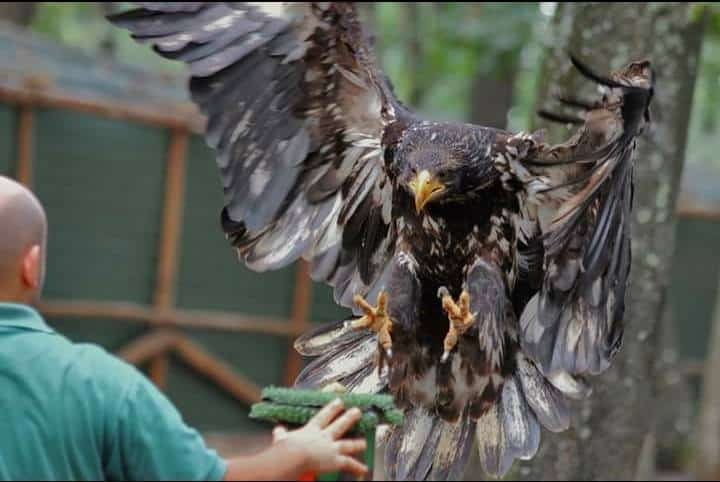
The raptor sector is the one that strikes visitors most, and also the one that requires the most expertise from those who run it. The association handles the training of raptors, and some birds born in the park are trained to fly: they fly and then return to the glove. Anyone who has never seen a raptor work up close usually underestimates the scene. It's not a circus show. It's a relationship built on weeks of daily work, on the animal's weight checked every day, on a language of calls and gestures that the falconer and the bird share. When a buzzard or an owl crosses 10 meters of air and lands a hand's breadth from your face, the silence that falls among those present is the most interesting thing of the day.
Falconry is debated, and it makes sense to debate it. The practice is very ancient, documented in Europe from the early Middle Ages and codified by Frederick II of Swabia in the treatise De arte venandi cum avibus, and in the modern context it has taken on two main functions: education and wildlife control at airports and in farming areas. Anyone watching it for the first time with a critical eye would do well to look at the condition of the animals, the spaces, the way they are handled. In the case of Selvotta the declared purpose is outreach and conservation, with particular attention to the breeding of species in difficulty.
The turtles
The turtle sector deserves a line more than it usually gets. Italian land tortoises and pond turtles are among the animals most mistreated by good faith: bought as pets, kept badly, released into the wild when they become unwieldy, with heavy consequences for local balances. The European pond turtle, in particular, is put in difficulty by competition from exotic species released into waterways. A dedicated section serves to explain exactly this, and the explanation is worth more than 10 signs.
The Etruscan sector and the small museum
The fourth sector is the one nobody expects in a wildlife park, and it is the reason Selvotta presents itself as a visit between nature and history. Under this countryside runs a system of Etruscan tunnels and channels of considerable length, and the facility includes in the route a visit to a stretch of Etruscan aqueduct that it presents as the longest and most important in Lazio. A small natural history museum has also been set up in the park, with bird nests, eggs of nocturnal and diurnal raptors and assorted finds collected in the area. It is not a museum in the institutional sense of the term, with climate-controlled display cases and scientific catalogs. It is a teaching collection, which lets you feel firsthand the difference between the shell of a barn owl and that of a buzzard.

A Curiosity About Parco Natura La Selvotta (Formello)
The curiosity concerns the month of March, and it's worth telling in full because it changes the sense of the visit. March is the time of births. Those who arrive at La Selvotta in those weeks find the newborn young, and this is not only a reason for tenderness: it is an educational opportunity that no documentary replaces. The nestlings of the raptors, in particular, undergo in a few weeks a transformation so rapid as to seem almost incredible to those who have never observed it.
The practical advice that follows is this: if you go in March, plan to come back in May. The same animal that in March was a blind ball of fluff, two months later is a specimen with almost complete plumage, with eyes that focus, with a recognizable posture. Seeing the before and after on the same individual is an experience that children remember for years, and that explains the concept of the biological cycle to adults better than any lesson. Some of the latest born are then started on training, and this means that the child who saw the chick in the nest in spring can find the same animal in flight, on the falconer's glove, on a later visit.
The Etruscan Aqueduct Under Formello and the Civilization of Water
Here we need to widen our view, because without this chapter you can't understand where you are. The territory between Formello, Isola Farnese and Campagnano is the heart of the ancient ager veientanus, that is, the countryside of the Etruscan city of Veii. Veii was a metropolis, not a village: Latin authors call it pulcherrima urbs, a most beautiful city, and between the seventh and sixth centuries BC it was one of the most powerful centers of southern Etruria. It controlled the septem pagi on the right bank of the Tiber and the salt pans at the mouth of the river, that is, the two resources that made the wealth of the area.
50 Kilometers of Tunnels
The fact that strikes anyone who looks into this area is the quantity of underground hydraulic works. In the Veii territory about 50 kilometers of tunnels cut into the tuff have been recorded, built to drain the land, regulate the flow of water and bring water where it was needed. These are not monumental aqueducts like the Roman ones, with arches crossing the countryside: they are underground galleries, dug by hand into the tuff bed, with ventilation shafts at regular intervals and slopes calculated with a precision that, considering the tools available, is impressive.
The Ponte Sodo and the Cremera
The most famous work of the system is the Ponte Sodo, which despite the name is not a bridge but an artificial gallery cut into the rock, about 70 meters long and about three wide, built to carry the course of the Cremera under the hill and keep floods from inundating the land downstream. It's a piece of hydraulic engineering from 2,000 500 years ago that still works, and that can be seen by walking through the archaeological area of Veii.
The Cremera, the stream that rises in the Sabatini and runs down toward the Tiber crossing this countryside, is the same watercourse that shapes the Valle del Sorbo and that, farther downstream, plunges over the drop of the Cascata dell’Inferno. It is the thread that ties together all the places I talk about in these lines: La Selvotta, the valley, the waterfall, the archaeological area. One stream, one basin, one story.
The 10-Year War
The end of Veii deserves to be told because it is one of the founding moments of Rome's history. In 406 BC Rome began a siege that lasted 10 years, a military commitment so prolonged that it forced the city, for the first time in its history, to institute pay for soldiers: until then they fought seasonally and went back to the fields. In 396 Marcus Furius Camillus took the city, according to tradition by having a tunnel dug that passed under the walls. The detail may be historical or legendary, but the fact that Roman tradition attributes the fall of Veii precisely to a tunnel dug in the tuff says how much that system of tunnels was part of this territory's identity.
Even earlier, in 477, the battle in which the gens Fabia was almost entirely annihilated by the Veientes had taken place on the banks of the Cremera. 306 Fabii, according to tradition, fallen in a single day in a stronghold that dominated the valley. The name of the stream that flows under these fields carries that story with it.
Where the statue ended up
The sanctuary of Portonaccio, near a sulfurous water spring on the edge of the ancient city, housed the terracotta statuary group that includes the Apollo of Veii, attributed to the sculptor Vulca, the only Etruscan artist whose name the Latin sources preserve. That statue is today in the National Etruscan Museum of Villa Giulia, in Rome. Anyone who visits Selvotta and wants to close the circle should plan a morning at Villa Giulia: looking at the Apollo's smiling face after walking on the territory that produced it is a different experience from looking at it cold.
One thing nobody tells you about Parco Natura La Selvotta (Formello)
What you won't find written almost anywhere concerns the very nature of the visit, and how this changes the expectations of those who arrive. You can't enter at will. There are no continuous hours in which the facility is open to the general public, with a ticket office issuing tickets. Access is by reservation and through membership in the association or the purchase of a daily pass. This means that a family that decides on a Sunday morning to go see the raptors risks finding the gate closed.
The second thing nobody mentions is that you don't decide how long the visit lasts. Since it is accompanied, it follows the pace of the operator and the group. Anyone expecting to spend half an hour in front of the same enclosure taking photos will be frustrated. Anyone who accepts the guided pace takes home much more information than they would have gathered wandering alone. It's a trade, and it's best to know it beforehand.
The third concerns the ground. The park spreads over real countryside, with natural surface, grass, packed earth, changes in elevation. After rain the ground holds water, like all the clayey and tuffaceous soils of this belt, and becomes slippery. Anyone who arrives in city shoes risks spending the whole visit worrying about where to put their feet instead of looking at the animals. Closed shoes with lugged soles, always, in any season. And in summer, a hat: the shade in the open sectors is patchy and the sun of the Roman countryside between noon and four doesn't forgive.
The fourth, and for me the most important: this is a small place. Anyone who compares Parco Natura La Selvotta with the Bioparco di Roma (Rome Zoo), which is a historic zoological garden with vast collections and museum structures, will be disappointed by the size. The correct comparison is another one: Selvotta belongs to the family of educational farms and environmental education centers, like the Il girotondo degli animali Educational Farm or C'era Una Volta, with the addition of a strong specialization in raptors that brings it closer to the VoloAlto Nature Park. Measured with the right yardstick, the assessment changes completely.
The advice I give you for visiting Parco Natura La Selvotta (Formello)
The main advice is just one and is worth more than all the others put together: call ahead. Don't just write an email and don't rely on what you read around, including these lines, to establish hours and conditions. Call, say how many of you there are, how old, which day you have in mind and what you want to see. In five minutes of conversation you'll get information more precise and more up to date than you'd find in an hour of searching. Small family-run facilities work this way, and expecting them to work like an amusement park is an error of perspective.
Build the day around the visit, not only on the visit
The second piece of advice concerns planning. A visit to Selvotta takes up part of the day, not all of it. The best way to use it is to fit it into a broader itinerary in the Parco di Veio. The recommended combination is this: morning at Selvotta, lunch in Formello or at an agriturismo in the area, afternoon at the Valle del Sorbo with the walk to the sanctuary of the Madonna del Sorbo. Those with suitable legs and clothing can replace the afternoon with the descent to the Cascata dell'Inferno, which is more demanding and requires care, especially with children and after rain.
The right season
The third piece of advice concerns the calendar. If the goal is to see the young animals, March. If the goal is the comfort of the day, April, May, September and October are the best months: manageable temperatures, green countryside, good light. July and August in this stretch of territory mean dry heat and sun straight overhead, manageable only early in the morning. Winter has the advantage of clear skies and empty spaces, but the mud after rain changes the experience quite a bit, and outdoor activities suffer from the cold.
With children: the rule of the three nos
The fourth piece of advice is for those bringing children, who are the main audience anyway. Three things to avoid. First: don't promise children that they'll see a specific animal. Animals are not scheduled attractions, and a raptor's off day is an off day for the falconer too. Second: don't bring them hungry or tired. A guided visit of a couple of hours requires attention, and an exhausted child doesn't listen. Third: don't let them approach the animals without the operator's go-ahead, ever, not even farm animals that seem tame. A beak or a hoof hurts even when there was no intention to hurt.
What to put in the backpack
The fifth piece of advice is practical. Water, always, even in winter. Closed shoes with lugged soles. A change of clothes for the children, because in the countryside you get dirty and that's part of the game. Hat and sunscreen from April to September. Insect repellent in the warm months, because the horseflies of the Roman countryside have a difficult character. And a real camera, if you have one: for raptors in flight the phone captures little, and I'll get to that in a few lines.
The Parco di Veio around it: the valley, the waterfall and the mills
The territory surrounding Parco Natura La Selvotta is one of the most underrated in the whole province of Rome. Even compared with much more famous places, the ratio here between quality of landscape and crowding is among the best in Lazio.
The Valle del Sorbo
The Valle del Sorbo is a tuff gorge cut by the Cremera, with pastures, riparian woods and a wide valley floor where horses living in the wild are a regular sight. At the most evocative point, on a rocky spur, stands the sanctuary of the Madonna del Sorbo, an ancient convent complex whose feast is celebrated on the Tuesday after Easter Monday and still draws considerable popular participation. The walk from the valley floor to the sanctuary is short and suitable for almost everyone, which makes it the natural complement to a morning at Selvotta.
The Cascata dell'Inferno
Farther downstream, the Cremera plunges in a drop into a narrow, shady gorge: this is the Cascata dell'Inferno, one of those places that, when you reach them for the first time, seem out of scale with the countryside that surrounds them. The descent requires care, suitable footwear and a minimum of fitness. After rain the ground becomes treacherous and the stream's flow changes quickly. It is a destination for adults and older kids, not for strollers.
The mills and the Mola waterfall
Along the ditches of the Parco di Veio you can count the remains of several water mills, which for centuries ground the grain of the Veii countryside using the natural drops of the tuff. Near one of these is the Mola waterfall, which comes in two drops, the second of which reaches about 20 meters. It is a piece of pre-industrial industrial archaeology, if the term can be used, that tells how the economy of this countryside worked before Rome ate it up with the building expansion of the 1900s.
The fauna of the regional park
From a natural history point of view, the Parco di Veio hosts mesophilous and mesothermophilous woods, with Turkey oak, maple and hop hornbeam dominating the slopes. The fauna includes wild boar, fox, fallow deer, porcupine, and in recent years the presence of wolf has been documented, consistent with the species' recovery along the whole Apennine ridge and its offshoots. Among birds there are woodpeckers and many passerines. In the waters of the ditches live salamanders and newts, while among reptiles there are snakes, lizards and tortoises. It's a list that explains why a facility like Selvotta makes sense right here: the animals seen in the educational park are, in large part, the same ones that live in the woods around it.
Another well-known fact, yet seldom cited
The well-known fact is that Formello is Lazio's town. In the municipal territory is the sports center of Società Sportiva Lazio, where the first team trains and where the club's offices are based. Every fan knows it, every sports journalist knows it, and the name of the town appears in Italian soccer coverage with a frequency that no other town of 13,000 inhabitants can claim.
What is rarely cited is the cultural consequence of this fact. For decades Formello has been, in the imagination of those who live in Rome, only that: the place where Lazio trains. The real town, with its early medieval church of San Lorenzo, with the church of San Michele Arcangelo mentioned since 1236, with the Palazzo Chigi that belonged to the Orsini before passing to the Chigi, has remained in the shadow behind a sports center. And this has had a paradoxically positive effect: nobody ever thought of Formello as a tourist destination, and so the town has not undergone the transformation that has distorted other villages of Lazio. You arrive and find a living historic center, with real residents, neighborhood shops, historic fountains fed by the Carissima and Tre Cannelle springs.
There is a second fact that Romans take for granted without thinking: Formello and this whole quadrant make up the territory where Rome fought its first long war, the one that transformed it from a village among Latin villages into a regional power. The conquest of Veii in 396 BC suddenly doubled Roman territory. Every time you drive on the Cassia bis you cross the battlefield that made everything else possible, and no sign points it out.
Third fact: the feudal history. Formello was granted as a fief to the Orsini in 1279 and remained theirs until 1661, when the family sold the fief to the Chigi. They are the two dynasties that designed half of Lazio. Cardinal Flavio Chigi, nephew of Pope Alexander VII, had Villa Chigi Versaglia built here, whose name betrays the ambition of the patron: Versaglia as in Versailles. Anyone who knows Palazzo Farnese in Caprarola or the residences of the Castelli recognizes the logic immediately: Roman nobility used the countryside as a mirror of the city's power.
The right photo to take at Parco Natura La Selvotta (Formello)
The photo everyone tries to take is the raptor in flight. The photo almost nobody brings home is the raptor in flight. It's worth explaining why and how to fix it, because here the difference between a memory and a decent shot comes down to three parameters.
Raptors: fast shutter speeds and continuous focus
A raptor crossing 10 meters of air moves too fast for a phone to freeze it sharply, especially in less than perfect light. Anyone with a camera with manual controls should set shutter speeds of at least 1/1000 of a second, better 1/2000, raising the sensitivity as much as needed: digital noise is tolerable, blur is not. Focus should be set to continuous mode, with the focus point at the center, and it's best to follow the animal with the camera already moving instead of waiting for it standing still. Anyone with only a phone still has one card: burst mode. 10 consecutive shots give a reasonable probability that at least one is in focus.
The portrait on the glove
The easiest photo and often the most beautiful is the close-up portrait of the animal perched on the falconer's glove. Here the subject is still, the distance is minimal, and even a recent phone produces an excellent result. The advice is to get down to the animal's eye level instead of shooting it from above: it completely changes the character of the image. And focus on the eye, always. In an animal portrait, if the eye is sharp, everything else is forgiven.
Children and farm animals
The third photo is the one that will really end up in the family album: the child touching an animal for the first time. Here technique matters little and timing matters everything. Don't ask the child to look at the camera: the good photo is the one in which they look at the animal. Stay at a distance, use a zoom if you have one, and let the scene happen. Photos in which children pose in front of an enclosure are all identical and all forgettable.
The landscape, which nobody photographs
The last photo is the one that 90 percent of visitors don't take, and they're wrong: the surrounding landscape. The countryside of Formello in the low light of late afternoon, with the soft profiles of the Sabatine hills and the dark patches of woodland, is one of the most photogenic rural landscapes in Lazio. An hour before sunset the light becomes warm and raking and the volumes of the terrain can be read. Turn your back on the animals for five minutes and look at where you are.
Some important events that took place here in history
The territory in which Parco Natura La Selvotta sits has a density of historical events that few Italian countrysides can match. I list them in chronological order, because the thread can only be understood that way.
Prehistory and the birth of Veii
Traces of human presence in this strip of territory go back to prehistory, favored by the abundance of water, the ease of digging the tuff and the fertility of the volcanic soils. Between the ninth and eighth centuries BC the Villanovan villages scattered on the plateau aggregate into the city that the Romans will call Veii: one of the best documented synoecism processes in southern Etruria.
477 BC: The Battle of the Cremera
On the banks of the stream that crosses this countryside the gens Fabia, which had taken upon itself the task of guarding the border against Veii, is annihilated. Roman tradition turned the episode into one of the founding stories of republican ethics: an entire family sacrificing itself for the State. Modern historians debate the numbers, not the fact.
406 BC: The Siege Begins
Rome begins the siege of Veii, which will last 10 years. The other Etruscan cities, divided and distrustful, refuse to intervene to help. The length of the conflict forces Rome to introduce the stipendium, pay for soldiers: an organizational revolution that lays the foundations of the professional army of the following centuries.
396 BC: The Fall of the City
Marcus Furius Camillus takes Veii. Roman territory doubles. The Veii population is dispersed and the area, in the following centuries, gradually depopulates until it becomes almost uninhabited countryside, dotted with Roman rustic villas like the one at Campetti.
780: The Medieval Rebirth
After centuries of abandonment, Pope Hadrian I founds an agricultural settlement in this area, one of those domuscultae with which the early medieval papacy repopulated and put back under cultivation the Roman countryside. It is the birth certificate of Formello as a stable community.
1279: The Orsini
Formello is granted in fief to the Orsini, one of the two great Roman baronial families. They will stay almost four centuries, fortifying the village and building the palace that still dominates the square today.
1661: The Chigi
The Orsini sell the fief to the Chigi, the Sienese family that rose to the papal throne with Alexander VII. The palace changes hands and takes the new name. Cardinal Flavio Chigi has the Villa Chigi Versaglia built, a vacation residence in 17th-century taste.
The 20th Century: The Sports Center and the Regional Park
In the 20th century the countryside around Rome changes nature. Formello stays agricultural longer than other municipalities of the belt, protected by distance and by the shape of the terrain. In the 1990s the Lazio sports center settles here, bringing the town a national fame of an entirely new kind. Shortly after, the Lazio Region establishes the Parco regionale di Veio, which restricts a very high share of the municipal territory and in effect freezes its land consumption. It is in this context that realities like Parco Natura La Selvotta are born and develop: private facilities that choose nature education as their activity, in a territory that environmental protection has shielded from building.
Who Has Passed Through Parco Natura La Selvotta (Formello)
The people who have passed through this countryside divide into three categories, and it's worth going through all three.
The Names of Ancient History
Marcus Furius Camillus, the dictator who took Veii and whom tradition calls the second founder of Rome, operated exactly here. The sculptor Vulca, the only Etruscan artist whose name the Latin sources preserve, worked at Veii: his terracottas reached the temple of Jupiter Capitolinus in Rome. The 300 and six Fabii who fell on the Cremera passed through here and did not return. They are names that appear on no plaque around La Selvotta, but the territory is the same.
The Names of Modern History
The Orsini and the Chigi administered this fief for a total of 700 years. Cardinal Flavio Chigi, nephew of the pope, is the figure who left the most visible architectural mark. Pope Hadrian I, with the founding of the early medieval settlement, is the remote cause of the very existence of the town.
Who Passes Through Today
The third category is the one that concerns Parco Natura La Selvotta most closely, and it is made of people whose names nobody will ever write. 15 hundred children a year, according to the numbers declared by the association, and over 100 and 50 schools. It means that over the span of a decade more than 10 thousand kids from the Rome area have passed through here. Many of them saw the first raptor of their lives in this place, touched the wool of a sheep for the first time, understood that eggs are not born in the supermarket carton.
And there are the Lazio fans, who come to Formello for completely different reasons and who in large majority don't realize they are a few minutes' drive from one of the archaeologically densest countrysides in Lazio. Every now and then someone notices, and when it happens it's always a small satisfaction.
When to Go to Parco Natura La Selvotta (Formello) and When to Avoid It
The seasonality of this place is more marked than it seems, and it doesn't depend only on the weather.
March and April: The Best Period
March is the month of births, and that alone would be enough. In April the countryside of Formello reaches its peak: green meadows, blossoms, temperatures between 15 and 20 degrees, lengthening days. The week after Easter also has the feast of the Madonna del Sorbo, the Tuesday after Easter Monday, which is an authentic popular event and is worth a detour if you combine the two destinations.
May and June: The Second Window
May keeps the advantages of April with even longer days, and lets you see the growth of the animals born in March. June starts to warm up, but the mornings stay perfect. From mid-June onward it's best to book the cooler time slots.
July and August: To Be Managed
The heat of the inland Roman countryside between 11 and 17 is serious, and the shade in the open sectors is patchy. A midsummer visit should be made early in the morning or in the late afternoon, with plenty of water and a hat. August also has the problem of the summer closure that many family-run facilities observe: another reason to phone ahead instead of just showing up.
September and October: The Forgotten Season
For me the most underrated window of the year. The heat breaks, the light turns golden, the woods of the Parco di Veio change color between late October and November, and the visitors thin out. If I had to choose a single weekend for an adult without children, I would choose the first one in October.
Winter: Clear Skies and Mud
From November to February the countryside is empty and the skies, after the passage of weather fronts, take on a clarity you never see in summer. The flip side is the ground: after rain the natural ground becomes heavy and slippery. Outdoor activities suffer from the cold and the wind, and the short days compress the schedule. It remains a workable season, but it requires suitable clothing and a good dose of flexibility.
When to Avoid
Without hesitation avoid the days immediately following heavy rain, for reasons of safety and comfort, and days of strong wind, because the flight activities with the raptors depend on atmospheric conditions and may be suspended. Also avoid days when you have little time: this is a place that requires slowing down, and those who arrive with a stopwatch in hand leave without having understood anything.
What There Is Around Parco Natura La Selvotta (Formello)
The real value of this area is the density of things to see within a radius of 20 kilometers. Here is how I organize them when I build an itinerary.
Inside the Parco di Veio
In addition to the Valle del Sorbo and the Cascata dell’Inferno, the protected area includes the archaeological area of Veii with the Ponte Sodo and the sanctuary of Portonaccio, the remains of the Roman villa of Campetti, the network of trails along the ditches and the old mills. The general page of the Veio Park gathers the overall picture.
The Villages of the Area
A short distance away are some of the most interesting villages in the northern quadrant of Rome. Castelnuovo di Porto, with its Colonna fortress, dominates the Tiber valley. Calcata, perched on a tuff spur above the Treja valley, is one of the most photographed villages in Lazio and the natural access point to the Treja Valley Park. Farther north, Nepi with its gorges and its fortress, and Sutri with the amphitheater carved into the tuff and the Parco Naturale Regionale dell’Antichissima Città di Sutri.
The Lakes
To the west opens the system of Sabatini volcanic lakes, protected by the Bracciano Martignano Regional Natural Park. Lake Bracciano is the largest, with the three lakeside towns of Bracciano, Anguillara Sabazia and Trevignano Romano. Lake Martignano, smaller and without roads on its shores, is the place where Romans go when they want fresh water without concrete. Farther north the Riserva di Monterano preserves an abandoned village that looks like a stage set and that, in fact, has hosted many film sets.
Other Destinations for Families
Those building a weekend around experiences for children can line up the VoloAlto Nature Park, the Il girotondo degli animali Educational Farm and the educational farm C’era Una Volta. Toward the coast is the Castel di Guido Oasis, while on the north-eastern side of the city opens the Marcigliana Nature Reserve.
In the City, to Close the Circle
Two Roman destinations complete the picture. The National Etruscan Museum of Villa Giulia, where the Apollo of Veii is found, is the obligatory stop for those who have walked the Veii territory. The Civic Museum of Zoology, near the Bioparco, is the natural complement to a day spent looking at live animals. And for those who love walking, Via Francigena crosses this quadrant of Lazio heading down toward Rome.
Quick Questions About Parco Natura La Selvotta (Formello)
Is Parco Natura La Selvotta a public park?
No. It appears to be a private facility run by a nonprofit association, located inside the boundary of the Parco regionale di Veio but independent of it. Access is by reservation and through membership in the association or the purchase of a day pass.
Can you go without booking?
Booking is required. Showing up without having agreed on the day and time means risking finding the gate closed. Phoning ahead is the right way to organize the visit.
How much does it cost?
The fees differ between adults, children and people with disabilities and change over time. The current rates should be asked directly of the association, which is the only reliable source on the matter.
What animals do you see?
The facility states that it hosts over 100 species among farm animals, raptors and tortoises. The makeup changes over time, through births, transfers and exchanges with other facilities, so it's best to ask what is there in the period you plan to go instead of setting out with a list in your head.
How long does the visit last?
The visit is accompanied and its length depends on the agreed route and the makeup of the group. Plan on a substantial part of a half day and organize the rest of the day accordingly.
Is it suitable for small children?
The main audience is precisely children, and the routes are calibrated to age. The ground, however, is real countryside, with natural surface and changes in elevation: the stroller is not the right tool, and for the youngest a baby carrier backpack is better.
Is it accessible to people with disabilities?
The association provides dedicated conditions for people with disabilities, but the natural ground surface poses objective limits that vary from sector to sector. Those with specific needs must report them at the time of booking, so as to agree on a workable route.
When are the young born?
The month indicated by the facility is March. Those who visit in that period see the newborn young and, coming back a couple of months later, can follow their growth.
Can you get there by public transport?
In theory yes, combining the regional railway and Cotral bus lines as far as Formello, but the last stretch toward Via della Selvotta is not served in a useful way. The car remains the realistic means, or the coach for organized groups.
What is the difference between Parco Natura La Selvotta and the Parco di Veio?
The Parco di Veio is a regional protected natural area that covers tens of thousands of hectares between the Cassia and the Flaminia, with free trails and archaeological sites. Parco Natura La Selvotta is a private environmental education facility located inside that territory. Two different things, with different management and different access rules.
Is it worth it for an adult without children?
It depends on what you're looking for. Those interested in falconry, species conservation or the history of the Veii territory will find material. Those looking for a spectacular attraction will find it small. The honest answer: for an adult without children, La Selvotta works as a stop within a day in the Parco di Veio, not as a sole destination.
The overall judgment, after many days spent accompanying groups in this quadrant of the Roman countryside, is that Parco Natura La Selvotta should be assessed for what it declares itself to be: a family educational project, of modest size, built around the idea that knowledge of nature comes through direct contact and not through a display window. Measured by the yardstick of the large European wildlife parks it will seem like little. Measured with the right yardstick, that of the environmental education centers that keep rare skills alive on a protected territory, it turns out to be one of the most solid realities in the north of Rome. And the surroundings, the Parco di Veio with its gorges, its Etruscan tunnels and its waterfall, are the reason why it's worth coming up here even without children in tow.
Frequently Asked Questions About Parco Natura La Selvotta (Formello)
Is Parco Natura La Selvotta a public park?
No, Parco Natura La Selvotta in Formello is a private facility run by a nonprofit association, located inside the boundary of the Parco regionale di Veio but independent of it. The legal formula determines how you enter, visit and pay for the activities offered.
How do you get into Parco Natura La Selvotta?
Access to Parco Natura La Selvotta is reserved for members and for those who buy a pass, and is by reservation. There are no continuous hours in which the facility is open to the general public with a ticket office tearing off tickets, so it's best to get organized before leaving.
Is it worth phoning before going to Parco Natura La Selvotta?
Yes, the main advice for Parco Natura La Selvotta in Formello is to phone ahead, without relying only on an email or on what you read online. By calling and saying how many people you are, of what ages, what day you have in mind and what you're interested in, you get more precise information on hours and conditions.
What is the best time to visit Parco Natura La Selvotta?
March and April are the best months for Parco Natura La Selvotta, because March is the time of births: those who arrive in those weeks find the newborn young, an additional educational opportunity. In April the countryside of Formello reaches its peak, with green meadows, blossoms and temperatures between 15 and 20 degrees.
What do you see at Parco Natura La Selvotta?
Parco Natura La Selvotta is organized in thematic sectors: the farm with the domestic animals of the rural tradition of central Italy, the raptor center, a sector devoted to tortoises and an area that tells the Etruscan past of the surrounding territory, the ancient ager veientanus.
Is Parco Natura La Selvotta suitable for children?
Yes, in particular the farm part of Parco Natura La Selvotta, which gathers the domestic animals of the rural tradition of central Italy, is the section designed to work best with children compared with other more educational sectors such as the raptor center or the Etruscan area.
What is near Parco Natura La Selvotta?
Around Parco Natura La Selvotta extends the Valle del Sorbo, a tuff gorge cut by the river Cremera with pastures and riparian woods, inside the Parco di Veio. In the same protected area are also the Cascata dell'Inferno and the archaeological area of Veii, with the Ponte Sodo and the sanctuary of Portonaccio.
Article written by the editorial team of TourLeaderPro, contact them for Private/Corporate/V.I.P. Tours and Experiences. For an organized day in the Parco di Veio, with a licensed tour guide, start from the TourLeaderPro contact page. Tour operators who build itineraries in the countryside north of Rome will instead find the consulting service in the section dedicated to tour operators.
Planning a trip to Rome? The English-language guides for visiting the city are on ItalyPlanner.com. For those thinking in day trips out of the city there is the guide to the best day trips from Rome, while those who want to understand how to organize a trip to Italy with children will find the full picture in the guide dedicated to vacations in Italy with children.