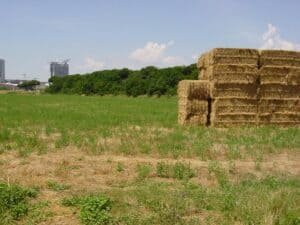
Castel di Guido Oasis
In short. The Castel di Guido Oasis is a protected natural area in the western quadrant of Rome, along Via Aurelia, a scant 20 kilometers from the Grande Raccordo Anulare and inside the administrative boundaries of the Municipality of Rome.
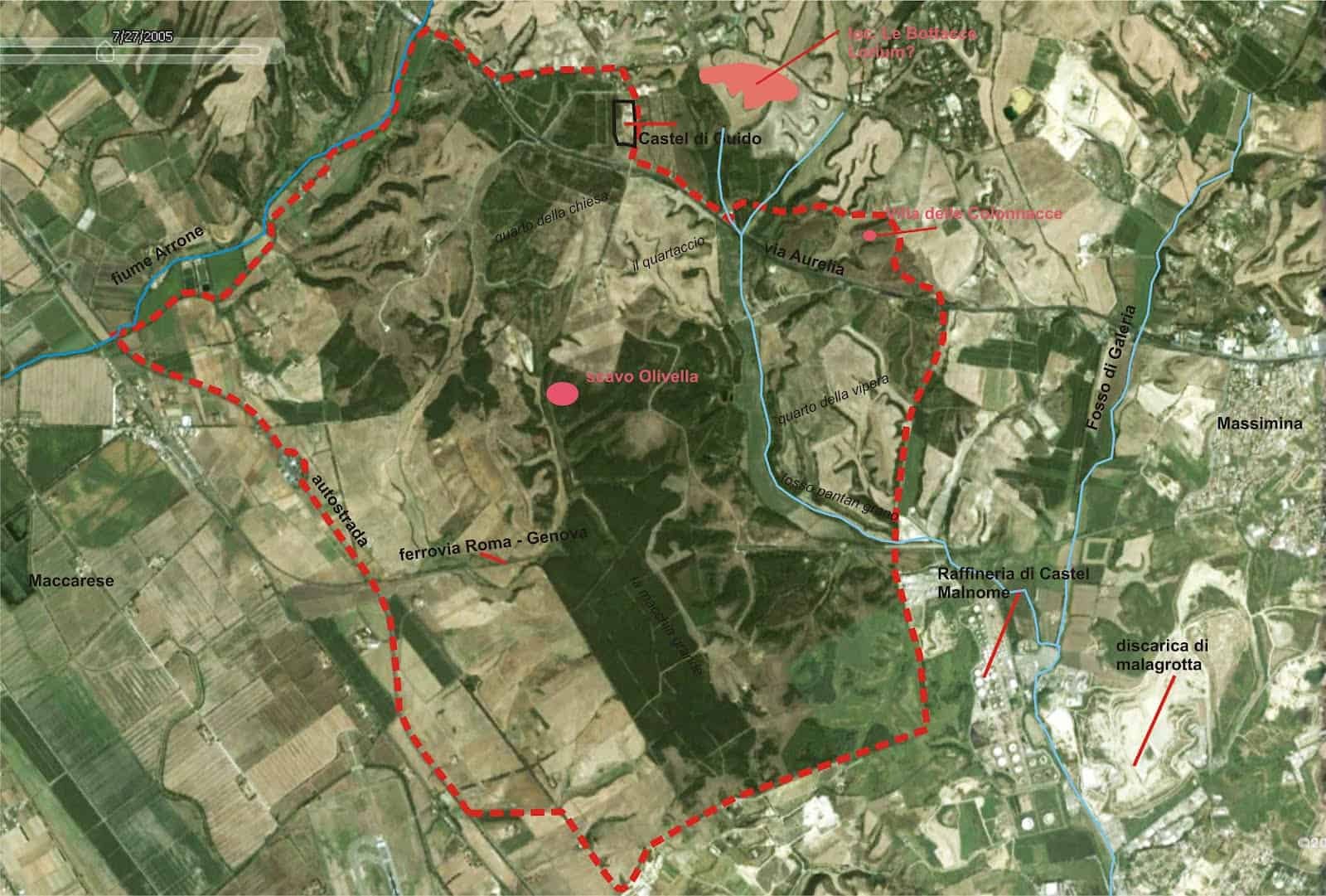
The Castel di Guido Oasis is a protected natural area in the western quadrant of Rome, along Via Aurelia, a scant 20 kilometers from the Grande Raccordo Anulare and inside the administrative boundaries of the Municipality of Rome. It's not a city park, it's not a fenced reserve with a ticket office, and it's not even a LIPU property. It is the result of an agreement, signed in 1999, among the Municipality of Rome, the Castel di Guido Agricultural Company and the Italian League for the Protection of Birds. From that agreement came an area of about 250 hectares managed for nature purposes, itself set within the roughly 2,500 hectares of the municipal agricultural company, which remains a fully productive farm, with herds grazing, arable fields, olive groves and farm machinery working the fields. The whole falls inside the Litorale Romano State Nature Reserve and is recognized as an IBA, that is, an Important Bird Area, the international classification that flags territories decisive for bird conservation. Inside it there is also a portion of the Natura 2000 network site known as Macchia Grande di Ponte Galeria, code IT6030025.
This tangle of bodies and acronyms explains the most important thing to know before getting in the car: the Castel di Guido Oasis doesn't work as a reserve with permanent free entry. Openings follow a calendar set by the LIPU management and visits are often by reservation, with an escort. Anyone who shows up at random on any Sunday risks finding the gate closed and consoling themselves with a walk along the provincial road, which is exactly the opposite of what this place deserves. Dates, hours and arrangements must be checked directly on the channels of the Italian League for the Protection of Birds before leaving, because they change from season to season and no outside page can guarantee them.
That said, and setting aside the bureaucratic part, what you cross here is one of the last recognizable portions of the Roman Campagna: low, wide hills, Turkey oak and Hungarian oak woods, fragrant garrigue, pastures with herds of Maremma cattle, ditches running down toward the sea, isolated farmhouses. It's the landscape that for two centuries filled the canvases of the landscape painters and the notebooks of the Grand Tour travelers, and that today survives in a few fragments squeezed between the highway, Fiumicino airport, warehouses and housing developments. If you're looking for other fragments of the same fabric, the pages dedicated to Macchiagrande, the Bosco di Palo and the Parco della Cellulosa are worth reading.

Where the Castel di Guido Oasis is and how you really get there
Geography matters more here than it seems. Castel di Guido is a locality on the western outskirts of Rome laid out along Via Aurelia, in that strip of land that descends from the last hilly offshoots toward the coastal plain of Fiumicino and Maccarese. The village can be recognized from afar by the tower and the cluster of houses facing the state road. The farm and the Oasis occupy the land behind it, toward the north and the interior, in a vast area that you can't even guess from the car.
By car along Via Aurelia
The car is the realistic way to get there. From Rome you leave the Grande Raccordo Anulare at Via Aurelia exit and continue west, toward Civitavecchia, leaving behind Casalotti, Massimina and the belt of neighborhoods that has eaten the countryside over the last 40 years. After a few kilometers the built-up fabric frays, the first pastures appear, and on the right the territory of the farm opens up. From the A12 Rome-Civitavecchia highway you can exit at Torrimpietra and go back up the Aurelia toward Rome, a convenient solution for those coming from the north or the coast.
The practical advice: Via Aurelia on this stretch is a fast-flowing road with abrupt side entrances and little signage for nature destinations. Set the navigator to the meeting point given by LIPU at the time of booking and not to the generic name of the village, otherwise you end up in the village and not at the entrance of the managed area, which is elsewhere. Parking is unpaved and informal. In winter, after days of rain, the surface becomes heavy and a low car suffers.
By train and public transportation
It must be said clearly: there is no railway station at Castel di Guido. The FL5 Rome-Civitavecchia line runs farther south, along the coast, and the stops usable as a reference are Maccarese Fregene and Torre in Pietra Palidoro, both however several kilometers away and connected inland by roads designed for residents. On Via Aurelia pass the Cotral intercity services and some surface lines of Rome's transit that serve the borgate of the western quadrant, but weekend frequencies are reduced and the nearest stop still leaves a stretch on foot along a road with no continuous sidewalk.
Our opinion is simple: the Castel di Guido Oasis is a destination for cars, or for an organized visit with group transport. Anyone without a car should team up with someone who has one, or rely on a guided outing that starts from the center. Improvising the last stretch by public transport is the quickest way to burn two hours of the day and arrive late to the visit, which here starts at a fixed time and doesn't wait for latecomers.
What the Castel di Guido Oasis really is: an agreement, not a fenced park
The most common misunderstanding concerns the legal nature of the place. Many arrive convinced they're entering a nature park with an entrance, marked trails and continuous hours, and find themselves instead inside a working farm where part of the land is managed for nature purposes. They're two different things and the difference completely changes the experience.
The 1999 agreement brings together three parties with compatible but distinct goals. The Municipality of Rome, owner of the farm, has an interest in keeping an enormous public land holding without turning it into building land. The Castel di Guido Agricultural Company has to keep producing: meat, fodder, grain, oil. LIPU brings the nature expertise and turns a portion of the land into a conservation lab, with reforestation, hedgerows, small wetlands, nest boxes, bird monitoring and environmental education activities. The result is a model that has few parallels in Italy for size: an oasis inside a public farm inside a state reserve.
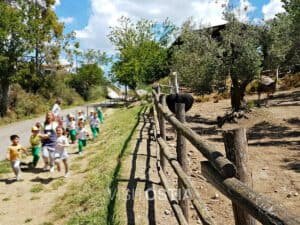
This also explains why the boundaries aren't always perceptible on the ground. Walking, you pass from a mature wood to a pasture, from a young reforestation to a plowed field, and there is no sign at each change. The operating rule is that you walk where the guide accompanies you and where the signs indicate. Leaving the paths isn't a prank, it's a concrete problem because in the enclosures there are adult cattle, because some areas are protected for nesting and because farm vehicles move on farm roads where they don't expect pedestrians.
The 250 hectares of the Oasis and the 2,500 of the Castel di Guido Agricultural Company
The numbers help give an idea of the scale. The area under nature management measures about 250 hectares. The farm that contains it measures about 2,500, and is one of the most extensive public agricultural properties in Europe under a single municipal administration. To understand what that means: 2,500 hectares are 25 square kilometers, an area comparable to that of a medium-sized town, all inside the territory of Rome and all a short distance from the ring road.
Inside this perimeter grazes what is indicated as the largest herd of Maremma cattle in Lazio, on the order of 450 head. The Maremmana is a hardy gray breed, with lyre-shaped horns in the males and crescent horns in the females, adapted for centuries to free grazing on poor, damp land. Seeing it at work in an open pasture, with the woods behind, is one of the reasons it's worth coming. That landscape, cows included, is the Roman Campagna as the painters told it, not a folkloric reconstruction.
The distribution of habitats is varied and this is the real wealth of the place. There are Turkey oak and Hungarian oak woods, that is, deciduous oak forests typical of the inland Lazio hills. There are patches of Mediterranean scrub with holm oak, phillyrea, mastic and strawberry tree. There are open garrigues with rockrose, helichrysum and aromatic labiates that in summer scent the air from a distance. There are permanent pastures, arable fields, reforestations carried out by the management, ditches with riparian vegetation and small bodies of water. The sum of all these habitats in a few hundred hectares is the reason the fauna here is so rich: every species finds a niche and the contact zones between one habitat and another, which ecologists call ecotones, are the most productive of all.
The hills are gentle, the elevation changes minimal, the paths well-worn and wide. It's terrain suited even to those who walk little, to families with children, to older people in good health. No technical gear is needed: closed shoes that can get dirty, water and, in the warm months, a hat are enough. Whoever expects a mountain walk will be disappointed. Whoever wants three or four hours of open landscape half an hour from home finds exactly what's needed.
A curiosity about the Castel di Guido Oasis
The curiosity that throws almost everyone off concerns the symbol chosen for the Oasis: the swallow. It seems a banal choice, because the swallow is the most familiar bird in the Italian imagination, the one of proverbs and calendars. In reality it's a precise statement. The barn swallow, the house martin and the swift depend directly on traditional agriculture: they nest in stables, under the eaves of farmhouses, in open hayloft barns, and feed on the insects that grazing livestock and untreated meadows provide in quantity. When a countryside is turned into intensive monoculture, or into residential development, swallows disappear within a few years. Their decline in Italy is one of the best documented among common birds.
Choosing the swallow as the emblem of an oasis therefore means saying one precise thing: here a working countryside is protected, not a piece of wild nature from which man has been excluded. The farm's stables, the farmhouses, the tool sheds are part of the habitat as much as the wood. It's the reversal of the current idea of conservation, which tends to imagine protection as subtracting territory from human activity. Here protection consists in keeping alive a human activity of a certain type, with free grazing, hedgerows at the edges of fields, rural buildings that remain accessible to birds.
There is a second curiosity that goes in the same direction and concerns size. Few European capitals own, within their administrative boundaries, a publicly owned farm of 2,500 hectares. Rome does, and almost no Roman knows it. In travel conversations you very often hear it said that the Capital is the greenest city in Europe. The phrase is repeated without almost anyone being able to say where it comes from. It comes partly from here, from these large public agricultural bodies that survived inside the municipal perimeter, which enter the statistics as non-urbanized surface and which in the daily perception of residents, instead, simply don't exist.

The fauna of the Castel di Guido Oasis: 160 recorded birds and the mammals of the Roman Campagna
The faunal value is the reason this territory has received the recognitions it has. The area falls within the IBA linked to the Litorale Romano State Nature Reserve and includes a portion of the Natura 2000 site Macchia Grande, the wooded complex that extends across the Ponte Galeria and Galeria area. The surveys carried out by the LIPU management speak of about 160 bird species recorded, a very high number for an area of this size, which is explained by the variety of environments described above.
The birds
Among the raptors the name that recurs most often is the black kite, a medium-sized raptor with a slightly forked tail that in spring and summer patrols the pastures and the edges of the ditches looking for carrion, fish and small prey. Watching it circle low over a freshly mown field, with the herd grazing below, is a spectacle that by itself justifies the day. Next to it appear the buzzards, which here are resident and many, the kestrel that hovers in place over the meadows, and in the right season the honey buzzard on migration.
Among the non-raptors the summer protagonist is the bee-eater, a bird with colors improbable for our latitudes, with a chestnut back, yellow throat, turquoise belly and a liquid, round call that is heard long before the animal is seen. Bee-eaters nest in tunnels dug in the earth walls of ditches and quarries, and the western Campagna Romana offers exactly that type of substrate. Then there are the hoopoes, the shrikes, the zitting cisticolas, the skylarks and crested larks of the open meadows, the woodpeckers in mature oak woods, the herons and little egrets along the watercourses, the turtle doves, the cuckoos, the golden orioles that in May are heard everywhere and almost never seen.
And of course there are the swallows, house martins and swifts, which together make up the symbol and the thermometer of the whole system. An afternoon in May, with hundreds of swallows hunting low over the pasture while the cows move and stir up insects, is the visual synthesis of the whole ecological reasoning that holds this place up.
The mammals
The list of mammals is long and includes species that many people don't imagine half an hour from the center of Rome. The badger, nocturnal and shy, leaves recognizable tracks on the paths and latrines dug at the edges of the woods. The porcupine, the largest European rodent, leaves everywhere the black and white quills that children collect as trophies. The fox can be seen even by day during the pup-rearing periods. The stone marten frequents farmhouses and rural buildings. To these are added the wild boars, whose presence along the whole Roman coast is by now massive, and the microfauna that holds up the whole food chain: Savi's pine vole, lesser white-toothed shrew, greater white-toothed shrew, shrews, dormice and hazel dormice where the woods are thickest.
The management also reports the wolf. The news should be taken for what it is, that is, the result of the expansion of the species across the whole peninsula in recent decades, with packs and dispersing individuals that have reached peri-urban farmland by going up the ecological corridors. It is not an animal you see: it is documented with camera traps, tracks, remains of predation. Whoever comes here hoping to meet it wastes time. Whoever understands that its presence tells of the quality and continuity of the territory has understood the right thing.
Reptiles and amphibians
The least showy and most significant component is that of amphibians and reptiles, which are the most sensitive indicators of the health of an environment because they depend on clean water, damp microhabitats and the absence of pesticides. Here you find the tree frog, which sings in the evening from the brambles near the ditches, the green toad with its livery of green patches on a light background, the four-lined snake, one of the largest snakes in Europe and entirely harmless to humans, and the land tortoise. The conservation of these species comes through small and unspectacular interventions: keeping drinking troughs, not draining temporary pools, leaving woodpiles and dry-stone walls, not obsessively cleaning the margins.
One thing nobody tells you about the Oasi di Castel di Guido
The thing that is almost never told, and that is instead the most extraordinary of all, is not about the birds or the cows: it is about what lies under your feet. The territory of Castel di Guido hosts one of the most important Paleolithic deposits in Italy and one of the most significant in Europe for a very particular category of finds: tools made from elephant bones.
The excavations conducted in this area have yielded a context from several 100,000 years ago in which human groups of the Lower Paleolithic, belonging to populations preceding our species, worked the long bones of ancient elephants to make bifaces and other flaked tools, applying to bone the same techniques that elsewhere were applied to stone. It is a rare practice, documented in very few sites in the world, and Castel di Guido is one of the international references on this subject. The finds have ended up in the scientific literature and in museum collections, not on the tourist signs along Via Aurelia.
The paleoenvironmental context that emerges is that of a coastal plain with watercourses, grasslands and woods frequented by ancient elephants, aurochs, deer, hippopotamuses and rhinoceroses, that is, a fauna that we today associate with Africa and that inhabited southern Lazio in a climate different from the present one. Walking today on these pastures knowing that under that grassy mantle lie levels with proboscidean bones worked by human hands completely changes how you perceive the place. It's not a countryside, it's a stratified archive of 300,000 years of occupation.
The second thing nobody tells is more prosaic and concerns the present: the farm's territory has coexisted for decades with very heavy pressures. The proximity to productive settlements, to high-traffic road infrastructure and to the large landfill that operated for 40 years in the Malagrotta quadrant made this strip of countryside a case study in the resilience of peri-urban ecosystems. That 160 bird species, a herd of Maremma cattle and a mature oak wood survive a short distance from all this says something both about nature's capacity for recovery and about the work of those who held the line for years against proposals for conversion and land consumption.
The advice I give you for visiting the Castel di Guido Oasis
The main advice is one and must be said before all the others: call or write first, and go only when you have a confirmation. Openings follow a calendar decided by the management and visits take place largely by reservation, accompanied by staff or volunteers. It's not discourtesy toward the occasional visitor: it's the consequence of the fact that the territory belongs to a working farm, with vehicles moving, animals grazing and nesting areas to protect. Anyone who shows up without notice doesn't get in, and there's no point in getting angry with those who apply the rule.
The second piece of advice concerns timing. Early morning outings are worth three times those at midday, and in an area with an ornithological vocation this isn't an aesthetic preference but a technical fact: the singing and feeding activity of birds is concentrated in the first hours after dawn, and on hot days it drops almost to zero between 11:00 and 16:00. If the offer includes a morning slot, take that. The second good moment is the last hour and a half before sunset, when crepuscular mammals move and the light on the pasture becomes what photographers look for.
Third: bring binoculars. It seems obvious and yet most people arrive empty-handed and then spend the morning asking the guide to describe in words a raptor 300 meters away. Even modest binoculars, eight or 10 magnification, radically change the day. If you have only one pair in the family, agree beforehand who uses it and in turns, because arguing about binoculars in front of a kite is the best way to lose the kite.
Fourth: dress for the countryside, not for an urban stroll. Closed shoes that can get muddy, long pants in the tick months, that is from April to October, and a skin check at the end of the day, which is the good practice of anyone who frequents pastures with livestock. In the warm months you need a hat, plenty of water and sunscreen, because a large part of the route runs in the open and the shade of the wood comes only in stretches. In autumn and winter mud is the dominant variable: the clay soil of the Roman Campagna, after rain, becomes heavy and sticky.
Fifth, and it counts as a rule of behavior: silence, or almost. A group that talks loudly empties the landscape in front of it. The birds move away, the mammals hide, and at the end of the walk the feeling is that there was nothing to see. There was nothing to see because you announced yourselves a quarter of an hour ahead. If you come with children, explain it to them beforehand as a rule of the game, and it works much better than you'd expect.
Sixth: don't bring the dog. In an area with grazing livestock and nesting wildlife the dog is a problem even when calm and on a leash, because its scent is enough to make ground nests be abandoned and to make the cattle nervous. The rules should be asked of the management, but the most common answer, in contexts of this kind, is that access with pets is not allowed.
The flora, the 2000 census and the 526 determined entities
The botanical part is the one visitors underestimate most, and that here has been studied with a precision rare for an area of this size. Between June 2000 and October 2003 a systematic floristic census of the territory was carried out, overseen by Dr. Fabrizio Bartolucci and Dr. Alessia De Lorenzis. The work determined 526 entities, of which 9 are tied to reforestation activity, that is, introduced by planting interventions and not spontaneous.
The 517 spontaneous entities are divided among 513 species, distributed in 305 genera belonging to 87 families: 4 families of Pteridophyta, that is, ferns and relatives, 1 of Gymnospermae, that is, conifers, and 82 of Angiospermae, the flowering plants. They are numbers that slide by on a distracted reading, but are worth decoding: over 500 spontaneous plant species in a few hundred hectares is a very high figure of floristic richness, and it reflects precisely that mosaic of habitats that makes the place interesting from the wildlife point of view too.
What you recognize while walking
In the oak woods the Turkey oak and Hungarian oak dominate, two deciduous oaks that in autumn color the wood a coppery brown and that in spring host most of the forest bird species. In the understory appear butcher's broom, madder, ivy, and cyclamens that in September poke through the leaf litter with their pink flowers even before the leaves. In the more Mediterranean stretches come holm oak, mastic, phillyrea, buckthorn and the strawberry tree that fruits in autumn while still in bloom, an image that always surprises whoever sees it for the first time.
The garrigues are the olfactory surprise. In May and June the rockroses bloom in waves, with pink and white corollas that last a few hours each, and the aromatic labiates, together with the helichrysum, fill the air with a resinous and sweet scent you smell before arriving. They are habitats poor in soil and very rich in pollinating insects, and therefore excellent points to stop for 10 minutes and observe.
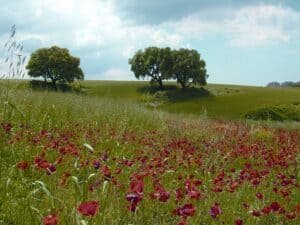
The pastures and meadows, in spring, produce the bloom most visitors remember: wild orchids of several species, among them the ophrys that imitate with the lip the shape and scent of a female insect to get pollinated by the males, asphodels, buttercups, clovers, daisies, poppies along the cultivated margins. Wild orchids should be photographed and left where they are: they are protected and picking is forbidden.
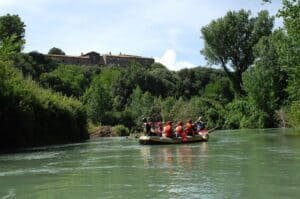
Along the ditches, finally, riparian vegetation develops, with willows, poplars, elms, marsh reeds and rushes in the dampest stretches. They are the corridors that hold the system together, let animals move between one wood and another and host amphibians, dragonflies and water-linked birds.

Another well-known fact, yet rarely mentioned
The well-known fact is that the area falls inside the Litorale Romano State Nature Reserve. Everyone writes it, including the first line of any presentation of the place. What almost nobody adds is what it concretely entails, namely that the Castel di Guido Oasis is not an isolated green island but the inland segment of a continuous system that reaches the sea.
The Litorale Romano Reserve is a state protected area established in the early 1990s and distributed between the territories of Rome and Fiumicino, with a patchwork-and-corridor configuration that includes pinewoods, dunes, wetlands, lowland woods and agricultural areas. Within this perimeter are very different habitats: the pinewoods of Castel Fusano and Ostia, the dunes of Capocotta, the wetlands of Focene and Maccarese, the relict woods of the inner belt. Castel di Guido represents its most continental and agricultural component, the one where the coastal plain begins to rise into hills.
The practical consequence is that the species don't live closed inside the 250 hectares of the Oasi: they move along the ditches and wooded corridors between the interior and the coast. A kite that hunts on the pastures of Castel di Guido may nest elsewhere in the system. Amphibians colonize new pools by moving up the watercourses. The wolf, when it appears, arrives through these same corridors. Protect one piece and interrupt the corridor and you have protected much less than you thought: this is the reason modern protected areas are designed as networks and not as enclosures.
The second well-known and little explored fact concerns ownership. That the farm is municipal is repeated everywhere, but it is rarely explained how unusual that is. It means that an enormous area of farmland, inside one of the most extensive cities in Europe, is removed from the real estate market and bound to a productive and environmental use decided by a public administration. In the urban history of Rome over the last 50 years, made of continuous expansion, this is a significant anomaly. And it is also the reason why the fate of the area is periodically discussed in political settings: such a large asset attracts projects of every kind, and the agreement with the LIPU has also worked as a cultural barrier, because it gave the area a recognizable identity that makes it harder to dismantle in silence.
The right photo to take at the Oasi di Castel di Guido
The wrong photo is the one almost everyone comes home with: the green meadow shot head-on at noon, with white sky above and no subject. It tells nothing because it lacks the thing that makes this landscape recognizable, namely the layering of planes.
The right photo is built like this. Look for a slightly raised spot along one of the low hills and compose the frame in three horizontal bands: in the foreground the tall grass or dry thistles, in the middle ground the pasture with the Maremma cows, in the background the dark profile of the Turkey oak wood. It is the image of the Campagna Romana as it has been painted for two centuries, and it works because it declares at once the three components of the system: the land, the livestock, the forest. If you manage to put a farmhouse or a rural building in a corner, the photo gains scale and story.
Timing matters more than equipment. The raking light of early morning and that of the last hour before sunset shape the hills and make readable the elevation changes that vanish at noon. On autumn and winter mornings in particular, the ditches hold low fog and for an hour the pasture floats above a white veil: it is the best condition this place offers, and it is worth getting up before dawn.
For the animal subject the advice is the opposite of the instinctive one. Don't chase the animal: find the spot and wait. A drinking trough, a woodland edge, a fence post used as a perch by the kestrel are places of certain passage. Sit 20 meters away, stay still and let the subject enter the frame. If you have a telephoto lens, use it at a respectful distance. If you only have a phone, forget the birds and focus on the landscape, on the cows, on close-up details. A porcupine quill resting on a mossy trunk, photographed up close with side light, is a better photo than a distant raptor reduced to four pixels.
Two details that deserve attention: the rockroses in bloom in May, shot backlit so that the very thin corolla lights up, and the September cyclamens in the leaf litter of the oak wood, shot from below with the camera resting on the ground. They are the two images nobody takes and that best tell the cycle of the seasons in this countryside.
A rule of conduct, which comes before all others: never approach nests, never move vegetation to get a clear frame, never enter the livestock enclosures to improve the angle. Badly done nature photography causes real damage, and in an area managed for conservation the first responsibility of the photographer is not to interfere.
Some important events that happened here in history
The Paleolithic and the elephant bone tools
The first layer is the one already mentioned: several 100,000 years ago this plain hosted human groups of the Lower Paleolithic who hunted or in any case exploited carcasses of ancient elephants and worked their long bones to make tools. The excavations have yielded bone bifaces, flakes, faunal remains and accumulation structures that have made the site a reference in the scientific literature on the European Paleolithic. The territory appears to have been frequented by humans, in different forms, since a time that our ordinary perception cannot even represent.
Lorium and the emperor Antoninus Pius
The second layer is Roman and it is the one that gives this area a historical rank that surprises those who pass through absentmindedly. Along Via Aurelia, at approximately the territory of Castel di Guido, stood the station of Lorium, about 12 miles from Rome. Lorium was not just any center: here stood an imperial villa in which Antoninus Pius spent his childhood, raised by his grandfather, and which, once he became emperor, he had rebuilt and enlarged. In that villa Antoninus Pius withdrew regularly during his long principate, and in that villa he died, in March of 161 AD.
This is worth weighing. Antoninus Pius reigned for 23 years, in what the historiographical tradition considers the quietest and most prosperous period of the empire, and his favorite residence was not at Tivoli, not at Baiae, not on the Palatine, but here, on these low hills facing the coast. The center of Roman power, for weeks every year, moved along the Aurelia and settled in this countryside. Of that villa there remain archaeological traces known to specialists and materials scattered across different collections, while the landscape that surrounded it, in its general lines of hills, woods and pastures, is still readable.
Marcus Aurelius also knew Lorium well: it was here that he spent part of his youth beside his adoptive father, and in his writings the name of the place appears as a place of formation and quiet. Knowing that the future author of the Meditations walked on this countryside adds to the walk a dimension that no sign declares.
The Middle Ages, the castrum and the ecclesiastical properties
The third layer is medieval and gives the place its name. The toponym Castel di Guido derives from a castrum, that is, a fortified settlement, tied to the name of a Guido, in an era when the Roman countryside organized itself around towers and fortified farmhouses to defend against raids and to control the consular roads. The tower that still dominates the village belongs to this phase. Like a large part of the Agro Romano, in the following centuries the estate passed under the control of Roman ecclesiastical and charitable institutions, which for centuries administered enormous landholdings outside the walls: it is the mechanism that produced the landscape of the latifondo, with isolated farmhouses, transhumant flocks and very few permanent inhabitants.
Malaria, land reclamation and agrarian reform
The fourth layer is the one that drew the countryside we see today. For centuries the Agro Romano was a depopulated and malarial territory, farmed extensively by seasonal laborers who arrived from the mountains and left again, and almost without permanent settlement. The great reclamation works, begun from the end of the 19th century and continued for decades, drained the marshes, fought the anopheles, built farm roads, farmhouses and canals, transforming a sanitary desert into a productive area. The structure of the modern farm, with its holdings, stables and network of internal roads, was born from there.
The transfer to the Comune and the 1999 agreement
The fifth layer is contemporary. In the second half of the 20th century the estate enters the holdings of the Comune di Roma, which finds itself managing a farm of dimensions out of scale with any European municipal standard. For years the vocation remains purely productive, with Maremmana breeding as the leading activity. In 1999 the turning point arrives: the agreement between the Comune di Roma, the Azienda Agricola Castel di Guido and the LIPU formally establishes the Oasi and assigns about 250 hectares to conservation, research and environmental education. It is the act that gave this territory its second life and the identity with which we know it today.
Between the two extremes, in the meantime, comes the establishment of the Riserva Naturale Statale del Litorale Romano in the early 1990s, which brought a very wide strip of territory between Rome and Fiumicino under state protection and placed Castel di Guido inside a broader frame of protection. The floristic survey conducted between 2000 and 2003, right after the birth of the Oasi, represents instead the first great scientific operation of the new management and remains the knowledge base on the area's vegetation.
Who has passed through the Oasi di Castel di Guido
The list of those who have passed through these hills is more illustrious than the place lets you suspect, and it begins with two emperors.
Antoninus Pius is the main name. Raised at Lorium, back here as emperor for 23 years, dead here in 161. If there is a place in Lazio that can be called the private home of a Roman emperor in the full sense, this territory has the right to claim it.
Marcus Aurelius frequented the same place as a young man, as adopted son and designated successor. The philosophical formation and the character of the figure were built also in these months of countryside away from the court, and the name of Lorium recurs in his personal writings.
Then there are the painters of the Roman Campagna. Between the 1700s and the early 1900s this landscape was one of the most painted subjects in Europe: the view painters of the Grand Tour, the northern landscape painters who came down to Rome to study the light, and then the Italian generation of the late 1800s that made the countryside around Rome its almost exclusive theme, with herds, butteri, aqueducts, isolated farmhouses under very wide skies. We aren't talking about a single artist tied to this precise farm, but about an entire figurative tradition that took its material from landscapes identical to this one. When you walk here, you walk inside a painting of that school.
There are the Grand Tour travelers, who traveled the Aurelia by carriage bound for Civitavecchia to embark, and who in their diaries left descriptions of the grandiose desolation of the Agro Romano: very few houses, endless herds, ancient ruins surfacing in the fields, and that sense of melancholy vastness that for two centuries constituted one of the literary attractions of travel in Italy.
There are the archaeologists and paleontologists who since the 1980s have excavated the Paleolithic levels, bringing the name of Castel di Guido into the international bibliography on the European Lower Paleolithic, and the botanists who between 2000 and 2003 determined the 526 entities of the floristic census.
And there are, every year, the school classes and the groups that LIPU accompanies along these paths. It's the least spectacular category and perhaps the most decisive, because a peri-urban protected area survives over the long term only if enough people know it exists and consider it their own.
When to go to the Castel di Guido Oasis and when to avoid it
The best season by far is spring, and in particular the window from mid-March to the end of May. In those weeks the migrants arrive, territorial song is at its peak, wild orchids bloom in the meadows, rockroses light up the garrigues and the temperature allows walking all day. If I had to name a single period for someone coming only once, I would name April without hesitation.
Autumn is the second choice and is underrated. From mid-September to November the oak wood turns coppery, cyclamens poke through the leaf litter, the strawberry tree carries flowers and fruit at the same time, mushrooms appear at the wooded margins and the return migration fills the skies. The first rains revive the landscape after the summer dryness and the mornings of low fog over the ditches are the finest photographic condition of the year.
Summer is the period to handle with care. From mid-June to August the heat in the central hours is severe, shade is scarce on the open routes, animal activity collapses and the landscape dries out to yellow. It's not a period to exclude, but it should be lived at dawn or in the last light: at noon in July you walk in an oven and see nothing. Whoever is in the area in summer should do the morning here and the afternoon at the sea, which is about 20 minutes away.

What's around the Castel di Guido Oasis
Toward the coast, the most natural combination is with the other protected areas of the same state reserve: the oasis of Macchiagrande, in the territory of Fiumicino, preserves a lowland wood and wetland habitats complementary to those of Castel di Guido, while the Lido di Maccarese offers the nearest and tidiest beach of the whole quadrant. A little farther north is Fregene, with its pinewood and its historic beach clubs, and going up the Aurelia you reach Ladispoli and the Bosco di Palo, one of the very few strips of lowland forest that survived on the coast, with the Castello di Palo Odescalchi beside it.
For those who want to combine archaeology and nature, Cerveteri with its Etruscan necropolis is a short distance up the coast, and farther north still the Santa Severa Castle and the Macchiatonda Nature Reserve round out a long day on the northern coast.
Toward the interior and the city, staying in the same quadrant, work well the Parco della Cellulosa, the Pineto Regional Urban Park, the Valle dei Casali Nature Reserve and the Monte Mario Nature Reserve, which together make up the western green network of Rome. Those with a second day who want to stay on the theme of the historic countryside find material in the Veio Park, the Macchia Grande Wood of Manziana and the Monterano Reserve. For comparison with the other great archaeological and pastoral Roman landscape, the Appia Antica Park is obligatory.
On the practical front: in the immediate radius the services are those of a borgata, with bars and grocery shops along the Aurelia and a few country trattorias. Whoever wants to eat well should plan lunch in Fiumicino, toward the port and the canal, or in Maccarese, or bring what's needed and stop where the management allows. Water supply should be taken care of beforehand: there are no drinking fountains on the routes and counting on the livestock troughs is not a good idea.
Quick questions about the Castel di Guido Oasis
Can you enter the Castel di Guido Oasis freely?
No. Openings follow a calendar set by the LIPU management and visits take place largely by reservation and with an escort, because the area is inside a working farm. Dates and arrangements should be checked on LIPU's official channels before leaving.
How big is the Oasis?
About 250 hectares under nature management, set within the roughly 2,500 hectares of the Castel di Guido Agricultural Company, which is municipally owned.
Since when has it existed?
Since 1999, the year of the agreement among the Municipality of Rome, the Castel di Guido Agricultural Company and the Italian League for the Protection of Birds.
Is it suitable for children?
Very much so. The routes are wide, the elevation changes minimal and the observation material abundant. It works better if set up as exploration and not as a lecture.
Can you bring the dog?
Where there is grazing livestock and nesting wildlife the answer, in areas of this kind, is normally no. The rule should be asked of the management directly.
What animals do you really see on a visit?
Birds, above all: raptors in flight, passerines of the meadows and the wood, and in summer swallows and bee-eaters. The Maremma cows at pasture are practically guaranteed. Wild mammals are shy and are more often observed through tracks, prints and quills than in the flesh.
Is special equipment needed?
Closed shoes suited to mud, water, a hat in the warm months and binoculars. Nothing else technical.
How long does a visit last?
Guided outings in areas of this size normally take half a day. The actual length depends on the program offered and should be asked about at the time of booking.
Can you get there by public transportation?
With difficulty. There is no railway station at Castel di Guido and the bus lines that run along the Aurelia still leave an awkward stretch to cover. It's a destination for cars or for organized visits.
In our judgment the Castel di Guido Oasis is the right place for those who have understood that nature around cities isn't played on the spectacle of the landscape, because that is elsewhere, but on the combination of historical continuity, agricultural work and conservation. Here this combination is denser than at any other point of the municipal territory: a herd of Maremma cattle grazing, an oak wood with 160 recorded bird species, an imperial villa under the fields and a Paleolithic deposit of European importance, all inside the boundaries of Rome. Whoever is looking for the postcard will remain indifferent. Whoever is looking for a place that explains itself in layers will come back.
Frequently asked questions about the Castel di Guido Oasis
Can you enter the Castel di Guido Oasis freely?
No, the Castel di Guido Oasis can't be visited freely: openings follow a calendar set by the LIPU management and visits take place largely by reservation and with an escort, because the area is inside a working farm. Dates and arrangements should be checked on LIPU's official channels before leaving.
How big is the Castel di Guido Oasis?
The Castel di Guido Oasis covers about 250 hectares under nature management, inside a farm that measures about 2,500, one of the most extensive public agricultural properties in Europe under a single municipal administration. The agreement that governs the area dates to 1999.
Where is the Castel di Guido Oasis?
The Castel di Guido Oasis is along Via Aurelia, on the western outskirts of Rome, in the strip of land that descends from the last hilly offshoots toward the coastal plain of Fiumicino and Maccarese. The village of Castel di Guido can be recognized from afar by the tower and the cluster of houses facing the state road.
What animals can you see in the Castel di Guido Oasis?
About 160 bird species have been recorded in the Castel di Guido Oasis, besides mammals typical of the Roman Campagna. The area falls within the IBA tied to the Litorale Romano State Nature Reserve and includes a portion of the Natura 2000 site Macchia Grande, in the Ponte Galeria and Galeria area.
What archaeology is there at the Castel di Guido Oasis?
The territory of the Castel di Guido Oasis hosts one of the most important Paleolithic deposits in Italy, with tools made from elephant bones, among the most significant in Europe for this category of finds. In Roman times the area was also the residence of Emperor Antoninus Pius, raised at Lorium and back here as emperor for 23 years, until his death in 161.
When is the best time to visit the Castel di Guido Oasis?
The best period by far is spring, in particular from mid-March to the end of May, when the migrants arrive, the birds' territorial song is at its peak, wild orchids bloom in the meadows and the temperature allows walking all day. April, in particular, brings all these factors together.
What is there to see near the Castel di Guido Oasis?
Toward the coast, the most natural combination with the Castel di Guido Oasis is the oasis of Macchiagrande, in the territory of Fiumicino, which preserves a lowland wood and complementary wetland habitats, while the Lido di Maccarese offers the nearest and tidiest beach of the quadrant, with Fregene a little farther north.
Article written by the editorial team of TourLeaderPro, contact them for Private/Corporate/V.I.P. Tours and Experiences. For an organized day in the Roman Campagna, with a licensed tour leader, start from the TourLeaderPro contact page. Tour operators who build nature itineraries around Rome find the consulting service in the section dedicated to tour operators.
Planning a trip to Rome? The English guides for visiting the city are on ItalyPlanner.com, and those thinking in terms of days outside the city find the guide to the best day trips from Rome.