Palo Odescalchi Castle (Ladispoli)
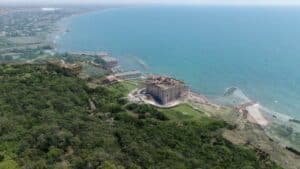
In short. Palo Odescalchi Castle is on Via Palo Laziale, in Ladispoli (postal code 00055, province of Rome), on the tongue of land that closes the Ladispoli shoreline to the south, between the pine woods and the rocky coast.


Palo Odescalchi Castle is on Via Palo Laziale, in Ladispoli (postal code 00055, province of Rome), on the tongue of land that closes the Ladispoli shoreline to the south, between the pine woods and the rocky coast. Before getting in the car it's worth knowing something that almost no guide says up front: it is not a museum. It is a private residence, still lived in by the Odescalchi family, and it has no ticket office, no opening hours, no open visits. The owners present it as a venue for weddings, ceremonies, corporate parties, gala dinners, conferences, birthdays, anniversaries, graduations, auctions and private events: you get in if you take part in one of these, or by asking the owners for a quote (telephone 06 6781067 and 333 9849298, email eredi.laode@gmail.com, website castellodescalchi.com). From Rome by car the owners indicate about 40 minutes along State Road 1 Aurelia. From Fiumicino airport about 40 minutes between the A12 and State Road 1. By train the reference is the Ladispoli-Cerveteri station, on the regional line between Rome and Civitavecchia: from the station to the sea at Palo there is still a stretch to cover by bus, by bike or on foot along the seafront. The cost of an event, the capacity of the halls and calendar availability are not published: they have to be asked directly. Anyone who arrives without an invitation can still see the castle very well from the outside, from the beach and from the coastal path, and that is a free visit worth the trip.
If you are building a day at the seaside north of Rome, the general map is in the Roman coast hub, where you also find the other landing places of the same stretch of coast.

What the Palo Odescalchi Castle (Ladispoli) Really Is
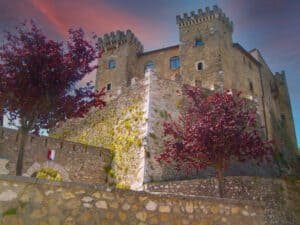
The form you see today is the result of four different operations, layered over 800 years. At the base is a medieval watchtower, sister of the dozens that guarded the papal Tyrrhenian. On top of the tower a quadrangular fortress with corner bastions was grafted, designed for grazing fire against the corsairs' boats. Then came the conversion into a noble residence, with windows opened where the gunports used to be. Finally the 1900s, which added the garden, the maintenance and the private life of a family that still lives here. It is not a scenic castle built to amaze: it is a military building that learned to be a drawing room, and you can see it in the grain of the masonry, in the setbacks, in the infills.
In our opinion, anyone who arrives expecting the fairy-tale castle is disappointed in the first five minutes and won over in the next 20, when they realize that dark mass resting on the rocks is the only piece of the Lazio coast left almost identical to how it was seen by the pilgrims who went up the Aurelia. The value is not in the isolated building, it is in the system: castle, vanished village, plain forest, Roman villa, watchtower, marsh. All within three kilometers.
The Name, the Village and the Birth of Ladispoli
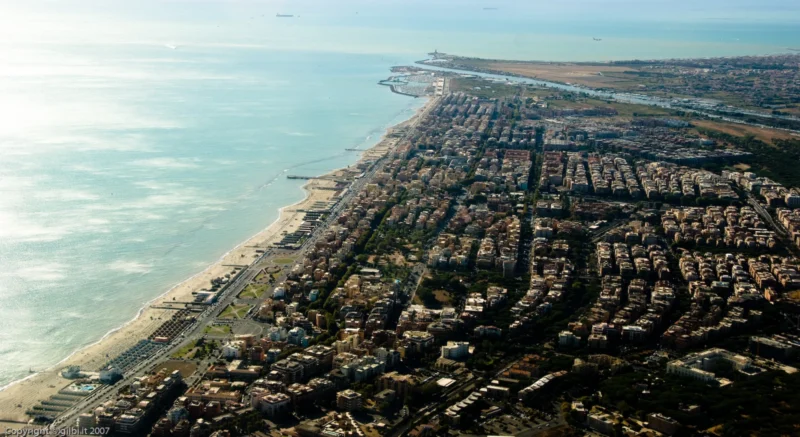
Palo is an ancient place name, tied to a coastal settlement that medieval documents call Castrum Pali. Around the fortification a small village grew, and from that village came the first inhabitants of Ladispoli, the town founded at the end of the 1800s by Prince Ladislao Odescalchi. The link between the castle and the town is not decorative: it is genealogical. Ladispoli was born as a seaside development wanted by the owner of the castle, with the railway already running and the promise of a sea season an hour from Rome. Anyone walking on the Ladispoli seafront today is walking inside a late-1800s real estate project, a successful one.
How to Get to the Palo Odescalchi Castle (Ladispoli)
By car from Rome: exit the Grande Raccordo Anulare toward the Aurelia, then State Road 1 to the Palo Laziale and Marina di San Nicola junctions. The castle's official website indicates about 40 minutes from the center of Rome and about 40 minutes from Fiumicino airport via the A12 motorway and then the state road. These are weekday times and outside the summer return traffic: on a Sunday evening in July, on the Aurelia, that 40 easily becomes double.
By train: the Ladispoli-Cerveteri station is on the regional line that goes from Rome to Civitavecchia, the same one that serves Santa Marinella and the Santa Severa Castle. From the station the castle is not within immediate walking distance: you have to go down toward the sea and continue south along the coast. Schedules and fares change by season and should be read on the railway operator's website before leaving.
By bike: the stretch between Ladispoli and Palo is one of the nicest on the northern coast, flat, with the sea always on your left as you head toward Rome. If you arrive by train with a bicycle, you solve the last-mile problem and you can also take home Torre Flavia on the other side of town.
The history of Castello Palo Odescalchi (Ladispoli), document by document
The property's official website gives the two oldest documentary anchors: a Castellum mentioned in 1254 and a Castrum Pali in 1330, with Palo appearing respectively as the property of the Normans and of the monks of San Saba. These are brief mentions, the kind archives hand back in a single line, but they are enough to say that in the thirteenth century there was already something fortified and contested here.
Local tradition pushes the military origin back to 1132, when Genoese troops are said to have occupied a Turris de Pulvereio near Palo. At that stage the only significant building was a watchtower, part of a chain of sister towers that guarded the coast against raids. This dating belongs to traditional storytelling more than to certain documentation, and it should be kept separate from the thirteenth-century records.
The fortress proper, according to what the property states today, was in all likelihood built under the pontificate of Pius II Piccolomini, elected pope on August 19, 1458. Shortly after construction came the baronial struggles of the fifteenth century, with the Orsini family in the middle: the castle was ruined, and in 1509 it is still listed as dirutum when Prospero d'Acquasparta sells it, in the name of Giulio Orsini, to donna Felice della Rovere Orsini, daughter of Pope Julius II. That sale is the turning point: from a ruin of war to the property of one of the most influential women of early sixteenth-century Rome.
The owners of Castello Palo Odescalchi (Ladispoli)
The list of changes of hands is long and says a lot about the strategic value of the site. Between the fifteenth and seventeenth centuries we find Francesco Orsini, Pope Alexander VI Borgia, Felice della Rovere Orsini, Pope Paul III, Pope Sixtus V, and Cardinals Flavio and Virginio Orsini. In 1693 Flavio and Lelio Orsini sell the property to Livio Odescalchi. His descendants in turn give it up: first to Duke Grillo of Genoa, then to Marquis Carlo Loffredo of Trevico. In 1780 the Odescalchi buy it all back, and since then they have not loosened their grip.
The old local account also adds Cardinal Alessandro Farnese and Pope Innocent XII to the list. These attributions circulate in the memory of the place, but the sources available today do not confirm them as clearly as the other names: I report them as tradition, not as archival fact.
From cannon to drawing room: the nineteenth-century transformation
With the Capture of Rome in 1870 and the end of the temporal power of the popes, the papal coastal fortifications lost the reason they were built. Palo included. The change from fortress to villa is described very well in a report from 1880 that is worth reading in full, because it is a verbal photograph: from the first entrance and from the rest of the building one recognizes every member diverted from military to civil architecture, the quarters reduced to halls, the barracks to kitchens, the batteries to privies, and on the high square of the walkway no longer the sentries around the arms and the guns, but adventurous guests around the chairs and the perches, when the sea breeze blows softest.
In those years the owner is Ladislao I, son of Livio III. Under him, with the remaking of the windows on the northern front, the castle takes on the look it keeps today. If you look at the landward facade and it seems more like a villa than a fortress, the responsibility is his.
What you see today at Castello Palo Odescalchi (Ladispoli)
From the outside, and from the inside when an event is on, the building reads in parts. I list five, in the order in which you meet them if you arrive from the beach.
The sea front and the cliff
It is the most photographed side and the most authentic. The masonry drops almost to the water, protected by a cliff that over the centuries has served as foundation and defense. When the sea is rough the spray reaches the base of the walls: this is the reason this stretch of coast was never built up like the rest of the shoreline. Look at the corner stones and the setbacks: under the nineteenth-century plaster you can make out the older masonry.
The corner bastions and the old batteries
The quadrangular plan with projecting bodies at the corners is the most obvious military legacy. The openings that look like windows today were firing positions: the 1880 report calls them batteries and records their inglorious end. It is a textbook case of reuse, and it is worth more than many freshly restored fortresses, because here the transformation has not been erased.
The northern front and the garden
On the landward side the castle shows its residential face: regular windows, light plaster, the green of the pine wood as a backdrop. It is the front remade by Ladislao I. It is also the side from which guests enter for ceremonies, because the large outdoor spaces and the interior halls are the ones the property offers for weddings and receptions.
The Mediterranean scrub around it
The castle is not isolated in a parking lot: it is surrounded by green. Holm oaks, pines, junipers, strawberry trees, mastic trees. This belt of vegetation is the reason the building, seen from the sea, seems to float on a dark mass. It is the edge of the wood that today bears the name of oasis.
The shoreline under the walls
Below the castle the beach is narrow, with pebbles and dark sand of volcanic origin. It is not a beach for umbrellas, and it doesn't have to be. It is the right place to understand the defensive geography: from here you can see how far the sentries' gaze reached, and you can sense why the chain of towers was spaced exactly that way.

The beach of Palo and the dune that tells about the Etruscans
Walking along the beach that connects Palo to Ladispoli, you come across Roman structures that cannot be identified more precisely and Etruscan presences that no sign points out. The coastal dune, by now eroded by the sea, shows holes in which wooden posts, now gone, were in all likelihood set, and furrows that suggest trenches of farmland. Anyone who pays attention to the natural stratigraphy of the dune can easily tell apart fragments of bucchero and of Etruscan and Roman terracotta.
A serious warning: you can look, but you can't pick up. The fragments are archaeological material and must be left where they are. The value of that dune is precisely in the sequence, and a shard taken away is a piece of data lost forever. If you want to see bucchero in a display case, you'll find it in the Etruscan museums of the area, starting with Cerveteri.
The Roman villa of Marina di Palo
Continuing toward the modern town, after passing a World War II bunker, you reach the beach of Marina di Palo. Here emerge the remains of a funerary monument, in all likelihood belonging to the Erennii family, buildings perhaps related to a large pool and, a little further on, the rooms of a seaside villa of the first rank.
Its remains were already noticed in 1867 by the archaeologist Luigi Tocco. The surviving rooms wind along the whole coastal strip that runs from the Palo woods to the Sanguinara ditch. Besides the structures of the thermal and residential area, found in Piazza della Rugiada, and the oval basin on the seafront, you can make out a large two-aisled cistern on Via Albatros, some basins and other masonry now submerged by the sea.
In the center of Ladispoli too, between Via Nervi and Via Rapallo, next to the Don Giovanni Bosco elementary school, other archaeological remains of the imperial era emerge. It is the clearest proof that the modern town rests on a continuous Roman fabric: here the seaside villa was not an episode, it was the normal way of occupying the coast.
La Grottaccia, the rustic villa under the ugly name
Not far away, another complex is known by the name of Grottaccia, because of a barrel-vaulted cryptoporticus that was used as a dwelling during the war. It is in all likelihood a large rustic villa, of which only some structures have been surveyed. Besides the access stairs to the cryptoporticus, rooms of the productive part can be recognized: an olive press, from which the millstone resting not far away perhaps came, and a doliarium, the room where the large dolia with foodstuffs were kept.
It is the flip side of the grand villa: while the owner looked at the sea from the panoramic cryptoporticus, someone 200 meters away was pressing olives and filling jars. The two things together make up the Roman coastal economy, and seeing them in the same landscape is a rare privilege.
Pompey's villa at Marina di San Nicola
Moving toward Marina di San Nicola, between the Cupino ditch and the beach, you come across the remains of the immense seaside villa known as Pompey's. It covers five hectares, of which only a portion is enhanced today: the area next to Piazza delle Muse, from which a corridor in opus reticulatum leads to a large cryptoporticus running along the beach.
On top of the cryptoporticus you can make out a large garden surrounded by a covered corridor that still preserves traces of colonnade and mosaic floors. Other rooms discovered in recent times, right along the Cupino ditch, suggest a long basin on the same watercourse, whose flow has shrunk over the centuries, surrounded by two long porticoes. Going along the beach toward Palo you meet new rooms that extend toward the interior of San Nicola and a series of rooms, perhaps service rooms, which remain the only structures excavated to date.
The attribution to Pompey belongs to the scholarly tradition: no inscription confirms it. The name remains convenient, but it should be called what it is. The basin on the ditch, instead, is the element I find most interesting: it means the villa had its own landing, and that the coast was served by a small-scale traffic of boats that no written source has told us about.
La Posta Vecchia, the post station with the Roman villa underneath
A short distance from the castle, La Posta Vecchia deserves its own discussion, a building that contains several centuries of history. It is a seventeenth-century post station, surrounded on three sides by an Italian garden and on the fourth by the sea, which laps its foundations, built on the remains of a Roman villa.
In the basement, during the reinforcement excavations carried out in 1966, the rooms of that villa came to light: master's quarters arranged around a garden with a central pool and a colonnaded corridor, decorated with polychrome marbles and mosaic floors with floral motifs. In one of these rooms a small antiquarium was set up, wanted by the then owner Jean Paul Getty, with the finds that emerged from the excavations: tableware in Italic and African sigillata ceramic, wine amphorae from the first to the fifth century AD, makeup tools, marbles from Egypt, Nubia, Greece and Italy, and some inscriptions attesting the imperial ownership of the villa.
In the gardens other ancient structures can be recognized: an outer courtyard with traces of marble facing built over an enormous cistern for collecting rainwater, service rooms, a long corridor, small rooms opening along a walkway. In another area of the garden, under a wooden cover, during the digging for a swimming pool the remains of a small Roman domus emerged, with the atrium and the rooms that branched off from it: the oldest house in Ladispoli, perhaps belonging to the ancient settlement of Alsium.
Today La Posta Vecchia is a privately run luxury hotel, open seasonally: in 2026 from April 1 to November 8, in 2027 from March 25 to November 7. The antiquarium is inside the property, so a visit depends on the hotel's rules and must be arranged with the owners. To put it plainly: it is one of the very few places in Italy where you sleep above a Roman mosaic dug up at home, and the price tells the story.
Torre Flavia, the wounded sister of Castello Palo Odescalchi (Ladispoli)
The best-known monument of Ladispoli is also the one most in need of care, and Torre Flavia has always been the symbol of the city. Reduced to little more than a ruin by the bombings of World War II, the lookout tower was built in the Middle Ages on structures of the Roman era and bears the name of Cardinal Flavio Orsini, who had it renovated from top to bottom in the sixteenth century.
At the time the tower was on dry land. It was part of the lookout system that covered the whole coast and that also included the towers of Palo castle, the Saracen tower of Santa Severa and the tower of the Odescalchi castle in Santa Marinella. It remained in service until the early nineteenth century, when it was still armed with two cannons of caliber 12 and 13 and three rifles with bayonets. The square base is battered, topped by the entrance door. Inside there were two floors connected by a masonry staircase. At the top, between four bulletproof corner turrets, was the terrace with a small furnace for fire signals.
Near the tower, at low tide, remains of Roman walls emerge, in all likelihood belonging to a villa now submerged. The sea that broke the tower is the same one that swallowed the villa: in a century and a half the coastline here has shifted by tens of meters. If you want to understand the erosion of the Lazio coast, you have the most instructive example in the region right in front of you.

The Piane di Vaccina: Etruscan necropolis, cistern and barbarian burials
In the Miami residential neighborhood, on a small hill overlooking the valley of the Vaccina ditch, between Via Luisiana and Via Florida, the structures of a large Roman cistern in opus mixtum with external buttresses are preserved, perhaps belonging to a rustic villa. Nearby, rooms related to a torcularium, the press for oil or wine, have been identified.
During the recovery excavations of 1983, barbarian burials dating to the fifth century AD came to light, probably belonging to Germanic peoples settled in the Roman villa, according to some the Ostrogoths of Theodoric. One of these cappuccina tombs deserves to be remembered on its own: it belonged to a young woman buried with a gold ring and two gilded silver fibulae in the shape of a cicada. They are small, telling objects, the kind of find that tells of a migration better than 10 pages of chronicle.
Downstream from the cistern, on the Vaccina ditch, the remains of the Roman bridge known as the Incastro bridge and stretches of Roman road paving survive. Beyond the Aurelia, on the limestone rise that overlooks the ditch, there is an Etruscan necropolis with about 60 chamber tombs dating between the seventh and sixth centuries BC. The necropolis was part of an Etruscan settlement controlled by the city of Caere, to be placed in the surroundings, if not at the mouth, of the caeretanus amnis, today's Vaccina ditch. On the remains of the necropolis a villa with a small bath complex arose in Roman times, and its remains are still visible.
Monteroni and the Castellaccio on the Aurelia
Along the ancient route of Via Aurelia, in the locality of Monteroni, a name that comes from the presence of some tumuli, a large Etruscan necropolis developed between the sixth and fifth centuries BC, in all likelihood belonging to the city of Alsium. Today it is almost entirely lost: the tuff quarries devastated it over the years. In Roman times the necropolis continued to be used, above all along the consular road, with cappuccina tombs and funerary monuments. The excavations of 1839, funded by the Duchess of Sermoneta, led to the discovery of several Orientalizing tombs.
Overlooking the ancient Aurelia is the Castellaccio, a building fortified by four crenellated corner towers, built in the fourteenth century and belonging in the fifteenth century to the Basilica of St. Peter. Renovated several times, for centuries it served as a rest stop: a reference point for pilgrims, couriers and travelers who walked the Aurelia and needed to refresh themselves, sleep or change horses.
Weighty figures have stayed at the Castellaccio. Giuseppe Gioachino Belli was stopped there because he had no documents, and the mishap ended up in his sonnet Er Passaporto. Saint Paul of the Cross, founder of the Passionists, passed through. Cesare Pascarella, another Roman poet, mentions it in his history of Italy in verse. The architect and archaeologist Luigi Canina, author of studies on the whole territory, worked there, and in all likelihood the English traveler George Dennis, the most reliable of the nineteenth-century explorers of Etruria, stopped there too.
Ad Turres and the Castrum Statua
Where the municipality of Ladispoli meets that of Fiumicino, near the turnoff for Ceri, once a very important road junction toward Caere and Via Clodia, a small fortress called Castrum Statua stood until the last war, in the locality that ancient sources call Ad Turres. The building disappeared under the bombings. Some structures remain on the hilltop that overlooks the Aurelia, a Roman bridge over the Cupino ditch and a funerary monument of the Roman era.
During the road-widening works in the 1990s, the ancient route of the Aurelia and the remains of a Roman villa with fine mosaic floors were found, now kept at the Banditaccia necropolis. More recently, with the digging for a road interchange, other rooms of the same villa came back to light. It is the fate of this coast: you dig for a roundabout and a second-century floor resurfaces.
The Bosco di Palo oasis, the wood that the castle saved
The Bosco di Palo oasis was born in 1980 from an agreement between the WWF and the owners of the area, the Odescalchi princes. The paradox is instructive: it was private property, with its ban on entry and its hunting reserve, that kept intact one of the last wet lowland woods left on the Tyrrhenian coast, an environment once extending along the whole shoreline.
Downy oaks, Turkey oaks, holm oaks, and then field maples, manna ashes, wild service trees: these are the trees that welcome whoever enters what ancient sources called a selva, impenetrable and dangerous. For a long time the area was a hunting reserve of the pontiffs, and tradition remembers Leo X shooting roe deer and fallow deer there. Today it is the refuge of foxes, porcupines, badgers, polecats, hedgehogs and martens.
The wood is also a stopover for migratory birds and a nesting site. Nightingales, golden orioles, great tits and long-tailed tits build their nests among the oak foliage. At night scops owls, tawny owls and barn owls move about hunting prey for their young. Access is regulated and happens only through guided visits organized by the oasis management: days, hours and booking procedures change by season and should be asked through the official channels of the association that runs it. It is not a public park: showing up at the gate hoping it's open is the best way to go home empty-handed.

The Torre Flavia marsh, the last wet strip
At the opposite end of the municipal territory, the natural monument of the Torre Flavia Marsh represents the last temporarily wet strip of what until the early 1960s was the much larger Campo di Mare marsh, extending over a few dozen hectares. The protected area was established by decree of the president of the Lazio regional government number 613 of March 24, 1997 and falls within the municipalities of Ladispoli and Cerveteri. Its management is entrusted to the protected areas service of the Metropolitan City of Rome Capital.
The territory presents itself as a succession of small depressions that seasonally fill with water, thanks to the surfacing of the coastal water table, the input of fresh water from the hinterland and the winter rains. The varying salinity has generated vegetation typical of brackish zones: glasswort, the symbol of the oasis, sea barley, sea lavender. The innermost area, flooded for a good part of the year and with less brackish water, is covered by common reed, water lily and several species of cattail.
The fauna finds its fullest expression in birds, which here have the ideal environment both for wintering and for stopping over during migrations. In the most flooded area appear herons, grey, great white and purple, and diving ducks such as the little grebe and the grebe, together with surface ducks, mallard and shoveler. On the brackish meadows you see small waders such as the Kentish plover and the little ringed plover and above all the black-winged stilt, a shorebird with long red legs. Bring binoculars: without them, the marsh looks like an uncultivated field and you won't understand why it is protected.

A curiosity about Castello Palo Odescalchi (Ladispoli)
The curiosity is not in the castle: it is in the name of the city that grew up next to it. Ladispoli is not an ancient place name nor a saint's name. It is a compound constructed at a desk at the end of the 19th century on the given name of the castle's owner, Prince Ladislao Odescalchi, with the addition of the Greek suffix polis. Ladislao, city of Ladislao. A Roman prince who, at the end of the century, founds a seaside town on his own name and sells it in lots to Romans who want the sea nearby: it is the most successful real estate operation of the Lazio coast, and it left a name that nobody questions anymore.
The second curiosity is hidden in the 1880 report already cited. That text records the exact moment when the papal war machine becomes furnishing: the batteries reduced to toilets, the troops' quarters turned into kitchens, the walkway where sentries watched the sea occupied by the guests' chairs. It is not often that a written source photographs the end of a function with such precision. And the document makes clear why the castle today is a wedding venue: the conversion into a place of celebration is not a contemporary invention, it began 140 years ago.
Third curiosity, the subtlest. The first documented owner after the 16th-century reconstruction is a woman: Felice della Rovere Orsini, daughter of Pope Julius II, one of the most powerful female figures of the Roman Renaissance, who in 1509 buys a ruined castle on the sea. It was not a whim: whoever controlled Palo controlled a landing place and a stretch of the Aurelia. The history of this building truly begins with a strategic operation signed by her.
Something nobody tells you about Castello Palo Odescalchi (Ladispoli)
It must be said plainly: it cannot be visited. Pages that promise hours, tickets or tours of the castle confuse Palo with the family's other castle, the Odescalchi Castle of Bracciano, which is a museum in every respect, in Piazza Mazzini 14, open from 10:00 to 18:00 on weekdays and from 10:00 to 19:00 on holidays, with free guided visits on Sundays and holidays and a dedicated contact for the museum. Two castles, same family, two completely different regimes. Anyone looking for the visit with audio guide must go to Bracciano. Anyone who wants Palo must settle for the exterior or have an invitation.
The second thing nobody says concerns the relationship between the castle and the wood. The oasis exists because the family kept that wood closed for centuries. The popes' hunting, the private reserve, the ban on entry: everything we consider a class privilege today produced the most important environmental result on the northern coast. The wet lowland wood of Palo survived because it was private property while all the rest of the coast was being reclaimed, subdivided and paved over with concrete. It is an uncomfortable truth and it has to be told in full.
Third: the beach under the castle is not a swimming beach. It is narrow, with irregular seabed and cliff. Anyone who arrives with a beach umbrella picks the wrong spot and spends the day uncomfortable. For real sea, in the area, you move to the beach clubs of Ladispoli, or toward Fregene and the Maccarese beach going south. Palo is a place for walking, not for lounge chairs.
My advice for visiting Castello Palo Odescalchi (Ladispoli)
Go in winter or early spring, on a day with a tramontana wind, in the late afternoon. The reason is technical: with the tramontana the air gets clean, the sea ripples against the cliff and the low-angled light ignites the masonry of the sea front. In summer, at the same hour, you get haze, heat and the Aurelia traffic at your back. The north coast of Rome gives its best out of season, and whoever visits it only in August has never really seen it.
The second piece of advice concerns the itinerary. Don't come to Palo for the castle alone: build a day in three stages. Morning at the Torre Flavia marsh with binoculars, around noon the center of Ladispoli and the seafront, afternoon Palo with the dune, the archaeological beach and the castle from the outside. It is six or seven kilometers in all, almost entirely flat, and they cover 2,000 500 years. If you have a whole day and want to raise the stakes, add Cerveteri with the necropolis the next morning, and the Etruscan picture is complete.
Third piece of advice, the one nobody follows and that changes everything: call first. If you want to see the castle from the inside, the only way is to contact the property at the contacts on the official website and ask whether there are openings, accessible events or visits that can be arranged. It is not a public body, it is not obliged to say yes, but a polite and specific request gets much more than a random visit. And if you are organizing a group or a custom trip in this part of Lazio, it makes sense to entrust the logistics to professionals: TourLeaderPro in Rome works exactly on this kind of itinerary off the beaten circuits.
Another well-known fact, yet rarely mentioned
That the Lazio coast was guarded by lookout towers everyone knows. What almost nobody considers is the logic of the system: the towers were not isolated monuments, they were nodes of an optical network. Each tower had to see the next one, by day with smoke, by night with the fire of the small furnace. The distance between one tower and the next is not random, it is calculated on the range of sight and on the height of the observation point. The towers of Palo castle, Torre Flavia, the Saracen tower of Santa Severa and the tower of the Odescalchi castle in Santa Marinella were part of the same chain.
The rarely mentioned fact is the date of decommissioning. Torre Flavia was still armed with two cannons of caliber 12 and 13 and three rifles with bayonets in the early nineteenth century: it means the anti-piracy system worked, in reduced form, until barely two centuries ago, when the first railways were already being built in Rome. It is not remote archaeology. It is the last tail of a sea war that lasted a thousand years, closed by the end of Barbary piracy in the western Mediterranean.
There is a practical consequence for whoever walks here today. If at some point on the coast you see a tower, look around: almost certainly from there you can see at least one other, or you see the spot where it stood. Try it at Palo looking north, toward Ladispoli and Torre Flavia. The landscape that seems random suddenly becomes readable, and it is one of the most solid pleasures that this stretch of coastline can offer.
The right photo to take at Castello Palo Odescalchi (Ladispoli)
The right photo is not the castle head-on. It is the castle at three-quarters from the waterline, with the cliff in the foreground wet from the wave and the dark mass of the wood closing on the right. You need a low-sun afternoon, so that the light comes from the west and carves the masonry. You need to kneel, because from human height the cliff flattens the base of the building, while from 50 centimeters the rocks become a real foreground and the castle gains height. Short exposure if you want to freeze the spray, half a second with a tripod if you want it silky. With the sea in a storm, and with due caution on the wet rocks, this becomes the best photograph of the north coast.
The second shot, the one that brings home the context, is taken from the path through the scrub: the castle framed by holm oak branches, with the sea as a light background. It is the photo that explains why this place is different from all the other coastal castles of Lazio: here the wood reaches the water, and that almost no longer happens anywhere.
A warning, and not a formal one: the castle is a private home. Photographing from the outside and from the beach is legitimate, entering the property without authorization is not, and neither is publishing images of private events or of recognizable people without consent. A drone, then, over a private residence and near a protected area is the fastest way to get yourself cited. Feet on the ground, long lens, and the result is better anyway.
Some important events that happened here in history
The first event is military and belongs to tradition: in 1132 Genoese troops are said to have occupied the Turris de Pulvereio near Palo, at a time when the maritime republics were competing for control of the central Tyrrhenian. There is no castle yet, there is a tower, and it is already coveted.
The second is the most dramatic: the baronial struggles of the fifteenth century. The fortress, just built under Pius II, ends up in ruins in the conflict involving the Orsini, and in 1509 it is still a ruin when Prospero d'Acquasparta sells it, in the name of Giulio Orsini, to Felice della Rovere Orsini. The 1509 document is the zero point of the modern castle: the reconstruction starts from there.
The third event is 1693, with the sale from Flavio and Lelio Orsini to Livio Odescalchi. It is the moment when a Lombard family risen to the top of the Church sets foot on the Roman coast. A parenthesis of changes of hands follows, Duke Grillo of Genoa and Marquis Carlo Loffredo of Trevico, closed by the Odescalchi buying it back in 1780. Since then the property has not changed family: that is 200 46 years of continuity, an almost unique case in Lazio.
The fourth is 1870, with the Capture of Rome and the end of the Papal State. The coastal fortifications lose the watch function they had performed for centuries. 10 years later, the 1880 report photographs the transformation into a residence, with the remaking of the windows on the northern front wanted by Ladislao I.
The fifth event is war. World War II leaves bunkers, rubble and absences on the coast: Torre Flavia reduced to a ruin by the bombings, the Castrum Statua erased entirely, the cryptoporticus of the Grottaccia used as makeshift housing. The sixth, finally, is peaceful and recent: in 1980 the agreement between the WWF and the Odescalchi princes turns the hunting reserve into the Bosco di Palo oasis, and in 1997 regional decree number 613 establishes the natural monument of the Torre Flavia Marsh. In 17 years this territory goes from the logic of closed property to that of declared protection.
Who has passed through Castello Palo Odescalchi (Ladispoli)
The castle has hosted, or belonged to, a sequence of names that by itself tells the history of the papacy. Francesco Orsini, founder of the Orsini phase. Rodrigo Borgia, that is Pope Alexander VI, at the height of the policy of controlling the coastal fiefs. Felice della Rovere Orsini, daughter of Julius II, buyer in 1509. Pope Paul III Farnese and Pope Sixtus V, in the season when the papacy reorganizes the defense of the coast against the Barbary pirates. Cardinals Flavio and Virginio Orsini, with Flavio leaving his own name to the tower of Ladispoli. Then Livio Odescalchi in 1693, Duke Grillo of Genoa, Marquis Carlo Loffredo of Trevico, and again the Odescalchi from 1780.
Among the figures who passed through the territory, and not through the castle, the liveliest is Giuseppe Gioachino Belli, stopped at the Castellaccio of Monteroni because he had no documents and able to turn the nuisance into a sonnet, Er Passaporto. Saint Paul of the Cross, founder of the Passionists, also passed through the Castellaccio, and Cesare Pascarella cites it in his history of Italy in verse. Luigi Canina worked there, the architect and archaeologist who surveyed half of ancient Lazio, and in all likelihood George Dennis stopped there, the Englishman who in the nineteenth century traveled through Etruria and wrote its most reliable account of the century.
The most recent name is Jean Paul Getty, who at La Posta Vecchia, a few steps from the castle, had the basement excavated in 1966 and set up the antiquarium with the finds that emerged. The richest oilman in the world who starts digging under his own house and finds an imperial villa: it is an episode that is little told in Lazio and that deserves to be remembered. In local tradition Pope Leo X also appears, a hunter in the Palo selva, which explains why that wood survived: it was reserved hunting ground.
When to go and when to avoid Castello Palo Odescalchi (Ladispoli)
From November to March the coast is empty, the light is better and the wintering birds fill the marsh. It is the right season for those who come to walk and photograph. April and May are the months of migrations and of the scrub in bloom: the richest period of all if you are interested in nature. June and September remain pleasant. July and August I would avoid, except for swimming at the equipped beach clubs of Ladispoli: the traffic on the Aurelia is heavy, parking in Marina is difficult, and the castle, closed and surrounded by private events, offers less than usual.
A detail few consider: on high-season weekends the area frequently hosts weddings. That means busy access roads and suppliers moving around. If you want quiet, pick Wednesday.
Castello Palo Odescalchi (Ladispoli) with children
It works better than it seems, provided you set it up as a treasure hunt instead of a visit. The castle from the outside, the cliff, the dune with the pottery fragments, the World War II bunker on the beach of Marina di Palo, the remains of the Roman villa surfacing among the houses: that is five concrete stops, visible, within reach of short legs. The Torre Flavia marsh, with binoculars and the bird checklist, holds court for a good hour.
What doesn't work with children is the claim of telling the succession of owners. No child remembers 13 names in a row. Two are enough: the princess who in 1509 bought a ruined castle and the prince who invented a city with his own name. With those two stories the place becomes memorable.
Accessibility and concrete limits
The castle is private property and does not publish information about the accessibility of the interiors: anyone with specific needs must ask the property directly before confirming an event. Outside, the seafront and the paved stretches toward Marina can be walked without difficulty. The beach under the castle, with pebbles and rocks, cannot. The path toward the wood is unpaved and in some places uneven.
The Torre Flavia marsh has paths on natural ground, with conditions that depend on the season and on the water level: updated information should be requested from the managing body. For groups with particular needs, the practical advice is to concentrate on the Ladispoli seafront and on Torre Flavia seen from the urban side, which remain the easiest points to reach.
How much a day at Palo costs
The castle from the outside, the beach, the dune, the walk on the seafront and the view of Torre Flavia cost nothing. The real expense items are three: the trip, parking and lunch. By train from Rome you travel on a regional fare. By car you pay for fuel and, in summer, parking in the paid areas of Marina. The guided visit to the Bosco di Palo oasis involves a contribution set by the management, which should be checked when booking. An event at the castle is another category of expense and is negotiated with the property.
If you are looking for a nearly free day north of Rome, this is among the best: the ratio between what you see and what you spend is tilted in your favor. More ideas of the same kind are collected in the tourist attractions section and in the itineraries of my trip.
What to eat and what is around
The cuisine of Ladispoli is seafood cuisine of the Lazio coast, with an agricultural specialty that here has become the city's identity: the Roman artichoke, celebrated every spring with a historic festival that fills the center. By the sea, fried paranza fish, tellina clams and spaghetti with clams are popular, and in the village trattorias Roman dishes hold out. I don't name restaurants, because they change management faster than a guide gets updated: ask in Ladispoli, where competition keeps quality high.
Within half an hour you have a rare range. To the north Santa Severa with its castle on the sea, which you can visit, and further on Tarquinia with its painted tombs. Inland, Cerveteri and the Banditaccia, a World Heritage site. To the south the pine woods and beaches of Macchiagrande. Toward the interior the lake and the castle of Bracciano, the other residence of the same family. If you want a reading in English of this part of the region, to accompany foreign guests, you'll find it in the ItalyPlanner Lazio guide.
How to fit Castello Palo Odescalchi (Ladispoli) into a wider itinerary
Palo works as the first stop of a coastal climb northward: castle and wood in the morning, Santa Severa at noon, Santa Marinella or Civitavecchia in the afternoon. It also works as the tail end of an Etruscan day: Cerveteri and the Banditaccia in the morning, down to the sea in the afternoon, sunset at Palo. Whoever has two days can finish with Bracciano and the lake, lining up the two Odescalchi castles and understanding, from the comparison, how different the fate of two buildings of the same family is.
For foreign guests, the most effective way to tell this coast is by contrast with Rome: 40 minutes by car and you go from the most visited city in Italy to a coast where there is no line anywhere. Day trips set up this way are well explained in the ItalyPlanner day trips section, while for a custom professional escort, including for corporate groups, the reference remains TourLeaderPro with its small-group experiences.
Quick questions about Castello Palo Odescalchi (Ladispoli)
Can you visit Castello Palo Odescalchi (Ladispoli)?
Not with a free visit. It is a private residence lived in by the Odescalchi family and it is opened for weddings, ceremonies and private events. For information you need to contact the property directly.
How much does it cost to enter the castle?
There is no entrance ticket because there are no paid visits. The costs concern renting the venue for an event and should be requested from the property, which provides quotes on request.
What is the exact address?
Via Palo Laziale, 00055 Ladispoli (RM). The contacts given by the official website are 06 6781067 and 333 9849298, with email eredi.laode@gmail.com.
How far is Castello Palo Odescalchi (Ladispoli) from Rome?
The property indicates about 40 minutes by car from Rome along state road 1 Aurelia, and about 40 minutes from Fiumicino airport via the A12 and then the state road.
How do you get there by train?
The reference station is Ladispoli-Cerveteri, on the regional line between Rome and Civitavecchia. From the station you need a last stretch toward the sea by bus, by bike or on foot. Schedules and fares are checked on the rail operator's website.
Where do you park?
Those attending an event park according to the property's instructions. Those staying outside use the spaces along the streets of Marina and the seafront, keeping in mind that in summer availability is scarce and partly paid.
Can you photograph the castle?
From the outside, from the beach and from the public path, yes. Entering the property without authorization, no, and drone filming over a private home and near a protected area is not allowed without the required authorizations.
Is Castello Palo Odescalchi (Ladispoli) wheelchair accessible?
The property does not publish information on the accessibility of the interiors: ask directly before confirming attendance. The seafront and the paved roads of the area can be navigated, the beach with pebbles and rocks cannot.
Do you need to book?
For the exterior no, it is always accessible. For anything concerning the interior, booking or an invitation is mandatory because it is a private home.
Is the castle free on the first Sunday of the month?
No. The initiative that makes some state museums free on the first Sunday of the month does not apply to Palo castle, which is not a public museum.
How much time do you need for the Palo area?
For the castle from the outside, the dune and the beach, a couple of hours is enough. For a full day with the Torre Flavia marsh, the center of Ladispoli and the Roman villa of Marina di Palo, you need five or six hours.
Can you enter the Bosco di Palo?
Only with the guided visits organized by the oasis management, which are booked in advance. Days and hours change by season and should be checked on the official channels of the association that runs it.
What is the difference from the Odescalchi castle in Bracciano?
Bracciano is a museum castle, open to the public with regular hours, guided tours on holidays and dedicated contacts. Palo is a private residence not open to the public. Same family, two opposite regimes.
What is the difference from the castle of Santa Severa?
Santa Severa is a publicly owned complex with a museum, visitable spaces and a cultural program. Palo remains private. If you want to enter a castle on the sea north of Rome, Santa Severa is the right choice.
Are there Roman remains visible without paying?
Yes, quite a few: the outcrops of the Roman villa of Marina di Palo, the cistern on Via Albatros, the remains near Piazza della Rugiada, the cryptoporticus of Pompey's villa at Marina di San Nicola and the submerged walls near Torre Flavia at low tide.
Is Castello Palo Odescalchi (Ladispoli) suitable for children?
As an exterior, yes, if you turn it into a walk in stages among cliff, dune, bunker and marsh. An interior visit is not available, so there is no risk of boring them on a museum route.
Can you swim under the castle?
The beach under the walls is narrow, with pebbles and cliff, and is not equipped. For swimming it's better to move to the beach clubs of Ladispoli or further south toward Fregene and Maccarese.
When is the best time to go?
From November to May, for light, silence and the presence of birds. April and May add the migrations and the scrub in bloom. July and August are the least interesting months, except for the equipped beach.
Can you collect the pottery fragments on the dune?
No. They are archaeological materials and must be left where they are. Looking at them and photographing them is legitimate, taking them away is not.
Can you get married at Castello Palo Odescalchi (Ladispoli)?
Yes, and it is the castle's main function today: weddings, ceremonies, corporate parties, gala dinners, conferences and private celebrations. Quotes and availability are requested at the contacts on the official website.
Is there a museum inside the castle?
No. The antiquarium of the area is the one set up at La Posta Vecchia with the finds from the 1966 excavations, and visiting it depends on the rules of the property that hosts it.
Final verdict on Castello Palo Odescalchi (Ladispoli)
Visitors' reaction is almost always the same: first disappointment at the closed gate, then surprise when you realize the castle is the last piece of an entire landscape, not a monument to tick off. My advice is to come with that spirit. Look at the masonry from the sea, walk on the dune where the bucchero surfaces, enter the wood if you manage to book, and close at sunset with the black silhouette against the sky. It is worth more than many paid guided visits, and it costs as much as a regional train ticket. And if you are lucky enough to be invited to a wedding at Palo, accept without thinking: that walkway where in 1880 the guests put chairs in place of the cannons is still there, and it works exactly as it did then.
To organize a custom escort in this part of Lazio, with authorized guides and tour leaders, the professional reference is TourLeaderPro. For those preparing a trip in Italian and English together, reading in parallel with the ItalyPlanner guide to Rome helps balance city and coast.
Article written by the editorial team of TourLeaderPro, contact them for Private/Corporate/V.I.P. Tours and Experiences.
Planning a trip to Rome? The English-language guides to visiting the city are on ItalyPlanner.com.