Ostia Lido
In short. Ostia Lido is the sea of Rome and you get there with the same ticket you use for the bus.
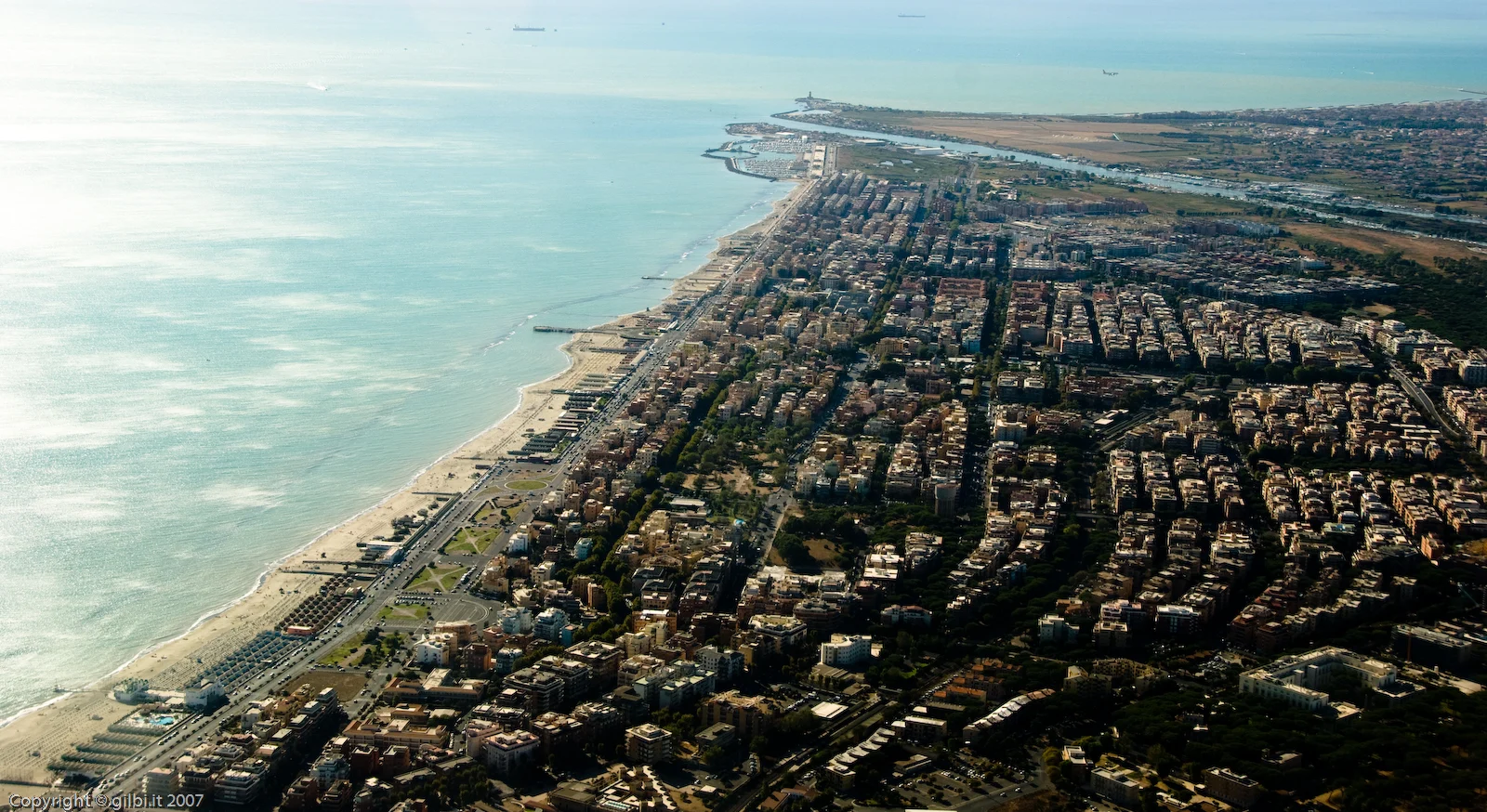
Ostia Lido is the sea of Rome and you get there with the same ticket you use for the bus. This is the main news, and many Romans themselves forget it. You leave from Porta San Paolo, next to the Piramide station of subway Line B, and in a little over half an hour you step off a short walk from the sand. No supplement, no regional train to buy separately, no reservation.
The district, though, is not only beach. Anyone who gets off at Lido Centro and walks toward the sea crosses one of the most compact pieces of 1920s and 1930s architecture that Rome has outside the center, with the same urban planning logic found at EUR but 30 years earlier and with the sea in front. There is a masonry pier, a town hall from 1924, a 900 hectare pine forest and the place where they killed Pier Paolo Pasolini.
The most common reaction is surprise: anyone arriving convinced of finding some ordinary seaside suburb realizes after 10 minutes that the design of the waterfront is deliberate, that the facades have an idea behind them, and that the relationship between the city and its sea is told here in full, for better and for worse. Data checked against official sources on September 28, 2026.
How to get to Ostia Lido, really
The line is called Metromare and until 2021 it was called the Roma Lido railway. The name change is from January 1, 2022, when the service passed to Cotral with the infrastructure under Astral. There are 13 stations, all above ground except Acilia, from Porta San Paolo to the Cristoforo Colombo terminus. The whole route takes about 37 minutes, but those going to the beach get off earlier and take fewer minutes.
The valid ticket is the normal Metrebus urban fare. The BIT costs €1.50 and lasts 100 minutes. The Roma 24-hour costs €8.50, the 48-hour €15, the 72-hour €22, the CIS weekly pass €29. Cotral confirms on its site that the Metrebus card and single-ride tickets are valid on this line, which falls within the integrated fare system. Anyone arriving from the airports will find the picture of connections in the page on arrivals in Rome.
The useful stations for the beach district are four. Lido Centro serves Piazza Anco Marzio and the pier, Stella Polare opens onto the central stretch of the waterfront, Castel Fusano lets off in front of the pine forest, Cristoforo Colombo is the terminus toward Capocotta and the southern coast. Stella Polare dates from 1948, Castel Fusano from 1949, Cristoforo Colombo from 1960: the line grew together with the district, it was not dropped in from above.
One thing has to be said without beating around the bush. The Metromare is a line that suffers: infrastructure renewal works under way, night service replaced by buses, last departures from Cristoforo Colombo and from Porta San Paolo at 22:30 on weekdays with replacement buses at 22:45, 23:30 and 00:15 depending on the termini. Whoever plans the day has to take this into account and not find out at 11 at night with feet full of sand.
The Cotral toll-free number for the line is 800 174 471. During strikes the minimum service is guaranteed until 8:30 and from 17:00 to 20:00, as for the rest of Roman public transport. Anyone who wants the full picture of subway, bus and tram will find everything in the guide to transport in Rome, which it's best to read before improvising.
You can get there by bicycle. From the Ostiense district one route runs along Via Cristoforo Colombo and another follows the Tiber: it is about 25 kilometers, flat, with wind almost always against you on the way out in the afternoon. The real conditions of the routes are told in the page on Rome's bike paths. The bicycle can be taken on the Metromare during the permitted hours, which change with the season: it's best to check before showing up at the turnstile.
By car you arrive via Via del Mare or Via Cristoforo Colombo, opened in its coastal stretch in the postwar years. Parking from June to September is a lottery and on July weekends wild parking occupies every sidewalk. In summer it's best to leave the car at home, and not out of ecological virtue: so as not to lose 40 minutes circling Piazza Anco Marzio.
A curiosity about Ostia Lido
Ostia Lido exists because someone drained a marsh. The territory was made of salt pans and malaria-infested swamps, and the reclamation was approved in 1878, eight years after the annexation of Rome to the Kingdom of Italy. In 1884 the laborers from Ravenna led by Federico Bazzini arrived and dug the drainage canals by hand, including the Dragoncello and the Pescatori canal.
In 1889 the pumps drained more than 1,500 hectares of marsh within a few weeks. It's a fact to be read carefully: the beach where people sunbathe today is land wrested from the water by workers from Emilia-Romagna who came to die of fevers among the mosquitoes. The Borghetto dei Pescatori, in the eastern part, still keeps the surnames of that migration.
The master plan was signed in 1910 by the engineer Francesco La Grassa. Via del Mare opened in 1927, the railway to the coast in 1924. Three years apart between the train and the road, and the train came first: Ostia was born as a seaside district reachable by the common people with a ticket, not as a riviera for motorists. This explains many things, including why even today people go there without a car.
The social distinction, however, was written into the plan from the start. The coastal strip was assigned to stately villas, the inland zones to workers' housing. Anyone walking today from the waterfront inland crosses that division in five minutes and sees it in the heights, the balconies, the width of the streets. Nobody ever erased it.
The 1930s rationalism along the waterfront
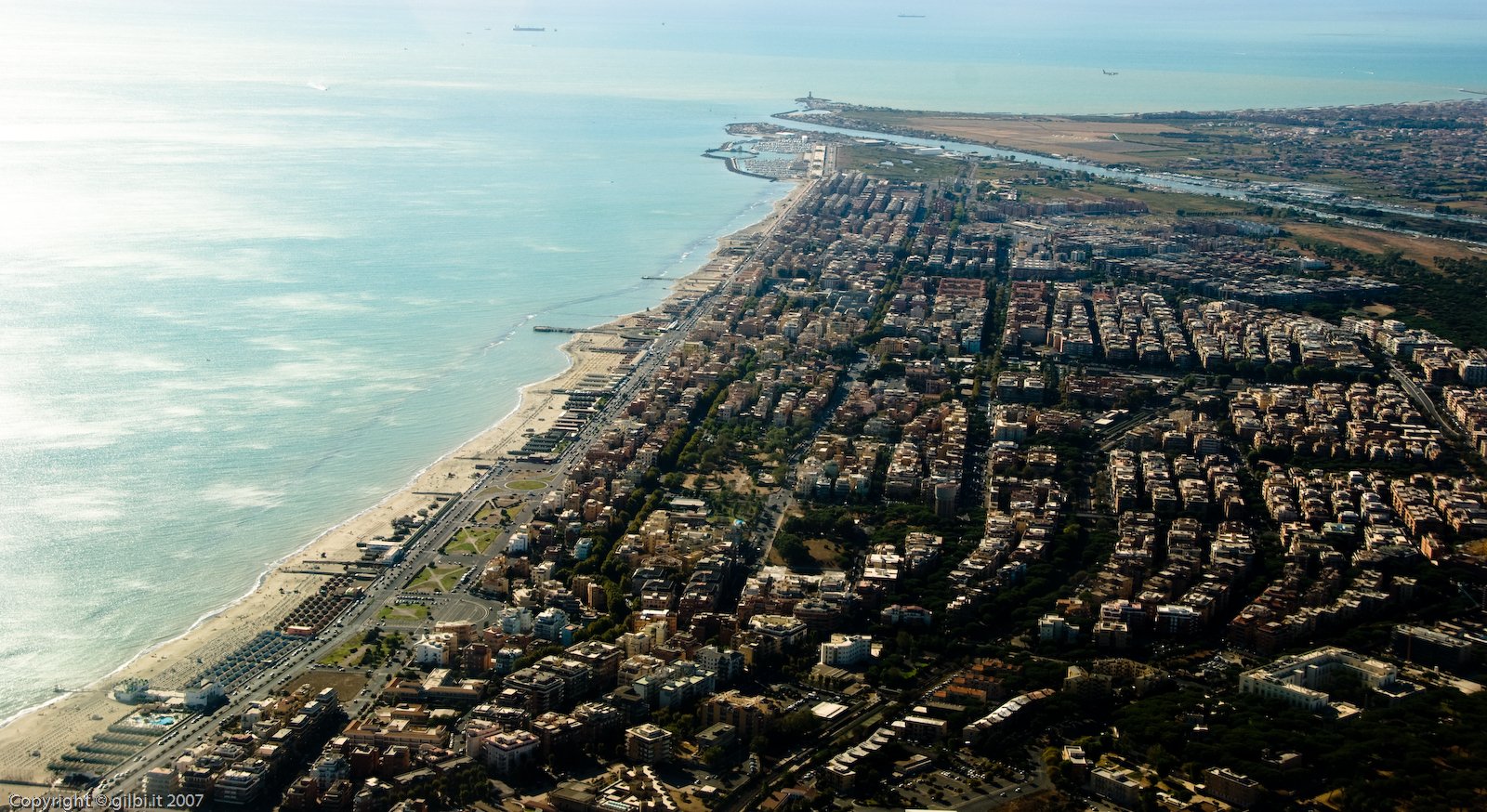
The Ostia waterfront is six kilometers long, from the Porto Turistico to Piazzale Cristoforo Colombo, and changes name along the way: Lungomare Paolo Toscanelli toward the west, Lungomare Amerigo Vespucci toward the east. On this stretch face villas and bathing establishments from the 1920s and 1930s, some remade, some badly reduced, some intact. Walking it in full takes an hour and a half at a relaxed pace.
The Palazzo del Governatorato
The Palazzo del Governatorato was built between 1924 and 1928 to a design by Vincenzo Fasolo and today houses the seat of Municipio Roma X. It is the building that sets the tone for the whole district: not yet pure rationalism, rather a synthesis between the Novecento idiom and classical memory, with the portico marking the front. Anyone arriving expecting an anonymous suburban town hall is thrown off.
The Colonia Marina Vittorio Emanuele III
The Colonia Marina Vittorio Emanuele III was built between 1927 and 1932, again to a design by Fasolo, on the waterfront. The seaside colonies are the great forgotten chapter of Italian architecture between the wars: enormous buildings constructed to house city children for a month in summer, with dormitories, refectories, infirmaries. Almost all are empty or converted with difficulty today.
The former GIL building
The former GIL complex, built between 1932 and 1936 to a design by Paolo Benadusi, is the most openly rationalist piece of the district. Clean volumes, ribbon windows, no decorative concession. The houses of the Gioventù Italiana del Littorio produced high-quality architecture all over Italy, from an embarrassing patronage, and in Rome the reference is the WeGil in Trastevere, now a regional cultural space.
Angiolo Mazzoni's post office
The post office of Ostia Lido is the work of Angiolo Mazzoni, chief engineer of the Ministry of Communications and one of the very few Italian architects to have signed a futurist manifesto of architecture. On the dating the sources diverge: some place the building in 1934, others date it between 1939 and 1942. The discrepancy probably concerns the difference between design and completion, but until a clear document comes out it's best to say that the figure varies.
Mazzoni in the same years signed stations and post office buildings across half of Italy, from the heating plants of Firenze Santa Maria Novella to the buildings of Latina and Sabaudia. His idiom mixes rationalist rigor with an almost obsessive research into materials: bricks, colored marbles, glass-concrete. In Ostia this research can be read in the thicknesses and in the way the light enters.
The Villini Rossini and the Stabilimento Roma
The Villini Rossini date from 1927, designed by Augusto Antonelli in barocchetto style, and show that in the district there is not just one language. The Stabilimento Roma, from 1927, was the work of Giovanni Battista Milani and was destroyed in 1943: of that structure today there remains the photographic documentation and nothing standing. Anyone who arrives looking for it wastes time.
A note of credit that nobody ever gives: in Ostia rationalism was applied to a real district, with public housing, schools, a market, not to a regime showcase like the Palazzo della Civiltà Italiana. The comparison with EUR is instructive precisely for this reason: there a manifesto, here a place where people kept on living.
One thing nobody tells you about Ostia Lido
The sea of Ostia is not the sea of Ostia. The current along this stretch of coast carries the waters of the Tiber mouth from north to south, and the quality of the bathing depends much more on what comes down the river in the preceding days than on what happens on the beach. After two days of heavy rain inland the color of the water changes visibly.
This explains the terrible reputation and also its partial injustice. The Regione Lazio checks have for years classified as swimmable most of the coastal stretches of the Roman coast, with specific exclusions around some canal mouths. The point is that the Romans' mental postcard was formed in the 1970s, when the situation was different, and mental postcards don't update themselves.
Anyone who wants guaranteed clear water takes the Metromare, gets off at the terminus and continues toward Capocotta, where the seabed is different and the dune is intact. Anyone who instead wants to understand Ostia stays in Ostia, because the urban beach with the pier and the buildings behind is a landscape that no longer exists elsewhere in Italy.
Second thing that isn't said. Ostia in winter is better than in summer. From November to March the waterfront empties out, the facades are seen without crowds in front, the raking afternoon light draws the rationalist volumes like a manual, and the Metromare runs half empty. For the architecture the right month is January, never July.
The Ostia pier
The pier was designed by Giovanni Battista Milani and opened to the public on August 10, 1940, with the official inauguration on October 27 of the same year. Its technical particularity is substantial: while Italian seaside piers of the period were built in wood, this one was built in masonry. That is the reason it still exists and the reason that, when the Germans mined it, they had to work at it.
In September 1943 German forces destroyed a good part of it to prevent an Allied landing. The reconstruction came in the early 1950s and a further remaking dates from 1982. The sources report for the original structure a width of six meters. On the length the figures in circulation do not agree with each other, because some measurements include the stretch on land and others only the arm over the sea.
Before the war the pier was the most elegant gathering place of the Roman beach, frequented by high society and by Mussolini in person. 40 years later it was something else: the opening sequences of Amore tossico, the 1983 film shot with nonprofessional actors from the coast, were filmed right here. Two images of the same piece of concrete a generation apart.
Today the pier can be walked, free of charge, and it is the point from which you understand the geometry of the waterfront better than from any other place. On the condition of the structure the news has chased itself for years between partial barricades, maintenance work and reopenings. Before leaving it's best to check the channels of Municipio Roma X, because a written page cannot guarantee the state of a structure exposed to salt air.
The practical advice is about the time. The pier faces southwest and the sun sets practically inside it in the winter months. Anyone going at three in the afternoon in August finds wind, salt in the eyes and no shade. Anyone going an hour before sunset in November finds the reason this structure was built.
My advice for visiting Ostia Lido
Get off at Lido Centro and not at Cristoforo Colombo. The terminus is convenient for the southern beach, but the district can only be understood by entering from Piazza Anco Marzio, which is the central pedestrian island and the point where the urban design closes. From there to the pier it is five minutes on foot, downhill, with the 1930s architecture on either side.
Then walk toward the east along Lungomare Amerigo Vespucci and not toward the west. The direction matters: toward the east the fabric of the 1920s and 1930s is more continuous and you reach the Borghetto dei Pescatori, which is the only piece of the district with a history different from the master plan's. Toward the west the front is more remade and more anonymous.
Allow half a day, not two hours. Ostia works badly as a quick stop and well as a whole day, ideally paired with Ostia Antica, which is on the same line four stops away. Anyone who does the excavations in the morning and the Lido in the afternoon spends one day ticket and takes home 2,000 years of history of the same river mouth.
The contrarian opinion concerns the season. Everyone comes from June to September and gets it wrong. The right months are April, May, October: you walk without sweating, the venues are open but not full, you look at the sea instead of occupying it, and the Metromare is not a cattle car. In August half of Rome comes here and the district is not sized to bear it.
Last recommendation, banal but useful: bring water. On the waterfront in summer the drinking fountains are few and far apart, shade is almost absent on the sea-side sidewalk, and the stretch between Stella Polare and Castel Fusano is a kilometer and a half of full sun. Anyone who tackles it at two in the afternoon regrets it.
The free beaches of Ostia and where they are
Free beaches in Ostia exist and coexist with the paid bathing establishments along the whole front. The logic is simple to understand once you are on site: the waterfront is a sequence of beach concessions separated by public access gaps, and through those gaps you pass without paying anything. The Romans call them gates and identify them by number.
The stretch with the greatest continuity of free shoreline is the one to the south, beyond the Cristoforo Colombo terminus, on the coast that leads toward Capocotta. There the beach is wide, the dune is protected and the kiosks are sparse. In the same area is also the Capocotta naturist oasis, signposted and regulated.
On the urban front the free beaches are narrower and more crowded, but they exist and can be reached on foot from the stations. The City of Rome publishes every season the list of free stretches and of those equipped with services, together with the opening and closing dates of the bathing season. It is the only source worth consulting, because the layout of the concessions changes from year to year.
A clarification that saves arguments under the umbrella. The strip of the first meters from the waterline is public domain and must remain passable even in front of the bathing establishments. Whoever walks along the shore is not invading anything. The right of passage exists, and should be exercised with common sense and without spreading your towel between other people's loungers.
Anyone looking for alternatives on the same rail axis or a short drive away will find Fregene and the Lido di Maccarese north of the river mouth, Santa Marinella and Santa Severa farther on the railway line to Civitavecchia, and toward the south Torre Paola at Sabaudia and Terracina.
The comparison should be made honestly. On water quality and the width of the shoreline, the Pontine coast and the one north of Civitavecchia give better results. On travel time and cost, Ostia has no rivals in all of Lazio: an hour and a half saved on the way out and as much on the way back are worth a lot when you have only one day.
Another well-known fact, yet rarely cited
Everyone knows that Ostia had a seaplane base, few remember why it mattered. The seaplane port was inaugurated in 1919 to a design by the engineer Raffaele Tarantini, at the mouth of the Tiber. In 1922 it was decommissioned because of coastal erosion, then reopened on March 3, 1926 and named after 1928 for Carlo Del Prete, a decorated pilot.
Italo Balbo landed here in 1933, returning from the Atlantic crossing, and the event was staged as a mass liturgy. In 1943 German forces damaged the structures. In the 1960s the area was occupied by a spontaneous settlement of fishermen and families, and between 1998 and 2001 the marina and the demarcation of the protected area arrived.
The sequence is that of all of Ostia: a modern idea, a regime use, a wartime destruction, a spontaneous occupation, a partial redevelopment. Anyone looking in this district for a linear story won't find it, and for that very reason the place is interesting. The layers can be seen with the naked eye.
In the same frame should be read the story of the river mouth, which shifted the geography of this stretch several times. The flood of 1557 diverted the course of the river and made useless the strategic function of the Castle of Julius II, the fortress commissioned in the 15th century by Cardinal Giuliano della Rovere to defend the mouth from pirates. The castle is today the heart of the Ostia Antica Village.
The Idroscalo and the Pasolini monument
Pier Paolo Pasolini was killed at the Idroscalo of Ostia on the night between November 1 and 2, 1975. The body was found on the morning of November 2 in an unpaved clearing near the river mouth, in an area then occupied by shacks. The place today is reached from the Cristoforo Colombo terminus continuing toward the river mouth and following the signs for the marina.
In 2005 the Pier Paolo Pasolini Literary Park was inaugurated at that spot, a garden with a stele and a bibliographic path dedicated to the writer. The arrangement gave the place a recognizable form after 30 years in which it had remained an ordinary clearing with a marker stone. On the author of the sculpture different attributions circulate that can't be verified on solid sources: I prefer not to name any.
The visit is not an outing. It is a clearing with dry grass, the noise of traffic behind, the river mouth in front, and in summer a heat with nothing to hold on to. Anyone arriving expecting a monumental memorial is disappointed, and that's as it should be: the disproportion between what happened and the modesty of the place is exactly the content of the visit.
Anyone going in summer may run into the Puntasacra Film Fest, the free cinema program held right at the Idroscalo and which works on the relationship between images and this piece of the city. It is the least rhetorical way I know of being in that place: sitting watching a film, in the evening, where Italian cinema lost one of its own.
Two practical warnings. There are no services, no bar, no shade and the evening lighting is poor: anyone arriving after sunset without a flashlight walks badly. And the final stretch of road is unpaved, not advisable in light shoes after rain.
The Castel Fusano pine forest
The Castel Fusano pine forest covers 916 hectares within the territory of the City of Rome and is cut in two by Via Cristoforo Colombo. It borders the Pescatori canal to the northwest and the presidential estate of Castelporziano to the southeast. It is the largest urban park on the Roman coast and by extent one of the largest in Lazio.
The ownership history explains the landscape. The Sacchetti bought the estate in the 1620s through Cardinal Giulio Cesare Sacchetti. In 1713 they planted about 7,000 stone pines there and a great number of holm oaks. The Chigi bought it in 1755. The City of Rome acquired the pine forest in 1932 and opened it to the public on April 21, 1933.
Inside the perimeter are the Villa della Palombara, attributed in some reconstructions to Quintus Hortensius Hortalus, the Villa Sacchetti designed by Pietro da Cortona, and the remains of Via Severiana, the coastal road ordered repaired by Septimius Severus in AD 198. The ancient route connected Ostia to Terracina and passed right through here.
On July 4, 2000 a fire struck between 300 and 350 hectares of century-old pine forest, and of these 280 hectares were completely destroyed. The reforestation that followed has been limited. Anyone walking today in the burned sectors still sees the difference between the old woods and the sparse zones: it is a wound from 25 years ago that has not closed.
Since 1996 the pine forest has been part of the Litorale Romano State Nature Reserve. You reach it by getting off at the Castel Fusano station of the Metromare, which opens directly onto the area. Entry is free and the access hours to the equipped sectors change with the season: it's one of those cases in which the municipal source must be checked before leaving and can't be taken for granted.
The judgment is clear-cut and not everyone shares it: the Castel Fusano pine forest is more interesting than the beach. Anyone who comes to Ostia for the sea and doesn't enter the woods misses the best piece. The comparison with Pineto Park inside the city or with the Appian Way Park holds up without embarrassment.
The right photo to take at Ostia Lido
The photograph to take at Ostia Lido is shot from the pier, turned toward land, an hour before sunset between October and February. From there the built front of the waterfront lines up in a single frame, the raking light carves out the rationalist volumes and the sea stays out of the picture. It is the image that explains the district better than any photo of sand.
The wrong photograph is the one toward the open sea from the tip of the pier: empty horizon, no scale, no reference. It works on any Mediterranean coast and for that reason says nothing. Whoever goes home with that one has not photographed Ostia, has photographed water.
The other frames that hold up
Piazza Anco Marzio works in the first hours of the morning, when the pedestrian island is empty and the design of the paving can be read. The facade of Mazzoni's post office asks for side light and therefore late morning or mid-afternoon, never noon. The Borghetto dei Pescatori gives its best under an overcast sky, because strong contrast cancels the details of the low houses.
The Castel Fusano pine forest needs the opposite: full sun and high canopy, because the trunks of the stone pines work as columns only when the light comes in from above. At the Idroscalo, out of respect and for the result, gray is better: a memorial photographed under a blue sky looks like a postcard and betrays what happened there.
Some important events that happened here
The land reclamation of 1884 is the first event that counts, because without it the neighborhood doesn't exist. The farmhands from Ravenna led by Federico Bazzini dug the canals by hand, and in 1889 the pumps drained more than 1500 hectares in a few weeks. It's one of the great hydraulic works of post-unification Italy and nobody talks about it.
In 1924 the railway to the coast went into service, and in 1927 Via del Mare opened. In the same year the city had the Stabilimento Roma built, to a design by Giovanni Battista Milani, and between 1924 and 1928 Vincenzo Fasolo built the Palazzo del Governatorato. In a decade, an entire neighborhood was built from nothing.
In 1933 Italo Balbo landed at the Idroscalo on his return from the Atlantic crossing, and in the same year, on April 21, the city opened the newly acquired Castel Fusano pine forest to the public. 1933 is probably the year Ostia took the shape it still has today.
On August 10, 1940 the pier opened, and it was officially inaugurated on October 27. Three years later, in September 1943, German troops destroyed most of it to prevent an Allied landing, and in the same period they damaged the Idroscalo structures and destroyed the Stabilimento Roma. The war reached Ostia from the sea as a threat and not as an event.
On November 2, 1975 the body of Pier Paolo Pasolini was found at the Idroscalo. It's the event that branded the name of the neighborhood in the national imagination, and 50 years later it still weighs on how Ostia is named in Italy.
On July 4, 2000 the fire in the Castel Fusano pine forest completely destroyed 280 hectares of centuries-old woodland. Between 1998 and 2001 the marina and the perimeter of the protected area at the Idroscalo were built. On January 1, 2022 the Roma Lido railway became Metromare under Cotral management.
Who has passed through Ostia Lido
Pier Paolo Pasolini is the name everyone associates with Ostia, and it's a partial and unfair association. Pasolini came to Ostia and the coast for years before dying there, shot parts of films here and set pages of his writing here: his relationship with this coast is one of work and of gaze, not just crime reporting. Reducing him to November 2, 1975 is convenient and wrong.
Benito Mussolini frequented the pier when it was the most elegant meeting place on the Roman beach, and Ostia was one of the regime's urban planning showcases, together with EUR and the founding cities of the Pontine plain. Italo Balbo landed here in 1933 between two wings of organized crowds. These are episodes the neighborhood has not removed, and you can still read them in the stones.
Vincenzo Fasolo, Angiolo Mazzoni, Paolo Benadusi, Giovanni Battista Milani, Augusto Antonelli: the architects who worked here between 1924 and 1942 are the same ones who signed stations, post offices and fascist party houses all over Italy. Ostia is one of the few places where their work can be seen all together, within a few hundred meters.
In 1983 Claudio Caligari shot the opening scenes of Amore tossico here, with actors taken from the coast and not from the academy. The film portrayed heroin in the Ostia of those years with a harshness Italian cinema had not used before, and it fixed an image of the neighborhood that took decades to shake off.
Then there were the farmhands from Romagna in 1884, the fishermen of the Borghetto, the families who built the shacks at the Idroscalo in the 1960s, the children of the seaside summer camps. They left no signatures on the facades. They left their surnames on the doorbells, which lasts longer.
What you can't see in Ostia Lido, and what is closed
Milani's Stabilimento Roma no longer exists: destroyed in 1943, only the photographic documentation remains. If you look for it on the waterfront, you won't find it. The Pontile dei Pescatori built in 2006 was destroyed in 2012 and has not been rebuilt: these are two absences that still appear on old maps and lead to useless searches.
The seaside summer camp buildings on the waterfront are, for a large part, not open to visitors inside. The Colonia Vittorio Emanuele III is seen from the outside, and its state of preservation varies over time. The same goes for several public buildings in the neighborhood: you photograph them from the street, and you visit them only on special occasions or during open days promoted by agencies and associations.
The presidential estate of Castelporziano, which borders the pine forest to the southeast, can't be visited freely. Access is only through guided visits organized by the Presidency of the Republic on its own calendar, by reservation. If you reach the edge of the pine forest thinking you can continue, you find a fence and nothing else.
The beach season has start and end dates set every year, and outside those dates the free beaches with services have no lifeguards, showers or open restrooms. From October to April the waterfront can be walked and the beaches are accessible, but with nothing around. Anyone bringing small children in winter needs to know this.
On the Metromare, finally, evening service ends earlier than people expect from a line everyone calls a metro. The last weekday departures are at 22:30 from the terminals, then replacement buses. If you plan to have dinner in Ostia and get back to the center at one in the morning by train, you'll be left on foot.
How Romans talk about Ostia, and why they're wrong
In Rome, people speak badly of Ostia out of habit. The line you hear most often is that Ostia isn't the sea, followed by the list: dirty water, packed beach, a train that doesn't work, crime news. Whoever says it almost always hasn't been to Ostia in 10 years and is repeating what someone told them who hadn't been in 20.
My position here is different. The problem with Ostia isn't Ostia: it's the way Romans go there. They go on a Saturday in July at 11 in the morning, all together, by car, for four hours, and then they complain it was crowded. With that behavior any Mediterranean resort would give the same result.
The contempt also has a class component that nobody ever declares. Ostia is the sea you can reach without a car and without money, so it's the sea of people who don't go on vacation. Saying it isn't the real sea means saying it isn't the right sea, and the yardstick becomes the second home in Sabaudia or at Circeo. It's a line you often hear from people who have been to Circeo twice in their lives.
Then there's the crime news chapter. In the last 15 years Ostia has made the national papers for judicial investigations and organized crime, and that coverage has crushed everything else. It really happened and it shouldn't be played down. But a neighborhood of more than 100,000 inhabitants reduced to its crime page is a neighborhood nobody talks about anymore.
What Romans never say about Ostia: it's the only place in Italy where you get off an urban train and in eight minutes on foot you're on the sand in front of a pier from 1940 with a town hall from 1928 behind you. Milan doesn't have that. Turin doesn't have that. Naples has the sea in the city but doesn't have this. It's an urban privilege and it's treated like a family shame.
The practical correction I propose is simple. Go off season, go on a weekday, go by train, and spend half the day on the architecture instead of all of it under the umbrella. People who do this change their minds. People who keep going only on August 15 will keep saying Ostia isn't the sea, and will keep being right for the wrong reasons.
Eating in the area without getting fleeced
On the Ostia waterfront the rules of every Italian tourist seafront apply, applied to a neighborhood whose population quadruples in summer. The first signal to read is the menu: if the dishes are photographed, the place is talking to someone who doesn't know what they are and won't come back. No place that lives on regular customers needs to show a photo of a fry-up.
The second signal is the person at the door inviting you to sit down. Anyone who has to stop passersby to fill the tables has a filling problem, and that problem is never solved by improving the cooking. On the waterfront in August this kind of pitch is constant, and it's better to cross the street than to argue.
The third signal, typical of seaside areas: the woman rolling fresh pasta behind the window or right on the sidewalk. It's a staged show designed for foot traffic, not proof of the cooking. The same goes for the tanks of shellfish displayed at the entrance, which are there to tell you the price before they sell you the fish.
The fourth signal: nonstop hours. A place open from nine in the morning to one at night without ever closing the kitchen isn't providing service, it's providing flow. Kitchens that work with fresh product take a break between lunch and dinner, and that break is a guarantee. In Ostia the difference is easy to see between the seafront and the inner streets three blocks away.
The fifth signal, the most expensive: places set up in front of the attractions. In Ostia the premium position is the stretch of waterfront facing the pier and the central square. That's where you find items with no price on the menu, fish sold by weight with nobody saying how much it weighs, and different price lists for the indoor room and the outside tables. Asking the price before ordering isn't rude, it's routine.
As for the chains with repeated signs that you find in central Rome and by now in the suburbs too, the issue is less moral than it seems. They work like tourist attractions: they guarantee an identical product, you find them without looking, and anyone with two hours and three tired kids finds a solution there. Romans simply don't go, because for the same money they eat better 20 meters farther on. It's not snobbery, it's arithmetic.
The one criterion: look at who is sitting there and what language they order in. If at two on a Tuesday afternoon in October the tables are taken by people speaking Roman dialect and the waiter greets them by name, the place holds up. If at the same two in the afternoon there are only suitcases and six different languages, the place lives off passing trade.
In Ostia this criterion works even better than in the center, because the neighborhood has 100,000 residents who eat lunch out all year round. You only need to move two or three streets away from the seafront, toward the interior, and the clientele changes completely. The distance is four minutes on foot and the difference in the bill is considerable.
On the raw ingredients, a local note. The Borghetto dei Pescatori keeps up a tradition of coastal fishing, and at the end of August it hosts the Sagra della tellina, with a procession by boat and the symbolic wedding between the fishermen and the sea. The tellina is the mollusk of this coast and the reference dish of the area: where they make it well, they make it with very little garlic and no cream.
For the general picture of how to eat in Rome without falling into traps, and for the markets where you buy instead of sitting down, I refer you to the page on where to eat in Rome and the one on Roman markets. If you prefer to buy and take your lunch to the beach, you solve the problem at the root and spend a third.
The list of places to eat, updated by hand and with no commercial arrangements, is public on Google Maps: Daniele's list. It's not a ranking and it's not complete. These are addresses chosen with care.
How to organize your day in Ostia Lido
Half a day, neighborhood only
Start from Porta San Paolo, get off at Lido Centro, Piazza Anco Marzio, go down to the pier, walk east along lungomare Amerigo Vespucci as far as the Borghetto dei Pescatori, and come back. It's 3 hours including stops, 4 if you stop for lunch. The €1.50 BIT ticket lasts 100 minutes and doesn't cover a round trip: you need two tickets or a day pass.
Full day, neighborhood plus the excavations
Ostia Antica early in the morning, when the site is empty and the shadows are still long, then four train stops and the Lido in the afternoon. It's the recommended pairing and it works because it tells the story of the same river mouth 1,700 years apart. The €8.50 day ticket is the one to get, since it covers all the rides and also the metro back from the center.
Full day, sea and woods
Morning in the Castel Fusano pine forest, getting off at the station of the same name, packed lunch, afternoon on the beach. If you want the wide stretch of sand, continue toward Capocotta from the Cristoforo Colombo terminus. This version holds up from April to October, and in July it needs to be moved earlier: at 11 in the pine forest you can walk, at two you can't.
Slow day, off season
From November to March the plan changes. Waterfront on foot at an easy pace, architecture, the pier at sunset, the Idroscalo in the early afternoon when there's still light. No beach, no lines, no parking problems.
If you have few days in Rome and wonder if Ostia deserves one of them, you'll find an honest answer in the itinerary pages: Rome in one day rules out the coast without hesitation, a weekend makes it difficult, three days make it possible. On a first trip to Rome the sea is not the priority, and it would be dishonest to claim otherwise.
For those who live in Rome or come back to it, Ostia falls into a different category: half-day outings at almost zero cost. In the same family are the walks on the Appia Antica, the tours around Testaccio and Monte dei Cocci, and the survey of the street art in Ostiense. The page on free Rome collects the others.
Ostia with children
The pier and the beach hold up well up to age 10, the architecture much less. The pine forest works for all ages as long as you bring water and avoid the middle of the day in summer. Structured activities are found in the city: the Luneur Park and the Piscina delle Rose are both in EUR, on the same road as Via Cristoforo Colombo.
Ostia in summer, when there is a program
From June to September the coast has its own cultural season. The family theater at the Teatro del Lido works on the neighborhood audience, the theater festival among the ruins of Ostia Antica brings performances inside the archaeological area, and the Puntasacra Film Fest takes over the Idroscalo. Three different offerings within the same 6-kilometer radius.
What's nearby
On the opposite bank of the river mouth, toward Fiumicino, you find the Porto necropolis at Isola Sacra and the imperial ports of Claudius and Trajan, which complete the picture of the ancient river mouth. To the north the coast continues with Maccarese, Fregene, the Torre Flavia marsh and the Santa Severa castle.
Toward Rome, on the same road, Via Ostiense lines up the Pyramid of Cestius, the Via Ostiense Museum inside Porta San Paolo, the Basilica of St. Paul Outside the Walls and the Centrale Montemartini. It's the road that has connected the city to its port for 2,300 years, and you can walk it in pieces.
Frequently asked questions about Ostia Lido
Which ticket do I need to get to Ostia Lido from Rome?
The urban Metrebus ticket is valid on the Metromare line as far as the Cristoforo Colombo terminus. The BIT costs €1.50 and lasts 100 minutes from the first validation. There is also the Roma 24 ore at €8.50, the 48-hour at €15, the 72-hour at €22 and the weekly CIS card at €29. Cotral confirms the validity of integrated tickets on the line. No supplement is needed.
How long does it take to get to Ostia Lido?
The full trip from Porta San Paolo to Cristoforo Colombo takes about 37 minutes. If you get off at Lido Centro, which is the useful stop for the pier and Piazza Anco Marzio, it takes a few minutes less. To this you need to add the connection to Porta San Paolo, which is next to the Piramide station on metro line B.
Are Ostia Lido and Ostia Antica the same thing?
Ostia Lido and Ostia Antica are two distinct places on the same railway line. Ostia Antica is the archaeological area of the Roman city, now a few kilometers from the sea because of the advance of the coastline. Ostia Lido is the seaside neighborhood built from 1910 onward on the reclaimed land. Between the two stops there are four stations and about 2,000 years.
Are the beaches of Ostia free or paid?
Both, along the whole front. The beach clubs alternate with public access points, and the free beaches are wider and more continuous to the south, beyond the Cristoforo Colombo terminus, in the direction of Capocotta. Every season the Comune di Roma publishes the updated list of the free stretches and those equipped with services, with the dates of the beach season.
Can you walk on the pier at Ostia?
The pier is a public, free promenade. Over the years there have been partial closures and maintenance work on the condition of the structure, so it's best to check the communications of Municipio Roma X before planning your visit. The original structure is from 1940, in masonry and not wood, designed by Giovanni Battista Milani.
Where is the Pasolini monument and how do you get there?
The site is at the Idroscalo of Ostia, near the mouth of the Tiber, and you reach it from the Cristoforo Colombo terminus by continuing toward the marina. In 2005 the Parco Letterario Pier Paolo Pasolini was inaugurated there, with a stele and a bibliographic route. There are no services, cafés or adequate lighting after sunset: it's best to go in daylight.
Is the Castel Fusano pine forest free to visit?
Entry to the urban park is free. The pine forest covers 916 hectares, has been part of the Riserva naturale statale del Litorale Romano since 1996 and is cut in two by Via Cristoforo Colombo. You reach it by getting off at the Castel Fusano station of the Metromare. The access hours for the equipped sectors change with the season and should be checked on municipal sources before leaving.
What is the best time to go to Ostia Lido?
April, May and October give the best result: manageable temperature, services open, no crowds, trains you can bear. From November to March the neighborhood is very much worth seeing but without the equipped beach and with many places closed. July and August are the worst months for anyone not coming exclusively for the umbrella, because the neighborhood isn't sized for the load it receives.
Can you have dinner in Ostia and go back to Rome by train?
With caution. The last weekday departures from the Metromare terminals are at 22:30, with replacement buses at 22:45, 23:30 and 00:15 depending on the departure terminal. If you have dinner late, you risk finding only the road service, which takes longer and stops at every station. The Cotral toll-free information number is 800 174 471.
Who wrote this page
The editorial team behind this page is that of Tour Leader Pro, a Rome-based outfit that designs itineraries, visits and cultural events in Rome and Lazio. The hours, fares, dates and access conditions reported here were checked at the date of publication against the official sources cited in the text. They change often, especially on the coast and especially between one beach season and the next: before leaving, one more check is not wasted time. If you find a piece of information that is no longer valid, you can report it.
Building a day on the Roman coast means making train schedules that don't match museum hours fit together, along with beach seasons with moving dates, archaeological areas with weekly closures, nature reserves with regulated access, and distances that look short on the map and aren't under the July sun. Those who work guiding groups, and also those who organize for themselves without wanting to improvise, will find on Tour Leader Pro planning materials designed for this kind of concrete problem.
For the wider picture on rail and sea connections, rentals, airports and destinations in Lazio outside central Rome, from the northern coast down to the Pontine area and the lakes, the reference resource is Italy Planner, which reasons on real distances and real travel times instead of theoretical ones.