WeGil
In short. WeGil is at Largo Ascianghi 5, in Trastevere, at the corner of Viale Trastevere, and opens every day from 10:00 to 19:00.
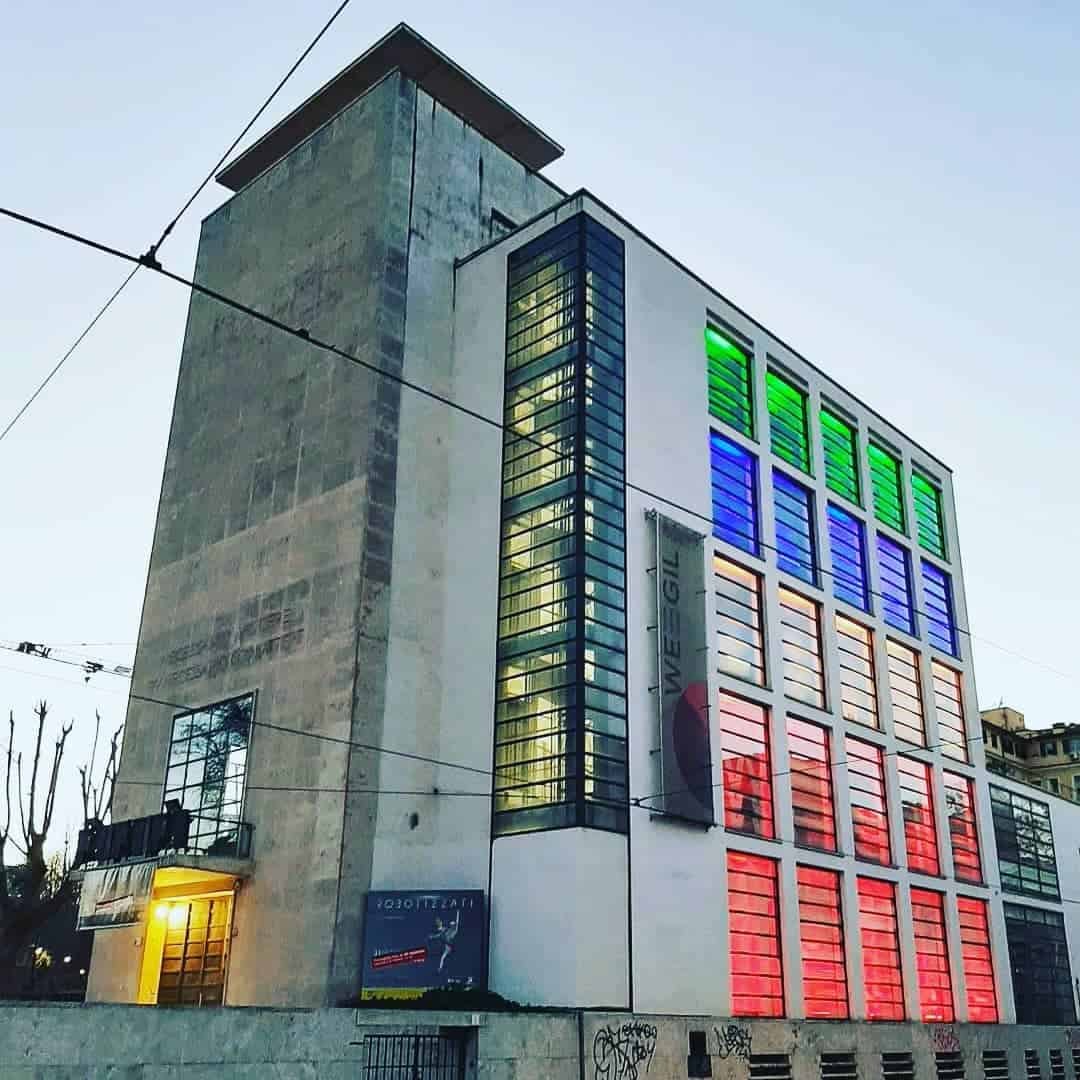
WeGil is at Largo Ascianghi 5, in Trastevere, at the corner of Viale Trastevere, and opens every day from 10:00 to 19:00. Entry to the building is free. Some exhibitions and some shows hosted in the interior spaces require a ticket or a reservation, indicated case by case on the official website wegil.it and at the venue's contacts (info@wegil.it, phone 334 6841506, answered Monday to Sunday from 10:00 to 19:00). You get there by tram 8 along Viale Trastevere, stop Trastevere/Ministero della Pubblica Istruzione, which is less than 100 meters away. By the buses that run along Viale Trastevere, including line H, the 780 and the 44. Or on foot in eight or 10 minutes from Roma Trastevere station, served by the regional lines that connect Fiumicino, Ostiense and the coast. Management is by the regional company LAZIOcrea, on behalf of the Lazio Region. There is no dedicated parking: the area around is paid parking and almost always full, and the practical advice is to come by tram.
To place WeGil in the rest of the city, it's best to start from the page on tourist attractions in Rome, where the places of 20th-century Rome appear next to the ancient ones.

What WeGil Is Today
WeGil is the cultural hub of the Lazio Region: a building of about 8,000 square meters reopened to the public in December 2017 after decades of abandonment, where temporary exhibitions, series, presentations, concerts, conferences, three training hubs and a restaurant bar live together. It is not a museum. It has no permanent collection, no obligatory route, no fixed ticket office. It is a container, and the container is the most interesting thing it holds.
Anyone who goes into WeGil to see the exhibition of the moment and never looks up has wasted the trip. The building is the former Casa della Gioventù Italiana del Littorio of Trastevere, designed by Luigi Moretti starting in 1933 and inaugurated on November 5, 1937: one of the most studied Rationalist buildings in Italy, commissioned by the Opera Nazionale Balilla in the middle of the Fascist regime for the physical, military and political regimentation of boys. The two things have to be kept together with no concessions: the quality of the design and the nature of the commission. You can admire a staircase and know perfectly well who had it built, and why.
The WeGil calendar changes constantly, because the Lazio Region assigns the spaces through calls for proposals and short-term agreements to associations, research bodies, universities, companies and third-sector groups. This rotation is the very reason for the name: a space that changes tenant every few weeks can't be named like a collection.
How to Get to WeGil
WeGil by Tram and Bus
The cleanest option is tram 8, which runs from Piazza Venezia down Viale Trastevere to Casaletto. The useful stop is the Ministero della Pubblica Istruzione one, on the avenue: once you get off, you cross and WeGil is in front of you, with the curved facade facing the square. It is less than two minutes on foot. Anyone coming from the Vatican or the historic center can use line H, which runs along Viale Trastevere toward Capannelle, or the surface lines serving the avenue, including the 780 from Ostiense and the 44 from Gianicolense.
One warning worth giving: tram 8 is replaced with shuttle buses fairly regularly because of track work. When that happens, the stop stays more or less in the same place but travel times get longer. Before leaving, it's best to check the service on the transport company's website.
Getting to WeGil by Train
Roma Trastevere station is an eight or 10 minute walk, following Viale Trastevere toward the river. The regional lines connecting Fiumicino airport, Ostiense, the coast and the Tiber valley pass through there. For anyone coming from outside Rome it is often the fastest and cheapest route, and it has the advantage of avoiding the traffic of the center entirely.
On Foot and by Bike
From Piazza Trilussa and Ponte Sisto you reach WeGil in a quarter of an hour's stroll along the inner streets of Trastevere, which is the best way to approach it: you cross the medieval district and come out in front of a 1930s building, and the contrast explains better than any caption what it meant, back then, to build modern inside Rome. By bike the route along the Tiber embankment is flat and continuous. The public racks around the square are few, so a serious lock is a good idea.
Parking and Car
Coming by car is the worst choice. Trastevere has access gates that are controlled at certain times of day, parking around Largo Ascianghi is paid and occupied, and the most convenient park-and-ride for this area remains the one near the station. If you really need the car, leave it far away and finish the trip by tram.
Hours, Tickets and Reservations at WeGil
The building is open every day from 10:00 to 19:00. Access to the common areas, the atrium and the bar is free. The exhibitions hosted can be free or paid, and in the latter case the ticket is bought on site or through the sales channel indicated on the body's official website. Since the installations rotate every few weeks, any price written here would risk being out of date tomorrow. The practical rule is just one: check wegil.it before leaving home, or call 334 6841506 during opening hours.
For school groups and guided tours of the architecture, the venue works by reservation: schools have a dedicated channel and a dedicated brochure, and special openings of the parts that are not always accessible are announced on the body's channels. Anyone who wants to get into the Salone d'Onore must check first: that room is often taken by private events and conferences, and on those days it cannot be visited.
The Building: Luigi Moretti's Casa della GIL
The Client and the Program
In 1933 the Opera Nazionale Balilla, the body the regime had built to regiment young people, entrusted a 26-year-old architect with the design of a Casa della Gioventù for Trastevere. The functional program was explicit and should be reported for what it was: to provide spaces and equipment for the education and the political-military and gymnastic-sports preparation of boys. Offices of representation, after-work club, gyms, swimming pool, refectory, classrooms, a cinema-theater, health and welfare services. A total building, which took charge of the free time of an entire generation and organized it. In 1937, with the reform of the youth bodies, management passed to the Gioventù Italiana del Littorio, and hence the name by which the building entered Romans' language: the ex GIL.
The area chosen was the narrow, elongated block between Porta Portese, the Janiculum Walls and Viale Trastevere, still largely empty and filled in precisely in those years. It was a fringe zone: workshops, vegetable gardens, hovels, the tram terminus. Building a Casa della Gioventù there also meant marking a working-class territory with a sign of the regime, and the choice was not accidental.
Luigi Moretti at 26
Luigi Moretti, a Roman, born in 1907 and died in 1973 off the island of Capraia, is one of the few Italian architects of the 20th century whose career runs through the whole century and also through its political fractures. He began here, with the Casa della GIL, and the project immediately had a critical fortune that is hard to imagine today: it was exhibited in the section devoted to the Italy that renews itself at the Exhibition of Italian Architecture of the 5th Triennale of 1933, and became the reference model for the youth houses built all over Italy in the following years.
After the war Moretti did not vanish, as happened to others. He founded the magazine Spazio, theorized parametric architecture, built the Corso Italia complex in Milan, the Casa del Girasole in the Parioli district, Villa La Saracena on the Lazio coast, and at the end of the 1960s he signed the Watergate complex in Washington, the one that would become famous for reasons that have nothing to do with architecture. It is a trajectory that deserves to be told in full, without hiding its beginning.
The Building Site and the Inauguration
Construction took the years between 1933 and 1936, and the official inauguration took place on November 5, 1937. The sources waver between 1936 and 1937 as the date the work ended: the difference depends on what you count, the structure or the interior fittings, which were completed later. The public date, the one engraved in the building's memory, remains November 1937.
The Three Buildings of WeGil, One by One
The complex is made of three volumes distinct in shape, size and function, interlocked on a difficult lot. This is the point where Moretti's design stops being skillful and becomes masterful: instead of leveling everything into a single block, he gave each function its own body and let the bodies touch.
The Quadrangular Building of WeGil: Pool, Refectory, Classrooms, Cinema-Theater
The quadrangular volume, toward the existing building on Viale Trastevere, is organized around an interior courtyard. Here were the indoor pool, the refectory, the classrooms and the cinema-theater. The indoor pool, in a building for boys in 1937, was a luxury worthy of a European metropolis: Rome had very few, and this one had changing rooms, a grandstand and a roof designed for light from above. The central courtyard is the most classical quotation of the whole complex, a Renaissance layout disguised as modern, and it also served to bring air and light into a narrow lot.
The cinema-theater is the part that went through the most transformations: in 1952 it was converted into a movie house and handed to private operators for 29 years, and that change of use is the reason many Romans of a certain age remember the ex GIL as a cinema and nothing else.
The Central Building: The Gyms of WeGil
The central body, tall and elongated, is set perpendicular to the others and has the curved facade facing Largo Ascianghi. It is the volume you see first arriving from the tram, and it is the one that holds the three gyms. The choice to stack the gyms one above the other, instead of spreading them out, is the boldest move of the project: three rooms for gymnastics, boxing and fencing stacked in a reinforced concrete building, plus two outdoor gyms on the roofs. In 1935 it was a heavy-engineering solution, and it required clear spans that only reinforced concrete allowed.
The curve of the facade is not a whim. It serves to connect the building with the course of the square and to give the mass a movement that the ribbon windows accentuate. Seen from below, at an angle, that wall stretches out.
The Representative Building and the Tower of WeGil
The third volume is the representative one, culminating in the travertine-clad tower, roughly 30 meters high. It contains the Salone d'Onore, the exhibition area, the library and the meeting room. The tower is the element that most openly dialogues with historic Rome: it is a tower, that is, the medieval urban form par excellence, reduced to a bare parallelepiped and clad in Roman stone. The technical sources point out that the cladding adopts optical corrections designed to make it look slimmer than it is, a device that comes straight from the classical tradition.
Inside, the representative building is the most solemn and the most political of the whole complex: this is where people were received, where celebrations were held, where the structure showed its official face.

The Spiral Staircase of WeGil
If WeGil had only one piece to see, it would be this one. The spiral staircase connects the floors in the building that holds the classrooms and the health area, and its peculiarity is not the shape, which is splendid all the same, but the calculation: it is drawn according to a logarithmic matrix, with decreasing risers as you climb, so that the climb is less tiring. A boy running up did not notice, but his legs did.
It is an idea that joins two worlds that rarely talked to each other in 1935: the Baroque taste for the spiral, which in Rome has illustrious precedents from Palazzo Barberini onward, and applied ergonomics. Moretti was not doing decoration, he was designing the way a human body spends energy going up. 30 years later he would theorize parametric architecture, and those who know that part of his work read this staircase as a first experiment.
Plainly: it is one of the five best staircases in Rome, and the only 20th-century one that holds up against the ancient ones. It is worth the trip regardless of the current exhibition.
The Salone d'Onore of WeGil and Mario Mafai's Fresco
The Rediscovered Fresco
The Salone d'Onore, on the first floor of the representative building, preserves a tempera mural painting executed by Mario Mafai between 1936 and 1937, depicting an imperial Roman triumphal procession. The work had been covered and damaged by the post-war transformations, and the restoration carried out between 2005 and 2007 brought it back to light. It is not intact: the gaps are large and visible, and whoever looks at it today sees a wounded surface, not a restored painting.
Who Mario Mafai Was
Mafai is one of the major names of 20th-century Italian painting and one of the founders of the Scuola Romana, the current that in the 1930s set against official rhetoric in Rome a painting that was intimate, tonal, anti-heroic, exactly its opposite. That Mafai himself, together with Scipione and Antonietta Raphaël, is the author of the imperial procession inside a Casa della GIL is a historical contradiction that deserves to be told in full and not smoothed over. In the same years Mafai was painting his Demolitions, a pained and critical series on the gutting of the center of Rome. Shortly afterward he would paint the Fantasies, openly anti-Nazi. Artists worked where the commissions were, and public patronage was only one. It is not an absolution, it is a clarification of the context.
The Bas-Reliefs and the Map of Africa
In the Salone d'Onore there are stucco bas-reliefs with the profiles of six Roman emperors: the classicist repertoire the regime used to build its own line of descent from antiquity. The sources also document, among the 1936 decorations, a large stucco map of Africa marking Italian colonial possessions, accompanied by a regime slogan. These are elements of explicit propaganda, and they should be looked at knowing what they are: part of the ideological furnishings of a building constructed to politically train boys. Not everything that was there originally is displayed or accessible today, and the availability of individual rooms changes with the installations.
The Other Artists: Orfeo Tamburi and Achille Capizzano
The decorative work of the Casa della GIL did not stop at Mafai. The historical sources attribute to Orfeo Tamburi encaustic decorations on a swimming theme in the room devoted to rowing, and to Achille Capizzano sgraffito designs with gymnastic subjects in the cinema area. Tamburi, from the Marche, would become one of the great Roman view painters of the second half of the 20th century and would spend much of his life in Paris. Capizzano, from Calabria, was one of Italy's leading specialists in the sgraffito technique, an ancient technique rediscovered precisely in those years for public facades and interiors.
The point to hold on to is that a building for boys on the urban periphery received, in 1936, a decorative scheme signed by first-rank artists. It was the model: artistic quality in the service of political pedagogy. It's worth knowing before you go in.
How to Read the Architecture of WeGil Without Apology
There is a lazy way of talking about the ex GIL, and it consists of saying it is beautiful and changing the subject. There is another, just as lazy, which consists of saying it is Fascist and closing the question. Neither does the reader a service.
The documented facts are these: the building was commissioned by a regime body for the physical and political regimentation of young people. The designer was 26 and worked inside that commission. The architectural result is of the highest level and influenced Italian public building for two decades. The name of the square it faces commemorates an episode of the Ethiopian war. All of this is true together. An adult visitor can admire the spiral staircase and at the same time know that the building served to prepare boys militarily, and that the street in front bears the name of an African lake where in April 1936 the Italian army used chemical weapons.
The distinction between degrees of certainty helps here too. The functional program of the Opera Nazionale Balilla is documented. The date of the inauguration is documented. The attribution of the fresco to Mafai is established. Instead, some symbolic readings of the building's forms that circulate on guided tours are oral tradition, and should be taken as such, including those on the relationships between the volumes and the symbols of the regime: they are told as readings, not as facts.
From 1945 to Today: The Many Lives of the Ex GIL
The Postwar Period and the Cinema
With the regime fallen, the building lost its reason for being and began a long decline. In 1952 the theater was turned into a movie house and handed over for 29 years to private operators: it was the first of many functional amputations. Via Ascianghi in front of the entrance was closed to traffic to make a sports field serving the building, and from that closure came the largo that today bears the same name.
The Opera Don Orione
From 1969 to 1981 part of the ex GIL was granted to the Opera Don Orione, which built dormitories and classrooms for boys there. The transformation was heavy: the gyms, corridors and halls were divided with partitions, the outdoor gyms were closed, the decorative apparatus covered. It is in this phase that Mafai's fresco disappeared from view. When the agreement expired, in 1981, the building was left.
The Dispute and the Abandonment
A dispute followed between the welfare organization and the public institutions, closed with the acquisition of the property by the Lazio Region and the Municipality of Rome. In 1975, with the abolition of the national body that held its assets, the properties of the old youth organization had already passed to regions and municipalities: the legal history of this building fits into that broader transfer. For almost 20 years the ex GIL stayed empty, with bricked-up windows, inside a district that in the meantime was becoming one of the most visited parts of the city.
The Restoration and the Reopening
The conservation restoration began around 2000 and had its decisive phase between 2005 and 2007, with the removal of the post-war additions, the recovery of the original configuration of the spaces and the rediscovery of Mafai's painting in the Salone d'Onore. Works on systems and safety upgrades followed, also supported through the Art Bonus instrument with contributions from private companies. The reopening to the public as WeGil took place on December 7, 2017.
Why It's Called WeGil
The name is a deliberate wordplay and, for once, a successful one. WE, the English we, replaces the ME and the overexposed I of contemporary communication, and stays attached to the building's historic acronym. The result is that the regime's acronym, GIL, is preserved and at the same time turned upside down in meaning: from Gioventù Italiana del Littorio to a collective, open we.
One can ask if such an operation is an elegant solution or a way of dodging the problem. It is an honest choice: it doesn't erase the acronym, doesn't hide it, forces it to mean something else. It is harder and more correct than tearing down a plaque.
The Schools and Workshops Inside WeGil
WeGil doesn't live on exhibitions alone. Inside the building three training hubs operate permanently, and this is the difference between an exhibition center and an inhabited place.
The Gian Maria Volontè School of Cinematic Art
The Lazio Region's film school, named for Gian Maria Volontè, is based in the building's spaces and offers free training programs on the film trades. It is a genuine public institution, with selections and productions of its own, and its presence brings into WeGil a daily flow of students and crews that you can see and hear.
The Lazio Cybersecurity Academy
The second training hub is devoted to cybersecurity. It is the least predictable tenant of a Rationalist building of the 1930s, and its presence tells well what the building has become: a reusable public container, not a frozen monument.
The WeGil Food Lab and the Modulo Caffè
The third hub is devoted to food and wine training, with an equipped professional kitchen. In April 2026 the Modulo Caffè opened on the ground floor, a café and restaurant with an open kitchen equipped for demonstrations, an adjoining room and a terrace on the first floor. It is the missing piece: a place to stop without a ticket in hand, which makes WeGil usable outside event hours too.
Exhibitions and Events at WeGil
The WeGil schedule is made of temporary exhibitions, festivals, series, book presentations, conferences and concerts. Recent programming has hosted major shows on 20th-century graphic design, photography exhibitions on the city, displays devoted to Lazio's agricultural and food chains, in collaboration with the region's sector bodies.
The mechanism is that of the calls for proposals: the Region assigns the spaces for short periods, and this produces a dense and discontinuous calendar, with peaks of very high quality and filler. The practical advice is to check the program before going, and not to take for granted that what was there last month is still there. Anyone looking for an overall view of the city's summer events can start from the pages devoted to the Estate Romana programs.
Visiting WeGil: Duration, Route, Accessibility
For the architecture, 40 minutes are enough, if you are prepared on what to look for: the square and the curved facade, the travertine tower, the atrium, the spiral staircase, the courtyard, the Salone d'Onore when it is open. With a medium-sized exhibition it rises to an hour and a half. With a large exhibition and a coffee you easily reach two and a half hours.
The building was the object of accessibility upgrades as part of the 2017 works, and the main exhibition spaces can be reached without stairs. The spiral staircase, by its nature, is not an accessible route: you admire it from below or from the landing. Anyone with specific needs does well to call ahead and ask which rooms are accessible during the current installation, because the answer changes from exhibition to exhibition.
The restrooms are on the ground floor, the coat check is not a permanent service and depends on the event. Photographs are generally allowed in the common areas. For the works on show, the rules of the individual installation apply, posted at the entrance.
WeGil With Children
It works better than you'd think, on two conditions. The first is choosing the right moment: many of the family activities are concentrated on weekends and in workshop periods, and outside those occasions a small child in an empty exhibition room gets bored in 10 minutes. The second is using the building as a game: counting the steps of the staircase and noticing they get lower, looking for the curve of the facade, comparing the interior courtyard with those of the district's palaces. A 10-year-old understands perfectly well what it means to design a staircase so that it tires you less.
Strollers: the common areas are wide and passable. A baby changing station is not guaranteed, so it's best to ask.
What to See Around WeGil Within a 10-Minute Walk
One of the reasons WeGil deserves a stop is its position. Heading down toward the river you reach Porta Portese in a few minutes, the 17th-century gate of Urban VIII and the famous Sunday market that took its name from it. Climbing back toward the district you reach the Basilica of Santa Maria in Trastevere, with the 12th-century apse mosaics and those of Pietro Cavallini, and a little farther the Basilica of Santa Cecilia in Trastevere, where Cavallini's Last Judgment and Stefano Maderno's statue are preserved.
A few steps from the ex GIL is the Church of San Francesco a Ripa, which holds the Blessed Ludovica Albertoni by Gian Lorenzo Bernini, one of his last sculptures and one of his most radical. Toward Viale Trastevere and Piazza Sant'Egidio you meet the Museo di Roma in Trastevere, devoted to the working-class Rome of the 19th century, and the small Church of Sant'Agata in Trastevere.
Climbing toward the hill you reach the Botanical Garden, Villa Farnesina with the frescoes of Raphael and Baldassarre Peruzzi, Palazzo Corsini, and higher up San Pietro in Montorio with Bramante's Tempietto and the Janiculum. Toward the river, Tiber Island closes the walk.
Anyone who wants to continue the discussion on the architecture of the Ventennio has two destinations within reach of a bus: the Foro Italico, where Moretti himself signed the Casa delle Armi, and EUR. For the 20th century and the contemporary, the MAXXI is the other obligatory chapter. And for the historic perimeter of the city, the Aurelian Walls pass a short distance from here.

When to Go to WeGil and When to Avoid It
The best moment is a weekday morning, between half past 10 and noon: the light comes in through the glass walls at the right angle, the rooms are empty and you can look at the architecture without bodies in the way. The second good moment is a winter late afternoon, when the travertine tower takes on a warm light that it never has in summer.
To avoid: Sunday morning, if you want calm, because the Porta Portese market pours a crowd over the whole area that reaches the largo, and surface transit becomes extremely slow. Also to avoid are the opening days of an exhibition, unless the opening is exactly what you're after: the building fills up and the architecture disappears.
In summer the interior spaces are cooler than the street, and this makes WeGil one of the lesser-known refuges of a Roman July afternoon.
A Curiosity About WeGil
The strongest curiosity about WeGil isn't about the building, it's about the address. Largo Ascianghi takes its name from Lake Ascianghi, in northern Ethiopia, where between April 3 and 5, 1936 the last great pitched battle of the Ethiopian war was fought, the one that opened the road to Addis Ababa for the Italian army. The historical sources document that during that operation the Italian air force used gas bombs on a massive scale, mustard gas included, and that the victims among the Abyssinian fighters and the population numbered in the thousands. Roman toponymy took up the name with a resolution of January 1937, a few months before the building was inaugurated.
It means that the Casa della GIL of Trastevere was born with an address that was already, in itself, a piece of propaganda: a building for the military training of boys facing a square named after the most recent colonial victory. The two things were conceived together, a few months apart.
It's a curiosity that almost no guided tour tells and that isn't found in tourist listings. It's worth knowing before going in, because it changes how you look at the facade. The name has remained, as dozens of colonial place names have remained all over Rome, from the African quarter on up: an open question that the city discusses periodically without ever concluding. In our judgment the right path is explanation, not erasure: a plaque telling what happened at Lake Ascianghi would do more for culture than a name change.
Something Nobody Tells You About WeGil
That you can walk in for free, every day, from 10:00 to 19:00, even without going to see anything in particular. This is the practical information missing from almost every page devoted to WeGil, and it completely changes how you use the place.
The building doesn't work like a museum with turnstiles: the atrium, the common areas and the bar are freely accessible, and free exhibitions are the majority. Anyone arriving in Trastevere with an hour to fill, or with rain on their back, has here one of the few free, air-conditioned shelters in the district, with international-level architecture all around and a café on the ground floor. In a neighborhood where every covered square meter has a price, it's a rarity.
The second part of the thing nobody tells you concerns the unpredictability of the interiors. Not all rooms are always open: the Salone d'Onore with Mafai's fresco is often taken up by private events, conferences and shoots, and on those days it can't be visited. There is no public calendar saying in advance which rooms will be accessible. The only serious way to know is to call the venue's number that very morning and ask. 30 seconds of phone call save a wasted trip, and nobody writes it anywhere.
Frequently Asked Questions About WeGil
Where exactly is WeGil?
WeGil is at Largo Ascianghi 5, in Trastevere, 00153 Rome, at the corner with Viale Trastevere and a short distance from Porta Portese. It is the cultural hub of the Lazio Region, set in a building of about 8,000 square meters reopened to the public in December 2017.
What are the hours of WeGil?
WeGil is open every day from 10:00 to 19:00, with free access to the common areas, the atrium and the bar. The hours of the individual exhibitions hosted may differ from those of the building and should be checked on the body's official website, because the installations rotate every few weeks.
How much does it cost to enter WeGil?
Access to WeGil and its common areas is free, every day from 10:00 to 19:00, even without going to see a particular exhibition. The temporary exhibitions hosted can be free or paid, and in the latter case the ticket is bought on site or through the channel indicated on the official website.
How do you get to WeGil by public transport?
You can get to WeGil easily by tram 8, which runs from Piazza Venezia down Viale Trastevere to Casaletto: the useful stop is the Ministero della Pubblica Istruzione one, less than two minutes on foot from the building. Anyone coming from the Vatican or the historic center can use bus line H.
How much time does it take to visit WeGil?
For the architecture of WeGil about 40 minutes are enough, if you are prepared on what to look for: the square, the curved facade, the travertine tower, the atrium and the spiral staircase. With a medium-sized exhibition the visit rises to an hour and a half, while with a large exhibition and a stop at the bar you easily reach two and a half hours.
Is WeGil suitable for children?
WeGil works well with children on two conditions: choosing the right moment, because many family activities are concentrated on weekends and in workshop periods, and using the building as a game, for example by counting the steps of the spiral staircase that get lower as you climb.
What is there near WeGil?
Heading down toward the river from WeGil you reach Porta Portese in a few minutes, the 17th-century gate of Urban VIII with the famous Sunday market. Climbing back toward the district you reach the Basilica of Santa Maria in Trastevere, with the apse mosaics of the 12th century, and a little farther the Basilica of Santa Cecilia in Trastevere.
What is worth seeing inside the WeGil building?
Inside WeGil the piece not to be missed is the spiral staircase, drawn according to a logarithmic matrix with decreasing risers as you climb, to make the climb less tiring. On the first floor the Salone d'Onore preserves a fresco by Mario Mafai made between 1936 and 1937, brought back to light by a restoration carried out between 2005 and 2007.
My Advice for Visiting WeGil
Arrive on foot from Porta Portese, not from the avenue. It's advice nobody expects, because the natural route seems to be the other one. But whoever arrives from the river passes beside the 17th-century gate, skirts the stretch of the Urbanian walls, crosses a piece of Trastevere made of workshops and low houses, and arrives at Largo Ascianghi finding the curved facade in front of them without warning. The gap between the 17th-century city and a building of 1937 can be read in 30 seconds of walking, and no explanation conveys it as well.
The second part of the advice concerns the order of the visit. Don't go in right away. Stay five minutes in the square and look at the facade from three different points: head-on, at an angle from the left, and from under the tower. The curve of the gym building changes noticeably depending on where you stand, and the tower's travertine works with the light differently at every hour. Then go in, and the first thing you look for is the staircase.
Third: ask. The staff at the entrance, when the building is not under siege for an opening, willingly answer about which rooms can be visited that day. Whoever doesn't ask sees the exhibition and leaves convinced that WeGil is an ordinary exhibition hall. Whoever asks sometimes finds the door of the Salone d'Onore opened. For those traveling in a group or wanting a professional reading of the architecture of the Roman Ventennio, the network of guides of TourLeaderPro in Rome organizes themed itineraries that put WeGil in sequence with the Foro Italico and EUR.
Another Well-Known Fact, Yet Rarely Cited
That Moretti's project was not an isolated case but a prototype, and that the prototype worked. The Casa della GIL of Trastevere was exhibited in 1933 at the 5th Triennale, in the section devoted to the Italy that renews itself, before it was even finished, and from there became the reference model for the youth houses built across the country in the second half of the 1930s. Anyone traveling in Italy who comes across a public building of the 1930s with stacked gyms, curved facades and ribbon windows is looking at a descendant of this.
The fact is well known among architecture historians and almost never cited on tourist pages, which prefer to present the ex GIL as an isolated curiosity of Trastevere. It isn't. It is the progenitor of a building type that the regime replicated for years, with local adaptations, from Forlì to Bolzano.
There is a second part of the fact, cited even less: that type survived the regime that generated it. Many of those structures, once the war was over, became municipal gyms, schools, headquarters of sports clubs, and are still working in that function today. The architecture built to train little soldiers proved, by sheer quality of layout, an excellent container for neighborhood sport in a democracy. It is a historical irony worth telling in full, because it says something true about the relationship between forms and political contents: forms last longer.
The Right Photo to Take at WeGil
The photograph everybody takes is the frontal facade from the square, with the tower on the right. It is correct, it is documentary, and it is boring: it flattens the curve of the gym building and takes away the building's only movement.
The right photograph is another one, and it is from the bottom of the spiral staircase, vertical, with the lens aimed at the center of the spiral. The logarithmic geometry does the rest: the succession of steps draws a snail shell that tightens upward, and the light coming down from above creates the gradient. It's a photograph that works even with a phone, as long as you hold the device perfectly level: a slight tilt and the spiral becomes a crooked ellipse. If you have a wide-angle lens, use it here.
The second shot to take home is outdoors, and should be done at sunset: you stand at the corner between Largo Ascianghi and Viale Trastevere, wait for the low sun to strike the tower's travertine from the side, and photograph the vertical volume against the sky, letting the curve of the gyms' facade enter the lower corner. The contrast between the still parallelepiped and the moving wall is the whole project in a single image.
Third idea, for those with patience: the detail of the travertine cladding. Get close to the tower and photograph the slabs edge-on, with raking light. Rome's quintessential stone applied to an abstract volume tells the ambiguity of the whole operation better than any overall view.
Some Important Events That Happened Here in History
On November 5, 1937 the building was officially inaugurated as the Casa della Gioventù Italiana del Littorio. It was a public regime event, with the press of the time reporting on the opening of the largest complex of its kind built in the capital.
Between 1936 and 1937 the decorative work took place: Mario Mafai painted the imperial triumphal procession in the Salone d'Onore, while other artists worked on the sports rooms and the cinema. It was one of the largest public mural painting projects in the Rome of those years.
In January 1937 a municipal resolution named the street in front after Lake Ascianghi, the scene in April 1936 of the decisive battle of the Ethiopian war.
In 1952 the theater was converted into a movie house and handed to private operators for 29 years: the building stopped being a unified organism and began to be broken up for different uses. In the same period the street in front was closed to traffic and turned into a sports field.
In 1969 part of the complex passed under agreement to the Opera Don Orione, which built dormitories and classrooms for boys there, dividing the gyms and halls with partitions and closing the outdoor gyms. The agreement lasted until 1981.
In 1975, with the abolition of the body that held the assets of the old youth organizations, those properties passed to the Regions and Municipalities: the legal framework in which the building's fate would later be resolved.
After 1981 came years of abandonment and a dispute between the welfare organization and the public institutions, closed with the acquisition of the property by the Lazio Region and the Municipality of Rome.
Between 2005 and 2007 the conservation restoration removed the post-war additions and brought to light Mafai's fresco, which nobody had seen for decades. It was the discovery that made the operation something more than a renovation.
On December 7, 2017 the Lazio Region reopened the building to the public under the name WeGil, after the safety and upgrade works supported also with private contributions through the Art Bonus.
In April 2026 the Modulo Caffè opened on the ground floor, with an open kitchen and a terrace, completing the building's transformation into a place open from morning to night.
Who Passed Through WeGil
The first name is Luigi Moretti's, who began here: he was 26 when he received the commission and 32 when the building was finished and already celebrated. He would become the architect of the Casa delle Armi at the Foro Italico, of the Corso Italia complex in Milan, of Villa La Saracena on the coast, of the Watergate complex in Washington and of the Montreal Stock Exchange tower. He died in 1973 off the island of Capraia. His is one of the few Italian careers of the 20th century that can be told from beginning to end without changing the subject halfway, and the starting point is this building.
The second name is Mario Mafai's, who left the imperial triumphal procession in the Salone d'Onore between 1936 and 1937. Mafai was the founder, with Scipione and Antonietta Raphaël, of the Scuola Romana, the current that in Rome in those years kept alive a private and pained painting against official rhetoric. His Demolitions, painted in the same years, are one of the few visual denunciations of the gutting of the historic center. Having him here, painting emperors for the Opera Nazionale Balilla, is the contradiction that makes this building interesting from the standpoint of cultural history too.
Orfeo Tamburi and Achille Capizzano complete the picture of the artists who passed through here: the first, from the Marche, author of the encaustic decorations on the theme of swimming, would become one of the great Roman view painters and would live for a long time in Paris. The second, from Calabria, was among Italy's leading specialists in the sgraffito technique, which he executed in the cinema area.
Then there are the anonymous passages, which in a building like this weigh as much as the names. Thousands of boys and girls from Trastevere and Porta Portese, between 1937 and the war, came in here for gymnastics, fencing, boxing and swimming. Between 1969 and 1981 other boys, in very different conditions, slept and studied here in the Opera Don Orione dormitories. Since 2017 the students of the regional film school and those of the cybersecurity and cooking courses pass through. Three different generations, three opposite ideas of what educating means, all inside the same walls. Anyone looking for an English guide to plan the rest of the stay will find a good starting point in ItalyPlanner's best things to do in Rome.
Quick Questions About WeGil
Where exactly is WeGil?
At Largo Ascianghi 5, in Trastevere, 00153 Rome, at the corner with Viale Trastevere and a short distance from Porta Portese.
What are the hours of WeGil?
The building is open every day from 10:00 to 19:00. The hours of the individual exhibitions may differ and should be checked on the official website.
How much does it cost to enter WeGil?
Access to the building and the common areas is free. Some exhibitions and some shows require a ticket: the price changes with the installation and can be checked on the body's website or at the venue's number.
Do you need to book to visit WeGil?
Not for free access. For guided tours of the architecture, for groups and for schools, yes, through the official contacts. Some events with limited capacity require registration.
Is WeGil closed on Mondays?
No. The declared opening is daily, Monday to Sunday. Individual exhibitions may have their own rest days.
Who runs WeGil?
The regional company LAZIOcrea, on behalf of the Lazio Region, owner of the property.
What was WeGil before?
It was the Casa della Gioventù Italiana del Littorio of Trastevere, built for the Opera Nazionale Balilla to a design by Luigi Moretti and inaugurated on November 5, 1937.
Why is it called WeGil?
Because the English WE, the we, replaces the ME and the I of contemporary communication and grafts onto the historic acronym GIL, preserving it and turning its meaning upside down.
Can you see the spiral staircase of WeGil?
The staircase is the most famous element of the building and is generally visible. The accessibility of the individual rooms, however, depends on the current installation: it's best to ask at the entrance.
Can you see Mafai's fresco?
It is in the Salone d'Onore, on the first floor. The room is often used for events and conferences and on those days it cannot be visited: a preliminary check by phone is a must.
How long does the visit to WeGil last?
40 minutes for the architecture alone, an hour and a half with a medium exhibition, two and a half hours with a large exhibition and a stop at the bar.
Is WeGil wheelchair accessible?
The 2017 works included accessibility upgrades and the main exhibition spaces can be reached without stairs. For a precise answer on the current installation it's best to call first.
Can you take photographs at WeGil?
In the common areas, generally yes. For the works on show, the rules of the individual installation apply, indicated at the entrance.
Is there a bar or restaurant inside WeGil?
Yes. On the ground floor is the Modulo Caffè, a café and restaurant with an open kitchen and a terrace on the first floor, opened in April 2026.
Is WeGil suitable for children?
Yes, especially on weekends and in workshop periods. The building works well as an observation game even outside the organized activities.
How do you get to WeGil by public transport?
Tram 8 along Viale Trastevere, stop Ministero della Pubblica Istruzione. Buses that run along the avenue, including line H, the 780 and the 44. Roma Trastevere railway station, an eight or 10 minute walk.
Is there parking at WeGil?
There is no dedicated parking. Parking around is paid and full: it's best to arrive by tram or train.
What is the difference between WeGil and a museum?
WeGil has no permanent collection or fixed route: it is a multipurpose space that hosts rotating exhibitions and activities, assigned through short-term calls for proposals.
What can you see near WeGil?
Porta Portese, Santa Maria in Trastevere, Santa Cecilia, San Francesco a Ripa with Bernini's Blessed Ludovica, the Museo di Roma in Trastevere, the Botanical Garden, Villa Farnesina and, climbing up, the Janiculum.
Does WeGil also host courses and schools?
Yes: the Gian Maria Volontè School of Cinematic Art, the Lazio Cybersecurity Academy and the WeGil Food Lab devoted to food and wine training.
Is it worth going to WeGil even without an exhibition on?
Yes, and this is the least obvious answer of the whole list. The building is worth the trip on its own, and entry is free.
When is it best to go to WeGil?
On a weekday morning, between half past 10 and noon, for the light and the quiet. Avoid Sunday morning, when the Porta Portese market congests the whole area.
If I had to give a single reason to get on a tram and come all the way here, it would not be the exhibition of the month. It would be the staircase. Go, stand under it, look up and count the steps: when you notice they get lower, you will have understood what distinguishes a good architect from just an architect. The rest can be read, this can only be climbed. And once outside, take the 10 minutes to Porta Portese: understanding where ancient Rome ends and where the Rome of the 20th century begins is an exercise that few neighborhoods pull off so well. Anyone organizing their Roman itinerary with an eye on the architecture of the last century will also find useful material in the English guides of ItalyPlanner on three days in Rome, and anyone traveling in a group can lean on the private tailor-made experiences of TourLeaderPro.
Article written by the editorial team of TourLeaderPro, contact them for Private/Corporate/V.I.P. Tours and Experiences.
Planning a trip to Rome? The English guides for visiting the city are on ItalyPlanner.com.