Monte dei Cocci, Monte Testaccio
In short. Monte dei Cocci can be visited only by reservation, groups with their own guide and individuals on the dates in the calendar: the number is the single one of the Capitoline Superintendency, 060608, active from 09:00 to 19:00.


Monte dei Cocci can be visited only by reservation, groups with their own guide and individuals on the dates in the calendar: the number is the single one of the Capitoline Superintendency, 060608, active from 09:00 to 19:00. Reservation is required for groups, which do not exceed 30 people, and for individuals, admitted according to an established calendar. The ticket costs €4.00 full price and €3.00 reduced. Those who reside in Rome and the metropolitan city enter free, as do holders of the MIC card. The mount is in the Testaccio district, between the Aurelian Walls and the left bank of the Tiber: the reference stop is Piramide on metro Line B, with the Roma Ostiense railway station a few minutes' walk away. The site is not accessible to people in wheelchairs and has no restrooms. You need flat, comfortable shoes, because you walk on loose ground made of fragments. Collecting potsherds is forbidden: the ones you see on the ground are archaeological finds that can be cataloged, not souvenirs.
The district around deserves the same attention as the mount, and the page of the Museo diffuso del rione Testaccio is the place to start from to build a sensible half day around here.

What Monte dei Cocci in Testaccio really is
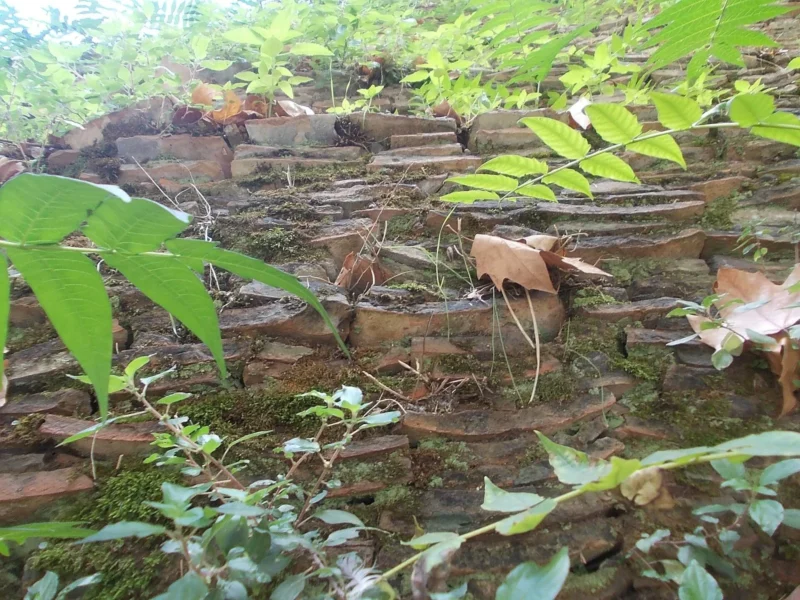
Calling it a hill is convenient and wrong. Monte dei Cocci is not a natural rise reshaped by people: it is a wholly man-made structure, built piece by piece, just under 40 meters above street level and 54 meters above sea level, with a circumference close to a kilometer and a base area of about 20,000 square meters, two hectares. The estimated volume is around 580,000 cubic meters. Under that grassy surface, under the wild fig trees and the holm oaks that have grown over the centuries, there is no earth: there are potsherds, and nothing but potsherds, laid in layers to a depth that nowhere lets you glimpse a natural soil.
The Latin word that explains everything is testa, plural testae: the potsherd, the fragment of terracotta. From it comes the medieval name Mons Testaceus, from it the name of the district, the 20th of Rome, which is called Testaccio precisely because it grew at the foot of this mountain of fragments. It is the only case in the world of an ancient dump preserved intact and become a monument: not a random accumulation that survived by luck, but a disposal facility designed, run and supervised for almost three centuries.
Why Monte dei Cocci is not just any mountain of waste
The difference between a dump and Monte dei Cocci is the same as that between a warehouse and an archive. Here the fragments were not thrown: they were carried, selected, arranged. Excavations have shown that the mount grew in successive terraces, each bounded by retaining walls built with nearly intact amphorae filled with potsherds to keep them in place. Into those cells the small fragments were poured, then lime was spread, then they moved on to the next terrace. It is a construction site, with a civil engineering logic, not a heap.
The consequence is that every layer can be dated and read. A fragment found at a certain depth belongs to a certain moment in the supply of Rome, and that fragment carries written on it who made the container, who shipped the oil, how much it weighed, who checked it. No other Roman archaeological site offers a continuous statistical series of this density on the economy of the empire. Historians of the ancient economy work on Monte dei Cocci the way climatologists work on ice cores.
Monte dei Cocci as a document, not as a ruin
Here lies the misunderstanding that spoils half of the visits: people climb up expecting a ruin, columns, walls, something to photograph. Monte dei Cocci offers none of this. It offers a slope of fragments that crunch under your shoes and a panorama. Whoever arrives without knowing what they are walking on comes down disappointed. Whoever arrives knowing it comes down with the feeling of having set foot inside the annual budget of an ancient capital. The story makes the difference, and it is the reason it's best to go up with a guide.
The numbers of Monte dei Cocci: how many amphorae, how much oil, over how many years
The most credited estimates speak of more than 53 million amphorae, counted not by eye but reconstructed from the volume of the mount and the average weight of the containers. The great majority of those amphorae had a capacity of around 70 liters. If you multiply, you arrive at a figure worth writing out in full: about 6 billion liters of olive oil landed in Rome and consumed in Rome, over a span of time from the Augustan age to the middle of the 3rd century.
At the moment of greatest intensity, toward the end of the 2nd century, up to 130,000 amphorae a year were deposited on the mount. That is more than 300 amphorae a day, holidays included, carried up a ramp by carts and unloaded by organized crews. Try to imagine the noise: 300 terracotta containers smashed every day, for decades, a few hundred meters from the river.
Why the oil count of Monte dei Cocci interests historians
7.5 million liters of oil a year, at the very least, are the share that passed through the public channel. Oil was not only food: it was fuel for lamps, a base for cosmetics, a raw material for body hygiene in the baths, a lubricant, an ingredient of medicine. A city of a million inhabitants consuming this quantity tells of a standard of living, a network of maritime transport and a grain-supply bureaucracy that worked with accounting precision. Monte dei Cocci is the material proof that this machine really existed.
What Monte dei Cocci does not contain
It is worth saying the opposite too, because it dispels three legends at one stroke. In the mount there are no wine amphorae in significant quantity, there are no cinerary urns, there is no rubble from fires. It is an almost single-subject deposit: oil containers, and to a much lesser extent containers of fish sauces and other goods. The monotony is precisely the reason the site is so valuable: a homogeneous series can be counted, compared, graphed.

The amphorae of Monte dei Cocci, one by one
Whoever visits the mount without knowing how to tell two amphora shapes apart sees only gray potsherds. Whoever can tell them apart sees two different economies, two provinces, two centuries.
The Dressel 20 of Baetica, the absolute protagonist
The vast majority of the fragments of Monte dei Cocci belong to a single type, the so-called Dressel 20: a globular, almost spherical container, with a short neck and sturdy handles, produced in the workshops along the Guadalquivir, in the province of Baetica, present-day Andalusia. It was the standard container of Baetican oil, the most appreciated on the Roman markets, and it traveled by ship to Ostia, then went up the Tiber on smaller boats to the landing of the Emporium.
The spherical shape has a flaw: broken, it produces curved and thick fragments, hard to reuse. A broken cylindrical amphora gives pieces that stack. A broken Dressel 20 gives shells that don't rest on one another and don't fit into walls. This technical detail, apparently marginal, is one of the reasons the potsherds of Baetican oil ended up in the dump instead of being reused as building material.
The African amphorae of Tripolitania and Byzacena
Alongside the Dressel 20 the mount preserves a substantial African component, which becomes dominant in the final phase of the deposit's life. They come from Tripolitania, in present-day Libya, and from Byzacena, today's central-eastern Tunisia. The shift from Spanish to African predominance is not a detail for specialists: it captures a shift in the productive center of gravity of the western Mediterranean, with Africa taking around the 3rd century the market share that had been Baetica's.
In the mount that change can be read vertically. You dig, you go up in depth, the shapes change. It is an economic stratigraphy that no ancient written document gives back with the same clarity.
Why oil amphorae were not recycled
Wine and grain amphorae were reused, resold, ended up in homes as water containers. Oil amphorae did not, and the reason is chemical before it is economic: the inside was not waterproofed with pitch, as in the wine ones, because pitch would have altered the taste of the oil. Without that lining the porous wall absorbed the fat, which quickly went rancid, making the container unusable and foul-smelling. Filling it again would have contaminated the next cargo.
There is a second reason, even more elegant. Terracotta fragments were usually ground to make cocciopesto, the opus signinum, the hydraulic mortar the Romans used for floors and cisterns. But oil-soaked terracotta, in contact with lime, produces a saponifying reaction: fat and lime give soap, and a mortar that contains soap does not set. The potsherds of Monte dei Cocci were, literally, unusable material. Hence the choice to send them to a single controlled place.
The lime spread on Monte dei Cocci
Lime was spread over every layer of fragments. The traditional explanation, which is correct, is hygienic: the lime neutralized the smell of rancid oil and kept away insects and rodents in a facility that stood inside the city, next to the food warehouses. But the lime also did a second job, unintentional and decisive. By binding the fragments together it gave the mount the cohesion of a conglomerate, and that is the reason 2,000 years of Roman rain have not leveled it. Monte dei Cocci has held for 2,000 years because someone, in the 1st century, wanted to get rid of the stink.
The stamps and the tituli picti: the written archive inside Monte dei Cocci
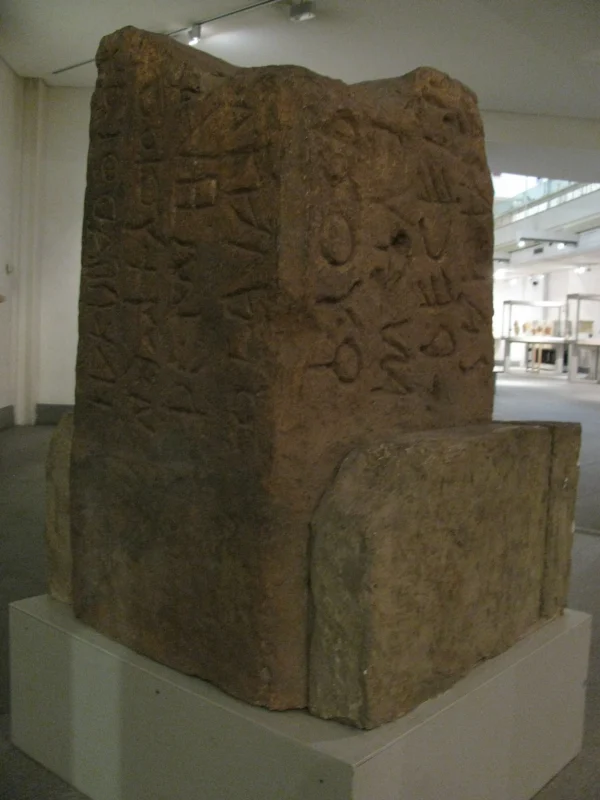
This is the part that turns a heap into a library. Every amphora, at the moment of manufacture, received a stamp impressed on a handle: the mark of the figlina, the workshop that had produced it, often with the name of the owner or manager. Once filled, the amphora was written on with a brush or reed pen in ink, and those inscriptions are called tituli picti.
What is written on the amphorae of Monte dei Cocci
The tituli picti record the weight of the oil contained, the names of the officials who had carried out the weighing, the district the product came from, the name of the merchant who exported it and, in many cases, the destination: the annona urbis, that is, the distribution to the city's population, or the annona militaris, the supply of the army. Add the checks carried out during the journey and the consular date, which amounts to a dating to the year, and you have a complete delivery note, complete with a weight certification.
It is a traceability system that any contemporary logistics chain would recognize as its own. Who produced, who shipped, how much it weighs, who checked, who it is for, in what year. Written by hand, on terracotta, and preserved by chance because nobody ever bothered to haul away that mountain.
The families, freedmen and merchants that Monte dei Cocci has given back to us
From the recurring names on the stamps and on the tituli, scholars have reconstructed entire family trees of Baetican producer families, limited partnerships among several merchants, and the careers of freedmen who ran, on behalf of their patrons, trades worth millions of sesterces. They are people who appear in no ancient historian: we know them only because their name was written on an oil jar that someone broke and threw away in Rome in AD 145. I find it the most moving thing about the mount, and it has nothing to do with the view.

The Emporium, the horrea and the port that generated Monte dei Cocci
Without the port the mount would not exist. Monte dei Cocci is the waste of an infrastructure, and that infrastructure was called the Emporium.
The river port of the Emporium
In 193 BC the aediles Marcus Aemilius Lepidus and Lucius Aemilius Paullus decided to build a new river landing downstream of the Aventine, because the old port of the Forum Boarium was by then insufficient for the traffic of a city growing exponentially. 20 years later, in 174 BC, the area was paved in stone and divided by barriers with staircases that went down to the river. Excavations have brought to light a quay about 500 meters long and 90 deep, with steps and ramps toward the water and projecting, perforated travertine blocks, where the boats' mooring ropes were tied.
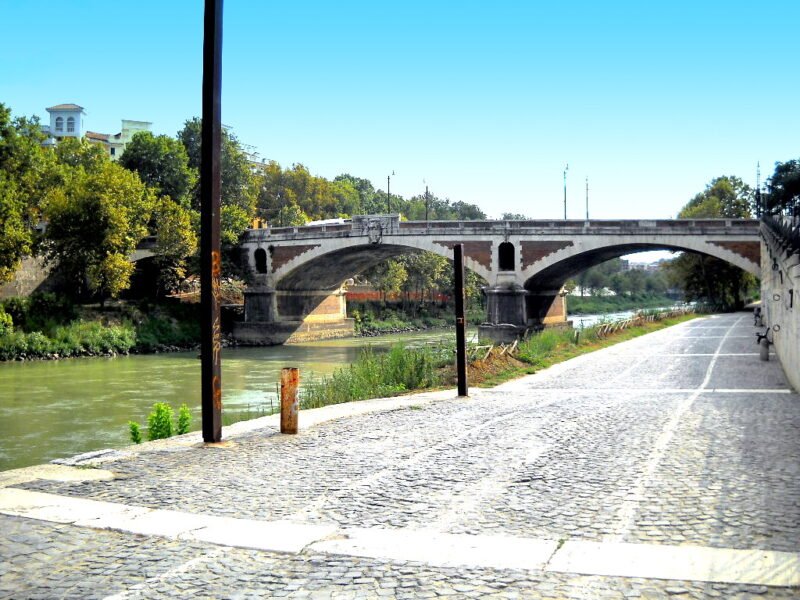
At the same time the Porticus Aemilia arose, an enormous vaulted covered structure intended for the storage and sorting of goods, of which stretches of wall survive incorporated in the buildings of the neighborhood. Whoever walks today along the Tiber between Testaccio and Ostiense passes over and beside a port that worked for four centuries.
The horrea: the warehouses that stood around Monte dei Cocci
Around the landing the warehouses, the horrea, multiplied. The most famous are the Horrea Galbana, of colossal size, but the sources also remember the Horrea Sempronia, Lolliana, Seiana and Aniciana. They were multi-courtyard depots, with arcaded courtyards and hundreds of cells, where grain, oil, wine and marble were stored, and from which the public distributions set out.
Monte dei Cocci is born exactly here: at the end of the chain. The ship arrives at Ostia, the goods go up the river, the amphora is emptied in the warehouses, the oil passes into skins or dolia, and the empty, unusable container is taken to the deposit of fragments. A closed supply chain, with a disposal facility a few tens of meters from the unloading point. I don't know many modern cities capable of as much.
The Marmorata and the marble that passed beside Monte dei Cocci
The road that runs along the river still bears the name Marmorata, and it is not a poetic name: it was there that the marble blocks arriving from the empire's quarries were unloaded, from Proconnesus, from Chios, from Numidia, and they stayed in storage there before being worked. Some of those blocks, never used, have been found still stacked with the quarry marks incised. The neighborhood that is visited today for its trattorias and nightlife was born as a gigantic logistics area.

Heinrich Dressel and the birth of a science on Monte dei Cocci
Until the 19th century almost nothing was known about the mount, and the little that was known was wrong. The passage from legend to science has a name and a date.
Who Heinrich Dressel was
Heinrich Dressel, a German epigrapher, began working on the mount in January 1872 and published the results in 1878. His contribution was twofold. On one hand he collected and transcribed thousands of stamps and tituli picti, which went into the 15th volume of the Corpus Inscriptionum Latinarum, the great collection of Latin inscriptions: it is the volume dedicated to the instrumenta domestica, that is, to inscribed everyday objects. On the other he built a typological table of the amphora shapes, ordering them by profile and numbering them.
That table is still in use. When an archaeologist today, in Marseille or London or Alexandria, says Dressel 20, he is using the classification born on Rome's Monte dei Cocci. Few other times has a single site given the vocabulary to an entire discipline.
The Spanish excavations on Monte dei Cocci
The second season of research is Spanish, and is still open. Emilio Rodríguez Almeida and José Remesal Rodríguez brought the mount back to the center of studies between the 1980s and 1990s, with excavation campaigns that clarified the building mechanism. It is to those investigations, in particular to the 1991 campaign, that we owe the discovery of the terraces and the retaining walls made of whole amphorae. Before, people thought of a heap that had grown by gravity. Since then we know it was a planned facility.
The dates Monte dei Cocci gives back
The consular dates written on the amphorae allow a rare precision. The deposits investigated fall between about 140 and the middle of the 3rd century, with the oldest datable finds around 144 and the most recent around 251. The accumulation, however, had begun earlier, in the Augustan age, and some phases might go back to the end of the Republican age. The dumping ceases in the 260s, probably because of the shift of the landings and the change in the amphora shapes in use.
The amphorae of Monte dei Cocci that ended up inside the Circus of Maxentius
A little-cited detail: after the activity ended, in the 4th century, Roman builders went back to taking amphorae to use as a lightening element inside concrete structures. In the Circus of Maxentius on Via Appia, built between 308 and 312, between 6,000 and 10,000 amphorae have been estimated to be incorporated in the masonry with this function. The mount, which had been a dump, had become a quarry.
Monte dei Cocci in the Middle Ages: games, bulls and the ruzzica de li porci
With the port finished, the dump was finished. But the mount remained, and medieval Rome, which had plenty of open space inside the walls, took it over to make it its own field for games.
The ludus Testaciae
Medieval sources call ludus Testaciae the set of public games that took place at the foot and on the flanks of the mount in the days before Lent. It was an organized city festival, with the guilds and the districts lined up, and it included forms of bullfighting: bulls let loose and faced by men on foot or on horseback, with outcomes that the chronicles do not hide were often bloody.
The ruzzica de li porci
The most famous and most ferocious number was the pig race. Carts loaded with live pigs were dragged to the top of the mount and then let fall down the slope: the carts smashed at the bottom and the people hunted the stunned animals, which ended up roasted the same day. Roman popular memory has kept the expression ruzzica de li porci, where ruzzicare means to roll. I feel no nostalgia for that kind of entertainment, but it has to be told in full: medieval festivals were like this, and cleaning them up is a historical falsehood.
The carnival that leaves Monte dei Cocci
In the 15th century Pope Paul II moved the Roman carnival from Testaccio to Via Lata, today's Via del Corso, where the races of Barbary horses and the other contests would have their home for three centuries. The mount lost the festival and gained a different role, of the opposite sign.
The cross on top of Monte dei Cocci and the Golgotha of Rome
With its conical shape, isolated position and bare summit, the mount offered the Rome of the popes a natural Calvary within reach of a procession. On Good Friday the procession climbed to the top and crosses were planted there in memory of that of Christ and those of the two thieves. A cross is still fixed on the summit today, and it remains the most visible sign of the second act of this place's life: from imperial dump to sacred mount.
The passage says a lot about how Rome treats its own ruins. It doesn't turn them into museums: it reuses them. A heap of amphorae becomes Golgotha, then cellar, then viewpoint, then archaeological site. Continuity of use is the true hallmark of the city, and Monte dei Cocci illustrates it better than far more famous monuments.
The ottobrate romane and the cellars dug into Monte dei Cocci
At the foot of the mount, in the following centuries, dozens of caves were dug, the so-called grottini. It was no whim: the compacted clay of the potsherds has excellent insulating properties and inside those cavities the temperature stays around 10 degrees all year. A natural cellar, free, inside the city.
The wine of the Castelli and the mozzatore
In those caves they mainly stored the wine that came from the Castelli Romani, and around the caves osterie and fraschette grew up. From here come the ottobrate, the festivals marking the end of the grape harvest that in the 18th century and throughout the 19th century drew Romans to Testaccio: until the early 20th century, in October, you could see the carts decorated by the mozzatore, the women who worked as grape pickers, parading toward the osterie. Songs, dances, improvised poetry contests, games, and wine by the river. The festival of the Ottobrata Romana was born here, at the foot of an imperial dump.
From the grottini to today's venues
Those same cavities, in recent decades, have become restaurants, breweries and nightclubs: the southern flank of the mount is today one of the most frequented spots of Roman nightlife. They are places where you dine one meter from a wall of 2nd-century amphorae, often without knowing it. If you go, look up at the walls: where the plaster is missing you can see the potsherds, and it is the only way to see the inside of the mount without booking a visit.

Monte dei Cocci at war: 1849 and the 20th century
An artificial hill 40 meters high, in an almost flat city and just outside the center, is above all a dominant position. The military understood it before the archaeologists.
The siege of 1849
During the defense of the Roman Republic, in 1849, an artillery battery was placed on the mount that from above shelled the French positions camped toward the Basilica of Saint Paul Outside the Walls. Monte dei Cocci thus entered, for a few weeks, the military history of the Risorgimento: the same height that had disposed of the empire's oil served to cover the southern flank of the besieged city.
The anti-aircraft battery of the Second World War
Almost a century later history repeats itself with other weapons: an anti-aircraft battery was installed on top, resting on concrete bases whose remains are still recognizable at the summit. Whoever climbs today walks between the 2nd-century potsherds and the footings of the 1940s, a few meters from one another. It is a stratigraphy that can be read in 10 steps.
The name of Monte dei Cocci: Testacium, Vicus Mundiciei and the legends
The original Roman name of the site is not known to us. No ancient source calls it in a way we can recognize with certainty, and this absence is already a fact: for the ancients the mount was a service facility, not a monument, and about service facilities nobody writes.
When the name Testacium appears
The first attestation of the place name is found in an inscription datable around the 7th century, kept in the portico of the basilica of Santa Maria in Cosmedin, the church where the Mouth of Truth is located and where the skull of Saint Valentine is kept. From Testacium descend in a direct line Testaccio and Monte dei Cocci: two names that say the very same thing in two different languages.
The hypothesis of the Vicus Mundiciei
Some scholars identify the area with the Vicus Mundiciei, a place name cited on the Capitoline Base among the denominations of the Regio XIII Aventinus, the Augustan region that included this area. The name would derive from munditia, cleanliness: in this specific case the collection and disposal of waste. It remains a hypothesis, however seductive, and as such it should be taken: no document proves it.
The legends born on Monte dei Cocci
With the memory of the origin lost, the Romans invented explanations. It was said that the potsherds were waste from the workshops of the potters of the area, that they were the remains of cinerary urns cleared from the columbaria of the nearby Via Ostiense, that the hill had formed from the rubble of the great fire of AD 64. All three versions are false, and all three circulated for centuries as truths. The most tenacious is the third, and you still hear it repeated today by some improvised guide: if they tell it to you, you know it isn't so.
The first protections of Monte dei Cocci: the edict of 1742
In the 18th century the mount ran a serious risk. Taking potsherds was a common practice, for road metaling and fill, and the continuous removal was compromising the stability of the premises carved at the foot. In 1742 the papal authorities issued an edict of protection, with a formula worth quoting for its tone, in defense of an antiquity so famous. Two years later a ban on grazing herds on the mount was added, for the same conservation reason.
They are routine administrative measures that have an extraordinary value: they mean that in the heart of the 18th century, before any scientific archaeology, someone had understood that this heap of fragments had to be protected. Without that edict, in all likelihood Monte dei Cocci would not be here today.

The Testaccio district at the foot of Monte dei Cocci
Rione XX is the youngest of the historic rioni: it was administratively separated from Ripa in 1921, but its urban form comes from the first master plan of Rome as capital, that of 1873, which designated this bend of the river for industrial expansion and workers' housing. Regular blocks, inner courtyards, shops on the ground floor: a planned neighborhood, rare in Rome.
Mattatoio and Macro
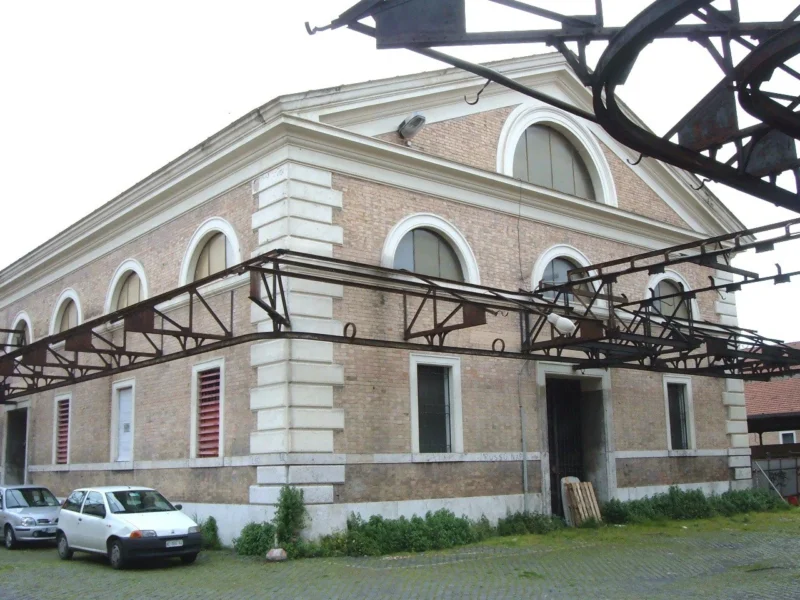
The former Mattatoio was designed in 1888 by the architect Gioacchino Ersoch with the engineer Filippo Laccetti, and occupies 25,000 square meters between the mount and the river: brick walls, gabled roofs, arched openings and iron structures, one of the best-preserved industrial architecture complexes in Europe. Closed in 1975, it was restored between 2006 and 2010, when Pelanda was inaugurated. Today it houses the Testaccio site of the Macro, opened in 2002, the Department of Architecture of Roma Tre and, since 2007, the Città dell'Altra Economia, where a large part of the district's summer programming is concentrated, as the Testaccio Estate calendar shows.
Nuovo Mercato di Testaccio
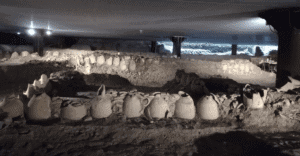
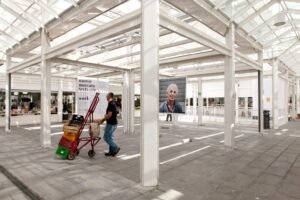
The Nuovo Mercato di Testaccio, opened in 2012 between Via Galvani and Via Beniamino Franklin, replaced the historic market of Piazza Testaccio and is built over archaeological remains left visible under the walkways. It is the right place to eat before or after the visit to the mount, in the morning, when the stalls are really working.
Museo diffuso and workers' memory
The Museo diffuso del rione Testaccio tells the neighborhood as a living organism, among slaughterhouse, market, public housing and street life. Whoever visits Monte dei Cocci without crossing the district does half the job: the mount explains antiquity, the district explains why that antiquity is still in the midst of the people.
What to see around Monte dei Cocci within 10 minutes on foot
Few places in Rome have such a high density of monuments within so short a radius. Here is the recommended tour, in order of distance.
The Pyramid of Cestius
The Pyramid of Cestius is the tomb of Gaius Cestius Epulo, a member of the priestly college of the septemviri epulones, built between 18 and 12 BC. It measures 36.40 meters in height on a square base of about 30 meters per side, in concrete with a brick facing and cladding of Carrara marble slabs. The inner burial chamber is 5.95 by 4.10 meters, 4.80 high. The inscription on the eastern side declares that the work was completed by will in 330 days. In the 3rd century it was incorporated into the Aurelian Walls as a bastion, and this is the reason it has been preserved while almost all of Rome's monumental tombs have vanished. The restoration of 2015, which cost about 2 million euros, was funded by the Japanese businessman Yuzo Yagi.
The Non-Catholic Cemetery
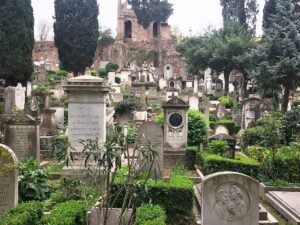
Next to the pyramid, the Non-Catholic Cemetery gathers the tombs of those who, in the Rome of the popes, could not be buried in consecrated ground: Protestants, Orthodox, Jews, and later Italians considered foreigners in their own country. Here rest John Keats, who died in Rome in 1821 at the age of 25, with the epitaph he himself asked for and which does not bear his name, the ashes of Percy Bysshe Shelley, Antonio Gramsci, Carlo Emilio Gadda, Andrea Camilleri and, since September 2023, Giorgio Napolitano. In the cemetery is the Angel of Grief sculpted by William Wetmore Story for his own family's tomb, one of the most copied funerary sculptures in the world.
Porta San Paolo and Museo della via Ostiense
Inside the towers of Porta San Paolo, the gate of the Aurelian Walls from which Via Ostiense left, you can visit the Via Ostiense Museum, dedicated to the road that linked Rome to the port and to the ancient topography of this urban sector. It is small, almost always empty, and explains exactly the context of Monte dei Cocci.
Centrale Montemartini
10 minutes to the south, along Via Ostiense, the Centrale Montemartini displays the ancient sculptures of the Capitoline Museums inside Rome's first public thermoelectric power plant, among diesel engines and boilers. The juxtaposition of marble and machine is the best museum idea in Rome of the last 30 years, and nobody gives it enough credit.
The Aventine above Monte dei Cocci
On the other side of Via Marmorata the Aventine rises, with the basilica of Santa Sabina and its 5th-century wooden door, the Orange Garden, the famous keyhole of the Villa del Priorato di Malta and, on the opposite slope, the Rome Rose Garden overlooking the Circus Maximus. Add the Baths of Caracalla a quarter of an hour's walk away and you have a full day without ever taking a vehicle.
The Porta Portese market and the opposite bank
Frequently asked questions about Monte dei Cocci, Monte Testaccio
How much does a ticket to Monte dei Cocci cost?
A ticket to Monte dei Cocci, in Testaccio, costs €4.00 full price and €3.00 reduced. Admission is free for those who reside in Rome and the metropolitan city, with ID, and for holders of the MIC card, the annual card of the Roma Capitale museum system, which costs €5 and is valid for 12 months.
Do you need to book to visit Monte dei Cocci?
Yes, reservation is required to visit Monte dei Cocci, for both groups and individual visitors. You book by calling 060608, active from 09:00 to 19:00.
Can you freely climb Monte dei Cocci?
No, you can't freely climb Monte dei Cocci: the site is fenced and closed, you enter only by reservation on the dates set by the Capitoline Superintendency, the guide is not included and groups do not exceed 30 people. Whoever arrives at the gate hoping to find it open without a reservation stays outside.
How long does the visit to Monte dei Cocci take?
The visit to Monte dei Cocci does not include a guide, which has to be arranged independently, and lasts on average a little under an hour. You climb along the ancient ramp, walk the intermediate plateau, reach the summit where the cross and the bases of the anti-aircraft battery are, and come down the same side while observing the stratification of the potsherds.
Is Monte dei Cocci wheelchair accessible?
No, Monte dei Cocci is not accessible to people in wheelchairs: the route runs along a ramp and on sloping paths of fragments, without stable paving or continuous handrails, and there are no restrooms inside the area.
Is Monte dei Cocci suitable for children?
Monte dei Cocci works well with children, better than many museums, on one condition: that they can walk by themselves on an unstable surface, because a stroller is impractical. From age eight and up, the idea of walking on top of 50 million broken pots is the kind of thing kids remember for years.
When to go to Monte dei Cocci?
The best seasons to visit Monte dei Cocci are full spring, from April to mid June, and autumn, from late September to November. In summer the summit has no shade and the terracotta reflects heat, while in winter, after rain, the ground becomes slippery and visits may be suspended.
What can you see near Monte dei Cocci within 10 minutes on foot?
A few steps from Monte dei Cocci is the Pyramid of Cestius, the tomb of Gaius Cestius Epulo built between 18 and 12 BC, 36.40 meters high on a square base of about 30 meters per side. The Testaccio neighborhood that surrounds the mount is Rione XX, the youngest of Rome's historic rioni.
On the right bank, opposite the ancient Emporium, opens the neighborhood that hosts the Porta Portese market: Sunday morning is the best excuse to cross the river and see the mount from afar, which is in fact the only way to grasp its bulk. If you are preparing your trip in English and want a general overview of the city, you'll find it on ItalyPlanner.
A curiosity about Monte dei Cocci, Monte Testaccio
The curiosity that puts all the others in their place concerns the lime, and nobody tells it because it requires a line of chemistry. Amphora fragments, in Rome, had a market: ground up they became cocciopesto, the aggregate that, mixed with lime, gave a hydraulic mortar able to set even underwater. Floors, cisterns, aqueducts, baths: half of Rome is built this way. A heap of 50 million amphorae should have been a contested mine, and yet nobody touched it for centuries.
The reason is that those potsherds were soaked in oil, and fat in contact with lime gives a saponification reaction. A mortar that contains soap doesn't bind: the wall stays soft, the floor crumbles. Roman builders, who were formidable empiricists, had understood this perfectly well, and oil amphorae were classified as absolute waste material. Monte dei Cocci exists because it was the only waste of imperial Rome that could not be recycled in any way.
There is an even funnier corollary. When, in the 4th century, people stopped throwing oil in that spot and the amphorae were taken back in hand, they were used not as ground aggregate but as empty containers sunk into the concrete to lighten the vaults: in the Circus of Maxentius, built between 308 and 312, between 6,000 and 10,000 have been estimated. Empty yes, ground never. The very property that had condemned them saved them with another function. Whoever visits Monte dei Cocci and grasps this passage has understood the monument better than whoever merely counts the meters of height.
One thing nobody tells you about Monte dei Cocci, Monte Testaccio
That the mount is not a heap, but a construction. It is the piece of information that overturns the visit, and it entered the studies only at the end of the 20th century, with the Spanish excavation campaigns and in particular with that of 1991.
Until then the current reconstruction was intuitive: material was dumped from above, it slid, the pile grew. The excavations showed the opposite. The deposit is organized in superimposed horizontal terraces, and each terrace is bounded by real retaining walls built with nearly intact amphorae, set in place and filled with fragments to weigh them down and hold them in position. Into the cells thus obtained the small potsherds were poured, lime was spread, it was leveled and they moved on to the upper level. There was a main carriageable ramp, which forks at the northeast corner and still today bears the name Salita Monte de' Cocci, plus two service lanes.
This means there was an office. Someone decided where to unload that day, someone kept the order of the layers, someone supplied the lime, someone checked that the amphorae to be reused as walls were intact. Not a collective habit, but a public disposal service with staff and regulations, operating for about two and a half centuries without documented interruptions. It is the only facility of this kind preserved in the world, and the reason ancient-economy historians consider Monte dei Cocci a firsthand source, on a par with an archive of papyri.
The practical corollary, for those who climb: the two peaks that stand out at the summit, the one above the north-south oriented plateau and the higher one on the ridge toward the northeast, are not whims of the terrain. They are the result of two dumping fronts that worked at different times and at different rhythms.
My advice for visiting Monte dei Cocci, Monte Testaccio
First: book well in advance and take nothing for granted. The mount is fenced and closed, you enter only by reservation on the dates set by the Capitoline Superintendency, the guide is not included in the ticket, groups do not exceed 30 people and the places for individuals follow a calendar that is not daily. The number to call is 060608, from 09:00 to 19:00. Whoever arrives at the gate hoping to find it open goes home: it happens every week.
Second: shoes. You walk on loose terracotta fragments, uphill, on ground that gives way under your weight. You need flat, closed shoes with a lugged sole. Sandals, wedges and smooth soles make the climb unpleasant and the return worse. Bring water, because on the mount there are no fountains or restrooms, and a hat: the summit has no shade and in July it beats down.
Third, and it counts as a rule of method: on Monte dei Cocci you collect nothing. The fragments on the ground are archaeological finds, many bear stamps and traces of tituli picti, and removing them is forbidden as well as stupid, because a potsherd out of context loses all its informative value. The same goes for approaching the edges of the landslides: the ground is unstable by definition.
Fourth, the time. If you can choose, ask for a visit in the early morning in spring or in the late afternoon in autumn: the low light brings out the profiles of the handles and amphora necks that at noon vanish into a uniform gray. And if you have to decide between the visit to the mount and one more hour at the market, choose the mount: the market you find open almost every day, the mount no.
Fifth: bring the context with you. An hour before or an hour after, visit the Via Ostiense Museum at Porta San Paolo. Understanding where the road ran and where the ships docked makes the climb something else entirely. If you lead international groups and want to build a half-day itinerary in this quadrant, you'll find a professional contact in TourLeaderPro in Rome.
Another well-known fact, yet rarely cited
That Monte dei Cocci is a dump everyone knows. That it is a written archive few say, and almost nobody explains what is really written on it.
Every amphora was born with a stamp impressed on a handle, the mark of the figlina that had produced it, often with the name of the owner of the estate or the manager of the workshop. Then, once filled and ready for shipment, it received a series of inscriptions painted with a brush or traced with a reed pen. Those inscriptions record the weight of the oil, the names of the officials who had carried out the weighing and the checks, the district the goods came from, the name of the exporting merchant and in many cases the destination, distinguishing between the annona urbis, that is, the supply of the population of Rome, and the annona militaris, the supply of the troops. Many carry the consular date, which amounts to a dating to the exact year.
The result is that from Monte dei Cocci tens of thousands of administrative documents of the imperial age have emerged. Heinrich Dressel collected them starting in 1872 and published the results in 1878. The body of the material went into the 15th volume of the Corpus Inscriptionum Latinarum, the volume dedicated to inscribed everyday objects. From that cataloging came the typological table of amphorae that bears his name: when in an excavation in Britannia or Syria a Dressel 20 is recorded, a vocabulary born on this Roman mount is being used.
Thanks to those names we know trading companies, dynasties of producers of the Guadalquivir valley, freedmen who managed estates on behalf of their patrons. People no literary source remembers, and whom we can call by name because they signed an oil container destined to be broken.
The right photo to take at Monte dei Cocci, Monte Testaccio
The wrong photograph is the one from above toward the panorama. You get an ordinary view of roofs and cranes, which could be taken from any terrace in Rome and says nothing about the place where you are.
The right photograph is on the ground, vertical, half a meter from the surface, with the camera pointed at the fragments. Look for a spot where recognizable rims, handles and necks surface, focus in the foreground and let the slope rise blurred in the background: that single image tells the whole monument, because it shows that the hill is made of objects. If you find a fragment with a legible stamp, photograph it where it lies, without touching it and without moving it.
The second framing to take home is from the side, backlit in the late afternoon, with the cross on the summit in silhouette. It sums up in one frame the two phases of the place: the pagan mount of oil and the Golgotha of the Rome of the popes.
The third, less obvious, is not made on the mount but from outside. Cross the Tiber toward Porta Portese or climb the Aventine and look for a spot where the profile of Monte dei Cocci stands out from the houses: only from afar do you perceive that that green mass of 20,000 square meters at the base is artificial, and the photograph acquires the sense of scale. Inside the enclosure, by contrast, the mount is so close that it escapes you.
A technical warning: midday light flattens everything into a dusty gray. The first hours of the morning and the last hour before sunset are the only ones in which the terracotta recovers its pinkish color and the reliefs become legible. A tripod is not needed, nor is an extreme wide angle: a 50 millimeter lens and a little patience are more than enough.
Some important events that happened here in history
The first event lasts two and a half centuries, and for this very reason is forgotten: the construction of the mount itself. From the age of Augustus to the middle of the 3rd century, every working day, carts loaded with empty amphorae climbed the ramp and unloaded. At the period of greatest intensity, toward the end of the 2nd century, the pace reached 130,000 amphorae a year. There is no other continuous construction site of this duration in Europe.
Then the break of the 260s, when the dumping stops. The landings change, the shapes of the containers change, the geography of imports changes. The mount stops growing and begins its second life.
In the 4th century the episode of taking amphorae for imperial constructions: at the Circus of Maxentius, between 308 and 312, thousands were used embedded in the concrete vaults. Around the 7th century the name Testacium appears for the first time, in the inscription kept in the portico of Santa Maria in Cosmedin.
In the Middle Ages the mount becomes the stage of the ludus Testaciae, with the bullfights and the ruzzica de li porci, until in the 15th century Pope Paul II moves the carnival to Via Lata. From then on the summit receives the Good Friday crosses and the mount becomes the symbolic Calvary of the city. The 18th century is the season of the ottobrate, with the osterie and the cellars dug at the foot, and in 1742 the first protective measure arrives, the edict against the removal of potsherds, followed two years later by the ban on grazing.
In 1849, during the French siege, an artillery battery is placed on the mount in defense of the Roman Republic, aimed at the enemy positions in the direction of San Paolo fuori le mura. From 1872 the scientific season begins with Heinrich Dressel. In the Second World War the summit hosts an anti-aircraft battery of which the concrete bases remain. At the end of the 20th century the Spanish campaigns of Emilio Rodríguez Almeida and José Remesal Rodríguez reveal the terraced structure, closing the circle: the dump becomes again, in the eyes of scholars, a work of engineering.
Who has passed through Monte dei Cocci, Monte Testaccio
The first list is made of anonymous people, and it has to be said before the others: the porters of the Emporium, the carters who carried the potsherds to the top, the lime workers, the annona measurers who weighed the oil and signed the amphorae. Their names, paradoxically, we know better than those of many senators, because they are written on the containers: Baetican merchants such as the members of the great families of the Guadalquivir, freedmen, partners of trading companies.
Among the figures with a name in general history, the mount saw the popes of the Middle Ages and the Renaissance climb, who on Good Friday led the procession to the top to plant the crosses there. Paul II, the Venetian pope Pietro Barbo, is the one who in the 15th century took the carnival away from Testaccio and moved it to Via Lata: a decision that for three centuries changed the topography of the Roman festival.
In 1849 the mount is in the hands of the defenders of the Roman Republic, with the artillery battery installed at the summit during the French siege. From January 1872 Heinrich Dressel climbed here almost every day, the German epigrapher who spent years transcribing stamps and painted inscriptions and who made this place the cradle of a discipline. A century later it is the turn of the Spaniards Emilio Rodríguez Almeida and José Remesal Rodríguez, who from the 1980s bring the mount back to the center of European studies on the ancient economy.
Then there is the crowd of travelers. In the 19th century the quadrant between the Pyramid, the Non-Catholic Cemetery and the mount was one of the fixed stops of the Grand Tour, described as a romantic countryside at the gates of the city: the English came looking for the tomb of Keats, who died in Rome in 1821, and the ashes of Shelley, and almost all ended up climbing the mount to look at the Tiber. They are the same years in which the Romans came here for the ottobrata, and the two worlds crossed without mixing.
In the 20th century, finally, a crowd of fans climbs the mount. From November 3, 1929 to June 30, 1940 the Roma team played its home games at Campo Testaccio, at the foot of the hill: 161 matches, with victories that remained legendary such as the two 5 to 0 wins over Juventus in 1931 and over Lazio in 1933, which earned the team the nickname Roma testaccina. Whoever didn't have a ticket climbed Monte dei Cocci, from where the roof of the grandstand let you see only half of the playing field. Half a pitch for free, from the top of an imperial dump: if you are looking for a place where ancient Rome and popular Rome touch physically, it is this slope of potsherds.
How much Monte dei Cocci costs and how to get in free
The ticket is €4.00 full price and €3.00 reduced. Admission is free for those who reside in Rome and the metropolitan city, with ID, and for holders of the MIC card. The MIC card is the annual card of the Roma Capitale museum system reserved for residents and students: it costs €5 and is valid for 12 months in the civic museums. Whoever lives or studies in the city and doesn't have it throws away tens of euros a year, and I'm not talking only about Monte dei Cocci.

A reasoned list of what can be seen for free in the city is on the page of the museums of Rome: it's worth scrolling through before planning a weekend.
Monte dei Cocci with children
It works, and better than many museums, on one condition: that the child is old enough to walk alone on an unstable surface. A stroller is impractical and a baby carrier uphill is tiring. From age eight and up the effect is guaranteed, because the idea of walking on top of 50 million broken pots is exactly the kind of thing kids remember for years.
The narrative hook to use is simple: here the Romans built a mountain out of garbage, and on every piece of garbage it was written whose it was. If you are looking for a half-day route for families in this quadrant, the mount in the morning and Centrale Montemartini in the afternoon, with the statues among the engines, hold attention without effort.
Accessibility of Monte dei Cocci
It has to be said plainly: the site is not accessible to people in wheelchairs. The route runs along a ramp and on sloping paths of fragments, without stable paving and without continuous handrails. There are no restrooms inside the area. Those with even mild mobility difficulties, balance problems or vertigo must consider carefully: the climb is short but the ground gives way at every step.
For those who can't climb there is still plenty to do at ground level: the walk around the mount at street level lets you see its bulk and the cellars carved out at the foot, and the district around is flat and well served.
When to go to Monte dei Cocci and when to avoid it
The best seasons are full spring, from April to mid June, and autumn, from late September to November. In summer the summit has no shade and the terracotta reflects heat: a midday visit in July is an endurance test that adds nothing to understanding the place. In winter, after rain, the ground becomes slippery and visits may be suspended for safety reasons.
The moment I prefer is the end of October, with the low light and the neighborhood filling up for the seasonal food festivals: you climb the mount in mid-morning, go down to the market for lunch, spend the afternoon between the Pyramid and the Non-Catholic Cemetery. If you are organizing a short stay and want to understand how to fit Testaccio into three Roman days, you'll find a reasonable plan in the English guide Rome itinerary in 3 days.
How the visit to Monte dei Cocci goes
The visit, for which the guide has to be arranged independently, lasts on average a little under an hour, with the meeting at the gate indicated at the time of booking. You climb along the ancient ramp, walk the intermediate plateau, reach the summit where the cross and the bases of the anti-aircraft battery are, and come down the same side. Along the way you observe the points where the cut of the ground shows the stratification of the potsherds and the walls of amphorae.
The cap on visitors isn't a whim. 30 people is already a lot on a path made of fragments, and the preservation of the deposit also depends on how many feet walk on it every year. For organized groups and parties who want a professional guide on site, the reference is the tour guide service by TourLeaderPro.
Quick questions about Monte dei Cocci, Monte Testaccio
How much is a ticket for Monte dei Cocci?
Four euros full price and three euros reduced. Free for residents of Rome and the metropolitan city and for MIC card holders.
Do I need to book to visit Monte dei Cocci?
Yes, booking is mandatory, for groups and for individuals alike. You book by calling 060608, which is open from 9:00 to 19:00.
Can I climb Monte dei Cocci freely?
No. The area is fenced and you can only enter by reservation, following the calendar set by the Sovrintendenza Capitolina.
How tall is Monte dei Cocci?
54 meters above sea level, a little under 40 above street level. The circumference at the base is about a kilometer.
How many amphorae are there in Monte dei Cocci?
Estimates speak of over 53 million amphorae, corresponding to about six billion liters of olive oil imported into Rome.
Why is it called Monte Testaccio?
From the Latin testa, a shard, a fragment of terracotta. The place name Testacium first appears in an inscription from around the 7th century.
Where did the amphorae of Monte dei Cocci come from?
For the most part from Baetica, present-day Andalusia, with Dressel 20 type amphorae. A substantial share, growing over time, came from Tripolitania and Byzacena, in North Africa.
What are the tituli picti?
Inscriptions painted with a brush or traced with a reed pen on the amphorae. They give the weight of the oil, the inspection officials, the origin, the exporting merchant, the destination and often the consular date.
Who was Heinrich Dressel?
The German epigraphist who studied the mound from 1872 and published the results in 1878, creating the typological classification of Roman amphorae that is still in use today.
Is Monte dei Cocci wheelchair accessible?
No, the site is not accessible to people in wheelchairs and has no restrooms.
How long does the visit to Monte dei Cocci take?
On average a little under an hour, including the climb up and the way down.
Can I take photographs on Monte dei Cocci?
Yes, photographs for personal use are allowed. What you can't do is pick up or move the fragments.
Can I take shards home as a souvenir?
Absolutely not. They are archaeological finds and removing them is forbidden.
What shoes do I need for Monte dei Cocci?
Low, closed shoes with a treaded sole. The ground is loose and sloped.
Is Monte dei Cocci suitable for children?
Yes, from age seven or eight and up, and on foot. You can't use a stroller.
What is the difference between Monte dei Cocci and Monte Testaccio?
None. They are two names for the same place, one in Italian and one derived from the Latin Testacium.
What can you see from the top of Monte dei Cocci?
The Testaccio district, the bend of the Tiber, the Pyramid of Cestius, the Ostiense neighborhood with the Gazometro and, to the north, the outlines of the Aventine.
Are there restaurants inside Monte dei Cocci?
At the foot of it, yes. The caves dug into the side of the mound have housed taverns, restaurants and nightclubs for decades.
When did Monte dei Cocci stop being used as a dump?
Around the 260s AD, after about two and a half centuries of continuous use.
What is there to see near Monte dei Cocci?
The Pyramid of Cestius, the Non-Catholic Cemetery, Porta San Paolo with Museo della via Ostiense, Nuovo Mercato di Testaccio, Mattatoio and, a little farther south, Centrale Montemartini.
Can you also see Monte dei Cocci from the outside?
Yes, you can walk around the perimeter freely at street level, and from there you can see the bulk of the mound and the cellars built into its base.
Is a guide worth it for Monte dei Cocci?
The ticket doesn't include a guided tour, which according to the Sovrintendenza has to be arranged on your own. If the mound is part of a wider itinerary through Testaccio and the Aventine, a professional guide makes the difference between a stroll and a day of real understanding.
One last thing. Monte dei Cocci is not a monument you admire. It's a monument you have to understand, and anyone who climbs it expecting a view leaves disappointed. Anyone who climbs it knowing that under their soles lie 50 million containers, signed, weighed and certified, and that each of those shards is the receipt for a load of oil that came down an Andalusian river 2,000 years ago, walks down with a different idea of what Rome was. Book, wear serious shoes, and go with someone who knows how to read a piece of terracotta. The panorama is a reward, not the point.
Article written by the editorial team of TourLeaderPro, contact them for Private/Corporate/V.I.P. Tours and Experiences.
Planning a trip to Rome? The English-language guides to visiting the city are on ItalyPlanner.com.
Contact Information
Nearby
 Testaccio: What to See in the Monte dei Cocci Neighborhood300 m
- Teatro Vittoria300 m
- Ex Mattatoio di Testaccio300 m
- Non-Catholic Cemetery in Rome300 m
- Museo diffuso del rione Testaccio300 m
- Nuovo Mercato Testaccio400 m

Upcoming events nearby
- L’imbarazzo della scelta at Teatro Vittoria, December 26, 2026 to January 13, 2027300 m
- Rumori fuori scena with the Compagnia Attori e Tecnici at Teatro Vittoria, January 21 to February 14, 2027300 m
- Non c’è due senza me at Teatro Vittoria, March 16 to 21, 2027300 m
- Streghe da marciapiede at Teatro Vittoria, March 9 to 14, 2027300 m